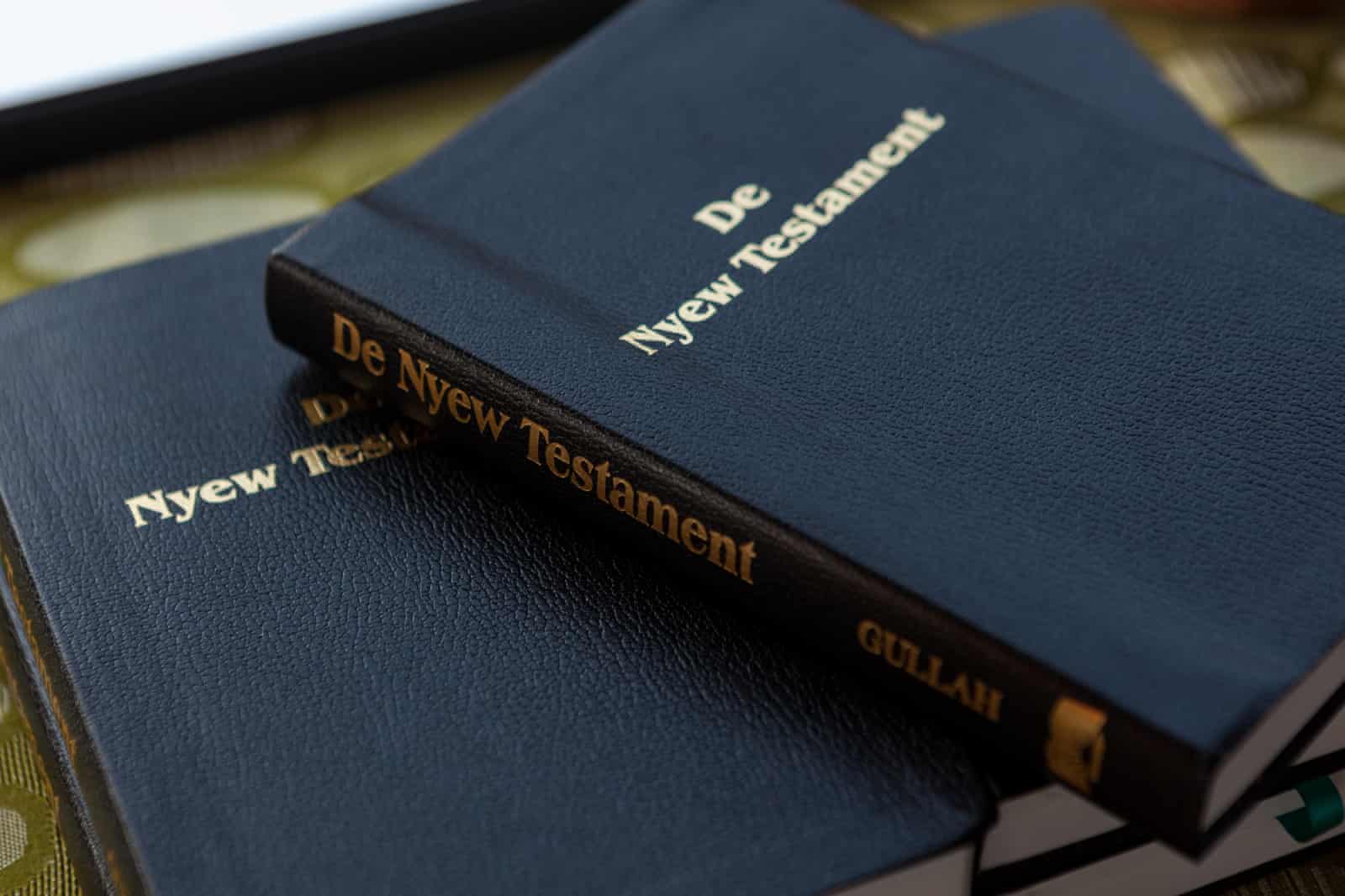
Photo: Richard Ellis/Alamy.
Copies of the Gullah-language Bible, De Nyew Testament. I once had a Bible collection that included this one. Some experts say artificial intelligence will help save endangered languages like Gullah Geechee.
For many reasons, including the fact that artificial intelligence “godfather” Geoffrey Hinton has said AI could wipe out humanity in three decades, I am not a fan. I know it can be helpful in medicine and other things I care about, but three decades is scary.
But what if AI saves dying languages?
Jonathan Abrams wrote recently at the New York Times about people using AI as a tool to do just that.
“While relaxing a couple of years ago, Prof. Joshua Caffery found himself in the mood to unwind with some old-time Cajun music. He asked Amazon’s Alexa to play selections from Dewey Balfa, a celebrated fiddler and singer credited with popularizing the genre.
“Instead, Alexa frustratingly steered him to the catalog of the modern pop artist, Dua Lipa, Caffery said.
“ ‘I love Dua Lipa,’ said Caffery, the director of the Center for Louisiana Studies at the University of Louisiana at Lafayette. ‘Don’t get me wrong. But it seems problematic if you’re interested in a different kind of culture and you want to surround yourself with the music of your region.’ …
“Louisiana French, the oral dialect of which Balfa was a cultural guardian, is part of the Bayou’s societal DNA, a link to its history, music and identity. Today, Caffery described the language as struggling and endangered. …
“In response, Caffery assembled a small team at the center to train its own language learning model in automatic speech recognition for Louisiana French, drawing from a trove of historical artifacts and interviews.
“Over the months, as the learning language model is trained on bits of the language — such as an old-age French nursery rhyme — it brings centuries-old dialect closer into the digital age.
“ ‘It’s scary how fast all this happened,’ Caffery said. ‘I don’t even think I knew a large-language model existed two years ago.’ …
“The efforts are part of inroads to preserve dialects at risk of being lost, and bridge a disconnect between large-language model machines, while maintaining a community’s ability to control and own its digital destiny.
“In the United States, questions exist over how to preserve languages like Louisiana French, the Gullah Geechee language (the English-based Creole language of some coastal regions in the Atlantic southeast) and Appalachian English in the modern, digital age.
“Globally, researchers at the University of Edinburgh are using artificial intelligence to strengthen and revive Scottish Gaelic and Manx. Google recently announced the availability of voice recordings of nearly 30 sub-Saharan African languages to help build tools like voice assistants and translation apps. …
“The importance of accurate speech recognition becomes greater as important tasks like job hiring and medical transcriptions become more automated and digitized, [Christine Mallinson, a professor of language, literacy, and culture at the University of Maryland, Baltimore County] said. …
” ‘There’s accents, patterns of grammar, word choice. Those differences are connected to our families, our neighborhoods, our age and gender and racial and ethnic and cultural backgrounds and where we grew up.’ …
“For centuries, Louisiana French was the predominant language spoken in South Louisiana. In 1921, a new state constitution declared English the primary language. Many parents stopped teaching their children the language out of fear of discrimination, as students who spoke Louisiana French in class were often punished with knuckle-rappings.
“A reversal came in 1968 when the Council for the Development of French in Louisiana was created to advance French, largely through education and community initiatives. In 2023, the Advocate of Baton Rouge estimated about 120,000 Louisianans still spoke French.
“Caffery grew up in Franklin, La., an antebellum town on Bayou Teche. As a child, he ate Cajun and Creole food. His grandparents sometimes sang Old French songs and passed along phrases in the language.
“ ‘Whether you spoke it or speak it, the language is floating in the air,’ he said. ‘There’s this feeling of there is this beautiful thing that we want to hang on to.’ …
“The Center of Louisiana Studies houses a vast trove of Cajun and Creole folklore recordings that include over 12,000 hours of oral histories, field recordings and music performances recorded on everything from wax cylinders to reel-to-reel tape. …
“The language is almost entirely preserved in vocal recordings. ‘A lot of it is sung in the language, and it’s something that’s vanishing,’ Caffery said. ‘Just in the same way you’d want food that’s local to your region, it’s important to have culture that is local to the region that makes you feel rooted and certain.’ ”
More at the Times, here,