Feeds:
Posts
Comments

Posts Tagged ‘literature’

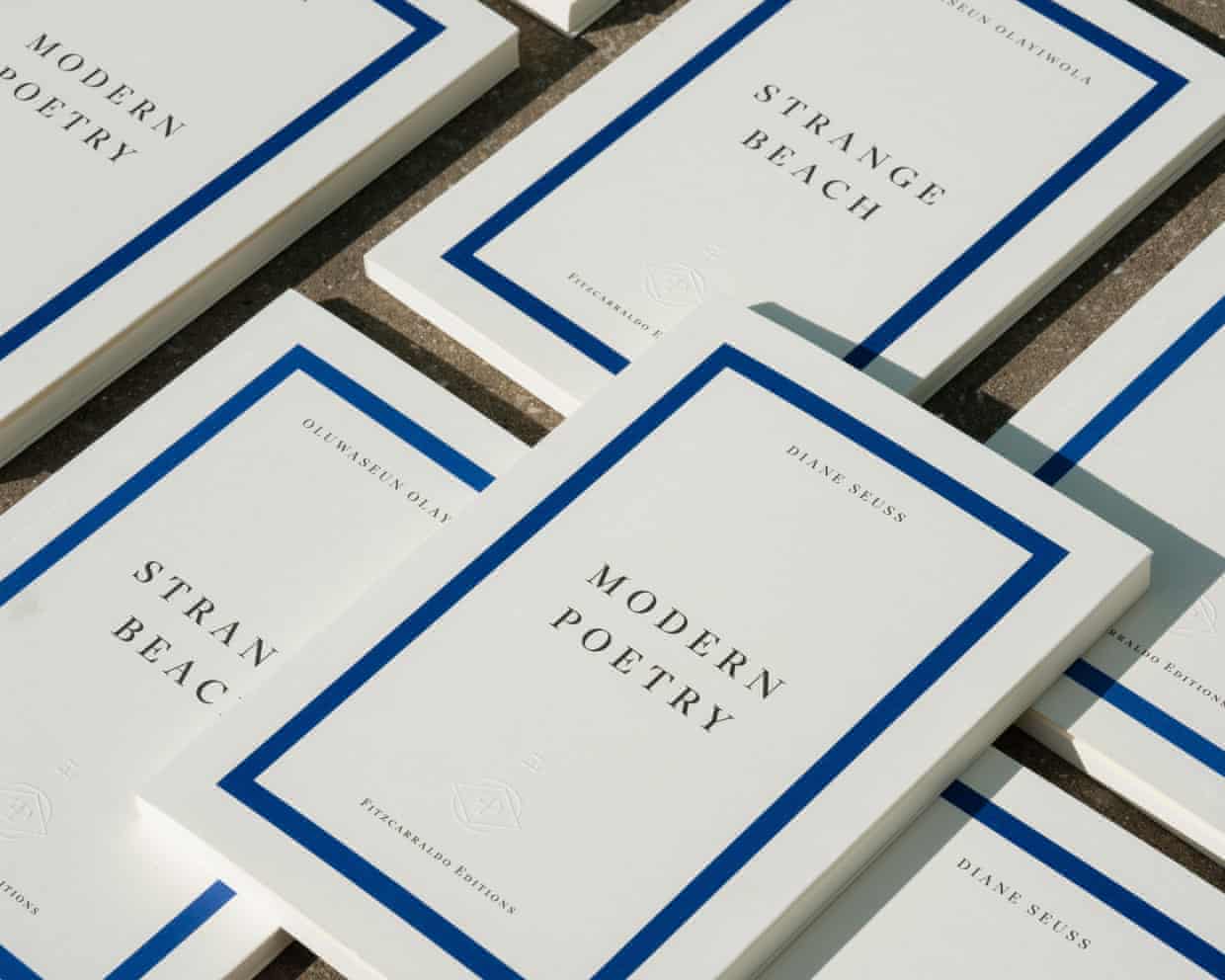
Photo: Fitzcarraldo Editions.
Three publishing companies have launched the biennial Poetry in Translation prize, which will award an advance of $5,000 to be shared equally between poet and translator.

Anyone who has used Google Translate for a simple sentence knows that AI is not going to be doing quality translations of whole books anytime soon. There is too much subtlety needed.

And if that’s true for, say, a murder mystery, imagine how important a human translator is for poetry!

That’s why a new prize for poetry translation from publishers in the UK, Australia, and the US is arriving just in time — before the world gets lulled into thinking an AI translation is just fine.

Ella Creamer reports at the Guardian, “A new poetry prize for collections translated into English is opening for entries. …

“Publishers Fitzcarraldo Editions, Giramondo Publishing and New Directions have launched the biennial Poetry in Translation prize, which will award an advance of $5,000 (£3,700) to be shared equally between poet and translator.

“The winning collection will be published in the UK and Ireland by Fitzcarraldo Editions, in Australia and New Zealand by Giramondo and in North America by New Directions.

“ ‘We wanted to open our doors to new poetry in translation to give space and gain exposure to poetries we may not be aware of,’ said Fitzcarraldo poetry editor Rachael Allen. …

“The prize announcement comes amid a sales boom in translated fiction in the UK. Joely Day, Allen’s co-editor at Fitzcarraldo, believes that ‘the space the work of translators has opened up in the reading lives of English speakers through the success of fiction in translation will also extend to poetry.’ …

“Fitzcarraldo has published translated works by Nobel prize winners Olga Tokarczuk, Jon Fosse and Annie Ernaux. ‘Our prose lists have always maintained a roughly equitable balance between English-language and translation, and some of our greatest successes have been books in translation,’ said Day. ‘We’d like to bring the same diversity of voices to our poetry publishing.’ …

“The prize is open to living poets from around the world, writing in any language other than English.

“The prize is being launched to find works ‘which are formally innovative, which feel new, which have a strong and distinctive voice, which surprise and energize and move us,’ said Day. ‘My personal hope is that the prize reaches fledgling or aspiring translators and provides an opening for them.’ …

“Submissions will be open from 15 July to 15 August. A shortlist will be announced later this year, with the winner announced in January 2026 and publication of the winning collection scheduled for 2027.

“The ‘unique’ award ‘brings poetry from around the world into English, and foregrounds the essential role of translation in our literature,’ said Nick Tapper, associate publisher at Giramondo. ‘Its global outlook will bring new readers to poets whose work deserves wide and sustained attention.’ ”

More at the Guardian, here. I hope a certain blogger who translates Vietnamese poetry into English will apply for that prize.
Read Full Post »

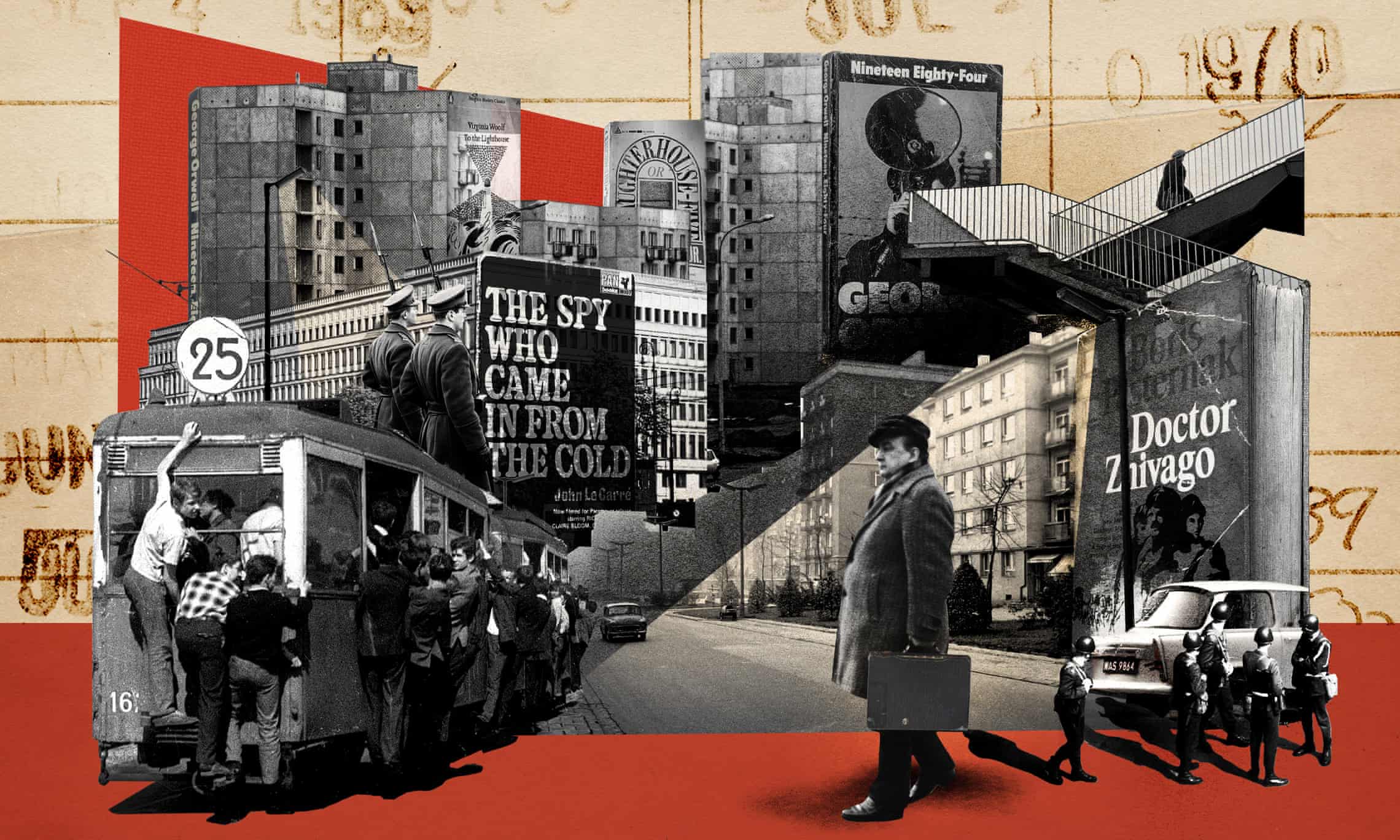
 Illustration: Eleanor Shakespeare/Bridgeman Images/The Guardian.

Of course, it couldn’t happen here, right? As we children always said during the time of the Cold War when someone opposed us, “It’s a free country!” And if we had applied that to reading material, we would have known we could read whatever we wanted. No need to smuggle anything in.

Well, what would that be like? In an edited extract from Charlie English’s book about Poland, The Best Kept Secret of the Cold War, the Guardian gives us an idea.

“The volume’s glossy dust jacket shows a 1970s computer room, where high priests of the information age, dressed in kipper ties and flares, tap instructions into the terminals of some ancient mainframe. The only words on the front read ‘Master Operating Station,’ ‘Subsidiary Operating Station’ and ‘Free Standing Display.’ Is any publication less appetizing than an out-of-date technical manual?

“Turn inside, however, and the book reveals a secret. It isn’t a computer manual at all, but a Polish language edition of Nineteen Eighty-Four, George Orwell’s famous anti-totalitarian novel, which was banned for decades by communist censors in the eastern bloc.

“This copy lives now in the library of Warsaw University, but for much of the cold war it belonged to the Polish writer and dissident Teresa Bogucka. It was Teresa’s father, the art critic Janusz Bogucki, who first brought it to Poland. In 1957, during a window of liberalization that opened after Stalin’s death, Janusz picked up the Orwell translation from a Polish bookshop in Paris, smuggled it back through the border and gave it to his daughter. Teresa was only 10 or 11 years old then, but she was a precocious reader, and recognized the ways in which communist Poland mirrored Orwell’s fictional dystopian state. …

“Years later, in 1976, when Bogucka joined the emerging Polish opposition movement, she decided to create a library of books that had bypassed the state censor, and donated her own small collection, including this Nineteen Eighty-Four. The SB security service, Poland’s KGB, kept continual watch on her, eavesdropping on her conversations, arresting her and searching her apartment, so she asked neighbors to store the forbidden books. Much of the time, though, they would be circulating among readers, since this would be a ‘Flying Library,’ which rarely touched the  ground.

“Bogucka’s system of covert lending ran through a network of coordinators, each of whom was responsible for their own tight group of readers. She sorted the books into categories – politics, economics, history, literature – and divided them into packages of 10, before allocating each coordinator a particular day to pick up their parcel, which they carried away in a rucksack. The coordinator would drop the books back the following month at a different address, before picking up a new set.

“The demand for Bogucka’s books was such that soon she needed more, and these could only come from the west. Activist friends passed word to London, where émigré publishers arranged shipments of 30 or 40 volumes at a time, smuggling them through the iron curtain aboard the sleeper trains that shuttled back and forth between Paris and Moscow, stopping in Poland along the way. By 1978, Teresa Bogucka’s Flying Library had a stock of 500 prohibited titles.

“How many people read her copy of Orwell’s book in those crucial cold war years? Hundreds, probably thousands. And this was just one of millions of titles that arrived illegally in Poland at that time. As well as via trains, books arrived by every possible conveyance: aboard yachts; in secret compartments built into vans and trucks; by balloon; in the post. Mini-editions were slipped into the sheet music of touring musicians, or packed into food tins or Tampax boxes. In one instance, a copy of Aleksandr Solzhenitsyn’s The Gulag Archipelago was carried on a flight to Warsaw hidden in a baby’s nappy.

“What some in the east suspected, but very few knew for sure, was that the uncensored literature flooding the country wasn’t reaching Poles by chance. It was sent as part of a decades-long US intelligence operation, known in Washington as the ‘CIA book program,’ designed, in the words of the program’s leader, George Minden, to assault the eastern bloc with an ‘offensive of free, honest thinking.’ Minden believed that ‘truth is contagious,’ and if they could only deliver it to the oppressed peoples of the Soviet zone, it was certain to have an effect.

“From today’s vantage point, when disinformation threatens western liberal democracy as never before, and censorship and book bans are once again turning schools and libraries into ideological battlegrounds, the CIA literary programs appear almost quaint.

Although they had political goals, they must rank among the most highbrow of psychological warfare operations.

“Along with copies of the Manchester Guardian Weekly and the New York Review of Books, the CIA sent works by blacklisted authors such as Boris Pasternak, Czesław Miłosz and Joseph Brodsky, anti-totalitarian writings by Hannah Arendt and Albert Camus, literary fiction from Philip Roth and Kurt Vonnegut, writing advice from Virginia Woolf, the plays of Václav Havel and Bertolt Brecht, and the spy thrillers of John le Carré.

“Later, as well as smuggling books, the CIA would fund and ship presses and printing equipment into Poland, so that the banned titles could be reproduced in huge quantities by underground printers in situ. Few individuals were more central to these latter operations than the dissident publisher Mirosław Chojecki, known to the CIA by the cryptonym QRGUIDE.

“On a Tuesday evening in March 1980, the police came to arrest Chojecki for the 43rd time.”

Exciting stuff! Read more at the Guardian, here. No firewall.

Read Full Post »

20190824_bkp511

Photo: The Economist
Ugandan writer Jennifer Nansubuga Makumbi is part of an African literary Renaissance.

Other than a day trip from Spain to Morocco decades ago, I have never set foot in Africa. But I have experienced it, in a way, by reading African writers such as Wole Soyinka and Chinua Acebe. Today, a new generation of young writers is offering the world fresh insight.

The Economist writes, “In 2003 Harriet Anena was a schoolgirl in northern Uganda, a region then at war. The army had ordered people into squalid, crowded camps; insurgents stalked the bush.

“ ‘We scratch our destiny / from hands of a curtailing fate,’ she scribbled, sitting beneath a mango tree. In poetry she found a way to ask questions that children, especially girls, were not supposed to ask. ‘I started writing for therapy,’ she says.

“This month Ms Anena recited those lines on the stage of the National Theatre in Kampala, melding drums, dance and poetry in an arresting evocation of love and war. Her performance was the highlight of this year’s Writivism festival, an annual celebration of creative writing, and a testament to the vitality of the country’s small but flourishing literary scene.

“Uganda was once at the fulcrum of African literature. It was at Makerere University, on a hill above Kampala, that giants such as Chinua Achebe and Ngũgĩ wa Thiong’o gathered in 1962 for the first African Writers’ Conference, a landmark event held on the eve of independence for many countries. …

“Yet in a place where history and politics weigh heavy, writers are finding fresh voice. A number of trailblazing authors have passed through FEMRITE, a non-profit founded in 1996 to publish and promote women’s writing in Uganda. Writivism, now in its seventh year, publishes an annual anthology and runs a short-story prize.

“And Ugandan literature can boast of an international superstar in Jennifer Nansubuga Makumbi (pictured), whose debut novel Kintu is a multi-generational saga that ties oral myth to a recognisable present. …

“Encountering the names of familiar places in a novel ‘just blew by mind,’ says Nyana Kakoma, who runs a small publishing house in Kampala. ‘I said wait a minute, this is me, this is my life, this is Uganda as I know it.’

“Much of this new literature is strikingly political. The Betrothal, a play by Joshua Mmali, is a retelling of a multimillion-dollar corruption scandal that he covered as a journalist for the BBC; its performances at the National Theatre in Uganda last year were greeted with whoops of recognition from audiences. Bold writers can draw on the daily chronicles of hypocrisy and clampdowns recorded by a lively press. …

“War, corruption and sexism are not easy topics, and creative expression has its limits. Uganda has an authoritarian government, presided over by an ageing and increasingly testy strongman. This month Stella Nyanzi, an activist and academic, was sentenced to 18 months in prison after posting a poem on Facebook [about] the president’s mother.

“For all that, it would be a mistake to assume that Ugandan writing is glum, pious or austere. Young writers are finding humour in struggle, and joy in the everyday. There is the promise of freedom in their work. ‘Do not miss the chance to groove, my child,’ writes Peter Kagayi, a poet, ‘at the pattering of life’s raindrops.’ ”

More here.


Read Full Post »

6016

Photo: Akhil DT
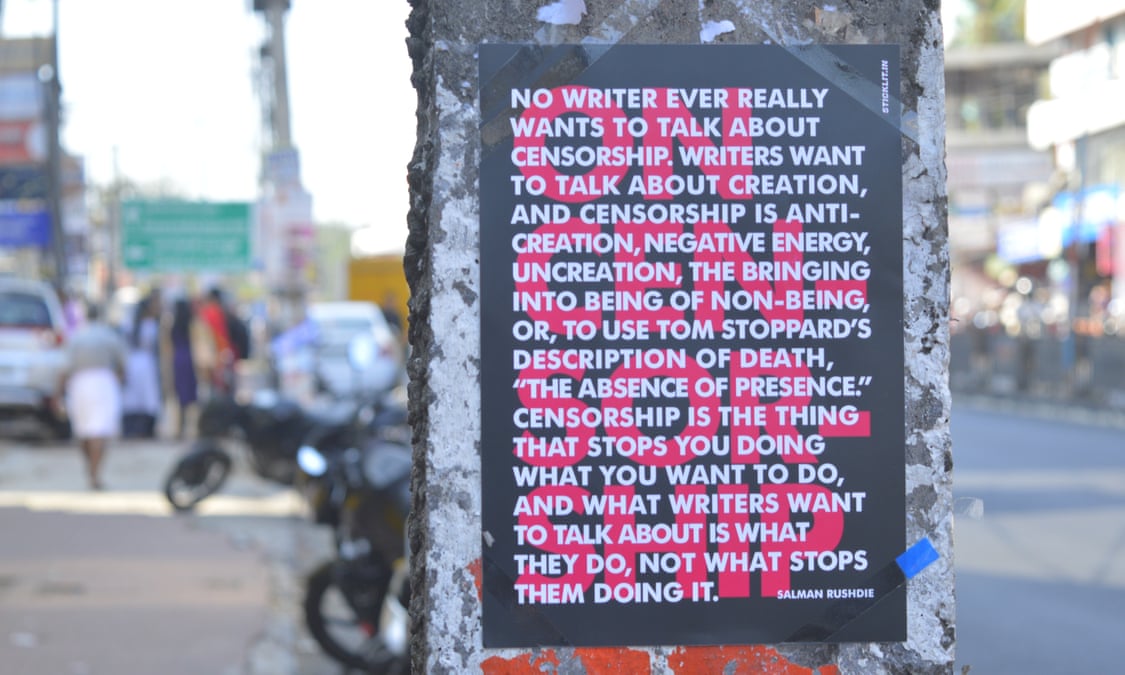
“Censorship is anti-creation” … A quote from a lecture by Salman Rushdie, as seen on a StickLit poster on a Bangalore cement pillar. StickLit brings literature to the people using stickers.

In the New York metro and the T in Boston, I’ve enjoyed the poetry posters that give riders something more meaningful to read and ponder than ads. Now I’m learning about a new poetry-for-the-people effort in India. It uses poetry stickers in both English and a local language in site-specific venues.

Priyanka Sacheti reports at the Guardian, “There are thousands of street food carts in New Delhi. But only one has the opening lines of Riyazat Ullah Khan’s poem ‘Wazoodiyat’ on the side:

Where can the pauper keep his pain of existence?
He has no container but a heart.

“The sticker bearing the couplet is from a campaign called StickLit, which seeks to make literature more accessible by placing quotes in public spaces.

“Nidhin Kundathil and Manoj Pandey had the idea for the project while contemplating the advertisements, posters and billboards that are consumed almost subliminally on Indian streets.

“ ‘We thought of turning this [visual] experience on its head to create a completely new and refreshing alternative for passersby – [one] which was not just selling something, for a change,’ says Pandey, 32, a freelance writer in Darjeeling.

“The idea subsequently evolved: they would make what they call the world’s largest library – ‘the largest repository of good literature in public spaces: a library that’s free for all.’ So they hit the streets, putting up free-format stickers, posters and wall murals. …

“After starting in Bengaluru and Delhi in 2017, the project has spread all over India, with volunteers in various cities taking it up. The stickers are available from the StickLit website and the founders encourage people to download them and use them freely. …

“The founders encourage placement based on context: poems in railway stations, for example, when people have longer to contemplate them; shorter quotes and excerpts for busy streets. They also use place-specific languages – Hindi in Delhi, or Kannada in Bengaluru – alongside English. There are plans to share prison poetry in prisons as well.

“Kundathil, 33, a Bengaluru-based graphic artist, handles the design. He says he deliberately chooses bold, brightly-coloured fonts and minimal design elements in order not just to attract attention but to ensure that attention remains focused on the text.

“The list of authors chosen is inclusive and diverse, from Rushdie and former government minister Shashi Tharoor to newer voices such as Nishita Gill and Nikhil Mhaisne. They have also shared works of Kannada literary greats across Bengaluru. ‘A lot of our material consists of work by aspiring writers as well,’ Pandey says, adding that the project is open to submissions.

“ ‘We like to believe that people, especially the young, are drawn towards StickLit as they are not cynical,’ Pandey says. ‘They still believe that a pen can change the world. And we’d like to foster that.’ ”

More at the Guardian, here.

Read Full Post »

blackorpheus01

I’ve always been interested in other countries and cultures and have tried to read books from afar if they are written in English or translated into English. Years ago, the works of Africa writers Chinua Achebe and Wole Soyinka were among my favorites. I have continued to read other African writers, but none have interested me as much as those two.

Recently I learned that some new authors have complained that African literary magazines — often the place to launch a writing career — have not been open to younger voices.

An article in Okay Africa provides an overview of the magazines that publish African literature and explains why the number of outlets has been increasing.

Tadiwa Madenga writes, “African literary magazines and journals don’t just shape literary culture, they offer the most rebellious responses to political and social movements. They not only respond to the cultures they’re in, these magazines also create distinct cultures of their own that reflect the personalities of their editors.

“Some are experimental and bold, some are satirical and polemic, some can also be aesthetically conservative, but they all find beautiful ways to confront the most pressing issues in society. Magazines archive stories that might not always gain the attention that books will, but are sometimes the most thrilling work in a writer’s career. Here are five of the most notable literary magazines that have shaped contemporary African literature.

“Based in Nigeria, Black Orpheus was groundbreaking as the first African literary periodical on the continent publishing works in English. It was founded in 1957 by German editor Ulli Beier, and was later edited by Wole Soyinka, Es’kia Mphahlele, and Abiola Irele. The magazine stopped printing in 1975.

“At a time when African writers needed spaces where they could simply gather and enjoy each other’s works, the magazine was started to promote African literature, publishing the works of literary giants like Chinua Achebe, Ama ata Aidoo, and Christopher Okigbo in their early career. The best part of the magazine was that it introduced literature from French, Spanish, and Portuguese speaking regions to an English speaking audience …

Transition was founded [in 1961] by Rajat Neogy in Kampala when Uganda, like other African nations, was gaining its independence. Like Black Orpheus, the magazine published notable writers like Achebe, Ngugi wa Thiong’o, Nadine Gordimer, and Taban lo Liyong when they were new writers.

Transition … has had fearless takes on politics that eventually forced it to be transferred to Nigeria when Soyinka was editor, and later to the U.S. Transition is now housed at Harvard University and is still producing provocative work …

Kwani? began after a group of Kenyan writers, artists, and journalists became frustrated with the slow publishing scene in the country that mostly accommodated earlier writers like Ngugi from the Transition and Black Orpheus generation. A new publication was created in 2003 for emerging writers that has led to the incredible literature we enjoy today from Kenya. The journal has published works by writer like Yvonne Owuor, Parselelo Kantai, Andia Kisia, Uwem Akpan and Billy Kahora.

“Edjabe is a Cameroonian journalist and a DJ who engages literature, music, and politics with a rebel spirit [in the magazine Chimurenga]. Edjabe founded Chimurenga in 2002 in Cape Town at a time where South Africans were having lively discussions about life during and after political and social revolutions. What makes Chimurenga unique is not only the amazing writing that they publish, but the ways the platform evokes other mediums with literature. …

“While the other literary magazines and journals where mostly print magazines, JALADA represents the digital moment where African literature is thriving on online platforms like Saraba, Enkare, and Brittle Paper. JALADA began after a group of writers from various African countries published their work on their own website which became so popular they began receiving submissions from other writers.”

Read more here.

600x600


Read Full Post »

I confess that although I can see why children adore books by certain illustrators, sometimes I don’t like reading the artists’ words.

Richard Scarry, for example, with his delightful animals and five-seater pencil cars, writes text that can get boring pretty fast. And Beatrix Potter, whom I admire for a multitude of reasons, employs very big words and potentially scary themes.

Christian Blauvelt recently covered that angle at the BBC. He begins with Potter’s first line in a storybook.

“ ‘Your father had an accident there; he was put in a pie by Mrs McGregor.’

“Old Mrs Rabbit’s frightful warning to her children Flopsy, Mopsy, Cotton-tail and Peter appears on the opening page of Beatrix Potter’s first book, The Tale of Peter Rabbit. Aside from featuring perhaps the most dramatic use of a semicolon in children’s literature, it sets the tone for her work from the start: that horrors abound in a world of Darwinian struggle, but that these must be faced calmly.

“Your parents, and perhaps your children, may be devoured by a vengeful property owner, or sold for tobacco; you may have your tail ripped off by an angry owl; an invading rat might tie you up in string and include you as the key ingredient in a pudding. But life goes on – disappointments must be faced and tragedies overcome. …

“Potter’s tales have been consistently popular with adults, as well as children, since The Tale of Peter Rabbit was published in 1902 when she was 36 years old. This is not just because they feature adorable creatures in harrowing situations; her talking-animal stories also comment on the era’s class politics, gender roles, economics and domestic life.

“Did she examine British society through animals because she spent more time with animals than children, aside from her brother Bertram, when she was young? Because she wanted to rebel against the bourgeois values and morals of her wealthy middle class family – which had made its money in the textile industry – but only dared do so through furry surrogates? Because she could only publish children’s stories since her true passion, science, was a career field closed to women in the late 19th Century? Because she had a German tutor who introduced her to the back-to-nature ethos of the Romantics?” More.

Hmm. Maybe I’m being too anti-intellectual here, but I’d say Beatrix Potter just got a kick out of telling stories like that.

And maybe she was right that small children could handle the scary parts. My three-year-old grand-daughter for example, has always loved Peter Rabbit and could recite the fancy phrases by heart when she was only two. Reciting fancy phrases is great for language development.

Photo of Beatrix Potter’s art: Penguin
Beatrix Potter, an amateur scientist, was meticulous about representing nature accurately, even if the animals did wear clothes. Here Peter Rabbit gorges on Mr. McGregor’s carrots.

Read Full Post »

When I was growing up in Rockland County, New York, my parents liked to buy art from artist friends and, when possible, offer other kinds of support. They hired the Hungarian-American artist André Dugo, for example, to paint a portrait of my brother Bo and me sitting in an armchair and reading one of the artist’s children’s books. We often read his book Pete the Crow or the books featuring a cardinal and a blue jay, or the one about the calf that ate the wrong kind of grass and puffed up like a balloon.

One day, Mr. Dugo came to our house to watch television with us. (We had one of the first TVs because my father was writing a story on Dumont for Fortune magazine.) We kept asking Mr. Dugo what he would like to see, and he kept saying he just wanted to see whatever we ordinarily watched.

As we worked our way through several programs, Mr. Dugo noted our reactions, sometimes asking questions.

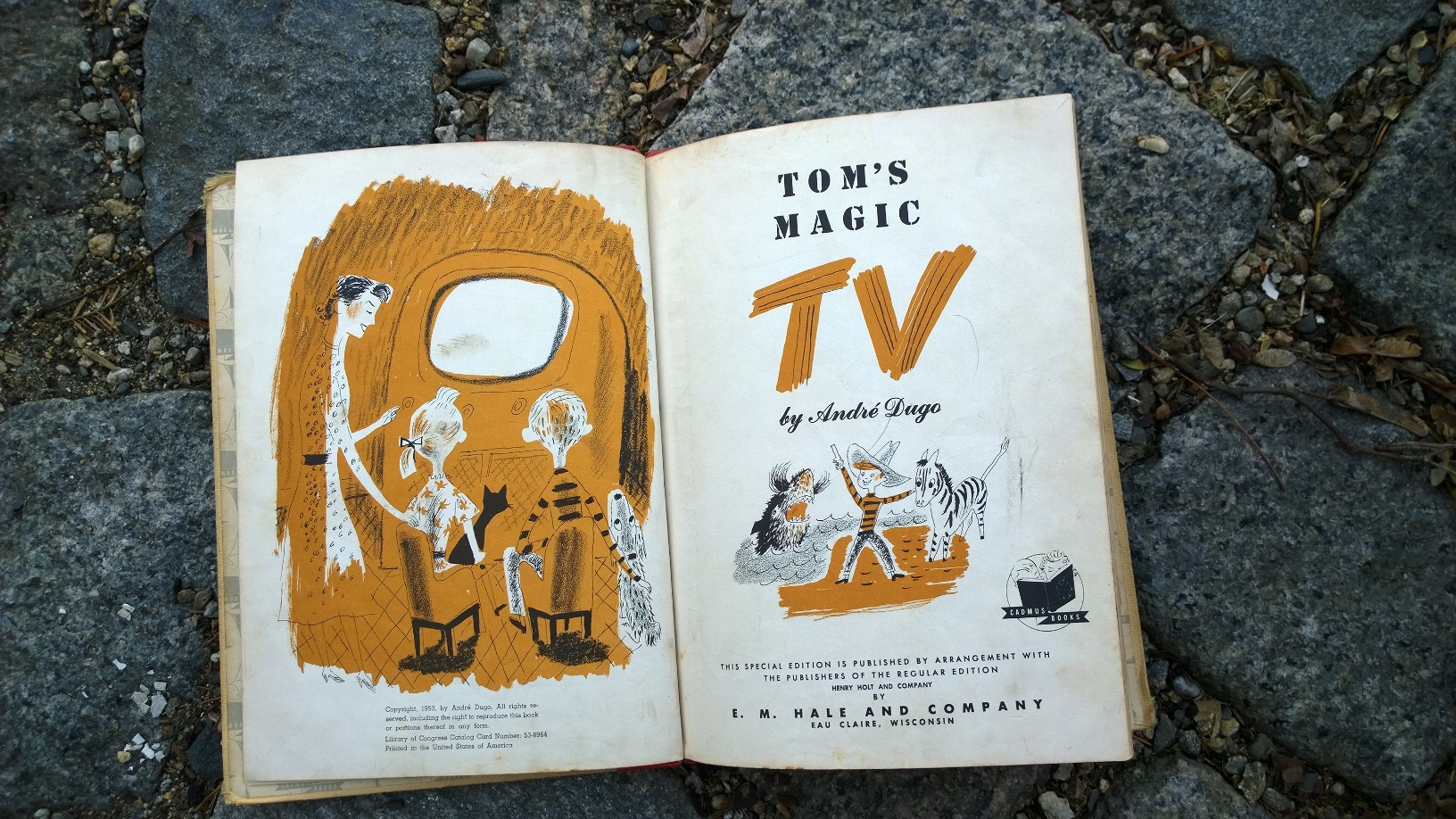
Not many months after, a children’s book came out. It was called Tom’s Magic TV, and its premise was that a boy traveled through the TV screen and into adventures with sharks, circus clowns, puppets, cowboys and spacemen. Bo and I were not mentioned. The mother didn’t look like my mother. This was an early exposure to children’s-literature research — or poetic license.

I’m pretty sure that Gene Autry was the model for the cowboy adventure.

030916-Toms-Magic-TV-Dugo

Read Full Post »

A day that Canadian short story writer Alice Munro wins the Nobel Prize for Literature might be a good day to talk about the power of fiction.

The NY Times took up the subject only last week. I think that reporter Pam Belluck must have been a little psychic. She wrote: “Say you are getting ready for a blind date or a job interview. What should you do? Besides shower and shave, of course, it turns out you should read — but not just anything. Something by Chekhov or Alice Munro will help you navigate new social territory better than a potboiler by Danielle Steel.

“That is the conclusion of a study published [October 3] in the journal Science. It found that after reading literary fiction, as opposed to popular fiction or serious nonfiction, people performed better on tests measuring empathy, social perception and emotional intelligence — skills that come in especially handy when you are trying to read someone’s body language or gauge what they might be thinking.”

Emanuele Castano and David Comer Kidd, researchers in the New School for Social Research’s psychology department. say “the reason is that literary fiction often leaves more to the imagination, encouraging readers to make inferences about characters and be sensitive to emotional nuance and complexity. …

“ ‘It’s a really important result,’ said Nicholas Humphrey, an evolutionary psychologist who has written extensively about human intelligence, and who was not involved in the research. ‘That they would have subjects read for three to five minutes and that they would get these results is astonishing.’ ” More.

My own use of literary fiction is mainly for pleasure, not job interviews. But when things are bleak, Dickens can be the best medicine.

Photo of Charles Dickens from Biography.com

Read Full Post »

You have heard of Let Us Now Praise Famous Men, the Depression era book on poverty in the South by James Agee and photographer Walker Evans. The forerunner was an article assigned by Fortune magazine to a young Agee but never published. This past Tuesday it was published as a book.

There are a couple aspacts to Christine Haughney’s NY Times story on the new book that intrigue me. One is the image of a young Agee moved by the plight of the sharecroppers and indignant at the magazine’s apparent exploitation of them.

The other is  how the original subjects, and later, their children, were embarrassed and didn’t want names used, but the grandchildren are able to see the beauty in their forebears.

Writes Haughney, “In 1936 Fortune magazine’s editors assigned a relatively unknown and disgruntled staff writer named James Agee to travel to Alabama for the summer and chronicle the lives of sharecroppers. When Agee returned, he was inspired by the subjects he had met and lived with, but frustrated by the limitations of the magazine format. His subjects, he argued, warranted far more than an article.

“What readers have known for decades is that Agee used his reporting material to create his 1941 book, Let Us Now Praise Famous Men, a literary description of abject poverty in the South, accompanied by starkly haunting Walker Evans photographs.

“The original magazine article was never published, as Agee squabbled with his editors over what he felt was the exploitation and trivialization of destitute American families. In the early pages of Famous Men, he wrote that it was obscene for a commercial enterprise to ‘pry intimately into the lives of an undefended and appallingly damaged group of human beings.’ What readers are about to discover now is what all the fighting was about.

“Melville House [is publishing] Agee’s original, unprinted 30,000-word article in book form, under the title Cotton Tenants: Three Families. The publication gives Agee fans a glimpse of an early draft of what became a seminal work of American literature.

” ‘With the book, we have a much better map of him writing Let Us Now Praise Famous Men,’ said John Summers, who edited Cotton Tenants and printed an excerpt from the article in a literary journal he edits, The Baffler. …

“Irvin Fields, whose grandfather Bud Fields was featured in the book, said he didn’t mind that the names were now being published.

“ ‘It makes me appreciate my relatives for bearing up under those circumstances and making me appreciate what I’ve got today.’ ” More.

A photo by Walker Evans, from “Cotton Tenants: Three Families,” via Library of Congress

Read Full Post »

When I got my current job, I went through the human resources “onboarding” with a young man from Mali. Even though he went back to Africa a couple years ago, we keep in touch. Naturally, I was worried when radicals took over Timbuktu, Mali, for a while. Fortunately, Mamoudou wasn’t living in Mali at the time, although he says Guinea is not that much safer.

Because of Mamoudou, I continue to follow the Mali news, and was especially interested in a link at the Arts Journal blog today: “Mali’s Underground Railroad: How Timbuktu’s Ancient Manuscripts Were Smuggled To Safety.”

Writes Sudarsan Raghavan of the Washington Post, “It was 7 o’clock on a hot night in August, and Hassine Traore was nervous. Behind him were 10 donkeys, each strapped with two large rice bags filled with ancient manuscripts. The bags were covered in plastic to shield them from a light rain.”

Radicals had taken over Timbuktu four months earlier and “had demolished the tombs of Sufi saints. They had beaten up women for not covering their faces and flogged men for smoking or drinking. They most certainly would have burned the manuscripts — nearly 300,000 pages on a variety of subjects, including the teachings of Islam, law, medicine, mathematics and astronomy — housed in public and private libraries across the city.”The scholarly documents depicted Islam as a historically moderate and intellectual religion and were considered cultural treasures  …

“A secret operation had been set in motion … It included donkeys, safe houses and smugglers, all deployed to protect the manuscripts by sneaking them out of town.

“This is the story of how nearly all the documents were saved, based on interviews with an unlikely cast of characters who detailed their roles for the first time. They included Traore, a 30-year-old part-time janitor, and his grandfather, a guard. …

“The New York-based Ford Foundation, the German and Dutch governments, and an Islamic center in Dubai provided most of the funds for the operation, which cost about $1 million.

“ ‘We took a big risk to save our heritage,’ said Abdel Kader Haidara, a prominent preservationist who once loaned 16th- and 18th-century manuscripts from his family’s private collection to the Library of Congress. ‘This is not only the city’s heritage, it is the heritage of all humanity.’ ”

There are heroes everywhere, keeping a low profile. And I am also pretty impressed with the funders, springing into action like that.

More here.
Map: National Geographic

Read Full Post »

It took me a while to get into twitter, but I’m hooked now. In fact, some readers  of this blog follow me by way of @LunaStellaBlog1 instead of signing up for e-mails. (Luna & Stella is Suzanne’s company.)

The abortive revolution in Iran showed me the power of twitter and was a turning point for me. I still know the date by heart, June 20, 2009. If you searched on , the tweets came so fast with offers of new servers when sites were blocked in Iran, with up-to-the-minute photos and recordings, with citizens getting the word out that I got hundreds of tweets per minute and the U.S. president had to ask twitter not to do maintenance one night because it was a critical time of day in Iran.

Now I learn a completely different thing about twitter. It seems that people have been writing fiction in 140-character bites and that the practice has matured to the extent that twitter fiction is ready for a festival.

Writes Jennifer Schuessler at the NY Times, “The participants, some two dozen published and neophyte authors from five continents chosen by a panel of American publishing insiders, are posting in five different languages, often with input solicited from readers. The Iowa-based writer Jennifer Wilson is posting photographs of gravestones and then writing ‘flash fiction’ in response to epitaphs submitted by followers. The South African author Lauren Beukes is writing mashups, gathered under the hashtag , based on ‘incongruous suggestions (the weirder the better!),’ according to the festival’s showcase page.

“The French fantasy novelist Fabrice Colin is writing a serialized story of five strangers trapped on a bus. And an anonymous Chinese author is contributing ‘Censortive,’ a story exploring the limits of free speech in the People’s Republic, tweeted out in a series of late-night installments.” Read more here.

It’s not War and Peace, of course.

Read Full Post »

I love children’s illustrated books like those of the Petershams. Eve M. Kahn wrote an article about the couple in the NY Times “Antiques” column prior to the opening of a retrospective at the Woodstock Artists Association and Museum.

“Maud and Miska Petersham, married book illustrators in Woodstock, N.Y., sat across from each other as they worked. From the 1920s to the ’50s, they ran a prolific studio at their handmade stone house. They took on classic stories like ‘Heidi’ and ‘Rip van Winkle,’ along with nonfiction about rayon and wool that is now obscure, and Queen Marie of Romania’s fairy tale starring a magic doll.

“Children and teachers sent fan mail. ‘It has gone through the school like wildfire,’ a Utah schoolteacher wrote to the Petershams in 1941, praising the couple’s alphabet book with patriotic pictures.

“The Petersham archive survives in the hands of family members and the University of Southern Mississippi’s library. The historian Lawrence Webster mined the material for a book, “Under the North Light: The Life and Work of Maud and Miska Petersham” (WoodstockArts). …

“Miska Petersham grew up in Hungary. Around 1912, shortly before he moved to New York, he Americanized his original name, Mihaly Petrezselyem. …

“The Petershams’ house on Glasco Turnpike [in Woodstock], with floor-to-ceiling windows that illuminated their drafting tables, is largely unchanged and has been on the market for about $440,000,” a short sale.

More. (Scroll down.) The show, “Inspired by the North Light,” runs through December 31.

Photograph from Lawrence Webster shows one of Maud and Miska Petersham’s illustrations for the children’s book “The Poppy Seed Cakes.”

Read Full Post »

For an artsy, literary treat, take a look at the Project Gutenberg version of painter Marsden Hartley‘s out-of-print book, Adventures in the Arts: Informal Chapters on Painters, Vaudeville, and Poets, dedicated to Alfred Stieglitz.

Hard to resist an introduction like this:

“Sometimes I think myself one of the unique children among children. I never read a fairy story in my childhood. I always had the feeling as a child, that fairy stories were for grown-ups and were best understood by them, and for that reason I think it must have been that I postponed them. I found them, even at sixteen, too involved and mystifying to take them in with quite the simple gullibility that is necessary. But that was because I was left alone with the incredibly magical reality from morning until nightfall …

“I was constantly confronted with the magic of reality itself, wondering why one thing was built of exquisite curves and another of harmonic angles. It was not a scientific passion in me, it was merely my sensing of the world of visible beauty around me, pressing in on me with the vehemence of splendor, on every side. …

“It is because I love the idea of life better than anything else that I believe most of all in the magic of existence.”

(Thank you, Ellen Levy, for sending me the link.)

Art:  Marsden Hartley

Read Full Post »

As readers know, I really believe that “one and one and 50 make a million” (a concept articulated by folksinger Pete Seeger). That’s why I can’t resist a recent story from Moscow, where a few writers decided to have a “stroll,” and 10,000 individuals individually decided to follow.

Ellen Barry writes in the NY Times: “It was only four days ago when 12 prominent authors, disturbed by the crackdown on dissent that accompanied President Vladimir V. Putin’s inauguration, announced an experiment. They called it a ‘test stroll’ …

“No one knew quite what to expect on Sunday. But when the 12 writers left Pushkin Square at lunchtime, they were trailed by a crowd that swelled to an estimated 10,000 people, stopping traffic and filling boulevards for 1.2 miles. …  The police did not interfere, although the organizers had not received a permit to march.

“ ‘We see by the number of people that literature still has authority in our society because no one called these people — they came themselves,’ said Lev Rubinstein, 65, a poet and one of the organizers. ‘We thought this would be a modest stroll of several literary colleagues, and this is what happened. You can see it yourself. … I don’t know how this will all end, but I can say that no one will forget it.’ ” Read more.

I can’t help thinking that one and one and 50 have been growing for a long time in Russia and that the 10,000 who joined the march are just the tip of he iceberg.

Photograph: Dmitry Kostyukov for The New York Times

Read Full Post »

I remember trying some years ago to persuade a certain lobster fisherman I know that fiction has value. A recent Boston Sunday Globe article has left me feeling validated.

Washington & Jefferson College’s Jonathan Gottschall writes, “Fiction seems to be more effective at changing beliefs than nonfiction, which is designed to persuade through argument and evidence. Studies show that when we read nonfiction, we read with our shields up. We are critical and skeptical. But when we are absorbed in a story, we drop our intellectual guard. We are moved emotionally, and this seems to make us rubbery and easy to shape. But perhaps the most impressive finding is just how fiction shapes us: mainly for the better, not for the worse. Fiction enhances our ability to understand other people; it promotes a deep morality that cuts across religious and political creeds.”

Read more here.

As Dickens said in Hard Times, it’s important to make room for Queen Mab among all the hard facts.


Read Full Post »

Older Posts »