Feeds:
Posts
Comments

Posts Tagged ‘martine powers’

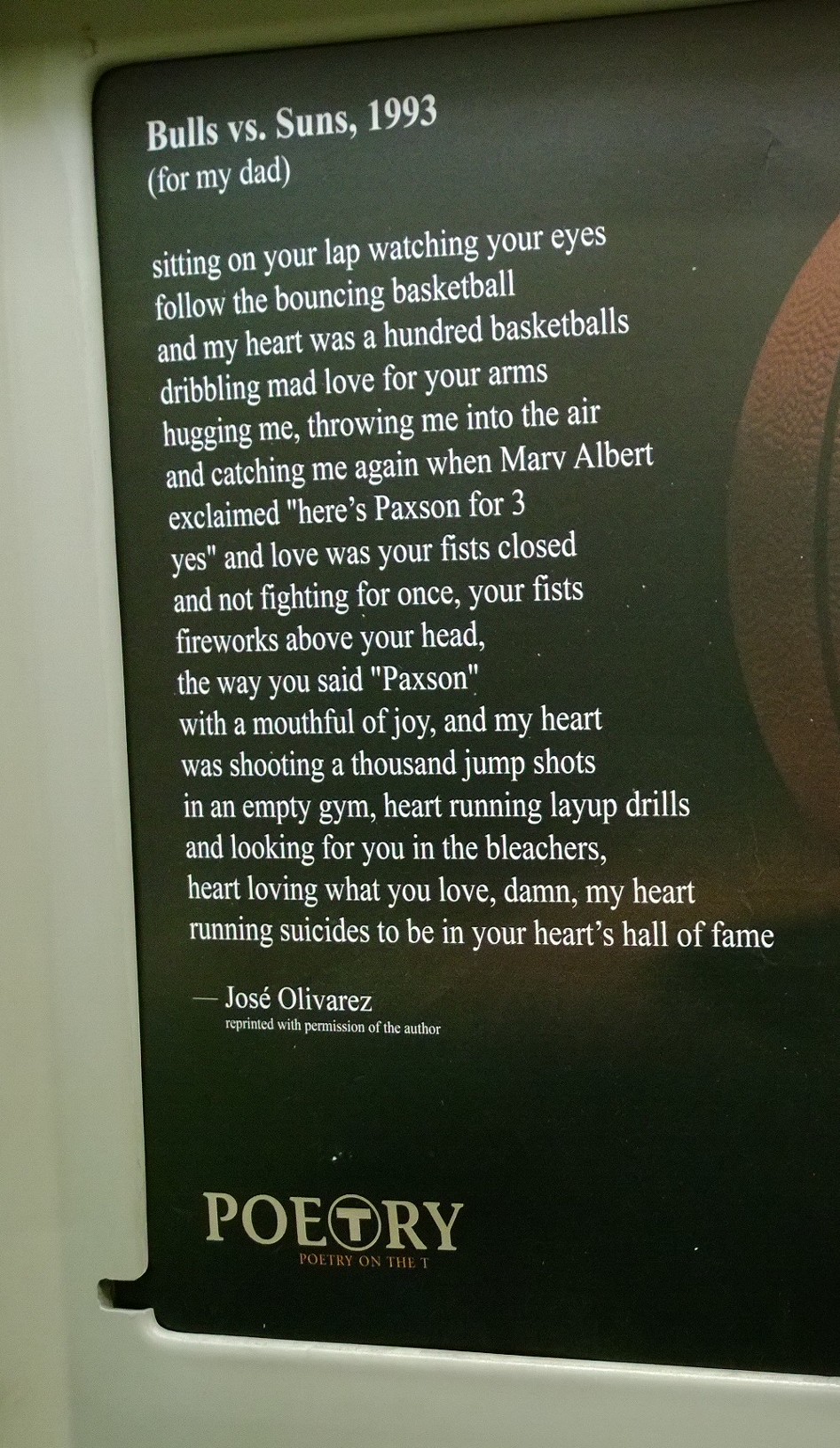
Jose-Olivarez-MBTA-poem


I was always impressed when I saw a poem in the place of an ad in the New York City subway. Now Boston has caught on.

Martine Powers wrote recently at the Boston Globe, “Finally, Bostonians will have the chance to experience the pleasures of poetry on the MBTA.

“Mass Poetry [is] bringing poems to advertisement spaces on subway cars. The initiative, dubbed PoeTry, is part of the organization’s Poetry in Public Spaces initiative, which began last year, said Mass Poetry program director Laurin Macios…

“ ‘Contemporary poetry is barely taught in schools, and often when it is, it is taught in a very scholastic sense instead of an artistic one,’ Macios said. “People often grow up without ever realizing there is poetry out there that can speak to them, or that they can speak back to. …

“Each appearance of a poem includes a tearsheet on the corner of the sign, allowing passengers to take a copy of the poem with them if the spirit strikes them.”

One poem in the series, says Powers, “What Travels,” by Joseph O. Legaspi, takes place on a subway car. “What travels beneath their secret faces? What is train but transport to other lives?” More at the Globe.

See also http://masspoetry.org.

Photo: Suzanne’s Mom
Poem: “Bulls vs. Suns, 1993,” by Jos
é Olivarez

Read Full Post »

The Puritan thinker Roger Williams got fed up with the rigid Puritans in the Massachusetts Bay Colony and went off to found the state of Rhode Island and advocate for freedom of religion.

Recently Lucas Mason-Brown, a Brown University math major, worked with a small group of undergraduates to crack the shorthand code Williams used while making notes.

According to Martine Powers in today’s Boston Globe, here, translation of the notes was an achievement that had resisted scholars for centuries. No major insights about Roger Williams were revealed, but some were confirmed.

For example, the notes show that Williams was against baptizing Indian children — a new example of how adamantly he opposed pressure to convince anyone of any religious belief.

In an earlier AP article in the Herald Online, Erika Niedowski writes, “College history professor emeritus J. Stanley Lemons and others at Brown started trying to unravel the so-called ‘Mystery Book’ a few years ago. But the most intense work began this year after the university opened up the challenge to undergraduates, several of whom launched an independent project.

” ‘No one had ever looked at it systematically like this in generations,’ Widmer said. ‘I think people probably looked at it and shrugged.’

“Senior math major Lucas Mason-Brown, who has done the majority of the decoding, said his first instinct was to develop a statistical tool. The 21-year-old from Belmont, Mass., used frequency analysis, which looks at the frequency of letters or groups of letters in a text, but initially didn’t get far.

“He picked up critical clues after learning Williams had been trained in shorthand as a court stenographer in London, and built his own proprietary shorthand off an existing system. Mason-Brown refined his analysis and came up with a rough key.” Read more.

AP Photograph
The preface page of the Mystery Book from Brown University’s John Carter Brown Library. Lucas Mason-Brown, a senior mathematics major, helped crack a mysterious shorthand code developed and used by religious dissident Roger Williams in the 17th century. The handwritten code surrounds the printed text on the preface page.

Read Full Post »

Thomas Daigle, an optician in Milford, Massachusetts, is a thrifty guy.

Writes Martine Powers in the Boston Globe, “Daigle, 60, has finally fulfilled the goal he set for himself decades ago: Arriving at the Milford Federal Savings and Loan Association in April with two 200-pound steel boxes, Daigle paid off the couple’s final mortgage payment with the contents — more than 62,000 pennies.

“That day was also the couple’s 35th wedding anniversary. Daigle hopes his story, first reported Wednesday in the Milford Daily News, will teach others the value of good old-fashioned long-term commitment.

“ ‘One of my sons always tells me, “Dad, you’re stuck in the ’50s,” ‘ Daigle said. ‘But it’s how you’re brought up, and it comes down to values.’ …

“It took the bank two days to count the coins, Daigle said, but it turned out his tally was exactly correct — to the cent. The sum was a little more than what Daigle owed, he said, but he did not ask for the surplus.

“ ‘I just wanted the pennies out of my house.’ ”

Wouldn’t you have liked to see the customers’ reactions when the 400 pounds of rolled up coins were delivered? But good for him. I value pennies, too.

Read more.

Photograph: Essdras M. Suarez/Globe

Thomas Daigle paid his last mortgage payment in pennies.


Read Full Post »