Feeds:
Posts
Comments

Posts Tagged ‘mosque’

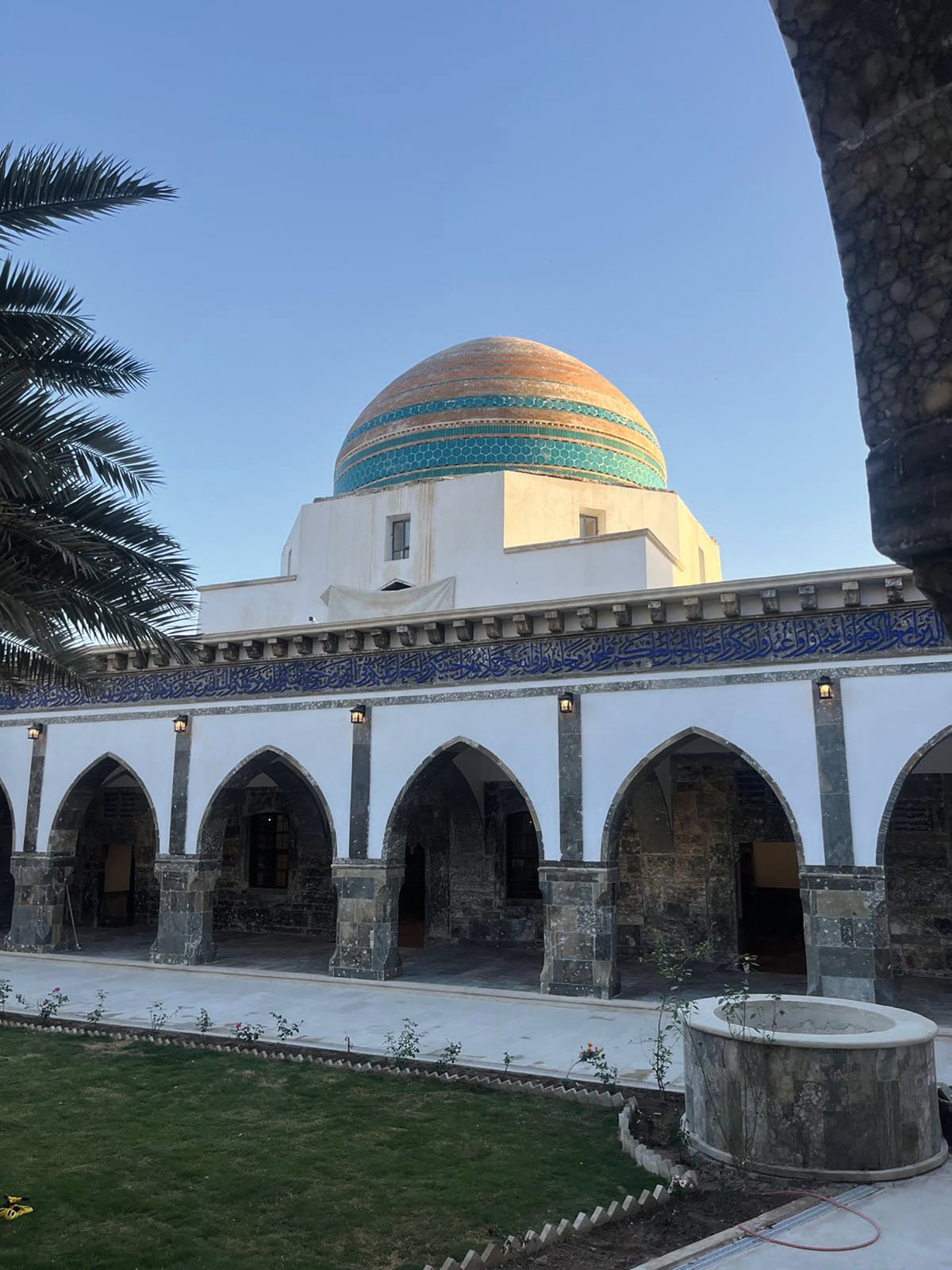
Photo: Valéry Freland/International Alliance for the Protection of Heritage (ALIPH).
The Al-Raabiya Mosque — severely damaged during the battle to liberate Mosul from Isis in 2017 — was one of several restored buildings revealed in October 2025.

Let’s think about how humans rebuild places after the unspeakable. Mosul, in Iraq, is one such place. A goal to nurture a diversity of faith traditions there has been dubbed the Mosul Mosaic.

Hadani Ditmars writes at the Art Newspaper that 2025 was “a banner year for the restoration of heritage in Mosul, a city rising from the ashes of war and still recovering from three years of occupation by Islamic State (Isis). When it was liberated in 2017, the northern Iraqi city lay in ruins at a level of destruction Unesco described as unequalled since the Second World War.

“A multitude of reconstruction projects began in 2018 after landmines and debris were cleared. Dozens of these were completed in the past year, among them, Unesco’s program to restore Ottoman houses in the old city. The Isis-ravaged Mosul Central Library opened on 1 January. The Al-Nouri Mosque, Al-Tahera Church, and Al-Saa’a Convent are among the sites to have been restored under Unesco’s $115m Revive the Spirit of Mosul program. In October, two more churches and a mosque restored by the Geneva-based NGO Aliph (International Alliance for the Protection of Heritage) were inaugurated.

“It remains to be seen whether rebuilding churches and mosques will encourage social cohesion and religious peace in a still-fractured society. There are fewer than 70 Christian families living in Mosul, down from a pre-2014 population of 50,000. …

“David Sassine, the project manager of Mosul Mosaic, an initiative launched by Aliph in 2018, tells the Art Newspaper that the NGO’s primary reason for restoring churches and mosques is their heritage value. But it is also, he says, ‘a message that the international community is supporting the presence of all communities in Mosul.’ Displaced communities can be encouraged to return by building schools and restoring monuments, he says. …

“In addition to preserving the cultural heritage of Mosul in its religious diversity (including documentation of the historic Jewish community), Mosul Mosaic also provides on-the-job training in heritage restoration and employment to locals. …

“[In 2024] Aliph reopened the historic Tutunji House—an Ottoman home used by Isis as an explosives factory that is now a cultural centre. This year, it completed the rebuilding of the House of Prayer at the Al-Saa’a Church and the Al-Masfi Mosque, one of Mosul’s oldest, likewise damaged during occupation by Isis, was also inaugurated. …

“At the first public mass at the exquisitely restored Al Tahera Church in May, most of the Christians in attendance no longer lived in Mosul. After the service, attended by perhaps three dozen worshippers, everyone left quickly. Few were inclined to speak to the Art Newspaper, including the priest. ‘I don’t feel comfortable,’ he said.

“One young man said he had moved back to Mosul to take a job as the church verger, and because his old family home was still standing in the old city. The rent in Erbil … where he and his family had fled in 2014, was unaffordable, he said.

“A Muslim construction worker outside the church, said he … fondly remembered his old Christian classmates at the Catholic school he attended in his youth. ‘I haven’t seen them in many years,’ he said.

“But Shams Majid, who returned to Mosul a few years ago to rebuild his family home, was optimistic. He recently transformed his traditional [house] with several stories that overlook the al-Nuri Mosque in the old city into the Mosul Heritage Art House, open to visitors.

“ ‘Everything in Mosul is great now,’ he said. ‘They are rebuilding all the monuments, the tourists are coming back, and the economy is improving.’ …

“Aliph’s next big restoration project—the Mosul Museum—combines ancient and modern heritage preservation. Looted after the 2003 Iraq War and ravaged by Isis in 2015, it is scheduled to open in autumn 2026. The $15.8m project was initiated in 2018 in partnership with the Musée du Louvre, the Smithsonian Institution and the World Monuments Fund.”

Learn about other restored buildings at the Art Newspaper, here.
Read Full Post »

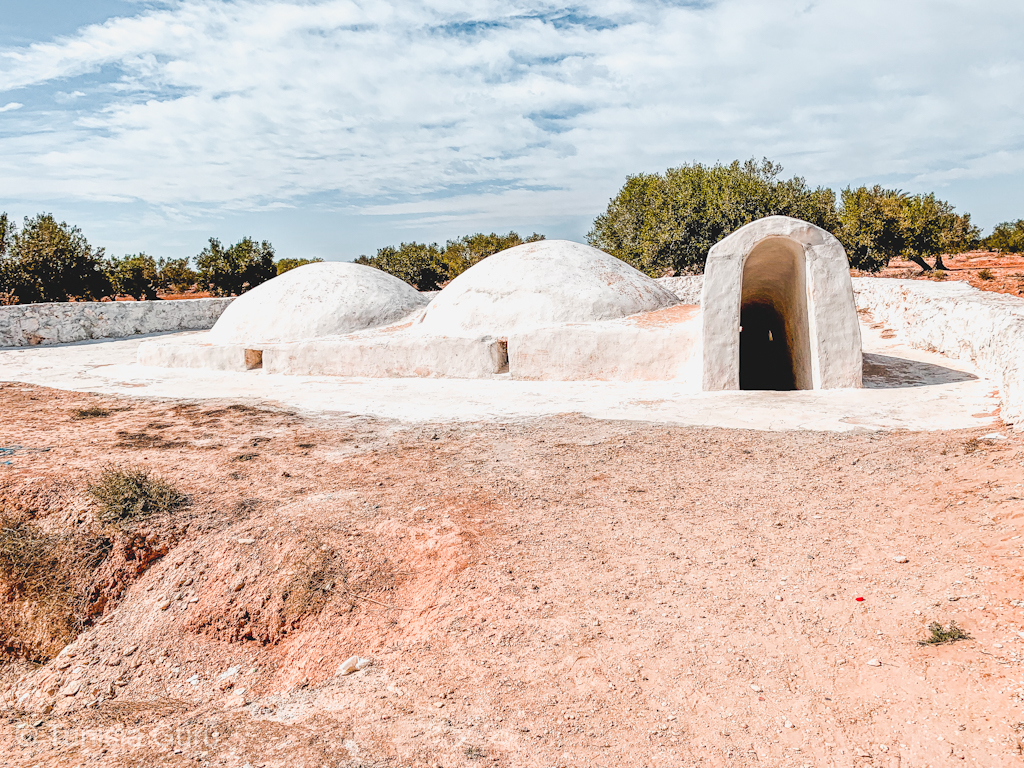
Photo: Tunisia Guru.
An underground mosque on the island of Djerba in Tunisia.

I got interested in finding out more about underground mosques after seeing a photo of one on the island of Djerba in Tunisia — an island thought to be the same that Homer had in mind when writing about the Lotus Eaters in the Odyssey.

An entry at Wikipedia says that underground mosques are “either erected beneath other buildings or lay freely in the ground with an inconspicuous appearance. The prayer rooms in underground mosques are usually very small, and they also have no minarets. Underground mosques are very rare. [The Djerba mosque] served as a hidden place of prayer for the Ibadis.”

From a different Wikipedia page, we learn that the mosque is near Sedouikech, Tunisia, and dates from the 12th or 13th century. “Surrounded by an olive grove, it opens to the outside by a very steep staircase that leads to the main room; next to it is a large underground tank fed by a well. Another of these underground mosques is located on the Ajim road. Not being used for worship, these mosques can be freely visited.”

An underground mosque in Turkey was built only recently, not because worshippers needed to hide like the Ibadis but because underground worship can feel peaceful.

Menekse Tokyay writes at Alarabiya, “The uniqueness of the Sancaklar mosque is that it departs from standard mosque design in a bid to break architectural taboos and encourage worshippers to focus on the essence of the religious space and on the Islamic faith. …

“Strolling around the mosque’s outdoor area, you will notice a long canopy running along one side where two olive trees and one linden tree are located. From this point, you have to descend natural stone stairs to reach the building.

“The cavernous prayer hall of the mosque is large enough to host more than 650 worshippers, while it aims to isolate believers from the outside world and invite them to delve deeper into their inner world.

“What strikes one about the Sancaklar mosque is that its design is humble and simple, perhaps to deepen worshippers’ relationship with their faith, and with this underground concept, visitors can leave behind all the challenges of the outside world. …

“Sancaklar mosque stands in Istanbul’s suburban Buyukcekmece district and is spread over an area of 1,200 square meters. The architecture combines Islamic and Ottoman designs with a modern touch, seemingly free from mainstream architectural typology.

“In 2013, out of 704 projects from 50 countries, the building won first prize in the World Architecture Festival competition for religious places. In 2015, the project was selected for the Design of the Year award, organized by the London Design Museum and it was also shortlisted among the 40 nominees for the Mies Van der Rohe Award.

“The mosque was designed by Turkish architect Emre Arolat for the Sancaklar Foundation. …

“The only decoration on the walls is the Arabic letter ‘waw’ and verse 41 of Surat al-Ahzab, a chapter in the Quran: ‘O you who have believed, remember Allah with much remembrance.’

“The main space is free of any decorative ornaments unlike many modern mosques built recently in Turkey. Daylight penetrates the prayer hall along the Qibla, or Mecca-facing, wall. …

“ Every time I come here for worship I feel an enormous [sense of] inner peace. It is also a place of meditation for me when praying under daylight infiltrating into the hall,’ Asli Karacan, a youngster living nearby, told Alarabiya.”

More at Wikipedia, here and here — also at Alarabiya, here.

Read Full Post »

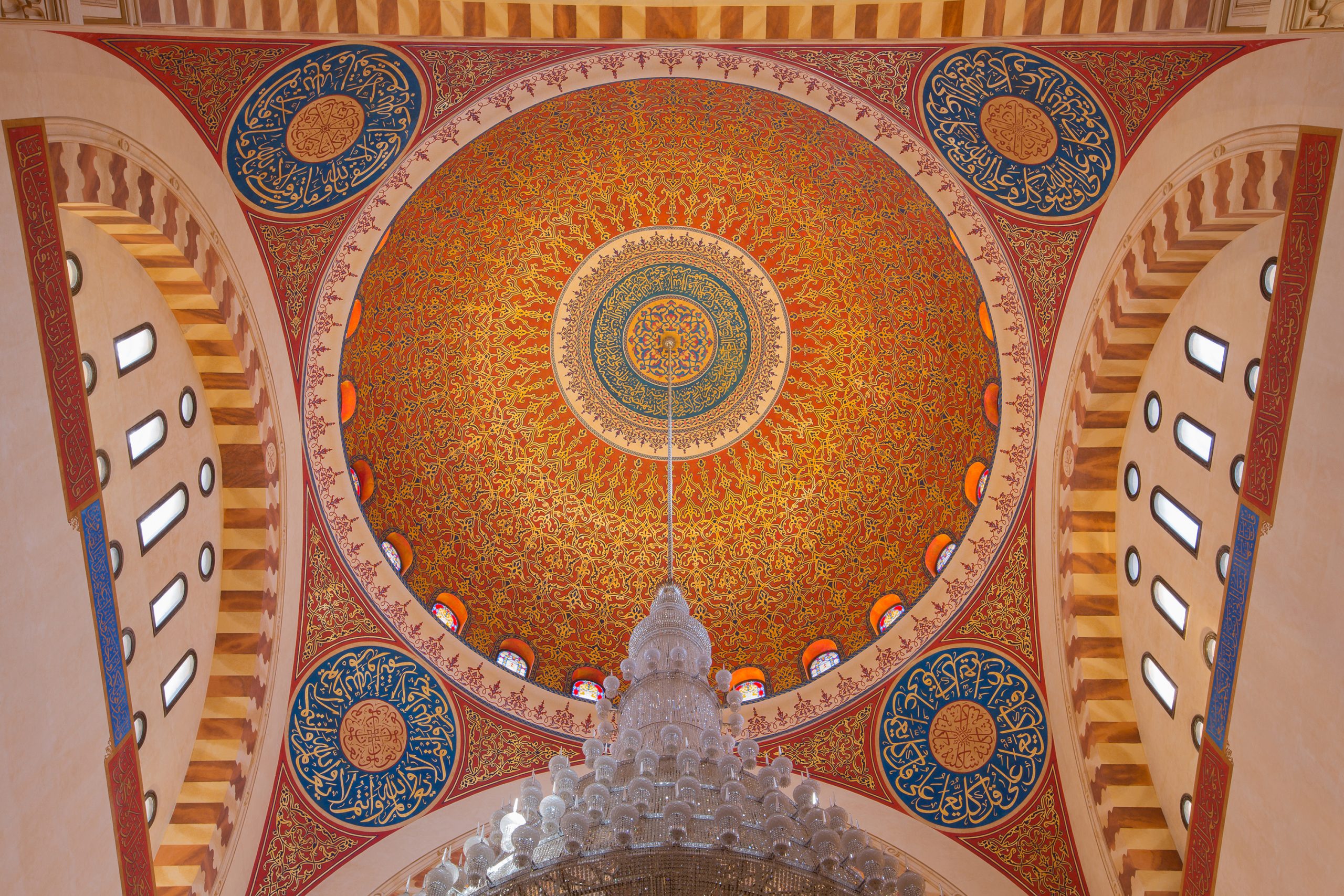
Photo: Harout Bastajian.
The Mohammad al-Amin Mosque, also referred to as the Blue Mosque, in downtown Beirut, Lebanon.

Some years ago, I read Jason Elliot’s fascinating book about his travels in Iran, Mirrors of the Unseen. One thing that stuck with me was his theory about caves and how they might have influenced Islamic art and the dome shape of mosques. I wrote about it before.

Today I chose an article on a man who is often called in to paint or repaint domes, both Islamic and Christian. His own theories are about which types of imagery are best for which sects.

Hrag Vartanian reports at Hyperallergic, “At the center of downtown Beirut is the prominent Mohammadal-Aminmosque, the largest mosque in Lebanon. …

“Inside is a stunning painted dome. It is the work of an artist who has gained a reputation as a leading painter of decorative ornament, particularly in mosques. What may surprise many people unaware of the rich cosmopolitan tradition of Islamic religious art is that the artist, Harout Bastajian, is not Muslim himself. When people ask him how a Christian is creating the decorative program of a mosque, he likes to answer, ‘God works in mysterious ways, brings us all together to decorate his house of worship.’

“He embarked on this artistic path back in 2004, when he was asked by the Hariris, a prominent business and political family in Lebanon, to decorate the newly inaugurated Hariri mosque in Sidon, Lebanon. …

“The journey into painting in sacred spaces has been inspiring for the artist. Not only has he painted the interiors of mosques but he’s also been involved in the restoration of Roman Catholic and Armenian Catholic buildings in Lebanon. He remembers his first mosque commission in Sidon well. ‘When I went in and saw the huge dome, which is like 900 square meters [roughly 9,687 square feet], I couldn’t sleep that night.

‘I was thinking, “How am I supposed to do this?” And then I was playing basketball in my backyard. I saw the basketball, the shape, how it’s divided. So I started thinking, how can I divide the dome and try to manage it?

” ‘And it was easy. Within two months I was able to finish the project with my team,’ he explains. … ‘I go through history, through different schools, and I try to come up with something somehow contemporary and work on it. And I will always use the golden ratio as a fundamental for my work. Regarding the colors, I don’t see one color. I always work with layers of colors.’ …

“He currently has a team of six or seven colleagues who work with him full time, and a graphic designer who helps organize the project plan since Bastajian doesn’t like to work with digital tools. …

“In the last 18 years, Bastajian says, he has painted 37 full and half domes, which translates into over a dozen mosques and many secular projects as far afield as Nigeria, the United Arab Emirates, Saudi Arabia, Kuwait, and Switzerland.

“ ‘[When] I did my first few mosques, I had to travel a lot and check other mosques in order to understand it all better. Then I took some courses in Islamic design and Islamic art [and] after a while it became part of me. I can see the end result only by doing the sketches and preparing the designs.’ …

“He conceives each project from the ground level, where visitors will experience the work, incorporating a mixture of geometric designs, along with vegetal and floral motifs, to create a rich web of patterns. ‘The shape of the dome itself, it has something divine in it because it’s circular. It doesn’t have a start or an end,’ Bastajian explains. ‘And the light that comes in from the windows, they call it the light of God. The dome itself, you feel that it’s flying, it’s something divine.’

“[The artist] is sometimes inspired by other works, such as the designs from the Topkapi Palace in Istanbul, which influenced his work for the al-Aminmosque in Beirut. He adjusts the designs according to the sect: Ottoman designs tend to work better for Sunni spaces, while Shia holy spaces tend to take their aesthetic cues from Persian-influenced styles and geometry.”

More at Hyperallergic, here. No firewall.

Read Full Post »

Last month, Steve Curwood of the radio show Living on Earth covered a special conference on climate change.

“Curwood: A coalition of 80 leading Islamic clerics, scholars and officials meeting in Istanbul has issued a declaration on climate change, ‘calling on all nations and peoples to phase out greenhouse gas emissions as soon as possible.’ …

“Islamic nations, including wealthy oil-producing states, are taking action on global warming, says Wael Hmaidan. He’s director of Climate Action Network International, one of the conference organizers and joins us now from Istanbul. …

“Hmaidan: I was really happily surprised by how rigorous the Koran and the Islamic teachings on the environment and the care for the planet. It’s a core function of Islam to care for the planet. It’s a responsibility. … It talks about the delicate balance that all the creatures have on Earth and it’s the responsibility of humans to protect this balance.

“It also talks actually about how humankind should not think that they are more important than other creatures. It talks about the role of all creatures and the need of respect, this diversity in the planet. So all of these kinds of proverbs from the Koran and the Islamic teachings, as well as stories about Prophet Mohammed’s life and his care for the environment clearly [makes] environmental care and climate change key issue for an Islamic teaching. And hearing strong statements saying that it is forbidden not to phase out greenhouse gas emissions coming from Islamic scholars is something very inspiring, even for climate activists. …

“There’s an agreement to establish an informal group … that will follow up on all the ideas that came out from the conference. And the ideas are varied, some of them are high-level, like I mentioned going to the UN agencies, to governments, but also the representatives of the organizations that attended want to create action plans in their communities of influence, to bring the declaration. … We need to transform all mosques to renewable energy, and so on. So a lot of ideas, and they’ve created this platform Muslims for Climate to continue the dialogue.”

More here.

Photo: Islamic Relief
Mohamed Ashmawey, CEO of Islamic Relief Worldwide and one of the Climate Change Symposium organizers addresses attendees.

Read Full Post »

The Christian Science Monitor recently ran a story by Bryan Kay about an ongoing  community service project.

“Not even the recent furlough of federal workers was enough to snuff out the latest community outreach effort of Masjid al Islam mosque in Dallas.

“On a weekend in early October, the mosque was participating in a national initiative known as the Day of Dignity, an annual event during which mosques feed, clothe, and equip people living in poverty. But federal workers who had been scheduled to attend to speak about the details of the Affordable Care Act …  had been forced to cancel because of a partial federal government shutdown.

“It was a blow to the mosque’s boosters, says Muhammad Abdul-Jami, treasurer of Masjid al Islam and coordinator of the Day of Dignity event. But it didn’t deter them from pursuing the same purpose they have had for the last several years, he says: aiding homeless people … .

“Masjid al Islam is in an area where the homeless are a ubiquitous sight. … Because of the great need every weekend, the mosque seeks to do what the Day of Dignity event, organized in conjunction with the national charity Islamic Relief USA, does on an annual basis. Through its Beacon of Light community center, Masjid al Islam feeds approximately 300 individuals in need on Saturdays and Sundays each week, Mr. Abdul-Jami estimates. That’s more than 15,000 meals per year, paid for with donations from individuals and other mosques and served by volunteers, he says. …

” ‘There are millions of Muslims in this country who are very regular people, people who [other] Americans might consider much like them,’ Abdul-Jami says. …  ‘These events help us showcase that we are concerned about the rest of humanity, not just wanting to help Muslims.’ ”

Read more here.

Photo: Walid Ajaj

Read Full Post »