Feeds:
Posts
Comments

Posts Tagged ‘museum’

After a father’s death, the family tries to find homes for his perfect metal miniatures.

Isaac Feldberg writes at the Boston Globe, “On any gift-giving occasion in the Megerdichian household, the most exciting presents to unwrap were always both the smallest and, funnily enough, the heaviest.

“Some boxes held metal miniature re-creations — a brass violin with horse-hair strings and a latched case; an aluminum piano music box that played ‘Raindrops Keep Falling on My Head.’ Others concealed stainless-steel jewelry, intricately detailed, immaculately formed. And others still contained children’s toys, like steel tractor-trailer sets to be nudged along the wooden floors of their Cambridge home.

“ ‘They were 14 ounces of love, 1 ounce of metal,’ says Robert Megerdichian, 63, of the tiniest pieces his late father, Abraham, bestowed upon the family throughout his lengthy career as a machinist. ‘He started off with a solid block of metal, brass, aluminum, copper, or stainless steel, and he gouged away, like a sculptor would, like an artist would, to create all of these objects.’

“Megerdichian’s description of his father as an artist has recently earned official validation, with museums across New England displaying an array of Abraham’s pieces. The Attleboro Area Museum of Industry, the Lynn Museum, and Boston’s Museum of Science all currently house some of his metal miniatures. Additional museum exhibits are set to open in the fall, including at Connecticut’s New Britain Industrial Museum. For more than half a century, however, Abraham’s creations were reserved for his loved ones. …

” ‘It was important to him to make things that made the people he cared for happy,’ ” said his son.

Read about Abraham’s history here. A great example of what the intersection of love and skill can give the world.

Photo: David L. Ryan/Globe Staff
Robert Megerdichian looks over a miniature Hoover vacuum cleaner crafted by his father.

Read Full Post »

I gravitate to stories about older people who keep on truckin’ and don’t let age keep them from doing what they love.

Here’s one about a 102-year-old museum docent, who is being honored with a café in her name.

Chuck Hinman of Rhode Island Public Radio reported, “There’s something new at the Rhode Island School of Design in Providence … . Visitors to the [Rhode Island School of Design] Museum have been unable to use its Benefit St. entrance since mid-April, but that entrance now has been re-opened, as RISD unveils what it’s been working on these past few months: its first café, called Café Pearl, after one of the museum’s most dedicated and long-serving docents, Pearl Nathan.

“RIPR’s Chuck Hinman talked to the 102-year-old Nathan at her home in East Providence, about her long association with the RISD Museum.”

Hinman goes on to say Nathan is bemused by the café and her new fame. She tells him her “emphasis was on my art collection,” not the food.  She graduated with a degree in art history in New York. When she came to Providence, a friend got her involved in “touring with the children,” and she stayed on. For 70 years.

When Hinman asks who Nathan’s favorite artist is, she says she thinks she will surprise him: “I adore Francis Bacon!”

Now, that takes a certain kind of person, I’d say. A person open to experience. Listen to the audio here and see a photo of Nathan leading a tour in 1962.

Photo: Chuck Hinman / RIPR

Pearl Nathan, 102, a guide at the museum of the Rhode Island School of Design.

Read Full Post »


I’ve been telling Suzanne and John about a free children’s hour on Thursdays at the Tomaquag Museum in Exeter, Rhode Island. I thought it sounded like fun for the kids.

According to the website, the program teaches “the history and culture of the Narragansett Tribal Nation through music, dance and storytelling. … Children’s Hour targets pre-school and homeschoolers during the school year and the families during school vacation. …

“Each week will have a different theme or focus. It will include music, dance, storytelling, engagement with exhibits and art or science activities. Each activity will be scaled to fit the ages and abilities of the youth. We will encourage peer mentoring between older and younger participants.

A typical Children’s Hour consists of: Traditional Greeting & Narragansett Welcome Dance (weather permitting); Narragansett Lesson/cultural concept (in our museum); Scavenger Hunt connected to theme where kids can explore exhibits; Social Dance to our Pavilion building; Storytelling/book share; craft or game depending on the content; Closing circle

The museum just won a national award for museum and library services. Executive Director Lorén Spears and Narragansett tribal leaders went to Washington last week, where Michelle Obama presented the award.

More here.

Photo: Tomaquag Museum Executive Director Lorén Spears


Read Full Post »

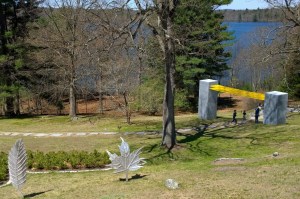
A beautiful day is always a good excuse to walk the grounds of the deCordova Museum in Lincoln, Mass., enjoying the sculptures and lake view.

A little history from the museum website: “DeCordova Sculpture Park and Museum is located on the former estate of Julian de Cordova (1851-1945). The self-educated son of a Jamaican merchant, Julian de Cordova became a successful tea broker, wholesale merchant, investor, and president of the Union Glass Company in Somerville, Massachusetts. Although he married into the locally prominent Dana family of Boston, Julian achieved prosperity without the advantages of inheritance or social position. …

“Inspired by his trips to Spain and his own Spanish heritage, Julian remodeled his summer home in Lincoln, Massachusetts in 1910 to resemble a European castle. …

“For Julian, the visual arts served as a medium for self-improvement and enlightenment. In his later years, he opened the doors of his estate to share the wonders he had collected during seven decades of world travel. Julian envisioned a place where art would continue to educate and excite beyond his lifetime. To meet that end, he gave his property to the town of Lincoln in 1930 with the stipulation that his estate would become a public museum of art following his death.

“Julian’s will established a committee of incorporation, whose duties included formulating the policy, objectives, and supervision of the new museum with the guidance of professionals in the field, such as the Director of the Museum of Fine Arts (MFA) in Boston. Independent appraisers determined that Julian’s collections were not of substantial interest or value, so the collection was sold and the proceeds were used to create a museum of regional contemporary art.”

It’s nice to have an institution that focuses on New England artists, especially one that also offers a beautiful park for families to enjoy.

The yellow cables that seem to vibrate between the concrete blocks are a startling aspect of Stephanie Cardon’s sculpture Beacon. The collection of giant leaves, by Alan Sonfist, is called The Endangered Species of New England. The purple carpet is by Mother Nature and is called Violets.

042416-DeCprdova-lake

042416-DeCordova-giant-leaves


042416-violet-carpet-Lincoln-Mass

Read Full Post »

In her comment at my post about artists returning a discarded museum to life, KerryCan wondered if all the old, weird museum collections ended up at the dump. All is not lost if they did, as dumps seem to attract amateur archaeologists with a nose for uncovering treasures.

Eve Kahn wrote recently in the NY Times about collectors who look for terra cotta shards in the Staten Island landfill and poke around promising demolition sites.

“This summer, true shard collectors [led] me into the weedier parts of the Northeast, where slag heaps and demolition debris survive from the long vanished factories that once thrived.

“These particular experts are interested in manufacturers of windowpanes and architectural ornament. They write books and lead tours, but they also pack their homes and workplaces with excavated artifacts from what seems to be a limitless supply. Anyone can follow in their trail and gain an understanding of American ingenuity as well as accumulate booty for gardens and windowsills or even more ambitious art projects.

“You must stay off private property, of course, but I also recommend that you avoid the comical errors that I made on my early expeditions. … I was so bedazzled by glass that I was about to sit down with shards in my front pockets.”

More on Kahn’s scavenging adventures, here. You might also like the blog “Tiles in New York,” here.

Photo: Agaton Strom for The New York Times
Tina Kaasman-Dunn searching for terra cotta shards on Staten Island.

Read Full Post »

No matter how bad things get in the great world, there will always be someone who starts a quirky, individualistic project just for the love of it, reassuring us all.

In Providence recently, a few folks got together to resurrect an abandoned natural history museum partly to see what an early museum looked like, partly because it was a shame to throw it all out.

In the NY Times, Henry Founatain wrote,  “If museums are meant to preserve objects forever, then forever ended here in 1945.

“That year, Brown University’s natural history museum, which included multitudes of animal skeletons and specimens among its 50,000 items, as well as anthropological curiosities like rope made from human hair, was thrown away.

“It was a sad end to what had been a labor of love for John Whipple Potter Jenks, a Brown alumnus, taxidermist and naturalist who founded the teaching museum in 1871.

“But Jenks had died in 1894 — on the steps of the museum, no less — and what by then was known as the Jenks Museum fell into disarray. It was shuttered in 1915, and the objects were scattered or stored until most of them were hauled, in 92 truckloads, to a nearby dump in 1945.

“But now the Jenks Museum lives again, at least temporarily, in an exhibition that is as much about art as it is about science.

“A group of Brown graduate students, with help from a faculty adviser and a New York artist, has rounded up a few surviving odds and ends, commissioned artists to recreate some of the vanished objects, and installed it all in Rhode Island Hall, the home of the original museum. The exhibition, which also includes a recreation of Jenks’s office as it might have looked in the year of his death, will be on display until spring.” Read more here.

The Lost Museum will be on display in Rhode Island Hall on the Brown University campus, 60 George Street, the Jenks Museum’s original home, through May 2015.

Photo: Mike Cohea/Brown University
The office of John Whipple Potter Jenks, who founded the natural history museum at Brown University, was recreated for an exhibition called Lost Museum.

Read Full Post »

Barnes-3


Barnes-waterfall

Today I need the Indian goddess with the many arms because I want to say about the Barnes Collection in its new home, “On the one hand, on the other hand, on the third hand …”

After I saw the documentary The Art of the Steal, about how the fabulous art collection that was willed to a historically black college to keep it from art-world experts ended up in the hands of art world experts, I thought a trustee at Lincoln University had sold his patrimony for a mess of pottage. Now I think that receiving untold wealth is a curse and the donor better have a good plan and lots of resources to support the unfortunate recipient. (More about the movie.)

That’s two hands.

On Thursday, having visited the Albert C. Barnes collection in its new Philadelphia Museum of Art building, I needed a few more hands.

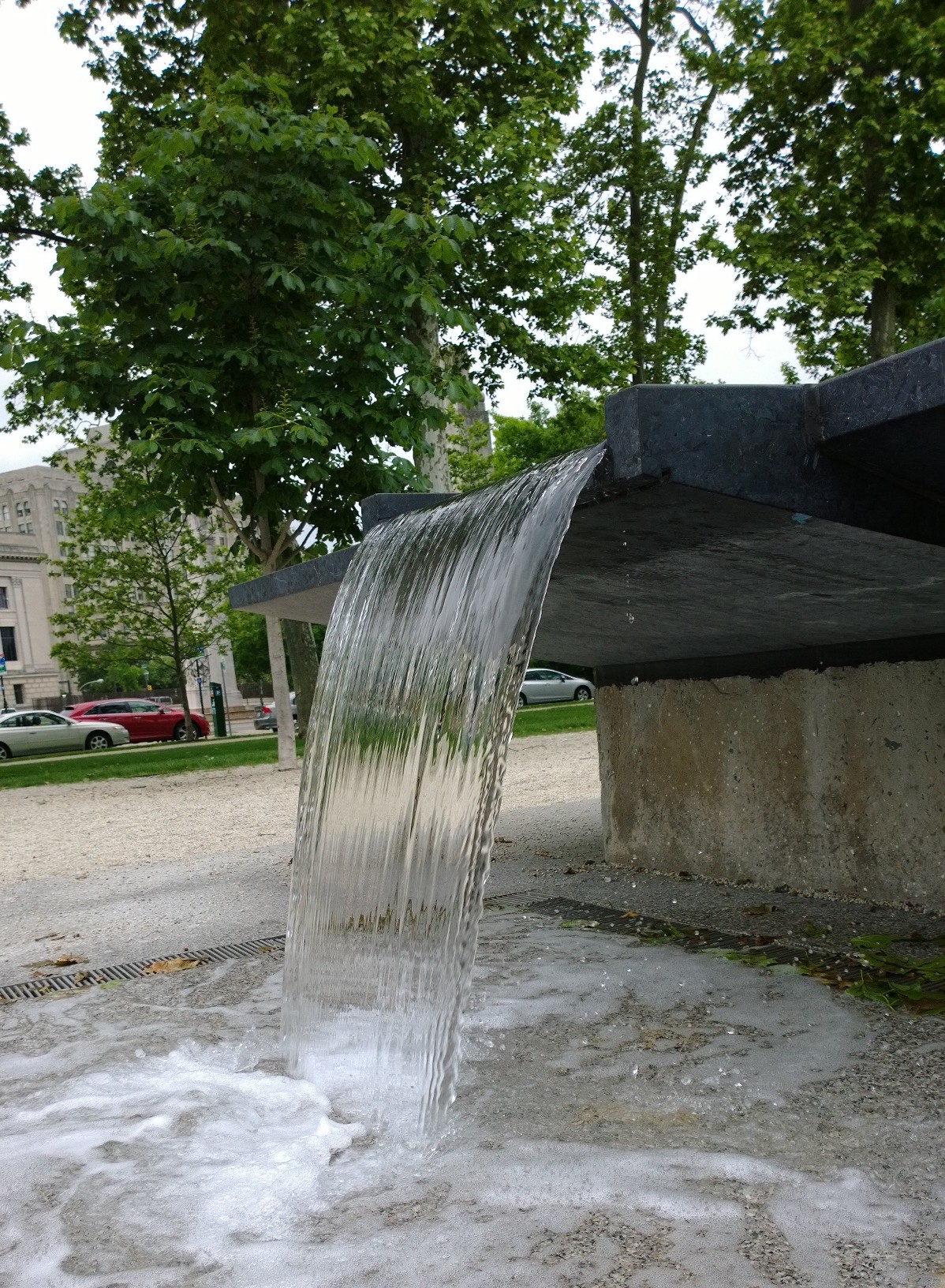
On the third hand, the building is gorgeous in its simplicity and displays the art (69 Cezannes, anyone? How about 60 Matisses? 44 Picassos? 178 Renoirs? Do you love Seurat? Van Gogh? Pennsylvania Dutch furniture?) in the quirky layout of the old Merion, Pa., setting and without labels as Barnes did. On the fourth hand, lack of labels is annoying. On the fifth hand, the art experts provide an ipod with lectures on selected works and a booklet to identify all the items exhibited. On the sixth hand, faithful as the layout is, Dr. Barnes, who made his money in pharmaceuticals and wanted ordinary working families to enjoy and study art without the filter of the art establishment — would have had a heart attack about the entry fee and the standard gift shop and coffee shop and other luxurious museum appointments.

The museum is definitely worth seeing, for the building, the art, and the way the roaring controversy was all handled. But it’s the little things I will cherish like finding black and white illustrations that reminded me of Dickens illustrations and turned out to be by the school friend Barnes asked to help form his taste and get him started on collecting (William Glackens).

Giorgio de Chirico, Portrait of Albert C. Barnes, 1926

Read Full Post »

David Guttenfelder seems to get into North Korea and take pictures there more than anyone else, but what are you allowed to take pictures of in North Korea?

When Guttenfelder isn’t attending any official event, he improvises. He may have invented an art form in North Korea — artifact photography. He snaps bunches of plastic flowers in a hotel room, dinner menus, concert programs and labels them as “artifacts,” numbered.

No wonder he is involved with a new artifact museum, mmuseumm, which features the kooky things people collect.

Consider Toothpaste Tubes from Around the World, collected by Tucker Viemeister.  Says Viemeister, “Although I come from a ‘Crest family,’ I got my first tube of foreign toothpaste in Finland in 1985. We were shopping for normal stuff (Marimekko and toiletries). I saw a tube of toothpaste that’s [got a] name as long as the tube! They have long words in Finland.

“As I traveled around, I’d sample the toothpaste around the world. It was fun to buy and fit easily in my bag. Meanwhile it was an easy gift!

“I noticed that toothpaste is a universal media for indigenous people – a veritable blank canvas — both graphics on the generic tube and the flavors of the paste. French brands are more gourmet, Asian is more fruity, while American is very sharp (it this stereotyping?).” More here.

The museum is in Cortlandt Alley between Franklin St. and White St. in Manhattan.

(I wonder if my collection of wooden thread spools is extensive enough for a museum. I am afraid I lost the varied European toilet papers I collected on a trip at age 15.)


Read Full Post »

If you saw a sign in a museum saying that the suggested entry fee for students was $8, would you ask if you could pay $2? Would you even ask what the sign meant?

Museums may be taking too much for granted about what people know.

All summer, after classes, Chanel Baldwin hung out in the lobby of the Brooklyn Museum for the air-conditioning. She didn’t understand that the $8 “suggested” student admission was merely suggested. So she got to know intimately the only painting that was in the lobby, and she thought about what was meant by the details surrounding the black man on the horse in “Napoleon Leading the Army Over the Alps,” by Kehinde Wiley.

One day when her cousin was cooling in the lobby with Chanel, NY Times reporter Anand Giridharadas showed up, explaining that they could go through the entrance gate without paying. “No donation today, thank you,” Giridharadas said to the cousins’ astonishment.

“The gates parted,” writes the reporter. “We received green tags to prove our bona fides. … The first room set [Chanel] alight and held her rapt until she had to leave. There was no label too tedious to read, no piece undeserving of her scrutiny. …

“ ‘Look at the detail on it,’ she said of a Fred Wilson mirror, gasping.

“A piece called ‘Avarice,’ by Fernando Mastrangelo, gripped Ms. Baldwin. It appeared from afar like a classic Aztec sun stone. But she got up close. Traced her fingers over it. Went to one side, looked at it; went to the other side, considered it that way. She noticed that the piece was made of corn, and then detected a toothpaste tube, soda bottles and cowboy hats lurking on the surface, all crackling with meaning.

“Watching her,” says Giridharadas, “I realized how the inadvertent exclusion from these rooms must have trained her eyes. … New York is run on the kinds of understandings that kept the cousins in the lobby, with so many places formally open to anyone but protected in their exclusivity by invisible psychic gates.

“Ms. Baldwin suggested a more honest approach, since people tend to think you have to pay: ‘They should just put a sign out telling us that it’s somewhat free.’ ” More here.

Suzanne’s Mom admits that she might not have known the secret code either. But then, she always had the $8.

Photo: Karsten Moran for The New York Times
Chanel Baldwin exploring the Brooklyn Museum after learning that “suggested” when admission fees are “suggested,” that could mean free.

Read Full Post »

Cultural institutions are getting smaller. And more local.

We wrote about a library in a phone booth here and the Little Free Library here. You can see fully realized short films on YouTube and street art just around the corner.

Now folks in Somerville have launched a museum in a doorway. It’s The Mµseum.

From the website: “Judith Klausner (Co-Founder, Curator) is a Somerville MA artist with a love for small, intricate, and overlooked things. She first dreamed up the Mµseum in 2010, as a way to combine her love of  serious miniature art with her passion for making art accessible, and her conviction that New England arts institutions should show the work of New England artists. Three years (and a lot of planning) later, she is delighted to see it become a reality. … Contact Judith at judith@themicromuseum.com.

“Steve Pomeroy (Co-Founder, Engineer) is a programmer and a builder, both by profession and by nature. He’s largely responsible for the engineering behind the Mµseum, from the solar-powered miniature track lighting to the 3D-printed doric columns and laser-cut façade typography. He formally studied computer science at the Rochester Institute of Technology where he discovered a love of communication protocols and formal computer languages. Contact Steve at steve@themicromuseum.com.”

WBUR had a story on the micro museum here.

There is something childlike and innocent about miniature enterprises. Didn’t you always think as a child you could take a few toys and tea cups and bags of flour and new sponges from around the house and set up a table on the street as an authentic store? You thought, Why not? Just do it.

I get a kick out of people just doing it.

Photo: Mara Brod, http://marabrod.com/fineart.html

Read Full Post »

Photo from FBI site: An empty frame in the Dutch Room of the Gardner Museum, where Rembrandt’s The Storm on the Sea of Galilee and A Lady and Gentleman in Black once hung.

The agent overseeing the FBI investigation into the 1990 Isabella Stewart Gardner Museum heist spoke at my workplace today (a real perk of my job).

I learned a lot. Did you know, for example, that because Mrs. Gardner’s will specified that no art was to be moved, sold, or replaced, the paintings had no insurance? They were not be replaced. The agent said that the usual scenario is that stolen art is held for ransom from the insurance company. The thieves probably didn’t dream that there was no insurance on Rembrandts and Vermeers.

Our speaker was quite entertaining (for example, showing a slide from the Simpsons cartoon in which Vermeer’s The Concert is found in Montgomery Burns’s mansion ). He answered many questions and punted others as the investigation is ongoing.

As you may have seen recently, the FBI announced that they knew who had stolen the art and at least two of the places it had been seen. They have not announced the names of the thieves but may do so once they work through all the leads the latest announcement has brought. The statute of limitations ran out on the theft after five years (Mass. Senator Ted Kennedy subsequently pushed through a federal law extending the limit to 20 years), but possession of stolen art is a crime not subject to time limits.

I learned that the museum had good security. As most locals know, the guards let the thieves in believing they were cops. When you have a Trojan Horse inside, security doesn’t help, the agent said. Nowadays guards in different museums call each other every 20 minutes just to check.

Extensive research has shown there has never been a museum theft like this, where the thieves stole so much of value and also so much of little value and took a leisurely 81 minutes to do so.

And perhaps there has never been a crime at a major museum where the paintings were not insured.

The agent believes the art will be recovered one day. Read the FBI dedicated site, here.

Photo: Simpsons

Read Full Post »

About a year ago we had the great pleasure of attending a panel discussion featuring Orhan Pamuk, winner of the 2006 Nobel Prize for Literature. We took our seats at the New Yorker magazine’s lecture series, and because I had read his novel Snow, I was expecting someone quite dour and grim.

Instead he was hugely entertaining and funny as he talked about literature and his latest project, creating a museum to replicate one he had invented for his 2008 novel, The Museum of Innocence.

Writes Gareth Harris in the September 2010 Art Newspaper, “Turkey’s most famous living novelist is holding a pair of dentures in a room packed with ephemera reflecting everyday Turkish life of the past three decades. Orhan Pamuk, winner of the Nobel Prize in Literature 2006 and author of My Name is Red (1998) and Snow (2002), is standing among a sea of objects—sewing machines, clocks, soda-bottle tops, buttons, lottery tickets, china dogs, birdcages, cigarette lighters and false teeth—that will soon go on display in The Museum of Innocence, a four-storey building in the Çukurcuma neighbourhood, central Istanbul. This venue, not just a chamber of curiosities, is the real-life incarnation of the museum painstakingly assembled and detailed in his book The Museum of Innocence (2008).”

I expect that, for someone who has read the novel, the museum experience will be both delightful and unnerving. I know I felt delighted and unnerved years ago after reading a nonfiction book about a Rhode Island community and then trying to reconcile the characters who had seemed so real with the people who had been described. Storybook characters coming to life. At first the real people seem shadows. Then as you get to know them, the storybook characters become the shadows, superficially imagined imitations.

April 30, 2012, update here.

Read Full Post »

We went downtown to have lunch at the Whitney Museum with friends and to take in the Real/Surreal exhibit.

Favorite artists like Charles Sheeler, Mardsen Hartley, and Grant Wood were featured. I liked the eerie emptiness of Edward Hopper’s “Seventh Avenue” and the anxious denizens of George Tooker’s subway world.

Sounds unnerving, but in surfacing the alienation, I think the artists make one feel the possibility of getting a grip on it.

Afterward, we walked up Madison, stopping at a gallery in the Carlyle Hotel that was showing Magritte works, some for sale.

I have always liked Magritte, with his bowler-hatted men blocked by giant green apples and his nighttime streets overarched by daytime skies. And I especially like him because once in a workshop, I directed a Tom Stoppard one-act play inspired by him, After Magritte. It was the best fun!

Read Full Post »

My workplace closes down on Veterans Day, so today my husband and I finally got a chance to visit the new Art of the Americas wing at the Museum of Fine Arts.

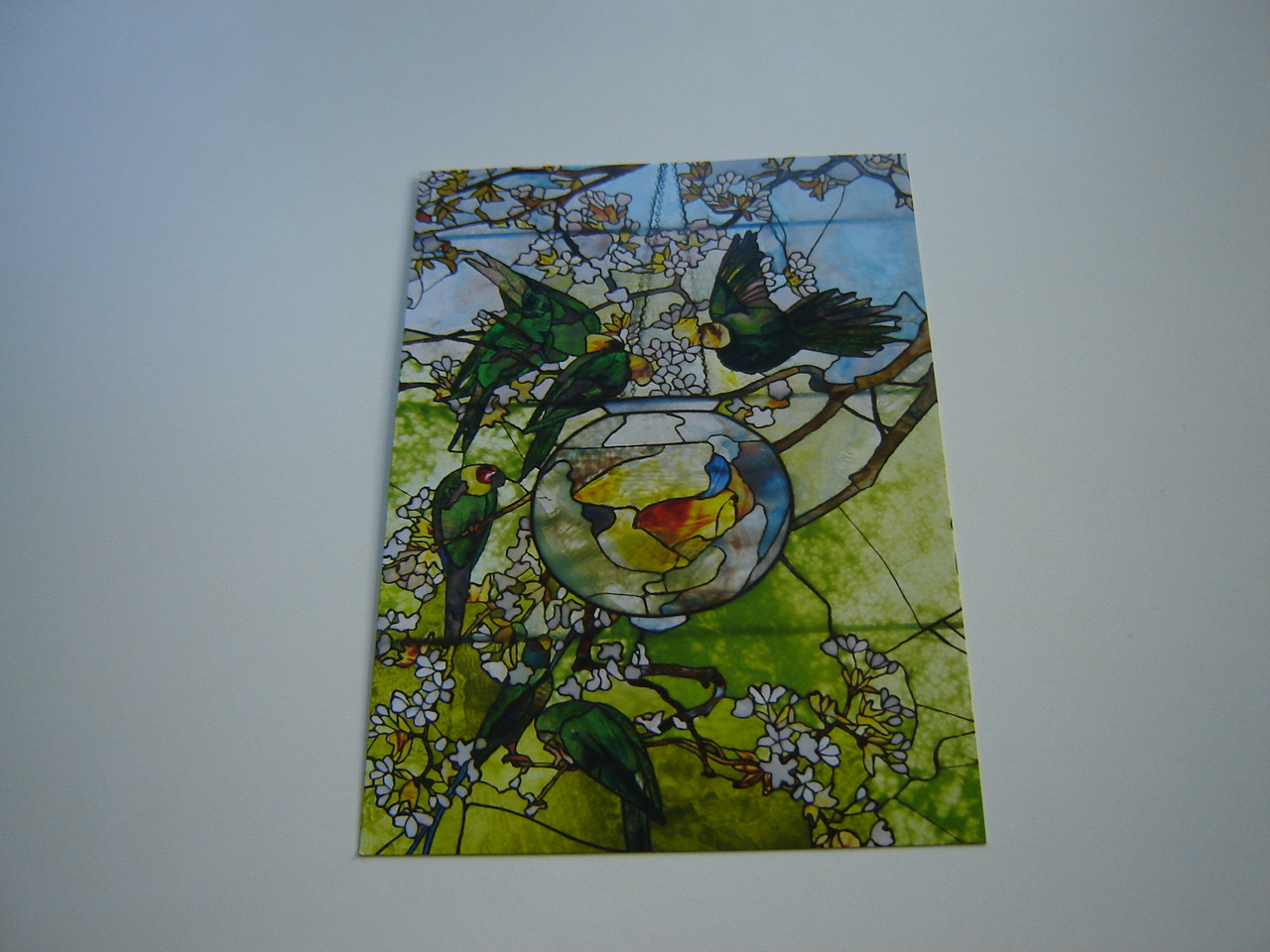
I didn’t realize that people bring cameras to museums now and take pictures of whatever they like. Is that allowed? For this post, I wanted to use a particular painting I saw today, but after trying the MFA site and searching the Internet, all I could find was a bootlegged photo for sale at Flickr. Fortunately, I did buy an MFA postcard that I was able to photograph at home.

This is a Louis Comfort Tiffany-designed stained glass window of parakeets and a goldfish bowl.

My favorite floor was the third, though. There we saw some great 20th Century art: Calder mobiles, a Jackson Pollock, works by Charles Sheeler, Georgia O’Keeffe, Arthur Dove, Marsden Hartley, the photographer Weegie, and more. Although the MFA also has a new gallery of contemporary art in a different part of the building, I liked the selections on the third floor of the Americas wing best.

At lunch we ate in the new dining area, a large, beautiful space that combines both classical and modern styles comfortably and features a tall, green, glass sculpture by Dale Chihuly.

The food was very good.

Read Full Post »

« Newer Posts