Feeds:
Posts
Comments

Posts Tagged ‘music’

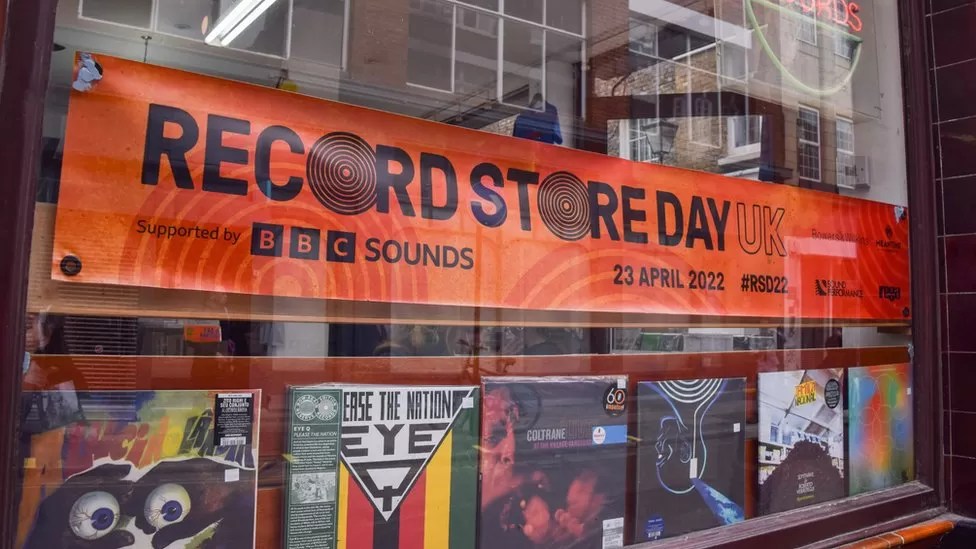
Photo: Getty Images.
Record Store Day celebrates independent music stores in the UK, says the BBC, “with many labels and artists releasing limited vinyl editions specifically on the day.”

Some of us still listen to our vinyl records. And others are starting to. In fact, vinyl records have become so popular in England that there is now an official Record Store Day to celebrate the bricks-and-mortar places you can buy them.

Gareth George reports at the BBC, “More young music fans are snapping up the latest releases on vinyl, triggering a boom in LP sales. In 2022, vinyl outsold CDs for the first time in 35 years. Ahead of Record Store Day in the UK, the BBC asked young record store regulars why ‘old school’ beats downloads. …

“Will, 16, is a GCSE [General Certificate Secondary Education] student and guitarist who hopes to study music full-time at the Colchester Institute. He believes buying vinyl is a better way of supporting artists than streaming or downloading music and reveals he has inherited his own collection of records from parents and grandparents. …

” ‘You can inherit not only the music, but also the memories, and tell the story though vinyl.’

“Will is running a second-hand vinyl stall with Sam, 18, from Chelmsford, a guitarist and singer who plays in a band called Alison. Sam says record fairs are essential because new vinyl LPs can be expensive for budding collectors.

” ‘It’s hard to become a vinyl collector now when you go to your local record shop and see that it’s 40 quid a record,’ he says. ‘That’s why these record fairs are important. Stuff’s just cheaper.’

“The pair work at Intense Records in Chelmsford, one of the hundreds of independent music shops across the UK taking part in Record Store Day on 22 April. The annual event, which was established in 2007, has become one of the biggest in the music calendar, with independent record shops often achieving their highest sales of the year. …

” ‘We’ve definitely seen a new generation of younger music fans embracing vinyl,’ says Record Store Day UK co-ordinator Megan Page. ‘For superstar artists like Taylor Swift and The 1975, vinyl has become a really important part of their marketing campaign. …

“Jon Smith, manager of Intense Records, says DJs will be playing to the crowds of collectors expected to go along. He said many customers hope to grab a bargain or snap up a limited release on the day. …

“Nineteen-year-old Kasabian fan, Geordie Breeze, is ‘crate-digging’ in Norwich – a vinyl hunter term for flicking through the rows and racks of records in music shops. The environmental science student at Lancaster University says he already has ‘a few hundred’ vinyl LPs. ‘I think the sound quality’s better, and I like a physical record to hold,’ he says.

“According to figures from the British Phonographic Industry, vinyl records outsold CDs in 2022 for the first time in 35 years. The revenue generated from vinyl was [about] £119.5m [$128 million] more than CDs. …

“Musician Imogen Bradley, 23, looks out for ‘old school hip-hop’ on vinyl. She is a fan of British rapper MF Doom and American hip-hop collective Wu-Tang Clan. ‘I just prefer having a physical copy,’ she says.”

What was before vinyl? My grandfather left behind a wind-up Victrola with a horn that would be valuable today. But my brother and I at a young age thought it was hilarious to smash the records. Golly, but kids are weird!

More at the BBC, here. No firewall.

Photo: Suzanne and John’s Mom.

Read Full Post »

Photo: Buda Musique via the BBC.
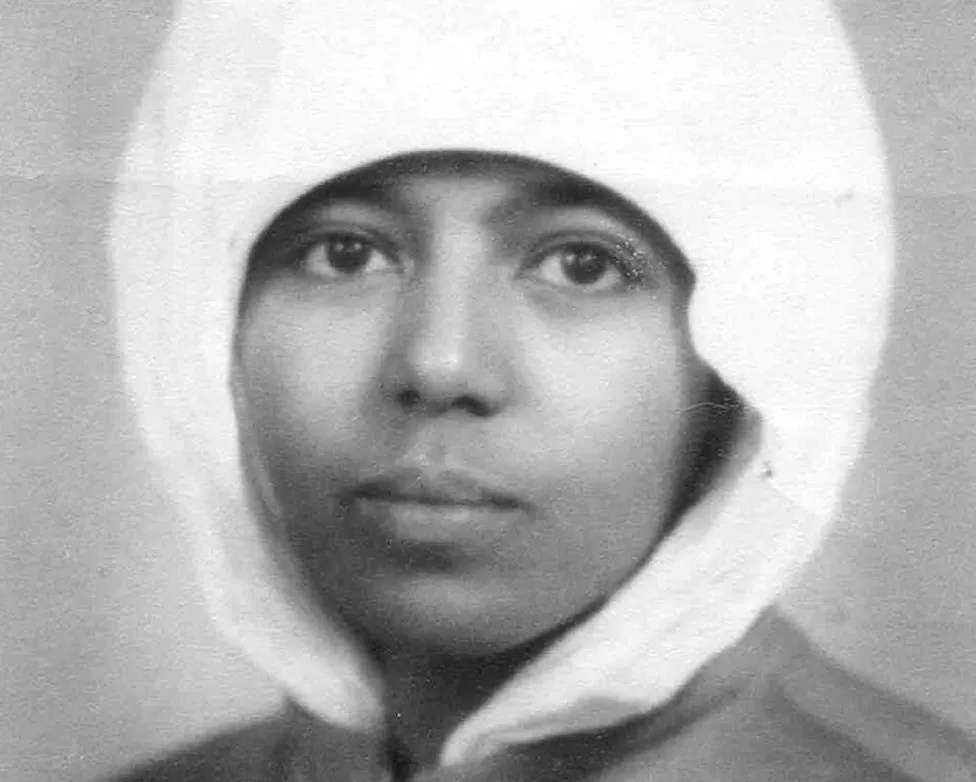
Emahoy Tsegué-Maryam Guèbrou, the composer and piano-playing nun who died March 26 at age 99. The BBC reports she led an “extraordinary life, which included being a trailblazer for women’s equality and walking barefoot for a decade in the isolated mountains of northern Ethiopia.”

Here’s a woman who had a long and fruitful life, dying at 99 after making her mark as a nun, a musician, and a proponent of women’s equality. You may be surprised to learn of the advantages a girl could have back in the day if her family was connected to Ethiopian royalty.

Brian Murphy reports at the Washington Post, “Emahoy Tsegué-Maryam Guèbrou, a classically trained musician who once abandoned music for a hermit-like life as a nun in her native Ethiopia and later returned to the piano with a genre-defying blend of Western and Ethiopian influences, died March 26 at her convent in Jerusalem. She was 99. …

“The styles explored by Sister Guèbrou (the title Emahoy is equivalent to ‘Sister’ for a nun) were so singular in sound and structure that music scholars often puzzled over the main source of her inspiration — seamlessly mixing forms such as jazz, chamber music and rhythms from her homeland. …

“Her work was brought to a larger audience in recent years on the soundtrack for the Oscar-nominated documentary Time (2020) about a two-decade saga for an inmate and his family; and as music on the Netflix race-and-prejudice drama Passing (2021).

“Sister Guèbrou, meanwhile, spent long stretches in solitude inside the Ethiopian Monastery of Debre Genet, or Sanctuary of Paradise, in Jerusalem, where she lived since 1984 in a single room adorned with her artwork of icons and angels. …

“In her few specific comments on her musical influences, she expressed admiration for the European classical canon including Frédéric Chopin and Johann Strauss. Yet she stayed rooted in the five-note melodic runs common in Ethiopian music, while also exploring the flowing richness of Eastern Orthodox chants or the distinctly American sounds such as jazz or the old-timey snap of ragtime. …

” ‘Just within the first five or 10 seconds of the song, we have invocations of European modernism, of Ethiopian traditional music and of the links between Ethiopian Orthodoxy and a broader Judeo-Christian tradition,’ said Ilana Webster-Kogen, an ethnomusicologist at the University of London’s School of Oriental and African Studies.

“ ‘Getting all of that musical information within about five seconds of listening means that comparing her to anyone else wouldn’t make sense,’ she added.

“There was a decade, however, when Sister Guèbrou played nothing at all.

“She was a rising young talent as a teen, studying for two years under Polish violinist Alexander Kontorowicz in Cairo and then was offered a scholarship to London’s Royal Academy of Music. Sister Guèbrou never made clear what happened next. For some reason, she was blocked by Selassie’s government from traveling to London.

“She was devastated. For nearly two weeks, she refused to eat. She ended up in a hospital in Ethiopia’s capital, Addis Ababa. Her family feared she was near death. Weak and ailing, Sister Guèbrou said she slept for an entire day.

“ ‘When I wake up, I had a peaceful mind,’ she told the BBC in 2017. ‘I was changed. And I didn’t care for anything.’

“She left music behind. At 19, she joined the Gishen Mariam monastery in Ethiopia’s northern highlands. For the next decade, she barely left the monastery grounds, where she slept in a hut on a dried-mud bed. She noticed many of the nuns and monks were barefoot. She gave up shoes as well.

“She had already experienced huge swings in her life. She was raised in privilege in a family that had deep connections in the Ethiopian royal court, including her father’s work in diplomatic and liaison roles. She and her sister, Senedu, attended a Swiss boarding school and soaked in Western music and art.

“After Italian forces under Benito Mussolini invaded Ethiopia in 1935, Sister Guèbrou and her family were placed under house arrest and later sent to POW camps in Italy for two years. Three of her brothers were killed in the fighting. (She composed the 1963 piece, ‘The Ballad of the Spirit,’ in their memory.) …

“At nearly 30 years old, she decided to see how her fingers felt back on the piano keys. The music flowed. Now, however, it was more infused with the meditative sounds and chants from the monastery.

“ ‘I said to myself, “I have nothing. I have music,” ‘ she recalled. ‘I will try to do something with this music.’ …

“In 1974, a coup toppled Selassie and ended Ethiopia’s monarchy. Anyone favored by the ousted royal regime, including Sister Guèbrou and her family, was now under suspicion and closely monitored. When Sister Guèbrou’s mother died in 1984, she moved permanently to the monastery in Jerusalem, always seen in public in the flowing religious garb that covered her head. …

“ ‘We can’t always choose what life brings,’ she told the BBC. ‘But we can choose how to respond.’ ”

More at the Post, here.

Read Full Post »

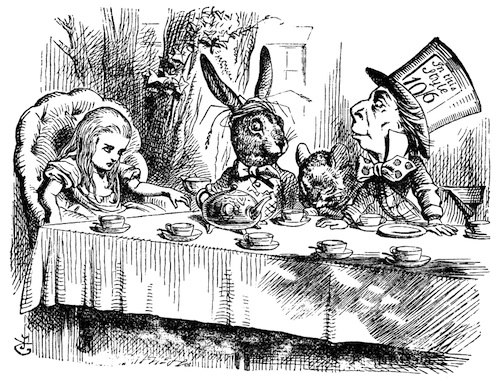
Art: John Tenniel.
The Dormouse in Alice in Wonderland tells a story of sisters at the bottom of a well who were learning to draw “all manner of things — everything that begins with an M … such as mouse-traps, and the moon, and memory.”

When periodicals like the Washington Post block bloggers from linking to their images, we scavenge around for alternative illustrations. Today’s Post article on music and memory made me think of words that begin with an “m,” as the Dormouse did in Alice in Wonderland. The Dormouse even talks about “drawing” memory. Look it up.

Marlene Cimons has a report on music and dementia.

“When Laura Nye Falsone’s first child was born in 1996, the Wallflowers album ‘Bringing Down the Horse’ was a big hit. ‘All I have to hear are the first notes from “One Headlight,” and I am back to dancing … with my brand-new baby boy in my arms,’ she says. …

“When Carol Howard’s early-onset Alzheimer’s worsened, often she couldn’t recognize her husband. She once introduced him as her father. But if she heard a 1960s Simon & Garfunkel song playing, Howard, a marine biologist who died in 2019, could sing every word ‘effortlessly,’ her husband says.

“This ability of music to conjure up vivid memories is a phenomenon well known to brain researchers. It can trigger intense recollections from years past — for many, more strongly than other senses such as taste and smell — and provoke strong emotions from those earlier experiences.

“ ‘Music can open forgotten doors to your memory,’ says Andrew Budson, chief of cognitive and behavioral neurology, associate chief of staff for education and director of the Center for Translational Cognitive Neuroscience at Veterans Affairs Boston Healthcare System.

“ ‘Music can take you back in time, as well as act like a jolt of electricity that can fire up your brain and get it going,’ he says. ‘We all have the familiar experience of going back to our hometown, visiting our high school and feeling the memories come flooding back. Music can do same thing. It provides an auditory and emotional setting that allows us to retrieve all those memories.’

“Scientists who study music’s powerful effects on the brain say that growing knowledge could improve therapy for such conditions as dementia and other memory disorders, anxietystress and depression, learning disabilities and many physical illnesses, such as chronic paincancer and Parkinson’s disease.

Evidence also exists that music prompts the secretion of brain neurotransmitters, such as dopamine, a chemical messenger that plays a role in the brain’s reward/pleasure system. Other studies have shown that music reduces the stress-producing hormone cortisol and increases the secretion of oxytocin, which plays a role in labor and childbirth, as well as in infant-parental bonding, trust and romantic attachment.

“ ‘Music activates different parts of the brain,’ making it an especially versatile tool, says Amy Belfi, assistant professor of psychological science at Missouri University of Science and Technology and principal investigator in its Music Cognition and Aesthetics Lab. ‘We can use it to improve mood, to help us learn, to socially bond with other people. It becomes part of our identity.’ …

“Some experts also see a role for music — which can ease agitation in those with dementia — as an alternative to sedating medications, for example, or as a means of enabling patients to keep living at home.

Frank Russo, professor of psychology at Toronto Metropolitan University, says he believes this ultimately will be possible. He is chief scientific officer of a company that is developing a music player that uses artificial intelligence to curate an individualized play list designed to guide a patient from a state of anxiety to one of calm.

“ ‘One of the really challenging things for caregivers is the anxiety and agitation,’ says Russo, whose research focuses on the intersection of neuroscience and music. … ‘Music has a real opportunity here.’

“Melissa Owens, a music therapist at Virginia Commonwealth University Health, already has seen this in her work. ‘I still find myself in awe of music’s ability to positively change behavior, emotion and even the relationship between a caregiver and their loved one, if even only for the duration of the specific song,’ she says. It provides ‘a moment of normalcy which so much of the time seems lost.’ ”

Read how experts look at the different types of memory involved at the Post, here.

Read Full Post »

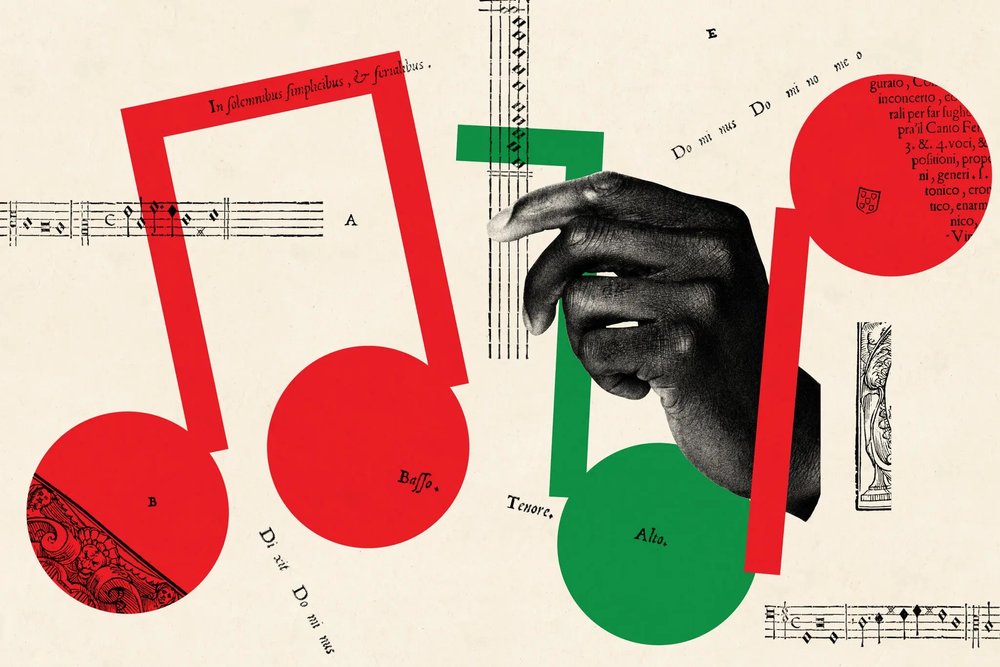
Illustration by Cristiana Couceiro at the New York Times. Photo: Getty Images.

A black musician who composed sacred and secular vocal music more than 400 years ago is getting attention at last, thanks to the internet. Garrett Schumann recently wrote for the New York Times about composer Vicente Lusitano.

“On a day in June 2020, Alice Jones was in her Brooklyn apartment getting ready to attend a Black Lives Matter rally. Dr. Jones, a flutist and composer who serves as an assistant dean and faculty member at the Juilliard School, was adamant about expressing herself as a Black classical musician. …

“Dr. Jones designed a sign that listed Black composers throughout history. After adding Joseph Boulogne, Chevalier de Saint-Georges, the 18th-century subject of the upcoming film ‘Chevalier, she faintly remembered another, older name: Vicente Lusitano.

“Lusitano was an African-Portuguese composer and music theorist who was most likely born between 1520 and 1522, and who died sometime after 1562. Probably the child of an enslaved African woman and a Portuguese noble, Lusitano traversed Europe in a career that saw him depart the Iberian Peninsula for Rome as a Catholic priest in 1550 and, around a decade later, relocate from Italy to Germany as a married Protestant.

“He wrote sacred and secular vocal music, taught extensively and produced scholarship that includes a unique manuscript treatise on improvised vocal counterpoint. …

“It took until the late 19th century for new scholarship to revisit Lusitano’s printed works, beginning a 150-year-old reclamation project. Important strides were made in the 1960s and ’70s as new sources emerged, most notably a 17th-century manuscript that describes Lusitano as ‘homem pardo,’ a historical Portuguese term for certain mixed-race people of African descent. And since 2000, the internet has become increasingly important to Lusitano scholarship; the summer of 2020 saw the onset of a new and ongoing flurry of interest whose roots are entirely digital.

“Dr. Jones’s demonstration sign played a part in the current wave of activity: A picture of her placard went viral on social media and broadcast Lusitano’s name to a new audience. Joseph McHardy, a Scottish-Congolese conductor and early music specialist based in London, was stunned when he saw Dr. Jones’s post. ..

‘Learning about Lusitano reminded me of the feeling I got when I learned there were Black people in the Roman Empire.’

“After seeing the sign, McHardy quickly searched for scores of Lusitano’s music to perform with his church choir, but could only find scans of the 16th-century originals. So, he spent that summer making his own updated versions. He’s one of many experts and enthusiasts who produced the first modern editions of Lusitano’s compositions and shared them on free online databases. The result was a burst of new performances in the months that followed. Nearly five centuries after Lusitano’s death, dozens of choirs in the United States, Canada and Europe performed his music for the first time, largely because his scores were finally accessible.

“Britain has been the epicenter of Lusitano’s current musical resurgence. In June, McHardy partnered with the Chineke! Foundation to produce a tour highlighting Lusitano’s sacred works with an ensemble composed entirely of vocalists of color. The motets’ beauty astonished McHardy, who said, ‘We had no idea Lusitano’s pieces would be so enjoyable to sing.’

“His collaborators, too, were impressed. ‘I have fallen in love with Lusitano’s music,’ said Malcolm J. Merriweather, an American baritone and conductor who performed on the tour.

“The Marian Consort, another British choir, led by the conductor Rory McCleery, preceded McHardy’s tour with a 2021 concert series featuring one of Lusitano’s works, which they also performed at that year’s BBC Proms. …

“Today, Lusitano is not easy to study, even if you can find performances of his music on YouTube. Little correspondence and few records of his life are known to have survived, both because earlier scholars had no interest and because his sociopolitical disenfranchisement constrained the production of such documents. Contextual evidence is critical, especially with respect to his identity.

“We know other pardo people existed in 16th-century Portugal. At the time, thousands of African and African-descended people, most of whom were enslaved, lived in the country. … Lusitano’s experience as a historical figure illustrates the kind of collective activity that has traditionally excluded composers of African descent from classical music’s conventional performance and academic institutions. Melanie Zeck, a reference librarian at the Library of Congress’s American Folklife Center and former reference librarian at the Center for Black Music Research, emphasized that the first historians of Black classical music responded to these exclusionary tendencies by developing what she called a ‘totally separate practice from mainstream academic scholarship.’ …

“Now, the internet and social media can empower these principles of Black music scholarship, though, as Dr. Zeck said, ‘misinformation abounds.’ But for Lusitano, these technologies nevertheless have helped the truths of his life and music become more accessible than ever, 500 years after his birth.”

More at the Times, here.

Read Full Post »

In spite of living in the Greater Boston area for 40 years, I had never been to the Boston Pops. I decided to check out this year’s holiday concert and go by public transportation.

The Red Line subway track was being repaired and was not in use that Saturday, so the transportation ended up being a problem, but I was glad I went. It was lovely.

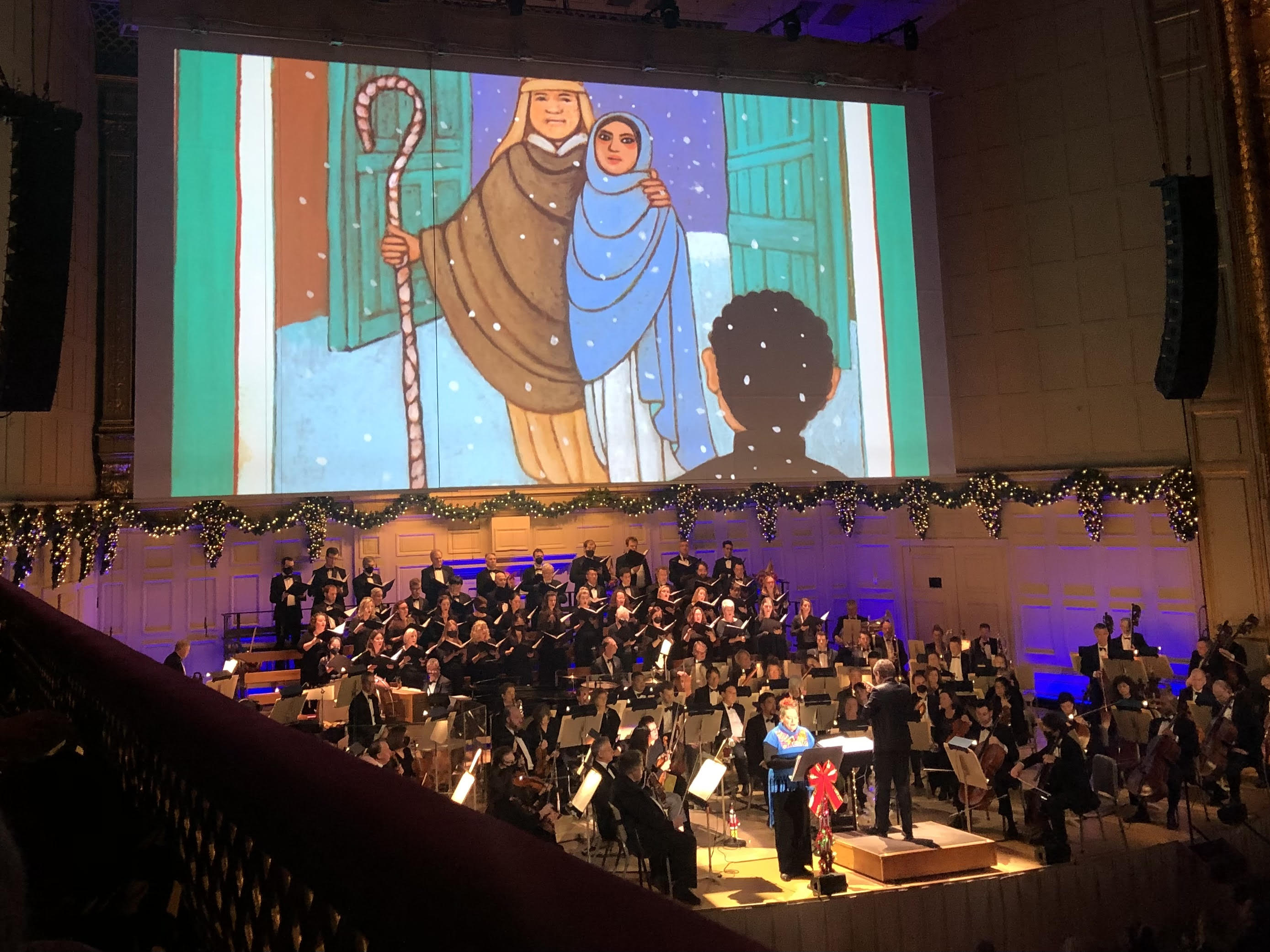
One of the pieces featured was the premier of composer Arturo Rodríguez’s Noche de Posadas (The Night of Las Posadas), which was based on a Mexican tradition and tied to a children’s book by the late author/illustrator Tomie dePaola.

Rodríguez, a native of Mexico, wrote in the program about the custom that inspired dePaola’s storybook and about working on the commission from the Boston Pops Orchestra.

“The enduring tradition of Las Posadas in México,” he wrote, “is a representation of Joseph and Mary and their pilgrimage from Nazareth to Bethlehem. The community organizes into two groups, those who accompany the couple while they go from door to door in search of shelter and those inside the houses that reject them. These are done by singing the traditional litany. Finally the couple are welcomed, and a big celebration with food and the emblematic piñata takes place. The piñata, symbolizing the triumph of faith over sin, must have 7 spikes, each of them representing a capital sin. The candy and fruit inside the piñata represent the grace of God. The high point of the celebration is when the piñata breaks and the guests are showered by all the blessings that fall from it.

“When I was asked to compose a work about the Mexican Christmas tradition of Las Posadas, to be premiered by the Boston Pops Orchestra conducted by maestro Keith Lockhart during the Holiday season of 2022, I was delighted and honored, and immediately I had a flashback to my childhood.

“I clearly remember this particular day, growing up in my hometown of Monterrey, México (I must have been around 7 years old), when I had to stay home and skip school because it had snowed, a rare occurrence in that city. Luckily for me, the local TV cultural channel was showing a Christmas concert with the Boston Pops Orchestra conducted by maestro John Williams. The cold weather, the warm blankets, and the beautiful music that came out of the TV set have stayed in my mind and soul all these years.

“Cut to the present: having the opportunity to compose a work through which I can share my Mexican culture with the Boston audience as well as the amazing musicians of the Boston Pops Orchestra and the Tanglewood Festival Chorus at Symphony Hall, that same venue I saw on the TV set as a child, is truly the best Christmas gift I could ever receive.

“The resulting work for orchestra with narrator and choir is also inspired and built around the touching children’s book written and illustrated by Tomie dePaola, The Night of Las Posadas. I hope this music lifts you from your seats and takes you right into the heart of some magical Mexican town and that you are embraced by the flavors, rhythms, and colors of this beautiful tradition of my home country.”

Also in the concert program, I learned about Karina Beleno Carney, who narrated the storybook in between sections of the music. “A Massachusetts-based actor, Karina has appeared this year in Central Square Theater’s Young Nerds of Color, Apollinaire Theater’s Don’t Eat the Mangos, and Huntington Theatre’s Breaking Ground Festival of New Work in Rough Magic. A first-generation Colombian American and mother of three, Karina is thrilled to bring the Latine children’s book The Night of Las Posadas to life with the Boston Pops.”

In the book, the couple playing Mary and Joseph for Las Posadas get stalled by a snowstorm, but the village doesn’t know it because everything goes on as it’s supposed to. How is that possible?

Enjoy this night, wherever you are. Try to find the hidden magic in it.

Read Full Post »

Photo: Kimberly Yatsko via EuroNews.
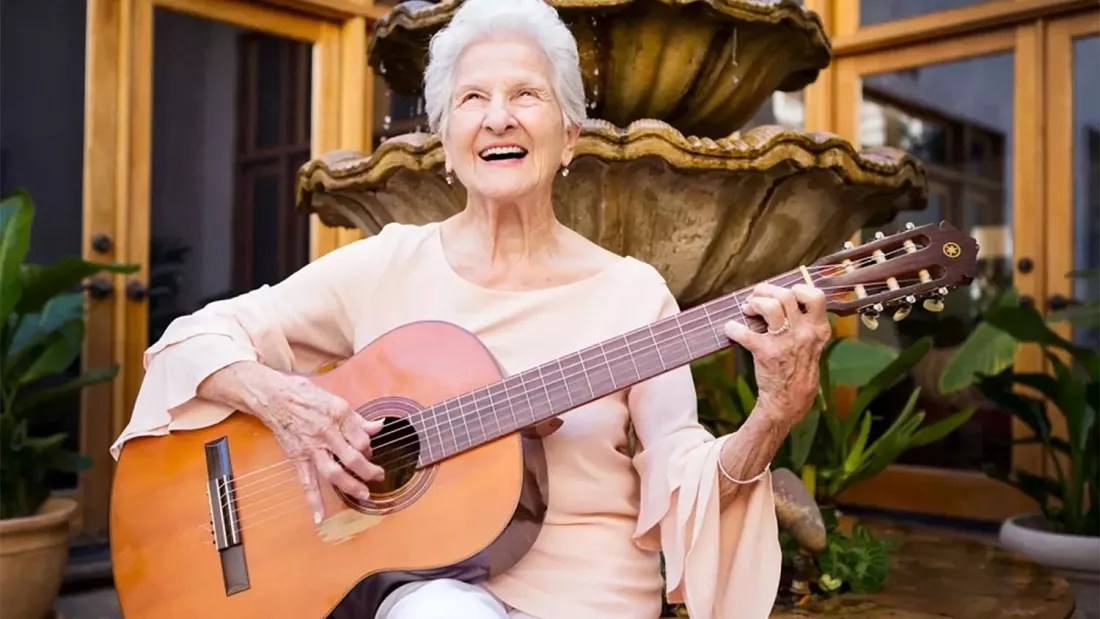
Latin Grammy Awards 2022: 95-year-old Alvarez was nominated for Best New Artist. “Sometimes, I pinch myself,” she says.

File this one under Never Too Old. A sparkling new career awaits a 95-year-old. That’s because of her genuine talent, of course, but it didn’t hurt to have a grandson with a promotional streak.

Sydney Page wrote at the Washington Post, “Growing up in Cuba, Angela Alvarez wanted to be a singer. But after coming to the United States as a young woman, she found herself cleaning a bank in Colorado to make a living.

“It now almost seems impossible that her long-held dream has become a reality: Alvarez was nominated for a Latin Grammy for best new artist. She is 95. …

“Alvarez composed her first song at age 14, then already proficient on piano and guitar. She also loved to sing. When she graduated from high school, Alvarez told her father she wanted nothing more than to become a professional musician. He rejected the idea. …

“ ‘I loved him so much,’ Alvarez said. ‘I liked to be obedient.’

“She put her professional pursuits aside and moved through life, getting married at age 19 and having four children — three boys and a girl.

“Fidel Castro came to power in 1959, upending life as they knew it in their home country. Alvarez and her husband, Orlando — who was a sugar engineer — decided they would flee to the United States. Given his profession, Orlando was initially forced to stay in Cuba. Alvarez took her children — the youngest was 4 and the eldest 15 — to the airport in May 1962, but officials also forbade her from leaving the country, saying she had missing paperwork. Alvarez made the impossible decision to let her children go alone to the United States.

“ ‘It was very hard for me,’ she recalled.

“It took several months before she was granted permission to leave Cuba, and once she arrived in Miami, she wasn’t financially eligible to reclaim her children — who were living at an orphanage in Pueblo, Colo. — through the welfare program they were assigned to.

“Finally, after not seeing her children for nearly two years, she secured a job cleaning a bank in Pueblo and was able to spend time with her kids on weekends. She lived in a small basement apartment.

“Amid her family’s difficult situation, Alvarez strived to fill her children’s lives with happiness, which she did through music. She invited other Cuban children living in the orphanage to join her family, and sang songs to remind them of home. …

“Throughout the many challenges Alvarez faced, she said, she leaned on music to cope with the pain. Over the course of her life, she composed a collection of about 50 songs, reflecting both the deep sadness and joy in her life. … But her music was only enjoyed by her family and friends, as her father had instructed her.

“That changed about eight years ago, when her grandson Carlos José Alvarez decided to record her songs. Carlos, who is a composer, grew up listening to his grandmother sing at family functions. …

“Every time he would visit his grandmother as a child, ‘she would grab a guitar and she would sing,’ said Carlos, 42, who calls Alvarez ‘Nana.’

“As his grandmother was getting older, Carlos wanted to preserve her songs so her future great-grandchildren could marvel at her voice, which he described as ‘angelic and soulful.’ He brought a microphone to her house and asked her to go through her personal trove of tunes. …

“In the process, though, he unexpectedly learned a lot of information about his grandmother’s history — including her undying hope of becoming a singer. …

“ ‘I got so inspired in that moment,’ Carlos said, adding that he decided he would one day bring his grandmother to a recording studio, and produce a proper album of her work. …

“In the years that followed, Carlos was focused on growing his own career. He put his grandmother’s prospective album on the back burner until 2016, when … he arranged to fly his grandmother to Los Angeles, where he lives, to record her songs in a professional studio. …

“In the past year, Alvarez’s career has taken off more than she thought possible. … The ultimate achievement so far has been Alvarez’s Latin Grammy nomination for Best New Artist, which was announced in September.

“ ‘I thought it wasn’t true,’ she said.

“Alvarez is attending the 2022 Latin Grammy Awards on Nov. 17 in Las Vegas with her grandson, and she is scheduled to perform.”

Want to know the rest of the story? She tied for best new artist! See the report. More at the Post, here.

Read Full Post »

Photo: Crispian Chan.
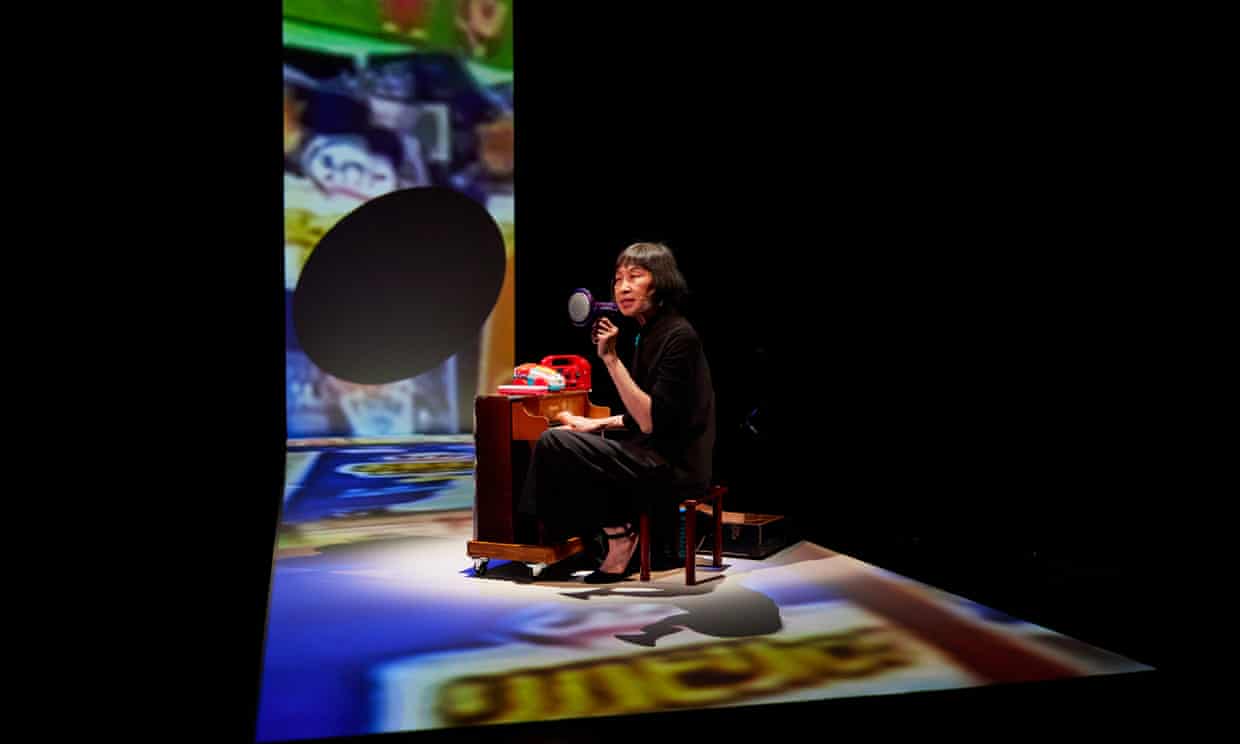
Margaret Leng Tan performing Dragon Ladies Don’t Weep on a toy piano. 

There is just no end to the variety of jobs people work at — or create for themselves — and no end to the variety of tools they use. Today’s story is about a toy-piano virtuoso called Margaret Leng Tan and the unusual career she built.

Sian Cain writes at the Guardian, “At her last count, Margaret Leng Tan owned 18 toy pianos – but these days she just settles for ‘lots and lots.’ The 76-year-old musician, once labelled ‘the world’s first toy piano virtuoso’ by the New York Times and ‘the formidable doyenne of the avant-garde’ by the Washington Post, finds her pianos everywhere from garage sales to garbage cans. ‘I picked up a beautiful one from the garbage – the legs were missing but it was vintage and had a beautiful sound,’ she says. Last year, a complete stranger even left a red one for her on her Brooklyn doorstep:

‘I have become a foundling hospital for orphan pianos.’

“Her personal favorite in her collection is a vintage Schoenhut, which she deems ‘the Steinway of the toy piano world.’

” ‘That one has been everywhere from Carnegie Hall to Beethoven’s house in Bonn. I played Beethoven in Beethoven’s house! Can you imagine? Eat that, Schroeder!’ she laughs. …

“Tan exudes a light playfulness that complements her chosen instrument: ‘I’ve always had aspirations to be a sit-down comic – not a stand-up one!’ she says. ‘The toy piano gives me that golden opportunity.’ She is not limited to the piano either: in one arrangement titled Old MacDonald’s Yellow Submarine, written for her by the composer Erik Griswold, she simultaneously plays toy piano, bicycle horn, bicycle bell and train whistle. ‘It was incredibly difficult,’ she says.

“In her latest show, Dragon Ladies Don’t Weep, she plays a simpler version involving a toy piano, a Fisher Price plastic phone and a toy mobile. …

“Have her audiences always understood what she’s doing? ‘They’ve come along for the ride. They’ve often been very enthusiastic and willing to go with me down that rabbit hole. I mean, the toy piano. [But] because I take it seriously, they take it seriously. And the toy piano is so seductive. How can you resist a toy piano? It is a marvelous way to introduce avant-garde music to audiences, who would never go to such a concert – they’ll go to a toy piano concert out of curiosity.’

Dragon Ladies is a step away from her usual concerts: it is a one-woman biographical theatre show in which Tan tells the story of her life through significant moments. ‘It started because I intended to sit down and write my memoir but I never could find the uninterrupted time to do that,’ she says. ‘I thought it’d be easier to make a sonic memoir than a written one. And I had the title – I read somewhere that if you have a good title, you must deliver.’

“A significant part of the show explores Tan’s lifelong struggle to manage her obsessive compulsive disorder. … Music and rhythm became outlets for her impulse to count everything. ‘Music is all about counting. OCD is all about counting. It is a marriage made in heaven,’ she says. “But I wouldn’t wish OCD on my worst enemy. It’s not fun.’ …

“Tan began playing piano when she was six. Her father was a famed lawyer and politician in Singapore, and her mother was a piano teacher – ‘though she had the good sense never to try to teach me,’ Tan says. When she was 16, Tan left Singapore to study at Juilliard; she became the first woman to graduate with a doctorate from the prestigious New York school. …

“At first, she was strictly a classical pianist. … ‘It was only after I met John Cage that I knew what I wanted to do,’ she says.

“Cage was arguably the world’s most influential avant-garde composer; his 1952 piece 4’33 is famously performed by musicians doing nothing, embodying his belief that any auditory experience, including silence, could be music. …

“Cage was her close friend and mentor until his death in 1992. ‘He believed, and I agree with him, that you can make music with essentially anything. Whether it is a tin can or a bucket, that is music,’ Tan says. ‘He was a genius. There won’t be anyone else like him for a very long time, if ever.’ “

More at the Guardian, here. No firewall.

Read Full Post »

Photo: Routledge, Taylor & Francis.
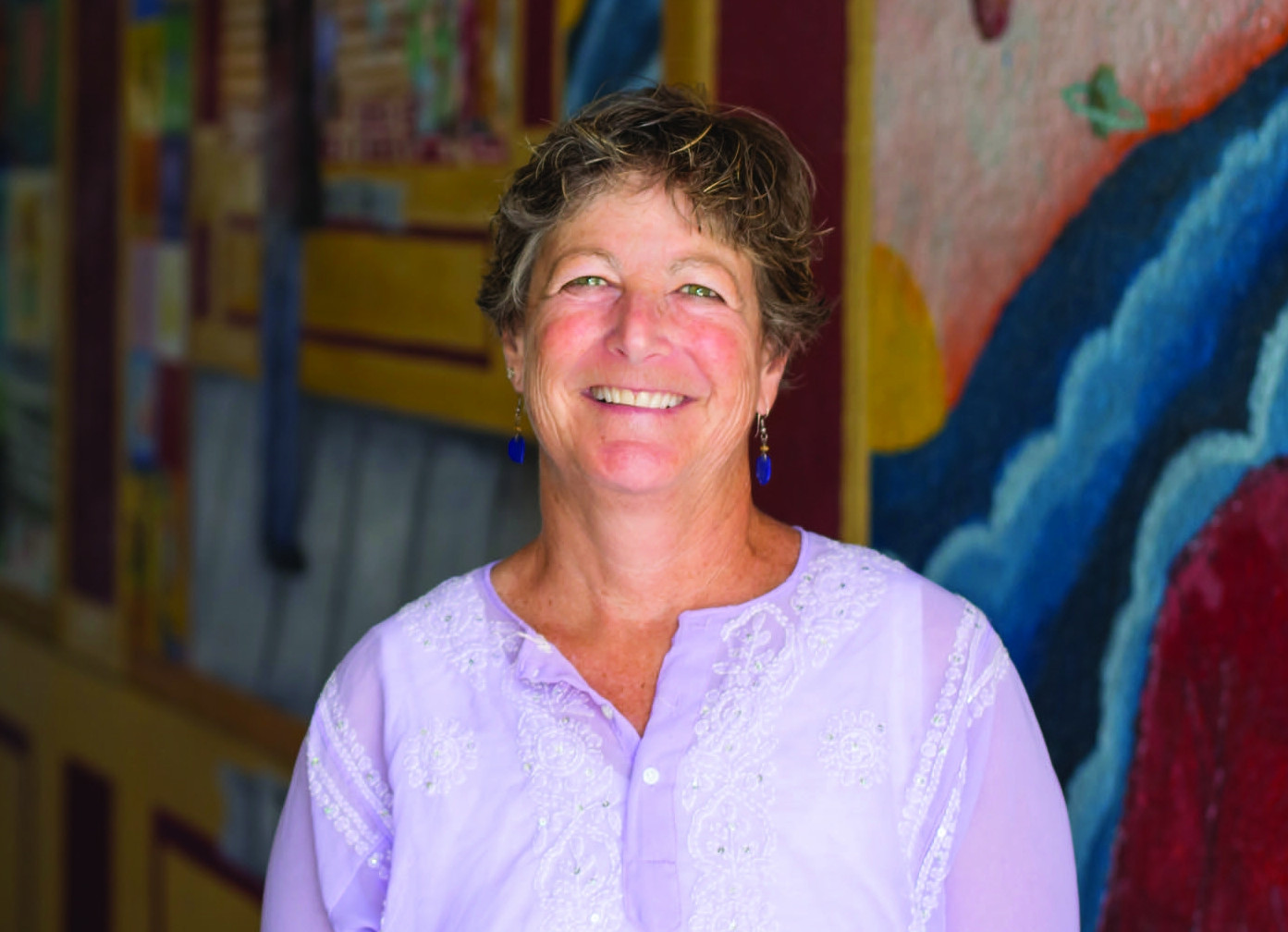
Merryl Goldberg, Professor of Music, California State University San Marcos, and part-time spy
.

Do you like true spy stories? Here’s one about a mild-mannered saxophonist, now a music professor, who felt a call to help Jewish musicians in 1980s Russia.

Lily May Newman has the story at Wired.

“In 1985, saxophonist Merryl Goldberg found herself on a plane to Moscow with three fellow musicians from the Boston Klezmer Conservatory Band. She had carefully packed sheet music, reeds, and other woodwind supplies, along with a soprano saxophone, to bring into the USSR. But one of her spiral-bound notebooks, lined with staves for hand-notating music, contained hidden information.

“Using a code she had developed herself, Goldberg had obscured names, addresses, and other details the group would need for their trip in handwritten compositions that looked, to an untrained eye, like the real melodies she’d written on other pages of the book. Goldberg and her colleagues didn’t want to give Soviet officials details of who they planned to see and what they planned to do on their trip. They were going to meet the Phantom Orchestra.

“The group was a dissident ensemble that Goldberg describes as an amalgamation of Jewish refuseniks (Jews who were barred from emigrating out of the USSR), Christian activists, and Helsinki monitors—watchdogs who tracked Soviet compliance with the 1975 Helsinki Accords. The Americans’ trip was funded and coordinated by the nonprofit Action for Soviet Jewry (now Action for Post-Soviet Jewry), which works on humanitarian relief in the former Soviet Union and was focused on helping Soviet Jews emigrate to Israel and the United States. 

“The trip was a rare and special opportunity for American and Soviet players to meet in the USSR and make music together. It was also an opportunity for the American musicians to smuggle information about aid efforts and plans to the Phantom Orchestra, and for the ensemble to send updates out, including details about individuals looking to escape the Soviet Union.

“Goldberg and her colleagues, all of whom are Jewish, traveled to Moscow separately in two pairs to make it less likely that they would arouse suspicion as a group. They had received training on how to react to questioning and been told to expect surveillance, even run-ins with Soviet officials, throughout their trip. But first Goldberg needed to get her notebook past border control. 

” ‘When we arrived, we were immediately pulled aside, and they went through everything in our luggage, to the point of unwrapping Tampax. It was crazy,’ says Goldberg, who [presented] about the experience and her musical code at the RSA security conference in San Francisco [in June]. ‘With my music, they opened it up and there were some real tunes in there. If you’re not a musician, you wouldn’t know what’s what. They went page by page through everything—and then they handed it back.’ …

“Musical note names span the letters A to G, so they don’t provide a full alphabet of options on their own. To create the code, Goldberg assigned letters of the alphabet to notes in the chromatic scale, a 12-tone scale that includes semi-tones (sharps and flats) to expand the possibilities. In some examples, Goldberg wrote only in one musical range, known as treble clef. In others, she expanded the register to be able to encode more letters and added a bass clef to extend the range of the musical scale. These details and variations also added verisimilitude to her encoded music.  For numbers, Goldberg would simply write them between the staves, where sometimes you might see chord symbols. …

“While someone could technically have played the code as music, it would have sounded less like a tune and more like a cat walking across piano keys.

“ ‘I picked a note to start, and then I created the alphabet from there. Once you know it, it ends up being pretty easy to write things. I taught my friends on the trip the code, too,’ Goldberg says. ‘We used it in order to take in people’s addresses and other information we would need to find them. And we coded things while we were there so we would be able to take out some information about people and their efforts to emigrate, as well as details we hoped could help other people ask to leave.’

“The US musicians got their bearings in Moscow before heading to Tbilisi, the capital of Georgia. There and on their next stop in Yerevan, the capital of Armenia, they successfully met members of the Phantom Orchestra, many of whom spoke some English. …

“During eight days of travel, the musicians were tailed constantly by Soviet agents and were repeatedly stopped for questioning. Goldberg says that members of the Phantom Orchestra, all of whom faced similar treatment in their daily lives, gave her and her colleagues advice and encouragement. When the Americans would express concerns that their presence was endangering the activists, Goldberg says the Phantom Orchestra members were resolute about the importance of spending time together. She adds, though, that some of the activists were later arrested and even beaten, because of the interactions.

“ ‘On the second night, we were playing together and the KGB came in and everything got shut down. The electricity was turned off; it was a scary situation,’ Goldberg says. ‘And yet, when we’re playing music no one can take away that sense of freedom and empowerment. Playing together and communicating with people through music is like nothing else. I was amazed by the strength it brought the people there. Music can be very comforting, but it also conveys a sense of feeling powerful.’ “

More at Wired, here. No firewall.

Read Full Post »

Photo: Masha Karpoukhina for Fondation Cartier pour l’art contemporain.
Soundscape ecologist Bernie Krause. Bernie Krause, 2021.

Spring is a time of year when birds are so vocal, I really do feel accompanied by music on my walk. Today’s story is about turning the sounds of nature into a kind of music that can be heard at any time of year.

Christine Ajudua at Artnet interviewed the artist behind “The Great Animal Orchestra” in November. His show will be at the Peabody-Essex Museum in Salem, Massachusetts, until May 22.

“In the late 1960s, Bernie Krause was at the top of his game as a musician, sound designer, and master of the Moog synthesizer, recording with the likes of Van Morrison, George Harrison, Mick Jagger, Brian Eno, and The Doors, while working on films such as Apocalypse Now. Then, he gave it all up and went wild — literally.

“Krause has been exploring the natural world as a pioneering soundscape ecologist ever since. And his masterpiece —’The Great Animal Orchestra‘ (November 20–May 22, 2022), originally commissioned by Paris’s Fondation Cartier pour l’art contemporain in 2016 — is about to have its North American premiere at the Peabody Essex Museum in Salem, Massachusetts. …

“The exhibition is based on 5,000 hours of Krause’s field recordings from the past 50 years, featuring 15,000 terrestrial and marine species from around the globe — many of them since lost or currently at risk. With the soundscapes reinterpreted as large-scale, animated spectrograms by the London-based collective United Visual Artists, it is an immersive and highly moving experience of the ever-vulnerable sound universe.

“Krause is meanwhile the subject of a new Cartier Foundation–produced documentary directed by the French filmmaker Vincent Tricon. …

ARTNET: What inspired you to move on from your life as a musician to explore the natural world as a soundscape ecologist? What are the biggest differences — and perhaps similarities — between your lives then versus now?

BERNIE KRAUSE: Paul Beaver, my late music partner, and I got invited to record with some awesome artists and groups [in the late 1960s]. But when it got to the point where we were being asked to replicate the sounds produced on previous sessions, something inside snapped — I found myself staring at the padded, windowless walls of studios in L.A., London, and New York, with mixed feelings of terror, boredom, and immobility. It was at that point that I began looking for an escape. …

“As it happened, Paul and I had just been signed by Warner Brothers to do three albums. For our own mental health, we sought to produce something thematic that hadn’t been tried before and where we could explore some of the Moog’s performance options we hadn’t shared with other artists. Our initial album, titled In a Wild Sanctuary, centered on the theme of ecology, and natural soundscapes [were] a main constituent of the orchestration. We needed a quiet rural area or wild forest in which to record.

“I didn’t go terribly far to secure those early recordings — just across San Francisco’s Golden Gate Bridge to a small park in Marin. But when I cranked up my new stereo recorder and heard the numinous impression of a nearby stream, the illusion of larger-than-life sonic space, the edge-tones of a pair of ravens’ wingbeats as they cut an arc across the sky overhead, and a gentle sea breeze in the redwood canopy wafting in from the Pacific to my west …

… something inside me instantly changed. I felt relaxed and present in the living world and amazingly free of anxiety.

“I had discovered for myself a new sense of being and felt obliged to go wherever that reaction took me. I was 30 years old then. …

“I begin by finding habitats that are relatively untouched by human endeavor. Then I identify a local naturalist or biologist that knows intimate details of the area [and its] unique wildlife [to] help facilitate my time on site. But for the most part, I prefer to work alone.

Over the course of a 24-hour day, I’ll likely record four two-hour sessions: a dawn chorus, a midday chorus, dusk and nighttime choruses, times when biophonies are likely at their peak. [These are] the collective sounds coming from all organisms in a given habitat at one moment in time.

“When I return to the studio, the first thing I do is transfer all of the field data related to that recording into my archive. Then I have two basic avenues of expression. The first, through science, is to write and publish a paper related to what I’ve observed given what the data show. The problem with that avenue is that very few people read this literature.

“If I want to reach a much larger audience, I turn to the arts, transforming the data into programs that are widely accessible and emotionally evocative while at the same time keeping the integrity of the message firmly intact. …

“I had written and released a book, The Great Animal Orchestra: Finding the Origins of Music in the World’s Wild Places — basically the story of how we learned to sing, dance, and speak from mimicking the voices of the natural world. [It] was translated into seven languages, one of which was French. Somehow, a French anthropologist, Bruce Albert, who has been working with the Yanomami tribe in northern Brazil for decades, found a copy and gave one to his good friend, Hervé Chandès, director of the [Cartier] foundation. After reading it, Hervé contacted me in 2014 proposing that I take some of the raw field data and transform them into large-scale sonic art pieces. …

“Over the course of a few intense days, we auditioned the soundscapes of many habitats, whittling them down to a couple of dozen. From those, I proposed a selection of 15 or 16 habitat recordings to choose from. With the field recordings from those selections, I began the transformation process, taking raw material representing each location, assembling and mixing the various segments and generating a seamless acoustic narrative that I felt would capture and evoke the essence of each unique biome.

“And because most of what we observe of the living world has been through what we see, we decided to include a visual component — one that illuminated the soundscapes. …

“If the habitats they represented were healthy, that condition [would] show in the structured detail of the spectrograms. Conversely, if the habitats are under stress, then the spectrogram images will appear to be chaotic and incoherent.

“With the expertise and insight of Matt Clark and his team at UVA [United Visual Artists], the problem of converting those sounds into instantaneous streaming spectrograms was solved.”

More at Artnet, here. No firewall.

Read Full Post »

Photo: Early Music America.
Catalina Vicens often performs on an organetto replica built in 2013 by Stefan and Annette Kepler, who run the Wolkenstayn Gothic Organ company in southern Germany.

For something a little different today, let’s look at a forgotten medieval instrument that a few enthusiasts have brought back to the world’s attention: a handheld pipe organ.

Kyle MacMillan reports at Early Music America last week, “Attend a few organ recitals in a church or concert hall and you’ll know that the instruments can vary widely in size — from behemoths with several thousand pipes to moveable, chamber models with just a handful of stops.

“Almost completely forgotten, though, is that an even smaller kind of pipe organ once existed. Called an organetto, it was typically played perpendicularly on a performer’s lap and was one of the most popular instruments in the 13th and the 14th centuries.

“A contemporary reproduction of this tiny organ will be front and center this week when the Chicago-based Newberry Consort presents Music Fit for the Medicis, featuring works that would have been heard at the powerful family’s court. Showcased will be 14th-century songs and dances taken from manuscripts found in the library of Lorenzo de’ Medici (1449-1492). …

“Featured as the Newberry’s organetto soloist will be Chilean-born Catalina Vicens, an internationally known historical keyboard performer and teacher who lives in Basel, Switzerland, and Bologna, Italy. She is artistic director of the Museo San Colombano, housed in a former monastery in Bologna, which dates to the Seventh Century. She also serves as curator of the Tagliavini Collection, the museum’s prize holding and one of the largest historical keyboard collections in Europe. …

“The organetto fell out of fashion by the 16th century. ‘They weren’t use in anymore, as far as we know, and they didn’t survive,’ Vicens told me.

What experts know today about the organetto comes from its depiction in hundreds of medieval paintings, illuminated manuscripts, and stained-glass windows, and well as the literature of the period.

“The instrument is mentioned, for example, in the Roman de la Rose, a famous medieval poem written in Old French, and the organetto playing of Francesco Landini, a famed 14th-century Italian composer and organist, is described in a novella by Giovanni da Prato.

“Today’s organettos, which are based on this historical imagery and documentation and technical knowledge drawn from larger extant medieval organs, typically have 28 pipes in two rows spanning just beyond two musical octaves.

” ‘From iconography, we see mostly instruments with fewer pipes,’ Vicens said. But balancing historically informed instrument building with modern performance needs, she points out that, ‘for us, it is very convenient to take those models with more pipes, because we want to be able to play more notes.’

“Air is produced by a bellows operated with the left hand while the right plays the instrument’s keys. … Because no original organetto exists, it is impossible to know exactly how the medieval instruments sounded. The aural qualities of today’s organettos vary depending on the builder and are affected by the pipes, which can be made of such materials as copper, wood, or a tin-lead alloy.

“ ‘It does sound like a small organ,’ Vicens said of the instrument, ‘but to the ears of many, also suggested by how it looks, it sounds more like a bagpipe. Or I’ve even gotten people who think it sounds like an accordion.’

“Vicens often performs on an organetto built in 2013 by Stefan and Annette Kepler, who run the Wolkenstayn Gothic Organ company in southern Germany, with pipes in a high-leaded alloy made by Winold van der Putten in the Netherlands. ‘I have sort of a custom instrument by different builders,’ she said. …

“While a student of harpsichord performance at the Curtis Institute of Music in Philadelphia, Vicens became fascinated with the instrument’s sound and how it was produced. That curiosity led her to study the harpsichord’s origins, including how instruments from several centuries ago were constructed and what early repertoire was written for them. Her interest in turn motivated her to learn about other historical instruments like the organ and fortepianos. Drawing on this background in historical performance and her knowledge of the organ and harpsichord, Vicens taught herself to play the organetto in 2009 and 2010 and soon got regular requests to perform on the instrument across Europe and beyond.

“The organetto poses two main hurdles for performers, starting with playing the keyboard with just one hand, which makes it difficult to convey different musical voices at the same time. The larger challenge is manipulating the instrument’s single bellows. ‘I have to breathe like a singer,’ Vicens said, ‘because with one bellow, you need to fill it every time you run out of air.’ “

More at Early Music America, here. Hat tip: Arts Journal.

Read Full Post »

Photo: Special Music School.
Three of the student authors of Who Is Florence Price? (left to right: Sebastián Núñez, Hazel Peebles and Sophia Shao), joined by their English teacher, Shannon Potts.

I want to follow where today’s kids are leading. So many of them seem to recognize they have to take matters into their own hands if they want change in their lifetimes, whether it’s a question of global warming or gun safety or race relations.

In today’s story, we see that empowerment can start early.

Anastasia Tsioulcas reports at Natural Public Radio (NPR), “For decades, it was almost impossible to hear a piece of music written by Florence Price. Price was a Black, female composer who died in 1953. But a group of New York City middle school students had the opportunity to quite literally write Florence Price’s history. Their [book]Who Is Florence Price? is now out and available in stores.

“The kids attend Special Music School, a K-12 public school in Manhattan that teaches high-level music instruction alongside academics. Shannon Potts is an English teacher there.

” ‘Our children are musicians, so whether or not we intentionally draw it together, they bring music into the classroom every day in the most delightful ways,’ Potts says. …

“Potts assigned her sixth, seventh and eighth grade students to study Florence Price — a composer born in Little Rock, Arkansas in 1887. She was the first Black woman to have her music played by a major American orchestra: the Chicago Symphony Orchestra performed her Symphony No. 1 in 1933 and her Piano Concerto in One Movement the next year. …

“Despite Price’s talent and drive, most classical music performers and gatekeepers put her aside, and her work failed to gain traction with the large, almost exclusively white institutions that could have catapulted her to mainstream renown. …

“Recently, though, there’s been a blossoming of interest in Price’s work. A recording of her symphonies by the Philadelphia Orchestra was just nominated for a Grammy. In the months ahead, her music will be performed by the San Francisco Symphony, the Atlanta Symphony Orchestra and the Chicago Symphony Orchestra.

“When the students began researching Price, however, they realized that although there were a few materials written about her life for grown-ups, there was nothing aimed at kids.

“That gave Potts had an idea: She would have her students write and illustrate their own book about Florence Price, and about how her music was rediscovered. As the kids’ book begins:

” ‘In 2009, a couple bought an old house outside of Chicago. in the attic, they found boxes filled with yellowed sheets of music. Every piece was written by the same woman, Florence Price. “Who is Florence Price?” they wondered…

” ‘Florence’s mind was filled with music, but she had a big question. She was a girl and her skin was a different color than so many of the composers she knew about. Could she grow up to be a famous composer, too? When Florence was only 11, her first piece was published. Was it possible that Florence’s music could change things?’

Special Music School [executive] director Kate Sheeran was extremely enthusiastic about the students’ work. …

“Sheeran was so impressed that she ordered a small, self-published print run of their work. She sent it around to various people in the classical music community — including Robert Thompson, the president of G. Schirmer, the company that publishes Florence Price’s music.

‘I think it’s one of the few moments in my job where I had to cancel the next meeting and I was just kind of filled with tears,’ Thompson recalls. ‘It was just an incredibly beautiful moment.’

“Thompson agreed to publish the book; all royalties will go to Kaufman Music Center, which is a non-profit organization.

Rebecca Beato is a 14-year-old violinist from Queens. She was also one of the lead illustrators of Who Is Florence Price? and she says that Price has been a personal inspiration. ‘Her music has been out there, performed by major orchestras,’ Beato says, ‘and she’s a woman of color, which even now — it’s like difficult to get your music shown to the world.’ …

“Hazel Peebles, a 13-year-old violist from Harlem, says that you can hear Price’s personal history in her music. ‘It really is beautiful,’ Peebles observes. ‘She worked in some of her history, some of her Black background into the music.’ …

“What the students learned in creating this book goes far beyond music, Kate Sheeran says.

‘They’re also seeing that they can have a voice in shaping who writes history and who tells stories … and that we don’t have to just accept the way music is presented to us or the way music history is presented to us — that they too can shape that.’ …

“Potts says that the very last lines of her students’ book have already come true, thanks to their hard work and creativity. ‘Today, Florence’s music can be heard all around the world just like she dreamed of when she was young,’ Potts reads. ‘If someone asks, “Who is Florence Price?” you can tell them.’ “

More at NPR, here.

Read Full Post »

Photo: Classical Voice America.
The composers represented in the African Diaspora Music Project include (top row, left to right) Nathaniel Dett, Donal Fox, Anthony Green, and Jacqueline B. Hairston, and (bottom row, left to right) Robert A. Harris, Roland Hayes, Lori Hicks, and Moses Hogan.

During lockdown, I read an excellent biography of Black classical singer Marian Anderson and learned a lot I didn’t know about Black musicians and composers of the early 20th century. To America’s shame, most of these musicians had to seek training and experience in Europe, which was more open to giving their talents space to grow.

There are still challenges for Black musicians, especially in the classical arena, which is why Louise Toppin has created the African Diaspora Music Project.

Xenia Hanusiak at Classical Voice America has the story.

“ ‘How do you move something from being token to intentional?’ asks musical polymath Louise Toppin. This provocation is just one of the many questions that occupy the mind of the international scholar, opera singer, and activist. As a musical avatar who has performed at Carnegie Hall and Elbphilharmonie, Toppin is on a mission to recalibrate who, what, and how we program our concert seasons to enable a more equitable representation of music from composers of African descent. She is seeking a sustained and systemic cultural shift.

“Toppin’s solution? Her recently launched African Diaspora Music Project, a database that houses nearly 4,000 songs and 1,200 symphonies by composers of African descent. …

‘We need to stop presenting one movement of Florence Price for Black History Month and giving no time to rehearse it,’ she says, ‘and then spend two weeks on the Beethoven Ninth Symphony that everyone has played for the last 30 years.’ … 

“The spotlight programming on African American composers during this year’s post-COVID season openers points to recent mea culpa moments. The staging of Terence Blanchard’s Fire Shut Up in My Bones at the Metropolitan Opera on opening night represented the first production of an opera by a Black composer in the company’s 138-year-old history. Riccardo Muti conducted a work by Florence Price for his opener with the Chicago Symphony. The question arises about what happens next.

“ ‘Before the pandemic, I was talking to programmers about their programming in Black History Month,’ says Toppin. ‘You are bringing in singers of color to sing Mozart? What does this have to do with Black History Month?’

“You might think Toppin is angry or frustrated with the historical lack of representation of African American composers in programming. But in our recent Zoom conversation from her office at the University of Michigan’s School of Music, Theatre & Dance, where she is professor of music and voice, Toppin presented her case with high-octane optimism and boundless passion.

“Her life’s work is genetically pre-determined to advocacy and pushing boundaries. Toppin’s commitment continues the legacy of her father, Edgar Allan Toppin (1928-2004), an author and professor of history specializing in Civil War, Reconstruction, and African American history. His accomplishments were many. But perhaps his most enduring legacies eventuated as board president of the Association for the Study of Afro-American Life and History. In this role, he was instrumental in turning Black History Week into Black History Month in 1976. …

“Toppin’s database is built on her lifelong commitment to her cause. She has been researching, recording, editing, and performing African American music across the globe. In October, Toppin gave a recital dedicated to the songs of Harry T. Burleigh — one of the most influential figures in the history of American song — at London’s Oxford Lieder Festival. The impetus for her database is further inspired by the vocal competition on African American art song and opera that she co-founded with tenor George Shirley. Toppin realized pretty quickly that the same repertoire kept resurfacing in the competition. So, the idea of a database to expand knowledge of the repertoire for the young singers began to take shape.

“ ‘My father’s passion for history as a public historian — not someone who spent his time just writing works for an academic audience, but hosting television and radio shows, writing for newspapers, finding ways to reach a wide audience — has deeply informed my approach and scope for this project.’ …

“Toppin’s father devoted his life to academia, but in equal parts he shared his work with his children. For the Toppin household, the line between his work and their play entwined with daily life.

“ ‘When I was a little girl, my father would take me to the library, and I would do the microfiche with him,’ says Toppin. ‘He would also take me to the stacks. He would teach me to look things up for him. He would give me a date. I could barely read, but I could manage January 1865.’ …

“Toppin began her African American Music Diaspora project in earnest during the 1990s as a way to catalog the music she had been collecting. She became a doctoral research student of Willis Patterson, bass-baritone and professor emeritus associate dean at the University of Michigan, who edited what the New York Times described as a ‘ground-breaking anthology of black art songs’ in 1977. ‘It made an international splash, and it is still selling,’ says Toppin.

“ ‘While I was organizing his music, I made sure that I made extras copies. It was part of what inspired me to start collecting. I had the foresight to see and record everything you see on the data base today: Dedications, dates, performances, biographical information, and recordings are all part of the catalog.’ ”

More at Classical Voice America, here.

You might also be interested a New York Times article on the importance of Europe for Black composers neglected at home. It begins, “In early September 1945, amid the rubble of a bombed-out Berlin, the Afro-Caribbean conductor Rudolph Dunbar stepped onto a podium and bowed to an enthusiastic audience of German citizens and American military personnel.

“The orchestra had gathered in an old movie theater functioning as a makeshift concert hall in the newly designated American zone of the city. First on the program was ‘The Star-Spangled Banner.’ Then came a fairly standard set of orchestral pieces, with Carl Maria von Weber’s ‘Oberon’ Overture followed by Tchaikovsky’s ‘Pathétique’ Symphony. But one piece stood out from the rest: William Grant Still’s ‘Afro-American Symphony.’ When it premiered in 1931 in Rochester, N.Y., it was the first symphony by a Black American to be performed by a major orchestra.” Europe helped that happen. Continue here.

Read Full Post »

I love my vinyl records and can easily understand the renewed demand for them. They’re so popular, there isn’t enough vinyl or pressing equipment to create all the new ones wanted right now. I sympathize, but what should I do with my anti-plastic concerns? Buying vintage is always a good solution for getting products that don’t hurt the environment, but new bands can hardly use vintage vinyl.

Ben Sisario wrote recently at the New York Times about the challenges.

“Within the Indianapolis office of Joyful Noise Recordings, a specialty label that caters to vinyl-loving fans of underground rock, is a corner that employees call the ‘lathe cave.’ There sits a Presto 6N record lathe — a 1940s-vintage machine the size of a microwave that makes records by cutting a groove into a blank vinyl platter. Unlike most standard records, which are pressed by the hundreds or thousands, each lathe-cut disc must be created individually.

‘It’s incredibly laborious,’ said Karl Hofstetter, the label’s founder. ‘If a song is three minutes long, it takes three minutes to make every one.’

“This ancient technology — scuffed and dinged, the lathe looks like something from a World War II submarine — is a key part of Joyful Noise’s strategy to survive the very surge of vinyl popularity the label has helped fuel. Left for dead with the advent of CDs in the 1980s, vinyl records are now the music industry’s most popular and highest-grossing physical format, with fans choosing it for collectibility, sound quality or simply the tactile experience of music in an age of digital ephemerality. After growing steadily for more than a decade, LP sales exploded during the pandemic.

“In the first six months of this year, 17 million vinyl records were sold in the United States, generating $467 million in retail revenue, nearly double the amount from the same period in 2020, according to the Recording Industry Association of America. …

“Yet there are worrying signs that the vinyl bonanza has exceeded the industrial capacity needed to sustain it. Production logjams and a reliance on balky, decades-old pressing machines have led to what executives say are unprecedented delays. A couple of years ago, a new record could be turned around in a few months; now it can take up to a year, wreaking havoc on artists’ release plans.

“Kevin Morby, a singer-songwriter from Kansas City, Kan., said that his latest LP, ‘A Night at the Little Los Angeles,’ barely arrived in time to sell on his fall tour. And he is one of the lucky ones. Artists from the Beach Boys to Tyler, the Creator have seen their vinyl held up recently. …

“For Joyful Noise, the vinyl crunch has also presented a puzzling problem. Up to 500 V.I.P. customers pay the label $200 a year for special editions of every LP it makes. But the production holdups mean the label cannot predict which titles will be ready during 2022. …

“The label’s solution is to make lathe-cut singles for each of the eight albums it intends to release next year, as placeholder bonuses while its customers wait. Doing so will cost Joyful Noise money and time — Hofstetter groaned as we calculated that eight records with five minutes of music per side, cut 500 times each, would take 666 hours of lathe work — but the label sees it as a necessary investment. …

“The pandemic shut down many plants for a time, and problems in the global supply chain have slowed the movement of everything from cardboard and polyvinyl chloride — the ‘vinyl’ that records (and plumbing pipes) are made from — to finished albums. In early 2020, a fire destroyed one of only two plants in the world that made lacquer discs, an essential part of the record-making process.

“But the bigger issue may be simple supply and demand. Consumption of vinyl LPs has grown much faster than the industry’s ability to make records. …

“ ‘What worries me more than anything is that the major labels will dominate and take over all of the capacity, which I don’t think is a good idea,’ said Rick Hashimoto of Record Technology Inc., a midsize plant in Camarillo, Calif., that works with many indie labels. Others say the big labels are just a convenient target. The real problem, they believe, isn’t celebrities jumping on the vinyl bandwagon but that the industrial network simply has not expanded quickly enough to meet growing demand.

“ ‘Am I mad that Olivia Rodrigo sold 76,000 vinyl copies of her album?’ said Ben Blackwell of Third Man, the record label and vinyl empire that counts Jack White of the White Stripes as one of its founders. ‘Not at all! This is what I would have dreamed of when we started Third Man — that the biggest frontline artists are all pushing vinyl, and that young kids are into it. If someone is mad that that prevents some other title from being pressed,’ Blackwell continued, ‘it feels a little bit elitist and gatekeep-y.’ “

More at the Times, here.

Read Full Post »

Photo: Laura Mam.
The artist’s mother writes the Cambodian lyrics. It makes her feel like a teenager again. She says, “This is what I would have wanted to be, you know, be silly, be brave,”

In today’s story, a pop star of Cambodian heritage stumbles on the fun of sharing her parents’ language with audiences hungry for a contemporary vibe.

Quinn Libson reported the story for National Public Radio (NPR) in February 2020.

“Laura Mam is one of Cambodia’s biggest pop stars, but she wasn’t born or raised in the country. She’s American, and even though both of her parents are originally from Cambodia, she hardly spoke a word of the country’s language, Khmer, when she first became famous there.

“Laura’s fame happened almost by accident. It all started 10 years ago, at her mother’s house in San Jose, Calif. It was Christmas Eve and Laura was home after graduating with a degree in Anthropology from the University of California, Berkeley.

” ‘I had been writing music and my mom was kind of interested in what I was doing. I think I went to her room and I was playing this song. I was like “Hey mom, could you write lyrics in Khmer on top of it?” ‘ Laura says. …

” ‘The first song, I didn’t understand what I was doing and I didn’t know how to rhyme,’ Thida says.

“But Thida gave it a try, and it turned out she had a knack for it. They called the song ‘Pka proheam rik popreay,’ which means ‘morning flower is beautifully blossoming.’ A few months later, Laura and some friends made a music video and uploaded the song to YouTube, not expecting much.

“The morning after the music video went live, they woke up to a big surprise. The video had reached 75,000 views in the course of a single night. But it wasn’t just about the numbers. The viewers’ reactions stunned them.

” ‘The comments were all just like “Yes! Original Cambodian music, oh my god!” ‘ Laura remembers. The comments came streaming in from all over the world. …

” ‘I was from Phnom Penh. And when I was growing up the music scene was huge. During that time there were all these new artists writing all these new sounds, new music,’ [Thida] says.

“This was the early 1970s and Cambodia was in the middle of a music renaissance. … While most fathers at the time might have discouraged their young daughters from diving headfirst into Phnom Penh’s music landscape, Thida’s father was different. …

“Thida says. ‘It was a beautiful childhood I had here in Phnom Penh until the war.’

“[In] the background of Thida’s childhood, bombing campaigns by the United States as part of the Vietnam war and political upheaval meant Cambodia was growing more and more unstable. And in the countryside, a radical Marxist insurgent group — the Khmer Rouge — was steadily amassing power. …

“Educated, urban families like Thida’s were considered politically suspect and were forced to live under intense scrutiny in regime-controlled villages.

” ‘As a child, I was wild,’ Thida says. ‘And then [during] the Khmer Rouge, I had to shut down the feeling. It’s as if there’s a lid put on top of something that bubble[s].’ … When the Vietnamese army swept through Cambodia in 1979, Thida’s family fled across the border to a camp in Thailand. And in 1980, when Thida was 19, she and her family came to California as refugees.

“Thida wanted her children to grow up feeling fully American — Laura and her younger brother had American friends and spoke English at home — but at the same time, Thida found ways to weave bits of Cambodia into their lives. Much of that revolved around music. …

“The Khmer Rouge had targeted and killed musicians. … The Cambodian music industry that came after had been shaped by that grim reality. The result was a country whose airwaves were flooded with cheaply produced, karaoke-style covers.

” ‘There was no pride in that kind of music for me,’ says Laura. Thida agrees. … ‘We were longing for something of our own. It’s a quiet longing.’

“The global reaction to the song they wrote showed Laura and Thida they weren’t the only Cambodians who felt that way. So they wrote more. … The process wasn’t always easy. For Thida, helping Laura transform her lyrics from English to Khmer often meant not just translating words, but translating culture as well. …

‘I would write these very American songs with such American attitude and then my mom would have to translate it into this really good girl who doesn’t break any of the rules and just loves with all the poetry of her heart,’ Laura says.

“But they got better at melding their points of view, and Laura’s fame in Cambodia started to grow. But fame alone wasn’t the goal: For both women, the real mission was to foster a more creative Cambodian music industry. To do that, Laura saw she’d have to leave California behind. …

“Moving to Cambodia opened Laura’s eyes to what was happening behind the scenes of the country’s music industry. ‘Once I got here, it was realizing that it’s not that people can’t do original music, it’s that they aren’t allowed to. [Karaoke] houses were like “No, you can’t do original music because that would be only one album a year and I need to sell 12 to 25.” ‘

Read more about this mother-daughter success story and why they created their own production company, here.

Read Full Post »

Photo: Singapore Chinese Orchestra.
Ionisers attached to ornamental snake plants in front of the stage improve air circulation with an “ionising curtain” between the performers and audience at a Singapore Chinese Orchestra concert. The idea is to keep people safe from Covid.

I was saddened and surprised the other day when I offended a woman wearing a mask by asking her if she was also vaccinated. We were in a small room where there was little air circulation, and she was there to give me a hearing test.

Sadness was my primary reaction as the question really upset her. But I was also surprised because so many clinics, performance spaces, restaurants, etc. bend over backwards to make patrons feel safe, even if their requests seem unreasonable.

Consider the introduction of snake plants at the Singapore Chinese Orchestra. Toh Wen Li reports for the Straits Times about their role in an unusual air-quality initiative.

“The air was charged with more than just emotion when the Singapore Chinese Orchestra (SCO) staged its first wind concert in months last Saturday (Sept 25).

“As the rousing sounds of the dizi, sheng and suona filled the concert hall, high-tech devices attached to 20 ornamental snake plants in front of the stage created an ‘ionising curtain’ between the performers and audience.

“The ionisers, designed to reduce the spread of Covid-19, induce a negative charge in the air particles around the plants. This pulls positively charged aerosols, droplets and particulate matter towards the leaves of the plants.

“The devices were introduced following a six-month collaboration between the orchestra and the Agency for Science, Technology and Research (A*Star).

“SCO’s executive director Terence Ho hopes these — and a slew of other measures, such as a filterless high-volume air purifier developed by A*Star to be used in the foyer — will give people peace of mind and encourage them to attend live concerts.

” ‘We have to work towards bringing audiences back to the hall and more musicians back on stage,’ he tells The Straits Times, adding that the plant-based ionisers will remain for future concerts at Singapore Conference Hall, home to the SCO. …

“SCO’s suona and guan principal Jin Shiyi, 56, says in Mandarin: ‘Wind players are now a “high-risk” occupation, and we have had fewer opportunities to go on stage. I’m so happy we can perform on stage again.’

“Last Saturday’s wind concert, also available online for streaming, was part of the recently concluded Singapore Chinese Music Festival. It had drawn a physical audience of about 100 people, less than half the permitted capacity of 250 for that venue.

“Mr Ho says audiences are worried about the recent spike in Covid-19 cases. … For now, he is keeping his fingers crossed as the orchestra prepares for two concerts in early October to celebrate the SCO’s 25th anniversary, while taking precautions to reduce the risk of Covid-19 transmission. It has split performers  into separate ‘teams,’ cut down on rehearsals and roped in understudies in case performers are hit by the virus or with a 10-day quarantine order. …

“The orchestra would have launched it even without the pandemic, [Chief executive Chng Hak-Peng ] adds, as a way to maintain ties with local and overseas audiences. Before the pandemic, as many as 10 per cent of SSO’s live audience members were tourists.

“Home-grown charity the Foundation For The Arts And Social Enterprise has also launched a 10-year Music Commissioning Series to support Singapore composers and build up a canon of local contemporary music — from Chinese orchestra and cross-cultural works to jazz and musicals. …

“Founder Michael Tay says: ‘While we have had Singapore composers write works for wind bands and orchestras in the past, we don’t see a systematic plan to encourage the writing of major works (of at least 30 minutes).’ The series, he adds, ‘is meant to plug this gap.’ …

“Despite the resumption of live concerts … life has not returned to normal for orchestras. While live performances with up to 1,000 audience members, subject to conditions, are allowed, most venues can accommodate only a fraction of this after factoring in safe distancing measures. …

“[Mr Chng] adds: ‘Even though we are having concerts, we still have not, for the last year and a half, been able to have our entire orchestra perform together.’

“Then there is the impact on freelancers, who in pre-pandemic times would often perform with the orchestra and give pre-concert talks. …

“Countertenor and freelance choral director and educator Phua Ee Kia, 41, had no income for eight months last year and has not performed since 2019. He has been doing his rehearsals online during the pandemic.

” ‘Conductors are really struggling,’ he says. ‘Not all of us are tech-savvy and we don’t just have to cope with our own (issues), but also have to deal with situations when our students say, … “My screen went blank.” ‘

“Phua, who tapped a training grant to take a course in audio production software Logic Pro, hopes there will be more upskilling opportunities and financial support for freelancers. …

“Phua says: ‘A choir is not formed of just five people. I hope in the near future, we are allowed to gather and sing in a bigger group, albeit with masks on. Some of us are forgetting what it’s like to be able to perform in a bigger group.’ “

More at the Straits Times, here.

Read Full Post »

« Newer Posts - Older Posts »