Feeds:
Posts
Comments

Posts Tagged ‘music’

singing

Photo: Teachingtimes.com
Could these faces lifted in song be any sweeter?

I was tired of “Deck the Halls,” “Jingle Bells,” and “I Saw Mommy Kissing Santa Claus” before I got through Thanksgiving this year. Maybe you felt the same. Why is it so rare to hear carols like “I Wonder as I Wander,” the haunting “Minuit, Chrétiens,” or authentic Gospel music at this season?

Today I decided to correct that loss a little with YouTube music that should not make anyone feel like running and hiding. I’d love it if you would share your favorite seasonal music with other readers in the Comments.

Above, the Choir of Kings College sings “In the Bleak Midwinter.” Next we have the Cambridge Singers with “I Wonder as I Wander.”

Finally, whatever one’s faith or feelings about religion, who can resist the voice of Harry Belafonte with his honeyed Jamaican diction? (Note where the person typing the lyrics wrote “the” instead of what he really said, which is so much more charming.)


Read Full Post »


Photo: Jason Rosewell
No one’s singing is hopeless, says a Toronto voice teacher.

I know many people who say they can’t sing, but a teacher in Toronto begs to differ. Anyone can sing, she says. People just need a little help.

Anya Wassenberg writes at Ludwig van Toronto, ” ‘I’m tone deaf. I can’t sing.’ It’s usually accompanied by a smile or laugh, but the message is both clear and absolute. And wrong.

“Lorna MacDonald is Professor of Voice Studies and Vocal Pedagogy at the University of Toronto, and she puts it even more strongly. ‘That’s a blatant lie.’

“Of all creative endeavours, singing is perhaps the most poorly understood. To the chagrin of vocal teachers everywhere, singing is the one pursuit where you will be told, you can’t sing, so don’t bother. Parents will readily pony up the resources for acting lessons, or soccer, but when it comes to the ability to sing, many people are still under the impression that it’s something magical – you either have it, or you don’t. …

“Sean Hutchins is the Director of Research at Toronto’s Royal Conservatory of Music. His lab looks into how music affects the mind, and how the mind affects music, in essence. …

“He points out that in older generations, in particular, the sole emphasis was on performance. When school children who couldn’t naturally hit the right notes, rather than training them, they would simply be told to mouth the words, and not sing at all. ‘There’s no better way to make sure someone is bad at something than to tell them they can’t do it.’ …

“Lorna MacDonald cites breath, posture, and vowels as the essential elements that are integral to vocal training for anyone. ‘It’s very much a physical process,’ she explains. ‘Our larynx isn’t necessarily made to create those beautiful sounds, any more than our legs were designed to kick soccer balls.’ …

“[MacDonald] suggests that thinking about what styles and genres you’d like to sing, and your ultimate goals as a singer are a good place to start. ‘It’s so important that it comes from a place of communication — not to be famous.’ …

“In reality, people with congenital amusia, or the innate inability to hear pitch properly, form a very small percentage of the population. The study of amusia is still quite recent, but estimates put it at no more than 1.5 to 4 percent. …

“In essence, amusia testing looks for evidence of faulty pitch perception. That’s the difference. Someone with clinical amusia actually can’t hear variations in pitch. …

“In extreme cases, a little delusional thinking can help. Florence Foster Jenkins was a Manhattan heiress in the early 1920s to 1940s who dreamed of being an opera singer, and was somehow entirely convinced of her talent. There are a smattering of Youtube videos that attest to the fact that she was, let’s say, entirely lacking in training. Still, she went on to become a cult favourite of the NYC music scene. …

“So why sing, in the end? Professor MacDonald puts it best. ‘You contribute beauty to the world,’ she says.” And pleasure to yourself, I’d add.

More here, at Ludwig van Toronto.

Read Full Post »


On September 20, Moby took part in #giveahome 2017 – a day of secret shows in homes around the world in solidarity with refugees. It was organized by Amnesty International and Sofar Sounds. Watch here, http://on.moby.com/2gUdSuL.

Many artistic people are sensitive to the struggles of the disenfranchised. That’s why as many as 1,000 musicians answered a call from Amnesty International to contribute their talents in support of refugees this past September.

Writes Amnesty, “Across more than 200 cities in 60 countries, musicians, artists, activists and local communities came together in a statement of support for the world’s refugees.

“Give a Home, a collaboration between Amnesty International and Sofar Sounds, saw living rooms across the globe play host to more than 300 special performances from some of the world’s leading musicians. …

“From the thousands of Rohingya currently fleeing Myanmar, to the desperate situation faced by those escaping conflicts in Syria and South Sudan, the world is in the grip of its worst refugee crisis since the Second World War. The global refugee population now stands at more than 22 million people.

“ ‘As the Secretary General I travel a lot and meet a lot of different people. But one person I have never met is a refugee who wanted to be a refugee. By definition, a refugee is a person fleeing a desperate situation of conflict or persecution. They are some of the most vulnerable people in the world,’ said Salil Shetty, Amnesty International’s Secretary General. …

“Of those 22.5 million, almost all are hosted outside the wealthiest nations, with just ten of the world’s 193 countries hosting more than half its refugees.

“ ‘While it’s a huge number, refugees represent only 0.3% of the world’s population. When we look at it that way, it seems crazy to me that we can’t find a home for all of them,’ said Salil Shetty. …

“Amnesty International’s research shows that four in five people around the world are open to welcoming refugees, while a recent attitudes survey by the World Economic Forum show that a huge 85% of young people in the US would welcome refugees.” More at Amnesty, here.

Read Full Post »


Photo: Brian Morri
Pianist and scientist Elaine Chew makes music out of heartbeats to diagnose arrhythmia.

We’ve written before about how the arts can benefit your health through enjoyment and the exercise of different parts of your brain. Now music is being used diagnostically, to identify the kind of arrhythmia afflicting patients who experience an irregular heartbeat.

Angus McPherson at Australia’s Limelight Magazine has the story.

“The driving, spikey rhythm of Mars from Gustav Holst’s ‘The Planets’ is probably not the most comforting sound to hear through a stethoscope. A UK scientist, Elaine Chew is analysing the heartbeat patterns of people with arrhythmia – an irregular heartbeat – and turning them into classical music, in what she hopes may become an important diagnostic tool for doctors. …

“The project, which was presented at the British Science Festival in Brighton on September 8, takes electrocardiogram data and translates the information using music notation, which then becomes the basis for new compositions, which accurately reproduce the rhythms of the arrhythmic heartbeats. The performance of these compositions will allow doctors and other people who haven’t experienced arrhythmia themselves to gain a more visceral understanding of the condition.

“ ‘Once the heartbeat is represented in a musical score, it can be used to find patterns,’ Chew told the Daily Mail. ‘Right now they don’t relate them to musical patterns. It’s not part of doctors’ training. But it is part of every musician’s training. We notice timing.’

“ ‘The reason I came up with this idea is because I was an atrial fibrillation patient myself,’ Chew said in an article published on the Queen Mary University of London’s website. ‘I was about to have my ablation procedure, and when the senior registrar heard I worked in digital music, he told me about a quiz he had organised for his cardiology colleagues.

“ ‘He said he played different types of electronic music of varying tempos to them, and they had to guess the type of arrhythmia that the music most resembled,’ she explained. ‘And so that got me thinking. After my surgery, I requested my own ECG data from the consultant, and started my analysis.’

“Chew and her team have already created an Arrhythmia Suite, of music based on the rhythms of irregular heartbeats.”

More at Limelight, here.

Read Full Post »


Photo: Johnny Milano for the New York Times
Members of the Long Island Vegetable Orchestra practice for a performance at Long Island’s Oyster Bay Music Festival.

If you liked my 2015 post about MIT wizards making vegetable instruments, wait! There’s more!

Recently, Annie Correal wrote at the New York Times about an orchestra of such instruments.

“On a muggy day in July, in a Long Island backyard, a group of musicians had gathered for rehearsal. As their conductor gently raised both hands, they steadied their instruments, and played the first notes of a Bach chorale, ‘Nun freut euch, Gottes Kinder all.’

“The conductor stopped them. The snake gourd had not hit the D and the butternut squash had come in a little sharp. Take it from the top, he told the players.

“The group rehearsing, the Long Island Vegetable Orchestra, plays instruments made entirely from vegetables. On this day, in addition to the squash and the snake gourd, it included two carrot flutes.

“The orchestra was created more than a decade ago by Dale Stuckenbruck, a classically trained musician from Germany who teaches music on Long Island. It is not the first of its kind. … But it may be the only orchestra of its kind in New York. Over the years, it has performed at schools, galleries, libraries and at an environmental conference in Geneva. It even appeared in a film.

“On this day, Mr. Stuckenbruck, 63, and his four players were rehearsing for their annual performance at the Oyster Bay Music Festival.

“Because vegetable instruments don’t last, fresh ones have to be made every time they play, and they had spent the hour before rehearsal carefully drilling into carrots and hollowing out squashes with an ice cream scoop. The table before them was covered with pulp and broken carrots. …

“The instruments had been kept in ice water so they would stay crisp. … But the temperature hovered around 90 and the day was windless, and as they played the Bach chorale, they were racing against time. In this weather, the instruments would soon grow soft and the mouthpieces gummy, or they might dry out.

“Mr. Stuckenbruck’s … patience was perhaps the key to the continued existence of the Vegetable Orchestra.

“ ‘Let’s do it again,’ he said, as they sat in the broiling sun. …

“Mr. Stuckenbruck was born in Stuttgart, Germany, the son of a saw player. He attended a Waldorf school — which favors hands-on learning — and moved to New York in his 20s to play violin and saw; he played the saw with the New York Philharmonic this spring. …

“He had been asked to create a music program for students who were not musically inclined, he said. After failing to capture their interest with in drumming and music theory, he stumbled across the Viennese Vegetable Orchestra on YouTube.”

“ ‘Everything looks easy on YouTube,’ he said.

“Making playable vegetable instruments turned out not to be easy, but once he got the hang of it, the concept caught on. Carrots could be wind instruments — flutes, panpipes and clarinets, or, as Mr. Stuckenbruck called them, carronets. (The reed is often made from a slice of sweet potato.)

“Depending on the depth of the cavity and the size of the mouth hole, butternut squashes could be trumpets, trombones or French horns.

“Over the years, Mr. Stuckenbruck added more instruments. Broccoli and potatoes made melodious flutes. A daikon, a big white radish, made a deep, honking sound like an oboe. Peppers, with their seeds, were natural maracas.”

More at the New York Times, here, where you can learn which leafy vegetables are good for a sound like scratching a record. Also, be sure to check out the array of instruments on the vegetable orchestra’s home page, here.

Read Full Post »


Associate conductor Roderick Cox and the Minnesota Orchestra during rehearsal. Photo from the conductor’s collection.

There are not many African American conductors. Not yet. In Boston, we know Isaiah Jackson, whose distinguished career included a stint with the Boston Pops in the 1990s. But black conductors have remained scarce.

Now there is Roderick Cox at the Minnesota Orchestra. John Mancini writes about him at NBC News.

“Growing up, the sound of music was a constant in the Cox household. As a boy, Roderick Cox joined his mother and brother in their Macon, Georgia, gospel choir. At home he would put on his own concerts in his room — with the help of his action figures. …

“Cox began his musical journey at Northwestern University, where he studied conducting under the tutelage of famed Russian Conductor Victor Yampolsky. It was actually Yampolsky who planted the seed in the young musician’s mind.

“ ‘Yampolsky, who was very charismatic to me, told me “You should be a conductor.” At first – I laughed at him. But after he reiterated that, it started to become a reality for me,’ says Cox. …

“Cox is just one of a handful of African-American orchestra conductors in the world — and at age 30, certainly one of the youngest. Even with his undeniable talent, the road hasn’t been easy.

“ ‘You’re clawing yourself through the profession. I always say you can’t want to be a conductor you have to need to be a conductor,’ he says.

“It’s having that attitude that helps you withstand, ‘hundreds of rejections and people, organizations telling you that you’re not good enough,’ says Cox. …

“Black folks have been largely left out of classical music. Cox said he felt inspired to do his part to change that and is working hard to break down the barriers that exist between different kinds of people from different walks of life. …

“ ‘I think it’s important for people of different races and backgrounds to see themselves represented onstage.’ ”

More at NBC, here.

Read Full Post »


Photo: SoundCloud
With his unconventional collaborations, classically trained cellist Seth Parker Woods draws new audiences to the arts.

I’m always interested in people who see the world in unconventional ways and take their talents down unconventional byways.

The July issue of Strings Magazine provides an example of one such path-breaker, cellist Seth Parker Woods.

Thomas May writes, “For Texas-born cellist Seth Parker Woods, pushing boundaries and definitions comes naturally — both for his own creative development and for his overall sense of mission.

“ ‘I’m trying to change the face and the landscape in which music can be experienced, regardless of class or ethnicity or background,’ Parker Woods says. …

“Parker Woods refuses to let his identity as a cellist be restricted by conventional perceptions of what a classical string player does. Which is why, even at this still-early stage of his career, he’s already been leaving his imprint on a fascinating variety of collaborations across disciplines.

“An increasingly frequent and welcome presence among new-music circles, Parker Woods also draws audiences from the spheres of dance and innovative visual arts. And while the cello is at the center of his creative work, it shares space with his ongoing explorations of kinesthetics and the body, choreography, electronic music, visual art, and theatrical performance. …

“ICED BODIES is Parker Woods’ contemporary reframing of a legendary avant-garde collaboration from 1972 between the maverick designer Jim McWilliams and the late cellist and performance artist Charlotte Moorman. The original version was a durational ‘happening’ … that involved Moorman using a saw and other tools to play a cello sculpted from ice as it melted. …

“Parker Woods [headed] to London’s Royal Albert Hall to perform with the Chineke! Orchestra for its debut at the BBC Proms on August 30. He’s one of the founding cellists of this ensemble, which was created to address the underrepresentation of ethnic minorities among Europe’s professional orchestras. …

“ ‘My upbringing is in classical, and that’s still a major part of my career. But I feel that we as performers have to usher in the music of now and be advocates for it,’ Parker Woods says. …

“As a boy in his native Houston, where he was born in 1984, Parker Woods recalls falling in love with the sound of the cello when he saw the film The Witches of Eastwick. In one over-the-top scene of this comedy-fantasy, based on a John Updike story, Susan Sarandon plays the instrument with Jack Nicholson at the piano until her cello bursts into flames.

“Parker Woods started lessons at age five or six. ‘My father was a gospel and jazz singer, and had a band that would rehearse in our basement studio. My earliest musical experiences came from listening to them rehearse when I was a toddler.’ …

“A connection to opera, ballet, and film composer Patrick Soluri opened the door to Europe, which has remained a major focus of Parker Woods’ career as a performer and scholar. Through Soluri, he was engaged to perform in the Berlin Staatsballett orchestra. He later worked with the contemporary choreographer Anne Teresa De Keersmaeker and P.A.R.T.S., the dance academy of her company Rosas. A residency at the Centre Intermondes in La Rochelle, France, led to several more collaborations.”

“ ‘I just kept breaking all the rules,’ says Parker Woods.”

Read more here.

Hat Tip: ArtsJournal.

Read Full Post »


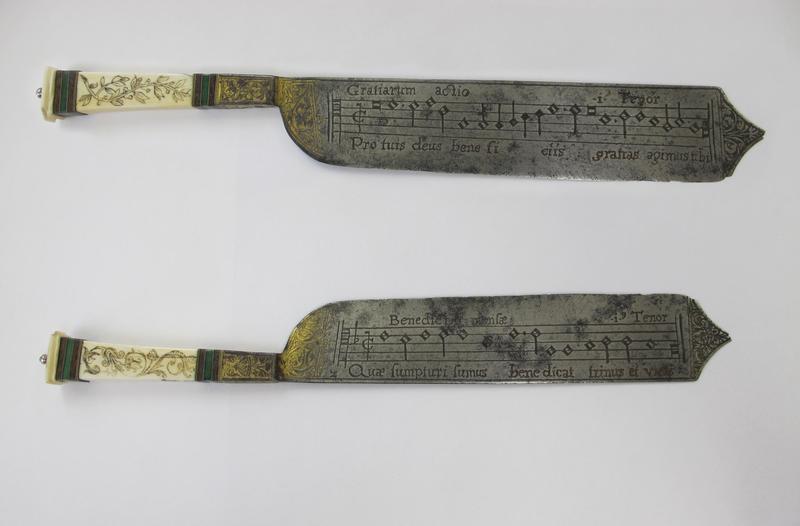
Photo: The Victoria and Albert Museum
A notation knife that has music carved into each side of the blade. Italy, c. 1550.

Read Full Post »


Photo: Alan Berner/The Seattle Times
Neurologist and musician Thomas Deuel, wearing a wired-up electrode cap, is researching brain activity in musicians and developing the encephalophone for people with limited motor ability so they can play by thinking.

Imagine being able to play music just by thinking about it! That day is coming, according to Brendan Kiley at the Seattle Times.

He writes, “In April of 2016, Seattle choir director and fifth-grade teacher Margaret Haney checked into the emergency room with an unusual problem — suddenly, she couldn’t sing.

“Haney had been in the classroom, trying to lead her students through George Gershwin’s ‘Summertime’ when, as she put it, ‘I failed miserably, like I never have.’ …

“The physicians ordered some brain scans and discovered she was suffering from ‘amusia’ — the inability to make music — due to a viral encephalitis infection in one section of her brain.

“After the tests, she was referred to Dr. Thomas Deuel, a Swedish neurologist who plays trumpet and guitar, studied musical composition and molecular biology at Princeton University, and then jazz at New England Conservatory in Boston. …

“Deuel had been working with DXARTS, a University of Washington program that incubates collaborations between scientists and artists. DXARTS was launched in 2001, with an emphasis on projects that boldly crisscross borders: video, performance, music, virtual reality, robotics and all-around tech-art hacking.

“Lately, Deuel had advised DXARTS on building a lab, with state-of-the-art technology to study the relationship between neurology and art (particularly music), and explore deep connections between the body and the brain. Deuel had also teamed up with UW-based physicist Felix Darvas on a neuro-musical invention: the encephalophone (pronounced ‘en-sef-ah-lo-fone’), an instrument you can play simply by thinking. …

“To play the encephalophone, a musician wears an electroencephalogram (EEG) cap fitted with electrodes that read brain waves and transmit them to a synthesizer. The EEG caps looks like a beanie without the propeller but protrudes a cluster of wires hooked up to amplifiers and computers. The instrument is a kind of ‘brain-computer interface,’ and sounds like an electric piano, electric strings, or whatever other kind of music the connected synthesizer can produce. …

“[DXARTS co-founder Juan] Pampin hopes the encephalophone will be developed enough to host a public concert of ‘brain performers’ by late 2018. …

“And Margaret Haney? Doctors … treated her with antiviral medication to halt the spread of the infection — and the instrument helped relieve her amusia.

“[Deuel says] learning to play the encephalophone ‘helped her make pitch. We weren’t able to completely cure her, but she was able to get back to singing again. We can’t prove that we’ve done a lot with just one patient, but it was a promising start.’ ”

More here.

Read Full Post »

Composer Tod Machover never stops experimenting. He’s known for music that combines his electronic inventions with traditional instruments, he records street sounds to capture the ambiance of cities, and he works continuously to engage regular folks in the process of creation.

Linda Poon writes at CityLab, “It’s easy to disregard the hum of a city — the incessant honking or indistinct chattering — or to cast it off as noise pollution. … To the likes of Tod Machover, a composer who combines music with technology at the MIT Media Lab, these sounds are what makes a city sing.

“Machover has turned the sounds of Toronto and Edinburgh into symphonies that reflect the characters of each city. His first piece for an American city, Symphony in D, invited Detroiters in 2015 to contribute over 15,000 sounds unique to the city—drumming from the streets, sounds from factories, and spoken words by local poets—that were combined with instruments played by the Detroit Symphony Orchestra.

‘Like so many things in our culture, there’s a growing gap between experts and ordinary people, and I thought music is such a great laboratory to show how things can be different,’ says Machover.

” ‘So I wanted the project to be a representation of connecting people—no matter what their background was in music—as equals.’

“His latest project, called Project 305 and funded by the Knight Foundation, takes him to Miami, where he’s teamed up with the city’s New World Symphony [NWS] academy to create an audio and visual masterpiece. He’s helping lead community tours to collect sounds and videos, and working with schools to teach students how to do the same. …

“Typical urban noise, like the revving of a car engine, the ringing of a bicycle bell, or the pitter-patter of pedestrian footsteps, can be found in virtually any city. So how do you make an audio portrait feel particular to the town it’s supposed to reflect?

“Sometimes, it’s about incorporating the sounds that reflect a city’s history. Detroit, for example, was famously dubbed the Motor City for being the heart of America’s auto manufacturing industry. So Machover asked the community to send in recordings of different car engines, which he merged with Motown riffs, in homage to the city’s music scene. …

“NWS is also gathering clips of human chatter, a way of capturing the diasporas within Miami. The city is often called the capital of Latin America with immigrants from Cuba, Venezuela, Colombia, and other Spanish-speaking countries making up the majority of the population. Spanish has become a dominant language, but ‘you hear the same words inflected with all kinds of different accents,’ says Machover.

“When all is done, the entire performance won’t be confined to the halls of the academy. Instead, it will also be projected onto the facade of the building and simultaneously broadcast in different neighborhoods throughout Miami.” More here.

I have attended two of Machover’s operas. I thought the one based on a story by Tolstoy was lovely, although the one written with former poet laureate Robert Pinsky didn’t work for me. Something about an inventor seeking immortality by entering his electronic system after death.

Photo: Bowers & Wilkins
Endlessly inventive composer Tod Machover is incorporating sounds of the city in his new music.

Read Full Post »

A recent post at Asakiyume’s blog reminded me of Young at Heart, the senior-citizen chorus that inspired a movie I recommended to readers in 2011.

Asakiyume wrote, “One of the women I work with at the jail is in the choir there. I got permission to go in for the performance. The jail choir group is called the Majestics, and they’ve been mentored by a senior-citizen choir called Young at Heart, all of whom were wearing T-shirts that said ‘We put the “zen” in “senior citizen.'”

“Young at Heart performed as the opening act … Then the Majestics took the stage. There were six women, and they covered a great age range (three in their twenties, two in their thirties-forties, and one who was even older than me) and ethnically diverse (two Black, one Hispanic, three White). They sang well-known songs with lots of different flavors (hip-hop, pop, blues, soul), and all the choir members were featured at least once … The entire thing was a huge success; the audience was **so** supportive. …

“At the end the programs director called for an encore, and there hadn’t been a song laid by for that, but the Young At Heart choir sang “Forever Young” … Each time someone sang a solo, he or she linked arms with one of the members of the Majestics and brought them forward, and I could see tears in my student’s eyes and I had tears in mine, because–as the chaplain who was present pointed out–that song is a benediction, and it was so great to hear those words of blessing and hope and expectation directed at the audience in the jail:

May you grow up to be righteous
May you grow up to be true
May you always know the truth
And see the lights surrounding you
May you always be courageous
Stand upright and be strong
And may you stay
Forever young”

-@-

So lovely. Such songs take on extra meaning when sung by seniors or by people who feel hopeless.

The Young at Heart movie, which I still hope you’ll see, was also full of resonance. And it exposed me to popular music like Coldplay’s “I will try to fix you.” Whenever that song comes on the radio, I see in my mind’s eye the old guy with the oxygen tank who drew tears from his audiences. He is surely gone now, but not that memory.

That the chorus has gone beyond inspiring seniors and their families to inspiring prisoners who have little to make them feel positive or hopeful — well, it’s just too amazing.

More at Asakiyume’s blog, here.

Read Full Post »

Photo: Ronald van der Meijs
In January, this candle organ was on exhibit in the Netherlands. 

You may recall my January 2014 post about zebra finches playing instruments at a museum (here) and a December 2016 post on Croatia’s sea organ (here). The sea organ harnessed the tides to push water through narrow passages leading to organ pipes under marble stairs.

How many ways there are to make music! So much need for music!

Today’s post is about an artist who created a candle pipe organ. Lauren Young at Atlas Obscura explains.

“There’s a curious low industrial hum emanating from what used to be a fish market built in 1769. At De Vishal gallery in Haarlem, Netherlands, a large nine-pipe organ operated by burning candles purrs a continuous concert.

“In the video, Dutch artist Ronald van der Meijs shows his elaborate musical mechanism. Inspired by the Muller Organ housed at Grote Kerk church next to the gallery, the series of pipes looks like a massive artillery weapon connected to wooden beam air ducts. The intricate system requires careful maintenance — van der Meijs changes out the candles multiple times a day as they burn.

“For the pipe organ, ‘the candles are the musicians,’ van der Meijs explains. The candles vary in size. As the wax melts, the pitch of each pipe shifts slowly and irregularly. The shortening of the candles causes a vertical movement in each mechanism, pulling a wheel connected to a brass valve at the front end of each pipe. Opening the valves allows for different toned pitches.” More.

The mechanical kookiness makes me smile and reminds me of Rube-Goldberg-esque egg-breaking machines I have known. (See this February 2013 post.)


Read Full Post »

Photo: Señor Codo/Flickr
Mariachi singer in Chicago, 2006.

Oh, the Internet! Last night, my husband was able to track down a ton of information on a 19th Century Norwegian church in the town where we have lived for 35 years that no one ever mentioned to us. For all the scary things the Internet is responsible for, who could do without it today? There are so many great links we share with one another.

How else would I have learned, for example, that Mariachi bands were extremely popular in the former Yugoslavia. Mexican Mariachi? Crazy.

Jonny Wrate at the website Roads and Kingdoms has a report.

“Marina de Ita had dreamed of travelling Europe for years. Her band, Polka Madre, was heavily influenced by Balkan and Roma folk music and, back in the late nineties in Mexico City, she’d fallen in love with the music of Goran Bregović.

‘ ‘I used to have parties in a clandestine bar in my house in 1998 and people went crazy for those tunes,’ she says. ‘It came as a relief for many of us who were tired of rock and the music offered by Western countries.’

“In 2015, her band was invited to play at the International Circus Festival in Mardin, Turkey, and de Ita seized the chance for a quick trip to the region she’d long wished to visit.

“Once she arrived in Belgrade, she decided to make some money busking. ‘At first, I played some Finnish polkas and some from our Balkan-influenced repertoire, but nobody paid much attention,’ she says. ‘They just threw a few coins.’

“Yet when she played ‘Bésame Mucho,’ a seventy-year-old Mexican bolero, a small crowd gathered around her. Some sang along. ‘An old man became very emotional and even shed a few tears,’ de Ita says.

“The warm reception took her by surprise, but half a century ago, such songs dominated Yugoslav airwaves. As a Croatian friend’s mother recalls, ‘It was always Mexican songs and Bollywood films.’ …

“Explore the many shelves in Belgrade’s Yugovinyl store today and you can quickly amass a pile of ‘Yu-Mex’ records. The faded photographs on their sleeves depict men with names like Ljubomir Milić and Đorđe Masalović, proudly wearing sombreros and glittering charro suits. On the turntable, these records sound straight out of Guadalajara, except that the lyrics are in Serbo-Croat. For the Mexicans that ruled the radios here were, in fact, Yugoslav.”

More at Roads and Kingdoms.

I do love this kind of unexpected cultural cross-fertilization. Who knew?


Read Full Post »

At National Public Radio, Rachel Martin reported recently on Music in Exile, an initiative that is providing a certain comfort to displaced musicians and other refugees.

“Alex Ebsary, a member of the Music in Exile team, explains that its mandate is straightforward: ‘What we do is go around, either to refugee camps or to places that we know there will be refugees or internally displaced Iraqis, and try to find musicians,’ he says. ‘They can be anyone, from somebody who knows how to sing a few songs to professionals.’

“One of the musicians featured in the project is Barakat Ali, a Yazidi man who fled from ISIS attacks on his home of Khana Sor. He says the past few years have changed the way he approaches music.

” ‘Sometimes, I feel very sad about what happened to Yazidis,’ he says. ‘So I’m just playing this music and singing to forget myself, to not be so worried and cry about these things. And sometimes I’m crying while singing.’ …

“Hear the full interview at the audio link,” here.

According to Wikipedia, “Yazidism is linked to ancient Mesopotamian religions and combines aspects of Zoroastrianism, Islam, Christianity and Judaism.”

I wish I could learn about these unfamiliar cultures through less tragic events, but I do like to learn something new. A colleague at my old job enlightened me about his Assyrian relatives, who were suffering the same dangers as the Yazidis at about the same time period, 2015.

Assyrians are mainly Christian (Wikipedia again) and speak a modern version of Aramaic. Amazing! Now I am completely confused by Byron’s energizing lines, “The Assyrian came down like the wolf on the fold …”

History is written by the victors.

Photo: Sasha Ingber
Barakat Ali is a Yazidi refugee and musician who has contributed to the recording project Music in Exile.

Read Full Post »

Photo: Odd Music
Croatia’s
Morske Orgulje — or, Sea Organ.

An architectural construction in Croatia enables the sea to play music as it flows in and out. I learned about it at the Huffington Post, where Carla Herreria has a report on the Morske Orgulje — or, Sea Organ.

“A 230-foot long instrument on the coast of Zadar, Croatia, that plays mesmerizing harmonies using the movements of the sea, the Sea Organ was conceived in 2005 by architect Nikola Bašić, after a new jetty was built to welcome cruise ships. …

“On its surface, the organ looks like large marble steps leading into the Adriatic Sea. Below, however, lies a series of narrow channels that connect to 35 organ pipes. Each set of steps holds five organ pipes each and is tuned to a different musical chord.

“As waves and wind push air through the channels, a song pours through the organ pipes and out onto the steps above. The sounds produced rely completely on the wave energy’s random time and space distribution.”

More at Wikipedia, here, and at the Huffington Post, here.

Read Full Post »

« Newer Posts - Older Posts »