Feeds:
Posts
Comments

Posts Tagged ‘music’

A recent post at Asakiyume’s blog reminded me of Young at Heart, the senior-citizen chorus that inspired a movie I recommended to readers in 2011.

Asakiyume wrote, “One of the women I work with at the jail is in the choir there. I got permission to go in for the performance. The jail choir group is called the Majestics, and they’ve been mentored by a senior-citizen choir called Young at Heart, all of whom were wearing T-shirts that said ‘We put the “zen” in “senior citizen.'”

“Young at Heart performed as the opening act … Then the Majestics took the stage. There were six women, and they covered a great age range (three in their twenties, two in their thirties-forties, and one who was even older than me) and ethnically diverse (two Black, one Hispanic, three White). They sang well-known songs with lots of different flavors (hip-hop, pop, blues, soul), and all the choir members were featured at least once … The entire thing was a huge success; the audience was **so** supportive. …

“At the end the programs director called for an encore, and there hadn’t been a song laid by for that, but the Young At Heart choir sang “Forever Young” … Each time someone sang a solo, he or she linked arms with one of the members of the Majestics and brought them forward, and I could see tears in my student’s eyes and I had tears in mine, because–as the chaplain who was present pointed out–that song is a benediction, and it was so great to hear those words of blessing and hope and expectation directed at the audience in the jail:

May you grow up to be righteous
May you grow up to be true
May you always know the truth
And see the lights surrounding you
May you always be courageous
Stand upright and be strong
And may you stay
Forever young”

-@-

So lovely. Such songs take on extra meaning when sung by seniors or by people who feel hopeless.

The Young at Heart movie, which I still hope you’ll see, was also full of resonance. And it exposed me to popular music like Coldplay’s “I will try to fix you.” Whenever that song comes on the radio, I see in my mind’s eye the old guy with the oxygen tank who drew tears from his audiences. He is surely gone now, but not that memory.

That the chorus has gone beyond inspiring seniors and their families to inspiring prisoners who have little to make them feel positive or hopeful — well, it’s just too amazing.

More at Asakiyume’s blog, here.

Read Full Post »

Photo: Ronald van der Meijs
In January, this candle organ was on exhibit in the Netherlands. 

You may recall my January 2014 post about zebra finches playing instruments at a museum (here) and a December 2016 post on Croatia’s sea organ (here). The sea organ harnessed the tides to push water through narrow passages leading to organ pipes under marble stairs.

How many ways there are to make music! So much need for music!

Today’s post is about an artist who created a candle pipe organ. Lauren Young at Atlas Obscura explains.

“There’s a curious low industrial hum emanating from what used to be a fish market built in 1769. At De Vishal gallery in Haarlem, Netherlands, a large nine-pipe organ operated by burning candles purrs a continuous concert.

“In the video, Dutch artist Ronald van der Meijs shows his elaborate musical mechanism. Inspired by the Muller Organ housed at Grote Kerk church next to the gallery, the series of pipes looks like a massive artillery weapon connected to wooden beam air ducts. The intricate system requires careful maintenance — van der Meijs changes out the candles multiple times a day as they burn.

“For the pipe organ, ‘the candles are the musicians,’ van der Meijs explains. The candles vary in size. As the wax melts, the pitch of each pipe shifts slowly and irregularly. The shortening of the candles causes a vertical movement in each mechanism, pulling a wheel connected to a brass valve at the front end of each pipe. Opening the valves allows for different toned pitches.” More.

The mechanical kookiness makes me smile and reminds me of Rube-Goldberg-esque egg-breaking machines I have known. (See this February 2013 post.)


Read Full Post »

Photo: Señor Codo/Flickr
Mariachi singer in Chicago, 2006.

Oh, the Internet! Last night, my husband was able to track down a ton of information on a 19th Century Norwegian church in the town where we have lived for 35 years that no one ever mentioned to us. For all the scary things the Internet is responsible for, who could do without it today? There are so many great links we share with one another.

How else would I have learned, for example, that Mariachi bands were extremely popular in the former Yugoslavia. Mexican Mariachi? Crazy.

Jonny Wrate at the website Roads and Kingdoms has a report.

“Marina de Ita had dreamed of travelling Europe for years. Her band, Polka Madre, was heavily influenced by Balkan and Roma folk music and, back in the late nineties in Mexico City, she’d fallen in love with the music of Goran Bregović.

‘ ‘I used to have parties in a clandestine bar in my house in 1998 and people went crazy for those tunes,’ she says. ‘It came as a relief for many of us who were tired of rock and the music offered by Western countries.’

“In 2015, her band was invited to play at the International Circus Festival in Mardin, Turkey, and de Ita seized the chance for a quick trip to the region she’d long wished to visit.

“Once she arrived in Belgrade, she decided to make some money busking. ‘At first, I played some Finnish polkas and some from our Balkan-influenced repertoire, but nobody paid much attention,’ she says. ‘They just threw a few coins.’

“Yet when she played ‘Bésame Mucho,’ a seventy-year-old Mexican bolero, a small crowd gathered around her. Some sang along. ‘An old man became very emotional and even shed a few tears,’ de Ita says.

“The warm reception took her by surprise, but half a century ago, such songs dominated Yugoslav airwaves. As a Croatian friend’s mother recalls, ‘It was always Mexican songs and Bollywood films.’ …

“Explore the many shelves in Belgrade’s Yugovinyl store today and you can quickly amass a pile of ‘Yu-Mex’ records. The faded photographs on their sleeves depict men with names like Ljubomir Milić and Đorđe Masalović, proudly wearing sombreros and glittering charro suits. On the turntable, these records sound straight out of Guadalajara, except that the lyrics are in Serbo-Croat. For the Mexicans that ruled the radios here were, in fact, Yugoslav.”

More at Roads and Kingdoms.

I do love this kind of unexpected cultural cross-fertilization. Who knew?


Read Full Post »

At National Public Radio, Rachel Martin reported recently on Music in Exile, an initiative that is providing a certain comfort to displaced musicians and other refugees.

“Alex Ebsary, a member of the Music in Exile team, explains that its mandate is straightforward: ‘What we do is go around, either to refugee camps or to places that we know there will be refugees or internally displaced Iraqis, and try to find musicians,’ he says. ‘They can be anyone, from somebody who knows how to sing a few songs to professionals.’

“One of the musicians featured in the project is Barakat Ali, a Yazidi man who fled from ISIS attacks on his home of Khana Sor. He says the past few years have changed the way he approaches music.

” ‘Sometimes, I feel very sad about what happened to Yazidis,’ he says. ‘So I’m just playing this music and singing to forget myself, to not be so worried and cry about these things. And sometimes I’m crying while singing.’ …

“Hear the full interview at the audio link,” here.

According to Wikipedia, “Yazidism is linked to ancient Mesopotamian religions and combines aspects of Zoroastrianism, Islam, Christianity and Judaism.”

I wish I could learn about these unfamiliar cultures through less tragic events, but I do like to learn something new. A colleague at my old job enlightened me about his Assyrian relatives, who were suffering the same dangers as the Yazidis at about the same time period, 2015.

Assyrians are mainly Christian (Wikipedia again) and speak a modern version of Aramaic. Amazing! Now I am completely confused by Byron’s energizing lines, “The Assyrian came down like the wolf on the fold …”

History is written by the victors.

Photo: Sasha Ingber
Barakat Ali is a Yazidi refugee and musician who has contributed to the recording project Music in Exile.

Read Full Post »

Photo: Odd Music
Croatia’s
Morske Orgulje — or, Sea Organ.

An architectural construction in Croatia enables the sea to play music as it flows in and out. I learned about it at the Huffington Post, where Carla Herreria has a report on the Morske Orgulje — or, Sea Organ.

“A 230-foot long instrument on the coast of Zadar, Croatia, that plays mesmerizing harmonies using the movements of the sea, the Sea Organ was conceived in 2005 by architect Nikola Bašić, after a new jetty was built to welcome cruise ships. …

“On its surface, the organ looks like large marble steps leading into the Adriatic Sea. Below, however, lies a series of narrow channels that connect to 35 organ pipes. Each set of steps holds five organ pipes each and is tuned to a different musical chord.

“As waves and wind push air through the channels, a song pours through the organ pipes and out onto the steps above. The sounds produced rely completely on the wave energy’s random time and space distribution.”

More at Wikipedia, here, and at the Huffington Post, here.

Read Full Post »

Photo: Iñaki LL

One of my Facebook friends shared an entertaining page on “rare and strange instruments” (you have to see it to believe it), leading me to seek more information on an instrument called the txalaparta. It may not be as unusual as the piano that makes cats meow but is nevertheless worthy of investigation.

According to Wikipedia, the txalaparta is “a specialized Basque music device of wood or stone. In some regions of the Basque Country, zalaparta (with [s]) means ‘racket,’ while in others (in Navarre) txalaparta has been attested as meaning the trot of the horse, a sense closely related to the sound of the instrument. …

“During the last 150 years, txalaparta has been attested as a communication device used for funeral (hileta), celebration (jai) or the making of slaked lime (kare), or cider (sagardo). After the making of cider, the same board that pressed the apples was beaten to summon the neighbours. Then, a celebration was held and txalaparta played cheerfully, while cider was drunk. …

“Traditional txalaparta was almost extinct in the 1950s with a handful of pairs of peasants maintaining the tradition. It was then revived by folklorists, such as Jesus and Jose Antonio Artze from the group Ez dok amairu.” Now you can hear it on YouTube, below.

More at Wikipedia.

Video: The Give and Take of Wood and Stone. Oreka Tx Brings Once Threatened Basque Sounds and New Global Resonances to the U.S. in September 2010 and on Nömadak Tx.

Read Full Post »

Photo: Postmodern Jukebox band.

Scott Bradlee and his Postmodern Jukebox band take modern hits and play them in old-timey styles with surprise guest artists. The results are awesome.

James Sullivan has the story at the Boston Globe.

“When the Wang Theatre at the Citi Performing Arts Center first opened in 1925, the ornate performance hall was known as the Metropolitan. Scott Bradlee’s Postmodern Jukebox [offers] listeners a ticket of sorts back to the Jazz Age of the theater’s beginnings, with Bradlee’s old-time piano anchoring the collective improvisation of a Dixieland ensemble.

“Then they’ll get to the part of the song when Justin Bieber taunts an ex because she still hits his phone up.

“Right from the start of the band’s five-year ascent on YouTube, Postmodern Jukebox made its method clear: The group takes the pop hits of the text-and-Snapchat age and recasts them as meticulously arranged period pieces, from ragtime to doo-wop. …

“Despite the vintage sound, his group’s work is not intended as a pure throwback, says Bradlee, a 35-year-old New Jersey native, who recently moved to Los Angeles after launching PMJ from a Queens basement in 2011.

“ ‘It’s more of an alternative universe, in a way,’ he says. ‘We might even go into something a little bit hip-hop or funky. It’s more . . . an aesthetic – you kind of know it when you hear it.’ …

“Working outside the conventional music industry in more ways than one, Postmodern Jukebox doesn’t announce all the performers expected at any given performance. Drawing from a roster that now numbers nearly 70 singers and musicians, Bradlee varies the lineup from city to city, depending on location and availability.

“Sara Niemietz … takes the lead on PMJ’s versions of OutKast’s ‘Hey Ya!’ and Bieber’s ‘Love Yourself,’ for which, she says, she had Bessie Smith – the ‘Empress of the Blues’ – in mind. …

“Though Niemietz headlines her own shows, acts, and does theater work, she likes the all-for-one-and-one-for-all camaraderie of the PMJ players.

“ ‘It’s almost like you’re on a team,’ she says. ‘Everyone is working together to create a larger experience.’ ” More at the Globe.

Listen:

Read Full Post »

Who wouldn’t love Harvard Square? Although too many sights there are troubling, the square also offers a nonstop showcase of wonders. It’s kind of a mirror of human experience.

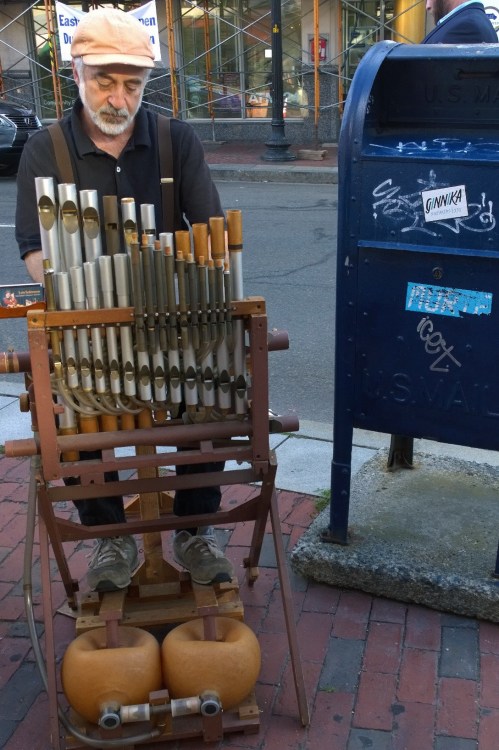
The last time I was in Harvard Square, I was meeting Minnesota friends for dinner. I ended up arriving at Harvest restaurant a few minutes after them because I simply had to stop and listen to this musician-inventor play his bellowphone.

From Len Solomon’s About page: “Classically trained musician, inventor, and one-man-orchestra Len Solomon performs a unique recital of music and comedy.

“The one-hour show features your favorite symphonic compositions, arranged for Dog Whistles and Bicycle Horn, plus a chromatic pipe organ devised from plumbing parts and coat-hanger wire, and of course, the ingenious Majestic Bellowphone: a musical masterpiece of Medieval technology! …

“Len majored in guitar and early music at Antioch College, and followed that with two years of playing guitar in a country-rock band in Idaho. He finally gave up the glory of playing for drunkards in bars five nights a week, and went to work for 10 years as a professional cabinetmaker in the Boston area. In 1983, in his Cambridge basement, Len built the Majestic Bellowphone, and he took it to the streets along with his 5-ball juggling routine, taking his place among the ranks of classic Harvard Square street acts.”

Click to hear the callioforte and bellowphone.

081816-inventor-plays-music-Harvard-Square

Read Full Post »

Photo: Suzanne Kreiter/Globe Staff
A stage in the back of a U-Haul (paid for in part by Fresh Sound Foundation) allows the Grammy Award-winning Parker Quartet to perform anywhere.

Classical musicians who believe their music will bring a blessing to whoever hears it have been presenting in offbeat locales in the Greater Boston area. Tomorrow, too. Malcolm Gay has the story at the Boston Globe.

“The 17-foot U-Haul truck sat parked in an empty field, ringed by trees. With the touch of a button, a roof-mounted winch whirred into action, unspooling cable as a fan-shaped stage lowered like a drawbridge from the rear. The U-Haul’s modified rear doors acted as a band shell, flanking the stage to project sound, and a custom-made sail, supported by deep-sea fishing rods, projected as a visor from above.

“Fifteen minutes later and the vehicle, dubbed the Music Haul, was a fully functioning stage — a 21st-century gypsy caravan that will bring live performances to the streets and schools of Greater Boston, Sunday through Tuesday.

“ ‘It really is more boat than truck,’ said Catherine Stephan, executive director of the Yellow Barn music center. ‘We got to know RV dealerships really well.’ …

“ ‘It’s supposed to be as close to magic as possible,’ said architect John Rossi, one of the traveling venue’s principal designers. …

“Its creators say the Music Haul’s main mission is to bring world-class concert performances to the most unlikely of places: schools, underserved neighborhoods, hospitals, perhaps even prisons.

” ‘We exist in the world as musicians that is in a way so finely controlled and tuned,’ said Yellow Barn’s artistic director, Seth Knopp. ‘Music Haul removes some of the ceremony, which can be a barrier for people who are not often exposed to that world. There’s an element of taking something out of its accustomed place and allowing it to take people by surprise.’ ”

What a good thought! Reminds me how you can suddenly start seeing the pictures on your walls again if you move them to a new location in the house.

Read more about this enchanting initiative here.

Read Full Post »


080616-vision-of-hope-zambia-apron

The first booth I encountered at the Art and Artisan fair Saturday was promoting a charity called Vision of Hope Zambia.

Co-founder Meg O’Brien had been a student at Berklee College of Music when a missionary friend in Zambia asked her to lend her musical talent to uplifting girls who lived on the streets.

When she visited Africa, Meg must have been shocked by what she saw: young girls, often orphaned, often HIV positive, who had no place to get a meal or even take a shower. She flew into action, co-founding Vision of Hope Zambia with Chitalu Chishimba.

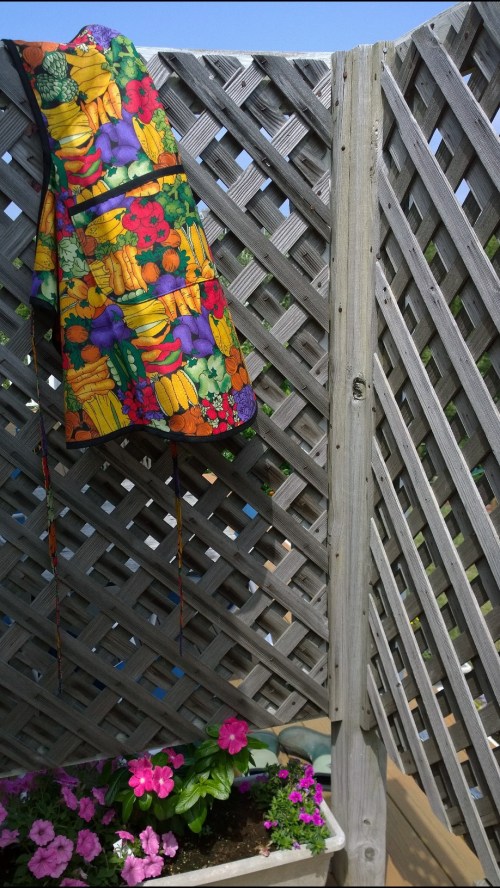
Meg’s mother and aunt also flew into action, creating a craft initiative that donates 100 percent of proceeds to the cause.

The two artisans not only sew with skill — baby bibs, changing blankets, aprons and the like — they also are good at selling, promoting Meg’s charity while highlighting various features of their products.

Meg’s aunt saw me talking to my grandchildren and immediately pointed out the colorful array of child-size aprons. In the end, though, I bought an adult-sized apron for myself.

From humble beginnings in 2009 (“weekly meetings in the backyard of the Girl Scouts building underneath a tree”), the organization is now able to provide housing and education for many girls as it continues to grow.

Photo: Vision of Hope Zambia
Girls at Vision of Hope proudly show off their hard work in rug making.


Read Full Post »

Do you know about the “Great Animal Orchestra“? Rachel Donadio at the NY Times has the story.

“The bioacoustician and musician Bernie Krause has been recording soundscapes of the natural world since 1968, from coral reefs to elephant stamping grounds to the Amazonian rain forest.

“Now, Mr. Krause’s recordings have become part of an immersive new exhibition at the Cartier Foundation here called ‘The Great Animal Orchestra.’ Named after Mr. Krause’s 2012 book of the same title, the show opens on Saturday and runs through Jan. 8, [2017].

“At its heart is a work by the London-based collective United Visual Artists, who have transformed Mr. Krause’s recordings of the natural world into 3-D renderings. Imagine stepping into a soundproofed black-box theater whose walls spring to life with what look like overlapping electrocardiograms, representing different species’ sounds. …

“The installation includes recordings Mr. Krause made in Algonquin Park in Ontario, where he found himself caught between two packs of wolves; in the Yukon Delta, a subarctic area in Alaska, where birds from different continents converge; and in the Central African Republic, where he heard monkeys. He also captured the cacophony of the Amazon, and whales off Alaska and Hawaii. …

“Mr. Krause is a polymathic musician who performed with the folk group the Weavers and helped introduce the Moog synthesizer to pop music — including songs by the Doors and Van Morrison — and film scores. He hears natural sounds with a studio producer’s ear.”

Read more here about Krause and his efforts to get the word out on the disappearing habitats of his featured animals.

This article inspires me to pay better attention to the music of the natural world on my morning walks. So much beauty goes right over my head.

Photo: Tim Chapman
Bernie Krause on St. Vincent Island, Fla., in 2001.
 

Read Full Post »

I liked this story from the “People Making a Difference” series at the Christian Science Monitor. It’s about refugee musicians in Europe finding one another and bringing beauty and deeper understanding to their new countries.

Isabelle de Pommereau writes, “On a March evening in Berlin, bassist Raed Jazbeh and other musicians play the melancholic tones of ‘Sea Waves’ by Syrian composer MAias Alyamani. Mr. Alyamani wrote the song a decade ago after leaving his homeland, ‘to hold in my mind a piece from my country in my music.’

“Now, with hundreds of thousands of Syrian refugees flooding Germany, ‘Sea Waves’ takes on new meaning.

“Mr. Jazbeh himself fled Syria three years ago, as war tore it apart. So did many of the other musicians – also Syrians – performing ‘Sea Waves.’ Some had risked their lives and lost their instruments crossing Turkey and the Mediterranean Sea and then trekking into Europe.

“Jazbeh is the one who brought these musicians together. Last fall, he created the world’s first philharmonic orchestra of Syrian musicians in exile, reuniting the violinists and harpists, percussionists and trumpet players …

“The Syrian Expat Philharmonic Orchestra (SEPO) has been giving Syrians and Germans a chance to connect in a fresh way, around music. The ensemble is helping to shatter stereotypical images of refugees, instead offering a portrayal of them as hardworking, creative people who have much to contribute to society. …

“Jazbeh grew up in the city of Aleppo, in northern Syria, with music at the center of his life. … After he landed at a refugee center in Bremen, he played chamber music for friends and at community centers. [He also] began looking for friends from his days at the Damascus conservatory. ‘Facebook was so important,’ he notes.

“Gradually, he found them. In Italy. Sweden. The Netherlands. France. …

“In all, about 30 Syrian musicians came together for that first concert. ‘It was very emotional,’ Jazbeh remembers. …

“ ‘The music touched my heart,’ said concertgoer Abdulrhman Hamdan, fighting back tears. At home, in Damascus, he had had to stop his engineering studies. He arrived in Berlin last winter after a journey by foot, bus, and boat.

“ ‘It makes me feel sad and happy,’ he added. ‘On the one hand, the music [evoked the] war. On the other hand, it was hope that there is peace again.’ ”

Read how the concert changed the impressions of one German audience member here.

Photo: Isabelle de Pommereau
Raed Jazbeh, a Syrian refugee, had to play a borrowed instrument until an anonymous German donor sent him this double bass as a gift.

Read Full Post »

Tim Jonze wrote a funny story at the Guardian about hiring a therapeutic opera singer to deal with his anxiety about becoming a father.

“The soprano reaches a dramatic climax, demonstrating impressive lung power as she sustains the dizzying peak note, before bringing Quando me’n’ vo’ to its close. It is a powerful, emotionally draining performance, and one that seems to resonate around the room for some time after she has finished. Which is why I get up off the sofa and ask her if she would like a cup of tea.

“This, as you might have guessed, is not your typical night at the opera – and not only because it’s only just gone 11 am. It is called Opera Helps, and is a project dreamed up by the artist Joshua Sofaer. The gist is this: contact the Opera Helps phoneline with a personal problem, and they will endeavour to send a singer to your house. Said singer will briefly discuss the issue with you, select a suitable aria that addresses it, then perform it for you while you relax in familiar surroundings: on a comfortable chair, for instance, or even in bed.

“It’s not therapy as such – in fact, they are very keen to stress that their singers are not trained therapists – but the project does aim to help you look at your problem from a new perspective and, hopefully, experience the healing power of music.

“ ‘It’s about giving someone the space for reflection, the same way having a chat with a friend might give you fortitude to carry on,’ says Sofaer, who found success running the project in Sweden before bringing it to the UK. …

“ ‘In my experience, you either respond to the music or you don’t – I don’t think it is based on your musical education or what class you’re from or how much money you’ve got, which is the common perception. The idea that opera needs an expert audience is a complete misnomer.’ ”

More at the Guardian, here.

Photo: David Bebber for the Guardian  
Opera singer Caroline Kennedy sings to Tim Jonze to relieve his stress.

Read Full Post »

In this story from radio show Studio 360, we learn that music is intriguing to animals, at the very least arousing their curiosity and perhaps stimulating and soothing them.

“Laurel Braitman is a historian of science and the author of ‘Animal Madness: How Anxious Dogs, Compulsive Parrots, and Elephants in Recovery Help Us Understand Ourselves.’ She’s particularly interested in the mental health of animals in captivity.

“ ‘If their minds aren’t stimulated, they can end up with all sorts of disturbing behaviors,’ she says. Braitman wondered if music — so often soothing to people, but usually foisted on animals without their permission — could help counter their symptoms of anxiety and depression.

“That led Braitman to arrange a series of concerts for all-animal audiences: gorillas in a Boston zoo and a small herd of bison in Golden Gate Park. Recently, the bluegrass band Black Prairie played for the residents of Wolf Haven wolf sanctuary in Tenino, Washington. …

“Can we say that they liked it?

“Researchers are trying to answer this question in controlled experiments where they observe whether animals move toward or away from speakers, depending on the music.

“Dr. Charles Snowdon of the University of Wisconsin collaborates with a composer, David Teie, who writes music tailored for certain species. They base their compositions on sonic frequencies the animals use in nature. Their music for domestic cats features tempos of purring or suckling kittens; small monkeys called cotton-top tamarins, on the other hand, got music that sounds remarkably like nails on a blackboard. ‘It is pretty godawful if you ask me,’ Snowdon says. ‘But the tamarins dig it.’ ”

More here.

Music for Wolves: Black Prairie from Aubree Bernier-Clarke on Vimeo.

Read Full Post »

What a weekend for entertainment! On one day, we saw the musical The Wild Party (LaChiusa version) at  Moonbox Productions in Boston. (Very good.) On another, we attended a flamenco concert in a church.

The flamenco headliner, guitarist Juanito Pascual, was joined by flamenco percussionist and singer José Moreno and singer and dancer Bárbara Martinez. Such exuberant and mournful fun! It reminded us of fado concerts we’ve attended, although that happy-sad tradition is Portuguese and flamenco is Spanish.

The music included pieces that go back centuries plus Pascual’s own compositions, which are a fascinating blend of old and new. Challenging at times, but pretty intriguing. One was dedicated to the person back home in Minnesota “who persuaded my mother to let me take guitar lessons.”

An article in the Concord Journal notes that Pascual,  who is just beginning a 15-city tour to promote his latest CD, “skillfully weaves such influences as Jimi Hendrix, the Grateful Dead, Bach and many others into his original compositions.” The Journal also quotes Boston Globe critic Steve Morse, who admires how Pascual “combines vivid colors, rich imagination and a yearning, never satisfied mastery of his art.”

Even in pieces without Moreno’s percussion support, Pascual’s virtuoso performance sounded like he was simultaneously playing two guitars and a set of bongos (flamenco involves slapping the wood as well has playing the strings). Very dramatic.

More at the Concord Journal, here. And you can hear samples of the music at all three artists’ websites.

Photo: www.juanitopascual.com

Read Full Post »

« Newer Posts - Older Posts »