Feeds:
Posts
Comments

Posts Tagged ‘mystery’

Photo: Jaida Grey Eagle via MPR News.
Among her many accomplishments, Twin Cities-based author Marcie Rendon writes a mystery series about indigenous investigator Cash Blackbear. 

I read a lot of mysteries, and I gravitate toward those about different cultures, often outside North America. But indigenous cultures here are equally foreign to me, which is why I have enjoyed Marcie Rendon’s Cash Blackbear series, about a tough young Ojibwe woman who investigates crimes against members of Upper Midwest tribes, often women.

I have several articles here for you to click on if interested, but I’m going to focus on what the Minnesota-based McKnight Foundation said about Rendon when they gave her an award.

“The McKnight Foundation is pleased to announce the selection of Marcie Rendon for its 2020 Distinguished Artist Award—a $50,000 award created to honor a Minnesota artist who has made significant contributions to the state’s cultural life. Rendon, an enrolled member of the White Earth Nation, is a writer whose poems, plays, children’s books, and novels explore the resilience and brilliance of Native peoples.

“ ‘Marcie brings a strong and necessary voice to so many genres,’ said Pamela Wheelock, McKnight’s interim president. ‘She has created a tremendous body of work, including poetry, plays, lyrics, and award-winning crime novels, all while raising up other Native voices in our community. Her commitment to making art in community embodies what a distinguished artist means to Minnesota and to McKnight.’ …

“A gifted storyteller and prolific writer, Rendon is the author of the award-winning Cash Blackbear mystery series, set in Minnesota’s Red River Valley. The first novel in the series, Murder on the Red River, earned the 2018 Pinckley Prize for Debut Novel, and the second, Girl Gone Missing, was nominated for the Mystery Writers of America – G. P. Putnam’s Son’s Sue Grafton Memorial Award. Rendon … is also the author of four nonfiction children’s books, including Powwow Summer (Minnesota Historical Society Press, 2013).

“Rendon’s plays include Sweet Revenge, chosen for the Oklahoma Indigenous Theatre Company’s 2020 New Native American Play Festival. She has also curated and produced a variety of Native-focused performances at the History Theatre, the Minnesota Fringe Festival, and Patrick’s Cabaret. She is the founder of Raving Native Theater, a platform that brings voice and visibility to other Native American artists and performers.

“ ‘We are more resilient than we are traumatized,’ said Rendon. ‘Art keeps us thriving, not just surviving. I try to make room for other Native artists. Every time someone steps forward, it makes room for others to step forward.’ …

“Rendon’s poem ‘Resilience’ is also included in US Poet Laureate Joy Harjo’s digital project ‘Living Nations, Living Words: A Map of First Peoples Poetry,’ which will join the permanent collection of the American Folklife Center at the Library of Congress.

“Rendon’s awards include a 2020 Ensemble/Playwright Collaboration Grant from the Network of Ensemble Theaters and the Playwrights’ Center, and a 2020 Covid-19 artist grant from the Tiwahe Foundation for demonstrating resilience during the pandemic. Rendon was named a 2018 50 Over 50 honoree by AARP Minnesota and Pollen Midwest and received Loft’s 2017 Spoken Word Immersion Fellowship with poet Diego Vazquez. …

“Said Sandy Agustin, a member of the Distinguished Artist Award selection committee, ‘Whether she is writing about boarding schools, incarceration, or the epidemic of missing and murdered Indigenous women, she is nurturing Native voices and amplifying communities that are too often unheard, especially Native women.’

“Born in northern Minnesota in 1952, Rendon was a voracious reader, creative writer, and poet from an early age. While studying criminal justice at Moorhead State College in the early 1970s, she was part of a group of Native student activists who successfully demanded the launch of the university’s first American Indian studies department.

“After moving to the Phillips neighborhood of Minneapolis in the late 1970s, she worked as a counselor and therapist, while raising her three daughters. In 1991 she saw a performance by Margo Kane, a Cree-Saulteaux artist, that inspired Rendon to share her own poetry and writing with a wider audience. …

“She is currently collaborating with artist Heather Friedli on an upcoming installation at the Weisman Art Museum about the high rates of incarceration among Native women.”

I have read most of the Cash Blackbear books (there’s a new one just out), and I find the urgent educational energy of the series both its strength and its weakness. Rendon feels empowered by a need to educate unenlightened readers like me, and I appreciate what she’s doing. After all, injustices continue and indigenous women in particular still disappear at an intolerable rate. I’ll just say that sometimes the mission overwhelms a good yarn.

More at the McKnight Foundation, here. See also Minnesota Public Radio, here, and Visual Collaborative, here.

Read Full Post »

Photo: Arthur Brand.
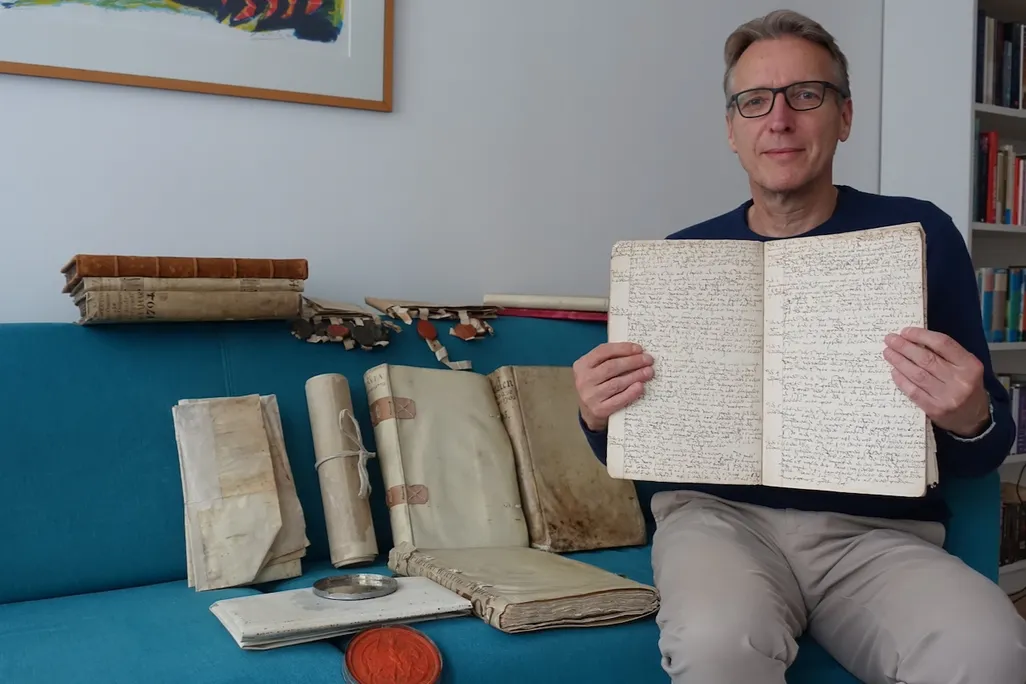
A box given to art sleuth Arthur Brand contained records from the Dutch East India Company. They had been stolen a decade ago from the Hague in the Netherlands.

Everyone likes a mystery, especially one that gets solved in a satisfactory way. Of course, “satisfactory” is in the eye of the beholder. I myself like to have the perp brought to justice. Other people prefer something brutally realistic.

France 24 reported recently on a mystery solved by Arthur Brand, the “Indiana Jones of the Art World.” In this case, the perp is long gone.

“A Dutch art sleuth has recovered a priceless trove of stolen documents from the 15th to the 19th century, including several UNESCO-listed archives from the world’s first multinational corporation. Arthur Brand [ said] the latest discovery was among his most significant.

” ‘In my career, I have been able to return fantastic stolen art, from Picassos to a Van Gogh … yet this find is one of the highlights of my career,’ Brand told AFP.

“Many of the documents recount the early days of the Dutch East India Company (VOC), whose globetrotting trading and military operations contributed to the Dutch ‘Golden Age,’ when the Netherlands was a global superpower.

“VOC merchants criss-crossed the globe, catapulting the Netherlands to a world trading power but also exploiting and oppressing the colonies it conquered. The company was key to the slave trade during that period, with generations of enslaved people forced to work on Dutch plantations. …

“The company was also a leading diplomatic power and one document relates a visit in 1700 by top VOC officials to the court of the Mughal emperor in India.

” ‘Since the Netherlands was one of the most powerful players in the world at that time in terms of military, trade, shipping, and colonies, these documents are part of world history,’ said Brand.

UNESCO agrees, designating the VOC archives as part of its ‘Memory of the World’ documentary heritage collection.

” ‘The VOC archives make up the most complete and extensive source on early modern world history anywhere,’ says UNESCO on its website.

“The trove also featured early ships logs from one of the world’s most famous admirals, Michiel de Ruyter, whose exploits are studied in naval academies even today. …

“No less enthralling is the ‘who-dunnit’ of how Brand came by the documents.

“Brand received an email from someone who had stumbled across a box of seemingly ancient manuscripts while clearing out the attic of an incapacitated family member.

“This family member occasionally lent money to a friend, who would leave something as collateral – in this case the box of documents. …

“Brand investigated with Dutch police and concluded the documents had been stolen in 2015 from the vast National Archives in The Hague. The main suspect – an employee at the archives who had indeed left the box as collateral but never picked it up – has since died. …

“The art detective said he spent many an evening sifting through the documents, transported back in time.

” ‘Wars at sea, negotiations at imperial courts, distant journeys to barely explored regions, and knights,’ he told AFP.

” ‘I felt like I had stepped into Robert Louis Stevenson’s Treasure Island.’ ” More at France 24, here.

Don’t you love that UNESCO has a category of valuables called “Memory of the World”? Wow, what else belongs to the Memory of the World, and is it being protected for the very reason that we don’t remember it? Is Robert Louis Stevenson in Memory of the World?

Read Full Post »

Photo: Soren Ryesgaard.
A boat looks tiny cruising by the rockslide gully of a destroyed glacier in Greenland recently. Rockslide plus global warming equals a surprise.

I don’t remember reading about this mysterious rumble at the time, but I’m always interested when scientists are stumped. I like how they approach figuring out a new phenomenon. Here’s hoping that science will continue to guide us the future. For one thing, unlike business or politics, it is usually collaborative, as seen in this story.

Kasha Patel wrote at the Washington Post, “The strange rumble was detected mid-September last year. An odd seismic signal appeared at scientific stations around the globe, but it didn’t look like the busy squiggles of an earthquake. A day passed, and the slow tremor still reverberated. When it continued for a third day, scientists worldwide began assembling to discuss what was causing the grumble in the ground.

“Some initially thought the seismic instruments recording the signal were broken, but that was quickly nixed. Maybe it was a new volcano emerging before their eyes, others said. …

“ ‘No one had ever seen this. We have nothing to compare it with,’ said Kristian Svennevig, a geologist at the Geological Survey of Denmark and Greenland.

“Nine days later, the vibrations greatly dissipated. But the mystery of the USO [Unidentified Seismic Object] lasted much longer. A year later, the puzzle has been solved, according to a study published in the journal Science [in September 2024]. It took about 70 people from 15 different countries and more than 8,000 exchanged messages (long enough for a 900-page detective novel) to crack the case.

“The short answer: A mega-tsunami created waves that sloshed back and forth in a fjord in Greenland, creating vibrations that traveled around the world.

“The long answer begins in the atmosphere. As greenhouse gas concentrations increase due to climate change, those heat-trapping gases accelerate ice melt particularly around Earth’s poles. On Sept. 16 last year, that extra heat thinned a glacier in eastern Greenland over time so much that it could no longer support the mountain rock above it.

“A 500-foot-thick piece of metamorphic rock, about a third of a mile wide and long, fell and triggered a massive landslide. Rock and ice, enough to fill 10,000 Olympic-size swimming pools, let loose as fast as 47 meters per second and ran for more than a mile. The avalanche plunged into the Dickson Fjord, triggering a 650-foot-high tsunami — one of the highest seen in recent history.

“Farther away from the fjord, tsunami waves reaching 13 feet high damaged an unoccupied research station and destroyed cultural and archaeological heritage sites, including an old trapper hut that had never been affected by tsunamis during its century-old history. …

“Meanwhile, in the fjord, the mega-tsunami wave traveled back and forth in the inlet and created a standing wave called a seiche. We often see small-scale seiches — this rhythmic oscillation in water — in a swimming pool or bathtub. This tsunami source was so energetic that the seiche radiated seismic waves globally, shaking the planet for nine days before it petered out.

“Members of the Danish military sailed into the fjord only days after the event to collect drone imagery of the collapsed mountain face and glacier front and scars left by the tsunami.

“Of course, Svennevig and many of his close colleagues didn’t fully know of the connection between the tsunamigenic landslide and the seiche as the events unfolded, which is detailed in the study.

“At the time, they were scratching their heads about the data at the seismograph stations. The seiche appeared as a single slow vibration, like a monotonous-sounding hum, as opposed to the frantic lines of a typical earthquake reading. The wave peaked every 92 seconds, which is slow compared with an earthquake. …

“ ‘When we started doing this research, nobody had any ideas about what was the root cause,’ said Carl Ebeling, a co-author of the study and a seismologist at the Scripps Institution of Oceanography at the University of California at San Diego. ‘Even for a large landslide under normal circumstances, it would be hard to see that on a global scale, so something special is going on here.’

“As some scientists investigated the peculiar seismic data, another group of authorities and researchers had heard of a large tsunami in a remote fjord in eastern Greenland. The two teams, among others, joined forces, quickly growing into a 24/7 international collaboration via a messaging system. The group brought a variety of local field data and remote, global-scale observations.

“ ‘We knew there was a landslide and a tsunami. You could pull the seismic signal of those,’ Svennevig said. ‘But then there was this other seismic signal that continued for nine days, and they were taken from roughly the same area, so they must be associated somehow.’ …

“The breakthrough came when they received new bathymetry data of the fjord, similar to a topographic map, from the Danish military, which allowed them to better map the seabed in the computer models. Once incorporated, the team used an unprecedentedly high resolution model to show how the landslide direction, along with the uniquely narrow and bendy fjord channel, led to the nine-day seiche.”

More at the Post, here.

Read Full Post »

Photo: Landon Speers/Guardian.
A Woodstock, New York, woodsman who prefers to be anonymous, cuts logs in his yard to deliver to neighbors.

Some people do good deeds and seek no credit. At the Guardian, David Wallis wrote early this year about one of those people.

“On a chilly morning in Woodstock, New York, frozen dew turns lawns a glistening white as puffs of smoke from chimneys float across the road.

“ ‘Winter is here,’ declares the woodsman, a broad-shouldered man in a black-and-gray checked wool shirt and navy denim Carhartt overalls as he sharpens his orange chainsaw. … The woodsman, who requested anonymity, is an accomplished director, writer and producer with several popular film and TV credits on his IMDb page. But he now devotes much of his time to supplying his struggling – and sometimes freezing – neighbors with free firewood. …

‘Many people are suffering,’ said the woodsman. ‘So many more than I imagined. Quietly, just secretly, really suffering.’

“The numbers back him up. Almost half of the children in the local public school district are economically disadvantaged, meaning that they or their families receive government anti-poverty aid such as supplemental nutrition assistance program (Snap) or disability funds. Affordable housing is in short supply: there are only a handful of long-term rentals on Zillow in the 12498 zip code with an average price of nearly $4,000 per month.

“A cord (128 cubic feet) of firewood, about enough fuel for a month or two, costs between $250 and $350 in Ulster county – up from about $200 before Covid. … In the world’s wealthiest nation, some people freeze to death inside their homes. … For many Americans, warmth is just another unattainable luxury.

“The woodsman has been an active activist for several years, helping refugees in Mexico stay in safe houses, distributing free masks during Covid and organizing voter registration drives with the Comedy Resistance, a non-profit organization.

“He moved to upstate New York from Los Angeles a few years ago to look after his mother, who had cancer and then Covid. He stocked a paying stand, which operated on the honor system, outside his mother’s house with bundles of wood; she donated the proceeds to local charities. But some of the bundles of wood vanished. The thefts distressed the woodsman, who recalled that a friend ‘suggested that I put a sign out on the stand that says if you if you need wood to heat your home, but you don’t have the resources, just ask me and I will deliver.’

“That conversation sparked the free firewood program. Two local librarians, Hollie Ferrara of the Woodstock Library and Elizabeth Potter of the Phoenicia Library, voluntarily spread the word about the grassroots initiative.

“ ‘Most people who work here can’t afford to live here,’ said Ferrara. ‘But there are still outlying folks who have been in their homes for a long time who basically have just about just enough money to live on and that’s about it.’ She acknowledged that librarians like her routinely act as unofficial social workers. …

“Residuals from the woodsman’s entertainment career defray some of his expenses. But Potter solicits donations for the charity from the community. Some benefactors leave gift cards for gasoline and stash them under a rock on her porch, or drop off oil for chainsaws.

“She first called on the woodsman during a power outage, a regular occurrence in upstate New York, two winters ago. An older couple had burned through their ‘last stick of wood.’ Within hours, the woodsman came to the rescue. ‘They said they and their spouse were huddled under the blankets upstairs, the fire long gone out, freezing cold, when they saw headlights in their drive and the soul-warming sound of wood being thrown on to the gravel. He got them through until the power was restored.’

“The woodsman considers his volunteerism a cheap form of therapy. ‘I’m sort of a quiet guy,’ he said. Giving away wood ‘does draw me out, pushes me out. When you interact with people, and I listen a lot, you do you learn their stories. And I’m moved by every one of them.’

“He often monitors his clients’ firewood reserves and notices that he is receiving requests for help earlier this winter than last, a sign, he believes, of increasing economic struggle. …

“When I visited him, he decided to check in with repeat customers who live about 20 minutes away from his wood lot. When driving on country roads, he eyed passing wood piles and offered reviews at 40 miles per hour. … He inspected a pile of logs strewn on the land to ensure they were not rotted. We then chatted in the house with Tom and Malley Heinlein, who had asked him to cut and split their wood. …

“Tom, the family’s main breadwinner, is gaunt and slowly recovering from Mycobacterium chelonae, a severe bacterial infection, that sapped his strength and swelled his body. ‘We’ve been happily living our independent little quirky life for all this time,’ Malley said wistfully. ‘And then all of a sudden, something trips you up.’ ” More at the Guardian, here. No paywall.

I have to say, I laughed out loud reading that, when the woodsman was a child, his mother boycotted grapes to help the United Farm Workers. I did that, too. Don’t know if there’s a direct connection, but both Suzanne and John do various kinds of good works now.

Read Full Post »

Photo: PenguinRandomHouse.
In Iceland, Christmas Eve signals the long-awaited “book flood,” Jólabókaflóð. Icelanders love to read. And the prime minister writes books herself.

Up at a Vermont ski lodge as Christmas approached, Suzanne’s family experienced the power outage from the latest winter storm. What is there to do in darkness but read a book by candlelight — or at least by headlamp? They did.

In Iceland, where winters are especially dark, Icelanders love to read.

David Mouriquand reports, “Euronews Culture was recently in Reykjavík for the European Film Awards, and while in the city, we sat down with Iceland’s Prime Minister Katrín Jakobsdóttir, one of only eight women in power in Europe. 

“She made her mark on the global cultural map this year when she published her first thriller novel, entitled Reykjavík, which she co-wrote with best-selling author of the ‘Dark Iceland’ series Ragnar Jónasson.

“Jakobsdóttir, former minister of education, science and culture, is the chairperson of the Left-Green movement and has been serving as the prime minister since 2017. …

I’d be remiss not to mention the fact that you published a novel this year, a crime novel. It’s not the first time that this has happened in Iceland, as one of your predecessors, Davíð Oddsson, published a novel when he was in office. What is it about writing and the crime / noir genre that appeals to you?

“I used to study crime fiction. I studied Icelandic literature and crime fiction was my main topic, so I have always enjoyed crime. In fiction, not in reality! And I actually was writing my master’s thesis when the Icelandic crime novel was flourishing and becoming rather big. It has become even bigger in the last decade or so. And it has been a longstanding dream to write a novel of my own, but I definitely would not have done it if I didn’t have this co-author (Ragnar Jónasson), who pushed me and said: ‘We have to do this together!’

“I must admit that I really enjoyed writing it, and I think that even us politicians can be creative. I think it’s very good for us, because sometimes we are not very creative in our politics! And it’s because the writing time was during the time of the pandemic, when I was totally absorbed in the virus and was getting, let’s say, obsessed with the virus and its effects and what we were doing.

“So having this kind of pet project to think about sometimes late in the evening or when I had an hour or two actually saved my mental health during the pandemic.

The more I thought about you writing your novel, the more I thought: Wouldn’t the world be a better place if world leaders took the time to embrace a creative outlet? So, tap dancing for Biden, or oil painting for Macron… Terrible ideas, granted, but as you say, it’s very good for politicians to get creative…

“I definitely think that the world would be a better place! Not just politicians, but all of us. I don’t think we all do major works of art, but I think it’s a very healthy thing to really grow and nurture that creative strength that I think we all have. I don’t think we do enough of it. So, yes definitely, the world would be a better place.” More at EuroNewsCulture, here.

Sara Miller Llana at the Christian Science Monitor stresses that Iceland as a whole is a book-loving country: “Hördur Gudmundsson spends the better part of his day with a book in his hands – but only in winter.

“As the skies darken, he will spend full mornings at his favorite bookstore, IÐA Zimsen, near the Icelandic capital’s harbor. After supper he’ll turn to his hobby: bookbinding. He’s already bound all the works of Iceland’s most famous author, Nobel laureate Halldór Laxness, and now is deep into the works of Gunnar Gunnarsson.

“By Icelandic standards, this doesn’t make him a fringe book buff. Iceland is known as one of the world’s most literary countries, when it comes to the love of both reading and writing. 

‘It must be in our mother’s milk,’ says Mr. Gudmundsson, a retired trades teacher.

“Books in Reykjavík, the first nonnative English-speaking city to be designated a UNESCO City of Literature, are everywhere. At one breakfast spot, the counter serves as a giant bookshelf. Tomes are piled onto the sills of steamed-up cafe windows.

“The streets of Reykjavík are an ode to the characters of the medieval sagas. Written in the 13th and 14th centuries, the Icelandic sagas retell the exploits of Norse settlers beginning in the ninth century. The works are a source of pride and a pillar of Iceland’s literary sensibilities. Tours in Iceland’s only city take visitors to the birthplaces of authors like Mr. Laxness and the scenes of plot twists in Nordic noir, a booming genre.” More here.

The WordPress site Jólabókaflóð.org posted the “founding story,” here.

And if you search on the word “Jólabókaflóð,” you will find lots of other fun articles.

Read Full Post »

Photo: Decca
British songwriter Bill Fay in 1970, when a Decca imprint released his debut album. After the release of ‘Time of the Last Persecution’ a year later, he seemed to disappear.

Who doesn’t love a mystery? Thanks to mystery fiction, I’ve waded deep into topics and places I would never have known anything about. Nonfiction mysteries can be even more fun. Today’s story is about a songwriter who really wanted to know why the musician behind an obscure album his father loved disappeared from the music scene after the album came out.

Grayson Haver Currin at the New York Times reported on the quest in January: “Joshua Henry never understood why his father owned ‘Time of the Last Persecution,’ an obscure 1971 psychedelic-folk album by the British songwriter Bill Fay.

“Henry, a 40-year-old songwriter and producer devoted to old-school analog technology, grew up in the woods at the edge of California’s Sierra Nevada. His father, Jamie, wasn’t a record collector: He reluctantly served in Vietnam before becoming an antiwar activist, then spent his final four decades as a hardscrabble logger. ‘Last Persecution’ was never issued in the United States, and barely caused a blip in England’s very crowded singer-songwriter scene of the early ’70s. After its release, Fay vanished from music.

“All his life, Henry remained curious about the Fay LP, with a portrait of a disheveled singer on its stark black cover. When he was caring for his father, who was battling cancer, the album became a lifeline between the two men. They’d listen to Fay, dissecting his peculiar mix of apocalyptic vision and hopeful grit. After his father’s [death], Henry began trying to make good on a fantasy they had shared: to find Fay and help him make his first record since 1971.

“[In January, Fay released] ‘Countless Branches,’ his third album in the 10 years since Henry tracked him down and urged him to return to the studio. Fay — now 76 and married, almost all he’ll allow about his personal life — has made as many studio albums this decade as in the previous six combined. …

‘When Joshua told me about his dad and that he’d grown up listening to my music, it was real and profound,’ Fay said by phone from his North London home. …

“Fay stumbled into music in the ’60s. As a college student in Wales, he began to forsake his electronics curriculum for writing songs featuring piano and harmonium. … His self-titled 1970 debut featured idealistic odes to friendship, nature and peace swaddled in swooping strings and cascading horns. But only a year later, he’d turned to thorny rock for ‘Time of the Last Persecution.’

“Fueled by the horrors of the Vietnam War and the violence of the Jim Crow South, Fay railed against social corruption for 14 fractured songs, framing life as a revolving door of chances to get right with God. Dense and challenging, the album flopped. …

“Labels rejected subsequent demos and his father died from an aneurysm, leaving Fay as his mother’s longtime caretaker. During the next four decades, he raised a family and worked as a groundskeeper in a London park and a fish packer in a supermarket. Still, in a quiet corner of his home, he slowly built a meager recording rig with a cheap eight-track and a little keyboard, shaping full-band arrangements of songs he never intended for anyone to hear.

“ ‘I was disappointed,’ Fay said, ‘but music was never my living. And I wasn’t like other people, who had become part of a scene. I went back to what I had always done, which is the gift and blessing of working on music in its own right.’ …

“Jim O’Rourke found Fay’s music while researching Ray Russell, the electrifying guitarist on both Decca albums. … When a small British label reissued both albums on one CD in 1998, O’Rourke began telling his friends. As O’Rourke worked on Wilco’s ‘Yankee Hotel Foxtrot,’ he played Fay’s debut for Jeff Tweedy.

‘I was astonished: How have I not heard this? How is this not something that is part of our DNA?’ [Wilco’s] Tweedy said of the first time he listened to Fay. … ‘It’s music that sounds like it was designed in a laboratory for me to fall in love with.’ …

“O’Rourke also sent ‘Last Persecution’ to David Tibet, … Despite rumors that Fay had absconded to a Christian cult, Tibet began looking for him; within a week, a British journalist connected him with a guitarist who had once played with Fay and became their intermediary. The two became fast friends.

“In 2005, Tibet released ‘Tomorrow Tomorrow and Tomorrow.’ …  In early 2010, Tibet also issued a two-disc sampler called ‘Still Some Light,’ culled from decades of Fay’s home recordings.

“A year after its release, the liner notes in that set finally gave Henry the lead he needed.”

Read what happened next at the New York Times, here.

Read Full Post »

A Year of Art Discoveries

Photo: Wikimedia Commons
Two Allegory of Justice figures in the Vatican, once attributed to Raphael’s followers, were identified in 2017 as being by the master himself.

This Artsy report on 2017 art discoveries was pretty cool. Curiously, I had already written about one of the finds — here. It was the Rodin sculpture discovered in a New Jersey town hall.

Abigail Cain writes, “Art history is, by definition, primarily a thing of the past — but each year, some small portion of it is rewritten by those in the present.

“In 2017, we gained new insight on the early years of Leonardo da Vinci and the final ones of Andy Warhol; amateur archaeologists were rewarded with major finds; and several masterpieces were discovered, simply hiding in plain sight. From newly mapped Venezuelan petroglyphs to a long-lost Magritte, these are 10 of the most notable art-historical discoveries of the year.”

I especially loved that volunteers made the find that occurred in England. “A team of amateur archaeologists,” writes Cain, “dug up one of the most significant Roman mosaics ever discovered in Britain.

“The discovery was made in a field outside of Boxford, in southern England, by a group of local volunteers supervised by professional archaeologists. Although the project began in 2011, it wasn’t until August of this year — during the final two weeks of the scheduled dig — that organizers realized they’d found something extraordinary.

“As it turned out, they’d uncovered a remarkably well-preserved mosaic, built as part of a Roman villa that dates to roughly 380 A.D. Not only is it a rare find for the country — experts have labeled it the most exciting of its kind unearthed in 50 years — the subject and style of the artwork is highly unusual for the area. The work illustrates the story of Bellerophon, a Greek mythological hero tasked with killing the Chimera.”

Check out Artsy, here, to read about: the discovery that two figures in the Vatican were painted by Raphael and not his assistants; two ancient tombs in Egypt; the likely identity of Leonardo’s mother; a portrait by Peter Paul Rubens found hanging in a historic Glasgow house; a miniscule carving recovered from a Bronze Age tomb with “detailed handiwork centuries ahead of its time”; the last piece of a lost René Magritte painting found in Belgium; and drone technology that helped researchers map “massive, 2,000-year-old petroglyphs in Venezuela for the first time.”

Doesn’t it make you want to go out and discover some long-lost treasure?

Read Full Post »

Weather like this is a reminder that simple pleasures are often the best.

A great blue heron flying over Thoreau Street. Buying three Vietnamese fresh rolls and chai tea after tai chi class. Listening to the smart Hillbilly at Harvard program in the car. Sitting on the porch dipping crackers into the famous guacamole from the shop around the corner. Reading in the bath the first Martin Beck mystery by the Swedish partners Maj Sjöwall and Per Wahlöö.

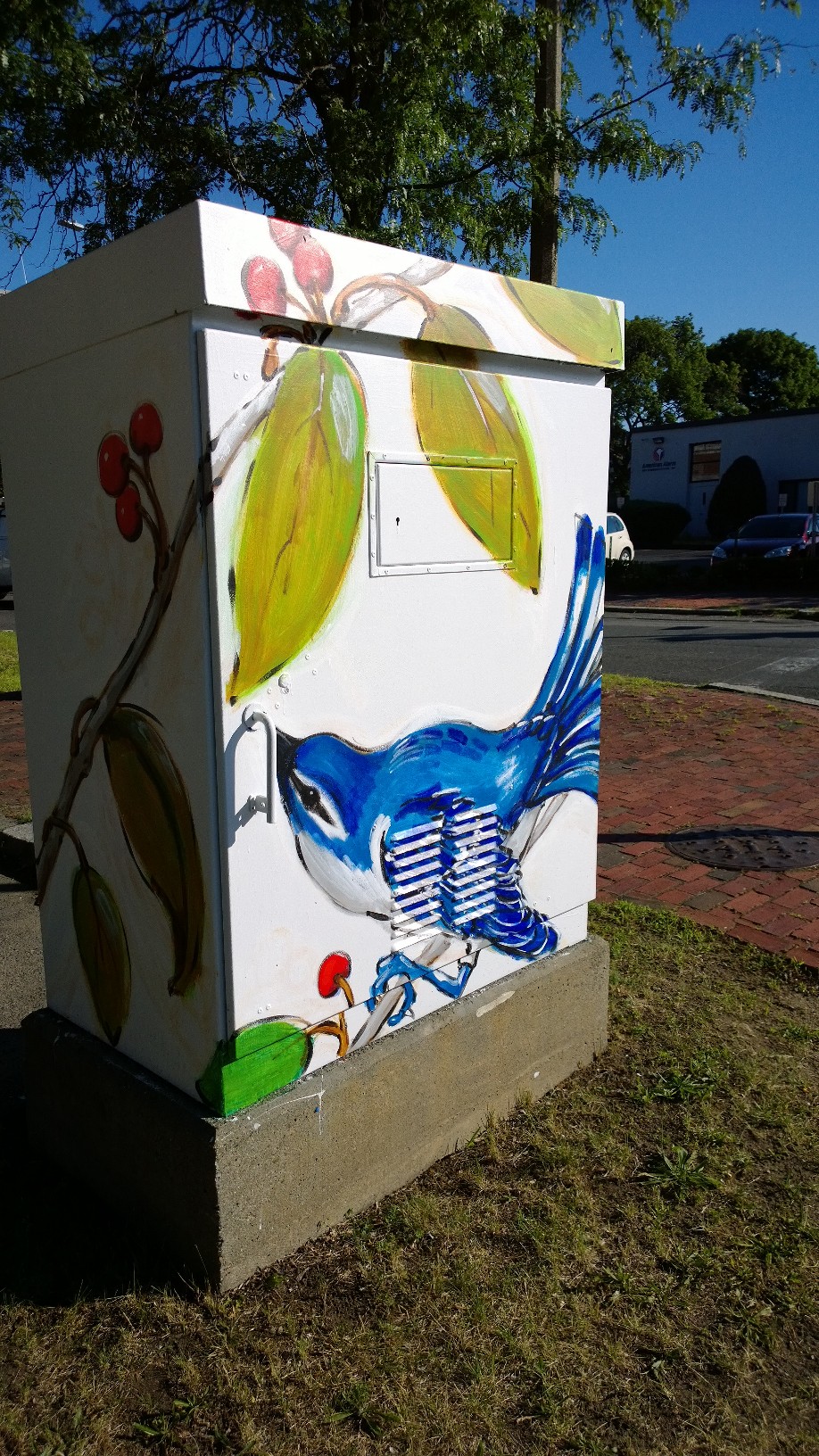
The pictures show flowers from the yard in a pitcher made by our engineer/potter friend, a bird painted on a utility box, and the garden maintained by the tai chi teacher and his youth classes. He says the care taken with the flowers is the kind of care the school devotes to students.

062714-backyard-bouquet


bird-on-utility-box


zen-ren-chuan-garden


Read Full Post »

My friend Ronnie is a former broadcaster, a poet, and a food maven, who lived in France for years and later wrote a book called Eat Smart in France. Recently Ronnie interviewed the mystery writer Cara Black for a blog called My French Life. Black writes about Paris. Her latest novel is Murder in Pigalle.

Ronnie asks, “What drew you to this part of town?

Black: “There are two worlds in Pigalle. The world of the day with families and people who work in the shops, and the world of the night, where people work in the clubs. …

“I really like Pigalle. I discovered so much I didn’t know. [But] I get intrigued by different districts, their flavor and feeling. If I ever figure them out, I’ll probably stop writing about them.” More of the interview here, including a observations on the German occupation of Paris during WW II.

For a wonderful, unusual book with the occupation of Paris as a setting, I recommend Léon and Louise. It’s an odd love story taking place over many decades in France, written by a Swiss and translated into English. I haven’t read many books by Cara Black, but if you like novels that teach you something about a different part of the world in a rather fanciful way, I recommend Léon and Louise, by Alex Capus.

Photo of Ronnie Hess

Read Full Post »

Something fun from Studio 360: the mystery of the Toynbee tiles.

“For more than two decades, an unknown artist has been leaving a message in the streets of Philadelphia. The message is has been cut by hand into a linoleum tile, and pressed into the asphalt by the weight of passing cars. There are dozens of these around the city; old ones wear away, and new ones appear. The message is the same:

TOYNBEE IDEA
IN Kubrick’s 2001
RESURRECT DEAD
ON PLANET JUPITER

“The Toynbee tiles, as they’re called, have become a thing in Philly — you can even buy a t-shirt (the tiler isn’t getting royalties). For artists, the cryptic message inspires far-out forms of creativity, but perhaps nothing as ambitious as the ten-minute work by the rapper and ‘bedroom composer’ Raj Haldar, who performs as Lushlife.

“The work is in four parts, one for each line of the tiles’ message. By the end, the ‘Toynbee Suite’ has left behind anything resembling hip-hop, going out on a two-minute clarinet solo.

“But what exactly is the Toynbee message? Alfred Toynbee was a historian and philosopher of the 20th century, known for the 12-volume A Study of History. …

“A documentary film speculated that the tiler remained unseen by dropping the tiles from a car with cut-out floorboards.”

More on the mystery here, where you also can listen to the rapper’s tile-inspired music and check out a map showing where Toynbee tiles are located around Philadelphia.

Photo: Kimberly Blessing/flickr
A Toynbee Tile at 9th and Market Streets in Philadelphia, Pa.

Read Full Post »

We had a great time at the Concord Festival of Authors Friday night. The brainchild of book maven Rob Mitchell, the festival has been going strong for about 20 years and lasts a month. The authors and topics are always amazing.

The event we most wanted to see this year featured a panel of mystery writers: Archer Mayor,  Spencer Quinn, and one whose books I know well, S.J. Rozan. The fans of these three novelists — and of Concord-based moderator and author Mark De Binder — filled the lobby of the Concord Library to overflowing.

I already knew from the Lydia Chin/Bill Smith mysteries that S.J. had a wacky sense of humor, but Mayor and Quinn also were hilarious in talking about their work and their lives. My husband said, “Who knew mystery writers were funny?”

Read about S.J. at the festival here and at her own site here.

“In her new novel, Ghost Hero, American-born Chinese P.I. Lydia Chin is called in on what appears to be a simple case. An art world insider wants her to track down a rumor. Contemporary Chinese painting is sizzling hot on the art scene and no one is hotter than Chau Chun, known as the Ghost Hero. A talented and celebrated ink painter, Chau’s highly prized work mixes classical forms and modern political commentary. The rumor of new paintings by Chau is shaking up the art world. There’s only one problem—Ghost Hero Chau has been dead for twenty years, killed in the 1989 Tiananmen Square uprising.” We enjoyed hearing S.J. read a passage from Ghost Hero, in which she had Bill Smith adopt her grandfather’s Russian accent and locution.

Quinn made me envious of his blog’s success. It attracts hordes of people who love his canine protagonist so much that they upload photos of their  pets to be the dog detective’s friend. Perhaps if I weren’t such an eclectic blogger …

If I had one reliable focus, though, I’d get bored.

Read Full Post »