Feeds:
Posts
Comments

Posts Tagged ‘navajo’

Photo: Peter Ellzey.
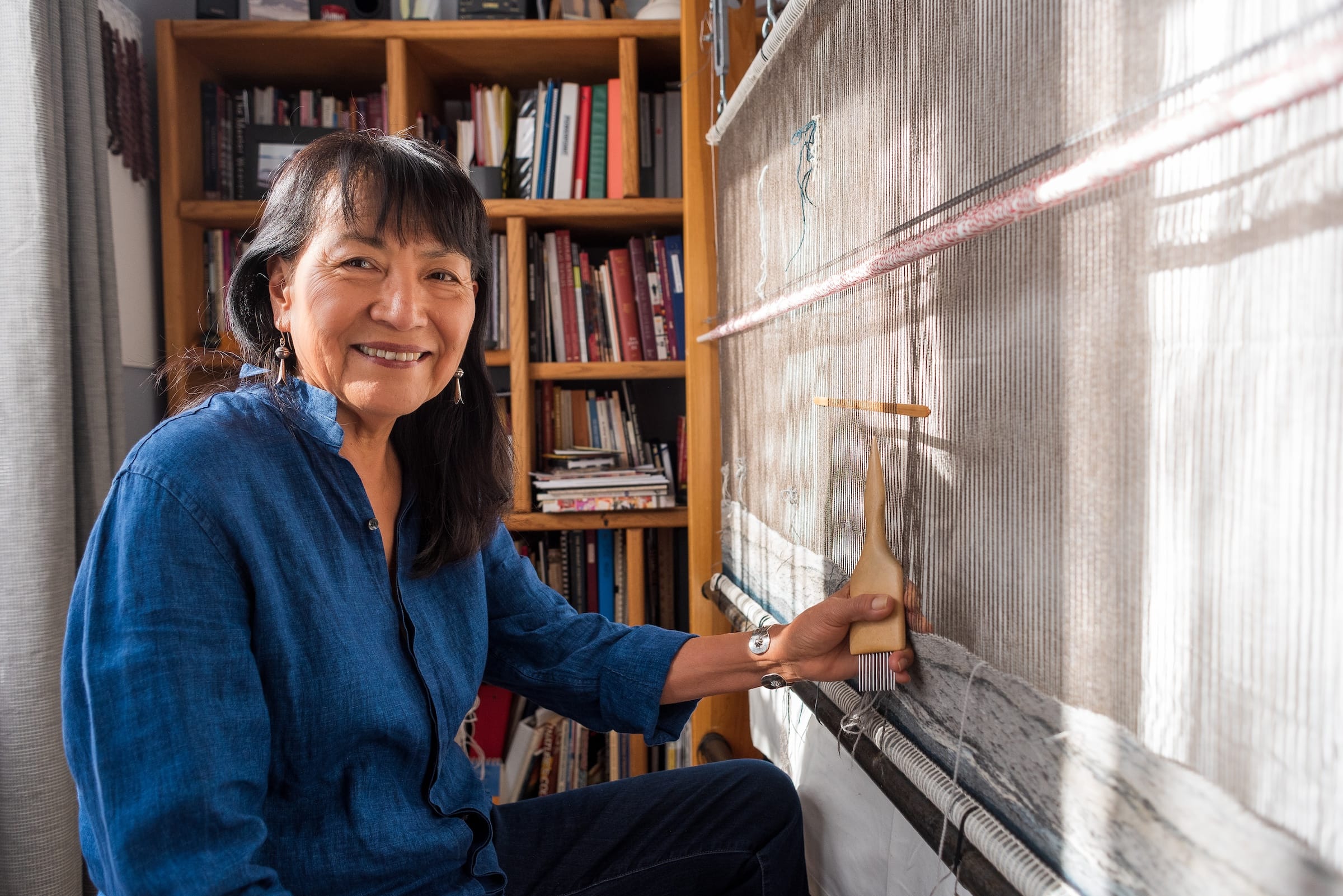
DY Begay in her weaving studio in Santa Fe, New Mexico, in 2022.

Traditions often gain strength and durability when the spirit behind them is reinterpreted through a new generation’s sensibilities. A case in point: the way the weaving and dyeing of Diné artist DY Begay has enriched a traditional Navajo craft.

Sháńdíín Brown and Zach Feuer at Hyperallergic recently interviewed the artist.

They write, “For over four decades, artist DY Begay expanded the expressive range of Diné (Navajo) weaving, transforming the form into a language that is entirely her own. She is a Diné Asdzą́ą́ (Navajo woman), born to the Tótsohnii (Big Water) clan and born for the Táchii’nii (Red Running into Water/Earth) clan. Her maternal grandfather is of the Tsénjíkiní (Cliff Dweller) clan and her paternal grandfather is of the Áshįįhí (Salt People) clan. 

“Begay is a fifth-generation weaver who was raised in Tsélání (Cottonwood) on the Navajo Nation, where her family’s sheep flock still resides. Rooted in Diné Bikéyah (Navajo homelands) — from the cliffs of Tsélání to the horizon of the Lukachukai Mountains — her work reflects the blended hues of sunsets, mesas, and mountain ranges, while her use of wool from her family’s flock and natural dyes binds her practice to the land she seeks to honor and protect.

“After graduating from Arizona State University in 1979, Begay moved to New Jersey and immersed herself in the fiber art world of New York City. She studied historic Diné textiles at the Museum of the American Indian, whose collections later became part of the Smithsonian’s National Museum of the American Indian (NMAI). Most of these pieces were created by Diné weavers whose names were not recorded, likely women. She also took inspiration from the work of artists such as Anni Albers, Sheila Hicks, and Lenore Tawney — all of whom trained in modern Western traditions yet studied Indigenous weaving practices. …

“When she returned to Tsélání in 1989, her grandmother, Desbáh Yazzie Nez (1908–2003), saw her weavings and urged her to develop her own compositional sensibility. Begay quickly gained recognition at the Heard Museum Guild Indian Fair and Market as well as the Santa Fe Indian Market, yet she felt restless in her practice. By 1994, that questioning crystallized into a breakthrough: She began developing color hatching, a method of creating subtle gradations and nuanced color interactions that transformed the solid, banded designs of conventional Diné weaving. …

“In August, Begay spoke with us over Zoom from her home in Santa Fe. The interview has been edited and condensed for clarity.

Sháńdíín Brown and Zach Feuer
“In Sublime Light: Tapestry Art of DY Begay, the first book dedicated to you and your recent retrospective at the NMAI, you write about watching your mother and grandmother weave in the hogan. …

DY Begay
 “I don’t remember the very first time I picked up weaving tools and set a loom on my own. I was very young. I do remember standing behind my mother’s loom, watching her pull colored yarns over and around the warps. Her fingers moved swiftly in and out, pressing the wefts into place. Within minutes, geometric shapes stacked and formed into the outline of a Ganado-style weaving. At that age — maybe four or five — I could not quite comprehend how those shapes came together. I was always perplexed and in awe. Everything happened so fast in front of me as her hands composed lines and rows of colored yarn. 

“I grew up surrounded by weavers: my maternal grandmother, my mother, and my aunts. Someone was always at the loom, often positioned in a very central place inside the hogan. And we lived in the hogan when I was growing up, and everybody else did too.

“I watched my mother create stepped patterns with hand-dyed yarns, moving with precision and grace. Teaching came through showing. It was a physical action. The word that I always remember, and is still used today, is kót’é — ‘like this.’ My mother said ‘kót’é, kót’é.’ …

SB & ZF
“Do you remember the moment when you first began weaving yourself — whether your family set up a loom for you or you started working on theirs?

DB
“I was very curious. I tried to hold my mother’s tools, but they were too big for my hands. … Eventually, she allowed me to sit with her once in a while and said ‘kót’é, kót’é.’ I began to get used to the natural action of tapping with the combs. I was about eight years old when I had my own loom. I don’t remember its size. My mother prepared the warp and I used leftover yarn from her bin. I do remember finishing my first weaving, maybe two colors. It was pretty decent for a first attempt. It was a good learning situation because my mother was there. She would sometimes unweave certain parts and we would go on. …

“Most finished weavings, maybe two by three or three by three feet, and some saddle blankets, were taken by my father and my grandfather to the local trading posts to exchange for food, fabric, or whatever was needed. My mother never went to the trading post herself — we didn’t have a vehicle then, so transportation was by wagon or horses. They would roll up the weavings, pack them, and take them to the trading post. …

“In weaving ‘Pollen Path,’ I wanted to share a cultural belief. Among the Diné, we sprinkle corn pollen to honor a new day, to seek blessings, and to bring balance into our lives. Corn itself is a sacred plant. The pollen is collected in late summer, when the tassels of the corn begin to pollinate. We gather it in the early morning, just before the sun rises. For me, ‘Pollen Path’ reflects peace, beauty, and gratitude for life.

“The project began in the summer of 2007, a very good year for growing plants that I use in dyeing my wool. My sister, Berdina Y. Charley, planted local corn seeds she received from our Táchii’nii (Red Running into Water/Earth) relatives. I believe these were heirloom seeds from our Táchii’nii family. …

SB & ZF
“How do you translate the experience of walking in beauty, through the landscapes of Diné Bikéyah (Navajo Country) and more specifically your home of Tsélani (Cottonwood), into the two-dimensional form of weaving?

DB
“Not only do I have my Tsélani landscape embedded in my mind, but I frequently photograph the surrounding textures at various times of the day to capture different lighting as it reflects on the terrain. …

SB & ZF
“Can you tell us about your color palette and the process of dyeing the wool? Is it essential for you to use and make dyes that are from the earth?

DB
“I have been practicing and experimenting with natural dyes for quite a while, and I love using local plants to create my color palette. It is both essential and traditional in my culture to use what the earth provides to create dyes for our yarn.

“My palette comes from many sources. I work with common plants such as cota (Navajo tea), chamisa, rabbitbrush, and sage. I also use non-native materials like insects, fungi, foods, and flowers. Each has its own season, and I collect plants according to the time of year.

“The process itself is an experiment every time. I’ve studied many dyeing methods and learned to be attentive to formulas that help obtain and preserve the colors. For me, making dyes from the earth is not only practical but also deeply connected to tradition and creativity.”

More at Hyperallergic, here. No paywall. Subscriptions encouraged.
Read Full Post »

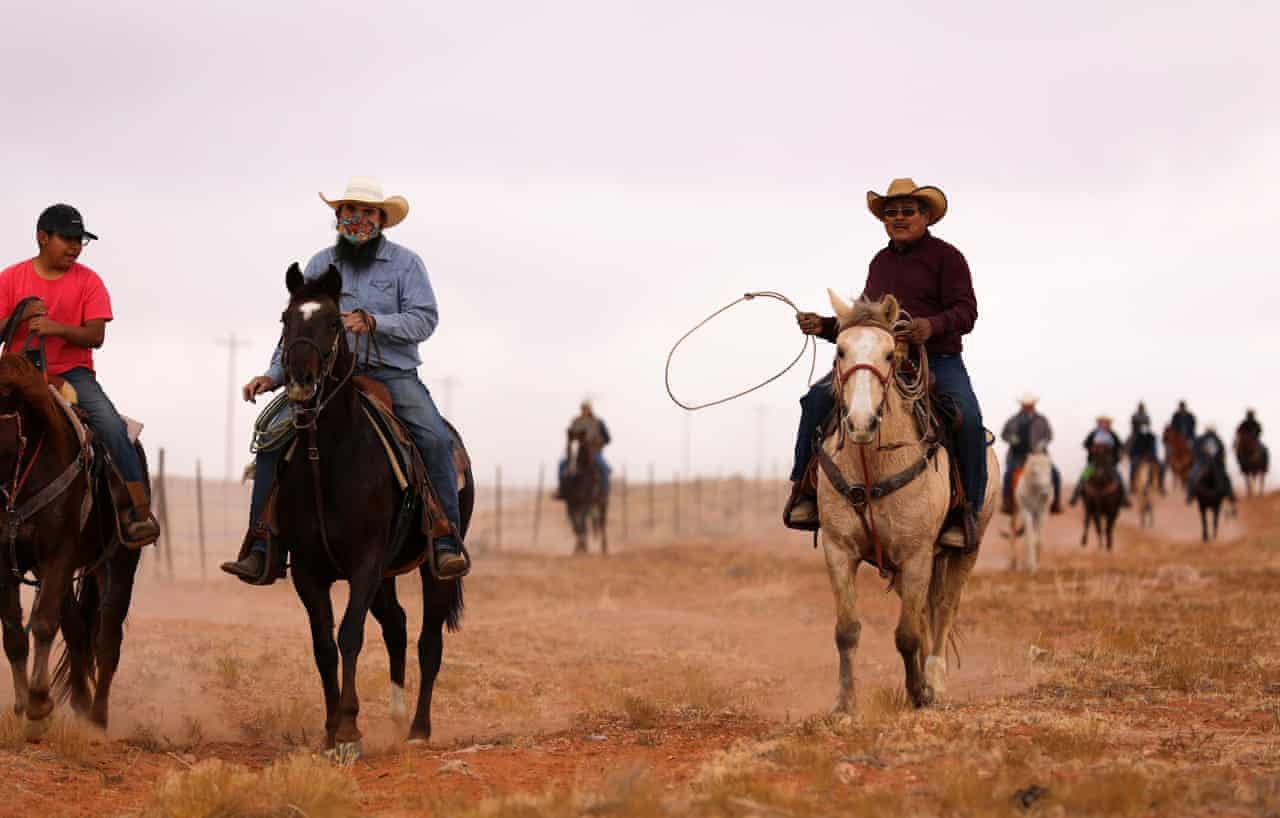
Photo: Larry Price/The Guardian.
Diné voters ride on horseback through the Navajo Nation to the polls in 2020. Allie Young, a Diné grassroots organizer, started the Ride to the Polls campaign.

Elections never stop being important, and next Tuesday, Nov. 4, will be a critical one in many parts of the country as we struggle to shore up democracy. Today we learn about how hard indigenous people sometimes work to get to the polls.

Melissa Hellmann wrote at the Guardian last year about Navajo people’s understanding of voting as an important way to protect the environment.

“In Diné, or Navajo, culture, the horse symbolizes strength and resilience, as well as a connection to the earth. Cowboy culture is so relevant to Native communities, that horseback trail rides are used to draw awareness to issues within the community including suicide prevention, and alcohol and drug use, said Allie Young, a 34-year-old Diné grassroots organizer. This fall, Young has harnessed the trail ride to engage Diné voters for the presidential election: her group’s voter-registration events will culminate with 100 Indigenous voters riding on horseback to a polling station in Arizona on election day. …

“Young, founder of the Indigenous-led civic engagement program Protect the Sacred, told the Guardian. ‘[When] we’re connected with the horse, we’re then reconnected to Mother Earth and reminded of our cultural values and what we’re fighting for, what we’re protecting.’ …

“Political representation that brings needed resources into Native communities is particularly important on tribal lands, where 75% of roads remain unpaved. …

“Young said she hopes that the success of the Ride to the Polls campaign in 2020 and 2022 will encourage ‘the greatest Native turnout ever’ in the upcoming election. This year, the campaign has extended its reach with events such as skateboarding and bull-riding competitions, heavy metal and country music concerts.

“ ‘We’re trying to communicate to our community that we need to protect our tribal sovereignty,’ said Young, ‘and with that, protect our sacred sites, protect our lands, our cultures, our languages, our traditions.’

“Young launched the Ride to the Polls campaign in 2020 in response to the rapid spread of Covid-19 infections in the Navajo Nation, where some counties saw the highest death rates per capita in the nation. She wanted to ensure that her community filled out the US census to receive the funding they deserved and to elect politicians who prioritize the concerns of Native communities.

“ ‘Our nation and many tribal nations across the country were devastated by the onset of Covid-19 because our system is being chronically underfunded,’ said Young, ‘which revealed to the rest of the world what we already know: that the government is not honoring our treaty, which says that we are to receive good healthcare and education.’ She began creating culturally relevant initiatives so that young Diné citizens who felt disenfranchised would see voting as a tool to ‘rebuild our power as a community.’ …

“So far, they have registered 200 new voters and checked or updated the registrations of about 400 people.

“On 12 October, the actor Mark Ruffalo will join Ride to the Polls to help mobilize Native voters and to mark the 100th anniversary of Native Americans being granted the right to vote. …

“ ‘Indigenous people have only been able to fight for their future at the ballot box for 76 years,’ Ruffalo said in a statement. ‘Now we’re seeing a massive movement of young Indigenous folk exercise their power at the polls.’ …

“All Native Americans were finally granted the right to vote under the federal voting rights act of 1965. Still, barriers have remained that make it difficult for Diné to register to vote and cast ballots, including a lack of residential addresses since many people on the Navajo Nation use post office boxes. It also can take up to an hour to drive to a polling location, said Young. And this summer, the US Supreme Court ruled that Arizona can enforce a state law requiring prospective voters to include proof of US citizenship in registration forms, which Young said was a ‘slap in the face to Native Americans, who are the first peoples of this land, to be asked to prove their citizenship.’

“To help address some of those hurdles, Protect the Sacred is partnering with the Indigenous-led voter-engagement non-profit Arizona Native Vote. Indigenous organizers register voters and help residents find their addresses by locating their houses on Google Maps. ‘A key talking point when we talk to voters is letting them know that voting and registering to vote should not be this hard,’ Jaynie Parrish, executive director of Arizona Native Vote, said. …

“During a six-stop trail ride to register Diné citizens throughout the Navajo Nation in mid-September [2024] indigenous organizers discussed with voters the importance of casting ballots in every election. They served citizens stew and frybread while explaining to them that county elections can determine how local government operations are funded. Young said: ‘I believe that we started a movement around the power of the Native vote.’ ”

And so, they voted. We know what happened in 2024, and we know what has been happening to environmental protection since then. But every election counts in moving the needle back toward the people. So, please vote on Tuesday and at every election in the future.

More at the Guardian, here.

Read Full Post »

Photo: Navajo Natural Heritage Program via Natural Resources Defense Council.
Diné Native Plants Program members work to restore a headwater stream impacted by livestock grazing.

The more that the US endangers its wetlands, the more we rely on the work that tribes do to protect them. Perhaps today’s article can help us see what the rest of us can do.

At the website for the Natural Resources Defense Council, or NRDC, Claudia Blanco Nuñez and Giulia CS Good Stefani describe how “Tribal Nations protect and manage millions of acres of wetlands, which help improve water quality, curb the risk of floods, recharge groundwater, and store large amounts of carbon.”

“Two years ago,” they report, “the U.S. Supreme Court slashed federal Clean Water Act protection of wetlands [with] harmful repercussions for droughts, wildfires, flooding, wildlife, and the drinking water supply. 

“In the absence of federal protection, the imperative to defend our shared waters falls increasingly on individuals, states, and Native American Tribal Nations. … Tribal Nations protect and manage millions of acres of wetlands in the United States, and with commitments made by the U.S. government to Tribal co-management and co-stewardship of federal lands, the amount of clean water safeguarded by Tribal Nations is growing.

“NRDC’s Science Office mapped the wetlands found within and intersecting the boundaries of Tribal reservation lands in the contiguous United States. Across the 294 federally recognized Tribal reservations mapped in this analysis, our scientists found that Tribes steward more than 3 million acres of wetlands. Even typically arid regions like the American Southwest have significant wetlands on Indigenous reservations. …

“In addition to the 56.2 million acres that are part of the Tribal reservation system, many Tribes have reserved or treaty rights on lands outside reservation boundaries, and most Tribes and their members maintain ongoing physical, cultural, spiritual, and economic relationships with their ancestral homelands. These reciprocal land and water relationships extend far beyond the political boundary of any designated reservation.

“This analysis is limited to federally recognized Tribes in the Lower 48 due to the complex Tribal governance systems in Alaska and Hawai’i. For example, the Alaska Native Claims Settlement Act of 1971 altered the previous Tribal ownership system to one led by Alaska Native Corporations. This system differs from federally recognized Tribes, which have a government-to-government relationship with the United States that includes eligibility for funding and services from the Bureau of Indian Affairs. That is to say, NRDC’s analysis looked at just a fraction of the total wetlands stewarded by and connected to the lives and well-being of Native peoples today.

“To learn more about Tribal wetland conservation, we spoke with leaders in the wetland management programs of the Navajo Nation and Red Lake Band of Ojibwe. …

“Navajo Nation agency staff are engaged in numerous projects to help restore and protect this essential resource. The Diné Native Plants Program recently submitted a grant application to remove invasive plant species along the Little Colorado’s riverbank. This will make space for native vegetation to grow and help with groundwater recharge for nearby Navajo farmers and families. The Diné Native Plants’ seed program also provides seed mixes for restoration projects that are solely sourced from Navajo plants. 

“Jesse Mike, the Diné Native Plants program coordinator, stepped out of the greenhouse to speak with us. He shared about the history of livestock grazing, trampling, and erosion that have impacted not only the health of the headwater streams on Navajo lands but also the underlying water table. His team is currently working to increase groundwater infiltration and improve the overall ecosystem health of three degraded streams in the Chuska Mountains. …

“The Red Lake Band of Ojibwe’s reservation is in northern Minnesota and has the greatest area of wetlands of any reservation in the contiguous United States. Across the Tribe’s more than 835,000 acres of land — all held in common by the Tribe — the Red Lake Band manages an astonishing 541,000 acres of wetlands. ‘So many wetlands,’ says Tyler Orgon, a biologist and the lead wetland specialist for the Red Lake Band Department of Natural Resources, ‘and we’re very fortunate for that.’ 

“A sizable portion of the Tribe’s wetland acreage north of Upper Red Lake is part of the largest expanse of peatlands in the continental United States. Peatlands cover about 3 percent of the earth and store more carbon than all of the planet’s other types of vegetation, including the world’s forests, combined. 

“One of the most important wetland-dependent plant species for the Red Lake Band — as well as other Anishinaabe and Dakota peoples across the Great Lakes region — is manoomin (Zizania palustris and Z. aquatica), the only wild rice native to Turtle Island. According to an Ojibwe prophecy, their ancestors were instructed to move west to the place where ‘the food floats on water.’

“The University of Minnesota research team We Must First Consider Manoomin (Kawe Gidaa-naanaagadawendaamin Manoomin) works to help protect this essential wetland-dependent plant by combining Western science with Indigenous science and learning from Ojibwe stewardship.

“The scientists have found that an increase in extreme weather conditions (like flooding events and record-breaking snowfall) negatively impact manoomin growth by uprooting the plant or drowning it out in its sensitive early stages. These weather events compound the already present settler-colonial impacts on wetlands in the region, including deforestation and conversion of wetlands into agricultural land use.

“Orgon hopes to restore some of the Red Lake Band’s wetlands that have been impacted by past agriculture.” More at NRDC, here.

Read Full Post »

Photo: Roberto Nutlouis.
Danielle Kaye builds a berm spillway on the farm of Roberto Nutlouis. The berm holds back water, flooding the cornfield behind it. Navajos are using ancient ways to restore parched earth.

In their eagerness to invent, humans seem to be programmed to forget why ancient ways worked. Then they have to reinvent the wheel. Fortunately, indigenous people often are repositories of that wisdom and can produce it as needed.

Lela Nari writes at YaleEnvironment360, “Here in Burnt Corn Valley, smack in the middle of the Navajo reservation’s vast Black Mesa region, the hilly land both craves water and is brutalized by it. The sandy Arizona soil cracks under a punishing August sun as red-striped blister beetles search for moisture across its baked surface. Cottonwood trees and sagebrush rise from deep gullies carved by floodwaters that, during the intensifying summer monsoon, sluice off surrounding mesas and wash away fragile topsoil — reminders that with climate change, even quenching rains harbor powers of destruction.

“This portrait of climatic havoc belies a softer reality, though. Farming once thrived in this parched region and could once again — if the right practices are adopted. Exhibit A: The crops on Roberto Nutlouis’s 12-acre Sliding Rock Farm, in his reservation hometown of Piñon, a five-hour drive north of Phoenix.

“ ‘The corn is actually pretty big and thriving,’ Nutlouis says. He believes — and both Western science and the lived experience of his Native elders affirm — that the traditional rock and stick structures he’s built on his property, which help store water and prevent erosion, have a lot to do with it.

“These structures, similar to those used by Native peoples long before Europeans arrived on the continent, are not only delivering water to crops. … They are also restoring Nutlouis’s watershed and those of his neighbors, helping to sequester carbon, and reviving this high-desert ecosystem. It’s all part of a bigger effort among a range of local and regional grassroots organizations to build back the reservation’s fragile, depleted ecosystems and bring greater sovereignty over food, water, and health to its communities.

“Diné (the Navajo name for themselves) are well aware that climate change is making the weather on their semi-arid plateau weirder, wilder, and more destructive. … The ecological health of the reservation has also been weakened by deforestation from timbering operations and from overgrazing over the years.

“Still, this season, Nutlouis, 44, has been able to skip his usual two-hour roundtrip drive to a reliable well to haul water home for his corn. His crop is healthy and hydrated because his land still holds last winter’s snowmelt. Clearly, his heavy labor over the past 20 years — during which he has built woven brush dams, gabions (wirework cages filled with rocks), earthen berms, concrete spillways and trenches, limestone aprons and walls, and stone-lined ‘Zuni bowls,’ which stabilize eroding streambeds — is paying off.

“Diné and others living in arid zones around the world have long used structures made of naturally occurring materials to capture and control water to grow crops and to mitigate the devastation of floods in ephemeral stream systems. …

“Time and again over the last 15 years, Laura Norman, a research scientist with the U.S. Geological Survey, has seen evidence that when these structures — which Norman calls Natural Infrastructure in Dryland Streams, or NIDS — are placed in gullies, they slow water to mitigate erosion, collect nutrient-rich sediment and plant debris that nourish both crops and wild plants, help store carbon, improve groundwater recharge, and increase downstream water availability by as much as 28 percent. ‘It’s a snowball effect that counters degradation, and you get all of these ecosystem services,’ she says.

“The structures on Nutlouis’s farm are integral cogs in a larger system. … Nutlouis’s property lies in an alluvial fan, where mineral-rich sediments and plant waste atop mesas and other uplands wash down onto flatter ground with rainwater, snowmelt, and spring water. Across the valley, similar farms rely on this kind of system, many of which feature stone and stick constructions that Nutlouis helped build. The organic materials trapped behind the structures, says Jonathan Sandor, an emeritus agronomy professor at Iowa State University, ‘are a major input into keeping the fertility of the soils up.’ …

“Whether rock walls or ramps, hand-dug depressions in the soil, earthen walls, or branches plaited into dams, NIDS splash water over a wider area and slow its flow so it can better soak into the soil. Many trap sediments behind them, fertilizing whatever grows nearby. The stone structures create a hyperlocal cooling effect, especially when they’re combined with shade-making vegetation.

“Here, too, smallness is a boon. ‘Even tiny little one-rock dams can make big changes on the landscape,’ Norman says. …

“Lately, climate change has thrown extra challenges at the reservation. … But the ecosystem services provided by Nutlouis’s structures on his farm and elsewhere do seem to be meeting those climatic challenges. He’s noticed small juniper trees popping up on hillsides around his property despite the dryness; A cottonwood tree towering over one cornfield is also lush and full. ‘The idea that Earth will restore itself with natural seed dispersal’ after NIDS begin to do their job ‘has been my observation,’ says Norman.

“Or as Nutlouis puts it, ‘We’re allowing nature to do its own thing and restore itself.’ ”

More at Yale e360, here. Fascinating pictures. No firewall.

Read Full Post »

Photo: Jean Ogden via Wikimedia.
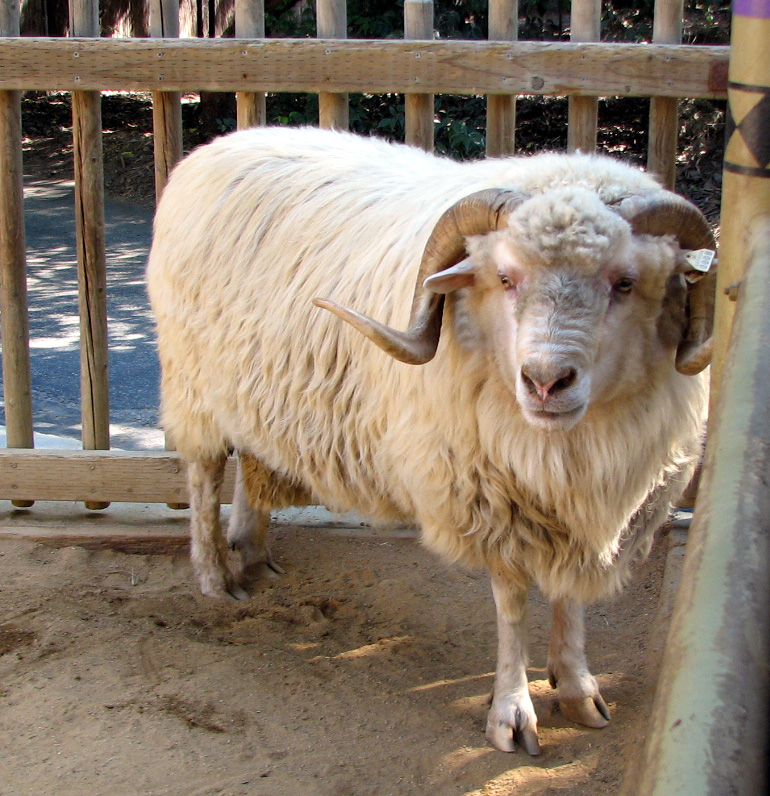
Navajo Churro sheep.

There’s a story at National Public Radio about the special relationship between a kind of sheep and the Navajo people, or Diné. Ayesha Rascoe hosts the NPR program, which you can listen here, if you prefer.

Ayesha Rascoe: For centuries, the lives of Navajo people have been intertwined with livestock — specifically, one particular breed of sheep they’ve relied on for meat and wool. The tribe is well known for weaving the wool of Churro sheep into colorful clothing and tapestries. Those weavings can fetch thousands of dollars from collectors, but they have far more than monetary value. Raising Churro sheep and weaving their wool is an important way Navajo people pass cultural knowledge from generation to generation. KSJD’s Chris Clements visited a Navajo Churro sheep celebration.

Chris Clements: Inside a crowded farmhouse on the edge of the Navajo Nation, weavers are demonstrating how to spin, dye and treat wool from Churro sheep, which they consider sacred.

Roy Kady: Hello. My name is Roy Kady. I am from Goat Springs, Ariz.

Clements: Kady, who’s in his 60s, is standing outside, wearing an ornate turquoise necklace, earrings, bracelets, and a white hat. He’s considered a master weaver, part of centuries of Navajo citizens who’ve carried on traditional beliefs that date back to the 1500s when Churro sheep arrived with early Spanish colonists.

Kady: I’m filling these big shoes that my mother wore as an agropastoralist.

Clements: Tyrrell Tapaha is Kady’s student and his grandson, who’s here at the event. …

“Tyrrell Tapaha: There’s always been weaving in my life, whether it be his work, my grandma’s work, or my great-grandma’s work. ..

“Kady: Tyrrell [says] I want to weave a human form. Do you have any ideas how I could do that? And so I just share with him. …

“Clements: Tapaha has been learning the tricks of the trade since he was very young. When he was only 8, Kady had him teach a class on the art of finger weaving at a nearby chapterhouse. … Tapaha knows that Kady’s teachings will live on with him.

“Tapaha: At least it’ll last my lifetime, you know? And I kind of hear that in how Roy talks about his contribution to the space is like him being an older person now and kind of seeing that handed off.

“Clements: After the morning’s presentations, it’s time for lunch. The weavers roast mutton, a Churro sheep they slaughtered earlier in the day. Participants of the sheep celebration gather around the grill, watching the fire hiss and sputter as the mutton cooks. It’s common for every part of the animal to be used. Nothing, not even its hooves goes to waste.

“In 1863, the U.S. military forced Navajo people to leave their ancestral homelands and relocate to an internment camp. It’s known as the Long Walk. … It almost led to the extinction of the Churro sheep.

“Navajo people were allowed to return home four years later. Some tribal members who’d managed to escape the Long Walk, kept some Churro alive. And today, thousands of Churro sheep live on or near the Navajo Nation.”

Read more about the sheep and the passing along of Diné culture at NPR, here.

Read Full Post »

Photo: Navajo-Hopi News.
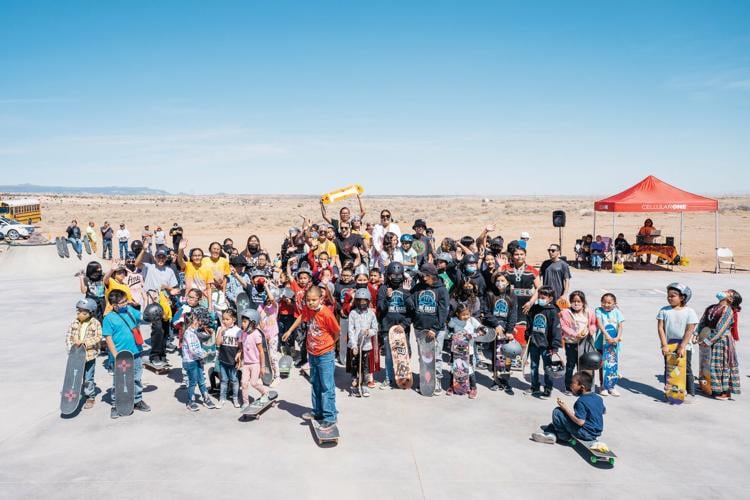
Two Gray Hills Skatepark in Newcomb, New Mexico.

The forced assimilation of indigenous children into colonist culture damaged the children, the relatives of the children, and the grown children’s descendants. In today’s story, we learn how one descendant was surprised to discover she was Navajo and looked for a way to help her long-lost community.

Roman Stubbs writes at the Washington Post, “The wind rolled off the Chuska Mountains and along the desert floor, whipping red dust and tumbleweed across the pavement of Two Grey Hills Skatepark. It was a pale Sunday morning in May, and Amy Denet Deal stood on a ledge, tying a crimson bandanna around her silver braids and smiling as she watched the children swerve down ramps in the middle of the storm.

“ ‘Amy!’ ” a young boy yelled, excited to greet the woman who helped bring the skatepark to this remote northwest corner of the Navajo Nation.

“ ‘Hi, honey. How you doing?’ she replied. ‘You’ve grown a foot since I last saw you!’

“Denet Deal, 59, considered herself younger than the boy in Diné (Navajo) years. She had reconnected with the tribe only five years earlier after a lifetime of displacement, giving up most of her belongings and a ­lofty salary as a corporate sports fashion executive in Los Angeles to move to New Mexico.

“The pandemic opened her eyes to the inequities children on the reservation face, including high rates of diabetes, mental health issues and suicide. Navajo Nation is roughly the size of West Virginia — 16 million acres stretching across Arizona, New Mexico and Utah — yet there are few opportunities for kids to play sports, with many remote areas lacking outdoor recreation and athletic facilities.

“She searched for solutions to give back and finally landed on one: Why not a skatepark?

“It took years of fundraising, with plenty of setbacks, but more than a year after it opened, she could still point to the benefits the park was bringing to her community. The kids from a nearby housing project came for free clinics held every weekend. Parents and grandparents parked their trucks near the concrete to watch, sharing food with one another in their camping chairs as the breeze stung their faces.

‘If I talk to any skateboarder, the first thing they’ll always tell me is, “Skateboarding saved my life,” ‘ Denet Deal said. …

“And so here she was again, making the four-hour drive from Sante Fe to her ancestral homeland, because visits were also helping her with the trauma of her past.

“ ‘The plus side of this is I come from displacement and a strange start in the world,’ Denet Deal said. ‘It’s really helping me heal through that work.’

“Denet Deal didn’t visit the Navajo Nation until she was in her late 30s. Her mother, Joanne, had been forced into a boarding school in Farmington, N.M., in the early 1950s. Joanne’s family had no horse or car to visit her for years. ‘She suffered all kinds of abuse and forced assimilation,’ Denet Deal said.

“Through the government’s Indian Relocation Act, Joanne left the reservation with a one-way bus ticket to Cleveland in her late teens. She got pregnant with Amy. Like thousands of other Native children in the 1960s, Amy was placed into adoption and taken in by a Catholic charity. …

“ ‘I was put up for adoption without anybody contacting my birth family, no connection to the tribe,’ Denet Deal said. ‘I grew up completely displaced from my community. I was the only Brown person in rural Indiana.’ …

“She found something to hold on to when she learned how to use a sewing machine as a child. She started making all of her own clothes and threw herself into fashion. Denet Deal developed into a rising star in the active sportswear space in the early 1990s; at 26, she was creating apparel at Reebok and by 30 she took over as design director at Puma. …

“For years, she searched for her mother. She hired a private investigator and scoured the internet. She numbed the emptiness with alcohol and work.

“In 1998, she had a breakthrough. Denet Deal convinced the Indiana Department of Health to release her record of adoption and was given Joanne’s address and phone number. She wrote Joanne a letter and received a letter back. Denet Deal visited her mother for the first time in Ohio, and together they eventually traveled to the Navajo Nation to meet other family.

“ ‘It wasn’t warm and fuzzy,’ she said. … ‘It brought back a lot of things for my mom that were hard.’ …

“Some locals rejected her because she didn’t grow up in the Navajo Nation. She was still getting to know many of her family members, and her presence could trigger reminders of a painful history for them. …

“The pandemic offered Denet Deal a chance to give back what she learned in another life. She used her past skills as a wealth generator for major corporations to help raise more than $1 million in medical supplies, food and support for a domestic violence shelter. But she wanted to do more, having seen up close the problems for children on the reservation.

“ ‘I just thought a skatepark was a really great thing to have for them.’ “

At the Post, here, you can read about the people who helped make it happen.

Read Full Post »

Weaver and Shepherd

Photo: John Burcham.
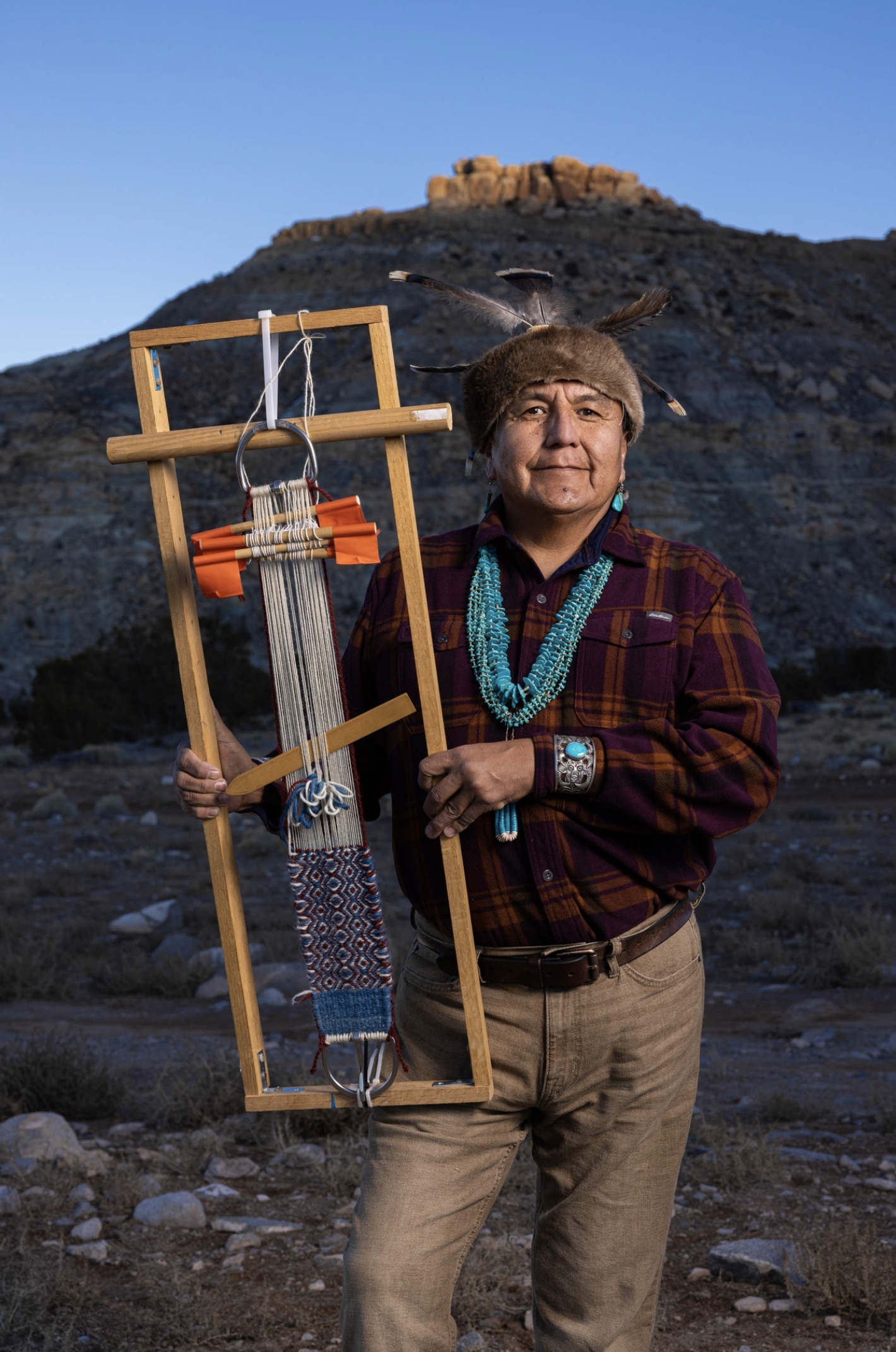
Textile weaver and fiber artist Roy Kady.

Today’s story is about a man for whom work and art are inseparable: Navajo weaver Roy Kady.

Elaine Velie at Hyperallergic conducted the interview.

“Diné weaver and fiber artist Roy Kady sat down for a video interview wearing a shirt that read ‘Sheep is life.’ Kady is a shepherd and an artist, roles he sees as definitively intertwined. ‘I am first a shepherd, then art comes with it,’ he said.

“Kady’s decades-long career has been one of constant learning, and in recent years, teaching. He shares weaving techniques and Diné stories that he says are too often missing from younger generations. Kady spoke to Hyperallergic about Diné conceptions of gender, apprenticeship in his small Arizona town, and being accepted as a gay man in his community.

Hyperallergic: What are your earliest memories of weaving, and how did your mother’s practice influence your own?

Roy Kady: My sisters and I grew up in a single-parent household where my mother brought us up, so we were taught everything from building a house to repairing a roof to working under the hood of a vehicle, the sort of things the colonized world would call ‘man’s work.’ We learned inside, too. From washing dishes and getting the house tidied up to cooking and baking, we did what would be considered ‘women’s work.’ But for us, it’s not.

“I was taught about weaving at the young age of nine years old. I have some recollections before that of sitting by my grandmother, grandfather, and mother, who all also partook in fiber arts — weaving and processing the fiber. My mom gifted and shared weaving techniques with me: vegetable dyeing and some of the family designs that came with it. I was fortunate; I was given the tools she and our kin relations had, and that’s what inspired me to become an artist. We learned farming and goat and sheep herding, too. …

“Sheep provide you with sustainability, food, and the opportunity to learn how to maintain the land. We take care of them so that they can take care of us.

“As a shepherd, you know what they like to eat and what keeps them healthy. They also know that themselves, so they’ll take you on journeys to where particular plants exist. On those journeys, you’re able to be inspired by color and the environment, by the mesas. You start to see geometric forms that you can bring back to your weaving repertoire.

“That’s what traditional Navajo weaving is: an interpretation of your environment. A lot of my earlier pieces were designed with that in mind. They’re not necessarily just stripes; they represent rainbows. They’re not just step patterns; they’re mesas or clouds.

“There’s a whole opening of the universe that is represented. In order to understand and have that knowledge, you must have the knowledge of shepherding. But it’s a rarity now because there are not many shepherds. The sheep population has really declined. Navajo fiber artists and textile weavers create beautiful artistry, and while they may no longer have herds, they have memories from their grandparents or parents or maybe from within themselves around growing up with sheep. …

“My mother would sometimes say something like, ‘You’re at the age when you are going to learn about horsemanship.’ She was a horsewoman type. She would teach us, then she would want us to ask a neighbor or other kinfolks to learn other forms. I remember growing up and learning a lot from the neighboring kids. We would go to their houses and learn different types of fiber arts, traditional recipes, or plant foraging. …

“I would go spend a day, a weekend, or even a month in their home and helping them with their livestock. That’s how I would earn the opportunity to learn from them. They’ve always told me that this knowledge doesn’t just belong to one individual, saying, ‘It was gifted to me. It goes all the way back to the creation story.’ That’s how I model my apprenticeships now. …

“I don’t just use wool. I use anything that’s of natural origin, including tree bark and wild cotton, nettle, silk, you name it — whatever I can get my hands on. If I can find somebody who says, ‘I have a herd of bison,’ then I say, ‘What do you do with their wool?’

H: Are there any works that you particularly love?

RK: That would be the one titled ‘Shimá,’ meaning ‘my mother.’ I would wheel her into the sheep corral in her wheelchair, and the sheep knew who she was and come up and greet her. They knew the scent of her hands and how she cared for them. I took a beautiful picture of her making those interactions and decided to weave it. I broke ground for myself by incorporating all different types of techniques that I’ve learned along my weaving journey. At this point, that would be my favorite. …

H: Are there any projects you’re working on now or that you’re excited to start in the future?

RK: There’s an upcoming gallery exhibit near us in Cortez, Colorado, that I’m starting with my grandson, Tyrell Tapaha. He’s come back to learn about shepherding and be my apprentice. We’re doing a collaborative type of show. I will show what took place between the two of us, and it will include his interpretation of what I taught him about sheep, the landscape, or a particular plant.

“We are utilizing what we call barbed wire art. When you’re a sheepherder in this country, you have barbed wires lying around everywhere that are rusty, but we create these wonderful shapes and incorporate that into our textiles or fiber work. We’re excited to venture.”

Read more and see how the artist wove an image of a sheep at Hyperallergic, here. No firewall. Subscriptions encouraged.

Read Full Post »

Photo: Anna Mulrine Grobe/The Christian Science Monitor.
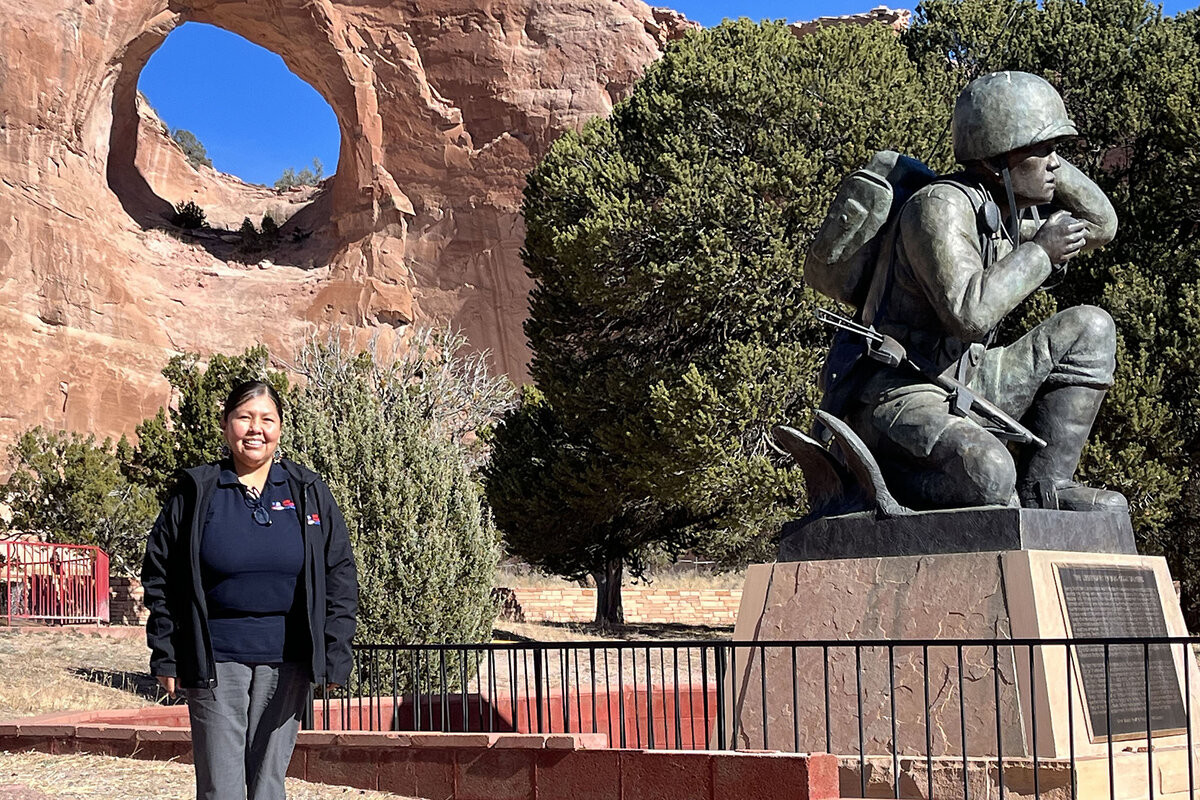
US veteran Bernadine Tyler stands at a memorial to Navajo code talkers on the Navajo Nation, in Window Rock, Arizona.

On this Memorial Day, let’s take a look at the indigenous people who have served in our military.

Anna Mulrine Grobe  writes at the Christian Science Monitor, “In her work with U.S. military veterans here on the Navajo Nation, Bernadine Tyler routinely logs 1,200 miles a month driving across an area the size of West Virginia, over high windswept plains dotted with rust-red mesas.

“Roughly one-third of homes here on America’s largest reservation don’t have electricity or running water, so Ms. Tyler, herself a member of the Navajo Nation and an Army veteran, brings services directly to her fellow vets, most of whom are over the age of 65. 

“She points out the occasional gas station and folks walking on the dusty shoulders of pot-holed roads. There’s a bus, ‘but it’s very unreliable and only runs one route,’ says Ms. Tyler, program lead for the Diné Naazbaa Partnership (DNP), which serves the Navajo Nation and receives funding from the U.S. Department of Veterans Affairs. …

“For vets without transport or refrigerators, she carries bags of ice to fill the convenience store coolers that many use to chill their food and medications. She enlists volunteers, including her sons, to help haul water and chop wood for warmth in the winter. 

“The particular challenges of accessing this care came to light during the COVID-19 pandemic, when Native American veterans living in small multigenerational homes without running water on closed tribal lands died at significantly higher rates than other former service members. The VA subsequently pledged to better serve America’s Native American community. 

“In 2020, the VA created the first advisory committee for Native American veterans. It held its first meeting in 2022 and began issuing its recommendations last year. Though they aren’t binding, the suggestions of some committees have an acceptance rate of 90%, according to the agency. …

“With this year’s 2024 defense spending bill, lawmakers also granted the Native American Indian Veterans a congressional charter, making it the first-ever group dedicated to the interests of Indigenous people in the U.S. to get the status. It is a development that took the NAIV nearly 20 years of lobbying to achieve. With the charter, NAIV can testify before Congress and, ideally, more easily help the VA process benefits claims. 

“The hope is that these developments will not only improve care, but also foment faith that, even after decades of neglect, change is possible – particularly among the 57% of Native American veterans who say their top reason for joining the military was a desire to serve their country. 

“Native American veterans are among America’s most patriotic, says Adam Pritchard, a researcher at Syracuse University’s Institute for Veterans and Military Families. ‘It’s a very important step in the right direction to acknowledge their history of the service and their ongoing needs.’ 

“ ‘Our history has much mistrust,’ Ms. Tyler says. Good-faith efforts to fix a long-broken system and build it up, she adds, can help heal old wounds, too. 

“In 1943, Thomas Begay joined the U.S. Marines. He was 16 or 17 years old – he’s not sure which. … He wanted to be an aerial gunner, Mr. Begay told the recruiter. [The recruiter sent him] to become a code talker. While he and his fellow troops practiced the top-secret tribal language with a twist, their basic training was more ad hoc than the Marine norm. 

“ ‘They got us a rubber boat, and they just dumped us way out in the ocean and said … “Learn how to get to shore,” ‘ he recalled in a 2013 discussion cataloged by the National Archives.

“Months later, after landing at Iwo Jima in February 1945, Mr. Begay and his fellow code talkers were hailed as instrumental in taking the island – and later with helping to win the war. Their code was never broken. …

“Today, Mr. Begay is living in a house where bad plumbing has damaged the floors and ceiling. ‘It’s not safe for him,’ says Karen Shirley, community coordinator for DNP, which is helping him apply for VA grants to fix up his home, or get Mr. Begay a new one. 

“ ‘How can we not support this great warrior who helped save this country, and just get him the housing he needs?’ Ms. Tyler says.”

More at the Monitor, here. No paywall. Subscriptions are reasonable.

Read Full Post »

Photo: Melanie Stetson Freeman/Christian Science Monitor.
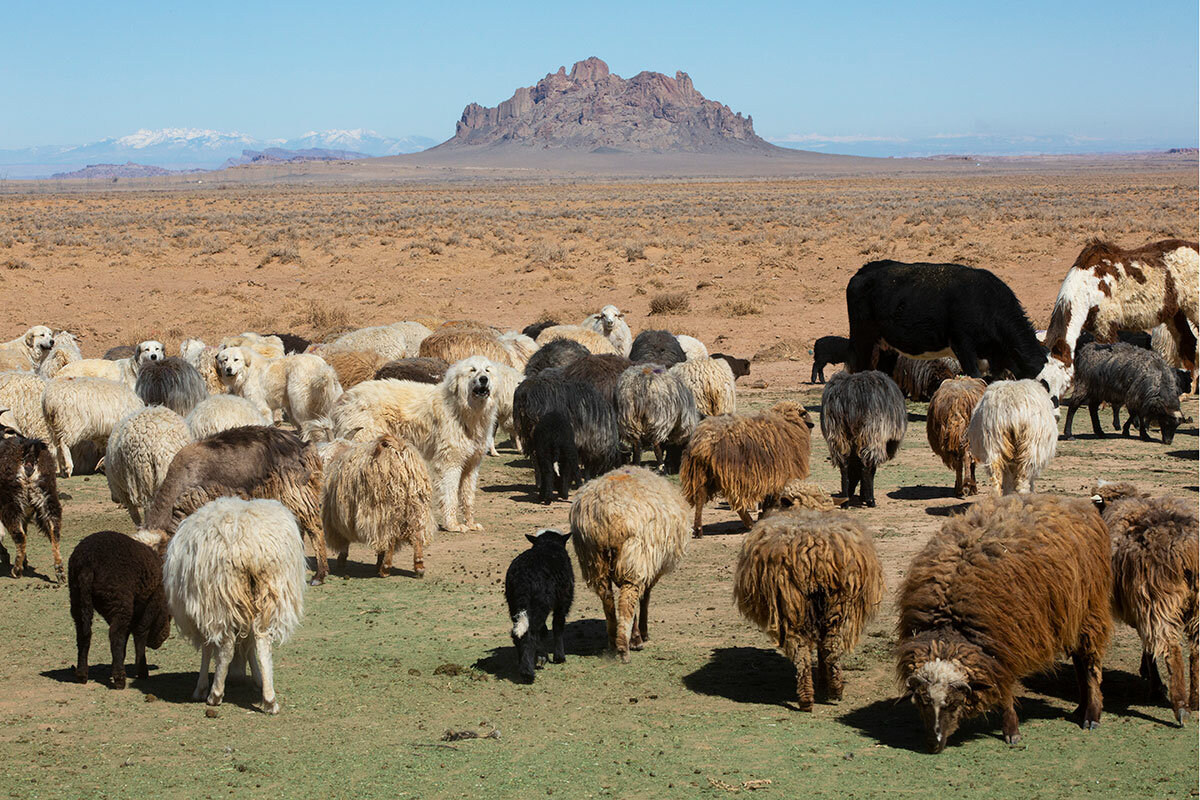
“Great Pyrenees dogs watch over Navajo-Churro sheep … outside Toadlena, New Mexico. … The sheep flourish in the harsh environment,” according to the Monitor.

I like that the Christian Science Monitor has so many stories about the Navajo Nation and other indigenous peoples. Although I’m not a Christian Scientist, I’ve always been impressed by the objective reporting at the Monitor and its steady coverage of underreported topics.

Reporter Henry Gass wrote recently from New Mexico about the resurgence of sheep farming on Navajo land.

“Irene Bennalley steps out into the fierce afternoon sunlight wearing jeans and a maroon sweater, her long gray hair knotted in a braid. Brandishing a long white stick as her crook, she picks her way across her parched desert farm toward the sheep pen. Answering their bleats with firm instructions in Navajo, she shepherds them out onto the dry, dusty range.

“She doesn’t know exactly how many Navajo-Churro sheep she has, but she ballparks it at around 100 head.

It’s bad luck to keep exact counts of your livestock, her father taught her. Don’t boast about your animals, he would say, or they’ll start dropping.

“Out here, ranchers like Ms. Bennalley can’t afford to lose animals. The winters are cold and hard, and the summers are hot and relentless. Water is scarce and feed is expensive. It’s the main reason she has come to love the breed, known colloquially as churros, that she’d grown up only hearing about in stories.

“The Navajo, who refer to themselves as Diné, have long been a pastoral society. Sheep are prominent in their creation myths, and after Spanish colonists first brought the churro sheep to the Southwest, the hardy, adaptable breed became, over centuries, the heart of a self-sufficient economy and vibrant Diné culture.

“But the days of sheep camps and flocks roaming the arid plains and valleys here are long gone. On two separate occasions the churro came close to full extermination. From over 1 million head at one time, by 1977 there were fewer than 500 left in the world.

“Efforts have been gaining momentum in recent years to rebuild the breed and return flocks to the Navajo Nation. Decades of painstaking, sometimes dangerous, work by a handful of committed ranchers and animal scientists have helped restore the population to over 8,000. 

“Now, people on the Navajo Nation are working to bring flocks back to the reservation, to try and fill the economic and cultural void left by their near extinction. 

“ ‘We’re back in a place of reevaluating how we live,’ says Alta Piechowski, whose family has been involved in restoring the Navajo-Churro for decades.

“ ‘When you’re walking the land [with the sheep], there’s a different kind of healing,’ she adds. ‘It heals your heart, and when it heals your heart you’re going to want other people’s hearts to be healed too.’ …

“An ‘unimproved’ breed – meaning one that hasn’t been selectively bred for market – churros are long and lean. … They are resistant to most diseases, and have adapted over the centuries to thrive in the dry, low-forage climate of the Southwest.

“For the Navajo people, the churro were something of a panacea. They provided a healthy and sustainable source of food and income; their many-colored fleece are ideal for weaving iconic Navajo blankets. And culturally, sheep have always been prominent in Navajo spiritual traditions. One of the six sacred mountains that bound the Navajo Nation, Dibé Nitsaa, translates to Big Sheep Mountain.

“But for the best part of a century, Navajo-Churro have been hard to find on the reservation. 

“The official term used by the U.S. government in the 1930s was ‘livestock reduction.’ The Midwest was in the grips of the Dust Bowl, and the Bureau of Indian Affairs, led by commissioner John Collier, concluded that too many livestock were causing land to erode and deteriorate.

“The policy resulted in the slaughter of hundreds of thousands of churros, often on the reservation, and sometimes on the properties of their owners. And it came after the Navajo people had spent over 70 years steadily rebuilding their churro herds. …

“Nearly a century since the stock reduction, the collective memory is still raw. Ms. Bennalley speaks mournfully of what she calls ‘the John Collier days.’ For a long time no one spoke of it at all.

” ‘Some people never really got out of losing their sheep that way,’ says Ms. Bennalley. ‘My family, my dad, nobody really talked about it, because it wasn’t something to be proud of.’ …

“ ‘That connection to the sheep is the connection to the land, which is the connection to the culture, which is the connection to the spirituality of the Diné people,’ says Dr. Piechowski, a career psychologist for reservation schools.

“ ‘If you exterminate the sheep, you’re pretty much eliminating [those] connections,’ she adds. …

“The churro never disappeared from the reservation, but the few that remained stayed hidden in some of the reservation’s most remote corners – so remote that the man who first led efforts to bring the churro from the brink of extinction almost died trying.”

Read more about that at the Monitor, here. Lovely photos. No firewall.

Read Full Post »

Photo: Melanie Stetson Freeman/Staff.
Ida Joe tries out her new sink with running water, which the nonprofit DigDeep installed in her home in Smith Lake, New Mexico. About 30% of those living on the Navajo [Diné] reservation do not have indoor plumbing or running water.

In Navajo Country, water is precious, and running water is sometimes nonexistent. Golly. I shouldn’t complain. Renovations at our house have left us without hot water since May 18, but at least we have cold water and friends with showers. Some Navajos [Diné, as they call themselves] trek periodically to the nearest town and rent a hotel room to take a shower!

Henry Gass, a writer at the Christian Science Monitor, reported the story from Smith Lake, New Mexico. “Ida Joe flinches a little as the tap sputters, then spurts water into the sink. Cautiously, tentatively, she pushes her hand under the faucet. She feels the water soak her skin and run through her fingers – first cold, then hot. After a few seconds, she starts to laugh.

“Outside the one-room house she shares with her two daughters and granddaughter, a cold breeze rolls across the dusty, arid plains of the Navajo Nation. A few hundred yards away, wild horses drink from a small, briny lake.

“Ms. Joe has lived on the Navajo Nation for all of her nearly 50 years. This late February day is her first with running water in her home. Until now, her family would drive to Thoreau, 10 minutes away, or Gallup, 45 minutes away, to buy gallon jugs of water.

They would drive to town to do laundry, and rent a hotel room for the day to use the shower. …

“Water is sacred on the Navajo Nation, and scarce. About 30% of the roughly 173,000 population lack running water, according to a report from the U.S. Water Alliance and DigDeep, an international nonprofit with Navajo employees who have been installing running water systems in homes on the reservation since 2014. The size of the reservation, the large distances between homes, scarce natural water sources, jurisdictional issues, and contamination from industries like uranium mines have all contributed to restricting access to running water here for generations.

“But according to those working to improve water access on the reservation, the COVID-19 pandemic has heralded a bittersweet turning point. … The pandemic drew widespread attention to the fact that many Navajo didn’t have enough water to thoroughly wash their hands, which was core advice of health experts at the time. … New coalitions have formed, funding has increased, and innovations from organizations like DigDeep have helped expand water access here more than ever before.

“ ‘This has been a silver lining for us,’ says Crystal Tulley-Cordova, principal hydrologist for the Navajo Nation Department of Water Resources. …

“A pickup truck, a trailer towing a backhoe, and a gleaming white water truck nicknamed ‘Big Ernie’ make up the DigDeep convoy. …

“The region has been in various forms of drought for over 20 years, and is currently experiencing severe and extreme drought. … There are also problems with water quality. Arsenic and uranium, both left over from a century of mining on the reservation. …

“Meanwhile, piping water onto the reservation is challenging because of how spread out the population is. Some areas are a checkerboard of public and private land, presenting right-of-way issues. On top of that, funding has typically been limited, according to Capt. David Harvey, deputy director of the Division of Sanitation Facilities Construction at the federal government’s Indian Health Service. …

“Through the CARES Act – a pandemic relief funding package passed by Congress in March 2020 – the Navajo Nation received over $5 million specifically for increasing water access on the reservation. …

“The [DigDeep] crew were here 18 months ago to install one of their foremost pandemic-era innovations: a ‘suitcase’ – a 4-cubic-foot box filled with a water pump, heater, filter, expansion tank, and battery installed outside homes to provide tap water from a 1,200-gallon underground tank. …

“During the pandemic, 100 of these suitcase systems have been installed by DigDeep crews on Navajo lands, at no cost to residents.

‘People [were being told], “Wash your hands for at least 20 seconds with soap and water.” But how can they do that if they don’t have running water?’ says Cindy Howe, the project manager for DigDeep’s New Mexico office. …

“Ms. Joe and her family wait in their car while Kenneth Chavez and Brian Johnson assemble the sink and Erving Spencer maneuvers the backhoe. …

“Ms. Joe likes living here, she says. She feels safe, and she wants to raise her kids and grandkids here.

“ ‘It’s one of the most important things that I would probably want to do before I go,’ she says, ‘teaching them the foundation of our culture.’ …

“As they finish their work at Ms. Joe’s house, ‘Big Ernie’ refills the 1,200-gallon tank that now supplies her indoor sink. …

“Lacking water ‘is just normal for a lot of people,’ says Ms. Howe of DigDeep. Her grandparents would melt snow for water. Her parents hauled water throughout her childhood as well – always on Sundays, so she could have a bath before school on Monday.

“ ‘It was really heartbreaking to see,’ she says. ‘Fifty-five years later, it’s still happening. We’re all helping each other [but] there’s still a lot of people that don’t have any water.’ ”

More at the Monitor, here.

Read Full Post »

Photo: Randall Hyman.
The Christian Science Monitor: “Activist Nicole Horseherder, who heads a nonprofit that seeks to protect water supplies on the reservation, stands on a ridge near Black Mesa in northern Arizona, the site of past disputes over coal mining.”

I’m grateful for the environmental leadership of indigenous people. They were environmentalists centuries before anyone used that word, and I think that paying attention to them will help us learn how to protect our planet.

Randall Hyman reports at the Christian Science Monitor about Navajo women who instinctively understand the importance of the natural world and their community’s place in it — and who don’t give up.

“One who has a master’s degree in linguistics,” Hyman says, “has made green energy a crusade on a reservation where coal, gas, and uranium have reigned supreme for decades, leaving tainted groundwater in their wake.

“Another returned to the Navajo reservation from Chicago to find that fracking had marred large sections of her native land – something she now works to stop in one of the largest methane hot spots in the United States. 

“A third was so distraught by the lack of ballot access on the reservation that she organized getting voters to the polls on horseback – her version of saddle-up democracy. 

“Two others have immersed themselves in politics directly – one as the youngest member of the Arizona State Legislature and the other as one of three women on the 24-member Navajo Nation Council. …

“Their efforts come at a particularly fraught time. Last year, from the vermilion sands bordering the Grand Canyon to the oil-rich scrublands east of Chaco Canyon, the Navajo Nation was hit by a perfect storm – a convergence of soaring pandemic deaths, dwindling energy revenues, and rising unemployment. Amid the chaos, Native women stepped up in what some see as an unprecedented wave. While one COVID-19 relief group raised $18 million in a matter of months, other women redoubled efforts to dismantle policies that have left Navajo (Diné) people vulnerable. 

“ ‘I think that you’re actually seeing a return to the way that Diné society has always been,’ says Nicole Horseherder, executive director of Tó Nizhóní Ání (Sacred Water Speaks), an organization pushing for new energy policies and water protection across the Navajo Nation. ‘Women are coming forward and saying, “I am a leader too. I can make these decisions. I can make better decisions.” ‘ …

“Underneath all the narratives is another factor – the dominant presence of women in Navajo society, where taking charge is rooted in a matrilineal culture. 

“ ‘When you see the destruction in your community, you realize you have to do something,’ says Wendy Greyeyes, assistant professor of Native American studies at the University of New Mexico in Albuquerque. ‘So, women are empowered. A lot of that harks back to our own creation stories. Changing Woman was a very powerful deity who reflected thinking about the longevity of our existence, of the Diné people. This ideology is baked into our DNA as Navajo women – our need to care and nurture and protect our communities, our families.’ …

“A year ago, on a chilly December morning, Nicole Horseherder marked an explosive turning point in her long battle against coal mining. Standing on a slope overlooking the towering smokestacks of the coal-fired Navajo Generating Station in northern Arizona, Ms. Horseherder set her cellphone on livestream and gazed at the 775-foot monoliths glowing in the sunrise a mile away.

“The stacks had been a landmark of the high desert for nearly half a century, symbols of fleeting prosperity and persistent pollution. The power plant serviced major cities of the Southwest and ran the huge Colorado River pumps supplying much of their water, but was among the top 10 carbon emitters in the United States. At precisely 8:30 a.m., a thunderous rumble shattered the clear morning and clouds of smoke mushroomed as 1,500 pounds of dynamite collapsed the stacks. …

“When I caught up with her last August on the Second Mesa of the Hopi reservation deep within the encircling borders of the Navajo reservation, [Horseherder] recalled her journey’s start. Driving to an overlook, she pointed north toward distant Big Mountain. For her, it stirred painful memories. 

“Ownership of the hardscrabble land surrounding Big Mountain, called Black Mesa, had long been an unresolved intertribal treaty issue. It remained in limbo until the 1950s and ’60s, when a Utah lawyer named John Boyden persuaded a minority of Hopi litigants to take it to court.

“True to its name, Black Mesa is underlain by rich coal seams. It is also sacred to the Navajos and Hopis, many of whom opposed outsiders tapping their minerals. But the lawsuit prevailed, eventually forcing the removal of some 10,000 Navajo residents while dividing mineral rights equally between the tribes. Boyden subsequently leased land and mineral rights for Peabody coal company. A half-century of coal mining and environmental controversy ensued. 

“Ms. Horseherder’s epiphany came when she returned home from Vancouver, British Columbia, with a master’s degree in the 1990s and discovered that her dream of leading a pastoral life had turned to dust. The springs that her family’s livestock depended on had run dry. ‘My whole attention and focus shifted,’ says Ms. Horseherder. ‘It became, “How am I going to protect the place where I live – how am I going to bring the water back? And where did the water go in the first place? ” ‘

“Ms. Horseherder became a vocal activist and founded Tó Nizhóní Ání, or Sacred Water Speaks. At the time, Peabody was pumping billions of gallons of water from deep aquifers, mixing it with pulverized coal, and sending the slurry through 273 miles of pipeline to a Nevada power plant. It assured tribal officials that the technology was safe, and many supported the operation because coal mining was a pillar of the Navajo and Hopi economies for nearly 50 years, providing tax revenues and well-paying jobs. 

“But environmentalists contended that depressurizing the aquifer was lowering the water table. While Ms. Horseherder fought Peabody for years – and others lost scores of animals to stock ponds they said were tainted by slurry – the power plant and related activities were only closed when the economics of the operations no longer worked. Wells never recovered, and impacts endure to this day, critics say. ‘What we’d like to see them do first,’ she says, ‘is fully reclaim those lands that they’ve mined, and reclaim the water as well.’ “

More at the Monitor, here.

Read Full Post »


Photo: Adron Gardner/Gallup Independent via AP
Fry bread is available at the Navajo Nation Fairgrounds in Window Rock, Ariz., but is no longer part of the Miss Navajo Pageant competition.

It’s interesting how customs that evolve out of oppression can sometimes be so warmly appropriated that they will be missed if discontinued. As tribes like the Navajo start to promote healthier ancestral foods, some feel wistful about the fry bread that families got used to over the years.

Felicia Fonseca writes at the Sante Fe New Mexican, “The Miss Navajo Nation pageant is parting ways with fry bread, the fluffy, golden brown delicacy that’s become a symbol of Native American culture but is rooted in oppression.

“Women vying for the crown [in September] in Window Rock [prepared] traditional Navajo foods instead, like blue corn mush or a cake made at puberty ceremonies.

“Outgoing Miss Navajo Ronda Joe said the tribe’s new ambassador must know the history of those foods and speak about them in Navajo.

“ ‘We need to educate our people to utilize plants as food that are tied to our land, culture and beliefs,’ she wrote in an email. The change aligns with a movement in Indian Country to refocus on traditional foods and reinforce native languages.

“Fry bread was born out of government rations given to Navajos on a forced relocation to Eastern New Mexico in the 1860s. Traditional Navajo breads or cakes would be made of corn and cooked on hot stones or in the ground, not in a cast-iron pan filled with oil.

“Fry bread can be found across the Southwest in Indian tacos, slathered in honey or powdered sugar, or broken off in pieces and used as a spoon for stews. The exact ingredients vary and everyone claims ‘mom’ makes it best.

“Despite being removed from the tribal pageant, fry bread offers lessons in survival, being a contributor and creating something out of nothing, said Jocelyn Billy-Upshaw, Miss Navajo 2006-07. She remembers her mom saying she’d never get married unless she knew how to make bread. …

Brian Yazzie, a Navajo chef who focuses on precolonial foods in Minneapolis, Minnesota … praised the switch from fry bread to a traditional food presentation.

“ ‘It encourages and inspires youth to step up and take a challenge of ancestral knowledge and ancestral roots,’ he said. ‘It makes my heart happy to see that.’ ”

More.

Read Full Post »

A Native American chef trained in French cuisine has a mission to teach the world about an older, unrecognized culinary tradition that has influenced most of us. Hanna Choi reported the story for National Public Radio.

“When Nephi Craig enrolled in the culinary program at Arizona’s Scottsdale Community College, there was nothing like ‘Native American Cuisine 101’ in the curriculum. Craig identifies as White Mountain Apache and Navajo, and the first mention he can recall of anything remotely related to his background was a class discussion on fry bread, a crispy fried concoction that ‘is really a taste of American colonialism,’ he says …

“Since then, he increasingly came to sense a sort of dismissiveness and sloppiness towards Native Americans and indigenous food ways in the mainstream culinary world.

“Craig grew up immersed in his culture through art, music and ceremony, and food always played a large role. He wanted to find a way to bridge the gap. …

“Upon graduating from culinary school in 2000, Craig launched the Native American Culinary Association. Based in Arizona, NACA is a network of Native chefs — professionals and those just starting out — dedicated to the research, refinement, and development of Native American cuisine. Since 2011, the association has organized a yearly Indigenous Food Symposium, bringing people from different fields together to share and learn about Native foods, agriculture and landscapes.

‘Craig is also the executive chef of The Summit Restaurant at Sunrise Park Resort in Whiteriver, Arizona. … Craig’s culinary team there is staffed entirely by cooks and other food workers who identify either with the White Mountain Apache tribe or as Navajo/Dineh.”

In the NPR interview, Craig tells Choi, “I had always been cooking since I was a kid, growing up here on the rez with my mom and my family. We didn’t have a lot of money and so we would bake and sell our goods and I would bag up stuff in sandwich bags and sell them as a little guy.

“I’ve been cooking my entire life, all through my adolescence and I had ultimately wanted to do something creative. …

“I had no idea the world that I would be entering in the long classical legacy that is French cuisine. But that’s kind of where I started out, just in childhood, and then realizing just by pure observation that we were left out of this picture of world cuisine even when about 70 percent of foods consumed around the world today were developed and domesticated by Indigenous peoples of the Americas.”

Craig explains more here. Check it out.

Photo: Evan Sung/Nephi Craig
Nephi Craig, executive chef of The Summit Restaurant at Sunrise Park Resort in Whiteriver, Arizona.

Read Full Post »

Raise your hand if you were taught that one day centuries ago people in Siberia woke up and crossed a land bridge to North America and became the first Native Americans.

That’s OK as far as it goes, but history doesn’t stand still, and new discoveries suggest that before they got to North America, the Siberians stayed over on the bridge for a few thousand years. Who figured out the new chapters? Archaeologists and geneticists. And linguists.

Nicholas Wade writes in the NY Times, “Using a new method for exploring ancient relationships among languages, linguists have found evidence further illuminating the peopling of North America about 14,000 years ago. Their findings follow a recent proposal that the ancestors of Native Americans were marooned for some 15,000 years on a now sunken plain before they reached North America.

“This idea, known as the Beringian standstill hypothesis, has been developed by geneticists and archaeologists over the last seven years. …

“Though often referred to as a bridge, the now sunken region, known as Beringia, was in fact a broad plain. It was also relatively warm, and supported trees such as spruce and birch, as well as grazing animals.

Writing in the journal Science last month, John F. Hoffecker, an archaeologist at the University of Colorado, summarized the evidence for thinking the Beringian plain was the refuge for the ancestral Native American population identified by the geneticists. ‘The shrub tundra zone in central Beringia represents the most plausible home for the isolated standstill population,” he and colleagues wrote. …

“Linguists have until now been unable to contribute to this synthesis of genetic and archaeological data. The first migrations to North America occurred between 15,000 and 10,000 years ago, but most linguists have long believed that language trees cannot be reconstructed back further than 8,500 years. …

“But in 2008, Edward Vajda, a linguist at Western Washington University, said he had documented a relationship between Yeniseian, a group of mostly extinct languages spoken along the Yenisei River in central Siberia, and Na-Dene.

“The Na-Dene languages are spoken in Alaska and western Canada, with two outliers in the American Southwest, Navajo and Apache.” More here.

This is why it’s important for someone to be interested in studying mostly extinct languages spoken along the Yenisei River in central Siberia.

Map: Science, a journal, and the New York Times

Read Full Post »

Photo: Ken Shulman/OAG
Players for Naat’aanii, a team created for Navajo youth, practice in Farmington, New Mexico.

Now that Native Americans are playing major league baseball, it seemed like a good time for Bill Littlefield’s Only A Game radio show to do a story about Native American kids getting into the game. Ken Shulman traveled to New Mexico “to meet a Navajo team that uses tribal lore to train quality ballplayers.”

One of the people Shulman interviews is Dineh Benally, a youth baseball coach with teams in Farmington and Albuquerque.

“’Benally learned baseball as a kid on a reservation in Shiprock, where New Mexico borders with Colorado, Utah, and Arizona. The Four Corners was the Navajo ancestral home until 1864, when the tribe was forcibly marched to a desolate reservation 500 miles away.

“ ‘Baseball is about failure,’ Benally said. ‘And I think life is about failure. You’re gonna fail more than you succeed. …’

“Benally’s had his share of hardship. And failure. Growing up on the reservation was fun. But farm chores often kept him off the ball field. And when he did play, there wasn’t much in the way of coaching. Still, the tall right hander was MVP of his all-Navajo high school team. He pitched two years in junior college. Then he got a break: a chance to make the team at New Mexico State University — and to prove that a boy from the rez could play Division I ball. He threw well in tryouts but was cut on the final day. …

“It was tough not making the team. But Benally rallied. He thought about his ancestors on that long walk from Four Corners. And he thought about what he’d learned.

“A few years after graduation, in 1999, he started a youth team, to give Najavo kids the type of training he wishes he’d had growing up. He called the team ‘Naat’aanii,’ a word that … means leader. He scoured the state for native talent, boys born on and off the rez who he could shepherd toward college baseball and maybe even the pros. …

“Naat’aanii is no longer just for native players. Any kid can join if he has talent and desire. But the logo and rhythm and ethos are still Navajo. Dineh Benally wants his players to learn more than how to turn a double play. He wants them to tap into the tribal soul, to find the strength to stick it out when times get tough. Because they will get tough.

“ ‘That’s where they’ll show me if they’re really a true Naat’aanii,’ he said. …  They look at me. They know what I’m talking about.’ ”

More at Only a Game, here.

Read Full Post »