Feeds:
Posts
Comments

Posts Tagged ‘new york’

Photos: Agata Poniatowski
Oyster shells from restaurants get taken to Governors Island in the heart of the New York Harbor to be used in fighting erosion. Billion Oyster Project has collected more than 1 million pounds of oyster shells so far. 

I go to poetry readings at the local library, and inevitably in the question period, someone in the audience asks the poet, “How do you get your ideas?” (This is a question poets expect, and they always have a ready answer. Watch for the deer-in-the-headlights look if you ask a question they don’t expect.)

But I’m not sure any of us really know where we get our ideas. There is something mysterious about the way individual brains connect connect things heard, seen, smelled, touched, tasted with their individual experiences.

Today’s story is about shoring up an eroding harbor with recycled oyster shells. The idea to use oysters this way comes from years of research and contributions from many people. But, according to the report at National Public Radio (NPR), an idea for extending the benefits came from kids. Read on.

Andrea Strong reports, “Across New York City, more than 70 restaurants are tossing their oyster shells not into the trash or composting pile, but into the city’s eroded harbor. It’s all part of Billion Oyster Project‘s restaurant shell-collection program. …

“The shells are trucked over to Brooklyn’s Greenpoint neighborhood and once a month are brought en masse to Governors Island in the heart of the New York Harbor, just yards away from both Brooklyn and Lower Manhattan. There, rolling shell hills sparkle in the sun while ‘curing’ out in the elements for one year, a process that rids them of contaminants.

“The shells then get a final cleaning and are moved to Billion Oyster Project’s hatchery at the Urban Assembly New York Harbor School, a public high school on Governors Island that offers technical and vocational training in the marine sciences. In an aquaculture classroom’s hatchery, student-grown oysters produce larvae in an artificially induced springtime environment.

“In one to two weeks, each larvae grows a ‘foot’ — a little limb covered in a kind of natural glue — and then is moved to a tank full of the ‘cured’ restaurant shells, which serve as anchors for all of those sticky feet. This phase is critical: If larvae can’t find a place to attach, they die. One reclaimed shell can house 10 to 20 new live oysters, depending on shell size. …

“If the water is warm enough, mature oysters are moved to a reef structure — a cage or shellfish bag — that provides a stable area for oysters to fuse together and create a healthy reef in the New York Harbor.

“Then, the oysters begin doing what oysters do — which, it turns out, is quite a lot. Oysters are natural water filters; each one cleans 30 to 50 gallons of water a day. They also provide food and shelter for all sorts of marine creatures, supporting biodiversity. …

“Oyster reefs can protect against a hurricane’s wave velocity, which can destroy a city’s infrastructure. The New York Governor’s Office of Storm Recovery has partnered with Billion Oyster Project to install oysters on its $74 million Living Breakwaters Project, which aims to reduce and reverse erosion and damage from storm waves, improve the ecosystem health of Raritan Bay and encourage environmentally conscious stewardship of nearshore waters. …

“Brian Owens, who goes through about 20,000 oysters a week at his restaurant, Crave Fishbar, … says the project is not just smart for sustainability; it’s also good for business. Recycling shells significantly reduces carting expenses, something all NYC restaurants must pay for by the bag. ‘Recycling them into the reef is a huge savings,’ he says.

“In addition to saving on garbage collection, restaurants may soon be eligible for a tax credit thanks to New York Assemblywoman Linda Rosenthal. The credit is a much needed balm for restaurants that have been hit with escalating costs and increasing regulatory burdens over the past few years. …

“The idea came from neither restaurants nor Rosenthal, but from students at one of Billion Oyster Project’s partner schools, West End Secondary on the Upper West Side.

“Rosenthal championed their idea, building support for the bill and bringing the students to Albany to learn about lawmaking and to participate in a press conference.

“Education of the next generation of environmental stewards has been at the heart of Billion Oyster Project since its inception in 2008, when [Billion Oyster Project Executive Director Pete] Malinowski was teaching aquaculture at the Harbor School. …

“Fifteen years later … that classroom program has grown into Billion Oyster Project and now includes programming in more than 80 middle and high schools. That works out to about 1,215 high school students and more than 6,500 middle school students. …

” Through this work, students develop awareness and affinity for the resource and the confidence that comes from knowing their actions can make a difference. With young people who care, the harbor has a real fighting chance,’ ” says Malinowski.

More.

Sending 422 oyster reef structures into the Hudson River to protect and purify New York Harbor.

Read Full Post »
Photo: CBSLocal
New York City hopes that donating reusable water bottles to high school students will make some advocates for reducing waste. The campaign is part of the city’s ultimate goal of sending zero waste to landfills by the year 2030.

After reading an inspiring book called Climate Justice, I signed up at the website 1 Million Women to get ideas for reducing my carbon footprint. One thing the site suggests is to boycott fruits and vegetables that have unnecessary packaging. You know, like those Japanese pears in plastic foam holders. Such gestures are small, but they add up if a lot of people pursue them.

In New York, meanwhile, schools are trying to wean students from plastic water bottles by giving them nice reusable ones.

CBSLocal reports, “After a recent push to ban plastic bags, straws, and bottles in New York, some local leaders are working to get the city’s high school students involved. …

” ‘When you think about it, you’re not gonna be wasting all that plastic,’ [student] Daisy Palaguachi said.

“More than 320,000 bottles made by S’well were donated to all New York City high schools throughout all five boroughs [in September].

” ‘The goal is really to extend our mission to rid the world of plastic bottles and we couldn’t help but think the best way to do that is to tap into the city’s future leaders,’ S’well Vice President Kendra Peavy said.

“The company partnered with Mayor Bill de Blasio’s Office of Sustainability for the new ‘Bring It’ campaign. They’re asking students to ditch the plastic and spread the word to their families and friends.

“ ‘To empower them with actual tools that they can bring and take to make better and more informed decisions,’ Mark Chambers, Director of the Mayor’s Office of Sustainability, said.

“The city says its goal in doing this is to try and get rid of 54 million single-use plastic bottles.

“ ‘About 167 water bottles are used by the average American every year, and so it’s important to say by using a reusable water bottle we could displace that many from going into the waste stream every year,’ Chambers said. …

“ ‘Knowing that you’re making a small change can turn into something bigger in the future,’ student Alexandra Capistran said. ‘You don’t have to spend all your money buying water bottles every day.’

“Sunset Park High School now also has a newly installed water bottle filler for that very purpose. … The bottles donated [would have cost] $19 to $35, and the campaign is part of the city’s ultimate goal of sending zero waste to landfills by the year 2030.”

More at CBS, here.

Read Full Post »

welling-court1

Photo: Welling Court Mural Project
New York City recently sought proposals from qualified nonprofit organizations to install artwork on an ugly sidewalk shed or fence.

There’s a lot of construction and renovation going on in New York City these days, and many otherwise interesting buildings are obscured by scaffolding and green plywood fences. Fortunately, the city is always looking for ways to bring culture to unlikely places and to engage artists.

Michelle Cohen writes at the website 6sqft, “On September 12, the New York City Department of Cultural Affairs announced a search for applicants for a new pilot program called City Canvas, Archpaper reports. The program was designed to beautify New York City’s visual landscape by installing large-scale–and temporary artwork on its endless construction fences and 270 miles of sidewalk sheds. The protective construction structures are an everyday eyesore for New Yorkers, but current building codes prohibit altering them. The City Canvas program circumvents that ban by allowing select artists and cultural institutions to add visual art to the visual affronts.

“There are two main objectives for the new initiative. First, to improve the experience of strolling through the city’s streets for residents and tourists alike by turning the ubiquitous fences into beautiful works of art, and second, to increase opportunities for artists and cultural institutions to get recognized for their work and to create art that represents the surrounding community. …

“During the pilot period, which will run for the next 24 months, the city is seeking proposals from at least one qualified nonprofit organization to install artwork on at least one ugly sidewalk shed/fence.” More.

The winning applications were announced November 28 at the New York City Department of Cultural Affairs (DCLA) website: “DCLA, in partnership with the NYC Department of Buildings and the NYC Mayor’s Office, is excited to announce two cultural organizations selected for the City Canvas pilot. ArtBridge and Studio Museum in Harlem will each work with local communities to transform protective construction structures into spaces for temporary art installations. First installations are anticipated in Spring 2019.”

Well, it’s a drop in the bucket, but I can’t wait to see what emerges.

Read Full Post »

110518-amazing-shade-of-red-on-Japanese-mapleDid you read The Hobbit? Do you remember the thrilling moment when an ancient prophecy comes true as a “thrush knocks” and the sun briefly beams at a tiny spot on the wall of the Iron Mountain, revealing the forgotten keyhole to the dragon’s backdoor? No? Well, check it out.

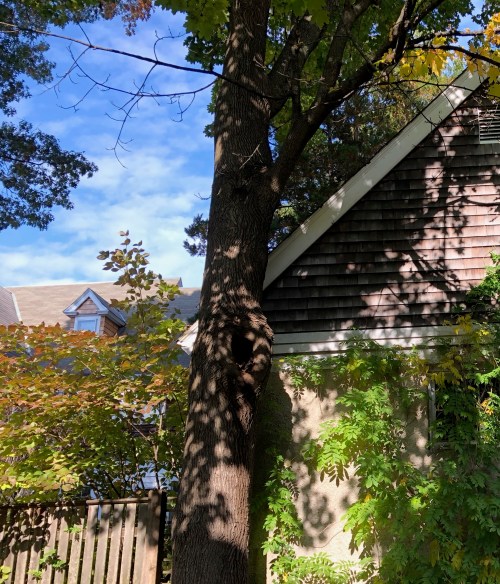
I mention this ability of the sun to shine at a certain place only at a certain time because the photo below represents one of my attempts to run outside in a mad rush and capture how a particular solar angle projects the squares of the gate on the stone wall. It only happens a couple times a year because the sun keeps moving. (That is, the Earth keeps moving in relation to the sun.) In a few minutes the projection would be on the grass, not the wall. The following week, it wouldn’t happen at all. I totally lost out last spring, but managed to get this much in the fall. Stonehenge.

The first sculpture was by a grateful patient of Mass General Hospital in Boston. Next come sculptures seen from the cafe balcony at the Guggenheim Museum in New York. And, typical of the City That Never Sleeps, Insomnia Cookies will deliver until 3 a.m. The port-a-potty confirms Asakiyume’s contention that these ubiquitous accommodations are as creatively named as hair salons.

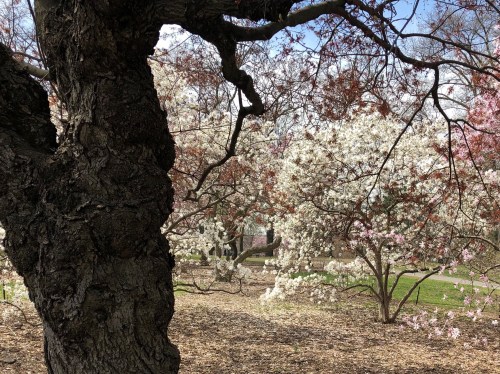
Then, I give you Central Park the Beautiful. What city would ever build something this magnificent today?

Finally, another of my favorite topics: the wonder of lichen.

110918-light-thru-fence

110118-Providence-backyard

103118-autumn-shadows

112918-.MGH-sculpture-Open-Arms

112918-Sculptor-Harold-Grinspoon

112118-view-from-Guggenheim-cafe

112118-open-to-3-am-NYC

112118-creative-potty-naming

112118-Central-Park-bridge-detail

112118-NYC bridge-detail-in-shadow

112518-love-of-lichens

Read Full Post »


112218-elf-at-Macys-parade

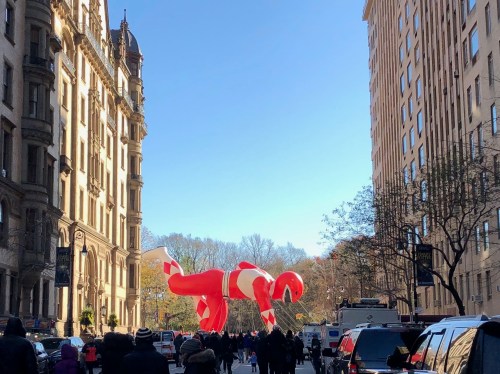
New York is the no. 1 Thanksgiving destination — four years in a row now. Crowds of all ages were ebullient despite the coldest Thanksgiving weather in 117 years. I really hadn’t taken in what a humongous block party the city would be.

I managed to get a few photos of Macy’s Parade participants getting ready and a Brunhilde dressing up just because. But it was impossible to get near enough to the actual parade to see the bands or anything not floating way high up. Folks in the know brought ladders. Next time, maybe.

The police, first responders, and other security experts seemed to anticipate every eventuality and the parade went smoothly. Besides huge sanitation trucks blocking streets, there were trash cans and mailboxes locked to prevent dangerous deposits. That’s what we’ve come to, Dears. Let’s just be grateful that human ingenuity continues to find ways to let us carry on.

112218-mailbox-locked-for-safety

112118-.Macys-parade-prep

112218-Brunhilda-comes-to-NYC

112218-piece-of-cake-costume

112218-solemn-cold-clown

112218-Thanksgiving-parade-float

112218-duck-float-at-parade

Read Full Post »

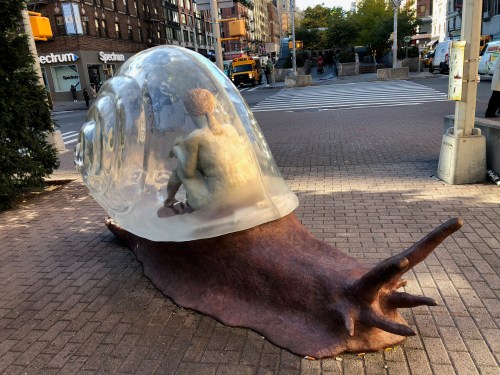
102518-contempative-life-in-snail

OK, New York is not a beautiful city in the sense of the traditional song (Dave Van Ronk sings “Oh, What a Beautiful City!” here), but that spiritual has been playing in my head today because I really like New York.

It’s definitely not a clean city. Every day of the week there are so many trash bags on the sidewalk that the garbage trucks often leave half behind for a later pass, and not-civic-minded New Yorkers toss last night’s take-out on the heap as they walk their children to school.

The electronic kiosks that I love featured a relevant quote by Fran Lebowitz this week: “When you leave New York, you are astonished at how clean the rest of the world is. Clean is not enough.”

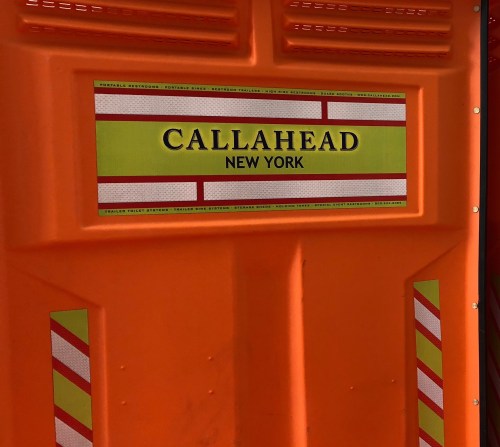
Speaking of clean, Asakiyume once pointed out that the business that attracts almost as much creative naming as beauty salons is the porta-potty business, so the first photo below is for her collection.

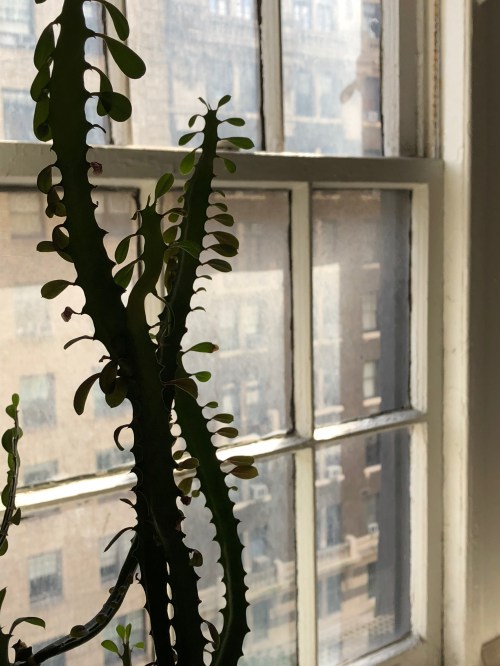
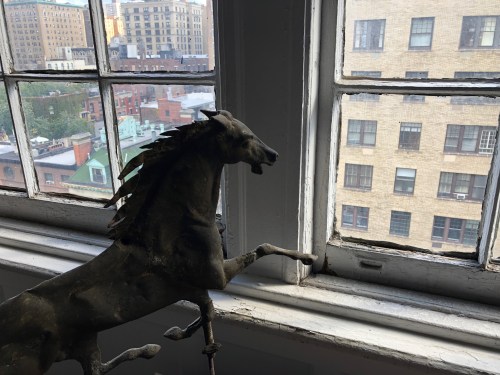
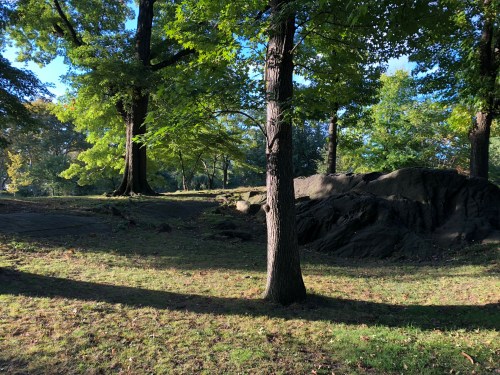
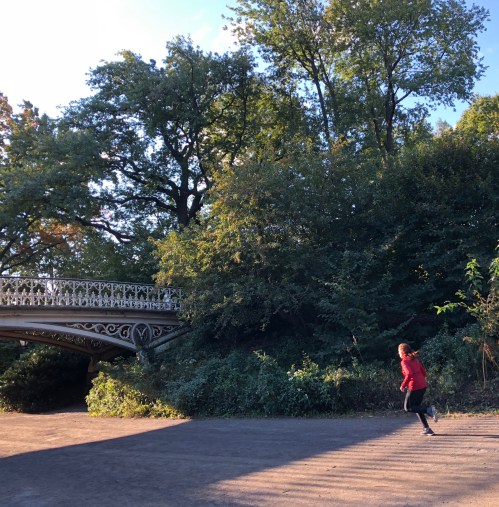
Next I have two indoor photos, followed by several from beautiful Central Park. Having been warned never to go near the park when I walked the Corgi in the morning decades ago, I’m always astonished that today one can walk there early in the morning and join many other people — runners, bikers, dog walkers, children headed to school, sometimes a solitary practitioner of tai chi chuan.

I love the shadows at that time of day and the greenery, the park’s architectural touches, the benches with thoughtful quotes, the paths that beckon. It’s pretty magical.

Riffing off a Lawrence Block quote, another kiosk asked what was “the thing about New York, if you loved it, if it worked for you, it ruined you for anyplace else in the world”? New York doesn’t ruin anywhere for me, but I feel challenged to answer what is the main thing I like about New York: it’s just that it’s always interesting.

(More quotations about New York City here.)

102518-fun-with-portapotty-names

102418-cactus-NYC-window

102418-horse-weathervane-NYC

102518-mega-dogwalking-Central-Park

102418-popular-park-in-am

102418-morning-shadows-Central-Park

102418-runner-Central-Park

102418-Good-Morning-Central-Park

102418-fairytale-bridge-Central-Park

102518-beckoning-path-in-park


Read Full Post »

102318-photographing-subway-mosaic

Yesterday was beautiful in New York, and my sister was feeling fine, having been off chemo and radiation a month. New treatments start today.

We took the subway from the Upper West Side down to Chelsea, which she says feels like a whole different city to her. We went to a very avant garde museum, walked around, met up with childhood friends, had tea at an indy bookstore, and admired several subway mosaics.

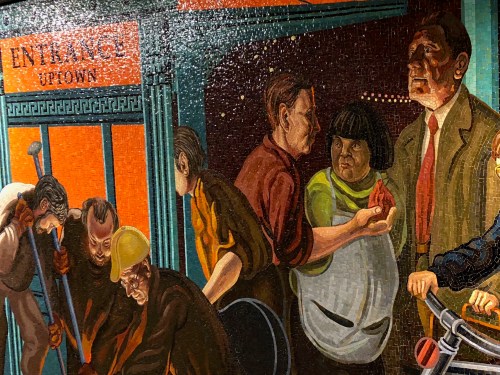
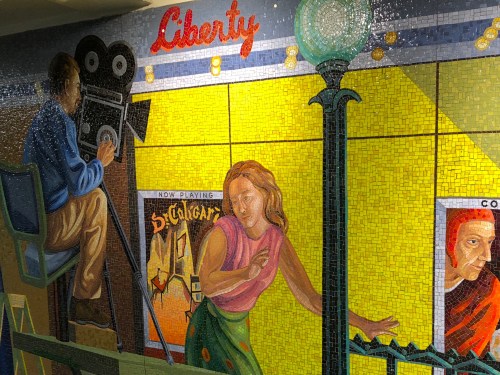
In the first photo below, a New York crowd is watching a cameraman who is making a movie of the woman in the second photo. Then there are several shots of a long city-life mural. I was especially struck by the man in the red tie, who seems to be riveted by a miracle that only he can see.

Next come New Year’s Eve revelers. The added sticker is a sign of how very eager New Yorkers are to vote right now, longing for a miracle.

Next come two unusual church signs. The first is in the graveyard of the Basilica of St. Patrick on Prince Street. I’m guessing they wanted the sheep for mowing the grass. The second is from a Greek Orthodox church on West End Avenue that has a service called the Falling Asleep of St. John the Theologian.

Finally, someone’s tortoise is running like a hare from paparazzi.

That’s New York for you.

102318-mosaic-watching-film-making-

102318-mosaic-NYC-film-making

102318-mosaic-NY-city-scene

102318-mosaic-NYC-scene

102318-mosaic-man-sees-miracle

102318-MTA-New-Yearmosaic-

102318-St-Pat-Basilica-graveyard

IMG-0674

IMG-0689


Read Full Post »

merlin_142511841_c0acf840-eaa7-49c5-a8ce-88b3071b3fa1-superjumbo

Photo: Nathaniel Brooks for the New York Times
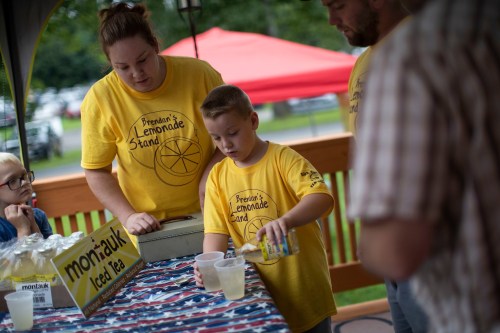
Jodi Mulvaney and Sean Mulvaney watch as their son Brendan Mulvaney, 7, served lemonade to a customer in Ballston Spa, N.Y. When the health department shut down the lemonade stand in July, an uproar ensued.

Pity the poor bureaucrat just trying to do a job! Nobody is glad to see you. But here’s a tip for for state health inspectors everywhere: Never mess with a kid’s lemonade stand.

As Tyler Pager reported at the New York Times in August, “When a 7-year-old boy’s lemonade stand was shut down by a health inspector [in Ballston, NY] last month, it became the talk of the town … and the roadside drink entrepreneur’s photo was splashed across newspapers around the country.

“But, at the end of the day, Brendan Mulvaney just wanted to sell lemonade. So, on [August 18th] Brendan and his family reopened the lemonade stand for one more day. Instead of raising money for a trip to Disney, as Brendan had planned to do the first time around, he and his family sought to capitalize on his newfound fame to raise money for a local family in need.

“Last month, Brendan set up his lemonade stand on the side porch of his house, just as he had done for the past two years during the Saratoga County Fair. This year, Brendan hung new signs, printed by a family friend, and with the help of his parents, added water and snow cones to the stand’s menu.

“But an inspector with the state Department of Health soon told the Mulvaneys that they needed a permit because their venture was similar to those of permitted vendors at the fair, said Jill Montag, a health department spokeswoman. … Brendan’s lemonade stand closed.

“But after Brendan’s dad, Sean Mulvaney, posted on Facebook about the interaction with the health inspector, the news spread quickly, leading [Gov. Andrew] Cuomo to issue a statement that he would personally pay the fee for any necessary permit. The Department of Health later clarified that Brendan would not need a permit if he wanted to sell only lemonade. …

“On Saturday, Brendan’s lemonade stand was back in business. Coinciding with the World’s Largest Yard Sale at the Saratoga County Fairgrounds, Brendan raised $946 for Maddy Moore, a 12-year-old battling Blount’s Disease, a growth disorder affecting bones in her lower leg. …

“By noon, as elected officials and media outlets descended on the Mulvaney’s porch, Mr. Mulvaney said he was worried the attention was distracting from the ultimate goal. … Mr. Mulvaney said, ‘My son’s loving it. But now we just got to get back to selling lemonade and try to raise as much money for Maddy.’ …

“State Senator James Tedisco introduced ‘Brendan’s Lemon-Aid Law,’ which would exempt people under the age of 16 who have lemonade stands from the health department’s permit requirements.

“ ‘When I was kid, probably half the people here had lemonade stands in front of their homes,’ he said. ‘Nobody ever complained.’ … The mayor of Ballston Spa also visited and presented Brendan with a key to the city.

“The buzz around Brendan’s stand achieved the goal the Mulvaneys had hoped for: customers. … As for next year, Brendan plans to resume operations for a fourth year. But, next time, he will return to a simple menu. Just lemonade.”

More at the New York Times, here.


Read Full Post »

skatekitchen_custom-7cb11468e3eaad2e6acb94579b8e6315ed0687dc-s700-c85

Photo: Magnolia Pictures 
In the film Skate Kitchen, the introverted Camille (played by Rachelle Vinberg, left) finds her tribe of skaters in New York City. The filmmaker found her subjects almost the same way — instinctively.

What I especially loved about this article on making a female-skateboarder movie was the director’s sixth sense. She hears girls on the subway talking in a wildly creative way and experiences vibes that direct her to pursue a new path of possibility.

Lakshmi Singh reports at National Public Radio, “Director Crystal Moselle made waves three years ago when her documentary The Wolfpack won the grand jury prize at the Sundance Film Festival. The film told the true story of six brothers growing up in confinement in Manhattan’s Lower East Side — and it all began from a chance encounter Moselle had with the brothers on the street.

“Her new film comes from a similar place. Skate Kitchen follows a group of teenage girl skateboarders and activists rolling their way through the streets of New York. This time, she met them on the subway.

From the NPR interview:

“I learned to understand my instinct. There’s this thing that happens to me. …  I’m like: Oh, this is something. This is interesting. I just — I have to explore it. …

“I was on the train in New York City. I was on the G train. And I heard this voice that just — you know, sometimes there’s a voice that’s so charismatic, you just have to figure out who’s talking and what’s happening. I mean, that’s how I am. And I look over, and there’s these three teenage girls, and they have skateboards. And Nina [Moran] — she’s telling a story. I can’t remember what the story was about. I think maybe it was about a party she went to or something that happened in the park that day. And she has that kind of voice that almost silences a room where you want to — just everybody stops what they’re doing and they want to see who’s talking.

“And so I — just out of curiosity and out of this instinct that I’ve kind of gained from my past project, I just — I feel like there’s this moment where I sort of know that there’s something there and I have to figure it out. And I went up to them and asked them — I just said, hey, you know, introduced myself. I said, my name’s Crystal. I’m a filmmaker, and I’d love to talk to you guys. Maybe you guys would be interested in doing some sort of video project at some point. [And] — I don’t remember saying this — I said, is there more of you? …
“They’ve found all these really interesting pockets [of the city], and they go to these skate parks, and they have these, like, spots that they skateboard and they just use the architecture of buildings. And you know, people chase them away. And it’s just, like, this kind of really riveting scene. And I would just start hanging out with them and experiencing it myself. They’d even, like, make me jump on the skateboard. They’re like, if you’re going to hang out with us, you have to skateboard. Here’s the board. Skate down the block. …

“The girls actually met through YouTube. They would be commenting on each other’s videos and, you know, that’s how they would create these communities because it’s difficult. Like, if you’re a girl living on Long Island and there’s no other girls around that skateboard, you can go to, you know, a social media platform to find other women that also do the same thing that you do that’s, like, something specific. …

“I think that it’s actually a really positive thing to be able to find people that are, I guess, your tribe. …

“When I was with Rachelle one day — Rachelle Vinberg, who plays Camille. She was skating with all these boys. And they all rolled by, and the little girl [watching the film crew] didn’t notice them at all. And then Rachelle rode by with her hair just like in the wind. It was just an epic moment — she’s, like, carving down this hill. And this little girl, like, stopped in her tracks and just watched her and, like, saw the future.”

More here. I love how this director is drawn by curiosity to pursue things that are unfamiliar and interesting. Having something interesting to think about is apparently as essential to her as food.

Read Full Post »

screen-shot-2012-07-15-at-10-09-57-am

Photo: MTA Arts for Transit
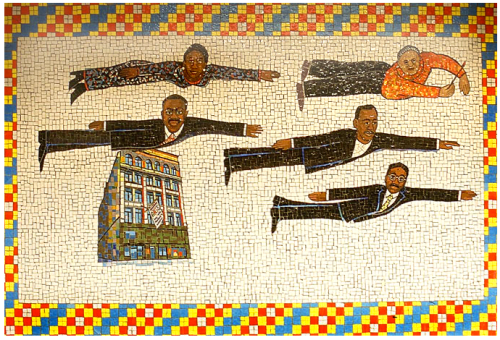
Faith Ringgold’s mosaic “Flying Home: Harlem Heroes and Heroines (Downtown and Uptown),” 1996, is one of the pieces of subway art featured in a PBS documentary.

I’m always amazed by the beauty of the mosaics in the New York subway, even the ones that merely tell you what street you’re at. It makes me happy to see that the city values them, too, and periodically cleans up the oldest ones. They go back as early as 1901.

My sister alerted me to an excellent PBS documentary about recent additions to the art in the subway system. You can read about it at the website Mosaic Art Now.

“For a delightful immersion into the history and current activities of the enormous underground museum that is the New York subway system’s Arts For Transit program, treat yourself to WNET Channel Thirteen’s free one hour video called ‘Treasures of New York: Art Underground.’ …

“Mosaic artist Steven Miotto gets major face time. His decades-long collaboration with artists of all stripes is a fascinating story in itself. When selected by a commissioned artist as a collaborating partner, he gets into their minds and hearts, leading them through the complex process of translating their vision and their graphic designs into mosaic ‘paintings for eternity.’ …

Faith Ringgold, speaks eloquently and nostalgically about the series of paintings – now mosaics – that portray the heroes of her Harlem childhood. Writers and musicians fly across the cityscape in flattened but vivid characterizations. I had the opportunity to interview her when she was in Miami last year, and she spoke about the challenges of trying to ‘make it’ as an African-American artist dealing with political themes at a time when the galleries favored the abstract.  Click here (http://bitly.com/yxGJ3R) to listen to that interview with her.”

See some of the beautiful new mosaics and watch the video here.

If you are up for more on transit-system art, be sure to check out an excellent article by Sarah Hotchkiss at KQED about what’s going on with San Francisco’s Transbay system, here.


Read Full Post »

vyc-camryn-jordan-wn-1684w

Photo: Celeste Sloman for The New York Times
Camryn Cowan and Jordan Millar, 11-year-old students in the Philharmonic’s Very Young Composers (VYC) program, received a burst of media attention after being featured along with their compositions in the New York Philharmonic Concerts in the Parks.

The young composers in this story got a boost for their musical talent thanks to a New York Philharmonic program. Just imagine what could be accomplished with similar programs in all areas of the arts — playwriting, painting, poetry, sculpture, etc.! Giving kids an opportunity to blossom benefits us all.

Joshua Barone described the experience of two gifted girls in a New York Times article: “It was the kind of debut most musicians only dream of: a world-class orchestra, tens of thousands of listeners.

“At its outdoor parks concerts [in June], the New York Philharmonic performed works by two 11-year-old girls, Camryn Cowan and Jordan Millar — newcomers to the world of composing. They won over the crowds, who gave standing ovations. Anthony Tommasini of The New York Times gave them an effusive review. …

“Where does a composer go from here? Ms. Cowan and Ms. Millar — two students from Brooklyn who are part of the Philharmonic’s Very Young Composers initiative — followed up on their victorious tour of New York City by, well, returning to class. …

“Both girls … were confident in explaining their works, originally written for a Harlem Renaissance-theme program earlier this year. Ms. Cowan, who was 10 at the time, said that her ‘Harlem Shake’ was an exercise in layering, but with saxophone improvisations that nodded to the neighborhood’s past.

“Ms. Millar’s ‘Boogie Down Uptown’ conjures stepping out of the subway onto the streets of Harlem for the first time, with musical textures inspired by the shadowy movement of Aaron Douglas paintings. (For all this seriousness, they are still children: Ms. Millar said her fascination with Douglas’s art comes from her favorite Disney movie, ‘The Princess and the Frog,’ which borrows its aesthetic from his paintings.) …

“Jon Deak — a composer, the Philharmonic’s longtime associate principal bassist, and the founder of its Very Young Composers initiative — said that … all children are creative. ‘People ask whether I’ve found the next little Mozart, and I say yes, I’ve found dozens of them,’ he said. ‘They’re all over the place. We just need to listen to them.’

“Participants in the program come from about 15 partner schools in New York. … Eventually, they graduate to writing complex scores that they workshop with one another and try out at Young People’s Concerts.

“In the process, Mr. Deak said, the students have to become leaders: ‘Look at a 10-year-old who comes up to a bassoonist’s kneecaps and says “That’s too fast” or “There’s something wrong with that note.” They have to defend their pieces, and boy, do they … do it.’ ”

More at the New York Times, here.

Read Full Post »

071218-fancy-NYC-bike

Thank you for all the lovely things you have written. My sister has a long road ahead, but she is a strong person and is facing it well. Ms. Mighty Mouse.

I actually saw a Ms. Mighty Mouse sculpture on my walk and took a picture. Unlike her, my sister has both her arms and all her faculties.

I liked the Alice Walker poetry mural I saw, too, and will repeat the poem here as my sister loves poetry. In fact, the day before her surgery, the four of us who were gathered in her room had the best time quoting poetry at each other. It was a lot of fun.

The Nature of This Flower Is to Bloom

Rebellious. Living.
Against the Elemental Crush.
A Song of Color
Blooming
For Deserving Eyes.
Blooming Gloriously
For its Self.

071218-Alice-Walker-1

071218-Alice-Walker-2

071218-Ms-Mighty-Mouse-text

071218-Ms-Mighty-Mouse

Read Full Post »

The Sunnyside Social Club performs at the celebration for the completion of the Second Avenue Subway in Manhattan

Photo: Elizabeth Shafiroff/Reuters
The Sunnyside Social Club had to pass a rigorous audition process to get into the subway busker program in New York.

One of the few things I miss about commuting to a job is the daily possibility of great music in the subway. I would never know what I was going to get. Some performers were bad. Some were so fantastic I felt like letting a couple trains go by so I could listen.

The MBTA doesn’t require much more than signing up and paying a fee to be a busker, but in New York City, it’s a different story. You have to pass a tough audition.

Claire Bryan writes at CityLab, “Each year, hundreds of musicians vie to see their name not in lights, but in pink, on a banner indicating they’ve earned official status to perform in New York City’s subway stations. …

“By a March deadline this year, MTA MUSIC received 309 applications with audio samples and selected 82 finalists to audition. On May 15, the 31st annual auditions opened in Grand Central Station’s Vanderbilt Hall, a passageway from the station to 42nd Street. On that morning, the hall, with its 48-foot ceilings and five chandeliers, was filled with a myriad of musical scales: Behind a black felt curtain, cellos, French horns, a Kurdish hammered dulcimer guitar, and vocalists, were warming up. One of the finalists, the all-female a cappella group Mezzo, took to the stage.

“The women of Mezzo launched into ‘Dreams’ by The Cranberries. They had just five minutes to prove to the judges that they deserved the right to serenade people in the subways.

“Since 1985, the MTA Arts and Design program, of which MTA MUSIC is a part, vets musicians to find the best subway-appropriate performance groups to enhance New Yorkers’ commutes. MTA MUSIC Senior Manager Lydia Bradshaw says the judges look for quality, musical variety, cultural diversity, representation of the culture and people of New York, and appropriateness for the transit environment. …

” ‘The thing about it in the subway is you have no stage, you have no backline, you have no stagehands, you must just create the space right here,’ said Sean Grisson, a Cajun cellist who has been in the program since 1987 and a judge since 2013. For Grisson, whether or not performers are chosen comes down to if the performance is something that ‘you would want to pause and make you reflect as you go about your busy New York existence.’

“Once admitted to the program, musicians must call in and book slots. … Performers receive a personalized banner with their name and the MTA MUSIC bright magenta logo. Musician’s names and contact information also gets added to MTA MUSIC’s website — a feature that can help groups land events.

“But anyone can play in the subway as long as they follow MTA’s Transit Rules of Conduct. … MTA employees and music performance groups believe that registered groups deserve their spot. ‘One of the benefits of being in the program is sort of having that permission to book and be at more visible spots,’ Grisson said.

“Which doesn’t mean that non-sanctioned performers can’t play — they just aren’t afforded the security and institutional support MTA MUSIC performers receive. …

“MTA Press Officer Amanda Kwan said that if an MTA MUSIC group calls in, signs up, shows up, and there’s a non-MTA MUSIC group there, the issue is often resolved between the musicians. …

“Grissom, the judge who has also been performing in the subways since 1983, said the competition to enter the program is challenging and he has come to appreciate the MTA MUSIC program much more.

“But he adds: ‘I’ve never had issues [with the authorities] believe it or not. I always feel that street performing or subway performing is kind of Darwinism at its best.’ Grissom said.”

More.

Read Full Post »

Photo: Carter Burden Gallery
The Carter Burden Gallery in Chelsea shows works by artists who are at least 60 years old.

I’m always happy to see that older people are still appreciated in some quarters — in this case, at a New York gallery that features only artists over 60. Susan Stamberg has the story at National Public Radio (NPR).

“Some artists in New York may be wishing to get older faster. A gallery there caters to artists age 60 and older. No kids allowed.

“Some 200 artists have exhibited at the Carter Burden Gallery since it opened nine years ago in Chelsea. Business is good, and works sell from $200 to $9,000. It’s a lot like hundreds of other galleries in New York — except for one important thing: The Carter Burden has an age limit. Why?

” ‘Older adults do not stop being who they are because they hit a particular age,’ said gallery director Marlena Vaccaro. ‘Professional artists never stop doing what we do, and in many cases we get better at it as we go along.’

“What does change is the art market. With rare exceptions, artists who were hot when they started out found that galleries, and certainly museums, cooled to them as years passed. They kept making art, but weren’t being shown or bought. Carter Burden’s mission is to give them a wall, ‘because walls are the thing we need,’ Vaccaro said.

“According to Vaccaro, very few galleries represent older professional artists, unless they’re really famous. ‘And I get that,’ she said. “Galleries are a business. They need to show artists that are going to bring in big bucks.’

“Carter Burden is different. It’s a nonprofit, supported by a board, a corporate sponsor and philanthropists. …

“Artist Nieves Saah, 67, originally from Bilbao, Spain, has painted all her life. ‘My first show was in SoHo in ’85,’ she said. ‘And I had like 28 paintings there. I sold a few, and then from that I got many shows. I think that year I was in like 15 shows.’

“Then things slowed down. There wasn’t much interest for 10 years. Saah kept on painting her figures and fantasies in vividly colored, cheerful oils. One day she heard about Carter Burden and decided to apply online. ‘I was in a show one month after I sent the application,’ she recalled. …

“Werner Bargsten, a newbie, had his first show this past October. It consisted of stunning, powerful sculptured wall hangings made with clay and copper tubing, and formed into what look like wrapped packages. …

“At 69, Bargsten is glad to be part of the Carter Burden over-60 crowd. ‘I mean, look, it’s always harder to get out of bed the older you get, but most of the artists that I’ve met here seemed like they missed that memo that they were getting old. Most of them have the brains of a 20-year-old or a 30-year-old or something. So they haven’t really aged in terms of their spirit.’ ”

More at NPR, here.

Photo: Carter Burden Gallery
“Under the Stars,” by Nieves Saah, an 0ver-60 artist who shows her work at the Carter Burden Gallery in New York.

Read Full Post »

Photos: Rachel Watson
Barbara Balliet and Cheryl Clarke, owners of Blenheim Hill Books, one of five bookstores in an upstate New York village of 500 souls.

This village sounds like heaven to a book lover. I think the people who live there must be very happy. I’m pretty sure they are well-read.

Daniel A. Gross writes at Atlas Obscura, “The village of Hobart, New York, is home to two restaurants, one coffee shop, zero liquor stores, and, strangely enough, five independent bookstores. … Fewer than 500 people live in Hobart. Yet from Main Street, in the center of town, you’re closer to a copy of the Odyssey in classical Greek, or a vintage collection of Jell-O recipes, than a gas station.

“This literature-laden state of affairs emerged just after the turn of the millennium, when two residents of Manhattan, Diana and Bill Adams, stopped in Hobart during a trip through the Catskills. ‘We were both intrigued,’ says Bill, who worked as a physician for 40 years. … He and his wife, Diana, a former lawyer, were looking for retirement activities that they could pursue into their old age.

“During that first trip, in 2001, the couple spotted a corner store for rent at the end of Main Street. After speaking with the owner, they decided to rent it on the spot, and soon they were lugging their hefty personal book collection to Hobart, one rental car-load at a time. They didn’t expect to establish a book village in the process. ‘There was no plan,’ Bill says. They weren’t even sure whether their bookstore would survive in the foothills of the Catskills, three miles from the main highway.

“But they did own a lot of books. … That was how it became possible to buy a leather-bound collection of classical verse, or a set of classic political essays, in a tiny village more than two hours from New York City. Wm. H. Adams Antiquarian Books had a relatively quiet first year. But then Don Dales, a local entrepreneur and piano teacher, decided that one good bookstore deserves another, and opened his own shop. …

“Readers, like shoppers at the mall, often wandered back and forth between the shops. As more bookstores came to town, one of Hobart’s original booksellers (no one can quite remember who) began to describe the town as ‘the only book village east of the Mississippi.’ (Other American book towns include Stillwater, Minnesota, and Archer City, Texas.) …

“Barbara Balliet and Cheryl Clarke, a couple who spent their careers at Rutgers University, moved to Hobart at around that time. Clarke was surprised to find such a tiny community, far from cities or colleges, so overrun with books. …

” ‘She says, “You find all kinds of people who like books, and they’re not just college-educated.’ When the two women arrived, they met a bookseller who was ready to sell her stock, so Balliet bought it and they hopped into business themselves.

“Both women saw right away that, compared to other Catskills towns that have lost jobs and emptied out, Hobart seemed to be coming back to life. … The bookstores were a part of that. …

“Balliet says that, although she can’t make a living off the store, she can make a tidy profit — enough to grow a garden, travel, and buy more books. …

“According to the International Organisation of Book Towns, [the first] was Hay-on-Wye, Wales, founded in 1961 by Richard Booth. … Others include Wigtown, Scotland; Featherston, New Zealand; Kampung Buku, Malaysia; and Paju Book City, South Korea.

“As Hobart evolved, individual book shops have found their own specialty, like siblings who each choose their own path. ‘We try to complement each other,’ Balliet says. ‘Each one maintained its own identity and individuality,’ adds Bill Adams. Creative Corner Books, a cozy one-room shop that specializes in craft, cooking, and DIY books, is Hobart’s only shop with a knitting corner.”

More here.

Hat tip: @michikokakutani on twitter

Photo: Blenheim Hill Books in Hobart.

Read Full Post »

« Newer Posts - Older Posts »