Feeds:
Posts
Comments

Posts Tagged ‘painting’

Photo: Robles Casas & Campos.
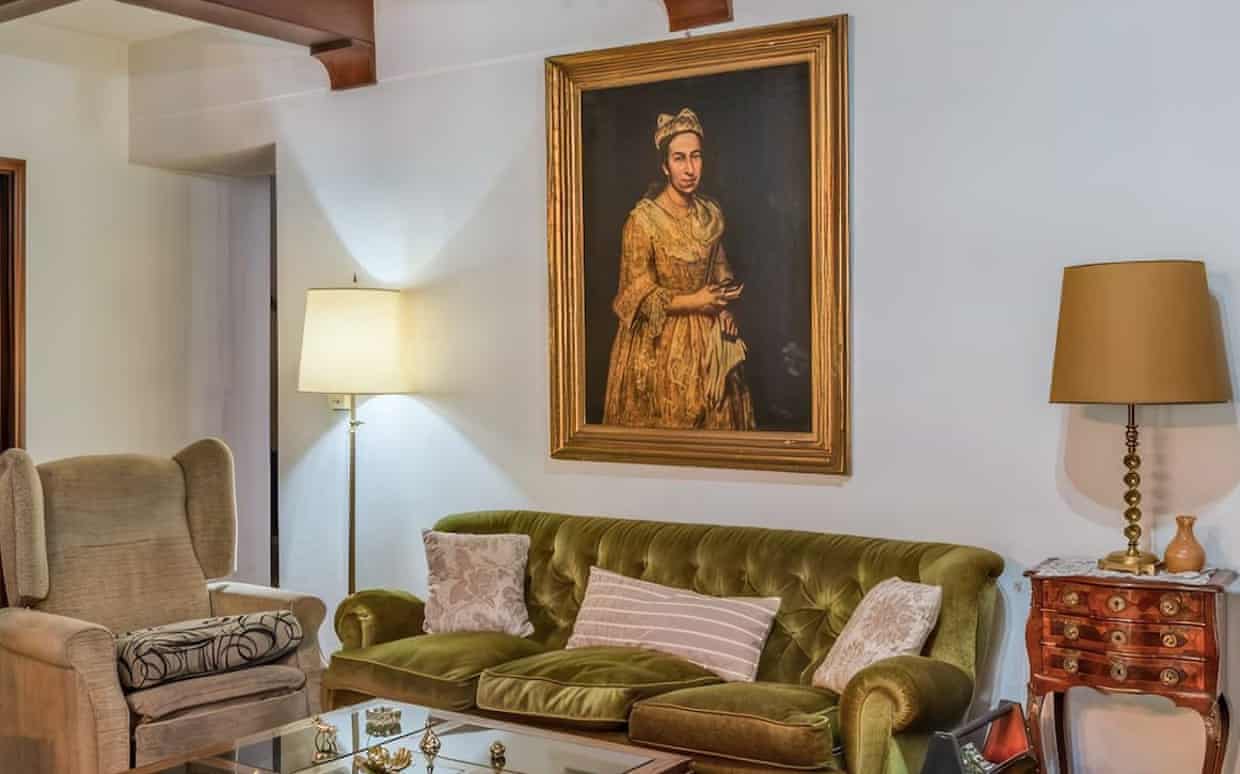
The painting by Italian artist Giuseppe Ghislandi in a living room in Mar del Plata. The 18th-century painting ‘Portrait of a Lady’ (Contessa Colleoni) was stolen by an SS officer and rediscovered this year in Argentina.

Guilty secrets don’t stay hidden forever. It may take a long time, as in today’s story about Nazi loot, but more often than not, truth eventually surfaces.

Facundo Iglesia  and Jon Henley write at the Guardian, “There was nothing very remarkable about the middle-aged couple who lived in the low, stone-clad villa on calle Padre Cardiel, a quiet residential street in the leafy Parque Luro district of Argentina’s best-known seaside town, Mar del Plata.

“Patricia Kadgien, 59, was born in Buenos Aires, five hours to the north. Her social media described her as a yoga teacher and practitioner of biodecoding, an obscure alternative therapy that claims to cure illness by resolving past traumas.

“Her husband, Juan Carlos Cortegoso, 61, built and raced go-karts. Like many in this neighborhood, the couple were comfortably off, and discreet. …

“Then, last month, they put their house up for sale. A photographer from a local estate agent, Robles Casas y Campos, came round to shoot the spacious, elegantly furnished interiors. The pictures went up. And their quiet existence came crashing down.

“The fifth photograph on the agency’s listing showed a general view of the villa’s living room. Hanging on the wall, above a buttoned sofa in plush green velvet and next to a polished antique commode, was a highly distinctive oil painting of a woman.

“More than [6,000 miles] away, the Dutch news outlet AD had, for several years, been quietly investigating the fate of old master paintings looted by the Nazis and still listed by the Dutch culture ministry as ‘unreturned‘ after the second world war.

“Journalists had made several attempts to speak to Patricia Kadgien, the owner of the property, and to her elder sister, Alicia, the daughters of a high-ranking Nazi official Friedrich Kadgien, who was known to have settled in Argentina after the war.

“Their calls and messages had consistently gone unanswered, or been rebuffed. But then a Dutch reporter based in Buenos Aires, Peter Schouten, went knocking on the door of the villa – and spotted a ‘for sale’ sign.

“What followed, after Schouten and his colleagues in Rotterdam clicked on the link to the property and instantly recognized the work, made headlines around the world as the story unfolded of the unlikely recovery of an 18th-century portrait missing for 80 years. …

“After the media reports of the work’s likely location, and before a police search, the couple had tried to obstruct the investigation, the prosecutor argued, by taking down the online property listing and for sale sign and replacing the portrait with a tapestry.

“Despite knowing they were under investigation, it was alleged that the defendants had also attempted a civil action claiming the painting was rightfully theirs, turning it over only after they were placed under house arrest and facing further police raids.

“Through their lawyer, Kadgien and Cortegoso have denied concealment, saying they had always been willing to hand over the painting, and obstruction, arguing that their civil action was aimed at establishing ownership and not at hiding the artwork. …

” ‘Portrait of a Lady’ belonged to Jacques Goudstikker, a Jewish-Dutch art dealer who fled Amsterdam in mid-May 1940 to escape the Nazis, but died after falling through an open hatch into the hold of the SS Bodegraven, the ship carrying him to the UK.

“Goudstikker carried with him a notebook detailing his collection of more than 1,100 artworks, including pieces by Rubens, Giotto, Titian, Rembrandt and Van Gogh, all of which were snapped up for a fraction of their value by Nazi officials.

“Some were later recovered and displayed as part of the Dutch national collection in the Rijksmuseum, before 202 works were restored to the dealer’s sole heir, his daughter-in-law, Marei von Saher, in 2006. ‘Portrait of a Lady’ was not among them. …

“Born in 1907, Kadgien joined the Nazi party in 1932 and the SS in 1935. By 1938, he was a special representative working for Göring on the four-year economic plan drawn up by Adolf Hitler to rearm Germany and prepare it for self-sufficiency by 1940. …

“Kadgien ‘confiscated a large amount of property from Jewish merchants, including jewelry and diamonds in Amsterdam, and oversaw the sale of expropriated shares and securities through banks and front companies in Switzerland’ [federal prosecutor Carlos Martínez] said.

“He fled to Zurich early in 1945, then to nearby Baden, where in 1948 he set up a successful finance and trading firm, Imhauka. With pressure growing after questioning by Swiss and US investigators, Kadgien left for South America in 1949. …

“Kadgien resurfaced in Rio de Janeiro in 1951, settling in the Santa Teresa district and establishing a Brazilian branch of Imhauka. … Imhauka secured valuable contracts with Juan Perón’s government, including acting as an intermediary for major German engineering firms such as Siemens. …

“The fate of ‘Portrait of a Lady,’ which will be registered with Argentina’s supreme court, is now uncertain. Prosecutors have requested it be held, but not displayed, at the Holocaust Museum in Buenos Aires while its ultimate ownership is determined. This week von Saher, Goudstikker’s heir, lodged a legal claim to the work with the FBI in New York.”

More at the Guardian, here. No firewall.

Read Full Post »

Art: Leonora Carrington/Arts Rights Society, New York.
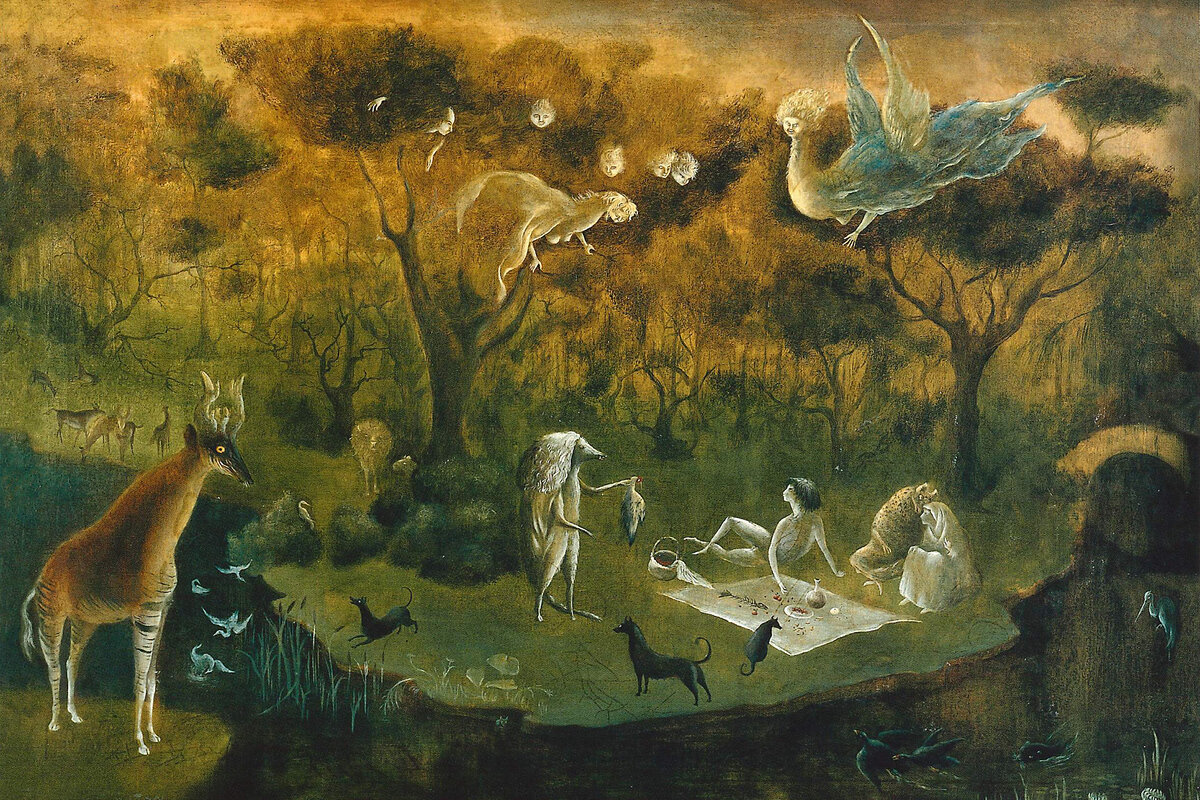
“Pastoral” (1950) is among the works included in “Leonora Carrington: Dream Weaver” at Brandeis University’s Rose Art Museum in Waltham, Massachusetts.

All praise to the Rose Art Museum at Brandeis University for thinking differently. Compared with other museums in New England, it has always been a little bit “out there.” In today’s story that involves taking a new look at the surrealists, especially a previously underappreciated one.

Mackenzie Farkus writes at the Christian Science Monitor, “Shape-shifting creatures. Dreamscapes of greenery. Prancing hyenas and noble white horses. These are just a few of the hallmarks of surrealist Leonora Carrington.

“The artist – who was born in 1917 in England and died in 2011 – was once on the periphery of the surrealist movement. But in the decade following her death, Ms. Carrington’s work has experienced a revival.

“While her adopted homeland of Mexico has long embraced her art, the celebration of Ms. Carrington’s legacy has reached a crescendo in other parts of the world in recent years. Her reemergence follows a trend of increased attention to fellow women creators. …

“In the case of Ms. Carrington, her ‘Les Distractions de Dagobert’ (1945) sold for $28.5 million at Sotheby’s in 2024, cementing her status as the highest-selling female artist in British history. … Her first solo exhibition in New England – at Brandeis University’s Rose Art Museum – is on display until June 1, and then moves to the Katonah Museum of Art in New York. …

” ‘What Leonora offers – and what surrealism offers – are alternative ways of understanding the world: not through the capitalist economic system of transactional politics, but tapping into empowerment through the imagination, invisible truths, things that have to do with our subconscious,’ says Gannit Ankori, director and chief curator of the Rose Art Museum in Waltham, Massachusetts.

“Dr. Ankori curated the museum’s exhibit ‘Leonora Carrington: Dream Weaver.’ A number of the pieces on display – including works in tempera, gouache, acrylic, oil, pencil, pen, and fiber – have rarely been seen outside private collections. …

“In the 1950 painting ‘Pastoral,’ water fowl, a hyena, and other animals congregate around an androgynous couple as ethereal animal-human hybrids float above. Ms. Carrington often emphasized the coexistence of humans and animals in her work.

“Of particular resonance to Dr. Ankori was Ms. Carrington’s love for Mexico … ‘a welcoming country that embraced and offered safe haven to refugees from war-torn Europe in the 1940s,’ says Dr. Ankori. … ‘And these immigrants, many of them intellectuals and artists, resettled in this new, embracing homeland and felt welcome. They built community and developed cultural excellence in the arts and philosophy and literature and more.’

“Alongside her many paintings, textile works, and sculptures, Ms. Carrington was also a prolific writer. Her 1944 memoir, Down Below, details her experiences of institutionalization in Spain. Her fictional work includes a wide range of surrealist short stories, plays, and novels. …

“Born into an upper-class Catholic family in England, Ms. Carrington often rebelled against the societal restrictions imposed on her. She was twice expelled from convent schools, and favored reading Irish fairy tales, Lewis Carroll, and Beatrix Potter over learning how to become the perfect debutante.

“A viewing of Max Ernst’s 1924 painting ‘Two Children Are Threatened by a Nightingale’ and a copy of Herbert Read’s 1936 book Surrealism influenced her artistic development, as did her tutelage under the French modernist Amédée Ozenfant.

“Women in the surrealist movement were often relegated to the role of the femme enfant – often young, beautiful women who were expected to be subservient to male artists.

“Ms. Carrington, however, had other plans. ‘I didn’t have time to be anyone’s muse,’ she once said. ‘I was too busy rebelling against my family and learning to be an artist.’ …

“Ms. Carrington eventually found her way to Mexico and married Hungarian photographer Emérico ‘Chiki’ Weisz.

“There, she encountered a community of European artists who had fled the horrors of World War II, often exhibiting her art in local galleries. She became close friends with fellow émigré and artist Ms. Varo. Together, they studied kabbalah, alchemy, Tibetan Buddhism, and Mayan mystical writings – the ideas of which feature prominently in Ms. Carrington’s art. She went on to become one of the founding members of Mexico’s 1970s feminist movement. …

“Ms. Carrington’s first solo museum show in Italy will open at Milan’s Palazzo Reale in September, on view until January 2026. An exhibition at the Musée du Luxembourg in Paris will be on view from Feb. 18 to July 19, 2026.”

More at the Monitor, here. No paywall.

Read Full Post »

Photo: Christie’s Images Ltd. 2025.
Eva Hesse, “Landscape Forms” (1959).

If you found a painting you loved in some cheap second-hand shop, what would you do with it? Even if it turned out to be valuable? I think if I bought it because I loved it, I’d want it on my walls. Everything in the world is not valued only in terms of gold.

In April, Laurie Gwen Shapiro reported at Hyperallergic about a brother-sister team who are in it for the gold.

“One afternoon last fall, 55-year-old Kara Spellman was working from her Upper East Side apartment when her phone pinged. Her big brother Glenn, 58, a longtime licensed appraiser and self-described ‘picker,’ who lives in the same building, had texted a photo and a short message: ‘Take a look at this.’

“The image was of a small abstract painting — 30 by 24 inches — titled ‘Landscape Forms’ and newly listed on ShopGoodwill.com, the online auction wing of the national thrift store chain. The brushwork was gestural, the color palette felt just right, and in the lower-right corner, a signature: E.H.

“Glenn had a hunch. Kara, director of Estates and Acquisitions at Hollis Taggart Gallery in Chelsea, had a stronger one.

“ ‘We both have a good eye,’ she told Hyperallergic, laughing. ‘The brushwork looked too specific to be a copy.’

“But instinct wasn’t enough. The siblings, who’ve teamed up before on treasure hunts, needed the catalogue raisonné — the official compendium of an artist’s authenticated work.

“Kara emailed the Watson Library at the Metropolitan Museum of Art and begged them to pull the volume by the end of the day. Miraculously, someone she knew replied right away: They’d do it. She jumped in a cab.

“ ‘There it was,’ she said. ‘Landscape Forms’ (1959). Signed. Documented. And officially marked: ‘Whereabouts Unknown.’

“The only visual in the book was an off-color image made from an unmarked slide in the artist’s papers at Oberlin College’s Allen Memorial Art Museum. In fact, as noted in the catalogue raisonné, it’s ‘one of 15 paintings known only by unmarked slides’ included in that archive. But it matched exactly. And it was lost for decades until it popped up at a Goodwill warehouse in Frederick, Maryland.
“The Jewish artist Eva Hesse, born in Hamburg in 1936, escaped the Nazis as a child via the Kindertransport to London with her sister. Their desperate parents followed soon after, and the family eventually resettled in New York. Hesse would go on to become one of the most influential figures of the postwar American avant-garde. Best known for her radical, impermanent sculptural work in materials such as latex, fiberglass, and cheesecloth, she died in 1970, at just 34. Fragile and emotionally charged, her most important pieces helped define Post-Minimalism and, though rarely offered at auction, have sold for millions. Most are held in the collections of major museums.

“But before all that, Hesse painted. ‘Landscape Forms,’ made while she was an MFA student at Yale under Josef Albers — who affectionately called her ‘my little colorist’— is part of that rare early body of work. …

“And then one day, it was gone. Was it lost? Stolen? A gift quietly passed along, then forgotten?

“ ‘I’m not an artist,’ Glenn said in a phone call late at night after a grueling 10-hour day looking at estates. ‘I’m a treasure hunter. A detective.’ …

“ ‘Once or twice a year, something outstanding shows up there,’ he said of ShopGoodwill. ‘You just have to know what you’re looking at.’ …

“For bigger finds, Glenn often partners with Hollis Taggart, his former boss and longtime friend. They agreed it was worth pursuing together. After winning the lot for $40,000 — not exactly a steal, but Hesse’s auction record is above $4 million — Glenn drove to Frederick, Maryland, himself. …

“Back in New York, Glenn brought the painting to Hollis Taggart Gallery. There, it underwent conservation: surface cleaning, minor restoration, and re-stretching.

“It was shown at two major art fairs, including the Armory Show last September. There was interest — almost a sale — but no one bit. …

“Now, after regrouping, ‘Landscape Forms’ is headed to Christie’s Post-War and Contemporary Art Day Sale in May, with an estimate of $60,000–$80,000. [Update: It sold for $107,100.]

“The Spellman siblings, Gen Xers who’ve been in New York for decades, grew up in Ballston Spa, near Saratoga Springs, and got their start as bottle diggers.

“ ‘There was an old slaughterhouse near the creek bed,’ Glenn recalled. ‘We’d find colored, hand-blown bottles and sell them downtown, because there was also a one-cent candy store in town. If we sold an old bottle for a quarter, we’d get 25 pieces of candy. A home run would be a dollar bottle, which equaled 100 pieces of candy!’ …

“Both are longtime fans of American Pickers (2010–), the History Channel’s reality TV series whose hosts travel across the country in search of valuable artifacts. ‘I still watch it religiously,’ Glenn added. ‘You pick up more than you’d think.’

“When asked how it felt to hold the Hesse in his hands for the first time, Glenn got quiet.

“ ‘It was very exciting,’ he said. ‘You get the thrill when you win it, but when you finally handle it, when you know it’s real, that’s the magic.’ ”

More at Hyperallergic, here. No paywall, but your donation helps keep great art coverage going.

Read Full Post »

Photo: Wikipedia.
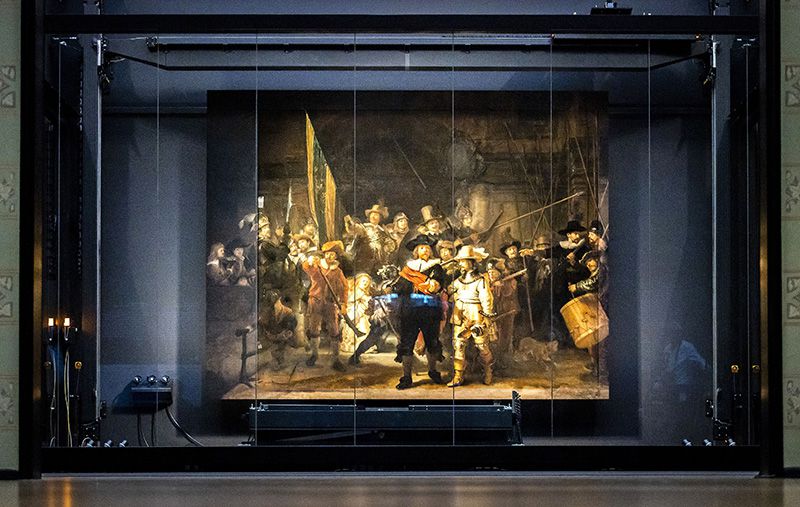
Rembrandt’s “The Night Watch” (1642) at the Rijksmuseum in Amsterdam.

A couple years ago I wrote (here) about how AI was being used to help in the restoration of Rembrandt’s “The Night Watch.” Now at the Rijksmuseum in Amsterdam, conservators are taking another unusual step: allowing museum goers to watch the restoration process.

Kelsey Ables writes at the Washington Post, “Visitors eager to catch a glimpse of Rembrandt’s ‘The Night Watch’ at the Rijksmuseum in Amsterdam may be surprised to find the large oil painting looking more like a work in progress than a masterpiece that was completed in 1642. On Tuesday, conservators — equipped with masks, gloves, brushes and scaffolding — began a long-anticipated restoration of the work, a process that would usually take place behind the scenes but that the Rijksmuseum is putting on full display to the public.

“Images and videos from the museum show conservators inside a glass chamber, crouching over Rembrandt’s emphatic figures and gently removing decades-old varnish with brushes and solvent, as curious visitors crowd around outside.

“Taco Dibbits, director of the Rijksmuseum, said in a statement that the beginning of the restoration, which follows years of research and a re-stretching of the canvas, ‘is filled with anticipation.’ …

“A sprawling 12½-by-15-foot canvas that depicts a group of civic guardsmen cast in a dramatic lighting style known as chiaroscuro, ‘The Night Watch’ is considered one of the crowning artistic achievements of the Dutch Golden Age. The Rijksmuseum’s undertaking marks another chapter in the long life of the famous work, which has survived two knife attacks and was hidden in a cave during World War II.

“The process will involve removing varnish that was applied during its 1975-1976 restoration and will significantly change the look of the painting, making white paint whiter and dark areas more visible. The current varnish is ‘discolored, has yellowed, and it saturates poorly,’ Ige Verslype, paintings conservator at the Rijksmuseum, said in a video. …

“To remove the old varnish, conservators are using a special technique that reduces the need for ‘mechanical action’ and involves applying a measured amount of solvent to the canvas with a tissue and brush. As they remove the varnish, the famously dark painting will become more matte and gray, the Rijksmuseum explained, until a fresh layer is applied, imbuing the figures with new life.

“Paula Dredge, a lecturer in cultural materials conservation at the University of Melbourne in Australia … said that such work, which involves peeling back previous restorations, is a ‘process of discovery,’ even for the conservator. ‘The value we give originality and artists’ intent is a modern concept. In the past, restorations were more invasive and often covered over passages of the artist’s paint,’ she wrote, adding, ‘We may find more of Rembrandt.’

“In the 18th century, the painting’s old varnish and accumulated dirt actually became a part of its identity when it was nicknamed ‘The Night Watch,’ in response to its dark colors. The painting is in fact set during the day.

“It is a type of painting unique to the northern Netherlands, where civic watchmen companies commissioned group portraits that were intended to create a sense of local pride. While such paintings were usually stiff and straightforward, Rembrandt broke with tradition in ‘The Night Watch’ by imagining a dynamic composition that shows the guardsmen poised for attack. In his scene, the guardsmen, cloaked in darkness, appear to be responding to a threat. They hold up flags, raise weapons, play the drums, as their captain, bathed in light, guides them forward.

“Rembrandt also added unique flourishes, such as a personification of the watchmen’s company in the form of a small girl with a chicken — and even his own self-portrait (peeking over a soldier’s shoulder in the top row, just left of center).

“But the drama is a fiction. By the time Rembrandt finished this, the Dutch war of independence against the Spanish was nearly over, Amsterdam was mostly safe, and these watchmen companies were largely drinking societies.”

More at the Post (via MSN), here.

Read Full Post »

Photo: Matthew Schuerman/NPR.
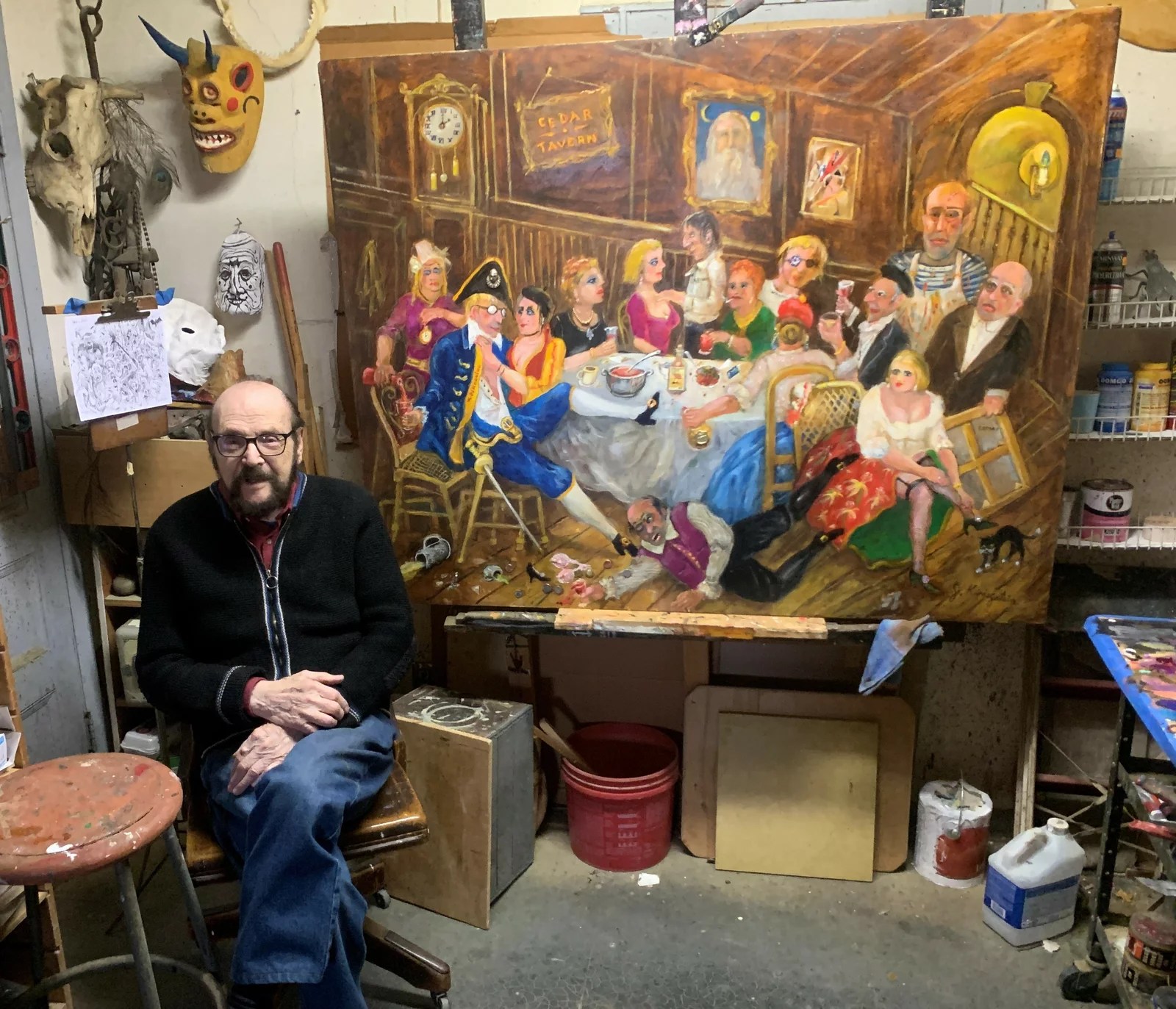
“Jonah Kinigstein, 99, has been making art since he was a teenager,” says NPR. “Some of his work satirizes modern artists such as Andy Warhol and Jackson Pollock, visible in the painting behind him.”

Although I am personally a big fan of abstract art, I find it interesting to consider that that former rebellion against convention spurred its own rebellion. When abstract art was the accepted best, what happened to artists whose inspiration lay elsewhere?

Matthew Schuerman reported at National Public Radio (NPR) about one artist working in the heyday of abstract expressionism who swam against the tide.

“In the 1950s, Jonah Kinigstein was on the verge of making it big in New York’s art world. He won a Fulbright to Rome. His paintings got into the Whitney Museum’s annual show of contemporary art (the precursor to the Whitney Biennial). And he was taken in by one of the biggest gallerists in the city, Edith Halpert. …

“Once, when Life magazine ran a profile of Halpert and nine of the artists she was promoting titled, ‘New Crop of Painting Protégés,‘ Kinigstein was among them. In fact, in the main photo, he stood directly behind Halpert. But then, as a result of changing tastes in the art world, he fell into obscurity and could not convince anyone to give him a gallery show.

“He nonetheless kept painting … and painting … and painting some more. Even today, at age 99, he said he spends two to three hours a day. …

“His painting style has gone through a lot of changes throughout his life, but he calls himself a ‘figurative expressionist.’ That is, he paints people, but they are often distorted and grotesque, set against backgrounds that are surreal and fantastical. His subjects are saints, rabbis, impresarios and showgirls — people who [seem] to be suffering or seem to be enjoying other people’s suffering. …

” ‘I was born in Coney Island, and I remember certain things,’ he said. ‘These large figures and people waiting in line.’ …

“Born in 1923 in Brooklyn, Kinigstein was raised in the Bronx by Jewish-Russian-Polish immigrants. As a teenager, he learned he had a knack for art by drawing with chalk on the sidewalk. His father, a house painter, used to brag about him to his co-workers.

” ‘I used to go with him to help paint the apartments. And he would say, as he introduced me, “Hey, I’m painting with a real artist,” ‘ Kinigstein said with a laugh.

“After high school, Kinigstein attended The Cooper Union. … But before he could finish, he was drafted into the Army for World War II, where he worked in a photo topography unit. …

“For years after World War II, the type of figurative art that Kinigstein practiced co-existed with abstract expressionism — e.g., the drip paintings of Jackson Pollock or the color field art of Mark Rothko. But as the 1950s wore on, abstract expressionism won the day. …

“To Kinigstein, though, the twilight of figurative art meant it was less and less likely that he would ever make a living as a painter. The rejection stung.

” ‘I made painting after painting. And I always felt, you know, I was doing my best,’ he said.

“Kinigstein married and had two children while continuing a career in commercial art. He designed store windows and also Bloomingdale’s first-ever collectible shopping bag. (He was later inducted into the National Academy of Design.) And he kept painting.

“He also began to draw cartoons: satirical and biting, like something out of a 19th century political magazine, except his lampooned the art establishment that promoted abstract painting.

“One of them is based on a famous Rembrandt painting, The Anatomy Lesson of Dr Nicolaes Tulp. Except the cadaver on the bed is labeled ‘figurative painting’ and the men around him, cutting him up, are members of the art establishment that promoted abstraction in the 1950s.

“A few times, Kinigstein took these cartoons to New York’s gallery district, SoHo, and pasted them onto building walls and lamp posts. Some passersby would get into arguments with him, while others would take them down and ask him to sign them. …

“To Kinigstein, abstract painting took no talent, no skill, no ability to observe the world. There was also a moral component — he refused to change the way he painted simply because it wasn’t popular.

” ‘I saw a guy right in my front of my eyes going from real, real painting to, you know, he laid the painting down on the floor and he started to splash around,’ he said. ‘I couldn’t talk to that guy. I really couldn’t talk to him.’

“Recently, though, Kinigstein is finally getting some recognition. In 2014, Fantagraphics, arguably the foremost art comics publisher in the U.S., came out with a collection of his cartoons, The Emperor’s New Clothes: The Tower of Babel in the ‘Art’ World. Editor Gary Groth knew he wanted to publish them the day he opened Kinigstein’s submission.

” ‘They were clearly not drawn by a young person because they displayed a level of craft,’ Groth said. ‘They were all so extraordinarily well-drawn. And then I looked at the content, and every single one of them was a ferocious attack on abstract expressionism.’

“Groth visited Kinigstein in Brooklyn and took a tour of his studio, which is packed with hundreds of paintings standing on their ends, like playing cards. That’s when he decided to do a second book, this one focused on Kinigstein’s paintings.

“The result, Unrepentant Artist: The Paintings of Jonah Kinigstein, appeared in June [2022]. …

” ‘What I paint is what I like to paint,’ [Kinigstein] said. ‘And I don’t paint for anybody.’ “

More at NPR, here. No firewall.

Read Full Post »

Photo: Daguerre Val de Loire via the Guardian.
The family thought their painting was a fake, but it turned out to be an authentic work by Pieter Bruegel the Younger, “L’Avocat du village” (“The Village Lawyer”). It sold at auction for $850,000.

It can sometimes happen in families as younger generations come along, new people marry into the family — and those who know the history of a painting on the wall die off — that the importance of a work becomes something no one takes seriously.

I remember the husband of a babysitter John had when he was three scoffing about a painting his wife said was a Turner. I believed the babysitter was better informed. Today I wonder where that painting is.

Jonathan Edwards reports at the Washington Post about a similar situation.

“Malo de Lussac entered the tiny, dimly lit TV room in October, expecting the unremarkable as he assessed the value of the art and artifacts in his new client’s home in northern France. Then, a painting caked in dust and almost entirely hidden by a door caught the auctioneer’s eye.

“Pay it no mind, his client told de Lussac. Yes, the family had long called it ‘The Bruegel,’ but it was an affectionate dig at a painting that was clearly a fake.

“Turns out, the family joke was a hidden masterpiece, a genuine work of Pieter Bruegel the Younger, a 17th-century Flemish artist. Painted more than 400 years ago, ‘L’Avocat du village’ — or ‘The Village Lawyer’ — sold [in March] at auction in Paris for the equivalent of about $850,000 — the result of a discovery that de Lussac described as one of the most thrilling of his career.

“ ‘I was very, very surprised,’ de Lussac said.

“His coup started out as a workaday assignment: Travel from Paris to a client’s home in northern France to estimate how much their artwork and artifacts would sell for at auction. Because of the home’s size, he’d blocked out the entire day to accomplish the job.

“For the first hour, everything went as expected. After a half-hour of chatting and building a rapport with the owner over coffee, they started touring the house by surveying the living room. They then moved to the kitchen. Everything fell within de Lussac’s expectations: furniture, china, some ‘interesting’ but relatively unimportant paintings.

“They moved on to a TV room, where his client directed his attention to some 19th-century paintings they thought would be of the most interest. … Then de Lussac spotted part of a painting covered in dust and mostly obscured by a door. He shut it to get a look at the entire work. The brushstrokes, the colors, the canvas material: It all rang true with de Lussac’s knowledge of Bruegel the Younger. Born in Brussels around 1564, Bruegel was the eldest son of Pieter Bruegel the Elder, one of the most prominent artists of the Flemish Renaissance in Flanders, a Dutch-speaking region of what is now Belgium. …

“ ‘My heart was beating so hard,’ de Lussac said.

“The owners broke the bad news: The painting had long been regarded as a knockoff by the family. Their forebears had purchased it in the late 1800s, and it spent the next century bouncing to different houses as younger generations inherited the work. …

“But acting on his hunch, de Lussac pressed the current owner. Everything he observed jibed with what he knew of Bruegel the Younger, who had painted several works depicting the same scene of a Spanish official collecting taxes from Flemish peasants.

“The owners were skeptical but willing to let de Lussac send the painting to a Bruegel expert in Germany. In December, they got word: It was genuine.

“[DeLussac] said that he believes the original buyer purchased it as a genuine Bruegel, and that knowledge of its authenticity was lost to time.”

More at the Post, here. At the Guardian, there is an earlier version of the story without a firewall, here.

Read Full Post »

Photo: John Tlumacki/Globe Staff.
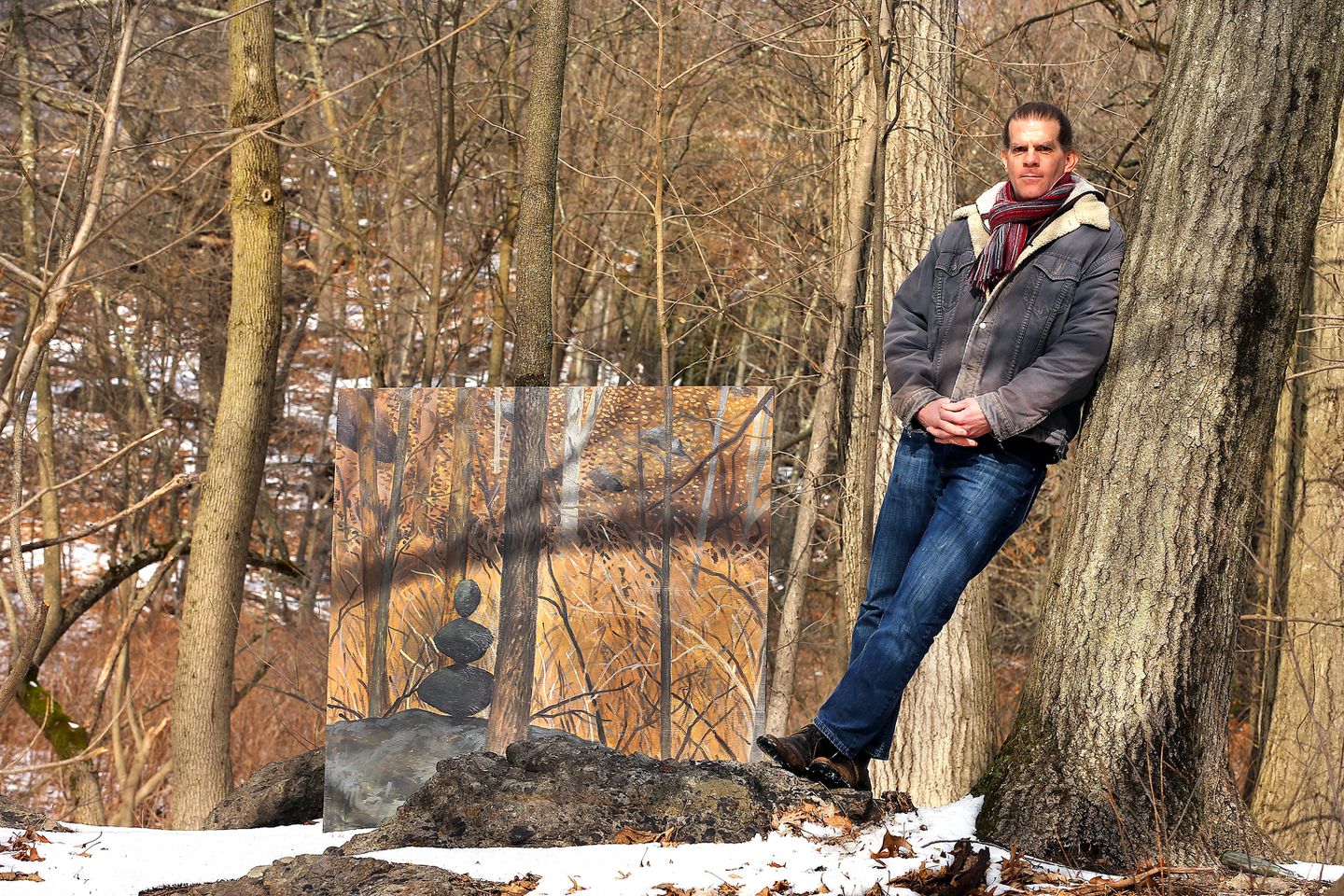
Artist and muralist Alex Cook painted two illusion paintings that he placed in Boston’s Franklin Park. The challenge is to keep them from being stolen.

It takes a brave artist to leave work in the woods. Where I live, Umbrella Arts members create art for an annual theme, trusting dog walkers, nature lovers, and connoisseurs to leave the paintings and sculptures in place over a period of months.

In Boston, trompe-l’œil art is appearing in woodland. Steve Annear has the story at the Boston Globe.

“When Jeffrey Jacobs went for a stroll along the trails in Boston’s Franklin Park last month, on a day when winter briefly gave way to spring, he expected to see the usual brown and beige leaves blanketing the ground, bare trees towering overhead, and a smattering of wildlife. But something else caught his attention that day: a clever piece of camouflaged artwork, just off the beaten path.

“The large painting perfectly matched its surroundings, but made it appear as if the trunks of the two trees it leaned against had been partially removed, replaced by a stack of gray stones and a twig wedged between the missing parts as if holding them up.

“ ‘I appreciated the illusion; I thought it was just wonderful,’ said Jacobs, who posted about his discovery on a Facebook page for Jamaica Plain residents. …

“The mysterious mural was one of two paintings recently hidden in a section of the sprawling park known as The Wilderness as part of a project by local artist Alex Cook. …

“ ‘There’s something so magical about coming across something wonderful in the woods,’ said Cook, a muralist by trade whose work is featured prominently on buildings around Boston and beyond. …

“The idea for the project, which he describes as a bit of a ‘treasure hunt,’ came at the beginning of the pandemic, when Cook was temporarily living in New Jersey with his wife’s family.

“After stumbling across a pair of boards from an old ping-pong table in the basement, he was inspired to bring them outside and use them as canvases. …

“ ‘All my projects had evaporated,’ he said. ‘I started making paintings on this thing.’

“Each Monday for several months, Cook would whip up a different mural on the boards, which he leaned against a pair of trees. …

“Some of the last murals he painted in the series were ‘illusion paintings’ that blended in with the natural surroundings and the trees that supported them. They had elements of trickery. …

“The memory of the playful paintings and the joy they brought people recently came back to him. He grabbed a wood panel, packed his art supplies into a bag, and headed out to the trail near his home in Jamaica Plain.

“The result was the first of two, 4-foot-by-4-foot paintings for people to discover on their way through Franklin Park. In a description of the process, which he posted online, Cook said the biggest challenge was reproducing and depicting the natural colors of the backdrop as accurately as possible, so everything lined up.

“ ‘And it’s crazily hard as the light is changing all through the day,’ he wrote. ‘But wicked fun when it works.’ …

“His work has ‘been received so warmly’ by the community, especially on Facebook, where people have marveled at its ingenuity.

“ ‘I appreciate this so much!’ one person wrote beneath a post of his artwork. ‘I walk here every day and finding surprise art is a delight and a treasure.’

“In the category of ‘this is why we can’t have nice things,’ [a painting with] missing trunks was stolen from its spot sometime in the past few days. But Cook is hoping the ‘art bandit’ will return it. …

“ ‘If you find yourself at a party and this painting is on the wall, do us all a favor and bring it right back to Franklin Park.’

“As for the remaining mural, once spring arrives and it no longer matches the landscape, Cook may swap it out for one that fits the season. Later, he’d like to feature his work in a more neutral environment, like an indoor art gallery. For now, he hopes his art continues to bring joy to unsuspecting viewers.

“ ‘I just want people to get a feeling of beauty, of wonder, of mystery,’ he said.”

Cook makes me think of Orson, the youngest of the Easter Egg Artists, who can’t help painting everything he sees. More at the Globe, here.

Read Full Post »

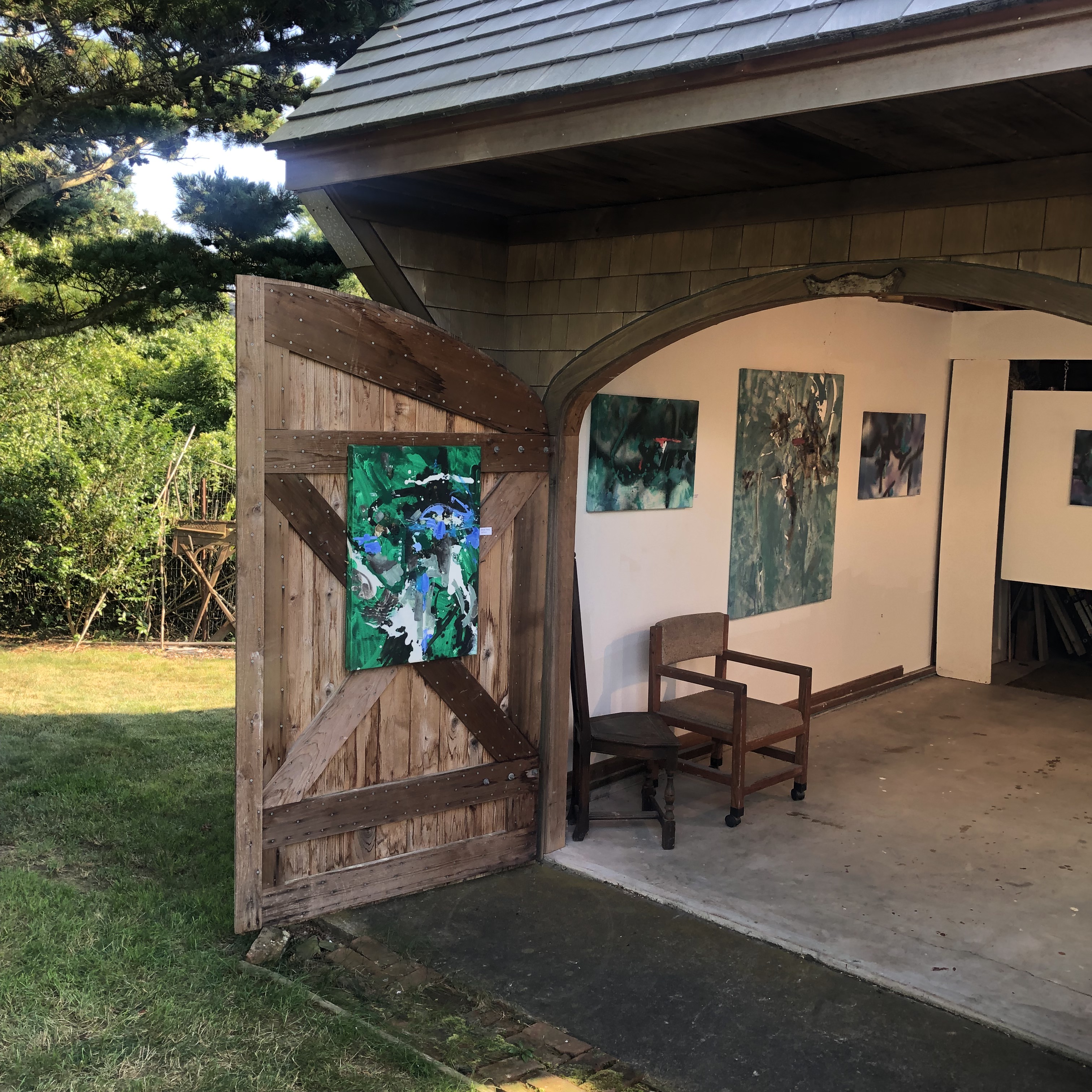
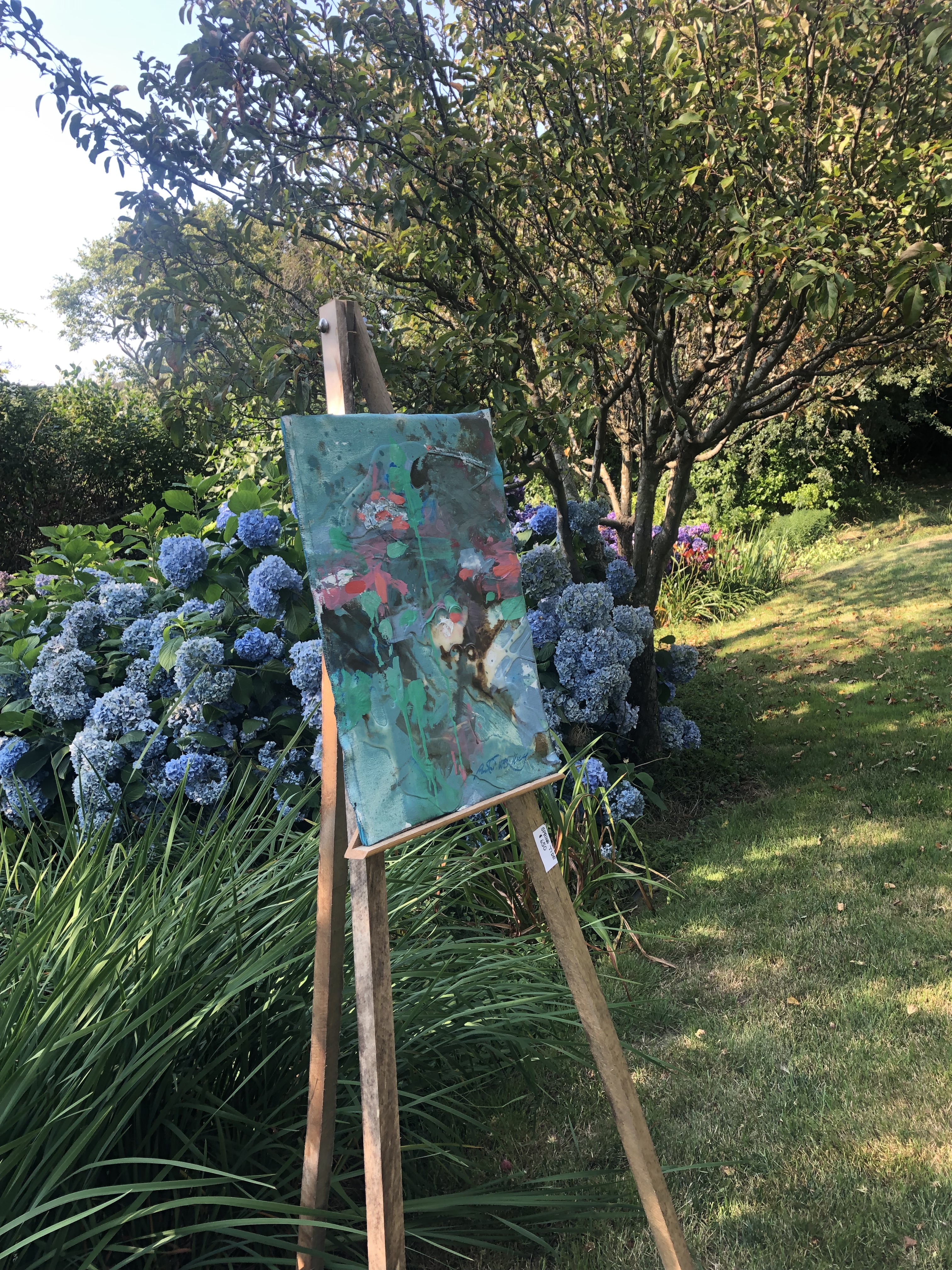
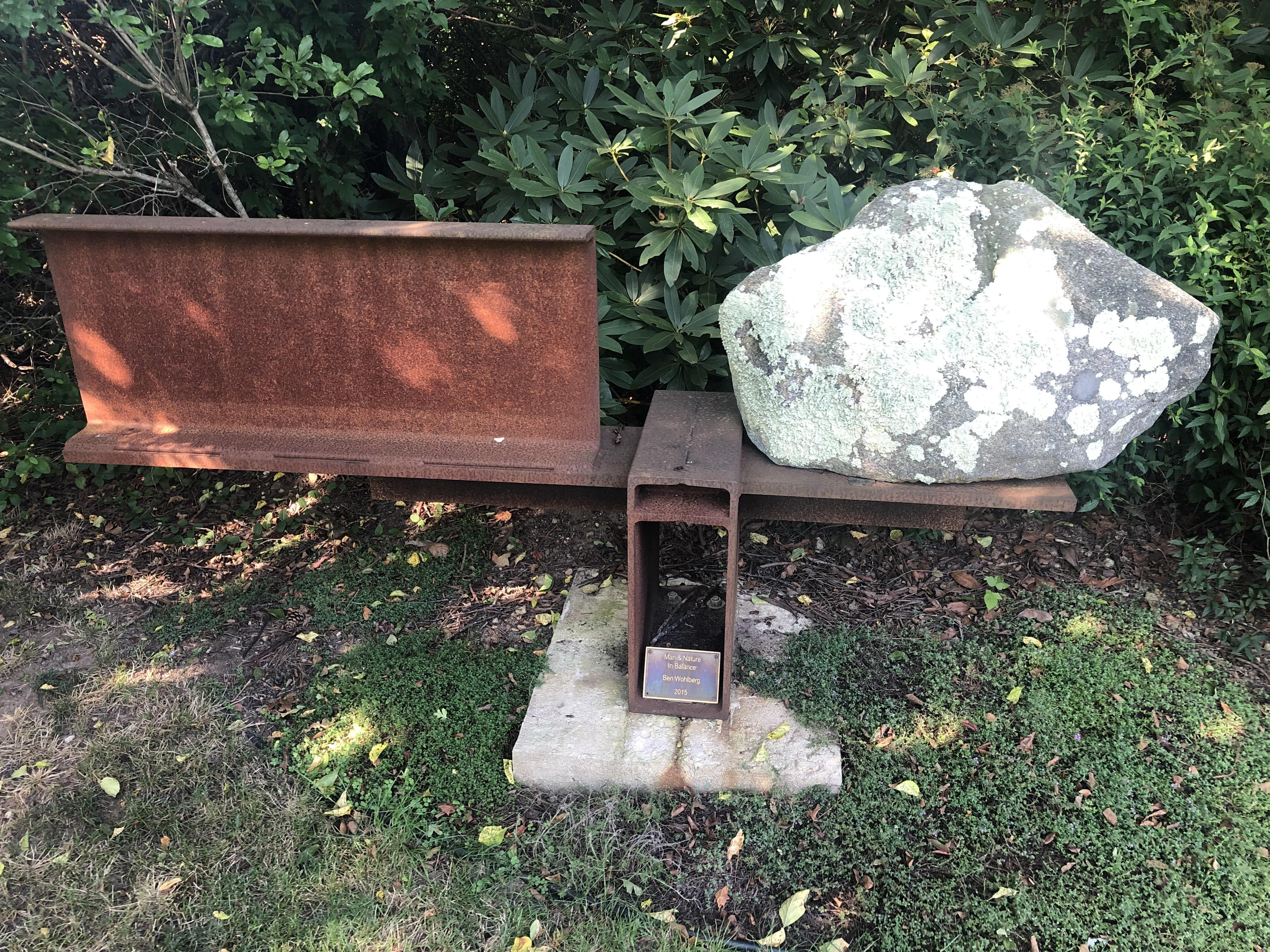
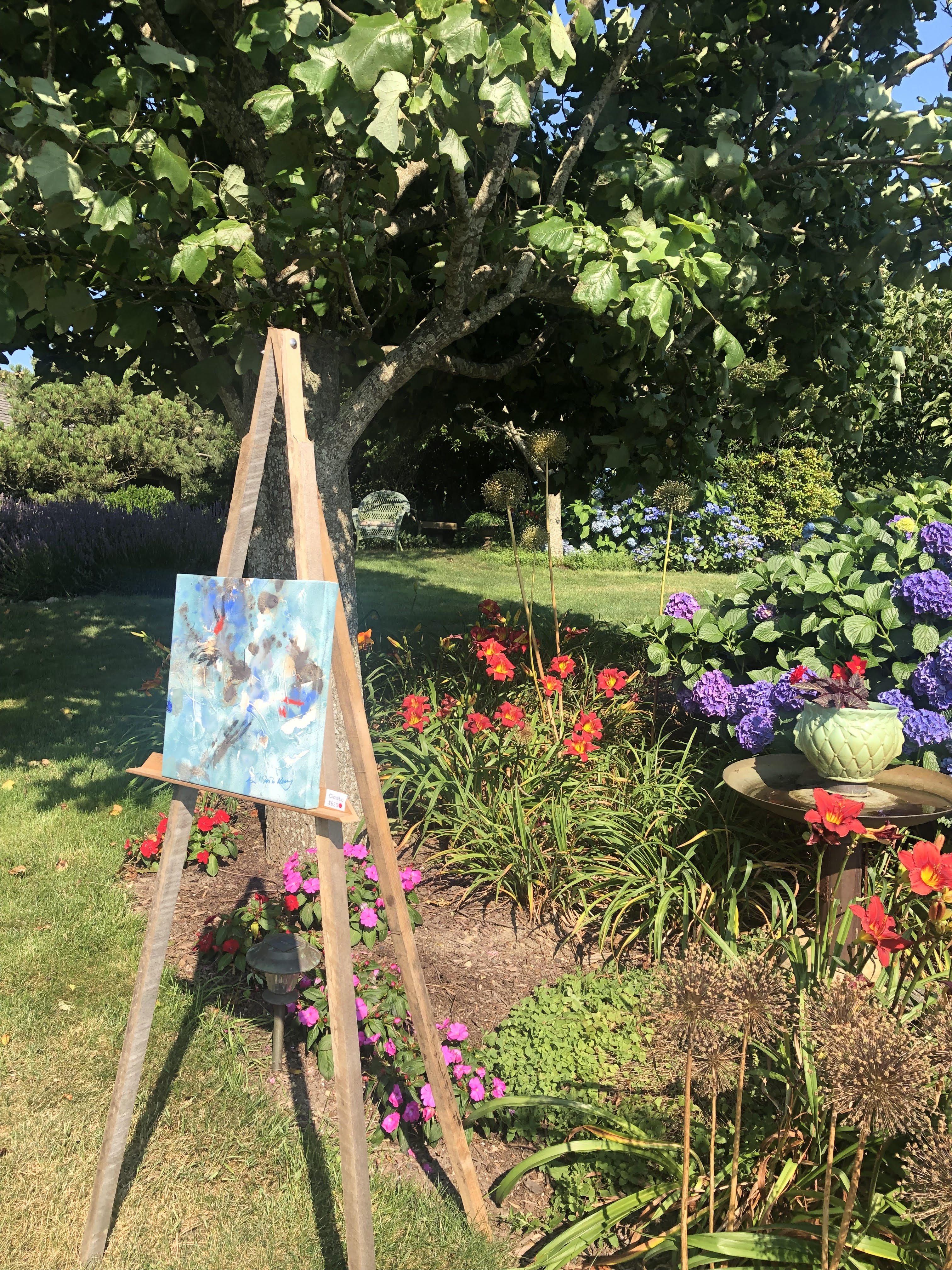
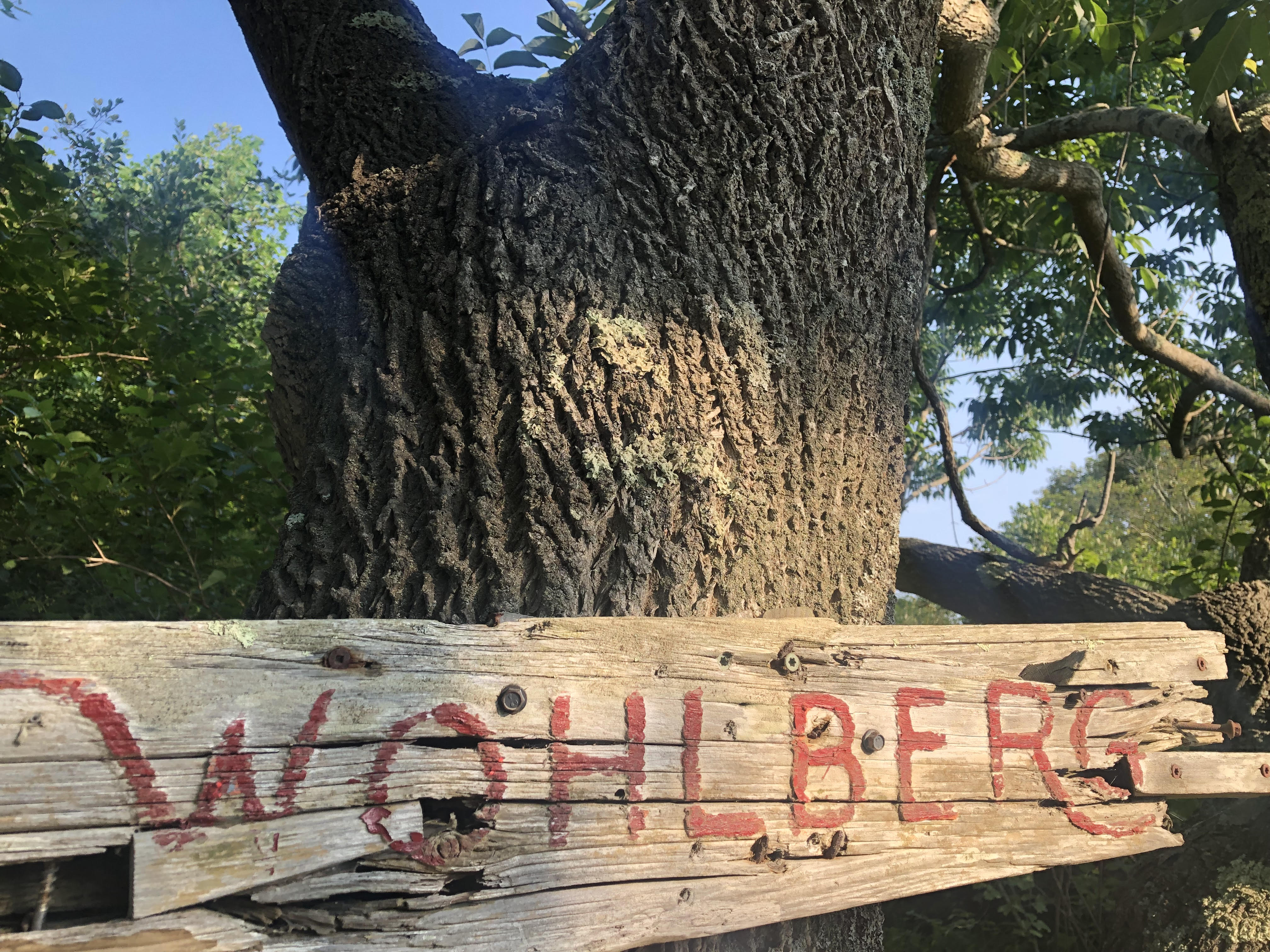
After decades as a commercial artist doing illustrations and portraits, Ben Wohlberg has “retired” to focus on abstract painting and gardening with his wife, Catherine. Once a year, they open to the public the grounds of their lovely summer home located on a shady dirt road. And what a treat that is!

I love the colors of the abstract paintings, which speak to me of the water, sky, flowers, butterflies, and mist that surround the couple on the island they love. In the blues of one with a flight of rose color lifting the upper right corner, I sense a bird flying in a studio window and swooping past a mirror that captures the feeling of its freedom rather than its photograph.

Seeing these paintings on easels around the grounds brings something extra to both. Note the “galrage” below (gallery in a garage) and the sculpture called “Man and Nature in Balance.”

More at Wohlberg’s website and in a video that features two islands the painter loves.

Read Full Post »

Photo: Cologne, Germany, police.
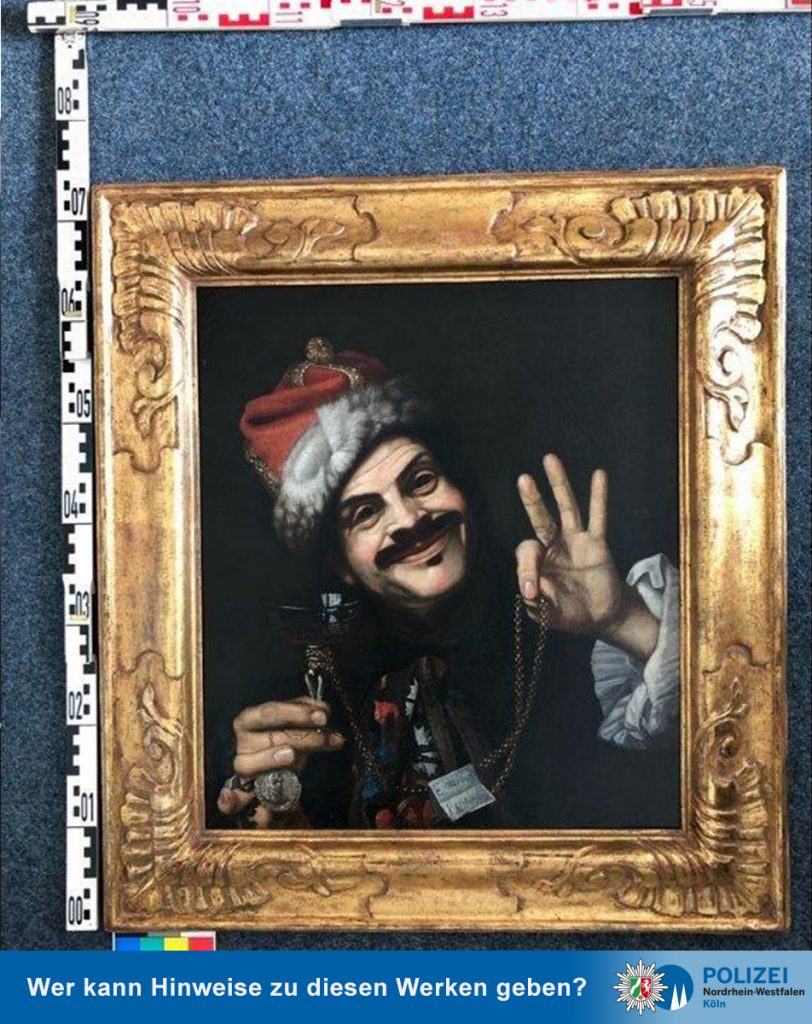
This painting by the artist Pietro Bellotti was found in a dumpster in Germany.

German dumpsters are yielding up treasures these days. In one case the rightful owners are unknown and being sought; in another, an owner realized in time that he’d left a valuable painting in an airport. (We all know how that can happen when our flight is called and we jump up. But we’re more likely to leave a sweater than a Tanguy.)

Naomi Rea writes about the unknown owners at Artnet News: “Police in Germany are appealing to the public for tips about the origins of two 17th-century paintings that mysteriously ended up in the garbage at a highway rest stop last month.

“According to authorities in the western city of Cologne, a 64-year-old man stumbled upon the two oil paintings in a dumpster at a rest stop near Ohrenbach on May 18. The man, who was taking a driving break at the stop at around 4 p.m., took the paintings with him and later turned them in to police in Cologne.

“After the paintings were examined by an expert, police concluded that they are both 17th-century originals, and have put out a public appeal to find their owner: ‘Who knows the paintings shown and / or how they got into the dumpster at the service area?’

“The first painting is a raucous self-portrait by the Italian painter Pietro Bellotti, dated to 1665. The other is a portrait of a boy by the Dutch Old Master Samuel van Hoogstraten, which has not been dated.

“The auction record for a Belloti is $190,000, achieved at the Swiss house Koller Auktionen in 2010, according to Artnet’s Price Database. There are multiple versions of the painting, and a very similar portrait, titled Self-Portrait of the Artist as Laughter, was put up for sale at Christie’s London in 2006 (estimate: $55,000–$91,000). … Other versions of the Bellotti painting are in the collection of the Uffizi Galleries in Florence, the Pinacoteca di Brera, and a third was once part of the Scheufelen Collection in Stuttgart.

“Meanwhile, works by Van Hoogstraten, who studied under Rembrandt in Amsterdam, have sold for as much as $788,000 (at Christie’s Monaco in 1993). The artist is best known for his experiments with perspective.” More at Artnet News, here.

In related news, a surrealist work turned up in another German dumpster. Check out Jesse O’Neill’s New York Post article from December.

“A surrealist painting worth $340,000 was recovered from a paper-recycling dumpster in Germany, police say.

“The valuable artwork, by French painter Yves Tanguy, was accidentally left behind by a businessman at Duesseldorf’s airport. The flier had forgotten the painting, which was packaged in cardboard, at an airport check-in counter before he boarded a flight to Tel Aviv, Israel, on Nov. 27.

“By the time the man landed in Israel, realized what he’d done and contacted police, the 16-by-24-inch masterpiece had disappeared. The mystery was solved only after the businessman’s nephew traveled to the airport from Belgium and talked with police. An inspector was able to trace the painting to a recycling dumpster used by the airport’s cleaning company.”

More at the New York Post, here. At least in that case, the owner knew where to look.

Read Full Post »

Photo: Remko de Waal/ANP/AFP via Getty Images.
Rembrandt’s restored ‘Night Watch’ at the Rijksmuseum in Amsterdam.

A project to restore a Rembrandt called “Night Watch” has received a lot of attention recently, but at the risk of repeating what you already know, I’d just like to point out that trimming a work of art can seriously affect its greatness.

How many times have building renovations cut paintings to fit or squashed them into too small a space to be properly appreciated. I think, for example, of the many special WPA paintings in US post offices that have been significantly altered over the years. I understand competing needs, but it’s a loss.

What was lost in Rembrandt’s ‘Night Watch,’ the New York Times says, was a sense of movement. The original was “asymmetrical: The large arch that stands behind the crowd was in the middle, and the group’s leaders were on the right. Rembrandt painted them this way to create a sense of movement through the canvas.

“Once the new pieces were restored, so was the balance, [said Rijksmuseum’s director, Taco Dibbits.] ‘You really get the physical feeling that Banninck Cocq and his colleagues really walk towards you.’ “

The main focus of the recent news coverage, however, was on how experts used artificial intelligence (AI) — along with an early copy of the original painting — to reimagine Rembrandt’s intentions.

Nina Siegal reported at the Times, “Rembrandt’s “The Night Watch” has been a national icon in the Netherlands ever since it was painted in 1642, but even that didn’t protect it.

“In 1715, the monumental canvas was cut down on all four sides to fit onto a wall between two doors in Amsterdam’s Town Hall. The snipped pieces were lost. Since the 19th century, the trimmed painting has been housed in the Rijksmuseum, where it is displayed as the museum’s centerpiece, at the focal point of its Gallery of Honor.

“[Now] for the first time in more than three centuries, it will be possible for the public to see the painting ‘nearly as it was intended,’ said the museum’s director, Taco Dibbits. …

“Rather than hiring a painter to reconstruct the missing pieces, the museum’s senior scientist, Robert Erdmann, trained a computer to recreate them pixel by pixel in Rembrandt’s style. A project of this complexity was possible thanks to a relatively new technology known as convolutional neural networks, a class of artificial-intelligence algorithms designed to help computers make sense of images, Erdmann said.”

As amazing as AI is, the work would not have been possible if a less renowned painter hadn’t made an early copy of Rembrandt’s work.

“Indications already existed of how the original ‘Night Watch’ likely looked,” Siegal continues, “thanks to a copy made by Gerrit Lundens, another 17th-century Dutch painter. He made his replica within 12 years of the original, before it was trimmed.

“Lundens’s copy is less than one-fifth the size of Rembrandt’s monumental canvas, but it is thought to be mostly faithful to the original. It was useful as a model for the missing pieces, even if Lundens’s style was nowhere near as detailed as Rembrandt’s. Lundens’s composition is also much looser, with the figures spread out more haphazardly across the canvas, so it could not be used to make a one-to-one reconstruction.

“The Rijksmuseum recently made high-resolution scans of Rembrandt’s ‘Night Watch,’ as part of a multimillion-dollar, multiyear restoration project, initiated in 2019. Those scans provided Erdmann with precise information about the details and colors in Rembrandt’s original, which the algorithms used to recreate the missing sections using Lundens’s copy as a guide. The images were then printed on canvas, attached to metal plates for stability and varnished to look like a painting.” More at the Times, here.

The Guardian also covered the story, quoting the Dibbits as saying, “With the addition especially on the left and the bottom, an empty space is created in the painting where they march towards. When the painting was cut [the lieutenants] were in the centre, but Rembrandt intended them to be off-centre marching towards that empty space, and that is the genius that Rembrandt understands: you create movement, a dynamic of the troops marching towards the left of the painting. …

“I am always hoping that somebody will call up one day to say that they have the missing pieces. I can understand that the bottom part and top might not be saved but on the left hand you have three figures, so it is surprising that they didn’t surface because at the time in 1715 Rembrandt was already much appreciated and an expensive artist.”

Update 8/11/21 — Michiel of Cook & Drink went to the exhibit, sending a picture and comment: “The AI-part adds a lot of value to the overall painting, but obviously it’s a reconstruction. This is clearly visible (the painting lies a bit deeper than the reconstruction) and that helps to appreciate both the original and the extended version. We’ve seen the painting many times, always in its original frame. To see it without a frame was also special. Very nice to see so many people interested in this project. It’s special to see the combination of very advanced IT, AI, art and history.”

Nice to see a line for art!

Read Full Post »

Talk about making delicious lemonade out of unwanted lemons! Here’s what two creative friends came up with during lockdown.

Sarah Buttenwieser writes at the Daily Hampshire Gazette, “Like so many of us, artist Katy Schneider worried about how to face quarantine and its uncertainty. Rather than bake sourdough, she reached for a bunch of discarded 3-by-4-inch aluminum slides from Smith College, where she’s taught art for 30 years.

‘I knew I could repurpose the aluminum plates,’ Schneider says. ‘I knew I needed a project to get through quarantine. I like working on things that are the same size.’

“She decided to paint shoes each day. ‘I wanted to play with color and texture,’ she says. ‘These tiny paintings became an exercise to keep me in the studio.’

“After a few weeks, she shared the images with friends, inviting them to write stories or poems about the paintings. … Her most loyal respondent was musician, music teacher and songwriter Jim Armenti.

“ ‘Jim wrote about every single shoe painting,’ Schneider says. There were 40 paintings.

“Schneider moved on from shoes. She began to paint other things she found around her house, like ‘laundry in a laundry basket.’ … Meanwhile, she kept sending Armenti images.

“ ‘Jim continued to write a poem about each painting. It was like we became beholden to one another to complete this daily practice, which has become essential. As soon as I am in my basement sitting with my paints, I feel more relaxed. …

“ ‘Unlike portraiture, which I’ve done so much of, these paintings are of things I’ve never focused upon,’ Schneider says. ‘I feel no pressure to match my best work, because I don’t have best work of these objects; it’s all new discoveries. I’m creating these weirdly joyful images during an abysmal time. It’s energizing. I’m having fun with it.’ …

“Schneider enjoys the fact that the slide dividers worked to protect history — slides — and that she’s repurposing them to create an historical document.

“ ‘These images preserve this time in history, as the slides did before they were digitized,’ she reflects. ‘We are all going through this at once, but alone, and there’s something echoed in that from the tiny images, each divided by squares on the wall, as the dividers kept the slides from one another originally.’ …

“Armenti … loved ‘the solidity of the project right away. It was in my wheelhouse. I just like to do the thing — write the poem — much as I like live performance.’

“He doesn’t watch videos of his musical performances and he doesn’t like to return to the poems he’s written, either. Instead, he considers the poems ‘part of my day.’ …

“Before 8:30 a.m., he responds to email, completes chess moves, takes language lessons online — Spanish, Italian and Turkish — and writes a poem in response to Schneider’s daily painting.

“ ‘I think of her paintings as being of things that are overlooked,’ Armenti conjectures. ‘I like to let a narrative emerge from them, for them to take me on an emotional journey.’ ”

More here.

Photo: Concord Art.
Silver Linings: Paintings, Process and Poetryis an exhibit of Katy Schneider paintings and Jim Armenti poems. Visitors can see it at Concord Art until May 13, 2021. Covid safety rules are in force.

Read Full Post »

Photo: Ottaviano Caruso/AWA.
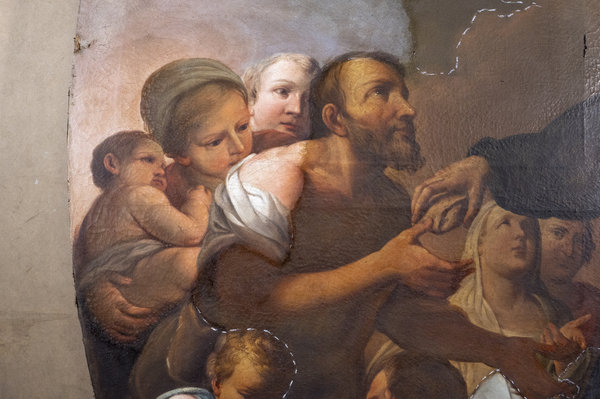
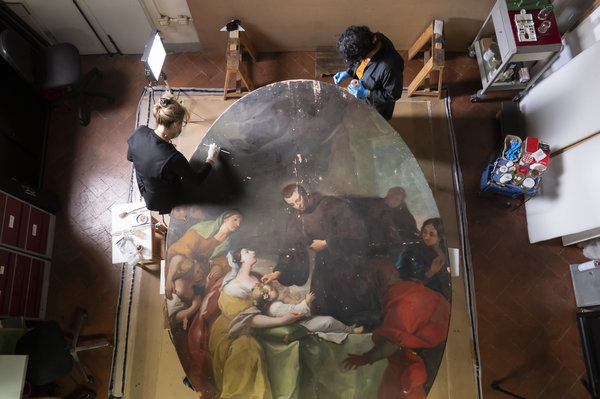
Restoration experts are working on Violante Ferroni’s painting Saint John of God Feeds the Poor.

An arts foundation in Italy asks, Where are the female Renaissance artists? Although many women who might have pursued some kind of art were probably bent over a tub of suds, there are others who created but are forgotten.

Sylvia Poggioli reported at National Public Radio’s “Weekend Edition” about new efforts to right centuries of wrong.

“Florence is one of the main stops on any art lover’s European itinerary. At the Uffizi Galleries, visitors can have their fill of works by Renaissance masters Leonardo da Vinci, Michelangelo and Raphael. Of course, none of these artists are women.

“In 2009, a new nonprofit foundation in Florence started to investigate why.

” ‘I started going into museum storages and attics and checking what was actually there, what works by women,’ says Linda Falcone, the director of Advancing Women Artists.

‘It was something that had never been done before because no one had ever before asked the question, “Where are the women?” ‘

“In the years since, AWA has shed light on a forgotten part of the art world, identifying some 2,000 works by women artists that had been gathering dust in Italy’s public museums and in damp churches. It has also financed the restoration of 70 works spanning the 16th to the 20th centuries.

“The organization was founded by Jane Fortune, an American philanthropist who died in 2018. Fortune was an intrepid art detective whom Florentines nicknamed ‘Indiana Jane’ in homage to her native state and her Renaissance treasure hunting skills. …

“During the Renaissance, Falcone says, ‘Women didn’t have citizenship. They couldn’t produce art as a profession. They couldn’t issue invoices. They couldn’t study anatomy.’ …

“A few Italian women were able to study painting in their fathers’ studios — most notably Artemisia Gentileschi, daughter of the 17th century painter Orazio Gentileschi. AWA is responsible for restoring David and Bathsheba, one of her paintings that was found after being hidden in a Florentine palazzo’s attic for 3-1/2 centuries.

“The group also rediscovered a 21-ft.-long canvas depicting 13 life-size males — the only known Last Supper painted by a woman. It is by the 16th century Dominican nun Plautilla Nelli — whose workshop was inside a convent in Florence. …

“Says [Falcone], ‘Nelli actually chooses sort of the key moment in which Christ announces his betrayal. And you have all of the apostles feeling the emotion of that very serious news. And so she is able to do a study of their responses, of their psychological responses.’ And, unlike most Last Suppers by male artists, Nelli puts food on the table, says Falcone.

‘She has lettuce, she has salt cellars, a lot of wine, bread for every apostle and knives and forks and beans and lamb — she did a Last Supper were people were meant to eat, first of all.’

“[Unlike] male artists of the time, Nelli signed her canvas — adding the words ‘pray for the paintress.’

“The nun’s works were prized by Florentines during the 16th century because they were believed to be imbued with spirituality. Her contemporary, the art historian Giorgio Vasari, wrote that she ‘would have done marvelous things if, like men, she had been able to study and to devote herself to drawing and copying living and natural things.’ …

“With backing from Advancing Women Artists, [art restorer Elizabeth Wicks] is currently restoring two large works by Violante Ferroni, an 18th century child prodigy of whom little is known today. …

“At the time, female artists were usually limited to painting still-lifes and small portraits. But while still in her 20s, Ferroni was awarded a prestigious commission by Florence’s San Giovanni di Dio hospital to paint two ovals — each of them 8-by-11 1/2 feet — with spiritual scenes to help heal the ill. The subject was usually reserved for men. …

“Falcone says that through restoration work, documentation and exhibits, AWA has contributed to a growing worldwide interest in and awareness of art by women. Yet the organization recently announced it is shutting down next June because it does not have sufficient funds to expand.”

More at NPR, here.

Photo: Francesco Cacchiani/AWA
Restoration expert Elizabeth Wicks and the nonprofit Advancing Women Artists have recently been restoring works by Violante Ferroni, a forgotten 18th century woman.

Read Full Post »

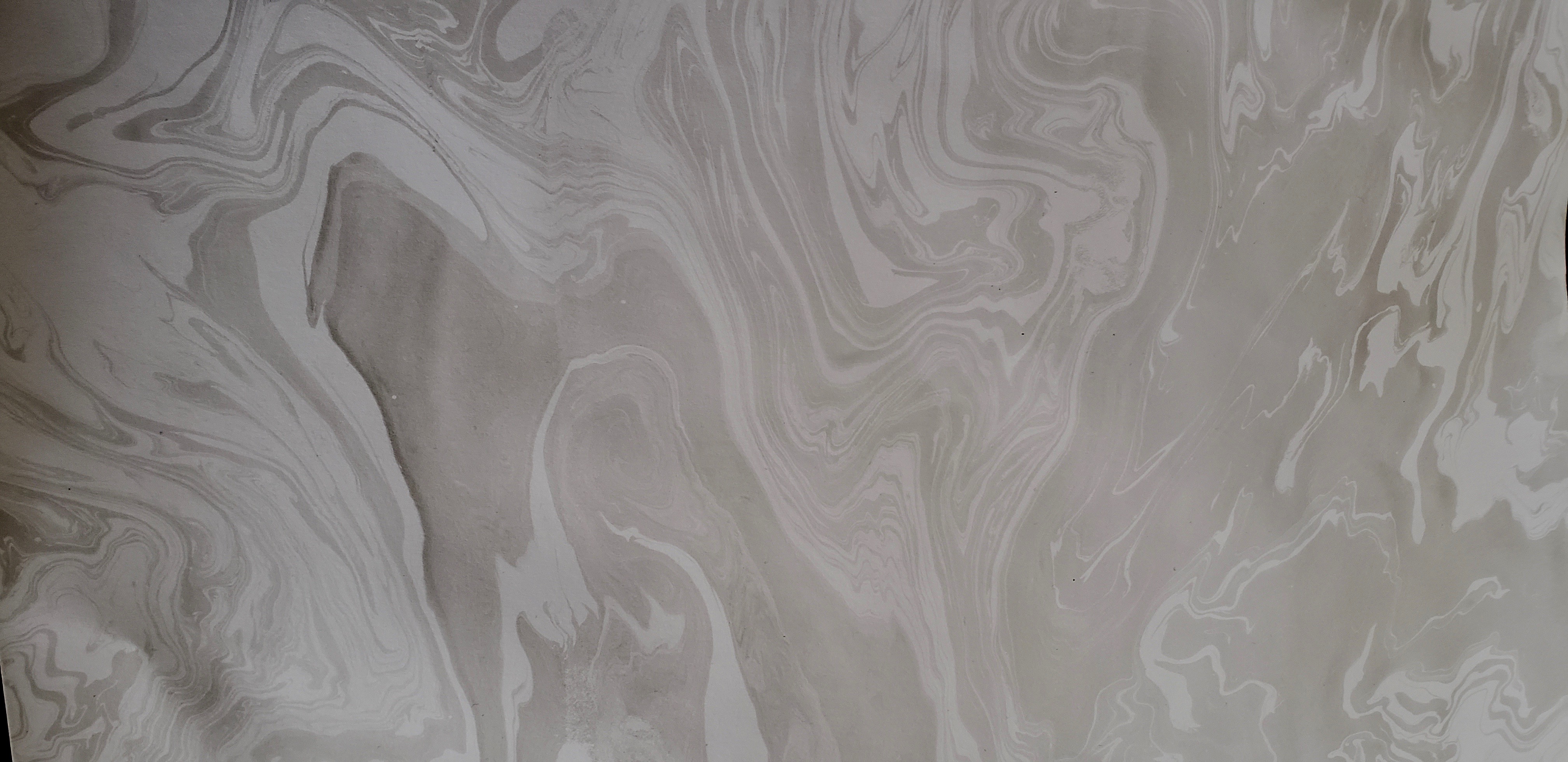
021619-grandson-tries-suminigashi-painting

The result of my grandson’s class in Japanese marbling technique. Suminagashi, or “ink-floating” on paper, has been around since the 12th century.

Not long ago, my older grandson’s class, which is studying Japan, went to the Boston Children’s Museum. The museum features an entire traditional home that was shipped from Japan years ago and rebuilt indoors.

While there, the 8-year-olds practiced an ancient painting technique, Japanese Suminagashi, which uses the unpredictable swirling of water to create one-of-a-kind images.

I love the idea of one-of-a-kind. Children are one-of-a-kind, too, all wonderful in their own way, and I like to hear about them getting a break from standardized-testing molds.

According to the website Beyond the Chalkboard, in which the Boston Children’s Museum helps teachers with enrichment activities, “Suminagashi, Japanese for ‘ink-floating,’ is a paper marbling technique that was practiced in Japan as early as the 12th century.  Creating these beautifully marbled pieces of paper encourages children to relax, focus and observe the changing swirls in front of them. …

“It is very important that everything used in this activity (the brushes, trays and jars) be as clean as possible. The trays or tubs you use should be at least 2 1/2” deep. Tupperware containers and some aluminum pie tins will work. Make sure that the paper you are using is smaller than the width and length of the trays.

“Fill each tray with 2 inches of room-temperature water, making sure to keep the water free of dust, oil or soap. Pour a small amount of sumi ink into each empty baby food jar, and have pairs of students share a jar.”

The instructions include advice on first discussing what swirls are and also what children already know about Japan.

Here are the instructions, in part.

“1. Make sure your hands and the water tray are CLEAN while you fill it with water. Keep the water and the papers free of dust, oil and soap.
“2. Find a steady place to lay your two brushes, wooden skewers or toothpicks.  Place one brush or skewer on the left side of the water tray and one on the right side.  Dip the left side brush or skewer into the ink.  If using a brush, you only need a little bit of ink!  The surface of the water will pull ink from the brush.  …
“3. Carefully touch the very tip of the inked brush or skewer just to the surface of the water in the middle of the tray.  …
“4. Lay down the inked brush and pick up the other brush (the un-inked one on the right side of the tray).  Touch the end of this brush or skewer either to the side of your nose (your nose has lots of oil on it), to a bar of soap, or (just barely) to the top of a detergent bottle.  Touch the tip of this oily or soapy brush/skewer to the water INSIDE THE DOT of ink (or the center of the tray, if you can’t see the ink yet).  You might see the ink that is floating on the surface of the water move away from where you touched. …
“5. Repeat, alternating between brushes, and always touch the brush tips in the middle of the ink circle on the surface of the water. You should soon see many concentric circles. Once you feel you have enough, you can gently blow across the surface of the water to start creating swirls. …
“6. When you like what you see on the water, pick up a piece of paper, holding it from the sides.  Bring the ends together a bit so the middle of the paper bends down toward the water — now you can lay the paper on the water, starting from the center and quickly laying down the sides and letting go. It may take some practice to get this to be a quick, smooth motion. …
“7. Now lift the paper off the water (if there seems to be a wash of ‘loose’ ink on the surface of the paper, try gently, quickly rinsing the paper under the faucet). The ink that actually printed will stay on the paper.
“8. Lay the your print on the newspaper to dry.”

More here and at Suminagashi.com. My grandson also alerted me to a Japanese anime called My Neighbor Totoro that he saw in school, and my husband and I got it from Netflix. We like Japanese animations.

Read Full Post »

02jphawaii1-jumbo

Photo: Honolulu Museum of Art
“Black Lava Bridge, Hana Coast No. 1,” 1939, by Georgia O’Keeffe.
 

Who knew that the great Southwest artist Georgia O’Keeffe also painted Hawaii? I myself was surprised to read the report at the New York Times of a new exhibit showcasing the artist’s Hawaii art.

William L. Hamilton writes, “Finding out Georgia O’Keeffe had a Hawaiian period is kind of like finding out Brian Wilson had a desert period.

“But here it is: ‘Georgia O’Keeffe: Visions of Hawaiʻi,‘ 17 eye-popping paradisal paintings, produced in a nine-week visit in 1939, and now on display at the New York Botanical Garden in the Bronx, through Oct. 28.

“It is the first time the largely unknown group has been shown together since its original exhibition in 1940 at Alfred Stieglitz’s gallery, An American Place, in New York. In addition, there are two oil sketches never before exhibited. And not a bleached skull in sight.

“As with previous shows on artists — including Frida Kahlo and Claude Monet — the Garden has also mounted a living display of the subjects depicted in the artworks, and more. In the Enid A. Haupt Conservatory are over 300 tropical plant types, representing the three major groups of flora in Hawaii. …

“[The] air is palpable in the humidly colored, freshly amplified palette of her paintings of hibiscus, wild ginger, pink ornamental banana, and the sea and landscapes in the library gallery, with its muted gray background, as meditatively sensual as a Hawaiian open-air church.

“That air also hangs, warmly spiced, in the Conservatory, with a profuse display of the natural exoticism of the islands that goes well beyond the painter’s depiction. …

“ ‘Every single portrait she painted — the heliconia, calliandra — they’re all imported,’ Todd Forrest, the Garden’s vice president for horticulture and living collections, said of O’Keeffe’s output. ‘That’s the sort of flora people have in their mind’s eye when they think of the islands.’ …

“Missing from her vision, as eager to absorb the overwhelming newness of the place as she was, were Hawaii’s true nobility: the hundreds upon hundreds of native species that exist nowhere else. To its credit, the Conservatory has represented them too, a group rarer to see than even the paintings. …

“O’Keeffe, of course, is an art world star, one of the first of the 20th century’s artists singled out for celebrity. Her larger-than-life flowers are famous too. Since 1924, she had studied and depicted them — gone to the startling heart of them — with her original style. …

“She was already a celebrity in 1939 when at 51, self-created and self-confident, she was asked by N.W. Ayer & Son, a Philadelphia advertising agency, to travel to the islands to produce two print-ad images for the Hawaiian Pineapple Company, later Dole. Not known for commercial work, O’Keeffe had completed a commission in 1936 — what would be the largest of her flower paintings — for the Elizabeth Arden Sport Salon in New York. …

“ ‘What she wanted was an adventure,’ [Honolulu Museum of Art deputy director Theresa Papanikolas] said. …

“ ‘Many of the native plants are endangered and therefore they can’t be shipped,’ explained Francisca Coelho, who designed the edenic installation. The Garden worked with the National Tropical Botanical Garden in Hawaii, which provided cuttings and seedlings of natives legally transportable. …

“And there are tiny groves of pineapples. O’Keeffe cavalierly neglected to paint any while she was in Hawaii on Dole’s dime. Her sponsors had to send her a pineapple when she got back to New York. Ignoring that, she painted a pineapple plant from her memory of being in the fields — a budding fruit guarded like a queen by its threatening wreath of swordlike leaves and fire-colored dirt.

“ ‘I laughed so hard,’ said Christine Gentes, who was visiting the Garden from Chicago with her daughter and sister. ‘She did it for an ad, and turned it into a painting. I mean, she really resisted. Artists never like to do that kind of work.’ ”

Lots of great pictures here and here.

Read Full Post »

The artist I have in mind is four. Here are some watercolors he painted over a couple days at Christmas.

The Christmas tree is green along the left side, but this artist likes lots of color. He is careful to keep colors from running together and getting muddy.

He paints snowmen and people in twos.

The still life features a banana, apples, grapes, a pear and limes.

I love that over two days, his people evolved to have hair, arms and a discernible smile. I’m smiling, too..

123016-xmas-tree

https://suzannesmomsblog.com/wp-content/uploads/2016/12/123016-snowmen.jpg


123016-still-life-with-fruit

123916-evolution-of-figure-painting

Read Full Post »

Older Posts »