Feeds:
Posts
Comments

Posts Tagged ‘philadelphia’


Photo: anekoho/shutterstock
As art classes get cut back, Philadelphia foundations are stepping up to protect a vital part of education.

In this time of cutbacks in school arts programs, it is heartening to see some organizations stepping up to the plate. If the trend continues, we may all need to start volunteering in schools — just as scores of parishioners at my church did for an amazing arts and crafts day yesterday. The only problem is, Who has the time for sustained volunteering when government doesn’t do its part?

In Philadelphia, foundations are providing some respite, as Mike Scutari reports at Inside Philanthropy.

“In June of 2013, Philadelphia’s School Reform Commission approved massive cuts in funding in what critics referred to as ‘The Doomsday Budget.’ Cuts included mass faculty layoffs, reduction of materials and athletics programs, and the complete elimination of arts and music programs.

“Four years later, Peter Dobrin, the Philadelphia Inquirer‘s culture writer, surveyed the city’s music education landscape and convincingly argued that funders sufficiently rose to the challenge, pointing to city’s web of innovative music education programs, including:

  • Play On, Philly!, launched in 2013 with seed money from Carole Haas Gravagno and the Lenfest Foundation.
  • The Philadelphia Youth Orchestra’s Tune Up Philly, which receives support from Impact100, a women’s giving collective.
  • AristYear Philadelphia, which will pay 12 arts teaching fellows in area schools with a high percentage of children from low-income families. The Knight Foundation has supported both Artist Year Philadelphia and Play On, Philly!

“Knight is only one of many influential funders active in the city. William Penn Foundation has doubled down on arts education, allocating more than $12 million over the last 4 years …

“The Andrew W. Mellon Foundation, meanwhile, recently awarded more than $2.5 million to a new program called the Philadelphia Music Alliance for Youth.

“Other examples include the Neubauer Family Foundation, which, in tandem with other local organizations, is ‘working to figure out what arts education programs are here already to determine what’s needed’  …

“The city’s financial woes were so calamitous that, funders, most of whom already had extensive footprints in the city, had no choice but to respond en masse. …

“In many cases, we’re not talking about your standard music education programs.

“Play On, Philly!, for example, is billed as ‘music for social change.’ Its 2017 summer programming included anti-child obesity and ‘active play’ programming at neighborhood recreation centers. ,,,

“More than ever, funders tend to support arts experiences that are immersive, experiential, and drive positive social outcomes.

“Now, consider the supporting role of big data in framing the arts as a means for driving social change.

“Play On, Philly!’s pilot collected data to show that students in the program improve their self-perceptions, academic motivation and school attendance, all while learning to play and perform a musical instrument. …

“Funders, increasingly beholden to this ROI [return on investment] mindset, are more inclined to cut checks when backed by compelling data. …

“All involved parties agree that access and equality is the key. Funders, more than ever, intuitively rally around this idea. Breadth is important, as well — ‘the net must be cast wide to capture all the talent out there,’ said Dorbin. Music education shouldn’t be just for future Julliard students.”

More here.

Read Full Post »


Photo: Arden Theatre Company
Staff of the Arden Theatre Company in 1995 celebrating their recently purchased home. The building is at 2nd and Arch, in the Old City neighborhood.

I always enjoy stories about the arts sparking neighborhood revitalization. John Timpane, of the Philadelphia Inquirer, recently covered one from the City of Brotherly Love.

“There’s a lot of turnover in the theater world, many an entrance and exit, so the Arden Theatre Company’s 30th anniversary this season is a testament to clear vision, luck, a lot of work, and even more talent.

“But this story embraces more than a theater – it’s about a neighborhood, Old City, that in part revitalized around the Arden, and how an arts venue plays a potent role in such transformations.

“It began with two 1980s theater buddies at Northwestern University near Chicago. ‘Aaron Posner and I talked all the time about starting a theater,’ says Arden cofounder and producing artistic director Terrence J. Nolen. …

“Cofounder Amy Murphy, who met Nolen when both were at Upper Darby Summer Stage, says … ‘When Terry said, “Let’s do this,” I thought, “Sure, I can go down for a few weeks and help out.” Right. We were 24, young, and dumb enough to do it.’ …

“Arden opened in 1988 with a Kurt Vonnegut adaptation. …

“Is there an Arden philosophy? ‘Our first commitment is to Philly actors,’ Nolen says. ‘When we first opened and started getting great reviews, people said, “Where did you get these actors?” We said, “They’re from here.” ‘

“You can feel that loyalty among grads of the Arden Professional Apprentice Program. … Raelle Myrick-Hodges is founder of Azuka Theatre and a busy theater professional. And she’ll direct an adaptation of Toni Morrison’s The Bluest Eye at the F. Otto Haas Stage March 1-April 1. She says, ‘I began as an apprentice at the Arden 24 years ago, and I’m so grateful I went there instead of to a grad school.’ …

“[Former Arden apprentice Scott] Greer says Arden’s 1995 arrival helped revitalize the ’hood: ‘When they got the space in Old City, they were a big part of changing that neighborhood. There was hardly anything there, and they started bringing in subscribers eight nights a week.’

“Ellen Yin, proprietor of Fork at 306 Market St., … said the Arden presence ‘helped build a clientele for the earlier 5:30-8 p.m. dining hours, which are crucial.’ She and several other restaurant owners regularly have partnerships with the theater. …

” ‘Blown away’ is a term Murphy uses for the whole Arden story. ‘All the people we know, all the good work we’ve done because of it,’ she says. ‘I’m very grateful. All of us are, and I think we always will be.’ ”

More here.

Read Full Post »


Photo: Jonathan Wilson
ArtistYear Fellow Aqil Rogers explains to Harrity School students in West Philadelphia how to assemble a contact microphone from component parts.

Many people worry about the drastic cutbacks in arts programs in schools. Not that many people do something about it. Pat Zacks of Camera Werks, Providence, is one person who does, as you may recall from this post.

In Philadelphia, another great idea is moving beyond the piloting phase — a kind of AmeriCorps for arts in education.

Peter Dobrin writes at the Philadelphia Inquirer, “With major new funding from a federal agency in hand, a Philadelphia service group in the arts is going national.

“ArtistYear has been operating since 2014, placing a few recent college graduates into Philadelphia schools each year as teaching fellows. This year, the program will expand to 25 full-time fellows who will teach music, art, dance, creative writing, and media arts in low-income schools in Queens, N.Y., and Colorado’s Roaring Fork Valley, as well as Philadelphia.

“A big boost to the program comes through AmeriCorps, part of the Corporation for National and Community Service, which has awarded ArtistYear a three-year, $1.45 million grant and extended certain benefits to the teaching fellows. …

“The grant is a first for AmeriCorps. ‘This is the first time there’s been a program that allows artists to dedicate a year of service to their country,’ said AmeriCorps spokeswoman Samantha Jo Warfield, citing the innovative model as one criterion for the award.

“Service-year programs for college graduates are common — to build English-language curriculum in Tonga, or to work on food-justice issues in Milwaukee. But ArtistYear may be unique. Its leaders call it the ‘first organization dedicated to national service through the arts.’

“This school year in the Rego Park neighborhood of Queens, storyteller and improviser Jill M. Pullara will put to use skills she learned earning an MFA in writing from the Royal Central School of Speech and Drama in London. Will Brobston, a guitarist and composer armed with a master’s degree from the University of Denver, goes west to the Colorado towns of Glenwood Springs, Carbondale, and Basalt.

“In Philadelphia, Aqil Rogers, a metal sculptor and designer who grew up in Lansdowne, is teaching at Mastery Charter Harrity Upper School at 56th and Christian Streets.

“ ‘What I’ll be doing is helping them create a maker space,’ said Rogers, 22, a Drexel University graduate whose senior thesis was Empowering Underserved High-Schoolers to Engage in Design/Maker Education through Hip-Hop and DIY Electronics. ‘We’ll work our way to electronics, robotics, lots of different sewing techniques — anything that can be done with hands, I suppose, will be learned at some point. And a lot of design-thinking work, which I think is critical.’ …

“In choosing fellows, the group wants artists who see teaching not merely as a space filler, but as a calling. ‘What we’re looking for is what kind of work experience they have that makes them think they are ready for a year of service, and that they want this as a piece of their career,’ says ArtistYear chief program officer Christine Witkowski.”

Learn more about the program and how it aims to supplement (not replace) arts in schools that still have them, here.

Read Full Post »


Photo: NextCity
A Philadelphia street scene

The ideas of writer Jane Jacobs, well-known for her influence on city planning, continue to be tested. Is it true, for example, that having a lot of “eyes on the street” reduces crime? Jared Brey writes at NextCity about efforts in Philadelphia to find out.

“In the five-and-a-half decades since Jane Jacobs published The Death and Life of Great American Cities, her core contention — that urban vitality and safety are a function of small-scale density, a mixture of uses and ‘eyes on the street’ — has become conventional wisdom in urban theory. …

“In June, a team of researchers released a paper, titled ‘Analysis of Urban Vibrancy and Safety in Philadelphia,’ that attempts to begin a quantitative analysis of Jacobsian theory by bringing together publicly available data sets related to crime, business activity and the built environment. The study is the first of a series they have planned.

“In order to test the ‘eyes on the street’ notion, the authors — three statisticians at the Wharton School at the University of Pennsylvania and an architect — investigated the correlations between public safety and population density, population count, zoning, business activity, and business hours. They also designed a model of ‘business vibrancy,’ meant to serve as a proxy for Jacobs’ concept of eyes on the street, based on the density of businesses in certain areas and the amount of ‘excess business hours’ on them — meaning blocks with businesses open longer than what the authors calculated to be the citywide average. …

“Among the authors’ findings:

* Population density is not as strongly associated with crime rates as population count.
* More crimes occur on blocks with more businesses, but fewer in the direct vicinity of businesses that have longer-than-average operating hours.
* Crime rates are higher in neighborhoods with high rates of vacancy, but within high-vacancy neighborhoods, fewer crimes are reported in the direct vicinity of vacant properties. …

“ ‘What it says is measuring human activity is subtle and difficult,’ [co-author Shane Jensen, a statistics professor at Wharton,] says. ‘Yes, it does seem like there is something to this concept of eyes on the street, but I don’t think it’s just as simple as making sure that there’s businesses on every street corner and stuff like that. If anything, the more high-resolution you break this down, the more insight you can glean.’ ” More at NextCity.

Here’s my question: as online shopping causes retail storefronts to close, how do we preserve any “eyes on the street” at all?

Read Full Post »

Well, here’s a new concept in energy production: braking regeneration.

Diane Cardwell writes at the NY Times, “Along Philadelphia’s busy Market-Frankford subway line, the trains behave like those of any transit system, slowing to halt at the platforms and picking up passengers.

“But more is happening than meets the eye. In an experimental system that is soon to be more widely adopted, every time the trains pull into certain stations, they recover the kinetic energy as they brake and channel it as electricity to battery banks at one of two substations.

“The batteries, managed by software, can then use that power to push the trains back out or to help modulate electricity flows on the grid.

“The system is unusual because the batteries are being used for more than just powering the trains, said Gary Fromer, senior vice president for distributed energy at Constellation, the power provider that will own and operate the system for the transportation authority.

“The electricity savings alone do not justify the battery costs, he said, so it was important to find another source of revenue, which comes from selling energy services to the grid. …

” ‘We don’t have to front the money and we’re reaping both savings and actually money coming back our way,’ said Jeffrey D. Knueppel, general manager of the transportation authority. The base technology of the system, known as regenerative braking, was one of the breakthroughs that allowed for the development of hybrid and electric cars like the Prius.” More here.

This reminds me of my 2012 post on inmates in Brazil who bike to create electricity — and reduce their sentences. And this post from 2013 about lighting schools by playing soccer. All hail to human ingenuity!

Photo: Jessica Kourkounis for The New York Times
The Market-Frankford subway line in Philadelphia is part of a regenerative braking experiment.

Read Full Post »

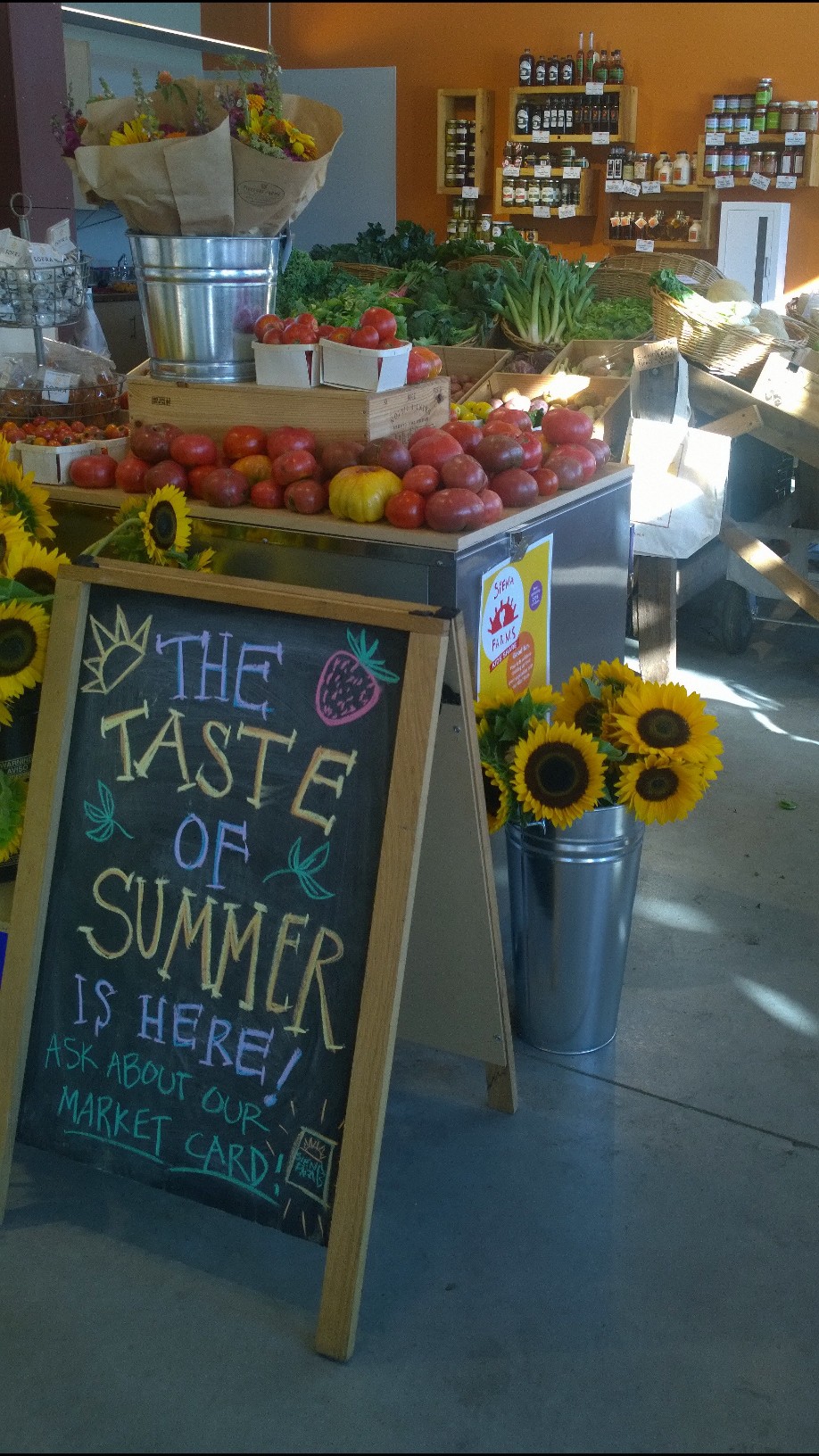
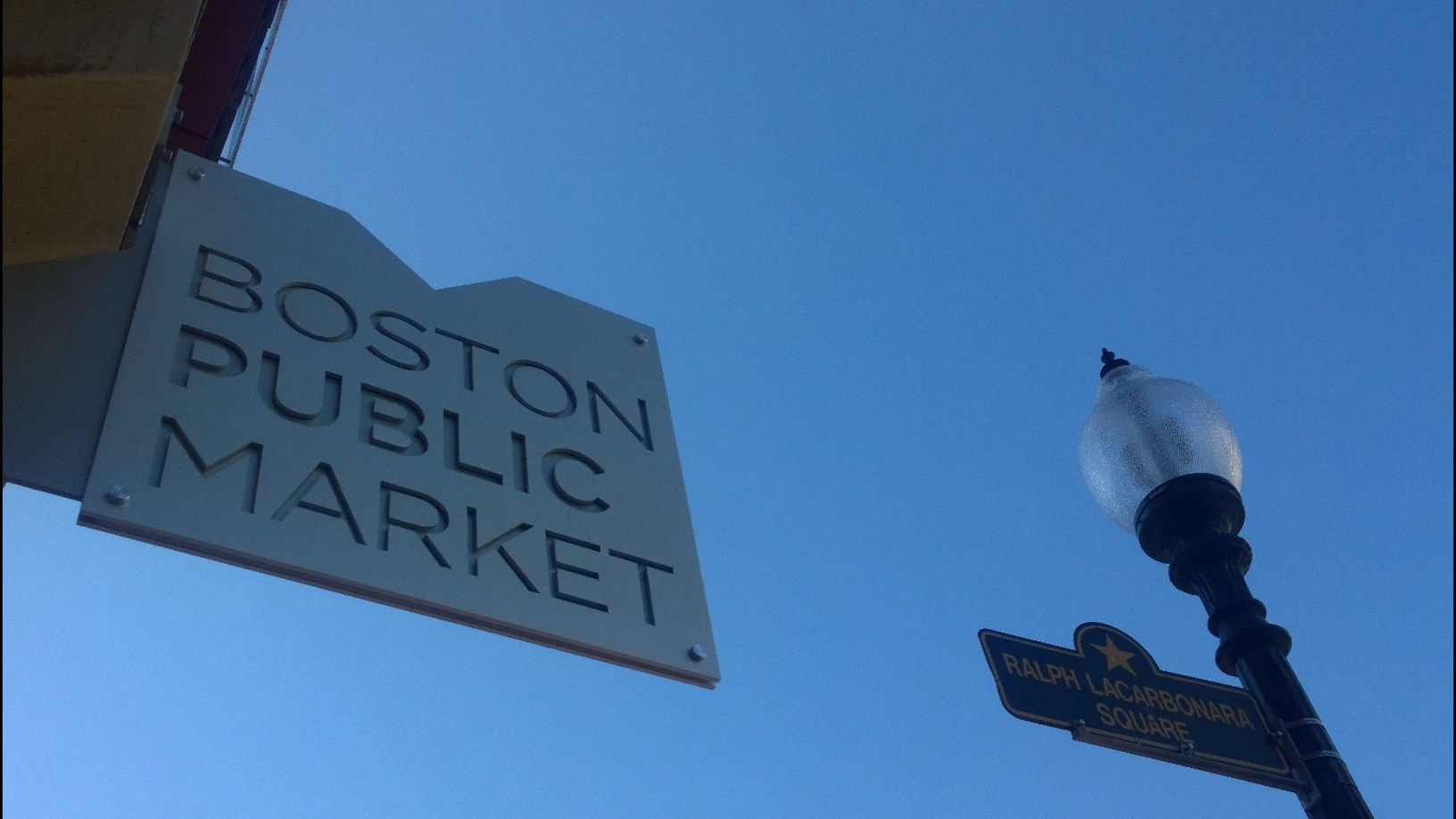
The original idea when the grandchildren visited my workplace was to walk to the new Boston Public Market, but it was too far and there were so many other interesting things along the way.

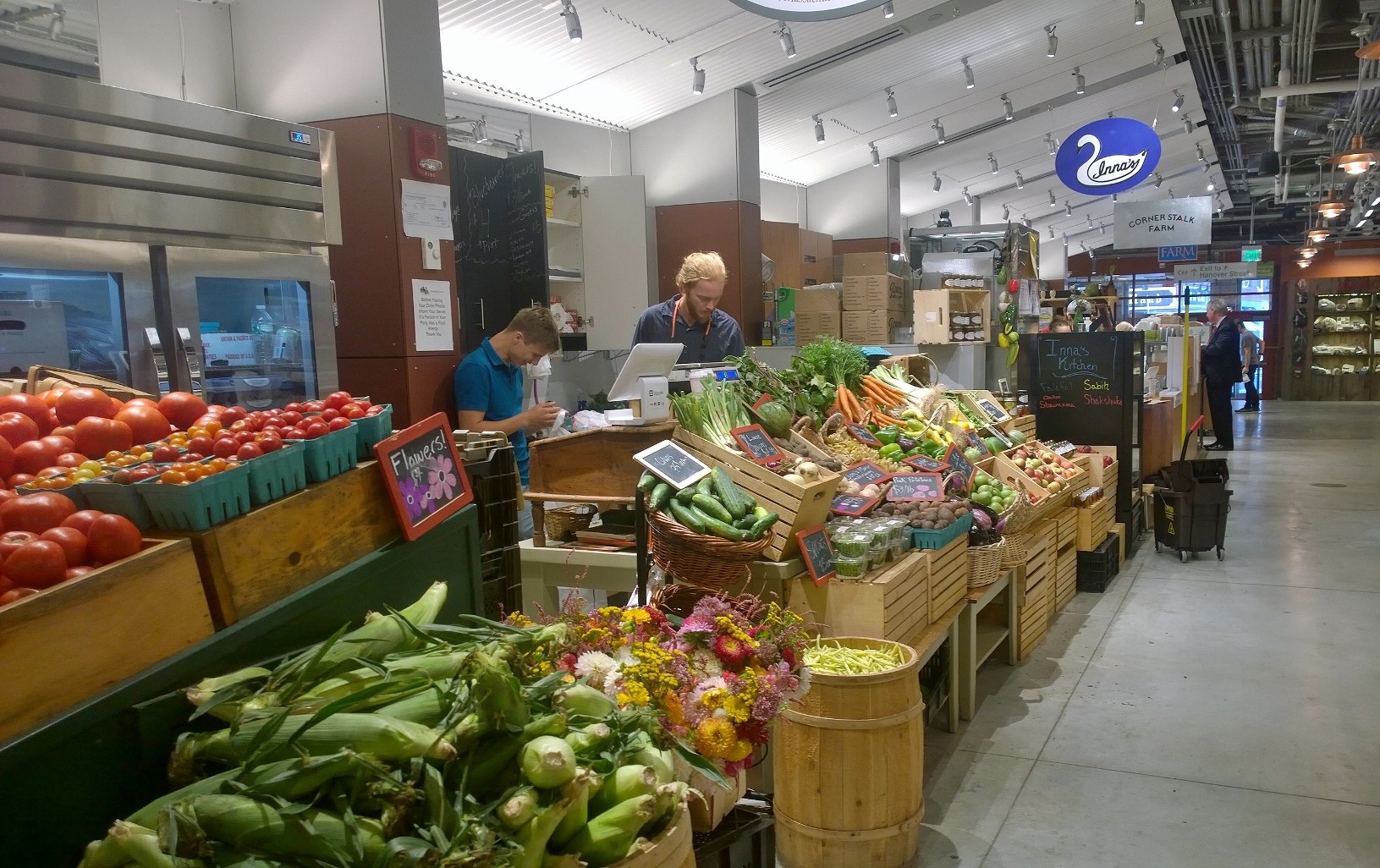
We will go as a family another day, but I thought I would zip over there Thursday and take some pictures. I arrived at 8 a.m. The market is open Wednesdays to Sundays, 8 to 8, and since the activity wasn’t in full swing, it was a good time to look around.

The Boston Public Market is not as big, as noisy, or as messy as the famed Reading Terminal Market in Philadelphia (and there are no Amish), but it shows real promise. Although the market was fairly quiet at 8 a.m., there was already a line at MotherJuice and George Howell’s Coffee — people getting revved up for work at Government Center and environs. At a farmstand, I bought two small squashes. Fifty cents.

The Vietnamese restaurant Bon Me had a counter, and I saw local honey, fruits, vegetables, artisan cheese, and crafts. The crafts gave me pause as the market is supposed to be mainly an outlet for regional farmers, and much as I love crafts, I have seen them overwhelm another farmers market. As long as there is a good balance, it will be fine.

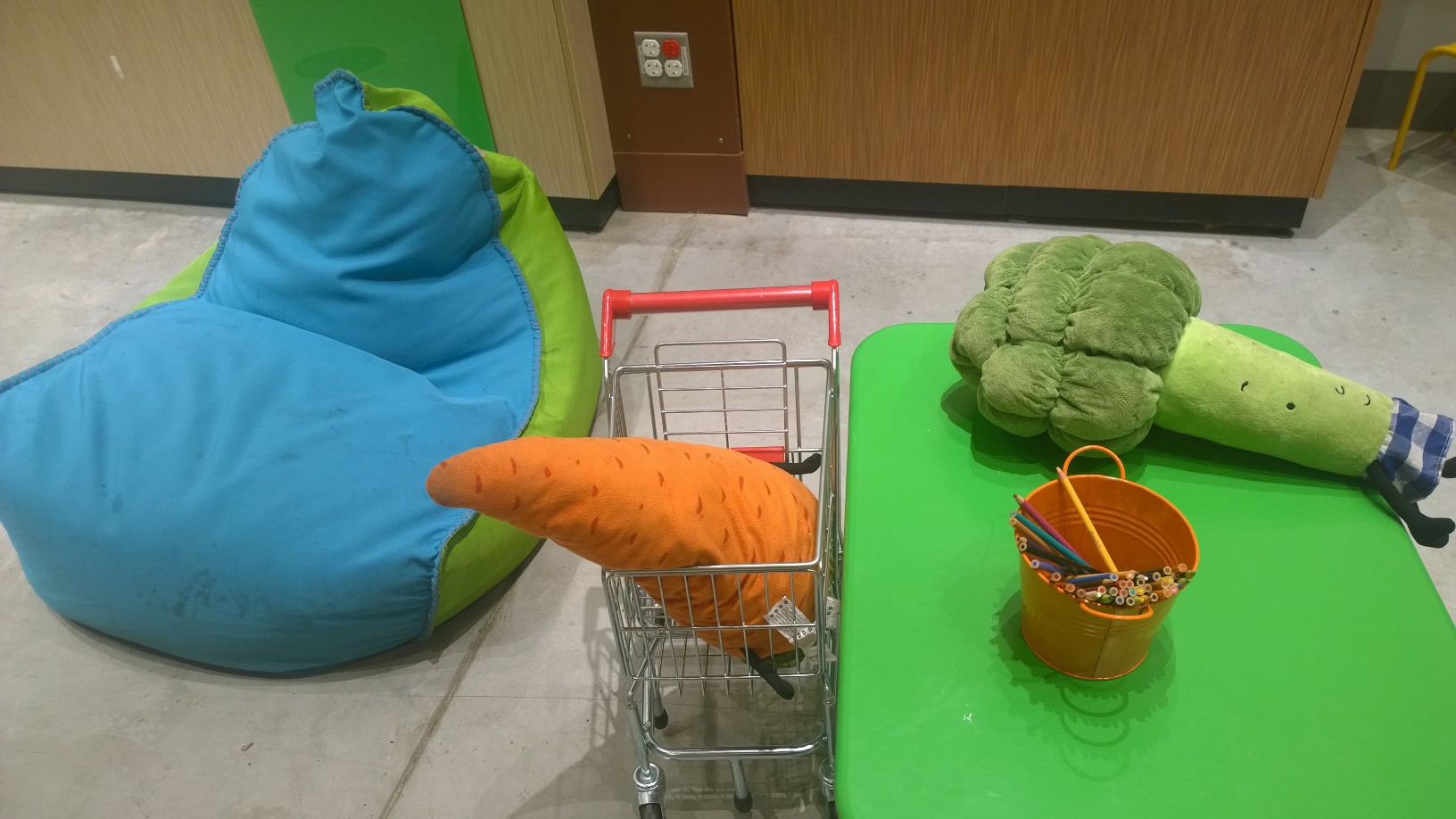
Note the vegetable soft toys in the children’s play area.

081315-market-window

081315-indoor-farmstand

081315-market-overview

081315-public-market-play-area

081315-cheese-at-market

081315-fresh-produce

081315-public-market

Read Full Post »

The Barnes Collection is a quirky museum that is now located in Philadelphia. The eccentric art collector required all his art to be displayed a particular way. Which is perhaps why two Cézannes hidden behind other works weren’t uncovered before now.

Writes Randy Kennedy in the NY Times, “In 1921, the wily art collector Albert C. Barnes wrote to Paris to his friend and fellow collector Leo Stein, who was in dire need of money and had deputized Barnes to sell some of his holdings in the United States. They included five watercolor landscapes by Paul Cézanne, but Barnes reported that he had failed to find ‘anybody who seems to think they are sufficiently important to want to own them.’

“It was pure mercantile flimflam. Barnes turned around and bought the watercolors for himself, at $100 each, installing them permanently in his personal museum near [Philadelphia]. Now it turns out that Barnes got a better deal than even he had thought: A conservation treatment of the watercolors has revealed two previously unknown Cézanne works — a graphite drawing and a watercolor with graphite — on the verso (the reverse side) of two of the watercolors.

“Hidden beneath brown paper backing, the newly discovered pieces are unfinished, but they have sent tremors through the world of Cézanne scholarship, where additions to his body of work are exceedingly rare and where even the resurfacing of long-unseen pieces can be huge news. …

” ‘These are a perfect example of how much we still don’t know about this collection,’ said Martha Lucy, a consulting curator at the Barnes and an expert on its Renoir and Cézanne holdings. ‘To add new work to Cézanne’s oeuvre is incredible.’ “

More here.

Art: “New” Cézanne at the Barnes Collection in Philadelphia

Read Full Post »

Photo of Gertrude Ely: Bryn Mawr College Collection

I was on the brink of unsubscribing to the American Academy of Poets poem-a-day e-mail because I let so many pile up and then have to slog through all sorts of contemporary brain twisters.

But as I was working my way through the poems today, I came across the one below. I thought, “Oh, I know exactly what this is about” and was carried back to my college days and hanging out at the home of my great aunt’s friend Gertrude Ely.

Gertrude Ely was quite elderly at that time but really interesting to be around. She knew all sorts of movers and shakers and was an awesome storyteller. I happened to be staying at her house one weekend when she received an unusual letter.

An elderly Philadelphia gentleman wrote that he had read in the Bulletin that she had received some civic award, and he just had to write and tell her a memory he had from his service in WW I in Europe. The Army was sending over carloads of friendly, proper young volunteers to chat with and cheer soldiers and bring a breath of home. The man wrote he would never forget a load of girls pulling up in an open car and Gertrude Ely calling out, “Any of you boys from Philadelphia?” He said, “At that moment, I believe every soldier there was wishing he was from Philadelphia.”

Gertrude Ely at my college graduation.

1966-GS-ELY-AT-CB-GRADUATION

***

American Boys, Hello! by Ella Wheeler Wilcox

Oh! we love all the French, and we speak in French
As along through France we go.
But the moments to us that are keen and sweet
Are the ones when our khaki boys we meet,
Stalwart and handsome and trim and neat;
And we call to them—“Boys, hello!”
“Hello, American boys,
Luck to you, and life’s best joys!
American boys, hello!”

We couldn’t do that if we were at home—
It never would do, you know!
For there you must wait till you’re told who’s who,
And to meet in the way that nice folks do.
Though you knew his name, and your name he knew—
You never would say “Hello, hello, American boy!”
But here it’s just a joy,
As we pass along in the stranger throng,
To call out, “Boys, hello!”

For each is a brother away from home;
And this we are sure is so,
There’s a lonesome spot in his heart somewhere,
And we want him to feel there are friends
right there

In this foreign land, and so we dare
To call out “Boys, hello!”
“Hello, American boys,
Luck to you, and life’s best joys!
American boys, hello!”

[Ella Wheeler Wilcox wrote “American Boys, Hello!” while visiting France during the latter stages of World War I as entertainment for the American soldiers stationed there.]

Photo of Ella Wheeler Wilcox: American Academy of Poets, here.

Read Full Post »

Barnes-3


Barnes-waterfall

Today I need the Indian goddess with the many arms because I want to say about the Barnes Collection in its new home, “On the one hand, on the other hand, on the third hand …”

After I saw the documentary The Art of the Steal, about how the fabulous art collection that was willed to a historically black college to keep it from art-world experts ended up in the hands of art world experts, I thought a trustee at Lincoln University had sold his patrimony for a mess of pottage. Now I think that receiving untold wealth is a curse and the donor better have a good plan and lots of resources to support the unfortunate recipient. (More about the movie.)

That’s two hands.

On Thursday, having visited the Albert C. Barnes collection in its new Philadelphia Museum of Art building, I needed a few more hands.

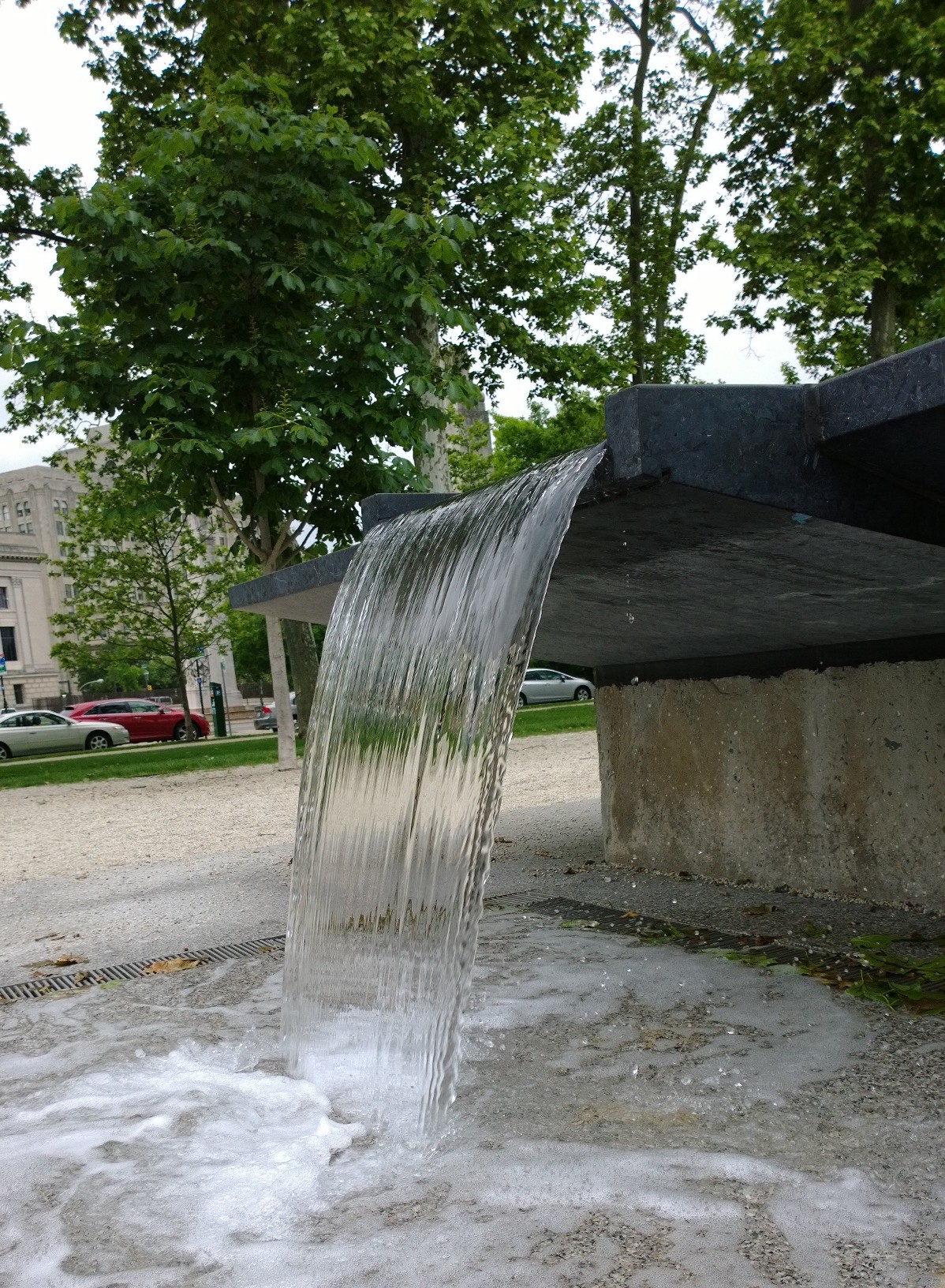
On the third hand, the building is gorgeous in its simplicity and displays the art (69 Cezannes, anyone? How about 60 Matisses? 44 Picassos? 178 Renoirs? Do you love Seurat? Van Gogh? Pennsylvania Dutch furniture?) in the quirky layout of the old Merion, Pa., setting and without labels as Barnes did. On the fourth hand, lack of labels is annoying. On the fifth hand, the art experts provide an ipod with lectures on selected works and a booklet to identify all the items exhibited. On the sixth hand, faithful as the layout is, Dr. Barnes, who made his money in pharmaceuticals and wanted ordinary working families to enjoy and study art without the filter of the art establishment — would have had a heart attack about the entry fee and the standard gift shop and coffee shop and other luxurious museum appointments.

The museum is definitely worth seeing, for the building, the art, and the way the roaring controversy was all handled. But it’s the little things I will cherish like finding black and white illustrations that reminded me of Dickens illustrations and turned out to be by the school friend Barnes asked to help form his taste and get him started on collecting (William Glackens).

Giorgio de Chirico, Portrait of Albert C. Barnes, 1926

Read Full Post »

Something fun from Studio 360: the mystery of the Toynbee tiles.

“For more than two decades, an unknown artist has been leaving a message in the streets of Philadelphia. The message is has been cut by hand into a linoleum tile, and pressed into the asphalt by the weight of passing cars. There are dozens of these around the city; old ones wear away, and new ones appear. The message is the same:

TOYNBEE IDEA
IN Kubrick’s 2001
RESURRECT DEAD
ON PLANET JUPITER

“The Toynbee tiles, as they’re called, have become a thing in Philly — you can even buy a t-shirt (the tiler isn’t getting royalties). For artists, the cryptic message inspires far-out forms of creativity, but perhaps nothing as ambitious as the ten-minute work by the rapper and ‘bedroom composer’ Raj Haldar, who performs as Lushlife.

“The work is in four parts, one for each line of the tiles’ message. By the end, the ‘Toynbee Suite’ has left behind anything resembling hip-hop, going out on a two-minute clarinet solo.

“But what exactly is the Toynbee message? Alfred Toynbee was a historian and philosopher of the 20th century, known for the 12-volume A Study of History. …

“A documentary film speculated that the tiler remained unseen by dropping the tiles from a car with cut-out floorboards.”

More on the mystery here, where you also can listen to the rapper’s tile-inspired music and check out a map showing where Toynbee tiles are located around Philadelphia.

Photo: Kimberly Blessing/flickr
A Toynbee Tile at 9th and Market Streets in Philadelphia, Pa.

Read Full Post »

Though I can’t say I’m crazy about the Philadelphia accent — or, for that matter, the accents of other places I’ve lived, like Boston’s, Minnesota’s, and Rochester’s — I really would hate to see it go.

I do like trying to identify where new acquaintances might be from. And the homogenization of regional accents just seems a loss. Maybe not a loss on the scale of endangered languages, but a part of a regional culture we’re likely to miss once it’s extinct like the heath hen.

This was in the NY Times recently: “The Philadelphia regional accent remains arguably the most distinctive, and least imitable, accent in North America. Let’s not argue about this. Ask anyone to do a Lawn Guyland accent or a charming Southern drawl and that person will approximate it. Same goes for a Texas twang or New Orleans yat, a Valley Girl totally omigod.

“Philly-South Jersey patois is a bit harder: No vowel escapes diphthongery, no hard consonant is safe from a mid-palate dent. Extra syllables pile up so as to avoid inconvenient tongue contact or mouth closure. If you forget to listen closely, the Philadelphia, or Filelfia, accent may sound like mumbled Mandarin without the tonal shifts.

“Some dialects can be transcribed onto the page, but the Philadelphia accent really has to be heard to be believed. And when an accent goes silent, so do its speakers. A recent study out of the University of Pennsylvania reported that, like many regional phenomena, the Philly sound is conforming more and more with the mainstream of Northern accents. And that’s a shame.

“The beauty of the Philly accent, and I should point out it’s mostly to whites that these sweeping statements apply, is its mashing-up of the Northern and Southern. Nowhere but in the Delaware Valley can you hear those rounded vowels — soda is sewda, house is hay-ouse — a clear influence from Baltimore and points south.”

More at the NY Times, here. The article is by Daniel Nester. (Nester? Not related to I.H. Nester, my Philadelphia father-in-law’s long ago employer? Now, that would be a small world.)

By the way, if you are interested in the Penn study, check out the National Public Radio interview: “Students of Penn linguistics professor Bill Labov have been walking around some 89 Philadelphia neighborhoods for four decades. At the school’s linguistics lab, they have shelves and shelves of recorded conversations from Philadelphians born in 1888 all the way to 1992.” More here.

Graphic: Jennifer Daniel
Can you identify the sawf pressel, the wooder, torsts (as in ” ‘Lannic city is too torsty ennymore”), a samalem, arnj juyce, a sennid cannle, a miskeeda, and the tayyin rowll (Italian roll)?

Read Full Post »

Here is another great music outreach to kids: the Philadelphia Youth Orchestra’s Tune up Philly initiative.

“The mission of Philadelphia Youth Orchestra’s Tune Up Philly program is to nurture urban children in challenging social and economic conditions by keeping them engaged in success through weekday out-of-school hours music instruction.  Through its Tune Up Philly program, Philadelphia Youth Orchestra organization believes that music education is a powerful vehicle for children to master skills that will enable them to acquire valuable tools for cooperative learning, teamwork, academic success and self-esteem.” More.

The Inquirer classical music critic Peter Dobrin wrote at Philly.com that an important goal of the initial program was to show the rest of the city what is possible.

“The brain-child of 24-year-old Curtis Institute of Music graduate Stanford Thompson … and adopted by the Philadelphia Youth Orchestra, Tune Up Philly started at St. Francis de Sales … with the aim of replicating itself at other sites …

“Modeled on the widely praised and emulated El Sistema program that has educated millions of children in Venezuela, Philadelphia’s upstart is already gathering considerable support. Since initial coverage in the Inquirer and subsequent media attention, the program has received donations of cellos, clarinets, double basses, flutes, saxophones, trumpets, trombones, violas, violins and other instruments, plus about $13,000 in cash and $10,000 in in-kind services.” More.

Photograph: First graders exploring xylophones in the 2012 summer program.

Read Full Post »

« Newer Posts