Feeds:
Posts
Comments

Posts Tagged ‘playground’

Photo: Inside Climate News.
Children play with a water fountain at a park in flood-prone Hoboken, New Jersey. The playground doubles as storage for stormwater runoff.

Yay for humans who come up with ingenious ways to mitigate the effects of climate change! Here’a a clever idea from Hoboken, New Jersey.

Victoria St Martin reports at Inside Climate News (via the Guardian), “For a city that is almost small enough to fit inside Manhattan’s Central Park just a few miles away, a lot of history has played out within the narrow borders of Hoboken, New Jersey.

“It was the site of the first organized baseball game in 1846, home of one of the US’s first breweries in the 17th century and the place where Oreo cookies were first sold in 1912. And, as any Hobokenite will tell you, the Mile Square City, as it is called, is also known for something else.

“ ‘Everything floods up here,’ Maren Schmitt, 38, said with a nervous chuckle on a Tuesday afternoon as she watched her two boys climb at a city playground.

“Nearly four-fifths of the land area in Hoboken – which sits on the western banks of the Hudson River – rests on a flood plain. And its intense susceptibility to flooding has probably never been more apparent than it was during Hurricane Sandy in 2012, when 500m gallons of storm surge flooded the city.

“But now … Hoboken officials have put in place a series of measures designed to mitigate the destructive effects of storms that are driven by climate change, including one innovation that the city hopes may become known as another Hoboken first.

“Located at the corner of 12th and Madison streets, one of Hoboken’s newest playgrounds, known as ResilienCity Park, [is] doubling as a storage area for roughly 2m gallons of stormwater runoff. …

“The park, which sits on five acres barely a mile and a half from the Lincoln Tunnel into Manhattan, features swing sets, slides, a basketball court and an athletic field – and, underneath it all, a below-ground tank capable of holding hundreds of thousands of gallons of stormwater that city officials say would have otherwise spilled on to the streets or streamed into the basements of Hoboken homes and businesses.

“Building climate-resilient – or climate-smart – playgrounds is part of a growing movement among municipalities and environmental advocacy groups in the US. … The Trust for Public Land, a nonprofit conservation group, estimates it has helped fund the construction of more than 300 such play spaces in communities around the country, including Philadelphia, New York and Los Angeles. …

“Some spaces, like those in Hoboken, utilize an underground tank, porous artificial turf and scuppers or openings on a basketball court to store excess stormwater. Others increase resilience with newly planted trees that can absorb carbon dioxide and airborne pollutants; once they mature, those trees also provide shade cover that can reduce the heat island effect of urban areas, a problem intensified by the traditional black asphalt playgrounds commonplace generations ago. …

“ ‘Every geography is going to have slightly different stressors,’ [Daniella Hirschfeld, an assistant professor at Utah State University who studies environmental planning] said. ‘Hoboken is a place that used to be an island. And the amount of water that it needs to store is very different than where I am here in Utah. But ultimately, you know, places can perform both as a safe haven for stormwater and, hypothetically, can even be a safe haven for fire, which is another threat that we’re facing.’

“Caleb Stratton, Hoboken’s chief resilience officer, recalls how city officials asked him to lead the rebuilding and recovery efforts after Hurricane Sandy. The park, one of four planned resiliency sites in the city, was primarily paid for with infrastructure replacement grants, including roughly $10m from the Federal Emergency Management Agency. Stratton said a key element of the park’s design was its multipronged approach to flood mitigation.

“ ‘It’s a park, stormwater pumping station, the whole thing,’ Stratton said during an interview at the park while a cluster of summer campers squealed on a playset nearby. ‘This is all the strategies mixed up into one.’ …

“In addition to the underground stormwater detention tank, which holds 1m gallons of water, Stratton said above-ground infrastructure including rain gardens could hold a million more. An above-ground pump can also send water back into the Hudson.

“ ‘What we’re doing is creating places for the water to go so that we can manage it and keep it off the streets, keep it out of people’s buildings, and get prepared for the uncertain future, which we’re kind of experiencing in real time.’ …

” ‘They need more like this, for sure, so the kids can get outside,’ said Tyrik Davis, 26, a resident of nearby Fairview, New Jersey, who was visiting the park with his children, Naylani, six, and Tyrik Jr, three. ‘Especially this generation. There’s no more kids at the parks. They’re all inside with their phones.’ ”

More at the Guardian, here. No paywall.
Read Full Post »

Photo: Caroline Gutman/Bloomberg.
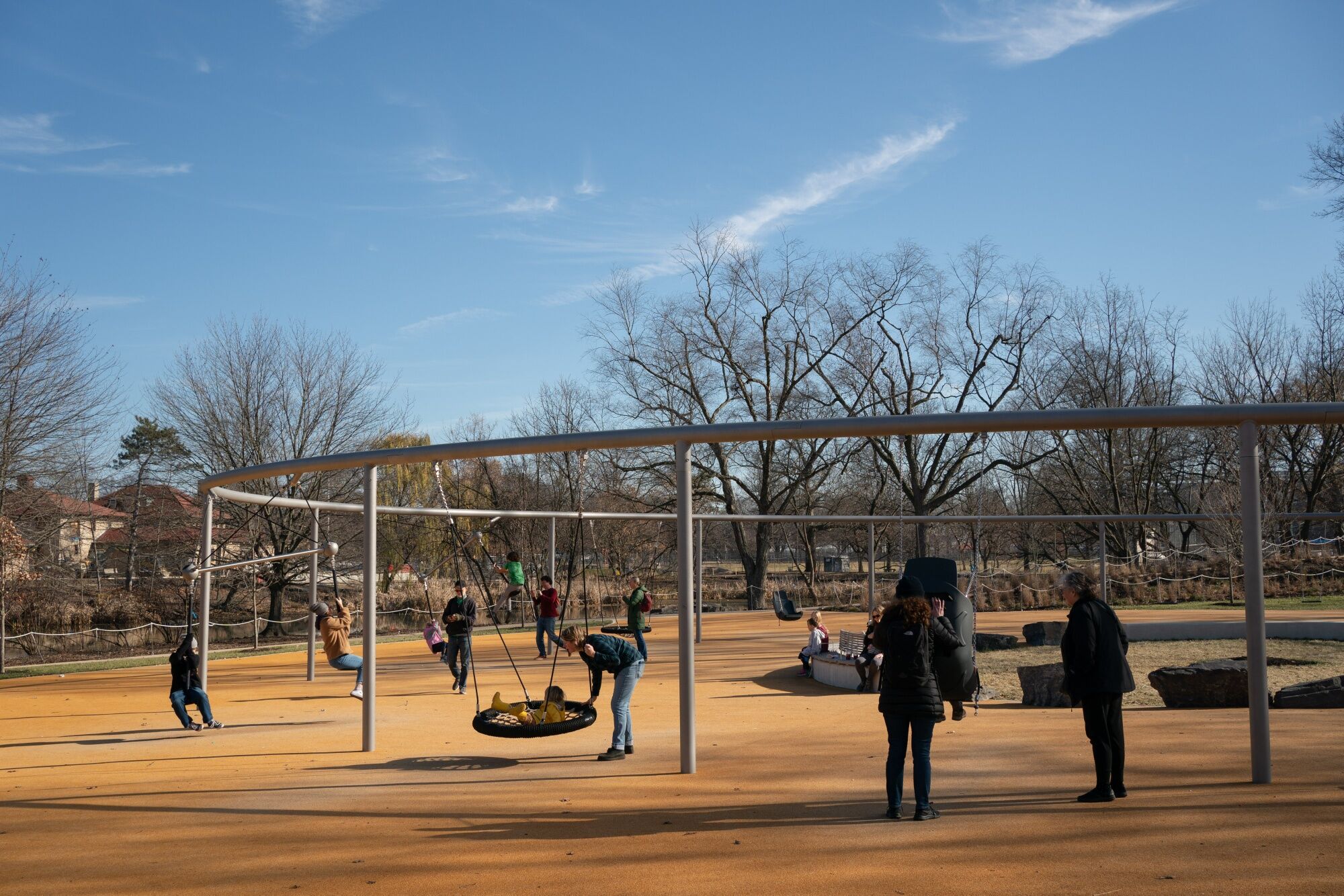
A 20-swing structure for visitors of all ages at the Anna C. Verna playground in Philadelphia. 

In the Swedish retirement community where reader Stuga40 lives, there’s a playground for adults. Of course, the Swedes are always ahead of the rest of the world on quality-of-life things, but the idea of all-ages playgrounds is catching on in other countries, too.

Alexandra Lange reports at Bloomberg, “A swing can be the simplest thing: two chains attached to a board, a rope knotted through a disc, a chair suspended from above. Swings appear on ancient Greek vases as instruments of leisure, and in eighteenth century Thailand as vehicles for competition.

“That’s the thing about swings: They can be sociable, but they are also physical. This inviting duality has often been undermined by public safety standards, which discourage swings for more than one person and mandate that they be far apart. After a certain age, swinging solo loses its thrill.

“But at Anna C. Verna Playground at Philadelphia’s FDR Park, on the south side of the city, the largest swing set in North America was designed to test those limits. Not by creating unsafe play, but by transforming those standards into something challenging, unusual, beautiful and rewarding for swingers of all ages.

“The playground, which opened in October and was designed by WRT Design with Studio Ludo as play consultant, features two acres of nature-based play, including seven slides of increasing height and speed, two steel-and-rope ‘birdhouses’ ascended by climbing nets, three log climbers, and assorted shady picnic tables, rock circles and sit-able logs.

“The centerpiece, however, is the 120-by-100-foot elliptical ‘megaswing’ from which 20 different swings of five different types hang in invitation to all the users of the park — from homeschool moms to tailgating Eagles fans, teenagers on a half-day to grandparents with toddlers, all of whom can train, bus, cycle or drive to the park.

“ ‘We are social animals, and play fosters social relationships,’ says landscape architect Meghan Talarowski, executive director of Studio Ludo, who is also a certified playground safety inspector. …

“At a time when many cities and business owners seem to want nothing to do with teenagers, it is refreshing to see a brand new public space issue them an invitation — and to go there and see that happening. Toronto urbanist Gil Penelosa, founder of 8 80 Cities, has long argued that designing a city that works for eight-year-olds and 80-year olds is a city that works for everyone. …

“Talarowski [got] her shot at the Anna C. Verna Playground in Philly, where she nestled a smaller ellipse — still equivalent to the size of a baseball infield — into FDR Park’s existing lagoon, like the thrust stage in a Shakespearean theater.

“ ‘There was this natural curve in the lagoon, and we were trying to connect the play design to the site conditions, without taking down any trees,’ says Allison Schapker, chief operations and projects officer for the Fairmount Park Conservancy, which is working with Philadelphia Parks & Recreation on the multi-phase, climate-sensitive $250 million dollar FDR Park Plan. ‘This is the point, if you are swinging high, you get views back to center city Philadelphia, so we are connected with both nature and the city.’ …

“The Anna C. Verna Playground is phase one in the restoration of FDR Park; the master plan is also by WRT. As part of their commitment to keeping things natural, WRT specified very little paint and plastic: The slides and climbing structures are stainless steel and rope, much of the seating is rocks and logs, the swings themselves are black plastic, plus more metal and rope. The big swing and the playground’s other custom pieces were designed in collaboration with equipment manufacturer Berliner Seilfabrik. Underfoot, the springy safety surface is not the flip-flop colored rubber of most playgrounds, or high-maintenance and inaccessible woodchips, but a permeable and recyclable cork product that comes in a subtle, toasted brown. ‘We feel strongly playgrounds should be sophisticated,’ says Talarowski.

“Sophistication [signals] to users that this equipment isn’t just for kids. As part of their two-year community process, the conservancy ‘did engagement activities on site with kids and their families,’ says Schapker. ‘Overwhelmingly, across every age group, they said they wanted to swing.’ ”

More at Bloomberg, here. Long article. Great pictures. No firewall.

Read Full Post »

Photo: Abby Oulton 

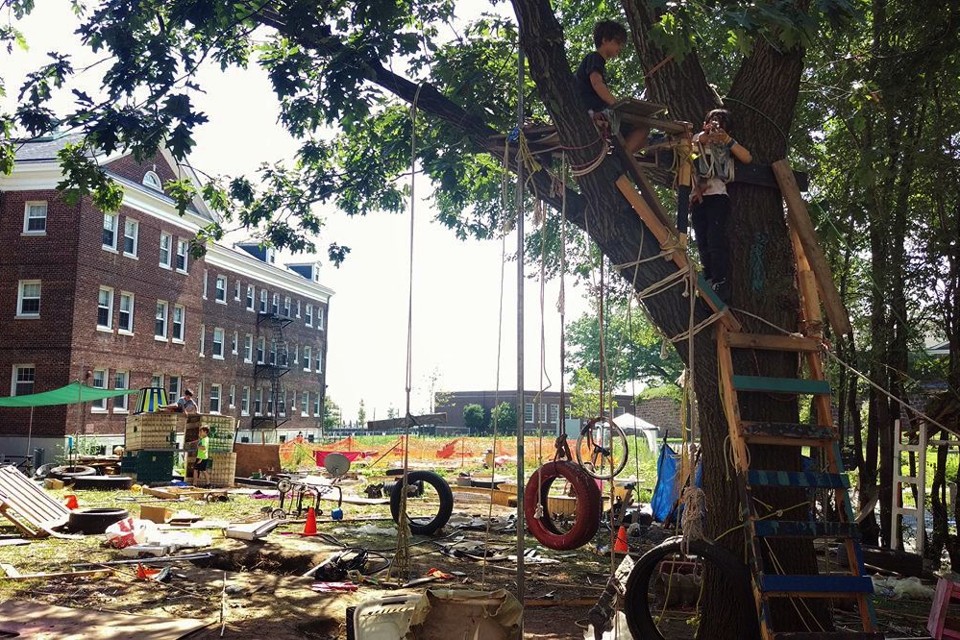
I’ve written before about outdoor nursery schools and child-directed play. Today we carry the concepts a bit further as Timothy D. Walker writes at the Atlantic about the “junk playground of New York City.”

“ ‘It looks like a dumpster playground,’ my wife told me, as we pushed our double stroller down a hill on Governor’s Island in New York City. ‘Like some slum.’

“In front of us was an area that looked like — to my eyes, at least — an Occupy Wall Street campground, with shoddy constructions of plywood, wooden palates, and blue tarp. I counted 10 children, who were roaming a space about half the size of a soccer field littered with car tires, plastic crates, orange cones, and a sea of unidentifiable debris. …

“In 1943, the first adventure playground (‘junk playground’) was piloted in the city of Copenhagen, Denmark, which was under Nazi occupation. From then on, the concept was embraced around the world, especially in Europe. A professional methodology called ‘playwork’ was established in the United Kingdom, in which trained adults (‘playworkers’) would run these environments. …

“Despite their global popularity, adventure playgrounds have struggled to gain traction in the U.S. … Peter Gray, a psychology research professor at Boston College, wrote in the American Journal of Play that free play — ‘activity that is freely chosen and directed by the participants and undertaken for its own sake’ — has declined over the past half century in America, and he inferred that a high level of parental fear about the safety of children and the rise of ‘adult-directed, school-like activities’ are two of the major causes. …

“On the ferry ride back to Manhattan, I reflected on how four  simple ingredients — junk, tools, physical space, and playworkers — could create such a powerful learning environment, where children appeared to develop their ‘Four Cs’ (communication, collaboration, critical thinking, and creativity) for hours on end. Indeed, these Four Cs were the key ’21st-century skills’ that many American schools strived to sharpen in their students, but at the junk playground, this development seemed to happen rather effortlessly through self-directed play, supported by well-trained playworkers. …

“Not only do I think playworker-run junk playgrounds represent the future of playgrounds, they seem to provide a glimpse into the future of schooling, too. Today, teachers — especially in America — are gravitating toward more active, child-directed pedagogical methods that look similar to what I observed on the junk playground: ‘project-based learning,’ ‘makerspaces,’ and ‘genius hour.’

“Finland, the Nordic nation that’s often praised as a leader in public education, is implementing its newest national core curricula this fall, in which playful learning and developing student agency are emphasized.”

Interesting, no? For me, child-directed play has always been the goal, but at the same time, I’m a safety nut. I suspect that US parents’ focus on increasing the safety of playgrounds may have something to do with the fact that fewer parents are there to watch. Just as monitoring your preschooler on a swimming trip may be something you don’t want to delegate, you may prefer to be nearby when you let your kids experiment with a junk playground.

There is more at the Atlantichere. Hat tip: Taught by Finland, on Facebook.

Read Full Post »

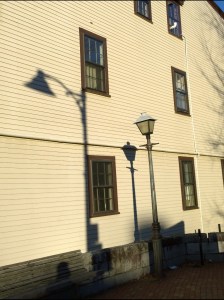
I love thinking about sunlight and shadow. Dickens uses them a lot for Richard and Ada’s story in Bleak House — maybe my favorite book of all time.

“So young, so beautiful, so full of hope and promise, they went on lightly through the sunlight … So they passed away into the shadow, and were gone.”

Many of you know what the decades-long case of Jarndyce vs Jarndyce did to Richard and Ada’s bright hopes. I’ve come to think that it was not so much Richard’s fevered expectations of an inheritance that brought the most sorrow, but his need to fix blame. Blame is corrosive.

When I interviewed a formerly homeless Marine last week and he started telling me about how upset he was that something bad had just happened with his benefits, I was touched by how he kept reminding himself how to cope, saying, “I believe in fixing the problem — not the blame.” Words to live by.

The first three photos were taken early Saturday morning, when the effects of sunlight and shadow were especially breathtaking. (I can never resist that old graveyard. You’ve seen it here in all weathers.)

The next three were taken at the playground near John’s house. Every few months, new creatures appear on that tall tree stump. (You’ve seen previous creature photos, too, on this blog.)

031216-early-footpath-shadows

031216-lamppost-shadows


WP_20160312_06_42_36_Pro

031216-carved-eagles-arlington


031216-carved-woodpecker-arlington

031216-hidden-bunny

Read Full Post »

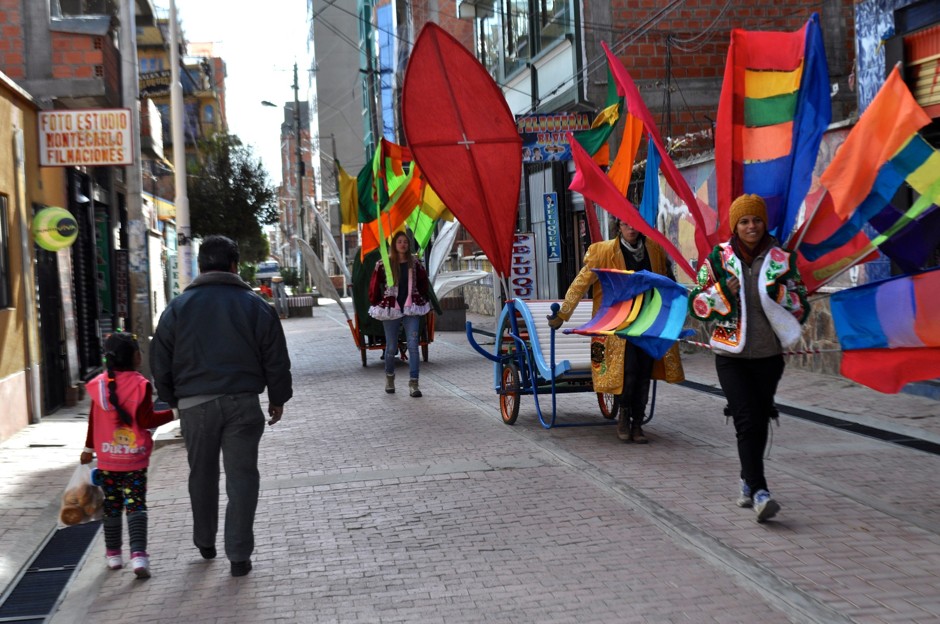
Azzurra Cox at the Atlantic‘s City Lab website wrote recently about design students and a nonprofit theater group that “created a ‘park-in-a-cart’ to serve the fast-growing city of El Alto, Bolivia.

“One bright July afternoon in El Alto, Bolivia, a playground paraded across a busy intersection.

“In the country’s second-largest city—and, at approximately 13,500 feet, the highest major urban settlement in the world—desfiles are a frequent occurrence, even a way of life. …

“But this parade was different. Dodging a stream of minibuses, a few individuals wearing carnivalesque costumes tugged two colorful metal carts—one resembling an astroturf bee, the other an elephant—to the center of a nearby plaza.

“Working in the harsh sunlight, they set about disassembling the carts. The shell of the bee became a series of green mounds, while the elephant trunk revealed itself as a slide.

“In a matter of minutes a playground was born, and the sounds of children playing rippled across the plaza. …

“In this dense city, driven by commerce at all scales, streets, sidewalks, and communal spaces are often transformed into informal markets, where vendors and minibuses compete for real estate. While this competition brings vitality, it requires novel methods of occupying urban space for play.

“The pop-up playground aims to do just that. Over three summers, the International Design Clinic (IDC), a ‘guerrilla design’ collective, has collaborated with Teatro Trono to design and build a pair of mutable, movable playspaces …

“Toward the end of that July afternoon, the park collapsed its way back into the carts. As one mother convinced her five-year-old to take her last turn down the slide, she asked one of the designers where she could find the playground next. Megan Hoffman, who studied anthropology at Temple University, recalls a grandmother who offered the group a sleeve of crackers to express her gratitude.

“ ‘That day,’ Hoffman says, ‘our pop-up playground was a space of joy.’ ”

More at City Lab.

Photo: Megan Hoffman
The mobile park on parade in El Alto this summer.

Read Full Post »

giant-sandbox-at-playscape

gluing-nature-collage

slide-at-Ripley-Playscape

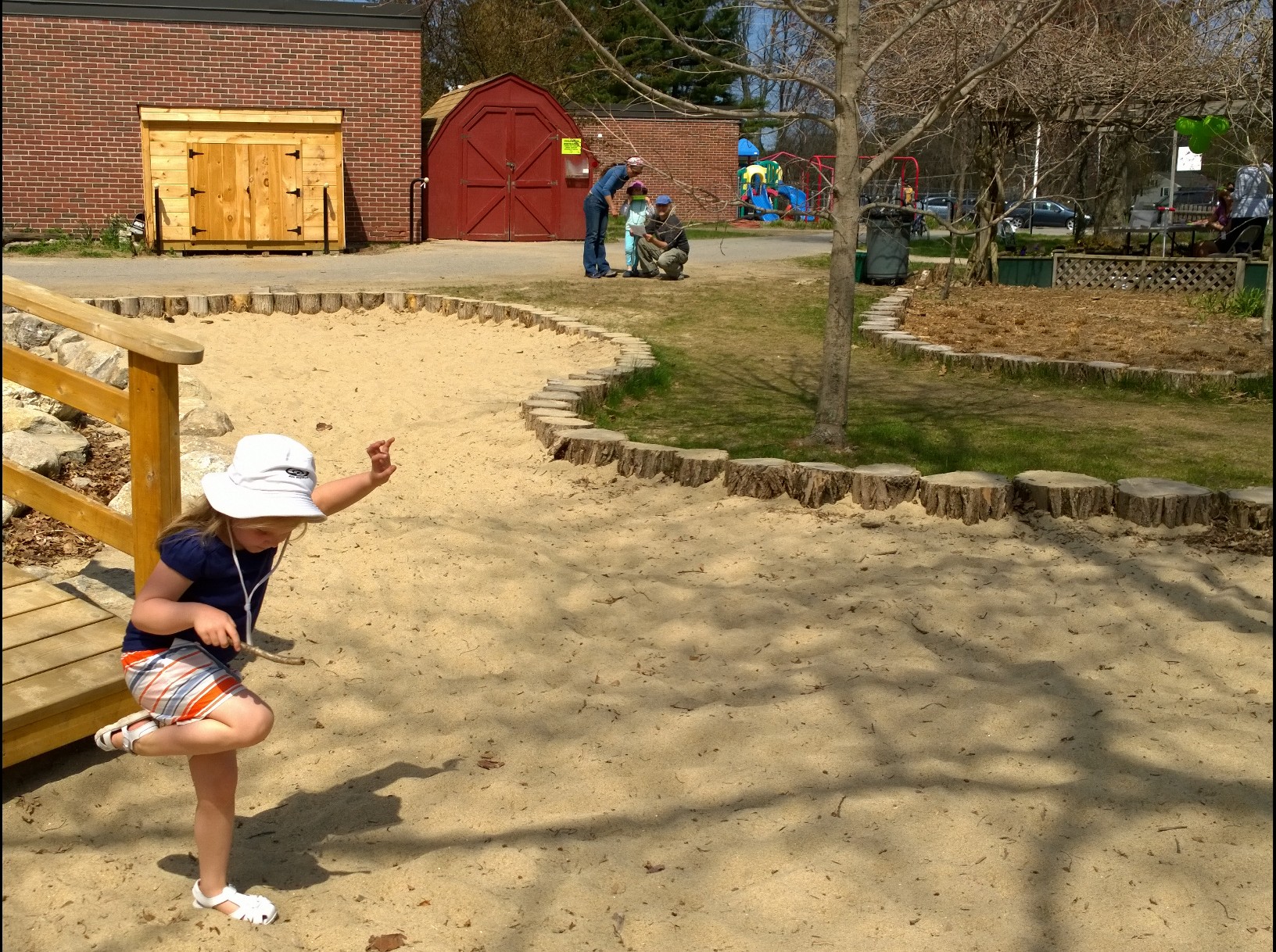
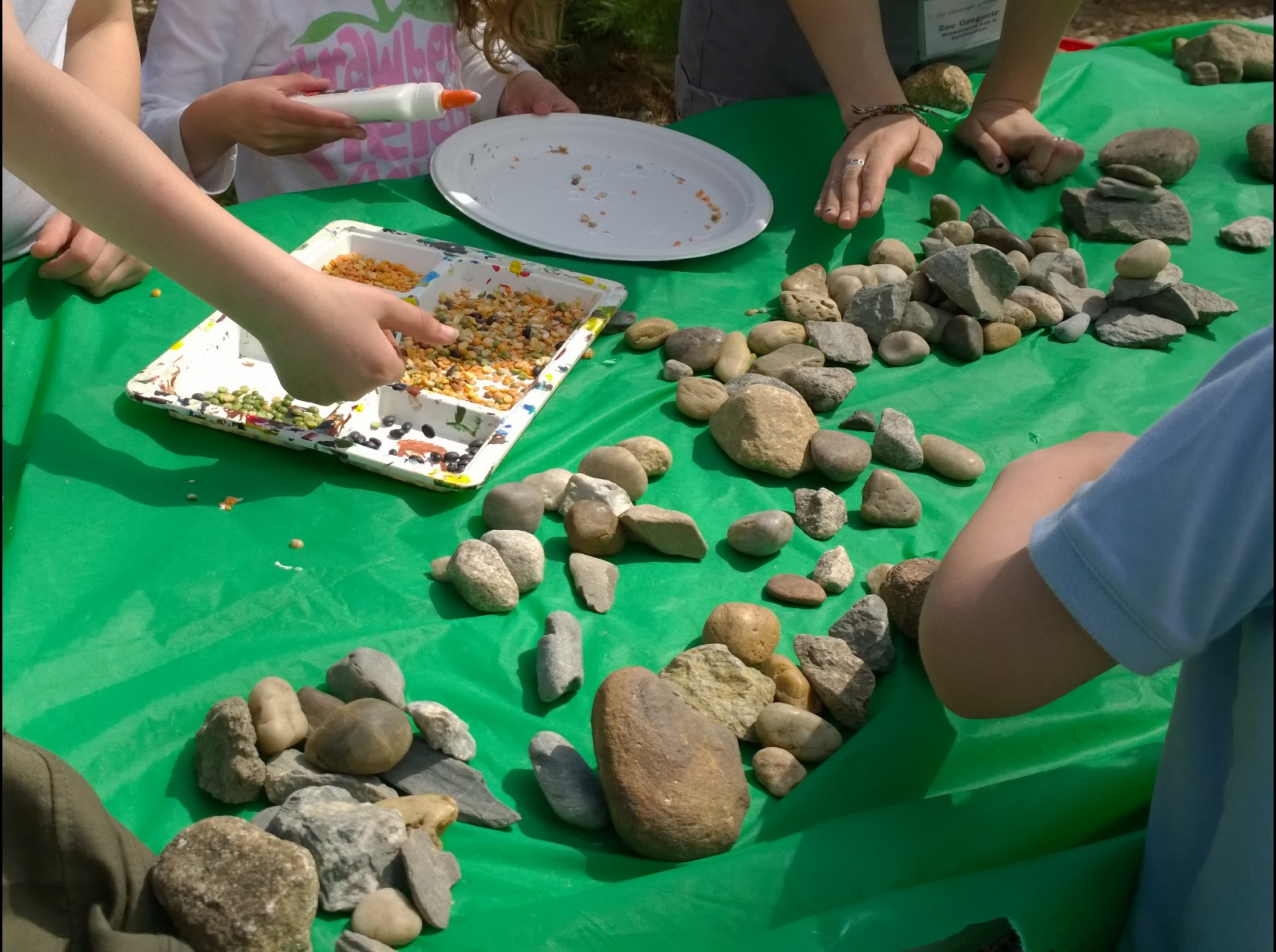
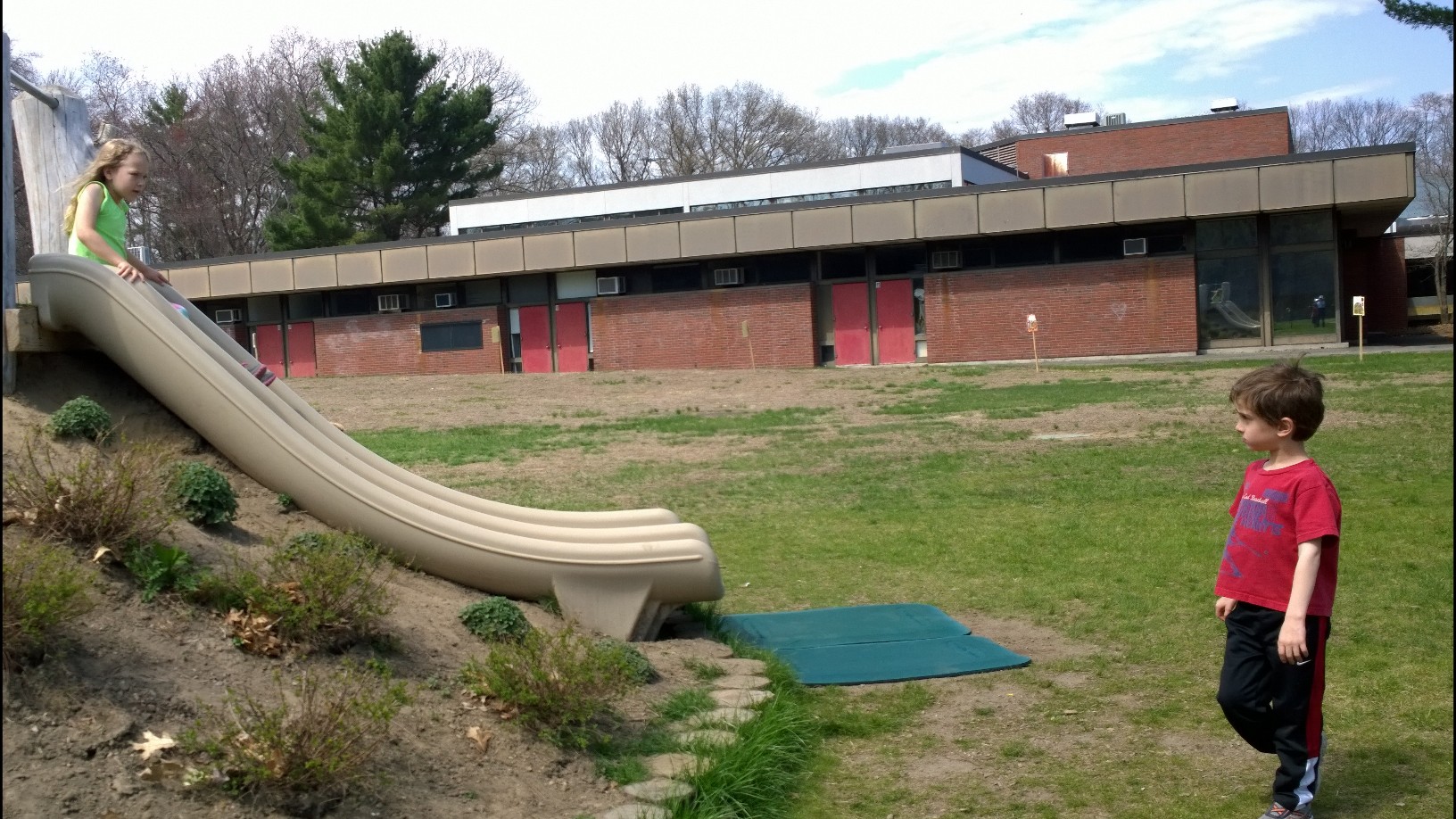
I wrote about the early stages of the Playscape at the Ripley School three years ago, here. The idea of the playscape was to incorporate nature activities into a playground. An open house was held last Sunday, and I saw lots of children, parents, and grandparents checking it out.

Perhaps because it was early in the season, perhaps because an open house seems to call for planned activities, it was hard to see if there were enough attractions available for exploring nature on quieter days. Of course, I grew up on the edge of an orchard, a forest, and a mountain, and no one told us kids how to have fun there. Anything less in nature play seems sparse.

One thing I liked was not really an interaction with nature except that you had to walk through a field to engage. It was the story walk for Lynne Cherry’s picture book on a groundhog who learns to make his own garden rather than help himself to other people’s. The laminated page spreads on posts around the field were charming and had lots of useful details about plants and seeds.

A gardening friend on my commuter train was very glad to hear the groundhog learned to grow his own food and leave hers alone.

Read Full Post »

From time to time I hear about a growing interest in play areas that focus less on safety and more on creativity and fending for yourself. Safety has always been important to me, but maybe children (grownups, too) get in more trouble when they leave the safety issues to authorities. Maybe there’s something to be said for learning to handle tricky situations by being in tricky situations.

In any case, woodland nursery schools, wild parks, and junky playgrounds are getting attention.

Amy Fusselman, adapting her book Savage Park for the Atlantic, describes her family’s reaction to a wild park in Japan.

“As the eight of us walked, first up a slight dirt hill, then past a gaggle of unlocked bicycles, we smelled it: smoke. The smell became stronger as we went ahead. We followed it until at last we were all standing beside a traditional Japanese hut that was perched atop a downward-sloping one-acre patch of dirt and trees.

“The hut’s front porch was completely overflowing with crap, including a pink-painted piano at which a girl, five, was sitting and playing a John Cage-ian ditty. It was a strangely radiant sound to be hearing as we stood there looking down through the smoke—we could see it as well as smell it now—to the smoke’s source: open fires.

“There were three of them. At one, a boy about eight years old was kneeling, poking at the flames with paper fans; at another, a father was sitting and roasting marshmallows with his toddler son. A third fire seemed to be unattended. …

“We stood there, dumbfounded, staring at the dirt and trees and the structures that were woven around and between them, structures that were clearly not made in any place where safety surfacing had ever been a subject of serious discussion. These were structures that looked like what remained when my sons decided to build an airport out of Legos and then abandoned the project halfway through, only these half-made baggage carts and control towers were much larger and crafted not from nicely interlocking plastic rectangles but from scraps of wood and nails. …

“At one point, I looked up at the trees. I was astonished to see that there were children in them. The more I looked, the more children I saw. There were children 15 feet high in the air. …

“I sat on a log, eating warm, white gooey marshmallows. The park was around us, and the trees were around us, and the dirt was around us, and the smoke, and the music. The children were in the trees, and were flying in the air. We stayed there as long as we could.”

More here.

Photo: Associated Press


Read Full Post »

When a do-gooder from the nonprofit Kounkuey Design Initiative told poor farmworkers at a California trailer park she wanted to work with them to build a place to relax and play, they didn’t think much would come of it.

Patricia Leigh Brown writes at the NY Times why the community is happy to have been proved wrong.

“When Chelina Odbert, the 36-year-old co-founder of the nonprofit Kounkuey Design Initiative, based in Los Angeles, showed up two years ago and asked residents to propose ideas for a park that they might design and build collaboratively, most assumed she was yet another do-gooder bearing ‘muchas promesas’ that would come to naught.

“And yet, after more than a year of drawing, debating, hauling rocks and waiting out bureaucratic delays, the residents had a fiesta recently to celebrate the opening of the park, a public space built out of railroad ties and other simple materials. It has a playground, a community garden, an outdoor stage and a shade structure where neighbors can gather and gossip even on 110-plus-degree days.

“The park, which doubles as a zócalo, or traditional town square, exemplifies a new phase for both Kounkuey (KDI for short) and the field of public-interest design, which tries to put design tools into the hands of neighbors who can create local change. …

“Alberto Arredondo, 51, lives across from the garden and has become its keeper. … Before, he said, he would come home after a day in the fields picking grapes and collapse on the sofa. The park, he added, has ‘de-stressed the women.’

“His theory was borne out by Rosa Prado, whose commitment to the park never wavered. ‘It helps with depression,’ she said. ‘You go out your door, and you see a lady in the park and sit next to her.’ She added, ‘Then a few minutes later, you forget what you’re worried about.’ ”

More here.

Photo: Monica Almeida/The New York Times
Residents of all ages turn out for the opening of a new public space, by the Kounkuey Design Initiative, in St. Anthony’s Trailer Park, home to farmworkers east of Palm Springs, Calif. 

Read Full Post »

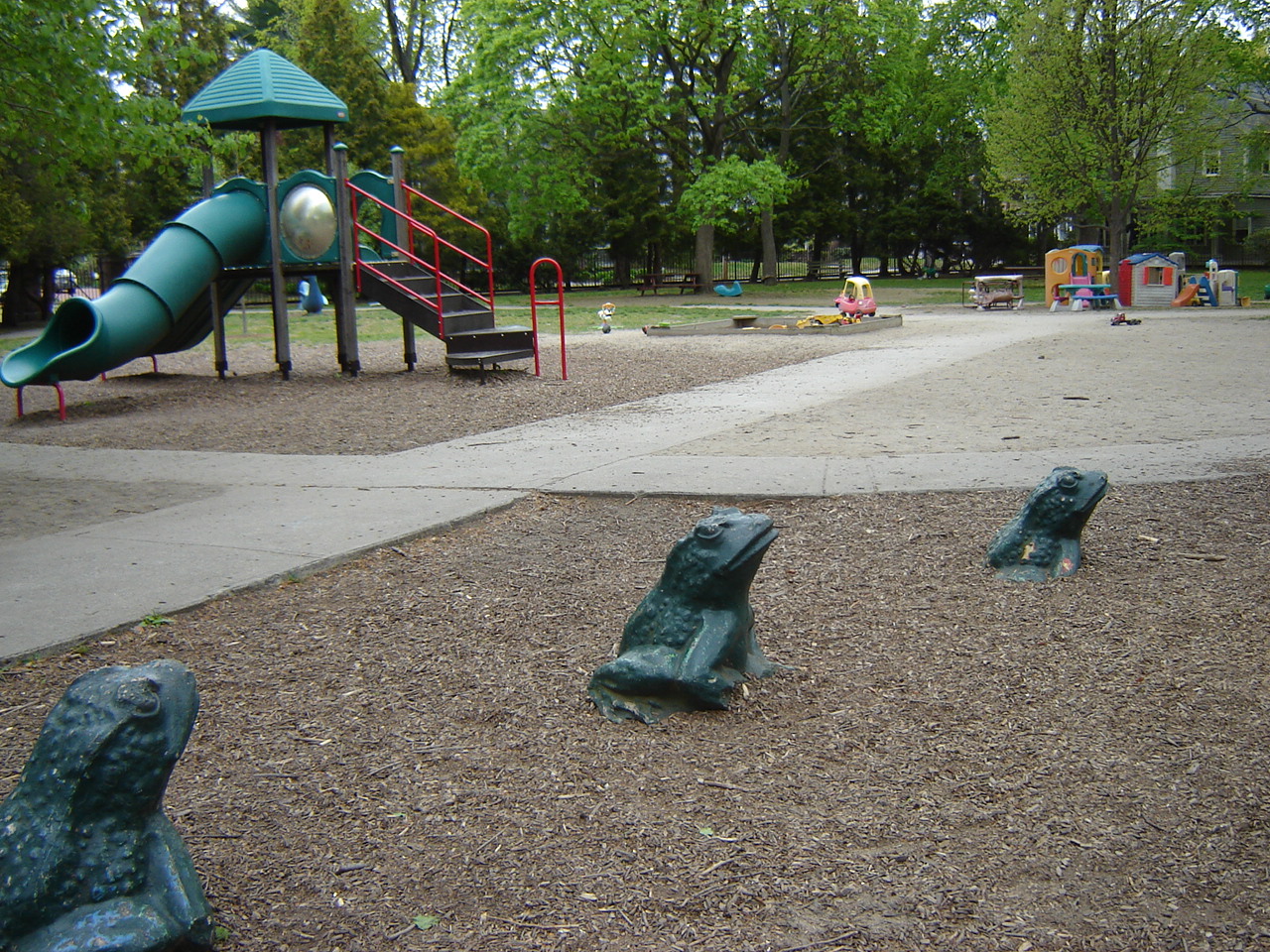
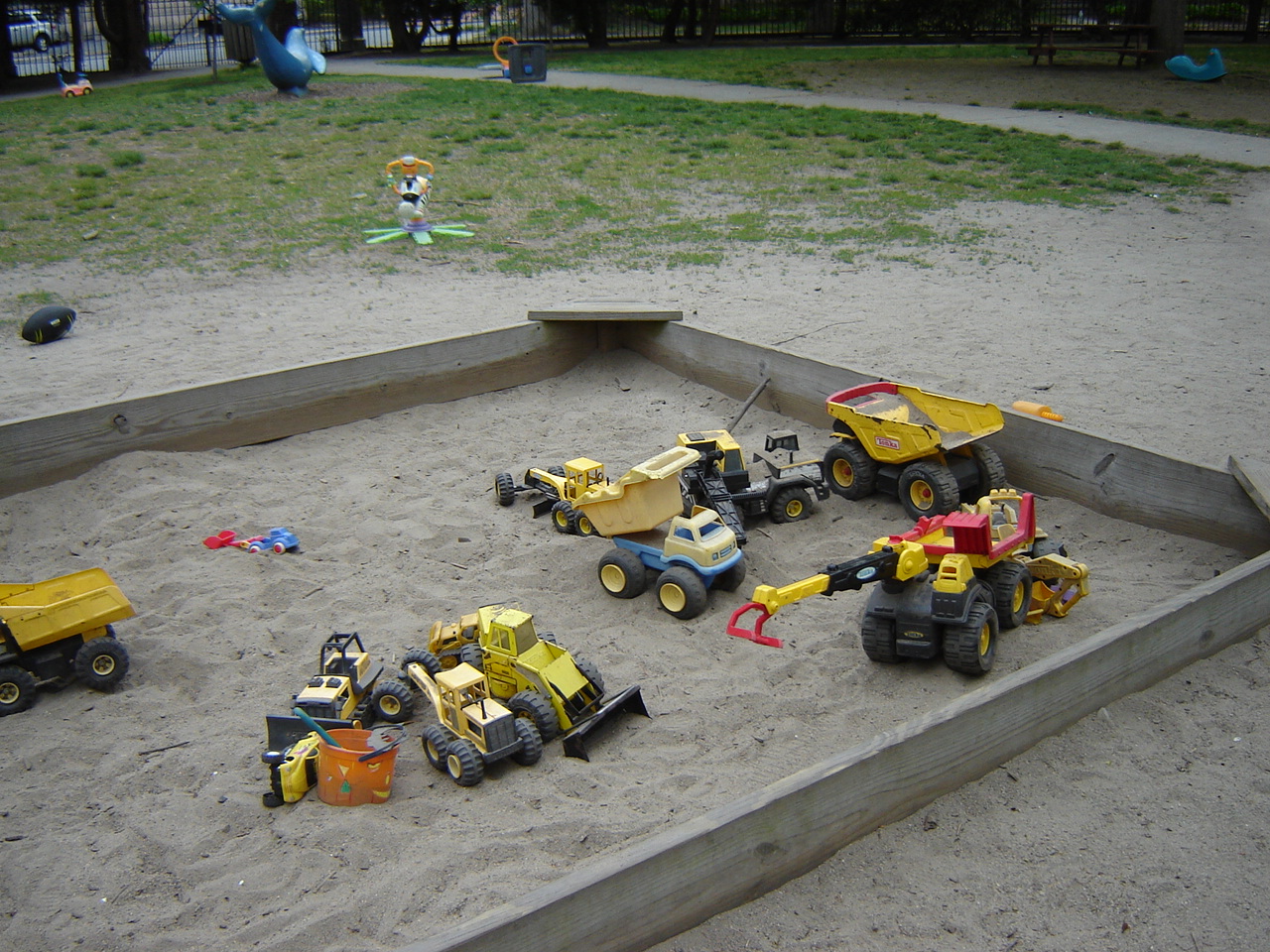
We took a walk and canvassed places where the new baby will play. It will be a while before that, of course. In the meantime, his cousin may be willing to test out the equipment. My husband, who knows this from experience, thinks our two-year-old grandson will be especially keen to try chin-ups on the dangling wheels.

Read Full Post »

Had an awesome playdate with my grandson and his parents today.

John and I pushed the stroller to a playground that has lots of climbing things and outgrown toys that families donate. On the way, we passed a neighbor’s yard. Smoke was curling up behind the fence. The three-year-old twins were roasting green coffee beans in an old popcorn maker, their dad watching. The children are apparently quite skillful aficionados and know the difference between “first crack” and “second crack,” a coffee-roasting concept that was news to me. They gave a jar of roasted beans to John to take home, with instructions to let the beans breathe overnight.

At the playground, there were many dads with toddlers. Only two moms. It seems to be a Saturday-morning phenomenon — proof that Suzanne’s high school friend Mike was onto something when he founded Playground Dad.

We also had fun playing in the pup tent that had temporarily taken over John’s dining room. And we danced. My grandson will dance at the drop of a hat. You don’t need to play music — singing a cappella or rattling a jar of freshly roasted coffee beans to a good beat will get him going. His dad took break dancing as a kid. Also tap. And his mom is a super dancer. So there you go.

Read Full Post »