Feeds:
Posts
Comments

Posts Tagged ‘poet laureate’

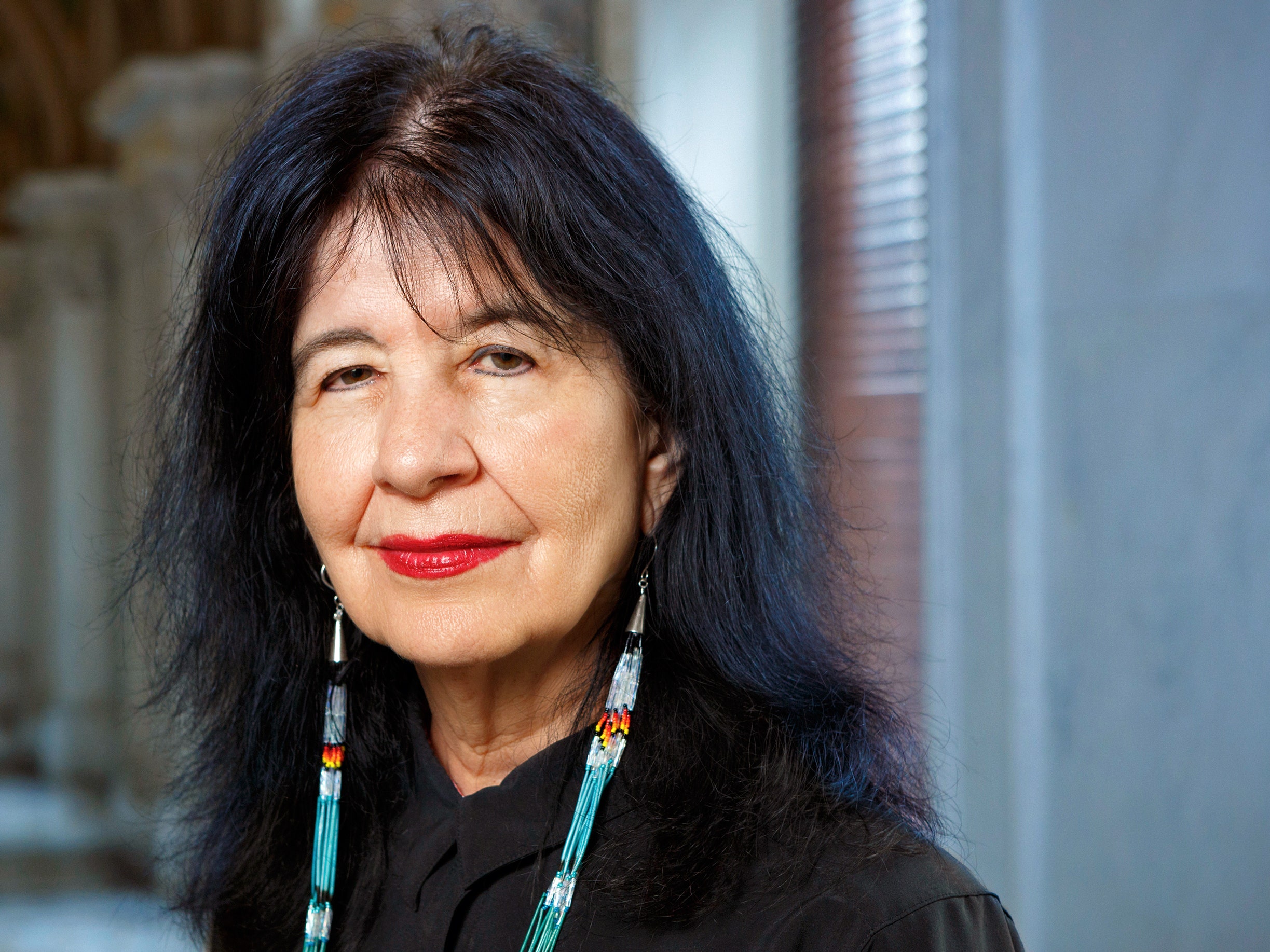
Photo: Shawn Miller / Library of Congress / NYT / Redux via the New Yorker.
Joy Harjo, US Poet Laureate, is an enrolled member of the Muscogee Creek Nation. Her hometown is Tulsa, Oklahoma.

Are you familiar with the work of our current poet laureate, Jo Harjo? I felt moved to share an article about her today because I’m about to attend for the first time the online version of my local library’s poetry readings.

Jason Berry at the Daily Beast writes, “I started a Joy Harjo reading jag the summer before last in Santa Fe, New Mexico, at op. cit., a magical store in whose forest of books, new and older, I picked up her 2012 memoir, Crazy Brave. I knew Harjo was the U.S. Poet Laureate, the first Native American so exalted, but I had never read her work. Her memoir’s opening scene hooked me right away:

“ ‘Once I was so small I could barely see over the top of the back seat of the black Cadillac my father bought with his Indian oil money. He polished and tuned his car daily. I wanted to see everything. …

“ ‘I wonder what signaled this moment, a loop of time that on first glance could be any place in time. I became acutely aware of the line the jazz trumpeter was playing (a sound I later associated with Miles Davis). I didn’t know the words jazz or trumpet. My rite of passage into the world of humanity occurred then, through jazz. The music was a starting bridge between familiar and strange lands.’

“That bridge runs through Harjo’s impressive trek of 22 books of poetry, six albums as a jazz saxophonist and husky spoken-word poet, two children’s books, two plays, last year’s memoir sequel Poet Warrior, screenplays, and editor of major anthologies. …

“The scenic lilts of self-discovery in her early work never took Harjo far from a steely focus on the dynamics of identity, enduring and transcending government injustices heaped on Indians, a legacy she came, over time, to see as precursor to the greater earth plundered by pollution, heaving from convulsions of the climate. …

“In Poet Warrior, Harjo circles back to devastating childhood episodes initially described in Crazy Brave, with new details on how she survived her early years. The father she initially adored, who came from a family with land generating some oil lease revenues, was an airline mechanic and raging alcoholic who chased women, beat his wife, and terrorized his kids. Joy’s mother sang as she bustled in the kitchen to sweet radio songs, doing a memorable take on Patsy Cline’s ‘I Fall to Pieces,’ getting the girl into jitterbug dancing. …

“The child had a poetry anthology which opened a new world with the kindred spirit of Emily Dickinson: … ‘I liked to read aloud to myself: “I’m Nobody! Who are you?/ Are you — Nobody — Too?/ Then there’s a pair of us!”

“ ‘Two nobodies equal one somebody. Emily’s poems told me she found herself with words. Poetry was a refuge from the instability and barrage of human disappointment. When I read and listened to disappointment I was out of the crossfire of my parents.’ …

“As a teenager [Harjo] found rescue with acceptance to the Institute of American Indian Arts, a high school in Santa Fe where she boarded in the late 1960s, meeting young Seminoles, Sioux, Creek, and Pawnee students among those from other nations, awakening to a Native American renaissance as they found expression in classes on drama, literature, music, and the arts. …

“She fell in love with a Cherokee boy, became pregnant, ended up going to live with the boy and his cloying mother in Talequah, Oklahoma. After working day jobs to cover babysitting for her son while the boy-husband failed to get jobs, she took the baby and moved to Albuquerque, a single mom balancing work and classes at the University of New Mexico.

“She fell in love with a poet by whom she had another child, only to realize that his wild binges, jumping in hotel swimming pools where he wasn’t staying, crawling home with flowers and florid apologies, were a disaster she had to escape. …

“She [had earlier] joined the Creek-Muscogee nation, adopting the surname Harjo in honor of a grandmother whose artworks inspired her. ‘Just as I felt my grandmother living in me, I feel the legacy and personhood of my warrior grandfathers and grandmothers who refused to surrender to injustice against our peoples.’

“In Albuquerque, at U.N.M., Joy Harjo became a poet, charged with a spiritual sensibility given shape by the stories and tribal history she absorbed in the Muscogee Creek Nation. The challenge of poetry was stark, as she writes near the end of the first memoir.

“ ‘I could not express my perception of the sacred./ ‘I could speak everyday language: Please pass the salt. I would like … When are we going … I’ll meet you there./ I wanted the intricate and metaphorical language of my ancestors to pass through to my language and my life.’ …

“She experienced a conceptual turning point in 1990 while attending a conference of indigenous peoples in a mountain village near Quito, Ecuador, discussing a counter-response to the approaching celebration in the Americas of the 500th anniversary of Columbus’ arrival in 1492.

“ ‘I’ll never forget the arrival of the people from the Amazon villages,’ Harjo wrote in a 2010 piece for Muscogee Nation News. ‘They walked up to the encampment barefoot, with their beautiful, colorful feathers and spears. They came to share a story of American oil companies, and how the lands were being destroyed and their way of life irrevocably broken.’ “

More at the Daily Beast, here. I especially liked an insight about indigenous people that Harjo quotes from one of the elders of her tribe: “No matter how small a tribal people may be, each of them has a right to be who they are.”
Read Full Post »

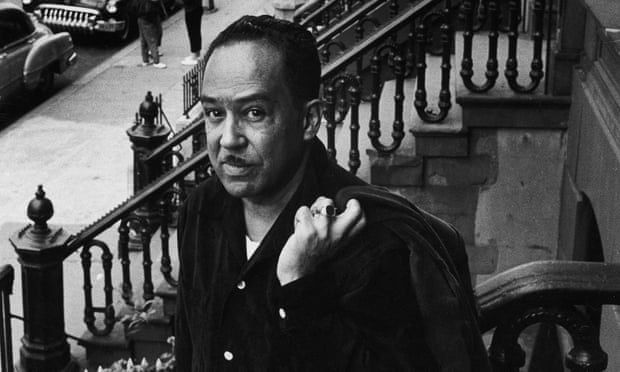
Photo: Robert W Kelley/Time Life Pictures/Getty Images
Langston Hughes on the front steps of his house in Harlem, June 1958.

Before Suzanne and Erik moved to Providence, they were living in a lovely renovated brownstone in Harlem.

There’s a fine line between newcomers investing where there’s been too much disinvestment — and gentrification. The early changes seem to benefit a neighborhood and its people, but inevitably rising property values push out many longtime residents and institutions.

Today, a group of Harlem artists from various disciplines are banding together to keep a significant piece of the Harlem Renaissance around to nourish African American arts.

Tom Kutsch writes at the Guardian, “All that signifies the legacy of a house once occupied by the poet laureate of Harlem is a small bronze plaque, partially covered by a cedar tree’s branches and the green ivy that envelops much of the building.

“The onetime home of Langston Hughes has sat largely unoccupied for years, but a new movement is trying to reclaim, for a next generation of artists, the space of a man who is forever intertwined with the Harlem Renaissance.

“Spearheaded by writer, performer and educator Renée Watson, the collective effort is busily trying to raise the necessary funds to purchase a lease and make needed renovations to the house. …

“Watson plans to make the Hughes house the home of the I Too, Arts Collective that she launched alongside the effort, which aims to, in her words, have ‘programming that nurtures, amplifies, and honors work by and about people of color and people from other marginalized communities.’ …

“The collective gets its name from one of Hughes’s most famous poems – I, Too – in which his narrator concludes by intoning:

They’ll see how beautiful I am
And be ashamed—
I, too, am America.

“Watson is using the crowdfunding website Indiegogo to solicit donations for the project, for which they’re hoping to raise at least $150,000 to cover a lease and begin the renovation process. By the time of publication, they had raised more than $54,000, already exceeding the $40,000 Watson says would cover at least a six-month lease. …

“For more than a century, Harlem has been inextricably linked to black life and culture in America; the birthplace of the aforementioned Harlem Renaissance, which fostered a wide array pre-eminent black artists and writers, from Zora Neale Hurston to Claude McKay and Duke Ellington. …

” ‘The erasure of black Harlem may come despite our best efforts …’ said Tracey Baptiste, a local children’s author who is involved with Watson’s collective. ‘But this project is about making sure that gentrification doesn’t also happen in the hearts and minds of our artists.’ ”

More here.

Read Full Post »

I was in New Shoreham in the spring, stopping at the bagel place, and Suzanne pointed out that on a patio table there was a little birdhouse where people were encouraged to contribute a poem to a small notebook. I added a haiku and a jingle I wrote decades ago.

Two days later, it hit me. I had participated in Poetry of the Wild, and I had written about it already here.

Rhode Island Monthly had a bit more on the subject.

Poetry Project founder and former RI poet laureate Lisa Starr told reporter Casey Nilsson about the April weekend when Poetry of the Wild was to be launched. “We’re finding ways to expose people to things that they might not be exposed to, to broaden the horizon while working on creative projects.

“One of the English teachers, Nancy Greenaway, started a project, Favorite Poems: Voices from the Village. She finds members of the community who have never come to a Poetry Project — like the guy who runs the deli or the music teacher — and asks them to choose their favorite poem … Nobody knows who they are until the day of the event.”

Starr also describes the new addition to the Poetry Project weekend, Poetry of the Wild: “a public art installation featuring boxes made by members of the community that contain a particular poem. The poems are meant to enhance whatever setting they’re in.

“The tech ed teacher at the Block Island School, Mark Mollicone, and the art teacher, Lisa Robb, [were eager to help.] They worked with the entire seventh and eighth grade class. Each student either made their own box or partnered with somebody. The kindergarten class made their own box and the first graders worked with a local bookshop owner on a box, too.”

The boxes were ultimately placed around the island. And I saw a birdhouse-like box outside the bagel shop.

More here.

Photo: Rhode Island Monthly
Carrying a box for a poem past Harbor Baptist Church, New Shoreham.

Read Full Post »

Nancy Greenaway, also known to readers of this blog as the Snowy Owl Poet, just told me about two New England poetry events taking place this spring.

The ninth annual Block Island Poetry Project, featuring Rhode Island Poet Laureate Lisa Starr, will be offering four workshops, starting in April 12 and going to May 13.  Former U.S. Poet Laureate Billy Collins will be there there May 12 and 13. I include a photo of Collins from the event website.

The other event is scheduled for a city best known for witches: “The fourth Massachusetts Poetry Festival will be held Friday, Saturday, and Sunday, April 20–22, in historic Salem. The three-day event, which will bring 1,500 poets and poetry lovers to the city, will showcase a variety of extraordinary local and regional poets, and engage the public through poetry readings, interactive workshops, panel discussions, music, film and visual arts, and performances geared toward a diverse statewide audience.” Check the line-up. It looks super.

(I see that my brother’s longtime friend Michael Ansara is on the advisory board!)

Read Full Post »

Philip Levine, 83, is a poet laureate for our times. He expresses, as the NY Times puts it, the “gritty voice of the workingman.”

“Half an hour to dress, wide rubber hip boots,
gauntlets to the elbow, a plastic helmet
like a knight’s but with a little glass window
that kept steaming over, and a respirator
to save my smoke-stained lungs. I would descend
step by slow step into the dim world
of the pickling tank and there prepare
the new solutions from the great carboys
of acids lowered to me on ropes — all from a recipe
I shared with nobody and learned from Frank O’Mera
before he went off to the bars on Vernor Highway
to drink himself to death. A gallon of hydrochloric …”

Read the Times article.

Levine’s appointment as poet laureate feels timely to me for several reasons.

While income inequality in the country has become increasingly pronounced over the last few decades, public attitudes toward the labor unions that worked to level the playing field have become markedly negative. Are unions really no longer needed? Certainly, there have been abuses of their power: for example, the way some teachers unions have protected bad teachers. And weak government officials in Central Falls (RI), having routinely succumbed to the demands of public safety workers, now find there is no money to pay the promised benefits. This summer Central Falls filed for bankruptcy.

But intensely hostile antilabor actions in Wisconsin, Ohio, and even Maine are like throwing the baby out with the bathwater.

A balance between workers and other stakeholders seems to make more sense. Workers are still sometimes abused, after all. That’s why I was happy to see unions helping out foreign “cultural exchange” students to protest conditions at a Hersey’s plant in Pennsylvania last week. (I blogged about that here.)

Read Full Post »