Feeds:
Posts
Comments

Posts Tagged ‘poetry’

You don’t have to love everything that someone calls a poem to believe that it’s a great thing to encourage poetic expression and enjoyment of poetry in all walks of life.

One of the memorable aspects of Jason Elliot’s book on Iran, Mirrors of the Unseen, at least for me, was how many ordinary people in that country were interested in the great poets of their culture and could recite ancient verse.

Meanwhile, in Miami, there’s a poetry festival that aims to touch everyone.

William Grimes at the NY Times says, “If you live in Miami and you do not read, recite or listen to a poem in April, something has gone seriously wrong. For the third year, the O, Miami Poetry Festival will flood the city with words, using any pretext to accomplish its mission of putting all 2.6 million residents of Miami-Dade County in contact with at least one poem. …

“Poems will be pasted on the mirrors of public bathrooms and positioned at congested intersections, so drivers stuck in traffic jams can get some uplift while their engines idle. …

“One of last year’s most popular events, run with WLRN, the local public radio station, was a poetry contest in which citizen-poets were asked to contribute lines dedicated to the theme: ‘That’s so Miami.’ The winner in the ‘best ode to Miami Spanglish’ category was Lauren Fernandez: ‘Exciting and Extravagant/Guajiros in Bentleys./Tostones and Champagne. That’s so Miami.’

“This year contestants must pick a location between the Palm Beaches and the Keys and enshrine it in verse, incorporating the words “this is where.” Winners will see their work published in The Miami Herald. …

“Ivan Lopez, an actor, will dress as the poet and revolutionary José Martí, mount a white horse and ride down Calle Ocho handing out roses with poems attached. That’s so Miami.”

More  at the Times.

Photo: Ting-Li Wang/NY Times
Reading poetry. Can you identify the poet? Hint: He’s not so Miami.

Read Full Post »

Today KM added three short poems to my recent blog post “Do you feel a poem coming on?”

Because of KM and the fact that everyone on twitter seems to be writing Valentine rhymes today, I thought I would point out an Andrew Sullivan post on the connection between poetry and childhood games.

Andrew quoted poet Sandra Simonds, who writes in the Boston Review, “The first thing is that sound itself intoxicates and that we connect sound, rhythm, and rhyme to form very early on, probably from infancy.

“The music of language forms our understanding of the world and that is why it seems so fundamental, in poems, to follow the music and sounds over sense, and to trust that your ear will take you where you want to go.

“We also learn that language is deeply connected to play — riddles, jokes, nonsense, and, for lack of a better word, fun. But it is also wedded to tragic losses, lost time, lost childhood, the loss of the child itself and the body of the child. … As poets, we take [a feeling of childhood] smallness with us into adulthood and turn it into poetry.” More here.

I need to think about that.

And while I’m thinking, I’ll share a rhyme that goes with jumping rope — and also perhaps with Valentine’s Day.

“Cinderella dressed in yella
“Went downtown to see her fella.
“How many kisses did she get?
“One, two, three, four, five, six, seven, eight …”

You are limited only by your jumping ability.

Photo: Luna & Stella, the birthstone jewelry company

Read Full Post »

stealth-poetry-project

I like reading about — and sometimes initiating — little stealth projects like buying a box of Georges Seurat note cards and putting them one at a time on shop shelves so folks will get a subliminal clue that the Players are putting on the musical “Sunday in the Park with George.”

In 2012, I created the Stealth Poetry Project. Read about that here. I have also blogged about the reshelvers, who move bookstore volumes around  (if they think a politician’s autobiography belongs in the fiction section, for example).

So imagine my delight when a website I subscribe to, Good.Is, sent a message about an international group of people doing similar projects. They call themselves Creative Interventionists.

“The League of Creative Interventionists,” says an e-mail I received this week, “is here to insert the creativity and unexpected back into our cities. The League is a worldwide network of people working to build community through creativity. We create shared spaces and experiences in public space that break down social barriers and catalyze connections between people and communities.

“Each month we will get people together to carry out a creative intervention around a theme. We will also share our inspiration and the template for others to replicate the intervention or create their own intervention in their community.

“The League is launching in San Francisco on February 12 with an event and group creative action around the theme of love. We will be creating an installation in public space where we will share the stories of our first love on postcard-sized stickers. Random passersbys will be able to enjoy these stories and participate by adding their own story. We will also place these stickers in random places to be discovered by unsuspecting strangers who will then be invited to add their story to the installation.”

More at www.Good.is.

Read Full Post »

The Telegraph notes how advertisers have been turning to classic poets to sell products.

Charlotte Runcie gives this example: “The new ad for the iPad Air features a voiceover from Robin Williams in his Whitman-toting Dead Poets Society incarnation. The Whitman extract in question is from Leaves of Grass:

“O me! O life!… of the questions of these recurring;
“Of the endless trains of the faithless—of cities fill’d with the foolish

“… Answer.
“That you are here—that life exists and identity,
“That the powerful play goes on, and you may contribute a verse.”

Here’s another: “Levi’s chose an extract from A Midsummer Night’s Dream to reboot their advertising campaign for 501 jeans in 2005.

“The magical fairy forest became downtown LA, with Bottom – played by Joshua Alba – getting grabbed by a member of a nearby gang, who exclaims: ‘Oh Bottom, thou art changed! What do I see on thee?’ At this point in the play, Bottom has grown donkey ears. In the advert, he has bought new jeans.

“Then fairy queen Titania arrives, and says:

“Mine ear is much enamoured of thy note;
“So is mine eye enthralled to thy shape…
More.

All good fun. But I think companies should reach out to contemporary poets the way Ford once reached out to poet Marianne Moore. It would be a good way for poets to earn a little money doing what they love. Then again, companies may prefer the “free” aspect of dead poets.

Read Full Post »

How delightful! Suzanne told me that Georgia’s childhood friend Jules calls his Rhode Island oyster business Walrus and Carpenter.

Lewis Carroll’s poem “The Walrus and the Carpenter” was the first poem I memorized in school. I was 11. It was a long poem but not too hard after memorizing the script of Alice in Wonderland at 10 (I was Alice’s understudy).

Here’s where oysters come in:

“O Oysters, come and walk with us!”
The Walrus did beseech.
“A pleasant walk, a pleasant talk,
Along the briny beach:
We cannot do with more than four,
To give a hand to each.”

The oldest oyster is wary and has no intention of leaving his oyster bed. But a slew of young oysters jump up, ready for a pleasant walk and talk. After many verses:

“O Oysters,” said the Carpenter,
“You’ve had a pleasant run!
Shall we be trotting home again?’
But answer came there none–
And this was scarcely odd, because
They’d eaten every one.

Read the whole poem, here.

And if you are in Rhode Island, please check out Walrus and Carpenter Oysters. On their website, you will find bios about the oyster cultivators on the team and information on where to show up for their current dinner series.

Suzanne particularly recommends reading some of the links on the company’s press page, especially the one to the New Yorker article (here) about how a dismantled bamboo art installation from the roof of the Metropolitan Museum of Art called Big Bambú ended up making oysters happy in Rhode Island.

Photo of the original John Tenniel art: wikimedia.org

Read Full Post »

Yesterday I was thinking about how Lewis Carroll’s wry humor was a kind of code targeted directly at kids. No kid could miss that Alice is the only sensible person among a nutty bunch of adults in Wonderland — Caterpillars, Mad Queens, March Hares, and Mad Hatters — who can’t seem to follow the rules of social behavior they always lecture children to follow.

I was thinking particularly of Carroll’s spoof on the moralizing poem about the little busy bee — familiar to children of that day — and how he entertained with verses about a completely irresponsible and self-indulgent reptile.

Instead of admonishing children to be industrious with “How doth the little busy bee improve each shining hour,” he writes, “How doth the little crocodile improve his shining tail.” (Click there and watch the delicious Disney version on YouTube. Note how confused Alice looks at hearing the wrong words and how polite she is anyway.)

I realized I could write a post on spoofs of poems after my husband pointed out a second item this morning. It seems that the tree Joyce Kilmer praised in his best-known poem turns out to have been close to where I grew up.

And I can never hear these words by Kilmer — “I think that I shall never see/A poem as lovely as a tree” — without immediately hearing Ogden Nash spoofing Kilmer with “I think that I shall never see/A billboard lovely as a tree/And that unless the billboards fall,/ I’ll never see a tree at all.”

Please help me think of more examples. I’m sure there must be more.

Beacon-Hill-tree

Read Full Post »

I love this poem.

For me, the poet is saying that darkness can never completely win; focus on what it can’t touch.

Try to Praise the Mutilated World
Adam Zagajewski

Try to praise the mutilated world.
Remember June’s long days,
and wild strawberries, drops of wine, the dew.
The nettles that methodically overgrow
the abandoned homesteads of exiles.
You must praise the mutilated world.
You watched the stylish yachts and ships;
one of them had a long trip ahead of it,
while salty oblivion awaited others.
You’ve seen the refugees heading nowhere,
you’ve heard the executioners sing joyfully.
You should praise the mutilated world.
Remember the moments when we were together
in a white room and the curtain fluttered.
Return in thought to the concert where music flared.
You gathered acorns in the park in autumn
and leaves eddied over the earth’s scars.
Praise the mutilated world
and the gray feather a thrush lost,
and the gentle light that strays and vanishes
and returns.

cloud-study

Read Full Post »

Photo of Patricia McCarthy: Agenda

The editor of a small poetry journal in England was desperate for money to keep the magazine going, so she entered a poem of her own in a contest — and won.

The poem came straight from her mother’s memories of World War I. WW I poems — mostly written by young men in service who never came home — are some of the saddest ever composed.

At the Guardian, Alison Flood has the story on Agenda editor Patricia McCarthy’s win.

“McCarthy, who has published several poetry collections of her own, beat 13,040 other entries to win the anonymously-judged prize. Her winning poem, ‘Clothes that escaped the Great War,’ tells of the plodding carthorse who would take boys away to war, and then return, later, with just their clothes. ‘These were the most scary, my mother recalled: clothes / piled high on the wobbly cart, their wearers gone,’ writes McCarthy. …

“McCarthy said winning the £5,000 prize was ‘just extraordinary.’ “I’ve never even won a raffle. I don’t go in for competitions – the only other time I did was decades back, when I got runner-up,’ she said. ‘But I’m really down on my finances – I edit Agenda, and was really struggling, and thought this was probably better than a gamble on the horses.’ ”

More.

Read Full Post »

Nancy Greenaway, owl poet, is passing along the website of the Block Island Poetry Project and details of this year’s gathering.

From the website: “The Block Island Poetry Project is turning 10, and we are so excited about it that we are outdoing ourselves with a 4-day celebration featuring the usual fun and extraordinary work which has become our hallmark. In addition, we are honoring our decade together with an anthology of poems written during, or as a result of, Poetry Project workshops.”

The website continues, “Unpretentious, textured, authentic, practical, frisky… that’s who we are at the Block Island Poetry Project, and that’s why our series is like no other.”

The 2013 featured poets are Li-Young Lee  and Coleman Barks.

According to poets.org, Lee was “born in 1957 in Jakarta, Indonesia, to Chinese parents. His father had been a personal physician to Mao Zedong while in China, and relocated the family to Indonesia, where he helped found Gamaliel University. …  ‘What characterizes [Lee’s] poetry is a certain humility …  a willingness to let the sublime enter his field of concentration and take over, a devotion to language, a belief in its holiness.’ ” More on Lee, here.

The Coleman Barks website says that he is “the author of numerous Rumi translations and has been a student of Sufism since 1977. His work with Rumi was the subject of an hour-long segment in Bill Moyers’s Language of Life series on PBS.” More on Barks, here.

The featured poets will be joined by a range of other poets, teachers, editors, and publishers. Rhode Island’s new poet laureate, Rick Benjamin, will also stop by.

(Perhaps one of my favorite Rhode Island poets, Kate Colby, will get to this workshop some year.)

Read Full Post »

When grandmas recite poetry before you are three, the look on your face probably translates as, “What the heck?”

Here we are testing out Edward Lear’s “The Owl and the Pussycat.”

A week or so ago, Ogden Nash’s “Custard the Dragon” held a certain fascination, but there was ambivalence about the “big, sharp teeth.”

In the spontaneous-story department, we have been working on variations of “The Three Bears” and are edging up on “The Pig Won’t Jump over the Stile.” Stay tuned.

listening to Edw Lear poem

what kind of story is this?

Read Full Post »

Erik’s mother saw yesterday’s post on poetry slams and sent this.

“I do not know if you are aware of a competition held in England in April for young people 14-18 years old who recite poems by heart. You can read about it on www.poetrybyheart.org.uk. I found out about it when I read a Swedish newspaper where they suggested it would be good if they had this type of competition in Swedish schools too.”

When I was in school, we were obliged to memorize both poetry and Bible verses. I still remember poems and verses going back decades, even some lines in French. The trend away from any sort of “rote learning” has an unfortunate side.

Having beautiful words and cadences in your head can help you so much with your writing. (It also helps when you are standing in a long line with nothing interesting to think about.) Educators threw out the baby with the bathwater when they decided kids should understand, not just memorize, historical facts, science, and math. Understanding is good, and sometimes it comes from memorization.

I’m going to reuse a funny little poetry recitation that I posted once before. Jim Clark, Poetry Reincarnations, copyrighted the animation and explains it on YouTube.

Read Full Post »

I think I first heard about poetry slams from Patricia Smith when she was a columnist at the Boston Globe. I went with Kristina to hear her slam some poetry at Cambridge Adult Ed once. It was fun.

Patricia Smith had too much imagination to be a Globe columnist, but I still remember one of her stories that, if it wasn’t real in the usual sense was real on a level that has meaning for me. She has developed her poetry side since then and has won the awards she deserves.

Today my husband pointed me to an article on another poetry slam guru, Jack McCarthy.

Bryan Marquard writes in an obit in the Globe, “At some 200 lines, Jack ­McCarthy’s first published ­poem appeared in the Boston Sunday Globe in October 1976. Filling a page, ‘South Boston Sunday’ describes a family stroll through the neighborhood of his youth

“He thought the poem would launch his writing career, but that didn’t happen until another October, in 1993, when Mr. McCarthy took his youngest daughter to a poetry slam at the Cantab Lounge in Cambridge. He got up to read and the positive response brought an epiphany: The poet’s voice and the audience’s ears were inseparable.

“ ‘For me, the live audience is really the only audience I ever think about,’ he said by phone when he knew his death was near. “When I put something down on paper and publish it, my highest hope is that someone somewhere will pick it up and read it to a third party. My sense of audience does not stop with the person who reads the poem. I hope the poem goes on to another life.’ …

“ ‘The only ambition he seems to have is to tell the truth as best he can in poems,’ the poet Thomas Lux once wrote of Mr. McCarthy.”

Stephen Dobyns, a respected poet and one of my favorite mystery writers, called him “one of the wonders of contemporary poetry. He writes — and often performs — dazzling narratives full of wit and humor, sadness and hard thinking. He should be cloned.”

Read more about McCarthy here, about Patricia Smith here, about poetry slams here.

Photograph: Peter Vicinanza/file 2007/Boston Globe
Mr. McCarthy became well known after he in the 1998 documentary “SlamNation.”

Read Full Post »

Alden wrote on Facebook that he was going to cut off all access to the outside world last night and just listen his Ella Fitzgerald album. It sounded like a good idea to me.

Where do you look for healing? People have their ways. Getting lost in a book, attending a Handel’s “Messiah” (“Comfort ye, My people”), playing with a child too young to understand, breathing deeply in a florist shop, creating a self-imposed news blackout.

Once you turn your face to things that are beautiful and good, once you feel able to stand upright, you may be up for action. Donating to an organization that can help, volunteering, writing to your congressmen, composing a poem or a requiem. Take your time.

Read Full Post »

It took me a while to get into twitter, but I’m hooked now. In fact, some readers  of this blog follow me by way of @LunaStellaBlog1 instead of signing up for e-mails. (Luna & Stella is Suzanne’s company.)

The abortive revolution in Iran showed me the power of twitter and was a turning point for me. I still know the date by heart, June 20, 2009. If you searched on #Iran, the tweets came so fast with offers of new servers when sites were blocked in Iran, with up-to-the-minute photos and recordings, with citizens getting the word out that I got hundreds of tweets per minute and the U.S. president had to ask twitter not to do maintenance one night because it was a critical time of day in Iran.

Now I learn a completely different thing about twitter. It seems that people have been writing fiction in 140-character bites and that the practice has matured to the extent that twitter fiction is ready for a festival.

Writes Jennifer Schuessler at the NY Times, “The participants, some two dozen published and neophyte authors from five continents chosen by a panel of American publishing insiders, are posting in five different languages, often with input solicited from readers. The Iowa-based writer Jennifer Wilson is posting photographs of gravestones and then writing ‘flash fiction’ in response to epitaphs submitted by followers. The South African author Lauren Beukes is writing mashups, gathered under the hashtag #LitMash, based on ‘incongruous suggestions (the weirder the better!),’ according to the festival’s showcase page.

“The French fantasy novelist Fabrice Colin is writing a serialized story of five strangers trapped on a bus. And an anonymous Chinese author is contributing ‘Censortive,’ a story exploring the limits of free speech in the People’s Republic, tweeted out in a series of late-night installments.” Read more here.

It’s not War and Peace, of course.

Read Full Post »

Last year around Christmas my husband visited Southeast Asia on business and came back with descriptions of Christmas trees decorated from head to toe with written words on strips of paper.

That got me thinking about a new stealth project, one I hinted at here.

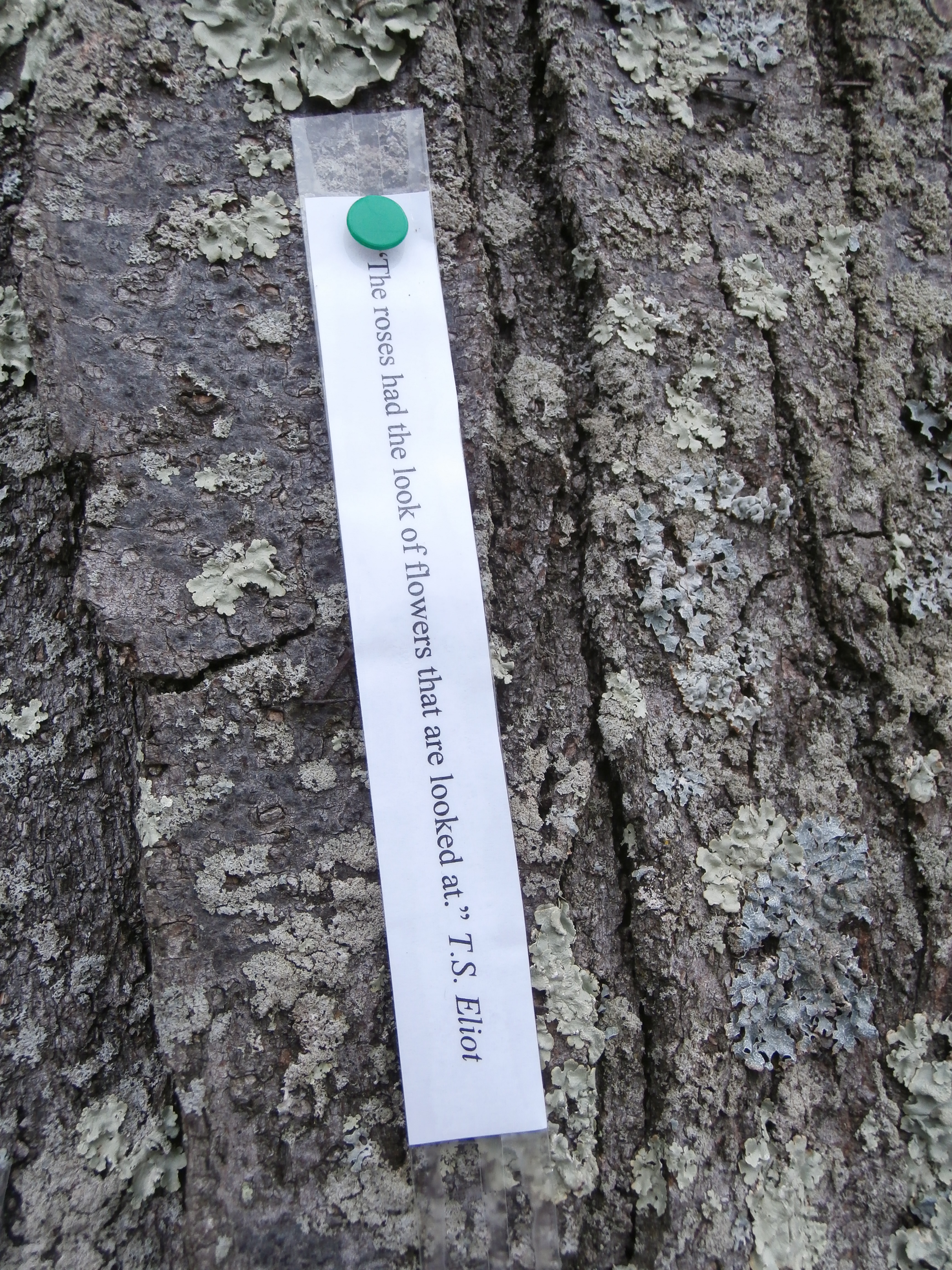
I printed out the quotes below and covered the paper with sticky plastic. I will put one set of quotation strips on our Christmas tree, but the first strips are now posted here and there around town. We’ll see what happens to them.

Feel free to use the lines here for a stealth project of your own, with or without sticky plastic. Or send some other quotes that I can use. If you are really ambitious, you might put strips of poems at the bottom of a poster headed something like “Help Yourself to Poetry” so people will be encouraged to take one.

“The roses had the look of flowers that are looked at.” T.S. Eliot

“The endlessly changing qualities of natural light, in which a room is a different room every second of the day.” Louis Kahn

“God inhabits the praise of his people.”

“Flowers have their agendas.” Mark Jarman

“I’d like to have a hand in things, what’s going on behind the screen.”  Kate Colby

“I don’t know where I’m going but I’m on the way.” Carl Sandburg

OLYMPUS DIGITAL CAMERA

OLYMPUS DIGITAL CAMERA

Read Full Post »

« Newer Posts - Older Posts »