Feeds:
Posts
Comments

Posts Tagged ‘prison’

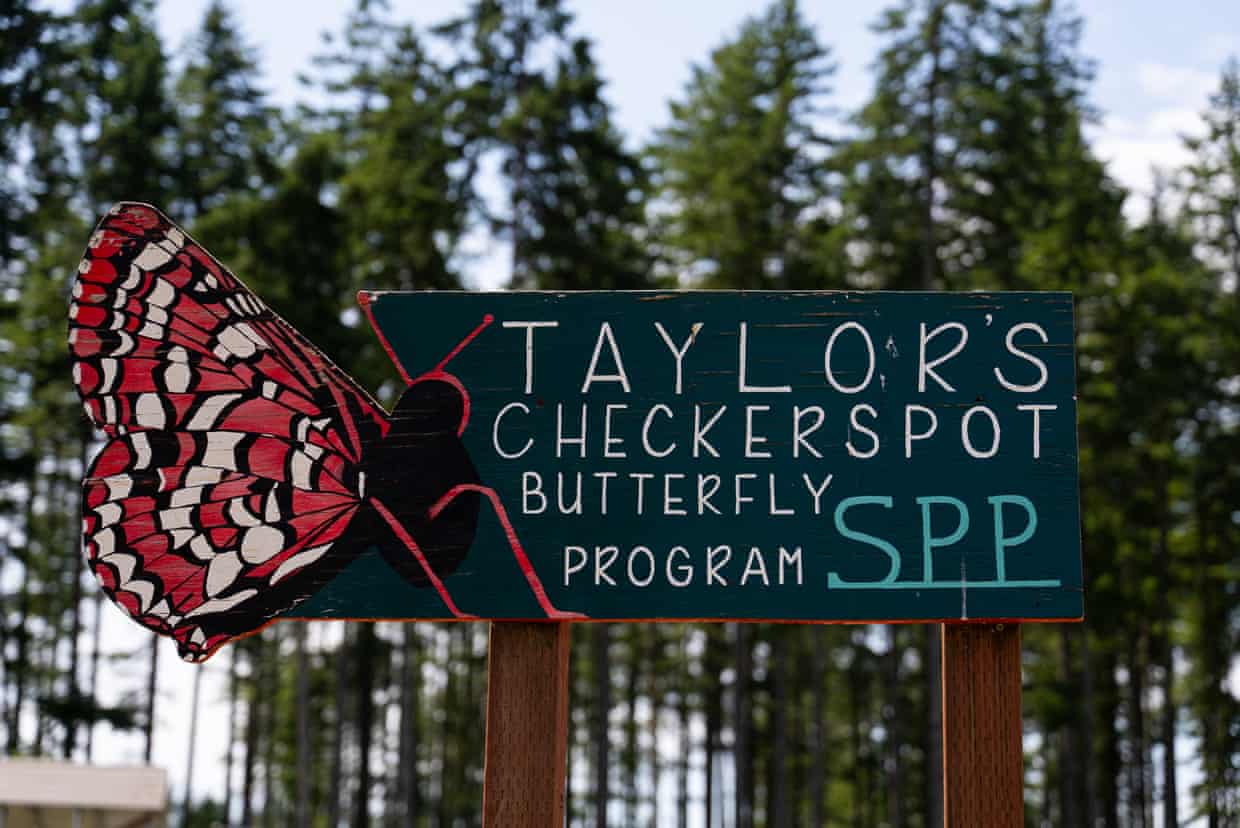
Photo: Washington State Department of Corrections.
Last year, scientists working with a team of incarcerated women released more than 67,000 larvae of a beautiful, endangered butterfly.

Today’s story about incarcerated women helping scientists reminds me that you don’t have to be in prison to get satisfaction from working for a cause. These women are gaining confidence, self-esteem, and hope for a better future.

Andrew Buncombe reports at the Guardian, “Trista Egli was standing in a greenhouse, tearing up strips of plantain and preparing to feed them to butterfly larvae.

“Of the many things the team here has tried to tempt larvae of the Taylor’s checkerspot [with], it is the invasive English plantain they seem to love the most.

‘The big thing for me is being part of an effort to save an endangered species,’ says Egli, 36. ‘It is a big thrill.’

“Egli is one of seven women incarcerated at the Mission Creek correctional facility, located a two-hour drive from Seattle, who are part of a year-long program that takes captured butterflies, harvests their eggs, and oversees the growth of the larvae before they are released into the wild where they will turn into adults.

“Last year, scientists working with the team released more than 10,000 larvae. The adult butterflies live for just a handful of fabulous, wing-fluttering days. …

“Many of the women speak of their pride working on a project that feels like it is making a positive contribution to the world.

“Lynn Cheroff, 42, said she had been thrilled to talk about it with her two young children when they come to visit. When she telephones her mother about the work, her mother tells her she is proud. Another woman, Jennifer Teitzel, appreciates the sense of order and discipline the program demands and instills.

“Every detail about the eggs and larvae has to be collated and recorded. It is the women’s responsibility, and nobody else’s, seven days a week.

“[While] the program run by Washington state department of corrections (DOC) is part of an effort to prepare the women for life once their sentences are over and to smooth the path to work or college, there is no sugar-coating their predicament.

“Egli, who has three young children, is serving a nine-year sentence for a 2020 drunken hit and run that left a woman with permanent brain damage.

“ ‘I am paying the price for that every day. I can never go back and undo what happened,’ she says. ‘But I can try to make sure the rest of my life is about making the world a better place.’

“The program at Mission Creek has been operating for 10 years. Kelli Bush, the co-director of Sustainability in Prisons Project, a partnership between the DOC and the Evergreen State College in Olympia, says a crucial component are graduate students who visit to offer educational support.

“Bush says in addition to providing the women something to feel proud about as many deal with shame and guilt, the program also gives them confidence about their own capabilities. …

“She says, ‘It’s routine to hear people say “I didn’t think I was smart and I’m realizing I’m doing science.” … Pretty soon people find themselves reading peer-reviewed scientific journals and saying, “I can do this too.” ‘

“The Taylor’s butterfly’s preferred habitat is open grasslands and prairie. For thousands of years, such landscapes were created and maintained by active burning by Indigenous communities. Without such native stewardship, and with ever-increasing threats from developers and town planners, the amount of grassland has drastically diminished. …

“A favored place is Joint Base Lewis-McChord (JBLM), operated by the US army and situated 10 miles from Tacoma. Training with heavy artillery has long kept the prairie free of unwanted vegetation. Yet when the Taylor’s was added to the US Endangered Species Act list in 2013, it presented military officials with a challenge; how could they continue to make use of the base without harming a species now protected by federal law?

“Dan Calvert, of the Sentinel Landscape Partnership, a coalition of federal and state groups that works with landowners to promote sustainable land use around military installations, says JBLM contains ‘90% of the prairie habitat in western Washington.’ …

“One of the efforts to boost the numbers of Taylor’s checkerspot in locations off-base – and thereby allow the military to work unimpeded at the base – led to funding for the Mission Creek project by the Department of Defense (DoD). …

“The collaboration has helped boost the Taylor’s checkerspot. This year could be a record year for releases of adults. In 2024, the program released about 10,900 larvae.

“However, there’s a dark cloud looming over the program. Mission Creek is set to close in October because of budget cuts. There is a plan to transfer the women and the program to a prison at Gig Harbor, located 25 miles away, but there is some concern among current participants it could simply be cut entirely.

“Egli, who is set to become eligible for a work-release program under which she would serve the last 18 months of her sentence working outside the jail and returning to do what’s known as a DOC re-entry facility every night, says the program changed the person she was.”

More at the Guardian, here. No firewall. Donations support his valued news outlet.

Read Full Post »

Photo: Noam Brown.
Bending the Bars artists Kashdatt, Chuckie Lee and ZQ recording in the studio. 

Given that the US leads the world in numbers of people incarcerated (1,808,100), more than even China, that’s a lot of human beings we can’t just forget about. We need to find ways for them to be engaged in the world and not give up hope, for our own sakes as well as theirs.

Monica Uszerowicz writes at the Guardian about an experiment in Florida that was organized by inmate advocates and received no help from the system.

“In ‘Locked Down,’ a song by the San Diego-based poet and rapper, Chance, she sings with both foreboding and care: ‘Every day that you wake up you’re blessed / love every breath, ’cause you don’t know what’s next.’

“Chance wrote the song – originally a poem, its title a callback to Akon’s ‘Locked Up’ – while imprisoned in Phoenix, Arizona, during the beginning of the Covid pandemic and subsequent lockdown (‘six feet apart in a five-by-five,’ she raps in the same song, alluding to the virtual impossibility of social distancing in the American prison system). … She shared with me in a recent phone call, ‘It’s crazy how they maintained control and instilled fear within us. When you’re locked up, you ask yourself … are you going to be angry, or are you going to find what your calling and purpose is?’

” ‘Locked Down’ is also one of 16 tracks on Bending the Bars, a hip-hop album featuring original songs by artists formerly or currently incarcerated in Florida’s Broward county jails (with the exception of Chance, a Florida native). Bending the Bars was organized by the south Florida abolitionist organization Chip – the Community Hotline for Incarcerated People – which was initially founded to support inmates during the early days of Covid.

“Nicole Morse, a Chip co-founder and associate professor at the University of Maryland Baltimore County, says the organization began fielding calls in April 2020, primarily from Broward, the county just north of Miami-Dade; the calls were primarily about medical neglect, abuse and an atmosphere of abject fear. …

“In 2021, the data Chip had gathered was used to support a lawsuit filed by the American Civil Liberties Union of Florida and Disability Rights Florida on behalf of individuals suffering from Covid in the Broward county jail.

“Something more hopeful was emerging from those hotline calls, too: creativity. ‘People wanted to share their latest poetry or a song they were developing,’ Morse said. ‘Art was helping people survive an incredibly desperate time.’

“Noam Brown, a children’s musician and Chip committee member, began dreaming up the idea of an album. … Chip hoped to create a platform for the wealth of talent they continually encountered. The organization began fundraising, applying for grants and putting the word out that they were producing an album; Gary Field, an incarcerated organizer, writer and scholar, became the executive producer, helping to connect the artists with Chip.

“Musicians on the inside used two phones to record their songs – one as the microphone to record their vocals, the other to listen to the beat. ‘The challenges were phenomenal,’ Field shared in a phone call. ‘People couldn’t even talk to their families, never mind collaborate on something as complicated as producing a studio album. We were in the middle of a pandemic. There were four phones and 40 inmates trying to use them.’

“Spaces with two easily accessible phones were limited; the duration of any prison phone call is restricted. But Chip covered the costs of the calls, while Brown’s brother, Eitan, worked as the sound engineer, and the Grammy-winning children’s artists Alphabet Rockers helped create beats. Artists who were already out were able to spend time in the studio, including Chance, who returned to south Florida after her release.

“After reconnecting with a former classmate, the two attended a meeting for Chainless Change, a Lauderhill-based non-profit advocating for those affected by the criminal legal system. ‘It was divine – I don’t believe in accidents; I knew I was being called to go back to Florida’ Chance said. She began working with the group and helped organize a poetry event, where she met Field, Brown and Morse. She asked if they had room on the album for one more.

“The result is nearly an hour of uniquely south Floridian hip-hop and R&B, both of which are constellations of so many genres – Caribbean beats, southern bass, Deep City soul, Miami drill – poetic musings on love, loneliness and hope, and demands for systemic change to the draconian and brutal conditions of the Florida prison system. While Morse noted that the album’s sound quality was impaired by technical limitations, Bending the Bars is polished and clear, an accomplishment owed partly to its production and mostly to the ingenuity of its artists: singers, rappers and collaborators like J4, Corvette Cal and Chuckie Lee, all of whom alchemized the tracklist into a textural tapestry: playful, mournful, educational and intentionally dotted with prerecorded interjections from the prison phone line (‘you have one minute remaining’). 

“Field, whose song ‘Tearing Down Walls and Building Bridges’ closes the album, studied political science at Columbia University and received his master’s from Gulf Coast Bible College, and has contributed 2,000 pages of writing to the Massachusetts Institute of Technology civic media project Between the Bars. He knows, intimately, the significance of the writing process.

” ‘I remember, as an inmate back in 2010, what a profound sense of gratitude the opportunity to write gave me,’ he shared. …

“The system often censored mail or blocked phone calls during the recording process. … ‘We had to develop a set of strategies to overcome those barriers,’ they said. ‘The project was made without the cooperation of any prison or jail. Every strategy we came up with for how to get through to people … we can now share those strategies with loved ones of incarcerated folks who don’t have any additional privileged access.’ “

More at the Guardian, here.

Read Full Post »

Photo: Moriah Ratner for the Washington Post.
At the home of the Cosmetology & Barber apprenticeship program, four instructors teach incarcerated people on mannequins, No sharp blades allowed.

I’ve always been interested in prison programs that help the incarcerated learn skills that can help them find work on the outside and avoid recidivism. It seemed so stupid to lock people up for months or years and then dump them on the side of the road somewhere with not much more than a toothbrush to get on with life.

Today’s focus is on teaching cosmetology skills to people who might be interested in eventually pursuing a license. A license requires serious application, but sometimes the effort starts with a little encouragement.

Samantha Chery writes at the Washington Post, “When Chet Bennett accepted a job in 1998 to teach incarcerated people in D.C. how to style hair, he was ‘scared to death.’ A native Washingtonian and Howard University alum, Bennett had never even seen the inside of a jail before his first day of work. Now, the 56-year-old is glad he took the chance.

“He makes weekly visits to the jail’s hair-care room, a small salon on the fifth floor of the city’s Correctional Treatment Facility, complete with dryer chairs and four shampoo bowls. At the home of the Cosmetology & Barber apprenticeship program, four instructors teach incarcerated people on mannequins, and the student stylists comb, braid and loc the hair of fellow jail residents, relatives and other clients from outside the facility.

“Since Bennett founded the program, he’s won a Legacy of Service Award and graduated thousands of hairstylists, many of whom now work in salons or have their own studios. …

“Teaching jail residents comes with logistical challenges: They aren’t allowed to use shears or razor blades, paint nails, or dye hair due to the facility’s restrictions, and they don’t have enough time during their short sentences — which typically run a year or less — to finish their necessary training for licensing.

“People trying to complete the 1,500 training hours required to receive a cosmetology license have the option to transition from the jail salon to Bennett’s off-site beauty school, the Bennett Career Institute near Catholic University, after finishing their sentences.

“When Angelina Millner was jailed in 2005, in her mid-30s, the cosmetology program improved her styling technique and helped her find work after her release.

“Despite homelessness and other personal battles, she said, Millner was able to attend Bennett’s school in 2012 to get her license, and now does business as Mo’ Hair by Angelina. She recalled how gratifying it felt to return to the jail in 2020 — as a teacher instead of a resident: ‘I just had to stay on the straight and narrow ever since.’

“Bennett said he has learned it’s best to reserve judgment. He doesn’t look at his students’ records, hoping to give them a clean slate. … There’s ‘something that we’ve all done and have fallen short, but by grace and mercy, we were allowed to straighten our ways and continue to move on,’ he said. ‘It has meant so much for me to know that I can go into a facility and give people a second chance.’ ” More at the Post, here.

Some years ago, in one of the English as a Second Language classes where I volunteered, a student decided to go for a cosmetology license at a Rhode Island training school. It was a pretty serious commitment of time and money. It took her more than a year. Watching her, I learned it’s not something you can be casual about and still be successful.

Looking up Washington DC licensing, I found these details: you are required to be “at least 17 years old. Have a High School Diploma or GED. Have completed and been credited with 1,500 hours of fundamental training.”

One place describes its course thus: “The General Cosmetology Course at Bennett Career Institute is a comprehensive 1,500-clock-hour program designed to provide instruction in a wide range of cosmetology skills and techniques.

“Students will learn about sanitation and sterilization, decontamination, and infection control practices, as well as hair cutting, coloring, perms, and other chemical services. The curriculum also covers hair styling techniques and other occupational requirements such as manicures, pedicures, and facials. BCI’s General Cosmetology Curriculum is designed to meet the requirements of the District of Columbia Board of Barber and Cosmetology, preparing students for a cosmetology operator’s license. …

” Individuals who obtain a license can provide a variety of beauty services such as shampooing, cutting, coloring, styling hair, apply makeup, dress wigs, perform hair removal as well as provide nail and skin care services.” More here.

Once you have a license and keep it up-to-date, you may go into completely different kinds of jobs, but you always have that to fall back on.

Read Full Post »

Photo: A24.
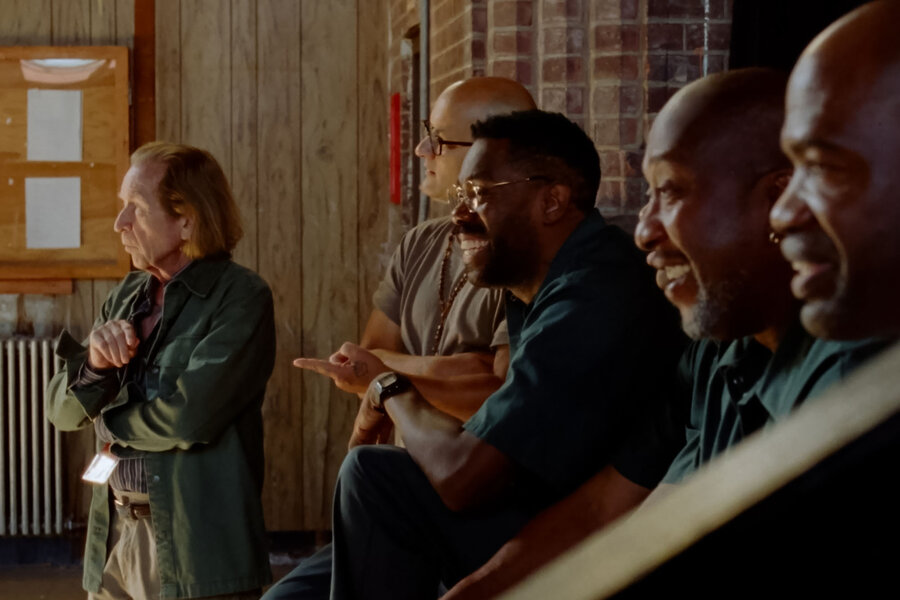
From left, Paul Raci, Sean San José, Colman Domingo, Sean “Dino” Johnson, and Mosi Eagle star in Sing Sing.

There are certain kinds of stories that always get my attention, and I’m grateful when other people find the same things interesting. Things like climate change, entrepreneurs, immigration, the kindness of strangers, housing, and life after prison. Just to name a few.

So you may be sure I liked today’s story about a theatrical production at a prison and the movie made about it.

Stephen Humphries writes at the Christian Science Monitor, “The world’s most unpredictable play only had one performance. It was staged inside a prison. The comedy, Breakin’ the Mummy’s Code, is about a man from ancient Egypt who embarks on a time travel adventure. Along the way, he encounters Robin Hood, Roman gladiators, cowboys, Hamlet, pirates, and – because why not? – Freddy Krueger from The Nightmare on Elm Street. It included a Shakespeare soliloquy – plus dance numbers. 

Breakin’ the Mummy’s Code was created by incarcerated men inside Sing Sing Correctional Facility in New York. It received a standing ovation in Cellblock B.

Now, a new movie explores the play’s legacy: the healing effect it had on its participants.

Sing Sing, directed by Greg Kwedar, reenacts the making of Breakin’ the Mummy’s Code. It even stars one of the play’s original actors. Already generating Oscar buzz, the movie … chronicles a budding friendship between two incarcerated men. Thematically, it’s about identity. The characters live in a hypermasculine environment that venerates bravado, toughness, and aggression. But the amateur actors come to discover that empathy, vulnerability, and tenderness are strengths, not weaknesses. The movie makes a case for the rehabilitative impact of arts programs inside prisons.

“ ‘I was a witness to it,’ says Mr. Kwedar, who taught an acting class in a prison with his creative partner, Clint Bentley, as part of their research. ‘I think the greatest teacher is what it’s like to step into another character and move in their shoes and step outside of yourself. That is a process of empathy’. … It gives you a prism to look at all the relationships in your life and to see perspective.’ …

“[Mr. Kwedar] spent seven years developing Sing Sing with Rehabilitation Through the Arts (RTA), the nonprofit that runs the theater program.

“There are dozens of similar theater projects across the United States. Perhaps the most well-known is Shakespeare Behind Bars. That program, which operates in three prisons in Kentucky and in one in Michigan, boasts a 6% recidivism rate for those who have participated in its productions. The Monitor was the first publication to write about that program. Then it became the subject of an award-winning 2005 documentary, Shakespeare Behind Bars

“ ‘Prisons function on shame and guilt,’ says Shakespeare Behind Bars founder Curt Tofteland, who has longtime collegial connections with the RTA. ‘But shame and guilt doesn’t change behavior. Why? Because shame and guilt doesn’t change thinking.’ …

“When change does happen, it’s a result of the actors exploring questions that the scripts raise, including ‘Who am I?’ 

“The two men at the heart of the story – John ‘Divine G’ Whitfield (played by Colman Domingo) and Clarence ‘Divine Eye’ Maclin (who portrays himself) – had to grapple with those existential questions. As the film unfolds, the audience learns that Mr. Maclin was one of the most feared men in the prison. Acting freed him to shed the gangster identity he’d clung to. The program helped him learn to express emotions. He even cried onstage. Now, he’s a natural performer on screen. …

“ ‘This is a movie about the landscape of the human face,’ says Mr. Kwedar. ‘It’s about drawing close to someone and looking them in the eyes and hearing their stories, and to know their names. And when you do that, it’s impossible to see that person as anything less than human.’

Sing Sing was filmed inside a recently decommissioned prison in New York. Its cast of established and first-time actors includes 13 RTA alumni. The production employed community-based filmmaking. For starters, it had a nonhierarchical pay structure. Everyone on set … was paid the same rate. …

“Last month, the director screened the movie inside the Sing Sing facility itself. He calls it the most profound theatrical experience of his life.”

More at the Monitor, here. No paywall. Subscriptions encouraged.

Read Full Post »

Photo: Kerem Yücel/MPR News via Oregon Public Broadcasting.
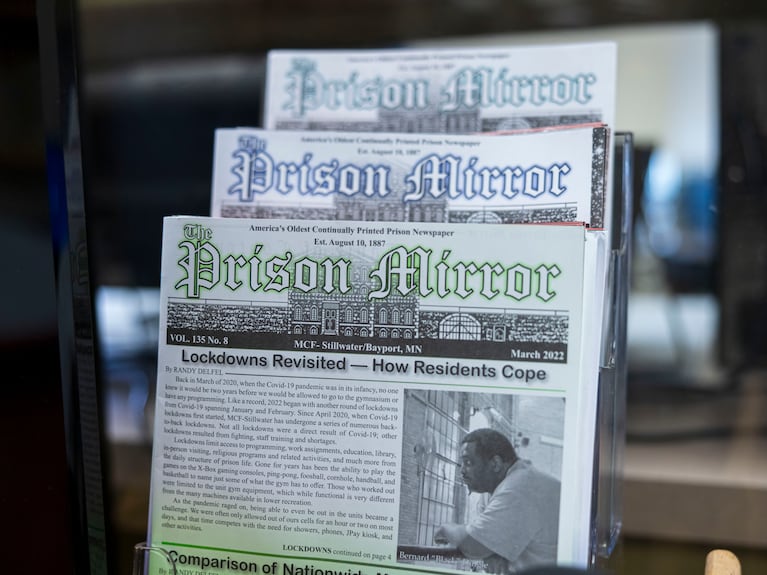
Previous issues of the Prison Mirror, which has been publishing since 1887, sit on display in the Minnesota Correctional Facility in Stillwater.

From time to time I like to run a story about interesting prison programs or ex-offenders trying to make good. I’m pretty sure we don’t have the right kind of prisons in the US. You may recall me writing about the system in Norway, which is completely different. (Click here and here.)

Meg Anderson (Minnesota Public Radio NPR) wrote recently about a longtime enrichment program at a prison in Minnesota.

“Inside a state prison near Stillwater, Minn., past the guards and the wings of cells stacked one on top of another, tucked in the corner of a computer lab, Richard Adams and Paul Gordon are fervently discussing grammar.

“Both men are on staff at the Prison Mirror, a newspaper made by and for the people held at the Minnesota Correctional Facility – Stillwater. Gordon had written a profile on the prison art instructor. He read it aloud to Adams. …

“Conversations like this have been happening in this prison for more than a century. The Prison Mirror is one of the oldest prison newspapers in the country, running since 1887. Publications like this aren’t common, but in an era where many journalism outlets in the free world are struggling to thrive amid scores of layoffs, journalism behind bars is actually growing.

“ ‘Overall we do see a growth and a lot of interest in starting publications, starting podcasts even. And so that’s really quite exciting,’ says Yukari Kane, CEO of the Prison Journalism Project.

“Thirty years ago, she says there were estimated to be only six prison newspapers. Today, there are more than two dozen. That doesn’t take into account the hundreds of incarcerated writers submitting work to publications on the outside, like The Marshall Project’s Life Inside series.

“Kane says this kind of work can offer a window into what prison is actually like, one that prison administrators aren’t necessarily going to offer up freely. … Even if a newspaper doesn’t circulate far beyond the prison yard, it can offer a sense of empowerment for its writers. …

“The Stillwater prisoners write book reviews, legal explainers, and summaries of local, national and international events for the monthly newspaper. One man recently submitted an essay on homesickness. Another wrote an editorial criticizing lockdowns. The men on staff — there are only three of them — had to apply for these unpaid jobs, and they’re highly sought after.

“Adams says the job requires a lot of reading and research about what’s going on around the world and the prison. There are challenges. They don’t have the internet, for instance, so they have to rely on print media and articles printed out by prison staff.

“The prison also has to approve everything the paper publishes. The men say that can limit what they write about, especially if they want to report on the harsher aspects of their lives.

“ ‘I am limited in the sense of, they’re not going to let me print all types of crazy things about the water or the lockdowns or getting restrained or anything like that, which is understandable to a degree,’ Gordon says.

“Last fall, around 100 Stillwater prisoners refused to return to their cells. Gordon says the disobedience was their way of protesting extreme heat, poor water quality, and staffing shortages, which he says often result in lockdowns. He plans to write about it, but says he has been retaliated against in the past for sending reporting to outside publications.

“ ‘I was a lot more aggressive in my writing back then, and that was a learning experience for me,’ he says.

Brian Nam-Sonenstein, a senior editor at the Prison Policy Initiative, says punishment for doing journalism behind bars is common. ‘You can lose what are called good time credits, which are essentially time off of your sentence based on good behavior. You could go to solitary confinement. You could have your privileges revoked,’ he says. …

“Marty Hawthorne works at the Stillwater prison and oversees the Prison Mirror.

“ ‘They have a lot of freedom. My philosophy is: It’s their newspaper. It’s not my newspaper,’ he says. ‘I believe they have a right to do what they’re doing.’ He says if the men plan to publish something critical, he makes sure whoever they’re writing about has an opportunity to respond. But he says he also pushes back when leadership tries to censor stories he believes are fair.”

More at NPR, here. No firewall.

Read Full Post »

Photo: Marissa Leshnov via the Guardian.
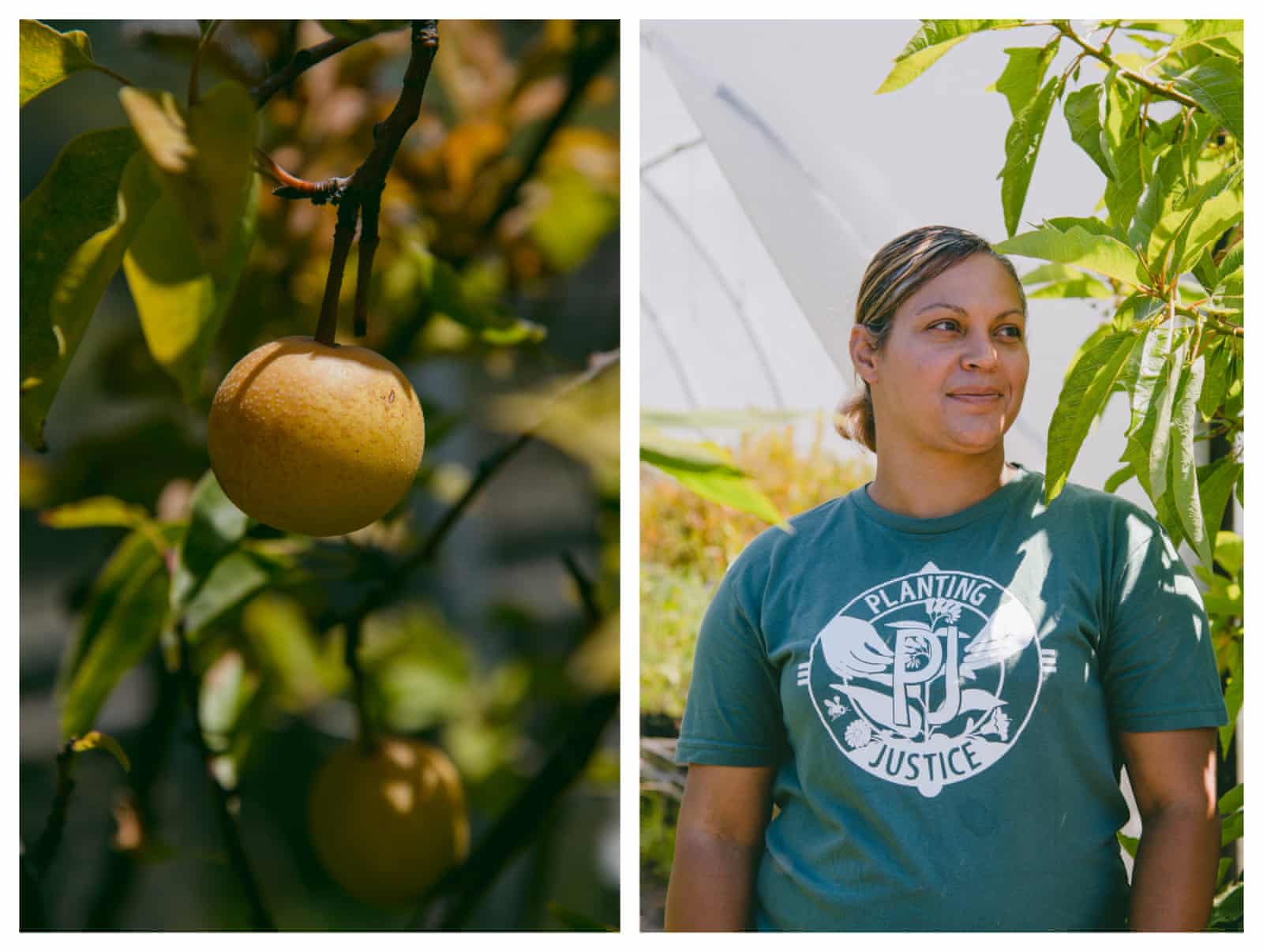
From the Guardian: Sol Mercado says her work as a gardener has brought her comfort and helped to reconnect with her roots.

Can Nature turn a life around? We’ve had a number of articles suggesting the answer is yes. Among others, our 2023 story about a traumatized Iraq veteran who discovered hiking in the wilderness.

Now Caitlin Yoshiko Kandil, of the Guardian, describes the role that an urban garden can play in life after prison.

“When Sol Mercado was incarcerated, one of her few sources of comfort was to dig her hands into dirt. Coming from a family of sugarcane and coffee farm workers in Puerto Rico, a love of gardening was in her roots. But it wasn’t until she was in prison and started participating in a gardening program that she truly connected with this part of her heritage. …

“Mercado – who was released a year and a half ago – now works for Planting Justice, a food justice organization based in Oakland, California, that tackles inequalities in the industrialized food system, from the underpayment of food workers to the lack of fresh produce in low-income neighborhoods.

“Planting Justice addresses food sovereignty with marginalized communities – in particular people who have been affected by the criminal justice system – through gardening workshops in prisons and jails, such as San Quentin state prison, and jobs for those formerly incarcerated.

“For Mercado, 36, the organization helped turn her life around. …

“ ‘What I learned in prison is that if I want to change, if I want to blossom, I need to work on myself and remove unhealthy things from my life,’ she said. ‘It’s the same as a plant. A plant, if you don’t weed it, if you don’t prune it, if you don’t water it, it’s not going to grow and give fruit.’

“Planting Justice’s two-acre (nearly 1 hectare) nursery – which grows more than 1,200 varieties of plants – is tucked between a busy highway and a railroad line in Sobrante Park, a low-income, predominantly Black and Latino neighborhood that’s long been a food desert with no grocery stores within walking distance. The land the nursery sits on once belonged to the Indigenous Ohlone people, so Planting Justice is working with the Sogorea Te’ Land Trust, a local organization that helps facilitate the return of Indigenous land to Indigenous people; once the transfer is complete, Planting Justice will lease the land from them.

“Founded in 2009, Planting Justice has installed 550 edible gardens at schools, community centers and homes; hosts education programs for local youth; distributes produce to local residents; gives away free fruit smoothies at Bay Area Rapid Transit stations; and sources produce for the Good Table, a nearby cafe where diners pay what they can afford.

“As part of a new initiative that started this year, Planting Justice is also planting 1,000 fruit trees – apple, pear, pomegranate, peach, olive and fig trees – in East Oakland homes for free.

“Like Mercado, many Planting Justice employees were formerly incarcerated. Some came to the organization through re-entry programs and partnerships in jails and prisons, while others found their way after their release.

Planting Justice says its recidivism rate is 2%, far lower than California’s rate of nearly 50%. …

“Bilal Coleman said he first heard about Planting Justice while incarcerated at San Quentin state prison, north of San Francisco. He was coming to the end of his 20-year sentence and was participating in a partner program called Insight Garden – and Planting Justice was advertising that it was hiring people returning home to the San Francisco Bay Area.

“Coleman said that gardening is in his roots. “Ever since I can remember, there’s been a garden in my family,” he said. But that wasn’t the immediate draw to Planting Justice; it was the security of having a job lined up after his parole, benefits and good pay – salaries start at $19 an hour. ‘It was a chance to get on my feet before I actually paroled,’ he said. …

“Planting Justice’s presence can be felt throughout Sobrante Park, revitalizing a neighborhood that’s long been in decline. Sobrante Park has been ‘underresourced and overpenalized for generations, where there aren’t the same food options,’ said Julia Toro, nursery office manager.

“Covonne Page, Planting Justice’s land team lead, was born and raised here, and recalls a time when things were different. The 33-year-old said that he and his friends would ride inflatable rafts on the San Leandro Creek, which was lined with wild blackberry bushes and filled with lizards and turtles. Most houses had fruit trees and vegetable gardens in the back yard, and families would trade their harvest so that everyone had their fill of oranges, loquats, lemons and plums. This bounty meant the community ate well; Page remembers his grandmother’s blackberry cobbler and his grandfather’s plum jam. …

“But years of disinvestment, longtime residents leaving – often for prison – and environmental degradation have decimated this landscape, Page said. … By bringing fruit trees back to people’s yards and teaching them how to garden, Planting Justice is not only offering much-needed jobs to the community; it’s revitalizing its food culture and sovereignty.”

More at the Guardian, here. No paywall. Great photographs by Marissa Leshnov.

Read Full Post »

Photo: STR/Reuters/Landov.
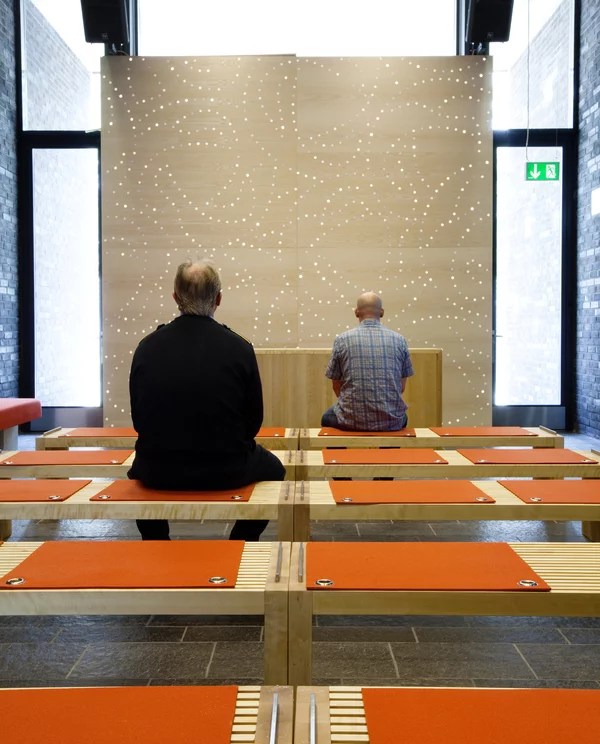
Two men sit inside the chapel at Halden prison in far southeast Norway in this picture taken in 2010. Prisoners here spend 12 hours a day in their cells, compared to many U.S. prisons where inmates spend all but one hour in their cell. NPR’s 2015 story is here.

Some years ago (2016), I wrote about research on Norway’s humane prisons. In a December 2023 Christian Science Monitor article, Troy Aidan Sambajon shows that some US prisons are moving in the same direction. Or at least testing the concept.

“Earlier this year,” he reports, “California Gov. Gavin Newsom announced a new vision for the San Quentin State Penitentiary, centered on rehabilitation and job training, inspired by another prison system that has halved its recidivism rate – in Norway. …

“About 2 out of 3 Americans released from jails and prisons per year are arrested again, and 50% are re-incarcerated, according to the Harvard Political Review. In Norway, that rate is as low as 20%. 

‘It has everything to do with your social safety net, your network, your support structure, and your job opportunities.’

“As more U.S. states seek to improve their correctional systems, the Norwegian model could prove key. It aims to create a less hostile environment, both for people serving time and for prison staff, with the goal of more successfully helping incarcerated people reintegrate into society. …

“ ‘Overcrowding, violence, and long sentences are common in U.S. prisons, often creating a climate of hopelessness for incarcerated people, as well as people who work there,’ says Jordan Hyatt, associate professor of criminology and justice studies at Drexel University. Correctional employees experience some of the highest rates of mental illness, sleep disorders, and physical health issues of all U.S. workers, a 2018 Lexipol report found. …

“Making a prison environment more humane will translate to a more efficient prison system overall, experts say. And the Norwegian model prioritizes rehabilitation and reintegration over punishment. Safety, transparency, and innovation are considered fundamental to its approach. Core practices aim to create a feeling that life as part of a community continues even behind walls and bars, says Synøve Andersen, postdoctoral research criminologist at the University of Oslo. 

“In some Norwegian prisons, incarcerated people wear their own clothes, cook their own meals, and work in jobs that prepare them for employment, says Dr. Andersen. They have their own space, too, since single-unit cells are the norm. …

“While they are separated from society, incarcerated people should experience normal, daily routines so they can have increased opportunities to reform without being preoccupied with fear of violence from other inmates, she argues.

“The principle of dynamic security means correctional officers also must have more complex social duties besides safety and security, including actively observing and engaging with the prison population, understanding individuals’ unique needs, calculating flight risks. …

“Washington state’s Lt. Lance Graham works within restricted housing and solitary confinement units, an environment he says lacks empathy and connection with those incarcerated. ‘We never had the opportunity to connect with the people in our care.’ 

“But when visiting Norway’s isolation units, he saw [that] their staff was much more engaged with the prison population and was much happier. 

“ ‘This program really promotes staff wellness, changing the relationship that you have with the people in your care,’ says Lieutenant Graham. ‘So you’re not going to have as many instances of fight or flight syndrome in your daily work. You reach common ground and talk like normal folks.’

“ ‘If you actually want to change the prison environment, invest in staff,’ says Dr. Andersen. ‘They’re there all the time. They’re doing the work.’

Amend, a nonprofit from the University of California, San Francisco, partnered with four states – California, South Dakota, Oregon, and Washington – to introduce resources inspired by Norwegian principles and sponsor educational trips to Norway for U.S. correctional leaders. 

“At California’s San Quentin, Governor Newsom hopes to emphasize inmate job training for high-paying trades such as plumbers, electricians, or truck drivers. … In Washington state, prison staff began developing supportive working relationships with the incarcerated in their care by developing individual rehabilitation plans. … In North Dakota, former Director of Corrections Leann Bertsch says after revamping the training and responsibilities of prison officers, interactions between staff and inmates felt respectful and calmer. …

“The Pennsylvania Department of Corrections collaborated with the Norwegian Correctional Services to pilot Little Scandinavia, a transformed housing unit operated at half the regular capacity to allow for individual cells. The on-duty officers at Little Scandinavia have reported enjoying their work much more now and there haven’t been any reports of violence since its opening in May 2022, says Dr. Andersen.

“Norway receives much attention for its low rate of recidivism, but some experts disagree on the measure as a rate of success. ‘[Recidivism] is not just a product of the correctional system. It has everything to do with your social safety net, your network, your support structure, and your job opportunities,’ said Dr. Andersen.”

More at the Monitor, here.

Read Full Post »

Photo: Riley Robinson/Monitor Staff.
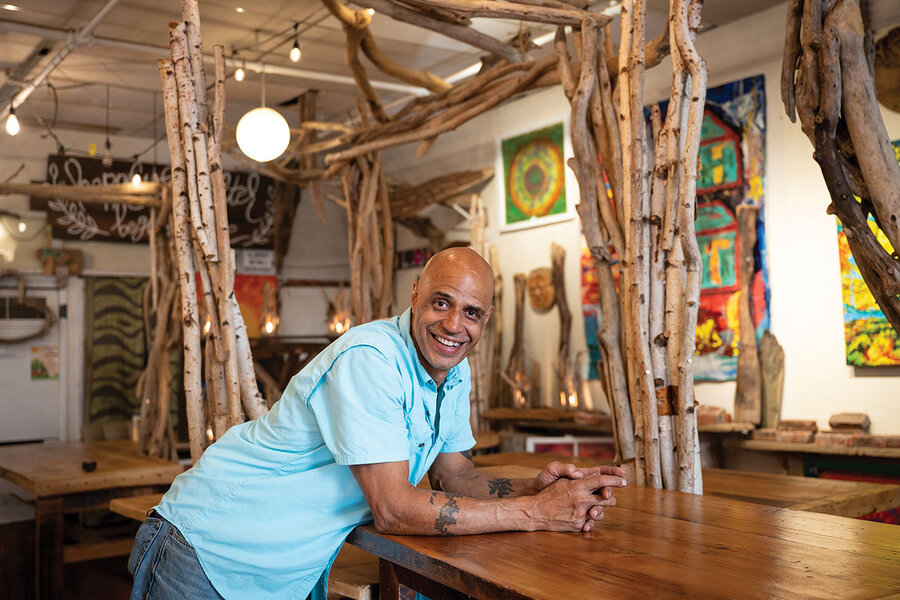
Artist Danny Killion poses in his gallery, Weathered Wood, in Troy, New York. He is one of many who have benefited from the Prison Arts Program.

Some folks have no sympathy for people in prison and would begrudge any type of cultural program that might help them. “If they wanted to do [art, music, a GED …], they shouldn’t have committed the crime.”

But many of us know that life circumstances and not always conscious decisions can accumulate until someone is in big trouble. I like the Norwegian approach to corrections, here, and the often small but meaningful work that is done in the US.

Troy Aidan Sambajon wrote about an example at the Christian Science Monitor.

On a long table, Jeffrey Greene prepares bundles of colored pencils for delivery to Connecticut state prisons. …

“Finished artwork lines the shelves of this airy warehouse, home to the permanent collection of the Prison Arts Program. Mr. Greene reaches up to a high shelf and retrieves a model RV, rendered in detail down to the windowsills. The shingles were cut from cardboard with a nail clipper and glued with a mixture of floor wax and nondairy creamer. Another artist unraveled a prison blanket and crocheted the threads into a 3D horse. …

“[Mr. Greene] has known his students for years, even decades. He can describe the medium they use and the metaphors their pieces convey, and has seen how the artistic process helps students deal with issues like depression, anxiety, and post-traumatic stress disorder.

‘Art unsettles habitual modes of thought and gives you the opportunity to think differently,’ says Robin Greeley, professor of art history at the University of Connecticut.

” ‘It can disrupt your whole routine and can create a sense of wonder.’

“The Prison Arts Program is one of the oldest correctional arts programs in the United States. It’s the longest-running program of Community Partners in Action, a criminal justice nonprofit based in Hartford. …

“Mr. Greene never intended to work in the prison system. After graduating from Hamilton College in New York, he volunteered to teach art workshops in prison on a whim. But he’s never forgotten the impression left by his first day on the job. 

“ ‘Everyone’s developing in this artificial, man-made, absurd, adversarial environment. It’s ridiculous,’ recalls Mr. Greene. …

“ ‘What drives Jeff really is the ability to show the humanity of the prison, of the people that are incarcerated,’ says Beth Hines, director of Community Partners in Action. ‘They know they can count on him when they get out.’

“In each prison he visits, Mr. Greene instructs his students to create art that only exists because they exist. He says it’s about more than finding a hobby while behind bars: ‘They are people that are coming out into the world with this incredible empathy and curiosity.’ Even if they never leave the prison system, he adds, that mindset can have a positive effect on others. …

“For years, Natasha Kinion felt like she’d been swallowed alive in prison. ‘I was guilt-ridden. I was shameful. I was really broken,’ she says in a phone interview. 

“A mother of four who has experienced domestic abuse and substance addiction, Ms. Kinion spent 13 years at York Correctional Institution in Connecticut. There she started making abstract art. 

“ ‘It took me at least the first six years of my incarceration to really open up and allow the healing process to start,’ says Ms. Kinion. …

“Mr. Greene helped Ms. Kinion send her artwork to her children. Her daughter Mayonashia Jones once received a drawing of a butterfly trying to fly with broken wings. She remembers thinking of her mom and wondering, ‘Has she always felt like that?’ …

“Since her release in 2019, Ms. Kinion has published a book about her journey, titled Stand Up You’ve Been Down for Too Long, and has opened her own digital art company, Dezigning Deztiny. 

“ ‘I never told him this … but Jeff is really my hero,’ says Ms. Kinion.

“Danny Killion had little interest in art when he was robbing banks in Connecticut. Then he was caught and sentenced to 12 years in prison. ‘Prison can be a very cold, hard environment,’ says Mr. Killion. …

“He spent 10 years in the Prison Arts Program, learning to concentrate on the artistic process and find solace in a concrete cell. 

“ ‘I’ve never met anyone who’s a more profound teacher,’ says Mr. Killion, who finished his sentence in 2007. As he found his feet in society, Mr. Greene would drop by, offering art materials and a listening ear.

“After working in construction, Mr. Killion began creating furniture using driftwood from the Hudson River. In 2013, he opened his own art studio and gallery, Weathered Wood, in Troy, New York. He traces his transformation back to those first classes with Mr. Greene. …

“This year, Mr. Killion unveiled his first public commission, a sculpture of twisted scrap metal depicting a man breaking through chains, installed at Old New-Gate Prison, a historical site in East Granby, Connecticut. Mr. Greene was there too, both men now standing outside prison gates.”

More at the Monitor, here.

Read Full Post »

Photo: Joanna Detz/ecoRI News.
The Garden Time program in Rhode Island gives formerly incarcerated people a chance to prepare for reentry into society.

Today’s article about a program to help incarcerated people find work on the outside notes successes and failures. One of the featured participants, Anderson, ended up back in trouble with the law. Others have stuck with the hard work needed to move on.

Colleen Cronin wrote about the initiative at ecoRI News.

“The Green Jobs Reentry Training program run by Garden Time, a Providence-based nonprofit [is] an offshoot of a gardening program run by Garden Time at the Rhode Island Adult Correctional Institutions (ACI) since 2011, according to Kate Lacouture, founder and executive director. In addition to teaching incarcerated people about gardening, the ACI program also helps participants on an individual level with reentry needs when their sentences end.

“Lacouture called the ACI training a ‘pre-employment program,’ because Garden Time teaches gardening, horticulture, and other green industries and brings in employers from those fields to teach and get to know program participants. …

“When the pandemic hit, Garden Time started expanding its work outside the prison. Lacouture said the organization started a garden at Open Doors, a nonprofit focused on reentry in the city’s Silver Lake neighborhood. Working in that garden regularly planted the idea of a formal reentry and job training program for individuals who were out of prison and trying to integrate into the community, Lacouture said.

“Garden Time ran a shorter reentry training pilot program in fall 2021, and thanks to its success, it was funded by the state Department of Labor and Training as a Real Jobs Rhode Island program. This allowed Garden Time to expand the program from six to eight weeks, offer larger weekly stipends to participants ($400 a week), and provide lunch Monday through Thursday.

“For participants of the program who have just left prison, ‘it’s really nice to have a nice landing spot,’ Lacouture said.

“The program also provides students with Chromebook laptops, work boots, and other tools that participants might need on a job. They attend classes in a Manton Avenue classroom on topics such as arboriculture and nutrition, or receive hands-on training at various locations Monday through Friday. Friday mornings are spent at the Open Doors garden.

“During the last week of the program, the students participate in an internship, for which Garden Time pays.

“The internship ‘becomes like an extended job interview, like a chance for the person to prove themselves, a chance for the employer to be comfortable with it,’ Lacouture said. ‘Because a lot of times, you know, you ask an employer if they would hire formerly incarcerated people, and they don’t really know what that means. It sounds scary. They don’t know what that entails.’

“By the end of the program, those who graduate become official Providence tree keepers, receive an Occupational Safety and Health Administration (OSHA) certification for completing a 40-hour training, and hopefully find full-time positions in a green industry job, Lacouture said.

“Participants must attend most of the classes to complete the program, but on the first Friday of the 2022 session, one of Lacouture’s star students was missing.

“Attending classes can be difficult for anyone who has recently been released from prison or has a police record. Suspended or revoked licenses, little funds for car insurance or a car itself, and sporadic and mandatory parole meetings and other legal hearings can all complicate attendance.

“But Ace, who … met Lacouture inside the ACI, missed the first Friday class because of a cat.

“Ace had been working for Groundwork Rhode Island earlier that week, when he saw a stray cat and couldn’t help picking it up, Lacouture said, despite his allergy to cats. The contact caused Ace’s asthma to flare up, keeping him from Friday’s class. …

“Since Ace was released from the ACI, before COVID, he has accumulated cats, dogs, and tons of pepper plants, gotten married, and started his own landscaping business.

“He knows some of the other participants in the reentry program, living in temporary housing and lacking satisfying work, struggling to maintain their connections in the world outside prison walls, looked up to him.

“Even though his success might look easy and the way he speaks and presents himself might seem completely controlled, his journey has been long, he said. He speaks mostly light-heartedly about the past and his hijinks while also admitting to deep pain and trauma. …

“ ‘I’m always getting in trouble,’ Ace said.

“He can talk about growing up in Liberia and sneaking into a neighbor’s garden to snatch fruit in the same easy tone as he discusses the trials of his addiction. And he readily speaks about the therapist he sees regularly to help him with his addiction, as well as attending Alcoholics Anonymous meetings.

“To overcome some of his challenges, Ace said he has had to make adjustments. The green jobs program starts at 9 a.m., but Ace regularly gets there hours early. If he picks his wife up from work, often at 2, 3, or 4 o’clock in the morning, sometimes he chooses to stay up, so he knows he’ll be ready for the class, he said. …

“On an unusually cold Friday morning, John Kenny, owner of Big Train Farm in Cranston, visited Open Doors to talk to the reentry program participants about green farming practices and how they could start their own farms.

“The Farm Service Agency (FSA) within the U.S. Department of Agriculture offers several different loan programs and has targeted incentives for women and people of color.

“ ‘I’m not going to kid you,’ Kenny said, going on to explain that even with help, obtaining a loan and starting a farm isn’t easy. …

“Ace has tried to let a lot go. He knows he’s made mistakes, and he tries to make up for them. He knows his life has been unfair, but he tries not to think about it. On the other hand, injustice boils under Anderson’s skin when [the  57-year-old military veteran and former oil-platform builder] talks about the environmental hazards Black and brown Americans face and their connection to the cyclical criminal justice he and others have experienced.

“Two million people are currently incarcerated in the United States. Out of the 11 participants that arrived at the first day of the reentry program, most were men of color. Two people were white. There was only one woman in the class. The group reflects the larger pool of Americans who are or have been incarcerated. …

“Like many of the people who have been incarcerated around the country, several of the participants in Garden Time’s green jobs program were in prison for long periods or repeatedly throughout their lives.

“A 2021 study of people incarcerated in Rhode Island showed that by the 3-year post-release mark, 47% had been sentenced again to prison. Many of them had been charged again within the first six months of their release date. Education programs inside a prison, like Garden Time, can do a lot to prevent this.”

Read the rest of the long article at ecoRI News, here. No firewall at this nonprofit, but donations are welcome.

Read Full Post »

Photo: Honolulu Civil Beat.
The inside of the Hale Lanipolua Assessment Center, which is run by Hale Kipa and serves as an alternative to the Hawaii Youth Correctional Facility. 

Hawaii has a different approach to helping kids who get in trouble. There’s an understanding that girls in particular often get started in crime after serious childhood abuse — and that locking them up doesn’t solve anything. (See my 2012 post about a Boston theatrical production by former inmates that spelled out just how females can get trapped in an endless cycle of crime and punishment.)

Claire Healy writes at the Washington Post, “When Mark Patterson took over as administrator of the Hawaii Youth Correctional Facility in 2014, he inherited 500 acres of farm ranch — and the care of 26 boys and seven girls between 13 and 19 years old.

“By 2016, his facility, in Kailua, Oahu, was only holding between five and six girls at a time. And in June, the last girl left the facility. For the first time, there are no girls incarcerated in the state of Hawaii.

“Patterson said this moment is ’20 years in the making,’ and the result of a systemwide effort to divert girls from the judicial system and into trauma-based care programs. The number of incarcerated boys has also lowered significantly in the past decade, he added.

“Patterson said HYCF is a last resort — the kids there ‘have run away from programs 10 to 11 times’ and are the most vulnerable of the high-risk youth. But various state officials have agreed that ‘we no longer want to keep sending our kids to prison,’ Patterson said.

‘What I’m trying to do is end the punitive model that we have so long used for our kids, and we replace it with a therapeutic model.’

“He added, ‘Do we really have to put a child in prison because she ran away? What kind of other environment is more conducive for her to heal and be successful in the community?’

“Hawaii isn’t the only state to reach zero girls in long-term placement facilities. According to Lindsay Rosenthal, director of the Vera Institute’s Initiative to End Girls’ Incarceration, Vermont has zero long-term placement facilities for girls, and for nine months in 2020, Maine had zero incarcerated girls statewide. Since February 2021, New York City hasn’t had more than two girls in the state’s juvenile placement facility at any given time.

“This is part of a larger trend in juvenile justice reform: Since 2000, more than 1,000 juvenile facilities have closed, including two-thirds of the largest facilities. And between 2000 and 2018, youth incarceration rates dropped by more than half, according to the Square One Project, a justice reform initiative.

“But just as women are the fastest-growing prison population, the proportion of girls in juvenile detention has increased even as overall numbers have gone down. … As advocates point out, the majority of incarcerated girls are in prison for low-level offenses, often influenced by a history of abuse — as noted in various research — or systemic challenges, such as poverty.

“Rosenthal [emphasized] that a state reaching zero doesn’t necessarily reflect progress — Vermont has sent some girls to facilities in New Hampshire, and placed at least one girl into an adult prison, for example — without the presence of community-based alternative programming. HYCF is an example of a facility that has seen such an investment pay off, she said.

“Gender-focused programming is essential, Rosethal added, because of ‘the criminalization of sexual abuse.’ This legacy, she said, reaches back to colonization and slavery in the United States and has resulted in the disproportionately high incarceration rates of Black and Indigenous women and girls. …

“Patterson said the movement to replace punitive systems with trauma-informed care in Hawaii’s juvenile justice system reaches back to 2004, when Judge Karen Radius, a now-retired First Circuit Family Court judge, founded Girls Court. One of the first in the nation, the program aimed to address the specific crimes and trauma history of girls. …

“Many influential programs in the state followed the formation of Girls Court. In 2009, Project Kealahou launched as a six-year, federally funded program aimed at improving services for Hawaii’s at-risk female youth. And in 2013, Hawaii created the Juvenile Justice Reform Task Force to analyze the juvenile justice system in Hawaii and provide policy recommendations aimed at reducing the HYCF population.

“Then, in 2018, Patterson partnered with the Initiative to End Girls’ Incarceration and drafted a ’10-year strategy to get to zero.’ The overarching goal was to focus on the underlying trauma the youth were suffering from, instead of the crimes they were charged with, Patterson said.

“Before working with youths, Patterson was the warden of Hawaii’s only women’s prison, the Women’s Community Correctional Center (WCCC), across the street. He said his time there showed him how many of the women there could trace their trauma back to their home life as a child.

“That same year, he set out transitioning HYCF into the Kawailoa Youth and Family Wellness Center, remodeling the program around trauma-informed care — a framework for care providers to understand and consider the impact an individual’s trauma history has on their life and health. Today’s campus has a homeless shelter, an assessment center, a vocational program serving youths ages 15 to 24, a farm managed by a nonprofit and a high school for high-risk youths.

“Guiding this transformation was Patterson’s goal of creating a pu’uhonua — a place created within a traditional Hawaiian village for conflict resolution and forgiveness — for Hawaii’s most vulnerable youths.

“As Patterson described it, a pu’uhonua acknowledges and identifies a wrong that has been committed in the village. But unlike a punitive system, ‘we’re going to teach you how to live with the village and manage the wrong,’ he said. ‘So that you’re no longer an outcast, but you’re still welcome back.’ ”

More at the Post, here.

Read Full Post »

Photo: Stephen Humphries/Christian Science Monitor.
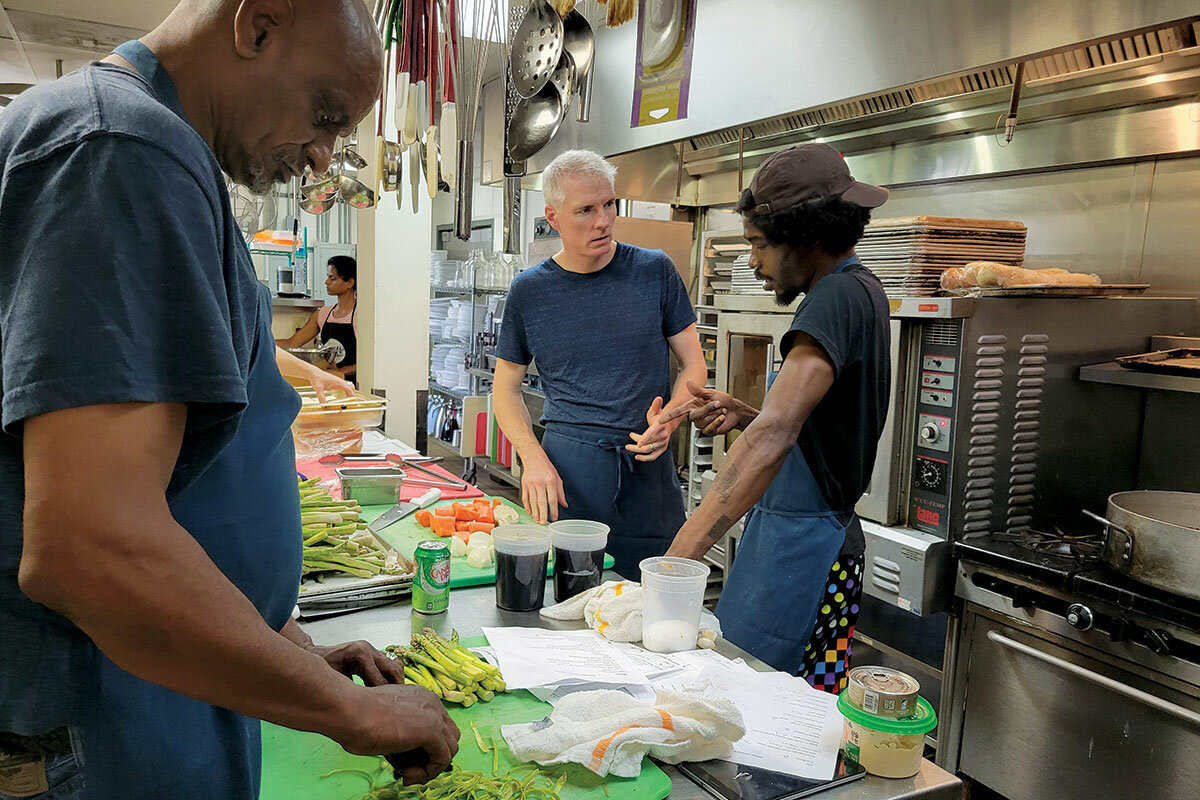
Chef Brandon Chrostowski (center) teaches trainees inside the kitchen for Edwins Too, one of his two French fine dining restaurants on the East Side of Cleveland.

When you take a wrong path in life, does it have to determine everything that happens later? At the Christian Science Monitor, Stephen Humphries writes about a chef who is making sure that some people are successful when they start over.

“Brandon Chrostowski is telling his origin story for probably the thousandth time. He’s pacing the stage of a local high school, holding his microphone with the confidence of a rock star. Mr. Chrostowski is a distinguished chef – he was a restaurateur semifinalist in the 2022 James Beard awards – and founder of a Cleveland restaurant with a philanthropic mission. Yet he’s ambivalent about all the acclaim. He’s tasted what it’s like to be stripped of dignity. At 18 he was arrested for fleeing and eluding the police. He and some friends had been in a car with drugs they intended to sell.

“ ‘I learned a lot of things. One, the dehumanization in the criminal justice system,’ he tells the students at Gilmour Academy. ‘Also, the idea of freedom. You don’t really know what freedom is until you lose it.’

“A lenient judge decided against sentencing him to prison. Mr. Chrostowski has never forgotten that he was fortunate not to serve a 5-to-10-year sentence. It’s the reason he launched Edwins Leadership & Restaurant Institute on Cleveland’s East Side. 

“What makes Edwins unique isn’t just its French cuisine, but its workers – they’re formerly incarcerated adults. Over six months, those in training learn skills for employment in the culinary world. More than that, Mr. Chrostowski tries to draw out a sense of self-worth in those who’ve served time by showing them how to attain excellence. 

‘The single hardest thing we have to do at Edwins is really build esteem in someone that has lost that, or that sense of humanity, through incarceration,’ says Mr. Chrostowski.

“Hours before giving his speech at the high school, Mr. Chrostowski strides into a kitchen where two trainees are singing along to a Bobby Womack tune on the radio. Tying a half apron around his waist, the chef quickly assesses a hunk of braised beef inside a pot as large as a bassinet. …

“As Mr. Chrostowski shares tips with Richie, he picks up a knife and demonstrates how to slice asparagus. In 2017, Edwins was the subject of an Oscar-nominated short documentary titled Knife Skills. …

“Abdul El-Amin enrolled in the program in June after being incarcerated for 20 years. ‘When you come here, it is sincere. You’re welcome. You can feel it,’ he says after his first two weeks of training. He adds, ‘I’m seeing so many other opportunities that I didn’t think about when I was incarcerated.’

“That’s not to say the program isn’t demanding. Over 2,000 people have trained at Edwins since its opening in 2013. Of those, only 600 have graduated because most drop out, often within the first two weeks. (They’re always welcome to reapply.) The program boasts a 95% employment rate for its alumni, and fewer than 1% of graduates are re-incarcerated. Star pupils have gone on to work in restaurants across America and even in France.

“ ‘[Mr. Chrostowski] really doesn’t care what walk of life you’re from, who you are, what you’ve done,’ says William Brown, a staff member at Cleveland’s Community Assessment & Treatment Services, a rehabilitation organization that enrolls promising individuals in the Edwins program. ‘He wants to see you succeed. And he will go the extra mile.’ 

“Mr. Chrostowski has a hectic daily schedule. During peak restaurant rush hours, the chef admits to hurling pans in frustration, but they’re not aimed at anyone. … He pursues the exacting standards he learned as an apprentice at restaurants such as Charlie Trotter’s in Chicago, Le Cirque in New York, and Lucas Carton in Paris. He rose fast. But he’s never forgotten his first break. In the late 1990s, a Detroit chef named George Kalergis took him in while he was still on parole. 

“Years later, Mr. Kalergis called from Detroit with bad news. A man named Quentin, who’d learned the rudiments of restaurant cooking alongside Mr. Chrostowski, had been stabbed to death. …

“ ‘I started to think, “How is it possible I’m here, and others are not?” ‘ says Mr. Chrostowski. … He wanted to help others, just as Chef Kalergis had helped him. But it took another decade of working in restaurants – including a move to Cleveland in 2008 – before he was able to raise the money to fulfill his vision.

“Mr. Chrostowski came up with the name, which is shorthand for ‘Education wins.’ Edwin is also the chef’s middle name. A few years after moving to Cleveland, he opened his restaurant in a historic, racially diverse area called Shaker Square. In 2020, he expanded by opening a second restaurant, Edwins Too, on the opposite side of the town’s leafy square. He’s also launched a French bakery and a butchery. The expansions have helped the area become a dining destination. 

“Just off the main street in Shaker Square, Mr. Chrostowski proudly shows off his latest project, which will become a child care center. ‘We’ve raised about $250,000 for a family center or day care,’ he says. ‘Free day care for staff and students, because 80% of our students with children don’t finish. It’s a big number and we want to change that.’

“The chef also wants to help outside Ohio. In April he traveled to his ancestral home of Poland to cook for refugees fleeing Ukraine. He’s also created a 30-hour curriculum and distributed it on 400,000 tablets to prisons in the United States. Dee and Jimmy Haslam, co-owners of the Cleveland Browns football team, will pay for transportation for anyone in the U.S. who completes the virtual instruction and applies to join the Edwins program.”

More at the Monitor, here.

Read Full Post »

Photo: Brandon Harris.
Brandon Harris (left) and Sura Sohna after Sohna’s release from the Patuxent Institute Feb. 8. Harris’s work on a Davidson College project figured into the court’s decision to release Sohna more than a decade before the end of his 14-year sentence.

Your childhood friends may know you better than anyone else. In today’s story, Brandon Harris knew that a disadvantaged friend who had gotten in trouble with the law was a good person at heart and deserved a second chance. Getting him out of jail took a college research project and people willing to listen.

Sydney Page reports at the Washington Post, “Brandon Harris sat anxiously in an Annapolis courtroom, his head buried in his hands. He took an audible breath as the judge prepared to read the ruling.

“The 22-year-old college student didn’t fear his own fate. He was concerned for Sura Sohna, his childhood friend, whose 15-year prison sentence for first-degree burglary was being reconsidered that morning.

“ ‘Being in that moment was completely surreal,’ said Harris, a senior at Davidson College in North Carolina. It was his independent-study project that was part of what compelled the court to reassess the case [of] Sohna, 23, who had been in the Patuxent Institution, a correctional facility in Jessup, Md., since he was 20. …

“Sohna’s friendship with Harris began at Hillsmere Elementary School in Annapolis, when they were in the same fourth-grade class.

“ ‘We had a lot of great times,’ Sohna recalled. ‘We were close as kids.’ … They remained close as they moved on to Annapolis Middle School.

“ ‘But towards the end of that, we started drifting apart,’ Harris said.

“As teenagers, they were on opposite paths. While Harris got an academic scholarship to a prestigious private high school, Indian Creek School, Sohna was living in an affordable-housing community, witnessing acts of violence with little guidance or stability in his life.

“ ‘We had bad circumstances,’ Sohna said, explaining that he felt responsible for looking after his mother and brother. ‘I felt like I had to be the one to support us, and I went into criminal activity because of that.’ He broke into several houses when people weren’t there and stole property. He would then sell the items for money.

“Sohna got caught and was first incarcerated at age 17 after being charged as an adult with 25 counts, including burglary, theft and multiple gun-related offenses. Many of the charges were dropped in a plea deal, but he still ended up behind bars. When he was released, he continued committing crimes and was again arrested. On Jan. 14, 2020, he was sentenced to 15 years in prison for one count of first-degree burglary, which he had committed while on probation.

“ ‘The judge gave him a really hefty sentence,’ said Keith Showstack, Sohna’s lawyer, who thinks the tough sentence was due to ‘a track record of Sura committing a lot of burglaries, and the judge thought enough was enough.’

“At that time, Harris and Sohna had lost touch. Harris remembers seeing Sohna’s mug shot in the local news more than once over the years. ‘I was very scared for him,’ Harris said. ‘That hurt.’

“Harris knew his friend was a good person at his core and believed he had committed those crimes as a response to poverty and desperation. ‘The thought that went through my head was that if our life circumstances were flipped, I might also be behind bars,’ Harris said.

“While they weren’t in contact, Sohna stayed on Harris’s mind, particularly during his college classes that covered social justice. ‘It just made me think a lot about him,’ Harris said.

“But it wasn’t until June 2020, when Harris read about how the coronavirus pandemic was worsening already poor prison conditions, that he decided to write a letter to his childhood friend to check in. Sohna was stunned to receive it.

“ ‘It was so shocking to me,’ he said. ‘I saw it said, “Brandon Harris,” and that made me feel warm inside.’ [He added] that when you’re in prison, ‘you don’t have people on your side.’

“Harris’s letter was mostly filled with life updates, as well as motivational messages. … Before long, their childhood bond was restored.

“Sohna shared with Harris what life was like in prison. ‘It was miserable. It was shameful. It was angering,’ Sohna explained. ‘I felt like that place was going to define me and make the worst of me.’ When Harris resurfaced in his life, he added, it was ‘at a time when I really needed it.’

“Corresponding with Sohna was meaningful for Harris, too. … He was inspired to start an independent-study project through the school’s Communication Studies department. … Sohna was enthusiastically onboard. It offered him a sense of purpose, and for the first time in a while, allowed him to see himself as more than an inmate.

“As part of the semesterlong assignment that started last January, Harris conducted interviews with Sohna, as well as some of the victims of Sohna’s crimes, prosecutors, law enforcement officers and Sohna’s family.

“Harris learned that Sohna’s father was mostly uninvolved in his upbringing, and that his family struggled with homelessness at one point. He also came to understand the violence that Sohna had seen while living in Robinwood, an affordable-housing community in Annapolis, where even this week, two youths were shota boy, 15, and a girl, 11.

‘He had to be willing to listen to good things about Sura but also things that were not all that flattering in order for him to actually have the full story, which is not always easy,’ said Ike Bailey, a journalist and professor at Davidson College, who mentored Harris through the project. …

“Harris contacted Maryland Gov. Larry Hogan (R), who gave permission for Sohna to participate in a public interview from prison, which the facility initially had prohibited. It turned into a live Zoom conversation that was publicly broadcast.

“Sohna’s lawyer, Showstack, participated in the discussion — which was promoted by the school and featured in local media — along with hundreds of members of the Davidson community and others. Sohna could feel the support, he said.

“His lawyer said the Zoom was helpful, as it ‘opened his eyes to the realization that there are a lot of good people who are willing to help,’ Showstack said. … In December, Showstack decided to try to get Sohna’s sentence reevaluated. … The judge granted the request. …

“By the end of the month, Sohna was granted a hearing. While Showstack was optimistic, Sohna was less confident. ‘I just had really no hope,’ he said.

“At the Feb. 8 hearing, though, he poured out his heart to the judge, owning his actions and explaining why he was worthy of being back in society. He said he wanted to contribute to his community rather than take from it.

“ ‘It was an amazing speech. I was proud,’ Harris said. … Harris also took the stand, outlining the findings from his project, including Sohna’s unstable situation at home and his family’s financial struggles. He reinforced that Sohna’s behavior was a series of bad choices he made rather than who he was as a person — or who he would be in the future.

“ ‘I talked about the progress I’ve witnessed since working with him’ [and added] that Sohna’s father is back in his life, he speaks regularly with a therapist and, because of the project, he has many prospective mentors in the Annapolis community and beyond.

“At one point, Maryland Circuit Court Judge William Mulford II — the same judge who sentenced Sohna in 2020 — asked everyone in the gallery to raise their hand if they had come to support Sohna that morning, and everyone did.

“Then, in a moment Harris and Sohna described as dreamlike, the judge said: ‘You’re going home today.’ “

More at the Post, here.

Read Full Post »

Photo: Erika Page/The Christian Science Monitor.
“Craig Watson (left), Keela Hailes (center), and Shannon Battle – seen here at the office of Free Minds Book Club & Writing Workshop in Washington on June 21, 2021 – form a network of support for formerly incarcerated individuals
,” reports the Monitor.

If you were following this blog five years ago, you might have caught the post about Norway’s enlightened prison system, which focuses less on punishment than on rehabilitation (here). Whenever I read about the system in the US and remember Norway’s impressive success, I just feel sad.

In this country, it’s pretty much up to nonprofits and volunteers to reacclimate ex-offenders to society and prevent recidivism. Today’s story is about one such effort, one that a certain US prison allows to enter its walls.

Erika Page reports at the Christian Science Monitor, “Craig Watson only showed up at that poetry workshop back in 2015 because his prison compound’s championship basketball game was canceled. ‘I was just sitting there, like, “I don’t write poems. I don’t rhyme,” ‘ he recalls, chuckling.

“The facilitator from Free Minds Book Club & Writing Workshop told him to forget about rhyming and just express himself. The blank page in front of him began to fill up. Poetry offered an outlet for expressing difficult feelings about a childhood marked by violence. During community ‘write nights,’ Free Minds members gave him positive feedback, and he began to lean into that network of support.

“Free Minds, founded in 2002, operates book clubs and writing workshops in prisons around the United States and at the jail and juvenile detention center in Washington, offering constructive connections among its nearly 2,000 members. Members never ‘graduate’ but remain part of the organization for life; thousands are on its waitlist.

When incarcerated people are released, Free Minds helps them find their feet back home through its reentry program. 

“When Mr. Watson returned from prison through the Second Look Amendment Act in 2019, he had 22 years of catching up to do. Free Minds helped him with practical things, like finding his first job, but most important, the organization became an extended family that kept Mr. Watson from becoming another statistic.  

“Every year, the U.S. releases 7 million people from jail and more than 600,000 from prison. Of the latter, more than two-thirds are rearrested within three years. Many return to communities of historical underinvestment with limited education and weak social support. Criminal records make the job search difficult, and drug use and suicide rates are high, according to a report by the Office of Disease Prevention and Health Promotion. 

“Free Minds offers its 330 reentry members workshops, coaching, counseling, group support, and connections to opportunities. But during the pandemic, Mr. Watson, who was serving as a Free Minds poetry ambassador, noticed he wasn’t hearing from a lot of reentry members.

“So in January, he presented his idea: a formalized peer support program, with the goal that every reentry member would have someone to talk to who had been through it themselves. Today, Mr. Watson is one of 12 peer supporters guiding others through the emotional and logistical challenges of starting over after incarceration. That level of peer involvement is key to the success of reentry, experts say. …

“Mr. Watson traces his journey as a peer supporter back to a time in solitary confinement in 2005. In many prisons, incarcerated people sent to solitary confinement end up doubled up in cells together. His cellmate had just learned of the death of his mother. Mr. Watson sat with the man, though he barely knew him. The two talked, heart to heart. Mostly, Mr. Watson listened. When his time in solitary confinement ended, Mr. Watson voluntarily stayed longer, to be there for his new friend. 

“ ‘I know how important it is to have somebody when you’re going through something,’ says Mr. Watson. …

” ‘The prison system is designed to break ties, to separate the person who is incarcerated from their community,’ says Tara Libert, co-founder and executive director of Free Minds. She says that peer support does the opposite. ‘They repair, restore, and create new community connections which are essential to successful reentry.’ …

“The peer supporters say that helping others helps them heal, too.

“ ‘After talking with them, we understand what our family was going through – our mothers, our sisters, our brothers,’ says Mr. Watson. ‘That’s where that connection really builds.’ ” 

More at the Monitor, here.

Read Full Post »

Just to remind you on the day after the Capitol invasion* that good people are still in the majority around these parts, I offer a recent story from California. It’s about prison inmates who received kindness from a local school and found an impressive way to give back. And since the story is about people in prison for serious crimes, it’s also about redemption.

As Lauren Kent at CNN reported in November, “It’s hard to imagine two more different places than an elite private school and California’s Soledad State Prison, which houses the state’s largest concentration of men sentenced to life behind bars.

“But for the past seven years, the two worlds have collided in an unusual way: through a book club. Palma School, a prep school for boys in Salinas, California, created a partnership with the Correctional Training Facility (CTF) at Soledad State Prison to form a reading group for inmates and high school students — bringing the two groups together to learn and develop greater understanding of one another.

“But the reading group has developed into much more than an exchange of knowledge and empathy. When one Palma student was struggling to pay the $1,200 monthly tuition after both his parents suffered medical emergencies, the inmates already had a plan to help.

‘I didn’t believe it at first,’ said English and Theology teacher Jim Michelleti, who created the reading program. ‘They said, “We value you guys coming in. We’d like to do something for your school … can you find us a student on campus who needs some money to attend Palma?” ‘

“The inmates, who the program calls ‘brothers in blue,’ raised more than $30,000 from inside the prison to create a scholarship for student Sy Green — helping him graduate this year and attend college at the Academy of Art University in San Francisco.’Regardless of the poor choices that people make, most people want to take part in something good,’ said Jason Bryant, a former inmate who was instrumental in launching the scholarship. ‘Guys were eager to do it.’

“Bryant served 20 years for armed robberies in which one victim was fatally shot by an accomplice. But while inside Soledad State Prison, he made a daily effort to turn his life around, earning his bachelor’s degree and two masters and running leadership training programs for inmates. ‘I’m never far from the reality that I committed a crime in 1999 that devastated a family — several families — and irreparably harmed my community,’ Bryant said. ‘I keep that close to my heart, and I would hope that people can identify the power of forgiveness and the probability of restoration when people put belief in each other.’

“Bryant’s sentence was commuted in March due to his contributions in restorative work while he was in prison. He now works as the Director for Restorative Work at an organization called Creating Restorative Opportunities and Programs (CROP), which helps equip formerly incarcerated people with tools like skills training and stable housing in order to succeed in their communities. …

“Hundreds of incarcerated men jumped at the opportunity to make a heavy, meaningful investment in someone else’s life. Considering that minimum wage in prison can be as low as 8 cents an hour, raising $30,000 is an astonishing feat. It can take a full day of hard labor to make a dollar inside prison. … Some brothers in blue who had no money to donate even hustled to sell possessions or food so they could be a part of the campaign. …

“Sy and his family started making visits to the prison in addition to taking part in the Palma reading group. He and his family have embraced building relationships with many of the bothers in blue, and four former inmates even attended his high school graduation. …

“The inmates also plan to continue the scholarship program for another student in need. With the help of inmate leadership groups and the CROP organization, they want to keep paying it forward. … Said Bryant. ‘If more people just decided to do good things, this world would be a better palace.’ “

More at CNN, here.

* In the first version of this post, I said the Capitol invasion Wednesday was a first in American history. I stand corrected.

Read Full Post »

Photo: Pat Greenhouse/Globe Staff
Carlos Omar Montes keeps all the equipment and supplies for his mobile barbershop in a 5′ X 5′ storage unit. With support from entrepreneurship programs, he’s building a new life after serving his time.

When I edited a magazine focused on low- and moderate-income issues in New England, I liked to acquire articles on helping former inmates lead a decent life after serving their sentence. Dumping someone on the side of the road with a toothbrush is hardly the way to help him start supporting himself and giving back to society (in the form of taxes, family stability, community service, etc.).

Although retired for four years, I am still drawn to such stories. Here’s one from Kelly Field at the Hechinger Report via the Boston Globe.

“Standing before a roomful of CEOs, angel investors and foundation representatives at Boston College Law School late last year, Carlos Omar Montes pitched his idea for a mobile barbershop.

“Omar’s Barbershop, he told the audience, would fill a niche in the grooming market, offering the ‘old-fashioned experience’ of hot lather and warm towels to men who are confined to group homes and nursing facilities.

“ ‘Omar’s will connect people to the happiest time in their lives, bringing them freedom, convenience and happiness,’ said Montes, dressed in a vest and tie for his presentation.

“A year and a half earlier, Montes, now 31, had been an inmate at the South Bay House of Correction in Boston. He served almost eight years in all, there and elsewhere, for possession of drugs and a firearm. Now he was in a lecture hall on the pastoral suburban campus of Boston College Law School, for the final day of an entrepreneurship boot camp that paired former inmates with law student mentors.

“Covid-19 would arrive a few weeks later. Still, Montes spent the lockdown positioning himself to move forward with his business as soon as reopening allowed — amid a recession that otherwise would have made it considerably harder for him to get any other kind of job.

“The idea of bringing higher education inside prisons got considerable momentum in the years leading up to the pandemic, becoming the subject of books, documentaries and extensive media coverage.

“But if ex-inmates weren’t getting hired before coronavirus, they are unlikely to be in the front of the line now that millions of Americans are unemployed, no matter how much education they received.

“The stigma against candidates with criminal records is so strong that, even with the skills they may have learned behind bars, many find it easier to start a business than get hired by one, said Marc Howard, a professor of government and law who helped start Georgetown University’s Pivot entrepreneurship program last year. …

“Project Entrepreneur at BC, launched last year, is one of a small number of similar efforts that take place both inside prisons and on college campuses and attempt to provide inmates and ex-inmates with the skills, confidence and contacts they need to start their own businesses. They also aim to open traditional students’ eyes to the stigmas and systematic barriers to employment former prisoners like Omar face. …

“Many employers are wary of hiring ex-convicts. According to one widely cited study, a criminal record reduces the likelihood of a callback or job offer by nearly 50 percent. The result: More than a quarter of formerly incarcerated people are unemployed, and nearly half are re-arrested within eight years of their release. …

“Thirty-five states, including Massachusetts, and more than 150 cities and counties have adopted ‘ban the box’ policies that bar questions about prior convictions from job applications. …

“Said Kevin Sibley, executive director of Boston’s Office of Returning Citizens, which helps formerly incarcerated people find education and employment, even in ‘ban the box’ states, many employers still run background checks late in the hiring process and drop any candidate who has committed a felony, ‘even when it has nothing to do with the work assignment.’ …

“Elizabeth Swanson, who has led a Babson College entrepreneurship program for prisoners for a decade, said the lessons of these prison entrepreneurship programs are not only for the inmates.

“When she asks students, at the start of each semester, what they think about prison, Swanson said, they’ll often say something like, ‘I’ve seen “Orange is the New Black.” ‘ Some are terrified to step inside a jail. But when they get to know the inmates, through letters or visits, ‘they do a complete 180.’ ”

More at the Globe, here.

Read Full Post »

Older Posts »