Feeds:
Posts
Comments

Posts Tagged ‘racism’

Photo: Debra Brehmer/Hyperallergic.
Installation view of Nordic Utopia? African Americans in the 20th Century at the Chazen Museum of Art in Madison, Wisconsin, showing the suitcase owned by classical pianist Eugene Haynes.

Looks like there was a good show last fall in Madison, Wisconsin, at the Chazen Museum of Art. Since it’s come and gone, I won’t be able to see it, but I was interested to learn about it from Debra Brehmer at Hyperallergic. I hadn’t known about the warm welcome that Nordic countries gave to African American artists in the last century.

Brehmer wrote, “An old suitcase with a small leather handle summons the presence of the person who once carried it across oceans and nations. Surrounding it in a display case are a pair of shoes, gloves, a hat, and a Bible, all owned by the Julliard-trained Black classical pianist Eugene Haynes. The suitcase symbolizes the flight of Black artists to European countries during the civil rights era and beyond. Although Paris was a well-known hotbed of artistic expats, Nordic Utopia? African Americans in the 20th Century at the Chazen Museum of Art zeroes in on a far less charted corner of Black history: the artists who ventured north.

“Haynes spent summers and winters in Denmark from 1952 to 1962 while he performed across Europe. … Even the most accomplished Black artists found the Jim Crow conditions untenable — the US wasn’t only segregated, it was dangerous. 

“At this time, the Nordic countries of Sweden, Norway, Finland, and Denmark held the promise of racial equality, despite primarily White populations. And slowly, word spread. While many Black artists found solace in the Parisian avant-garde (Josephine Baker, James Baldwin, and Langston Hughes, among others), the Nordic regions, according to poet Gregory Pardlo, quoted in the exhibition catalog, were ‘hipper … for black intellectuals escaping the stifling air pollution of American racism.’ 

“One could get lost in the details of this research-heavy presentation, but an overall theme emerges: the need to get away, not just from an inhospitable place, but from the weight of always being defined by race. Distance from US discriminatory politics gave these artists room to experiment, to make art that wasn’t about being Black or the entrenched problems of their homeland. After he ventured to Scandinavia, the artist William H. Johnson painted van Gogh-influenced portraits, expressionistic sunrises, street scenes, and boats in a harbor. He had married Danish textile artist Holcha Krake. When he returned to the US in 1938, his art underwent a major stylistic shift as he produced folk art-influenced paintings that centered on Black life in Harlem and portraits of Black global activists, for which he is best recognized. …

“Harlem-born painter Herbert Gentry, who first spent five postwar years in Paris and then moved to Copenhagen and later Stockholm, chose cities with thriving jazz scenes as well as international art communities. Gentry often made abstract paintings on unstretched canvas that he could fold into suitcases for easy transport. Ronald Burns, who relocated to Denmark in 1965, pursued a Surrealist style of complex dreamlike compositions. Howard Smith, an artist and designer who arrived in Finland in 1962, worked across media with paper-cutting, laser-cut steel forms, porcelain sculpture, and collage. …

“Being in Europe, most of the artists absorbed the prevalent modernist influences, seeing themselves as part of a broader and more open public consciousness, an environment particularly supportive of Black swing and jazz musicians. … A brilliant documentary, Dancing Prophet (1971), shows dancer/choreographer Doug Crutchfield back home in Cincinnati in earnest conversation with his Baptist minister father about why he needs to leave the USA to pursue his dancing career.

To its credit, the exhibition does not offer simple conclusions.

“Instead it provides multiple perspectives on issues of expatriation, including the fact that racism also existed overseas. … Dexter Gordon expresses one attitude, quoted in wall text: ‘Since I’ve been over here, I felt that I could breathe, you know, and just be more or less a human being, without being white or black, green or yellow, whatever. Actually it’s very seldom that I’m conscious of color here in Europe.’ Artist Howard Smith, who lived in Finland for 14 years, suggests a different condition: ‘I got lonesome there … I need the spiritual input, I guess, of being around Black people.’ …

“Walter Williams first ventured to Denmark in 1955 on a fellowship. He previously earned recognition for his New York City urban scenes. The new landscapes of Denmark stirred him to paint sun-infused pastoral imagery. ‘Southern Landscape’ (1977–78) portrays a young Black girl in the foreground, standing in a field of blooming sunflowers. A bouquet of flowers sprouts from her shoulders. Butterflies surround her. In the background, another Black girl appears to be picking cotton in a field with a shanty behind her.”

“The exhibition was organized by the National Nordic Museum, Seattle.”

More at Hyperallergic, here. No firewall. Subscriptions encouraged.
Read Full Post »

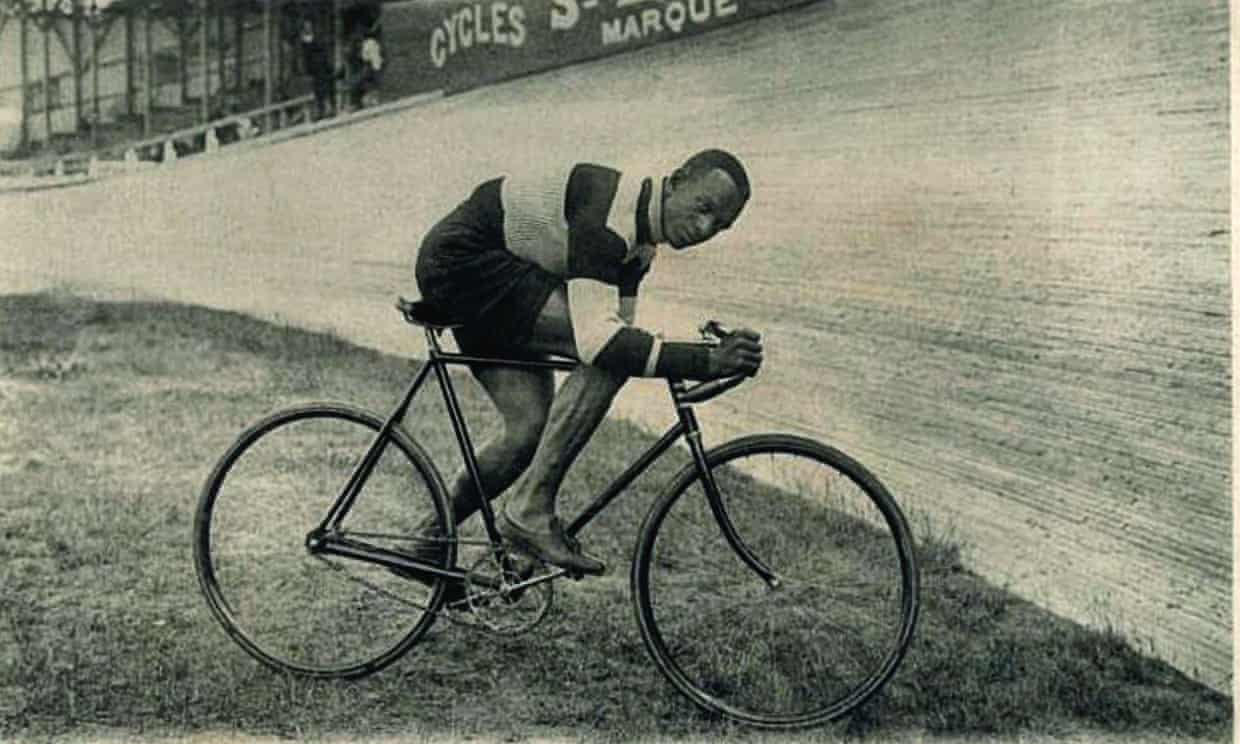
Photo: via Robert Turpin.
Woody Hedspeth was one of several Black American cyclists in the early 20th-century to move abroad to further his career. 

A country shoots itself in the foot when it pushes away talent. I’m thinking of asylum seekers who may have something to offer. I’m thinking of Black talent going to Europe to find a more welcoming and level playing field — writer James Baldwin, for example, singers Josephine Baker, Marian Anderson, and Paul Robeson.

Today I’m learning about Black bicycling champions turning to Europe in the early days of the competitive sport.

Rich Tenorio writes at the Guardian, “When cycling first took the US by storm in the late 19th and early 20th centuries, Black Americans joined in the new pastime. One Black cyclist, Marshall ‘Major’ Taylor, became a world champion in 1899. Yet American cycling installed a color line in professional racing. Opportunities became so limited that Black competitors had to take them wherever they could find them – including on the vaudeville stage and in Europe. Their story is documented in a new book, Black Cyclists: The Race for Inclusion, by Robert J Turpin, a professor of history at Lees-McRae College in North Carolina.

“ ‘We fall into the trap that history is linear,’ Turpin says. ‘With race relations, we think about the end of the Civil War: “Slavery ended, and things gradually got better and better for Black people.” My book shows what we already know: Things actually got worse for Black people in the US, especially from the 1880s through the 1920s … It got harder for Black cyclists to compete as professionals or even win prize money in general.’

“Turpin is a cyclist himself, and his college features a cycling studies minor, which he believes is the only such program in the US. His interest in the history of cycling extends to how it has been marketed over the decades – the subject of his previous book. …

“Turpin raises another issue: a lack of diversity in contemporary cycling. The book cites a 2020 USA Cycling survey of over 7,000 members in which just 3% reported they were Black or African American. Such underrepresentation extends to the [Olympics] and the Tour de France, where [in July] Biniam Girmay became the first Black African stage winner in the race’s 120-year history. Yet the book notes the increasing impact and influence of Black elite competitors such as 11-time national champion Justin Williams and the first Black female professional cyclist, Ayesha McGowan.

“Before attending graduate school at the University of Kentucky in 2009, Turpin learned about Taylor, whose exploits in cycling began as a teenager in Indianapolis, and crested with a world championship in the one-mile sprint in Montreal. In doing so, he became the first Black American world champion in any sport and his achievements were chronicled in an autobiography, The Fastest Bicycle Rider in the World. ‘He was an international superstar,’ Turpin says. …

“Several years later, Turpin returned to Taylor’s story. By that time, additional primary sources had been made publicly available through digitization. Turpin learned more about not only Taylor, but also his predecessors and peers. …

“Massachusetts became a venue for early Black success in cycling. David Drummond regularly won Fourth of July races in Boston. Taylor used his winnings to buy a home in Worcester – and the city’s first automobile. Katherine ‘Kittie’ Knox, a seamstress turned racing star, was famous for her self-designed outfits and her endurance. Knox illuminated challenges faced by cyclists who were both Black and female.

“ ‘If you were Black and a woman, those were two big strikes against you,’ Turpin says. …

“In 1894, a prominent nationwide cycling organization called the League of American Wheelmen, … barred all Black cyclists except Taylor from professional racing. The ban was not officially repealed until 1999 by the organization, which had been renamed the League of American Bicyclists.

“The book shows the ways in which Black cyclists responded. These included criticizing the decision in the Massachusetts state legislature and forming Black cycling leagues.

“ ‘I stress their agency,’ Turpin says. ‘I do not talk about them as victims. They were resourceful in figuring out alternative ways to still make a living and find social mobility.’ …

“Unlike Jim Crow America, international venues welcomed Black participation as professionals. Taylor left for France and Australia, and named his daughter Sydney after the city where he felt most welcome. Fellow racer Woody Hedspeth followed Taylor to France – and while Taylor returned to the US, Hedspeth remained in Paris.”

More at the Guardian, here. No firewall.

Read Full Post »

Photo: Dominique Soguel.
The
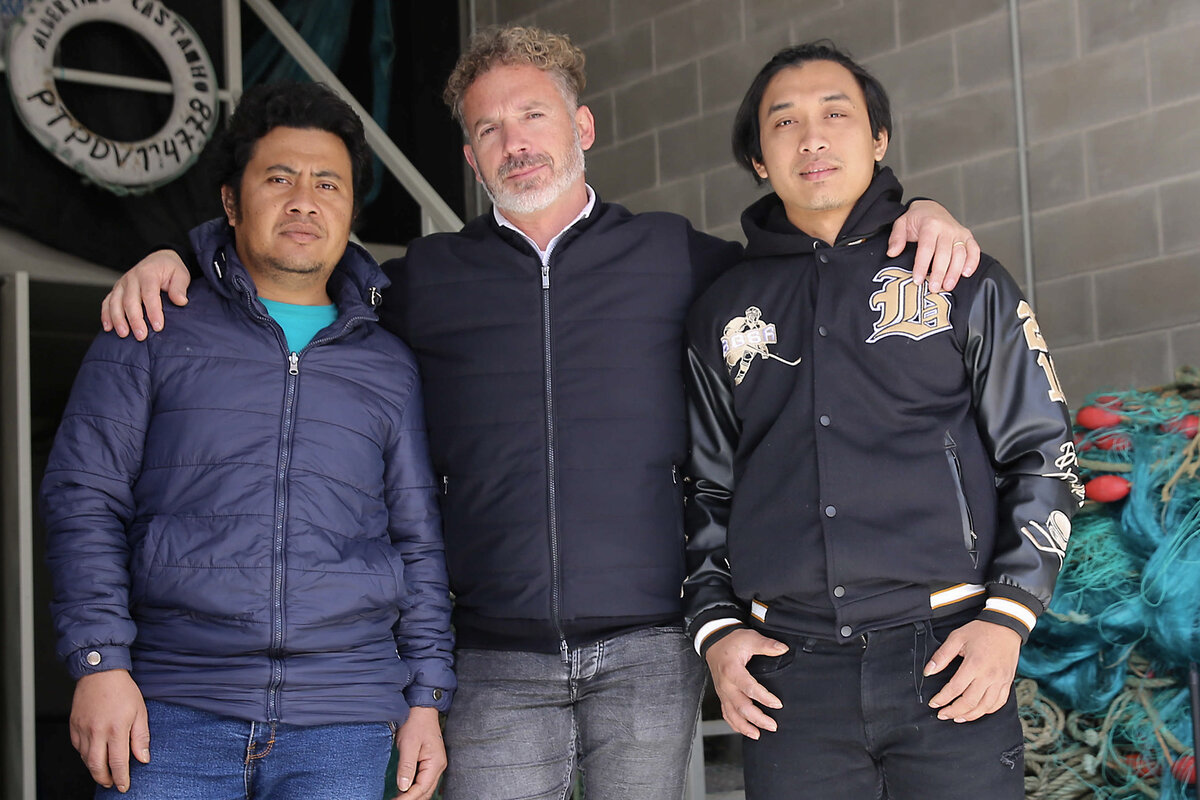
Christian Science Monitor shows a Portuguese fishing vessel captain with two of his Indonesian deckhands, March 8, 2024.

The Christian Science Monitor does a great job of finding stories about humans treating other humans with respect, even kindness. Such stories do exist. Why other media outlets don’t spend much time on them is anybody’s guess. They seem to think that anger is what people want, but why do they think that?

Dominique Soguel writes that many in Portugal are giving a welcome to migrants rejected elsewhere. They know it’s in their mutual interest. A far-right party is trying to change that, but so far harmony, says Soquel, is winning.

“Among the warehouses of one of Portugal’s oldest ports, conversations are flowing among the men sorting their fishing nets. But not without the help of Google Translate.

“The fishers at work include not just Portuguese people but also Indonesians. Thanks to a local ship captain who ventured east to solve labor shortages, Póvoa de Varzim sees a steady supply of deckhands from Indonesia, and now they account for half of all crew mates.

“And while an influx of Muslim migrants into a traditional vocation like fishing is the sort of event that would be potentially inflammatory elsewhere in Europe, in Portugal it seems to be working out without much fuss.

“ ‘The Indonesians are quite well integrated in the community,’ says another ship captain, Manuel Marques. ‘We were never against their culture. We did not ask them to change a single thing. We tried to make things as easy for them as if they were at home.

‘We do need them, and we know it. There is a mutual respect.’ …

“ ‘We also have a place to worship here, like a mosque,’ says Wahono Lucky, an Indonesian fisher. ‘I tell my boss that I don’t eat pork – I eat meat, chicken, rice, pasta, but no pork. Muslim, Christian, it’s never a problem here.’ …

“ ‘We are the only country in the European Union that allows people to come to Portugal without a job,’ notes journalist and professor Paulo Agostinho. ‘We are one of the biggest entry doors for Europe, and we are having problems with Brussels because of that. But Portugal does not have an immigration problem.’

“People from former colony Brazil make up about a third of the migrant population. Citizens of the Community of Portuguese Language Countries are also well represented, benefiting from facilitated residency procedures. In recent years, migration from India, Pakistan, Nepal, and Bangladesh has ticked up.

“Not all of Portugal’s South Asian arrivals are integrating smoothly. In the agricultural fields of Póvoa de Varzim, the sense of harmony that is palpable portside is elusive.

“Lazaro Morgado, a foreman overseeing a quartet of Indians planting seeds, clearly prefers working with a Brazilian, with whom he shares a native tongue. ‘It is complicated for the Portuguese to work with the migrants,’ says Mr. Morgado. ‘Sometimes they don’t know the procedure, and it is hard to explain. And sometimes they don’t obey the Portuguese worker even though at the end of the day, the Portuguese one is the one directly accountable to the boss.’

“Two Indian workers say they paid exorbitant sums – about €14,000 ($15,200) – to visa consultants to get here. ‘Not all Portuguese like migrants,’ notes Hardy Singh, one of the Indian workers, citing experiences of job and housing rejections on account of his ethnicity. ‘But our boss here is good.’

“Back at the port, Mr. Marques wants the Indonesian crews to stay. That’s why he – like other shipowners in the area – houses the workers in apartments scattered across the community and invites them for barbecues. The Indonesian fishers also get minimum-wage contracts and a paid-for trip home for vacation.

“ ‘Some Portuguese don’t make as much as them because they are on contract, while we only get paid if we go to sea,’ laments Tomas Postiga, an older fisher. But he grasps the importance of Indonesian workers to keep the traditional community afloat and prefers them to workers of other nationalities. Religious differences are not a problem. ‘Some are religious. Some are not. It changes nothing,’ stresses Mr. Postiga. …

“For Masrura Rashid, [Portugal’s Moorish quarter] is simply home. She arrived here six months ago, after studying engineering and wandering in the lush tea gardens of Sylhet, Bangladesh. Her father moved to Lisbon first, obtaining the right to family reunification. Now she works at her uncle’s travel agency.

“In a street rich in halal butchers and supermarkets, Ms. Rashid does not especially stand out. Donning traditional Muslim attire that fully covers her face, she is keen to learn Portuguese. ‘It’s easy here,’ she shares. ‘The weather, the environment, the people, it’s all good.’ “

More at the Monitor, here. No paywall. Subscriptions are not expensive.

Read Full Post »

Last Sunday, Pam and I walked over to the library to hear an acclaimed poet read at the poetry series. Ross Gay, who lives in Indiana, had just published his poetry collection Catalogue of Unabashed Gratitude and was doing readings around New England.

Glenn Mitchell, who organizes the library’s poetry series, was able to publish an advance interview with Gay in the local paper.

She wrote, “Gay says his inspiration for writing poems is a determination to practice joy as a discipline. He is a finalist for the 2015 Kingsley Tufts Poetry Award and the National Book Critics Circle Award and was a finalist for the 2015 National Book Award in Poetry and the NAACP Image Award in Poetry.

“Gay also works in the field of literary sports writing. He is a founding editor of the online sports magazine Some Call it Ballin’, a publication of reflective essays written by well-known poets, essayists and fiction writers along with podcasts of contributors.

“He serves on the board of the Bloomington Community Orchard, a nonprofit, food justice project.

“An associate professor of poetry at Indiana University, Gay is residing in Cambridge while a 2015-16 Fellow at the Radcliffe Institute for Advanced Study.”

Here is what Gay told Mitchell about the poet that inspired him to write poetry: “[Amiri] Baraka’s poems were such a clear articulation of the kind of alienation I was experiencing when I went off to college — a kind of racial alienation and class alienation — that I had no idea how to begin to talk about other than wanting to break things. I knew I was full of rage (which I later knew was a version of sorrow, too), but I didn’t know how to put it into words, which Baraka’s work made it possible for me to understand was possible.”

To her question about gardening coming into his life and the difference it made, he says, “I think close looking, paying attention, going slow, a kind of training in receptivity — I think those are things I learn from the garden … I approach poems like that, usually. I like to listen to them as much as I try to impose my own will on them. … A garden or a poem is potentially a device for pulling people together, they are both food, I’m saying, which we might feed to each other.”

In his Sunday reading, Gay included a poem about strangers sharing figs from a tree unexpectedly flourishing near his Philadelphia home — a poem that expresses some of his thoughts about our history of racism and the possibility of goodness.

He says, “The poem ‘To the Fig Tree at 9th and Christian’ gets at it—gets at what it means for us to come together despite the brutal history we’ve inherited, or even enacted. I think that fig tree is a kind of mercy.”

More here.

Read Full Post »