Feeds:
Posts
Comments

Posts Tagged ‘rebuild’

Photo: Erin Brethauer.
Marquee hosted more than 300 artists and small business owners in Asheville, North Carolina, before Hurricane Helene, a devastating storm in 2024.

When Hurricane Helene washed through Asheville, North Carolina, last year, my childhood friend Ursula was one of the many who lost out. Her basement washed out, not only forcing her to stay at a neighbor’s but damaging many of her father’s artworks and the materials for her own weaving. At the same time, Asheville lost its whole arts district.

Now Ursula is rebuilding, and so is Asheville.

Jonathan Abrams writes at the new York Times, “Jeffrey Burroughs strolled among crooked trees and clumsily leaning chain-link fences on a recent Thursday afternoon in Asheville’s lower River Arts District. Nearby, heaps of flood-damaged antiques dotted the ground outside gaptoothed buildings that had previously housed hundreds of working artists.

“ ‘It’s nice that at least it’s green,’ Burroughs, president of the River Arts District Artists, said of the bent trees. ‘It was really depressing through the winter and the fall.’

“Burroughs, who uses they/them pronouns, is not joking when they say they have taken just two days off in the more than 10 months since Hurricane Helene, the deadliest hurricane to strike the mainland United States since Katrina in 2005, ravaged wide swaths of the Southeast, leaving at least 250 people dead.

“The storm overwhelmed Asheville’s French Broad River, submerging much of the once robust River Arts District in as much of 24 feet of water, caking it in layers of mud and destroying the life’s work and financial pipeline of hundreds of artists. …

“ ‘People were prepared because this area has flooded’ in the past, Burroughs said. ‘They moved everything up. Nobody anticipated second floors would flood. That’s not something you even conceive.

‘All of a sudden, it was like a lake opened in the middle of our town.’ …

“Over the past few decades, the River Arts District blossomed into that sprawling artistic epicenter as antiquated buildings transformed into bustling studios, classrooms, galleries and showrooms. The district’s recovery is seen as a crucial step in regaining a steadiness of income and the sense of normalcy for the many who lost so much in the storm.

“ ‘The business owners in the River Arts District have been working their tails off to rebuild since Hurricane Helene struck and I am making sure the state works with that same urgency to support their recovery,’ said Gov. Josh [Stein] who recently toured the district on a bike.

“The River Arts District housed nearly 750 artists before the hurricane. ‘You’re just immersed in art,’ said Davis Perrott, a woodworker who recalled waking up from the storm to a sound like someone forcefully slamming themselves against his window. ‘I’m sure there are other areas like it, but I haven’t seen it.’

“The upper portion of the district, which houses Burroughs’s jewelry store, returned fully in January. A few spaces have reopened in the lower portion of the district, which is closer to the river and suffered the most flooding.

“About 350 of the displaced artists are working again in the district. Some are actively involved in the continuing recovery process, waiting to return to the home that welcomed them.

“Others have decided not to return. For them, the risk of another storm outweighed anything else.

“Riverview Station was a major hub in the district, once hosting hundreds of artists, including the 14,000-square-foot ceramics space, the Village Potters Clay Center. That was before ’26 feet of water went through and wiped us out,’ said Sarah Wells Rolland, its founder. …

“The center was home to studios, showrooms, a gallery and classrooms where workshops were held. Wells Rolland said that $500,000 worth of equipment was lost in the flooding.

“ ‘I never even entertained going back,’ she said. … ‘I believe it’ll all wash away again.’

“Instead, Wells Rolland opened a new center near the arts district. While her business has returned, she is still searching for her creative spark.

“ ‘I’ve lost a lot of people. … Just numb is what I felt. I didn’t have any ideas. Still, almost a year out, I’m a highly creative person, but I still don’t feel like I have that creative energy yet.’

“As the district returns in fits and bursts, it could provide a blueprint for how other communities ravaged by increasingly destructive natural disasters can recuperate their livelihoods. Those affected have been depending much more on smaller networks of supporters and volunteers than on any government channels. …

“Marquee, an art gallery that hosted more than 300 artists, [anticipated] a September reopening, with other businesses in the lower district.

“ ‘We’re able to tweak the things that we wished we’d have done the first time before we opened and now we’re getting to get it all right,’ said Robert Nicholas, the building’s owner.

“Despite the devastation it caused, the storm reinforced what had drawn many to the district in the first place, heightening their sense of community.” More at the Times, here.

Read Full Post »

Photo: Gerry Hadden/The World.
The town of Libros, in northeastern Spain, has a population of 60.

What are you reading?

Sometimes that question is my way of greeting someone: “Hi. What are your reading?”

Books are so important to me, I make the mistake of assuming they’re important to everyone. Right now I’m reading Fresh Water for Flowers, recommended by Suzanne, who liked the French bestseller (translated) about a woman who was a cemetery caretaker.

Books are important to a town in Spain, too. How could they not be, with a name like Libros? And now the town is now planning to rebuild its economy on the back of books.

Gerry Hadden has the story at Public Radio International’s The World.

“On a typical winter’s day in the village of Libros, in northeastern Spain, about the most exciting thing that happens is the hourly ringing of the church bell, which startles flocks of pigeons living in the belfry. …

“Libros has a population of 60. But once upon a time, some 2,500 people lived here. The majority of residents worked on farms, or in the nearby sulphur mines, which closed in the 1950s. But like lots of villages in the Teruel region, most of the older population has died off over the years, while the young emigrated, said Arana, who is an electrician by trade. …

“To attract newcomers, Arana thinks the key to the town’s salvation is in its name: Libros translates to ‘books,’ and he wants to open the town’s first ever library. 

“The library’s location has yet to be determined, but Arana has already started building its collection. A year ago in June, Arana made a plea for book donations on social media with the hashtag, Libros para Libros, or ‘Books for Books,’ which went viral.

“Since then, over 70,000 volumes — including novels, kids’ books, nonfiction and encyclopedias — have poured in from all over the world — from Argentina to Germany. Twelve boxes alone came in from Mexico.

“At one point, Arana said, the postman was coming by so many times a day that they gave him a key to town hall. Books were piled up all over the building, to the point where Arana could barely reach his office. So, late last year, he worked with volunteers to move a bunch of the books to a warehouse. …

“Adrian Soriano, 37, the town’s handyman, pointed to a big, red shipping container on the edge of town. It was filled to the ceiling with books.

“Arana said that he paid $3,000 for the container, money the tiny town can’t spare. And this is where the success and euphoria of the online book drive meets the economic realities of a small village.

“ ‘Now, we just need the library itself,’ Arana said. ‘The regional government likes the idea. But they say it will cost some $4 million to build it. We don’t have the money, but I am sure we’ll find it.’

“Arana said that they’ll apply for funds from the European Union if need be. His idea is to combine the library with a hotel to pay the salary of a librarian.  

“ ‘The library hotel will generate jobs. People need work, which is why they leave to begin with. If we can bring back just seven or eight families, well, they’d count as villagers.’

“Someone, he said, needs to organize the collection. Arana said that he’s confident because there’s proof that literary tourism can work here.

“For example, bestselling Spanish author Maribel Medina talked to Teruel TV about a project she runs called My Town Reads. It stages literary events in tiny villages, including Libros, inviting famous authors to visit, sign books and spend the night.

“Libros has hosted four events with Medina’s help. Arana said that hundreds of people showed up each time.

“ ‘It seems that because of our little literary boom, folks are starting to fix up the houses here,’ he said. ‘On weekends, more people are returning.’ …

“Libros native Santiago Perez, 81, who lives past a bunch of crumbling homes, pointed to a house with scaffolding around it. ‘One of my boys has set out to fix up that one. He’s making a really nice home for himself.’ “

Is this dream unrealistic? Well, that’s another thing about books — they encourage big dreams. And big dreams are a necessary step for big accomplishments.

More at PRI’s The World, here.

Read Full Post »

Photo: Patrick Zachmann/Magnum Photos.
The real miracle: Reconstructing the intricate wood frame of Notre Dame’s roof.

When the unthinkable happens to a beloved cultural icon, what’s next? In the days and weeks after the great fire of Notre Dame Cathedral broke hearts around the world, plans began to take shape.

Joshua Hammer writes at GQ, “Some time after six in the evening on April 15, 2019, Rémi Fromont was sitting at the Brasserie Saint-Malo, a lively café in Montparnasse, Paris, when his phone rang.

“ ‘Notre-Dame is on fire,’ ” said a friend on the other end of the line. … Fromont leapt out of his chair, got on his bike, and pedaled north toward the cathedral. …

“About an hour after his arrival, Fromont, with thousands of Parisians at the scene and millions watching around the world, looked on as the 750-ton spire, made of 1,230 oak beams, blazed, teetered, snapped like a matchstick, and crashed through the roof. Spectators broke into tears of disbelief and horror. …

“The day after the fire, French president Emmanuel Macron made a promise: Notre-Dame would rise again in the next five years.  …

“None of the many priceless paintings, sculptures, and windows that filled the church’s interior — though they were stained by smoke and singed by fire — had been wrecked beyond repair. …

“The roof frame was a different story. Known in French as the charpente, it was an ingenious assemblage of triangular-shaped trusses, each one consisting of horizontal and vertical beams and diagonal rafters designed to support the heavy roof cover and distribute the weight over the walls beneath it. Built from thousands of pieces of wood and assembled without nails, it was a singular achievement, one of the oldest surviving all-wood structures in the world. …

“During World War I, German artillery shells had reduced the cathedral in Reims, another Gothic masterpiece, to charred wood and rubble. In 1919, the architect Henri Deneux launched the restoration, reconstructing the church’s roof with reinforced concrete, a decision that was controversial at the time.

“Fromont had not warmed to Deneux’s approach. He believed that the roof’s charpente could be rebuilt exactly as the medieval carpenters had done it. The approach was not without risks — Fromont had told me, ‘Wood burns. I’m not going to say the opposite’ — but certain measures could be put into place to mitigate its vulnerability.  …

“The roof’s charpente was perhaps [Notre Dame’s medieval woodworkers’] greatest creation. Yet Fromont told me that, until recently, it had never been the subject of serious scholarly study. …

“In 2012, Fromont, then a 35-year-old scholar at Paris’s École de Chaillot, decided to address that absence. For his advanced degree, Fromont proposed spending a year surveying every inch of the charpente. When they were at last granted permission, he and his partner on the project, Cédric Trentesaux, entered the cathedral’s south transept and climbed a winding staircase into the triangular south gable. There they squeezed through an aperture and entered a medieval realm barely visited in over 800 years. …

“The two men emerged from the project with the most extensive blueprint of the 800-year-old structure that had ever been created. ‘It wasn’t a lot, but it was enough,’ Fromont said. …

“There was some skepticism that the charpente could be re-created in its original glory, but Fromont found an ally in François Calame, France’s leading apostle of traditional carpentry. In the early 1990s, as a young carpenter, Calame had visited Maramures‚ a remote region in western Romania. Isolated from a fast-changing world during Nicolae Ceausescu’s 24-year dictatorship, artisans there had kept the old ways of carpentry alive.

“Like in Romania, traditional French axmen used hand tools: the hache de grossière, a long-handled, narrow-bladed axe used to remove large amounts of wood, and the doloire, a broad-bladed, short-handled axe designed for precision chipping following the grain of the wood. It’s slow and physical work: Squaring lumber by hand can take much more time than doing it with buzz saws. For that reason, by the 20th century, axes had all but disappeared as a construction tool. Yet their proponents extol the end result: more pliable, stronger beams, and imperfections that reflect the extensive labor and love of craft. ‘This is a kind of magical work because you feel the material,’ Fromont told me. ‘You smell it and touch it.’ ”

Read what happened next in Paris. The long and fascinating article is at GQ, here. No firewall.

Read Full Post »

Photo: Asif Hassan/AFP/Getty Images.
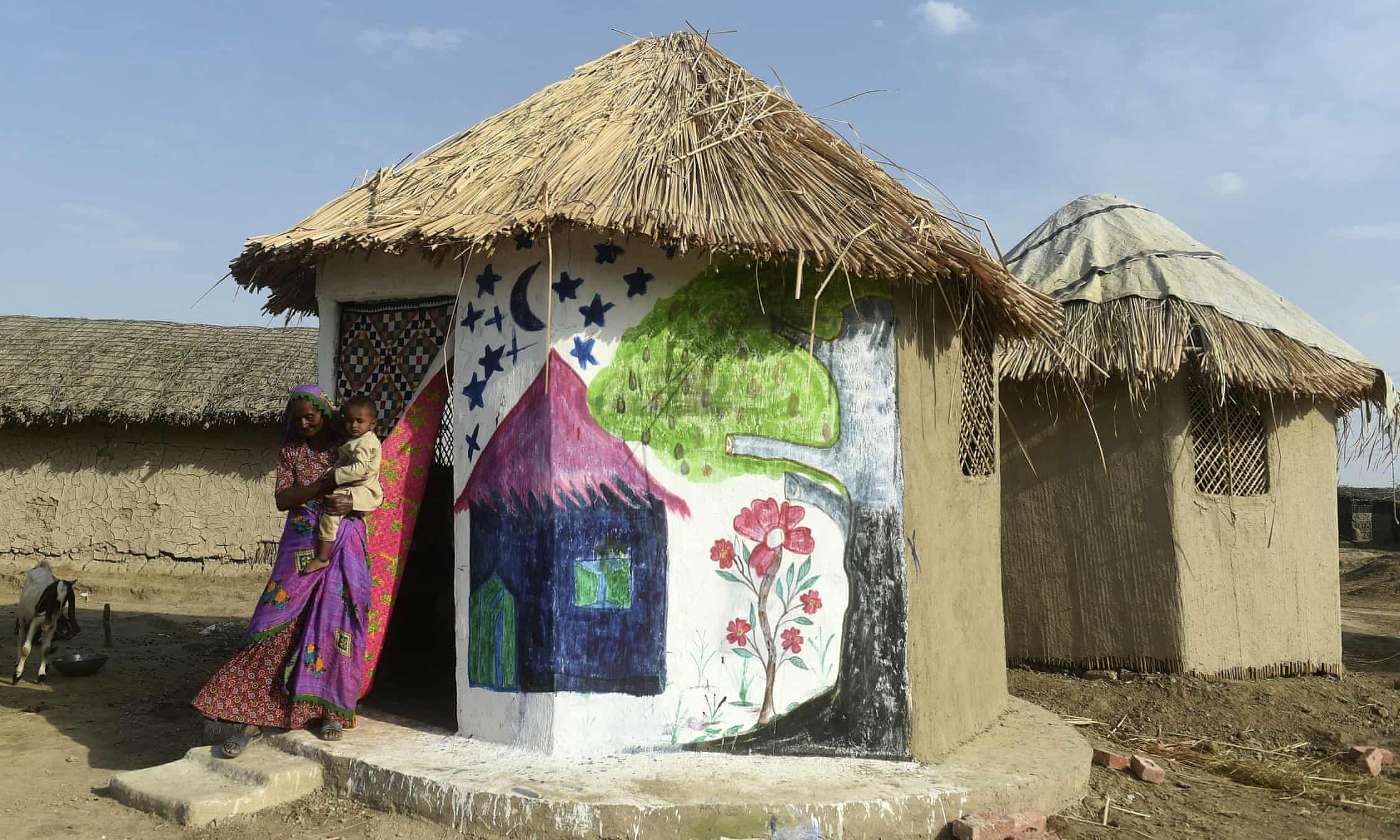
A resident with her flood-resistant hut made from bamboo at a cost of about $87.

The news of floods this week is tragic. In Libya a dam suddenly broke, wiping away villages, and even near me, a quixotic rainfall — 11 inches in about 6 hours — submerged many homes in one city while the rest of the region was untouched.

Pakistan, of course, has suffered worse. That’s why it’s extra interesting to read about a sustainable, cost-efficient way that some poor areas there are rebuilding.

Zofeen T Ebrahim writes at the Guardian, “A year ago, Shani Dana’s mudbrick house was swept away in the worst floods on record to hit Pakistan. More than 1,700 people were killed and 900,000 homes damaged or destroyed. Sindh province, where Dana lives, was the worst affected.

“While waiting for government money to rebuild her home in Wasram village, in the Tando Allahyar district, word reached Dana that the Heritage Foundation of Pakistan (HFP), founded by a renowned architect, Yasmeen Lari, was building one-room homes in neighboring Pono village.

“The buildings ‘looked like rounded chauhras [traditional huts], but were octagonal in shape and the walls were much sturdier,’ says Dana.

“The foundation agreed to help Wasram rebuild and in March the HFP team joined villagers to construct 50 new homes. Prefabricated bamboo frames were built on meter-high raised platforms. Walls made of bamboo canes were fixed and plastered with mud mixed with rice husk and lime, and radial-style conical roofs were fitted. Four solar panels, six water hand pumps and 25 toilets were also built.

“ ‘This will not be swept away if the floods come again. It is not built at ground level, it’s airier and brighter since there is a window – ours didn’t have one before – and also looks much neater, since the walls and floor are plastered,’ says Dana outside her new home. …

“The HFP has helped build more than 5,000 chauhras since September [2022]. ‘In the next two months, I should be able to build another 2,600 homes,’ says Lari, who is urging every villager who has built their home to help 10 others build theirs.

“A year after the floods, tens of thousands of people are still waiting for help to rebuild. Organizations like HFP and the NGO Karachi Relief Trust have been stepping in.

“About 250 of the 1,000 one-room homes KRT is building in villages across Sindh, Punjab and Balochistan provinces … are being built using burned-earth bricks or cement blocks with roofs made of steel girders and precast cement slabs. ‘The houses we built in 2010 have survived and aged well,’ said Ahsan Najmi, the trust’s architect. …

“The Sindh People’s Housing Foundation (SPHF), which is overseeing the rebuilding, hopes 50,000 one-bedroom ‘resilient’ cement, brick and steel homes will be livable by September. It has enough money to cover the cost of 350,000 homes, but needs at least $500m to finish all the work. …

“However, Lari questions the cost of the project and believes rebuilding could be cheaper and more sustainable. The houses SPHF is asking people to build cost 300,000 rupees [~$1,030] each, about the same amount KRT’s homes are costing.

“HFP homes, which are made of fully cured bamboo, the ends of which are covered with lime to protect them from termites, cost just 25,000 rupees. The lime in the plaster and bamboo also absorb and store carbon from the air, helping mitigate the effects of the climate crisis.

“ ‘I’m not doing anything new. I may have tweaked the design, but the material used is age-old, indigenous and easily available,’ says Lari, who began her humanitarian work after a 7.6-magnitude earthquake shook northern Pakistan in 2005. …

“Lari, who is this year’s recipient of the Royal Institute of British Architects’ royal gold medal, one of the world’s highest honours for architecture, says she would like the government to adopt sustainable alternatives to housing. ‘I am happy to provide any assistance if they would like to provide a better quality of life for the poor,’ she says. ‘Our design is open source, available free. We can also identify many trained master artisans. It is up to the government. We are there to further the cause.’

“An essential part of Lari’s work is involving communities in the rebuilding process so they learn a trade. While the foundation pays for the bulk of the materials and brings its expertise, local people collect the mud and rice husk, and provide the labor.”

More at the Guardian, here. No firewall. Donations encouraged.

Read Full Post »

Photo: Felipe Werneck/Ibama via Wikimedia.
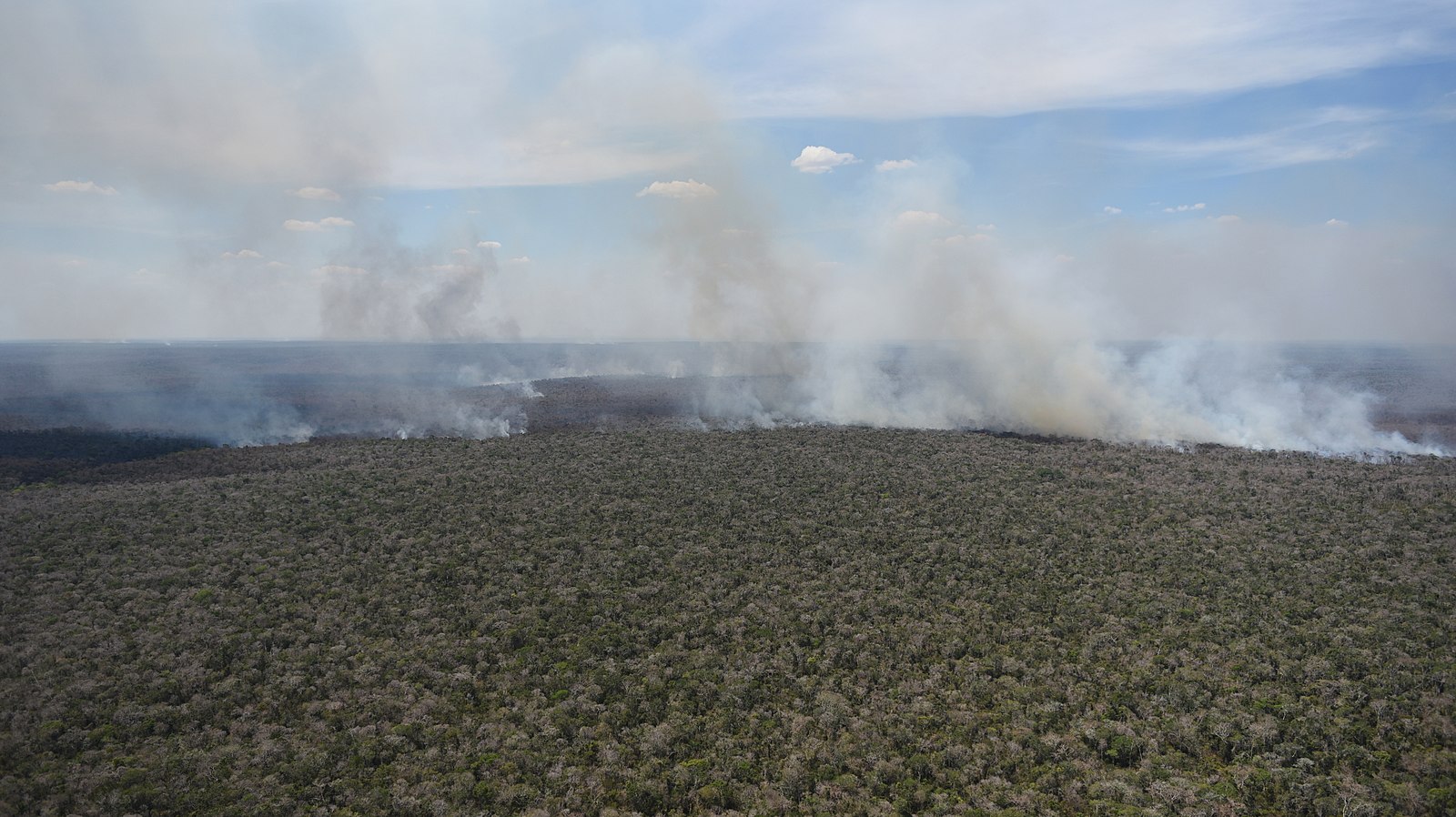
Wildfires in Brazil’s indigenous territory, 2017. Conservationists believe that restoration of the rainforest works best if a variety of seedlings are used, not just one kind.

I think humans are like ants in this regard: as soon as our anthill is destroyed, we start rebuilding. And as soon as greed destroys another swath of rainforest, conversationists, indigenous people, and fundraisers move in to rebuild. It may be hopeless, but that’s how we roll.

Bruno Vander Velde, managing director of content at Conservation International, writes at the Conversation about one rebuilding program.

“A bold initiative to regrow 73 million trees in the Brazilian Amazon has made substantial progress despite some unexpected hurdles, according to an upcoming report. While the global pandemic and an increase in Amazon fires presented setbacks, the initiative, launched in 2017, has delivered almost 20 percent of its forest restoration target, according to Conservation International in Brazil, one of several partners involved in implementation. 

“The partners point to surprising progress taking root, as the COVID pandemic shows signs of leveling off and a new incoming presidential administration publicly commits to stem the tide of deforestation. …

Launched at a Brazilian music festival, the initiative targeted areas along the southern edges of the Amazon forest, known as Brazil’s ‘arc of deforestation,’ as well as in the heart of the forest, where natural regeneration is still possible.

“By restoring these carbon-absorbing forests, the initiative is intended to help the South American country achieve its climate commitments under the Paris Agreement, as well as its target of reforesting 12 million hectares (nearly 30 million acres) of land by 2030. 

“The initiative comprises two efforts: Amazonia Live, an effort led by the Rock in Rio music festival in collaboration with Conservation International and Brazilian nonprofit Instituto Socioambiental; and the Amazon Sustainable Landscape project, a collaboration among Conservation International, the Brazilian Ministry of Environment, the Global Environment Facility, the World Bank and the Brazilian Biodiversity Fund. 

“In sum, the initiative is an experiment to ‘figure out how to do tropical restoration at scale, so that people can replicate it and we can drive the costs down dramatically,’ Conservation International CEO M. Sanjayan told Fast Company in 2017. …

“One of the initiative’s most noteworthy features was the use of a seed-planting method called ‘muvuca,’ widely advocated by the Instituto Socioambiental as a way to reduce restoration costs. Unlike typical reforestation efforts, in which tree saplings are planted one at a time, the muvuca method relies on spreading a large and varied mixture of native seeds across the targeted areas, to assure a higher diversity of trees. The technique’s results have exceeded expectations, experts say. 

‘We’re seeing a tree yield that is three times higher than our initial estimates,’ said Miguel Moraes of Conservation International’s Brazil office. 

“ ‘Rather than 3 million trees growing in 1,200 hectares (3,000 acres), as we would have expected, we’re estimating 9.6 million trees in the same area,’ based on monitoring reports, he added. …

“This restoration effort has not escaped some hard, real-world realities in Brazil’s Amazon. Some restored areas were burned by fires and will be monitored to see if they can regenerate on their own, Moraes said. (The area lost was not counted against the overall goal.) 

“Such fires — all of them set by humans, usually to clear forests for agriculture and livestock — are a sign of the times. The Brazilian Amazon has been hit especially hard by wildfires in recent years. By September 2022, more forest fires were recorded in the region than in all of 2021, amid a surge of deforestation. …

“ ‘Our initial expectation [in this effort] was to prioritize the restoration of large contiguous areas within conserved areas,’ Moraes said. Restored forests in those areas should have been more durable; however, in the past two years ‘deforestation within protected areas in Brazil has increased significantly,’ he added. 

“The resilience of the Brazilian Amazon’s many protected areas will be critical to the long-term success of the initiative. 

“As it did around the world, COVID upended life in Brazil. …

“ ‘Like everyone, we were completely unprepared for a global pandemic — not only at the project level, but also at an individual level,’ [Moreas] said. … ‘Twenty percent restored might seem a low figure — and it generates a bit of frustration. But given the context, that we were able to achieve 20 percent of our target is impressive.’

“Even in the tropics, trees take years to grow to maturity. But reforestation projects usually last only a fraction of that time. … ‘Most projects like these are an intervention at a point of time, and then they end,’ Moraes said. ‘But restoration is a long and continuous process. So, ensuring permanence is a huge issue.’

“Practitioners are taking steps to address this, including planning for long-term satellite monitoring to keep a close eye on restored forests. They will also work with communities and local governments to try to bolster on-the-ground protection of these areas. 

“Five years after the restoration initiative was announced, nearly three years into a pandemic and just weeks since a new administration took office in Brazil, project organizers are hopeful. The 2023 deadline for completion has been shifted to 2026, after some administrative challenges in the project’s early years. Organizers have now grown more comfortable managing the complexities inherent in a partnership of this size, Moraes said.

“ ‘I believe we underestimated the complexity of the challenge ahead of us. We are now trying to be more strategic. … Conservation International’s restoration efforts in Brazil go beyond just this effort,’ he said. ‘But if we succeed, we can show that we can make an impact at the scale needed to bring the forest back from the brink.’ ”

More at Conversation, here. No firewall.

Read Full Post »

Photo: Felipe Milanez via Wikimedia.
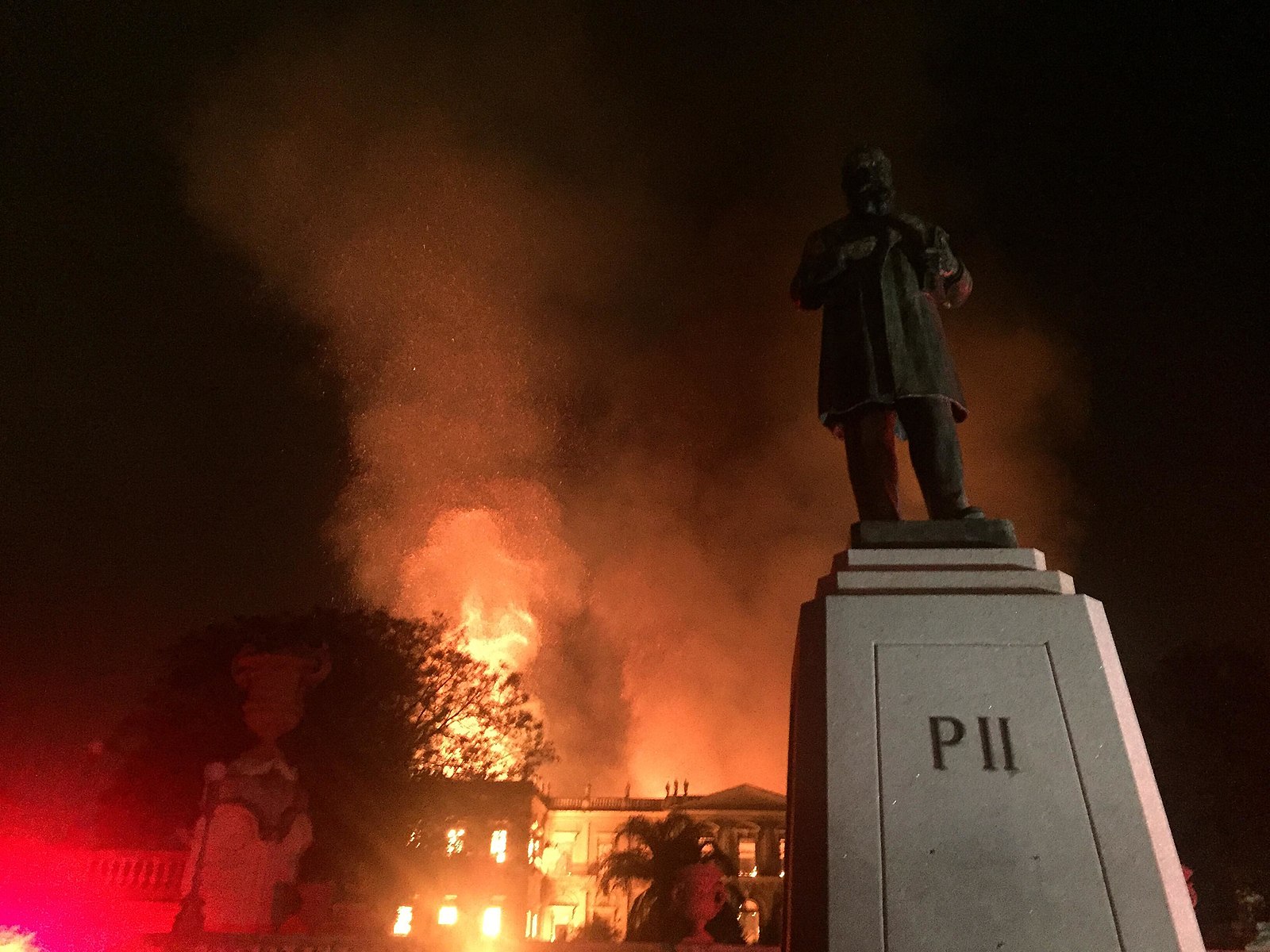
Fire at the National Museum of Brazil, in Rio de Janeiro, on 2 September 2018.

Do you remember reading about the disastrous fire at Brazil’s national museum? It was before Covid. Many irreplaceable artifacts were destroyed. I recall, for example, that the curator of entomology at the University of Texas, Austin, was devastated by the loss of that museum’s priceless insect collection.

Also lost were indigenous artifacts. But since that part of the collection had been created without tribes’ input, the rebuilding is a chance to make something better.

Mariana Lenharo and Meghie Rodrigues report at the New York Times, “In the evening of Sunday, Sept. 2, 2018, the National Museum of Brazil in Rio de Janeiro was closed, and its hallways were empty. Silent activity, however, coursed within its walls. Electricity hummed through wires connected to computers; climate-controlled storage and three air-conditioning units connected, improperly, to a single circuit breaker in the ground-floor auditorium. When one unit most likely received a surge of electricity it couldn’t handle, the overburdened system sparked. The museum’s smoke-detector system was not set. There were no sprinklers or fire doors, and a flame bloomed.

Seeing the news, staff members rushed to the building and pleaded with firefighters to let them enter and rescue something — anything. …

“Much of what was lost or severely damaged was irreplaceable: the mummy of an Ancient Egyptian priestess, a 110-million-year-old fossilized turtle, a vast collection of butterflies, the oldest known human remains in Latin America.

“The fire also obliterated an enormous assemblage of artifacts representing the cultural history of Brazil’s Indigenous populations. Masks, vases, weapons, mortars and elaborately feathered ceremonial capes dating back at least a century from the Ticuna, the Kadiwéu, the Bororo, the Tukano — at least 130 peoples in all — were gone. Researchers worked to salvage what they could from the ashes. Astonishingly, a few ceramic vases kept their original paint. One Karajá animal sculpture was found almost intact. But most ‘were fragments, scraps that would no longer be recognized by the people who made them,’ says João Pacheco de Oliveira, the head of the museum’s ethnology and ethnography division. When Ananda Machado, a social historian at the Federal University of Roraima, told members of the Wapichana people about the fire, they were devastated. ‘To them, these objects were much more than material,’ she said; they carried with them the strength of the people who made them. …

“In 2018, after 40 years with the museum, Oliveira planned to retire. But the fire pushed those plans aside. Even while mourning the tragedy, he saw possibility. Yes, the ethnographic collection was in some ways unparalleled, but he had long been vexed by what was missing from it. Many objects were collected by European travelers in the 19th and early 20th centuries who didn’t grasp the purpose that the objects served. A pot or a cape might have been chosen simply because it seemed beautiful or peculiar to a Western eye. As a curator, he found this lack of cultural context deeply frustrating.

“As an anthropologist, Oliveira was even more troubled. Since the 1970s, he has spent long periods with the Ticuna in northern Brazil trying to understand them on their own terms and to communicate their culture to a wider world. The museum was an important vehicle for his aims, but the institution came with its own inglorious history. As with other 19th-century museums, the National Museum was a repository of items plucked, purchased or plundered from Indigenous communities and had presented the people themselves as curiosities, papier-mâché figures in dioramas alongside taxidermied animals. And sometimes worse. …

“With no building to return to, Oliveira met with his team members on park benches and in cafes and explained his vision for a new collection. Indigenous people would be consulted not only about what items would go into the museum but also on how they should be identified, stored and exhibited. One of the first people he turned to was a former student named Tonico Benites.

“Benites grew up in Mato Grosso do Sul in midwestern Brazil on a reserve for the Guarani-Kaiowá, one of the country’s 305 surviving Indigenous groups. His parents never learned to read and write, but he finished high school and went on to study for a degree in education, picking up work on the side as an interpreter for anthropologists. Drawn to the questions the researchers asked, he applied to a master’s program in social anthropology offered at the museum.

“Benites’s first visit to the museum in 2006 was also his first day as a student there. Entering the ethnographic exhibition area, he saw a collection of spears and arrows and then rounded a corner. He froze, sickened. Covering an entire wall was an outsize reproduction of a woodcut from a 1557 book by the German explorer Hans Staden. The account of Staden’s captivity by the Tupinambá was immensely popular in its day, and some scholars now assert that its sensational depictions of cannibalism were used to justify European conquest of Indigenous peoples. …

“Benites raised his concerns with Oliveira, who was his research adviser. Oliveira sympathized but suggested that Benites use his research to change people’s minds. The image was removed months later, but almost a decade would pass before Benites, who had just finished his anthropology Ph.D. — the first Indigenous person to do so at the museum — began research for what he hoped would be a Guarani-Kaiowá exhibition. The fire decimated his plans. …

“The absence of Indigenous perspectives in exhibitions about Indigenous people has been acknowledged, if rarely remedied, at natural-history museums. … Unlike Indigenous groups in other countries, those in Brazil have traditionally maintained a sense of ownership over the museum, which was conceived as a museum of the nation’s history as well as of natural history, Oliveira says. Even the Wapichana, so distraught by the loss of their heritage, have committed to working with curators. Had there been arguments over ownership of older objects, the fire, in its indiscriminate destruction, made them moot. The National Museum has a unique opportunity, says Mariana Françozo, an associate professor of museum studies at Leiden University in the Netherlands. Museums in Europe would find it difficult to build a collection entirely based on collaboration, she says, ‘because they still have the old collections that carry the weight of colonialism.’ ”

More at the Times, here.

Read Full Post »

Photo: Book Aid International
The first shipment of books for the University of Mosul’s library arrives in Iraq for Alaa Hamdon’s Book Bridge campaign.

It’s a good thing that humans are like ants in one regard because as soon as a community is destroyed, people begin the work to build it back up. That is what is happening in Mosul, Iraq, a city that was overrun by the culture-hating forces of Isis not that long ago.

Olivia Snaije writes at Publishing Perspectives, “Since the destruction of the University of Mosul’s library, momentum is building for Book Aid International’s efforts to coordinate and enable publishers’ contributions to rebuilding. …

“Most news accounts date the main destruction of the University of Mosul library to 2015, following the start of the Islamic State group’s occupation in June 2014. … The library had been one of the most important in Iraq and the Middle East, a repository of information on the cultures, religions, and ethnicities that make up the region. The destruction of thousands of books, many of them precious, was a tragic addition to the country’s list of tremendous cultural losses in recent years.

“Used by up to 40,000 students, the library was, in the words of Alaa Hamdon at the London Book Fair, ‘an icon for the university, a lighthouse for students and the community, a shining light at the heart of the university.’ Hamdon is the founder of the Mosul Book Bridge campaign to rebuild the library. …

“When Mosul was liberated from ISIS in 2017, Dr. Hamdon decided to establish the Mosul Book Bridge effort to rebuild the university’s library, and contacted Book Aid International. The British charity works with more than 100 publishers in the UK and reports sending up to 300,000 books to countries worldwide.

“Traditionally, Book Aid’s service area has been mostly in Africa. But [Alison Tweed, chief executive, said] that reports of the deliberate cultural and intellectual destruction in Iraq were so moving that she offered to partner with Hamdon’s Mosul Book Bridge campaign.

“ ‘We have infrastructure and logistics,’ she said, ‘and it seemed like a wonderful partnership. … We like a challenge. We made a selection of books and put them onto trucks. They sat in Bulgaria for a few weeks and then limped across the border. The situation is volatile and ever-changing, but the books got there.’

“When the first shipment of 3,750 or so books arrived in Mosul in March 2018, Hamdon said he and his colleagues danced in the street. Tweed said that her colleagues danced in the office. ‘That appreciation is everything for us, it makes our work worthwhile.’

“What made Book Aid’s coordination and contribution especially valuable was that they delivered new books that the University of Mosul had specifically requested, said Mehiyar Kathem, whose Nahrein Network helps people across the Middle East to ‘reclaim their ancient heritage as local history, putting it to constructive use for their communities.’ …

” ‘I visited Mosul in January,’ Kathem said. ‘I’d like to stress how important it is to have the physical books there because the Internet doesn’t work well. These are brand-new important books, because you also have out-of-date books donated, like a book on electronics from the 1980s.’ …

“Hamdon said that rebuilding the library can help ‘give hope to everyone living there, that culture is back. People will feel reassured about their education and their future.’ ”

More here.

Read Full Post »