Feeds:
Posts
Comments

Posts Tagged ‘recycling’

Photo: Tracy Nguyen for NPR.
In general, Hollywood cares little for the “circular economy,” but this helicopter at Beachwood Services, originally used in 
Black Hawk Down, has been repurposed in Terminator 4Suicide Squad and The A Team, among other movies and TV shows.

As I was working on a post in which actor Benedict Cumberbatch bemoaned the wastefulness of Hollywood, I ran across a contrary example. Apparently, some folks in that world care about the environment or maybe just see a buck to be made by repurposing sets.

A big part of Hollywood’s problem relates to being in a hurry and taking the easy way out.

First Cumberbatch at the Guardian.

Catherine Shoard writes, “Benedict Cumberbatch has called the Hollywood film industry ‘grossly wasteful,’ taking particular issue with its squandering of resources in the aid of set building, lighting – and bulking up physiques for blockbusters.

“ ‘It’s horrific eating beyond your appetite,’ Cumberbatch told Ruth Rogers on her food-focused podcast, Ruthie’s Table 4, adding that when he was shooting Marvel’s Doctor Strange, he would eat five meals a day. In addition, he would snack on boiled eggs, almonds and cheese, in order to try to ingest enough protein to transform his body.

“ ‘Going back to responsibility and resourcefulness and sustainability, it’s just like, “What am I doing? I could feed a family with the amount I’m eating,” ‘ Cumberbatch said.

“ ‘It’s a grossly wasteful industry,’ he continued. ‘Think about set builds that aren’t recycled, think about transport, think about food, think about housing, but also light and energy. The amount of wattage you need to create daylight and consistent light in a studio environment. It’s a lot of energy.’ “

So there’s that.

On the other hand, according to National Public Radio, “Beachwood Services, owned by Sony Pictures Entertainment, rents out sets and props for reuse that were originally built for its own productions.”

That spark of hope was reported by Chloe Veltman.

“For decades,” she says, “it was standard practice in Hollywood for art departments to build sets for movies and TV shows from scratch, and then break them down at the end of production and haul the pieces off to the landfill.

” ‘The dumpsters just line up at the end of the show,’ said veteran Hollywood art director Karen Steward of many productions she worked on, from the 1988 high school comedy Johnny Be Good, to the 2013 political action thriller Olympus Has Fallen. ‘And there’s no talking about it, because it’s time to get off the soundstage.’

“Steward is part of a group of like-minded Art Directors Guild members who have been pushing for more sustainable practices for years, along with other allies. At first, she said, it was hard at first to get much traction. ‘We’re all about not wasting time, and hurry up, and get it done, and time is money.’

“But Steward said things are becoming easier, as the industry is gradually coming to grips with its impact on human caused climate change. …

” ‘To find a true circular solution, a true zero waste idea, is what we’re working toward,’ she said.

“According to Earth Angel, an agency that helps productions in the U.S. and around the globe reduce their carbon footprints, the average TV show or movie in 2022 created about 240 tons of waste, with an estimated half of that amount coming from the disposal of props and sets.

” ‘There are definitely more innovative, efficient ways of working,’ said Earth Angel founder and CEO Emellie O’Brien. ‘

‘We often just don’t give people the space and the breathing room to uncover those solutions.’

“One such solution is to reuse old sets rather than always building new ones. Beachwood Services, owned by Sony Pictures Entertainment, rents out sets and props for reuse that were originally built for its own productions. Located in Santa Clarita, north of Los Angeles, its warehouses are packed with scenic gems. …

“Art directors sometimes resist the idea of reusing old sets, because they want to realize their own creative vision. But Sondra Garcia, Beachwood’s director of scenic operations, said the service allows them to alter what they rent to suit their needs.

” We tell people, “You’re going to put your own spin on it. You’re going to paint it. You’re going to reconfigure it. And then it is your design,” ‘ said Garcia. ‘The most important thing to remember is to recycle stuff because it’s less wasteful, and producers like it because it saves money.’

“And when those sets get too old to rent out to big-budget productions, they often wind up at places like EcoSet. Productions pay for the Los Angeles-based company to haul away their unwanted sets, props and construction materials. Instead of going to landfills, those treasures are then donated to whoever wants them. …

“But these solutions to Hollywood’s chronic waste problem only go so far.

“Ecoset’s owners don’t know what happens to all of the free stuff the business gives out — whether it’s recycled again or thrown away. Also, many warehouses around the region that used to keep old sets and props in circulation have downsized — Sony’s Beachwood Services formerly had five warehouses and now there are two — or have shuttered in the past couple of years, owing to rising real estate costs. …

” ‘I don’t think anyone in our industry would shy away from really hard challenges or else we wouldn’t be in our industry,’ said Everything Everywhere All at Once producer and sustainability champion Jonathan Wang. ‘But I do think it’s tricky.’

“Wang said despite people’s best intentions, a lot of materials still get thrown out in the rush to meet hectic production deadlines — including on his own sets.

” ‘I think it’s important to just acknowledge that we’re all figuring it out,’ Wang said. ‘We’re trying to do it better.’ “

More at NPR, here, and at the Guardian, here. No firewalls, but both those outlets need our support.

Read Full Post »

Photo: The Guardian.
Phra Mahapranom Dhammalangkaro, abbot of Wat Chak Daeng, with the solar-powered Hippo waste-collection vessel behind him. When he began his campaign against plastic, he found a novel way to get people to send monks their waste: ‘People can make [Buddhist] merits by giving us plastic bottles, bags and paper.’

Today’s story shows a good way to reduce current plastic problems, even though we know that long-term, we need to stop producing plastic. You can collect it and turn it into other products, but when the new products break down, we still have plastic.

Claire Turrell writes at the Guardian from Bangkok, ” ‘Once upon a time this river was filled with fish; now, nothing swims in it any more,’ says Wat Chak Daeng temple’s abbot, Phra Mahapranom Dhammalangkaro, as he looks out over Bangkok’s Chao Praya River.

“As a novice monk in the 1980s, he remembers seeing children playing in the river and people scooping up handfuls of water to drink. But when he became abbot of Wat Chak Daeng more than 25 years later, those bucolic images were a thing of the past. Instead, when he arrived at the 240-year-old temple, he was saddened by the sight of the dirty river and the rubbish-strewn grounds surrounding it.

“Dhammalangkaro knew that if nothing was done, the situation would only get worse. He built a recycling centre in the temple grounds, which evolved from collecting a handful of bottles to upcycling 300 tons of plastic a year. His biggest problem was that he was unable clean the river itself.

“But then he met Tom Peacock-Nazil, chief executive of Seven Clean Seas, an organization that finds solutions for plastic pollution. Last week the two men launched the Hippo, a solar-powered boat, which aims to remove [millions of pounds] of plastic a year from Bangkok’s busiest waterway. …

“The Chao Phraya River is the largest waterway flowing through central Thailand. It stretches more than 230 miles from the northern Nakhon Sawan province to the Gulf of Thailand and is home to critically endangered species such as the Siamese tigerfish, giant barb and Chao Phraya giant catfish.

“In Bangkok, it is an artery for a network of water buses, ferries and wooden long-tail boats. But it’s not just carrying people. According to research by the Rotterdam-based non-profit organization Ocean Cleanup, the Chao Praya River carries 4,000 tons of plastic waste to the sea every year. …

“The Hippo’s design is simple and effective. A boom on the vessel funnels the floating plastic from the river on to a solar-powered conveyor belt. This then hauls the rubbish out of the water and drops it into a dumpster hidden under its roof.

“The tangled mass of water hyacinths, food containers, plastic bottles and bags is then sorted by hand and recycled at the plant in the temple. …

“Chalatip Junchompoo, a director of the Marine and Coastal Resources Research Centre, believes the Hippo’s presence will have an important impact by raising awareness of plastic waste. She views it as a welcome addition to its network of river booms and rubbish-collection boats. …

Thailand is aiming to have all plastic recycled by 2027, up from 37% now, according to the Pollution Control Department. Plastic that cannot be recycled is, where possible, used for refuse-derived fuel. …

“While sponsorship has helped cover the running costs of the Hippo, future expenses and maintenance will be paid for with plastic credits, which companies can use to offset their plastic footprint.

“In Wat Chak Daeng, some of the plastic is sent to a factory to be converted into fabric. The fabric is then sewn by volunteer seamstresses at the temple into saffron-colored robes for the monks, as well as blankets and bags. …

“The monks can upcycle multilayered plastic, which is seen as challenging to recycle, thanks to a new machine that uses a chemical recycling method known as pyrolysis to break plastic down into oil. Any organic waste is converted into fertilizer using two industrial composters.

“The Hippo has created the final link in Wat Chak Daeng’s circular economy. Now the aim of the team is to build more Hippos to tackle other polluted rivers elsewhere in Thailand and south-east Asia.

“Peacock-Nazil says that addressing rivers alone is not the solution. ‘We need to work onshore and in riverside communities to make sure they have the infrastructure needed to stop plastic leaking into the environment in the first place,’ he says.

“Seven Clean Seas, as well as extending its reach in Bangkok, plans to create educational programs at a local level and would like to offer the Hippo as a floating laboratory for universities in the future.”

More at the Guardian, here. No paywall. Contributions keep the Guardian going.

Read Full Post »

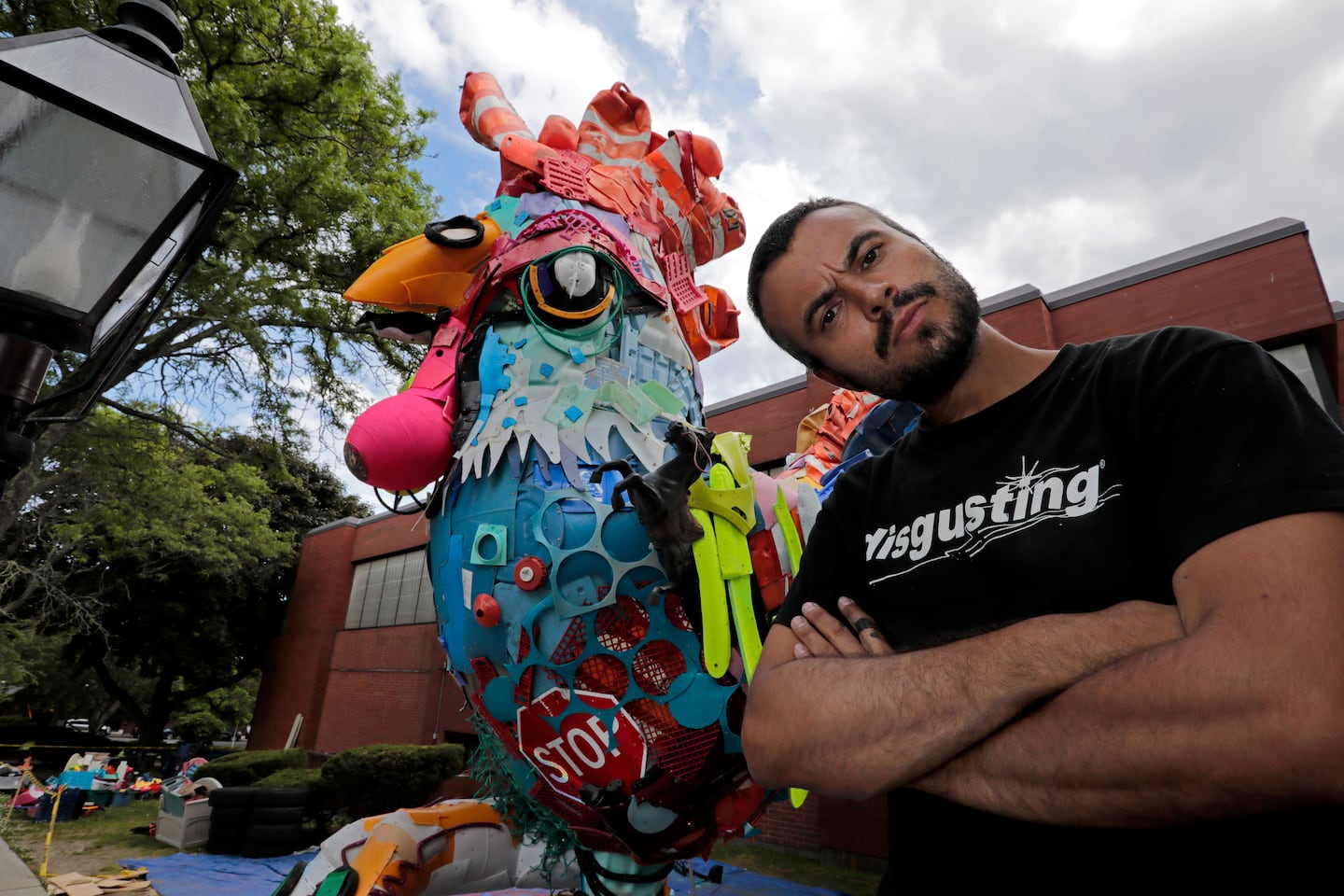
Art: Bordalo II.
Photo: Pat Greenhouse/Boston Globe.
I’ve been following this Portuguese sculptor on Instagram for several years. Now he’s worked with high school students to create a sculpture for Portuguese-speaking New Bedford, Mass., not too far from where I live.

I have been curious about this artist, age 36, for a long time. He makes vibrant sculptures from trash and shows them on Instagram.

Cate McQuaid wrote recently at the Boston Globe about Bordalo II’s “Plastic Rooster.” 

“There’s a new rooster in town,” she says, “and he’s close to 20 feet tall and kind of trashy. Portuguese artist Bordalo II’s ‘Plastic Rooster’ sits beside the New Bedford YMCA, the centerpiece of Massachusetts Design Art and Technology Institute’s (DATMA) ‘TRANSFORM: Reduce, Revive, Reimagine’ public-art initiative through Oct. 14. …

“Bordalo has traveled the world, from Bora Bora to Montreal, painting and building gaudy, charismatic animal sculptures out of waste materials. He was in town in mid-June putting finishing touches on ‘Plastic Rooster.’ The giant bird is clad in nautical refuse, plastic, street signs, and more collected by locals. He wears a plastic penguin under his beak like a bowtie, and his talons are cut from bright-pink safety cones. …

“[He says] ‘My grandfather, he was an artist. I was really young and I always tried to dig into his studio and steal his paints and draw stuff.’

“The artist, whose first name is Artur, calls himself ‘Bordalo II’ as a tribute to his grandfather, Real Bordalo. At 11, the younger Bordalo became a graffiti artist.

“ ‘It shaped the person I am, the way we do everything,’ he said. “Not being afraid to risk, to really do it. The scale. The sense of how it connects with the street.’ …

“The artist’s lighthearted characters carry messages about over-consumption and conservation. ‘With the big trash animals, it’s like you make portraits of the victims with what destroys them or their habitats,’ he said. …

“ ‘Plastic Rooster’ was commissioned by DATMA, which has partnered with local landfill management departments and the Greater New Bedford Regional Vocational Technical High School to involve the community.

“Bordalo sent his rooster image to the school’s 11th-grade Metal Fabrication students, who built the structure from steel and wood.

“ ‘After that we have a list of plastic trash materials that we know we’re going to need, and we ask the local production team to collect all those materials,’ Bordalo said. ‘My team starts to cover it, to make the first skin. I join them in the middle of the process, and I make more skin, more volumes, all the details. I make the head, the eyes, the nose.’ …

“Public art and programming presented around New Bedford by Massachusetts Design Art and Technology Institute through Oct. 14, www.datma.org/transform.”

I am adding more fromWikipedia, as I felt I had more questions.

“He studied painting at the Faculty of Fine Arts at University of Lisbon in Lisbon for eight years, but never finished the course, instead experimenting with ceramics, sculpture, and other materials. …

“His work has been shown in solo and group exhibitions and mounted in streets across the world, including Singapore, the United States, French Polynesia, and Europe. In the 10 years between 2012 and 2022, he used over 60 (or 115, by another estimate) tons of waste materials to create around 200 sculptures of animals.

“Bordalo’s work is focused on the themes of ecology, waste, and recycling, and makes use of garbage in his work as a method of critiquing over-consumption in the world. Using materials such as old tires, pieces of wrecked cars, discarded appliances, plastic waste, and aluminum cans, he challenges materialism and consumerism in the modern world. …

“Bordalo supports Portuguese refugee advocacy organization Humans Before Borders, which helps to fund five medical NGOs working in refugee camps on the Greek islands of Lesbos and Samos.

“A short documentary film entitled Bordalo II: A Life of Waste was released by the Irish Film Board in 2017.”

More at the Globe, here, and at Wikipedia, here.

Read Full Post »

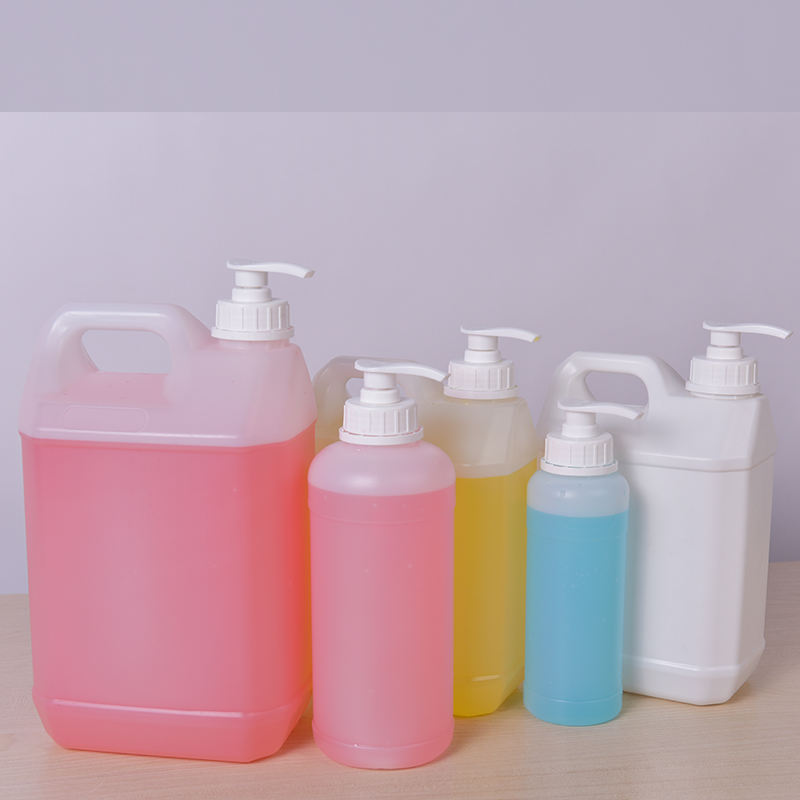
Photo: Alibaba.
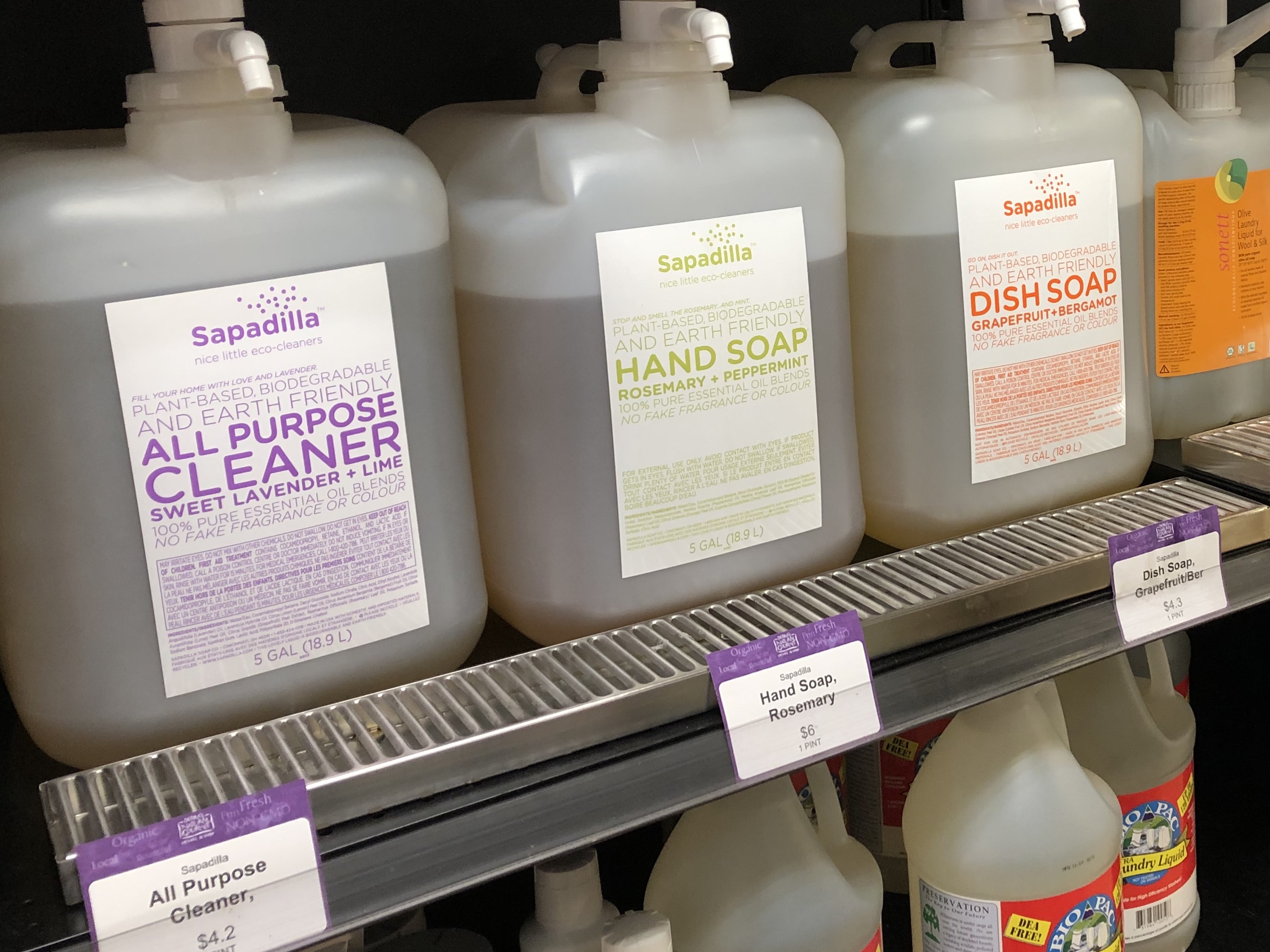
You can take a jug to buy detergent in bulk at Debra’s and keep refilling the smaller bottle you keep by your sink.

For a few years now, I have been refilling the plastic bottle that my dishwashing liquid once came in. For a while I bought a concentrate online. Now I take a clean jug into Debra’s Next Door, pump the detergent into the jug, and refill my smaller container for months.

Today’s story is about big brands trying to get into the act.

Susan Shain reports at the New York Times, “Every week, Angela Espinoza Pierson looked at her recycling bin — filled with detergent jugs, shampoo bottles and clamshell containers that once held strawberries — with mixed feelings. Sure, it was a lot of plastic. But it was going to be recycled.

“Or so she thought. Then her husband sent her some articles revealing that less than 6 percent of the country’s plastic gets recycled, and that even recycled plastic can only be reused once or twice. Ms. Espinoza Pierson, who lives in Buda, Texas, was shocked. …

“Determined to cut back on her plastic consumption, Ms. Espinoza Pierson got a starter kit from a company selling refillable household cleaners. In it were tablets containing concentrated hand soap as well as multi-surface, glass and bathroom cleaners — and four empty containers. She filled each one with tap water, then dropped in a tablet and watched it dissolve. If she is happy with the cleaners, she will order more tablets but reuse the containers. No new plastic required.

“Given plastic’s detrimental effects on the environment, nearly three-quarters of Americans say they are trying to reduce their reliance on single-use plastic, according to Pew Research Center. Since plastic is everywhere and avoiding it altogether is extraordinarily difficult, some, like Ms. Espinoza Pierson, have revived a once-customary practice: refilling containers rather than disposing of them. If just 10 to 20 percent of plastic packaging were reused, a report from the World Economic Forum estimates, the amount of plastic waste entering the ocean could be cut in half. …

“Over the past few years, Windex, owned by SC Johnson, introduced concentrates that dissolve in water; Dove began selling a deodorant stick that slots into a reusable case; and The Body Shop added refill stations to half its American stores.

“These are tiny experiments in a country that generates nearly 500 pounds of plastic waste per person, per year. But Matt Prindiville, the chief executive of Upstream, a reuse advocacy organization and consultancy, says his organization has seen the number of reuse-refill start-ups grow from a dozen in 2019 to more than 150 today.

‘If you asked me about this three years ago, I wouldn’t have guessed at how quickly the interest in the sector has blown up,’ Mr. Prindiville said. ‘Not just from the do-gooders, but from the biggest brands in the world.’

“American beverage companies switched to single-use plastic containers during the 1970s, largely because it saved money, said Bart Elmore, an associate professor of environmental history at Ohio State University. No longer would companies have to collect or clean refillable bottles.

“Since throwing things away, rather than cleaning and reusing them, was convenient, too, it seemed like progress. … Manufacturers and consumers alike fell in love with the lightweight and unbreakable material. More than a third of all plastic ever produced has been used for packaging, most of it created and disposed of in the same year.

“Today, the pressure to reduce corporate carbon footprints is forcing a second look at all that plastic packaging. ‘Reuse, for some types of products and packaging,’ Mr. Prindiville said, ‘can put a huge dent in reducing those climate impacts.’

“Household cleaners seem particularly primed for a refill revolution. Whereas shampoo and conditioner* involve complicated chemical formulas, many cleaners can be easily concentrated and reconstituted with water. In fact, that’s what makes up the bulk of traditional cleaning products, leading Mr. Prindiville to describe the current system this way: ‘We’re just shipping around water. And that’s dumb.’

“In contrast, the concentrated surface cleaners sold by Grove Collaborative each contain 1 ounce of liquid, far less than a standard 16-ounce bottle of ready-to-use cleaner, and thus require less fuel to transport.

Grove’s spray bottles are meant to be reused, and its concentrates are packaged in glass or aluminum — materials that, unlike plastic, can be recycled over and over.

“Grove’s products are now on shelves in more than 5,000 stores, including Target, CVS and Walmart, and the company has seen its net revenue from refillables grow by more than 600 percent since 2018. But with $322 million in total revenue, it is a tiny player in the $30 billion home care market.

“The Clorox Company, on the other hand, has a huge reach. Last year, the $7.1 billion company, which sells products in 100 countries, stepped into the refillable market with cleaning spray concentrates that can be emptied into a reusable plastic spray bottle. (Packaging accounts for more than half of all trigger spray manufacturers’ greenhouse gas emissions, transportation for another third.) …

“Not everyone is as enthusiastic. Jan Dell, a chemical engineer and founder of the anti-plastic pollution organization The Last Beach Cleanup, noted that many cleaning products are housed in PET or HDPE, two types of plastic with relatively high recycling rates. So she is less concerned about them — and far more concerned about the packaging of other products.

“ ‘Where these companies should be focusing is on this vast portfolio of everything else that isn’t recyclable, that is single use and that often becomes plastic pollution,’ she said, pointing to SC Johnson’s Ziploc bags and Clorox’s Hidden Valley ranch dipping cups. ‘This is just a classic example of big corporations doing a stunt over here on something that’s not the main issue to distract from all the single-use plastic they’re pushing out.’

More at the Times, here, including the response from Clorox.

*Note that shampoo and conditioner in a soap-bar form work just fine.

Read Full Post »

Photo: Antoine Giret via Unsplash.
Are you ready to do something more about plastic?

Not quite sure what to make of the inventions described in today’s post. Another energy-using appliance, this time for dealing with plastics? I’m keeping an open mind.

Chris Velazco writes at the Washington Post that “a new wave of home tech could keep plastics out of landfills. …

“For a pair of start-ups we first met at CES [Consumer Electronics Show] no kitchen would be complete without a new kind of home appliance: one that makes recycling a little easier.

Lasso Loop relocated from the United Kingdom to California to work on its product, a hefty home appliance machine that automatically sorts and breaks down the recyclables you toss inside it. And ClearDrop, founded by a Texas businessman named Ivan Arbouzov, aims to handle single-use plastic bags, one of the most odious artifacts of modern life. …

“And while it might sound a little easier to keep a couple of dedicated recycling bins around, both companies are, in their own way, tackling a flaw in our waste management systems that many people probably aren’t aware of.

As it turns out, much of the material we toss into our recycling bins doesn’t actually ever get recycled.

“That’s for a whole host of reasons: improperly cleaned materials can contaminate others that would have been recyclable otherwise, and some of the items people might just assume are recyclable — say, plastic cutlery — usually aren’t. …

“In 2018 — the last time it published these figures — the Environmental Protection Agency reported that glass accounted for a little over 4 percent (or 12.3 million tons) of our total municipal solid waste. About a quarter of it was recycled. But of the more than 35 million tons of plastics that entered the country’s waste management systems that same year, just 9 percent was recycled or composted.

“Perhaps the only surefire way to reduce plastic waste is for companies to produce less of it in the first place. In the meantime, start-ups like Lasso Loop and ClearDrop hope to make people more mindful of what happens to the materials they don’t need anymore.

“For Lasso Loop, that means removing as much of the guesswork as possible. In its current form, the company’s Lasso machine is bigger than a dishwasher but smaller than a fridge, though the team hopes to be able to squeeze the final model under your countertops.

“What’s more interesting is the stuff inside: Lasso growth manager Dominique Leonard said the machine uses a smattering of sensors, cameras and AI to determine whether the stuff you’ve put inside it can be recycled. (Anything that doesn’t pass muster, like certain kinds of plastic, are summarily rejected.) From there, the remaining plastic, glass and metal products are steam cleaned, broken apart — seriously — and stored separately in a series of bins based on type to prevent contamination. …

“That sophistication will come at a cost, especially at first. The Lasso team plans to sell its machine for $5,000 — or $3,500 with a prelaunch discount — to start, though it hopes incentives from local governments will help lighten the load on potential customers.

“ClearDrop’s Minimizer, a trash can-sized plastics compactor, is much less complicated by comparison. You’re meant to feed all of your soft plastics into a slot onto the top of the machine, and once it has had enough — Arbouzov said that usually takes around a month — the Minimizer heats and compresses the bags to form a slightly squishy brick. If your municipality is one of the rare ones that accepts soft plastics, you should be able to toss those bricks into your recycling bin. …

“Important questions still linger. Leonard and Arbouzov both claim that an important chunk of their future business will require them to partner up with manufacturers and recycling facilities that are equipped to turn those materials back into actual products. … For now, those key partnerships have yet to solidify. It’s also unclear how energy-efficient these appliances are, though Lasso Loop claims that its machine requires roughly the ‘amount of power required for a hot water washing machine cycle’ to function.

“These start-ups face another considerable hurdle: How will they handle all the stuff their machines create, especially if they plan to resell it?

“The Lasso team will find out when it launches a pilot program with customers in the San Francisco Bay area next year. Once those first Lasso machines are live and full of precious glass and plastic bits, their owners are meant to schedule pickups from a smartphone app. But when people come to haul away those materials, they won’t be working from their local municipal recycling crew, but a team of people working on behalf of Lasso itself.

“That means, beyond just building the machines to help people recycle, it must also manage a fleet of people who fetch those recyclables and make sure they go where they’re supposed to. …

“ClearDrop has similar issues to sort out. … For now though, [Arbouzov] seems slightly more concerned with another goal of his: to be able to produce his Minimizers within six months, and sell them for just $150. Whether that’s a realistic forecast or start-up founder bluster is difficult to say, but to Arbouzov, what mostly matters is getting people to think more closely about where their old stuff goes.”

Gotta love inventors — whether they succeed or not. Their thought processes are inspiring. More at the Post, here.

Read Full Post »

Photo: Obinna Obioma via BBC.
Nigerian photographer Obinna Obioma using creative ways to display an iconic West African plastic bag.

Suzanne liked a recent plastic-recycling article in the New York Times, and we thought you would like it, too. (The Times blocks people from sharing photos, so the one above is from the BBC. You can also check out fashions made of plastic at the Guardian, here.)

Times reporter Ruth Maclean writes from Senegal, “A crowd of people holding curved metal spikes jumped on trash spilling out of a dump truck in Senegal’s biggest landfill, hacking at the garbage to find valuable plastic.

“Nearby, sleeves rolled up, suds up to their elbows, women washed plastic jerrycans in rainbow colors, cut into pieces. Around them, piles of broken toys, plastic mayonnaise jars and hundreds of discarded synthetic wigs stretched as far as the eye could see, all ready to be sold and recycled.

“Plastic waste is exploding in Senegal, as in many countries, as populations and incomes grow and with them, demand for packaged, mass-produced products.

“This has given rise to a growing industry built around recycling plastic waste, by businesses and citizens alike.

From Chinese traders to furniture makers and avant-garde fashion designers, many in Senegal make use of the constant stream of plastic waste.

“Mbeubeuss — the dump site serving Senegal’s seaside capital of Dakar — is where it all begins. More than 2,000 trash pickers, as well as scrubbers, choppers, haulers on horse-drawn carts, middlemen and wholesalers make a living by finding, preparing and transporting the waste for recycling. It adds up to a huge informal economy that supports thousands of families.

“Over more than 50 years at the dump, Pape Ndiaye, the doyen of waste pickers, has watched the community that lives off the dump grow, and seen them turn to plastic — a material that 20 years ago the pickers considered worthless.

“ ‘We’re the people protecting the environment,’ said Mr. Ndiaye, 76, looking out at the plastic scattered over Gouye Gui, his corner of the dump. ‘Everything that pollutes it, we take to industries, and they transform it.’

“Despite all of the efforts to recycle, much of Senegal’s waste never makes it to landfills, instead littering the landscape. Knockoff Adidas sandals and containers that once held a local version of Nutella block drains. Thin plastic bags that once contained drinking water meander back and forth in the Senegalese surf, like jellyfish. Plastic shopping bags burn in residential neighborhoods, sending clouds of chemical-smelling smoke into the hazy air.

“Senegal is just one of many countries trying to clean up, formalize the waste disposal system and embrace recycling on a bigger scale. By 2023, the African Union says, the goal is that 50 percent of the waste used in African cities should be recycled. …

“The recycled plastic makes it to enterprises of all stripes across Senegal, which has one of the most robust economies in West Africa.

“At a factory in Thies, an inland city known for its tapestry industry to the east of Dakar, recycled plastic pellets are spun out into long skeins, which are then woven into the colorful plastic mats used in almost every Senegalese household.

“Custom-made mats from this factory lined the catwalk at Dakar Fashion Week in December, focused this time on sustainability and held in a baobab forest. Signs were constructed out of old water bottles. Tables and chairs were made of melted down plastic.

“The trend has changed the focus of the waste pickers who have worked the dump for decades, gleaning anything of value. …

“The government says that in a few years, the giant landfill will close, replaced by much smaller sorting and composting centers as part of a joint project with the World Bank.

“Then, most of the money made from plastic waste will go into government coffers. The waste pickers worry about their livelihoods.” More at the Times, here.

As great as it is to keep reusing plastic, it would be best not to make it at all for most purposes. It eventually breaks down and ends up in the ocean and our bodies. When I read “plastic mayonnaise jars” in the article, I wanted to remind you that, at least in the US, there are lots of things you can buy in glass if you look: glass mayonnaise jars, glass olive oil jars, glass mustard jars, glass pasta sauce jars, glass lemon juice bottles, and more. I even get milk in glass bottles. Glass is better than plastic. And you can get both laundry and dishwasher detergent in cardboard.

Check out my 2019 post on Cambodian fashion made from recyclables, here.

Read Full Post »

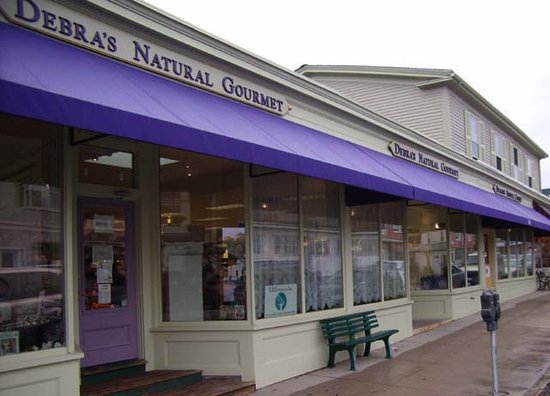
storefront-west-concord

Photo: TripAdvisor
Debra’s Natural Gourmet helps customers cut back on plastic like liquid-soap bottles. They don’t have an answer yet to takeout containers, though.

Every day I’m trying to think of ways to cut back on plastic like the good people at Plastic Free Hackney in England. How am I doing so far? Not great. Plastic is so ubiquitous. But “one and two and 50 make a million,” and there is help from like-minded businesses.

I found a dish-soap concentrate that lets me reuse bottles (etee dish soap), and now a local organic store is letting folks reuse bottles from home over and over by filling up from the store’s large dispensers.

According to Emily Holden at the Guardian, we need to cut back because recycling of plastics is not really working. No one wants them. Holden offers tips on reducing our plastics dependency.

“As plastics corporations ramp up production,” she writes, “they are also promoting a failing recycling system.

Just 9% of plastics get recycled. Traditional plastics are made from extracted oil and gas, and they contribute to the rising temperatures behind the climate crisis.

“Environment experts are increasingly calling for a reduction in plastic use, as the waste accumulates in the oceans, poor countries and even human bodies. Plastics are also burned, as China – which once accepted the bulk of America’s waste – has begun to refuse it. And more than a million Americans lived next to polluting incinerators.

“Significant reductions will require systemic change, researchers say. But there are also some easy tips for individuals who want to cut back on plastics. (If this list is overwhelming and you’re not sure where to start, collect your plastic waste for a month and conduct an audit. Cut back on what you find the most of.)

“1. Carry a reusable bottle, fork/spoon and bag …

“2. Refuse the lid on your coffee cup. … (Some coffee shops will say they are required to give you a lid, citing possible liability for burns.)

“3. Choose products in glass or cans if they are an option. Recycle those materials. … Glass and aluminum cans are much more likely to be recycled. Glass is most efficient when reused (ie. with returnable milk bottles).

“4. When possible, eat in the restaurant instead of taking it to go. Unless you have a physical disability, let your server know in advance that you won’t need a straw.

“5. If you order takeout or delivery, tell the restaurant you don’t want plastic utensils or straws. …

“6. Opt for products with less packaging. Say no to bagged lemons, apples, onions and garlic, and tea that comes in plastic packets. Choose more fresh produce for snacks to avoid individual plastic wrappers.

“7. Shop from the bulk section and use your own containers. …

“8. Use bars of soap (also available for shampoo and shaving) instead of bottles. … For an extra environmental benefit, avoid palm oil.

“9. Use a razor that requires replacing only the individual blades. … You will save money over time. Note that TSA does not allow passengers to fly with individual blades.

“10. Use a bamboo toothbrush or one with a replaceable head.

“11. Buy concentrated cleaners that can be mixed with water in a reusable container. …

“12. Choose frozen, concentrated juice that comes in cardboard tubes instead of the plastic jugs. …

“13. Don’t buy bottled water. …

“14. Buy fewer clothes, or shop secondhand. Wash your clothes less so they last longer. Hang them to dry. …

“15. When shopping online, group as many items together as possible, so you can receive fewer plastic envelopes.”

More here.

022320-fill-your-own-soap-bottle

Read Full Post »

3500

Photo: Vincent Kessler/Reuters
Surplus bakery products account for nearly a third of the UK’s total retail food waste. Now Tesco is turning unsold bread into other products.

Remember this post on turning stale bread into beer? Stale bread is good for other products, too. Rebecca Smithers at the Guardian describes how the UK supermarket chain Tesco plans to make money while cutting waste.

“Britain’s largest supermarket chain is launching a drive to reduce food waste from bread by turning unsold baguettes and batons from its in-store bakeries into new products.

“Surplus bread is one of the biggest waste problems for food retailers, according to the government’s food waste adviser Wrap, particularly from freshly baked lines which have a short shelf life.

“Its most recent figures show surplus bakery products account for nearly a third (67,500 tonnes) of the UK’s total retail food waste a year. Bread is the second most wasted food in the home, with an estimated 1m loaves thrown away each day. It is also one of the most wasted items at every stage of the supply chain.

“Tesco said that, as well as being among the UK’s most popular breads, freshly baked baguettes and batons were among bread items left on its selves at the end of the day. The retailer said it had decided to use the unsold products to make a range of olive crostini and bread pudding which will be launched in 24 stores next week. It estimated the amount of unsold fresh bread could be cut by up to a half if the range was made available at all its outlets.

“Currently, Tesco’s surplus bread is reduced in price while still on sale, and some is sent to food distribution charities on the evening of its production. The remainder is then offered free in Tesco’s staff shop, after which it is sent for use in animal feed. …

“Said David Moon, the head of business collaboration at Wrap, ‘Using surpluses in store to make a delicious new product saves good food from spoiling and reduces the cost of waste to the business.’ ” Read more here.

If you would like to know more about the work of the sustainability consultant Wrap, check out the website. It says in part, “Our five year plan, ‘Resource Revolution, Creating the Future’ sets out how businesses, organisations and consumers can be part of a resource revolution that will re-invent, re-think and re-define how we use materials.

“It focuses on the three priority areas that will help best meet our goals – Food and Drink; Clothing and Textiles; and Electricals and Electronics, all of which are underpinned by resource management. …

“We work uniquely, and by design, in the space between governments, businesses, communities, thinkers and individuals – forging powerful partnerships and delivering ground-breaking initiatives to support more sustainable economies and society. We are world leaders in establishing the facts, getting the right people working together, then converting ideas into action and delivery on the ground. …

“Underpinning all our priority sectors is resource management, our focus on maximising the value of waste by increasing the quantity and quality of materials collected for re-use and recycling.”

Read Full Post »

Photos: Sonia Narang for WHYY
Kamikatsu has become a hub for workshops on recycling. Employees from the Osaka branch of the Patagonia clothing store traveled here to learn waste-reduction techniques. Recyclables are sorted into 45 bins.

The other day I was reminiscing with my husband about the first time we took our recyclables to a voluntary recycling station outside Philadelphia. It stands out in my mind because John was a brand new baby in the car seat and the young man who assisted us said, “Oh, what a tiny baby,” and I was indignant because I thought John had gotten really big in his first three weeks!

Today most municipalities offer or demand curbside recycling, but if you think we are advanced in this department, consider Kamikatsu, Japan.

Sonia Narang reports at Philadelphia’s WHYY, “It’s not yet 8 a.m., and the recycling center in the town of Kamikatsu is already bustling. Locals arrive in a steady stream, unloading bags full of bottles, cans, and paper into dozens of clearly-labeled bins — all neatly lined up in rows.

“Kamikatsu is a rural town of about 2,000 people in the forested mountains of Japan’s Shikoku island.

“The town’s waste collection center runs a tight ship. Each resident gets a thick booklet of recycling guidelines.

“At the collection center, everything is carefully sorted and arranged with the help of staff. There are a whopping 45 different categories of recyclables, and the town recycles 80 percent of its trash.

“Akira Sakano heads up the town’s Zero Waste Academy, a non-profit organization that manages the recycling program. …

“ ‘We have newspapers, cardboard, scrap papers, shredded papers, paper containers, paper containers with aluminum packaging on back, paper cups, hard paper tubes, other papers,’ she says. …

“The town of Kamikatsu adopted a ‘zero waste’ policy in 2003. Before that, the town used to burn all its trash in incinerators. …

“When waste decomposes in landfills, it releases methane, one of the most potent greenhouse gases. A large amount of that methane leaks into the atmosphere, heating up the planet. …

“Zero waste has become a buzzword, and cities around the world are pledging to drastically reduce waste. But, in Japan — where land is scarce and there’s limited space for landfills — aggressive recycling has been a way of life for years.

“In addition to helping the environment, Sakano says recycling also has an economic benefit for the town. Incinerating trash can be expensive. …

“There’s no garbage truck service here. Almost everyone has to bring their trash into the waste collection center, and only about 20 percent ends up in the dumpster.

“For older residents who can’t drive themselves to the recycling center, the town does send a pick-up truck. Kazuyuki Kiyohara, who works for the town, also drives the truck around. He’s really concerned about using the earth’s resources wisely, and super enthusiastic in his personal life about recycling. He’s got 14 separate bins at home. …

“Everyone has to wash and dry all their food packaging. Many locals say that’s the most annoying part of the town’s trash policy.

“Back at the recycling center, I catch Daichi Hyakuno as he unloads bags of juice cans, plastics, and … dirty diapers. He moved here from Osaka a few years ago.

“ ‘At first, I was quite confused because the categorization was so detailed,’ he says. ‘It was easier in Osaka, since all I had to do was separate trash into burnables and non-burnables.’ … He’s not a big fan, but understands his social responsibilities. …

“Personally, I got better at recycling when it was practically mandatory. Fifteen years ago, when I lived in rural Japan, all the residents in my town had to write our names in big black letters on clear trash bags.

“It made me feel conscious about what I threw away: If I left even one bottle in there, the town wouldn’t pick up the trash, and everyone would see my bag left out there on the curb. …

“The town is small, but Kamikatsu is gaining international attention. Now outsiders are traveling here to take workshops at the academy.

“On the day I visit, folks from a Japanese branch of the outdoor clothing company Patagonia are here to learn.” More at WHYY, here.

Now who’s going to teach this town about composting so it can burn even less?

Hat tip: @morinotsuma, One More Voice, on twitter.

Once every two months, the town of Kamikatsu in Japan sends a truck to pick up bags of recyclables from elderly residents who are unable to drive to the recycling center.

Read Full Post »

jesse-taylor

Photo: Kelly Howard
At Lincoln City Glass Center, a glassblower melts down objects made of clear glass to keep the studio supplied during a glass shortage — the unintentional consequence of environmental regulations and high demand from large overseas companies.

When I read recently about the closing of a glass-recycling center in Massachusetts, I didn’t have the imagination to consider all the causes or all the consequences.  What I did learn at the time was that beer companies were not using glass bottles as much and were moving to cans. That was all I knew.

Come to find out, thanks to the Law of Unintended Consequences, environmental regulations are having an effect on the amount of glass pellets available for a range of traditional purposes — including the glassblower’s art.

Lori Tobias writes at Oregon ArtsWatch, “On the Oregon Coast, creating a work of glass art is a bucket-list favorite, and there’s plenty of places to make that happen. But recent weeks have stressed some mom-and-pop glassblowing studios to the point of, well, a meltdown. It seems there’s just not enough glass to go around.

“Robin and William Murphy, owners of the Oregon Coast Glassworks in Newport, ran into problems earlier this month when they tried to buy a new supply of ‘cullet’ glass – furnace-ready recycled glass pellets that glassblowers turn into floats, bowls, and other art. There was ‘no glass anywhere available for purchase,’ Robin Murphy said. Nor would there be any until November, they were told. The shortage seems to be the culmination of stricter environmental laws, which led to a cutback in suppliers, compounded most recently by heavy demands on an overseas supplier.

“The Murphys have launched a fundraising raffle – of a glass sea turtle crafted by William – to help finance a new furnace that will melt ‘batch,’ a pelletized powder that is an alternative to cullet. It requires a natural gas furnace or what’s known in the industry as a ‘moly’ (short for molybdenum) furnace – a piece of equipment that generally comes with a price tag ranging from $30,000 to $50,000. The Murphys have a less expensive wire-melt furnace, but it doesn’t get hot enough to melt batch. …

“Oregon Coast Glassworks isn’t the only small shop facing the shortage. The Edge Art Gallery in South Beach is also experiencing it, as is the Lincoln City Glass Center. One of the largest of the dozen or so glassblowers on the central and north Coast with 21 employees, the Glass Center does have a ‘moly’ furnace, capable of melting batch or cullet. Owner and glass artist Kelly Howard prefers to use cullet, but she also has been unable to get any.

“Most glassblowers agree that the problem can be traced to 2016, when the Oregon Department of Environmental Quality and the federal Environmental Protection Agency imposed stricter regulations on glass manufacturers, ultimately prompting the closure of two major suppliers. One was Spectrum, based in Woodinville, Wash., which supplied glass products for 40 years to many Pacific Northwest artists. Bullseye Glass Co. of Portland survived the crack-down, but does not provide the type of glass used by glass blowers.

“With Spectrum gone, glass blowing studios turned to a German manufacturer, Cristalica, which is distributed through Olympic Color Rods, headquartered in Seattle. But this summer, Cristalica failed to keep up with demand, in part because of the heavy use of existing equipment.

“Howard said she heard the German company had a furnace go down a couple of weeks ago ‘and didn’t give anyone a warning. They said there is no more, and what they had was all given to the big companies. All of the rest us didn’t get any.’ ”

More here. Raffle tickets for the sea turtle are available for $50 here or by calling the studio at 541-574-8226. The winner will be chosen Sept. 2. No more than 500 tickets will be sold.

sea-turtle-face

Read Full Post »


I enjoyed an upscale pre-auction showing of art and antiques with Stuga 40 on my recent trip. Next time I may need to check out an unusual shopping mall dedicated to recycled items. Steve Ghent wrote about it at Good News Network.

“A new generation of recycling has now gone from local drop-off centers to a shopping mall that sells only repaired or upcycled products. …

“ReTuna Återbruksgalleria … contains both a recycling center and a shopping mall. Customers can donate the items that they no longer need, then shop for something new – all in one stop.

“Dropped off goods are sorted into various workshops where they are refurbished or repaired accordingly. Products are then sorted into 14 specialty shops that include furniture, computers, audio equipment, clothes, toys, bikes, and gardening and building materials; all garnered from second-hand products. …

“The center, which is operated by the local municipality, has benefited the local economy by creating 50 new repair and retail jobs, and providing space for private start-ups and local artisans.

“The biggest bonus for the Swedish community is how the center relieves local government from the tremendous burden and expense of disposing of unwanted goods while turning potential ‘waste’ into profits.” More at Good New Network, here. Environmentalist Brad Zarnett posted the link on twitter.

By the way, if you are a big fan of recycling, be sure to check out the WordPress blog Things I Find in the Garbage, which is written by a Canadian who makes a living from things people throw out.

In his regular posts, he describes what he finds, what he usually gets for such items, where he sells them, and any little interactions with people who see him digging through their trash. He also offers resources like “How to Spot Bedbug Infested Garbage.”

Read Full Post »

I’ve been encouraged to see an increased focus on keeping food from going to waste when so many people are hungry.

In the Boston area, for example, Spoiler Alert and 2012 Mass Challenge winner Lovin’ Spoonfuls are just two of several local organizations moving leftovers and surplus to places they can be used. And how about Daily Table, which makes delicious prepared meals from surplus ingredients and sells the meals at low prices?

Meanwhile, in France, action is taking place on a national scale.

Writes NewCo Shift, “Back in 2014, the third largest supermarket chain in France, Intermarché, launched their memorable ‘Inglorious’ fruits and vegetables campaign. To help reduce ‘cosmetic’ food waste, Intermarché sold scarred, disfigured and odd-shaped fruits and vegetables for 30 per cent less than ‘normal-looking’ produce. On the back of their playful marketing and waste-conscious campaign, many supermarkets all over the world followed suit and wonky veg has been the unlikely pin-up of food waste ever since.

“[France was] the first country in the world to ban supermarkets from throwing away or destroying unsold food, forcing them to donate to food banks and charities instead. The law was a result of a grassroots campaign launched by councillor, Arash Derambarsh. After his petition gained more than 200,000 signatures and celebrity support in just four months, he managed to persuade French MP’s to adopt the regulation, which is now being copied in different parts of the world. Since the ban has been in place, over 300,000 tonnes of food has been saved from landfill and redistributed to France’s three networks of food banks. …

“Let’s not forget France’s most shimmering, sequin-laden, food-saving exports: Disco Soupe! Disco Soupe (or disco soup) has captured the imagination of the world, proving to be one of the most fun events out there, while reducing food waste. Strangers collide, music spins, food is saved from the clutches of the bin, chopped to the beat and eaten with rhythm.”

More at NewCo. If you like this topic, you can also subscribe to Zero Waste Weekly here. Do you tweet? You might like to follow the entertaining @UglyFruitAndVeg. Send your whimsical pictures of produce to those folks and join the fun.

Photo: Shift.NewCo.co

Read Full Post »

Some school districts are pushing the envelope on recycling.

Michael Wines wrote for the NY Times in December, “Nothing seemed special about the plates from which students at a handful of Miami schools devoured their meals for a few weeks last spring — round, rigid and colorless, with four compartments for food and a fifth in the center for a carton of milk.

“Looks, however, can be deceiving: They were the vanguard of what could become an environmental revolution in schools across the United States.

“With any uneaten food, the plates, made from sugar cane, can be thrown away and turned into a product prized by gardeners and farmers everywhere: compost. If all goes as planned, compostable plates will replace plastic foam lunch trays by September not just for the 345,000 students in the Miami-Dade County school system, but also for more than 2.6 million others nationwide.

“That would be some 271 million plates a year, replacing enough foam trays to create a stack of plastic several hundred miles tall. …

“Compostable plates are but the first initiative on the environmental checklist of the Urban School Food Alliance, a pioneering attempt by six big-city school systems to create new markets for sustainable food and lunchroom supplies.” More here.

Apart from what the initiative does for school budgets, what it does for the environment, just think how educators are setting an example for children about working to find solutions to problems. Impressive.

Photo: Joshua Bright for The New York Times
Kindergartners in Manhattan being served lunch on plates made from sugar cane, which are expected to replace plastic foam trays next year in six districts.

Read Full Post »

No reason a recycling facility can’t have an attractive design, right? As long as it isn’t expensive.

Michael Kimmelman wrote for the NY Times last month about a municipal facility that must make the recycling staff there feel good about going to work.

“Recycling in New York is a scrappy business,” Kimmelman writes. “Billions have gone toward building water tunnels, power plants, subways and sewage treatment facilities, but little toward an infrastructure of recycling. …

“But a Sims Municipal Recycling Facility will open shortly at the South Brooklyn Marine Terminal in Sunset Park. The city’s first big, state-of-the-art plant for processing discarded plastic, metals and glass, it promises jobs to nearby residents and, as the cost of exporting garbage out of state rises, some savings for the city. …

“The facility is understated, well proportioned and well planned — elegant, actually, and not just for a garbage site. It is an ensemble of modernist boxes squeezing art, and even a little drama, from a relatively meager design budget. …

“Instead of letting engineers design the plant, as often happens at an industrial site, Sims hired Selldorf Architects, a glamorous New York firm known for doing Chelsea art galleries and cultural institutions. …

“The idea? Partly to game the public review process, but also to build a well-designed plant — welcoming to the public, beckoning from the waterfront.” More here.

Photo: Fred R. Conrad/The New York Times
A look inside the new Sims Municipal Recycling Facility in Brooklyn.

Read Full Post »

I just got a great lead from Erik. It seems that Sweden has run out of garbage for running its waste-to-energy program. Fortunately, Norway has garbage it can spare. (I wonder if Erik’s buddy Svein knows that.)

Check out Matt Hickman at Mother Nature Network:

“Sweden, birthplace of the Smörgåsbord, Eric Northman, and the world’s preferred solar-powered purveyor of flat-pack home furnishings, is in a bit of a pickle: the squeaky clean Scandinavian nation of more than 9.5 million has run out of garbage. The landfills have been tapped dry; the rubbish reserves depleted. And although this may seem like a positive — even enviable — predicament for a country to be facing, Sweden has been forced to import trash from neighboring countries, namely Norway. Yep, Sweden is so trash-strapped that officials are shipping it in — 80,000 tons of refuse annually, to be exact — from elsewhere.

“You see, Swedes are big on recycling. So big in fact that only 4 percent of all waste generated in the country is landfilled.

“Good for them! However, the population’s remarkably pertinacious recycling habits are also a bit of a problem given that the country relies on waste to heat and to provide electricity to hundreds of thousands of homes through a longstanding waste-to-energy incineration program. So with citizens simply not generating enough burnable waste to power the incinerators, the country has been forced to look elsewhere for fuel. Says Catarina Ostlund, a senior advisor for the Swedish Environmental Protection Agency: ‘We have more capacity than the production of waste in Sweden and that is usable for incineration.

“Public Radio International has the whole story (hat tip to Ariel Schwartz at Co.Exist), a story that may seem implausible in a country like garbage-bloated America where overflowing landfills are anything but scarce.” Read more.

Photograph: Smath/Flickr

Read Full Post »