
Feeds:
Posts
Comments

Posts Tagged ‘rehabilitation’

Photo: Noam Brown.
Bending the Bars artists Kashdatt, Chuckie Lee and ZQ recording in the studio. 

Given that the US leads the world in numbers of people incarcerated (1,808,100), more than even China, that’s a lot of human beings we can’t just forget about. We need to find ways for them to be engaged in the world and not give up hope, for our own sakes as well as theirs.

Monica Uszerowicz writes at the Guardian about an experiment in Florida that was organized by inmate advocates and received no help from the system.

“In ‘Locked Down,’ a song by the San Diego-based poet and rapper, Chance, she sings with both foreboding and care: ‘Every day that you wake up you’re blessed / love every breath, ’cause you don’t know what’s next.’

“Chance wrote the song – originally a poem, its title a callback to Akon’s ‘Locked Up’ – while imprisoned in Phoenix, Arizona, during the beginning of the Covid pandemic and subsequent lockdown (‘six feet apart in a five-by-five,’ she raps in the same song, alluding to the virtual impossibility of social distancing in the American prison system). … She shared with me in a recent phone call, ‘It’s crazy how they maintained control and instilled fear within us. When you’re locked up, you ask yourself … are you going to be angry, or are you going to find what your calling and purpose is?’

” ‘Locked Down’ is also one of 16 tracks on Bending the Bars, a hip-hop album featuring original songs by artists formerly or currently incarcerated in Florida’s Broward county jails (with the exception of Chance, a Florida native). Bending the Bars was organized by the south Florida abolitionist organization Chip – the Community Hotline for Incarcerated People – which was initially founded to support inmates during the early days of Covid.

“Nicole Morse, a Chip co-founder and associate professor at the University of Maryland Baltimore County, says the organization began fielding calls in April 2020, primarily from Broward, the county just north of Miami-Dade; the calls were primarily about medical neglect, abuse and an atmosphere of abject fear. …

“In 2021, the data Chip had gathered was used to support a lawsuit filed by the American Civil Liberties Union of Florida and Disability Rights Florida on behalf of individuals suffering from Covid in the Broward county jail.

“Something more hopeful was emerging from those hotline calls, too: creativity. ‘People wanted to share their latest poetry or a song they were developing,’ Morse said. ‘Art was helping people survive an incredibly desperate time.’

“Noam Brown, a children’s musician and Chip committee member, began dreaming up the idea of an album. … Chip hoped to create a platform for the wealth of talent they continually encountered. The organization began fundraising, applying for grants and putting the word out that they were producing an album; Gary Field, an incarcerated organizer, writer and scholar, became the executive producer, helping to connect the artists with Chip.

“Musicians on the inside used two phones to record their songs – one as the microphone to record their vocals, the other to listen to the beat. ‘The challenges were phenomenal,’ Field shared in a phone call. ‘People couldn’t even talk to their families, never mind collaborate on something as complicated as producing a studio album. We were in the middle of a pandemic. There were four phones and 40 inmates trying to use them.’

“Spaces with two easily accessible phones were limited; the duration of any prison phone call is restricted. But Chip covered the costs of the calls, while Brown’s brother, Eitan, worked as the sound engineer, and the Grammy-winning children’s artists Alphabet Rockers helped create beats. Artists who were already out were able to spend time in the studio, including Chance, who returned to south Florida after her release.

“After reconnecting with a former classmate, the two attended a meeting for Chainless Change, a Lauderhill-based non-profit advocating for those affected by the criminal legal system. ‘It was divine – I don’t believe in accidents; I knew I was being called to go back to Florida’ Chance said. She began working with the group and helped organize a poetry event, where she met Field, Brown and Morse. She asked if they had room on the album for one more.

“The result is nearly an hour of uniquely south Floridian hip-hop and R&B, both of which are constellations of so many genres – Caribbean beats, southern bass, Deep City soul, Miami drill – poetic musings on love, loneliness and hope, and demands for systemic change to the draconian and brutal conditions of the Florida prison system. While Morse noted that the album’s sound quality was impaired by technical limitations, Bending the Bars is polished and clear, an accomplishment owed partly to its production and mostly to the ingenuity of its artists: singers, rappers and collaborators like J4, Corvette Cal and Chuckie Lee, all of whom alchemized the tracklist into a textural tapestry: playful, mournful, educational and intentionally dotted with prerecorded interjections from the prison phone line (‘you have one minute remaining’). 

“Field, whose song ‘Tearing Down Walls and Building Bridges’ closes the album, studied political science at Columbia University and received his master’s from Gulf Coast Bible College, and has contributed 2,000 pages of writing to the Massachusetts Institute of Technology civic media project Between the Bars. He knows, intimately, the significance of the writing process.

” ‘I remember, as an inmate back in 2010, what a profound sense of gratitude the opportunity to write gave me,’ he shared. …

“The system often censored mail or blocked phone calls during the recording process. … ‘We had to develop a set of strategies to overcome those barriers,’ they said. ‘The project was made without the cooperation of any prison or jail. Every strategy we came up with for how to get through to people … we can now share those strategies with loved ones of incarcerated folks who don’t have any additional privileged access.’ “

More at the Guardian, here.
Read Full Post »

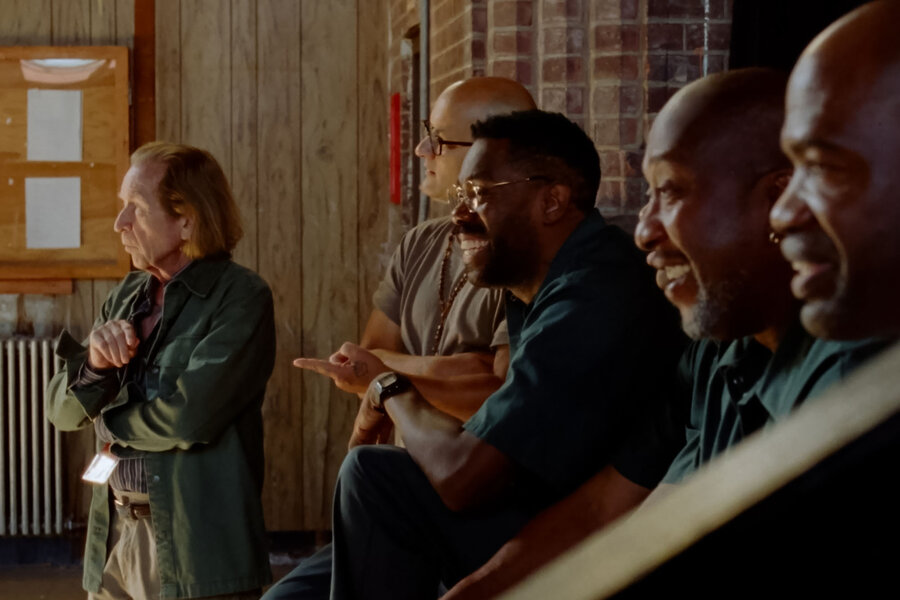
Photo: A24.
From left, Paul Raci, Sean San José, Colman Domingo, Sean “Dino” Johnson, and Mosi Eagle star in Sing Sing.

There are certain kinds of stories that always get my attention, and I’m grateful when other people find the same things interesting. Things like climate change, entrepreneurs, immigration, the kindness of strangers, housing, and life after prison. Just to name a few.

So you may be sure I liked today’s story about a theatrical production at a prison and the movie made about it.

Stephen Humphries writes at the Christian Science Monitor, “The world’s most unpredictable play only had one performance. It was staged inside a prison. The comedy, Breakin’ the Mummy’s Code, is about a man from ancient Egypt who embarks on a time travel adventure. Along the way, he encounters Robin Hood, Roman gladiators, cowboys, Hamlet, pirates, and – because why not? – Freddy Krueger from The Nightmare on Elm Street. It included a Shakespeare soliloquy – plus dance numbers. 

Breakin’ the Mummy’s Code was created by incarcerated men inside Sing Sing Correctional Facility in New York. It received a standing ovation in Cellblock B.

Now, a new movie explores the play’s legacy: the healing effect it had on its participants.

Sing Sing, directed by Greg Kwedar, reenacts the making of Breakin’ the Mummy’s Code. It even stars one of the play’s original actors. Already generating Oscar buzz, the movie … chronicles a budding friendship between two incarcerated men. Thematically, it’s about identity. The characters live in a hypermasculine environment that venerates bravado, toughness, and aggression. But the amateur actors come to discover that empathy, vulnerability, and tenderness are strengths, not weaknesses. The movie makes a case for the rehabilitative impact of arts programs inside prisons.

“ ‘I was a witness to it,’ says Mr. Kwedar, who taught an acting class in a prison with his creative partner, Clint Bentley, as part of their research. ‘I think the greatest teacher is what it’s like to step into another character and move in their shoes and step outside of yourself. That is a process of empathy’. … It gives you a prism to look at all the relationships in your life and to see perspective.’ …

“[Mr. Kwedar] spent seven years developing Sing Sing with Rehabilitation Through the Arts (RTA), the nonprofit that runs the theater program.

“There are dozens of similar theater projects across the United States. Perhaps the most well-known is Shakespeare Behind Bars. That program, which operates in three prisons in Kentucky and in one in Michigan, boasts a 6% recidivism rate for those who have participated in its productions. The Monitor was the first publication to write about that program. Then it became the subject of an award-winning 2005 documentary, Shakespeare Behind Bars

“ ‘Prisons function on shame and guilt,’ says Shakespeare Behind Bars founder Curt Tofteland, who has longtime collegial connections with the RTA. ‘But shame and guilt doesn’t change behavior. Why? Because shame and guilt doesn’t change thinking.’ …

“When change does happen, it’s a result of the actors exploring questions that the scripts raise, including ‘Who am I?’ 

“The two men at the heart of the story – John ‘Divine G’ Whitfield (played by Colman Domingo) and Clarence ‘Divine Eye’ Maclin (who portrays himself) – had to grapple with those existential questions. As the film unfolds, the audience learns that Mr. Maclin was one of the most feared men in the prison. Acting freed him to shed the gangster identity he’d clung to. The program helped him learn to express emotions. He even cried onstage. Now, he’s a natural performer on screen. …

“ ‘This is a movie about the landscape of the human face,’ says Mr. Kwedar. ‘It’s about drawing close to someone and looking them in the eyes and hearing their stories, and to know their names. And when you do that, it’s impossible to see that person as anything less than human.’

Sing Sing was filmed inside a recently decommissioned prison in New York. Its cast of established and first-time actors includes 13 RTA alumni. The production employed community-based filmmaking. For starters, it had a nonhierarchical pay structure. Everyone on set … was paid the same rate. …

“Last month, the director screened the movie inside the Sing Sing facility itself. He calls it the most profound theatrical experience of his life.”

More at the Monitor, here. No paywall. Subscriptions encouraged.

Read Full Post »

Photo: James O Davies/The Historic England Archive, Historic England.
Sphinx House, Moulsford, Oxfordshire, is an example of Egyptian influences on the work of newly rehabilitated British architect John Outram.

Sometimes a person whose work hits a wall of resistance from contemporaries is merely ahead of the times. That may be the case with UK architect John Outram.

Guardian reporter Oliver Wainwright talks to the architect about his philosophy and rehabilitation. ” ‘Our beginning was a worm,’ says John Outram. ‘It had light-sensitive cells at one end that later turned into eyes.’ He is standing in the bathroom at the top of his house in London’s Connaught Square, explaining the symbolism of the patterns that line the walls of his shower.

“Three white worms wiggle their way across a background of blue mosaic tiles at the base of the cubicle, while a black I-shape floats against a band of red tiles above, denoting ‘the emergence of the ego.’ A third yellow band at the top marks the realm of light, where the figure of ‘thought’ appears between two triangles, signifying the parted halves of the ‘heap of history.’

“It’s a lot to digest before breakfast – and we haven’t even got on to the symbolic ceiling (the ‘raft of reason’) or the hexagonal serpent-skin floor tiles.

“ ‘I stand here every morning to do my exercises,’ says Outram, breaking into an infectious giggle. ‘A good dose of metaphysics sets one up for the day.’

“The eccentric architect has reason to be cheerful. At the age of 87, he is enjoying an unexpected wave of popularity. Having been stamped with the label of postmodernism – out of favor since the 1990s, when his work was described as ‘architectural terrorism’ – he has been rediscovered by a new generation, thirsty for color, pattern, ornament and fun.

“The last few years have seen several of his buildings listed, from the Isle of Dogs pumping station, that cartoonish temple to summer storms, to an opulent country house in Sussex built for the Tetra Pak billionaires Hans and Märit Rausing. Illustrations of Outram’s buildings can now be found emblazoned on T-shirts and mugs, while he has a growing following on Instagram, which he joined during lockdown, where he expounds his esoteric theories to a rapt audience. And now, for the first time, the full breadth of his maverick output has been brought together in a monograph. So how does it feel to be recognized so late in life, after years in the wilderness?

” ‘I call it being dug up,’ he says with a chortle. ‘Disinterred, as it were. It’s quite entertaining.’

“As Geraint Franklin, the book’s author, observes, the English have never quite known what to do with Outram. His buildings are hi-tech, neoclassical and postmodern all at once, yet they fit neatly into none of these categories. His chubby columns house sophisticated mechanical systems for ventilation, wiring and drainage, while simultaneously alluding to ancient mythologies in their richly layered ornament.

“A huge jet engine fan in the pediment of the pumping station helps to cool the machinery inside, while also standing as the symbolic source of the ‘river of somatic time.’ A pyramidal glass fireplace in the Egyptian-themed Sphinx Hill house in Oxfordshire summons momentous Pharaonic allusions, while cleverly sucking smoke beneath the floor to a hidden flue.

“In Outram’s world, embracing technology and modernity did not preclude the presence of poetry and history. … Outram piled it all on, mining inspiration from Sumerian, Egyptian, Chinese and Mayan cultures with magpie glee. …

“Born in Malaysia, where his army officer father was stationed, Outram’s outsider status owes something to his upbringing. His childhood saw spells in Burma and India, before he arrived at prep school in England at the age of 11, feeling like ‘a refugee from the British empire.’ His early exposure to the vivid sights and sounds of South Asian cities informed his impression of the classical world, as being ‘much more like India than like the British Museum. Very noisy, very smelly, very colorful.’ …

“Unlike his hi-tech peers, his projects rarely exceeded the capabilities of the average builder. ‘The problem with hi-tech is that it’s very expensive, and the tech isn’t very high,’ he says. ‘I’d been a pilot, so I knew what real hi-tech was – and it wasn’t suitable for architecture.’ …

“As Franklin writes, base materials are subject to an almost alchemical transformation in Outram’s hands. Humdrum concrete – which he once described as a ‘funereal porridge of muddy ashes’ – could be transformed into ‘blitzcrete with fragments of colored brick, ground and polished to an edible nougat finish. It debuted at his New House for the Rausings in Wadhurst, Sussex, in 1986, where five types of crushed brick swirl across the facade like confetti in the wind.”

More at the Guardian, here. Great Pictures. No firewall.

Read Full Post »


800px-savinien_de_cyrano_de_bergeracArt: Zacharie Heince (1611-1669)
The 19th Century Edmond Rostand comedy
Cyrano de Bergerac was recently performed in a New York prison that has unusual rehabilitation programs.

Sometimes when an article I want to share with you has its photos under lock and key, I look for alternative images on Google. It was interesting to see that modern renditions of the outsize nose on Cyrano de Bergerac are much more extreme than the one above. Today’s productions really go overboard trying to make the silver-tongued hero look as ugly as possible. A recent production in a prison also exaggerated the nose, which you can see if you click on the original article.

Jesse Wegman wrote about the show at the New York Times, “Cyrano de Bergerac will be eligible for parole in 2022. For the time being, he is a vision in Gallic effrontery, pinballing around the stage in the gymnasium at Fishkill Correctional Facility in Beacon, N.Y.

“The production of Edmond Rostand’s canonical 19th-century comedy, which enjoyed a well-attended two-day run early [in June], was the work of Rehabilitation Through the Arts, a 20-year-old organization that operates in prisons across New York State. The program introduces inmates to theater, dance, writing and other creative arts in the hope of teaching them life skills and improving their chances at success upon release. …

“When [inmates] proposed ‘Cyrano de Bergerac,’ the show’s director, Charlie Scatamacchia, was skeptical. ‘I thought, yeah, that’s not gonna happen,’ he said. ‘It’s got multiple scene changes, costume changes. It’s got sword fighting. I doubted my ability to direct them, and their ability to pick up these skills in the time we had. I’ve never been happier to be proved so wrong.’

“Behind the title character’s plastered-on proboscis and feathered chapeau is Rodney Spivey-Jones, a 35-year-old from Syracuse. Mr. Spivey-Jones, who had never acted before, first auditioned for the role of Le Bret, the play’s narrator. But Mr. Scatamacchia quickly realized that he was a good fit to play the lead — one of the most verbose roles in theater.

“Mr. Spivey-Jones is no stranger to addressing a crowd — he helped form an inmate debate team at another prison that beat a team from Harvard in 2015. Still, he had not given any thought to playing Cyrano and didn’t understand how big the role was until he kept getting called back to read for it. …

“When the show went up, Mr. Spivey-Jones realized that he had memorized not only his own lines but every other character’s as well — a handy trick when a castmate ran into trouble, and he could provide a cue on the spot. …

“A bigger obstacle than memorization, it turned out, was getting swords inside the prison. Corrections officials nixed various materials, like a hard plastic foil. … The cast of 13 men took the setbacks in stride, as people in prison learn to do with most things. Along with a professional actress, Kate Kenney, who played the role of Cyrano’s love interest, Roxane, the crew worked every week through the winter and spring to get the show into shape. …

“The program, which has about 400 alumni who were released from prison, is popular among both inmates and New York’s prison administrators, who have seen its philosophy pay off. Studies of prison-arts programs around the country, including R.T.A., have found that their participants are better behaved than other inmates, earned educational degrees earlier and in some cases are less likely to wind up back behind bars after release.”

It would be wrong to minimize the crimes these guys have committed or the pain they have caused their victims, but if there’s a way for offenders to become engaged with the world in more positive ways, that’s a good thing in my book.

And I love that play.

More at the New York Times, here.

Read Full Post »

Photo: John Walker
Melvin Smith, who completed the Transition from Jail to Community (TJC) program at Fresno County Jail, is now clean and running his family’s well-drilling business.

Here’s another example of a program that has been helping ex-offenders reintegrate into society.

Brianna Calix reports at the Fresno Bee, “The last time Melvin Smith was arrested, he was so hungry and tired that he prayed to God the authorities would keep him in Fresno County Jail instead of releasing him.

“Smith was arrested 14 times in 2013 for drug use, auto theft and vandalism. In Fresno County, law enforcement arrested him 41 times since 1999. ‘I was wild,’ he said. In jail, his ‘celly’ asked him where he saw himself in five years. Smith’s goal was to reunite with his family.

“He’s been out of jail for four years, sober for five years and his probation ends in June. He runs his grandfather’s well and pump company, goes to church with Fresno Police Chief Jerry Dyer and is about to buy a home with a pool for his family. For birthdays, he takes his family on trips to places such as Universal Studios, Magic Mountain and Disneyland.

“During that last stint in jail, Smith went through the Transition from Jail to Community program. It helps inmates who are more likely to re-offend prepare for life after incarceration.

“The TJC program, as it’s known, was started in 2013. The men who complete the program have a dramatically lower recidivism rate than the rest of the jail population, in part due to the support system the program builds for them.

“ ‘We’ve had programs for many years in the jail,’ Sheriff Margaret Mims said. ‘This one was very different.’ …

“Inmates have to opt into the program voluntarily, and not just any inmate can qualify. Forty or fewer people participate in the program at a time. The jail houses between 2,600 and 2,900 inmates.

“Jail staff evaluate each inmate based on how many times they’ve been arrested in Fresno County, their age and how old they were when they first were arrested. Based on that score, staff evaluate the inmate’s risk to re-offend. Only medium-to-high-risk inmates qualify.

“If the inmate agrees to participate in the program, he signs a contract pledging to participate, follow the rules and stay engaged with supervision upon release.

“In a typical housing unit, the inmates tend to group by race, said Michelle LeFors, Fresno County Jail’s inmate services director.

“ ‘Not in the TJC,’ she said. ‘You’ll see mixed races sitting together, sharing a meal with each other. … They work with each other as opposed to against each other. If you ask the inmates, they’ll tell you they leave their politics at the door.’ …

“As a gang dropout in jail, [inmate Clinton S. ] constantly worried about his safety. But that’s not the case in the TJC program. …

” ‘Everyone in here is pretty much in here for the same reason. There is perks that they come over here for, but everyone obviously wants to change because being in jail is not cool. It gets old. You grow up quick.’

“The program has helped transform his mindset and taught him to persevere and that his consequences have actions.

“So far, his biggest takeaway in the program is to ‘not give up.’ ”

More here. See also the recent post on my cousin’s work to rehabilitate 18- to 24-year-old prisoners. So encouraging.

Read Full Post »

My cousin Alex Frank is on a mission to reform the criminal justice system, starting with young men. She has worked in prisons on a variety of programs for some years now and is seeing measurable results.

A recent Boston Globe editorial expressed hope for the latest initiative. “Early next year, one of the most important criminal justice reform experiments in the country will spread to a stately brick jailhouse in Billerica.

“The Middlesex Jail and House of Correction will become one of the first in the nation to create a dedicated, service-rich cell block for young men.

“Inmates, ages 18 to 24, will gather in peace circles to talk through conflict. They’ll learn how to budget for rent and transportation. And they’ll get the chance to hold their children during visiting hours. ….

“The idea is that 19- and 24-year-olds are fundamentally different than 35- and 40-year-olds — less mature, yes, but also more malleable, and better positioned to change.

“It’s an idea borne out by decades of neuroscience research, which shows the brain is still developing into the mid-20s. And Middlesex Sheriff Peter Koutoujian, who is launching the unit, understands that research intuitively.

“He calls himself a ‘recovering young adult,’ who was adrift as a young man and didn’t get serious until his mid-20s. …

“Koutoujian says it only makes sense to keep impressionable young offenders away from the older inmates they mix with now. … Tailored services, he says, can make a real difference. A separate unit he established for military veterans is showing strong early results and garnering national attention.

“For this new project, Koutoujian is leaning heavily on the Vera Institute of Justice, a New York-based organization that helped create the nation’s first comprehensive unit for young adults at a tough prison in Cheshire, Conn., known as ‘The Rock.’

“The Cheshire unit hasn’t had a single fight between prisoners or attack on a guard since it launched early this year, and just a fraction of the disciplinary issues that normally arise among young adults in prison.

“Alex Frank, a senior program associate at Vera who has worked on both the Connecticut and Middlesex projects, says any serious effort to reduce mass incarceration in this country ‘requires a focus on young adults.’

“Eighteen-to-24-year-olds account for 10 percent of the American population but 21 percent of prison admissions, she notes. And their recidivism rates are much higher than for other age groups. Whatever we’re doing now is clearly failing. …

“The most expedient approach may be creating the sort of separate cell block Koutoujian is preparing to launch in Middlesex in February. …

“UTEC, an impressive, Lowell-based organization already working to rehabilitate some of the toughest young men in the region, will play a central role. Gregg Croteau, the executive director of the nonprofit, says his group will aim to smooth the transition to the outside — offering job training in jail, for instance, followed by work at a UTEC-run cafe after release. More.

See also this Lowell Sun article, which quotes Alex: “This project goes beyond simply improving living conditions for young people, and seeks to transform facility culture for everyone who lives and works in their facility … By providing meaningful opportunities for young adults to be successful and investing in their potential, supporting and reimagining the role of staff, Middlesex Jail & House of Correction is transforming the current correctional culture to promote equity, accountability, restoration, and healing.”

I think reader Asakiyume, who volunteers in a prison, knows exactly what Alex is saying about prison culture.

Photo: UTEC
Young people from the nonprofit UTEC in Lowell, Massachusetts, have been actively engaged in pushing for criminal justice reform. In February, they will start working with the Middlesex sheriff on a promising prison intervention.
organizing_banner2

Read Full Post »

The United States has the highest incarceration rate in the world. Some reasons: required minimum sentences, for-profit prisons that lobby officials to get more business, lack of programs to treat addictions. Most US prisons don’t help people who commit crimes to learn better behaviors, and it’s hard for ex-offenders to find jobs when they get out.

According to the Sentencing Project, “In the last forty years, incarceration has increased with rates upwards of 500% despite crime rates decreasing nationally.”

The good news is that here and there, local sheriffs are experimenting with techniques to reduce recidivism, as are individual states. Whether the new programs are motivated by the wish to save public money, by compassion, or for any other reason, the trend is promising.

Mikaela Porter writes at the Hartford Courant about an initiative in Connecticut.

“For years John Pittman was known as a lifer in the state prison here. But now, he’s taken on a new identity: mentor. …

” ‘My philosophy is this: no one is going to save us but us,’ Pittman said in an interview. ‘I’m older than these guys – grandfather age – and if they can learn something from me without being in my situation with a life sentence then I felt I did my job.’

“The pilot program, called T.R.U.E. (Truthfulness to oneself and others, Respect toward the community, Understanding ourselves and what brought us here, Elevating into success) was set up [early this year] for about 70 18- to 25-year-old offenders at the prison. …

“The pilot program started with a visit to Germany, when Gov. Dannel P. Malloy, Correction Commissioner Scott Semple, Vera Institute of Justice President Nicholas Turner toured prisons there.

” ‘We saw people behind bars who had keys to their own cells, cells [they] decorated themselves,’ Turner said. ‘They wore their own street clothes and they cooked their own meals and they worked in the community. People who were there left better off than they had come in.’ …

” ‘This population of 18- to 25-year-olds is responsible for 25 percent of the incidents that we respond to within our correctional institutions,’ Cheshire Warden Scott Erfe said.

“Erfe said approximately 100 correction staff over three shifts will work in the unit, and that workers have taken three weeks of training on human development and behavioral impact, motivational interviewing, mediation and conflict resolution for young offenders, trauma-informed interventions for young adult offenders and family engagement.

“The program includes work on life skills, educational assistance, team-building exercises and family assistance.

” ‘Although this unit is still in its infancy, it is clear that this has a chance to be something truly special,’ Erfe said.” More here.

I particularly like the “U” of T.R.U.E. I believe a lack of self-knowledge probably underlies most of the world’s problems, not just incarceration rates.

Photo: Lauren Schneiderman / Hartford Courant
Inmates talk to Connecticut Gov. Dannel P. Malloy about a rehabilitation program at the Cheshire Correctional Institution. Mentors work with offenders between the ages 18-25 to both make facilities safer and prevent young adults from returning to prison.

Read Full Post »

Photo: Mary MacDonald/Providence Business News
A rehabilitation project recently turned the old Mechanical Fabric Company mill in Providence’s West End into a live-work space for culinary entrepreneurs.
Providence can be a good place for starting a food business, partly because Johnson & Wales turns out so many good cooks, partly because the cost of a restaurant liquor license is much less than in many other cities.

And in recent years, the arrival of food incubators like Hope & Main in nearby Warren have provided a way for food entrepreneurs to get up and running without going deep into debt.

Recently, Providence Journal reporter John Hill wrote about a new food incubator, combined with living space, going into the old Mechanical Fabric Co. mill in Providence’s West End.

“In its 125 years,” writes Hill, “the old brick factory at 55 Cromwell St. has made bicycle tires, electronic components and jewelry. Now it’s getting ready to make dinner.

“The interior of the 1891 building, once filled by the clatter and thrum of steam-powered, belt-driven machines, is being gutted and rebuilt as the new home of two commercial kitchens, restaurant space and 40 efficiency apartments for young food-industry entrepreneurs.

“Federico Manaigo, whose Cromwell Ventures LLC owns the building, said the conversion is aimed at capitalizing on Providence’s reputation as a restaurant mecca. When finished, he said, the factory will be home to recent college graduates considering the restaurant business, either as chefs or owners. …

“Manaigo wants to see if he can duplicate the success of Hot Bread Kitchen, an incubator program in East Harlem in New York City. That program, without apartments, rents space to people with small ethnic food businesses who want to grow into full-fledged commercial operations. It also provides training programs and rents space to start-ups that grow from those efforts.

“The idea is to give promising food-business grads a way to stay in Providence, he said, where they can hone their skills and, when they’re ready to open a restaurant, bakery or catering company, do it in Rhode Island and hire Rhode Islanders. …

“Manaigo said he wants to see if the project can tap into sources of culinary inspiration beyond the colleges. The East Harlem incubator found success by recruiting immigrants, especially women, from the neighborhood, persuading them to share their recipes from home and start small bakeries selling their food. The West End has Middle Eastern, Asian and Central and South American restaurants in its storefronts, a sign of a diverse ethnic population Manaigo said he hopes the kitchen can work with.”

Mayor Jorge Elorza has said he likes that the project offers “a way for the city to use the colleges in the area as sources of potential new business owners and play off the restaurant business in a way that could make it even bigger in the future.

” ‘The whole food scene is a strategic strength for the city,’ he said. ‘This fits squarely within that.’ ” More here.

Read Full Post »

Kirk Johnson writes in today’s NY Times about efforts to make time in prison more constructive, both in terms of sustainable practices that control prison costs and in terms of inmate improvement.​ The endangered frog program in Oregon, which requires perfect behavior from participating prisoners, is especially intriguing.

Johnson writes, “Mat Henson, 25, serving a four-and-a-half-year sentence for robbery and assault, and his research partner, Taylor Davis, 29, who landed in the Cedar Creek Corrections Center here in central Washington for stealing cars, raised about 250 Oregon spotted frogs in the prison yard this summer.

“Working with biologists, Mr. Henson is now helping write a scientific curriculum for other frog-raisers, in prison or out. A previous inmate in the program, released some years ago, is finishing his Ph.D. in molecular biology. …

“The program’s broader goal of bringing nature and sustainable practices to prisons is echoed across the nation as states seek ways to run prisons more cost-effectively.

“Utilitarian practicality led Wisconsin in 2008 to begin having inmates grow much of their own food. And federal energy rules are pushing the goal of zero-net energy use in federal prisons by 2030.

“Indiana and Massachusetts have become aggressive in reducing energy and water consumption and waste in their prisons, and tough renewable energy mandates in California are pushing alternative generation and conservation at prisons there, said Paul Sheldon, a senior adviser at Natural Capitalism Solutions, a Colorado-based nonprofit that works with government agencies and companies on sustainability issues. …

“There may be some intangible benefits for inmates who are being exposed to the scientific process, many of them for the first time, said Carri LeRoy, a professor of ecology at Evergreen State College in Olympia, and co-director of the Sustainability in Prisons project.

“Science, she said, is about procedural order, point A to point B, with every step measured and marked for others to check and follow. And when the focus of that work is a creature that undergoes a profound metamorphosis from egg to tadpole to adult, the lesson is also one about the possibilities of change. In a prison, Professor LeRoy said, that is a big deal.

“ ‘This image of transformation, I think, allows them maybe to understand their own transformation,’ Professor LeRoy said.”

Read more.

Photograph: Matthew Ryan Williams for The New York Times

Read Full Post »