Feeds:
Posts
Comments

Posts Tagged ‘remote’

Photo: Scotsman.
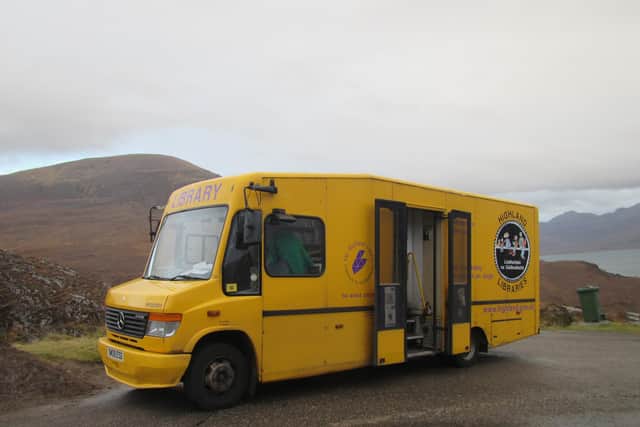
A yellow mobile library in the Highlands. The fleet has dwindled from 10 to seven. Transit vans, with fewer books packed in crates, are now filling the gaps.

All over the world, fans of books and libraries have found ways to reach readers in largely inaccessible regions. We’ve had stories here about using camels, horseback riders, vans, carts, and more.

Today’s article from the Scotsman, bemoans the gradual disappearance of Scotland’s yellow library buses.

As Alison Campsie reported in June, “For those living in the most isolated pockets of the Highlands, the sight of the yellow library van coming into view has long been a welcome one.

“But now, concerns for the future of the mobile libraries have been raised after the distinctive vans – complete with desk and bookshelves – dwindle in numbers.

“Mr Preston said a fleet of 10 yellow mobile libraries – plus a spare – has now been reduced to seven vans. Of these, five are standard Transits, which are now packed with crates, carry fewer books and have to be loaded and unloaded.

“The librarian, whose yellow van did not return from the garage in April, said: ‘I am worried that the mobile library service will fizzle out and die.

“ ‘People love the service and they want to see it continue. A lot of the people I serve are single people living by themselves and they might not see people, apart from the postman, for two or three weeks and then the library arrives. …

“Megan MacInnes, a co-opted community councillor for Applecross, said the mobile library was ‘a hugely important service.

” ‘The range of demographics of folk who use it demonstrates that. We have to drive nearly an hour to get to the nearest library at Lochcarron. That is just not feasible for many.

” ‘Personally, I completely rely on the mobile library for my books and as a parent it has been hugely important in helping my son to read and become interested in books. The children at school love being able to use the mobile library and they come out with such a range, from history and geology to novels and cartoons and the latest David Walliams or Harry Potter.

“Everyone here is very aware of the financial pressures that Highland Council is under but when it comes to these lifeline services, we really urge them to be continued.’ We are so far from population centres that we really can’t afford for our outreach services to go.’ …

“A spokesperson from Highlife Highland said it was working with Highland Council, which owns the vans, ‘to better understand how such services can be delivered including accessibility and customer needs. This will also help to inform replacement fleet requirements and to establish specifications and costs.’

“A statement added: ‘High Life Highland is providing an alternative service for rural customers with the option of a drop-off of books to their homes to ensure that they have access to reading material and schools are also given the option of a drop-off of books to their building.

” ‘We recognise that mobile libraries are an essential part of life in the Highlands and while this service is not a like for like replacement, it may help to ease some of the difficulties for the most vulnerable and isolated service users during this time.’ ”

More at the Scotsman, here. PS, if you search this blog on “mobile library,” you could get enough material for a dissertation, almost! Mobile libraries are cherished all over the world.
Read Full Post »

Photo: Dan Cameron.
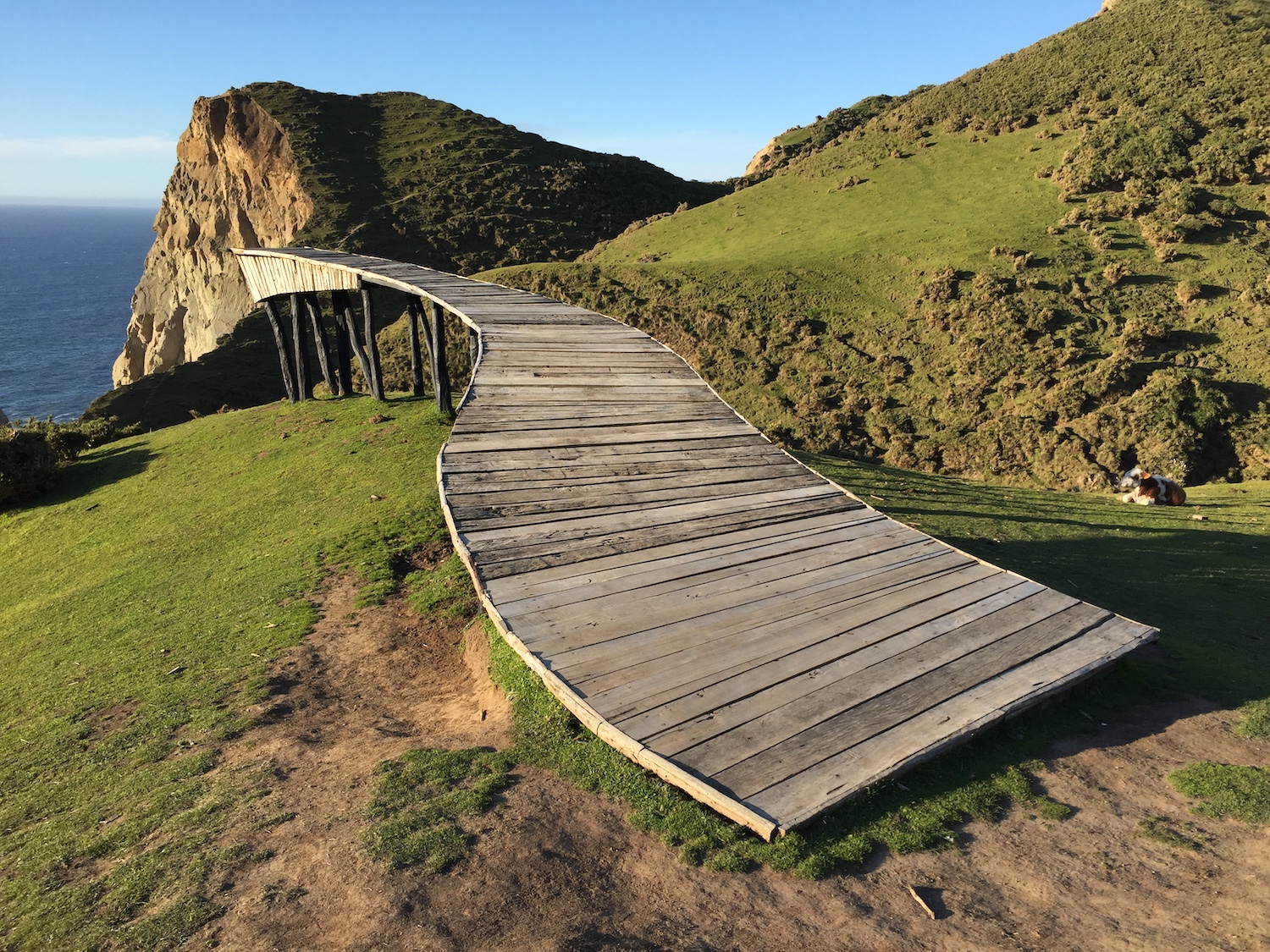
Chumono, Muelle de Alma (2005), site specific art installation near Cucao, Chiloé, Chile.

Today’s article is the first in a Hyperallergic series about a fellowship for curators that one recipient used for a project in Chile. Blogger Rebecca may know the part of Chile that curator Dan Cameron talks about.

He writes at Hyperallergic, “While preparing this project one day, I was perusing Chilean regional news outlets for details about the December 2021 fire that damaged or destroyed a number of houses in Castro, the capital of the Isla Grande de Chiloé, when I noticed that multiple sources referred to the island as a ‘tourist’ destination.

“Maybe it’s the just intellectual vanity that goes with being the sort of curator who leaves New York City to come to a remote corner of South America, but it felt weirdly like a slap in the face to see this little-known (outside of Chile) place that I’d been steadfastly exploring for a future curatorial project seemingly transformed by a single word into a locale that would be for, well, tourists. In my mind it didn’t matter that Chiloé’s famed palafito stilt houses and 17th- and 18th-century wooden churches attract visitors worldwide, or that the more secluded corners of Chiloé I’d scouted on previous trips had everything a moderately resourceful traveler would need for a splendid visit. …

“My flash of pique at reading Chiloé so described is curiously linked to my personal history with Chile, which I first visited exactly 30 years ago. … I’ve returned consistently to Chile over the years, precisely because I thought I wouldn’t otherwise get to know it. This was summarized by the word that the Santiago-based artist Eugenio Dittborn would employ five years later as his title for a survey exhibition I curated of his signature pinturas aeropostales (airmail paintings) at the New Museum: Remota.

In 1992 I hardly knew anybody who possessed firsthand information about Chile, and that made it irresistible.

“During our initial meeting at his studio in Santiago, I shared with Dittborn my very ambitious itinerary, which included Santiago, Valparaiso, Easter Island, and the northern cities of Iquique and Antofagasta. … Dittborn responded that in the future, I should visit the southernmost art museum in the world, in Castro [in Chiloé], and perhaps consider organizing an exhibition there. …

“I finally made it to Chiloé in 2015 with the artist Gianfranco Foschino. … It helped that Gianfranco was personally enthusiastic about organizing a contemporary art exhibition in Chiloé, but what became less clear once we’d made our initial reconnaissance of the island was whether or not MAM Chiloé was the ideal venue for a project that would function largely as a platform for local artists. After spending time with and talking to various artists living on the island, it seemed that, for most, the museum functioned as a venue for artists based in Santiago. If I wanted to see where local artists showed, I’d need to dig a little deeper into the patchwork of regional museums, municipal libraries, gallery-cafés, and community centers, which tended to be scattered all over Chiloé, and on the nearby islands of Quinchao and Lemuy.

“My last time in Chiloé, in November 2019 … I started envisioning Alrededores more as a long-term curatorial endeavor, where instead of artworks appearing for one season and vanishing, some might require years even to come to fruition. That would place the project closer in spirit to the niche that the Chilote artist Chumono opened up with his site-specific Muelle del Alma (‘Pier of the Soul’), which since its 2005 construction has become emblematic of art and nature co-existing on mutually beneficial terms. Thousands of visitors each year park their cars near the village of Cucao and hike nearly three miles through verdant hills and pastures to the westernmost edge of the island.

“There, according to Chiloé folklore, the boatman Tempilcahue will someday ferry them to the afterlife; fittingly, Chumono’s wooden ramp visually beckons visitors up into the sky and out over the Pacific Ocean. …

“The most exciting part of my plan was the possibility that Chiloé’s artists might end up with an international context for their work, without rupturing the sociocultural framework of their lives.

“The art was already there — I had already been surprised by its depth, and it was simply a matter of introducing the world to it. Even if cultural tourism, broadly speaking, was on a temporary hiatus as new waves of COVID spread worldwide, other avenues could bring the public to the art of Guillermo Grez or Anelys Wolf, or to the sole-proprietor storefront Museum of the Accordion in Chonchi.

“The latter, a modest but beloved establishment, preserves an integral part of the musical legacy left through centuries of ships — on which the accordion was that rare instrument capable of surviving adverse conditions — rounding Tierra del Fuego to pass between the Atlantic and Pacific Oceans, which slowed to a crawl after the 1914 opening of the Panama Canal. Part of the original Alrededores concept had been to move the museum’s collection — acquired long ago from sailors who left their accordions for repair and never returned — temporarily to MAM Chiloé, while putting some TLC into the museum’s display and conservation in Chonchi, where exhibits are typically set out on folding tables with hand-written labels.

“This month I’m returning to Chiloé for the fifth time in eight years … in pursuit of something that compels me to return over and over again, and to continue dreaming of a truly marvelous future art exhibition.”

More at Hyperallergic, here, where you can click through the curator’s updates. No firewall, nice pictures.

Read Full Post »

Photo: Chris Bell/The Culture Trip.
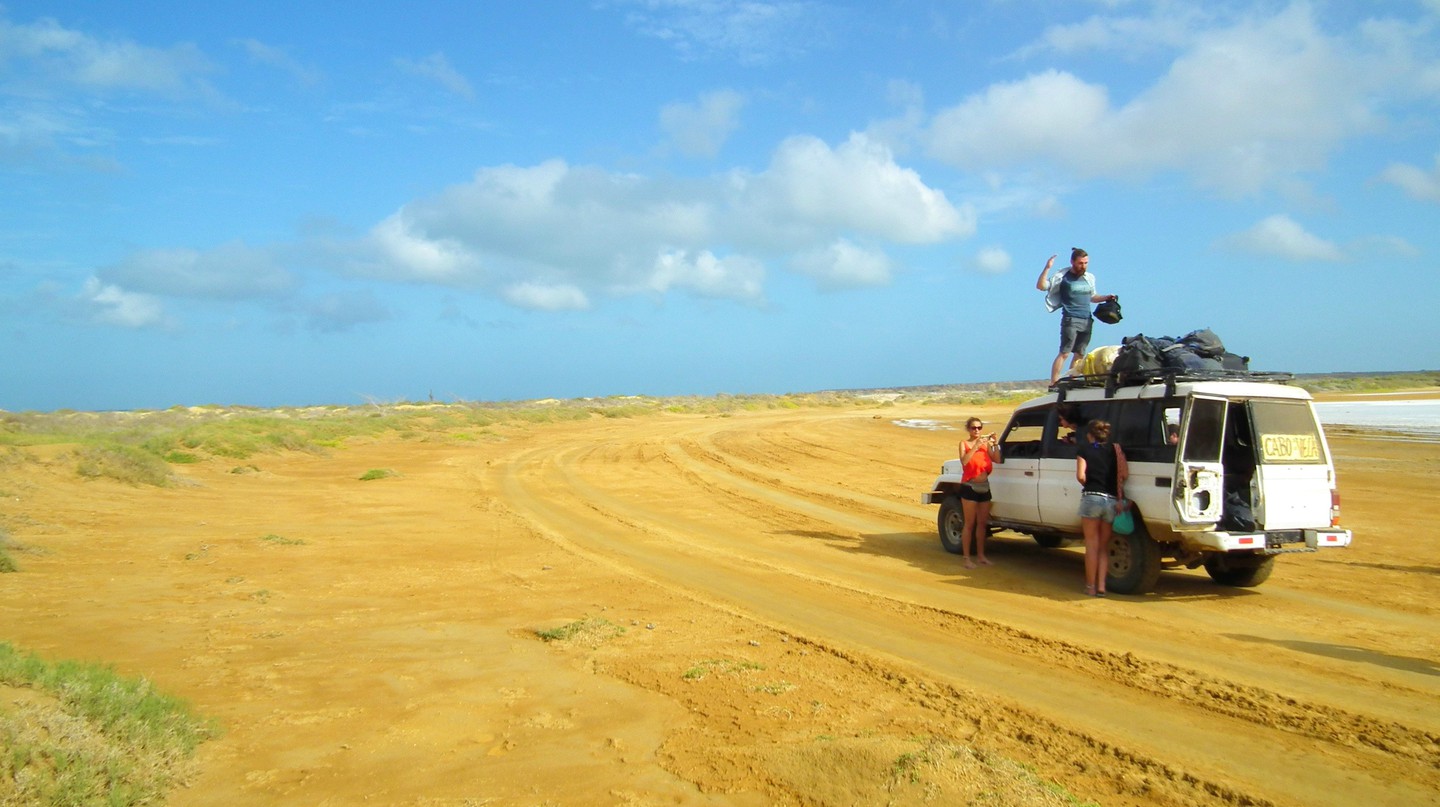
Tourists in La Guajira, a remote part of Colombia. Nowadays the focus is on a vaccine outreach to wary indigenous residents.

John assures me that pandemics always peter out as variants emerge weaker and weaker. I hope he’s right. Meanwhile, some experts are saying we won’t be done with Covid until we vaccinate the whole world.

Samantha Schmidt at the Washington Post wrote recently about an effort to reach a remote corner of Colombia — one step in vaccinating the whole world.

“The vaccination team had spent an hour bouncing and bucking down a dirt road and over train tracks when the van driver issued a warning. The toughest part of the drive was still to come. The two women gripped their seat cushions as the van jolted, climbed a mound of dirt and fishtailed in the slick mud. Driver Toto Girnu honked at passing goats as he followed a path blazed only by tire tracks. In the distance, he spotted dark, menacing clouds.

“If the group was lucky, the drive through this remote desert would take four or five hours. If it rained, as it did when Girnu made this trip a few days earlier, it could take more than 10.

“But this was the only way to reach the Indigenous families who live in this arid swath of land in the northern department of La Guajira, where there are no paved roads, no electricity, no running water and no other access to the vaccines that would protect their communities.

“Travel is only part of the challenge confronting the team, one of many contracted by the Colombian government to deliver vaccines to some of the country’s remotest peoples. There is also a lack of information about the coronavirus, hesitation around vaccines and a general mistrust of authorities.

“The van, ‘Route of Hope’ written across the windshield, came upon a roadblock. Adults and children here string ropes across the road, to be lifted only in exchange for water, food or cash.

“ ‘Are you vaccinated?’ vaccine team coordinator Katherin Gamez shouted to a young man. Girnu gave the man a fist bump, tossed him a small bag of water and translated the question into Wayuunaiki, the language of the local Wayuu Indigenous people.

“ ‘For what?’ he asked.

“Across the Andes, a region that has reported some of the world’s highest covid-19 death rates, teams are traversing deserts, mountains, rainforests and rivers to vaccinate isolated communities.

“Such teams are particularly active in Colombia, a country of more than 48 million people, where about 16 percent of the population lives in rural areas that were often neglected by the government during more than five decades of armed conflict. …

“About 35 percent of Colombia’s population has been fully vaccinated, according to the Health Ministry. More than half of residents in major cities — 62 percent in the capital of Bogotá — have received at least one dose.

“But in La Guajira, home to the country’s largest Indigenous population, only 38 percent have received at least one dose. … Years of government abandonment and mismanagement have caused many Wayuu residents to mistrust the health system. Only 4 percent of Wayuu people here have access to clean water, Human Rights Watch reported last year; 77 percent of Indigenous households are food insecure. In Alta Guajira, where the largest number of Wayuu people live, there is only one hospital, and it offers only basic care. …

“ ‘By the time a lot of them get to care, they’re so near death … there’s this perception that maybe the care didn’t help,’ said Shannon Doocy, an associate professor of international health at Johns Hopkins who co-wrote the Human Rights Watch report. …

“ ‘We’re getting close,’ Girnu told Gamez and Eliana Andrioly, the team’s Indigenous leader. They sped down a salt flat, their view miles of sand and the distant bay. …

“A team of nursing assistants and a doctor were waiting. The providers spend 15 days at a time living in a dormitory next door, sleeping in hammocks and showering with buckets of water, to stage daily medical missions to the surrounding communities.

“The organization, IPSI Palaima — ‘land of the sea’ in Wayuunaiki — was founded in 2007 by an Indigenous woman who grew up in the area. It is one of the only providers in Alta Guajira with a permanent vaccine refrigerator, in a medical center powered by solar panels.

“The team member in charge of shots this week was Daniela Vergara, a 21-year-old nursing assistant who had never been to AltaGuajira before she applied for the job. Each day, Vergara aims to vaccinate at least 10 people — a modest goal that often requires a massive effort.

“On this Monday, she had not yet reached her target. She packed her cooler — a blue backpack filled with vials of the single-dose Johnson & Johnson shot that has been a godsend to rural vaccine teams — and set out for a community across the bay. [Then] they drove to a gathering place where they hoped to meet people interested in the vaccine.

“ ‘There’s no one here,’ Vergara said. ‘We got here too late.’

“A local leader suggested they go house to house. As darkness fell, the team members asked anyone who looked 18 or older if they wanted the vaccine. Soon a woman recounted a rumor they had heard many times: Outsiders were pushing a vaccine that was sickening members of the Wayuu community.

“The woman, a teacher who spoke some Spanish, knew what was at stake. She had contracted the virus a few months earlier, after a trip to the town of Uribia. For a month, she suffered chest pains, headaches, an intense cough and the loss of taste and smell. … She worried about a 66-year-old neighbor who had no interest in getting a shot.

“ ‘Many people are dying from this disease,’ Juan Larrada, a Wayuu doctor in the group, said in Wayuunaiki. He said the vaccine could have side effects, but it would protect them from serious illness. He asked Amaita Uriana why she did not want it.

“ ‘Because I was afraid of getting sicker,’ she said. ‘I really feel very sick. I carry pains in my body. That’s why I refused when a girl came here for the same reason. Besides, she was very pretentious. And we had already heard about the experiences of other Wayuu who had been vaccinated and become ill.’

“ ‘The vaccine can have those effects,’ Larrada agreed. ‘Fever, muscular pains, that’s normal.’

“Understanding the doctor as he spoke to her in her own language, Uriana assented. She closed her eyes; Vergara emptied the syringe into her arm.”

Read about the many Wayuu who cannot be persuaded and why that is, here. The photos in the article are terrific, but I can’t share them because they’re blocked. If you have a subscription, you are in luck.

Read Full Post »

You’ve heard of TED Talks — interesting people lecturing about amazing work?

Well, there is also something called a TED Prize, and medical entrepreneur Raj Panjabi will receive it in April. The TED website provides background.

“Raj Panjabi grew up in Liberia, but at age nine, his family fled a devastating civil war and relocated to the United States. He studied hard, and in 2005 returned to his native country as a medical student. He was shocked to find a health care system in shambles.

Only 50 doctors remained to treat a population of four million.

“Raj founded Last Mile Health to expand access to health services for those living in Liberia’s most remote regions. The nonprofit partners with the government to recruit, train, equip and employ community health care workers, empowering them to provide a wide range of services.

“In 2016, Last Mile Health deployed 300 community health workers, who conducted more than 42,000 patient visits and treated nearly 22,000 cases of malaria, pneumonia and diarrhea in children. The organization also helped tackle the Ebola epidemic in southeastern Liberia by assisting the government of Liberia in its response and training 1,300 health workers to prevent the spread of the disease.

“Last Mile Health has created a model that can be replicated. … The key: training and employing community health workers — individuals who learn to diagnose and perform medical interventions, and can serve as a bridge to the primary health system.”

At TED2017, Panjabi will reveal how he aims to transform access to care in remote areas elsewhere and protect against pandemic outbreaks.

More here. (Hat tip: Maria Popova on Twitter.)

Photo: Last Mile Health 
Born in Liberia, Raj Panjabi fled as a child because of civil war. He returned as a medical student — and went on to found Last Mile Health.

Read Full Post »

Are you familiar with the “Lens” blog at the NY Times? It focuses on “photography, video and visual journalism.” Here David Gonzalez writes about the photos of Putu Sayoga.

[Hat tip: Asakiyume on twitter.]

“If you live in a far-off place, a library may be something you’d only read about in books. That is, if you had books to begin with.

“That became the mission of Ridwan Sururi, an Indonesian man with a plan — and a horse. Several days a week, he loads books onto makeshift shelves he drapes over his steed, taking them to eager schoolchildren in the remote village of Serang, in central Java. ..

“Mr. Sayoga, a co-founder of the collective Arka Project, had seen something about the equine library on a friend’s Facebook page. It reminded him of his own childhood, where his school had only out-of-date books. Intrigued, he reached out to Mr. Sururi, who offered to put Mr. Sayoga up in his home while he spent time photographing Mr. Sururi on his rounds. …

“Mr. Sururi made a living caring for horses, as well as giving scenic tours on horseback. One of his clients, Nirwan Arsuka, came up with the book idea as a way of doing something to benefit the community, specifically a mobile library. He gave Mr. Sururi 138 books for starters. Most were in Indonesian, and the books included a lot with drawings.

“Children at the schools he visits can borrow the books for three days, and demand has been so great that he now has thousands of books.” More here. Check out the slide show.

Photo: Putu Sayoga

Read Full Post »