Feeds:
Posts
Comments

Posts Tagged ‘research’

Photo: AP Photo/Charles Krupa.
A detail of the 2025 Ig Nobel award, one of many that get awarded by the Annals of Improbable Research magazine for silly sounding scientific discoveries that often have surprisingly practical applications.

If your serious research gets an award for sounding silly, it’s a good idea to put your sense of humor on display and accept the free publicity. That’s what winners of the Ig Nobel have learned to do. Some researchers even hope they’ll be chosen.

Michael Casey writes at the Associated Press, “A team of researchers from Japan wondered if painting cows with zebralike stripes would prevent flies from biting them. Another group from Africa and Europe pondered the types of pizza lizards preferred to eat.

“Those researchers were honored [in September] in Boston with an Ig Nobel, the prize — a hand made model of a human stomach — for comical scientific achievement. In lieu of a big paycheck, each winner was also given a single hand wipe.

“ ‘When I did this experiment, I hoped that I would win the Ig Nobel. It’s my dream. Unbelievable. Just unbelievable,’ said Tomoki Kojima, whose team put tape on Japanese beef cows and then spray painted them with white stripes. Kojima appeared on stage in stripes and was surrounded by his fellow researchers who harassed him with cardboard flies.

“As a result of the paint job, fewer flies were attracted to the cows and they seemed less bothered by the flies. Despite the findings, Kojima admitted it might be a challenge to apply this approach on a large-scale.

“The year’s winners, honored in 10 categories, also include a group from Europe that found drinking alcohol sometimes improves a person’s ability to speak a foreign language and a researcher who studied fingernail growth for decades.

“ ‘Every great discovery ever, at first glance seemed screwy and laughable,’ Marc Abrahams, master of ceremonies and editor of the magazine, said in an email interview ahead of the awards ceremony. …

“The 35th annual Ig Nobel prize ceremony is organized by the Annals of Improbable Research, a digital magazine that highlights research that makes people laugh and then think. It’s usually held weeks before the actual Nobel Prizes are announced.

“The ceremony to celebrate winners [began] with a longtime tradition: the audience pelting the stage with paper airplanes. Several of those who couldn’t attend had their speeches read by actual Nobel laureates including Esther Duflo, who won the Nobel Prize for her experimental approach to alleviating global poverty.

“There was also a mini-opera about gastroenterologists and their patients, inspired by this year’s theme which is digestion. …

“There was also a section called the 24-second lecture where top researchers explain their work in 24 seconds. Among them was … Trisha Pasricha, who explained her work studying smartphone use on the toilet and the potential risk for hemorrhoids.

“When any winner appeared to be rambling on too long, a man wearing a dress over his suit would appear at their side and repeatedly yell, ‘Please stop. I’m bored.’

“Other winners this year included … a team of international scientists that looked at whether giving alcohol to bats impaired their ability to fly.

“ ‘It’s a great honor for us,” said Francisco Sanchez, one of the researchers from Colombia who studied the drunken bats. ‘It’s really good. You can see that scientists are not really square and super serious and can have some fun while showing interesting science.’

“Sanchez said their research found that the bats weren’t fans of rotten fruit, which often has higher concentrations of alcohol. Maybe for good reason. When they were forced to eat it, their flying and echolocation suffered, he said. …

“Among the most animated of the winners was a team of researchers from several European countries who studied the physics of pasta sauce. One of the researchers wore a cook’s outfit with a fake mustache to accept the award while another dressed as a big ball of mozzarella cheese got pummeled by several people holding wooden cookware. They ended by handing out bowls of pasta to the Nobel laureates.”

More at AP, here. Fun pictures.

Read Full Post »

Photo: Mike Householder/AP.
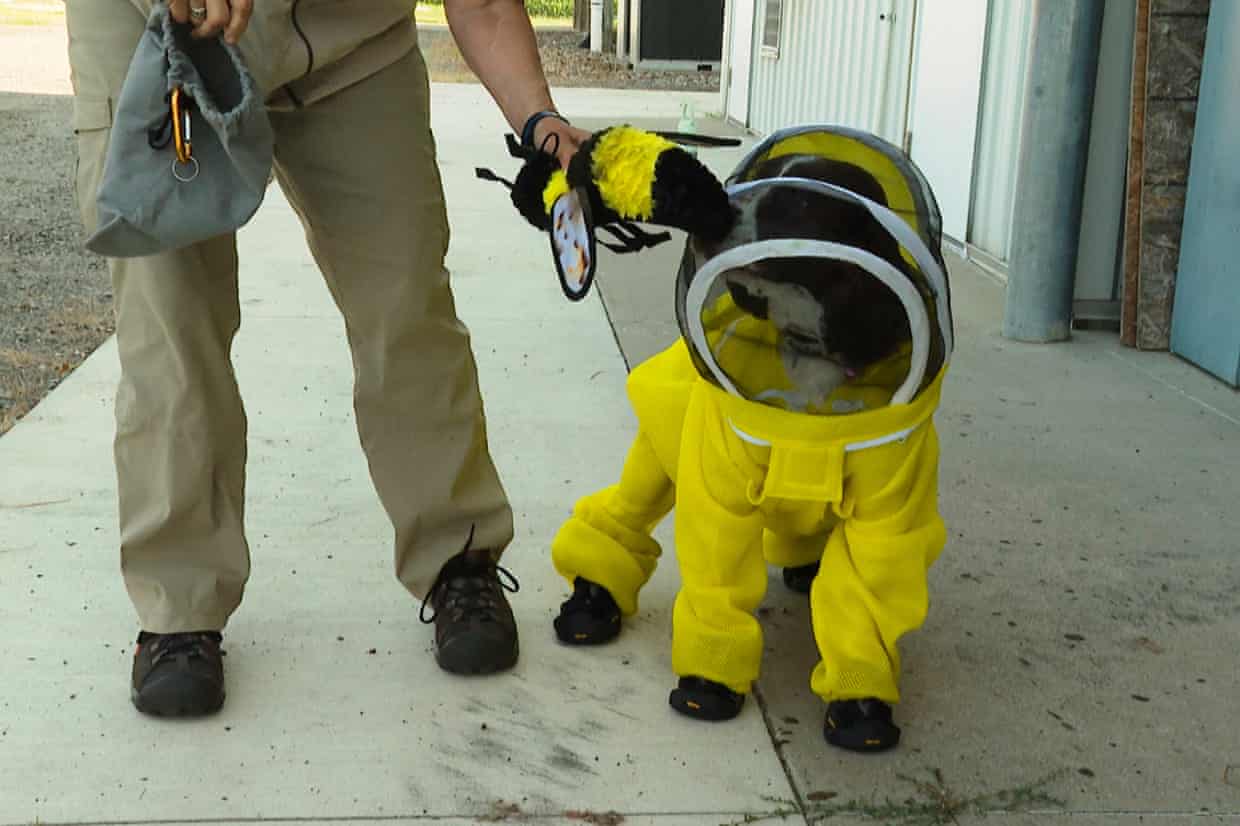
Sue Stejskal lets Maple, an English springer spaniel, sniff a bee-themed dog toy at Michigan State University’s Pollinator Performance Center. Maple is part of an effort to screen and diagnose diseases that sicken honeybees.

It seems that over the past few years, I’m hearing more and more about bees — their importance to the food chain, their worrisome diseases. On Instagram I’ve been following the intrepid Erika Thompson @texasbeeworks, and after Sandra told me about an inspiring bee tour, I added @bodhis.bees in Rhode Island. Then, there’s my friend AJ, who shares honey from his hives when the black bear leaves them alone.

Keeping bees and other pollinators healthy is an important job that’s getting increasingly difficult as unaware humans damage their environment. In today’s story, a specially trained dog is helping protect bees.

Ramon Antonio Vargas reports at the Associated Press via the Guardian, “Maple, a springer spaniel aged nine, is earning news headlines by helping Michigan State University (MSU) researchers identify bacteria that is harmful for bee colonies. …

“Maple landed the role after spending seven years detecting human remains for a sheriff’s office. She had to retire from the sheriff’s office after suffering an injury on the job – leaving her handler, Sue Stejskal, in search of something to keep Maple busy.

“ ‘She’s a very over-the-top, enthusiastic, sometimes hard-to-live with dog because of her energy level,’ Stejskal, who has been training dogs for law enforcement and other uses for more than 25 years, said to the AP.

“Fortunately for Stejskal, MSU professor Meghan Milbrath was seeking out tools to screen and diagnose diseases that sicken honeybees, which her lab studies. A veterinarian who had taken part in a training about honeybees later put Stejksal and Milbrath in touch.

“And soon, the pair hatched a plan by which Stejskal taught Maple to apply her police canine detection methods in beehives to uncover American foulbrood – a bacterial disease that poses a deadly threat to honeybee larvae.

“The work Maple has since done for MSU’s Pollinator Performance Center has been crucial, with bees and other pollinators in a years-long decline stemming from diseases, insecticides, a lack of a diverse food supply and climate change driven by human emissions of greenhouse gases.

“ ‘American foulbrood [harms] young developing bees, and when a hive gets infected, it actually basically leads to death,’ Milbrath, an assistant professor in MSU’s entomology department. …

” ‘Beekeepers have had to burn tens of thousands of dollars of equipment due to this disease,’ Milbrath said to WILX.

“Maple carries out her duties in a distinctive, yellow protective suit. Her gear includes a veil for her head and four bootees worn on her paws to shield Maple in case she steps on a bee. …

“About 465 bee species are native to Michigan alone. Among the goals of training Maple to spot American foulbrood for the Pollinator Performance Center was to create a guidebook with which other dogs could be similarly taught, WILX noted.

“Stejskal told the AP, ‘I was over-the-moon excited because my dog would have joy in her life and would still be able to work,’ Stejskal said.” More at the Guardian, here.

You probably know there are things we can all do to help bees.

Many homeowners, for example, are giving up pesticides and herbicides. They are leaving the leaves on their lawns in fall to provide pollinator habitat in spring, and they’re committing to No Mow May. After all, as Bee City tells us, “The start of the growing season is a critical time for hungry, newly emerged native bees. Flowers may be hard to find. By allowing it to grow longer, and letting flowers bloom, your lawn can provide nectar and pollen to help your bee neighbors thrive.”

Please add bee tips if you know of some not covered here.

Read Full Post »

Photo: Bennett Whitnell / Hakai Institute.
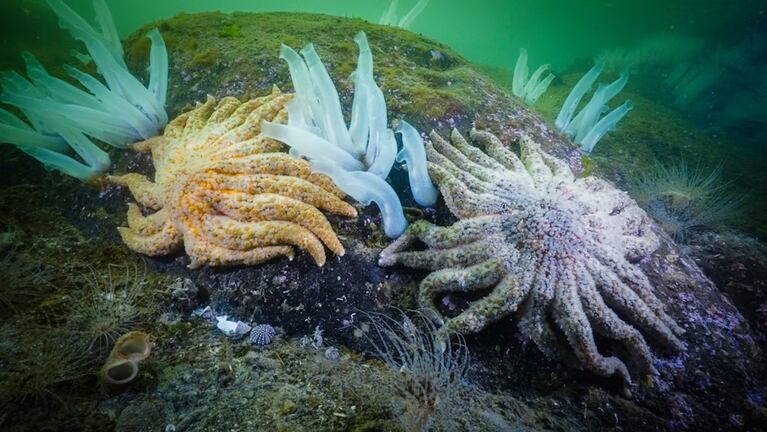
Sunflower stars and vase tunicates grow on the sea floor of Rivers Inlet, British Columbia, in 2023.

There have always been voters who care more about knocking a few cents off the gas they put in their SUVs than researching what’s going on with some small creature in the natural world.

But many of us do care about the natural world and believe that a dieoff in any one area can have repercussions for humanity. Everything is connected.

John Ryan reports at OPB (Oregon Public Broadcasting) about how scientists worked to “crack the case” of melting sea stars.

He writes, “Researchers in Washington and British Columbia say they have solved a deadly mystery that has stumped scientists for more than a decade. They have identified the pathogen behind one of the world’s biggest disease outbreaks: a wasting disease that has turned billions of sea stars into goo – from Alaska to California.

“A mass dieoff of ocean-shaking proportions began among sea stars along North America’s West Coast in 2013. Of 20 species affected, the pizza-sized sunflower star was hardest hit. More than 5 billion sunflower stars, or 90% of their global population, wasted away.

“With key predators of sea urchins largely wiped out, the spiny little grazers proliferated and chewed their way through kelp forests, leading to widespread losses of that productive ocean habitat.

“For 12 years, the cause of the wasting disease was either unknown or, mistakenly, thought to be a virus. Instead, the new study says, it is a strain of bacteria known as Vibrio pectenicida. Other Vibrio bacteria sicken corals and shellfish. One species, Vibrio cholera, causes cholera in humans.

“ ‘It is not surprising that it is a Vibrio,’ said biologist Alyssa-Lois Gehman of British Columbia’s Hakai Institute. ‘It was surprising because it took us so long to find out that it was a Vibrio.’

“Gehman and her coauthors are not the first scientists to claim to have found the culprit behind the worst underwater wildlife pandemic on record. …

“Gehman said the new study, published in the journal Nature Ecology & Evolution, avoids a key oversight of the earlier work by focusing on the sea stars’ blood-like internal fluid and not just its external tissues, where many other microbes live. …

“Gehman’s research team not only found much more Vibrio pectenicida in sick stars than in healthy ones. They were able to isolate the Vibrio, grow it in the lab, and give the wasting disease to healthy sunflower stars by injecting them with the Vibrio, steps the earlier researchers had not achieved. …

“The current study grew out of four summers of experiments at the U.S. Geological Survey’s Marrowstone Marine Field Station, a beachfront facility on Marrowstone Island, near Port Townsend, Washington. Avoiding microbial contamination was a top priority.

“ ‘There’s a lot of ethanol and bleach and betadine,’ Gehman said. …

“Researchers stepped in foot baths when entering and leaving the facility. Each sunflower star, after enduring a two-week quarantine, lived in its own tank with its own supply of sand-filtered, ultraviolet-treated seawater. Researchers avoided touching the stars, even with gloves on.

“In January 2024, after analyzing the previous summer’s data, the researchers found large amounts of Vibrio pectenicida in sick sunflower stars and hardly any in healthy stars. …

“Sunflower stars have become so rare that taking any from the wild is both difficult and potentially harmful to the species.

“ ‘We ran at sort of the bare minimum necessary to get robust and strong evidence,’ Gehman said.”

Continued research is under threat. The administration in DC proposes to cut the key U.S. Geological Survey budget 38% in 2026 and eliminate its biological research arm, which environmental advocates call “the backbone of environmental and ecological monitoring.”

More at OPB, here.

Read Full Post »

Photo:The Metropolitan Museum of Art.
Google’s Aeneas AI program proposes words to fill the gaps in worn and damaged artifacts. 

Whenever I start to worry that Google has too much power, it does something useful. Today’s story is about its artificial intelligence program Aeneas, which can make a guess about half-obliterated letters in ancient inscriptions.

Ian Sample, science editor at the Guardian, writes, “In addition to sanitation, medicine, education, wine, public order, irrigation, roads, a freshwater system and public health, the Romans also produced a lot of inscriptions.

“Making sense of the ancient texts can be a slog for scholars, but a new artificial intelligence tool from Google DeepMind aims to ease the process. Named Aeneas after the mythical Trojan hero, the program predicts where and when inscriptions were made and makes suggestions where words are missing.

“Historians who put the program through its paces said it transformed their work by helping them identify similar inscriptions to those they were studying, a crucial step for setting the texts in context, and proposing words to fill the inevitable gaps in worn and damaged artifacts.

” ‘Aeneas helps historians interpret, attribute and restore fragmentary Latin texts,’ said Dr Thea Sommerschield, a historian at the University of Nottingham who developed Aeneas with the tech firm. …

“Inscriptions are among the most important records of life in the ancient world. The most elaborate can cover monument walls, but many more take the form of decrees from emperors, political graffiti, love poems, business records, epitaphs on tombs and writings on everyday life. Scholars estimate that about 1,500 new inscriptions are found every year. …

“But there is a problem. The texts are often broken into pieces or so ravaged by time that parts are illegible. And many inscribed objects have been scattered over the years, making their origins uncertain.

“The Google team led by Yannis Assael worked with historians to create an AI tool that would aid the research process. The program is trained on an enormous database of nearly 200,000 known inscriptions, amounting to 16m characters.

“Aeneas takes text, and in some cases images, from the inscription being studied and draws on its training to build a list of related inscriptions from 7th century BC to 8th century AD. Rather than merely searching for similar words, the AI identifies and links inscriptions through deeper historical connections. …

“The AI can assign study texts to one of 62 Roman provinces and estimate when it was written to within 13 years. It also provides potential words to fill in any gaps, though this has only been tested on known inscriptions where text is blocked out.

“In a test … Aeneas analyzed inscriptions on a votive altar from Mogontiacum, now Mainz in Germany, and revealed through subtle linguistic similarities how it had been influenced by an older votive altar in the region. ‘Those were jaw-dropping moments for us,’ said Sommerschield. Details are published in Nature. …

“In a collaboration, 23 historians used Aeneas to analyze Latin inscriptions. The context provided by the tool was helpful in 90% of cases. “’t promises to be transformative,’ said Mary Beard, a professor of classics at the University of Cambridge.

“Jonathan Prag, a co-author and professor of ancient history at the University of Oxford, said Aeneas could be run on the existing corpus of inscriptions to see if the interpretations could be improved. He added that Aeneas would enable a wider range of people to work on the texts.

“ ‘The only way you can do it without a tool like this is by building up an enormous personal knowledge or having access to an enormous library,’ he said. ‘But you do need to be able to use it critically.’ “

More at the Guardian, here. Please remember that this free news outlet needs donations.

Read Full Post »

Photo: Sean Waugh.
NOAA’s National Severe Storm Lab has been looking into the hail problem.

Here’s my periodic reminder that cutting out funding for scientific research can affect your life. The important work of the National Severe Storm Lab of National Oceanic and Atmospheric Administration (NOAA) in Oklahoma is just one example of what may be lost.

Nick Gilmore at public radio WVTF in Virginia reported recently on NOAA’s research into hail.

“Just picture this – it’s a warm afternoon and a thunderstorm starts to roll overhead. You head indoors and hear rain begin to fall. As the cracks of thunder get louder, you peek out the window to see large chunks of ice on the ground. … Rain makes sense to fall from a storm – but large pieces of ice?

“ ‘Hail is one of those things that we don’t really know how it forms,’ says Sean Waugh, a research scientist at NOAA’s Severe Storms Laboratory.

“We do know some of the basics. Strong thunderstorms have strong updrafts – think like a vacuum cleaner that’s able to lift moisture high up into the atmosphere. It’s cold up there, so that water freezes into a small stone. It collects more water, refreezes as it cycles through the storm – more water, refreezes. … Eventually, the hailstone gets too heavy and tumbles to the earth below. Waugh says wind speed, direction and moisture in the air also play a part in hailstorm development.

We also know hail can be expensive.

“ ‘In any given year, it’s 60-80% of the damage that comes from severe thunderstorms,’ says Ian Giammanco – a meteorologist at the Insurance Institute for Business and Home Safety. He says we’re just getting more hailstorms these days.

“ ‘Rewind the clock all the way back to 2008 – every year since then, we’ve had over $10 billion in damage from hail. This has crept up now to a $20-30 billion problem.’

“Giammanco says that’s why research like what Sean Waugh is doing is so important – finding out what hail looks like before it hits the ground. …

“Waugh says, ‘We don’t know what broke when it landed, how much of that mass, or size or shape have we lost between when it fell and when we find it, right? I’ve seen six-inch diameter stones melt before I can get out of the car to pick them up.’ …

“There are other questions, too: how fast does hail fall? Does it fall in a specific orientation? Does the stone melt while it’s falling to the earth below?

” ‘These are all really, really important questions if you’re trying to ascertain what hail looks like to a radar. And that’s a really critical piece of knowledge if you’re trying to warn for hail in real time, which is obviously the goal! Most people want to know if there’s going to be golf balls falling at their house or softballs.’ …

“Waugh and his team have built a complex rig that observes hail in free fall and in real time. They head out from Oklahoma – typically to the Southern Plains – to get the system in front of a storm producing large hail.

“The rig has high speed and high-quality cameras, and Waugh says there’s another key component.

” ‘But we need a lot of light to do that. Otherwise, the image would just be dark,’ he explains. ‘So, the LED array I have on the back of the truck produces about 30% more light than the sun!’ …

“ ‘We can use that knowledge to improve our forecasts of what storms are likely going to produce hail days in advance. By understanding the type of hail that different storms produce, that increases our ability to model it properly and then forecast that in the future,’ Waugh says. ‘And that way people can take appropriate action to protect life and property.’ ”

More at public radio WVTF, here. Cool video of hail in flight.

I don’t get the funding cuts. The jobs that will be lost at the weather center are in Oklahoma, so it’s not just coastal communities that will be hurt. And anyway, don’t hurricanes damage golf courses in Florida sometimes? Weather is something no human can be the boss of, so it’s just common sense to try to understand it.

Please share your hail stories.

From the University of Oklahoma news site, OU Daily.

Read Full Post »

Photo: Colleen Reichmuth, NMFS 23554, via the New York Times.
Ronan, a California sea lion of the Long Marine Laboratory at the University of California, Santa Cruz.

Do you recall reading about the dancing cockatoo Snowball with the head-banger technique? Snowball was a big hit for a while there. I think critter behavior is interesting even when it does not look like human behavior, but it seems that scientists can’t get enough of animals dancing like humans.

Here are two relevant Guardian reports — one on on sea lions and one on rats.

“Ronan the sea lion can still keep a beat after all these years. She can groove to rock and electronica. But the 15-year-old California sea lion’s talent shines most in bobbing to disco hits such as ‘Boogie Wonderland.

“ ‘She just nails that one,’ swaying her head in time to the tempo changes, said Peter Cook, a behavioral neuroscientist at New College of Florida who has spent a decade studying Ronan’s rhythmic abilities.

“Not many animals show a clear ability to identify and move to a beat aside from humans, parrots and some primates. But then there’s Ronan, a bright-eyed sea lion that has scientists rethinking the meaning of music.

“A former rescue sea lion, she burst to fame about a decade ago after scientists reported her musical skills. From age three, she has been a resident at the University of California, Santa Cruz’s Long Marine Laboratory, where researchers including Cook have tested and honed her ability to recognize rhythms. …

“What is particularly notable about Ronan is that she can learn to dance to a beat without learning to sing or talk musically.

“ ‘Scientists once believed that only animals who were vocal learners – like humans and parrots – could learn to find a beat,’ said Hugo Merchant, a researcher at Mexico’s Institute of Neurobiology, who was not involved in the Ronan research.

“But in the years since since Ronan came into the spotlight, questions emerged about whether she still had it. Was her past dancing a fluke? Was Ronan better than people at keeping a beat?

“To answer the challenge, Cook and colleagues devised a new study. … The result: Ronan still has it. She is back and better than ever. This time the researchers focused not on studio music but on percussion beats in a laboratory. They filmed Ronan bobbing her head as the drummer played three different tempos – 112, 120 and 128 beats per minute. Two of those beats Ronan had never been exposed to, allowing scientists to test her flexibility in recognizing new rhythms.

“And the researchers asked 10 college students to do the same, waving their forearm to changing beats. Ronan was the top diva.

“ ‘No human was better than Ronan at all the different ways we test quality of beat-keeping,’ said Cook, adding, ‘she’s much better than when she was a kid.’ “

Meanwhile, at the Guardian, Hannah Devlin writes that rats, too, “instinctively move in time to music. This ability was previously thought to be uniquely human and scientists say the discovery provides insights into the animal mind and the origins of music and dance.

“ ‘Rats displayed innate – that is, without any training or prior exposure to music – beat synchronization,’ said Dr Hirokazu Takahashi of the University of Tokyo.

“ ‘Music exerts a strong appeal to the brain and has profound effects on emotion and cognition,’ he added.

“While there have been previous demonstrations of animals dancing along to music – TikTok has a wealth of examples – the study is one of the first scientific investigations of the phenomenon.

“In the study, published in the journal Science Advances, 10 rats were fitted with wireless, miniature accelerometers to measure the slightest head movements. They were then played one-minute excerpts from Mozart’s Sonata for Two Pianos in D Major, at four different tempos: 75%, 100%, 200% and 400% of the original speed. Twenty human volunteers also participated.

“The scientists thought it possible that rats would prefer faster music as their bodies, including heartbeat, work at a faster pace. By contrast, the time constant of the brain is surprisingly similar across species.

“However, the results showed that both the rat and human participants had optimal beat synchronicity when the music was in the 120-140 beats per minute (bpm) range – close to the Mozart composition’s original 132bpm – suggesting we share a ‘sweet spot’ for hitting the beat. The team also found that rats and humans jerked their heads to the beat in a similar rhythm, and that the level of head jerking decreased the more that the music was sped up. …

“The team now plans to investigate how other musical properties such as melody and harmony relate to the dynamics of the brain.

“ ‘Also, as an engineer, I am interested in the use of music for a happy life,’ said Takahashi.”

Gotta love scientists! More on rats. More on Ronan.

Read Full Post »

Photo: Atlantic Shark Institute.
A Great White shark.

Here I am on the island of New Shoreham reading about a Great White shark that people in Australia actually dared to rescue. Oy! Some sharks are harmless, but keep me away from that particular shark!

In New Shoreham, we know that warming seas are bringing more seals north. And seals, of course, mean lunch to the Great White. Grandchildren are told to keep clear of seals.

Recently, I read an Associated Press article at the Guardian about a different kind of shark adventure down under. A rescue.

“Tourist Nash Core admits he felt some fear when he and his 11-year-old son waded into the ocean off the Australian coast to help rescue a three-meter [10 foot] great white shark stranded in shallow water.

“Three local men managed to return the distressed animal from a sand bank into deeper water after an almost hour-long rescue effort [near] the coastal town of Ardrossan in South Australia.

“ ‘It was either sick or … just tired,’ said Core, who was visiting with his family from the Gold Coast in Queensland. ‘We definitely got it into some deeper water, so hopefully it’s swimming still.’

“Core came across the unusual human-shark interaction while traveling around Australia with his wife, Ash Core, and their sons, Parker, 11, and Lennox, 7.

“Nash Core used his drone to shoot video of the writhing shark before he and Parker decided to help the trio who were struggling to move the shark into deeper water. …

“The three men had used crab rakes – a garden rake-like tool for digging small crabs from sand – to move the shark into deeper water by the time the father and son arrived. …

“ ‘They … got it into deeper water where I thought it’s probably not a good idea to go any further. That’s its territory and I’ll stay back,’ he said. …

“Macquarie University wildlife scientist Vanessa Pirotta said while shark strandings were not common, they were becoming more visible through social media. …

“ ‘If you see something like this, human safety comes first and foremost,’ Pirotta said. ‘You can contact environmental authorities … who will get someone appropriate to come and assist.’ More at the Guardian, here.

Meanwhile, here is a relevant research project being conducted at the Atlantic Shark Institute. It’s called “White Shark and Seal Interaction — Block Island, RI.”

“The focus of this study is the White Shark (Carcharodon carcharias), a growing Gray Seal (Halichoerus grypus) population, and the potential for interaction between the two in the waters off Block Island, RI.

“Through the use of an extensive acoustic array, the tagging of white sharks and seals with acoustic transmitters, the tagging of seals with satellite (SPLASH) tags, and detailed seal counts and assessment using cameras and visual counts, the team hopes to better understand the ecology of white sharks and gray seals in this area, and potential interactions between the two.

“With a wide variety of white sharks being tagged (young-of-the-year [YOY],  juvenile, sub-adult and adult) and little baseline data for either species at Block Island, this is a unique opportunity to investigate if and when predator-prey dynamics are established. The Atlantic Shark Institute, RI Department of Environmental Management, Mystic Aquarium, NOAA Northeast Fisheries Science Center, Dr. Greg Skomal, Atlantic Marine Conservation Society and the Block Island Maritime Institute are collaborating on this study.”

Read about other Atlantic Shark Institute studies here

Read Full Post »

Map: Cloudwards.

Using Google searches to analyze which books are most popular in each US state seems about as flaky a brand of research as can be, but it’s kind of fun anyway. I mean: The favorite genre in Texas is fantasy? I need to ponder that for a while.

Kelly Jensen writes at Book Riot, “Are there different preferences for book genres depending on what state you’re in? According to new research from Cloudwards, there are trends in book preferences based on location.

“Utilizing Google Trends data over the last 12 months, Cloudwards explored the most searched genre in each of the 50 states, plus the District of Columbia. All searches were limited to Google Trends ‘Books and Literature’ category, and the researchers used a variety of common genre terms to determine the frequency of interest in them by state. Some of the genre categories were a little unconventional for the average reader –- how do you determine the difference between ‘fiction’ and ‘family’ as terms -– but the major genres were included, including romance, fantasy, mystery, and so forth.

“Romance dominated in terms of genre popularity across the US, with 22 states seeing it as their top searched genre. In terms of geographic region, romance was especially popular in the south, with states like Florida, Georgia, Louisiana, Tennessee, Kentucky, and Virginia ranking it as their top genre.

“Fiction and poetry tied for next most popular genres, each either nine states reporting it as the most searched genre. The researchers note that these findings aren’t surprising, given that fiction is broad and encompassing. As for poetry, it is likely not surprising to see people looking for more information about poetry; the research here isn’t about poetry being the most read genre, but rather, one of the most researched genres.

“The next most popular genres were fantasy (six states), family (3 states), mystery (1 state), and fantasy (1 state).

“It should come as little surprise there is so much national interest in romance. It is a genre that consistently sells well across all of its subgenres, and in 2023, print romance books sold upwards of 39 million copies. …

“One of the most surprising findings might be that only one state ranked historical fiction as its most popular genre. That state was Massachusetts. It is a perennially popular genre among readers, and it is a genre that has been a long-running staple on best-of and awards lists. …

“The researchers note that their methodology lacks scientific scrutiny but shows a general idea of interest in different reading genres. Among some of the weaknesses of this study are the loosely-defined genres, as well as the lack of nuance when it comes to format of genre. It’s not clear whether or not the researchers looked into genres outside of those which ranked among the top in the US, as there’s no full list of utilized search terms. There is no indication in the research, for example, whether or not science fiction or westerns were researched, and while horror is a mood and not a genre, it is surprising to see zero representation for horror here, either.

“Furthermore, poetry encompasses a wide variety of genres, as it is a format, rather than a genre. It’s also worth wondering where and how graphic novels in their myriad genres fit in with reader popularity.

“If there’s a takeaway, it’s this: no matter how frequently romance novels can be derided or belittled in pop culture, it’s a genre that is thriving, that is growing, and that tops the list of genres readers are interested in in nearly half of the United States.”

This is fun, but I really think that a more useful study would analyze books sales and library book preferences, don’t you?

It’s hard for me to name a book genre that is my favorite. I love fantasy, but I read many more mysteries than fantasies as there are so few good fantasies. I love certain kinds of biography but read more fiction than biography. I live in Massachusetts but hate historical fiction. If asked about your favorite genre, how would you answer?

More at Book Riot, here. See unscientific results for individual states here.

Read Full Post »

Photo: John and Suzanne’s Mom.

Do you talk to your houseplants? Do you sing to them?

Today’s story suggests that it’s no joke. Music can be the plant “food of love,” so play on.

Kate Morgan at the Washington Post reported the phenomenon.

“Zak Peters’s business began when he realized that the cannabis plants in his Massachusetts basement seemed to grow better when he played music for them. ‘I don’t know why, but they loved Radiohead so much,’ he says. …

“The flora seemed like an enthusiastic audience, so at the start of the pandemic, when most live music performances were canceled and venues closed, Peters started inviting local bands to play to the plants. …

“When Peters relocated to Austin in 2021, the idea grew. Bands and venues across the city have hired his company, Play to the Plants, to cover stages with houseplants of all shapes and sizes. It’s about more than just decoration, he says.

“ ‘People just love the idea of playing to the plants,’ Peters says. ‘It’s calming and it just makes the bands feel good.’ It also makes the plants feel good, at least in Peters’s estimation. ‘We’ve never had a plant die,’ he says. ‘If anything, they’ve had better growth.’

“Even if you’re not toting your plants along to concerts, there may be some benefit to exposing them to music. A number of streaming services now offer curated playlists and channels aimed at improving plant growth, and while scientists can’t say for sure whether it works, it probably can’t hurt.

“Plants do respond to sound. That much, at least, is settled science. Researchers have found that plants feel vibrations and react to them. When Heidi Appel, a chemical ecologist and professor of biology at the University of Houston, and her colleague, Rex Cocroft of the University of Missouri, replicated the sound of a caterpillar chewing, plants sensed those vibrations and increased their chemical defenses. They concluded it was proof that plants respond directly to noises.

“In fact, Appel says, plants (and all living things) are constantly surrounded by sound waves and vibrations. Whether we’re aware of it or not, she says, we all live in a vibroscape, an atmosphere of natural vibrations that humans may not even notice. ‘Plants are so responsive to everything in the environment,’ she says. ‘So what sounds are important to plants? Raindrops, probably. And pollinators, perhaps herbivores.’ …

“One study found that when beach evening-primrose flowers were exposed to the sound of a flying insect, they produced sweeter nectar almost immediately. …

“Research from the past few years suggests plants will lean toward sounds played at certain frequencies, and in a recent study, Japanese scientists exposed some arugula plants to Jimi Hendrix and others to Mozart. While the study didn’t look at which might be ‘better’ for the plants, it did find that the cellular structure of the plants was different depending on which music had been played to them. …

“Regardless of the science behind it, there’s plenty of music being made for plants. Several major streaming services have launched dedicated plant channels, and they all have different vibes, so choosing the right fit might depend a lot on your plants’ personalities. SiriusXM’s Music for Plants channel is heavy on the strings-driven instrumentals, for romantic plants that appreciate a sweeping fantasy film score or an Andrew Lloyd Webber musical. On Apple Music, artists including Hortus Botanist and Audioponics offer ambient synthesizer grooves for plants that just want to, like, chill, you know?

“And then there’s Spotify’s Hardcore Gardening.

“Last year, the streaming service partnered with Chris Beardshaw, a Britain-based horticulturalist and broadcaster who oversaw a study in which plants exposed to hardcore punk grew to be ‘much more robust’ compared to plants grown in silence or exposed to classical music. The plants that were ‘bombarded’ by hardcore, he says, ‘were the shortest but the stockiest and most resilient, with the least incidence of pests or disease.’

“In other words, if you want to grow the toughest plants in the mosh pit, toss on the playlist, which kicks off with Black Flag and keeps up the energy with songs from Bane, Have Heart and all the other loudest bands you can think of.”

More at the Washington Post via MSN, here. No paywall.

Read Full Post »

Photo: Nilo Merino Recalde.
A visual representation of an audio clip of five different great tit birds singing one song each.

There is so much for humans to learn about other species! The other day, a post on household pets reacting to the animated film Flow inspired Deb in Tennessee to conduct her own experiment with her dog. She learned that Buster, for one, was bored by Flow, failing to replicate the anecdotal evidence of curiosity described at the New York Times — a good example of why studies usually say, “More research is needed.”

Today we learn something new about birds, but maybe it’s only certain birds.

Victoria Craw writes at the Washington Post, “They sound beautiful, herald the start of spring, and even have the power to reduce stress and boost mental health.

“Now it turns out that some birdsongs also contain a hidden world of shared language, with varying local accents and dialects that change depending on the age of the bird and its peers — not unlike human songs.

“ ‘Just as human communities develop distinct dialects and musical traditions, some birds also have local song cultures that evolve over time,’ said Nilo Merino Recalde of the University of Oxford’s biology department, who led the new research published in the journal Current Biology. ‘Our study shows exactly how population dynamics — the comings and goings of individual birds — affect this cultural learning process.’ …

“The study is based on analysis of over 100,000 bird songs from at least 242 birds recorded in 2020, 2021 and 2022 in Wytham Woods in Britain’s Oxfordshire — a sprawling 1,000-acre wood where ecological and environmental research is carried out. For the last 77 years it has been the site of the Wytham Great Tit Study showing how two species of tit — the great tit and blue tit — have changed over time. …

“While some birds learn songs from their fathers and others learn continuously from neighbors, great tits are believed to do most of their learning in the first 10-11 months of life. …

“Merino Recalde said he was inspired by his love of birds and interest in social learning in animals, which creates an evolving shared culture reminiscent of the way humans learn languages and music. Theoretical work indicates that factors such as population turnover, immigration and age can affect the evolution of these cultural traits — so far, however, empirical evidence on the subject has been limited.

“His research team focused on the great tit, a small bird that lives just 1.9 years on average. The team recorded the ‘dawn chorus’ from March to May — coinciding with breeding season — using microphones placed near nesting boxes to gather more than 200,000 hours of the ‘simple yet highly diverse songs’ sung by males. Through a combination of physical capture, microchips and an artificial intelligence model, researchers were able to recognize the songs of individual birds and track how they changed over time, showing each bird had a repertoire ranging from one to more than 10 tunes.

“ ‘One of the main findings was that the distance that these birds travel while they are learning the songs, and also the ages of the other birds they interact with … affect how varied their songs become, collectively,’ Merino Recalde said. …

” ‘Homegrown’ songs in areas where birds stay close to their birthplace tend to stay unique, similar to the way in which isolated human communities can develop distinct local dialects over time, the team found.

“Age also had a significant impact, with birds of a similar age singing similar tunes, whereas mixed-age neighborhoods had ‘higher cultural diversity.’

This shows that the older birds can act as guardians of culture as they ‘continue to sing song types that are becoming less frequent in the population,’ researchers said.

“ ‘In this way, older birds can function as “cultural repositories” of older song types that younger birds may not know, just as grandparents might remember songs that today’s teenagers have never heard.’ …

“Merino Recalde said capturing how population changes are reflected in song could provide a future avenue for less invasive research, eliminating the need for capturing and tagging animals, for instance. …

“Professor Richard Gregory, the head of monitoring conservation science at Britain’s Royal Society for the Protection of Birds (RSPB), who was not involved with the study, praised the ‘herculean’ effort to analyze such a large data sample over a three-year period and said similar research could be used to highlight ‘critical tipping points’ for a population in future.

“While the great tit is not endangered, Gregory said the study could help inform plans to reintroduce or relocate certain animals, as such conservation efforts may be ‘doomed’ if they don’t take their cultural traits into account. ‘This study reminds us that the details of an animal’s life really matter.’

“Gregory, who is also an honorary professor of genetics, evolution and environment at University College London, said the study also showed that ‘methods of wildlife recording and song analysis are developing at break-neck speed,’ and AI is going to ‘revolutionize conservation science’ by allowing patterns in nature to be identified more readily.”

More at the Post, here. You can listen to an audio clip there.

Read Full Post »

Photo: John and Suzanne’s Mom.
Fungi and algae receive less than 0.2% of conservation funding, according to a new study. Small speices never seem as cool as rhinos and elephants.

Is it human nature to pay more attention to the large and aggressive than to the small and quiet? As a female, I think so.

At the Guardian, Mariam Amini writes about how that tendency, when applied to the study of the natural world, can be harmful to the planet.

“Most global conservation funds go to larger, charismatic animals,” she says, “leaving critically important but less fashionable species deprived, a 25-year study has revealed.

“Scientists have found that of the $1.963bn allocated to projects worldwide, 82.9% was assigned to vertebrates. Plants and invertebrates each accounted for 6.6% of the funding, while fungi and algae were barely represented at less than 0.2%.

“Disparities persisted among vertebrates, with 85% of all resources going to birds and mammals, while amphibians received less than 2.8% of funding.

“Further funding bias was found within specific groups such as large-bodied mammals towards elephants and rhinoceros. Although they represent only a third of that group, they were the focus of 84% of such conservation projects and received 86% of the funding. Meanwhile mammals such as rodents, bats, kangaroos and wallabies remained severely underfunded, despite being considered endangered.

“ ‘Nearly 94% of species identified as threatened, and thus at direct risk of extinction, received no support,’ said Benoit Guénard, the lead author of the study. ‘Protecting this neglected majority, which plays a myriad of roles in ecosystems and represents unique evolutionary strategies, is fundamental if our common goal is to preserve biodiversity.’

“Alice Hughes, a coordinating lead author of the research, said: ‘The sad reality is that our perception of “what is threatened” is often limited, and so a few large mammal species may receive more funding than the near-12,000 species of reptile combined.

“ ‘Not only does this limit our ability to implement protective measures, but it closes opportunities to researchers. I have lost count of the number of times collaborators have switched taxa [organism populations] purely because theirs was difficult to fund. This leads to a chicken and egg situation – some of the groups with the highest rates of recent extinction, like freshwater snails, have the most outdated assessments.’

“The study, led by Guénard and colleagues at the University of Hong Kong, analyzed 14,566 conservation projects spanning a 25-year period between 1992 and 2016. …

“ ‘We are in the midst of a global species extinction crisis,’ said research author Bayden Russell. … ‘We need to change how we think about conservation funding. The community needs to be educated about the value of biodiversity and protecting species that are under threat.’ …

“ ‘Governments, in particular those which represent the main pool of funding, need to follow a more rigorous and scientifically driven approach in conservation funding,’ said Guénard.”

More at the Guardian, here.

And be sure to check Anna Kuchment’s Boston Globe interview with Mandë Holford, here, about a poisonous snail with lifesaving properties. It reads in part: “Some of the most powerful drugs in our medical arsenal come from animal venom. Ozempic was derived from Gila monsters, a lizard native to the southwestern US; Prialt, used to treat chronic pain in HIV and cancer patients, comes from deadly cone snails; and captopril, the first ACE inhibitor, a class of drugs used to treat high blood pressure, came from Brazilian pit vipers.”

Read Full Post »

Photo via the Guardian.
Imperial College researchers Franklin Keck, left, and Ion Ioannou are seeking a biological approach to mining copper with less danger to the environment. 

Can mining be made greener? I know it sounds implausible, but you have to love people who will tackle questions like that. Especially as the modern world is demanding more and more metals.

Robin McKie writes at the Guardian that copper “faces an uncertain future as manufacturers prepare to expand its use to make the electric cars, renewable power plants and other devices that will help the planet move towards net zero. Unrestricted extraction could cause widespread ecological devastation, scientists have warned.

“The issue is to be the prime focus for the new Rio Tinto Centre for Future Materials, based at Imperial College London in partnership with several international university groups. …

“ ‘The world needs to electrify its energy systems, and success will absolutely depend on copper,’ materials scientist and Imperial vice-provost Prof Mary Ryan, one of the centre’s founders, told the Observer last week. ‘The metal is going to be the biggest bottleneck in this process. So, in setting up the centre, we decided copper would be the first challenge that we dealt with.’ …

“Copper has become essential for powering devices ranging from smartphones to electric vehicles because it transmits electricity with minimal loss of power and is resistant to corrosion. Around 22m tons of copper were mined in 2023, a 30% increase from 2010, and annual demand will reach around 50m tons by 2050, say analysts.

“Such an output will have enormous environmental consequences because copper mining uses acids that poison rivers, contaminate soil and pollute the air. Producers such as Peru, Chile and the Democratic Republic of the Congo have seen natural habitats destroyed, wildlife populations wiped out and human health damaged near mines. Deep-sea mining has been proposed, but the idea horrifies marine biologists, who say such enterprises would devastate sea life.

“The aim of the new centre is to find ways round these problems and help provide the materials the world will need to reach net zero. It is funded by the mining group Rio Tinto and hosted by Imperial College London in partnership with the University of British Columbia in Vancouver, the University of California, Berkeley, the Australian National University and the University of the Witwatersrand, Johannesburg.

“One key project is seeking new ways to mine copper. ‘We typically extract it from minerals that have crystallized out of very saline, copper-rich brines,’ said Professor Matthew Jackson, chair in geological fluid dynamics at Imperial College. ‘However, this process requires huge amounts of energy to break open the rocks and bring them to the surface and also generates a lot of waste as we extract copper from its source ores.’

“To get round this issue, Jackson, working with international partners, has been searching for underground sites where copper-rich brines are still in liquid form. These brines are created by volcanic systems which can, crucially, provide geothermal energy for extraction.

“ ‘That means we can extract the copper by pumping the brines to the surface via boreholes – which is relatively easy – and also use local energy to power the mine itself and possibly provide excess energy for nearby communities,’ Jackson said. ‘Essentially, we are seeking to build self-powered mines and have already pinpointed promising sites in New Zealand, and there is potential to explore conventionally barren areas such as Japan.’

“A different approach is being followed by another Imperial project where a company, RemePhy, has been started by Imperial PhD students Franklin Keck and Ion Ioannou.

“They have used GM technology to develop plant-bacterial systems that have an enhanced ability to extract metal from the soil. ‘Essentially, you will be able to grow these crops on land contaminated by waste left over from the mining of metals such as copper, and they will extract that metal,’ said Keck.

“The importance of these techniques was stressed by Ryan. ‘The world will need more copper in the next 10 years than has been mined in the whole of the last century. [We] need to both reduce our demand for copper and work out how to extract it in the most sustainable way possible.’ “

More at the Guardian, here. No firewall. Donations support reliable journalism.

Read Full Post »

Photo: Lilian Carswell/USFWS.
Sea otter.

According to the state of Washington’s Fish and Wildlife department (WDFW) , the European green crab is a menace. That is something we’ve noticed in Rhode Island, where it’s pushing out the delicious blue claw crabs.

WDFW says, “The European green crab (Carcinus maenas) is a globally damaging invasive species that poses a threat to native shellfish, eelgrass, and estuary habitat critical for salmon and many other species.

“Potential impacts include destruction of eelgrass beds and estuarine marsh habitats, threats to the harvest of wild shellfish and the shellfish aquaculture industry, salmon and forage fish recovery, and a complex array of ecological impacts to food webs. Research is ongoing regarding potential impacts on juvenile Dungeness crab and crab fisheries.

“In areas where European green crabs have been able to establish large populations for extended periods of time, they have had dramatic impacts on other species, particularly smaller shore crabs, clams, and small oysters. While green crabs cannot crack the shell of a mature oyster, they can prey upon young oysters, and will dig down six inches to find clams to eat.

One green crab can consume 40 half-inch clams a day, as well as other crabs its own size.

“Their digging can have significant negative impacts on eelgrass, estuary and marsh habitats.”

But here’s a ray of hope.

Manuela López Restrepo reports at National Public Radio (NPR), “A new study has found that a restored sea otter population might be the solution. …

“As it turns out, sea otters — which are listed as threatened under the Endangered Species Act — love to eat these crabs. One estimate by researchers in California found that a group of otters in Elkhorn Slough consumed somewhere between 50,000-120,000 crabs a year.

“A new study, published in the Biological Invasions journal, found that there was a direct relationship between the two species: if an area had a healthy population of sea otters, it would also have a low green crab population.

“Yes, says ecologist Rikke Jeppesen, whose team at Elkhorn Slough Reserve on the California coast published the recent study.

” ‘It’s really a win-win scenario if we can support a native threatened species, the sea otter, which in turn then helps control an invasive invertebrate,’ Jeppesen told ‘All Things Considered.’ … ‘Sea otters are our assistant managers of the estuary for invasive species control.’

“What’s more, they’re biologically predisposed to eating a lot of crabs, she said.

” ‘Sea otters rely on fur for insulation as opposed to seals, which rely on blubber. Blubber insulates much better, so sea otters have to eat a lot to keep warm,’ she said. ‘It’s basically a weasel in the water. And weasels are super active. They have a high metabolism. So to sustain sea otter health and keep warm, they just need to eat a lot.’ “

More at NPR, here. An interview with the researcher is here. And a previous study in Nature showed similar results, here.

Read Full Post »

Photo: Andrea Lightfoot via Unsplash.

For Valentine’s Day this year I thought I would post about the love people have for pets. The article I found at Yale University’s human relations website is a little research-y, but it shows just how far back in history humans have felt that kind of love.

“The human love of pets is a powerful and global phenomenon. For many pet owners, their furry (or scaly) domestic companions transcend any simple categorization of non-human animal. Indeed, research shows that it is a growing global trend for pet owners to consider their animals to be full members of their families; to dote upon them as they would children or romantic partners, both emotionally and financially; and to thereby develop strong bonds of dependency, love, and support.

“Gray and Young (2011) conducted a broad cross-cultural study of human–pet dynamics around the world utilizing … a stratified random sample of 60 culturally, linguistically, and geographically diverse societies represented in eHRAF [Human Relations Area Files] World Cultures. Their study revealed that ‘dogs, birds, and cats were the most common pets, followed by horses, other hoofed mammals such as water buffalo, rodents, nonhuman primates, and pigs.’ … Attitudes and sentiments towards the domesticated animals vary, with many societies attaching spiritual meaning to their birds, cats, or dogs. …

“The emotional connection between pets and their owners is worthy of cross-cultural attention. For example, it has been discovered that dogs are able to read emotional cues from the faces of their owners and to respond accordingly. Other recent studies have shown that people tend to have more compassion for animals who are suffering than for adult humans in similar circumstances, treating the hurt dogs akin to helpless infants who need protection. Based on global data, researchers in this telling social experiment concluded that, by and large, subjects ‘did not view their dogs as animals, but rather as “fur babies” or family members alongside human children.’

“As to the origins of human-pet relationships, anthropologists suggest that our propensity for keeping pets, as well as our finely honed empathy for their emotional state, stems from the process of animal domestication in early human history, beginning with dogs and continuing to horses, sheep, goats, and others:

” ‘In each case, humans had to learn to put themselves in the minds of these creatures in order to get them to do our bidding. In this way our senses of empathy and understanding, both with animals and with members of own species, were enhanced. Our special relationship with animals is revealed today through our desire to have pets (McKie 2011).’ …

“Evidence of ancient burials from eHRAF Archaeology supports recognition of a longstanding bond between humans and animals far back into prehistory. For example, in ancient Egypt (5000-2000 BCE), Rice finds that, ‘amongst the graves at Helwan are examples of the burials of dogs and donkeys; as these do not seem to be the subject of cult or religious observance, it may be that they were family pets, since the Egyptians always kept animals about them, as members of their households’ (1990: 131). Similarly, on the other side of the world, the purposeful interment of animals in prehistoric settlements is known throughout the American Southwest and northern Mexico. According to Woosley and McIntyre, at the Wind Mountain site in New Mexico dating back to 2000-600 BP, the animals buried included dogs, bears, turkey, golden eagles, hawks, mourning doves, and scarlet macaws (1996: 281).

“Edmund Leach’s seminal work, Animal Categories and Verbal Abuse (1964), presents the human relationship to animals in terms of social distance. Attitudes towards different animals reflect our familiarity with them, so that the most familiar or ‘closest’ to ourselves are subject to ritual provisions or prohibitions because they are considered ‘taboo.’ They are also most worthy of human-like care and devotion. This is why people generally avoid eating the animals that they might also keep in their homes as pets. …

“The dynamic of intimacy in the human relationship to animals recurs in the ethnographic literature. The closeness of human-animal relationships is evident around the world with instances of beloved species being cared for as fondly and tenderly as human babies.”

Check out more at Yale’s Human Relations Area Files, here. No paywall.

Read Full Post »

Photo: Zihui Zhou/University of California, Berkeley.
A carbon-capturing powder, pictured on Berkeley’s campus. 

Somehow or other scientific research about global warming will continue. Today’s example comes from Berkeley in California.

At the Guardian, Katharine Gammon reports, “An innocuous yellow powder, created in a lab, could be a new way to combat the climate crisis by absorbing carbon from the air.

“Just half a pound of the stuff may remove as much carbon dioxide as a tree can, according to early tests. Once the carbon is absorbed by the powder, it can be released into safe storage or be used in industrial processes, like carbonizing drinks.

“ ‘This really addresses a major problem in the tech field, and it gives an opportunity now for us to scale it up and start using it,’ says Omar Yaghi, a chemist at the University of California, Berkeley. It’s not the first material to absorb carbon, but ‘it’s a quantum leap ahead [of other compounds] in terms of the durability of the material.’

“The powder is known as a covalent organic framework, with strong chemical bonds that pull gases out of the air. The material is both durable and porous, and can be used hundreds of times, making it superior to other materials used for carbon capture.

“Yaghi has been working on similar materials for decades. It’s part of a broader push to collect tiny amounts of carbon from the air – either from power plants or from air around cities. Yaghi’s research with Zihui Zhou, a graduate student in his lab, and others was published in the journal Nature. …

“Yaghi’s team tested the new powder and found that it could successfully absorb and release carbon more than 100 times. It fills up with carbon in about two hours, and then must be heated to release the gas before starting the process over again. It only requires a temperature of about 120F to release the carbon; that makes it an improvement over other methods, which require a much higher temperature.

“That feature means places that already produce extra heat – such as factories or power plants – could use it to release the gas and start the cycle again. The material could be incorporated into existing carbon capture systems or future technology.

“Yaghi … plans to scale the use of this type of carbon capture with his Irvine, California-based company, Atoco, and believes the powder can be manufactured in multi-ton quantities in less than a year.

“Shengqian Ma, a chemist at the University of North Texas who was not involved in the new work, says this technology could be gamechanging. ‘One longstanding challenge for direct air capture lies in the high regeneration temperatures,’ he says, adding that the new material can substantially reduce the energy needed to use direct air capture. …

“Says Farzan Kazemifar, a associate professor in the department of mechanical engineering at San Jose State University who was not involved in the new study, ‘In the short term, replacing large emitters of carbon dioxide – like coal power plants – with renewable electricity offers the fastest reduction in emissions. However, in the long term, in case the emissions don’t go down at the desired pace, or if global warming effects intensify, we may need to rely on technologies that can remove carbon dioxide from the atmosphere, and direct air capture is one of those technologies.’

“Still, removing carbon from the air remains difficult, and as with all early-stage lab-scale studies, the challenge is scaling up the system for pilot studies. … Any technology to capture the gas from the air requires moving huge volumes of air – and that requires large electricity consumption for running fans, says Kazemifar. …

“Some scientists worry that the expectations of direct air capture systems has been overly rosy. A group of scientists from MIT recently wrote a paper analyzing the assumptions of many climate stabilization plans, and pointing to ways that direct air capture may be overly optimistic.

“Ma also points out that a major challenge to using this approach to combat climate change lies in the high cost of materials for creating substances that capture carbon.

“Still, Yaghi says this material can change the way we address carbon removal. ‘This is something we’ve been working on for 15 years, that basically addresses some of the lingering problems,’ he says.”

More at the Guardian, here.

Read Full Post »

Older Posts »