Feeds:
Posts
Comments

Posts Tagged ‘restoration’

Photo: Luke Spencer
Inside the main concourse of the abandoned art deco Buffalo, New York, train station. 

It seems everyone loves old art deco buildings, but no one knows how to preserve them. At least that is the feeling I get listening to the endless discussions of the future of Providence’s Superman Building, so-called because it looks like the Daily Planet building from the 1950s television series.

Meanwhile, as Luke Spencer writes at Atlas Obscura, preservationists in Buffalo, New York, are holding out hope for an art deco “train station, lying forlorn and mostly forgotten … the old Buffalo Central Terminal.

“Opened in 1929 for the New York Central Railroad, the Buffalo Central Terminal was every bit as grand and opulent as Manhattan’s Grand Central Terminal, Philadelphia’s 30th Street station and Washington DC’s Union Station.

“These were the days when Buffalo was known as the Queen City, built on the strength of automobiles, livestock, steel, and other heavy industries prospering along the seam of the Erie Canal, connecting New York to the Great Lakes. Buffalo thrived to such an extent it was chosen to host the prestigious 1901 Pan American World’s Fair. At this point, Buffalo was the eighth-largest city in the United States. … In its heyday, Buffalo Central Terminal was servicing 200 trains a day.

“But the decline in Buffalo’s economic fortunes, and the rise of domestic airlines and automobiles, spelled the end of the grand Terminal. In the early hours of the morning of October 28, 1979, the last Lake Shore Limited train service heading west left Buffalo. The grand old Terminal was never used again.

“For decades, the building was left abandoned, silently falling apart, while the surrounding neighborhood similarly declined. But the spirit of the Nickel City is strong. No more so than in the recent efforts of the non-profit, Central Terminal Restoration Corporation (CTRC), which has been fighting to not only preserve the Terminal, but restore it to its original magnificence. …

“The building itself would need extensive repairs. Forty years of neglect have seen much of the original fixtures either stolen or stripped, particularly in the mid 1980s, when the Terminal was sold off in a foreclosure sale. …

“Perhaps the best chance for the Terminal’s rejuvenation lies with Canadian property developer Harry Stinson, who was named as the designated developer of the site by the City of Buffalo and the CTRC in 2016.” More at Atlas Obscura, here.

It’s a treat to see historic buildings saved and turned to new and profitable uses. Let’s keep tabs on this one.

Photo: Luke Spencer
Is this the prison staircase in the opening scene of Little Dorrit, by Charles Dickens? Oh, guess not.

Read Full Post »

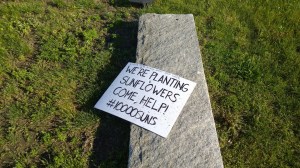
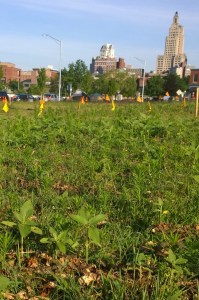
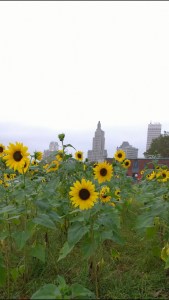
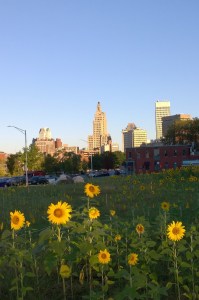
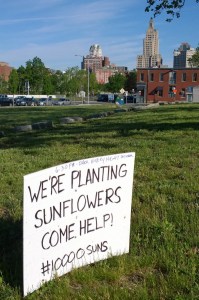
For the longest time, it looked like nothing at all, this art installation of 10,000 sunflowers where route 195 once polluted the soil.

Adam E. Anderson, the brains behind the community-building project, writes on his website, “Ten Thousand Suns is a summer-long botanical performance in which over 10,000 sunflower seeds have been planted and being nurtured over the course of the summer months, on land that until recently sat under a highway, with high compaction, low-organic material, and embedded with toxicity.  …

“Rather than using high maintenance and energy intensive large swaths of turf grass, the installation uses the bio-accumulating (removes toxins) and habitat creating properties of Helioanthus (aka, Sunflower) planted in rows in a series of large circles, leaving paths in-between for intimate exploration.

“The project will create a spontaneous and unique cultural identity for the citizens of Providence and its visitors during the summer months.”

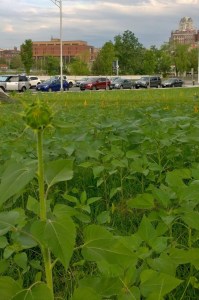
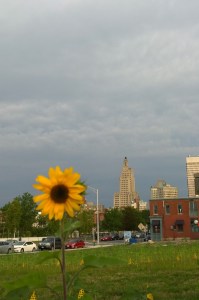
With little rain all summer, the project looked like a hopeless cause for many weeks. Until it didn’t.

In celebration of the cheery results, I want to share a few lines of a poem about a goldfinch loving a sunflower. Because who wouldn’t love a sunflower?

From poet Ross Gay‘s “Wedding Poem”

Friends I am here modestly to report
seeing in an orchard
in my town
a goldfinch kissing
a sunflower
again and again
dangling upside down
by its tiny claws
steadying itself by snapping open
like an old-timey fan
its wings
again and again
until swooning, it tumbled off
and swooped back to the very same perch …

Read more about the project at Adam Anderson’s site, here, and on Facebook, here. Click on my photos to check the dates.

060816-plant-sunflowers-superman-bldg

060816-help-us-plant-sunflowers


071216-sunflower-seedlings

081616-sunflower4


082916-finally-sunflowers

090716-sunflowers-growing


091316-sunflowers-providnece

Read Full Post »

I checked Gwarlingo not long ago to catch up on Michelle Aldredge’s thorough, sensitive meditations on art and literature.

What caught my attention was her review of a movie about restoring an old house in Japan.

“It is rare to find a film that is pitch-perfect in its cinematography, story, pacing, and length,” Aldredge writes, “but Davina Pardo’s short film Minka is such a gem. (I owe writer Craig Mod a thank you for turning me onto this quiet masterpiece.)

“Based on journalist John Roderick’s book Minka: My Farmhouse in Japan, the film is a moving meditation on place, memory, friendship, family, and the meaning of home. Most remarkable, this haunting story plays out in a mere 15 minutes.

“Minka is the Japanese name for the dwellings of 18th-century farmers, merchants, and artisans (i.e., the three non samurai-castes), but as Wikipedia explains, this caste-connotation no longer exists in the modern Japanese language, and any traditional Japanese style residence of an appropriate age could be referred to as minka. The word minka literally means ‘a house of the people.’

“The story of how AP foreign correspondent John Roderick and his adopted Japanese son Yoshihiro Takishita met, and then rescued a massive, timber minka by moving it from the Japanese Alps to the Tokyo suburb of Kamakura is full of small surprises and revelations (the biggest one comes at the end of the film).

“Minka is a film that celebrates stillness. Pardo’s camera lovingly lingers on sun, shadows, and dust. But the peaceful home is not just a restored space full of beautiful, personal objects, it is also an expression of the deep connection between Roderick and Takishita and of familial love.”

Read about that at Gwarlingo, where the filmmaker will let you watch the entire 15-minute movie.

Photo: Davina Pardo & Birdlings LLC
A still from the film
Minka

Read Full Post »

The radio show Living on Earth (LOE) reported recently on work to restore seaweeds that are a key part of the ecosystem.

From the LOE website: “Ripped from the seafloor by strong swells, massive amounts of kelp recently washed ashore in southern California. But the uprooted algae may actually be a sign of successful kelp restoration efforts. Marine biologist Nancy Caruso discusses the fragile ecosystem and how she and a community are helping to rebuild the majestic kelp forests.”

Radio host Steve Curwood interviewed Caruso. She recounts how she began 12 years ago with a group of students and volunteers “to restore the kelp forests off of Orange County’s coast.”

After a storm, she says, big holes get ripped in the forest of kelp, often 10 feet high. Then “new life can grow from the bottom up, and so if we see this happen, which we’re seeing right now, the kelp returns immediately after this event, then we know that our restoration efforts are successful, and after 30 years of our local ecosystem not having healthy kelp forests, we can rest assured that it’s now restored.”

To Curwood’s question about how restoration is done, Caruso answers, “It was actually quite an effort because I had the help of 5,000 students from ages 11 to 18 as well as 250 skilled volunteer divers, and we planted this kelp in 15 different areas in Orange County. There’s a spot down in Dana Point. It’s the only kelp forest that was left in Orange County so we would collect the reproductive blades from those kelp plants, and I would take them into the classrooms for the students to clean them and we would actually stress them out overnight. We would leave them out of water in the refrigerator, kind covered with paper towels, and then the next morning we would put them back in the ice-cold seawater and the kelp blade would release millions of spores” that would then be raised in nurseries and returned to the ocean.

“All those animals that get washed up on the beach inside the wrangled tangled kelp become a food source for shorebirds that live along our coast.”

More from Living on Earth here. For more on the importance of seaweed, see also Derrick Z. Jackson’s article in the Boston Sunday Globe: “Eelgrass Could Save the Planet.”

Photo: NOAA’s National Ocean Service
Kelp forests can be seen along much of the west coast of North America.

Read Full Post »

I liked this story by Penny Schwartz from the Sunday Globe. It’s about the painstaking work of restoring a magnificent synagogue built in the 17th and 18th centuries and destroyed by the Nazis in WW II.

“For the last 10 years, Laura and Rick Brown have been immersed in the art and architecture of Poland’s historic Gwozdziec synagogue. …

“Now, after a decade of research and building small-scale models, the Browns and their international team of 300 carpenters, artists, and students have created a nearly full-scale replica of the the triple-tiered roof and intricately painted ceiling and cupola of the Gwozdziec synagogue, considered one of the most magnificent, well-documented of the wooden synagogues of the era. …

“ ‘They really have done something miraculous,’ said Barbara Kirshenblatt-Gimblett, professor of performance studies at New York University’s Tisch School of the Arts, who was tapped to lead the museum’s exhibit development team. …

“The Browns’ approach to building, using traditional tools and techniques dating back to the time the synagogue was built, offered something beyond having a copy of the synagogue roof built as a prop, Kirshenblatt-Gimblett said. …

“Both sculptors, the Browns came to the Gwozdziec project as founders and directors of Handshouse Studio, an educational nonprofit in Norwell [Massachusetts] that replicates historic objects using authentic methods. …

“Looking back on the journey, Laura and Rick say they are humbled by the hundreds of people, including many MassArt students and graduates, who have given so much time to this project.

“They are grateful to MassArt for allowing them the flexibility to create courses designed for the project including a series of Lost Historic Paintings’ classes analyzing and replicating quarter-scale, then half-scale models of the Gwozdziec synagogue ceiling panels.

“The 85 percent scale replica represents more than the grandeur of a long ago synagogue, Laura said. ‘This object speaks to a very painful history that is still very alive,’ she said.” More.

Photo: Jonathan Wiggs/Globe Staff
Artist Rick and Laura Brown at their studio in Hanover, Massachusetts.

Read Full Post »

I’m happy to see some long-neglected murals being restored in Harlem. Robin Pogrebin has the story in the NY Times:

“When the Works Progress Administration [WPA] commissioned murals for Harlem Hospital Center in 1936, it easily approved the sketches submitted by seven artists, which depicted black people at work and at play throughout history. The hospital, however, objected, saying four of the sketches focused too much on ‘Negro’ subject matter … .

“Protesters rallied around the art, though, lodging complaints as high as President Franklin D. Roosevelt, and the murals ultimately prevailed.

“Over the years, those wall paintings deteriorated or were obscured by plaster. Now they have been restored and brought front and center as part of a new, $325 million patient pavilion for the hospital, on Lenox Avenue at 135th Street that will be unveiled on Sept. 27. …

“The artists — the last of whom, Georgette Seabrooke, died last year — were not well known and their murals portrayed ordinary people going about their daily lives. Vertis Hayes’s ‘Pursuit of Happiness’ panel traces the African diaspora from 18th-century African village life to slavery in America to 20th-century freedom; from agrarian struggles in the South to professional success in the industrialized North.” More.

The WPA cost money, but it put a lot of people to work. And look at all the great things that were created! I especially love the idea that unemployed people were paid to paint murals, write and produce plays, interview ordinary Americans for the National Archives, and record folk music. I know it was a stressful time, but thinking about the art makes me almost nostalgic.


Photograph: Karsten Moran for The New York Times
Elizabeth Kolligs works on restoring Vertis Hayes’s “Pursuit of Happiness” at Harlem Hospital.


Read Full Post »

« Newer Posts