Feeds:
Posts
Comments

Posts Tagged ‘russia’

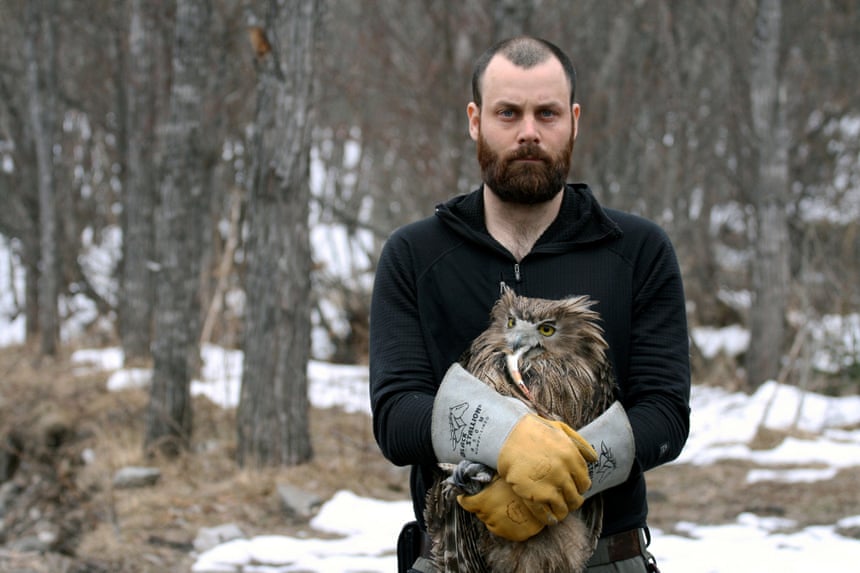
Jeremy Hance has an article at the Guardian on the quest to save from human encroachment a huge — and largely unknown — raptor: Blakiston’s fish owl.

“It’s not easy studying an endangered species few people have ever heard of,” says Hance. “It’s difficult to raise money, build awareness, or quite simply get people to care. But still, Jonathan Slaght – one of the world’s only experts on the massive, salmon-eating, frog-devouring Blakiston’s fish owl – insisted there are upsides. …

“Blakiston’s fish owl is the world’s largest [owl], and in the Russian forests, where Slaght conducts his research, it cohabits with a lot of big names: the Ussuri brown bear, the Amur leopard, the Asiatic black bear and, of course, the grand-daddy of them all, the ever-popular Amur Tiger. …

“Slaght is a project manager with the Wildlife Conservation Society and a co-founder of the Blakiston’s Fish Owl Project along with Russian ornithologist, Sergei Surmach. But his first run-in with a Blakiston’s came in 2001 when he was a Peace Corps volunteer in Russia. At the time, all he knew about the species was from a tattered bird book more than 40 years old, including an ‘inaccurate, terrible illustration of Blakiston’s fish owl. …

“Although an avid birder, Slaght never expected to actually see one of these things. He was told the owl was so rare that even seasoned ornithologists rarely saw it. Yet one day, hiking in the forest with a friend, he had an encounter that changed the course of his life.

“ ‘Something enormous flies away from us and lands close by and it’s just this big owl.’

“He assumed it was a Eurasian eagle owl – which can be found across the entirety of Eurasia, from the coast of Spain to that of Primorye – but took a few photos just in case.

“ ‘My brain wouldn’t believe it was this mythical thing.’ …

“A few weeks later, though, Slaght gets his pictures developed and takes them to a local ornithologist.

“ ‘He says: “don’t show anyone this picture; this is a Blakiston’s fish owl.” ‘

“Slaght … has become one of the foremost experts on the great owls and continues to find them where people thought them vanished.”

Read about other places this rare bird is found (including Hokkaido, where it was once considered a god), here.

Photo: Jonathan C. Slaght/WCS Russia  
Jonathan Slaght holds a Blakiston’s fish owl in his arms. He is one of a handful of researchers studying this massive raptor, which is threatened by human activity.

Read Full Post »

When I think of Russia and the words “big brother” together, I don’t ordinarily picture the charitable organization that partners adults with kids who need role models. Roman Sklotskiy has altered my mental model.

Last month, Diana Kultchitskaya interviewed Sklotskiy for the Christian Science Monitor.

“Roman Sklotskiy, a former businessman and a graduate of the Moscow State Institute of International Relations, didn’t dream of having a career in charity. In the early 2000s he was a pioneer in the telecommunications industry, testing applications for mobile networks.

“But then he was invited by a friend to be the administrator of a theater for deaf actors – a charity project launched by a group of professional actors and directors. He was so inspired by the experience that he decided to pursue charitable work.

“In 2007 he learned of a nonprofit group trying to bring a United States-based mentoring program to Russia. Big Brothers Big Sisters International is a volunteer program that helps orphans and children from troubled families find mentors who provide them with a role model and help them build a healthy relationship with an adult.

“In Russia this kind of volunteering was a new idea. Mr. Sklotskiy decided to join the Big Brothers Big Sisters of Russia team and became its director, spending six years developing it. …

“The selection process for people who would like to participate in Russia’s Big Brothers Big Sisters program is strict. … Those who are selected receive training. Psychologists work with them and explain the unique demands of communicating with an orphan. …

“Alexandr Gezalov, an expert on child adoption and orphanages, says that the project is very successful.

“ ‘I’ve never seen a more effective format for communicating with an orphaned child,’ Mr. Gezalov says. The success of Big Brothers Big Sisters should be shared with other organizations, he says.

“Today Sklotskiy serves as director of charitable programs at the RVVZ Foundation. But he’s stayed involved in Big Brothers Big Sisters as chairman of the board. And he thinks it still has great potential to grow and help even more children. Currently Big Brothers Big Sisters is operating in Moscow and St. Petersburg.”

More here.

Photo: Svetlana Balashova for the Christian Science Monitor
Roman Sklotskiy longed to do charitable work, and he found his calling in developing Big Brothers Big Sisters of Russia.

Read Full Post »

My husband passed along word of a TV special on an ecologist interested in the Siberian tiger who joins forces with a remarkable Korean filmmaker.

From the Public Broadcasting website: “Hunted almost to extinction, the last wild Siberian tigers can only be found in the forests of the far eastern Russian frontier—but not easily.

“Ecologist Chris Morgan embarks on a challenge that will fulfill a lifelong dream — to find and film a Siberian tiger living wild and free in these forests. To help him, Morgan turns to Korean filmmaker Sooyong Park, the first individual ever to film Siberian tigers in the wild.

“Park spent more than five years watching and waiting for a glimpse of the elusive creatures, confined sometimes for months in tiny underground pits or 15-foot hides in trees. His technique was unconventional, but produced more than a thousand hours of wild tiger footage that told the story of a three-generation tiger dynasty.

“During their time together, Park teaches Morgan the secrets of tracking tigers—where to look and what to look for in these vast, seemingly uninhabited frozen forests. Eventually, Morgan’s mentor and guide leaves him to his own private quest, and it is up to Morgan to follow the tracks and markings of these giant cats, searching out spots where tigers are prone to hunt, setting up cameras he hopes will also capture a precious image of a wild Siberian tiger.

It must take courage to do pursue these creatures. The local bears are so afraid of Siberian tigers that they hibernate in nests up in trees.

More.

Read Full Post »

A political analyst from Russia who has lived in the U.S. off and on for 20 years has written a book for Russians thinking of living in America, and it’s a knockout hit. It turns out that even Russians who are not planning to go to the U.S. find our culture deeply puzzling and want to learn more.

Reading about Nikolai Zlobin’s book in the NY Times is helping me understand how differently Russians see some everyday things. Live in a cul-de-sac with few neighbors? That’s a dead end. Very dangerous! Leave curtains open at night, and let people see what you’re up to? No way!

“In Russia,” adds Ellen Barry, “children are raised by their grandmothers, or, if their grandmothers are not available, by women of the same generation in a similar state of unremitting vigilance against the hazards — like weather — that arise in everyday life. An average Russian mother would no sooner entrust her children’s upbringing to a local teenager than to a pack of wild dogs.

“But of course much in everyday American life sounds bizarre to Russians, as Mr. Zlobin documents meticulously in his 400-page book, ‘America — What a Life!’

“It seems strange, 20 years after the fall of the Iron Curtain, that ordinary Russians would still be hungry for details about how ordinary Americans eat and pay mortgages. But to Mr. Zlobin’s surprise, his book — published this year and marketed as a guide to Russians considering a move abroad — is already in its fifth print run, and his publisher has commissioned a second volume.” Read more here.

Photograph: James Hill for the NY Times
Nikolai Zlobin, the political analyst and author, in central Moscow near the Kremlin.

Read Full Post »

You might be interested in this article about how Dayton, Ohio, is welcoming immigrants as part of its effort to spur economic growth.

Dylan Scott at Governing magazine writes, “In contrast to some states’ anti-immigration policies, a few cities are actively trying to attract immigrants to boost their own economies. …

“City officials estimate that 10 percent of the Ahiska Turks in the United States have established themselves here in Dayton. But they aren’t alone. There are also immigrants from Mexico, Vietnam, Samoa and elsewhere.

“Watching some of these residents’ difficulty in adjusting to their new surroundings — some encountering language barriers and others struggling to secure housing — convinced city officials they needed to do more to help.

“Dayton’s Human Relations Council, a city department that investigates discrimination complaints, started in 2010 by initiating a study into allegations from Hispanic residents regarding housing discrimination. Around the same time, City Manager Tim Riordan and City Commissioner Matt Joseph resolved to make public services more accessible for those who spoke English as a second language.

“It didn’t take long for Dayton’s leaders to figure out that incremental steps wouldn’t do, that the immigration issue needed a comprehensive solution and the involvement of the entire community.

” ‘It requires a huge partnership. There are only so many things we can do as the city,’ Joseph says. ‘And the big thing is an attitude change. We have to make sure we’re encouraging people to be more welcoming and that the incentives are running the right way. That’s our role.’ …

“Dayton officials seized on a growing academic consensus that embracing immigrants is beneficial to the country as a whole and specifically the economy. A June 2011 Brookings Institution report concluded: ‘U.S. global competitiveness rests on the ability of immigrants and their children to thrive economically and to contribute to the nation’s productivity.’ The U.S. Chamber of Commerce wrote last year that research shows ‘immigrants significantly benefit the U.S. economy.’ ” Read more.

Photograph: Tim Witmer
Sarvar Ispahi, his son Uzeir and their family moved to the United States from Russia in 2005 after Ahiska Turks were granted refugee status by the federal government. They chose Dayton because a refugee community was already forming there.

Read Full Post »

You may recall that six grandmothers from the former Soviet Union competed in Eurovision. We blogged about them here. Loreen from Sweden won first prize, but the babushki came in second.

In a follow-up story in the NY Times, Andrew Kramer writes that the grandmas’ fame is bringing a modicum of prosperity to their forgotten village. In particular, it is rebuilding the church that Stalin destroyed and that they loved in secret. They chose to spend their winnings on the church.

“For years, Buranovo was a dying village, one of many in the Russian countryside left behind by an oil-driven boom that revitalized drab Soviet cities and drew the young away from the farms that had sustained their parents. …

“Now, the women’s good fortune is transforming not only their lives, but also Buranovo. In appreciation of the group’s near victory, the local government is building a water pipeline, installing streetlights and high-speed Internet for the village’s sole school and laying new gravel on the main roads. …

“It all began with a miracle, said Olga N. Tuktareva, the leader of the singing group …. Ms. Tuktareva recalled strolling about the village with a friend in 2008 and lamenting a sad episode in local history: the destruction of the Church of the Trinity, taken down like countless other churches in Stalin’s Russia. …

“During that walk, Ms. Tuktareva recalled, her cellphone rang. It was a music producer in Moscow who had heard of the singing babushki …”

Read more.

Photograph: Oleg Nikishin

Read Full Post »

Your blogger is one grandma all excited about having some baby time this weekend.

But in Azerbaijan, six grandmas from Russia are competing in a pop-music contest.

“Eurovision 2012 is under way, and about half a billion viewers are expected to tune in for the finale on Saturday. …

“The song contest started in the 1950s, and each country competing is represented by a single singing group or soloist. Because Azerbaijan won last year, Eurovision is being staged in its capital, Baku. …

“Representing Russia this year is a group of six grandmothers. Their song, ‘Party for Everybody,’ tells the story of the babushkas welcoming their grandchildren home. ‘This song itself is kind of appalling, but Eurovision isn’t about the best song,’ [says William Lee Adams, editor-in-chief of Wiwibloggs]. ‘It’s about the best act. And this one comes with attitude and spunk and spirit, and the belief that you can keep on moving no matter how old you are.’ ” Amen to that.

Read more at NPR, and watch the videos. If you catch what language the babushkas speak, please let me know. It is not actually Russian but a minority language.

Read Full Post »

As readers know, I really believe that “one and one and 50 make a million” (a concept articulated by folksinger Pete Seeger). That’s why I can’t resist a recent story from Moscow, where a few writers decided to have a “stroll,” and 10,000 individuals individually decided to follow.

Ellen Barry writes in the NY Times: “It was only four days ago when 12 prominent authors, disturbed by the crackdown on dissent that accompanied President Vladimir V. Putin’s inauguration, announced an experiment. They called it a ‘test stroll’ …

“No one knew quite what to expect on Sunday. But when the 12 writers left Pushkin Square at lunchtime, they were trailed by a crowd that swelled to an estimated 10,000 people, stopping traffic and filling boulevards for 1.2 miles. …  The police did not interfere, although the organizers had not received a permit to march.

“ ‘We see by the number of people that literature still has authority in our society because no one called these people — they came themselves,’ said Lev Rubinstein, 65, a poet and one of the organizers. ‘We thought this would be a modest stroll of several literary colleagues, and this is what happened. You can see it yourself. … I don’t know how this will all end, but I can say that no one will forget it.’ ” Read more.

I can’t help thinking that one and one and 50 have been growing for a long time in Russia and that the 10,000 who joined the march are just the tip of he iceberg.

Photograph: Dmitry Kostyukov for The New York Times

Read Full Post »

« Newer Posts