Feeds:
Posts
Comments

Posts Tagged ‘science’

The New York Times Science section had a cute piece in January about surprising friendships among different species of animals. Perhaps you saw it.

Erica Goode reported, “Videos of unlikely animal pairs romping or snuggling have become so common that they are piquing the interest of some scientists, who say they invite more systematic study. Among other things, researchers say, the alliances could add to an understanding of how species communicate, what propels certain animals to connect across species lines and the degree to which some animals can adopt the behaviors of other species.

” ‘There’s no question that studying these relationships can give you some insight into the factors that go into normal relationships,’ said Gordon Burghardt, a professor in the departments of psychology and ecology and evolutionary biology at the University of Tennessee, who added that one video he liked to show students was of a small and persistent tortoise tussling over a ball with a Jack Russell terrier. …

“Until recently, any suggestion that interspecies relationships might be based simply on companionship would probably have been met with derision, dismissed as Pixar-like anthropomorphism. That has changed as research has gradually eroded some boundaries between homo sapiens and other animals. Other species, it turns out, share abilities once considered exclusive to humans, including some emotions, tool use, counting, certain aspects of language and even a moral sense. …

Barbara J. King, an anthropologist at the College of William and Mary, said that she hoped researchers would begin to collect examples of cross-species interactions to build a database that would merit scientific scrutiny. ‘I think we’re not even at the point of being able to extract patterns because the database is so small,’ she said, adding that the topic could also benefit from a rigorous definition of what constitutes a ‘friendship’ between members of different species.” More here.

Photo: Noah’s Ark Animal Sanctuary by way of Africa Geographic.

Read Full Post »

As an icebreaker at lunch Monday, a colleague asked us all to go around the table and name a New Year’s resolution. I said I was going to emulate the phone-reading guy in the comic who tells his friend, “Yes, I just got a text, but I think there’s also a subtext.”

I meant that I want to go beneath the surface of things, to listen to what people are really saying. You know how you can sharpen your skills in that department? Read fiction.

That’s according to an Emory University study written up at MicGabe Bergado has the story. “It’s not news that reading has countless benefits: Poetry stimulates parts of the brain linked to memory and sparks self-reflection … But readers of fiction? They’re a special breed.

“The study: A 2013 Emory University study looked at the brains of fiction readers. [Neuroscientist Gregory Berns and coauthors] compared the brains of people after they read to the brains of people who didn’t read. The brains of the readers — they read Robert Harris’ Pompeii over a nine-day period at night — showed more activity in certain areas than those who didn’t read.

“Specifically, researchers found heightened connectivity in the left temporal cortex, part of the brain typically associated with understanding language. The researchers also found increased connectivity in the central sulcus of the brain, the primary sensory region, which helps the brain visualize movement. When you visualize yourself scoring a touchdown while playing football, you can actually somewhat feel yourself in the action. A similar process happens when you envision yourself as a character in a book: You can take on the emotions they are feeling. …

“Need more proof? Psychologists David Comer Kidd and Emanuele Castano at the New School for Social Research focused on the effect of literary fiction, rather than popular fiction, on readers.  For the experiment, participants either read a piece of literary fiction or popular fiction, followed by identifying facial emotions solely through the eyes. Those who read literary fiction scored consistently higher, by about 10%.

” ‘We believe that one critical difference between lit and pop fiction is the extent to which the characters are complex, ambiguous, difficult to get to know, etc. (in other words, human) versus stereotyped, simple,’ Castano wrote to Mic.” More here.

Thank you, Claire, for sending this. You know what I like.

WP_20141231_17_28_21_Pro

Read Full Post »

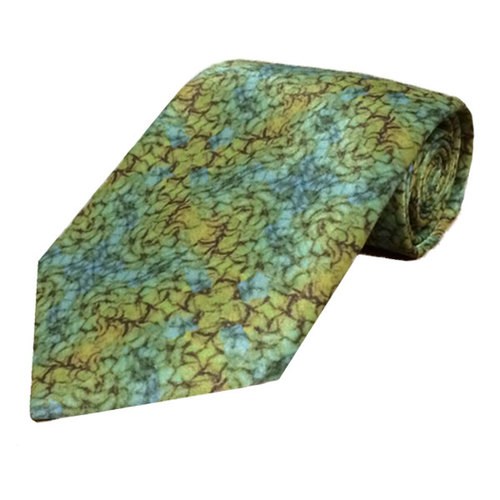
If you are a scientist who wears ties, or if you know one, consider designing your own at Vermont-based Cerebella. Past design ideas have resulted in frog-skin, moon-jellyfish, pollen-tetrad, and obelia (a tiny marine animal) neckties.

At Cerebella’s blog, Lucy Partman wrote on October 13 about how she ended up Chief Curator for the company.

“I grew up in New York City … going to museums— and I mean a lot of museums —especially the Met. … My parents … are designers and own a clothing store in Manhattan so dinner table discussions often involved fabric prints, shirt designs, sizes, quantities, and window displays …

“At LaGuardia High School of Music & Art and Performing Arts … I went from biology to painting, from art history to calculus.

“At Yale, I tried to continue this interdisciplinary education. I majored in both history of art and biology and constantly sought to intertwine these interests, passions. For example, I worked with conservators — who work in a hybrid art studio and science lab — at the Yale Center for British Art to conserve paintings …

“I founded an organization at the Slifka Center called Slifka Arts to provide students the opportunity to curate and exhibit student art. … Shortly after the opening of an exhibit I curated at the Slifka Center called Only in a Woman: Microscopic Images by Harvey Kliman, MD, PhD — which will soon be exhibited at Brown Medical School — Ariele [Faber, Cerebella founder,] contacted me regarding the exhibit and Cerebella. Our conversation has continued ever since.” More here.

Photo: Cerebella
Frog-skin Necktie. Each Cerebella textile pattern is designed by finding inspiration under the microscope.

Read Full Post »

No matter how bad things get in the great world, there will always be someone who starts a quirky, individualistic project just for the love of it, reassuring us all.

In Providence recently, a few folks got together to resurrect an abandoned natural history museum partly to see what an early museum looked like, partly because it was a shame to throw it all out.

In the NY Times, Henry Founatain wrote,  “If museums are meant to preserve objects forever, then forever ended here in 1945.

“That year, Brown University’s natural history museum, which included multitudes of animal skeletons and specimens among its 50,000 items, as well as anthropological curiosities like rope made from human hair, was thrown away.

“It was a sad end to what had been a labor of love for John Whipple Potter Jenks, a Brown alumnus, taxidermist and naturalist who founded the teaching museum in 1871.

“But Jenks had died in 1894 — on the steps of the museum, no less — and what by then was known as the Jenks Museum fell into disarray. It was shuttered in 1915, and the objects were scattered or stored until most of them were hauled, in 92 truckloads, to a nearby dump in 1945.

“But now the Jenks Museum lives again, at least temporarily, in an exhibition that is as much about art as it is about science.

“A group of Brown graduate students, with help from a faculty adviser and a New York artist, has rounded up a few surviving odds and ends, commissioned artists to recreate some of the vanished objects, and installed it all in Rhode Island Hall, the home of the original museum. The exhibition, which also includes a recreation of Jenks’s office as it might have looked in the year of his death, will be on display until spring.” Read more here.

The Lost Museum will be on display in Rhode Island Hall on the Brown University campus, 60 George Street, the Jenks Museum’s original home, through May 2015.

Photo: Mike Cohea/Brown University
The office of John Whipple Potter Jenks, who founded the natural history museum at Brown University, was recreated for an exhibition called Lost Museum.

Read Full Post »

Fireflies are not as ubiquitous as they used to be, and that’s a concern. They are like the canary in the mine. If fireflies go, other species go.

What has caused the decline? Lawn chemicals? Rapid urbanization? Scientists want to know.

NY Times reporter Alan Bllinder writes from Greenville, South Carolina, about a crowdsourced research project to help figure out what’s going on.

“As dusk faded over the home of Jeremy Lyons and his sons on a recent evening here, one ritual of the Southern summer — the soft hiss of a can of mosquito repellent — signaled that the start of another was near.

“And although Raine Lyons, 6, grimaced, coughed and flinched during his dousing with bug spray, he soon stood near a chain-link fence in his backyard and shouted, in speedy succession: ‘Found one! Found one! Found one!’ Mr. Lyons, perched on his knee next to Raine, was almost completely silent as he tapped the screen of his cellphone again and again and again.

“There, on a weeknight in a South Carolina backyard, a father and his son, in their different ways, were counting fireflies. But an evening among fireflies was not merely a modest round of summertime nostalgia; instead, it was part of a multiyear quest by Clemson University researchers to measure the firefly population and investigate whether urbanization, especially here in the fast-growing South, threatens the insects.” Read how they are going about it here.

I hope we can reverse the decline of fireflies. I have so many happy memories of them from my childhood and my children’s childhood.

Photo: Jacob Biba for The New York Times
Raine Lyons counting fireflies alongside his father, Jeremy, in Greenville, S.C., as volunteers in the Vanishing Firefly Project of Clemson University.

Read Full Post »

I’ve put off writing about sprites because I’m not sure I can explain what they are  — powerful upward lightning flashes that send electricity around the earth and were originally going to be photographed by an astronaut on the ill-fated Columbia.

A team of scientists and a few daredevil pilots flew repeatedly into storms to prove the visions were real. The television show Nova covered the quest.

“NARRATOR: On a stormy night, in Denver, a team of scientists takes to the air to investigate a mystery.

“RONALD WILLIAMS (United States Air Force): I reported it, and nobody believed me.

“NARRATOR: They’re trying to catch a burst of energy so fleeting and hard to see that scientists call it by the ethereal name of ‘sprite.’

“EARLE WILLIAMS (Massachusetts Institute of Technology): The bolts that cause sprites are superbolts, the kind of lightning that’ll blow your T.V. sky high. …

“KERRI CAHOY (Massachusetts Institute of Technology): You can see airglow that’s more diffuse and just in layers than the curtain-like aurora.

“NARRATOR: NOVA takes to the air, on a quest to record these elusive events.

“GEOFF MCHARG (United States Air Force Academy): Sprite!

“NARRATOR: And the effort also continues above, from the vantage point of space, where the work had it’s beginning during the ill-fated Columbia mission, with Israeli astronaut Ilon Ramon.

“YOAV YAIR (The Open University of Israel): I asked him, ‘Please bring me one sprite image.’ He said, ‘Don’t worry, I’ll get you a couple.’

“NARRATOR: Ramon’s colleagues now continue where he left off.

“SATOSHI FURUKAWA (Japanese Astronaut): We must take over their work. I thought that was the survivors’ duty.

“NARRATOR: Their dramatic discoveries are revealing that we live on an electrified planet, surrounded by a global circuit that rings the earth. And like a planetary heartbeat, we can now detect it.”

More here.

 Image: Nova

Read Full Post »

My friend Jean Devine is always up to something interesting. A Brown U grad, with an MBA from Simmons, she used to work in investor relations but in recent years has been testing the waters of social entrepreneurship.

Her latest initiative, with Barbara Passero of Sandpiper Creative, is called meadowscaping and is intriguing on many levels.

With access to a Waltham church lawn for a summer youth program, Jean and Barbara will work with kids to convert the yard into a meadow that uses native species from Garden in the Woods and provides a habitat to the bugs and other small creatures that make a healthy environment.

From the Meadowscaping for Biodiversity website: Meadowscaping “is an outdoor, project-based, environmental education program that provides middle school youth with real-world experiences in STEAM learning (Science, Technology, Engineering, Arts and Math), while inspiring and empowering them to address challenges to the environment and our society.

“Today, few children spend time experiencing Nature and the benefits of outdoor recreation, education, and contemplation. Founder and former Director of the Children and Nature Network (C& NN) Richard Louv coined the phrase nature-deficit disorder to describe the negative effects of reduced outdoor time on children’s development. …

“Children who spend little time outdoors may value nature less than children who spend time outdoors in free play. Similarly, children who feel part of something bigger than themselves may … understand their dependence on a clean environment and know that they are responsible for caring for the Earth as their home.” More here.

The idea behind the meadowscaping summer program is that children, both at a young age and as they become adults, can actually do something about the environment.

Remember our post “The Doctor Is In” about the woman who sets up in a Providence park to listen to your worries about global warming (here)? Stop worrying and do something, say the meadowscape entrepreneurs. Give up lawn chemicals, plant a meadow, provide a home for tiny necessary critters, and work to make change.

white-iris-in-morning

Read Full Post »

Gregg tweeted recently about Robinson Meyer’s Atlantic article on 92-year-old metallurgist Ursula Franklin.

Meyer writes, “It’s hard to describe what Ursula Franklin’s done in her life. There’s just too much.

“The 92-year-old metallurgist pioneered the field of archeometry, the science of dating archaeologically discovered bronzes, metals, and ceramics. Her research into spiking levels of radioactive strontium in baby teeth factored heavily into the U.S. government’s decision to institute a nuclear test ban.

“She delivered the Massey Lectures—an important, annual series of talks delivered by Canadian public intellectuals—in 1989, and she was the first woman to be named University Professor at the University of Toronto, the university’s highest position.

“She was also born in Munich in 1921, and was imprisoned in a Nazi work camp for the last 18 months of the war.”

Meyers’s questions cover much of Franklin’s life, her pacifism, and her trail-blazing for women scientists. It’s a long interview. Here’s a taste.

“Once you were at the University of Toronto … did you see the university change over your time there, and just generally what was it like to be a female professor of engineering during the ’70s and ’80s?”

Franklin answers, “Well, pretty lonely. You know the real difficulty is to protect and advance your women students, and to see that they are in a hassle-free learning environment. When I came to the university, I’d been around long enough to know that I wasn’t one of the gang, and I never would be. I didn’t have a desire to be one of the boys.

“But the great wish—to give my women students a hassle-free, happy learning environment—that’s what’s difficult. The culture of engineering is not a culture of acceptance and understanding of anything that is female and—at the same time—equal. So that’s… that’s a real job. It was a long and hard [work] in this, and it’s by no means yet all done.”

I remember the fuss over strontium 90 in milk. How great to read about this woman ‘s role in uncovering the problem and to see that she is going strong at 92. More at the Atlantic.

Ursula Franklin  photo

Read Full Post »

If you happen to be in the jungle with nothing but paper, a ball lens, a button battery, an LED, a switch, 3 cents worth of copper tape, and a need to see if there is E. coli in the drinking water, you’re in luck! You can make your own microscope.

Writes Keith Hartnett at the Boston Globe, “In recent years there’s been a trend in international development work towards building low-cost versions of key tools for widespread dissemination—inexpensive computers that let Indonesian fisherman check the weather before they go out to sea, or clean-burning stoves that replace coal and improve air quality in family huts.

“Now a laboratory at Stanford University has introduced a microscope that’s made of paper, assembled using principles of origami, and costs less than $1 to manufacture. It’s called Foldscope. …

“Despite the simple construction, Foldscope is a capable tool of real science. Users can adjust the focus using paper tabs, and the engineering team, led by bioengineer Manu Prakash and funded in part by the Gates Foundation, explained in a paper [PDF] that Foldscope ‘can provide over 2,000X magnification with submicron resolution.’ ” More. Hat tip to MIT Technology Review.

I wonder if I could get a gig folding paper at John’s Optics for Hire. I just made an origami fortune-teller for John’s son on Saturday, after all.


Read Full Post »

OLYMPUS DIGITAL CAMERAYou never know what you’ll find at Andrew Sullivan’s blog.

Today he notes research on the memory of toddlers. A new study has demonstrated that three-year-olds have memories of  seeing someone once, back when they were one.

Danish researcher Osman “Kingo and his team first renewed contact with parents and their children who’d taken part in an earlier study when the children were age one. That earlier research involved the infant children interacting with one of two researchers for 45 minutes – either a Scandinavian-Caucasian man or a Scandinavian-African man.

“Now two years on, 50 of these parents and children – the latter now aged three – were invited back to the exact same lab (hopefully cueing their earlier memories). Here the children were shown two simultaneous 45-second videos side by side. One video was a recording of the researcher – either the Scandinavian-Caucasian or Scandinavian-African man – interacting with them two years earlier; the other video showed the other researcher (the one they hadn’t met) interacting with a different child in the exact same way. …

“The children spent significantly more time looking at the video that featured the researcher they’d never met. … This result provides strong evidence that the children had some recognition of the researcher they’d met, and were drawn more strongly to look at the unfamiliar researcher.”

More at Andrew Sullivan, here, and at Research Digest at the British Psychological Society, here.

I am especially delighted that there’s a bit of proof for what I have long insisted was true. (No one ever believes that I remember taking my first steps.)

Read Full Post »

National Public Radio recently featured a researcher who has figured out a way to help people who can’t talk by matching the sounds they are able to make to someone else’s voice and creating a synthetic voice.

“Speech scientist Rupal Patel creates customized synthetic voices that enable people who can’t speak to communicate in a unique voice that embodies their personality.

“Rupal Patel directs the Communication Analysis and Design Laboratory at Northeastern University. She helped found VocaliD, an organization working to help the millions of people who use computerized devices to communicate in unique voices.

“Patel’s technique to move beyond the usual generic male voice. She samples the tones of those with severe speech disorders and matches them with a surrogate talker. By blending the two, the team can create a synthetic voice to match the person using it.”

Check out the NPR story here.

Read Full Post »

Carolyn Johnson’s science column in the Boston Globe yesterday had a funny bit about the blog, LOLmythesis, “a tongue-in-cheek celebration of the futility and incrementalism that can seem to be at the root of a project that has basically co-opted a person’s life.” She means science projects.

“Harvard senior Angie Frankel told the origin story of LOLmythesis on National Public Radio,” writes Johnson, “explaining that ‘I have killed so many fish’ sometimes just feels much more accurate than the true title of her thesis, “Characterizing the Role of [A Specific Gene] in Second Heart Field Progenitor Cells — A Close Look at Zebrafish Embryonic Cardiogenesis.”

There are other funny thesis titles at LOLmythesis from universities around the world. Here are a few.

“Rocks that are next to each other in Massachusetts now were also next to each other 400 million years ago.” — Geology, Amherst College

“A newly discovered worm protein does the same thing as a more well-known worm protein.” — Biology, MIT

“People reach faster and straighter to [take] pictures of cake than pictures of vegetables.” — Cognitive Neuroscience, Brown University

“Turns out my 3 years of research made zero ripples in reproductive biology. But spending 3 years researching bull sperm serves as a great first date and bar topic.” — Reproductive Biology & Nutritional Sciences, Cornell University

Read more here. And how about sending me your own? I remember making up silly titles for possible papers when I was in college, but the funnier part of my fake title “Soap Imagery in ‘Troilus and Cressida’ ” was that someone actually thought it could make a good paper.

Photo: DoctorMacro.com
Pick a thesis title for this research. How about “People from similar backgrounds tend to be wary on first acquaintance.”

Read Full Post »

The NY Times contains a Science section on Tuesdays, and it always has delightful tidbits. Today Sindya N. Bhanoo writes that if you had music lessons at a young age, the experience may benefit you in old age.

“A new study reports that older adults who took lessons at a young age can process the sounds of speech faster than those who did not.

“ ‘It didn’t matter what instrument you played, it just mattered that you played,’ said Nina Kraus, a neuroscientist at Northwestern University and an author of the study, which appears in The Journal of Neuroscience.

“She and her collaborators looked at 44 healthy adults ages 55 to 76, measuring electrical activity in a region of the brain that processes sound.

“They found that participants who had four to 14 years of musical training had faster responses to speech sounds than participants without any training — even though no one in the first group had played an instrument for about 40 years.” More here.

Now, of course, I am looking back and trying to count how many years of piano lessons I had as a kid. I’m sure it was at least the four Kraus deems necessary. But I hardly ever practiced, so probably the effect was small.

The serious pianist below was sitting on my lap when the picture was taken in 2011.

at-the-piano

Read Full Post »

The concrete that the ancient Romans created is so durable that it may hold lessons for those who want to reduce carbon emissions.

Paul Preuss, from the Lawrence Berkeley National Laboratory, explains.

“The chemical secrets of a concrete Roman breakwater that has spent the last 2,000 years submerged in the Mediterranean Sea have been uncovered by an international team of researchers led by Paulo Monteiro of the U.S. Department of Energy’s Lawrence Berkeley National Laboratory (Berkeley Lab), a professor of civil and environmental engineering at the University of California, Berkeley.

“Analysis of samples provided by team member Marie Jackson pinpointed why the best Roman concrete was superior to most modern concrete in durability, why its manufacture was less environmentally damaging – and how these improvements could be adopted in the modern world.

“ ‘It’s not that modern concrete isn’t good – it’s so good we use 19 billion tons of it a year,’ says Monteiro. ‘The problem is that manufacturing Portland cement accounts for seven percent of the carbon dioxide that industry puts into the air.’ …

“The Romans made concrete by mixing lime and volcanic rock. For underwater structures, lime and volcanic ash were mixed to form mortar, and this mortar and volcanic tuff were packed into wooden forms. The seawater instantly triggered a hot chemical reaction. The lime was hydrated – incorporating water molecules into its structure – and reacted with the ash to cement the whole mixture together.”

Apparently the key ingredients are found all over the world, enough to make a big difference in construction — and carbon emissions.

There’s more at the Berkeley Lab site for readers who can follow a technical explanation.

Photo: Berkeley Lab

Read Full Post »

“How did the turtle get its shell?” asks Carolyn Y. Johnson in the Globe.

“A group of scientists at Yale University and the Smithsonian Institution argue that a reptile fossil that has been gathering dust in museum collections is actually a turtle ancestor, and that its reduced number of ribs, distribution of muscles, and T-shaped ribs could help settle the question once and for all.

“In a paper published Thursday in the journal Current Biology, they unveil the argument that a 260 million-year-old creature called Eunotosaurus africanus was a turtle ancestor, hoping to help resolve a debate that has split the scientific community for decades. …

“The ink spilled so far has roughly divided the scientific community in two camps. On one side are those who believe that the turtle shell came about as external bony scales, similar to the ones found on armadillos or certain lizards, that eventually fused together with the reptile’s internal rib cage. On the other side are those who believe that reptiles’ ribs instead began to broaden until they eventually formed the bony protrusion that is the shell, mirroring the way that turtles develop in the egg.”

Which theory does the 260-million-year-old Eunotosaurus support? Read up.

“ ‘The results are pretty convincing; previously I was skeptical as to whether Eunotosaurus was a likely relative of turtles,’ [Kenneth Angielczyk, a paleobiologist from the Field Museum in Chicago], wrote in an e-mail. ‘But Tyler [Lyson]’s results make me think it is a plausible idea.’  ”

Scientists clearly have a lot of fun, but let me try a more Kipling-esque approach to the turtle question.

When the world was new, Oh, Best Beloved, the Turtle was a small, soft creature who played all day with other small, soft turtles on the banks of the great gray greasy Limpopo River all set about with Giant Eucalyptus Trees. He was timid. He was shy. He kept his distance from the great beasts of the jungle. But he was watchful, too, and he learned from what he saw. And so it happened, Oh, Best Beloved, that at the very day, hour, and minute that the Giant Python Rock Snake stretched out the stumpy nose of the Elephant’s Child, the Turtle felt a great fear come upon him. And he ran and rolled himself in the grease of the greasy Limpopo River all set about with Giant Eucalyptus Trees, raced to the most gigantic of the Giant Eucalyptus Trees, embedded his sticky self in the most gigantic of the Giant Eucalyptus Trees seeds, and there remained.

When he felt brave enough to stick his head out, he reported to all the small, soft turtles what he had seen. And thus the world gained not only a Turtle with a Shell, but the very first embedded reporter.

Photo: Luke Norton
This South African sideneck turtle bears a structural resemblance to the fossil of a creature called Eunotosaurus africanus.

Read Full Post »

« Newer Posts - Older Posts »