Feeds:
Posts
Comments

Posts Tagged ‘sesame street’

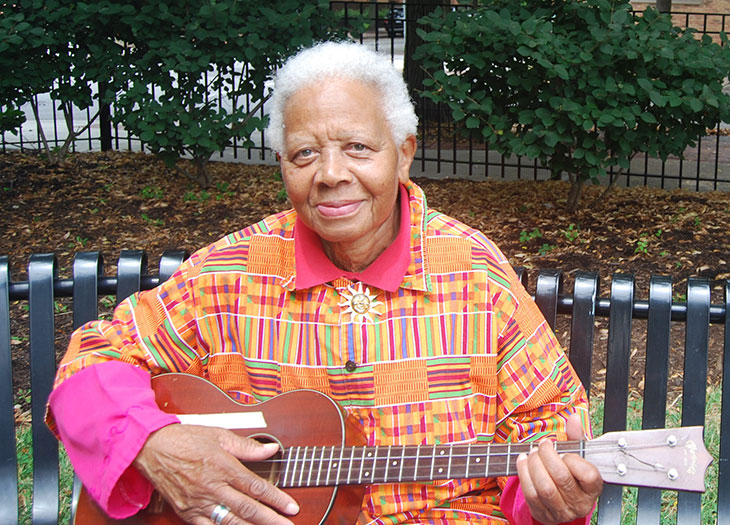
Photo: EllaJenkins.com.
Ella Jenkins is the best selling individual artist in the history of Smithsonian Folkways Recordings. She introduced children to music from around the world and never talked down to them.

Today we learn about a folksinger whose unorthodox approach revolutionized music for children. Her name is Ella Jenkins.

Laurel Graeber writes at the New York Times, “When Ella Jenkins began recording young people’s music in the 1950s and ’60s, her albums featured tracks that many of that era’s parents and teachers would probably never have dreamed of playing for children: a love chant from North Africa. A Mexican hand-clapping song. A Maori Indian battle chant. And even ‘Another Man Done Gone,’ an American chain-gang lament whose lyrics she changed [into] a freedom cry.

“ ‘She found this way of introducing children to sometimes very difficult topics and material, but with a kind of gentleness,’ said Gayle Wald, a professor of American studies at George Washington University and the author of a forthcoming biography of Jenkins. ‘She never lied to them. She certainly never talked down to them.’

“Jenkins’s unorthodox approach became a huge success: … A champion of diversity long before the term became popular, Jenkins helped revolutionize music for the young, purposefully encouraging Black children. In addition to introducing global material, which she often recorded with children’s choruses, she wrote original, interactive compositions like ‘You’ll Sing a Song and I’ll Sing a Song,’ now part of the Library of Congress’s National Recording Registry. …

“You might think that Jenkins, [100], would now want to relax. … What she would really like to do — although her fragile health prevents it — is to perform again herself. ‘I want to get well and get back on the job, where I’m working with other people, working with children,’ she said. ‘I work with them, and they work with me. I enjoy work.’

“Jenkins’s efforts, which comprise more than 40 recordings, began on Chicago’s South Side, where she grew up. Although never formally trained as a musician, she learned harmonica from her Uncle Flood and absorbed a variety of musical traditions through neighborhood moves and jobs as a camp counselor. After graduating from what was then known as San Francisco State College, she directed teen programs at the Chicago Y.W.C.A., which helped cement her love for children. Her street performances led to an offer to do young people’s music segments on local television, a debut that would be followed years later by appearances on shows like Sesame Street and Mister Rogers’ Neighborhood.

“ ‘Her curiosity is so insatiable,’ said Tim Ferrin, a Chicago filmmaker who is completing a documentary, Ella Jenkins: We’ll Sing a Song Together. He added, ‘I think she saw herself as a conduit, as somebody who could then share that enthusiasm, share that understanding.’

“Often called ‘the first lady of children’s music,’ Jenkins captivated her listeners because she presented music not as lessons but as play. A charismatic performer whose accompaniment often consisted of only a baritone ukulele and some percussion, she encouraged her young audiences not to sit still but to get up and move. Using a signature call-and-response technique that she adapted from African tradition and artists like Cab Calloway, she engaged her listeners in a musical conversation, even if they didn’t understand what they were singing.

“ ‘She made it very immediate and not exotic,’ said Tony Seeger, an ethnomusicologist and the founding director of Smithsonian Folkways. … At a Chicago convention of the National Association for the Education of Young Children in the 1990s, he recalled, so many members tried to crowd into a Jenkins concert that the organizers shut the doors. Those excluded responded with frenzied knocking.

“ ‘It was astounding, her popularity, and also the insistence with which these preschool teachers were pounding on the door,’ Seeger said, chuckling in a video interview. ‘I mean, you don’t think that they would do that sort of thing. But they did.’ ”

More at the Times, here.
Read Full Post »

The Arabic Sesame Street was designed especially for children in refugee camps, but it’s a delight for other children, too.

I posted about the development of a “Sesame Street” for Middle East refugees in 2016 (here) and for Bangladesh refugees in 2019 (here).

To give you the latest, I’m sharing a recent interview that National Public Radio’s Deborah Amos conducted in Beirut.

NPR Host Audie Cornish
” ‘Sesame Street’ is taking on one of the world’s biggest crises — the plight of Syrian refugee children. The Muppets are reaching out to millions of displaced children in a new program. Refugee children face special issues — losing their homes, missing time from school and frequent moves. They grapple with emotions and fears they barely understand. NPR’s Deborah Amos reports from Beirut.

Deborah Amos
“The Syrian refugees at this soccer practice are part of the target audience for ‘Ahlan Simsim’ — ‘Welcome Sesame,’ a new show on Arab TV stations and online — also for refugee kids in Jordan, Iraq and Syria. Some here are old enough to remember the war. Many more were born as refugees, raised by parents who fled violence and devastating loss and can pass on the trauma. …

Bassil Riche
“Definitely, these kids have experienced something that no kid should have to experience.

Amos
“Bassil Riche, the soccer coach, has seen the signs in these kids.

Riche
“Maybe the kid misses a shot or something. You know, you can see kind of over-the-top anger or frustration or disappointment in themselves. It’s important for them to talk about these things and not keep it inside.

Amos
“Getting those emotions out is the aim of the new program. … Produced in Amman, Jordan, the scripts are in consultation with regional educators and researchers. For 50 years, ‘Sesame Street’ has pioneered programs to address childhood challenges. The new challenge — to create a show for children who are likely to remain refugees throughout their childhood. Scott Cameron is the executive producer in New York.

Scott Cameron
“The show was developed to help children become smarter, stronger and kinder and give them skills to be — to thrive and be resilient. …

Amos
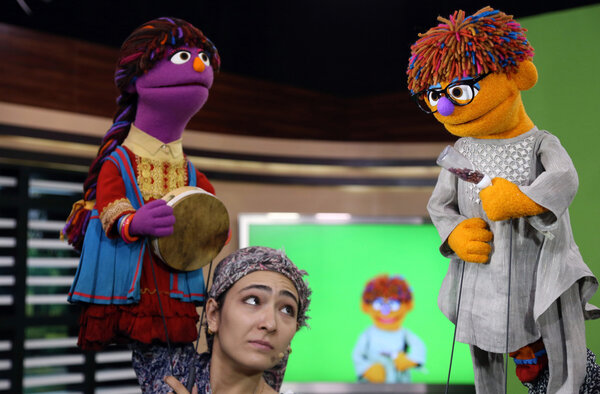
“[Grover] speaks Arabic in ‘Ahlan Simsim.’ The newcomers are Jad — bright yellow — Basma is purple. She becomes Jad’s best friend when he arrives in the neighborhood. Jad is sometimes sad because he’s had to leave everything behind, including his favorite toys. Research shows displaced children don’t have the language to identify emotions and the skills to cope, says Cameron. So that’s a key educational goal.

Cameron
” ‘Ahlan Simsim’ focusing an entire season on emotions is … a bold move that is born out of a need.

Amos
“The teaching techniques are sometimes silly. They’re always fun.

Cameron
“Debka dancers are three animated dancers whose sole function is to identify emotions and label them in a really funny way. … They pop into frame out of nowhere, sometimes. So it’s always fun to see where they’re going to come from. Sometimes, they pop up out of the bushes. They do a dance. They are a very important way for us to make sure that the children pay extra attention when we’re first introducing the vocabulary word that matches the emotion.

Amos
“Syrians are now the largest refugee population in the world. The statistics for going home are grim. Displacement lasts longer than ever before, sometimes for decades. Head writer Zaid Baqaeen says he never uses the label.

Zaid Baqaeen
“It was never put in any script that, oh, you’re labeled as a refugee or not because our focus is about welcoming. …

Amos
“The welcome is extended on the ground. In a partnership with the International Rescue Committee, the IRC is sending thousands of outreach workers to four countries and extend the lessons of the TV production and tackle some of the hardest subjects, says Cameron. … The ‘Ahlan Simsim’ project is a new way to correct the shortcomings of traditional humanitarian aid that provides for immediate needs but does little to prepare a generation to become resilient adults.”

NPR transcript and audio are here.

Read Full Post »

Photo: Rahmat Gul/AP
Characters from the Afghan Sesame Street. A MacArthur Foundation grant will enable the Sesame Workshop and the International Rescue Committee to roll out a version for Syrian refugee children.

Even if they make it to relative safety, children often suffer the most from wars and dislocation. In addition to the trauma, there is the problem of education, which is unavailable or spotty in refugee camps.

That is why people of goodwill are reaching out with programs that can both comfort and teach. Jason Beaubien reports on one example at National Public Radio.

“The MacArthur Foundation will give $100 million to Elmo, Big Bird and their buddies to massively scale up early childhood development programs for Syrian refugees.

“Sesame Workshop and the International Rescue Committee won a global competition by the MacArthur Foundation seeking solutions to what the judges called ‘a critical problem of our time.’

” ‘The most important thing to remember is that the humanitarian system is designed to reach people’s immediate needs — to keep people alive, feed them, make sure that they have shelter,’ says Sarah Smith, senior director of education at the IRC. The global humanitarian system, she says, isn’t very good at supporting displaced children. ‘And the fact is these children are likely to stay as refugees for their entire childhood.’ …

“The IRC and Sesame Workshop plan to launch what they’re describing as the ‘largest early childhood intervention program ever created in a humanitarian setting.’ …

“It will be distributed over traditional television channels, the internet and mobile phones. It will also serve as an educational curriculum for childcare centers, health clinics and outreach workers visiting the shelters where refugees live. The workers will deliver books to kids and caregivers.

“Sherrie Westin of Sesame Workshop says … ‘These Muppets will be created to reflect the children’s reality so that children can relate with them. … One of the Muppets may have had to leave home. She may live in a tent. She may become best friends with her new neighbors.’ …

” ‘We know that in their first years of life the trauma that children are experiencing has the greatest impact on them,’ Westin at Sesame Workshop says. ‘And yet they receive the least support.’ ”

More at NPR, here.

Read Full Post »

Among all the sad aspects of the refugee crisis, children in refugee camps going without any education — sometimes for years — has to be one of the saddest.

10 million under the age of 8 are displaced

Fortunately, there are occasional rays of light, such as adult refugees deciding to start their own school. And here is a story from Mashable about a partnership between the International Rescue Committee and the makers of Sesame Street.

Matt Petronzio writes, “A new partnership between Sesame Workshop, the brand’s educational nonprofit, and global humanitarian aid organization International Rescue Committee (IRC) will allow the two groups to develop, distribute, and test educational resources and programs designed with young refugees in mind. …

“The first phase is to develop educational multimedia content that can reach children living in displaced or resettled communities through mobile devices, radio, TV and printed materials in engaging, enjoyable ways.

” ‘We really set out to find a partner that complements our offerings, and I think the IRC is ideal,’ said Sherrie Westin, executive vice president of global impact and philanthropy at Sesame Workshop. …

“Sesame Workshop and the IRC will adapt existing Sesame products and content for regions where the two organizations already have a presence working with young children and their families. …

“The partnership is aimed at the children who make up half of the record 60 million people currently displaced around the world, specifically the one-third of that population under the age of eight. In addition to a lack of education, these children also often deal with toxic stress and trauma.

” ‘We’ve seen time and time again, in the context of conflict and crisis, that those very young children don’t have a safety net to support them,’ Sarah Smith, senior director for education at the IRC, told Mashable. …

“Most recently [Sesame] launched Zari, the first local Muppet in Afghanistan, a country where many young children lack access to education, especially girls.

“Zari’s gender was a deliberate choice to promote girls’ empowerment — an example of tailoring curricular goals to the needs of a particular country. (According to Westin, recent research showed that fathers in Afghanistan changed their minds about sending their daughters to school after watching Baghch-e-Simsim, the local language version of Sesame Street.)”

More at Mashable.

Image: Vicky Leta/Mashable

Read Full Post »