Feeds:
Posts
Comments

Posts Tagged ‘south carolina’

Photo: AP/Luis Andres Henao.
“Voices of Gullah” members, Joe Murray, from left, Minnie “Gracie” Gadson, Rosa Murray and Charles “Jojo” Brown, sing Gullah spirituals at the Brick Baptist Church, St Helena Island, South Carolina.

Not long ago, I read a fascinating memoir called The Water Is Wide, by Pat Conroy, about teaching poor children on a South Carolina island in 1969-1970. The depravation on that island was troubling to read about.

Today’s story about a different South Carolina island shows a different side. The island elders in this article about preserving tradition have agency.

Luis Andres Henao writes for the Associated Press (AP), “Minnie ‘Gracie’ Gadson claps her hands and stomps her feet against the floorboards, lifting her voice in a song passed down from her enslaved ancestors who were forced to work the cotton and rice plantations of the South Carolina Sea Islands.

“It’s a Gullah spiritual, and the 78-year-old singer is one of a growing group of artists and scholars trying to preserve these sacred songs and their Gullah Geechee culture for future generations. …

“On a recent summer day, her voice rang out inside Coffin Point Praise House. It’s one of three remaining wooden structures on St. Helena Island that once served as a place of worship for the enslaved, and later, for generations of free Black Americans.

“Gadson grew up singing in these praise houses. Today, as a Voices of Gullah member, she travels the U.S. with others in their 70s and 80s singing in the Gullah Creole language that has West African roots.

“ ‘This Gullah Geechee thing is what connects us all across the African diaspora because Gullah Geechee is the blending of all of these cultures that came together during that terrible time in our history called the trans-Atlantic slave trade,’ said Anita Singleton-Prather, who recently performed and directed a play about Gullah history.

“The show highlighted Gullah contributions during the American Revolution, including rice farming and indigo dying expertise. At the theater entrance, vendors offered Gullah rice dishes and demonstrated how to weave sweetgrass into baskets.

“More than 5,000 descendants of enslaved plantation workers are estimated to live on St. Helena Island, the largest Gullah community on the South Carolina coast where respect for tradition and deep cultural roots persists.

“Singleton-Prather [says] that despite slavery’s brutality, the Gullah people were able to thrive, ‘giving our children a legacy — not a legacy of shame and victimization, but a legacy of strength and resilience.’ …

” ‘It’s important to preserve the Gullah culture, mainly because it informs us all, African Americans, where they come from and that it’s still here,’ said Eric Crawford, author of Gullah Spirituals: The Sound of Freedom and Protest in the South Carolina Sea Islands.

“For most of his life, he hadn’t heard the word Gullah. That changed in 2007 with a student’s master’s thesis about Gullah culture in public schools.

“ ‘As I began to investigate it, I began to understand that “Nobody Knows the Trouble I’ve Seen,” “Roll Jordan Roll,” “Kumbaya!” — all these iconic songs came from this area,’ he said.

“Versions of these songs, he said, can be traced back to the 19th century when ‘Slave Songs of the United States,’ the first book of African American spirituals, was recorded on St. Helena Island. …

“He was so curious that he traveled to St. Helena, where he met the singers and began recording their music. … Crawford said, sitting on the original wooden pews of the island’s Mary Jenkins Praise House, ‘They were forced to go to their owners’ church and stay in the balcony. But then in the evening, typically on Sunday evenings, Tuesday and Thursday, they had this space by themselves, away from the watchful eye of the owners, and they could engage in their own songs.’ …

“At a recent concert they clapped their hands in one rhythm, stomped the floor in another and swayed, singing at the island’s Brick Baptist Church.

“ ‘These singers are as close as we would ever come to how the enslaved sang these songs,’ Crawford said. ‘That authenticity — you just cannot duplicate that.’

“He began to take the singers on tour in 2014. Since then, they’ve performed across the U.S. as well as in Belize and Mexico. The touring band’s members include Gadson; 89-year-old Rosa Murray; 87-year-old Joe Murray; and their son, Charles ‘Jojo’ Brown.

“ ‘I’m gonna continue doing it until I can’t do it no more, and hope that younger people will come in, others younger than me, to keep it going,’ said Brown who, at 71. …

“His mother agrees. Sitting in her living room, surrounded by framed photos of dozens of grandchildren, she said she’ll continue singing for them.

“ ‘I hope and pray one or two of them will fall in my footsteps,’ she said.”

More about the Gullah culture at AP, here.

Read Full Post »

Photo: Candace Dane Chambers for the New York Times.
Arianne King Comer, an artist, wearing hand-made textiles in her home studio on Wadmalaw Island, S.C. She first learned batiking at Howard University.

I was drawn to this story about about dyeing textiles on the South Carolina mainland and islands after reading Pat Conroy’s amazing memoir The Water Is Wide. That book recounts his 1960s teaching experience among impoverished black children on one of the islands — a sad and moving tale.

I am happy to learn something more upbeat about the islands.

The New York Times says reporter Patricia Leigh Brown “followed South Carolina’s indigo trail from Charleston to Johns Island to St. Helena Island” for this story.

“On a spring morning nearly a decade ago, Leigh Magar was out walking rural Johns Island, off Charleston, S.C., with her ‘snake stick,’ a wooden cane with a jangling Greek goat be. … As she tells it — and she swears this story is true — a beautiful blue dragonfly alighted on her stick and then encircled her, before fluttering toward the woods. She followed it into a thicket of pines, where she discovered a patch of wild blue indigo hidden among the trees.

Magar, a textile artist and dressmaker partial to indigo-dyed jumpers and indigo-stained silk ribbons tucked into her hair, is at the artful forefront of the ‘seed to stitch’ movement — the growing, harvesting and processing of Indigo suffruticosa, a robust plant that flourishes in the tropics and produces a deep, cherished ocean-blue color, one of humankind’s oldest dyes.

“This benign-looking bush is used in designing garments and batiks. It was a major export in 18th-century South Carolina. Like rice and cotton, the lucrative indigo crop was dependent on the skills and labor of enslaved Africans, who tended the plantation fields and extracted the dye in preparation for shipment to England for its burgeoning textile industry.

“Today, the revival of indigo by a diverse group of artists, designers and farmers is hardly confined to South Carolina. … In the United States, the passion for indigo dovetails with a growing appreciation for nontoxic plant-based dyes, including turmeric and marigolds, and the renewed focus on Africa’s role in contemporary fashion, spotlighted by recent museum exhibitions like ‘African Fashion‘ at the Brooklyn Museum and the Portland Art Museum, and by ‘Blue Gold: The Art and Science of Indigo,’ which opened at the Mingei International Museum in San Diego on Sept. 14 [until March 16, 2025]. …

“Fashion designers like Awa Meité van Til, who is based in Bamako, Mali, draw inspiration from her ancestors. In Africa, her grandmother re-dipped her clothes in what the older woman called ‘the blue of life’ when they aged, van Til recalled by email. In Lagos and other major cities, adire, a woven indigo-dyed cloth historically made by the Yoruba, is a fashion staple. …

“Magar was drawn to indigo after a career designing hand-stitched hats and fedoras for Barneys New York from her shabby chic cottage in Charleston. In 2015, she and husband, Johnny Tucker, an architect and artist, moved to a house on Johns Island. …

“Madame Magar, as she is known professionally, became infatuated with the idea of creating art from Mother Nature and began reading histories about Johns Island indigo. At the time, indigo seeds were hard to come by. Then a local botanist told her about a ‘hermit monk’ deep in the woods who not only had seeds but a thriving indigo garden. …

“The ‘hermit’ turned out to be an affable Eastern Orthodox monk named Father John, who lives down a rutted sand road. In his black cassock, he had a slightly bohemian air, with a bountiful silver beard and hair pulled back in a tight bun. …

“Father John is adept at ‘resist techniques,’ in which certain areas of a textile are blocked from receiving the dye, most often by applying molten wax (the process is often called batik). He prefers making a golden paste out of rice bran which he then applies through intricately hand-cut stencils to create patterns on fabric, in a centuries old Japanese technique known as katazome.

“He pulled out a small plastic bag full of tiny brown curlicues — they were indigo seed pods (you could hear them rattling). He demonstrated their alchemy in the yard, in tubs — one dye steeped with dried leaves, and a deeper color, from concentrate, its bubbling iridescent surface resembling a liquid stained-glass window.

“When Father John immersed his stenciled textile into the brew, it turned a distressing pickle green. But as he fished it out and exposed it to the air, it transformed into a breathtaking blue, enhanced by intricate white patterns where the rice paste had been. …

” ‘Every country that does indigo honors ancestors through this magical blue,’ said Arianne King Comer, an artist who first learned batiking at Howard University and has an indigo plant tattoo above her ankle.

“ ‘It aligned me,’ she said of her indigo education, which began in 1992, when she made her first trip to Nigeria on a grant to study with Nike Davies-Okundaye, a celebrated textile artist who has built centers for young people to learn traditional arts and crafts. …

“King Comer’s indigo-dyed tunics and silk scarves, sold on her website, practically spill out of her trailer, many employing shibori, a Japanese technique in which cloth is twisted or folded to create different patterns. … She will stay in her DIY outpost until she is able to build a center honoring historical and cultural crafts techniques, through her nonprofit, IBILE. Her work is part of the permanent collection of the Acres of Ancestry/Black Agrarian Fund, a cooperative that supports efforts to secure and protect Black farmlands.”

More at the Times, here.

Read Full Post »

Photo: WJCL via CNN.
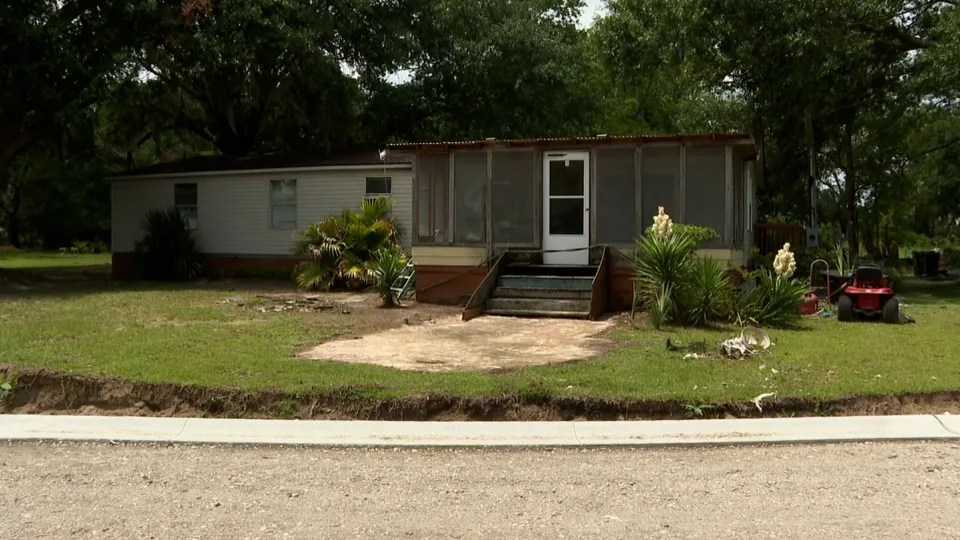
The home of Josephine Wright, 93, on Hilton Head Island, where resort development has encroached on the rights of Gullah Geechee people for generations.

We often read about how in “the old days” the powerful usurped the rights of minorities and paid expensive lawyers to take their land. Alas, it’s still going on.

Nicquel Terry Ellis reports at CNN, “Josephine Wright and her late husband, Samuel Wright Sr., moved from New York to Hilton Head Island, South Carolina, nearly 30 years ago to seek peace and relaxation on a family-owned property.

“The 1.8-acre parcel of land had been in her husband’s family since the Civil War and it was there that they carried on family traditions, hosted Thanksgiving and Christmas gatherings, planted trees and bushes and built a porch, Wright said.

“Wright, who is 93, acquired the deed to the land in 2012 after her husband died in 1998, her granddaughter, Tracey Love Graves, said. Now, Wright’s beloved land is at the center of a legal battle with a property developer looking to build a residential development next door. According to the Post and Courier, Georgia-based Bailey Point Investment, LLC is planning to construct 147 homes.

“Graves said Bailey Point had previously showed up at her grandmother’s house and offered $30,000 for Wright’s land, which she declined.

“The developer later filed a lawsuit in February 2023 against Wright claiming that her satellite dish, shed, and screened-in porch were encroaching on the developer’s land and delaying the construction of new homes.

“The lawsuit asked for the removal of the structures and sought ‘just and adequate compensation for its loss of the use and enjoyment’ of their property, and expenses related to delays in development.

“Wright and Graves said they have since removed the shed and satellite dish and were preparing to downsize the screened porch when Wright decided to file a counterclaim. …

“Wright’s counterclaim, filed April 25 and amended in June, accused Bailey Point of a ‘constant barrage of tactics of intimidation, harassment, trespass, to include this litigation in an effort to force her to sell her property.’

“The counterclaim also accused the developer of ‘trashing her property, going onto her property cutting brush and shrubs, littering, causing dirt and debris to cover her automobile, house and contents.’ The claim said Wright had been ‘deprived of the peaceful enjoyment of her property.’ …

“The legal battle is drawing renewed attention to the historic expropriation of Black-owned land. Wright told CNN she is concerned the developer is using well-known pressure tactics to get her to give in and sell her land. …

“Bakari Sellers, a civil rights attorney and CNN political commentator who is advocating for Wright, said land battles with developers have historically been an issue for the Gullah Geechee people – descendants of Africans who were enslaved along the lower Atlantic coast and forced to work on rice, indigo and Sea Island cotton plantations. Wright’s late husband was Gullah Geechee.

“ ‘Their land is so valuable,’ Sellers said. ‘They (developers) have been doing this for years. This is not new.’

“Wright says she hopes that her fight will inspire other Black landowners in Hilton Head Island to defend their property. …

“Wright’s land fight has garnered the attention of celebrities, including NBA star Kyrie Irving who donated $40,000 to a GoFundMe created to raise money for her legal fees. Filmmaker Tyler Perry also shared Wright’s story on Instagram saying, ‘Please tell where to show up and what you need to help you fight.’ “

Rebecca Carballo and Amanda Holpuch add at the New York Times, “Ms. Wright’s granddaughter Charise Graves, who lives on the property, said that loud construction has sometimes begun around 6:30 a.m. and that she and other family members have often dealt with noise and construction workers. An aunt who had also been living there, and is a defendant in the lawsuit, moved to Florida in February because she couldn’t handle the noise and stress of the situation, Ms. Graves said.

“Ms. Graves estimated that she has spent $6,000 to cover the costs of responding to the developer’s complaints and to hire a lawyer. The family created a GoFundMe to help pay for the legal battle and property taxes. Snoop Dogg donated $10,000 to the fund-raiser. …

“Ms. Graves said she planned to use some of the more than $300,000 raised so far to create a foundation in her grandmother’s name that aims to support other families who are trying to keep their property.”

More at CNN, here, and at the Times, here.

Read Full Post »

Photo: Lane Turner/Globe Staff.
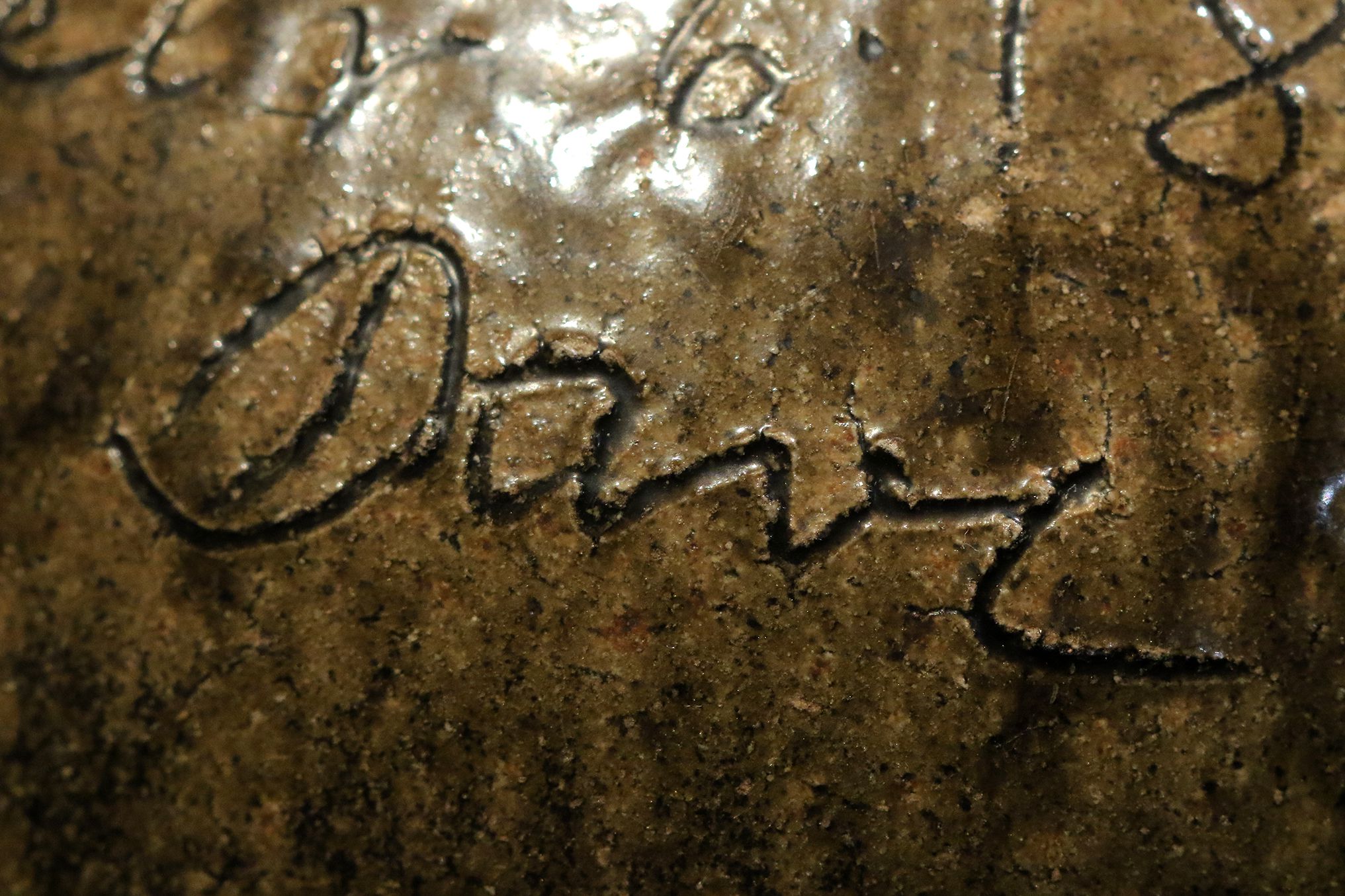
“Hear Me Now: The Black Potters of Old Edgefield, South Carolina,” an exhibition at Boston’s Museum of Fine Arts, presents 12 works by enslaved potter David Drake. Above, David Drake’s signature, “Dave,” on a storage jar from 1858. 

Today’s story is about an enslaved potter and the descendants who found him 150 years later. It is so painful to read about him being “bought.” You really have to wonder about the depths to which humanity sometimes descends.

Malcolm Gay reports at the Boston Globe, “In 1857, an enslaved potter in South Carolina’s Old Edgefield district carved a brief poem into a pot he’d turned in the mid-August heat.

“The potter had been bought and sold by a series of owners by then. He’d lost a leg, but his gifted hands won him local renown: His expert work with clay ensured he would be kept in the district known for its stoneware, even as his family was torn from him at auction.

“Using a sharpened tool, he etched into the jar’s shoulder: ‘I wonder where is all my relation/Friendship to all — and every nation.’ The potter then added his enslaver’s initials, the date, and, finally, his own name: ‘Dave.’

“In that simple act, the man, long known as Dave the Potter, and later David Drake, was not only wondering about his lost family: He was committing an extraordinary act of defiance in pre-Civil War South Carolina, indelibly asserting his existence in an age that sought to obliterate the humanity of Black people.

“Originally created to store meats and other foods, Drake’s 40 or so poem jars are today highly sought after by museums. His inscribed vessels routinely fetch six figures at auction, and his stoneware features prominently in ‘Hear Me Now: The Black Potters of Old Edgefield, South Carolina,’ an exhibition featuring enslaved potters [at Boston’s] Museum of Fine Arts.

“Perhaps most significantly: More than 150 years after Drake composed his mournful verse, researchers appear finally to have found his direct descendants.

“ ‘He was sending these messages,” said Daisy Whitner, 84, whom genealogists have identified as Drake’s great-great-great-granddaughter. ‘He wanted people to know: I’m a human being; treat me as such.’

“Now in their mid-70s and 80s, Whitner and her three siblings, Pauline Baker, John N. Williams, and Priscilla Ann Carolina, believed for most of their lives that their known family tree began in Aiken, S.C. They hadn’t known they’d had family in Edgefield. They’d certainly never heard of David Drake.

“But that changed in 2016, when April Hynes, an independent genealogist and researcher who’s been tracking down descendants of enslaved people from the area, cold-called Whitner. By pairing historical research with publicly available documents, Hynes had determined that Whitner and her siblings were the potter’s direct descendants. …

“ ‘I don’t have a word to describe him,’ said Baker, 75, seated on a sofa in her niece’s tidy home outside Washington, D.C., a replica Drake pot placed prominently on the dining room table. …

“Seated to her right, Whitner grew emotional as she described touching one of Drake’s pots during a trip to New York’s Metropolitan Museum of Art, which organized the exhibition with the MFA.

“ ‘It just tore me to pieces,’ she said. ‘I can’t stop reading and reading, trying to dig more and more.’

“The family has read nearly everything published about their ancestor, as they puzzle over his poems, searching for possible meanings and seeking clues about his life.

“Whitner is haunted by a particular jar Drake created and inscribed in 1836. It reads: ‘horses mules and hogs —/all our cows is in the bogs —/there they shall ever stay/till the buzzards take them away.’ ‘He’s using farm animals rather than to say slave,’ she said. …

“The [family] had mixed emotions when Hynes first called them with the news about Drake, but soon they were traveling down to Edgefield with around 30 family members to take part in celebrations to honor the potter.

“ ‘It’s a joyous feeling,’ said John N. Williams, 81. ‘But then there was a sadness about it, because you thought about the atrocities that happened.’

“They appreciate how rare it is, as the descendants of slaves, to be able to read their ancestor’s thoughts — particularly while he was still in bondage. But discovering a forebear who spent most of his life enslaved has also personalized their perception of the era, wrestling as they do with the scant details, and many unknowns, of Drake’s life.

“Whitner said she’d previously avoided looking at movies about slavery because ‘my heart couldn’t take it.’

“ ‘It hurt me to my core,’ she said. ‘And I will look now.’ ”

More at the Globe, here.

Read Full Post »

Photo: Lauren Petracca/PostAndCourier.
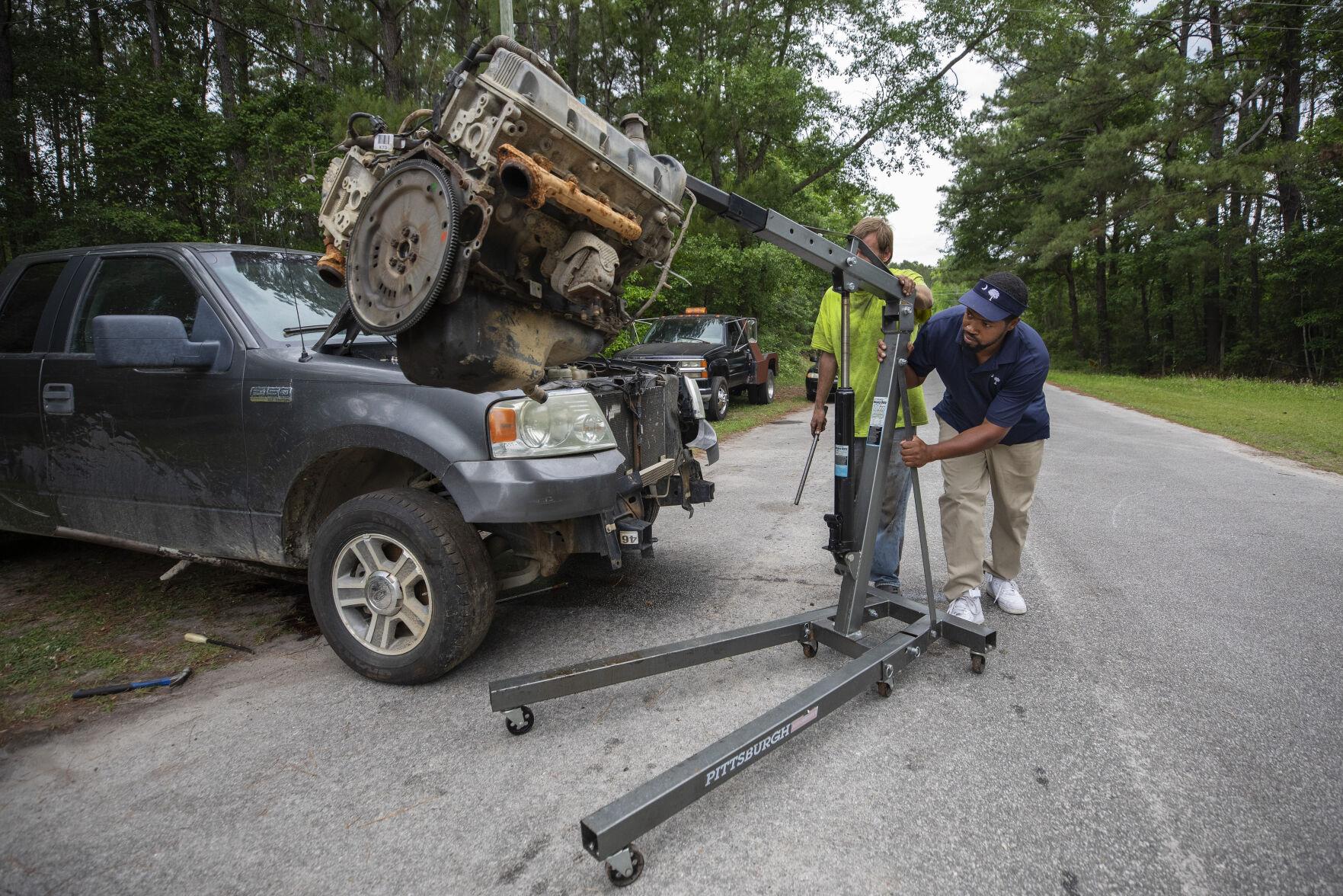
Eliot Middleton (right) and Matthew Poston remove an engine from a truck they are fixing up for donation in McClellanville, South Carolina, on May 10, 2021.

The roots of today’s story were planted in a strong relationship between a South Carolina father and son who knew how to repair cars.

Sydney Page reported at the Washington Post in July, “On Christmas Day last year, Eliot Middleton showed up unannounced at Melanie Lee’s home in Andrews, S.C., with a white 1993 Oldsmobile. What happened next shocked her: Middleton, whom she had never met before, put the key to the Oldsmobile in her hand. He didn’t charge her a dime. He just gave her the car, no strings attached.

‘I had no idea what was going on,’ said Lee, 59. ‘He handed me the keys and didn’t ask for anything.’

“She is one of 33 people Middleton has gifted with a car in the past nine months. Middleton, 38, is a restaurant owner and former auto mechanic who spends his spare time repairing used cars and giving them to people in need in rural South Carolina.

“ ‘There’s a lack of transportation in the rural areas, and I knew I could use my previous experience in mechanics to help,’ Middleton said.

“Only a few weeks before Middleton dropped off the car, Lee’s 33-year-old son, who was ill for several years, passed away. After driving daily for two hours to and from the hospital in Charleston to visit him, her 2007 Chevrolet Tahoe broke down.

“She took the car to a shop to replace the transmission, but ‘I had no means of paying for it,’ she said. She needed a car to help with child care for her two granddaughters, who are 12 and 6 and rely on her to pick them up from school every day and drive them to dance rehearsal. …

“The idea to fix and donate old vehicles came spontaneously to Middleton in early 2020, after he hosted a food drive and several local families showed up with no transportation. They walked more than four miles to get a hot meal. …

“ ‘There’s no public transportation in the area whatsoever,’ said Middleton, who lives in McClellanville, a small fishing town on the Atlantic coast with a population of about 600. ‘We don’t have taxis and Ubers. Without a car, people don’t have a way to get around.’

“So, Middleton — who co-owns Middleton & Maker Village BBQ, a restaurant in the neighboring town of Awendaw, S.C. — decided to put his auto mechanic skills to use the two days a week he isn’t at the restaurant. [As of July], nearly 100 vehicles have been donated for him to fix up. …

“Before jumping into the restaurant industry, Middleton worked as an auto mechanic for 15 years. As a young boy in McClellanville, his plan was to follow in his father’s footsteps.

“ ‘My dad was a mechanic, and I would hang out around his shop since I was 4 years old,’ Middleton said. ‘I’ve always been fascinated by cars.’

“After he graduated from high school, Middleton trained to become an auto mechanic, and in 2004, he and his father opened their own auto service. …

“ ‘We had a lot of single moms as customers, and we always ran into problems with them not having enough funds,’ Middleton recalled. ‘We spoke about trying to find a way to help them,’ [but] whenever they started to brainstorm ideas, something got in the way. Middleton’s father’s health began to decline, and in 2014, they closed the shop. Barbecuing has always been a side passion for Middleton, he said, so he decided to change course and pursue it professionally.

“Still, despite leaving the auto industry, the notion of repairing used vehicles for people in need remained a shared goal for Middleton and his father. But after receiving the first donated car in January 2020, several things in their lives took priority, including Middleton’s father’s failing health — he died in March 2020. Around the same time, Middleton opened a restaurant, just as the coronavirus pandemic was taking hold.

“ ‘Things started changing in my life, and I couldn’t focus on the car program the way I wanted to,’ said Middleton, who has two daughters, ages 14 and 8.

“By September 2020, though, Middleton felt ready, with fresh motivation to honor his father’s legacy. He repaired the first car — a 1997 navy Toyota Camry — and gave it to an unemployed single mother of two children, one of whom is disabled and requires regular medical appointments. …

” ‘That felt great. I could feel my dad’s presence around me, and I could hear him saying “this is exactly what we always wanted to do.” ‘

“Within two months, the same woman was able to land a stable job, and she recently contacted Middleton to say she bought herself a new car and is donating the one he gave her back to him.

“ ‘That blew me away,’ Middleton said.”

More at the Post, here.

Read Full Post »

Photo: Charleston County School/Facebook
South Carolina teacher Katie Blomquist said she wanted her students to grow up with happy biking memories like hers.

I woke up one morning and checked the headlines and saw four stories on horrible things and felt the weight of the world descending. But I also keep finding stories reminding me that, whatever happens, the human spirit of kindness survives.

Here is a recent example from South Carolina, where a teacher was so moved by the poverty of her students that she took an unusual action.

Eun Kyung Kim reported the story at TODAY.com.

“Students jumped with joy, hugged one another and squealed with delight as teachers at their South Carolina elementary school revealed hundreds of custom-made bicycles beneath parachutes normally used for P.E. class.

“The new set of wheels [came] courtesy of first-grade teacher Katie Blomquist.

“ ‘I made a really conscious effort to watch their faces and let it soak in and imprint in my brain when those tarps went up,’ she told TODAY. ‘It was that moment I’ve been waiting for seven months.’

“But the idea originated more than a year ago. Blomquist, 34, teaches at North Charleston’s Pepperhill Elementary School, where many of the students live in poverty. Last year, one of her students mentioned how much he wanted a bike for his birthday. His parents couldn’t afford to buy him one, and neither could she.

“ ‘I started thinking about all the other kids who might not have bikes. We take a lot for granted and we forget that there’s a large category of kids out there who don’t have bikes,’ she said. ‘That was such a large piece of my childhood memories, and I immediately thought, “oh, they’re not getting that!”‘ …

“In September, Blomquist started a ‘Every Kid Deserves a Bike!’ GoFundMe page and set a $65,000 goal, enough to buy bikes and helmets for the 650 students at Pepperhill. Within three months, she had raised more than $82,000. …

“ ‘This was an entire second job for me, when I got home from work until midnight every night,’ she said.

“Radio Flyer donated 100 big-wheel tricycles and training bikes for the pre-school students, while a local business, Affordabike, worked with Blomquist to customize the remaining 550 bicycles …

“Beyond the children’s reactions — and the hugs from parents as they picked up the bikes —Blomquist said she’s enjoyed the sense of community created by strangers around the nation who donated to the campaign. It was support she hadn’t anticipated. …

“ ‘But maybe one day when they’re adults, they’ll know that this gift, it wasn’t from me. It was from our community and our country,’ she said.”

More here.

Read Full Post »

One of the many reasons I’m grateful to WordPress is that, as the largest self-hosted blogging tool in the world, it gives me some visibility among other bloggers.

One day recently I garnered a “like” from the Girl Scouts of South Carolina Mountains to Midlands. I decided to check out their blog, and I found a good story to share.

Michelle Taylor writes, “Zainab Bhagat has always reached out to the hurting, even when she didn’t realize she was practicing philanthropy. As a child in elementary school, she noticed one of her friends often went without. Her friend never seemed to have school supplies or a complete lunch. Without a second thought, Zainab shared everything she had to offer. …

“When Zainab had the opportunity to earn the Gold Award in high school, she never questioned if she should pursue it or not. She felt it a moral obligation to share her time, talent, and treasure with the world. …

“She knew the project would take her full devotion. She would have to spend at least 80 hours researching, planning, and working her project. She would have to present her concept before a committee, and her project would have to address a real issue in her community. But anything worth doing is rarely easy.

“Zainab created a documentary about homelessness in her hometown of Irmo, South Carolina. She interviewed and became fast friends with a local teen who had endured incredible hardship. Watch her hard-hitting and inspirational documentary [here].”

More at the Girl Scouts of South Carolina blog, here. How reassuring it is to see young people like this readying to enter the world of adulthood. They will make that world better.

Read Full Post »

I heard about poet Terrance Hayes on the radio show Studio 360. He is the winner of a MacArthur Fellowship, among other honors, and a University of Pittsburgh writing professor. Kurt Andersen interviewed him.

“Hayes grew up in South Carolina, where he was one of the only black students at a very preppy high school. But he says that race didn’t define him as a kid. ‘I was a basketball player, and I ran track, and I was a visual artist.’

“With all his accolades, invisibility hasn’t been too much of an issue for Hayes. But as a theme, it’s certainly present in his work. His poem ‘How to Draw an Invisible Man’ plays with Ralph Ellison’s take on black invisibility in the eyes of white society. ‘The thing that I’ve decided is, I don’t want to be invisible, but I’d like to be transparent. I want people to see what I’m thinking and see through me,’ he says. ‘I’m about 6’6’’. You know, I don’t have trouble walking into a room. I would prefer to be more invisible, in fact, than I am.’ ”

Listen to the interview at Studio 360. And read a review by Jonathan Farmer, at Slate, of his latest book of poems.

Photo: Becky Thurner Braddock
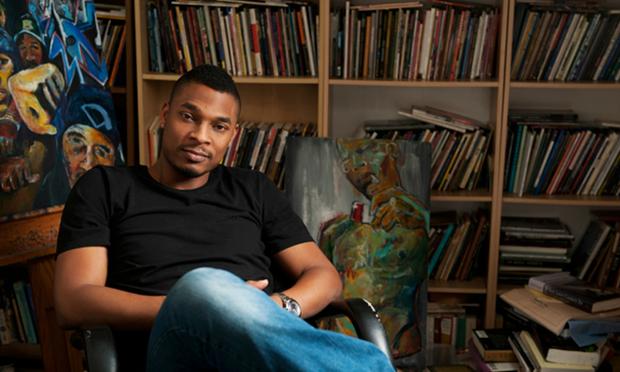
Poet Terrance Hayes. His new book of poems is called How to Be Drawn.

Read Full Post »

Fireflies are not as ubiquitous as they used to be, and that’s a concern. They are like the canary in the mine. If fireflies go, other species go.

What has caused the decline? Lawn chemicals? Rapid urbanization? Scientists want to know.

NY Times reporter Alan Bllinder writes from Greenville, South Carolina, about a crowdsourced research project to help figure out what’s going on.

“As dusk faded over the home of Jeremy Lyons and his sons on a recent evening here, one ritual of the Southern summer — the soft hiss of a can of mosquito repellent — signaled that the start of another was near.

“And although Raine Lyons, 6, grimaced, coughed and flinched during his dousing with bug spray, he soon stood near a chain-link fence in his backyard and shouted, in speedy succession: ‘Found one! Found one! Found one!’ Mr. Lyons, perched on his knee next to Raine, was almost completely silent as he tapped the screen of his cellphone again and again and again.

“There, on a weeknight in a South Carolina backyard, a father and his son, in their different ways, were counting fireflies. But an evening among fireflies was not merely a modest round of summertime nostalgia; instead, it was part of a multiyear quest by Clemson University researchers to measure the firefly population and investigate whether urbanization, especially here in the fast-growing South, threatens the insects.” Read how they are going about it here.

I hope we can reverse the decline of fireflies. I have so many happy memories of them from my childhood and my children’s childhood.

Photo: Jacob Biba for The New York Times
Raine Lyons counting fireflies alongside his father, Jeremy, in Greenville, S.C., as volunteers in the Vanishing Firefly Project of Clemson University.

Read Full Post »

Take two tomatoes and call me in the morning.

***

The University of South Carolina has developed a manual for health centers that want to collaborate with farmers markets on health, even writing food prescriptions for patients who need to improve their eating habits.

The manual’s authors, Darcy Freedman and Kassandra Alia, write in the intro of their manual:

“Farmers’ markets have grown in popularity in recent years as a place for improving health, increasing economic growth for local agriculture, and building communities. …

“Though the rebirth of farmers’ markets represents an exciting movement in the United States, data reveal that the benefits of farmers’ markets are not evenly distributed. Communities with the greatest need for farmers’ markets, for instance, are least likely to have them.

“In the present manual, we describe an approach for developing a health center‐based farmers’ market. Health centers, in particular federally qualified health centers or FQHCs, were identified as a strategic place to locate farmers’ markets because they may be located in food desert contexts (i.e., low‐income communities with low‐access to healthy food retailers). Additionally, locating at a health center makes an explicit connection between farmers’ market and preventive medicine.” More.

Photo: Aram Boghosian for The Boston Globe

Read Full Post »