Feeds:
Posts
Comments

Posts Tagged ‘spain’

Photo: Álvarez-Alonso et al.
The archaeologists excavating on the outskirts of Segovia, Spain, noticed there was something odd about this stone.

Today we ask ourselves the timeless question, “Did Neanderthals ever just horse around?”

Sam Jones has a scenario at the Guardian, “One day around 43,000 years ago, a Neanderthal man in what is now central Spain came across a large granite pebble whose pleasing contours and indentations snagged his eye.

“Something in the shape of that quartz-rich stone – perhaps its odd resemblance to an elongated face – may have compelled him to pick it up, study it and, eventually, to dip one of his fingers in red pigment and press it against the pebble’s edge, exactly where the nose on that face would have been.

“In doing so, he left behind what is thought to be the world’s oldest complete human fingerprint, on what would appear to be the oldest piece of European portable art.

The discovery, which could enrich our understanding of how Neanderthals saw and interpreted the world, has come to light after almost three years of research by a team of Spanish archaeologists, geologists and police forensic experts.

“The dig team noticed there was something odd about the stone – which is just over 20cm [~8 inches] in length – as soon as they found it while excavating the San Lázaro rock shelter on the outskirts of Segovia in July 2022. It did not look like something that had been used as a hammer or an anvil; it didn’t look like a tool at all.

“ ‘The stone was oddly shaped and had a red ochre dot, which really caught our eye,’ said David Álvarez Alonso, an archaeologist at Complutense University in Madrid. … We were all thinking, ‘This looks like a face.’ But obviously that wasn’t enough.

” ‘As we carried on our research, we knew we needed information to be able to advance the hypothesis that there was some purposefulness here, this was a symbolic object and that one possible explanation – although we’ll never know for sure – is that this was the symbolization of a face.’ …

“The team enlisted the help of other experts. Further investigations confirmed that the pigment, which contained iron oxides and clay minerals, was not found elsewhere in or around the cave.

“ ‘We then got in touch with the scientific police to determine whether we were right that the dot had been applied using a fingertip,’ said Álvarez Alonso. ‘They confirmed that it had.’ The print, they concluded, was human and could be that of an adult male. …

“Álvarez Alonso argues that the dot’s existence raises questions that all point in the same direction.

“ ‘It couldn’t have been a coincidence that the dot is where it is – and there are no markings to indicate any other use,’ he said. ‘So why did they bring this pebble from the river to the inside of the cave? And, what’s more, there’s no ochre inside the cave or outside it. So they must have had to bring pigment from elsewhere.’

“The team’s findings, reported in the journal Archaeological and Anthropological Sciences, reinforce the idea that Neanderthals – who died out some 40,000 years ago – were capable of acts of artistic and symbolic creation, meaning modern humans were not the first to use art as a means of expression.

“ ‘The fact that the pebble was selected because of its appearance and then marked with ochre shows that there was a human mind capable of symbolizing, imagining, idealizing and projecting his or her thoughts on an object,’ the authors write.

“ ‘Furthermore, in this case, we can propose that three fundamental cognitive processes are involved in creating art: the mental conception of an image, deliberate communication, and the attribution of meaning. These are the basic elements characterizing symbolism and, also prehistoric – non-figurative – art. Furthermore, this pebble could thus represent one of the oldest known abstractions of a human face in the prehistoric record.’ …

“ ‘We’ve set out our interpretation in the article, but the debate goes on,’ he said. ‘And anything to do with Neanderthals always prompts a massive debate. If we had a pebble with a red dot on it that was done 5,000 years ago by Homo sapiens, no one would hesitate to call it portable art. But associating Neanderthals with art generates a lot of debate.’ I think there’s sometimes an unintentional prejudice.’ “

More at the Guardian, here.

Read Full Post »

Photo: Museo Nacional del Prado, “El Greco. Santo Domingo el Antiguo.”
El Greco’s iconic altarpieces are reunited for the first time in nearly 200 years.

It’s impressive that museums not only preserve the wonders of the past but keep finding pieces of the past and reintroducing them. Consider how the Prado in Spain is currently uniting dispersed panels of El Greco’s first major commission.

Adam Schrader writes at Artnet that an exhibit at Spain’s Prado Museum “brings together the works the Greek painter Doménikos Theotokópoulos, better known as El Greco, completed for the Monastery of Santo Domingo el Antiguo in his first major commission.

“The exhibit reunites works that El Greco, a master of the Spanish Renaissance, made for the church, and marks the first time they have been brought together since their dispersion, thanks to to the loan of the main altarpiece, ‘The Assumption,’ by the Art Institute of Chicago which has owned it since 1906.

“In ‘The Assumption,’ the Virgin Mary ascends to heaven on a crescent moon over Jesus’s open tomb while aided by a group of angels. It has a companion, made for the attic of the altarpiece, titled ‘The Trinity,’ that visually connects above it. …

“In the main altarpiece, ‘The Assumption’ is flanked by four other canvases which depict John the Baptist and St. Bernard on the left side and John the Evangelist and St. Benedict on the right side, which were meant to act as intermediaries between the earthly realm and the divine. Those works are housed at the monastery and in private collections.

“Other works El Greco made for the altarpieces include a depiction of the ‘Adoration of the Shepherds,’ a scene from the nativity; the ‘Resurrection’; and ‘The Holy Face,’ an iconographic depiction of [a legend] in which a woman obtained the ‘true image’ of Jesus from a cloth he had wiped his face on. …

“For the works that are housed at the monastery, a team from the Prado Museum had to convince the nuns to let them borrow the paintings.

” ‘It was difficult,’ Leticia Ruiz, the head of the Prado’s Spanish Renaissance painting collection, told the newspaper. She added that the monastery also lives off of its visitors and from the sale of ‘delicious marzipans’ that they make. So, the museum agreed to restore one of its pieces by the painter Eugenio Cajés in exchange for the loan.

“Funnily, the Prado Museum’s exhibit comes several years after France’s Louvre Museum tried, and failed, to borrow three works by El Greco from them. …

“El Greco was first documented in Spain in June 1577 and quickly received the commission for the new monastery, which was designed and jointly paid for by a powerful dean of the cathedral named Diego de Castilla and a Portuguese woman named Doña María de Silva. According to the museum, the two benefactors were buried at the monastery. The Greek artist was appointed to make the altarpieces at the suggestion of Diego’s son Luis de Castilla, who had met him in Rome a few years earlier. He completed it in 1579.

“ ‘The result could not have been more dazzling. He revealed himself as a perfectly developed artist, with a creative maturity that linked him to some of the best painters of the Italian Renaissance,’ the Prado Museum said on its website.

“ ‘El Greco. Santo Domingo el Antiguo‘ is on view at Museo Nacional del Prado, Madrid, through June 15, 2025.”

Some of El Greco’s works look strikingly modern, and I’m always suprised that they were painted in the 16th century — and especially that patrons back then could appreciate them.

Here’s more from Wikipedia: “El Greco was born in the Kingdom of Candia (modern Crete), which was at that time part of the Republic of Venice, Italy, and the center of Post-Byzantine art. He trained and became a master within that tradition before traveling at age 26 to Venice, as other Greek artists had done. 

“In 1570, he moved to Rome, where he opened a workshop and executed a series of works. During his stay in Italy, El Greco enriched his style with elements of Mannerism and of the Venetian Renaissance taken from a number of great artists of the time, notably Tintoretto and Titian.

“In 1577, he moved to Toledo, Spain, where he lived and worked until his death. In Toledo, El Greco received several major commissions and produced his best-known paintings, such as View of Toledo and Opening of the Fifth Seal. El Greco’s dramatic and expressionistic style was met with puzzlement by his contemporaries but found appreciation by the 20th century.”

More at Artnet, here.

Read Full Post »

Photo: Gerry Hadden/The World.
The town of Libros, in northeastern Spain, has a population of 60.

What are you reading?

Sometimes that question is my way of greeting someone: “Hi. What are your reading?”

Books are so important to me, I make the mistake of assuming they’re important to everyone. Right now I’m reading Fresh Water for Flowers, recommended by Suzanne, who liked the French bestseller (translated) about a woman who was a cemetery caretaker.

Books are important to a town in Spain, too. How could they not be, with a name like Libros? And now the town is now planning to rebuild its economy on the back of books.

Gerry Hadden has the story at Public Radio International’s The World.

“On a typical winter’s day in the village of Libros, in northeastern Spain, about the most exciting thing that happens is the hourly ringing of the church bell, which startles flocks of pigeons living in the belfry. …

“Libros has a population of 60. But once upon a time, some 2,500 people lived here. The majority of residents worked on farms, or in the nearby sulphur mines, which closed in the 1950s. But like lots of villages in the Teruel region, most of the older population has died off over the years, while the young emigrated, said Arana, who is an electrician by trade. …

“To attract newcomers, Arana thinks the key to the town’s salvation is in its name: Libros translates to ‘books,’ and he wants to open the town’s first ever library. 

“The library’s location has yet to be determined, but Arana has already started building its collection. A year ago in June, Arana made a plea for book donations on social media with the hashtag, Libros para Libros, or ‘Books for Books,’ which went viral.

“Since then, over 70,000 volumes — including novels, kids’ books, nonfiction and encyclopedias — have poured in from all over the world — from Argentina to Germany. Twelve boxes alone came in from Mexico.

“At one point, Arana said, the postman was coming by so many times a day that they gave him a key to town hall. Books were piled up all over the building, to the point where Arana could barely reach his office. So, late last year, he worked with volunteers to move a bunch of the books to a warehouse. …

“Adrian Soriano, 37, the town’s handyman, pointed to a big, red shipping container on the edge of town. It was filled to the ceiling with books.

“Arana said that he paid $3,000 for the container, money the tiny town can’t spare. And this is where the success and euphoria of the online book drive meets the economic realities of a small village.

“ ‘Now, we just need the library itself,’ Arana said. ‘The regional government likes the idea. But they say it will cost some $4 million to build it. We don’t have the money, but I am sure we’ll find it.’

“Arana said that they’ll apply for funds from the European Union if need be. His idea is to combine the library with a hotel to pay the salary of a librarian.  

“ ‘The library hotel will generate jobs. People need work, which is why they leave to begin with. If we can bring back just seven or eight families, well, they’d count as villagers.’

“Someone, he said, needs to organize the collection. Arana said that he’s confident because there’s proof that literary tourism can work here.

“For example, bestselling Spanish author Maribel Medina talked to Teruel TV about a project she runs called My Town Reads. It stages literary events in tiny villages, including Libros, inviting famous authors to visit, sign books and spend the night.

“Libros has hosted four events with Medina’s help. Arana said that hundreds of people showed up each time.

“ ‘It seems that because of our little literary boom, folks are starting to fix up the houses here,’ he said. ‘On weekends, more people are returning.’ …

“Libros native Santiago Perez, 81, who lives past a bunch of crumbling homes, pointed to a house with scaffolding around it. ‘One of my boys has set out to fix up that one. He’s making a really nice home for himself.’ “

Is this dream unrealistic? Well, that’s another thing about books — they encourage big dreams. And big dreams are a necessary step for big accomplishments.

More at PRI’s The World, here.

Read Full Post »

Photo: keriliwi via Unsplash.
In Spain these days, a pineapple means you are available.

I’m sharing a funny dating story from September with the caveat that global warming may have upset everything in the short time since then. That’s because the lighthearted craze described here may have been inundated in the recent floods. On the other hand, maybe I should give more credit to the resilience of the human spirit. Especially when it comes to dating.

Guy Hedgecoe writes at the BBC, “A Spanish craze encouraging single people to seek partners in supermarkets by using a fruit-based code has caused some chaotic scenes and even led to the police being called to restore order.

“In recent days, many single Spaniards have been drawn to branches of supermarket chain Mercadona between 7pm-8pm by claims they can find romance at that time, particularly if they put a pineapple upside down in their shopping trolley.

“The phenomenon seems to have been driven in great part by the actor and humorist Vivy Lin, who posted a video on TikTok of her pushing a trolley around a Mercadona store talking about the supposed window. …

“The pineapple maneuver is reportedly completed by pushing your trolley into the wine section of the store and hoping that a person you find attractive responds positively.

“As the story has gone viral, it has led to some unusual and sometimes disorderly sights.

“In Madrid there have been reports of groups of teenagers pushing trolleys around stores in the evening, without buying products.

‘One man was dressed as a giant pineapple by his friends inside a store as part of his bachelor party celebrations.

“In Bilbao, police were called to a branch of Mercadona during the 7pm-8pm time slot because of rowdy scenes inside, although they were not required to intervene.

“A song, circulating online, has further driven the success of the trend, with the words: ‘In the wine section / My heart races / Looking for someone special / That my soul needs.’ …

“While the latest use of the fruit may have proved popular with some, there have been reports that the pineapple mania has not found favor with many Mercadona employees who are left to clear up unpurchased goods.

“One video showed a worker pushing boxes of the fruit away from shelves and towards a storeroom as 7pm approached.”

Meanwhile at the Washington Post, Leo Sands interviews a Malaga resident, ” ‘I think that currently the apps are very monotonous and people are already looking for something different,’ said Gustavo Contreras, a 28-year-old waiter living in Malaga, on Spain’s southern coast. …

“Contreras, who said he knows people who have met by crashing their carts together, said he spent about an hour carting around an upside-down pineapple at his local Mercadona store twice last week, but failed to knock carts with anyone else.

“The first time, ‘I went in and grabbed a pineapple and went around with my cart. I was going to go shopping anyway, but I realized that when I carried a pineapple, there were some knowing glances on 2 occasions,’ he said in a text message Wednesday. ‘I could feel the tension in the stares.’

“When he returned to the store the next day to try again, Contreras said that there were no pineapples left — a shortage he attributed to the popularity of the new dating craze.”

More at the BBC, here, and at the Post, here.

Read Full Post »

Photo: Erika Page/The Christian Science Monitor.
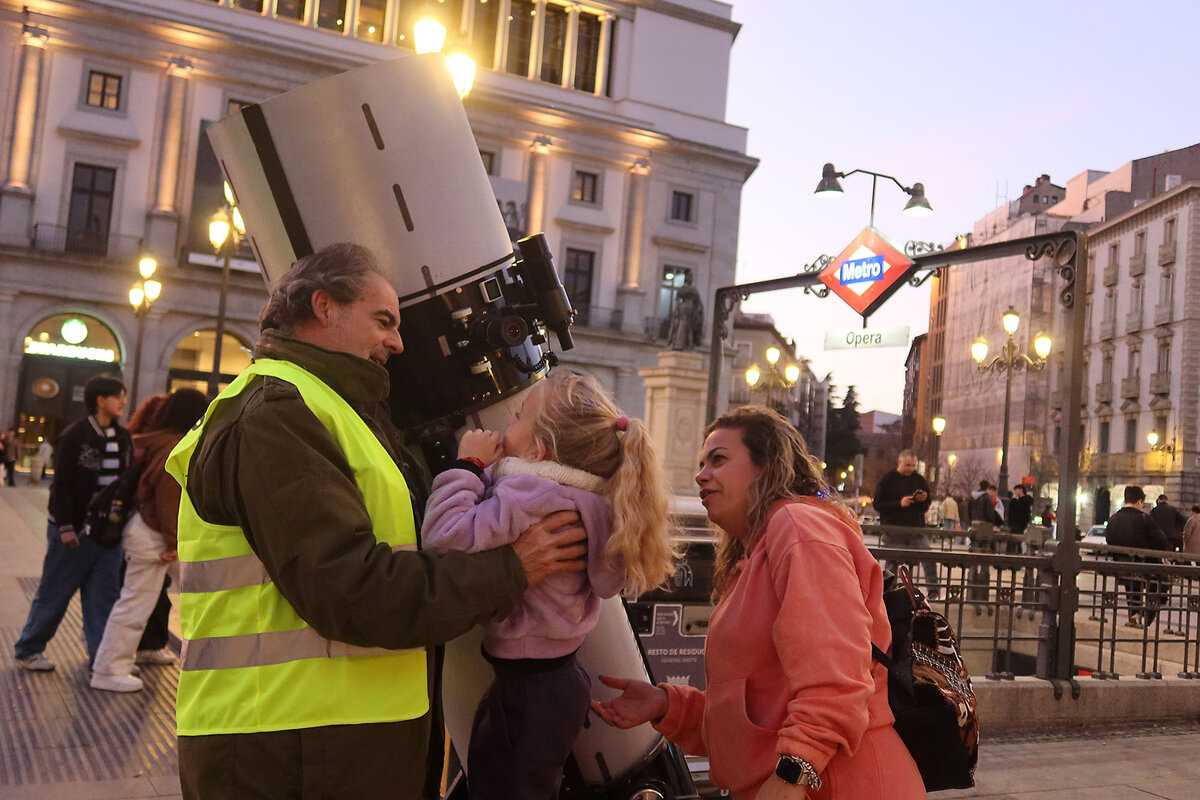
Alfredo Paniagua lifts a young girl up to see planet Jupiter through his telescope on a sidewalk in Madrid last February.

It seems that people are more likely to engage with the stars in the summer than at other times of year. I myself see a lot more stars when I vacation in New Shoreham in July because there are fewer sources of ambient light. The stars are more noticeable.

Today’s story is about a man in Spain who loves to show anyone who’s interested the wonders of astronomy.

Erika Page reports at the Christian Science Monitor, “As the rest of the city heads out on a Friday evening, Alfredo Paniagua dons a lime-green vest, loads his 180-pound telescope into a van, and drives into the center of Madrid.

“He sets up the telescope at the mouth of the busy Ópera metro station, a block from the Royal Palace. The sun still setting, he swivels the massive cylinder to an invisible point in the sky and fiddles with the focuser. And then he waits.

“It doesn’t take long for curiosity to pique. Children tug on sleeves and point. Friends dressed for an evening out stop to ask what’s up there.

“ ‘Jupiter,’ says Mr. Paniagua. ‘The view is spectacular tonight.’

“A line begins to take shape, curious passersby waiting their turn to peek through the lens. Mr. Paniagua places a footstool for those who need it and lifts the smallest kids up himself. He shows each viewer how to focus the image. Then he steps back for his favorite part. Eyebrows raised, he watches face after face light up at the sight: a perfectly round ball of bright gas marked by two clear stripes near its equator, tiny to the eye yet big enough to fit 1,321 Earths. Four moons stretch out in a straight line below. …

“It’s a nightly ritual Mr. Paniagua has performed for two decades, whenever the sky is clear. He often stays past midnight, sharing his telescope with hundreds of strangers free of charge. Many leave a donation, which he accepts. … ‘I like to think that they begin to ask themselves new questions.’ …

“[The immensity is] what Ana Afonso Martin says she felt looking through Mr. Paniagua’s telescope. She and three friends just arrived from the Canary Islands for a weekend in Madrid. Jupiter was the last thing she expected to find in the capital.

” ‘We are teeny, tiny, and this is immense,’ she says. ‘If you’re always stuck in your world, and you don’t look up at the sky, you don’t realize that.’

“It’s also what pulled Mr. Paniagua into the fold 25 years ago. At the time, he was working odd jobs, mostly as a metalworker, on the outskirts of Madrid. He heard word of a free astronomy course offered by someone in his neighborhood, and signed up.

“It was Saturn that hooked him, on the last day of the class. From there, he and a few others formed the Agrupación Astronómica Madrid Sur (South Madrid Astronomical Association) and began bringing an old telescope to schools, hospitals, small towns, and whoever invited them. Most of what he has learned he taught himself, though he eventually became a certified astronomy monitor through the Starlight Foundation, a nonprofit dedicated to promoting and protecting the night sky. Over time he realized that to reach the most people, he needed to be out on the street. …

‘A growing dark-sky movement is working to protect the night from light pollution, which grew by nearly 10% every year between 2011 and 2022.” More at the Monitor, here.

Read Full Post »

Photo: Erika Page/Christian Science Monitor.
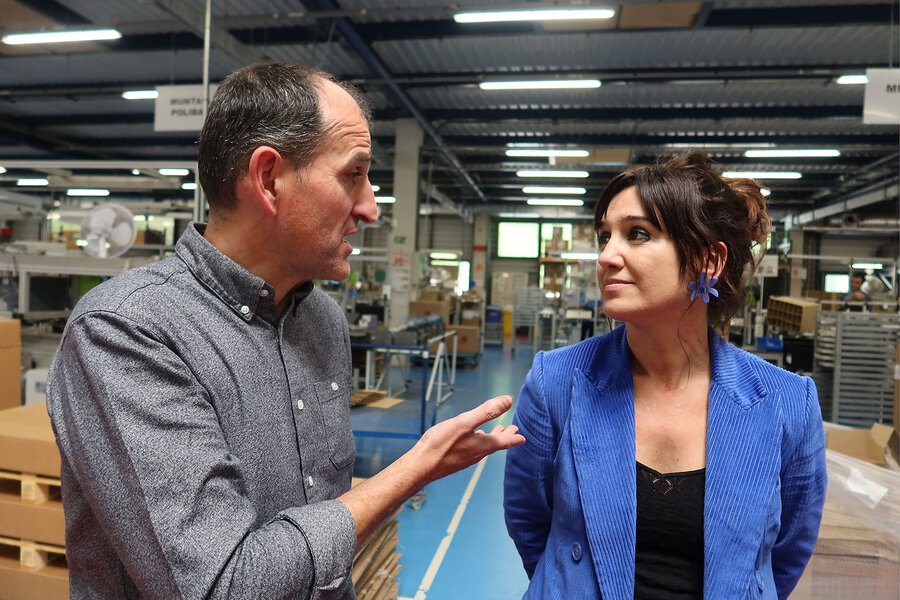
Amaia Salbide speaks with plant manager Ander Jausoro on the factory floor of an industrial plant belonging to Copreci, one of the Spanish companies sharing ownership with workers. “No one is rich. No one is poor.”

Giving workers a piece of the responsibility for a company’s success — and a piece of the profits — is not a new idea. But lately it’s been gaining traction in Spain.

Erika Page reports at the Christian Science Monitor, “At first glance, this could be any industrial factory. Workers wearing protective gloves assemble control panels and heating plates amid the relentless whirring of machinery. Giant yellow robot arms swing back and forth, lining trays with tiny metal parts.

“But there is a reason that each year thousands of visitors from every continent come to this mountainous Basque landscape to study factories like this one. This is the home of the Mondragon Corp., the world’s largest federation of worker-owned cooperatives. 

“Copreci, which makes parts for home appliances, is one of 81 Mondragon cooperatives, ranging from manufacturing to finance and retail. By the end of the day, this floor alone will churn out 30,000 gas valves, destined for stoves worldwide.

“Yet it is also churning out a radically different vision of capitalism. For young people especially, capitalism brings to mind wealth inequality, cost-of-living crises, and environmental collapse. …

“The Mondragon Corp. sees itself as a third way, not as an alternative to capitalism, but as an alternative way of doing capitalism – one that can build trust, not widen divisions.

“ ‘The purpose of what we’re doing here is not the machinery or the production process,’ says Amaia Salbide, president of Copreci, on a visit to the factory floor. ‘Those are tools to reach a higher goal of social transformation.’ …

“Mondragon’s nearly 70,000 members, ranging from floor workers to top executives, are co-owners of their businesses. They have voting power at general assemblies, where they weigh in on company strategy and policy. The income disparity between the highest- and lowest-paid employees in Mondragon’s cooperatives is capped at a ratio of 6-to-1, compared with a typical ratio of 344-to-1 in the United States. …

“As the saying around here goes, Mondragon does not create rich people, but rich societies. That means prioritizing quality of life for the employees who live and work in the towns dotting these forested hills rather than maximizing profit for investors.

“ ‘I think of it as a sort of attractive form of capitalism,’ says Nick Romeo, author of The Alternative: How To Build a Just Economy. ‘One that works more effectively for more people but retains some of the benefits of markets and efficiency and competition.’

“Hugo Montalvo knows he could make more money as a sales manager at a regular multinational company. But he wouldn’t trade his middle-class status or the small town where he is raising his two children. At the end of a day’s work, Mr. Montalvo often finds those on the assembly line picking up their children from the same schools as top managers and gathering at the same tables at local bars. The base pay for a Mondragon worker is on average 40% higher than Spain’s minimum wage.

“ ‘Here, no one is rich,’ says Mr. Montalvo, who works for Ecenarro, a Mondragon cooperative. … ‘But no one is poor either. We’re all in that middle range, earning decent salaries.’

“Solidarity permeates the business model. To become a member of a cooperative, a worker invests €17,000 ($18,400), normally bit by bit over time. As for company profit, 60% is reinvested in the business, 30% goes to employees as capital, and 10% is for the local community. At the end of each year, Mondragon reviews each cooperative’s earnings, and companies in better financial positions contribute to those that are struggling.

“ ‘Just as we’ve received in the past, now it’s our turn to give,’ says Mr. Montalvo.

“Back in 2013, he was working for Fagor Electrodoméstico, a Mondragon cooperative that at the time was Spain’s leading home appliance company. When the company went bankrupt in the aftermath of the financial crisis, his job and initial investment disappeared.

“Within two weeks, he was transferred to Ecenarro, and Mondragon covered his membership fee. Of the almost 2,000 people who lost their jobs at Fagor, 95% were relocated within the Mondragon network. During the pandemic, workers came to collective agreements to avoid job losses, including salary reductions. …

“ ‘The cooperative is a creator of wellness, so it has to exist for decades and decades,’ says Ander Etxeberria, who leads Mondragon’s cooperative outreach program.”

As with anything, there are challenges here, too. Get more details at the Monitor, here.

Read Full Post »

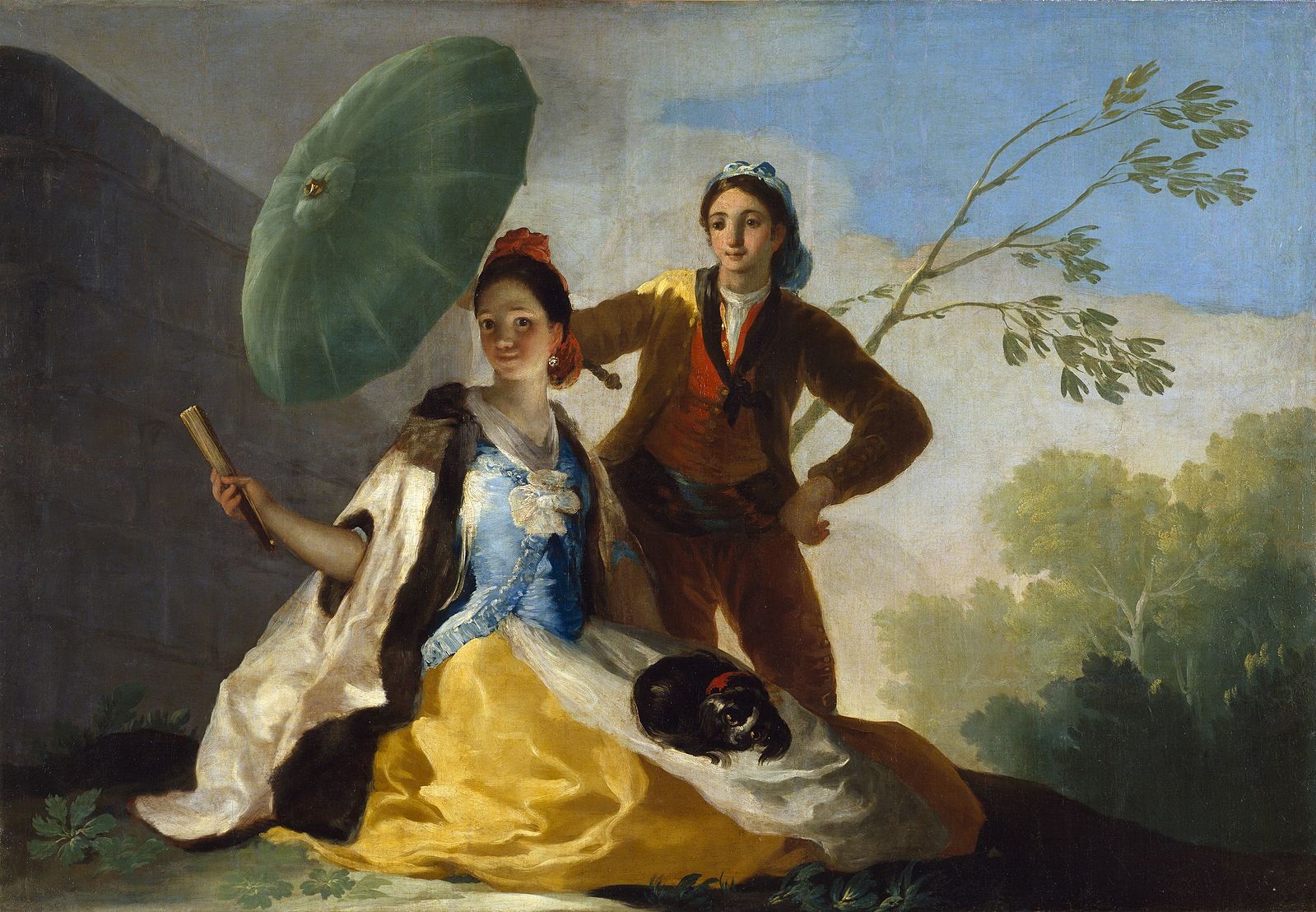
Art: Francisco Goya via Museo del Prado.
The Parasol (also known as El Quitasol) is one of a series of oil on linen paintings made by Francisco Goya. This series was made in order to be transformed into tapestries that would be hung on the walls of the Royal Palace in Madrid.

Companies that last over many generations know how to evolve with the times. There are a few in the US but more in other parts of the world. In Spain, for example, a factory that once converted pieces by the painter Francisco Goya into tapestries for his clients still plays a role in art and design.

Irene Yagüe writes at the Associated Press (AP), “Spain’s Royal Tapestry Factory has been decorating the walls and floors of palaces and institutions for more than 300 years. Located on a quiet, leafy street in central Madrid, its artisans work with painstaking focus on tapestries, carpets and heraldic banners, combining the long wisdom of the craft with new techniques.

“The factory was opened in 1721 by Spain’s King Felipe V. He brought in Catholic craftsmen from Flanders, which had been part of Spain’s empire, to get it started. Threads and wool of all colors, bobbins, tools and spinning wheels are everywhere. Some of the original wooden machines are still in use.

“The general director, Alejandro Klecker de Elizalde, is proud of the factory’s sustainable nature. ‘Here the only products we work with are silk, wool, jute, cotton, linen,’ he said. ‘And these small leftovers that we create, the water from the dyes, or the small pieces of wool, everything is recycled, everything has a double, a second use.’ …

“The factory recently received one of its biggest orders, 32 tapestries for the Palace of Dresden in Germany — worth more than 1 million euros and providing work for up to five years, according to Klecker de Elizalde. …

“Creating a tapestry is a delicate process that takes several weeks or months of work for each square meter. A tapestry begins with ‘cartoons,’ or drawings on sheets of paper or canvas that are later traced onto vertical thread systems called warps, which are then woven over.

“One of the factory’s most illustrious cartoonists was master painter Francisco Goya, who began working there in 1780. Some of the tapestries he designed now hang in the nearby Prado Museum and Madrid’s Royal Collections Gallery.”

Just for fun, see if you recognize any companies on the list of the world’s oldest companies, here. There’s one called Adam & Eve, which you’d expect to be old! It’s a pub in England, founded 1249.

More at AP, here. No paywall. Wonderful pictures!

Read Full Post »

Photo: Rewilding Europe.
By 1627, the massive auroch had been hunted to extinction across its entire range. But strands of its DNA remain alive, and in 2013, Rewilding Europe, together with the Dutch Taurus Foundation, embarked on a program to bring the auroch back to life.

Are you up for another “extinct but still around” story? This one is about the mighty auroch, whose bull form Zeus assumed in one Greek myth. The rewilding folks in Europe are using the auroch’s remaining DNA to bring it back.

Gerry Hadden at PRI’s The World reported recently on the herd being “back-bred” in Spain.

“The auroch — giant, wild cows — date back nearly 10,000 years and once roamed freely across Europe. Until they were hunted to extinction by humans. The last ones died in Poland in 1627, according to Ricardo Almazán, a safari guide in the mountains of Albarracín, Spain, where a herd of modern-day aurochs can be found. 

“Today, the wild bovine — called tauros in Spanish — are here once again thanks to the nongovernmental organization Rewilding Spain.

“They are working to ‘rewild’ the auroch — or bring back the animal hunted out of the area to restore the wilds as they were before. …

“Aurochs played a key role in the ecosystem — namely, grazing the largest brush and small trees to keep forests from growing too dense and prone to burning. …

“Reintroducing the auroch to the wild involves crossbreeding cows with the ancient genes of the aurochs, according to Lidia Valverde from Rewilding Spain.

“So, taking the ‘genetic features from different breeds of cows that we know that are descendants of that wild ancient cow’ to create a new breed, she explained. But they’re not introducing an entirely new species — scientists have managed to recover more than 90% of the aurochs’ DNA, she said.

“Rewilding Europe, together with the Dutch Taurus Foundation, began the program to bring back the auroch in 2013. Now, the breeding of aurochs is happening in a selective way in Spain, Portugal, Croatia, Czech Republic, Romania and the Netherlands. And, more than 600 of the animals have been bred since the end of 2017, according to Rewilding Spain.

They are reminiscent of fighting bulls, but up to three times bigger.

“Almazán said these new aurochs look and behave just like their forebears. They are reminiscent of fighting bulls, but up to three times bigger. An auroch may weigh over 2,000 pounds, with horns hovering 7 feet above the ground. They are Europe’s largest herbivore.

“Almazán said their presence in the forest is evident in the fact that a lot of trees have been knocked down — the aurochs walk along and smash them flat and then eat the wood and everything. The cows’ behavior has a larger, ecological benefit, he said. The new clearing has allowed the sun to reach the forest floor for the first time in years, giving other plants the chance to grow and attracting insects, birds and other grazers, like deer.

“Local farmer, Paco Rollola, who works with Almazán to help keep the aurochs from straying too far, said that lightning struck a tree nearby recently, but it didn’t start a fire because there was no undergrowth around the tree. The aurochs had eaten it all, he said. Without them, he said, everything would have burned down.

“Valverde of Rewilding Spain said that the beasts are not only making this forest healthier, but they’re also helping the local economy [by] attracting tourists to an area seldom visited.”

More at the World, here. I am fascinated by rewilding projects, but as for these giant animals, I just hope they don’t bulldoze (to coin a phrase) the wrong trees. Can’t you just imagine a science fiction film in which the program runs amok?

All innovations need supervision, I guess.

Read Full Post »

Photo: Josep Lago/AFP/Getty Images.
Ancient grape varieties in the laboratory at the Familia Torres vineyard near Barcelona. 

Here we go, Humans! More adapting.

Today’s story is about pragmatic grape growers adapting to climate change by seeking out grapes that can handle more heat. Too bad they have to do this, but what they learn may help other growers — and all of us.

Ashifa Kassam covers the topic for the Guardian: “The ads – tucked in the corners of local newspapers and directed at winemakers – began turning up across Catalonia in the 1980s. ‘If you know where to find any uncommon grape varieties, please get in touch,’ they read.

“Dozens of tips came pouring in, shepherding Miguel A Torres in his search for long-forgotten wine grapes. But it wouldn’t be until a decade later, as the climate crisis began wreaking havoc on vines, that the fourth-generation winemaker realized his foray into the past could play a key role in tackling what lies ahead.

“ ‘I simply wanted to recover the heritage – the ancient traditions and vines – left to us by our ancestors,’ said Torres, the president of Familia Torres winery.

‘And then we realized that some of these varieties take longer to ripen, meaning they might be able to help us in a warming world.’

“It was a glimmer of hope as the wine industry grapples with a changing climate. Extreme weather, drought and steadily rising temperatures have laid bare a crop that is extremely sensitive to change. In Spain, rising temperatures have meant grapes ripening more quickly, leaving winemakers rushing to harvest in hopes of protecting the carefully concocted balance between the fruit’s sugars and acidity.

“ ‘Climate change is the worst threat the sector has ever faced,’ said Torres. …

“In California, vintners are embracing grapes such as mourtaou, a nearly extinct variety from south-western France, to create peppery reds, while some in France’s Cognac region are toppling more than a century of tradition to trial climate-resistant grapes. In Bordeaux, concerns about the climate crisis recently helped to secure the approval of six new grape varieties, including castets, a disease-resistant variety that had been on the brink of disappearing.

“The reasons these grapes fell into disuse varies widely, said José Miguel Martínez Zapater, the director of the Institute of Grapevine and Wine Sciences in La Rioja. Some were abandoned in the late 19th century as the phylloxera plague forced European grape growers to chase efficiency, while others were discarded as winemakers sought to comply with strictly defined appellations or consumer preferences for certain grapes.

“Martínez Zapater’s publicly funded institute is one of several across Spain that have been peering into the past to bolster wine grape diversity – a years-long process that involves identifying the varieties, testing out their characteristics and seeking official approval for their use. … ‘People are finding varieties in different areas that they consider interesting.’

“In Spain – home to a €5bn-a-year wine production industry [$5,390,000,000] whose production outpaced all other EU countries in 2021 – much is on the line. Last year, the country experienced its hottest year since record-keeping began; since 2015 the country has sweltered through four of its hottest years on record.

“At the Agrarian Technological Institute of Castilla y Leon, known as ITACyL in Spanish, two decades of research have led to the recovery of more than a dozen varieties of grapes. The list includes estaladiña, a grape whose last recorded reference stretches back to 1914, and cenicienta, a grape close to extinction before it was revived to make fruity reds.

“ ‘The wines they make are very distinct and interesting,’ said José Antonio Rubio Cano, who heads the viticulture and woody crop department at the institute. … He stressed, however, that the embrace of these long-overlooked varieties is just part of the broader efforts needed as the industry adapts to a changing climate. ‘There’s no one solution,’ said Rubio Cano. ‘It has to be a set of things; we have to pay more attention to the vines, be more aware of how their fruits are ripening and we need to develop a deeper understanding of the vineyard and the different varieties.’ …

“The Caserío de Dueñas vineyard is taking the institute’s research to the next level, planting hectares of eight of the recovered varieties to test out how the grapes behave in a real-world scenario.

“ ‘I find it super-interesting,’ said Almudena Alberca [who in 2018 became Spain’s first female master of wine and is] the technical director for Entrecanales Domecq, the vineyard’s owner. ‘The possibilities are endless.’ …

“Four decades after Torres placed his first ad seeking forgotten grapes, Familia Torres has begun releasing small quantities of wines made from the fruits of his quest, such as forcada and pirene. The wines tell a story that is both steeped in the past and nods at the enormous challenge that lies ahead as the climate crisis tightens its grip, said Torres.

“ ‘I’ve always said that the wine sector is the canary in the coal mine,’ he added. ‘The consequences that vineyards are living through right now should make everyone take notice.’ ”

More at the Guardian, here. No firewall; donations encouraged.
Read Full Post »

Photo: El País.
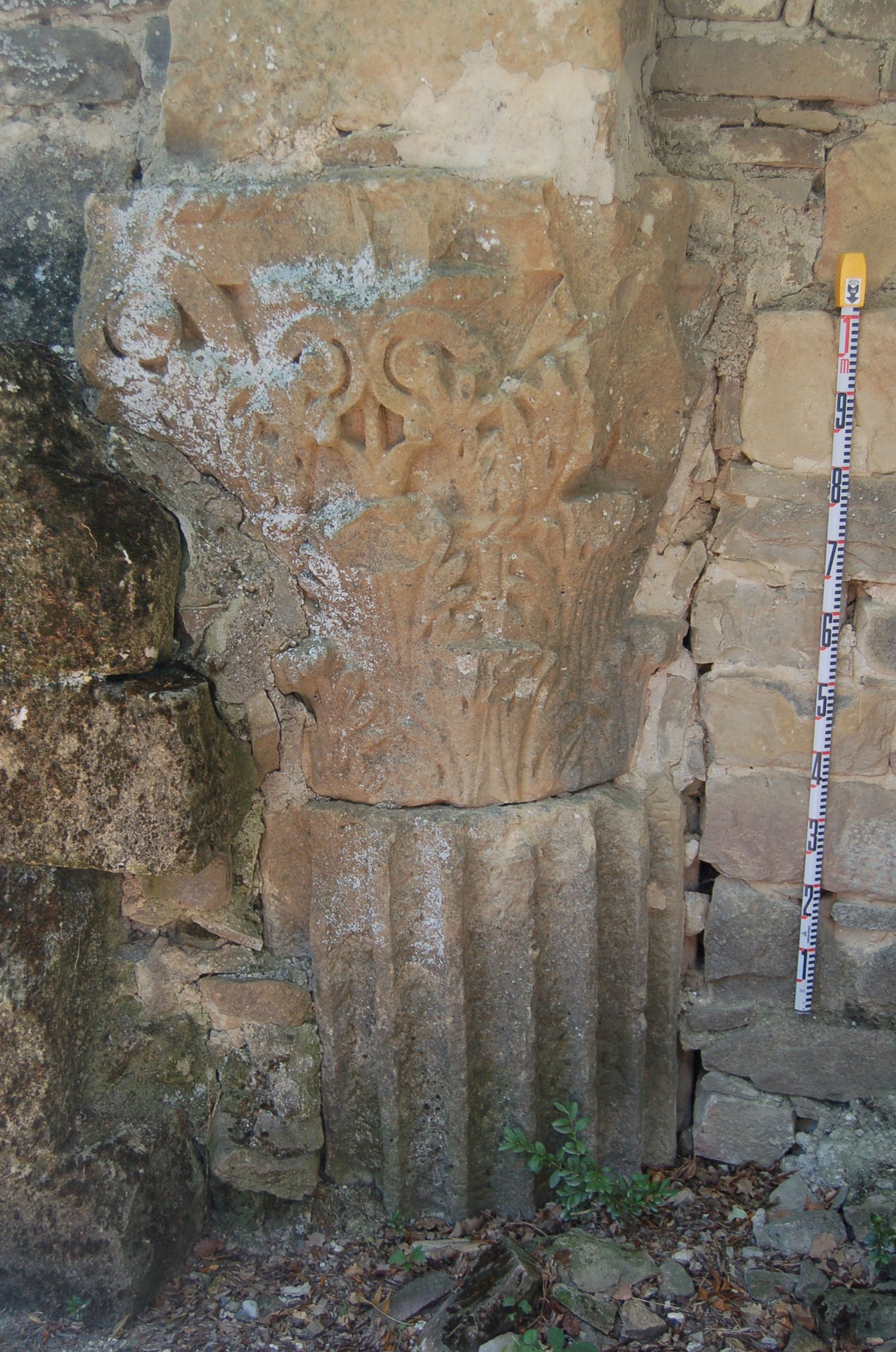
A Corinthian capital and fluted drum with a shaft located in a city discovered at the foot of the Pyrenees in 2018.

Do you ever wonder what sort of report archaeologists of a future civilization would write about your town? What if they had only the location and a few crumbled buildings to go on, no contemporary testimony? That was the plight of a group of archaeologists in Spain who investigated a “new” ancient city.

Vicente G. Olaya says at El País that archaeologists were surprised that they didn’t know the name of a recently unearthed city, but there were simply no historical documents mentioning it.

“In 2018,” he says, “the City Council of Artieda — located in northeastern Spain in the province of Zaragoza, and part of the country’s Aragon region — asked the University of Zaragoza’s Archaeology Department for help in studying some ruins located around the San Pedro hermitage, known variously as El Forau de la Tuta, Campo de la Virgen, or Campo del Royo.

“Three years later, the experts have confirmed that these sites formed a large single archaeological complex, and they detected two phases of occupation on the surface of the site: one during the imperial Roman period (the 1st to 5th centuries) and another during the early-medieval Christian era (the 9th to 13th centuries). Now, the research team has published the results in a reportEl Forau de la Tuta: A Hitherto Unknown Roman Imperial City on the Southern Slopes of the Pyrenees. …

“The report notes that based on important evidence from the ruins preserved in the hermitage, as well as artifacts held in various public and private collections and the findings at the site, the settlement was ‘of urban character — the city’s name is currently unknown — and it developed during the [Roman] imperial period. Later, the same site took on another iteration as a rural habitat during the Visigoth and early Andalusian periods.’

“The specialists have also found that, between the 9th and 13th centuries, another peasant habitat-type town or village was superimposed on top of the Roman settlement. They have identified the village as Artede, Arteda, Artieda or Arteda Ciuitate. The medieval enclave’s ruins include the apse area of the church, which was part of the San Pedro hermitage; numerous silos with circular openings, which were excavated from the subsoil and only perceptible by geo-radar; and an extensive cemetery consistent with Christian burial rites. …

“The El Forau de la Tuta site is located 1.5 kilometers from Artieda’s city center, on the fertile plain of the Aragón River. … It is possible that the site’s dimensions are even larger and that it extends to other — still unexplored — agricultural lands.

“The Roman settlement stood next to the road connecting three northern cities. … Currently known as Camino Real de Ruesta a Mianos (the High Road from Ruesta to Mianos), the road lasted through the Middle Ages as a stretch of the French Route, the Arles Way or the Via Tolosana (Tolouse Route), as part of the Way of St. James (Camino de Santiago). …

“Inside the hermitage, the study’s authors have identified two Corinthian capitals, three Italic Attic bases, a classical Attic base, several flat-edged fluted shaft drums, and a fragment of cornice. The huge dimensions and typology of the artifacts indicate that they came from several early [Roman Empire] public buildings. … 

“The study confirms that these pieces come from at least two different monuments. Their typologies indicate that they were sculpted more than half a century apart, ‘which demonstrates a prolonged period in the process of monumentalizing the city.’

“To the west of El Forau de la Tuta, next to the San Pedro ravine, ‘an impressive set of public works made of opus caementicium (the Romans’ early version of concrete) including at least four sewer outlets, a powerful massive abutment, a foundation, and a series of quadrangular structures,’ possibly supply cisterns, is also preserved. … The presence of these works is typical of urban settlements, where water drainage was a problem that had to be addressed, especially in relation to buildings, such as bath houses, that produced a large amount of water waste. …

“Archaeologists are also currently studying a sculptural fragment that is preserved in an Artieda private collection. The artifact — which was collected near the hermitage — is an incomplete, nearly life-sized left hand that holds a patera umbilicata [an offering bowl], which would have been part of a statue representing an offering figure. …

“In the first round of excavations in 2021, the archaeologists confirmed the existence of an intersection of two roads. ‘On one of the roads, possibly one of the settlement’s main streets, we documented the ruins of a sidewalk and a surface channel for draining water, which pedestrians could circumvent by means of three steppingstones.’ …

“In one of the excavations they performed, the archaeologists found ample remains of black and white mosaics made with tesserae (small cubes of stone or glass) and fragments of rudus (a layer of material placed under the tesserae). …

“Inside this structure, under a large number of slabs that fell in the building’s collapse, archaeologists found a practically complete black-and-white tessellated pavement (with some isolated red and yellow tesserae); it was extraordinarily preserved. Decorated with iconographic motifs in white on a black background, it has shells or scallops in the four corners, while the central emblem features seahorses, ridden by little Cupids, facing each other next to three representations of marine animals, a fish in the upper part and possibly two dolphins in the lower part.

“Thus, the archaeologists are certain that everything they’ve found so far ‘corresponds to a single urban complex from between the first and second centuries, and that the city had infrastructure and public monuments, including baths, a water supply system, regular urban planning, sewers, and possibly a temple.’ ” 

I can’t help thinking about the way early archaeologists (Schliemann, say, at Troy) barged in and dug at random, destroying historical records. Imagine how carefully and boringly the archaeologists in today’s story had to sift every little thing to discover the town built on top of the Roman city — and date both!

More at El País, here.

Read Full Post »

Photo: Denis Dobrovoda.
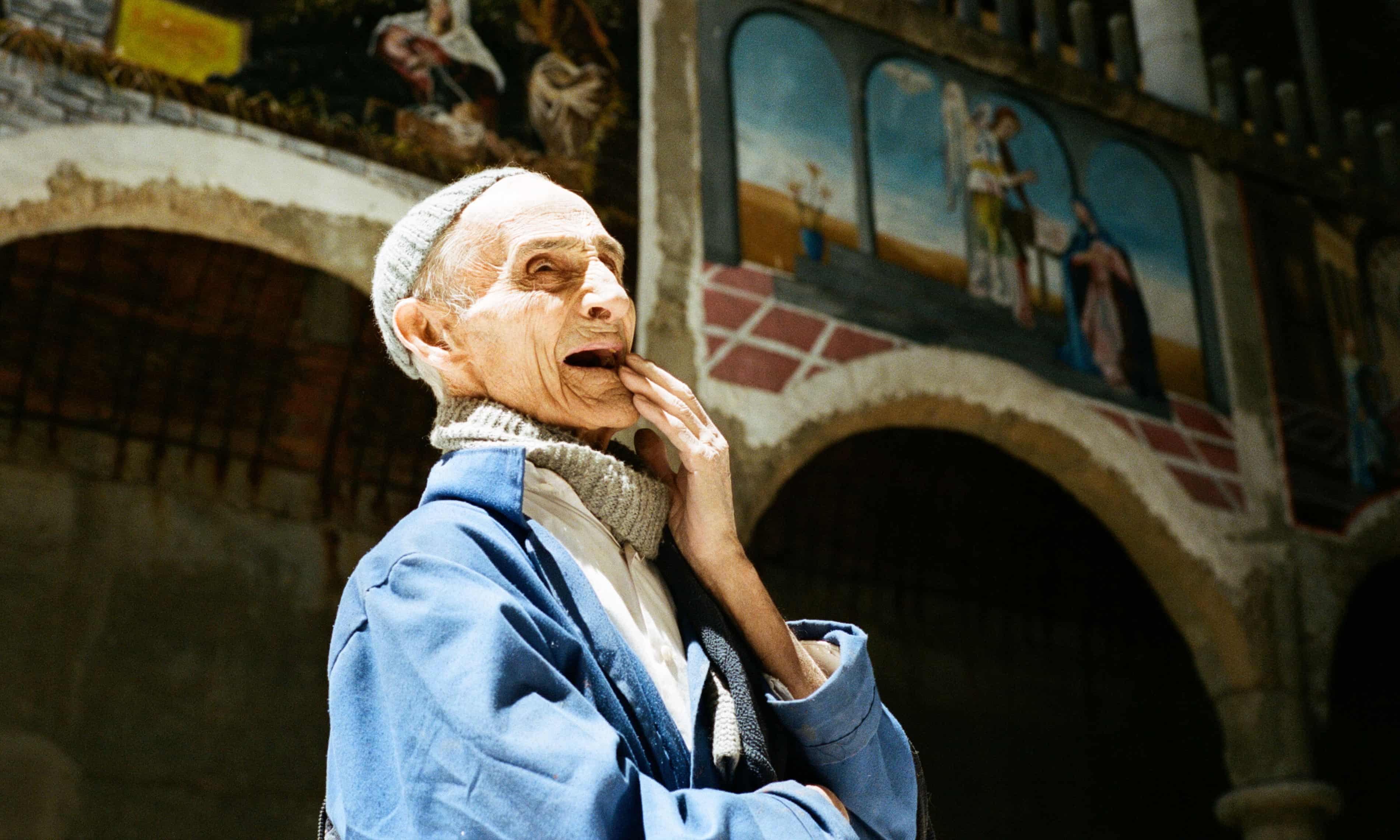
Justo Gallego Martínez, 2018, in the cathedral he built in Mejorada del Campo, Spain. The self-taught monk even made the crypt he wanted to buried in.

I often wondered about the investment of time and money that went into places people wanted to be buried. In the case of Egyptian Pharaohs and Chinese emperors, it had to do with what they believed would happen after death. But what about European kings and queens? It’s hard to understand.

Today’s story is about a contemporary monk who built a crypt for himself as part of building a cathedral — alone.

Matthew Bremner writes at the Guardian, “One late spring evening in 2018, Justo Gallego Martínez said he would show me his grave. The old man was warming his hands by a stove in the dim back room of his cathedral. A dusty film coated the concrete floor. The shelves and tables were full of relics, screws, chipped wood, crushed glass, half-eaten loaves of bread. A bare hanging bulb cast the room in jaundiced light.

“ ‘I want to be buried here,’ Justo said, signalling around him to the cathedral’s cavernous nave and the 20 trembling towers sprawled across thousands of square feet of his own land on the outskirts of Madrid. … He’d be buried there because it was his cathedral.

He’d designed it entirely in his head, without a single measurement or calculation on paper, without a record of any of the materials he’d used. And he had done it largely by himself. …

“Outside, the uncovered frame of a dome, 35 metres high and 10 metres wide, loomed above us. The nave lurched around 45 metres to our left, covered by a half-barrel vault whose exposed beams curved upwards like a whale’s ribcage.

“The rest of the cathedral was an architectural Frankenstein’s monster propped up on mismatched bricks, tires, wheels, food cans, plastic and excessive quantities of concrete. Large chunks of the building were already in decay, invaded by moss and rising damp. In the aisles dusty cement bags were piled as high as the first-floor gallery. Other rooms erupted with broken tiles, dismantled cement mixers, motorbikes, rotten wood, oxidised saws, festering ropes, chicken carcasses and plastic bags fossilised in pigeon shit. It sprawled over an area the size of a football pitch. …

“Next to the shrine, the floor opened to the darkness of the crypt below. This hole was where it had all begun, Justo said. Here, he had first started to dig, and to formulate his vision. …

“In early 2018, I came across an article in a local paper about an ex-monk building a cathedral in Mejorada del Campo, just outside Madrid. For almost 60 years, with no help or architectural expertise, Justo Gallego Martínez had been constructing a cathedral that was almost the size of the Sagrada Familia, using waste and recycled materials.

“When the monk started his project, the locals had called him a madman. Since then he had fought with family members, made enemies and won an adoring international public. He had never gained formal permission to build the structure, which meant it was illegal. …

“As I got to know Justo better, I realized that he was a mess of incongruities. He could be open-minded and bigoted, forgiving and stubborn, kind and brusque, wise and simple. He was a flawed genius, who never sought to be named as such. …

“Justo’s early life was marked by religious fervor, political upheavals and health problems. As a boy, he was very close to his mother. ‘She was the one that taught me the words of the Bible,’ he said. At an early age, he had to leave school to escape the dangers of the Spanish civil war, which ravaged Madrid and its surroundings. His mother’s teachings were a vital part of the little education that Justo would receive.

“The young man had always dreamed of dedicating his life to God. … At the age of 27, he entered the monastery of Santa María de Huerta in Soria, northern Spain. Many of his fellow monks found him strident and difficult; he would work longer hours than necessary and often pray into the night. Insisting on remaining teetotal, he even refused to drink the wine during communion. ‘They were very suspicious of me,’ he once told local journalists. ‘They said I was breaking the rules.’ …

“Justo told me that after he was rejected from the monastery, he went to Mejorada del Campo and fell into a ‘funk,’ what we might consider depression. … Where would he channel his religious fervor? What could he do with himself that would mean anything? It was in the midst of this self-questioning, he said, that it came to him – the idea to build something for his creator: a cathedral, which would demonstrate his willingness to sacrifice himself for God.

“So, in 1961, he started to dig.

“Justo worked feverishly. Alone, he barrelled mountains of dirt, scaled scaffolding with no harness and soldered with no mask. Sometimes he would have visions. Laying bricks, he would suddenly remember the holy trinity, drop to his knees and weep. …

“Justo came from a relatively well-off family who owned land near Madrid. Over the years, he sold much of it to fund the construction of his church. He also relied heavily on charity. …

“Justo hated sharp angles and straight lines and tried to avoid them at all costs. He preferred curves and circles – vaulted ceilings, domes, arches, rounded chapels, annular altars and spiral staircases. ‘God made all things round. He made the planets round. He made the earth round.’

“To make circles he would bend metal rods around columns and draw around circular water drums or tins of paint. But making curves was more difficult. They were expensive and had little tolerance for error. A millimeter of imprecision in one step could culminate in a spiral staircase that didn’t quite reach its landing.

“The curve Justo loved most was the dome, which was modeled on St Peter’s basilica in Rome. With large blue metal girders curving up to a pressure ring at its centre, it looked like a mechanical spider atop the nave. The dome took him 30 years to imagine and seven years to build. It is the only thing I ever heard him boast about. …

“Justo made up for his technical shortcomings by devising strange solutions. He piled empty paint cans on top of one another and filled them with concrete to make columns. He bent corrugated iron rods and fed them through slinky-like springs to create the structure for arches. When the columns he built were too short, he filled the gaps with clumps of iron, piling them up like mismatched books to the height of the support beams. He’d then solder them together. …

“Soon there was interest from local newspapers. Then the national press came, followed by journalists from abroad. At the end of 2003, photographs of Justo’s cathedral appeared in an exhibition at the Museum of Modern Art in New York. …

“The cathedral became even more famous in 2005 when it appeared in an advertisement for a new soft drink made by the Coca-Cola Company. Justo only agreed to the advert to get funds to continue building. He wasn’t thinking about cash, only more bricks. Indeed, when the commercial was shot, Justo had no idea of the consequences of his decision: ‘I didn’t know it was going to be on TV. I thought they were just going to print something on the side of the can.’

“There was an irony to the advert’s success. While Justo had tried to embody temperance and humility, one of the world’s biggest brands had turned his abnegation of the ego into the exact opposite – a celebration of individual accomplishment. The ad had made his faith synonymous with ambition, his devotion with perseverance, and his sacrifice with self-interest.

“Over the years, tens of thousands of people have come to visit the cathedral. They all want to see Justo – to touch him, to hear him speak, to understand him, his inspiration, his genius and his imagination. I saw old ladies kiss him, pilgrims accost him and fanatics pitch him with all manner of schemes for the future of the cathedral.

“People often talked about him in saintly terms. They marveled that, during almost 60 years of construction, he had suffered no significant injury. Carlos Luis Martin, an architect who helped Justo at the cathedral, recalled witnessing an accident: ‘I was working in the crypt. Justo tripped over a stone and fell and smashed his head on the ground hard … “God has healed me, and now all is fine,” he said. And there was not a scratch on him.’ ”

Read the article at the Guardian, here. No firewall. Justo Gallego Martínez died on 28 November 2021.

Read Full Post »

Photo: IPHES.
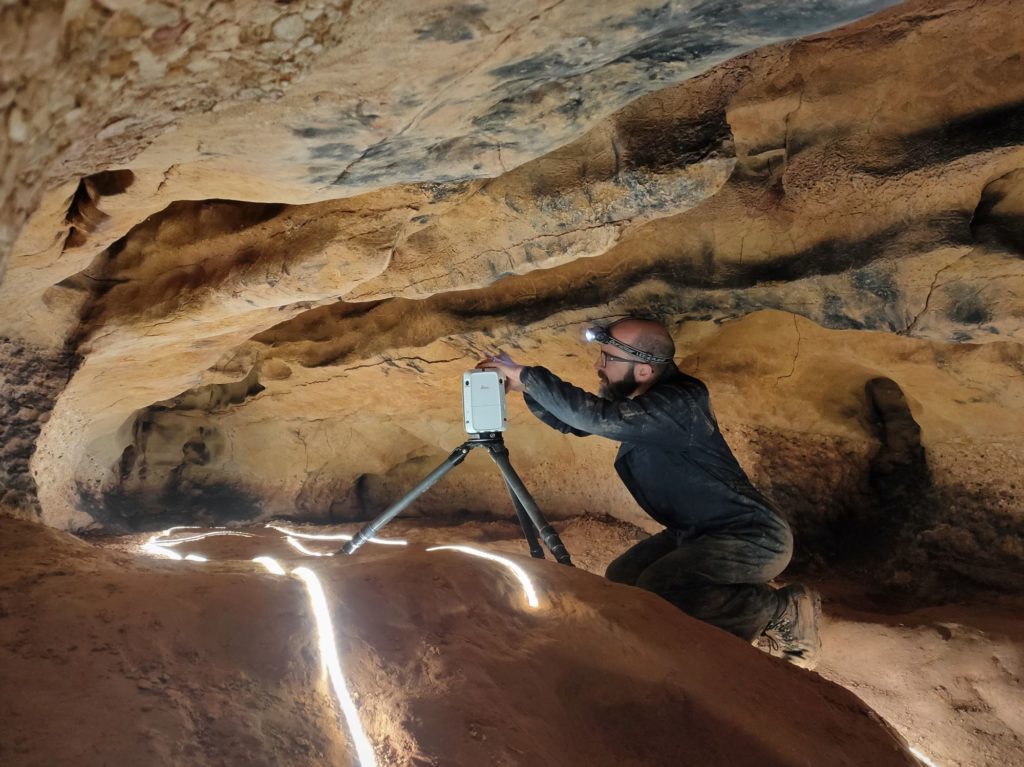
Archaeologist makes a 3D scan of the prehistoric cave art at Font Major in Spain.

Without going into space and littering it with our detritus and conflicts, there are plenty of unknowns here to satisfy our taste for exploration. In this article from ArtNet News, we learn, for example, about a recent discovery made in Spain that opened up a whole new batch of mysteries.

Javier Pes writes, “Experts have discovered a cave full of prehistoric carvings in northern Spain. Among the hundreds of rock carvings, some believed to be 15,000 years old, are vivid depictions of horses, deer, and bulls, as well as a wealth of mysterious and abstract symbols. Unlike the famous prehistoric paintings at Altamira, also in northern Spain, the recently discovered cave art in Catalonia is carved directly into the soft surface of the rock.

“A team of archaeologists stumbled across the richly decorated cave at the end of October 2019. … Josep Maria Vergès, who led the team from IPHES (the Catalan Institute of Human Palaeoecology and Social Evolution) described the find as ‘exceptional’ in a statement, and compared the cave to a ‘shrine.’

“The cave art is now being recorded and studied using 3D scanning technology. The engravings were created on a layer of soft sand deposited on the cave’s surface in an area that is difficult to access. The artworks are extremely fragile. … Several figures seem to have been damaged in the past by visitors who were unaware of their existence. Experts are now studying the best way to preserve the remarkable finds.

“Vergès tells Artnet News, that he felt a ‘mixture of surprise and disbelief, followed by great satisfaction,’ when the he first saw the ancient works of art. ‘Surprise because the cave is not an ideal place to find engravings due to the characteristics of the rock, the walls were very irregular, and the specialists thought that it was not suitable for painting or engraving.’ …

“The oldest art in the cave is believed to date back to the Late Stone Age, or Upper Paleolithic period. The earliest cave paintings at Altamira date from the same period, although they are around 20,000 years older. 

“Researchers uncovered the art within a nearly two-mile-long complex of caverns about 60 miles from Barcelona called the Cave of Font Major, which was first discovered in 1853. Parts of this cave complex, one of Europe’s largest, are open as a subterranean museum, although the specific stretch containing these carvings is closed to the public. …

“[In a related event] anthropologists working at Abri Blanchard in France’s Vézère Valley announced in 2017 the rediscovery of a 38,000-year-old rock engraving. It depicts an aurochs, or wild cow, and rows of dots. That ancient image is believed to be one of the earliest artworks found in Europe.”

More at ArtNet News, here.

Read Full Post »

Sometimes when scientists are doing basic research with no practical application in sight they land on the missing piece to understanding a rare disease. And when conservationists preserve some creature no one else cares about, the world may later find that the creature is essential to a whole ecosystem. Unexpected discoveries are often the best kind.

Meanwhile, in the department of Treasures Found While Seeking Something Else, there’s a delightful report at the BBC on the unsought discovery of a rare copy of Shakespeare’s last play. No one would have found it if they were looking for it.

Reevel Alderson from BBC Scotland writes, “The Two Noble Kinsmen, written by Shakespeare with John Fletcher, was found by a researcher investigating the work of the Scots economist Adam Smith. …

“In the 17th Century, the seminary in Madrid was an important source of English literature for Spanish intellectuals. The Two Noble Kinsmen was included in a volume made up of several English plays printed from 1630 to 1635.

“Dr John Stone, of the University of Barcelona, said he found it among old books in the library of the Real Colegio de Escoceses — Royal Scots College (RSC) — which is now in Salamanca.

” ‘Friendship turns to rivalry in this study of the intoxication and strangeness of love,’ is how the Royal Shakespeare Company described the play, which is based on Chaucer’s The Knight’s Tale.

“It was probably written around 1613-14 by Shakespeare and John Fletcher, one of the house playwrights in the Bard’s theatre company the King’s Men. …

“Described as a ‘tragicomedy,’ the play features best friends, who are knights captured in a battle. From the window of their prison they see a beautiful woman with whom they each fall in love. Within a moment they have turned from intimate friends to jealous rivals in a strange love story which features absurd adventures and confusions.

“Dr Stone, who has worked in Edinburgh and Aberdeen, said: ‘It is likely these plays arrived as part of some student’s personal library or at the request of the rector of the Royal Scots College, Hugh Semple, who was friends with the Spanish playwright Lope de Vega and had more plays in his personal library. …

” ‘In the 17th and 18th Centuries, collections of books in English were rare in Spain because of ecclesiastical censorship, but the Scots college had special authorisation to import whatever they wanted.’ …

“The rector of the Scots College, Father Tom Kilbride, said the college was proud such an important work had been discovered in its library.

“He said: ‘It says a lot about the kind of education the trainee priests were getting from the foundation of the college in Madrid in 1627, a rounded education in which the culture of the period played an important part. To think that plays would have been read, and possibly performed at that time is quite exciting. There was clearly a great interest in Spain at that time in English literature.’

“The RSC no longer trains men for the priesthood in Scotland, but offers preparatory six-month courses for those expressing a vocation, and holds regular retreats and conferences for the Scottish Catholic community.” More at the BBC, here.

Hat tip: ArtsJournal.com.

Read Full Post »

Photo: Etienne Naude
“I felt that I was making something bigger than me,” said Angel Sierra (right) after he and Etienne Naude made the Earth into a sandwich with pieces of bread 8,000 miles apart.

I love any attention-getting gag meant to show we are all part of one world. This story describes a feat that seems silly on the surface, but draws attention to something deep. Eight thousand miles deep.

As Owen Amos reported at the BBC in January, “Two men in New Zealand and Spain have created an ‘Earth sandwich’ — by placing bread on precise points, either side of the planet, at the same time.

“The man behind the sandwich, Etienne Naude from Auckland, told the BBC he wanted to make one for ‘years,’ but had struggled to find someone in Spain, on the other side of the globe. He finally found someone after posting on the online message board, Reddit.

“The men used longitude and latitude to make sure they were precisely opposite. That meant there was around 12,724km (7,917 miles) of Earth packed between the slices — and some 20,000km between the men, for those forced to travel the conventional route.

“The first ‘Earth sandwich’ is credited to the American artist Ze Frank, who organised two slices of baguette to be placed in New Zealand and Spain in 2006. …

“Wanting to create his own, Mr Naude, 19, used an online longitude and latitude tool called ‘tunnel to the other side of the Earth’ to find his exact opposite point. …

“He posted on the Spain section of the online message board Reddit. He got ‘a few replies’ and found one person close to the precise location.

Angel Sierra, a 34-year-old chef, told the BBC he replied to the message because ‘it can help to show how people can work together across the globe … I felt that I was making something bigger than me.’ …

“Once the men were in contact, then came the tricky part — making a sandwich with another person when you are on opposite sides of the planet.

” ‘It was quite hard to organise since it’s 12-hour time difference,’ Mr Naude said. ‘And there’s lots of things to arrange, such as the kind of bread, the time, the [precise] location, et cetera. … It’s quite tough to find a spot which isn’t water on the New Zealand end — and where public roads or paths intersect in both sides.’ …

“Using a ‘near top of the range laser cutter,’ he burnt an ‘Earth sandwich’ design onto 20 slices of bread, then used one slice to mark his exact, tightly defined sandwich spot in New Zealand.

“His counterpart used nine slices of unmarked bread to make sure he covered the exact spot. …

“The scientific name for points opposite each other on the Earth’s surface is antipodes … According to World Atlas, only around 15% of ‘territorial land’ is antipodal to other land. The UK, Australia and most of the US do not have antipodal land points — the other side of the world is water. More at the BBC, here.

Naude was later reported saying, “It’s also quite nice to just know that there is someone at the exact opposite point of the world that has done exactly the same thing as you. In this one particular instance, we’ve got entirely different lives, but we are now connected by this one point.”

Read Full Post »

spanish-stonehenge-1024x604

Photo: Ruben Ortega Martin, Raices de Peraleda
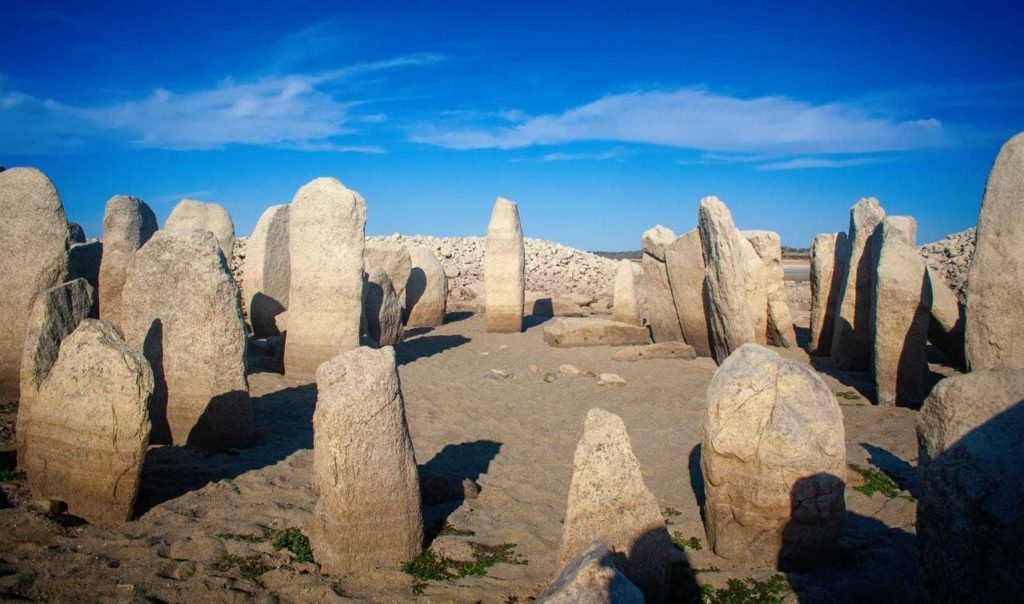
Drought has uncovered a Spanish version of Stonehenge, the 7,000-year-old Dolmen of Guadalperal.

As global warming brings changes to our planet, the permafrost is melting and releasing dangerous bacteria. But sometimes other, less harmful things come to light.

Caroline Goldstein writes at ArtNet, “If there’s even the slightest silver lining to the ravages of climate change, it’s that the warming conditions are revealing some previously unknown archaeological sites and artifacts.

“This past summer, an extreme drought in the Extremadura area of Spain that caused the Valdecañas Reservoir’s water levels to plummet has revealed a series of megalithic stones. Previously submerged underwater, the Dolmen de Guadalperal, often called the Spanish Stonehenge, are now in plain sight.

“Though the Dolmen are 7,000 years old, the last time they were seen in their entirety was around 1963, when the reservoir was built as part of Franco’s push toward modernization. …

“Angel Castaño, who lives near the reservoir and serves as the president of a Spanish cultural group, told the website the Local, ‘We grew up hearing about the legend of the treasure hidden beneath the lake and now we finally get to view them.’

“The approximately 100 menhirs are, like Stonehenge, hulking megalith stones — some standing up to six feet tall — that are arranged in an oval and appear oriented to filter sunlight. Evidence suggests that these stones could actually be 2,000 years older than Stonehenge.

“Castaño is working with the group Raices de Peraleda to move the dolmen before rains come and re-submerge them. ‘Whatever we do here needs to be done extremely carefully.’ he said.”

I guess so. I can’t help wondering if it would be better to move the reservoir and leave the stones, which obviously were placed where they are for a reason. But not being an engineer, I suppose moving the reservoir would be even more difficult. And already access to water is becoming a serious problem around the world. (For a heartbreaking story about the difficulty many Navajo people have getting clean water, read this.)

So hard to balance conflicting goods!

More here.

Read Full Post »

Older Posts »