Feeds:
Posts
Comments

Posts Tagged ‘study’

Map: Cloudwards.

Using Google searches to analyze which books are most popular in each US state seems about as flaky a brand of research as can be, but it’s kind of fun anyway. I mean: The favorite genre in Texas is fantasy? I need to ponder that for a while.

Kelly Jensen writes at Book Riot, “Are there different preferences for book genres depending on what state you’re in? According to new research from Cloudwards, there are trends in book preferences based on location.

“Utilizing Google Trends data over the last 12 months, Cloudwards explored the most searched genre in each of the 50 states, plus the District of Columbia. All searches were limited to Google Trends ‘Books and Literature’ category, and the researchers used a variety of common genre terms to determine the frequency of interest in them by state. Some of the genre categories were a little unconventional for the average reader –- how do you determine the difference between ‘fiction’ and ‘family’ as terms -– but the major genres were included, including romance, fantasy, mystery, and so forth.

“Romance dominated in terms of genre popularity across the US, with 22 states seeing it as their top searched genre. In terms of geographic region, romance was especially popular in the south, with states like Florida, Georgia, Louisiana, Tennessee, Kentucky, and Virginia ranking it as their top genre.

“Fiction and poetry tied for next most popular genres, each either nine states reporting it as the most searched genre. The researchers note that these findings aren’t surprising, given that fiction is broad and encompassing. As for poetry, it is likely not surprising to see people looking for more information about poetry; the research here isn’t about poetry being the most read genre, but rather, one of the most researched genres.

“The next most popular genres were fantasy (six states), family (3 states), mystery (1 state), and fantasy (1 state).

“It should come as little surprise there is so much national interest in romance. It is a genre that consistently sells well across all of its subgenres, and in 2023, print romance books sold upwards of 39 million copies. …

“One of the most surprising findings might be that only one state ranked historical fiction as its most popular genre. That state was Massachusetts. It is a perennially popular genre among readers, and it is a genre that has been a long-running staple on best-of and awards lists. …

“The researchers note that their methodology lacks scientific scrutiny but shows a general idea of interest in different reading genres. Among some of the weaknesses of this study are the loosely-defined genres, as well as the lack of nuance when it comes to format of genre. It’s not clear whether or not the researchers looked into genres outside of those which ranked among the top in the US, as there’s no full list of utilized search terms. There is no indication in the research, for example, whether or not science fiction or westerns were researched, and while horror is a mood and not a genre, it is surprising to see zero representation for horror here, either.

“Furthermore, poetry encompasses a wide variety of genres, as it is a format, rather than a genre. It’s also worth wondering where and how graphic novels in their myriad genres fit in with reader popularity.

“If there’s a takeaway, it’s this: no matter how frequently romance novels can be derided or belittled in pop culture, it’s a genre that is thriving, that is growing, and that tops the list of genres readers are interested in in nearly half of the United States.”

This is fun, but I really think that a more useful study would analyze books sales and library book preferences, don’t you?

It’s hard for me to name a book genre that is my favorite. I love fantasy, but I read many more mysteries than fantasies as there are so few good fantasies. I love certain kinds of biography but read more fiction than biography. I live in Massachusetts but hate historical fiction. If asked about your favorite genre, how would you answer?

More at Book Riot, here. See unscientific results for individual states here.

Read Full Post »

Photo: Nilo Merino Recalde.
A visual representation of an audio clip of five different great tit birds singing one song each.

There is so much for humans to learn about other species! The other day, a post on household pets reacting to the animated film Flow inspired Deb in Tennessee to conduct her own experiment with her dog. She learned that Buster, for one, was bored by Flow, failing to replicate the anecdotal evidence of curiosity described at the New York Times — a good example of why studies usually say, “More research is needed.”

Today we learn something new about birds, but maybe it’s only certain birds.

Victoria Craw writes at the Washington Post, “They sound beautiful, herald the start of spring, and even have the power to reduce stress and boost mental health.

“Now it turns out that some birdsongs also contain a hidden world of shared language, with varying local accents and dialects that change depending on the age of the bird and its peers — not unlike human songs.

“ ‘Just as human communities develop distinct dialects and musical traditions, some birds also have local song cultures that evolve over time,’ said Nilo Merino Recalde of the University of Oxford’s biology department, who led the new research published in the journal Current Biology. ‘Our study shows exactly how population dynamics — the comings and goings of individual birds — affect this cultural learning process.’ …

“The study is based on analysis of over 100,000 bird songs from at least 242 birds recorded in 2020, 2021 and 2022 in Wytham Woods in Britain’s Oxfordshire — a sprawling 1,000-acre wood where ecological and environmental research is carried out. For the last 77 years it has been the site of the Wytham Great Tit Study showing how two species of tit — the great tit and blue tit — have changed over time. …

“While some birds learn songs from their fathers and others learn continuously from neighbors, great tits are believed to do most of their learning in the first 10-11 months of life. …

“Merino Recalde said he was inspired by his love of birds and interest in social learning in animals, which creates an evolving shared culture reminiscent of the way humans learn languages and music. Theoretical work indicates that factors such as population turnover, immigration and age can affect the evolution of these cultural traits — so far, however, empirical evidence on the subject has been limited.

“His research team focused on the great tit, a small bird that lives just 1.9 years on average. The team recorded the ‘dawn chorus’ from March to May — coinciding with breeding season — using microphones placed near nesting boxes to gather more than 200,000 hours of the ‘simple yet highly diverse songs’ sung by males. Through a combination of physical capture, microchips and an artificial intelligence model, researchers were able to recognize the songs of individual birds and track how they changed over time, showing each bird had a repertoire ranging from one to more than 10 tunes.

“ ‘One of the main findings was that the distance that these birds travel while they are learning the songs, and also the ages of the other birds they interact with … affect how varied their songs become, collectively,’ Merino Recalde said. …

” ‘Homegrown’ songs in areas where birds stay close to their birthplace tend to stay unique, similar to the way in which isolated human communities can develop distinct local dialects over time, the team found.

“Age also had a significant impact, with birds of a similar age singing similar tunes, whereas mixed-age neighborhoods had ‘higher cultural diversity.’

This shows that the older birds can act as guardians of culture as they ‘continue to sing song types that are becoming less frequent in the population,’ researchers said.

“ ‘In this way, older birds can function as “cultural repositories” of older song types that younger birds may not know, just as grandparents might remember songs that today’s teenagers have never heard.’ …

“Merino Recalde said capturing how population changes are reflected in song could provide a future avenue for less invasive research, eliminating the need for capturing and tagging animals, for instance. …

“Professor Richard Gregory, the head of monitoring conservation science at Britain’s Royal Society for the Protection of Birds (RSPB), who was not involved with the study, praised the ‘herculean’ effort to analyze such a large data sample over a three-year period and said similar research could be used to highlight ‘critical tipping points’ for a population in future.

“While the great tit is not endangered, Gregory said the study could help inform plans to reintroduce or relocate certain animals, as such conservation efforts may be ‘doomed’ if they don’t take their cultural traits into account. ‘This study reminds us that the details of an animal’s life really matter.’

“Gregory, who is also an honorary professor of genetics, evolution and environment at University College London, said the study also showed that ‘methods of wildlife recording and song analysis are developing at break-neck speed,’ and AI is going to ‘revolutionize conservation science’ by allowing patterns in nature to be identified more readily.”

More at the Post, here. You can listen to an audio clip there.

Read Full Post »

Photo: Jazeen Hollings via Wikimedia.

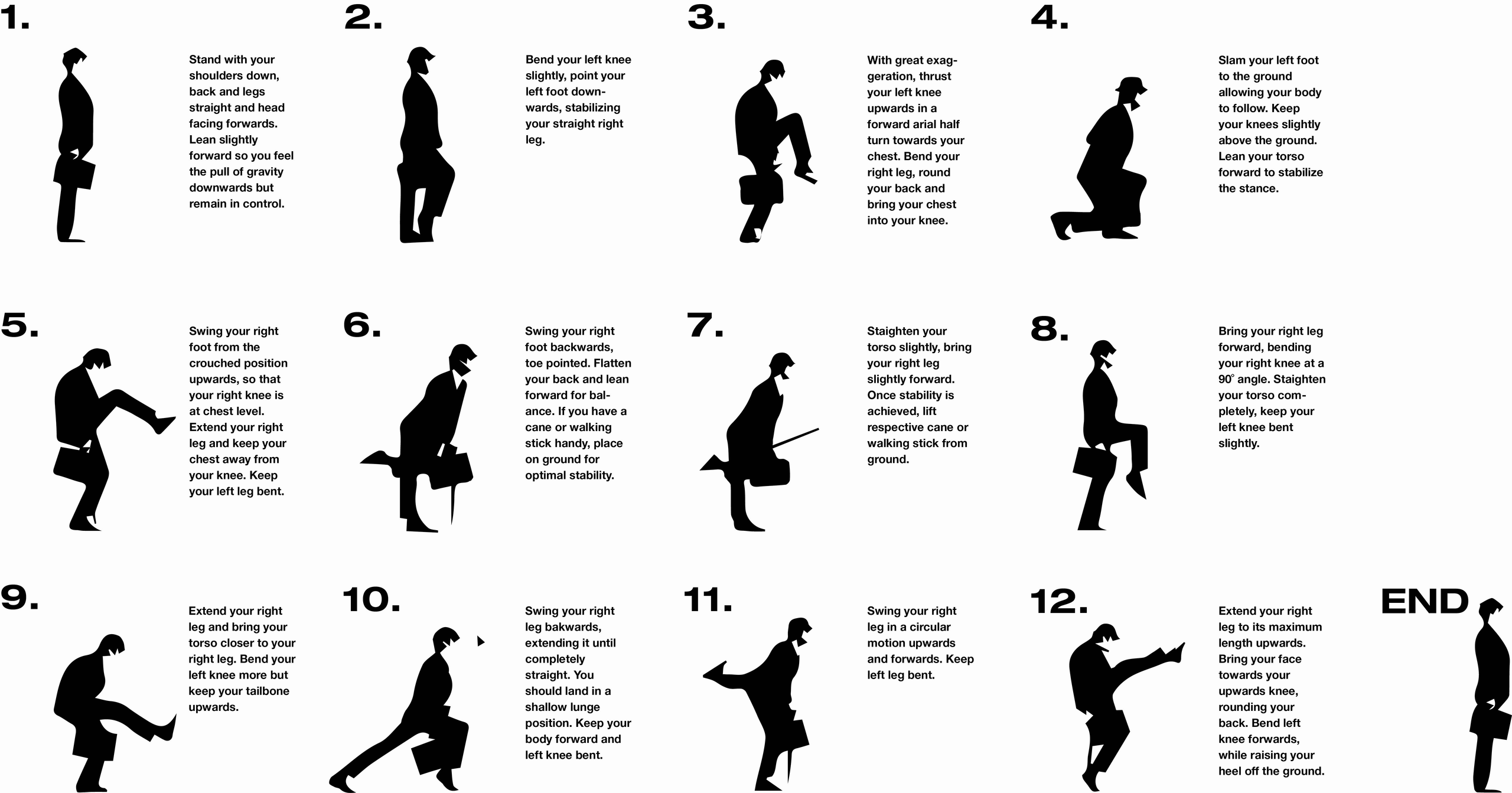
Working at maintaining your health through exercise? Here’s a form of exercise I bet you haven’t tried yet: Monty Python silly walks.

Gretchen Reynolds reports at the Washington Post that “a not-so-serious study discovered that a walking style made famous by the comedy troupe … works, according to an important — or, at least, actual — study published [in] the annual holiday edition of the BMJ, a British medical journal.

“Employing high-tech science and a tittering adolescent’s sensibility, the study’s researchers filmed volunteers perambulating like the ungainly bureaucrats in the Monty Python comedy troupe’s Ministry of Silly Walks sketch, while wearing metabolic monitors.

“Their aim was to determine the physiological effects of ambling around a track in the manner of the actor John Cleese, playing the apparently boneless Mr. Teabag, the head of the Ministry of Silly Walks, or Michael Palin’s Mr. Putey, a wannabe silly walker whose screwball stroll needs work.

“The scientists soberly wondered whether silly-fying people’s walking form would up the intensity and caloric expenditure of their exercise and make an otherwise simple stroll into a serious workout. …

“ ‘What we wanted to know was, how would deliberately inefficient walking affect energy costs?’ said Glenn Gaesser, a professor of exercise physiology at Arizona State University in Phoenix, who led the new study. …

“To find out, Gaesser and his colleagues gathered 13 healthy adults, ages 22 to 71, and had them watch the Ministry of Silly Walks sketch several times.

“For those unfamiliar with the skit, Mr. Teabag leads his ministry by example, moving like an unhinged heron, high-kicking, low-bobbing and randomly whisking up and jiggling his knees with abandon. The more-sedate Mr. Putey merely hitches his left leg out a bit with every other step, a motion the disapproving Mr. Teabag finds ‘not particularly silly.’

“After absorbing the basics of silly walking, the study volunteers donned a facial apparatus to measure their oxygen uptake and started walking around a short track in Gaesser’s lab. First, they walked as themselves, at their preferred pace, for five minutes. Then, they copied Mr. Putey, hooking out their left leg sometimes, for another five minutes. Finally, they went full-on silly, imitating Mr. Teabag’s demented eggbeater strides, for the concluding five minutes, generally giggling throughout, Gaesser said.

“Afterward, the scientists calculated the walkers’ speed and metabolic costs during each form.

“Silly walking like Mr. Teabag proved to be much harder than un-silly walking, requiring about 2.5 times as much energy. Putey-style strolling, meanwhile, was comparable to normal walking in terms of energy expenditure, but slower.

“In practical terms, these findings suggest super-silly walking can be strenuous enough to qualify as ‘vigorous exercise,’ Gaesser said.

If someone adopts a silly walk for at least 11 minutes a day, he continued, they will meet the standard recommendation of at least 75 minutes of vigorous exercise every week, which should meaningfully improve health and aerobic fitness. …

“Said David Raichlen, a professor of human and evolutionary biology at the University of Southern California in Los Angeles, [who] was not involved with this study, ‘Across human evolution, one of our key adaptive advantages was the development of a very economical, bipedal walking gait,’ [so] normal walking barely challenges our hearts and lungs or burns many calories. …

“But we can upset this walking ease ‘through biomechanical tweaks like those seen in the silly walks,’ Raichlen said, increasing the energy expenditure of getting from place to place.

“Gaesser, in fact, believes the utility of silly walking may lie in using it to replace our most quotidian strolls. Heading to the bus stop? Lift your knees, he said. Dip your rump. You’ll burn extra calories and improve your fitness.”

I was unfortunately not able to learn what John Cleese thinks of the study. More at the Post, here.

Note: “Gaesser said he understands walking is an enormous challenge for people with some disabilities, and the study was not meant, in any way, to exclude or mock them.”

Read Full Post »

Photo: קלאופטרה.
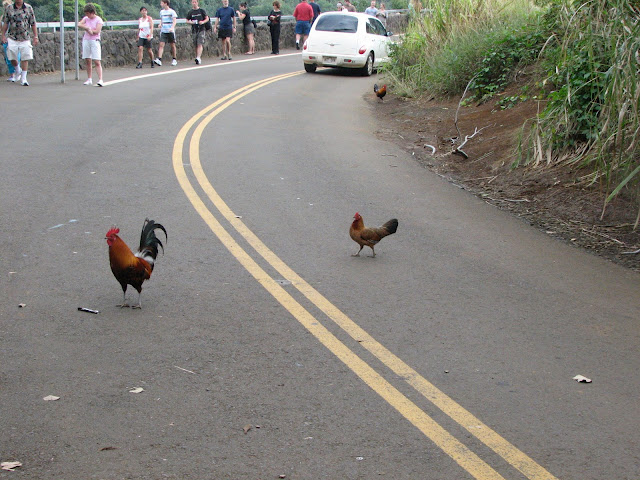
Part of “Matanya’s graduation project” at Wikipedia. See amusing answers to the perennial question “Why did the chicken cross the road?

The way the people at the Farm Sanctuary in Watkins Glen, NY, talk about the animals they study reminds me so much of the naturalist Sy Montgomery, a frequent visitor to Boston Public Radio. I only ever heard her speak disparagingly of one critter, and it was one without a brain. To her, all creatures have personalities, even souls.

Emily Anthes reported recently at the New York Times about the Farm Sanctuary.

“It was a crisp October day at Farm Sanctuary, and inside the small, red barn, the chicken people were restless.

“A rooster, or maybe two, yodeled somewhere out of sight. A bruiser of a turkey strutted through an open door, tail feathers spread like an ornamental fan. And a penned flock of white-feathered hens emitted tiny, intermittent squeaks, an asynchronous symphony of chicken sneezes.

“The hens were experiencing a flare-up of a chronic respiratory condition, said Sasha Prasad-Shreckengast, the sanctuary’s manager of research and animal welfare, who was preparing to enter the chicken pen. She donned gloves and shoe covers, threw on a pair of blue scrubs and then slipped inside, squatting to bring herself face-to-face with the first hen who approached.

“ ‘Who are you?’ she cooed.

“Ms. Prasad-Shreckengast meant the question literally. She was trying to find the birds that were enrolled in her study: an investigation into whether chickens — animals not often heralded for their brainpower — enjoy learning.

“But her question was also the big philosophical one driving the new, in-house research team at Farm Sanctuary, a nonprofit that has spent more than 35 years trying to end animal agriculture. …

“A growing body of research suggests that farmed species are brainy beings: Chickens can anticipate the future, goats appear to solicit help from humans, and pigs may pick up on one another’s emotions.

“But scientists still know far less about the minds of chickens or cows than they do about those of apes or dogs, said Christian Nawroth, a scientist studying behavior and cognition at the Research Institute for Farm Animal Biology in Germany. ‘I’m still baffled how little we know about farm animals, given the amount or the numbers that we keep,’ he said. …

‘They have their own desires, and their own wants and preferences and needs, and their own inner lives — the same way that human people do,’ said Lauri Torgerson-White, the sanctuary’s director of research.

“Now the sanctuary is trying to collect enough data to convince the general public of the humanity of animals.

“ ‘Our hope,’ Ms. Torgerson-White said, ‘is that through utilizing really rigorous methodologies, we are able to uncover pieces of information about the inner lives of farmed animals that can be used to really change hearts and minds about how these animals are used by society.’

“The sanctuary is conducting the research in accordance with its own strict ethical standards, which include giving the animals the right to choose whether or not to participate in studies. Consequently, the researchers have sometimes found themselves grappling with the very thing that they are keen to demonstrate: that animals have minds of their own.

“And today, the birds in ‘West Chicken’ seemed a bit under the weather. Ms. Prasad-Shreckengast crossed her fingers that a few of them might still be up for a brief demonstration. …

“Farm Sanctuary began not as a home for rescued animals but with a group of young activists working to expose animal cruelty at farms, stockyards and slaughterhouses.

“ ‘We lived in a school bus on a tofu farm for a couple of years,’ said Gene Baur, the president and co-founder of the organization. But in the course of its investigations, the group kept stumbling upon ‘living animals left for dead,’ he recalled. ‘And so we started rescuing them.’ …

“In 2020, the organization, which now houses about 700 animals, began assembling an internal research team. The goal was to assemble more evidence that, as Mr. Baur put it, ‘these animals are more than just pieces of meat. There’s emotion there.

‘There is individual personality there. There’s somebody, not something.’

“The research team worked with Lori Gruen, an animal ethicist at Wesleyan University, to develop a set of ethics guidelines. The goal, Dr. Gruen explained, was to create a framework for conducting animal research ‘without dominance, without control, without instrumentalization.’

“Among other stipulations, the guidelines prohibit invasive procedures — forbidding even blood draws unless they are medically necessary — and state that the studies must benefit the animals. And participation? It’s voluntary. …

“The idea is not entirely novel. Zoo animals, for instance, are often trained to cooperate in their own health care, as well as in studies that might stem from it. But such practices remain far from the norm.

“For the researchers at Farm Sanctuary, voluntary participation was not only an ethical imperative but also, they thought, a path to better science. Many prior studies have been conducted on farms or in laboratories, settings in which stress or fear might affect animals’ behavior or even impair their cognitive performance, the researchers note.

“ ‘Our hope is that they’re able to tell us more about what the upper limits are for their cognition and emotional capacities and social structures because of the environment that they’re in and because of the way we are performing the research,’ Ms. Torgerson-White said.

“Although the approach is unconventional, outside scientists described the sanctuary’s ethical guidelines as admirable and its research questions as interesting.”

“ ‘The idea that you could study these species, who are usually only studied in sort of pseudofarm conditions, in more naturalistic environments that actually meet not just their needs but even their most arcane preferences — I think they’re right,’ said Georgia Mason, who directs the Campbell Center for the Study of Animal Welfare at the University of Guelph. ‘I think that really allows you to do something special.’ ”

More at the Times, here. You might also be interested in this op-ed at the Times by Sarah Smarsh on the difference between “harvesting” animals on small farms and harvesting them in the big, industrialized farms that dominate our food supply.

Read Full Post »

Photo: ThePhotoImpression at Etsy.
Bighorn sheep.

Earle sent a cool article about capturing bighorn sheep by helicopter and suggested that it might be something for the blog. It comes from the California Department of Fish and Wildlife (CDFW).

“Wildlife biologist Paige Prentice grew up surrounded by trees in Nevada City, California, and knew she had selected the right college when she saw all the redwoods on the campus of UC Santa Cruz. But it was a seasonal job after college in Death Valley National Park that spawned her love of the desert, and today she is a Desert Bighorn Sheep Biologist with CDFW, based in Inyo County. …

“CDFW: Do you remember when you first became so interested in science you realized it might become your career?

“When I was a little kid, I used to tell people that I wanted to study elephants and gorillas. After college I had the opportunity to spend six months studying orangutans on the Island of Borneo in Indonesia. And while that was an awesome once-in-a-lifetime experience, I learned that I wanted to focus on species a little closer to home. Growing up, my folks were the type of people that would drive through deserts and say, ‘It’s just hot and dry and there’s nothing here.’ I believed them, until I was 24 and I got a job in Death Valley as an AmeriCorps intern with the Park Service. It was then that fell in love with the desert. I was mesmerized by the expansive landscapes and amazed by how much life the desert supported. …

“Why does CDFW dedicate staff to Desert Bighorn Sheep specifically?

“Well, first, you have to understand that in California we have three separately managed bighorn populations. Two populations are endangered and managed under their own recovery programs — the Sierra Nevada bighorn sheep and the peninsular bighorn sheep (San Diego, Riverside and Imperial counties). Then, there is the broad grouping of desert bighorn sheep which are not endangered — these are the ones I focus on. Because … we’re interested in questions at both the population and metapopulation level, it makes sense to have a desert bighorn sheep specific program.

“As a bighorn sheep biologist, what are you studying? What are you looking at when trying to manage that population?

“Great question. There is a lot to study, given that we are looking at over 50 distinct populations across a large geographic area that is fragmented by major interstates. On a broad scale, we’re looking at which mountain ranges have bighorn in them, how many animals are in each population and how the populations are connected to one another. We conduct ground, camera, and helicopter surveys to document age and sex ratios and recruitment (lambs surviving to adulthood). We capture and collar animals to track movements, monitor survival and to test for disease. We are interested in what type of diseases are present and what the short- and long-term impacts are. We also have artificial and natural water sources in the desert, and we work with NGOs, like the Society for the Conservation of Bighorn Sheep, to makes sure these sources are maintained and stay full of water. …

“Aren’t there times we capture sheep as well, shooting nets on them from helicopters?

“Yes, we generally capture bighorn using a helicopter with a netgun. Thankfully, we’re not the ones that are flying for captures– we hire professionals for that. We conduct captures in the fall and this past November we captured and collared 100 animals across eight populations. It is a team effort and certainly a lot of work. I think some folks hear about the captures and think, ‘Why capture wild animals?’ But in fact, the work we do with captures provides the majority of the data we have to help protect these magnificent creatures.

“What is it you like about bighorn sheep?

“They completely captivate me. I am aware of very few species that are experts of such extreme environments. Within California, there are desert bighorn that live above 14,000 feet and navigate snow in the wintertime. A hundred miles to the south, there are animals in Death Valley that are living below sea level and are experiencing temperatures of over 125 degrees in the summer. When you track these animals and spend time in the landscapes in which they flourish, you can’t help but respect them. They are also one of the most graceful animals I have ever seen — watching them move with ease, at top speed up mountain sides is stunningly impressive.”

More here.

Read Full Post »

Some years ago I asked a woman who headed an excellent Rhode Island nonprofit for housing whether she gave money to panhandlers. She said she did not, and I thought I shouldn’t either. But Mother Teresa had said to smile at people in need. I found I could manage that.

The belief that giving money leads panhandlers to buy drugs has long been the common wisdom. But a new study from Canada suggests it’s wrong.

Francesca Giuliani-Hoffman reports at CNN, “You’ve heard this refrain before — giving money to homeless people is not the best way to help them because it might be squandered, or spent on harmful habits.

“But a new Canadian study makes a powerful case to the contrary. The study, dubbed ‘The New Leaf Project,’ is an initiative of Foundations for Social Change, a charitable organization based in Vancouver, in partnership with the University of British Columbia.

“Researchers gave 50 recently homeless people a lump sum of 7,500 Canadian dollars (nearly $5,700). They followed the cash recipients’ life over 12-18 months and compared their outcomes to that of a control group who didn’t receive the payment. The preliminary findings, which will be peer-reviewed next year, show that those who received cash were able to find stable housing faster, on average. By comparison, those who didn’t receive cash lagged about 12 months behind in securing more permanent housing.

“People who received cash were able to access the food they needed to live faster. Nearly 70% [maintained] greater food security throughout the year.

The recipients spent more on food, clothing and rent, while there was a 39% decrease in spending on goods like alcohol, cigarettes or drugs. …

“Said Claire Williams, the CEO and co-founder of Foundations for Social Change, ‘We really think it’s important to start testing meaningful risk-taking in the name of social change.’ …

“The 115 participants in the randomized controlled trial were between the ages of 19 and 64, and they had been homeless for an average of 6 months. Participants were screened for a low risk of mental health challenges and substance abuse. Funding for the initiative came from a grant from the Canadian federal government, and from donors and foundations in the country.

” ‘One of the things that was most striking is that most people who received the cash knew immediately what they wanted to do with that money, and that just flies in the face of stereotypes,’ Williams told CNN.

“For example, she explained some cash recipients knew they wanted to use the money to move into housing, or invest in transportation — getting a bike, or taking their cars to the repair shop to be able to keep their jobs. Others wanted to purchase computers. A number of them wanted to start their own small businesses. …

“Direct cash transfers are not ‘a silver bullet for homelessness in general,’ and the program focused on ‘a higher functioning subset of the homeless population,’ Williams said, but she believes the research shows that providing meaningful support to folks who have recently become homeless decreases the likelihood they will become entrenched. …

“The study shows there are advantages for the taxpayer, too. According to the research, reducing the number of nights spent in shelters by the 50 study participants who received cash saved approximately 8,100 Canadian dollars per person per year, or about 405,000 Canadian dollars over one year for all 50 participants.”

More details at CNN, here.

Read Full Post »

The blogger at A Musical Life on Planet Earth — who has been healing from an injury suffered when he nearly tripped on an eager toddler in a music class — doesn’t need to be told that music is healing.

But for the rest of us, a new study from Greece on music and heart health might be enlightening. Tom Jacobs writes at Pacific Standard, “There are many ways of reducing your risk of a heart attack. A healthy diet. Regular exercise. And don’t forget your daily dose of Dylan or Debussy.

“A newly published, small-scale study from Greece finds listening to either classical or rock music positively impacts two important predictors of cardiovascular risk. The effects are particularly pronounced for classical music fans, who, in the study, had a more robust physiological response to music of either genre.

“ ‘These findings may have important implications, extending the spectrum of lifestyle modifications that can ameliorate arterial function,’ a research team led by cardiologist Charalambos Vlachopoulos of Athens Medical School writes in the journal Atherosclerosis. ‘Listening to music should be encouraged in everyday activities.’

“The pulse waves of one’s circulatory system and the rigidity of one’s arteries are related but independent predictors of morbidity and mortality. Essentially, the stiffer one’s blood vessel walls become, the greater the pulse pressure, and the harder the heart has to work to pump blood into the arteries. This can lead to higher blood pressure and an increased strain on the heart. …

“The participants, described as ’20 healthy individuals,’ visited the lab three times. On each occasion, baseline measurements of aortic stiffness and pulse wave reflections were taken following a half-hour rest period.

“They then either listened to a half-hour of classical music (primarily excerpts from J.S. Bach’s Orchestral Suites); a half-hour of rock (including tracks by Led Zeppelin, Black Sabbath, and Green Day); or a similar period of silence. …

“The key result: both indicators were lower after participants listened to either genre of music. … More at Pacific Standard here.

And you can listen to to Will McMillan’s healing singing at A Musical Life on Planet Earth, here.

Will McMillan

Read Full Post »

OLYMPUS DIGITAL CAMERAYou never know what you’ll find at Andrew Sullivan’s blog.

Today he notes research on the memory of toddlers. A new study has demonstrated that three-year-olds have memories of  seeing someone once, back when they were one.

Danish researcher Osman “Kingo and his team first renewed contact with parents and their children who’d taken part in an earlier study when the children were age one. That earlier research involved the infant children interacting with one of two researchers for 45 minutes – either a Scandinavian-Caucasian man or a Scandinavian-African man.

“Now two years on, 50 of these parents and children – the latter now aged three – were invited back to the exact same lab (hopefully cueing their earlier memories). Here the children were shown two simultaneous 45-second videos side by side. One video was a recording of the researcher – either the Scandinavian-Caucasian or Scandinavian-African man – interacting with them two years earlier; the other video showed the other researcher (the one they hadn’t met) interacting with a different child in the exact same way. …

“The children spent significantly more time looking at the video that featured the researcher they’d never met. … This result provides strong evidence that the children had some recognition of the researcher they’d met, and were drawn more strongly to look at the unfamiliar researcher.”

More at Andrew Sullivan, here, and at Research Digest at the British Psychological Society, here.

I am especially delighted that there’s a bit of proof for what I have long insisted was true. (No one ever believes that I remember taking my first steps.)

Read Full Post »

A woman in my tai chi chuan class yesterday mentioned that she was taking her son to an “Instrument PettingZoo” this weekend to see if he could find an instrument he’d like to study.

What a great name for the event! With a title like that, no one needs to explain that the idea is to help children learn about different instruments — and have fun at the same time.

This weekend’s Instrument PettingZoo is at Powers Music School.

The school’s website provides some history:

“Powers Music School is a regional, not-for-profit institution established in 1964 to provide superior music instruction and performance opportunities to all interested students. Each year the School also provides musical outreach opportunities in the community through programs such as Belmont Open Sings, the Stein Chamber Music Festival, the Peter Elvins Vocal Competition, and the Mildred P. Freiberg Piano Festival.

“The founding principles, that all students are entitled to high quality musical instruction and that music is an essential part of our lives and belongs in the community, continue to guide the School today. During 2010-2011, the School worked with over 1,000 students who traveled from 50 surrounding communities. In addition, Powers gave over 70 student recitals/community performances.”

I love the school’s dual-meaning slogan, “A great place to play.”

Makes me realize my off-and-on-music education may have left out the playful side of “play.”

Photograph: PowersMusic.org

Read Full Post »

John sent me this heavenly video from a Public Broadcasting show called “The Human Spark.” Do watch it. It isn’t long.

It highlights research with both chimps and toddlers, showing what is apparently an innate impulse to help others. Interestingly, whereas the chimp will pass you something you are reaching for and stop at that, a toddler will go above and beyond — and seem to enjoy it.

All of which suggests to me that if you want to be around people who are truly human, hang out with the ones who like to help others.

Read Full Post »