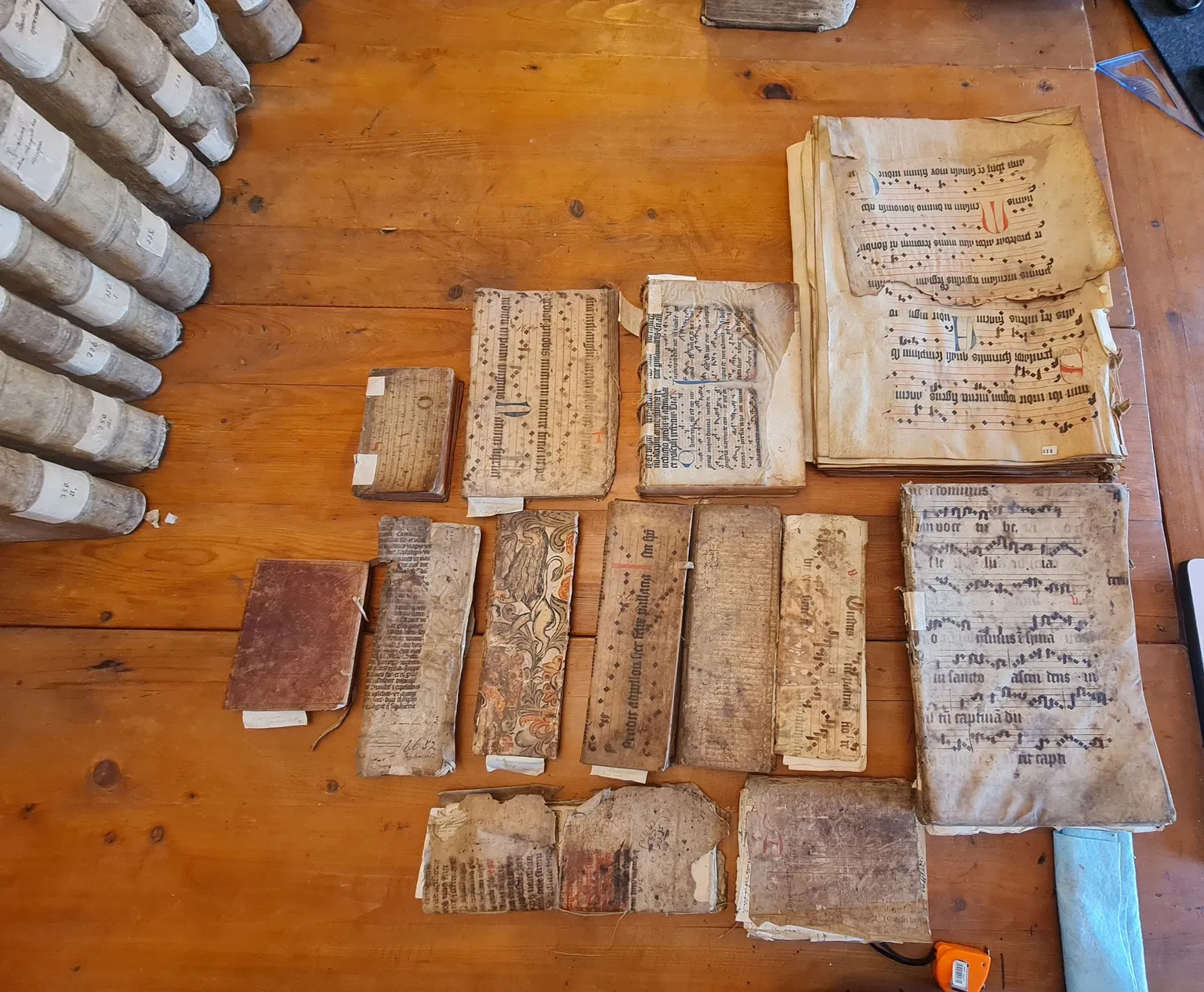
Photo: Adinel C. Dincă / Biblioteca Batthyaneum.
Buried for centuries in a Transylvanian church tower, a forgotten medieval library has come to light, offering a glimpse into the intellectual and cultural life of medieval Romania.
By Jove! How many treasure troves are yet to be discovered on Planet Earth? It makes me want to start a limerick using “Jove,” “trove,” “grove” …
The website Medievalists reports, “Hidden away for centuries in a Transylvanian church tower, a forgotten medieval library has come to light, revealing treasures as old as the 9th century. This extraordinary discovery of manuscripts, books, and documents offers a rare glimpse into the intellectual and cultural life of medieval Romania.
“The discovery was made two years ago in the Church of St. Margaret in Mediaș, a 15th-century Gothic structure built by the Transylvanian Saxons. A team led by Professor Adinel C. Dincă of Babeș-Bolyai University uncovered the collection in the church’s Ropemakers’ Tower, where it had remained hidden for decades, possibly centuries. Biblioteca Batthyaneum, which first announced the find, described it as a scene straight out of an Indiana Jones adventure, complete with a struggle against nesting pigeons to recover the precious volumes. The cache includes:
- Printed Volumes: Approximately 139 books printed between 1470 and 1600.
- Manuscript Volumes: Two manuscripts from the early 16th century.
- Original Documents: Around 60 documents from the 14th to 16th centuries, with a few originals and copies from the 17th century.
- Administrative Registers: About 10 registers from the 17th–18th centuries, containing fragments of medieval manuscripts. …
“Professor Dincă believes the library was deliberately hidden, possibly during a period of war or religious upheaval. The organization of the books suggests a carefully curated collection rather than a haphazard storage. ‘When I first encountered the books, I immediately noticed the disposition of the volumes according to a certain historical typology: bibles and biblical texts, patristic, theology etc,’ Dincă explained to Medievalists.net. ‘This order doesn’t look like an improvisation. …
“The items found are likely part of a larger collection held by the church. A catalogue from 1864 lists around 7,700 books in the church library, many of which were authored by key Protestant Reformers such as Martin Luther, John Calvin, and Philip Melanchthon. The cache provides researchers with the rare opportunity to match the recovered volumes with the historical records and explore what remains of this once vast repository.
“Among the most intriguing finds are fragments of medieval manuscripts, some dating as far back as the 9th century. These include texts written in Carolingian minuscule, a script commonly associated with the Carolingian Renaissance, as well as liturgical manuscripts from the 14th and 15th centuries. Many of these fragments were found recycled into administrative registers, offering insights into how older texts were reused within the community.
“ ‘One highlight of this historical collection is the large number of original 16th-century bindings, many of them dated,’ Dincă notes. ‘In addition to that, in the series of administrative registers of the parish, there are several fragments of mediaeval manuscripts, among them one copied in Carolingian minuscule, the rest of the “fragments collection” containing the usual liturgical manuscripts from the 14th to 15th century. The closed context of re-use makes it very likely that such recycled pieces of parchment are in fact remnants of a pre-Reformation stock of manuscripts locally used.’
“The discovery has launched a comprehensive research project. … Funded by Germany’s Ministry for Culture and Media, the project focuses on preserving the collection, digitally reconstructing it, and conducting detailed scientific analysis. …
“Researchers are particularly interested in the collection’s role in reflecting the intellectual and cultural life of the Transylvanian Saxons. The books and manuscripts provide unique insights into the circulation of ideas in medieval Europe. …
“Professor Dincă and his team believe the discovery represents more than just a hidden archive — it is a time capsule that offers a rare glimpse into the cultural and religious life of the region during the Middle Ages.”
More at Medievalists, here. No paywall. (Once I started thinking about rhymes for “ove,” I realized once again how weird English is. You can’t use “love” or “shove” with “trove” or “move” either.)


 Suzanne's Mom's Blog