Feeds:
Posts
Comments

Posts Tagged ‘Ukraine’

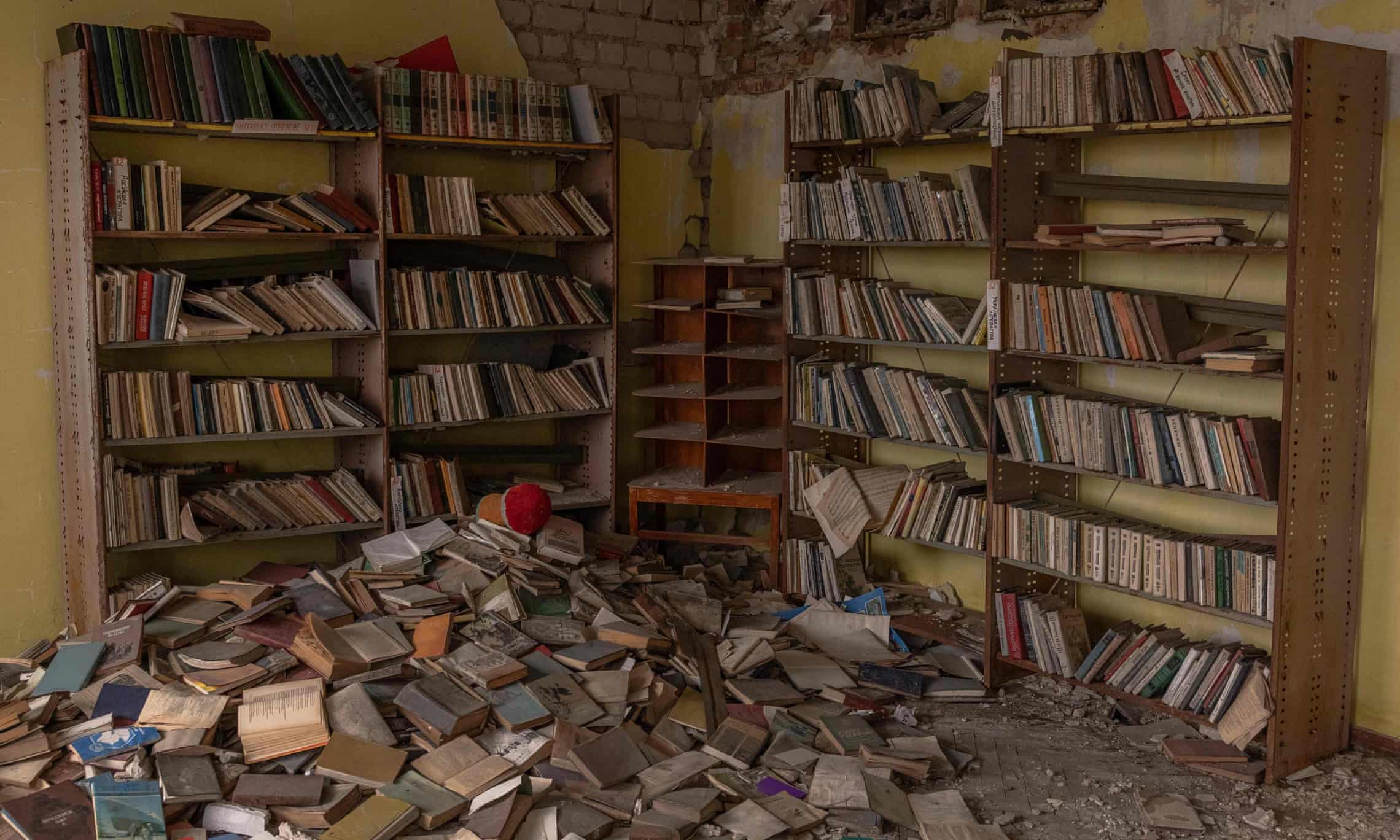
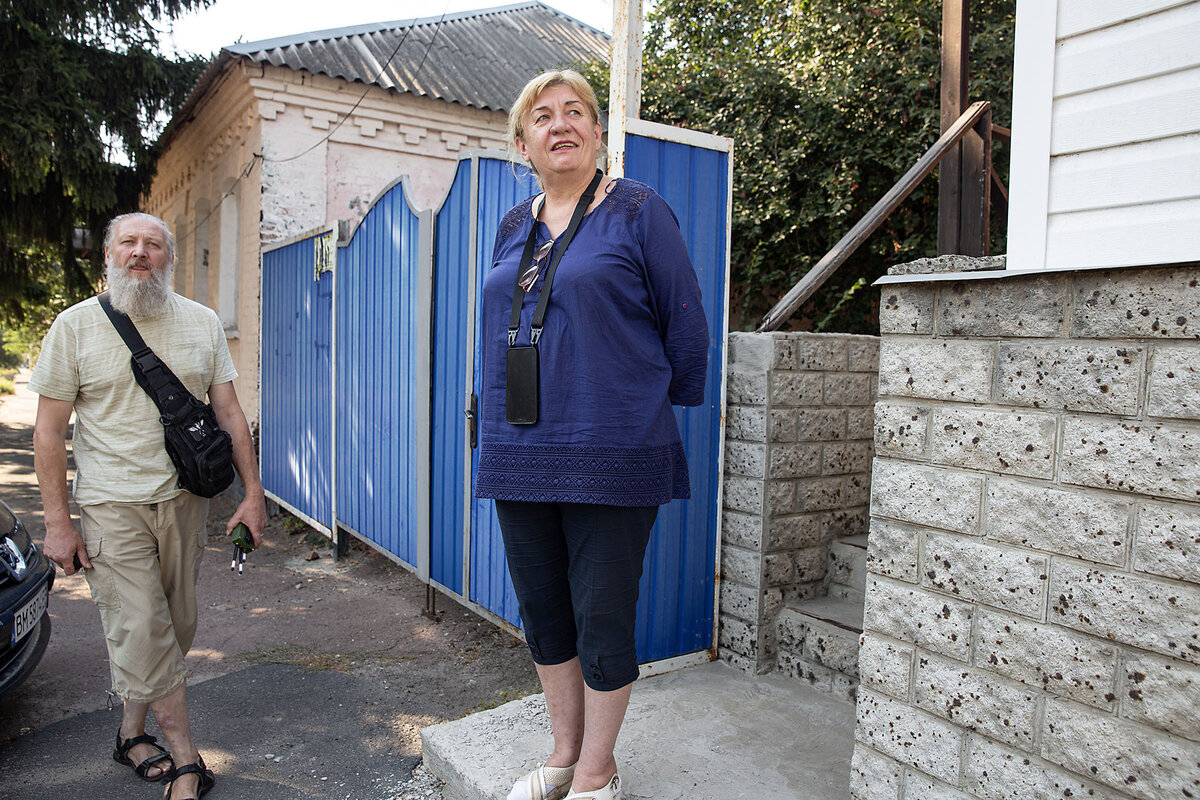
Photo: Roman Pilipey/AFP/Getty Images.
The house of culture in the village of Posad-Pokrovske in southern Ukraine was badly damaged in attacks by Russian forces in 2022. 

There’s a secret teen book club in occupied Ukraine, where the “official” schools teach Russian propaganda. Confided one student, “They don’t teach us knowledge at school, but to hate other Ukrainians.” 

Peter Pomerantsev and Alina Dykhman report at the Guardian, “It must be one of the most dangerous book clubs in the world. Before they can feel safe enough to talk about poetry and prose, 17-year-old Mariika (not her real name) and her friends have to first ensure all the windows are shut and check there is no one lurking by the flat’s doors.

“Informants frequently report anyone studying Ukrainian in the occupied territories to the Russian secret police. Ukrainian textbooks have been deemed ‘extremist’ – possession can carry a sentence of five years. Parents who allow their children to follow the Ukrainian curriculum online can lose parental rights. Teens who speak Ukrainian at school have been known to be taken by thugs to the woods for questioning.’

“That is why the book club never meets with more than three people – any extra members would pose further risk of being discovered.

“Apart from the danger, there is another challenge: finding the books themselves. In the town where Mariika lives, the occupiers have removed and destroyed the Ukrainian books from several libraries – nearly 200,000 works of politics, history and literature lost in one town alone.

“So Mariika and her friends have to use online versions – careful to scrub their search history afterwards. The authorities like to seize phones and computers to check for ‘extremist’ content.

“Among the poems and plays Mariika’s book club likes to read are those of Lesya Ukrainka, the 19th-century Ukrainian feminist and advocate of the country’s independence under the Russian empire.

“In 1888 Ukrainka also formed a book club, in tsarist-era Kyiv, at a time when publishing, performing and teaching in Ukrainian was banned. Ukrainka’s works, in turn, explore the 17th-century struggle of Ukraine for independence from Moscow.

“In the dramatic poem ‘The Boyar Woman,’ the heroine chides a Ukrainian nobleman who has come under the cultural influence of Muscovy and praises a humiliating peace with the tsar that has ‘calmed’ Ukraine: ‘Is this peace,’ she asks, ‘or a ruin?’ …

“Over the centuries, Russia’s tactics have adapted. During the Russian empire, Ukraine was conquered, and its language and literature were suppressed. At other times, the Kremlin used mass starvation and the mass murder of intellectuals, as in the Holodomor, the Ukrainian famine of the 1930s, when about 4 million people were killed by Stalin’s policies.

“During the later years of the Soviet Union, the approach was subtler: some Ukrainian schools and a small amount of publishing were allowed but if you wanted to prosper, you had to speak Russian. Ukrainian poets and activists who asked for more national rights were sent to the last labour camps as late as the mid-1980s. …

“As it has done for centuries among its colonies, the Kremlin is changing the population on the ground by deporting local people and importing new ones with no connection to Ukraine. Since 2014, more than 50,000 Ukrainians have been forced to leave Crimea and about 700,000 Russian citizens brought in, many of them with military and security service backgrounds. …

“More than 19,000 children have been forcibly removed to Russia to indoctrinate them and break their connection to Ukraine. … There are the 1.5 million children who are still inside the occupied territories, but who are being forced to abandon their Ukrainian heritage, attend military youth groups and ultimately be conscripted into the Russian army. …

” ‘They don’t teach us knowledge at school,’ said Mariika, ‘but to hate other Ukrainians. They’ve taken down all Ukrainian symbols and have hung portraits of Putin everywhere. History is all about “great Russia” and how it’s always been under attack by others.’ …

“Part of what keeps Mariika’s book club going is the desire for people outside the occupied territories to realize that there are people fighting for their right to exist as Ukrainians. Not all the books the club has been reading are overtly political. Sometimes they enjoy reading books that are just about normal life of young women in Ukraine – about dating and shopping.

“These tales take on a greater meaning in the occupied territories – a way to stay in touch with everyday life in the rest of the country. Novels have always helped to make you feel part of the community, of a nation.

“But still there is no getting away from the all-too-relevant ideas of Ukrainka’s writing. One of her main themes was to meditate on the relationship between personal freedom – the freedom of the imagination and to define your life – and the political freedom of the nation. ‘Whoever liberates themselves, shall be free,’ she wrote.

“Mariika’s book club makes those words real every day.”

More at the Guardian, here.

Read Full Post »

Photo: Howard LaFranchi/The Christian Science Monitor.
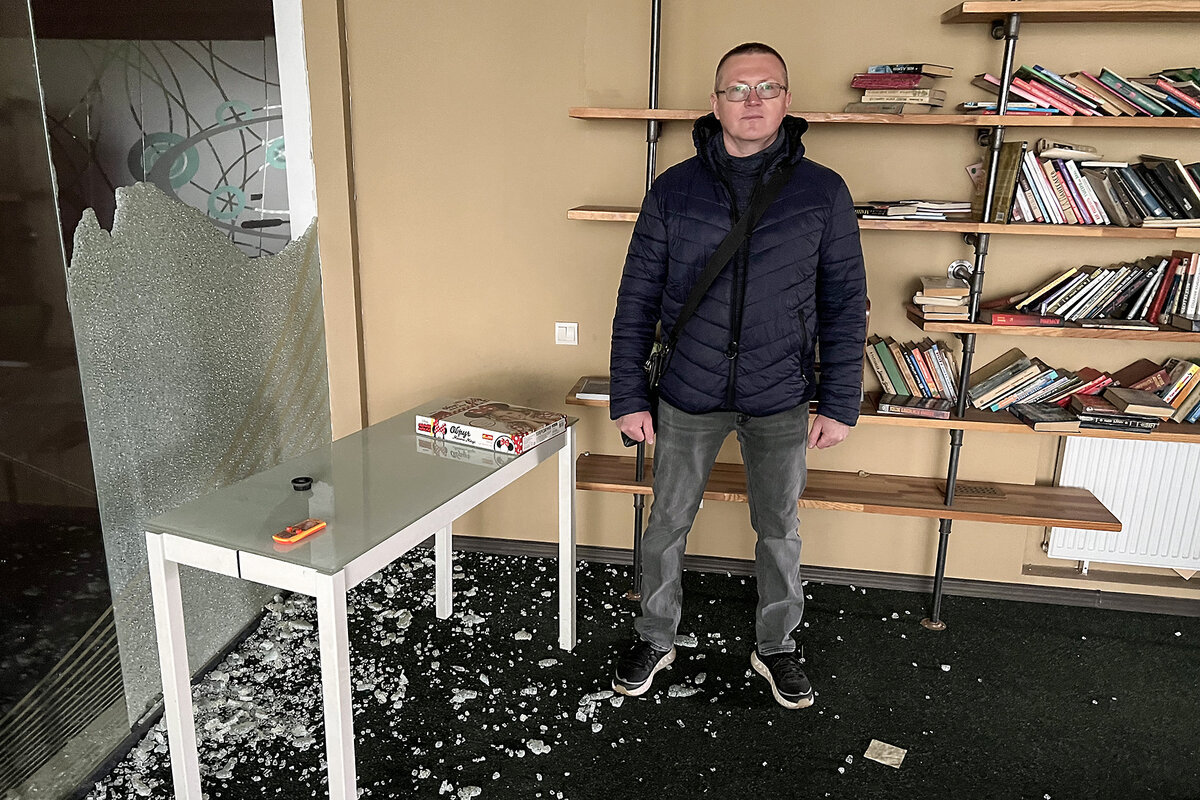
Ihor Pohorielov, commercial director of Ranok Publishing, at the company’s bomb-damaged offices, in Kharkiv, Ukraine, Nov. 4, 2024.

If ants can keep working and rebuilding after we’ve knocked over their anthill, how much more humans in war zones?

Among the many buildings damaged or destroyed by the Russian invasion in Ukraine are publishers of books. But books remain strong and Ukrainians keep reading.

Here’s a story by Howard LaFranchi at the Christian Science Monitor.

“Across Ukraine, but especially in Kharkiv, the country’s publishing capital, Russia’s war has been something of a boon to the nation’s publishing industry. More Ukrainians are seeking solace and distraction in books, and interest in Ukrainian literature and Ukrainian-language books is spiking.

“Many of the country’s publishing houses – from textbook-publishing giants to boutique operations specializing in culture – are keeping busy. And this despite the fact that Russian President Vladimir Putin has made publishing houses a key target of his war on Ukrainian culture.

“Publishers say a combination of their resolve to keep operating and a reawakened enthusiasm for books among a variety of readers is keeping the presses running.

“ ‘The war is reminding Ukrainians that books are an outlet for joy, for culture, for travel, when other outlets are closed to us,’ says Yuliia Orlova, general director of Vivat Publishing.

“ ‘We hear all the time about people rediscovering the joys of books as they spend less time on their computers and phones,’ she says. ‘People want to distract themselves from all the sad and depressing things going on around them, so they turn to fiction and fantasy. It’s their way to escape.’

“One night in November, Ihor Pohorielov was awakened by a Russian bomb blast that nearly shook him out of bed. His thoughts went to the modern offices and cavernous storage facilities where he works as the commercial director for Kharkiv’s Ranok Publishing, and which had already been the target of Russian air strikes. …

” ‘I thought of the orders we need to get out and the clients we need to serve – so I came into work’ the next day. …

“Across Ukraine, but especially in Kharkiv, the country’s publishing capital, Russia’s war has been something of a boon to the book publishing business.

“As more Ukrainians seek solace and distraction in books, and as interest in Ukrainian literature and Ukrainian-language books spikes, many of the country’s publishing houses – from textbook-publishing giants to boutique operations specializing in culture – are keeping busy.

“And this despite the fact that Russian President Vladimir Putin has made publishing and printing houses a key target of his war on Ukrainian culture.

“Kharkiv’s publishing industry was shaken to its core last May when a Russian S-300 missile struck the giant Faktor-Druk, one of Europe’s largest printing houses. The blast destroyed presses, incinerated some 100,000 books, and knocked out the three publishing companies housed there. …

“But the sense of devastation was short-lived. In a show of solidarity, several European publishers offered to print Ukrainian books for distribution to millions of Ukrainian refugees around Europe.

“An American philanthropic organization, the Howard G. Buffett Foundation, quickly agreed to pick up the tab for Faktor-Druk’s reconstruction. …

“ ‘Printing in Kharkiv is hanging on despite the almost daily attacks on the city,’ … says Yuliia Orlova, general director of Vivat Publishing, a division of the Faktor Group. …

“Ms. Orlova does not hide the fact that the war has been devastating for Ukrainian publishing in many ways, especially for the people who work in the sector. ‘The attacks and the destruction in the city have a big impact on the mental health of our workers. People don’t sleep and they are constantly worried for their families,’ she says. …

“Since 2022, the number of registered publishers in Ukraine has plummeted from about 1,600 to 150, Ms. Orlova says. …

“But Ms. Orlova cites another statistic that underscores the bright side of Ukrainian book publishing: Over the same period, the total number of books printed grew by 70%.

“The reasons for that jump are largely related to the war. Russia’s systematic destruction of Ukraine’s infrastructure has meant widespread power outages and spotty access to the internet, Ms. Orlova says. ‘We hear all the time about people rediscovering the joys of books as they spend less time on their computers and phones,’ she says. …

“Mr. Putin’s war on Ukrainian culture – targeting museums, churches, universities, and publishing houses – is feeding a renewed interest in history, language, art, and literature that confirm Ukrainian nationhood, publishers say.

” ‘Interest among Ukrainians in who we are was already starting to grow, but it was the full-scale invasion that really encouraged this desire to know more about our history and culture,’ says Oleksandr Savchuk, whose specialty Kharkiv publishing house carries his name.

“ ‘For many Ukrainians, the picture of who we are was like a puzzle with lost pieces,’ he says. ‘But now people are finding those pieces so we can complete the full picture.’

“To help nurture that process, in 2023 the philosophy professor and publisher opened a facility he calls a ‘Book Strongroom,’ a combination bookstore, event space, and neighborhood bomb shelter adjacent to his publishing operations. …

“Oleksandr Savchuk is a small player who has published about 50 titles over the last decade. … ‘For the 12 years before the invasion I was suffering to try to show people their great history and culture. It was a hard-going process,’ he says. … ‘I see now that I’m being heard.’ “

More at the Monitor, here. No firewall, reasonable subscriptions rates for a paper unusually strong in international news.

Read Full Post »

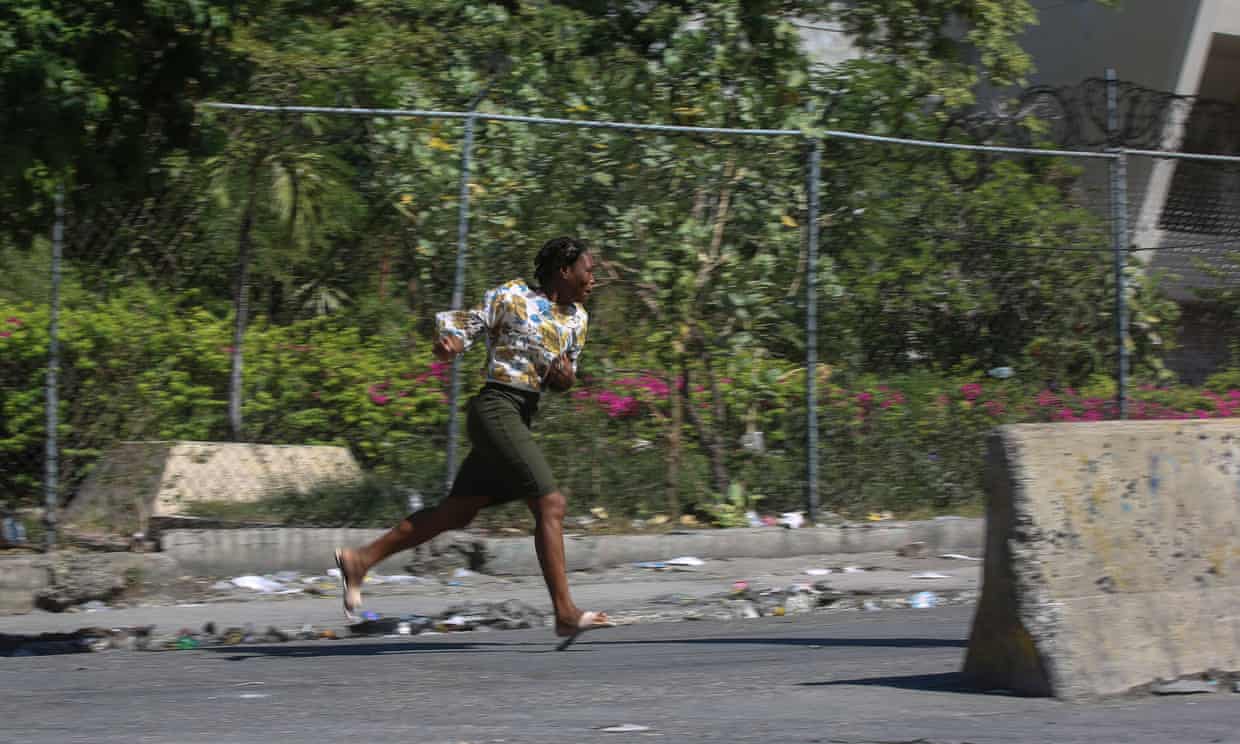
Photo: Odelyn Joseph/AP.
A woman runs to take cover from gunfire during clashes between police and gangs in Port-au-Prince, a city where a theater company perseveres.

There’s something about theater people and defiance. Something that keeps them from giving in to the ways things are when things are bad. I’ve blogged here about the anti-government theater of Belarus and here about Ukrainians offering theater in the subway, away from Russian bombs.

In today’s post, Tom Phillips and Etienne Côté-Paluck report at the Guardian about Haiti.

“In a dimly lit rehearsal room in a city under attack, Jenny Cadet raised an imaginary pistol and fired a single make-believe bullet at her director.

“ ‘Life is a theatre. I am a theatre. We are a theatre. The world is a theatre,’ proclaimed the 31-year-old Haitian actor, turning to the audience as she uttered the tragicomedy’s final lines.

“Moments later, real-life shots rang out outside the stage school in Port-au-Prince – the latest act of violence in an increasingly terrifying drama that has forced tens of thousands of people to flee their homes here in the past fortnight alone.

“ ‘Every day [there’s shooting],’ sighed the play’s director, Eliezer Guérismé, as his company took a break from their read-through to the all-too familiar sound of gunfire. ‘But even with the shooting, we keep on working because that’s our mission. We don’t want to stop.’

As gangs tighten their grip over a city now almost entirely outside of government control, Guérismé, 39, said he saw drama as a key way of interrogating and denouncing the social and political crisis. …

“Theatre was also ‘an act of rebellion and resistance’ and a way of fostering renewal, given the politically charged violence into which Port-au-Prince has been plunged since the 2021 assassination of Haiti’s president Jovenel Moïse.

“ ‘People need to see the reality that they are living up on stage … theatre is the mirror of society … Everything we hear in this city – the sound of the bullets that are very, very present – we try to put on stage,’ the director said. …

“Nearly 4,000 people have been killed since the start of the year, according to the UN, as rifle-carrying gang fighters have advanced across the capital, opening fire on government buildings and burning homes.

“A US-backed policing mission has so far failed to restore order and in recent days the violence has intensified further with gangsters even attacking Pétion-Ville, one of the last supposedly safe enclaves in the hills over Port-au-Prince. … Foreign diplomats and aid workers are fleeing by helicopter amid calls for a UN peacekeeping mission to be deployed.

“ ‘It feels like the end of Port-au-Prince,’ Guérismé admitted this week. “Every day people are leaving their neighborhoods.’

“The Haitian director recognized that continuing to rehearse his latest production was a perilous business in a city where residents’ movements grow more restricted by the day.

“One of his troupe’s actors commutes to the drama school each day from Carrefour, a gang-run area to the city’s south which is effectively off-limits to outsiders. ‘I know he’s taking a risk to come. He’s taking a huge risk… Living in Port-au-Prince today requires a superhuman effort,’ Guérismé said. …

“But Guérismé was determined to fight on. … ‘It’s my country. It’s my homeland. It’s my city’ … and I have responsibilities,’ the director said as his group prepared for Port-au-Prince’s annual ‘En Lisant’ theatre and performing arts event. ….

“Philippe Violanti, the French dramatist who wrote Guérismé’s latest tragicomic play, had planned to fly to Port-au-Prince to see his work staged for the first time. But Violanti was forced to cancel after flights into the capital were suspended because three US aircraft were hit by gunfire while taking off or landing.

“Six of the seven foreign artists invited to the festival – from Guadalupe, French Guiana, France, Belgium and the US – have pulled out. Performances for primary and secondary school children have been dropped from the program. Some rehearsals are being held online.

“Guérismé said the mood was grim, but he believed it was essential Haiti’s acting community did not throw in the towel.

“ ‘The festival will not be postponed. We will go ahead,’ he vowed. ‘This is the time to make a gesture of hope – to affirm that life is here.’ ”

More at the Guardian, here.
Read Full Post »

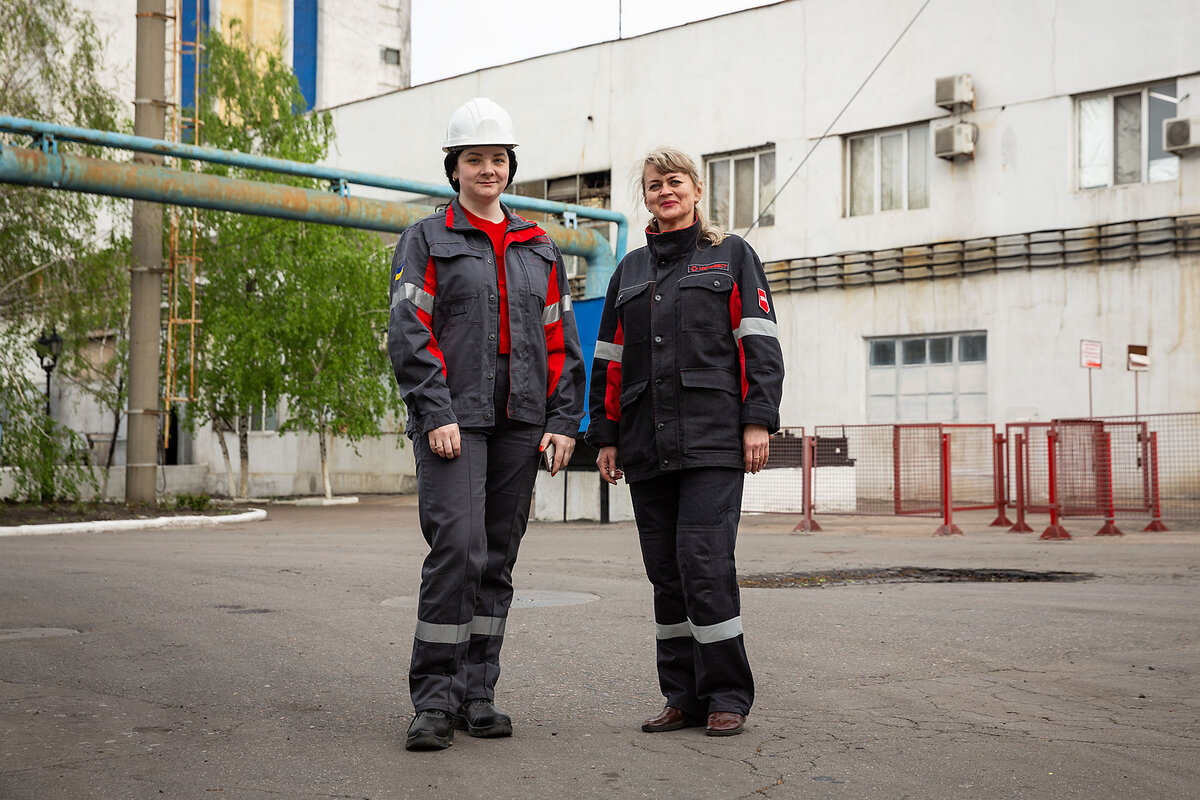
Photo: Dominique Soguel.
Kateryna Tolmachova (at left) and Olena Boiko stand in front of Metinvest Pokrovsk Coal, April 17, 2024. Both women have had to step up their work since Russia’s invasion has called away many of their male colleagues to military duty.

Yesterday I sent another donation to a Ukrainian I know from my four-month gig with Ukrainian journalists at the beginning of the Russian invasion. (Read about that here.) The war has kept going since then, affecting every aspect of life in Ukraine.

Consider how some women have had to step up to jobs men used to do. The women in today’s story work in coal mining. Whether coal mining is a bad thing in general is a topic for another day.

Dominique Soguel writes for the Christian Science Monitor, “Kateryna Tolmachova started working in the Donbas coal industry in 2017. But when Russia invaded Ukraine in February 2022 and men were called to military service, her career accelerated. For women like her, stepping into the critical roles the men left empty wasn’t just an opportunity, but a duty.

“ ‘Who, if not us?’ says Ms. Tolmachova, who recently became deputy head of the pumping division at Metinvest Pokrovsk Coal. ‘If our men are taken to the army and protect us from there, we need to protect the economy.’

“Nowhere is this shift more evident than in the coal mining industry of Donbas, where women have increasingly taken on critical roles to sustain both the war machine and their families. Ms. Tolmachova’s journey from machine operator to a leadership role highlights the expanding opportunities for women in the industry as more men get called to the front. …

“Metinvest Pokrovsk Coal, one of Ukraine’s newest coal mines, has been quick to harness the potential of female employees. … The war has brought significant challenges to the company. Approximately 1,000 employees have been mobilized to the Ukrainian military, and about 1,500 have moved to safer regions with their families. In all, 87 employees have been killed and 232 injured due to the ongoing conflict. Before the war, Metinvest employed around 8,000 people; now, this number has decreased to about 6,000.

“In response, the company’s female employees are taking on a greater share of the workload, and in more critical capacities. As Andry Akulih, general director of Metinvest notes, they make up almost a third of the current workforce (31%) compared with just under a quarter (24%) before the war. Those who stay often do so to care for older relatives who are either unable or unwilling to leave. Women are turning to the mine for employment opportunities as there is a dearth of other jobs, with most supermarkets and schools closed in the region.

“Traditionally, he explains, women at the coal mine were confined to roles such as operating the elevator or managing the facilities where miners receive their lamps and oxygen equipment. These jobs were considered suitable for women, as they did not involve the strenuous physical labor required underground.

“ ‘Women have come to substitute men in some underground jobs like pumping and electrical machines,’ he says. Before, ‘there were enough men to do these jobs. Women were not interested.’ …

“Metinvest’s training center, led by Larysa Batrukh, has adapted to this new reality. Previously, the center trained approximately 100 students per month, but now it trains around 50, including a small but growing number of women. …

“Inside a large classroom with boarded-up windows, most chairs are stacked on empty desks. One woman was killed after a Russian missile hit the grounds of the training center.

“But that did not deter Oksana Mariash, who returned to the mine after evacuating her daughter to Poland. She is training to become a pumping system operator, and focuses attentively on her lessons, aware that exams are approaching. ‘Of course, it is scary and hard when you hear explosions, but it is interesting to learn, and I really like my teachers.’

“One of those instructors, Yevhen Mezhenny, oversees the education for technical positions, including welders and machine operators. He is impressed by the seamless transition of women into traditionally male-dominated roles.

“ ‘I’m surprised, but it is going very smoothly, with no big hiccups,’ he says. ‘Ukrainian women are very smart and hardworking, and they put a lot of effort into studying. Many of them were previously teachers or accountants.’

“Most of the women working or training at the mine also have significant responsibilities on the home front, too.

“Tetiana Hrekova manages the demands of her job while caring for her 11-year-old son and her elderly parents. She begins her day at 4 a.m. to catch the bus, a crucial link in keeping operations running smoothly despite the war. She returns home at 5 p.m. and starts a fresh shift feeding the family and supporting her son’s online schooling.

“ ‘I can only hope that the war will be over soon and children will go to school,’ she says during her eight-hour shift deep in the coal mine. ‘We will not be afraid of leaving them above ground and be able to … enjoy our work.’ ”

Rosie the Riveter rises again!

More at the Monitor, here. No paywall.

Read Full Post »

Photo: Dominique Soguel.
Nataliia Kalinichenko and her husband, Yurii, outside the office of the print weekly Bilopilshchyna, which they have continued to publish despite the war.

And while we’re on the subject of Ukraine, I want to share a story while it’s fresh, because in a war zone, you never know how long a piece of good news will last.

Dominique Soguel (with support from Oleksandr Naselenko) reports at the Christian Science Monitor, “The streets of [Bilopillia, Ukraine], just seven miles from the Russian border, are nearly deserted. Air-raid sirens have been a round-the-clock reality for weeks, and people take them seriously: When the warnings blare, everyone lies flat to take cover or scrambles to underground shelters.

“But for Nataliia Kalinichenko and her husband, Yurii, there’s no break from getting the news out to the community. They have safety routines; Ms. Kalinichenko asks friends or relatives to monitor social media platform Telegram for news of incoming Russian attacks, while Mr. Kalinichenko uses a drone detector while driving. But their mission is to keep locals informed through publication of their print weekly, Bilopilshchyna.

“Before the war, the newspaper featured 12 to 16 colorful spreads with articles on local entertainment, politics, and practical information like bus schedules. Now, it is a stark black-and-white publication filled with military and civilian obituaries and snapshots of local buildings destroyed by Russian attacks.

“ ‘With the onset of Russia’s invasion, our community’s information needs changed dramatically, as did our ability to meet them,’ says Ms. Kalinichenko, who joined the newspaper in 1996 and became its editor-in-chief a decade later. ‘Safety became the primary concern.’ …

“The information landscape has transformed over the past 2 1/2 years. Televisions, once tuned to Russian and Ukrainian channels, lost their appeal. The first Russian strike on the town’s television tower in March 2022 marked the beginning of a series of barrages. Telegram, which now tracks incoming missiles, has become a lifeline – though it requires electricity and an internet connection. Both have been hard to reliably access amid Russia’s offensive. …

“Inevitably, the community has shrunk. The agricultural district of Bilopillia was once home to about 16,000 residents. Now the figure is between 3,000 and 8,000, according to Ms. Kalinichenko. Residents come and go depending on attacks and electricity supplies. New arrivals from other regions temporarily swell the numbers.

“The Kalinichenkos are determined to stay put and keep the paper running as a team. On the walls of their office hang photographs documenting the paper’s history, including a period when it was known as the Flag of Stalin. Piles of newspapers are testament to disruptions in postal delivery services, and a collapsed ceiling from a recent blast prevents Ms. Kalinichenko from sitting at her usual desk.

“At a nearby shop, salesperson Nina Davydova and her teenage daughter, Victoria, discuss the toll of constant strikes. Though Victoria gets her news only through Telegram, Nina says Bilopilshchyna is still popular.

“ ‘People really like to buy the newspaper,’ she says, pointing out that she has already sold six copies this morning, even though Russian attacks were particularly intense. ‘Grandmothers will buy five to six copies so that they can bring it to their neighbors who cannot walk.’

“The newspaper sells at 20 locations in the Sumy region, which shares a 28-mile border with Russia. While many readers have fled, they continue to pay for a subscription in order to remain connected to their homeland, says Ms. Kalinichenko. Even in its reduced format, it serves as a vital source of information for local agricultural communities.

“Serhii, a sardonic shopkeeper, displays the latest copies alongside shrapnel that damaged his shop, which sits a few blocks from Nina’s. ‘If people would not buy it, I would not sell it,’ he says. ‘About five people buy it every day. But people also come from surrounding villages on market days to buy 10 copies at a time.’

“Articles pay tribute to slain soldiers and quote analysts to dispel rumors and dismantle Russian disinformation. One recent instance involved pollution of the river Seim – caused by industrial activities upstream in Russia. Russian trolls on Telegram spread the notion that drinking water had also been compromised, but that was not actually the case. Experts quoted in the paper helped debunk that notion.

“ ‘For villagers with no internet, it is an important source of information and local news,’ says Serhii.

“That assessment is echoed by customer Dymtro Potiomkyn, who grew up with the paper on the family table. He recalls it being a way for people to buy and sell goods locally. Today, it publishes information about what kind of social help is available locally. He buys the paper in person, while his mother gets it delivered by mail.

“ ‘This newspaper is crucial for villages that are right on the border with Russia,’ says Mr. Potiomkyn, who runs a funeral business in the region. ‘Some have been without electricity or internet for years. It’s literally their only source of Ukrainian news.’ “

I know from my own four-month remote gig with a Ukrainian news outlet that Telegram is important to the information landscape there. I also know about Ukrainians’ concern that the outside world gets false information from social media posted by Russians. That’s why Americans like me were helping Ukrainian journalists put their own Twitter and Facebook updates in colloquial English. My experience here.

More at the Monitor, here. No paywall. Subscriptions are reasonable.

Read Full Post »

Photo: Julia Kochetova/The Guardian.
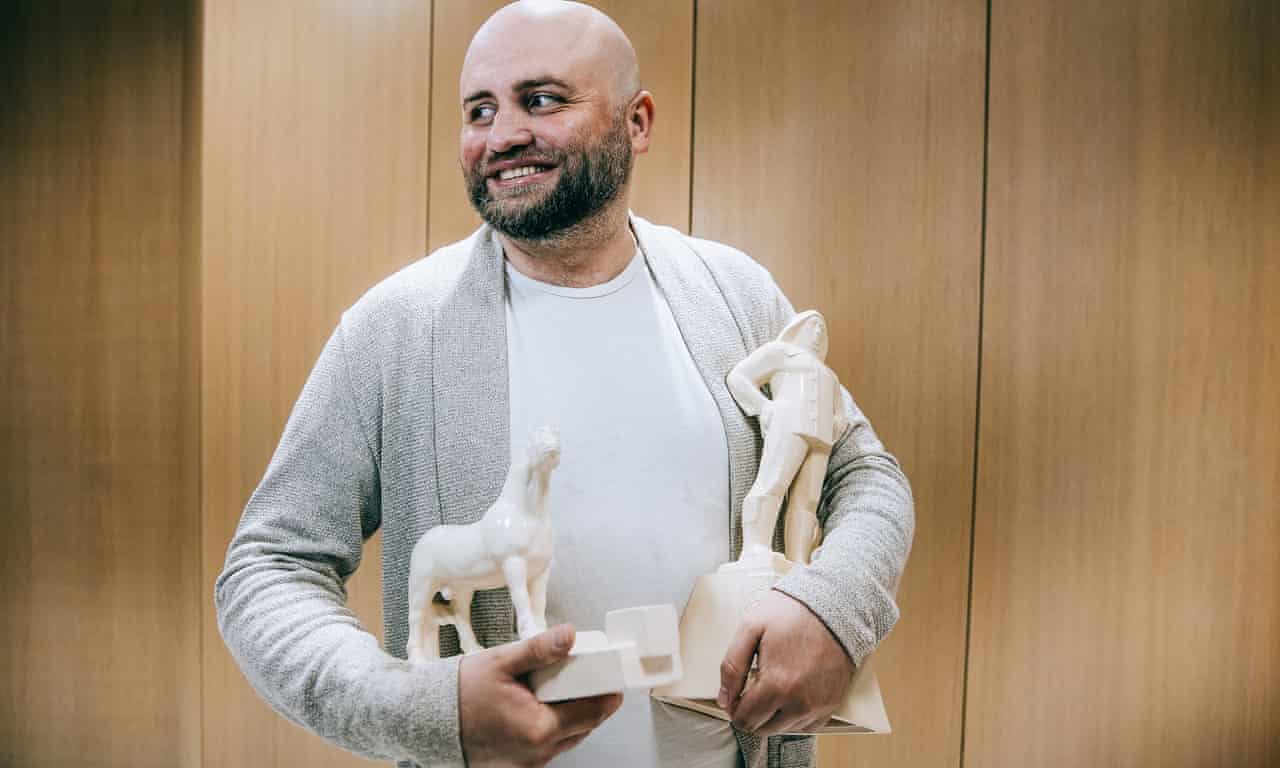
Leonid Marushchak with artworks from his private collection. He launched a death-defying rescue plan to help museums save Ukraine’s art from the invaders.  

You may know about the Monuments Men, charged by President Roosevelt with protecting cultural heritage during World War II. In Ukraine, after the Russian invasion, private individuals took on a similar task. One man especially.

At the Guardian, Charlotte Higgins has a fascinating piece about what historian Leonid Marushchak and his cohorts have accomplished.

“In early March 2022, when his country seemed in danger of falling to the Russians, it occurred to Leonid Marushchak, a historian by training, to call the director of a museum in eastern Ukraine to check that a collection of 20th-century studio pottery was safe.

“He had loved the modernist works by artist Natalya Maksymchenko since he had encountered them almost a decade earlier. There were vessels covered with bold abstract glazes in purple, scarlet and yellow; exuberant figurines of musicians and dancers with swirling skirts; dishes painted with birds in flight. The collection was the radiant highlight of the local history museum in Sloviansk, the ceramicist’s home town.

“It was remarkable that they were in this small museum at all. Though she was born in Ukraine in 1914 and studied in Kharkiv, Maksymchenko had lived the rest of her life in Russia. But, after her death in 1978, her family, fulfilling her wishes, oversaw the transfer of about 400 works from her studio in Moscow to the city of her birth. … Maksymchenko’s final gift to her home town and country seemed like a statement of defiance.

“Now, as the Russian army inched nearer and nearer to the museum, Marushchak worried that these works in delicate porcelain could be destroyed by a missile in a moment – or, if Sloviansk were occupied, taken by the invaders back to Moscow. Had the ceramics been prioritized for the first round of evacuations, Marushchak asked the museum director on the phone.

“ ‘Lyonya, what round?’ came the reply. ‘We still haven’t got the order to evacuate!’

“Marushchak phoned his friend Kateryna Chuyeva, who was then Ukraine’s deputy minister for culture. ‘Katya,’ he asked her, ‘why have you still not given the order for the Sloviansk museum?’ She explained that she couldn’t just authorize it herself – the regional authorities needed to request it first. So he called the region’s culture department. They said that to issue an order, they would first need a full list of items to be evacuated.

“Marushchak was furious. The situation was urgent; there was no time for that kind of paperwork. ‘Let’s just say I have sometimes had to take my time and breathe slowly,’ said Chuyeva, in the face of her friend’s sometimes volcanic passion. She found a way to break the bureaucratic impasse. Before the official order had even arrived, Maruschak was on his way to Sloviansk.

“Marushchak cannot drive. … Without his own means of getting to Sloviansk, Marushchak had his brother-in-law drive him from Kyiv 300 miles east to the city of Dnipro. From there, friends took him a further 50 miles, to the city of Pavlohrad. Then he walked to the last checkpoint in town and hitched a lift for the last 120 miles – this time, on a Soviet-era armored personnel carrier.

“In Sloviansk, artillery boomed alarmingly close; the opposing armies were fighting over a town only 18 miles away. When Marushchak reached the museum, staff were finally packing up the exhibits – though, to his annoyance, the official instructions on what should be prioritized dated from 1970, and stated that what he referred to as ‘an old bucket of medals’ from the second world war should be rescued first. Aside from the Maksymchenko ceramics and the medals, there was also a natural history collection to deal with – AKA, stuffed animals, which, just to add another layer of danger to the enterprise, had probably been preserved with highly toxic arsenic. …

“Since those early days of the war, with the help of a motley group of intrepid friends, Marushchak has achieved something quite extraordinary. He has organized the evacuation of dozens of museums across Ukraine’s frontline – packing, recording, logging and counting each item and sending them to secret, secure locations away from the combat zone. Among the many tens of thousands of artifacts he has rescued are individual drawings and letters in artists’ archives, collections of ancient icons and antique furniture, precious textiles, and even 180 haunting, larger-than-life medieval sculptures known as babas, carved by the Turkic nomads of the steppe.

“ ‘At times,’ said Chuyeva, ‘he has been doing almost unbelievable things’ – putting himself into extreme personal danger for the sake of often humble-seeming regional museum collections on Ukraine’s frontline.

“A nation’s understanding of itself is built on intangible things: stories and music, poems and language, habits and traditions. But it is also held in its artworks and artifacts, fragile objects that human hands have made and treasured. Once lost or destroyed, they are gone for ever, along with the stores of knowledge they contain, and potential knowledge that future generations might harvest from them. For Marushchak, his country’s culture, no less than its territory, is at stake in this war: a culture that Vladimir Putin has repeatedly claimed has no distinct existence, except as an adjunct to Russia’s.

“On that day in Sloviansk, something became clear to him: there was no point relying on official evacuation efforts. If he wanted to see the job done, he was going to have to do it himself. ‘He had to do it with his own hands,’ his friend, the artist Zhanna Kadyrova told me. ‘There was no one else.’

This is a long article. Read it at the Guardian, here. No paywall, but contributions are solicited.

Read Full Post »

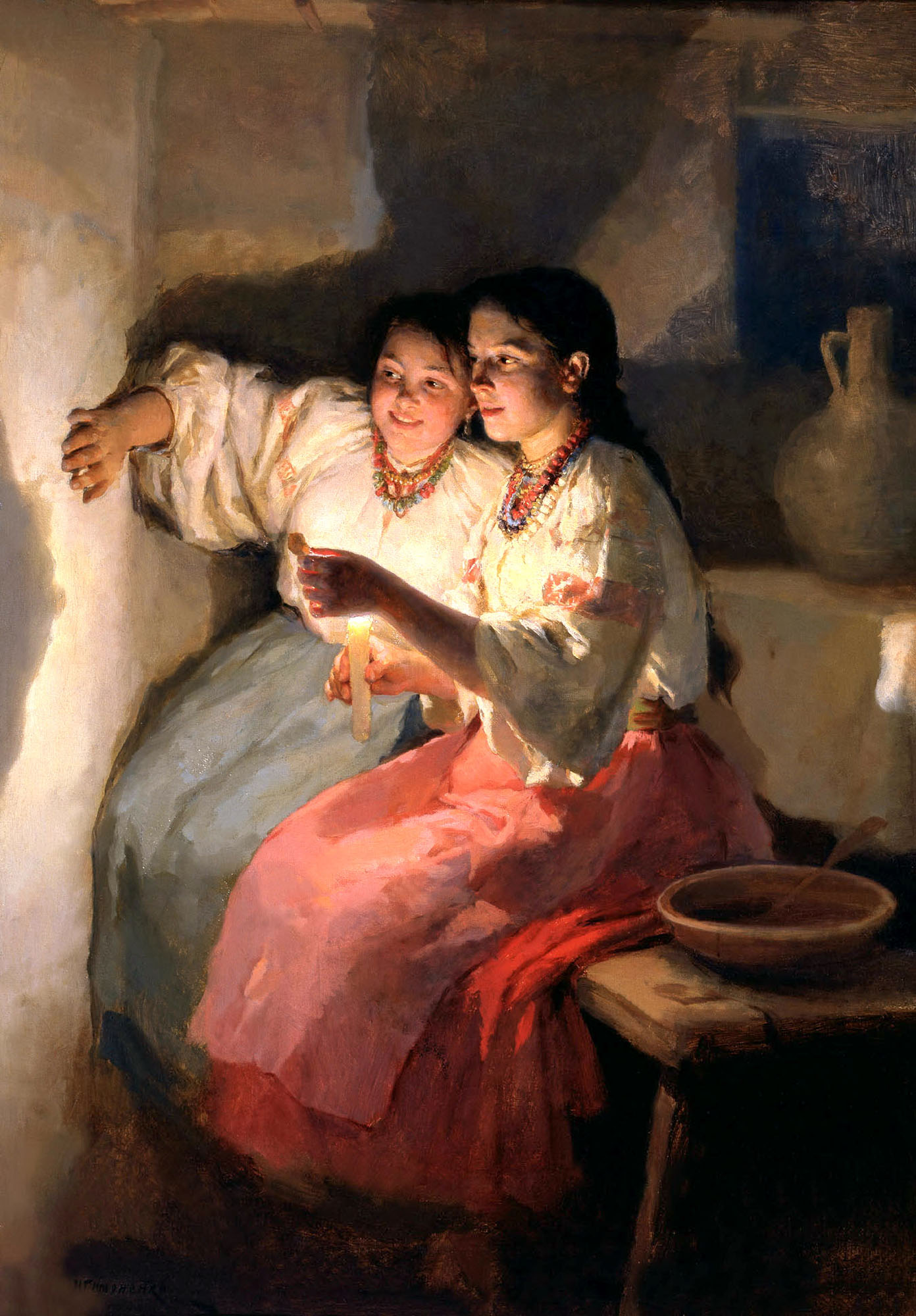
Photo: Ivan Honchar Museum.
Witchy arts are part of Ukrainian folklore. The girls in the painting above (Divination by Mykola Pymonenko, 1888) are trying to predict the future.

Somehow, even in wartime, artists’ imaginations keep creating. Today’s story is about a new Ukrainian play that has captured the country’s attention.

Ashley Westerman at National Public Radio [NPR] tells us that “even though the plot takes place centuries ago, the play’s takeaways and parallels to today resonate with Ukrainians.”

Here are excerpts from the NPR transcript.

Westerman: In the early days of Russia’s full-scale invasion of Ukraine, a video surfaced online – a woman shouting at a Russian soldier sitting atop a tank. …

‘Do you even know where you are? You’re in Konotop,’ shouted the woman off-screen. ‘Every second woman here is a witch.’ …

“The video went viral in Ukraine, not just because of the woman’s defiance, but also because Konotop, a city in the country’s far northeast, is a place associated with witches. ‘Witches are a part of Ukrainian culture and Ukrainian tradition,’ says Khrystyna Fedorak, so you can rely on something having to do with witches going viral. This is one of the reasons the play Fedorak is currently starring in at the Ivan Franko Theater in the capital, Kyiv, has become a summer blockbuster. Fedorak plays the witch in the dark musical comedy The Witch Of Konotop.

“Based on the 1833 satirical fiction by Ukrainian writer Hryhorii Kvitka-Osnovianenko, this story leans hard on the stereotype that Ukrainian literature is full of sadness and tragedy. Taking place in the 1600s, the audience follows the main character, Zabryokha, a Cossack military leader in Konotop, pursuing the lovely Olena, but she rejects his proposal. She loves someone else. In this scene, Pistryak, Zabryokha’s cunning assistant, tries to confuse Olena’s love interest by accusing him of crimes he didn’t commit. …

“Then, in a twist of events that sounds a lot like today, Zabryokha receives an order to join a military campaign to help the Cossacks fend off an overreaching Tsarist Russia.

” ‘They order us,’ Pistryak says, ‘to take our Cossacks in Konotop to join the main army. There may be drills, or there may be war.’

“But Zabryokha refuses to go, saying he needs to stay in Konotop to root out the witch problem — the root, he says, of everyone’s problems. What ensues is a string of ridiculous, funny and very human moments. Spells are cast, couples are wed and, of course, there’s a witch hunt, meaning a swim test. If you’re not a witch, you drown. If you are a witch, you don’t.

“All with a larger threat looming over everything — Russia. But while that might be the most obvious takeaway from The Witch Of Konotop, the cast has some of their own ideas.

Kateryna Artemenko: Don’t kill women (laughter). Don’t mess with women. …

Westerman: Artemenko plays one of the townswomen mistaken for a witch. …

Artemenko: The main message is about people who — they’re trying to fool their destiny, but destiny will find them.

Westerman: Nazar Zadniprovskiy, who plays the ill-fated Cossack commander, views this play as a lesson in avoiding responsibility. … Zadniprovskyi says many people see a parallel with Ukrainian men dodging conscription today. …

“As the play ends and the theater’s mustard-yellow felt curtain drops to a thunderous applause, producer Polina Lytvynova and I ask a few audience members what parallels they drew. Olha Vasylevska is from Kharkiv, the northeastern Ukrainian city currently fending off an intense Russian offensive. She thinks the play is about love.

Olha Vasylevska: (Through interpreter.) If the love is true, it doesn’t need any outside assistance … but if the love is not true, nobody and nothing can help it, even the witch.

“Westerman: Markian Halabala, from Kyiv, says the message he took away is that you shouldn’t interfere in God’s will.

“Markian Halabala: (Through interpreter.) This is like Putin. He interfered in natural Ukraine’s way of independence. And Russians, they try to stop and prevent, like, [the] natural way of Ukrainian history with this war.

“Westerman: Critics say the many takeaways The Witch Of Konotop offers its audiences is one reason it’s been so popular. … But another reason is the overall push to celebrate Ukrainian culture and literature. Putin has repeatedly said victory, to him, means nothing short of Ukraine losing not just their sovereignty, but also their identity.”

Finally, Westerman spoke to Mykhailo Kukuyuk, who plays Pistryak. He speaks of the value of his country’s arts: “What are we fighting for? it’s the details, the sparks, that make us alive.” He adds that, while it’s sometimes difficult to block out the events happening outside of this theater, it’s an honor to perform for his country.

More at NPR, here.

Read Full Post »

Photo: Kasia Stręk/The Guardian.
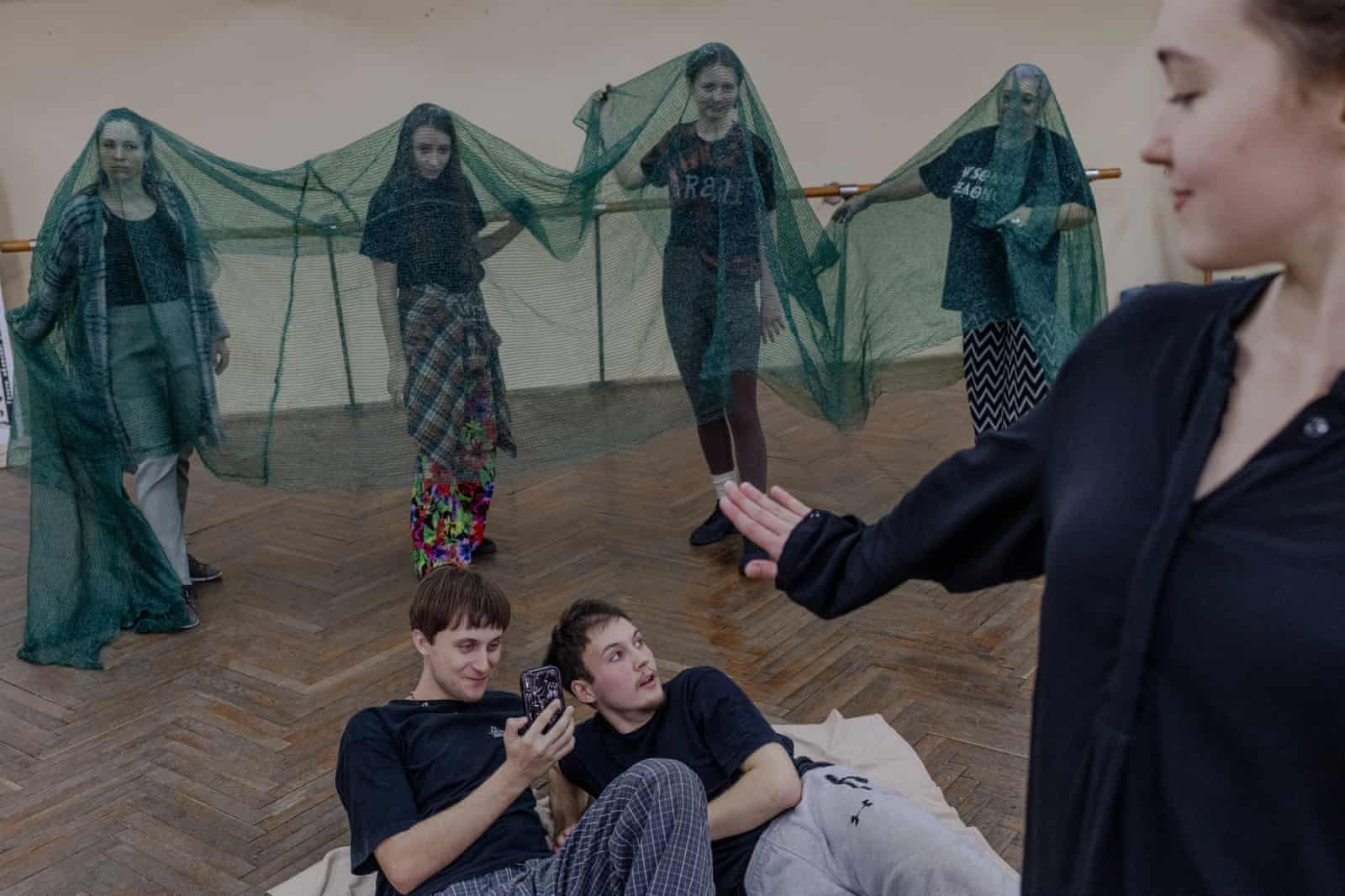
Actors from Mariupol theatre and new recruits of the renewed theater, now in Uzhorod, rehearse for a piece called Poets Lived Here, depicting how lives have been changed by the war.

As with all stories about war zones like Ukraine, one hopes that positive news published yesterday — or a few months ago — is still true today. Consider an article by the Guardian’s Shaun Walker written in March that was a testament to the resilient spirit of the Ukrainian people.

“When the bombs hit the Mariupol Drama theatre, Vira Lebedynska did not hear a boom or a blast. From the recording studio in the theatre’s basement, where she was sheltering along with a few other theatre employees, the sensation was more like a vacuum.

“ ‘There was a whoosh, and a feeling that the air was being sucked out of the room,’ she recalled. A few seconds earlier, her cat Gabriel had suddenly tensed, perhaps sensing the sound of a plane overhead. … The 65-year-old actor and vocal trainer was one of about 20 theatre employees among the more than 1,000 people sheltering in the theatre as the Russian army laid siege to Mariupol in March 2022.

“The strike, believed to have been carried out with two 500kg bombs dropped from a Russian aircraft, came despite widespread knowledge that it was the biggest civilian shelter in the city. …

“[Now] in Kyiv, Lebedynska will perform in Mariupol Drama, a play based on the memories of four actors who were sheltering inside the theatre, all of whom speak about their own experiences from the stage.

“The four are among a small group of actors and staff from the theatre who have resurrected the troupe in Uzhhorod, in the far west of Ukraine. Performances take place in the vast, boxy auditorium of the city’s main theatre, which has offered up its stage for the Mariupol troupe. There are also occasional tours; [The March 16] performance will be the Kyiv premiere of Mariupol Drama. Props are minimal while costumes have been sewn from scratch or bought in local secondhand shops, but the spirit and sense of duty is high.

‘The body of our theatre has been destroyed, but the heart still beats here in Uzhhorod,’ said Hennadiy Dybovskiy, the theatre’s recently appointed 63-year-old director, who is originally from Donetsk.

“In Mariupol Drama, each of the actors brings a real artifact on to the stage that reminds them of their time sheltering in the theatre. For Lebedynska, it is cloakroom tag number 392; staff of the theatre wore the tags around their necks to identify themselves to others who might need help finding their way around. For 24-year-old Dmytro Murantsev, it’s the one-piece Spider-Man pyjama suit that he wore throughout the siege, as it was his warmest item of clothing.

“Also on stage in the play are Ihor Kytrysh, 43, and his wife, Olena Bila, 42 who have both acted at the Mariupol theatre for more than two decades. They left the theatre the day before the explosion, risking a drive across the frontline to get out of the city.

“They feel grateful they made it out, with their son, but like most people from Mariupol, they feel a sharp sense of loss for everything they left behind. …

“Lebedynska said she ignored her son’s pleas to leave Mariupol in the buildup to the war because she did not think full-scale war was possible. When the hostilities started, she took a rucksack of important possessions and Gabriel the cat, and made her way to the theatre. She and a few other theatre colleagues set up camp in the recording studio in the basement. …

“ ‘There weren’t that many people at first, but then someone opened the theatre doors and people started streaming in. They had heard there would be an organized evacuation from the theatre, but there was no evacuation so in the end everyone stayed there,’ she recalled.

“People cooked food on open fires outside, and carried various sets and props from the storerooms to sleep on. On occasion, some people tried to leave and drive out of Mariupol, but they often came back some hours later, saying they had been shot at.

“Lebedynska does not remember the aftermath of the strike clearly. … She walked for two hours through the ruined city, in a dressing gown, before stopping to stay the night in an apartment on the edge of Mariupol with the windows blown out. …

“It can feel strange playing with a skeleton troupe to a mostly empty auditorium, in a theatre a thousand miles from Mariupol in the opposite corner of Ukraine. But Dybovskiy said it was an important act of defiance to keep going. ‘This is the only professional collective that is flying the flag of Donetsk region. We won’t let the Russian Orcs appropriate our Donetsk theatre traditions,’ he said. …

“[Meanwhile, a] newly Russianized troupe has already been on several tours to Russian regions, and Moscow has sent in actors and directors to work in occupied Ukrainian territory. The theatre frequently takes part in ‘patriotic’ concerts devoted to Russian national holidays and its orchestra is called on to play military marches. …

“Lebedynska said that in the months after she had fled to Ukraine-controlled territory, she still had some contact by telephone with fellow actors who had stayed. ‘I think a lot of them had simply been waiting for the “Russian world” to come.’ …

“Murantsev said he thought these views were more of a coping mechanism, for people who could not bear to leave their home town. ‘I don’t think there were many super pro-Russian people there, I think they just feel “outside politics” and want to stay quiet,’ he said.”

There will come a time after the war, a time of rebuilding. And it will have to start with healing these sorts of divisions. Meanwhile, a reduced but feisty Mariupol theater will grow in the west.

More at the Guardian, here. No firewall. Donations encouraged.
Read Full Post »

Nurse in Ukraine

Photo: Scott Peterson/Getty Images/The Christian Science Monitor.
Ukrainian senior nurse Oksana Sokhan waits to treat wounded soldiers near the southern war front in Zaporizhzhia district, Ukraine, in February.

You don’t need to save the whole world. Just do something where you are. That is a bit of wisdom I heard on the radio last week from a woman who had served as a judge in Massachusetts. In her youth, she had fought apartheid in her home country when the battle seemed hopeless. But as we know, many hands together made a difference in South Africa.

Scott Peterson writes at the Christian Science Monitor about a nurse in Ukraine who is also making a difference.

“From all her years of caring for wounded soldiers, the Ukrainian nurse recounts one transcendent moment of comfort she provided early in this war that she says she’ll never forget. …

“Not long after Russia’s February 2022 invasion of Ukraine, Oksana Sokhan found herself in an evacuation minibus, wedged between two stricken soldiers in the dark, as the vehicle tried to safely get away from the front line.

“The wounded men were agitated and anxious, disoriented and determined to get up and move. Ms. Sokhan had no sedatives – but she had within her the key to calming them. She began singing Ukrainian lullabies to the wounded fighters, and stroking them as a mother would. Their anxiety eased. If she stopped the soothing singing for a moment, she saw their anxiety surge again.

“ ‘I was surprised myself that it worked – surely it worked on a subconscious level for both of them. … I didn’t know what else to do; we didn’t have any medicine.’ …

“Ms. Sokhan may be just one senior nurse, but she is emblematic of the legions of Ukrainian military medics devoted to preserving the lives of the country’s outnumbered forces. …

“Ukraine’s liberation of Kherson in September 2022, for example, and the monthslong grinding fight for Bakhmut late last year pushed Ms. Sokhan and her colleagues to the limit. During both campaigns, the medical teams regularly saw 100 casualties come through their doors daily. …

“ ‘Everyone here, we all live for one day. If we survive today, it’s good,’ she says. ‘I’ve learned not to not build plans.’ …

“Ms. Sokhan never expected to be a front-line nurse in Russia’s war, either. … She was a decade ago at the opposite end of the country, in the far west, taking care of people at a sprawling resort.

“When Russian troops invaded Ukrainian Crimea in 2014, she recounts, her daughter and son-in-law, who were on the peninsula to ‘live close to the sea,’ called her in alarm. They told her the Russians had issued an ultimatum: Take Russian passports and denounce Ukraine, or leave. … They moved back to their hometown of Lysychansk, but within a month, Russian and pro-Russian proxies were there, too, seizing control. The family had to walk more than 4 miles, with a 4-year-old and all the belongings they could carry, before fleeing west.

“ ‘I got very angry,’ recalls Ms. Sokhan. ‘I quit that job and went to the military office to sign up for the army.’ …

“Ms. Sokhan focuses on doing what she can to contribute to the well-being of Ukraine’s wounded soldiers.

“ ‘We want to save everyone,’ she says. … ‘What’s uplifting and inspiring are our guys, people who come here wounded, who are cold and hungry and dirty,’ says Ms. Sokhan. ‘But all they say is, “Doc, quickly get me fixed up; I’ve got to get back to my guys.” ‘ “

More at the Monitor, here.

Read Full Post »

Photo: BBC/Sarah Rainsford.
Culture has had to move underground in Kharkiv, to hide from Russian drone and missile strikes.

I want to tell you about a beautiful initiative to move culture underground in Kharkiv, Ukraine. But you know that in a county at war, plans are made with the knowledge that they may go off track at any time. What matters most about the story is the indomitable spirit of the Ukrainian people and how they always strive to get things back on track no matter what.

The BBC’s Eastern Europe correspondent Sarah Rainsford wrote about the initiative in March.

“If you want to go to a concert in Kharkiv these days, you have to know who to ask. In Ukraine’s second city, just 40 kilometres [~25 miles] from the Russian border, mass gatherings have been banned since the start of Russia’s full-scale invasion. Most cultural events that do take place are not advertised to make sure they do not get shelled.

“But after two years of near-silence, the Kharkiv National Opera and Ballet is about to burst back into sound — underground.

” ‘We want to bring life back to Kharkiv, including cultural life,’ the theatre’s general director, Ihor Touluzov, explains. ‘Demand for any kind of cultural event here is really high.’

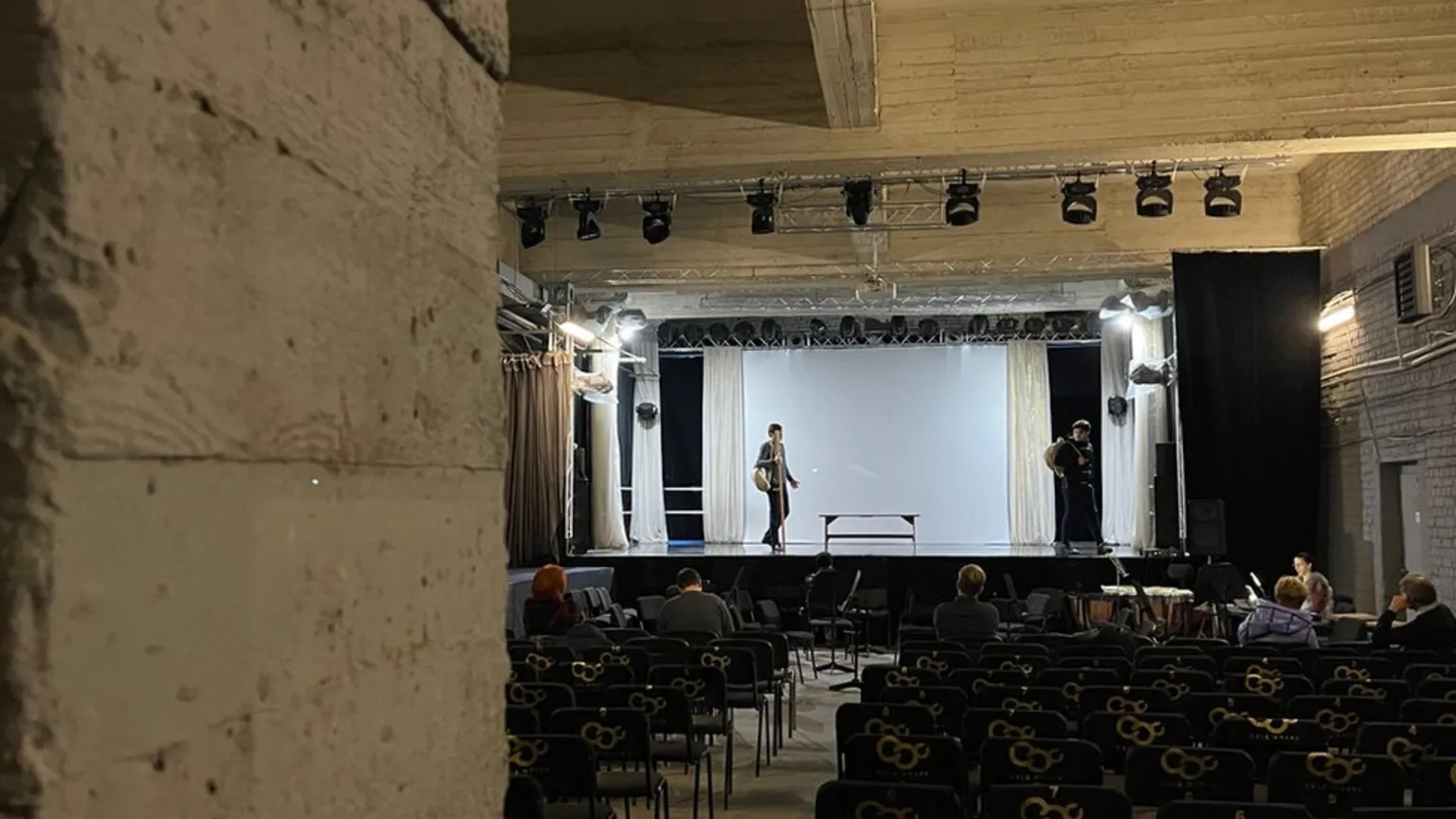
“The bunker theatre is being prepared beneath the main auditorium, down several flights of stairs.

“It has no dress circle, chandeliers or champagne — and a lot of grey concrete. But follow the sound of music and it leads to a raised stage with spotlights and rows of seats. Most importantly, there’s a company of singers, dancers and musicians desperate to perform before a proper audience again.

” ‘We really miss our big hall, the feeling of being on a big stage with lots of people watching,’ violinist Natalia Babarok explains. …

“In the first weeks after the full-scale invasion, when Russian troops were closest and the shelling most intense, a missile landed near to the theatre. Chunks of stone were torn from the side of the building and windows blown out. The roof caught fire several times, but staff managed to extinguish the flames before they took hold. The risk to life remains. …

“When the main theatre closed in February 2022, Volodymyr Kozlov did not stop singing. Thousands of Kharkiv residents were living on the metro then, staying underground away from the explosions. So Volodymyr and a group of fellow artists would tour the stations, performing three concerts a day, a mixture of classical music and popular tunes.

“When he was not singing, Volodymyr was helping to evacuate residents from the areas under heaviest fire or delivering food and other supplies.

” ‘It was impossible to stop, because if you did then the thoughts [of danger] would enter your head, and you couldn’t let them,’ the baritone explains. …

“Volodymyr is performing alongside his wife, Yulia Forsyuk, a soprano soloist who plays the lead role in the Ukrainian opera, Natalka Poltavka. …

“Now the pair are rehearsing to perform for Kharkiv residents again, safely beneath the city streets. But it’s not just the surroundings and acoustics that are different. … One man was killed fighting on the frontline and several more have been mobilized; others are scattered as refugees.

“For those who have stayed in Kharkiv, everything is being adjusted to their reduced new reality.

” ‘Our director adapts the score to feel like everyone’s still there,’ Natalia Babarok describes the changes for the orchestra.

” ‘My husband plays the trombone, but he’s told to play the bassoon and the horn parts too. As a violinist, I might also play the part of the flute. You have to play for yourself, and for someone else.’ “

The long, beautiful article is at the BBC, here. No paywall.

Alas, last Friday: “KYIV, May 10 (Reuters) – Russian forces launched an armored ground attack on Friday near Ukraine’s second city of Kharkiv in the northeast of the country and made small inroads, opening a new front.”

Read Full Post »

Photo: International People’s College.
Leisure time at an unusual school in Elsinore, Denmark. Some Ukrainian young people have found new ideas there for a stronger post-war democracy.

In Denmark, a non traditional high school called a “folk high school” is the model for a movement in Ukraine to build the strengths needed for a strong participative democracy. You could say “a folk school with Ukrainian characteristics.”

Amanda Leigh Lichtenstein reports at the radio show the World about work at “the International People’s College, a residential school located on a tree-studded campus in Elsinore, a historic town just an hour by train from the capital. …

“The IPC, one of Denmark’s oldest folk high schools, focuses exclusively on global affairs, and all classes are taught in English.

“[Marta Kostiv], a 23-year-old student from Lviv, said that she heard about the chance to study at the IPC when she was still in Ukraine. 

“ ‘I saw in one of their group chats that IPC is proposing a scholarship for Ukrainian students, so I applied for it, and I’m really glad.’ …

“Since Russia’s full-scale invasion began, 27 students from Ukraine have been accepted to study at various Danish folk high schools across the country as part of a special endowment to encourage young Ukrainians to learn about democratic change and civil society-building — a purpose aligned with the overall history and aim of the Danish folk high school system. 

“Denmark’s 70 folk high schools are residential colleges where young adults come to live and learn together for up to six months with no grades or exams.

These schools embody the concept of bildung — a German word for a learning approach that blends personal, civic and moral development through shared values like cooperation, empathy and dialogue. 

“The idea for the endowment came from a small group of educators in Ukraine with Bildung in Ukraine, a nongovernmental organization that believes that bildung holds the key to the country’s future.

“ ‘A very clear message from [Bildung in Ukraine] was to please open your schools for our youth because they need something meaningful to do while the country’s in a state of war,’ said Sara Skovborg Mortensen, who oversees international partnerships with the Association of Danish Folk High Schools. ‘And we need to prepare and democratize [and] build strong individuals for a time after the war.’

“A 24-week semester at the IPC costs about $6,500, which the special endowment makes free of charge. Students can apply to attend any type of Danish folk high school; they emphasize everything from gymnastics to the arts to spirituality. 

“At the IPC, residents do everything together, sharing meals and cleaning up in the kitchen, working on class projects, attending cultural nights, hanging out in the library and partying together on the weekends. 

“Students and faculty say the school’s emphasis on small-group dialogue and personal storytelling helps them break through cultural barriers and stereotypes.

“ ‘The classes are different, so we have choir, we have intercultural communication, Asian studies, we have all of that, even gardening. And my goal was to try everything I could,’ said Kirill Karuna, a 22-year-old student from Kyiv. ‘You just cannot help but fall in love with this whole concept.’ 

“Karuna originally applied to stay 12 weeks but was convinced to stay the full 24 weeks and said that he does not regret it — he even discovered his love for filmmaking here. 

“ ‘What I’ve learned about myself is that it’s all right to deviate from society and be on your own,’ Karuna added, ‘but don’t go to extremes and don’t leave the [community] for too long.’ … 

“Kostiv admitted that ‘even if you move abroad, you can’t get rid of your problems,’ [adding] that she is eager to return to Ukraine, find meaningful work and continue to build her life there. ‘The thing I will [return with] is curiosity,’ Kostiv said, noting how she was encouraged to explore the arts and try new things. …

“The 19th-century thinker N.F.S. Grundtvig is credited as the creative genius behind the folk high school system. 

“ ‘He was a priest. He was a poet. He was a politician. He was a pedagogical thinker. And he was a philosopher. And basically, Grundtvig’s thought was that we need to educate the Danish population — the sons of farmers — who only had very little education at that time,’ said headmaster Soren Launbjerg. …

“Over time, folk high schools flourished as a fundamental force in the formation of Danish consciousness. Many leaders and activists around the world would later turn to the folk high school system as a working model for civic engagement, nation-building and democracy. 

“Julie Shackleford, an American anthropologist and teacher at the IPC, oversees the school’s archives in a few crowded offices bursting with historical documents, records and relics. …

“ ‘In Denmark, they went from an absolute monarchy to democracy overnight. How do you participate in that when … you’ve never had a voice before? What do you do? So, people needed some training in finding their voice,’ she said. …

“Elena Tochilina, one of the founding members of Bildung in Ukraine, has been in residence at the IPC in Denmark since February to learn more about the folk high school system and find ways to adapt to the Ukraine context. 

“Tochilina said that the need for social change in Ukraine erupted in 2013-2014 with waves of large-scale protests calling for massive political reforms that became known as the revolution of dignity.

“ ‘We were very clear that revolutions sometimes are needed, but it’s better to evolve through self-development, through education,’ Tochilina said. 

“About a year and a half before Russia’s full-scale invasion into Ukraine, the group outlined plans, created a road map, established a nongovernmental organization and purchased land for the school. ‘When the war started, of course, everything stopped,’ Tochilina said. 

“But the war has also crystallized the need for democratic values in Ukraine, she said.  

“ ‘And it seems like we’ve got the key, we’ve got the knowledge of how to educate a critical mass of people who will be voters in the future and will be making more conscious choices,’ Tochilina said.

“The folk high school system offers a blueprint for ‘installing a new mindset’ among Ukrainian youth, Tochilina said, but not everything is directly transferable to a Ukrainian context. For example, Tochilina said the IPC’s habitual morning singing gave her flashbacks to mandatory, Soviet-era Young Pioneer camps she attended as a child. 

“ ‘You always have to be in the group and you have to stay in the group … I can notice some of these socialist traces in Danish society,’ she said, adding that the Ukrainian approach will require far more flexibility — and freedom.”

More at radio show the World, here. No paywall.

Read Full Post »

Photo: Erin Clark/Globe staff.
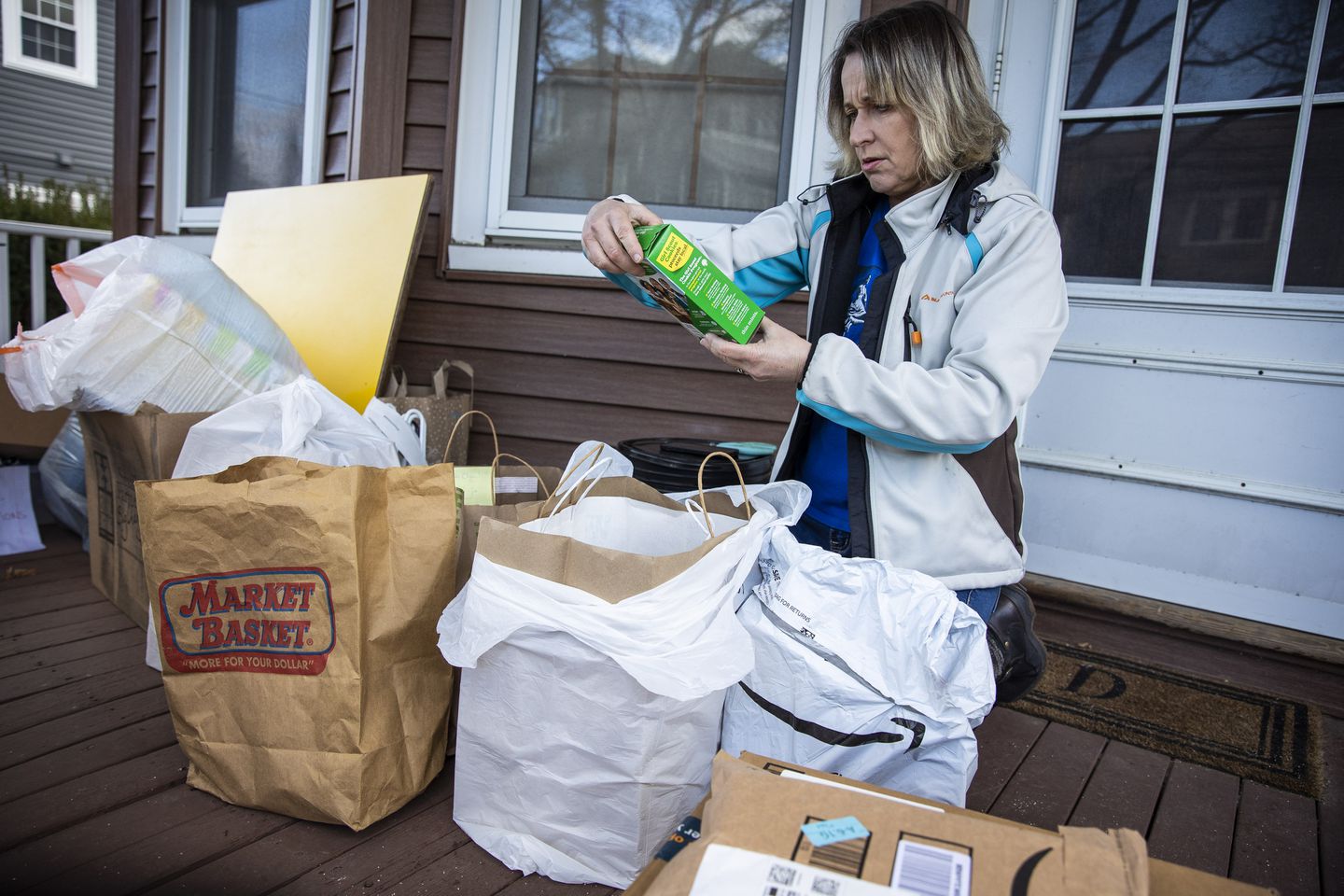
Olga Yulikova sorts through donations that people drop off “onto the front porch of her Arlington home to help a Ukrainian family fleeing war,” the Boston Globe reports.

Because I’m downsizing and complaining about how difficult it can be to get some items into the hands of people who need them, Suzanne told me about our community’s Buy Nothing Project on Facebook. So far, no one there has wanted an old ironing board, but lots of people were interested in beat-up posters. I picked the first to raise her hand.

Meanwhile, in Arlington, they call their Facebook group Everything Is Free and are using it to help refugees get settled. To me that’s a worthier cause than giving free things to people who could often afford to buy them ten times over.

Sonel Cutler writes at the Boston Globe, “In Ukraine, Olena had a fulfilling job in real estate and an apartment she loved. The only time she had ever left her home city of Zaporizhzhia was to go on vacation.

“[In] February 2022, Olena, who asked to be identified by her first name only for privacy, became scared for the safety of her young daughter and made the most difficult decision of her life: to flee her home.

“She and her daughter left Zaporizhzhia abruptly in March after Russian forces took over a nearby nuclear power station. They took only passports, her daughter’s birth certificate, and few other items before driving to western Ukraine and then to Germany.

“In April, the Biden administration launched the Uniting for Ukraine program, which helped Olena and her daughter seek refuge in the United States. They arrived in late June, staying with childhood friends in Arlington until January, when their hosts had to bring their own parents to the country from Ukraine. …

“Connecting on Facebook, Olena became friends with Arlington resident Olga Yulikova, who helped her secure an apartment and turned to the town’s ‘Everything is Free’ Facebook group for donations to furnish the place.

“Arlington residents overwhelmingly answered her request. In a matter of days, the previously bare apartment had a fridge, coffee maker, queen-sized mattress, dish soap, and more essentials for Olena and her daughter.

“ ‘I’m completely overwhelmed, and I’m so grateful for all the help,’ Olena told the Globe, with Yulikova translating. …

“Yulikova, who immigrated from Moscow as a refugee in 1989, had been organizing humanitarian aid for Ukrainian refugees since the war began last year.

“She and Olena became close friends after meeting online, sharing stories over cups of coffee, and connecting over the discovery that Yulikova’s great-grandmother hailed from Olena’s hometown in Ukraine.

‘I cannot stop the war. I’m very much against it,’ Yulikova said. ‘I cannot save the Ukrainian people that are suffering. I can only help one or two individuals.’

“Yulikova posted her request for donations or small amounts of money in the community Facebook group on Jan. 22, and set up a wish list, listing a drop-off location for donated items.

“ ‘She [had] an empty apartment with no money,’ Yulikova said. ‘She’s very happy, but she [didn’t] really have a mattress to sleep on. So I figured I’ll put it on our Arlington lists, just like I did for everything else when I was collecting donations to be sent to Ukraine.’

“Daniel Icekson, a 54-year-old Arlington resident and friend of Yulikova, had been following Olena’s story after they had met briefly months before.The tragedy of the war in Ukraine moved Icekson, whose relatives perished in the Holocaust. When he heard Olena was looking for donations, Icekson began disassembling a large wardrobe, planning to reassemble it in Olena’s apartment.

“ ‘I thought, Why not? We have this extra wardrobe. We’ll just give it away,’ Icekson said. ‘If I can just contribute in a small way to one family, then I guess that’s a good thing.’

“Yulikova said she initially worried about how she and Olena would transport hefty items like a kitchen table and a jumbo bean bag into the apartment by themselves. But, according to Yulikova, ‘people came out of the woodwork’ to help.

“ ‘[They] said “Oh, no problem. I will drive. I will bring. I will assemble, disassemble,” ‘ she said. ‘People just volunteer.’

“While she knew Icekson, the majority of donors were complete strangers to Yulikova, something she said helped restore her lost faith in humanity. …

“Though her young daughter has immersed herself in school, performing with the local theater, and learning English, Olena remains troubled by her separation from her son and father, who remain in Ukraine to support the army.

“ ‘Every day, I don’t know if my son and my father will live another day,’ she said. ‘Every day I keep the phone at my fingertips and check in on them 100 times a day.’ “

More at the Globe, here.

Read Full Post »

Permission to Stay Warm

Photo: Henry Nicholls/Reuters.
Residents take shelter inside London’s Roehampton Library, Dec. 14, 2022. The library is being used as a “warm bank,” according to CSM, welcoming members of the community to spend time there in the winter months as an alternative to heating their homes amid increased energy costs.

After Russia invaded Ukraine a year ago, oil prices and heating costs went up for everyone. And rather than help people out, oil companies gave their windfall profits back to themselves. In the long run, that can only help to spur alternative energy development. But meanwhile, folks are just trying to keep warm.

Natasha Khullar Relph writes at the Christian Science Monitor, “String lights, boxes full of postcards to share a story, or a sign on the door that lists the top five David Bowie songs with the message, ‘Come in and argue’: There are many ways to make people happy to come out of the cold and into a public warm space, says Maff Potts. The key, he adds, is to make sure they feel welcome and not judged.

“ ‘What gets people in is that it’s not a church. It’s not a charity,’ says Mr. Potts, who founded Camerados, a social movement that’s been opening public living rooms in communities across the United Kingdom since 2015. ‘There’s no fixing, no answer. There’s just permission.’ …

“While the U.K. Health Security Agency is encouraging people to warm their homes to at least 18 degrees Celsius (64.4 F), more than 3 million low-income households cannot afford to heed this advice.

According to analysis by the Joseph Rowntree Foundation, around 710,000 households across the U.K. cannot pay for warm clothing, heating, and food, with approximately 2.5 million households – a fifth of all low-income households – going without both food and heating.

“And with power prices hitting record levels and energy costs double what they were last year, warm spaces have popped up all over the country. To avoid any potential stigma, they’re being presented as communal spaces where people can come to chat rather than charitable offerings of heat or food. While the main reason someone would go to a warm space or public living room is most likely to be warmth, it’s the camaraderie and conversation that keeps people there. …

“Britain’s poor people face the worst winter in living memory, tweeted former Prime Minister Gordon Brown in December. ‘A year ago we talked about people having to choose between heating and eating, now many can’t afford either,’ he wrote. Two-thirds of the country will be in fuel poverty come April, which includes 70% of pensioners [retirees] and 96% of single-parent families with two or more kids, he noted. …

“If you’re struggling to pay to heat your home, you only really have three options, says Matt Copeland, NEA’s head of policy: You could rack up debt with your energy supplier, ration your energy and use less than you need to stay warm, or simply turn off the heating, the impact of which can be significant. Research shows that more people die from cold homes than they do from alcohol’s short- and long-term effects, Parkinson’s disease, or traffic accidents.

“ ‘We know of households with prepayment meters who just can’t afford to top them up at all,’ says Mr. Copeland. ‘They’re going days, weeks, and sometimes months without access to energy.’ …

“Where the government is failing, communities are stepping up. ‘It is completely absurd that one of the 10 richest countries in the world can’t put a sufficient priority on things and make the right choices so that we have somewhere to keep people warm,’ says Mr. Potts of Camerados, whose public living rooms are now being used as templates for warm spaces around the country. After almost 30 years of working with people at the margins, Mr. Potts says he doesn’t have faith that the solution lies in the civil service. …

“An LGBTQ+ community space in Brighton. A bakery in North Yorkshire. A gaming cafe and ‘geek culture’ store in Ipswich. A vegetarian restaurant in Tunbridge Wells. A brewery in Devon. A former shoe store in Worcestershire. Warm spaces are popping up all around the country, in all manner of ways, in a community effort that started organically, from the grassroots, without a central organizer.

“In addition to community halls and churches, hotels, hairdressers, and cricket clubs are opening up their doors for anyone who needs some warmth, some company, and perhaps even a drink. Even legendary soccer club Manchester United has gotten in on the action and is offering Old Trafford, the club’s stadium, as a free warm hub, with its restaurant, the Red Café, opening its doors on Monday and Wednesday evenings ‘to help those facing difficult months ahead.’

“The Warm Welcome campaign, an organization that has encouraged thousands of faith groups, charities, and businesses to provide such public spaces, said they’d seen 80,000 people use their facilities during December’s cold snap. The campaign notes that there are now warm spaces in every town and city in the country, and lists over 3,200 venues on their website, which include spaces run by local authorities, charities, and businesses. …

“ ‘What we have in Brighton and Hove is a tremendous community-mindedness among residents. Despite the stark reality facing residents this winter, people have stuck together and they’ve really helped each other through some of the starkest problems,’ says Brighton and Hove City Council Leader Phélim Mac Cafferty, who notes there are more than 40 warm spaces available to the public across the city. …

“This nationwide response to the energy crisis is unique in how much of a community effort it is. The effort to create warm spaces was neither government- nor council-led, nor the work of any one particular organization. As the need became obvious, first volunteers, then organizations, and later local councils jumped in feet first.”

More at the Monitor, here. No firewall.

Read Full Post »

Photo: Office of the President of Ukraine via Reuters Connect.
Ukrainian soldiers capture the moment when Ukraine President Volodymyr Zelenskyy visited the liberated city of Kherson on Nov. 14, 2022. War is hell, but soldiers rejoice when they can, even putting dance videos on TikTok.

When the Ukrainian oligarch gave up control of U24 news and the volunteer social-media team I was on disbanded in May, I knew that the outlet would be managed by the government. Now a new law makes it official that freedom of the press is out, at least for now. (See New York Times article here.)

Naturally, I am worried about that. Freedom of the press should not be a luxury only for peacetime. But I don’t feel I have the right to judge, and I am waiting to hear what some of our Ukrainian colleagues have to say.

In the meantime, I want to share the playful videos from Insider, where you can see Ukrainian soldiers relaxing with goofy dance videos that get put on TikTok.

In early December, Andrew Lloyd wrote, “Across social media, videos showing what appear to be Ukrainian soldiers taking part in lighthearted trends and dances are going viral, drawing a mixed response. 

The most viral video in the genre appears to be a 23-second clip shared by the official Twitter account for the Ministry of Defense of Ukraine on December 5. It shows a person in military attire performing a dance in the snow while what sounds like gunshots could be heard in the background. …

“The same account had previously shared a 21-second clip of a soldier dancing on the hood of what appeared to be a military vehicle, which was viewed over 285,000 times, and included the caption, ‘Morale is high.’ 

“The videos have received a mixed reaction from Twitter commenters, some of whom expressed exasperation with the soldiers.

” ‘What is the point of these dancing videos,’ one comment with over 1,400 likes said. ‘War is hell, soldiers in trenches are freezing to death and most likely are not thinking about pikachu dance.’ …

“But another commenter with over 700 likes came to their defense. ‘Maybe, just maybe, it is to help cope with that hell.’ 

One Twitter user wrote, ‘For those of you who think this is bad: Not sure if you’ve ever been in a combat zone, but I have. … People do things to have some semblance of fun, joy, and normalcy when we could.’

“In the comments, some Twitter users also shared older footage of soldiers dancing and photos of soldiers engaging in ‘silliness in WW2’ in response to the dancing video. Similar videos have also circulated on TikTok, although they don’t appear to have been posted by official accounts. 

“One user who goes by @diyak_yuriy has posted three videos in the past month showing a person dressed in what appears to be a Ukrainian military uniform. … Diyak Yuiry, the 24-year-old dancer behind the account, told Insider he’s been in the military for more than three years and he was ‘very grateful to everyone’ who watched his TikTok and left comments. …

“Viewers seemed to have a more positive response on TikTok [than on Twitter]. One comment with over 1,800 likes said, ‘Damn! These Ukrainians do have a sense of humor. I’m rooting for you,’ while a comment with over 200 likes said, ‘You can’t break a brave soldier’s spirit. Keep on dancing.’

“Russia invaded Ukraine on February 24, but Vladimir Putin’s troops have since lost half more than half the territory they had initially gained, the BBC reported in November. 

“Half of Ukraine’s energy infrastructure was damaged or destroyed as a result of attacks from Russia, which caused a ‘devastating energy crisis,’ according to Hans Kluge, the WHO’s regional director for Europe.”

More at Insider, here. No firewall.

Because Ukraine’s media is currently under government control, it is not possible to be sure this dance video is a real thing. But I have to enjoy it anyway.

Read Full Post »

Artists Leave Russia

Photos: Tanya Habjouqa/NOOR for NPR.
Choreographer Polina Mitryashina, artist Victor Melamed, and jazz producer Evgenii Petrushanskiy are Russian artists who have recently fled Russia to live in Israel.

Most of the Ukrainians I worked with for those precious few months after the Russian invasion believe that all Russians support Putin’s war. But although I would probably feel the same if I were constantly being bombed and had no electricity and was running out of food, I believe that nations aren’t monoliths.

Today we learn about some Jewish Russian artists who are against the war and have left their country. It’s not just about saving their own skin. It’s outrage.

As Daniel Estrin reports at National Public Radio, “Some of Russia’s biggest artistic talents have immigrated to Israel this year, finding a safe place to rebuild their careers and voice their conscience about their country’s war in Ukraine.

“Since Russia invaded Ukraine in February, it has cracked down on even the slightest opposition to the war, forced thousands of citizens to enlist to fight and drawn tough sanctions from the West. All this has prompted many Russians to flee.

“More than 28,000 Russian nationals have acquired Israeli citizenship since the war began, according to Israeli government figures. …

” ‘Staying behind the Iron Curtain was incredibly scary,’ Russian artist Victor Melamed says. … Melamed, whose portraits have appeared in the New Yorker magazine, fled to Israel in June. He says: ‘I want to be a person of the world.’

“Russians are relocating mostly to Turkey, Kazakhstan and Georgia. But Israel offers one big advantage: Those with at least one Jewish grandparent can get Israeli citizenship for themselves and their close family.

” ‘When the war started, I think, like, everybody literally remembered their Jewish grandma,’ says Liza Rozovsky, a Russian-born Israeli journalist tracking Russian celebrity arrivals for the Haaretz newspaper. …

“Some Ukrainian immigrants in Israel wish the Russian newcomers would stay in Russia to protest their leadership, despite the risks. ‘They’re trying to run away,’ says Ilona Stavytska, 33, a Ukrainian-born barista in Tel Aviv.

“But Russian exiles say their protest is more effective here. ‘Go protest in Moscow. I will support you. I will say, “Oh, look, this person is protesting.” Then I will send you letters to jail,’ says Maxim Katz, 37, a Russian YouTube blogger and former opposition politician who escaped to Israel and publishes anti-war videos to audiences in Russia. …

“What a difference a year has made for jazz producer Evgenii Petrushanskii. Last year, his record label in Russia, Rainy Days Records, produced a jazz album which got nominated for a Grammy. This year, the record label has gone silent.

” ‘I don’t feel it’s the right time now to release music as a Russian label,’ Petrushanskii, 36, says at a Tel Aviv coffee shop. ‘For the ethical reasons, I stopped.’ Days after Russia invaded Ukraine, he left St. Petersburg for Tel Aviv, claiming Israeli citizenship based on his father’s Jewish roots.

” ‘It’s impossible to release a record in Russia so it goes to the foreign audience,’ Petrushanskii says. ‘A majority of music aggregators who release music toward the platforms like Apple Music, Spotify … are not presenting in Russia anymore.’ Now he’s re-registering his record label in Israel, hoping to release new records of Russian artists next year.

Polina Mitryashina, 28, worked at one of the world’s leading dance institutions, Russia’s Mariinsky Theater. Then when the war broke out, her dancers began to vanish.

” ‘Now they’re in Oslo,’ she says. …

“Mitryashina attended a recent networking event at the Israel Festival in Jerusalem, which brought 100 Russian and Ukrainian artists in film, music, art and dance — new immigrants like her — to meet veteran Israeli artistic directors and try to rebuild their careers in Israel.

‘Sometimes I’m angry [at] the people who stay … and continue to work for the big companies, and continue to make money’ in Russia, she says. ‘I am like, “Are you crazy? You, you’re like a sponsor of the war.” ‘

“Artist Victor Melamed, 45, moved his family to a quiet Tel Aviv suburb to keep his teenage boys out of a potential Russian military draft — though they will likely be drafted into the Israeli army.

” ‘I have no romantic visions of, you know, Israel’s policies,’ he says. ‘The Israeli army is an institution that cares for every person they have … as opposed to the Russian army.’

“Each morning he draws a black-and-white portrait of a Ukrainian civilian killed in a Russian attack, and posts it on Instagram. He says it’s his way of pinching himself, not to get too comfortable in his new home in Israel. …

” ‘We need to grow up,’ he says. ‘We cannot afford to stay the same.’ “

More at NPR, here.

Read Full Post »

Older Posts »