Feeds:
Posts
Comments

Posts Tagged ‘urban garden’

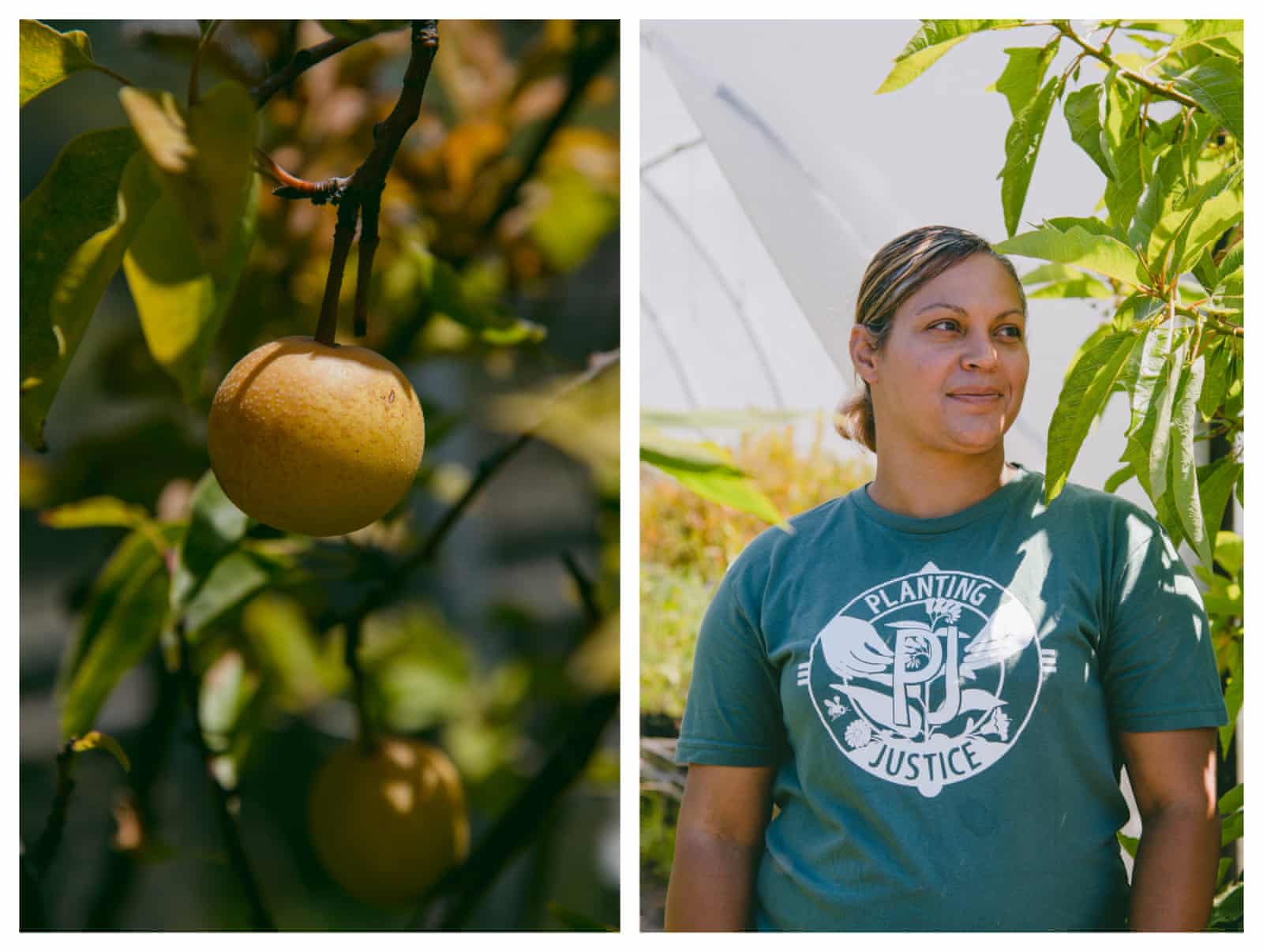
Photo: Marissa Leshnov via the Guardian.
From the Guardian: Sol Mercado says her work as a gardener has brought her comfort and helped to reconnect with her roots.

Can Nature turn a life around? We’ve had a number of articles suggesting the answer is yes. Among others, our 2023 story about a traumatized Iraq veteran who discovered hiking in the wilderness.

Now Caitlin Yoshiko Kandil, of the Guardian, describes the role that an urban garden can play in life after prison.

“When Sol Mercado was incarcerated, one of her few sources of comfort was to dig her hands into dirt. Coming from a family of sugarcane and coffee farm workers in Puerto Rico, a love of gardening was in her roots. But it wasn’t until she was in prison and started participating in a gardening program that she truly connected with this part of her heritage. …

“Mercado – who was released a year and a half ago – now works for Planting Justice, a food justice organization based in Oakland, California, that tackles inequalities in the industrialized food system, from the underpayment of food workers to the lack of fresh produce in low-income neighborhoods.

“Planting Justice addresses food sovereignty with marginalized communities – in particular people who have been affected by the criminal justice system – through gardening workshops in prisons and jails, such as San Quentin state prison, and jobs for those formerly incarcerated.

“For Mercado, 36, the organization helped turn her life around. …

“ ‘What I learned in prison is that if I want to change, if I want to blossom, I need to work on myself and remove unhealthy things from my life,’ she said. ‘It’s the same as a plant. A plant, if you don’t weed it, if you don’t prune it, if you don’t water it, it’s not going to grow and give fruit.’

“Planting Justice’s two-acre (nearly 1 hectare) nursery – which grows more than 1,200 varieties of plants – is tucked between a busy highway and a railroad line in Sobrante Park, a low-income, predominantly Black and Latino neighborhood that’s long been a food desert with no grocery stores within walking distance. The land the nursery sits on once belonged to the Indigenous Ohlone people, so Planting Justice is working with the Sogorea Te’ Land Trust, a local organization that helps facilitate the return of Indigenous land to Indigenous people; once the transfer is complete, Planting Justice will lease the land from them.

“Founded in 2009, Planting Justice has installed 550 edible gardens at schools, community centers and homes; hosts education programs for local youth; distributes produce to local residents; gives away free fruit smoothies at Bay Area Rapid Transit stations; and sources produce for the Good Table, a nearby cafe where diners pay what they can afford.

“As part of a new initiative that started this year, Planting Justice is also planting 1,000 fruit trees – apple, pear, pomegranate, peach, olive and fig trees – in East Oakland homes for free.

“Like Mercado, many Planting Justice employees were formerly incarcerated. Some came to the organization through re-entry programs and partnerships in jails and prisons, while others found their way after their release.

Planting Justice says its recidivism rate is 2%, far lower than California’s rate of nearly 50%. …

“Bilal Coleman said he first heard about Planting Justice while incarcerated at San Quentin state prison, north of San Francisco. He was coming to the end of his 20-year sentence and was participating in a partner program called Insight Garden – and Planting Justice was advertising that it was hiring people returning home to the San Francisco Bay Area.

“Coleman said that gardening is in his roots. “Ever since I can remember, there’s been a garden in my family,” he said. But that wasn’t the immediate draw to Planting Justice; it was the security of having a job lined up after his parole, benefits and good pay – salaries start at $19 an hour. ‘It was a chance to get on my feet before I actually paroled,’ he said. …

“Planting Justice’s presence can be felt throughout Sobrante Park, revitalizing a neighborhood that’s long been in decline. Sobrante Park has been ‘underresourced and overpenalized for generations, where there aren’t the same food options,’ said Julia Toro, nursery office manager.

“Covonne Page, Planting Justice’s land team lead, was born and raised here, and recalls a time when things were different. The 33-year-old said that he and his friends would ride inflatable rafts on the San Leandro Creek, which was lined with wild blackberry bushes and filled with lizards and turtles. Most houses had fruit trees and vegetable gardens in the back yard, and families would trade their harvest so that everyone had their fill of oranges, loquats, lemons and plums. This bounty meant the community ate well; Page remembers his grandmother’s blackberry cobbler and his grandfather’s plum jam. …

“But years of disinvestment, longtime residents leaving – often for prison – and environmental degradation have decimated this landscape, Page said. … By bringing fruit trees back to people’s yards and teaching them how to garden, Planting Justice is not only offering much-needed jobs to the community; it’s revitalizing its food culture and sovereignty.”

More at the Guardian, here. No paywall. Great photographs by Marissa Leshnov.

Read Full Post »

Photo: BBC News.
Rooted in Hull, a nonprofit that teaches people how to grow produce in urban areas, flourishes in the industrial heartland of Hull, UK.

Here’s a city in the UK that is essentially giving residents permission to save the planet in those small ways that can add up. It’s about growing healthful food where polluting industry once held sway.

Kevin Shoesmith writes at BBC News, “Hull looks set to become the first UK city to give people the ‘right to grow’ food on disused council land.

“Council bosses say the move would bring communities together, reduce antisocial behavior and make places look better, as well as put quality food on dinner plates. As campaigners call for the idea to be adopted nationally, BBC News visited one Hull-based community group that is ahead of the curve, growing healthy food in the shadows of factories. …

“In multiple raised beds on a graveled patch of land off St Peter’s Street, plants flourish, irrigated using a system which collects and stores rainwater from the roof of the Royal Mail’s sorting office next door.

“Stopping to inspect an apple tree as an HGV rattles by, Martin King, manager of Rooted in Hull, a not-for-profit community organization, said staff and volunteers have proven food can be grown almost anywhere.

” ‘You don’t need a lot at all,’ he says, grinning. ‘Joinery students at Hull College made the raised beds for us.’

“The organization acquired the land in 2015, with Mr King explaining it was once a basin used to hold ships delivering timber to a nearby dock. A stipulation of the lease, he told me, is that no foundations must be dug, hence the presence of containers, a compost toilet and even a reed bed that filters dirty dishwater. …

“[King is] supportive of Hull councillors who recently unanimously passed a ‘right to grow’ motion. If approved by the city council’s scrutiny committee, a map would eventually be produced showing suitable land it owns that could be used by those who want to grow their own fresh food.

“Hull would become the first city in the UK to give people a right to grow on unused council land. …

“Inside a grocery box before us is an abundance of autumnal vegetables destined for the dinner plates of volunteers. Glancing over the road towards the muddy banks of the River Hull, [King] says: ‘Let’s wash away the idea that Hull is some rundown backwater.’

“Incredible Edible, a network of more than 150 community growing groups, is pressing for more councils to do the same. The group insists unused land could ‘with a little TLC be turned into oases for food and wildlife.’ …

” ‘Land already earmarked for building in the future could be temporarily used to grow food,’ [Councillor Gill Kennett] says. ‘Years pass before the foundations are laid and fruit and vegetables could be grown over several seasons.’

“Councillor Mark Ieronimo, the council’s infrastructure portfolio holder, says the city is ‘blessed with green areas,’ adding there are also spaces that are no longer used, such as former car parks. … ‘This will bring people together and it’ll improve mental health and reduce food waste.’

“Back at Rooted in Hull, two volunteers beaver away, weeding and removing the remains of wilted, summer crops. Kale and butternut squash are in plentiful supply.

“Mr King agrees community gardening projects such as this one can help boost mental wellbeing. He says the group works with many vulnerable members of society, including Hull All Nations Alliance (HANA), which helps refugees.

” ‘We had a group of kids from HANA come down,’ he points out. ‘They made chips and pizzas using produce grown here. We help tackle social isolation.’

“At the back of the yard, there are three beehives. ‘A man serving a sentence at HMP Hull used his graphic skills to design labels for the honey,’ Mr King informs me.

“Mr King is content but conscious that more spaces, not just in Hull, could be used in a similar way for food production.”

More at BBC News, here.

Read Full Post »

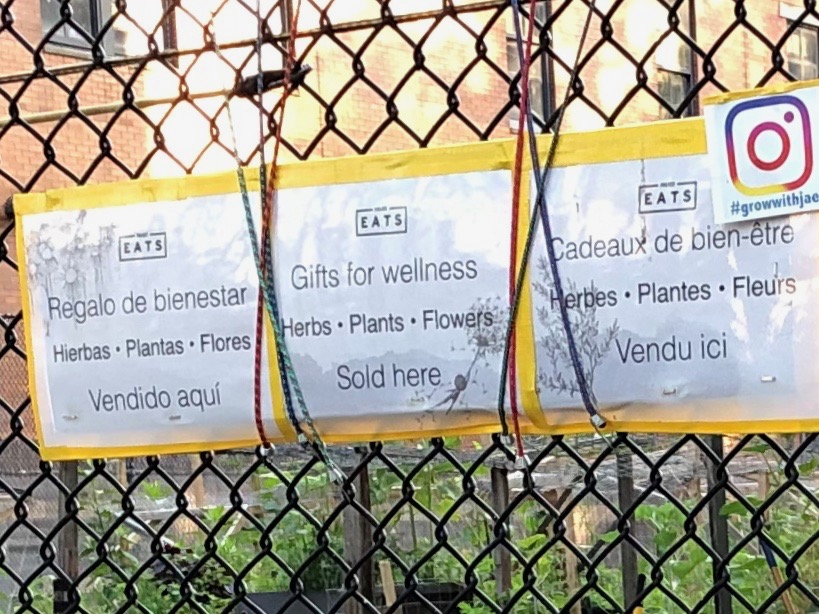
072719-Jae-has-healing-plants

When in New York, I like to walk from the Upper West Side to Central Park in the morning. I often walk east on the West 101 Street path that goes past the Frederick Douglass Houses. On the right is a playground and a popular little swimming pool (three feet deep, lifeguards provided), and on the left is a big field for sports and an empty lot converted to a garden.

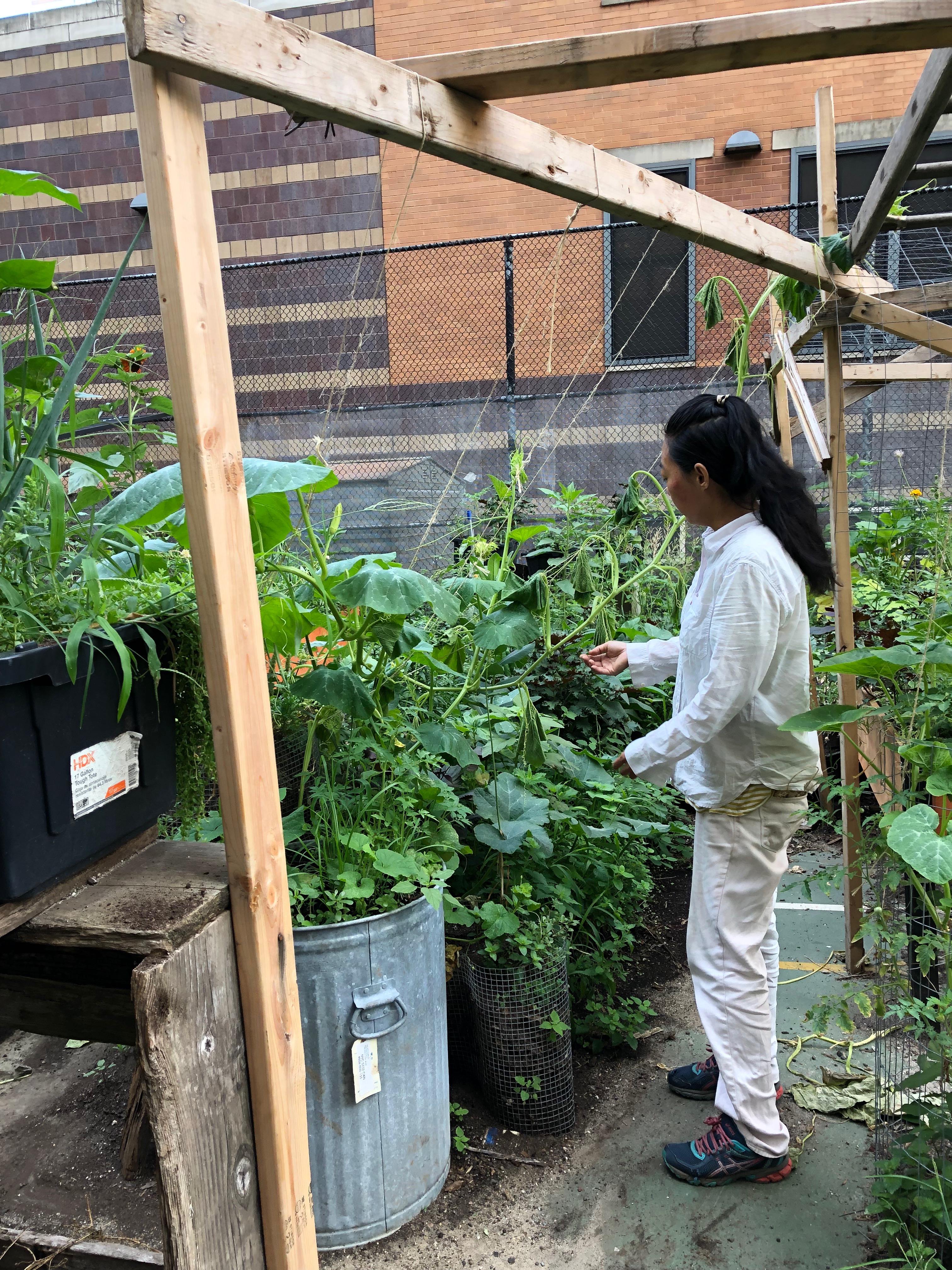
When the garden fence was open recently, I stopped in and talked to Jae the gardener, whose passion for growing and feeding people is an inspiration.

Jae says she used to overthink food shopping, experiencing a kind of paralysis in the market as she asked herself, Where was this fruit grown? Who grew this vegetable? Were they paid a fair wage? Were pesticides used?

But she found her calling when she started growing her own food. First she helped gardeners by learning to compost, and she is still crazy about the whole idea of composting. “That’s where I come from as a gardener. I love worms!”

A full-time volunteer, Jae is eager to show visitors around the converted tennis-court farm. The garden has been built on top of the court, starting with piles of compost. Although her partner organization, Project EATS, notes the garden is not an official production farm this year, Jae sells some produce in hopes of saving up to hire a Haitian neighbor as a full-time gardener at some point. (“I don’t speak Haitian, he doesn’t speak English, but we both speak Farm.”) She gives half to the partner organization.

Jae has a completely organic approach (no pesticides or herbicides), and she expresses a feeling of awe at how nature works without such interventions. She shows how Mother Nature has let her plants flourish despite the views of “schooled farmers” that there was inadequate sun in that space.

When I told Jae I come to the city to visit my sister, who has cancer, she said my sister should come enjoy the garden’s healing aura and should bless the plants by breathing out carbon dioxide to help them grow.

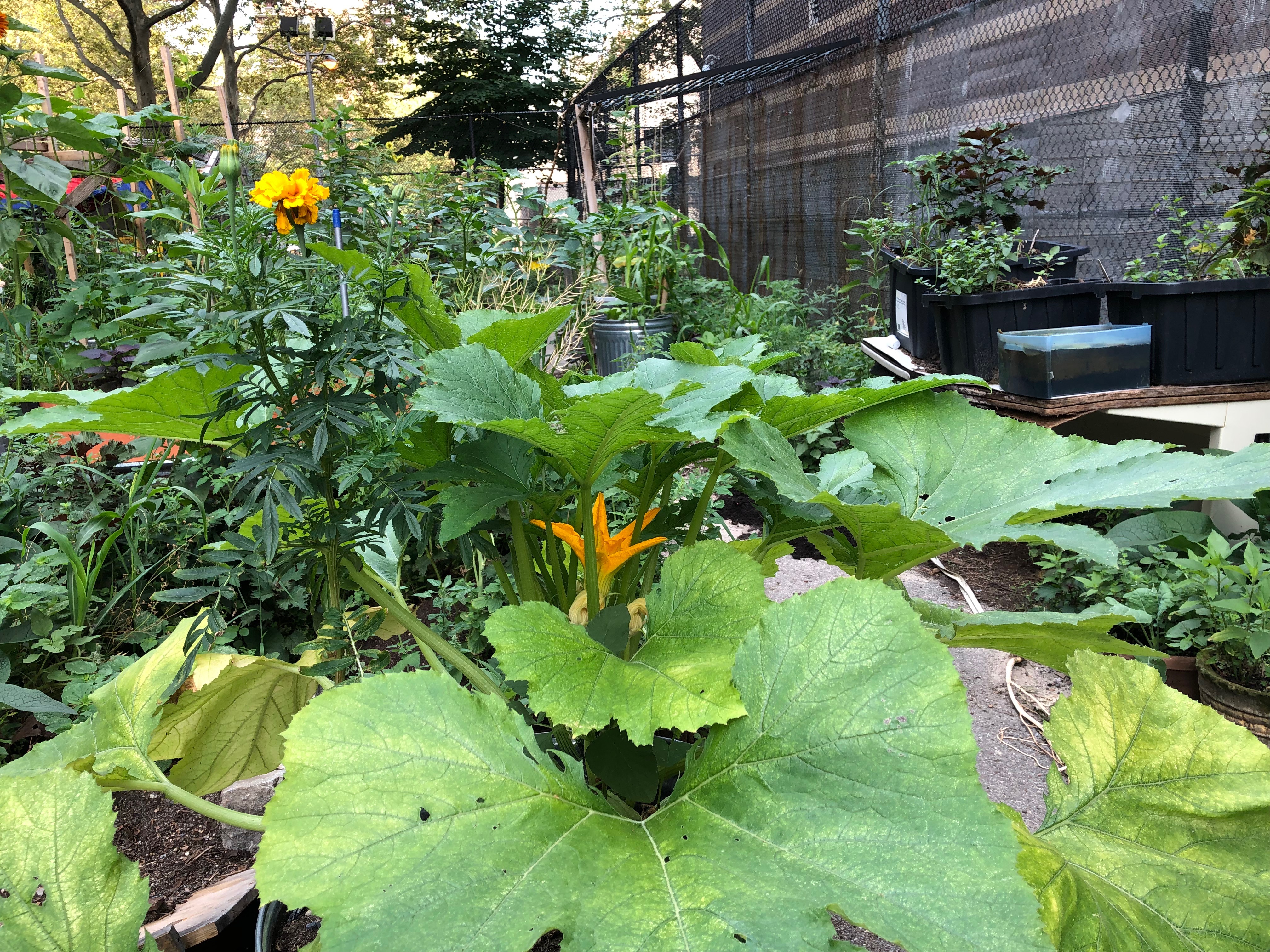
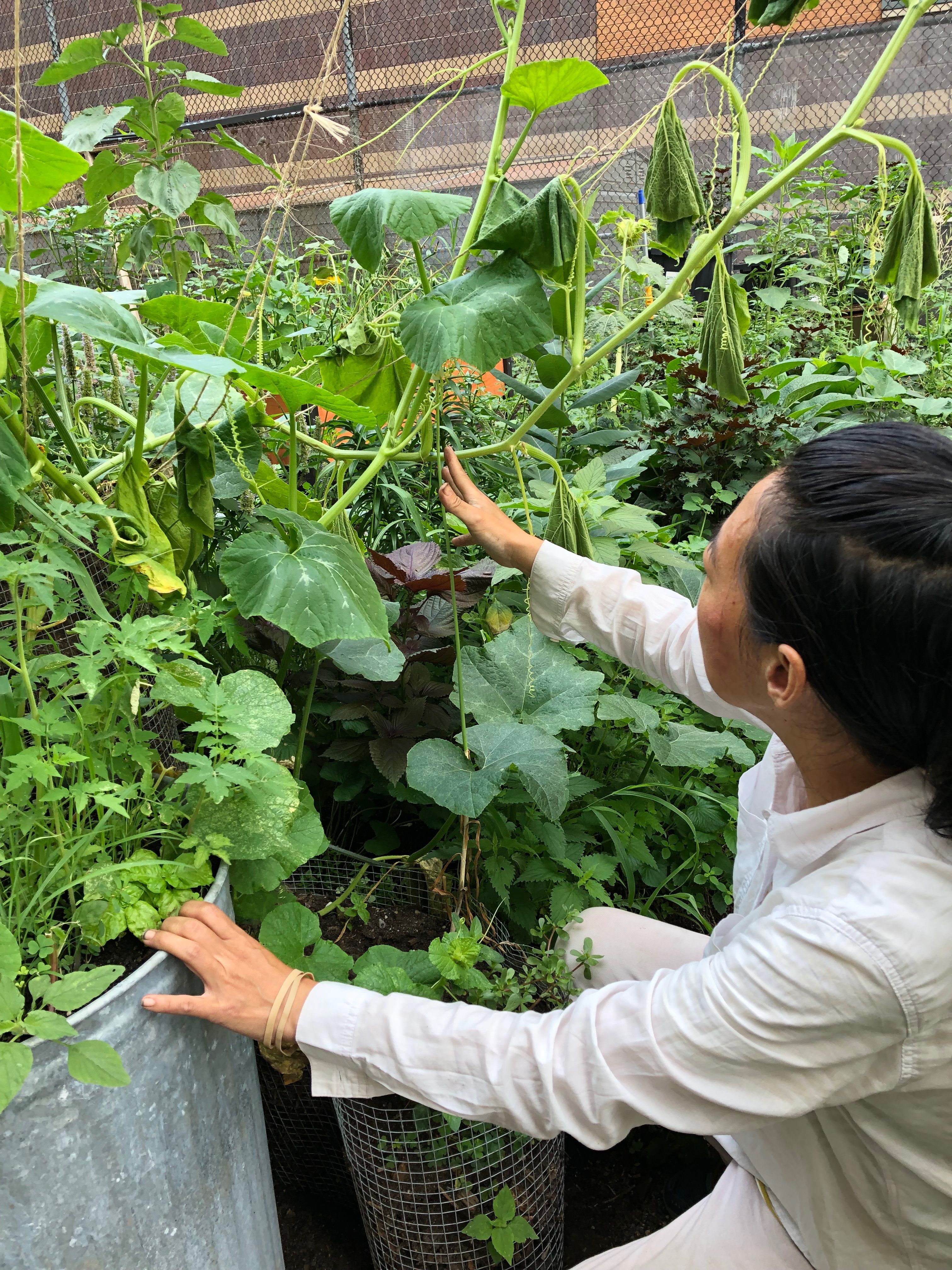
I left Jae hand-removing squash borer eggs. (“Look how symmetrically they are laid! Isn’t it beautiful?) As beautifully as those eggs are laid, she knows she has to destroy them to protect the squash plants. Follow Jae on Instagram, @growwithjae .

Jae’s partner organization describes its own mission thus: “Social inequalities lead to health inequalities and ill-being in our communities. They affect our access to fresh food, life expectancy, physical and mental well-being, quality of education, employment opportunities. income, and share of public resources. They shape our behavior and expectations, and what we perceive and believe is possible for our communities, our society, and us.

“To achieve its mission of a fair society, Project EATS is a neighborhood-based project that uses art, urban agriculture, partnerships, and social enterprise to sustainably produce and equitably distribute essential resources within and between our communities. Especially those where people live on working class and low-incomes.

“To do this, we bring diverse neighbors together to take agency over the use of land in their neighborhood, provide the infrastructures and support for a community to develop their resources into productive spaces. We share knowledge and skills that support the ability of people to turn these relationships and resources into sustainable social enterprises employing community residents and stimulating local economies.”

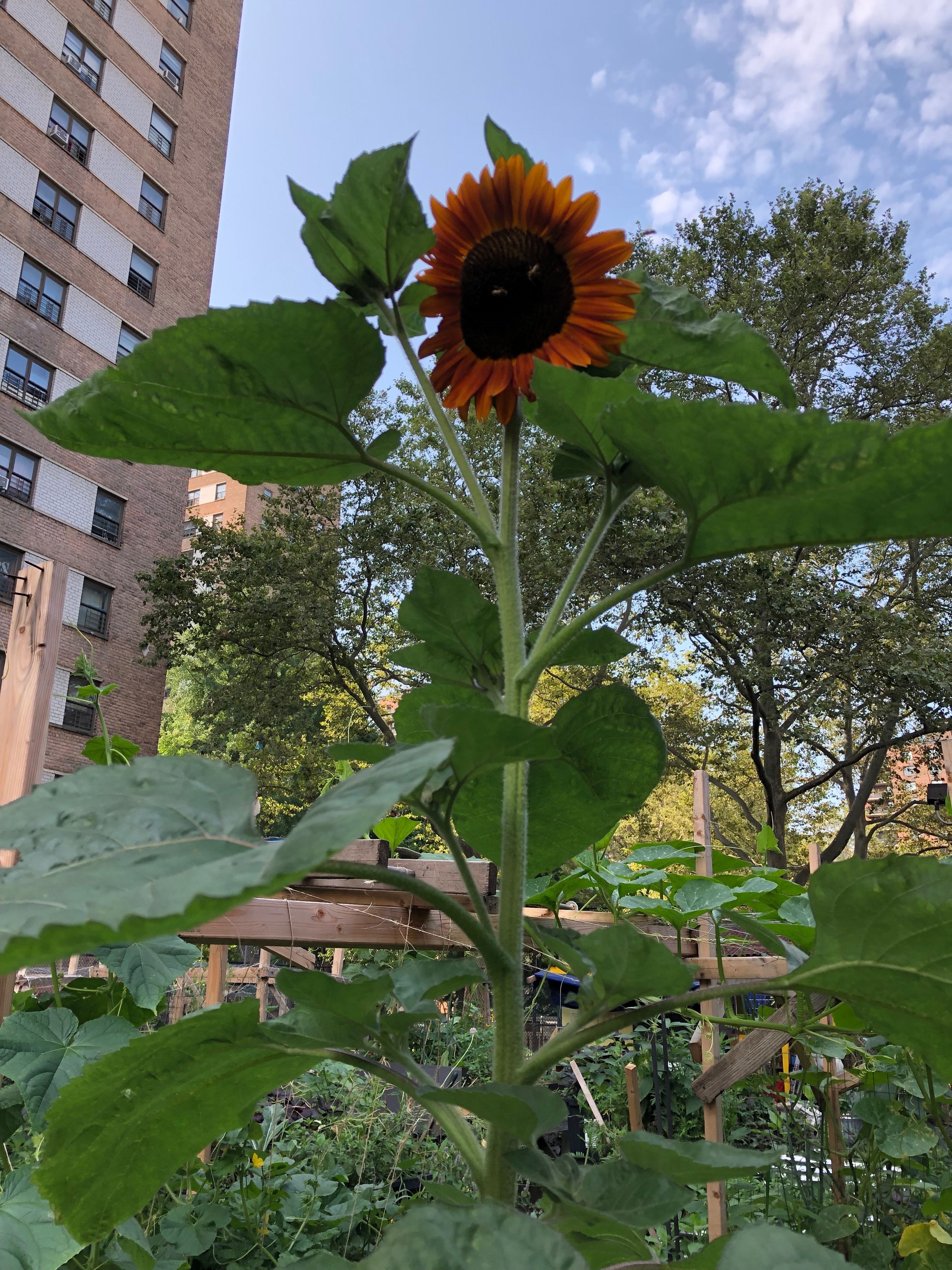
Note the happy sunflower, one of several that Jae rejoices in, especially as she was told there was not enough sun to make gardening worthwhile in that space.

072719-squash-west-101-st-NYC

072719-Jae-in-organic-garden

072719-checking-squash-for-borers

072719-Jae-loves-her-sunflowers

Read Full Post »

At the Guardian, teacher Steve Ritz tells Matthew Jenkin about how he began growing food in a troubled South Bronx school.

“The Green Bronx Machine was an accidental success. I wound up working at a very troubled high school in New York’s South Bronx district. It had a very low graduation rate and the bulk of my kids were special educational needs, English language learners, in foster care or homeless. It was dysfunctional to say the least.

“Someone sent me a box of daffodil bulbs one day and I hid them behind a radiator – I didn’t know what they were and figured they may cause problems in class. A while later … we looked behind the radiator and there were all these flowers. The steam from the radiator forced the bulbs to grow.

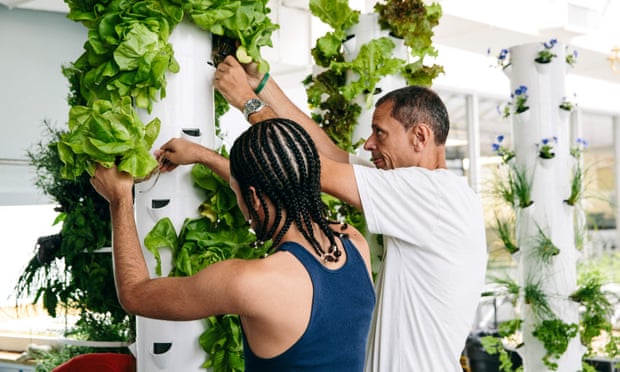
“That was when I realised that collectively and collaboratively we could grow something greater. We started taking over abandoned lots and doing landscape gardening, really just to beautify our neighbourhood. … We then moved on to growing food indoors in vertical planters around the school.

“By building an ‘edible wall’ to grow fresh vegetables in our science classroom, I gave the kids a reason to come to school. …

“Remarkably the plants grew. The kids really believe that they are responsible for them and attendance has increased from 43% to 93%. Students come to school to take care of their plants – they want to see them succeed. Along the way, the kids succeed, too.” More here.

Photo: Progressive Photos  
Steve Ritz gets students involved in the natural world. Attendance has more than doubled.

Read Full Post »

Not sure how I learned about this story in the St. Louis Post-Dispatch, but I knew right away it would be good for the blog. It seems that enterprising neighbors of some vacant urban land started a garden on it 35 years ago, always wondering what would happen if the owners ever turned up.

Reporter Paul Hampel writes, “Joe Spears was ready to give up the farm. He had no legal claim to the plot of land in Kinloch, after all. Spears was just one of several dozen people who, without any official clearance, had been planting and harvesting greens, okra, melons, beans, tomatoes and peppers for the past 35 years on about nine vacant acres abutting North Hanley Road.

“When an executive from one of the largest construction firms in the Midwest approached the amateur farmers in the fields last fall, it looked like a good thing was coming to an end.

“ ‘We were never trying to pull the wool over anyone’s eyes,’ Spears, 70, of Rock Hill, said … ‘It wasn’t our property. And it wouldn’t be right for us to make a scene when the rightful owners told us to move on.’

“The rightful owner, Clayco Inc., explained that the minifarms lay in the path of the planned expansion of NorthPark Business Park, the company’s massive development … Then came a proposal that caught the farmers, including Armstead Ford, by surprise.

“ ‘Clayco offered to give us another place to farm,’ Ford, 75, of Northwoods, said. ‘I was hopeful but skeptical.’ …

“Clayco president Bob Clark allayed those concerns when he announced that the company was relocating the farmers to 8 acres in Berkeley that they had asked him for, just across North Hanley Road from the old farm.

“And the farmers won’t have to capture rain in barrels or haul in water to the new site: Clark, 56, was throwing in an irrigation system, along with a building on the property that has running water, electricity and restrooms.”

Read the rest of the story here, and check out the other photos.

Read Full Post »