Feeds:
Posts
Comments

Posts Tagged ‘usda’

Photo: Southside Community Land Trust.
Southside Community Land Trust high school interns making pizza. SCLT has numerous programs to ensure that locally grown produce gets to community members.  

Today’s story is about regular folks doing good things. It isn’t news. It’s common. As I scroll through all my feeds, I like to remind myself that it’s actually common.

Brooke Warner wrote at the Providence Eye about a neighborhood I know.

“The term ‘produce aggregation’ may not conjure up an image of healthy kids and families and farmers bringing good food to communities facing food insecurity. But Southside Community Land Trust’s Produce Aggregation Program is working to do just that. It’s a way to connect urban farmers to their neighbors with healthy food while at the same time connecting their small farms to new markets.

“It ‘gets fresh local food into the local community,’ said Amelia Lopez, food access associate at Southside Community Land Trust (SCLT), who works on the Produce Aggregation Program.

“Small-scale farmers typically face numerous challenges to access wholesale markets: they lack the capacity to grow large quantities; may not have access to processing facilities; and must manage the complexities of logistics and distribution required to fulfill wholesale orders.

“The Produce Aggregation Program addresses these challenges by acting as a wholesale buyer that combines the harvest of numerous urban farmers to distribute in larger quantities. The program has its own farm-to-market processing center to collect and process crops grown by the farmers and manages the logistics and distribution of the produce, making it possible for small farms to increase the scale of their businesses.

“Twenty-seven farmers regularly sell their produce through the program. Most of the farmers are refugees, immigrants, or part of other marginalized communities. More than half of the farmers who participate have plots at SCLT’s Urban Edge Farm or Good Earth Farm properties, where farmers are able to farm on larger plots of land.

“As their businesses expand and they run out of space, many farm on numerous plots in multiple community gardens and farms. Most of the farmers in the program also sell at farmers markets, but income from farmers markets can be unpredictable and unsteady, Lopez said. The aggregation program gives them another, more reliable, outlet to sell their produce. In addition, there are many years of experience among the farmers, and they are able to share this knowledge with the high school students who take part in the SCLT’s paid internship program. ..

“ ‘Sometimes there are moments when we have an abundance of some products and the program helps us to sell them,’ said Margarita Martinez, translating her husband’s comment from Spanish. Teo Martinez, a farmer from the Dominican Republic, and Margarita are commercial growers based at Urban Edge Farm. …

“Marcel De Los Santos, SCLT’s grants and communications manager, said, ‘The fight against food insecurity faces several significant obstacles that threaten its sustainability. Reducing crucial funding sources, such as the expiration of ARPA [American Rescue Plan Act] funds, has left many food assistance programs needing help to maintain their service levels. Land acquisition for food production and community gardens has become increasingly difficult as urban development drives up property costs and reduces available space.’

“Additionally, rising food and transportation costs and persistent supply chain disruptions strain food banks’ operational capacities. These challenges are compounded by the growing demand for food assistance services, climate change impacts on agricultural production, and the need for consistent volunteer engagement. …

“The [aggregation] program runs two distribution cycles each week during the growing season. SCLT orders different products in various quantities from different participating farmers and notifies them in advance of each cycle what they will be purchasing. Farmers deliver their produce to the food hub, where it is processed and packed into bags with other farmers’ produce. Each bag contains about $20 worth of fresh produce, sourced from different farmers, and is ready to be distributed … through numerous community partners that in turn give it out to their participants at no cost. Distribution partners include organizations such as health clinics, day care programs, and recreation centers. Health clinic partners … give out the produce through the VeggieRx program, where doctors give patients a ‘prescription’ of produce. …

“[As of this writing] the program us funded primarily by the USDA’s Local Food Purchase Assistance Cooperative Agreement program (LFPA), which began during the pandemic to expand access to local, healthy food and increase economic opportunities for underserved farmers. [The] program has a new home in the SCLT’s new Healthy Food Hub. …

“SCLT’s mission is to help local urban farmers by providing land access, agricultural resources, and agriculture and business training. The nonprofit supports the operation of 60 community gardens in Providence, Pawtucket, and Central Falls, including 20 land trust-owned properties.

“The Produce Aggregation Program is one of many that the SCLT runs or partners with to address food insecurity in the Providence area. Farmers markets, gardens, education programs, and internships are among further examples of the SCLT’s mission. All of these activities, like the Produce Aggregation Program, help increase access to fresh, healthy, and culturally relevant food for these urban communities and feed roughly 1,200 families annually.

“Although the growing season typically ends at Thanksgiving, the work of the SCLT continues year-round, along with its partner organizations and local businesses, farmers, volunteers, students, families, and the local community.”

Not being sure that USDA will still fund programs like those, I suspect this could be another worthy cause that will have to rely on private fund raising.

More from the Providence Eye via ecoRI News, here.

Read Full Post »

What a good idea for economic development in Rhode Island! Rhode Island is where Johnson & Wales has been building a strong gastronomic culture for decades. And the school is not alone. You have your oysters and your Point Judith fishing industry, of course — and I’m leaving out nearly everyone.

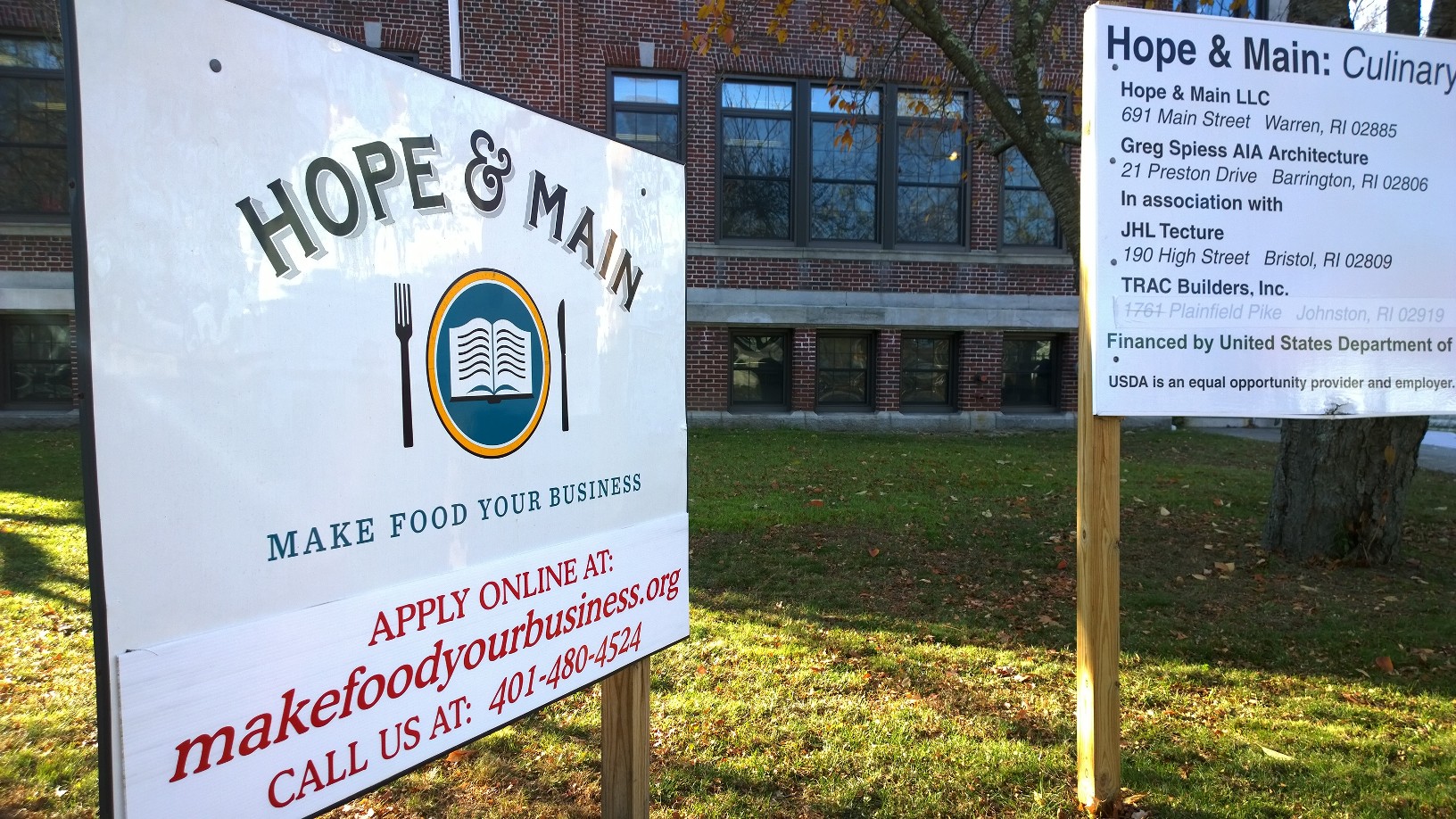
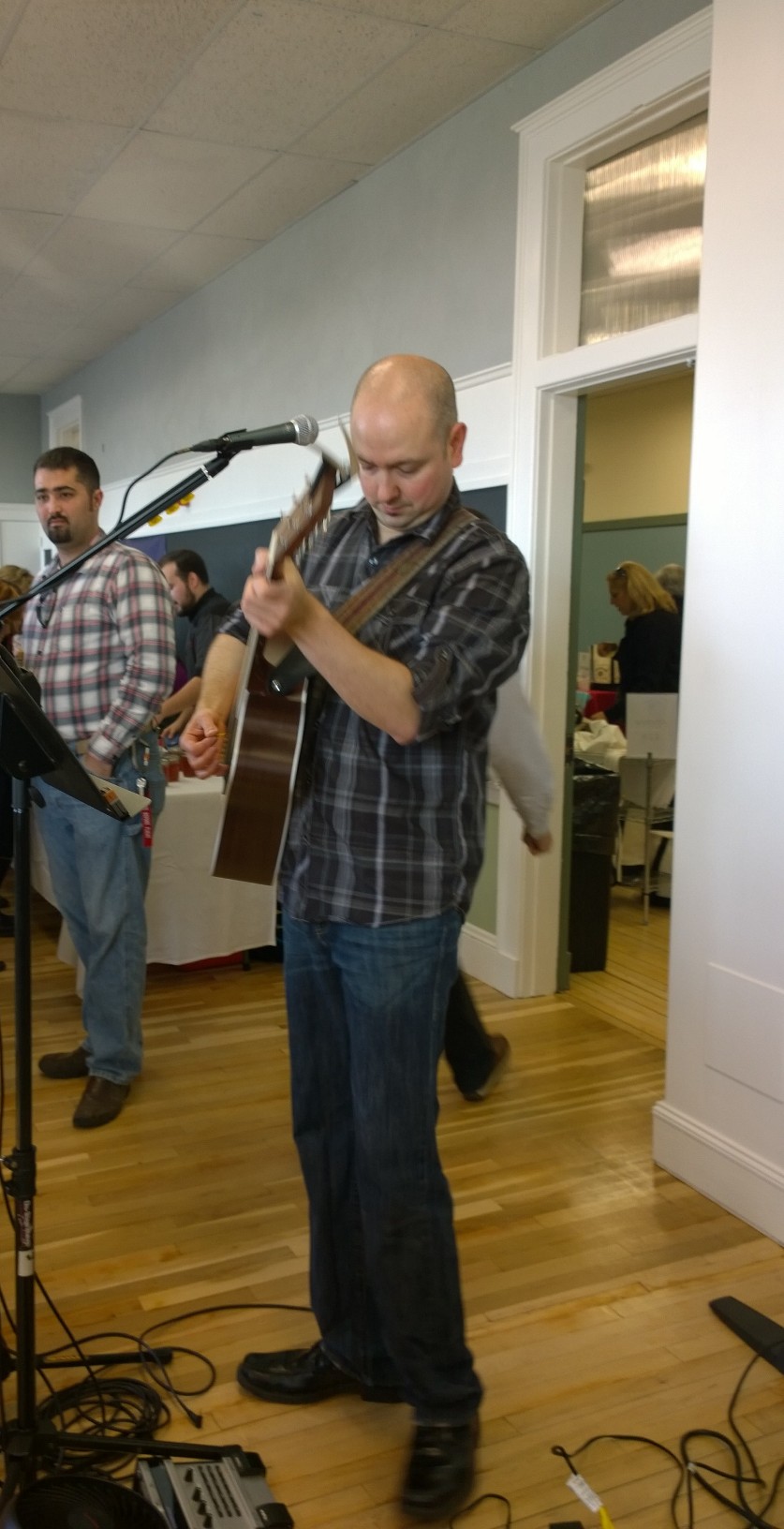
Yesterday, my husband and I checked out the state’s first food-business incubator, Hope & Main, at a festive event in the nonprofit’s new, permanent location. The story was posted in October on their website.

“Hope & Main today celebrated the opening of its 17,500-square-foot culinary business incubator facility in Warren, Rhode Island. U.S. Senators Jack Reed and Sheldon Whitehouse spoke at the ribbon-cutting ceremony, as well as other honored guests including USDA Director of Community Programs Daniel R. Beaudette, Warren Town Council President Christopher W. Stanley, and Founder and President of Hope & Main, Lisa J. Raiola, MPH.

“ ‘Hope & Main is about helping food entrepreneurs get started in a licensed kitchen. …  It’s also a place where people can congregate and collaborate, take a class or develop and test new recipes. I am proud to be part of this effort to support start-up food entrepreneurs and help them launch their own food businesses,’ said Senator Reed. ‘This is a great example of what’s possible when federal, state, and local officials collaborate with the private sector to support innovation. …’

“Housed in the historic Main Street School building, located at 691 Main Street in Warren, the renovation project transformed the 100-year-old structure into a state-of-the-art workspace for the region’s food entrepreneurs. [The] building’s highlights include three code-compliant, shared-use commercial kitchens, including a gluten-free kitchen and artisanal bakery, over 6,000-square-feet of production space, cold and dry storage, and a range of commercial equipment to support small-scale operations for baking, food processing and catering. Designed to facilitate collaboration and community involvement in the local food economy, the rehab also features a demonstration kitchen, co-working and meeting spaces, and a 2,000-square-foot community event space. A weekly market will be located on the grounds to give Hope & Main member companies and other local producers direct access to local consumers. …

“The Hope & Main project is funded in large part by a $2.9 million U.S. Department of Agriculture (USDA) Rural Development Community Facilities Loan.” More at MakeFoodYourBusiness.org, here.

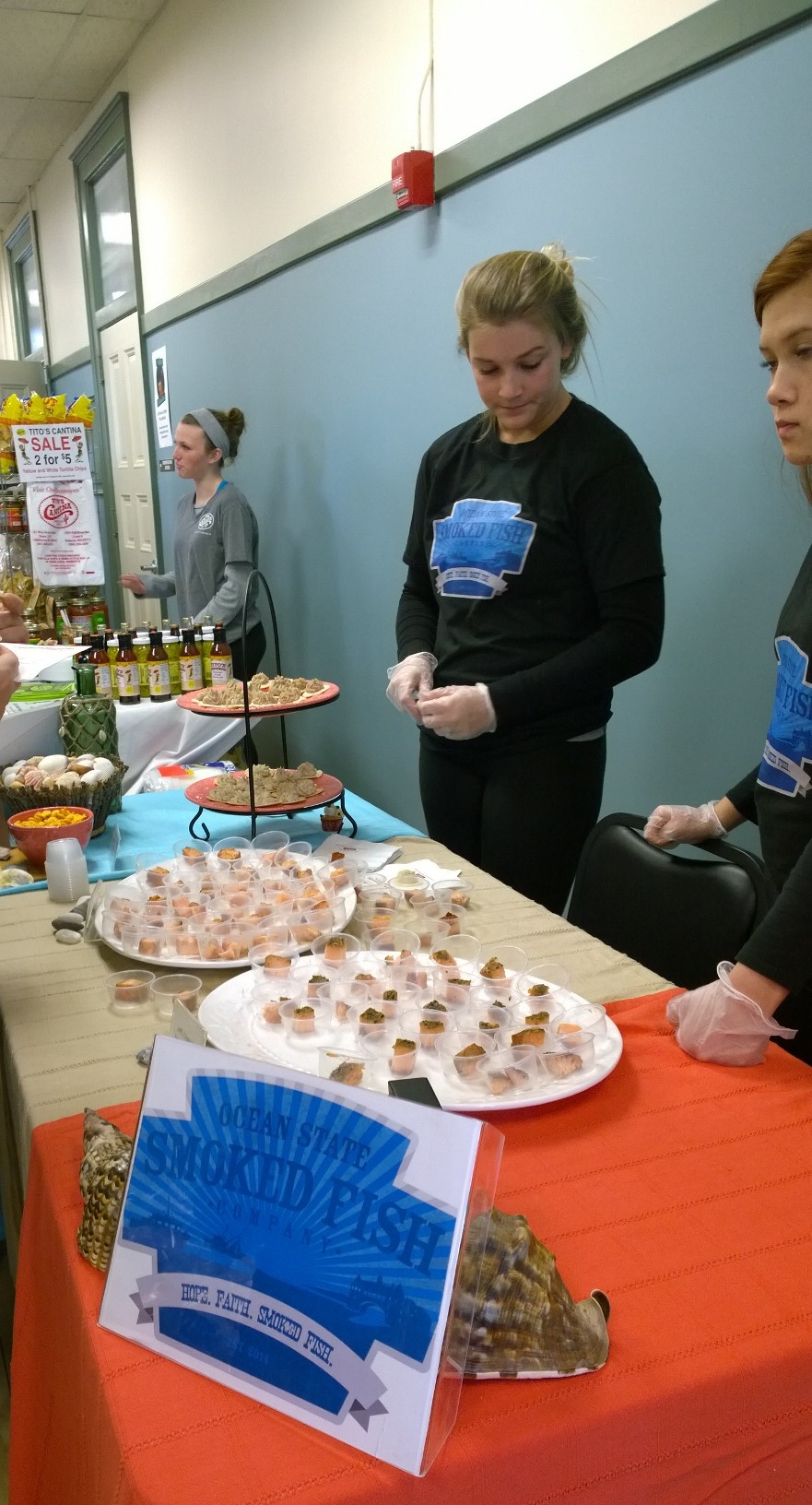
My husband and I left with several business cards and goodies, including a a tomato jam with a great slogan: “To boldly go where no tomato has gone before.” I had a big smile on my face.

hope-and-main-RI-food-biz-incubator

hope-and-main-food-incubator


salmon-at-RI-food-incubator

112314-Hope-and-Main-entertainment

Read Full Post »

Martha Bebinger had a great story at WBUR recently. It’s about an immigrant from Burundi with a mission.

“There were still drops of dew on the stalks of thick, spear-shaped leaves Fabiola Nizigiyimana slashed and tossed into a box one early morning.

“ ‘We call them lenga lenga, in our language,’ she said, laughing the words. “They are [a] green.’

“The 40-year-old single mother of five farms a one-acre plot in Lancaster. She’s one of 232 farmers who share the 40-acre Flats Mentor Farm. Last year, Nizigiyimana helped found a co-op that teaches farmers, many of whom can’t read or write in English or their native tongue, how to turn their plots into a business.

“They get help with packaging and selling their goods to local restaurants, ethnic food stores and farmers’ markets, many of them creating budgets and balance sheets for the first time.

“Nizigiyimana [was] honored for her work … at a White House ceremony after being selected as one of 15 USDA Champions of Change, who represent the next generation of farmers and ranchers.”

Read about all that this optimistic, cheerful woman has overcome and what challenges lie ahead for her business here.

Photo: Martha Bebinger/WBUR
Fabiola Nizigiyimana helped found a co-op that teaches farmers how to turn their plots into a business.

Read Full Post »

The radio show Living on Earth is a font of useful and interesting environmental knowledge.

In a recent show, host Steve Curwood spoke with “agronomist Frank Forcella about how he modified the common sand blaster to simultaneously fertilize and weed food crops.”

Curwood introduces the topic thus, “If you’ve ever weeded a garden, you know it’s a backbreaking job, and if you have row upon row of crops, it’s, well, it’s easier to use herbicides. But then the crop is not organic. Enter a team of soil scientists for the U.S. Department of Agriculture who harnessed a common tool of the building trades to blast away those unwanted weeds without chemicals. Joining me to explain this breakthrough is Frank Forcella. He’s an agronomist with the USDA’s North Central Soil Conservation Research Laboratory.”

Forcella then tells Curwood how he got the idea. “One of my hobbies here in Minnesota is growing apricots, and 2007 happened to be a wonderful year for apricot production in Minnesota.

“We ended up with about a five gallon bucket worth of apricot pits, and I was wondering what can we do with apricot pits. One of the things you can do with them is to grind them up and use then as a grit in sandblasters, and I was talking about that with one of the fellows who works with me, Dean Peterson, on our way out to our field plots. Both of us work on weeds, and we had more or less simultaneously had the idea, ‘I wonder if you could use sandblasters to kill weeds.’ Initially we thought that had to be the dumbest idea in the world, but it was one of those ideas we just couldn’t get out of our heads.”

Read how a dumb idea led to a great invention here.

Photo: Frank Forcella
The four-row grit applicator in action, driven by Charles Hennen.

Read Full Post »

The U.S. Department of Agriculture funds a wide range of activities to boost the economic strength of small towns and rural areas. It doesn’t just fund farmers, although farmers may benefit from a more vibrant rural economy.

To that point, here’s an story from the Philadelphia Inquirer by Howard Shapiro on how the USDA is helping a New Jersey theater.

“A little semiprofessional theater amid the farmland of Hammonton, N.J., has become the beneficiary of more than a half-million dollars in grants and low-interest loans from a most unlikely arts angel: the U.S. Department of Agriculture. …

“The Agriculture Department money is coming directly to the theater in three acts, so to speak: a $23,000 grant to improve its historic building and its ticketing and computer programming; an $89,000 20-year loan at 3.5 percent interest, mainly to enhance stage equipment; and a 30-year loan of $482,000 at 3.38 percent interest, to buy its building.

” ‘It’s an unusual project for the USDA to finance,’ said Howard Henderson, the department’s rural-development director for New Jersey. “This is a fascinating way we’ve been able to benefit a rural community.’

“The Rural Development program, financed by Congress, exists to strengthen or help establish facilities in rural communities that will improve downtowns, provide services, and encourage local activities. But money usually goes to such projects as firehouse restoration or, as in New Jersey’s northern Sussex County, a plan for hospice units.”

The Eagle Theatre applied for the money because, according to Henderson, everyone around Hammonton knows how active the USDA has been in supporting growth. More.

Photograph: http://theeagletheatre.com/about-us/

Read Full Post »