Photo: Juan Karita/AP. An Aymara grandmother passes the ball during a warm-up before a traditional Bolivian handball match, Dec. 9, 2025.
Juan Karita writes at AP, “Before setting out for the wide, white mountain, Ana Lia González Maguiña took stock of her gear: A chunky sweater to guard against the chill. A harness and climbing rope to scale the 6,000-meter summit of one of Bolivia’s tallest mountains. Aviator glasses to protect from the bright highland sun. And most crucially, a voluminous, hot-pink skirt.
“The bell skirt with layered petticoats — known as the ‘pollera’ (pronounced po-YEH-rah) — is the traditional dress of Indigenous women in Bolivia’s highlands. Imposed centuries ago by Spanish colonizers, the old-fashioned pollera has long since been restyled with local, richly patterned fabrics and reclaimed as a source of pride and badge of identity here in the region’s only Indigenous-majority country.
“Rather than seeing the unwieldy skirt as a hindrance to physically demanding work in male-dominated fields, Andean Indigenous women, called ‘cholitas,’ insist that their unwillingness to conform with contemporary style comes at no cost to their comfort or capabilities.
“ ‘Our sport is demanding, it’s super tough. So doing it in pollera represents that strength, it’s about valuing our roots,’ said González Maguiña, 40, a professional mountain climber. …
“Skirt-clad miners, skaters, climbers, soccer players and wrestlers across Bolivia echoed that sentiment in interviews, portraying their adoption of polleras for all professional and physical purposes as an act of empowerment.
“ ‘We, women in polleras, want to keep moving forward,’ said Macaria Alejandro, a 48-year-old miner in Bolivia’s western state of Oruro, her pollera smeared with the dirt and dust of a day toiling underground. ‘I work like this and wear this for my children.’
“But many also described the current moment as one of uncertainty for pollera-wearing women in Bolivia. … Center-right President Rodrigo Paz entered office [in November 2025] as Bolivia’s economy burned, ending a long era of governance shaped by the charismatic Evo Morales (2006-2019), Bolivia’s first Indigenous president who prioritized Indigenous and rural populations … Through a new constitution, Morales changed the nation’s name from the Republic of Bolivia to the Plurinational State of Bolivia and adopted the Indigenous symbol of the wiphala — a checkerboard of bright colors — as an emblem equivalent to the national flag. For the first time, pollera-wearing ministers and officials walked the halls of power.
“But disillusionment with Morales’ Movement Toward Socialism party grew, especially under his erstwhile ally ex-President Luis Arce, who was arrested [in December] on allegations that he siphoned off cash from a state fund meant to support Indigenous communities.
“Some cholitas now wonder how far that change will go and fear it could extend to their hard-won rights despite Paz’s promises to the contrary. They describe feeling neglected by a government with no Indigenous members. They worry about the implications of the army last month removing Indigenous symbols from its logo and the government deciding to stop flying the wiphala from the presidential palace, as was long the tradition.
“ ‘I feel like the government won’t take us into account,’ said Alejandro, the miner. ‘We needed a change. The economy must get better. But it’s sad to see there are no powerful people wearing polleras. I see it as discrimination.’
“But González Maguiña said she still had hope, given how far Indigenous women had come.
“ ‘We already have the strength and everything that comes with it,’ she said. ‘We’re certainly going to knock on the doors of this new government.’ ”
More at AP, here. I have posted several articles about these Bolivian women in the past. Here is one on handball competitions.
Photo: AP Photo/Michael Probst. Yodel teacher Nadja Räss yodels with students at the HSLU university music department in Lucerne, Switzerland, in October 2025.
When I was a child, we had a babysitter who was Swiss German. Her name was Frieda, and I remember her with fondness because she was kind in a funny, sharp way and had a different way of thinking about things than my parents did.
Frieda taught me a yodeling song. I got the yodeling down more or less, but I’m sure I make mincemeat of the German words, the only German I ever learned.
Here’s a story about how the art of yodeling is expanding to new enthusiasts.
Jamey Keaten wrote in November at the Associated Press, “Yodel-ay-hee … what?! Those famed yodeling calls that for centuries have echoed through the Alps, and more recently have morphed into popular song and folk music, could soon reap a response — from faraway Paris.
“Switzerland’s government is looking for a shout-out from U.N. cultural agency UNESCO, based in the French capital, to include the tradition of yodeling on its list of intangible cultural heritage. A decision is expected by year-end.
“Modern-day promoters emphasize that the yodel is far more than the mountain cries of yesteryear by falsetto-bellowing male herders in suspenders who intone alongside giant alphorn instruments atop verdant hillsides. It’s now a popular form of singing.
“Over the last century, yodeling clubs sprouted up in Switzerland, building upon the tradition and broadening its appeal — with its tones, techniques and tremolos finding their way deeper into the musical lexicon internationally in classical, jazz and folk. U.S. country crooners prominently blended yodels into their songs in the late 1920s and 30s.
“About seven years ago, the Lucerne University of Applied Sciences and Arts became the first Swiss university to teach yodeling.
“ ‘For me, actually, in Switzerland we have four languages but I think really we have five languages. We have a fifth: The yodel,’ said Nadja Räss, a professor at the university, alluding to the official German, French, Italian and Romansh languages in Switzerland. Yodeling exists in neighboring Austria, Germany and Italy, but Swiss yodeling is distinctive because of its vocal technique, she said.
“In its early days, yodeling involved chants of wordless vowel sounds, or ‘natural yodeling,’ with melodies but no lyrics. More recently, ‘yodeling song’ has included verses and a refrain.
“The Swiss government says at least 12,000 yodelers take part through about 780 groups of the Swiss Yodeling Association.
“In Switzerland, Räss said, yodeling is built on the ‘sound colors of the voice’ and features two types: one centering on the head — with a ‘u’ sound — and one emanating from deeper down in the chest — with an ‘o’ sound.
“And even within Switzerland, styles vary: Yodeling in the northern region near Appenzell is more ‘melancholic, slower,’ while in the country’s central regions, the sounds are ‘more intense and shorter,’ she said.
“What began as mostly a male activity is now drawing more women. …
“UNESCO’s government-level committee for Intangible Heritage will decide in mid-December in New Delhi. The classification aims to raise public awareness of arts, craftsmanship, rituals, knowledge and traditions that are passed down over generations. …
“The list is different from the UNESCO World Heritage List, which enshrines protections for physical sites that are considered important to humanity, like the Pyramids of Giza in Egypt.
“Last year, Japan’s famed sake — the smooth rice wine — was one of more than 60 honorees in the intangible heritage list, alongside things like the Nowruz spring festival in parts of central Asia, and the skills and knowledge of zinc roofers in Paris.
“Räss of the Lucerne university says that candidates for the intangible heritage list are asked to specify the future prospects of cultural traditions.
“ ‘We figured out some projects to bring it to the future. And one of those is that we bring the yodel to the primary school,’ said Räss, alluding to work along with the Swiss Yodeling Association and a folk music center known as the Roothus Gonten. She said 20 Swiss school teachers know how to yodel and are trying it with their classes.
“ ‘One of my life goals is that when I will die, in Switzerland every school child will be in contact with yodeling during their primary school time,’ she said.”
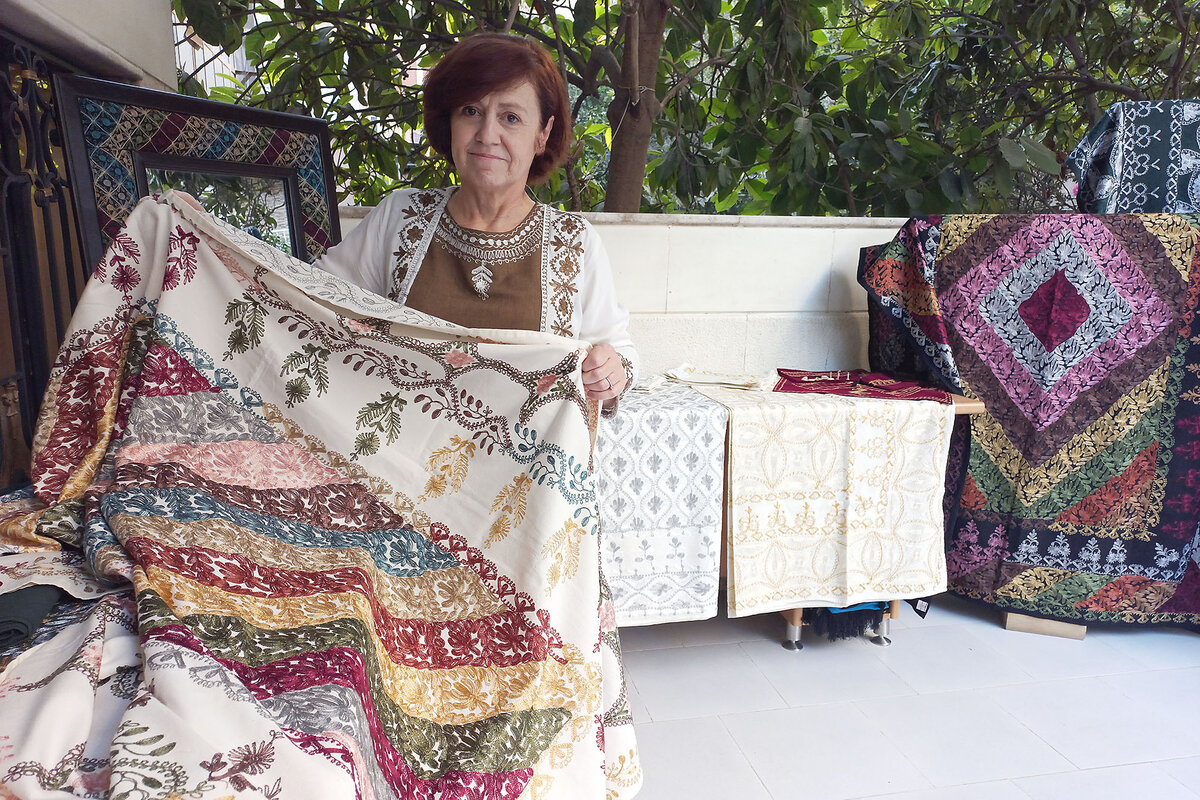
Photo: Walaa Buaidani. Mona Araghili showcases aghabani embroidery at the Threads of Hope exhibition in Damascus, Syria. Post-Assad, she sees an opportunity for serious investment in traditional crafts.
“Threads of Hope” is a phrase that seems to cover a lot of what is going on in the world. Hopes may be hanging by threads, but every day they can strengthen. In today’s article from the Christian Science Monitor, the words are applied to the reemergence of traditional Syrian embroidery after the fall of the Assad regime.
Dominique Soguel writes, “By the time Ameera al-Hammouri was 10, her hands were dancing across the taut fabric beneath her grandmother’s aghabani embroidery machine. She was too short to sit, so she stood, working the foot pedal to coax floral patterns from metallic thread and her own memory.
“Decades later, in a rundown apartment building on the outskirts of Damascus, her machine now runs on an erratic supply of electricity. The building’s elevator no longer works and many of its windows are broken, but inside the sanctity of Ms. Hammouri’s spotless home, the artistry lives on. ‘Working on the embroidery machine for me is like drawing on paper,’ she says. … ‘Whatever I imagine, I bring to life with my hands.’
“Aghabani embroidery originated in Damascus more than 150 years ago, blending Ottoman, Arabic, and Persian design influences. Traditionally, patterns were hand-printed in Damascus onto fabrics that were then sent to Douma, about 8 miles from the capital, where women embroidered them at home. Their work, displayed on tablecloths and other household items, became a hallmark of Syrian hospitality.
“Today, the survival – indeed, the revival – of this craft tradition rests in the hands of women from Douma, a city synonymous with both resistance and ruin. The women behind these works are not only artisans. They are mothers, widows, and survivors of siege, displacement, and economic collapse.
“Ms. Hammouri herself endured all of it. Her husband and eldest son were arrested in 2012 and never returned. Douma was subjected to a five-year siege, when government forces surrounded the city, cutting it off from food, medicine, and fuel. Ms. Hammouri’s house was destroyed. As the bombs fell, she moved her children from house to house, basement to basement.
“The siege ended in 2018. With no income and no husband, Ms. Hammouri turned to the one thing that had always grounded her: her original aghabani machine, bought in 1988 with money she scraped together by selling her wedding gold and other treasures. It still stands in a corner of her bedroom, alongside a newer model.
“ ‘I talk to this machine,’ confides Ms. Hammouri, who is known in the community as Umm Meriee. ‘It holds my secrets. I’ve cried over it.’
“At first, she worked quietly from home, taking orders from traders who remembered her family’s reputation and bought pieces for export. Over time, she began training other women.
“If Syria’s current political opening brings more trade and tourism, she says, crafts like aghabani could once again become a source of stable income rather than just a means of survival.
“Now, twice a week, her apartment fills with the chatter and laughter of industrious women. … This gathering of women is not a formal enterprise. There is no signboard or registration, no website to market their work. But family reputations endure in a country where word of mouth is the norm.
“ ‘They know my name in the market,’ says Umm Meriee, recalling how she revived ties with shopkeepers in the Al-Hariqa market, in Damascus’ old city, because her aunts and grandmother had put the family name on the map. …
“For Mona al-Masri, a Tuesday regular, embroidery is her identity. … While her colorful pieces earn heartfelt ‘wows’ from her daughters, it is next to impossible to eke a living from this craft. In a good week, working three hours a day in between bouts of housework, Ms. Masri earns just over $6. … Despite the skill and time aghabani requires – a single detailed motif can take hours, and a full tablecloth might take a week or more to complete – handmade aghabani cannot compete with cheaper, machine-made imitations that dominate the local market, such as those imported from China.
“ ‘Right now, aghabani has no future,’ says Ms. Masri. But with government support, she feels that future could ‘be a very bright one.’
“Mona Araghili shares that optimism. … More than a decade ago, Ms. Araghili set up Threads of Hope – Aghabani with little more than a social media page and materials she borrowed from friends. With her college friend Basheera Baghdadi, who had grown up in Douma, she smuggled fabric and thread into the besieged city, using tunnels and roundabout routes through the countryside. …
“Ms. Araghili never shut down her group’s Facebook page, she says. ‘I always hoped that we could restart someday.’ ”
Photo: Jeff McIntosh/Associated Press. Emma Eastwood stretched before competing in women’s ranch bronc during rodeo action in Alberta.
I’ve mentioned before how interesting it was to me that my husband’s director of manufacturing at the Maple Grove company was a bull rider on the side. We told Craig we’d love to see a Minnesota rodeo, and he sent us off to nearby Buffalo, where we had a wonderful time.
In today’s story, we learn about the rising numbers of women getting a kick out of riding bucking broncos.
The Associated Press (AP) reports, “Sophia Bunney launched the first time she tried ranch bronc riding, landing ‘quite a ways away from the horse.’
“ ‘I’m very stubborn, and I don’t like being defeated,’ said the 18-year-old from Cessford, Alberta.
“In other words, the teenager was hooked on a sport that pits women against bucking horses for eight seconds.
“ ‘I always kind of wanted to hop on a bronc,’ Bunney told the Canadian Press. ‘In Grade 3 … I said I wanted to be a female bronc rider.’
“Unlike saddle bronco riding, a rodeo mainstay, ranch bronc uses a regular western saddle — not a specialized one — and riders hang on with two hands instead of one. A hand is on a rein and the other on a strap wrapped around the saddle horn.
“Pearl Kersey, who won the Canadian women’s ranch bronc title [recently] in Ponoka, Alberta, is president of Women’s Ranch Bronc Canada and teaches it at clinics.
“ ‘I’ve got teenagers, 20-year-olds, 30-year-olds, and this year a woman in her 50s. I was like, “You sure?” ‘ Kersey said. ‘She doesn’t want to compete. She wants to try it before she gets too old. We have bucking machines. She doesn’t necessarily need to get on a horse’. They can go through all the drills and the bucking machine, and if they’re comfortable enough, they can get on a horse.’ …
“It took a while for 19-year-old Blayne Bedard, who grew up cow riding in the Canadian Girls Rodeo Association, to master keeping her feet forward toward the horse’s shoulders.
“ ‘If they come back, I’m like a pendulum and I just go head over teakettle,’ Bedard said. … She’s improved to the point where Bedard has competed in the last two Canadian championships.
“ ‘I like the look of it, too,’ Bedard said. ‘You get cool pictures.’
“One of the lessons Bedard picked up at a Kersey clinic had nothing to do with riding form — and everything to do with what goes inside a boot.
“ ‘I put baby powder in my boots every time before I ride, and I wear my mom’s boots that are a size too big for me, because if you get your foot stuck in a stirrup — which I’ve had a few times — you need your boot to be able to come off so you’re not being dragged by the horse,’ she said. …
“Kersey, 36, has qualified for the world finals July 19-20 in Cheyenne, Wyoming, where she won in 2019 and has twice finished second. Kersey intends to retire from competition after this year, but continue teaching.
“One of her students, Calgary’s Emma Eastwood, picked it up quickly thanks to years of riding horses and a stint as an amateur jockey. She attended Kersey’s clinics last fall and this spring, and won an event in just her third time competing.
“ ‘It is difficult to try and think through your ride and hang on through all that adrenaline,’ said the 27-year-old massage therapist. ‘Things kind of get a little blurry, and it’s hard to process everything going on so quickly.’ …
“Kersey said … ‘Women have come up to me and said, “Thank you for doing what you’re doing.” They might not go into ranch broncs, but it just gave them the power in themselves to go pursue something that they wanted that they didn’t think they could because they were women,’ Kersey said. ‘Other girls tell me, ‘” saw you ride at Ponoka,” and they’re like, “I want to try it.” Sometimes it’s a confidence-booster thing. Sometimes they want to see if they’ll like it and some are like, “Yeah, I’m doing this.” ‘
More at the Associated Press via the Boston Globe, here.
Photo: Washington State Department of Corrections. Last year, scientists working with a team of incarcerated women released more than 67,000 larvae of a beautiful, endangered butterfly.
Today’s story about incarcerated women helping scientists reminds me that you don’t have to be in prison to get satisfaction from working for a cause. These women are gaining confidence, self-esteem, and hope for a better future.
Andrew Buncombe reports at the Guardian, “Trista Egli was standing in a greenhouse, tearing up strips of plantain and preparing to feed them to butterfly larvae.
“Of the many things the team here has tried to tempt larvae of the Taylor’s checkerspot [with], it is the invasive English plantain they seem to love the most.
‘The big thing for me is being part of an effort to save an endangered species,’ says Egli, 36. ‘It is a big thrill.’
“Egli is one of seven women incarcerated at the Mission Creek correctional facility, located a two-hour drive from Seattle, who are part of a year-long program that takes captured butterflies, harvests their eggs, and oversees the growth of the larvae before they are released into the wild where they will turn into adults.
“Last year, scientists working with the team released more than 10,000 larvae. The adult butterflies live for just a handful of fabulous, wing-fluttering days. …
“Many of the women speak of their pride working on a project that feels like it is making a positive contribution to the world.
“Lynn Cheroff, 42, said she had been thrilled to talk about it with her two young children when they come to visit. When she telephones her mother about the work, her mother tells her she is proud. Another woman, Jennifer Teitzel, appreciates the sense of order and discipline the program demands and instills.
“Every detail about the eggs and larvae has to be collated and recorded. It is the women’s responsibility, and nobody else’s, seven days a week.
“[While] the program run by Washington state department of corrections (DOC) is part of an effort to prepare the women for life once their sentences are over and to smooth the path to work or college, there is no sugar-coating their predicament.
“Egli, who has three young children, is serving a nine-year sentence for a 2020 drunken hit and run that left a woman with permanent brain damage.
“ ‘I am paying the price for that every day. I can never go back and undo what happened,’ she says. ‘But I can try to make sure the rest of my life is about making the world a better place.’
“The program at Mission Creek has been operating for 10 years. Kelli Bush, the co-director of Sustainability in Prisons Project, a partnership between the DOC and the Evergreen State College in Olympia, says a crucial component are graduate students who visit to offer educational support.
“Bush says in addition to providing the women something to feel proud about as many deal with shame and guilt, the program also gives them confidence about their own capabilities. …
“She says, ‘It’s routine to hear people say “I didn’t think I was smart and I’m realizing I’m doing science.” … Pretty soon people find themselves reading peer-reviewed scientific journals and saying, “I can do this too.” ‘
“The Taylor’s butterfly’s preferred habitat is open grasslands and prairie. For thousands of years, such landscapes were created and maintained by active burning by Indigenous communities. Without such native stewardship, and with ever-increasing threats from developers and town planners, the amount of grassland has drastically diminished. …
“A favored place is Joint Base Lewis-McChord (JBLM), operated by the US army and situated 10 miles from Tacoma. Training with heavy artillery has long kept the prairie free of unwanted vegetation. Yet when the Taylor’s was added to the US Endangered Species Act list in 2013, it presented military officials with a challenge; how could they continue to make use of the base without harming a species now protected by federal law?
“Dan Calvert, of the Sentinel Landscape Partnership, a coalition of federal and state groups that works with landowners to promote sustainable land use around military installations, says JBLM contains ‘90% of the prairie habitat in western Washington.’ …
“One of the efforts to boost the numbers of Taylor’s checkerspot in locations off-base – and thereby allow the military to work unimpeded at the base – led to funding for the Mission Creek project by the Department of Defense (DoD). …
“The collaboration has helped boost the Taylor’s checkerspot. This year could be a record year for releases of adults. In 2024, the program released about 10,900 larvae.
“However, there’s a dark cloud looming over the program. Mission Creek is set to close in October because of budget cuts. There is a plan to transfer the women and the program to a prison at Gig Harbor, located 25 miles away, but there is some concern among current participants it could simply be cut entirely.
“Egli, who is set to become eligible for a work-release program under which she would serve the last 18 months of her sentence working outside the jail and returning to do what’s known as a DOC re-entry facility every night, says the program changed the person she was.”
More at the Guardian, here. No firewall. Donations support his valued news outlet.
Photo: Seabound. Seabound co-founders are chief executive Alisha Fredriksson (left) and chief technology officer Rojia Wen. Seabound’s carbon-capture prototype sailed for two months on a midsize container ship.
Today’s story is about two women in the male-dominated shipping industry and their work on what might be a stepping stone to sustainability. The challenge is that the process to create their carbon-absorbing pellets also involves carbon release.
Emma Bryce writes at the Guardian, “An industrial park alongside the River Lea in the London suburb of Chingford might not be the most obvious place for a quiet revolution to be taking place. But there, a team of entrepreneurs is tinkering with a modest looking steel container that could hold a solution to one of the world’s dirtiest industries.
“Inside it are thousands of cherry-sized pellets made from quicklime. At one end, a diesel generator pipes fumes through the lime, which soaks up the carbon, triggering a chemical reaction that transforms it into limestone.
“With this invention, Seabound, the company behind it, hopes to capture large amounts of carbon directly from the decks of cargo ships, and help clean up this strikingly polluting industry. …
“Behind all this is Alisha Fredriksson, a young entrepreneur who once dreamed of being a doctor but reached a turning point in her career after reading a report from the Intergovernmental Panel on Climate Change that detailed the global implications of 2.7 F degrees versus 3.6 F degrees of warming.
“ ‘That’s when I realized that everyone around the world will be affected by the climate crisis, and so if I cared about large-scale social impact, the best thing I could do would be to help tackle it,’ says 30-year-old Fredriksson, chief executive of Seabound. …
“Trials have shown that her invention can scrub most of the carbon from the ship exhaust, filtered through its lime-pebbled interior. Ultimately, the goal is to have this device strapped to ships across the world’s oceans, she says. …
“She and her co-founder, Roujia Wen, hit on the idea of scaling down the existing quicklime-based carbon-capture technology typically employed at industrial plants. They then made a prototype, and attracted about $4m in funding from investors. Some of this came from shipping companies.‘It all happened really quickly. Suddenly we had money, and we had to go build it,’ says Fredriksson. …
“Since then, successive prototypes of the Seabound container have taken her from the company’s test-bed in east London, to … a three-week voyage to test its efficiency. This showed that a Seabound unit can capture 78% of all the carbon from the exhaust that is pumped through it, and 90% of the sulphur, a toxic air pollutant.
“The latest prototype is being built to the dimensions of a standard 20ft shipping container, so that it can seamlessly slot in with cargoes on deck, Fredriksson says. … Once in port, the limestone-filled units can be substituted for containers of fresh quicklime. This product is made by heating limestone to high temperatures in kilns, an energy-intensive process that also releases CO2 from the limestone, making production extremely carbon-intensive.
“Companies are trying to make quicklime using kilns heated with renewable energy, or developing methods to capture the released CO2 so that it doesn’t enter the atmosphere. Seabound is working to source this ‘green’ quicklime, Fredriksson says. …
“Some critics are concerned that decarbonizing technologies could distract from solutions, such as zero-emission ammonia fuel or wind-powered innovations, that are essential to push the shipping industry to net zero.
“ ‘The potential for short-term use of carbon-capture retrofits on existing vessels should not become a justification to extend the lifespan of fossil fuels or delay the shift to truly sustainable alternatives,’ says Blánaid Sheeran, climate diplomacy policy officer at Opportunity Green, a nonprofit organization focused on gaps in global climate policy.
“But Fredriksson believes Seabound’s technology could support this transition. In April, at a meeting of the International Maritime Organization, UN member states agreed to a landmark deal that will start charging ships for every ton of emissions above a threshold. That threshold will gradually decrease to push the industry towards green fuels.
“Seabound slots into this new regulatory landscape, according to Fredriksson, by enabling ships to decarbonize their fuels, thereby lowering their emissions, and gradually adjust to the rules by adding more containers over time. …
“Fredriksson says [Seabound’s] offering is cost-effective and she has already had a commitment from one company to fit the first full-scale containers on to its ships this year.”
More at the Guardian, here. No firewall. Donations sought.
Illustration: The Guardian. Why did a province in Canada decide to provide universal childcare for only $7 a day? And how was it supposed to decrease the budget deficit?
When I read in June that Quebec was providing universal childcare for very little cost to families, all I thought was, How can they manage it?
Isabeau Doucetexplains at the Guardian that the system actually pays for itself.
“When asked how much she pays for childcare, Leah Freeman chuckles and says she isn’t sure. ‘It’s like C$93 (about $67) every two weeks or something. I barely see it leaving my bank account,’ she said.
“To most parents in the US, where the average cost of childcare is $1,000 per month and can reach more than $2,000 a month in some states, the idea of paying so little sounds impossible. But it’s happening – north of the US border in Quebec, Canada, where Freeman’s three-year-old daughter, Grace, attends a subsidized early childhood education center (centres de la petite enfance, known by its acronym CPE), for C$9.35, or less than $7 a day.
“As soon as she found out that she was pregnant, Freeman, a social worker, placed her daughter on a handful of waiting lists through a government website. Now she can drop her daughter off for up to 10 hours a day, between 6am and 6pm, five days a week, all year round. In addition to childcare, Grace sees a speech therapist at the CPE. A daily menu of the home-cooked meals and snacks is posted at the building’s entrance every morning; meals are on a monthly rotation with seasonal changes and locally sourced produce when available.
“All this is possible because in 1997, Quebec lawmakers enacted a universal childcare program as part of an effort to give equal opportunities to all children – especially kids from low-income families – to get young mothers back to work and to increase the government’s tax revenue and eliminate the province’s budget deficit.
“The massively popular program has been a win for everyone involved: it offers high-quality early education to toddlers; good, unionized jobs to childcare workers; has helped close the gender pay gap; affords young families crucial support in the earliest years of their children’s lives and has been a financial boon to the government. It’s been so popular that now the model is being built up across the rest of Canada.
“Perhaps ironically, Quebec’s approach was partly inspired by the groundbreaking research into early childhood coming out of the US – that providing high-quality education early on was not just socially good but a smart economic investment.
“ ‘The best way to reduce social inequalities is to invest in small children very early in their lives,’ said Nathalie Bigras, a retired professor at Université du Québec à Montréal who spent her career researching Quebec’s childcare. …
“On the ground floor of a redbrick school that also houses an adult education center, Les Trottinettes (‘The Scooters) is a CPE that serves 26 kids from nine months to five years old. It’s part of a network of five CPEs in Verdun, a traditionally working-class, though rapidly gentrifying, neighborhood of Montreal.
“Asylum seekers who are single parents can enroll their children here while they take French language classes and continuing education courses upstairs.
“Across two big rooms with a maze of different play stations, children paint bright colors at small easels. There’s a water table, a sand box, wooden construction blocks, colorful bricks, a quiet reading nook and lots of well-loved, sturdy wooden furniture. …
“ ‘You can learn so much about a society by studying its approach to early childhood,’ said Stéphane Trudel, a trained sociologist and the general manager of Les Trottinettes. ‘We’re at the frontline of social inequalities, of gender inequalities, of cultural clashes.’ Yet he finds that very few anthropologists or journalists are interested in it. ‘It’s a blind spot,’ he said.
“Trudel credits research from the US as having influenced Quebec’s approach to early childhood education. American research spanning child welfare, psychological development, nutrition, education and economics was extensively cited in the 1991 report that led to Quebec’s new family policy. And even in terms of pedagogy, Les Trotinette’s curriculum, for instance, is based on HighScope, an approach started in Michigan designed to close the opportunity gap for low-income families.
“HighScope’s longitudinal study, conducted by the Nobel prize-winning economist James Heckman, found lasting intergenerational benefits to high-quality early childhood education, calculating an estimated C$12.90 return for every C$1 invested – from success in school, higher earning over decades, reduced crime and use of social assistance programs.
“The roots of Quebec’s childcare model go back decades, to the French-speaking province’s ‘Quiet Revolution’ in the 1960s, which booted the Catholic church out of state institutions and made them more secular and egalitarian. Marriage went out of fashion and rates plummeted, leading to dire poverty among children of single mothers.
“Social movements, feminist activists, labor unions and single-parent family associations demanded new policies, such as parental leave and universal childcare, to address the new family structures. Later, in 1997, the secessionist Parti Québécois government enacted the new family policy as part of an effort to restructure the social safety net and eliminate the budget deficit.
“The crown jewel of this new policy was the creation of the centres de la petite enfance (CPE), an autonomous network of subsidized childcare centers, offering high-quality, low-cost care (C$5 at the time), with unionized staff and parent-led governance.
“ ‘It’s the parents who run the show,’ said Pauline Marois, the architect of Quebec’s family policy who was also Quebec’s first female premier, and is now chancellor of Université du Québec à Montréal. …
“Marois described the key ingredients for this public system’s success as investment into educational programs, universal access through low fees and high parental involvement – because no institution could protect children’s interests better than their parents. …
“It might seem like a public childcare network offering high-quality education, homemade meals and help for children with special needs for about C$10 a day would be expensive for taxpayers, but it actually generates a profit, said Pierre Fortin, an emeritus economist at Université de Quebec at Montreal.
“ ‘The system pays for itself – it brings women into the workplace and they pay taxes,’ said Fortin, a leading expert on the economics of subsidized childcare. ‘You get more money flowing into government coffers.’ This extra tax revenue actually exceeds what the government initially paid to establish the universal childcare system, he said. …
“Today, Quebec has among the highest female labor force participation rates in the world right next to Sweden, while the US lags more than 10% behind. In addition, the gender pay gap . …
“Measuring the causal impact of Quebec’s subsidized childcare on factors such as poverty and social assistance is an imprecise science, but Fortin points out that the number of single-parent families on social assistance in Quebec plummeted by more than 50% in the decade following the reform. Today, Fortin calculated exclusively for the Guardian, that Quebec has 75% fewer single-parent families on social assistance than it did in 1996.
“It’s also had a tremendous impact on childhood wellbeing. In 1996, child poverty rates across Canada were at an all-time high and children in Quebec were among the worst off. Today, it’s the opposite. …
“Fortin estimates that poverty in Quebec decreased by more than 60% in two decades, but points out that universal childcare wasn’t implemented in isolation, but alongside other important social policies, such as enhanced parental leave (now up to 55 weeks of paid leave), high rates of education and employment and pay equity legislation. …
“ ‘I’m convinced that the more women we have in politics, the more we’ll move towards public policies that promote gender equality and the fight against poverty,’ said Marois.”
Lots more at the Guardian, here. No paywall there, but please consider giving them a donation.
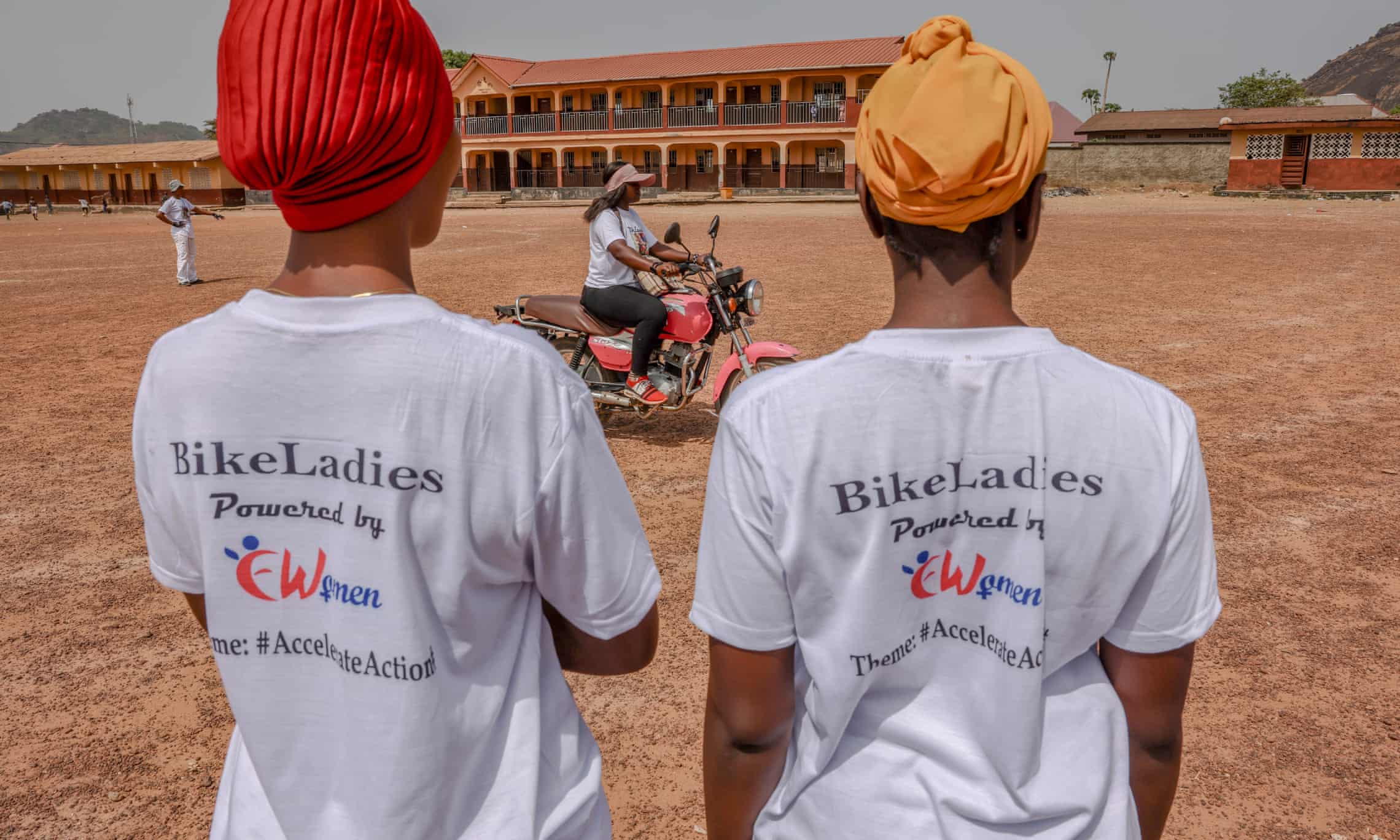
Photo: Caitlin Kelly. The Bombali Bike Ladies of Sierra Leone hope that by learning to ride a motorbike and take up package delivery services it will be possible to improve their lives.
I’ve been reading a mystery about some Minnesota Indigenous women who, fed up with a spate of kidnappings, unite to fight back. Whenever I read stories about women uniting to improve their lives and the lives of other women, I rejoice. After all, the individual women who eventually get to run their countries do not always operate differently from their male predecessors, but women in mutual-support initiatives definitively behave differently.
In today’s Guardian article, Caitlin Kelly writes about Mariama Timbo, the sole female biker in her Sierra Leone province ferrying people and goods to town and “training a new generation of women to follow her lead.”
“Streaming through the green fields of Sierra Leone’s Bombali district, Mariama Timbo sits tall on her pink motorbike. Women selling nuts on the side of the road wave as she glides by; policemen give an approving nod as she passes through checkpoints. ‘They don’t give me any trouble,’ she says – a badge of honor in the rural district. Taking her time on the rocky roads, she brakes, slowly approaching the bumps. …
“The 26-year-old is the sole female motorcyclist in the northern province ferrying people and goods to Makeni, one of Sierra Leone’s fastest growing cities. …
“At a petrol station en route, male drivers greet Timbo with fist-bumps and high fives. ‘At first when I started, people were mocking me,’ she says. ‘Now they see how my life has changed since I started riding the bike.’
“In Sierra Leone, motorcycles are a lifeline. The locally known okadas are often the only accessible and affordable way to reach markets, hospitals and cities. With nearly 60% of the country’s rural population living in poverty, commercial riding offers income to hundreds of thousands – nearly all of them men.
“In her early teens, Timbo left her village, Kagbere, to ‘join society’ and attend school in Makeni, but the opportunity turned into a nightmare when she was sexually abused by a male relative who was helping her financially. ‘I didn’t feel safe,’ she recalls.
“She managed to move out and pay for the last years of school by doing odd jobs in Makeni but couldn’t afford further education. In 2022, she turned to Kisimi Kamara at eWomen Sierra Leone, a local NGO that supports business initiatives for women. One thing she had learned during her time away was how to ride a motorbike. The NGO helped Timbo get funding for a motorbike via a World Bank grant.
“ ‘I decided to ride because I knew I could survive,’ says Timbo.
“Defying stereotypes, Timbo has since started transporting goods and people – earning about 50NLE [$2.42] a day.
“Since the civil war in the early 2000s, okadas have become a popular mode of transport after the fighting destroyed public infrastructure. A recent survey by the Institution of Civil Engineers found that women make up almost half of motorcycle taxi passengers in rural Sierra Leone – but the drivers are almost always men.
“Timbo makes the 45-minute journey between Makeni and Kagbere twice a day, mostly to the market. Like many rural villages in Sierra Leone, Kagbere is isolated, agriculture-dependent, and cut off from mains electricity and water. As she arrives, women flock to greet her.
“ ‘We are exchanging things – we are constantly giving to each other because we are family,’ says ‘aunty Marie,’ one of the women in the village.
“Marie hops on the back of Timbo’s bike to sell pepper and groundnuts at the market, but she also helps tend the land Timbo has recently been able to invest in.
“ ‘Mariama has changed over the past few months … because of that motorbike,’ says Kamara. According to him, more than 60 local women – including sex workers in search of alternative work – have shown interest in learning to ride after seeing Timbo on her bike in Makeni.
“On International Women’s Day in March, a group of young women gathers in a dusty school playground, watching as Timbo skids around confidently. One by one, they jump on the bike, nervously revving the engine. They are the newly formed Bombali Bike Ladies – under Timbo’s leadership. Timbo recently won a grant from the UNFPA and the government to teach others how to ride.
“ ‘It’s good for women to ride bikes, because they are very patient and caring,’ says Aysha Kamara, a 21-year-old student who hopes the motorbike could help her secure work with an NGO.
“ ‘Job opportunities for young people in Sierra Leone are so difficult … unless you create one for yourself,’ says Adama Makaloko, 24, who is hoping to master the bike to ’empower herself’ and sell produce.
“Sibeso Mululuma at the UNFPA says: ‘The challenge presented by the group was that young women in Bombali district faced economic hardship, making them vulnerable to exploitation and gender-based violence due to a lack of skills and financial independence.
“ ‘It sends a strong message … that there’s nothing wrong with taking up space or doing things differently. That’s powerful.’ ”
More at the Guardian, here. Great photos and no paywall.
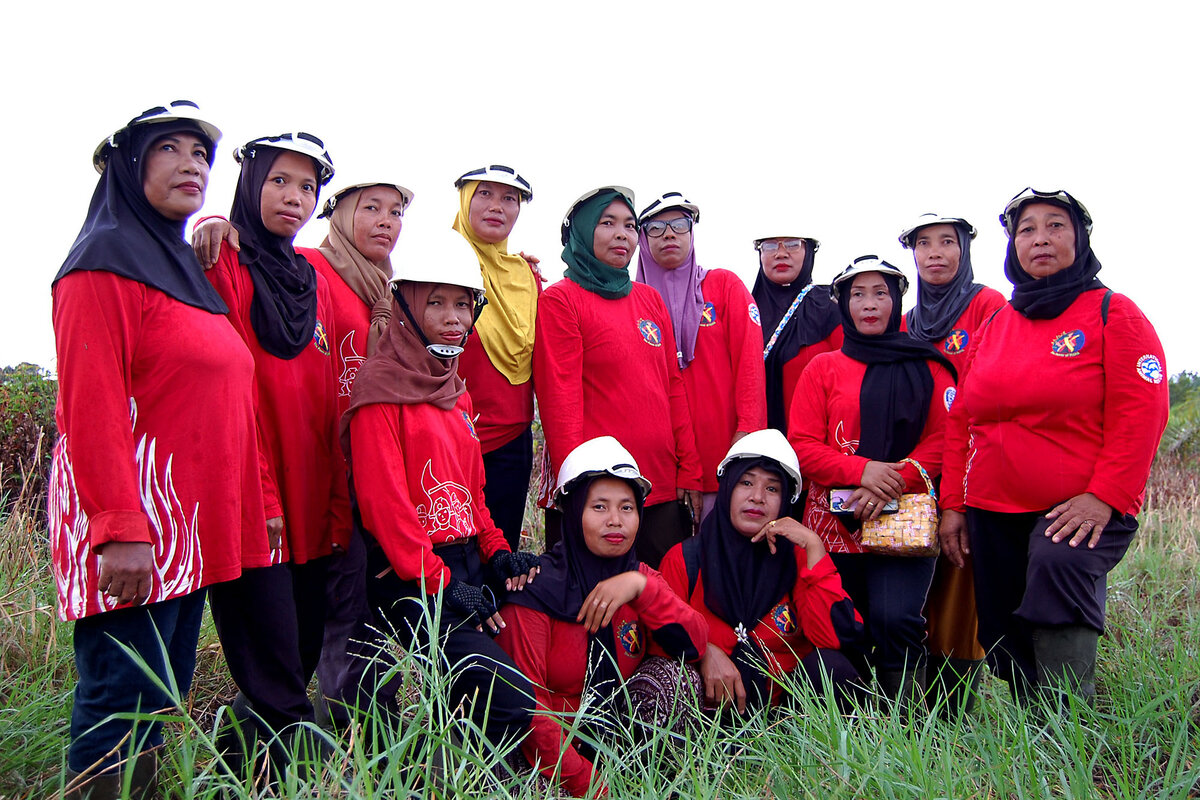
Photo: Lindsey McGinnis/The Christian Science Monitor. Power of Mama patrollers, who routinely put out palm oil fires in Indonesia.
In Indonesia, women have answered the call to do something about wildfires. Because in Indonesia, careless and illegal palm-oil logging routinely causes fires, endangering orangutans. And not just orangutans.
Lindsey McGinnis and Sara Miller Llana report the story at the Christian Science Monitor.
“The women adjust hard hats over hijabs and pull on knee-high boots. Then they set off into what was once a dense forest of rubber and bamboo trees but is now a patchwork of small-scale palm oil fields. Everyone knows who they are. Their scarlet, elbow-patched uniforms with flames snaking up the torso, and the image of a firefighter emblazoned on the chest, give it away.
“This is the Power of Mama.
“Across Kalimantan, the Indonesian part of the island of Borneo, lush rainforest hosting carbon-rich peatland and one of the country’s most significant populations of orangutans meets illegal logging and palm oil farms. That adds up to wildfires.
“So Power of Mama members have started patrolling for fire risks, urging farmers to follow the rules about slash-and-burn clearing, and challenging stereotypes about women’s roles in rural Indonesian life along the way.
“Female forest rangers in Indonesia are rare, says Eulis Utami, director of a nongovernmental organization called Hutan Itu Indonesia, or Indonesia is Forest, which aims to educate Indonesians about their tropical rainforest, the world’s third-largest. But when women are given training and information, she says, ‘They protect the forest with their whole hearts.’
“In untouched forests of West Kalimantan, orangutans build their nests high up in trees. Hornbills soar through the vines with deep swoops of their wings. The chirps of songbirds mingle with the ‘o-ho!’ calls of gibbons.
“But this habitat is shrinking. West Kalimantan has lost more than a third of its tree cover since 2000.
“Indonesia is the world’s largest producer of palm oil, and nearly all of it comes from either Sumatra or Kalimantan. The farms have wreaked havoc on peatlands, one of the world’s most important carbon sinks. When the bogs are cleared, the water table sinks and soil becomes highly flammable.
“A new consciousness about the risks of fire spread rapidly to this community in 2019, when agricultural burning amid drought conditions sparked fires that raged for months. Millions of acres of peatlands and rainforest burned. And it kept many of the mothers who would eventually form the Power of Mama up at night, worried about the effects of smoke and haze on their children’s health.
“The Power of Mama was launched in 2022 by Yayasan International Animal Rescue Indonesia (YIARI), whose long-term goal is to save the critically endangered orangutan. …
“YIARI intentionally made women part of the solution. Male farmers have been impervious to NGOs trying to convince them to protect the forests, but they listen to their wives, says Anna Desliani from YIARI. ‘Women have influence in their families,’ she says.
“One of the newest branches is in the community of Sungai Putri, which counts 2,000 residents. Farmers here have long tended rice paddies but many switched to more lucrative oil palm trees in 2017.
“ ‘It’s sad because … before it was real forest,’ says Misnati, a patroller who, like many Indonesians, has just one name. She says she misses the sounds of gibbons and the cooler air the forest brought. She also felt more protected from fire and floods when the forest served as a buffer zone.
“The Power of Mama doesn’t aim to stamp out cultivation – in fact, most of its members’ husbands toil in palm oil now. But they have been educated on the risks of clearing land by burning, of overcultivating, and of smoking in a highly flammable field. And that knowledge gives them an authority that many had never known. …
“When it comes to forests, the discussion is always ‘heavy,’ explains Ms. Utami. It’s about deforestation, wildfire, conflict. That’s why Indonesia is Forest, which introduces young town dwellers to the rainforest, focuses on positive narratives that make people want to protect Indonesian biodiversity.
“The Power of Mama is, in its own way, cultivating a similar enthusiasm.
“On this rainy day, the women aren’t on high alert. They walk the land and talk with farmers. Passing a patch of blackened vegetation, Misnati recalls her proudest moment: when she figured out how to connect a hose to a water pump and put out a fire here last year. …
“Before the Power of Mama, ‘I’d never venture this far into the land alone,’ she says. ‘I’ve gotten to know the landscape even though I’ve lived here my whole life.’ …
“ ‘We need to be a role model, to set an example,’ says another patroller, Lita, sporting an upcycled crossbody purse made of plastic detergent sachets she collected from her neighbors. Other women are wearing them, too. ‘If we don’t do this, who will?’ ”
More at the Monitor, here. Nice pictures. No paywall.
Photo: Riley Robinson/CSM. Above, Lucy Lujana, a carpenter with United Brotherhood of Carpenters and Joiners Local 54 in Chicago. As of 2023, only 3.1% of carpenters were women. Sometimes they call themselves the “Sisters of the Brotherhood.”
In the US, some women have moved into jobs traditionally held by men, but progress seems slow to me. In countries including India, Australia, Finland, England, and Israel, women have served at the very top, same as being president in the US. America’s oddly progressive and backward character is something to ponder.
Today we consider women in unions.
Richard Mertens writes at the Christian Science Monitor, “Last year, Lisa Lujano, a longtime member of the United Brotherhood of Carpenters and Joiners Local 54, found herself in very unfamiliar company. She had been tasked to build stairs in one section of the Obama Presidential Center on Chicago’s South Side. When she showed up for work, she discovered she would be part of a crew of five, all women.
“ ‘I don’t know how it came about,’ Ms. Lujano says. … Most of the time, when she shows up for work, she’s the only woman on the crew. And she and her fellow tradeswomen know as well as anyone an inescapable truth: The American construction site is still a man’s world. Until that moment, at least, when suddenly it wasn’t.
“ ‘It was a good experience,’ Ms. Lujano says, looking back on the 11 months working alongside other women carpenters. ‘We were able to relate, be more comfortable with each other. Then she adds, almost exultingly, ‘We’re sisters in the brotherhood!’ …
“Ms. Lujano has been a member of her union for almost 25 years. The journeyman carpenter loves her work, the daily routine. But she still puts up with unpleasant conversations. At lunch she’ll sometimes sit by herself, or take a nap in her car. …
“On a recent Friday, she was … on a team of about 60 workers rebuilding a train station at the edge of the University of Illinois Chicago campus. She’s one of only five women at the site today, the only one on her crew of 10. …
“Over the past decade, the number of women in the construction sector of the U.S. economy has risen steadily, from about 800,000 in 2012 to about 1.3 million in 2023, according to the U.S. Bureau of Labor Statistics.
“Only 11% of jobs in construction industries are held by women, and the majority of these jobs are in office work, sales, or other support services. A growing number are even becoming managers. But on construction sites themselves, the vast majority of construction workers remain men. …
“ ‘The whole process of diversifying the construction trades has been an incredible slog,’ says Jayne Vellinga, executive director of Chicago Women in Trades, an organization that has worked for decades to help women find jobs in the skilled trades.
“[Yet] there’s been a surge in demand for construction workers. … About 94% of construction firms report being unable to hire the skilled workers they need, according to the Associated General Contractors, a trade group in Arlington, Virginia. Experts estimate this shortage numbers more than a half-million workers.
“Given these shortages, the contractors trade group also found last year that 77% of construction companies report that ‘diversifying the current workforce at our firm is critical to strengthening our future business.’
“This doesn’t mean companies will be hiring more women. There remains a significant cultural obstacle to bringing more women into and training them for the skilled trades: Construction is still widely believed to be the domain of men. …
“Like many women, Ms. Lujano followed an unconventional path into the trades. She had no family connections, no uncle or father to bring her into the business, as young men often had. She had dropped out of high school to care for a son who was just a year old. ‘I couldn’t support him,’ she says. …
“In 1998, she saw a flyer from Job Corps, a federal program that offers young people preapprenticeship training and a chance to finish high school. The flyer listed different jobs: plumber, electrician, carpenter, secretary, and more.
“She enrolled in a program in Golconda, a small Illinois town on the banks of the Ohio River. There, over 13 months, she earned a GED certificate and received hands-on training in how to build things. She and other students built ladders, bunk beds, and even frame houses. ‘It was just so cool,’ she says. ‘I ended up loving it.’
“But it wasn’t easy. In her first job she spent four months demolishing and rebuilding porches for a nonunion contractor. Then she got her first union job, working on a bridge in Skokie, just north of Chicago. She was the only woman in a crew of young men in their early 20s. The men would make vulgar comments to her, or about her, even in her presence. …
“Ms. Lujano is no longer a rookie apprentice, but a journeyman carpenter making the full journeyman’s wage: $55 an hour, plus health benefits and a pension. She’s also a union steward, responsible for making sure the workers are properly credentialed and helping them deal with complaints or problems on the job. …
“Looking out over the worksite at the train station in Chicago’s Near North Side, Ms. Lujano sees both good and bad, both progress and the limitations of that progress. Including her with the carpenters, there is one woman among the electricians, one among the ironworkers, one among the bricklayers, and one among the painters. Tradeswomen often feel they are only tokens of diversity on the job site. But to Ms. Lujano, one woman is better than none. …
“Now in her third decade as a union carpenter, she feels keenly the need to help younger women as they face the challenge of working in a world that has, for so long, been dominated by men.”
More at the Monitor, here. No firewall. Subscriptions solicited.
For some reason, I thought today might be a good day to talk about the women of the French Resistance and the power of flying under the radar.
The Library of Congress research guide on the French Resistance says, “Women had a unique ability to serve as Resistants, in some part due to views among many Nazis that women were harmless and non-threatening. … Women were by default granted much greater latitude in moving around — and when apprehended were much more likely to convince officers or soldiers of their innocence.
“Often overlooked, they served as consummate spies. Often speeding along by bicycle, women devised all manner of ways to hide items in their purses and baskets. They used baby carriages as a sort of camouflage to transport goods. …
“Women were invaluable as messengers and couriers; they carried everything from arms and ammunition to intelligence and Resistance propaganda. They also rescued airmen shot down … and operated what were called ‘escape lines’ that served to usher US and British servicemen into safety. They gathered military intelligence (some of these women even worked with Madames in brothels … where information could be gathered secretly), decoded messages, managed underground publications, ran guns, provided support for strikers, and carried out sabotage of German communications. They [worked] as typists and counterfeiters, and proved themselves brave and extraordinarily wily. …
“Recent scholarship has finally brought women Resistants out from the shadows. Women were often slower than men to write about their experiences, but as decades went on, and in some cases archives opened, more of these stories came to light.
“[One] valuable source of material are the témoignages — statements made by individuals during interviews conducted immediately after the War. Some such interviews were under the auspices of the Comité d’Historie de la Deuxième Guerre Mondiale in Paris. Many of these sources can be found at the Bibliothèque nationale de France or the Bibliothèque Marguerite Durand in Paris. …
“Some accounts of these women and their activities can be found in reports from those U.S. servicemen, which are available in the National Archives, Washington National Records Center in [Maryland]. There are firsthand accounts of downed American airmen who were assisted by Resistants. Many of these accounts talk about being fed, given medical attention and shelter, and even being shepherded to a safehouse. For safety reasons, these women did not usually give their real names, thus they will forever remain anonymous.
“As Margaret L. Rossiter notes in her study, Women in the Resistance, some women that have gained attention for their heroic acts managed to preform them while nonchalantly preforming their day jobs.
“Jeanne Berthomier, who was a civil servant in the Ministry of Public Works in Paris, managed to deliver top-secret information typed on tissue paper to the Alliance chief, Marie Madeleine Fourcade. Mme Paule Letty-Mouroux used her position as a secretary at the Marine de Toulon in order to report the repair status of Axis ships. Mme Marguerite Claeys collected information from agents who posed as customers at the company she owned with her husband — all without his knowledge.
“Simone Michel Lévy used her job in the Postal, Telegraph, and Telephone Service (PTT) to obtain intelligence [that] she managed to send to London under the code name of Emma. These women all took enormous risks and many of them were eventually caught and arrested. …
“Women from a variety of countries, including Britain and the US, served in the French Resistance. Isabel Townsend Pell … was an American socialite who joined the French Resistance during World War II — one of the few women who was part of the Maquis — purportedly due to her good aim. Going by a code name of Fredericka … she was imprisoned twice during the war, and subsequently decorated with the Legion of Honor for her service.
The stories of these women and countless others stand as testaments to the fact that no matter what role you have or where you find yourself, there is often a way to contribute to a larger cause. …
“Eighty years after their Liberation, France continues to commemorate French Resistance fighters and Allied veterans from WWII. … On May 27th, 2024, in the presence of the family of Alice Arteil, a secondary school in Le Mayet-de Montagne, was renamed in honor of French Resistant Alice Arteil. Arteil was one of the only women to command her own Resistance group. Her knowledge of the mountainous and woody terrain was invaluable for the rescue missions and the general activities of the group.” More at LOC, here.
At the website, there are other women, listed alphabetically. I loved reading about Pippa the “knitting spy,” who hid her information within a knitting kit by knotting codes onto silk. Was she thinking about Madame Defarge? What a testament to fiction being as real as real life — and sometimes more influential!
“ ‘En 1940, il n’y avait plus d’hommes. C’étaient des femmes qui ont démarré la Résistance.’ -Germaine Tillion, quoted in Femmes de la Résistance: 1940-1945.”
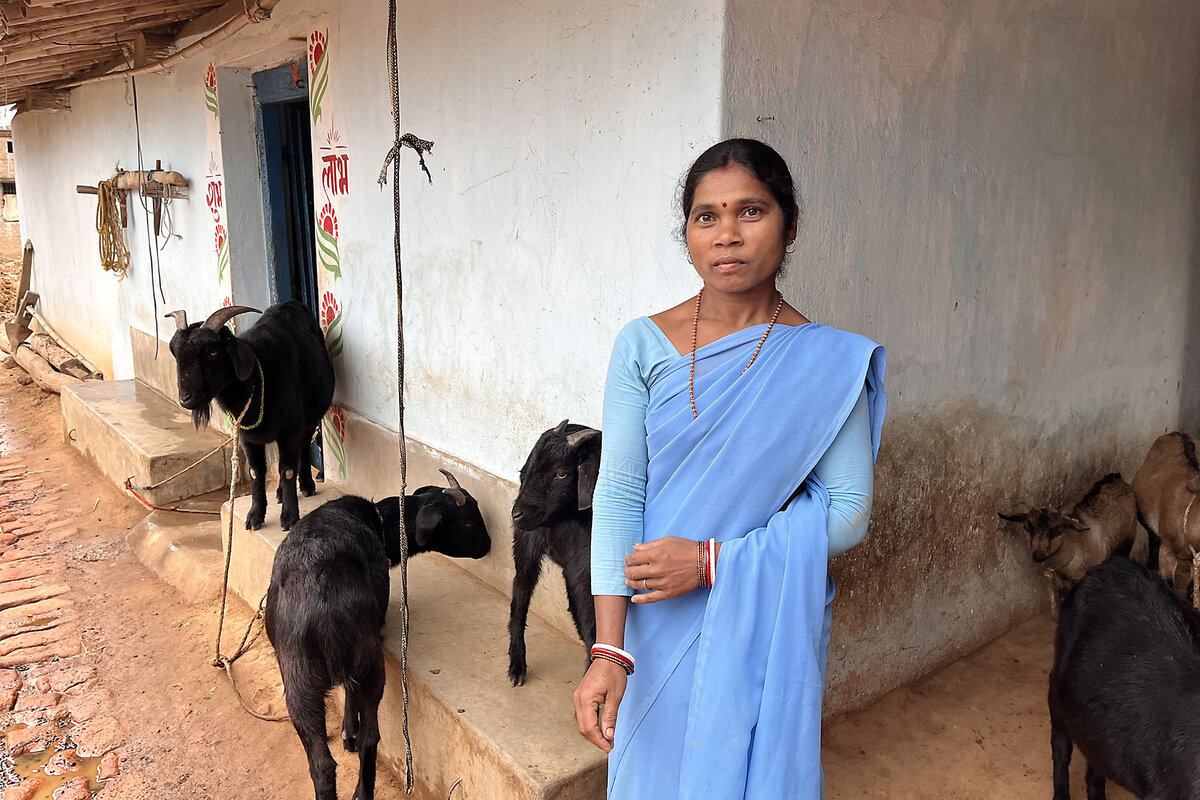
Photo: Sushmita Pathak. Ritmani Devi, one of roughly 60,000 women in India trained as goat nurses under the Pashu Sakhi initiative, stands with her herd in Angara, India, March 19, 2024.
It seems wrong somehow that there should ever be a need to “empower” women, anymore than there is a need to empower men.
But such is the case, whether women live in rich countries or in the most impoverished villages of India.
Still, it’s better to have empowerment initiatives for women than to do nothing about the imbalance.
At the Christian Science Monitor, Sushmita Pathak reports from India about one such initiative, “Dressed in a light-blue sari, Ritmani Devi cradles two black baby goats as she guides a flock of ducks toward its coop. …
“A few years ago, this muddy yard was much less lively. Ritmani Devi’s goats would often die, she says, and the ones that survived weren’t very healthy. This was common here in the east Indian state of Jharkhand and throughout the country.
“India is home to one-sixth of the world’s goat population. A goat is a valuable asset for a low-income family, ready to be sold at a moment’s notice in case of emergencies. But with owners lacking basic animal health knowledge, that’s all they were – a one-time, last-ditch safety net, rather than an alternative stream of income. Plus, poor access to veterinary services led to high mortality and morbidity rates among goats.
“Now, results from one novel initiative that began a decade ago indicate the tide may be turning. The Pashu Sakhi, or ‘friend of the animal,’ program works to fill gaps in veterinary care by transforming rural, semiliterate women into community animal health care workers, or ‘goat nurses.’ With support from the Indian government, the World Bank, the Gates Foundation, and others, around 60,000 women across India have been trained to provide services like vaccination and deworming, leading to a spurt in goat populations in several states. They are paid for the care they provide, and gain a sense of pride and independence. …
“At the community hall near Ritmani Devi’s home in Getalsud village, the walls are painted with training material, including illustrations of common symptoms to look out for, like swelling under the animal’s mouth or pale eyes, and tips on how to negotiate better rates for goats in the market.
“Jharkhand was one of the first states in India to adopt the Pashu Sakhi model. Having women at the forefront of the initiative was a natural choice, says Swadesh Singh, a livestock specialist at the Jharkhand State Livelihood Promotion Society, the government agency that runs the program.
“In rural India, the responsibility of managing small ruminants and poultry usually falls on women. Meanwhile, veterinary doctors – who sometimes serve multiple village clusters alone – focus on larger, more valuable animals like cows and buffalo. Before the program, goat mortality in Jharkhand was 50%, says Dr. Singh. Authorities say that figure is now below 15% – thanks in large part to the state’s goat nurses.
“The typical Pashu Sakhi candidate has at least eight years of schooling. After being selected by the state’s livestock department, they’re taught how to administer vaccines, what type of fodder is best for the animals, and how to give preventative care. More advanced nurses also get trained in managing disease, performing castration, goat breeding and marketing, and more.
“Goat nurses are often the first responders in any livestock-related medical emergency, in addition to conducting regular check-ups and advising others on goat rearing. Their proximity is a huge advantage. Hailing from the same community that they serve makes it easier to build trust, and the women can take on as much work as they like.
“Livestock owners pay a fixed sum for each service – about 12 cents for every vaccination, for example – and goat nurses also receive a small stipend from the government. Ahilya Devi says she makes anywhere from $25 to $85 a month. That money goes toward her children’s school fees, groceries, and other household expenses – and, occasionally, a personal treat like makeup.
“ ‘Earlier, I had to consult my husband for every expense,’ she says. …
“To be sure, the work comes with challenges. Farmers are often reluctant to pay for services, says Dr. Singh, and there’s the risk that goat nurses may be threatened or harmed if an animal dies under their care. …
“Still, the initiative has paid rich dividends. In some districts of Bihar, Maharashtra, and Haryana, goat mortality fell to single digits. Between 2012 and 2019, Jharkhand’s goat population – which had become stagnant – grew by nearly 40%, and another livestock census is expected to take place this year. Spurred by the program’s success, goat nurses in some parts of Jharkhand are also being trained to cater to larger animals like cattle, says Dr. Singh. …
“The initiative has contributed to ‘the building of social capital and self esteem’ among urban women, wrote [Observer Research Foundation senior fellow Arundhatie Biswas Kundal]. People often refer to the goat nurses as ‘doctor didi,’ meaning an elder sister or person you think highly of. …
“But none of this happens overnight. When Ahilya Devi first started as a goat nurse, people would look at her with some suspicion. ‘Even those from my own village did not recognize me, because I did not step out of the house much,’ she says.
“Now, nearly a decade later, they welcome her into their homes with respect.”
Photo: Ng Han Guan/AP. A worker arranges books in a Chengdu, China, bookstore that specializes in nüshu, a centuries-old secret script.
As a kid I always liked the idea of communicating in mysterious ways. For a long time, my friends and I used what was called Goose Latin, which was based on English but with syllables repeated using an “f” in front. Did you ever hear of it? Something like Pig Latin.
I liked the idea of leaving messages in strange places and talking through a tin can on a string and making up a code known to maybe one other person.
So I was intrigued to read today’s report on a secret style of writing that women in China once used.
Huizhong Wu writes at the Associated Press (AP), “Chen Yulu never thought her home province of Hunan had any culture that she would be proud of, much less become an ambassador of. But these days, the 23-year-old is a self-proclaimed ambassador of nüshu, a script once known only to a small number of women in the south China.
“It started as a writing practiced in secrecy by women who were barred from formal education in Chinese. Now, young people like Chen are spreading nüshu beyond the women’s quarters of houses in Hunan’s rural Jiangyong, the county whose distinct dialect serves as the script’s verbal component.
“Today, nüshu can be found in independent bookstores across the country, subway ads, craft fair booths, tattoos, art and even everyday items like hair clips.
“Nüshu was created by women from a small village in Jiangyong, in the southern province where Mao Zedong was born, but there’s little consensus on when it originated. Scholars estimate the script is at least several centuries old, from when reading and writing were deemed male-only activities. So the women developed their own script to communicate with each other.
“The script is slight with gently curving characters, written with a diagonal slant that takes up much less space than boxy modern Chinese with its harsh angles. …
“Women lived under the control of either their parents or their husband, using nüshu, sometimes called ‘script of tears,’ in secret to record their sorrows: unhappy marriages, family conflicts, and longing for sisters and daughters who married and could not return in the restrictive society.
“[Xu Yan, 55, the author of a textbook on nüshu] is also the founder of Third Day Letter, a nüshu studio in Beijing named after a centuries-old practice by the script’s practitioners. The third-day letter is a hand-sewn book presented in farewell to a woman in Jiangyong on the third day after her marriage, when she’s allowed to visit the childhood home she left.
“The script became a unique vehicle for composing stories about women’s lives, typically in the form of seven-character line poems that are sung. A secret world sprung from the script that gave Jiangyong women a voice through which they found friends and solace. …
“Chen, who studied photography at an art school in Shanghai, said her male professors often doubted that she could keep up with the male photographers because of her slight physique. That attitude, she said, is ‘in every aspect of life, there’s nowhere it doesn’t touch.’
“She was frustrated but didn’t see much room to push back — until she learned about nüshu. ‘I felt that I had received a very strong power, and I think a lot of women need this power,’ she said.
“Chen wanted to make a documentary about feminism and came across nüshu in her online search. When she realized the script originated from Jiangyong, just a few hours from her hometown, she immediately knew that she had found her graduation project’s topic.
“The more she learned about this script, the more she learned about its duality: that it was as much a painful thing as it was a source of strength.
“In her documentary, she follows He Yanxin, a formally designated inheritor for nüshu who is now in her 80s. … He comes from Jiangyong and says she was forced to marry a man she didn’t want to be with, who physically abused her and tore up photos from nüshu meetups and workshops she attended. She did not feel that the script had made her life materially better, according to Chen’s first-person account, published on social media. Yet, He is the one who urged her to learn the script.
“Formal inheritors of the script have to be from Jiangyong, Chen said, and have to master the nüshu, but there was nothing stopping her from sharing her love of the script with others. …
“Lu Sirui, a 24-year-old working as a marketer, learned about nüshu from online feminist groups and joined Chen’s nüshu-focused WeChat group.
“ ‘At first I just knew that it was a women’s inheritance, belonged only among women,’ Lu said. ‘Then, as I got to know it better, I realized that it was a kind of resistance to traditional patriarchal power.’ “
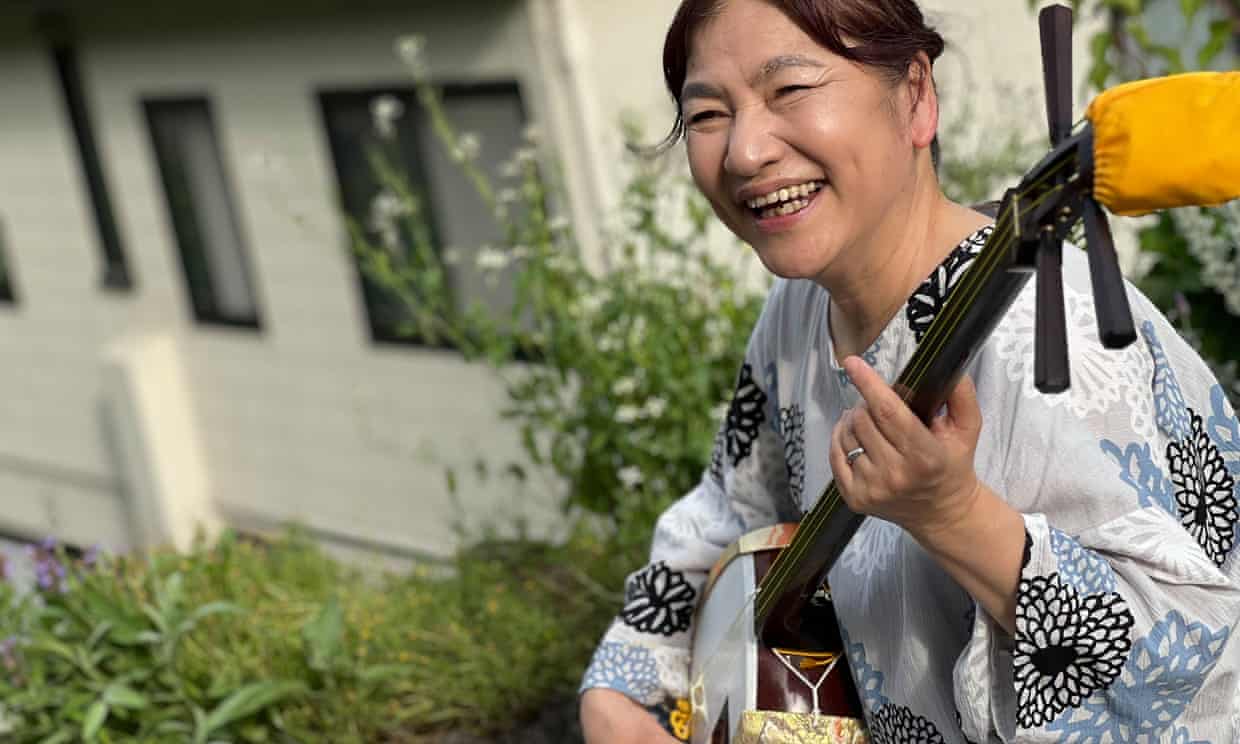
Photo: Justin McCurry/The Guardian. Rieko Hirosawa performs the music of the goze – itinerant blind and visually impaired women who earned a living playing the shamisen in Japan.
I love how the Guardian collects stories from around the world that I would never learn about otherwise. Sometimes I wonder how they do that. Do they have a reporter in all these locales, does a freelancer pitch them an idea? Maybe they have a stringer in a nearby country and send them there. Here is a story I like from Japan.
Justin McCurry reports at the Guardian, “Rieko Hirosawa sits on a stone bench outside her home, tunes her instrument and takes a deep breath. She unleashes an impossibly high note while her bachi plectrum slaps the three strings of her shamisen, a traditional instrument. …”
“Barely a decade has passed since Hirosawa started learning goze uta (blind women’s songs) – a prodigious genre of music spanning four centuries that most Japanese people have probably never heard.
“That she now plays with the composure of a veteran is remarkable for two reasons: not a single goze uta musical score exists, and even if the chords and notes had been written down, Hirosawa would not be able to read them.
“ ‘I knew when I was a young child that I would lose my sight,’ says Hirosawa at her hillside home in Tomi, Nagano prefecture, the outline of the Japanese Northern Alps in the distance.
“But it is because of her condition, not in spite of it, that the 65-year-old has formed an unbreakable spiritual bond with the music of the goze – blind and visually impaired women who earned a living as itinerant musicians and who numbered in their hundreds in the late 19th century.
“In the north-western prefectures, where the tradition flourished during the Edo period (1603-1868), Hirosawa is at the heart of a movement to protect the legacy of the goze.
“ ‘They sang songs while they were living really tough lives,’ she says. ‘Just surviving was a challenge. They used music to have a sense of purpose and then passed on those skills to their apprentices.’
“The musical genre, which historical texts and artwork suggest began as long ago as the 1500s, was no simple career choice. In feudal Japan, girls from poor rural regions who suffered from visual impairment as a result of measles and cataracts, then both commonplace, had only two means of making a living – as masseuses or as traveling musicians.
“Those who chose the latter route out of poverty and discrimination became live-in apprentices at guilds run by an experienced goze, who would pass on songs by word of mouth and teach the shamisen by sitting behind younger musicians and guiding their hands along the instrument’s three strings. …
“They were expected to give a portion of their earnings to the most senior woman in a show of loyalty and observed a strict hierarchy, from the use of honorific to address senior musicians, to the way they wore their hair. The least experienced ate and bathed last, their stock rising with every year of their apprenticeship. The women were not allowed to marry, and men were banned from their lodgings. …
“ ‘It wasn’t unusual for parents to go directly to the master of a goze household and ask her to take on their daughter,’ says Zenji Ogawa, curator of a museum dedicated to the musicians in Takada, a town in Niigata prefecture that was once home to almost 100 performers. ‘They were worried about what would happen to them after they died.’ …
“Life on the road was even more arduous. Three or four musicians, led by a sighted guide, spent 300 days of the year walking from one village to the next, mainly in Japan’s northwestern prefectures of Nagano and Niigata. …
“The women were paid in rice that they would exchange for cash. ‘There was a belief that the goze must have magical powers to have overcome so much adversity and become musicians, so people would buy back the rice they had donated to the women,’ says Ogawa, who organizes bus tours of goze-related sites. …
” ‘They thought that feeding the rice to their children would make them just as strong-willed,’ adds Ogawa, co-founder of the Takada Goze Culture Preservation and Promotion Association. ‘It was the opposite of discrimination. People with disabilities suffered terrible discrimination in those days, of course, but the goze were treated differently.’ …
“Haru Kobayashi, who went blind when she was three months old, is regarded as the last true goze. Born in 1900, she spent her childhood locked in a room at the back of her family home in Niigata and began her career at the age of eight.
“She continued performing until 1978 and was named a living national treasure and received the medal of honor. …
“ ‘Kobayashi-san was 101 years old when I met her,’ says Hirosawa, who wanted to interview the musician for her local radio program, Rieko no Mado (Rieko’s Window). ‘She had lost her sight, of course, and her hearing was failing too.’ Hirosawa had been warned by care home staff that Kobayashi would not be able to sing during their meeting.
“ ‘But she was determined to sing one stanza of a song to me. When I heard her sing it was like thunder … I’d never experienced anything like it. It sent chills down my spine, and I found myself crying the whole time, even on the train on the way home.’
“Inspired by the encounter, she continues to memorize more of the goze repertoire with the help of a teacher who once studied under Kobayashi. ‘All I want is for people to enjoy the music … after all, that’s what the goze’s original purpose was,’ she says.”
More at the Guardian, here. No paywall. Contributions encouraged.
Photo: Shawn Henry via Unsplash. Skateboarding in New Zealand has a culture all its own.
At a certain age, we start getting the same question at the beginning of every medical appointment: “Any falls?”
For a few years, that question seemed silly. Why would I have any falls? But after a while, it starts to make sense because we start to feel unsteady or because so many people we know have bad falls. A dear friend even died of one last year.
So I am in awe of people like those in today’s story who seem impervious to fear of falling: skateboarders.
Becki Moss and Lauren Bulbin write at the Washington Post, “If you venture past a skate park on any given day in the center of New Zealand’s capital, look for the skaters with neon hair. There’s a good chance they’re members of Wozer, an ever-evolving collective of young, diverse skaters, musicians and artists that has revolutionized the skate scene in Wellington in part by making it more welcoming to women and gender minorities.
“The group has blossomed in this city of approximately 200,000 residents, known for its abundance of native birds, must-visit coffee shops and notoriously strong winds. … Becki Moss, a photographer and artist based in New Zealand, followed the Wozer collective for two years, capturing their lives, their athleticism and their creativity.
“The first Wozer meeting was held in June 2022 by a group of friends who loved the sport, an effort to take their group chat offline and into the real world. Two years later, the collective has released two print magazines and become an increasingly visible force within the scene, teaching workshops at festivals and collaborating with clothing brands, including Converse.
“The point is to show skaters who feel left out of the sport’s cis-male-dominated spaces that there’s a hub for them, too. As the group writes in its 2022 zine: ‘Skating is infamous for its community, when you find a skate community you love, you become part of an instant family. Unfortunately, in amongst a battle of male egos, there wasn’t much room for us in our own local skate communities.’
“Clare Milne is a 23-year-old visual communications design student who moved from Gisborne to Wellington to study. She created the first version of Wozer magazine in May 2022 for a school assignment. Five months later, backed by a sponsorship from Kingsbeer Architecture, the first issue was officially released the same weekend as Bowlzilla, a national skateboard championship.
“ ‘It’s given a lot of people confidence in their identity,’ Milne said. ‘Just meeting like-minded people, it really made me feel comfortable in my own skin. I think the reason I’m so passionate about this is because I saw how these people influenced my life.’
“While the city-run Waitangi skate park features impressive bowls and ramps, Milne said enthusiasts might wish to venture out of the central business district and up a hill behind Wellington city hospital. There you’ll find ‘Hospital DIY’ — a skate park created by the skating community over the years. …
“Here, Gala Baumfield, 22, [who uses they/them] showed where the handprint of their mother, Pearl, is set in the concrete. Their hands are the same size. Pearl died in April 2023 after fighting lung cancer. The Wozer community supported Baumfield as a young caregiver and after their mother’s death continued as their found family, they said. …
“Wozer is continuing to grow. Initially, the group identified itself as a hub for women and gender minorities, but it has since expanded to include cis men. Baumfield says this was because it just felt really exclusionary to a lot of trans whanau’ — a Maori term for extended family or community — ‘especially if you’re not open about being trans, and you don’t really want to broadcast it to the whole world.’ “








 Suzanne's Mom's Blog