Feeds:
Posts
Comments

Posts Tagged ‘wwI’

Photo: Signature Theatre.
A behind-the-scenes look at the rehearsal process for the musical Private Jones, featuring deaf and hard-of-hearing artists.

When we were watching the Hulu series Only Murders in the Building, we noticed efforts by the producers to be inclusive. For example, a key character is deaf. When he is on, he uses sign language and we read subtitles. A few other characters use signing for his benefit. He can also read lips.

A push for diversity and inclusion is not happening only in streaming services. At the Signature Theatre in Virginia, for example, deaf and hard-of-hearing characters powered a whole musical.

As Thomas Floyd has the story at the Washington Post.

“Signing, singing and soundscapes are intermingled on a late-January afternoon at Signature Theatre’s Arlington, Va., rehearsal studio, where the cast of Private Jones is marching through the world-premiere musical’s opening scene.

“Loosely inspired by Gomer Jones, a deaf sniper who fought in World War I, the show opens in rural Wales with an 8-year-old Jones getting a lesson from his gruff father in sharpshooting and hard truths. As the only scene before Jones loses his hearing, it uses radio-play-like foley effects to create the sounds that will echo in the character’s head through the rest of his life — and give deaf and hard-of-hearing audiences visual cues to associate with those sounds.

“When Johnny Link, the hard-of-hearing actor playing Jones, raises a prop rifle, another performer flaps an umbrella to conjure the sound of birds fluttering overhead. A ratchet replicates a rifle cocking. A snare drum stands in for a gunshot. All the while, two actors narrate — one in spoken English, one in American Sign Language — and writer-director Marshall Pailet reminds his cast to be aware of the open captions that will flank the stage at every show. …

“Accessibility is a guiding principle for [writer-director Marshall Pailet], the hearing playwright and composer who wrote the book, music and lyrics for Private Jones. … The musical features a cast of hearing, hard-of-hearing and deaf actors performing dialogue in three languages — English, ASL and British Sign Language — while also delivering Pailet’s Celtic-inspired score. To Pailet and Alexandria Wailes, the show’s director of artistic sign language, no scene should be staged without careful consideration of how narrative intent is both seen and heard.

“ ‘If the piano does something that is supposed to evoke an emotion and there’s not a visual equivalent of that, we haven’t done our job,’ Pailet says. ‘Theater is taking psychology and turning it into behavior. So everything is visual, everything is behavioral, and it’s also therefore a perfect medium for sign language, which is a visual language. It exists to be seen.’

“Pailet acknowledges that the origins of Private Jones are fairly mundane: He was interested in writing a World War I trench warfare story — specifically exploring how being asked to commit violence can reorient a person’s worldview — when he came across an article with a couple of sentences about the deaf Welsh sniper. …

“After traveling to Wales … and tracking down war records he believes belonged to Jones, Pailet took an early iteration of the show to Connecticut’s Goodspeed Festival of New Musicals in January 2020. He subsequently connected with Wailes, the ASL master on the Oscar-winning film CODA, and the duo began swapping ideas during the pandemic on how to better integrate deaf and hard-of-hearing perspectives.

“While the show features a narrator performing in ASL, Wailes pitched the idea of also incorporating British Sign Language during dialogue exchanges between characters who would have spoken in that wholly different dialect. …

“Finding the right actor to enlist as Jones — a deaf character who tricks his fellow soldiers into thinking he’s hearing and carries much of the show’s vocals — also proved critical. As a musical theater performer who has used hearing aids since childhood, Link came with connections to the hearing and deaf worlds that the character bridges. …

“ ‘I have never felt so seen in a character,’ Link says. ‘Truly, this is one of the most special projects I’ve ever worked on because it pulls from different parts of my life. I feel a lot of the things that Gomer feels. I just knew I had to do it.’

“Pailet says unfamiliar perspectives are at the core of Private Jones, which uses its innovative soundscapes to place the audience in Jones’s shoes while interrogating how people empathize with or dehumanize those they don’t understand. …

“Having spent the better part of five years developing the show, Pailet hopes this isn’t his last shot at envisioning Jones’s journey onstage.”

More at the Post, here.
Read Full Post »

Images: Brett Hawkes photos; Ally Rzesa illustration.

When do people get interested in researching family history? Some people never. Others — like my cousin who has made his genealogy hobby an obsession — very young. In today’s article, a 71-year-old from Massachusetts got the bug when he started going through the photos his grandfather took in France.

Travel writer Christopher Muther reports for the Boston Globe about Brett Hawkes and the stacks of old photos he used to re-create his grandfather’s journeys in WWI.

“For the better part of a century, the boxes and their mostly-forgotten contents collected dust while occupying real estate in attics throughout Massachusetts.

“But for Brett Hawkes … they inspired a once-in-a-lifetime journey that spanned 600 miles across the French countryside.

“Hawkes received the boxes of old photos and letters when his mother passed away in 2013. He said he glanced at them occasionally, but otherwise, they remained stored away, collecting another decade of dust. He came upon them again in the winter of 2022 while cleaning his office, but this time, the more he studied them, the more he was drawn to what he saw.

The pictures, taken in 1917 on the frontlines of the war in France, showed soldiers fighting in trenches, bombed buildings, and previously idyllic fields transformed into hastily-dug cemeteries.

“But his grandfather also took pictures of everyday life in the small towns where he was stationed. There are pictures of friends he made, soldiers playing football in a snowy field, and peaceful streets.

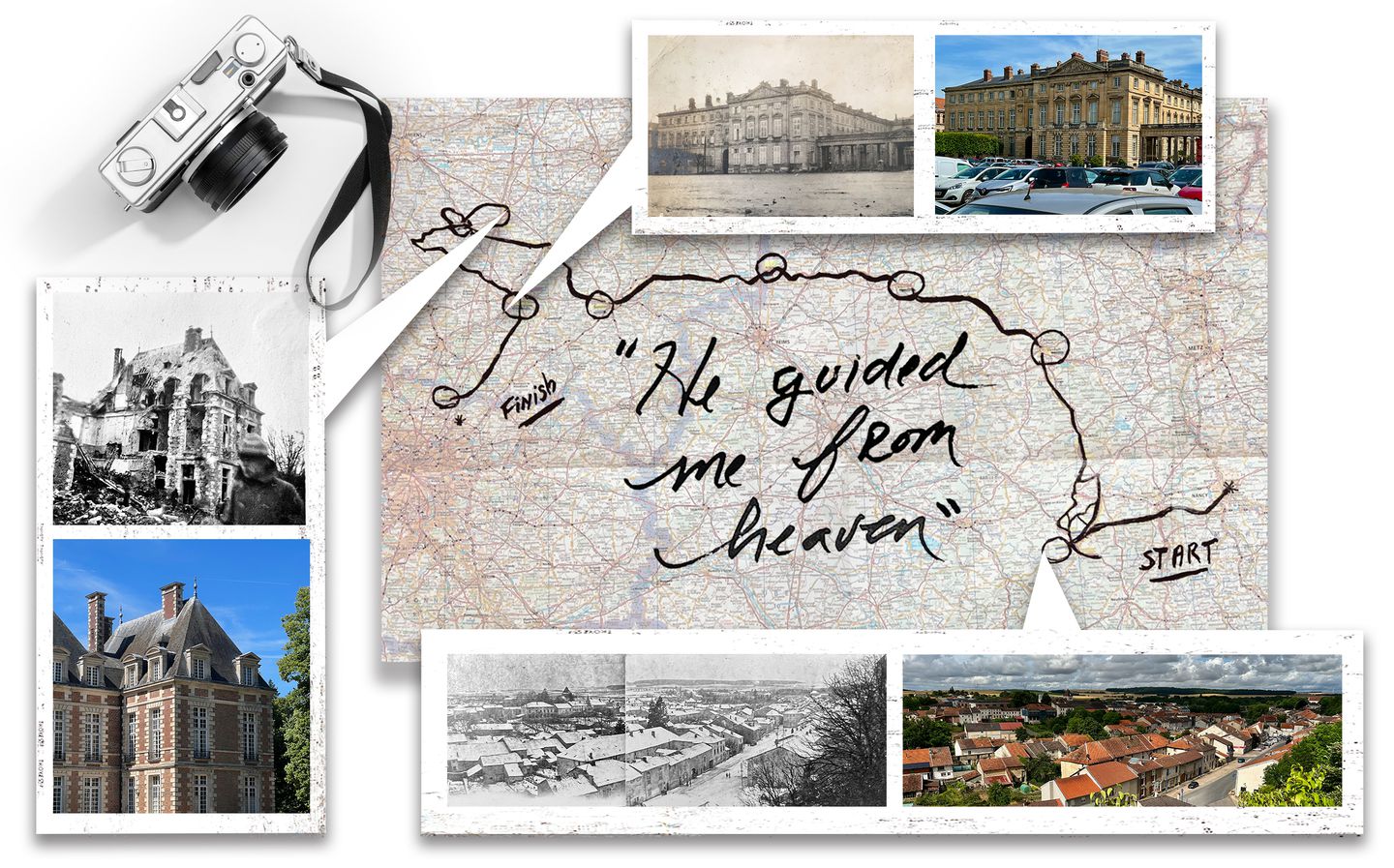
“ ‘I stared at these old photos and thought, “Oh my God, look at these churches bombed to the ground.” I started wondering what they look like now,’ Hawkes said. ‘I happened to find a photo he took of a famous chateau, and I Googled it and saw it was all renovated.’

“That’s when the idea for his trip took root. He devised a plan to find the locations of as many of the photos as possible — thankfully, his grandfather had labeled the towns where pictures were taken — and re-create his grandfather’s 1917 route in France. …

“Alton Hawkes entered the war just months after America’s entry and was sent for further training in Abainville before being stationed in the villages of Warmaise, Chepoix, and Broyes, about 70 miles north of Paris.

“Brett said his grandfather, who studied engineering, was also an avid amateur photographer and collector, which made reconstructing the route easier. He also had letters that his grandfather had written home to his family, outlining some of his more benign activities.

“ ‘What boggled my mind was that he took these photographs of the destruction and fighting that would be classified today,’ he said. ‘The more I learned, the more I became emotionally involved. It’s part of the reason why Ancestry.com and 23andMe are so popular. People want to feel an emotional connection with the past.’

“Hawkes has two skills that made the trip possible. The first was years of cycling experience. When he was 16, his neck was broken in a severe car accident. As a result, the right side of his body was paralyzed. Over time he regained the use of his body, but the former athlete continued walking with a limp. While he could no longer run or play sports, he could cycle, which remains his passion.

“His other skill is the ability to speak French and a general love of French culture. He brushed up on his French before the trip, but he spoke no English for three weeks on the road.

“ ‘Being able to speak French helped form bonds and broke down barriers with the people I met,’ he said. …

“Those meetings with residents are what made his trip a success. He would roll into small farming towns and seek out cafes where he would strike up conversations with locals. If the town was too small for a cafe, he knocked on the doors of houses that his grandfather had photographed, or he would seek out the mayor of a town he was visiting for assistance in finding buildings or bridges.

“ ‘I’m an older guy. I wasn’t threatening. I couldn’t punch myself out of a paper bag,’ he said. ‘I think that helped a lot.’

“When word spread through these tiny towns of the American retracing his grandfather’s WWI route, strangers would show up at bed and breakfasts where Hawkes was staying with information about locations in the photographs and stories about the war that had been handed down. …

“ ‘I started to really go through a transition. It became more than a vacation, it became a passion. It was an incredible experience. It’s hard to explain, but that’s really what happened. I went through a transformation.’

“He found the field where the French government awarded his grandfather the Croix de Guerre for his bravery in battle. In one photo, his grandfather stood on a pile of rubble that had once been a church. Hawkes found the location with a new church in its place. It was the same with historic buildings that had been repaired or rebuilt. Just like his grandfather, the younger Hawkes was there to document it all.

“ ‘He guided me from heaven,’ Hawkes said.”

More at the Globe, here.

Read Full Post »

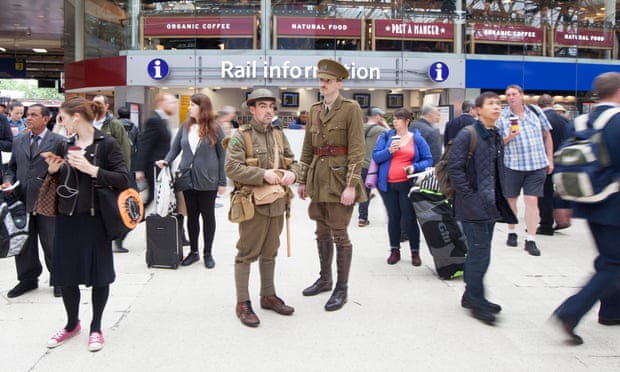
Early last month, an unusual tribute took place at Waterloo Station, London. How I would have liked to be there and see return to life the soldiers who died in the devastating Battle of the Somme in World War I!

Charlotte Higgins at the Guardian describes what the event was like.

There “were about 20 young men, immediately conspicuous because they were dressed in the dull-green uniforms of the first world war. They were just there: not speaking, not even moving very much. Waiting, expressionless, for who knows what.

“A small crowd gathered, taking photographs. A woman caught the eye of one of the men. She tried to speak to him. Without speaking or dropping his gaze, he pulled a small card out of his pocket and handed it to her.


‘Lance Corporal John Arthur Green,’ it read. ‘1st/9th Battalion, London Regiment (Queen Victoria’s Rifles). Died at the Somme on 1 July 1916. Aged 24 years.’

“There were similar scenes across the UK. … They gathered on the steps of the Gallery of Modern Art in Glasgow. They smoked roll-ups outside Bristol Temple Meads and marched, metal-tipped boots ringing, through Manchester Piccadilly. They stood in clumps by the entrance to Queen’s University, Belfast, and sat on the market cross in Lerwick, Shetland. …

“The event, which unfolded without advance publicity, can now be revealed as a work by Jeremy Deller, the Turner prize-winning artist …

“The participants were a volunteer army of non-professional performers, including social workers, farmers, security guards, farmers, shop assistants, students, labourers, flight attendants and schoolboys. All were sworn to secrecy, and rehearsals took place across the country over the past months. Deller worked with Rufus Norris, the artistic director of the National Theatre in London, and theatres throughout the UK to train the volunteer army.” More.

Photo: Alicia Canter for the Guardian
Soldiers at Waterloo station, London. Each represents a real person who died in the Battle of the Somme.

Read Full Post »

An Imperial Elegy
by Wilfred Owen

Not one corner of a foreign field
But a span as wide as Europe;
An appearance of a titan’s grave,
And the length thereof a thousand miles,
It crossed all Europe like a mystic road,
Or as the Spirits’ Pathway lieth on the night.
And I heard a voice crying
This is the Path of Glory.

@-> @-> @->
Born in Shropshire, England, poet Wilfred Owen is best known for telling the truth of what he saw in World War I, a war joined too lightheartedly by many of his countrymen 100 years ago. He  died at the Sambre-Oise Canal a week before the Armistice was signed.

Read more about Owen here.

Photo: Suzanne’s Mom
Azalea moving to the next phase

azalea-moving-to-next-stage

Read Full Post »