Feeds:
Posts
Comments

Archive for March, 2017

Photo: Steve Atwood
The wrybill uses its laterally curved bill to reach insect larvae under rounded riverbed stones.

I was intrigued by new research showing that some cells in nature have a left or right orientation and, when disrupted, are able to repair themselves. The Quanta Magazine article reposted at Wired is long and technical. I’m hoping to capture the basics here.

Tim Vernimmen writes, “In 2009, after she was diagnosed with stage 3 breast cancer, Ann Ramsdell began to search the scientific literature to see if someone with her diagnosis could make a full recovery. Ramsdell, a developmental biologist at the University of South Carolina, soon found something strange: The odds of recovery differed for women who had cancer in the left breast versus the right. Even more surprisingly, she found research suggesting that women with asymmetric breast tissue are more likely to develop cancer.

“Asymmetry is not readily apparent. Yet below the skin, asymmetric structures are common. Consider … how our heart, born from two identical structures fused together, twists itself into an asymmetrical pump that can simultaneously push oxygen-rich blood around the body and draw in a new swig from the lungs, all in a heartbeat. …

“In her early years as a scientist, Ramsdell never gave asymmetry much thought. But … after her recovery, Ramsdell decided … to start looking for asymmetry in the mammary glands of mammals.

In marsupials like wallabies and kangaroos, she read, the left and the right glands produce a different kind of milk, geared toward offspring of different ages. …

“Research from [the lab of Michael Levin, a biologist at Tufts University] suggests that communication among cells may be an under-explored factor in the development of asymmetry.

“The cellular skeleton also directs the transport of specialized proteins to the cell surface, Levin said. Some of these allow cells to communicate by exchanging electrical charges. This electrical communication, his research suggests, may direct the movements of cells as well as how the cells express their genes.

“ ‘If we block the [communication] channels, asymmetrical development always goes awry,’ he said. ‘And by manipulating this system, we’ve been able to guide development in surprising but predictable directions, creating six-legged frogs, four-headed worms or froglets with an eye for a gut, without changing their genomes at all.’

“The apparent ability of developing organisms to detect and correct their own shape fuels Levin’s belief that self-repair might one day be an option for humans as well.

“ ‘Under every rock, there is a creature that can repair its complex body all by itself,’ he points out. ‘If we can figure out how this works,’ Levin said, ‘it might revolutionize medicine. Many people think I’m too optimistic, but I have the engineering view on this: Anything that’s not forbidden by the laws of physics is possible.’ ”

The original story appeared in Quanta Magazine. Check the Wired reprint here.

Photo: SEFSC Pascagoula Laboratory; Collection of Brandi Noble, NOAA/NMFS/SEFSC
The twospot flounder lies on the seafloor on its right side, with both eyes on its left side.
Read Full Post »

032717-ESL-class-Providence

I volunteer with English Language Learners at two agencies in Providence and one in Boston. The classroom teachers are all quite different in their approach, and I learn from them all. JVS in Boston has a rapid-employment model, so all the English learning is geared toward what you need for a job.

At one Providence agency, I work with a teacher who has brand-new refugees, some of whom, because of war or poverty, have never been to school in their native countries. She keeps the atmosphere friendly and light, but there is an understandable level of seriousness, given how new everything is to the participants.

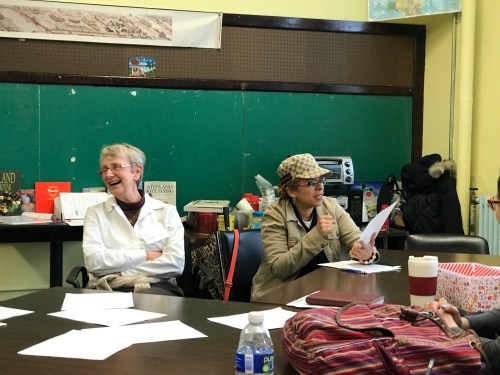
The teacher I assist at the Genesis Center has a class of immigrants whose language skills are a bit further along and who mostly come from Spanish-speaking countries and are not refugees. I believe the woman in the hat, above, is from Puerto Rico — so, born a US citizen. She wants to improve her English and loves to write.

On Monday, the teacher was following up on the previous week’s discussion of periodic tables, the instability of hydrogen, and the 1937 crash of the German pleasure blimp the Hindenburg in New Jersey. He showed the crash film to the class, one that I’ve seen often enough to know I really can’t take it. I look away.

I said, “What’s interesting is that when Orson Welles did his radio play at Halloween the following year about Martians landing in New Jersey, many listeners were so sensitized to disaster they thought the radio play, presented as real news, was true.

I said, “It might be fun sometime for the class to practice their English by reading the script.”

The next thing I knew the teacher had found the radio play on the web and was passing around copies.

When we were halfway through it, we discussed the ways Orson Welles had adapted the H.G. Wells sci-fi classic to New Jersey, with an authentic-sounding ballroom broadcast that was frequently interrupted by a studio announcer switching to reports of an unusual light burst on Mars and (after some more of the big band concert) a shiny cylinder falling on a farm in Grovers Mills. Details like the boom heard as far as 100 miles away in Elizabeth, New Jersey, added to the verisimilitude. So did the on-the-ground reporter conducting interviews with the farmer and a scientist who didn’t believe in life on Mars, as police sirens wailed in the background. We talked about how panicked some listeners were and how they jammed the lines at the radio station.

The teacher next had people write their own endings to the story. It was a lot of fun. The students don’t speak much English, but they certainly got the point about the panic. One woman, remembering how in her hometown some individuals thought the turn of the millennium was the end of the world and did away with themselves, put that into her story. Others envisioned panicked parents rushing to schools to pick up their children.

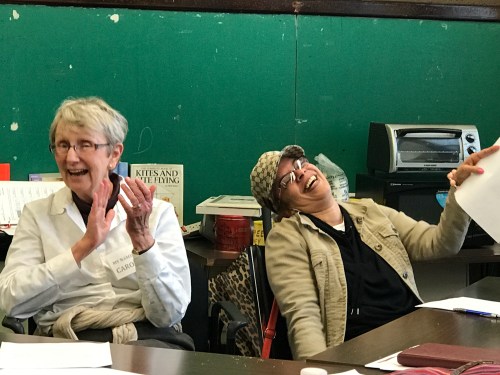
It was serious in a way, but we laughed a lot. I felt grateful to work with a teacher who is able to make up a good lesson on the spur of the moment like that.

Photos: David Buchalter

032717-ESL-hilarity-GenCenterJPG

Read Full Post »

Photo: Rachel Sussman
Rachel Sussman’s “Study for Sidewalk Kintsukuroi #02 (MASS MoCA),” photograph with enamel paint and metallic dust.

What a lovely art idea! Mending cracks with gold resonates with me on so many different levels. You start with sidewalks and then …

Allison Meier writes at Hyperallergic, “Artist Rachel Sussman had traveled for years photographing the most ancient organisms on Earth when a photograph on social media of a shattered bowl reassembled with gold introduced her to the tradition of kintsukuroi, also called kintsugi. In this Japanese practice, broken pottery is repaired with gold dust and glue. …

“This sense of time and its visibly healed scars, and the beauty of imperfections, helped inspire her current Sidewalk Kintsukuroi series, of which the newest edition is in ‘Alchemy: Transformations in Gold,’ currently at the Des Moines Art Center in Iowa. As part of the exhibition, which considers the cultural and historical connotations of gold, Sussman repaired a fissure in the museum’s marble floor, an embedded installation now in their permanent collection.

“ ‘We’re not talking the millions of years it took for the Grand Canyon to form, but by noticing the crack in the marble floor of the Des Moines Art Center that formed over the course of several decades, it serves as a reminder that natural processes are happening all around us, but at a pace that is far too slow for us to observe with the naked eye,’ Sussman explained.

“The Alchemy exhibition includes images of her Sidewalk Kintsukuroi gold dust alterations on photographs of cracks on the streets of Soho and Williamsburg in New York City. Each patching, whether a physical surface or photograph, can take weeks of physically straining work. …

“ ‘Over time, even the repairs will be destroyed,’ Sussman stated. … “Such is the transient nature of everything in the universe. All the more reason to value the time we have.”

” ‘Alchemy: Transformations in Gold’ continues at the Des Moines Art Center (4700 Grand Avenue, Des Moines, Iowa) through May 5.”

Love this concept! Let’s mend everything in ways that go beyond the need.

More at Hyperallergic, here.

Hat tip: Gwarlingo on twitter.

Read Full Post »

Have you ever run into one of those pay-it-forward situations — when a stranger does you a small favor and then you choose if you want to do the same for another person? I was in line to buy coffee at a Jamaica Plain shop a couple years ago when the person in front paid for me. Then I paid for the person behind me. Fun. I blogged about the phenomenon here and here. It can be about helping someone who has few resources, but not necessarily.

Here’s a recent example of the practice. It involves theater tickets.

“A theatre in Rome has taken the tradition of ‘suspended coffees’ — where a person buys an extra drink for someone less well-off — and applied it to tickets.

“The initiative [ran] for just over two weeks at the Teatro delle Muse, where people buying tickets for a variety show [purchased] an extra seat at a reduced price to leave at the box office for someone else … The aim is to use a small charitable gesture to make the theatre accessible to everyone. The comedy show, called ‘You Are Not Neapolitans,’ [started] on 16 February. …

“The ‘caffe sospeso’ tradition originates in Naples, the idea being that when ordering your coffee you also anonymously gift another to a stranger in need. The idea has now spread internationally, and in some places has been adapted to include pizza or other food items. In a nod to the original Neapolitan custom, the theatre’s donated tickets [came] with a steaming cup of coffee … courtesy of a local bar.”

More here. Il Messaggero reported the story, and the BBC passed it on.

I’d love to know if you have encountered this kind of thing. Panera Cares, for example, was a noble experiment begun during the economic downturn in 2010 to help the hungry, but I read that the some of the locations ran into trouble.

Photo: Google Maps
The initiative at Teatro delle Muse is called “Theatre and Coffee… on hold for you”

Read Full Post »

Photo: Dinghua Yang/AFP/Getty Images
This pregnant Dinocephalosaurus, a long-necked marine reptile, didn’t lay eggs but instead gave birth to live young 245m years ago.

After uncovering new evidence, surprised scientists are revising a long-held understanding of the pre-dinosaur Dinocephalosaurus.

According to a Reuters story at the Guardian, “An extraordinary fossil unearthed in southwestern China shows a pregnant long-necked marine reptile that lived millions of years before the dinosaurs with its developing embryo, indicating the creature gave birth to live babies rather than laying eggs.

“Scientists said [in February that] the fossil of the unusual fish-eating reptile called Dinocephalosaurus, which lived about 245m years ago during the Triassic Period, changes the understanding of the evolution of vertebrate reproductive systems.

“Mammals and some reptiles including certain snakes and lizards are viviparous, meaning they give birth to live young.

“Dinocephalosaurus is the first member of a broad vertebrate group called archosauromorphs that includes birds, crocodilians, dinosaurs and extinct flying reptiles known as pterosaurs known to give birth this way, paleontologist Jun Liu of China’s Hefei University of Technology said. …

“ ‘I think you’d be amazed to see it, with its tiny head and long snaky neck,’ said University of Bristol paleontologist Mike Benton, who also participated in the research published in the journal Nature Communications.

“Its body plan was similar to plesiosaurs, long-necked marine reptiles akin to Scotland’s mythical Loch Ness Monster that thrived later during the dinosaur age, though they were not closely related.

“Not laying eggs provided advantages to Dinocephalosaurus, the researchers said. It indicated the creature was fully marine, not having to leave the ocean to lay eggs on land like sea turtles, exposing the eggs or hatchlings to land predators.” More here.

I admire scientists for continuously revisiting accepted wisdom when they find new data. The only complaint I have about the story concerns the Loch Ness Monster, an old friend of mine. Should one really call it mythical? Perhaps the data just haven’t floated to the surface yet.

Read Full Post »

My husband has found some of his best reading-list ideas after checking out the obits. Sometimes I find blog stories there. This one is about a ballet dancer who brought her art to the desert.

The Associated Press reported, “Marta Becket, a dancer and artist who spent decades presenting one-woman shows at a remote Mojave Desert hall that she made famous as the Amargosa Opera House, died Jan. 30 at her home in Death Valley Junction, Calif. She was 92.

“A New York City native, she had performed on Broadway and at Radio City Music Hall. A flat tire during a 1967 camping trip with her husband to Death Valley, changed her life.

“They discovered an abandoned theater in a mining town. The couple rented the building, and Marta Becket made her debut in 1968 at the renamed Amargosa Opera House. In the beginning, only the three Mormon families who lived in the town at that time came to watch.

“The nearest town is 23 miles away from the opera house, but audiences filled its 114 theater seats so many times over the years that extra chairs sometimes had to be brought in.

“Ms. Becket wrote songs and dialogue, sewed costumes, and painted sets. She danced every Monday, Friday, and Saturday whether the house was full or empty. …

‘‘ ‘I love dance. I love ballet. It’s the world I want,’ she said in 2001. ‘It’s mystifying. I feel as if this is what I was intended to do.’’ …

“Her story was captured in 2000 in the award-winning documentary ‘Amargosa.’ ” More here.

I love that she danced even if there was no audience. That’s art.

Photo: AM Morris/The Las Vegas Sun
Marta Becket danced en pointe during the inaugural performance of “Masquerade” at the Amargosa Opera House.

bb4425d5c92f43c4aabdb3f1af3b9f22-bb4425d5c92f43c4aabdb3f1af3b9f22-0

Read Full Post »

Today I wanted to share several links on the power of getting to know those with views that are opposed to yours. It’s not something I’m especially good at, but I’m sure there are few things more important.

ArtsJournal posted a New York Magazine/”Science of Us” link about “the contact hypothesis” recently.

Jesse Singal wrote, “In the last few months I’ve found a bit of solace and much-needed solidity in a social-psychological idea that has been developed for the better part of the last century: the contact hypothesis.

“It’s the simple, inspiring idea that when members of different groups — even groups that historically dislike one another — interact in meaningful ways, trust and compassion bloom naturally as a result, and prejudice falls by the wayside.

“The contact hypothesis, or contact theory as it’s sometimes known, is a really powerful, promising idea for a country like the United States — one that is big and diverse and whose national conversation on a host of subjects ranging from poverty to crime is veined through with implicit and explicit racism. …

“[For example,] if you could get more non-Muslims to interact with Muslims, whether as neighbors or business partners or in a host of other contexts, [the percentage of those with bias] would likely drop. And while this idea sounds idealistic, there’s solid evidence behind it — significantly more than there is behind other ideas, like corporate diversity trainings for reducing prejudice that focus more on information and awareness than personal relationships. …

“As I read about [the work of LindaTropp, a social psychologist and contact-theory expert at the University of Massachusetts Amherst] and spoke with Tropp, I kept thinking about the airport protests [this year].

“Suffice it to say that many of the protesters were simply there because they thought it was the right thing to do, because they were motivated by politics or religion or their social networks or whatever else. But think about how much more potent that drive is when you know and value and worry about people who could be personally affected: Think about the difference between I am protesting this policy because it is wrong and I am protesting this policy because it is wrong and could hurt people I care about.

“That’s the ultimate promise of the contact hypothesis: You don’t need fancy educating or lecturing or anything else to get people to treat one another better. To a certain extent, you just need to get them to interact on the same level, and progress will follow.”

Two favorite examples of the power of human contact: Parents Circle, in which Israelis and Palestinians who’ve lost loved ones to the conflict come together, and Kids4Peace, summer camps for Jewish, Muslim, and Christian youth to get to know one another.

Also note this Guardian story about a descendant of General Custer reaching out to the Dakota Access Pipeline tribes!

Photo: David Valdez 
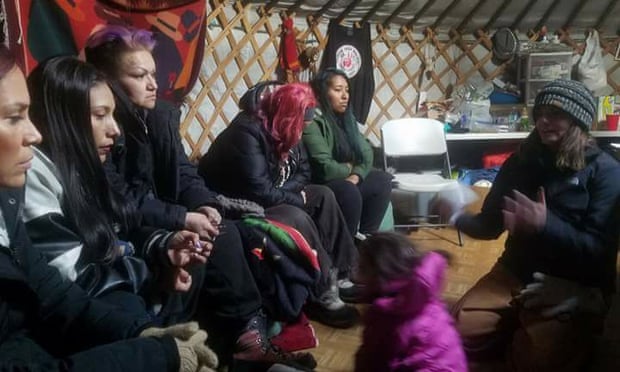
Alisha Custer – whose lineage traces back to the US army commander who led the 19th century wars against Lakota Sioux and Cheyenne warriors – meets with Standing Rock members.

Read Full Post »

Back in the day, a regular on the kids’ television show Howdy Doody was a putative Indian called Princess Summer Fall Winter Spring. The last two seasons in her name were run together as if they were one word.

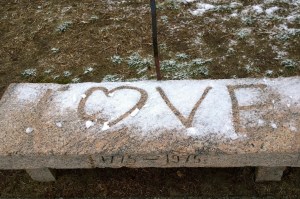
Lately, “WinterSpring” seems to be the right name for what we’re experiencing in New England. Here are a few pictures from my confused season.

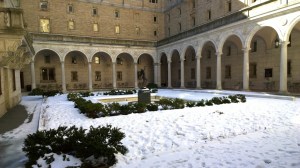
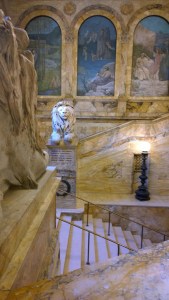
There are four photos of the beautiful Boston Public Library. The hardest shot to get was a lion not surrounded by photographers and visitors posing for their picture. While I was at the library, I was delighted to hear the retired Massachusetts chief justice being interviewed by Boston Public Radio, which sometimes broadcasts from there. Margaret Marshall is perhaps best known for her reasoning in the case to make gay marriage legal in Massachusetts. My photo of her friendly wave did not come out.

The ornate clock suddenly appeared on Washington Street. I don’t recall seeing it in all the years I took walks in that neighborhood.

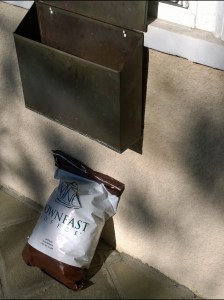
The 5-lb coffee bag will get us through any kind of WinterSpring.

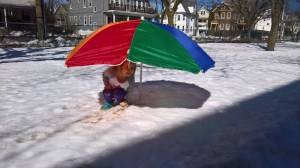
Finally, I include a couple indoor shots of my living room in a welcome shower of sunlight and a couple pictures of grandchildren managing just fine in WinterSpring.

Caroline is fine and let me know what flavor you want there is vanilla, chocolate, coffee, pineapple, and I expect your response many thanks Caroline

031717-library-courtyard-shadows


031717-rare-view-of-BPL-lion-sans-tourists

031017-snow-writing-ConcordMA


032017-thinking-beach-time-in-the-snow

031717-pastoral-reminder-re-love


031717-outdoor-clock-washington-st-boston

032317-coffee-in-5-lb-bag


032317-sunlight-thru-lattice

032317-rugs-on-wood-floor


032317-two-young-artists-sunny-day


Read Full Post »

Photo: Taught by Finland
Taught by Finland promotes a play-centered approach to early education and writes loving posts about “the joyful, illiterate kindergartners of Finland.”

On Facebook, I’ve been following Taught by Finland, which highlights the Finnish approach to education (e.g., lots of playtime for young children) and posts links to related research and stories.

In higher grades, Finns usually outrank American students by a lot on standardized tests. That may have multiple causes, but it seems reasonable to ask what Finland is doing right and what would happen if American schools were to lighten up.

A school in Burlington, Vermont, is beginning to get answers to that question.

Nicole Higgins DeSmet writes at the Burlington Free Press, “Five months after a no-homework policy went into effect, Orchard Elementary parents report that after-school reading is flourishing.

” ‘We have a first grader, and at her age it’s as much a chore for the parents as the kids,’ parent Rani Philip said about homework. ‘Instead we’ve been spending time reading. We don’t have to rush.’

“Philip said her husband was skeptical, but now he’s convinced. Other parents who were surprised by the policy said their children are reading more. …

“[Kindergartner Sean Conway] hid behind his dad’s legs but managed to share that his solo literary conquest was the book ‘Spirit Animals.’

“Teachers at Orchard voted unanimously before the start of the school year to end homework for their kindergarten through fifth-grade students. Instead students are encouraged to read, play games and be kids.

“Orchard Principal Mark Trifilio sent a homework policy survey to parents in November. Of those parents, 254 sent back answers. About 80 percent indicated they agree with the policy.

“Parents reported in the survey concern that their fifth-graders might miss skills that will help them succeed in middle school. …

“Lolly Bliss, a fifth-grade teacher with 25 years experience, said her students will be prepared to accomplish more because they are freed from busywork — which is how she defined some homework.

“She has more time to accomplish academic goals in class because she doesn’t have to spend time on kids’ and parents’ anxieties about missing or incomplete homework.

” ‘We get a lot done in a calm class,’ Bliss said.”

If you read the rest of the story, you’ll see that some parents fear children are missing needed skills. They may not take into account how difficult it is to learn if you are stressed. I hope someone will tell those parents about Finland.

Read Full Post »

Photo: Simon Peter Fox 
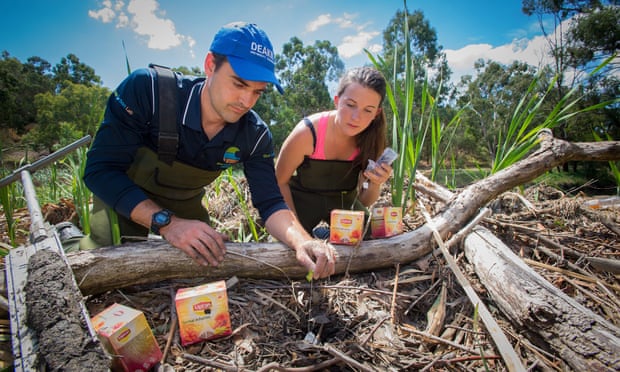
Deakin University researchers bury the first of 50,000 teabags to be placed in wetlands around the globe as part of a project to monitor which wetlands do best at soaking up the carbon that causes global warming.

It’s reassuring to know that people will keep doing whatever they can for the environment no matter what. The increased carbon dioxide that contributes to global warming will not go away by itself. One approach to breaking it down could come from preserving wetlands.

Melissa Davey writes at the Guardian about Australian scientists who are using Lipton green tea bags and red tea “rooibos” bags to study how wetlands capture carbon and make it harmless.

“Australian scientists have launched a project to bury tens of thousands of teabags in wetlands around the world. …

“Lipton green tea and red tea ‘rooibos’ varieties will be used in the project, which already involves more than 500 scientists in every continent except Antarctica.

“Leader of the project, Peter Macreadie from Deakin University’s Blue Carbon Lab, said wetlands were important for carbon capture and storage, a process known as carbon sequestration, holding up to 50 times as much carbon by area as rainforests.

” ‘But some wetlands are much better at carbon storage than others, and some are in fact carbon emitters, so they’re not all fantastic,’ Macreadie said.

“ ‘We need to find out the best wetland environments for carbon sequestration so we know where we should invest our energy.’

“That’s where scientists have come up against barriers in the past. There are hundreds of thousands of wetlands around the world. A standardised technique for monitoring the carbon is needed for accurate comparison, and monitoring devices can cost thousands of dollars to install.

“But Macreadie had been reading scientific research about teabags being buried and used to measure the rate at which carbon was being released from soil into the atmosphere.

“Fast decay of the tea inside the bag meant more carbon was being released into the atmosphere, while slower decay meant the soil was holding the carbon.

“ ‘I thought, “Jeez this is a bloody good idea. Why aren’t we using it in wetlands?” ‘ Macreadie said.

“ ‘People think of innovation as involving fancy new technology, but sometimes the best ideas are the most simple ones.’ ” More here.

I wonder if this property of tea relates to another thing I’ve noticed. Loose tea seems to absorb the aroma of whatever is around it. I’ve often thought that if you wanted to remove, say, a burned smell from upholstery or clothing, tea (not brewed) could do the trick.

Read Full Post »

Photo: Southwest Minnesota Housing Partnership
Hmong dance festival in southwest Minnesota. A Community Development Investments grant from ArtsPlace aims to give newcomers a voice.

Never underestimate the power of art and cultural events to improve lives.

As Amy Evans reports in the magazine Shelterforce (published by the National Housing Institute), the community development field has come to recognize that the arts are key to integrating diverse populations.

Evans discusses the issue with the McKnight Foundation’s Vickie Benson.

“More and more, it seems that arts and culture are being perceived as essential to the core fabric of what builds and nourishes communities — and that gives Benson enormous hope. ArtPlace America, a decade-old collaboration of foundations, federal agencies, and financial institutions, has been one of the driving forces for that shift, Benson says, by insisting that the arts must be in conversation with other sectors, whether community development, housing, or health.

“In Minnesota, the Southwest Minnesota Housing Partnership (SWMHP) has joined that conversation. With the support of a community development investment [CDI] grant from ArtPlace America, which will provide $3 million in funding over three years, SWMHP is exploring ways of building arts and culture into its operations.

“It’s a bold step for the organization, and one that Benson wholeheartedly applauds.

” ‘Music, dance, or visual art are forms of expression within many cultures. And just the weaving together of these many, many varied cultural traditions is a natural path for people to communicate with each other,’ says Benson. ‘That is what I hope to see, that communities will understand the importance of arts and culture not as an add-on but as a core piece of community development.’ …

“A couple of decades ago, [the future of the southwest Minnesota town of Worthington] future looked bleak. The farm crisis had taken its toll; the town’s population dropped from 10,243 in 1980 to 9,980 in 1990 as people left the area in search of better opportunities.

“The expansion of the meat processing industry in Worthington turned this trend around. JBS Swift and Co., a subsidiary of ConAgra Foods Inc., established what would become its principal plant in Worthington. The impact was far-reaching in the area, propping up small businesses like Smith Trucking Inc. and local hog producers.

“In 1989, increases in productivity led to an additional shift at the plant, attracting workers from literally around the world. … The so-called foreign-born population of Worthington jumped in parallel from 3.7 percent of the total population in 1990 to more than 15 percent in 2000.

“Mike Woll remembers when that shift took place. ‘Worthington’s history of immigration dates back to when I was in high school, when we had some early Lao immigrants,’ Woll recalls. ‘The community became incredibly diverse.’

“Walk into Woll’s high school today and some 50 dialects can be heard, from Central American to Southeast Asian to East African. Downtown on 10th Street, Woll says, ‘you’ll see people from all over the world. Myanmar, Ethiopia, Laos, all sorts of Latin American influence. It’s a remarkable place.’ …

“Woll hopes that one outcome of Worthington’s participation in the CDI Initiative will be preservation of one of the community’s strongest assets.

“ ‘Diversity brings challenges, but it’s put Worthington ahead of the curve. It gives us a broader scope of the world,’ Woll says. He is proud to know that his college-aged son, who grew up in Worthington, can take living in a multicultural environment for granted, even more so than his peers from places like Minneapolis and Chicago. But making space for multiculturalism to truly thrive means giving voice to communities that often haven’t had a seat at the table. Woll hopes that the CDI Initiative will help expand leadership roles to segments of the population who have so much to say, but haven’t had the platform to say it.

“ ‘If not for a program like [ArtPlace], those cultures do get lost,’ Woll says. ‘Having a bit of institutional strength and a financial boost from ArtPlace can help take what are challenges and turn them into positives.’ ”

More at Shelterforce, here.

Read Full Post »

A recent post at Asakiyume’s blog reminded me of Young at Heart, the senior-citizen chorus that inspired a movie I recommended to readers in 2011.

Asakiyume wrote, “One of the women I work with at the jail is in the choir there. I got permission to go in for the performance. The jail choir group is called the Majestics, and they’ve been mentored by a senior-citizen choir called Young at Heart, all of whom were wearing T-shirts that said ‘We put the “zen” in “senior citizen.'”

“Young at Heart performed as the opening act … Then the Majestics took the stage. There were six women, and they covered a great age range (three in their twenties, two in their thirties-forties, and one who was even older than me) and ethnically diverse (two Black, one Hispanic, three White). They sang well-known songs with lots of different flavors (hip-hop, pop, blues, soul), and all the choir members were featured at least once … The entire thing was a huge success; the audience was **so** supportive. …

“At the end the programs director called for an encore, and there hadn’t been a song laid by for that, but the Young At Heart choir sang “Forever Young” … Each time someone sang a solo, he or she linked arms with one of the members of the Majestics and brought them forward, and I could see tears in my student’s eyes and I had tears in mine, because–as the chaplain who was present pointed out–that song is a benediction, and it was so great to hear those words of blessing and hope and expectation directed at the audience in the jail:

May you grow up to be righteous
May you grow up to be true
May you always know the truth
And see the lights surrounding you
May you always be courageous
Stand upright and be strong
And may you stay
Forever young”

-@-

So lovely. Such songs take on extra meaning when sung by seniors or by people who feel hopeless.

The Young at Heart movie, which I still hope you’ll see, was also full of resonance. And it exposed me to popular music like Coldplay’s “I will try to fix you.” Whenever that song comes on the radio, I see in my mind’s eye the old guy with the oxygen tank who drew tears from his audiences. He is surely gone now, but not that memory.

That the chorus has gone beyond inspiring seniors and their families to inspiring prisoners who have little to make them feel positive or hopeful — well, it’s just too amazing.

More at Asakiyume’s blog, here.

Read Full Post »

Photo: Getty
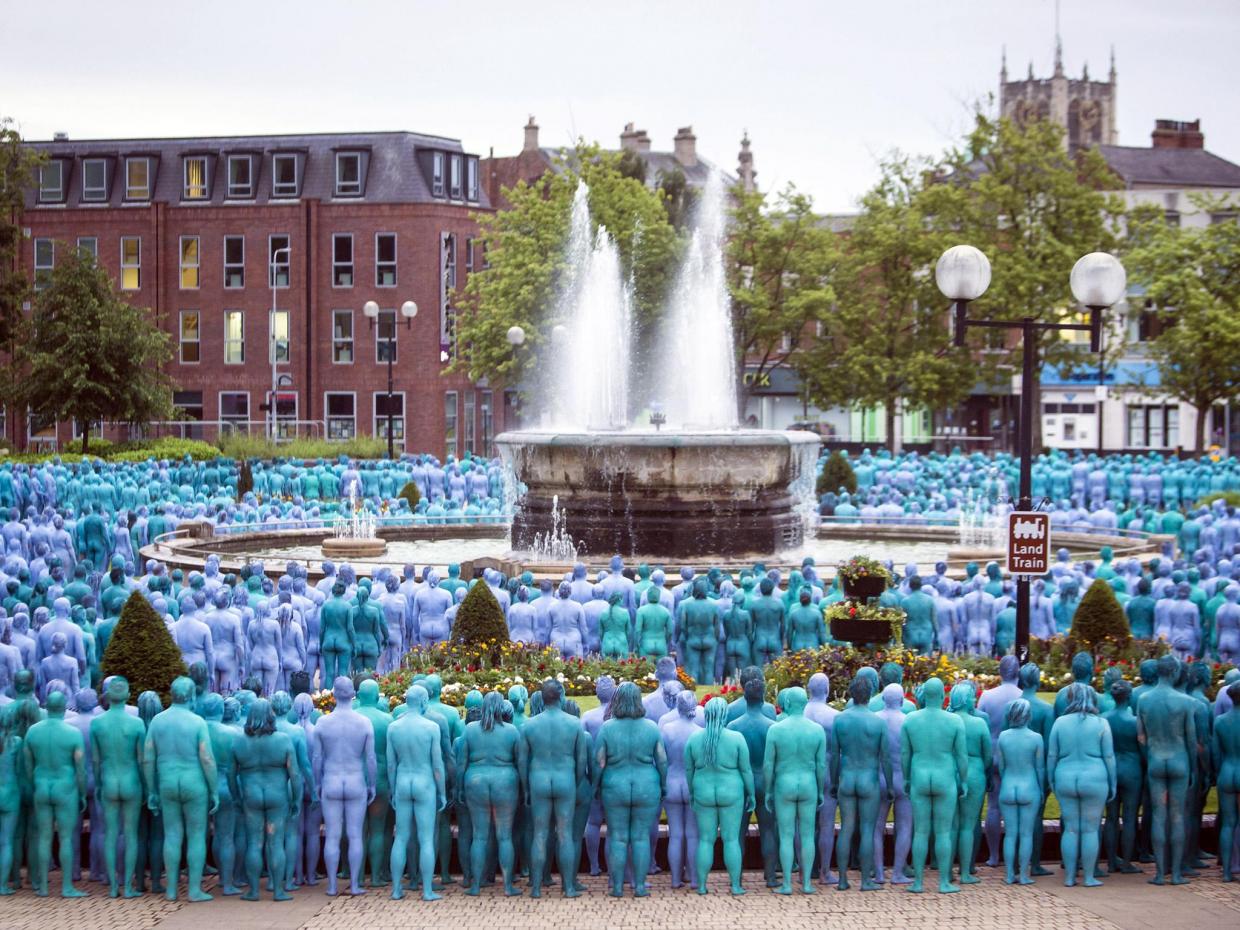
People take part in an installation entitled Sea of Hull, by artist Spencer Tunick.

The notion that the arts and related fields like graphic design can boost local economies has been an article of faith for decades, causing disappointment when it frequently fails to lift whole cities above poverty.

Nevertheless, done right and with other stars in alignment, it can be a piece of the economic puzzle in a changing world.

Here is a recent angle from Kingston upon Hull in the UK.

David Barnett reports at the Independent, “On New Year’s Day, a firework display heralded the beginning of Hull’s tenure as the Britain’s City of Culture. Multimedia stories from the city’s maritime and industrial heritage were projected on local buildings in front of a crowd of thousands.

“Over in the Hull City Museum they like a bit of culture and they know Hull’s had it for a long time; exhibits go back to the Paleolithic era. There’s also a recreation of a Roman bath house, featuring mosaics discovered in the 1940s in the Roman settlement of Petuaria, modern-day Brough in East Yorkshire.

“But never mind the Romans … what, the people of Hull might be asking, in true Monty Python’s Life of Brian style, has culture ever done for us? …

“It regularly tops the deprivation rankings for the UK’s 326 local authorities – according to the Kingston upon Hull Data Observatory’s latest figures, Hull ranks as the third most deprived local authority generally, and tops the lists of deprivation for education, skills and training. ..

“Perhaps a typical, post-industrial Northern city. Its traditional industries of whaling and sea-fishing have declined, as elsewhere; Hull still remains a large port, though, and there has been a successful drive to attract chemical and health companies to the area. …

“ ‘There might well be degrees of scepticism about what culture can mean to a place like Hull,’ says Robert Palmer, the director of the team that won and managed Glasgow’s successful bid to be named European City of Culture (as it was then known) in 1990. ‘But being designated a capital of culture can bring long-term effects in terms of the legacy it can offer.’ …

” ‘We employ a very broad definition of culture,’ says Palmer. ‘It’s not just what people might think of as “fine culture.” It’s not just opera. …’

“Which is why Hull’s City of Culture website lists events for the coming year that range from acrobatics to walking tours, by way of cabaret, jazz, literature, parkour and, yes, opera. Which is all very nice, but is it just a distraction from the problems facing Hull?

“ ‘There are tangible economic benefits,’ says Palmer. ‘We’ve seen it before in all cities that get a culture status, it’s well documented. Visitor numbers, job creation, the social impact through participation from social groups who are not normally involved in culture. The benefits are incontestable.’ ”

Lots more here.

Perhaps one year of intense focus on the arts and culture can energize enough residents to keep the momentum going. It certainly seems to have done so for Liverpool, another struggling postindustrial city that was a UK City of Culture in 2008.

One wonders if a designation as, say, a City of Math and Science might have the same kind of long-term ripples.

Read Full Post »

Photo: Jack Alterman
Linda Lear’s books include biographies of Beatrix Potter and Rachel Carson.

In 2015, I wrote here about Linda Lear’s excellent biography of Beatrix Potter, which highlights the scientific side of the beloved children’s book author /illustrator /land preservationist.

More recently, when my husband and I were watching a television special on Rachel Carson (author of The Sea Around Us and Silent Spring), I saw Lear being interviewed and realized she’d written a biography of Carson, too.

So I went to Linda Lear’s web page to learn more about her.

“Whenever my parents drove over the Allegheny River into downtown Pittsburgh from the rural community of Glenshaw where I was born,” Lear reports, “I begged my father not to go over the bridge that crossed the river above the stock yards.

“There were animal parts visible in the yard, and debris strewn along the river’s edge. The smell of dead animals mixed with the stench of sulfur from the smelting operations further down river. We talked about why the city was dirty, the river polluted, and what we could do about it. For generations my family had been involved in the natural world and from them I learned to appreciate and nurture it.

“My grandfather loved books and loved to read to me when I was little. Our favorites were fairy tales, [Grimm brothers] and [Hans Christian Anderson], Lewis Carroll, and any sort of animal fable. We loved Aesop, Br’er Rabbit, Uncle Wiggly, and of course, Peter Rabbit. He introduced me to the nonsense rhymes of Edward Lear, and to illustrators such as [Mary Jo] Beswick, Walter Crane, and Beatrix Potter.

“From my grandparents and from my mother, I absorbed the pleasures of gardening, herbaceous and perennial, learning the names of plants, and later of making a garden of my own. I always loved woodland flowers and animals. I became adept at rescuing stray kittens and baby rabbits, and finally got a healthy kitten of my own.

“I was educated at women’s schools until my graduate work at Columbia University. Before finishing my doctorate, I taught American history at independent schools, and fortunately ended up teaching at one in Washington, D.C. in the late 1960s — just in time to become an activist.

“I have had a long career in college and university teaching and have written a variety of books and articles. I began to specialize in environmental history just as the field was being defined. Fellowships at Yale’s Beinecke Rare Book Library and at the Smithsonian Institution allowed me to redefine myself as a full-time writer.”

Read her comments on her books here.

Read Full Post »

Photo: Andrew Edlin Gallery
Part-time gravedigger John Byam’s carvings of hands, as seen in a New York gallery.

Artists often have to support themselves with non-art jobs. Gone are the wealthy arts patrons of past centuries, and maybe that’s not all bad, considering the Medicis. In any case, it’s interesting to see what kinds of jobs contemporary artists hold down. You may recall this post about Brando’s gardener’s art, for example.

Now at Hypoallergic, Allison Meier describes the recent gallery showing of a self-taught artist who dug graves in his spare time.

“Dusted with sawdust, John Byam’s sculptures appear as if they’ve just been carved, the shavings attached with glue binder giving a rawness to the miniature spacecrafts, airplanes, houses, helicopters, cameras, and coffins. Andrew Edlin Gallery in Manhattan [displayed] an assembly of these pocket-sized pieces by the late Byam in Unearthed. …

“Born in 1929 in Oneonta, New York, Byam mostly lived a local life, working at his family’s trailer court, with a two-year stint in the military taking him to Japan during the Korean War.

“Later, he had odd jobs with the Delaware and Hudson Railway and as a gravedigger at the local cemetery. The wood carvings, arranged by theme at Andrew Edlin with no label text, have traces of this autobiographical narrative, with a platoon of tanks and heavy artillery, or an open coffin, colored black, on a rolling gurney.

“Yet others, like spaceships and rockets, one with ‘”Moon or Bust’ scrawled in red, herald dreams of exploration. Recognizable pop culture forms, including the U.S.S. Enterprise from Star Trek, suggest these ambitions were limited to vicarious experiences through television, magazines, and movies.

“While that gives the toy-like objects a melancholy edge, they have a lot of joy in their detailed shapes. Byam seemed to delight in making even a simple chair on such a small-scale, with annotations in pencil indicating details like ‘door front’ on a tiny house. An array of human hands chiseled into various poses, one holding a coin, another with the words ‘2 close hands’ folded in prayer, shows a similar enchantment with the shape of things. …

“Byam was a deft craftsman in the tradition of American vernacular woodcarving, and his roughly hewn art is haunted by 20th-century culture, both its wars and fantasies.”

Hyperallergic has some great pictures of Byam’s art here.

Read Full Post »

Older Posts »