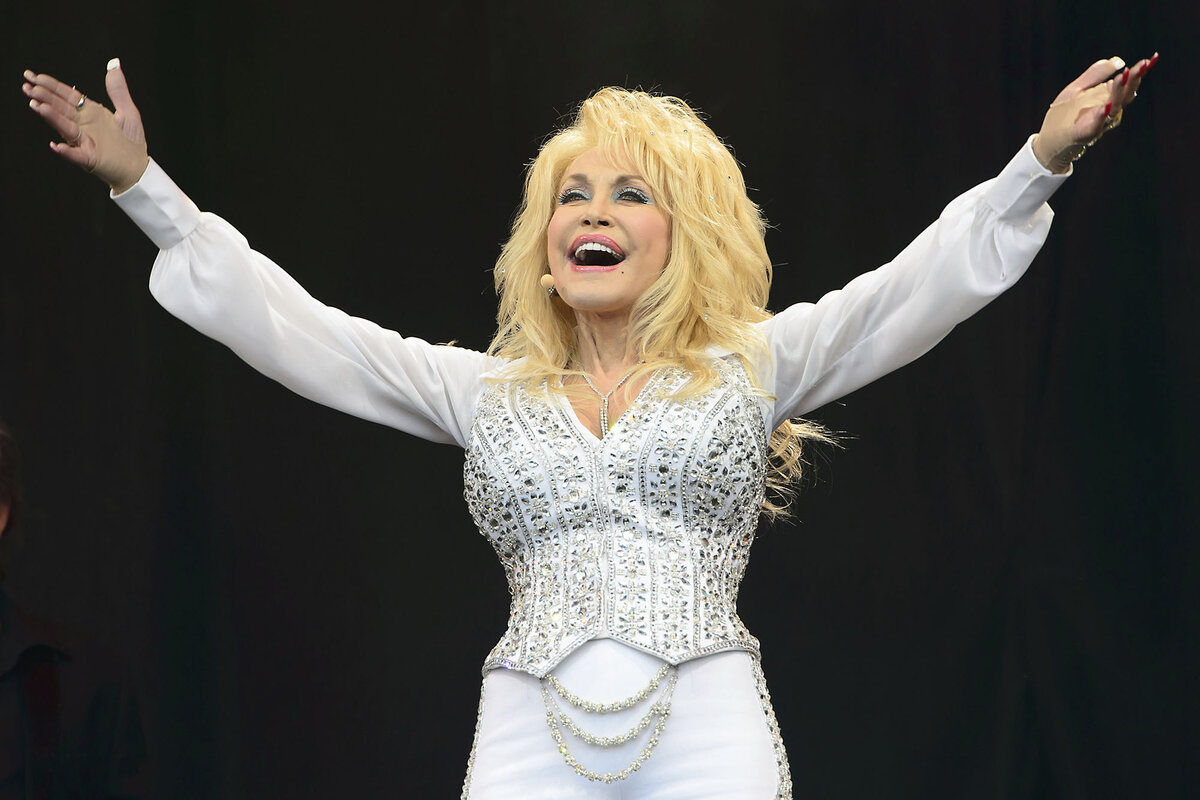
Photo: Jonathan Short/Invision/AP/File.
Dolly Parton performs at the Glastonbury music festival, in Somerset, England, June 29, 2014. Considering that she died on in August at age 80, she must have been 68 in that lovely AP photo.
I’m only a part-time country music fan, but I’ve read enough about the late Dolly Parton to feel that she deserves all the admiration she has received.
Harry Bruinius, Victoria Hoffmann, and Patrik Jonsson contributed to the following Christian Science Monitor article about Parton.
” ‘A Few Old Memories’ wasn’t one of her numerous self-written songs, but the performance on a 1999 album is pure Dolly Parton. She sings of old love letters and a faded photograph – relics of a relationship supposedly put away long ago.
“The arrangement is spare; her voice rises above fiddle, banjo, and dobro with a sadness that feels less performed than remembered. Just a few old love letters / with the edges all brown / and an old faded picture / I keep turned upside down.’
“ ‘It’s so heartfelt,’ says Maureen Loughran, director and curator of Smithsonian Folkways Recordings in Washington. ‘It’s really expressing a personal experience that can be shared across age, across location, across any kind of experience.’ …
“Dolly Rebecca Parton, who died [in August] at 80, spent some seven decades performing that way. She took things that were intensely particular – the music of the Tennessee mountains, a childhood in poverty, a woman’s fear of losing a lover, the indignities of work, as well as her own flamboyantly constructed femininity – and made millions of strangers recognize themselves in them.
“From the 1973 crossover ballad ‘Jolene’ to her ‘I Will Always Love You’ (later recorded by Whitney Houston) to the Grammy-winning ‘9 to 5,’ a working woman’s anthem, Ms. Parton’s accessible melodies and lyrics – by her own estimate, she wrote more than 3,000 songs – conveyed her authentic experience with grief and struggle, but also her drive to spark hope, humor, or resilience in others. That might help explain an achievement harder to measure than record sales, awards, or the ability to play multiple instruments by ear. … Ms. Parton somehow came to belong to almost everybody.
“She was loved by good ol’ boys and drag queens, evangelical Christians and gay men, country traditionalists and feminists. She was a daughter of poor rural Appalachia who became fabulously wealthy without seeming to repudiate her roots.
“ ‘She was absolutely what you thought she was, and more,’ says Lori Moore, chief executive of the American Eagle Foundation, which worked with Ms. Parton on eagle conservation at Dollywood, the singer’s theme park in Pigeon Forge, Tennessee. ‘She was an amazingly smart business lady, and she had this incredible persona, and just anyone that got around her felt the energy that seeped out of her – she was this magnet.’
“Ms. Parton was a devout Christian who became an LGBTQ+ icon; an extravagantly feminine woman who fiercely guarded ownership of her songs and built a business empire around them and her other passions: childhood literacy, her Appalachian heritage, and community care. She could look almost comically artificial – the wigs, rhinestones, and exaggerated curves were part of the joke, and she was always in on it – while leaving people with the conviction that the person underneath was unusually genuine.
“Her broad appeal was not, however, the result of avoiding convictions. She generally avoided partisan politics, but she spoke plainly about race, women, poverty, and LGBTQ+ people.
“That self traveled remarkably far. Ms. Parton moved from country into pop and movies, then later back toward the bluegrass and old-time music of her childhood. In 2023, at 77, she made a rock album. …
“Ms. Edwards describes a career spent building ‘an immersive storytelling world out of her own life’ – through songs, films, books, Dollywood, and even the Imagination Library, her literacy program for children.
“But songwriting remained the center of it.
“ ‘What Dolly brought is this deeper-rooted knowledge and love of the music from where she came from,’ says Ms. Loughran. Instead of simply reproducing that tradition, she says, Ms. Parton turned it toward the experiences of people living modern lives. Her gift was observation: seeing how the world acted upon ordinary people and putting that into songs ‘so that all of us can be engaged in understanding each other.’
“That formulation might also describe the larger Parton phenomenon. She did not resolve America’s contradictions so much as make room for them. Her version of belonging did not require people to become less particular, or one group’s dignity to depend on another’s humiliation. She remained unmistakably herself and somehow gave very different people permission to do the same. …
“As both a country music icon and American pop cultural force, Ms. Parton was also relentlessly optimistic and rarely without a smile – and she often said as much.
“ ‘If you see someone without a smile today, give ’em yours,’ she once said. … ‘I make a point to appreciate all the little things in my life. I go out and smell the air after a good, hard rain. These small actions help remind me that there are so many great, glorious pieces of good in the world.’ ”
For my 2017 story about Parton’s inspiring Imagination Library, click here. There’s also at the Monitor, here.


Leave a comment. Website address isn't required.