
Feeds:
Posts
Comments

Posts Tagged ‘ivory coast’

Photo: Miléquêm Diarassouba.
Biama is a frenetic subgenre of the dance style coupé-décalé, popular on TikTok and in the Ivory Coast.

There’s a joyful kind of dance in East Africa that just makes people want to laugh and join in. According to this article in the Guardian, it’s not unusual for happy dances to emerge in Côte d’Ivoire, but the silly elements added to coupé-décalé, have special appeal to the young.

Eromo Egbejule writes, “The 400-strong crowd, perched on plastic chairs and wooden benches in Abidjan’s Yopougon-Selmer neighbourhood, roared with approval as Sauce Graine twisted and turned on the spot with breathtaking speed and dexterity.

“The dancer, named after the Ivorian palm nut delicacy, was competing in a series of street dance battles set to biama, a frenetic offshoot of coupé-décalé, a type of percussive dance music popular across west Africa that originated in Côte d’Ivoire around the turn of the century.

“A neighborhood square in Yopougon-Selmer had been transformed into a dance arena. … The performers were all under 25, with some as young as five. Audience members, some munching on skewered meat or drinking from beer bottles or plastic cups, periodically joined in as one competitor after another showcased intricate footwork and dramatic chest pops. …

“Says Sauce Graine, a 15-year-old whose real name is Arnold and who began dancing to biama six years ago, ‘Since many people aren’t very familiar with the dance yet, they think it’s just a neighborhood thing. All we have to do is create the dance so that more people can see it and love it.’ …

“Biama has become emblematic of the resurgence of Ivorian pop culture over the past decade. There is some debate over exactly when biama emerged, but it exploded in popularity after the coronavirus pandemic as young people turned to TikTok to post and respond to dance challenges that fused acrobatics with goofiness that pushed bodies to their limits. …

“Says Cédric Kouamé, a music producer and chief archivist at Baoulecore Archive Center in the Angrè district of Abidjan, ‘Like maïmouna, it comes from Yopougon [where] a lot of artists started their career.’

“For decades, this working-class district has dictated the cultural zeitgeist of both Abidjan and Côte d’Ivoire. Stéphane Doukouré, better known as Douk Saga, grew up there before founding coupé-décalé with his Jet 7 crew after returning from Paris in the early 2000s. There, he had made a name for himself in a nightclub frequented by wealthy young partygoers by setting light to thousands of euros.

“Their genre championed the philosophy of sagacité – the shrewdness needed to outwit authority – alongside farotement, the flamboyant display of wealth. …

“The genre was propelled to new heights by Ange Didier Houon, who was born in Yopougon to an icon of the Ivorian sound engineering industry. In his teens, his Lebanese friends gave him the stage name DJ Arafat, after the Palestinian political leader. …

“Over time, he increased the tempo of his music to match the high-energy, acrobatic roukaskas routines devised by his dancers, drawing on traditional Ivorian dance. Their feet shuffling quickly in lêkê – the ubiquitous Ivorian water-resistant plastic sandals – the dancers performing Arafat’s roukaskas continued a long tradition of audience participation in Ivorian popular music. …

“Today, a new generation of artists is vying to be the next megastar of Ivorian pop. Among those hoisting the flag for maïmouna are Didi B, who has gained international recognition, and the more street-famous Himra. The rappers’ rivalry entered a new phase last year when both filled stadiums just weeks apart in different parts of the country.

“Biama remains the more popular of the two subgeres, particularly among children and young people, who proudly call themselves biamaseurs and eagerly accept dance challenges shared across social media. …

“Kouamé argues that dance has always been inseparable form Ivorian music. ‘Since the beginning of Ivorian music, as artists were creating their sounds, they were also thinking of the dance moves,’ he says. …

“Some cultural observers in Côte d’Ivoire dismiss the genre as little more than ‘street music,’ but biamaseurs remain undeterred. ‘People will love us,’ Sauce Graine says. “[They] will spread the word through their social networks. Then it will take off.’ ”

More at the Guardian, here.
Read Full Post »

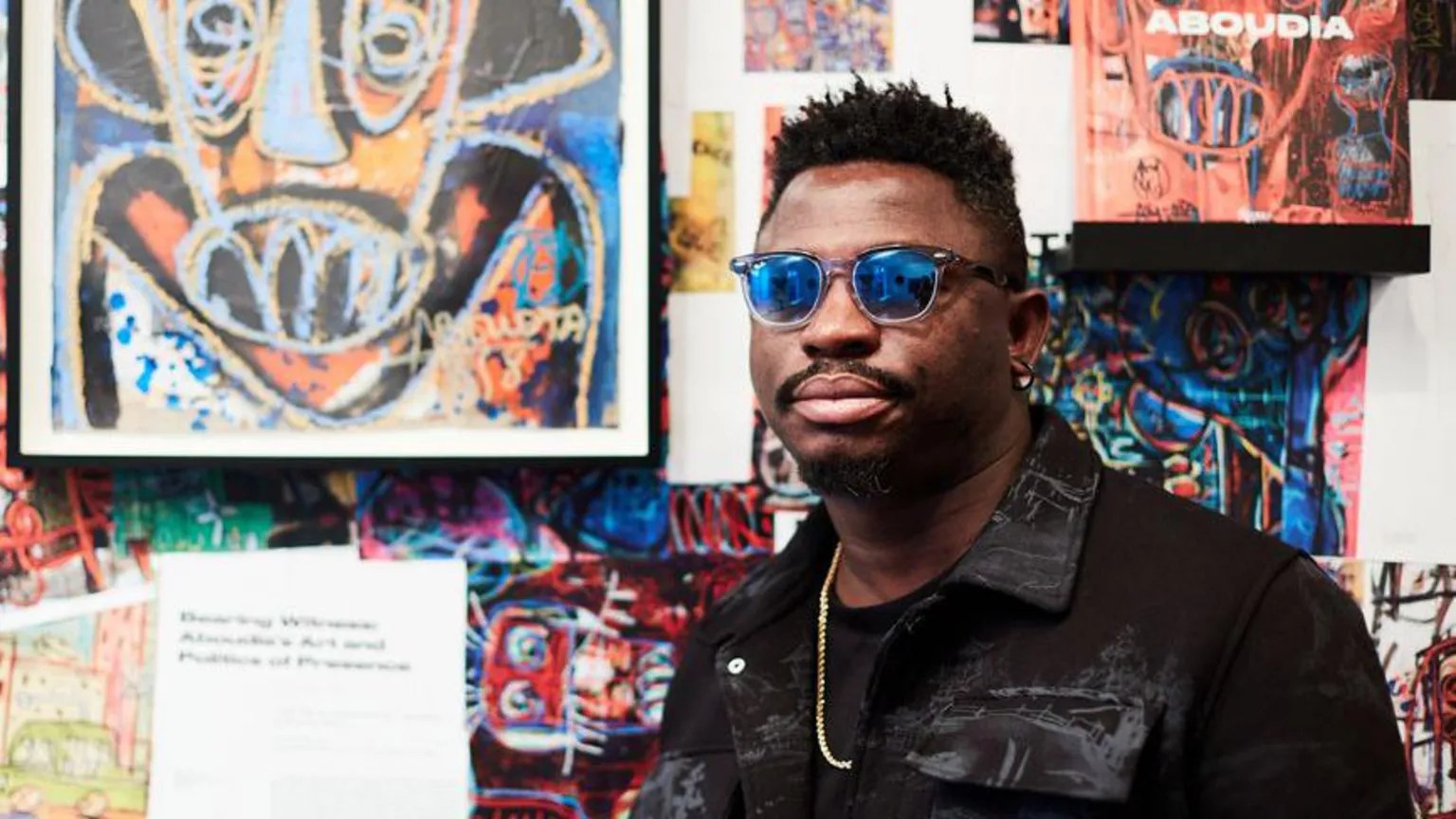
Photo: Larkin Durey.
Aboudia’s work has been shown in exhibitions held in Abidjan, London, New York and Tel Aviv
. Hiscox Artist Top 100 says he sold more than even Banksy in one year.

The art world is becoming more international, and that’s a good thing. For too long, people have used their own world’s cultural references to judge the quality of art. And how can only one culture be the only worthy measure?

Wedaeli Chibelushi reports at the BBC about an African that is currently making a big splash internationally.

“Back in September, global art experts were taken aback by the name topping a fresh list of the world’s best-selling artists.

“Aboudia, a graffiti-inspired artist from Ivory Coast, had beaten well-known names, like Damien Hirst and Banksy, to sell the most pieces at auction the previous year.

“According to the Hiscox Artist Top 100, Aboudia, real name Abdoulaye Diarrassouba, had flogged 75 lots. One of these canvasses had gone for £504,000 ($640,000).

“Leading online marketplace Artsy called Aboudia’s triumph ‘striking,’ while The Guardian said market experts were ‘blindsided by the ranking.

“Months later, sitting in a London gallery plastered with his paintings, Aboudia tells me the survey results were no surprise to him. ‘Because if you work hard, the success is going to come,’ he says. …

“Aboudia’s mellow disposition clashes with the art surrounding him – his vividly colored, heavily layered canvases feature a cast of cartoon-like figures plucked from the streets of Abidjan, Ivory Coast’s largest city. Through a blend of oil sticks, acrylic paints and recycled materials like newspapers, Aboudia depicts the hardships of life in downtown Abidjan.

He particularly focuses on the children who live and work on the city’s streets.

“His eyewitness portrayals of Ivory Coast’s 2011 civil war are equally arresting. Figures gaze at the viewer with vacant eyes, while armed soldiers and skulls crank up the intensity. …

“Aboudia was born in 1983, in Abengourou, a small town around [124 miles] from Abidjan. In a 2012 essay, the artist said he was kicked out of his home aged 15 after telling his father he wanted to paint for a living.

“After being cast out, the young Aboudia pressed on and enrolled in art school. Due to a lack of financial support, he slept in his classroom after the other students went home for the day. These uncomfortable nights paid off — after graduating in 2003 the soon-to-be-star was accepted into Ivory Coast’s leading art school, École des Beaux-Arts.

“Abidjan’s École des Beaux-Arts would expose Aboudia to the Ivorian art icons whose influence can be found in his current work. For instance, Aboudia’s focus on his direct surroundings and his use of recycled materials can be traced back to Vohou Vohou, a modernist collective established in the 1970s by artists like Youssouf Bath, Yacouba Touré and Kra N’Guessan.

“Aboudia began to veer away from traditional styles of art, instead using untamed brushstrokes and earthy colors to recreate graffiti produced by Abidjan’s underprivileged children. In Aboudia’s words, these young, de facto street artists ‘draw their dreams on the world.’

“The children are his main influence, he says. …

“After establishing his core style, Aboudia would lug his paintings around the galleries of central Abidjan, hoping for a way in.

” ‘It was very hard. … They’d say: “Are you crazy? What is this work? You better go to London, to United States or Paris, because this work … here it doesn’t make sense,” ‘ Aboudia recalls.

“The adversity did not end there. In 2010, Laurent Gbagbo, the then president of Ivory Coast, refused to step down after losing an election to rival Alassane Ouattara. A civil war broke out, killing 3,000 people and forcing another 500,000 from their homes.

“Throughout the four-month conflict, Aboudia sought refuge in his basement studio, documenting the horrors he saw when venturing above ground.

“The war ended with Mr Gbagbo’s dramatic capture by UN and French-backed troops — and Aboudia emerged from his haven with 21 disconcerting paintings.

“Art-lovers and journalists from Ivory Coast and beyond lauded his work and Aboudia’s ascent to global success began. He was championed by renowned art collectors Charles Saatchi and Jean Pigozzi — and went on to exhibit his work at prestigious venues like Christie’s New York and the Venice Biennale.

“Aboudia’s first solo exhibition was at the setting for this interview, London’s Larkin Durey (then named the Jack Bell gallery). Owner Oliver Durey, who has now known Aboudia for over a decade, tells the BBC: ‘There is something we can all relate to in his paintings; hiding amidst the uncertainty and horror there are balanced moments of strength and beauty.’

“African art expert Henrika Amoafo [notes] reasons for his success … like his ‘authenticity, the really raw emotional power that he’s able to convey, the way that he speaks to urban life, the way that he speaks about conflict and its impact on children.’ …

“Aboudia’s rise also coincides with that of the African art market. In 2021, art analysis firm ArtTactic reported that the auction sales value of contemporary and modern African art surged by 44% to a record high of $72.4m. …

“Aboudia’s rise has led to him splitting his time between his country of birth and New York. When he is back in Ivory Coast, he pours his efforts into the Aboudia Foundation, an organization he launched to support the country’s children and young artists.

“This is yet another example of the star’s drive — but when I ask him if he has any plans lined up for his career, he … says he takes things one day at a time.”

More at the BBC, here. No paywall.

Read Full Post »

Sweden has taken in a lot of refugees from troubled countries, but like the U.S., it sometimes struggles to find the best approach for absorbing the influx.

At the NY Times, Suzanne Daley writes about one Swede who may have found an important way to speed integration, a way that enriches the experience of Swedes and newcomers alike.

“Last year, when Ebba Akerman, 31, was teaching Swedish to immigrants in the suburbs of this city, she ran into one of her students on the train and asked him whether he enjoyed living in her country.

“She found the answer deeply disturbing. The man shrugged, saying his life here was not much different from the one he had left behind in Afghanistan. It became clear to her that most of her students, living in neighborhoods packed with immigrants, had virtually no contact with native Swedes.

“In the months that followed, Ms. Akerman decided to try to change that, calling herself the minister of dinners in charge of the Department of Invitations and using Facebook and Instagram to try to bring individual Swedes and immigrants together for a meal, something like a dating service.

“ ‘We let people into our country, but not into our society,’ Ms. Akerman said on a recent Friday night. … ‘I finally decided that I had to do something. I could be the connector.’ …

“On a recent evening, Ms. Akerman was feeding about a dozen people, including a middle-aged couple from Bangladesh who had brought a chicken dish, a recent arrival from Cameroon with her two children, a Swedish marketing expert, the mother of one of Ms. Akerman’s friends and a young Swedish doctor in training, all of whom had been early participants in her project. All told stories of good times and miscues.

“The marketing expert, Henrik Evrell, said he had served spaghetti Bolognese, the most Swedish dish he knew, to his guest from Ivory Coast. At first they had trouble communicating because his guest’s Swedish was so poor. But soon they discovered that they both spoke French and loved the same Ivory Coast musicians. After eating, they spent the rest of the evening in front of a computer, taking turns pulling up music on Spotify that each thought the other would like.” More here.

Photo: Casper Hedberg for The New York Times
Ebba Akerman set a table on her backyard for a meal that brought Swedes and immigrants together. 

Read Full Post »