Feeds:
Posts
Comments

Posts Tagged ‘north korea’

Photo: Radio Free Asia.
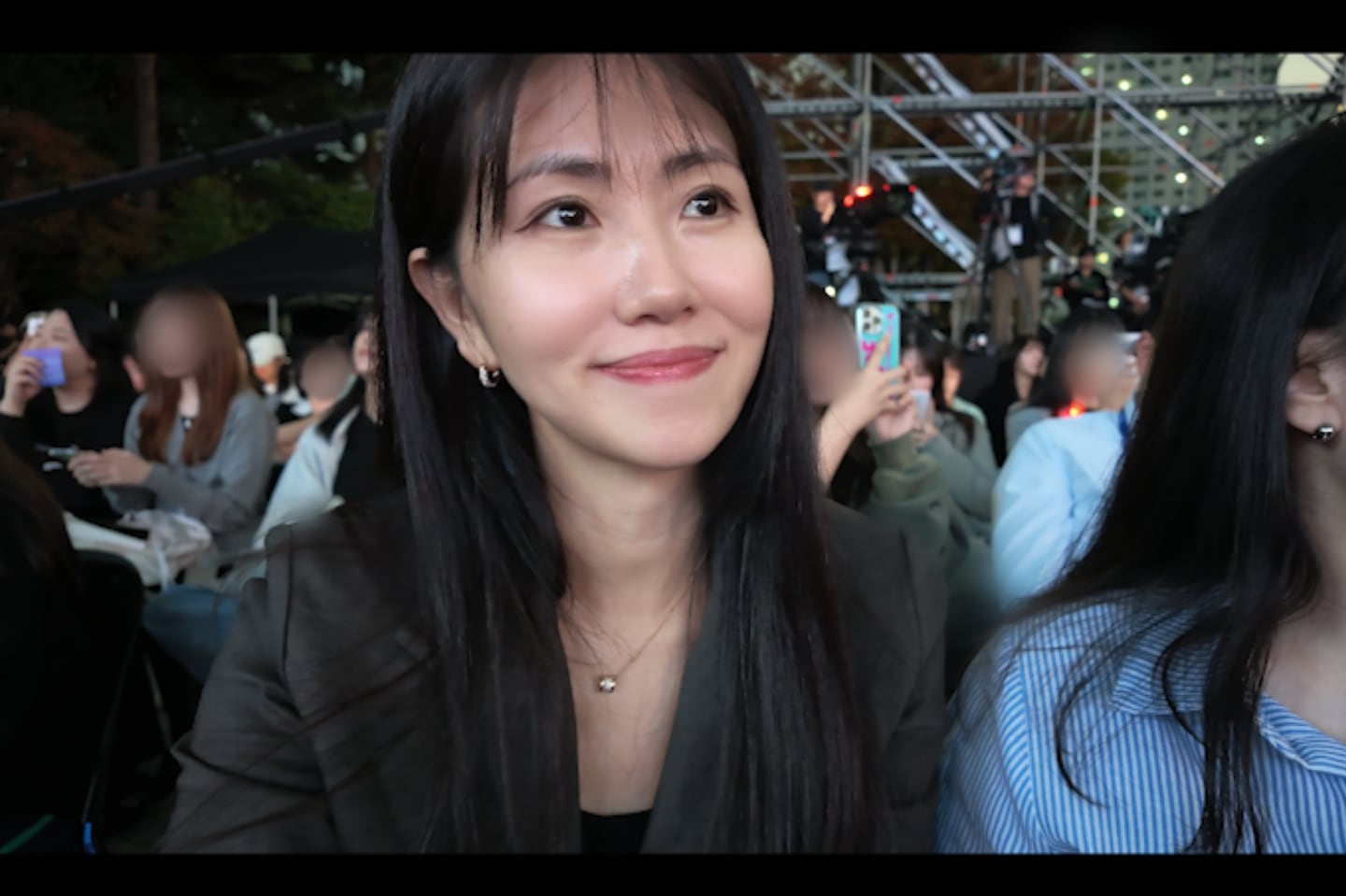
Cho Mi-young watches a live broadcast of KBS Music Bank at the National Museum of Korea in Seoul, Oct. 16, 2026.

In North Korea, the internationally popular South Korean music called K-Pop is illegal and the ban is strictly enforced. But as the Guardian wrote in 2024, “Despite such harsh measures, the influence of South Korean culture, including recent television shows, appears unstoppable, according to a recent North Korean defector.

“ ‘The speed of South Korean culture influencing North Korea is seriously fast. Young people follow and copy South Korean culture, and they really love anything South Korean,’ a woman in her early 20s who defected from North Korea told reporters at a briefing in Seoul.’ “

This month, Kim Jisu wrote for Radio Free Asia about another defector’s reaction to seeing a K-Pop show in person for the first time.

“A white tiger entered the courtyard outside the National Museum in Seoul. He mugged for the camera and darted up the steps. At the top were the six members of BOYNEXTDOOR, wearing quasi-traditional outfits that mixed elements of hanbok with modern formal wear and a tinge of ‘bad boy’ biker gear.

“As they danced in unison and sang the opening lines of their hit single ‘Animal,’ the crowd went wild.

“Sitting in the audience was Cho Mi-young – born in Chongjin, North Korea – who arrived with her family in the South in 2004. …

“Cho is in the audience at an episode of KBS Music Bank, a Friday night K-pop showcase program with all the latest acts. It has been the start of the K-pop weekend for most of its 28-year runtime. Surprisingly, it’s her first time ever seeing a live K-pop performance in person after 22 years in the South.

“Tickets to studio tapings of KBS Music Bank are hard to come by. Fans either have to know someone, know someone who knows someone, or enter the ticket lottery. The episode she’s watching on Oct. 16 is special — it’s a live broadcast and the biggest boy bands, girl bands, and boy-girl bands are plying their craft on an outdoor stage on the grounds of the National Museum of Korea, which the show’s special intro vignette called the ‘beating heart of Korean culture.’ …

“ ‘I’ve seen it a lot on TV, but today is the first time I’ve seen it with my own eyes,’ Cho told Radio Free Asia. ‘Seeing such beautiful and handsome people dancing and singing right in front of me, moving like that, is absolutely mesmerizing.’

“Cho is no stranger to music, or to the stage. In North Korea she had been a vocalist for a state-run provincial arts troupe. After settling in the South, Cho was a fixture in Seoul’s burgeoning musical theater scene and she toured as an accordion player. She later transitioned into broadcasting. …

“But today, she’s just a fangirl in a sea of other diehards, most of whom are screaming the names of the idols on stage.

“On the night of her first live K-pop concert, Cho reminisced about how she first encountered South Korean music in North Korea. At the time, she didn’t have access to what most would describe as K-pop today; instead she took in a lot of trot – a unique South Korean genre that mixes Western foxtrot dance rhythms with pentatonic minor scale melodies. Most young South Koreans consider trot to be music their grandparents like. …

“Today’s performances on the Music Bank stage were a far cry from her own back in North Korea. For one, everyone on stage just seems happy to be there, she said.

“ ‘When I performed in North Korea, I was always stiff,’ she said. ‘When we were on stage, we performed with the mindset of conveying the Party’s voice, so I don’t think I ever had the thought that we were actually enjoying our own music.’

“Several more musical acts came and went and then the undistorted electric guitar of indie rock band Jannabi’s Kim Do-hyung echoed through the air as vocalist Choi Jung-hoon sang the first few lyrics of ‘Thoughts on an Autumn Night.’ … The song struck a chord with Cho. Performed by just one singer and one guitarist it was a bit of a shift from the rest of the evening’s heavily choreographed bangers.

” ‘The lyrical melody seems to have a bit of North Korean sensibility to it.’ …

“When it was all over, Cho talked about her experience on the show, but it wasn’t only the dazzle of the K-pop acts that caught her eye. She was also amazed by the devoted fans, who sang along with every lyric from memory and chanted in pre-arranged cheers in unison. She thought back to how strange that seemed when she first arrived. …

“The best performance of the evening, according to Cho, was by a co-ed group called AllDay Project. She thought they looked cool in their all-black outfits, some in furs, others in biker leather – almost like warriors.

“But as an artist, Cho’s thoughts naturally turned to the massive effort that must have gone on behind the scenes. The meticulous choreography alone must take many months of practice, she said. …

“She said, ‘In terms of the sheer volume of training, it might be difficult to see a significant difference between the North and South.’

“But she noted that the payoff in the South is individual success, unlike the North, where it would merely advance the goals of the state.”

More at the Radio Free Asia, here. No paywall.
Read Full Post »

Photo: via Freeport Traveler/YouTube.
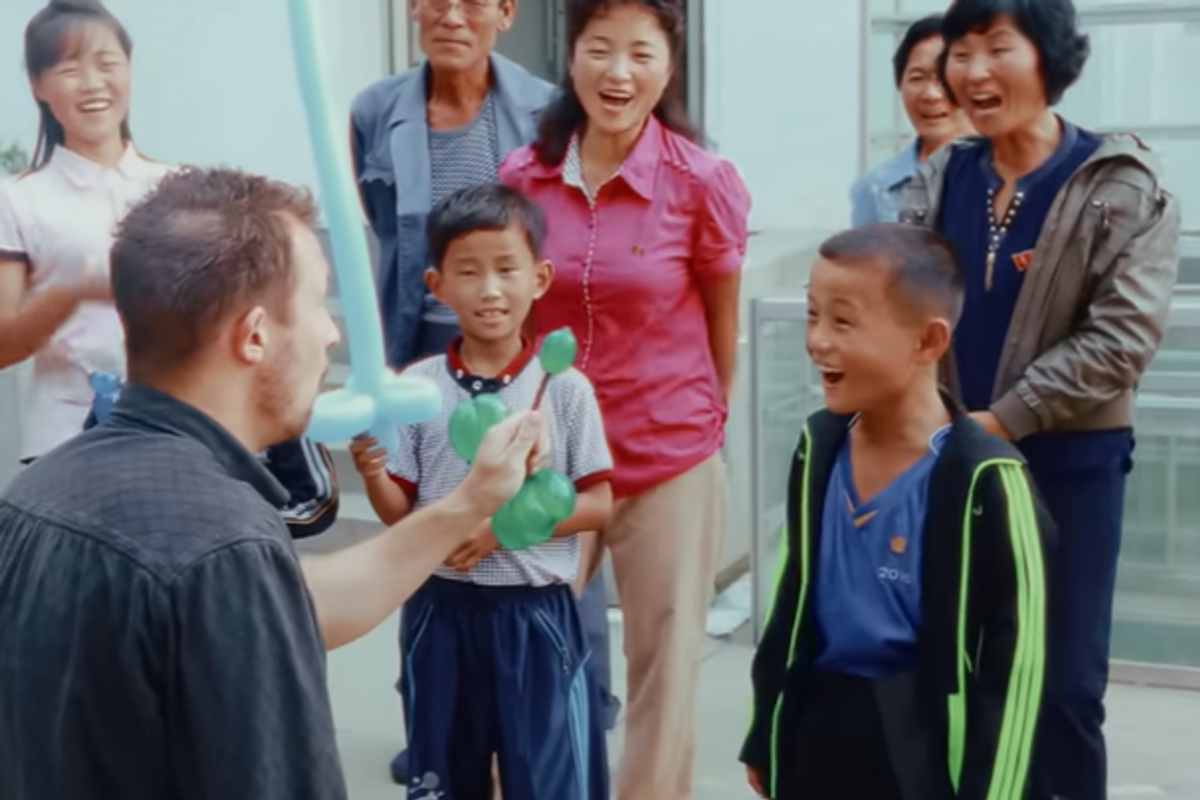
Jesper Grønkjær, of Denmark, performs magic for children in North Korea.

What does it take to venture into enemy territory to entertain children? A Danish magician just does it.

Tod Perry writes at Upworthy, “North Korea is the most oppressive place in the world, and its people lack freedom of speech, press, or movement. The government, headed by Kim Jong Un, controls all aspects of its citizens’ lives, and those who stand up against the regime are punished harshly. It’s also hostile to people outside the country for fear that outside ideas could destabilize the regime.

“The country is so isolated from the rest of the world that it just recently opened its border to allow a small number of tourists to visit its Special Economic Zone for the first time since the COVID-19 pandemic. …

“Another of North Korea’s recent visitors was [Danish] magician and adventurer Jesper Grønkjær, who set out to see if he could manage to get a smile from its citizens. ‘I’ve spent my life proving one universal truth: a smile is the shortest distance between all people on Earth,’ Grønkjær said.

” ‘We know you can suppress people, but you can’t suppress a smile. I will investigate that, and where better to do it than in one of the strictest countries in the world?’ he opens his video on the Freeport Traveler YouTube page. When Grønkjær visited North Korea, he was accompanied by two guards wherever he went, and his passport was taken from him. At night, he was locked in his hotel like a jail cell. However, he still elicited huge grins from children and adults alike as he wowed them with magic tricks with animal balloons, a stuffed ferret, red foam balls, card tricks, and much of his joyful brand of Abracadabra.

“While visiting North Korea, Grønkjær watched the country’s ‘Day of the Sun Celebrations‘ at Kim Il-Sung Square in North Korea. Held each year on April 15th, the holiday celebrates the birthday of Kim Il-Sung, the country’s founder, and features dancing, military tests, parades, and concerts. For North Koreans, the holiday is akin to Christmas.

“Grønkjær’s trip to North Korea isn’t the only exotic and potentially dangerous place where he has performed magic. He has also performed for Indigenous people in Peru, the descendants of the Incas in the Andes mountains, and the Masai warriors in Tanzania. The magician of 20 years has also performed for orphanages in Uganda, the jungles of Irian Jaya, the ice caps of Greenland, and the Las Vegas strip.

“Grønkjær uses his adventurous expeditions as subject matter for his various lectures, print articles, and appearances on Danish television. When he’s back home, he performs more than 225 nights a year for family events, circuses, weddings, and corporate parties. …

“Grønkjær’s work shows that no matter where you live on the planet or what language you speak, we all share the same sense of wonder and humor. While nefarious forces in the world work to drive us apart, he proves it takes very little for all of us to realize our shared humanity.”

More at Upworthy, here. Listen to a radio interview at The World, here.

Read Full Post »

There’s nothing like concentrating on something completely “other” to calm one down. Here, at the tension-filled demilitarized zone between North and South Korea, soldiers take a break to concentrate on ballet.

Kim Hong-Ji reports at Reuters the Wider Picture,”The 15 male ballet students groaned as they strained to do the splits and laughed with relief after their teacher counted to five and let them relax.

“Once a week, a group of South Korean soldiers near the Demilitarised Zone (DMZ) that divides the Korean peninsula trade army boots for ballet shoes in a class intended to ease the stress of guarding the world’s most heavily fortified border.

” ‘There’s a lot of tension here since we live in the unit on the front line, which makes me feel insecure at times,’ said Kim Joo-hyeok, a 23-year-old sergeant doing his nearly two years of military service that is mandatory for South Korean men.

” ‘But through ballet, I am able to stay calm and find balance as well as build friendships with my fellow soldiers,’ said Kim, who is learning ballet for a second year and plans to continue when he is discharged from the army. …

” ‘Being in the army itself can be difficult, so I wasn’t sure what kind of help I can be here,’ said Lee Hyang-jo, a ballerina at the Korean National Ballet who visits the base once a week to train the soldiers.

” ‘But as the soldiers learn ballet little by little, they laugh more and have a great time and seeing that makes me think that coming here is worthwhile,’ she said.”

I suspect it is fun for her, too, in the same way that teaching English lit to a class of engineers was fun for one professor I heard about. The fresh perspectives of those who come from an entirely different discipline has to be rewarding for a teacher.

More at Reuters.

Photo: Reuters

Read Full Post »

A couple years ago, I was taken with a newspaper photograph of pink and blue buildings in a lonely North Korean square. So foreign. So melancholy.

I tried to get in touch with the photographer, David Guttenfelder, to see if I could buy a print. That didn’t work out, but I learned quite a bit about him and his special status as an approved photographer for Western outlets in North Korea. I became a follower on twitter and instagram, where I discovered that his photos of everyday life in the isolated country had inspired other Westerners living there. Now I follow posts on instagram by a group of people calling themselves everydaydpk.

So I was intrigued when Studio 360 also took an interest in photographs from North Korea.

Khrista Rypl posts on the radio show’s website, “North Korea’s seclusion makes pictures from inside the country irresistible novelties. But while the country’s borders are tightly controlled, visiting isn’t as difficult as you might expect. Almost anyone with enough cash can book a tour (although the US State Department advises against it) and people even travel there to run in an annual marathon. Officially, North Korea says it hopes to attract two million visitors by 2020.

“One of the tours available is an architectural survey of the nation’s capital, Pyongyang. Oliver Wainwright, architecture and design critic for The Guardian, recently visited the country with that itinerary. He’s been posting photos of interiors of the city’s buildings, and wrote a nice piece about his visit. It’s a fascinating glimpse inside a closed society. The empty interiors look like they’re part of an abandoned theme park from the 1980s.

“Wainwright notes that pastel colors appear everywhere in the city and calls the aesthetic ‘kindergarten kitsch’ — ‘the logical next step for a regime intent on projecting an image of carefree prosperity.’ …

” ‘In every refurbished building we visit, there is a peculiarly consistent style of preschool colour schemes and shiny synthetic surfaces, the pastel palettes and axial symmetry giving an eerie feeling of walking into a Wes Anderson film set, or a life-size Polly Pocket toy,’ [he adds].

“The decor certainly has a child-like quality, both in the color palate as well as in how each room has been pared down to a few essential elements, like a dollhouse.”

See if you agree, here.

Photos: Oliver Wainwright/Tumblr
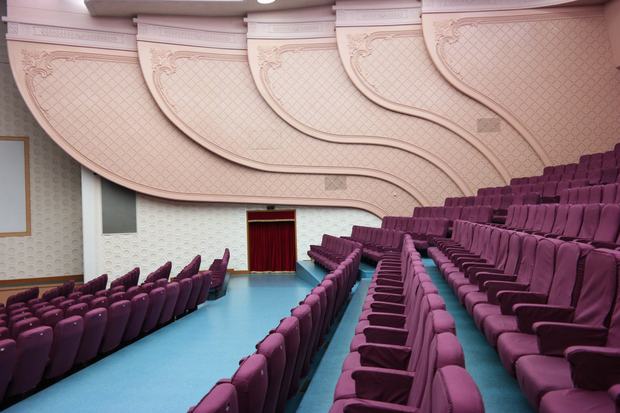
The National Drama Theater in Pyongyang

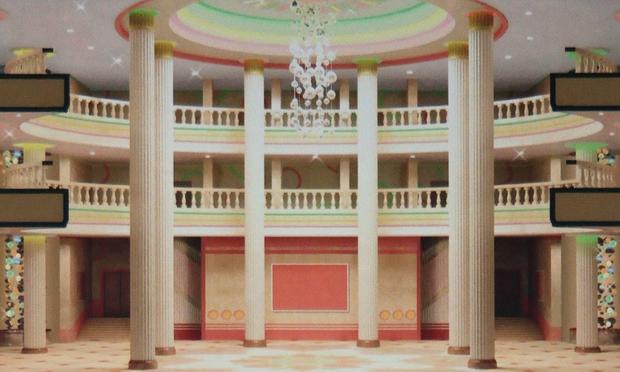
Below, a rendering of an architectural project from the Paektusan Academy of Architecture in Pyongyang 

Read Full Post »

I’ve been following David Guttenfelder on twitter and Instagram for about a year, initially because of a stunning photo of North Korea that appeared in the NY Times. Guttenfelder has made a specialty of North Korea, although he now works for National Geographic and travels extensively. He has recently been promoting a group of instagrammers who spend time in North Korea.

Writing for Time magazine’s Lightbox column, Olivier Laurant quotes Guttenfelder: “ ‘My motive has always been to open a window on North Korea,’ says David Guttenfelder. ‘There are so few images coming out of there, and yet there’s so much interest.’

“A former chief photographer at Associated Press, Guttenfelder helped open the agency’s first bureau in the Democratic People’s Republic of Korea (DPRK) in January 2012. Now, after he resigned from AP to continue his career as a freelance photographer and one of National Geographic’s Photography Fellows, he’s not turning his back on the reclusive country. In September 2014, he quietly launched the Everyday DPRK Instagram account, which features pictures by North Korean residents and photographers. …

“Six photographers, including Guttenfelder, are currently posting on the Everyday DPRK account — @drewkelly, @sunbimari, @andrea_uri, @simonkoryo, @soominee. …

“Kelly first visited Pyongyang in June 2012, and he usually spends three to four months a year in the country. ‘I had come right out of graduate school and learned of an opportunity to teach at a university here in the capital,’ he says. ‘I wanted to do something different, not sit around in the U.S. hoping the”right” job would come along.’

“When he’s not teaching English, Kelly is using Instagram to offer an ‘expat point-of-view’ on North Korea and to show that ‘there are real people living, working and striving for a better life with the cards dealt to them,’ he says.” More here, at Lightbox.

Guttenfelder comments at Instagram, “We are a small group of photographers who have, with different routes, unique access to North Korea. @andrea_uri started a tour company for example. @drewkelly is a teacher at a nkorean university. @dguttenfelder is a photojournalist. @sunbimari is a translator and working on major cultural exchange programs. @simonkoryo is a British nations with more trips inside nkorea than any other foreigner that I know of, more than 150. @soominee works on a farm in Rason.”

Photo: @drewkelly
North Korean kindergarten students stand outside a school at a collective farm near Wonsan, North Korea.

Read Full Post »

David Guttenfelder seems to get into North Korea and take pictures there more than anyone else, but what are you allowed to take pictures of in North Korea?

When Guttenfelder isn’t attending any official event, he improvises. He may have invented an art form in North Korea — artifact photography. He snaps bunches of plastic flowers in a hotel room, dinner menus, concert programs and labels them as “artifacts,” numbered.

No wonder he is involved with a new artifact museum, mmuseumm, which features the kooky things people collect.

Consider Toothpaste Tubes from Around the World, collected by Tucker Viemeister.  Says Viemeister, “Although I come from a ‘Crest family,’ I got my first tube of foreign toothpaste in Finland in 1985. We were shopping for normal stuff (Marimekko and toiletries). I saw a tube of toothpaste that’s [got a] name as long as the tube! They have long words in Finland.

“As I traveled around, I’d sample the toothpaste around the world. It was fun to buy and fit easily in my bag. Meanwhile it was an easy gift!

“I noticed that toothpaste is a universal media for indigenous people – a veritable blank canvas — both graphics on the generic tube and the flavors of the paste. French brands are more gourmet, Asian is more fruity, while American is very sharp (it this stereotyping?).” More here.

The museum is in Cortlandt Alley between Franklin St. and White St. in Manhattan.

(I wonder if my collection of wooden thread spools is extensive enough for a museum. I am afraid I lost the varied European toilet papers I collected on a trip at age 15.)


Read Full Post »

Photo: MediaBistro.com

One day when I was reading the paper I saw a photo of North Korea. It was beautiful in a lonely sort of Edward Hopper way, showing a street that was empty of almost everything generally seen on streets, just a couple people in a hurry and blank walls of buildings, one pink, one blue.

I really wanted to buy a copy, but in spite of sending a twitter message, I never did figure out how to reach the photographer, David Guttenfelder. Since then I have seen other fans on his Instagram site asking for copies of North Korea photos.

According to Guttenfelder’s official website, he “has spent all of his career as a photojournalist working and living outside of his native United States. He began as a freelance photographer in East Africa after studying Swahili at the University of Dar es Salaam in Tanzania. As an Associated Press photographer he has been based in Kenya, Ivory Coast, India, and Japan. … Born in the U.S. state of Iowa, he graduated from the University of Iowa with a B.A. in Cultural Anthropology, African Studies, and Journalism.

“He now lives in Tokyo as AP’s chief photographer for Asia.”

In a National Geographic article that Elizabeth Krist wrote called “Reality On A Need-to-Know Basis,” Guttenfelder talks about his photo collection of “North Korean artifacts,” odd little bits from his hotel rooms and from banquets and events he has been allowed to attend. He is a frequent visitor and has an unusual amount of access.

The artifact pictures are a lot of fun. Check out a few, and follow the photographer on twitter: @dguttenfelder.

“North Korean artifact #155. A book of piano sheet music for a North Korean songs found in the town of Sinpyong, DPRK. The title is, roughly, ‘My Nation’s Bright Moon’ ”

“North Korean artifact #156. Hotel room key, Rajin, DPRK.”

“North Korean artifact #157. Toilet paper roll with no hole in the center.”

Read Full Post »

After seeing a beautifully composed NY Times photo of people walking by bluish and rose-colored buildings in a nearly empty North Korea street, I began following the photographer on twitter, .

David Guttenfelder is one of the few Western photographers in North Korea. He was there when former Secretary of State Madeline Albright met with the previous ruler, Kim Jung Il. He takes pictures for media outlets and for his own amusement. His Instagram pictures of “artifacts” like a frilly computer screen cover and visitor handbooks can be hilarious or creepy.

Nina Porzucki had a lovely piece about Guttenfelder at Public Radio International’s “The World,” here. If you go to the PRI site, you have your choice of reading the transcript or listening to the report via SoundCloud.

The photographer tells Porzucki, “Over the years, every time I’ve gone back I’ve had more access, I’ve seen more. I’ve actually met people, I’ve seen real things.

“And I had this transformation. I kind of feel like that’s what I’m trying to do with my photography, is to take people who see my pictures through the same process. When they opened up the 3G local network and suddenly I could post pictures or tweet from the streets, from North Korea, that was more revolutionary than it would be anywhere else in the world, for sure. It’s sort of anything goes. I can just stop and take pictures of all these little mundane things in life that aren’t really so-called ‘newsworthy.’

“These are the things you run past on your way to covering the news. You know, a picture of bar snacks or a little yellow computer cover over a computer terminal, and none of them are great pictures the way photographers describe great pictures, ‘Oh, that’s a great picture.’ …

“It has as big of an impact probably as my professional daily newspaper work does. … I know that I’m not photographing anywhere near everything that’s going on in the country, especially the darkest things. But this is a long-term project, and we’re pushing to do as much as we can. If I’m not there, the only pictures that we’re getting out of Korea are distributed by Korean Central News Agency, where propagandist is not a dirty word.” More.

Photo of North Korea: David Guttenfelder, AP


Read Full Post »

We read a lot of mysteries in our house. We especially like stories set in places we don’t know much about, although my husband enjoyed the Qiu Xiaolong books because he had lived in Shanghai himself.

I just finished a mystery by James Church (pseudonym for an author who is a “former Western intelligence officer”). He writes about North Korea. Since hardly anyone ever goes there, I tend to accept Church’s descriptions as better informed than your average Joe’s. And I find that whenever there’s a news story about that isolated country, it seems to mesh with the murder mysteries. The series starts with The Corpse in the Koryo.

Eliot Pattison’s Tibetan series, starting with The Skull Mantra, was a great hit with me — son John, too, until he got tired of exotic locales and started reading business books (snore). Pattison now alternates writing Tibetan mysteries with writing mysteries about pre-Revolution America and Indians. I heard him say at a book reading in Porter Square that he finds similarities in the spiritual beliefs and practices of Tibetan Buddhists and American Indians.

The wacky Colin Cotterill writes a series set in Laos, stating with The Coroner’s Lunch. We love his style and his unique characters. I’m just starting his new series, set in Thailand and featuring a malapropism of George W. Bush at the start of each chapter.

S.J. Rozan’s detective Lydia Chin operates mostly in New York’s Chinatown, but she does get to Hong Kong, and you can pick up a lot of Chinese culture from her. That series starts with China Trade.

Good novelists do a lot of research. You can get the flavor of a culture without going anywhere.

Read Full Post »