Not long ago, a teacher I work with as an English as a Second Language volunteer asked the class if, like us, their home countries had an independence day. They all did, but it seemed to me that independence from a colonizer hadn’t led to happily ever after. If their countries had flourished after gaining independence, I doubt any of them would have ended up in the USA.
It made me ask myself whether I could identify my own opinions on the building blocks of a successful country. Our recent national introspection has helped. We are looking closer at our history and asking ourselves if it’s really true we’re the only ones on the planet without a stain on our national character. Of course not.
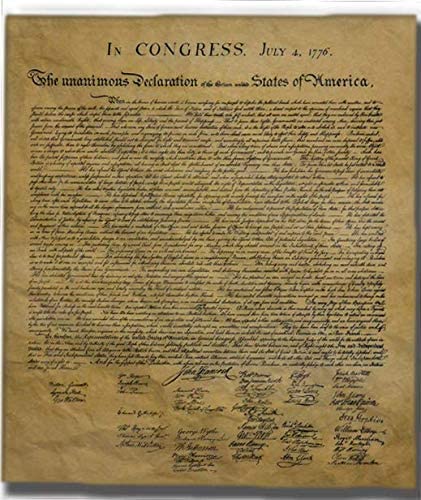
One Glorious Fourth at the Robbins House, a freed slave’s preserved home in my town, I got to hear the whole Declaration of Independence read aloud, and I winced about items I hadn’t remembered, such as the wording about King George using the local “savages” against the colonists. Even more revelatory that day was a reading of Frederick Douglass’s speech “What to the Slave is the Fourth of July?” (Read it here.)
So what makes a country that lives up to its ideals after independence? For starters, I’d say that all adults vote. The corollary to that is that everyone gets a good education so their votes will be informed and based on facts.
Then there are a few things we managed to get into our constitution, things that need to be eternally protected, like the right to free speech and the freedom of the press — to uncover government corruption, for example. There needs to be a structure that enables local resources to be used for good jobs so that people can have homes and other requirements met. There needs to be a fair system of justice in which wrongs are righted as much as possible.
When I think of ESL students from, say, Guatemala, I know that a country’s resources are not always used fairly for all the people. If that were so, those students wouldn’t have become immigrants. The resources have continued to be plundered after “independence,” the government is corrupt, the press is not allowed to say so, and gangs fight everyone over the little that is left.
My knowledge of these things is not deep, but off the cuff, that’s how see what a country needs to be a successful democracy, and I’m hoping you will add some of the important things I’m sure I’ve forgotten. I wonder if we began to think of this holiday as Independence and Introspection Day, we might move a little closer every year to our ideals.
Photo: Alfredo Sosa/Christian Science Monitor. Farmers who aren’t climate-action types may nevertheless be proponents of profitable wind energy. In Knox County, Illinois, the farmers above were glad to get a contract with Orion Energy for a 300-megawatt wind farm that is bringing in extra money for them and tax revenues for the county
One precept that my reading of fiction keeps hammering home to me is that people are complicated. A character doesn’t have to be one of the good guys to do something good or one of the bad guys to do something bad. Similarly, in real life, you don’t have to be on one side of a political divide to find value in something the opposing side values.
This article from the Christian Science Monitor provides an example.
Stephanie Hanes writes at the Christian Science Monitor, “For five generations, Andrew Bowman’s family has worked the land in Oneida, population 700-ish – a flat and fertile swath of Illinois his father always said was good for growing crops and kids. Today, he farms soybeans and corn, as well as specialty popcorn, which he sells under the label Pilot Knob Comforts. Mr. Bowman hopes to have a new resource to harvest soon, as well: wind.
“This past year, Mr. Bowman took a lead representing local landowners in negotiating with Orion Renewable Energy Group, one of the many companies installing wind farms across Illinois, to build a new 100-turbine project in his part of Knox County. Clean energy would not only help keep the local school open and support the fire department and library, he says, but would also offer a new income stream to farmers who agree to lease some of their land for the project – some $30 million over 25 years, according to the proposal. …
“For Mr. Bowman, embracing wind power is part of stewarding the land for the next generation – and one of many steps he and his brother-in-law, Matt Hulsizer, have taken to ensure resiliency on their 1,800 acres. They are acutely focused on soil health, low tillage, and reducing fuel consumption; they have tried organic practices and are investigating cover crops to retain nutrients and prevent erosion.
“But none of this is because they are trying to fight climate change.
“They care deeply about the environment, they say; after all, they live and work in it. But they cringe at the cries for climate action, and they bristle when city people suggest their outdoor, low-consumption life is problematic. … If human-made climate change is happening, they say – something they find dubious – they doubt there’s much anyone can do to stop it.
“For them, tending soil and harvesting wind for clean energy – two initiatives climate scholars say are crucial for reducing carbon emissions – is simply about taking the best steps economically
“And that, scholars point out, is a tremendous shift.
“For years, the dominant narrative of climate action was one of trade-offs and costs – that saving the world as we know it meant taking hard steps to reduce carbon emissions, and likely sacrificing jobs and lifestyle in the process. …
“[But] economic shifts, whether around clean energy or electric vehicles, regenerative agriculture or green construction, may be starting to defuse much of the debate over climate change.
“Instead, climate action has merged with economic progress – particularly when it comes to clean energy. And although climate activists say this awakening won’t by itself put the nation on track to meet the Paris Agreement goal of net-zero carbon emissions by 2050, some suggest it is making that path less arduous, while creating new opportunities and connections for those across the ideological spectrum.
“ ‘There’s an argument that’s been around for a long time, that somehow the economy and the environment are at odds and we can’t do two things at once,’ says Bob Keefe, executive director of E2, an organization of business groups focused on environmental action.
‘What we’re seeing today is that there’s never been more clarity about the economic costs of climate change, or the economic potential of climate action.’
“The narrative of “climate versus jobs,” though, is an enduring one. For decades, environmental protection has been presented in terms of extra costs such as regulations on businesses, requirements for companies, and restrictions on activities. While this wasn’t always divisive – the Clean Air Act of 1970 and the establishment of the Environmental Protection Agency were both highly bipartisan measures, for instance – it has increasingly become a dividing line. …
“Where the left has seen necessary checks on industry for the preservation of the natural world, and the potential for a clean environment to lead to new economic prosperity, the right has seen challenges to businesses, job losses, and economic hardship. Both sides have studies that support their views. Climate action has followed a similar pattern. …
“ ‘We’ve seen that constant conversation about jobs versus climate action,’ says Catrina Rorke, vice president of policy for the Climate Leadership Council, a centrist bipartisan group that promotes policies to price carbon. ‘We think it’s woefully incorrect. We think aggressive climate action can actually unlock a lot of economic activity.’
“In large part, says Stephen Cohen, former director of Columbia University’s Earth Institute, this is because a climate action economy is simply a modern economy – one that is moving away from a stagnating World War II-era industrial approach and into a newly automated, technologically innovative, and cleaner system. …
“ ‘It’s 100 years later and it’s time to modernize,’ he says. … ‘Most of the farsighted businesspeople – they know all of this. It’s how they think about the world.’
“This isn’t just about fossil fuels versus clean energy, he and others say. From the auto industry’s shift to electric vehicles, with all of the connected grid and battery production, to the construction industry’s work retrofitting old buildings, to wind and solar energy jobs, the impact of climate-connected development is broad. It is also spurring a new wave of innovation and entrepreneurship, scholars say.
“None of this means the end to the underlying political tension surrounding climate action. … Nor does this new economy benefit everyone. In any industrial shift, Dr. Cohen points out, some skills and jobs become obsolete. And when it comes to a climate-connected economy, those hardships are concentrated in particular communities, such as in West Virginia and Wyoming, that were built around fossil fuel extraction. In other words, it’s easy to focus on the story of a coal town dying because of a shift in the energy sector. The hardship is concentrated. It’s harder to tell a story when the benefits are diffuse, and everywhere.
“ ‘The losers are more specific and more easily identified – the winners might not exist yet,’ says Wolfram Schlenker, a professor at Columbia University’s School of International and Public Affairs and the Earth Institute.
“Still, Americans increasingly see a price to pay if rising temperatures go unchecked. The number of Americans who believe global warming will harm people in the United States a great or moderate amount grew from 51% in 2014 to 61% last year, according to polling by the Yale Program on Climate Change Communication.
“Here in Illinois and elsewhere, most workers have jobs that aren’t directly focused on climate change. But ‘green’ growth, from the booming renewables market to energy-efficient construction projects, is everywhere. As a trip across the state shows, the positive economic story of industry that could be categorized as climate-related – even if those involved wouldn’t categorize it as such – is getting easier to observe.”
More at the Monitor, here, where among other topics you can learn about the battle between a fungi protein and chicken nuggets.
Photo: Sierra Mar via Forbes. A California restaurant has initiated impressive air-quality controls post-pandemic.
In the beginning, we were wiping everything down with bleach. I know I kept sharing a video from a doctor who’d worked with Ebola protocols. And for quite a while, I was treating all my groceries as if they could kill me.
Then we learned Covid was contracted mainly through the air, in invisible droplets from people breathing. So now that it’s possible once more to eat indoors in restaurants, the wary among us are asking how well restaurants are doing on ventilation.
“When California’s Monterey County allowed restaurants to reopen in March, indoor dining returned to the cliff-perched Sierra Mar, known for its spectacular views of the Pacific Ocean.
“The Big Sur restaurant now featured some new pandemic touches: 18 tabletop mini-purifiers, 10 precisely distributed HEPA air purifiers, an upgraded heating and air conditioning system, and four sensors measuring the air quality in real time.
“The bar was closed, and at a table in the back sat someone new: an engineering professor whose specialty is air quality.
‘If this is going to work right, the ventilation keeps up with the head count,’ explained the expert, Mark Hernandez of the University of Colorado.
“Every 15 minutes, he would walk to the front desk to check how many people were now seated indoors. Then he would compare that number to the air’s current levels of carbon dioxide and particulate matter, to see how much exhaled breath lingered in the air and what expelled aerosols it could contain.
“Indoor dining remains risky, as the pandemic rages on, propelled by highly transmissible new coronavirus variants that threaten gains from widespread vaccination. The virus has been brutal for the restaurant industry. … Thousands of restaurants already have shut down permanently.
“Those struggling to hold on are considering a broad range of air ventilation and filtration techniques to keep customers and staff safe. Sierra Mar’s new air-quality experiment, partly funded by a regional foundation, cost about $30,000. That’s a hefty expenditure that might be out of reach for many restaurants running on thin profit margins.
“Mike Freed considers it a worthy investment. He’s the managing partner of the Post Ranch Inn, the exclusive resort that contains Sierra Mar and caters to an affluent eco-conscious traveler. Since the setup, if successful, could potentially be utilized in other restaurants and indoor spaces, the Washington Post asked several experts on indoor air to review the restaurant layout and strategy. They agreed it should work to make the dining experience considerably safer, while noting 100 percent safety is unattainable.
“These experiments in the restaurant industry may usher in a new data-driven relationship with indoor air, with people able to judge where they dine, vacation and work based on the quality and transparency of real-time readings. …
“[One] interior air circulation has been designed, says Hernandez, as a ‘seat belt in a place where you can’t control your peers … This is long overdue for public places.’
“At a time when its vista is clouded by recurrent wildfires, the Post Ranch Inn now displays the restaurant’s air quality updates on its website, so diners can time their escape around what they want to eat — and breathe.”
Check the Post, here, for a variety of new air-quality gizmos. For example: “An air purifier about the size of a water bottle [that] sits on each table. It can’t clean a lot of air quickly, but it can direct filtered air in a small area. And it runs on batteries.
“While the portable air purifier can be tilted toward a person’s face, Hernandez positioned it straight up, to reduce the risk of unmasked diners infecting others by breathing across the table. Instead, the device, made by Wynd and marketed as a personal air purifier, should push any shared or unfiltered air aloft”!
I keep thinking how the the pandemic has created new opportunities for obscure products like that and has also made rock stars out of certain kinds of engineering professors. Those are among the changes we’ll keep.
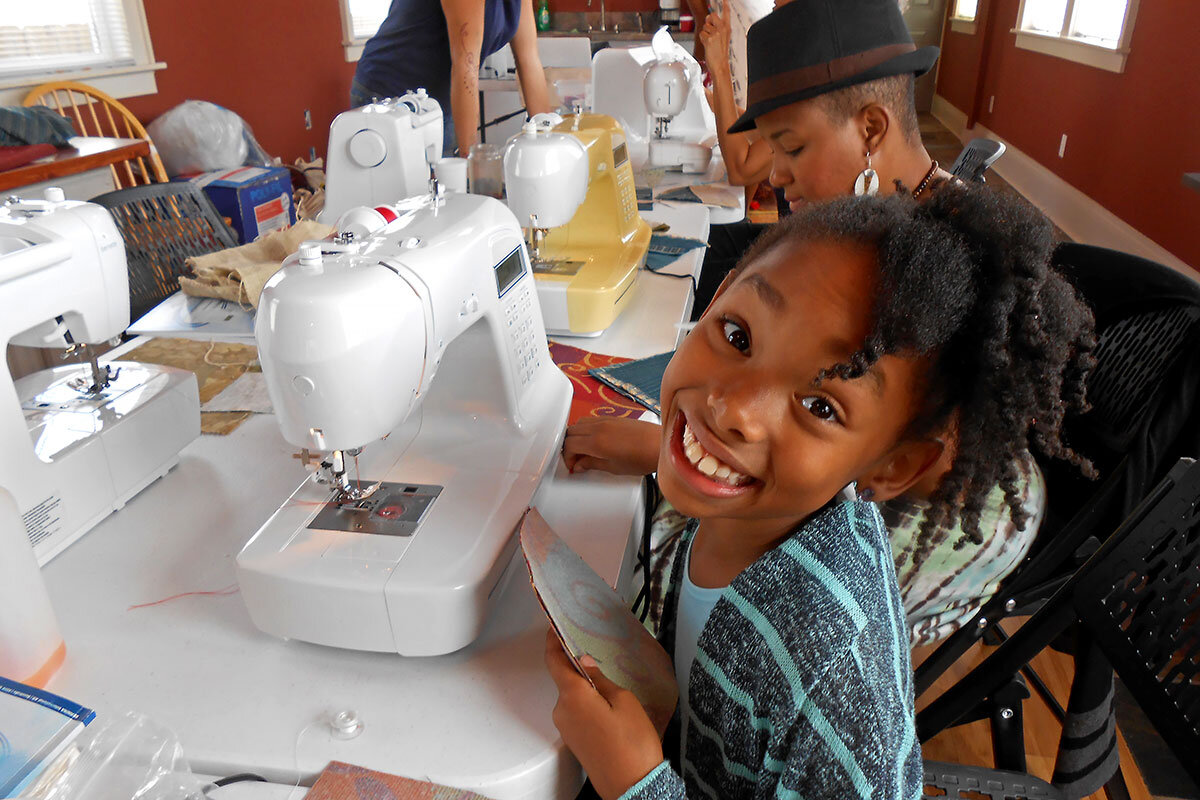
Photo: Margaret Jankowski. Students in a 2013 sewing class test their new skills on a suite of machines donated by the nonprofit Sewing Machine Project to a community center in New Orleans.
There have always been a few followers of this blog who quilt, weave, knit, crochet, or sew, and I’m hoping they will like today’s focus on a nonprofit that harnesses the multifaceted power of sewing. Richard Mertens reported about it at the Christian Science Monitor.
“A tsunami helped Margaret Jankowski understand the real value of a sewing machine. Like many girls of her generation, she had learned to sew at an early age. Her mother taught her on an old Singer Featherweight, and she learned the basics by hemming her father’s handkerchiefs. As an adult, she bought her own clothes off the rack but sewed for her first child. … She taught classes at a sewing shop, ‘preaching the gospel of sewing,’ she says. …
“Then, in December 2004, a tsunami hit Sri Lanka and other coasts around the Indian Ocean, leveling communities, hurling wooden fishing boats far inland, and killing 230,000 people. … What touched Ms. Jankowski most deeply was the story of a woman returning to her ruined village. The woman had worked for years to save enough to buy a sewing machine, enabling her to work as a tailor and giving her a future. Now it was gone. …
“She resolved to send sewing machines to Sri Lanka. ‘I thought maybe I could collect a few of these machines that people are getting rid of anyway,’ she says. She explained her idea on a local news program and was inundated with machines. She raised money for voltage converters and shipping, and in 2005, with the help of the American Hindu Association, sent five boxes each to five orphanages in India and Sri Lanka, each packed with toys, medical supplies, fabric, and the most precious cargo – a sewing machine.
“ ‘They were used to sew for kids,’ she says. ‘They were also used to teach kids a trade, which I felt was really important.’
“It didn’t end there. Ms. Jankowski went on to start the Sewing Machine Project, a small organization that redistributes used machines. It’s a mission that springs from a love for an old craft and a belief in its practical and redemptive possibilities today. …
“In 16 years the project has shipped 3,350 machines around the world – and across town. It’s sent them to coffee pickers in Guatemala, women who help vulnerable girls in Guam, and war widows in Kosovo. It’s sent them to programs that help refugee women in Detroit, incarcerated women in Mississippi, and sewers of Mardi Gras outfits. … In these and other places, unwanted machines find new uses. In many places sewing can be a livelihood, whether in a factory job or at home.
For those trapped in poverty, Ms. Jankowski says, sewing ‘is a way out.’
“Sewing is also a way forward for immigrant and refugee women in Detroit, says Gigi Salka. Ms. Salka is the director of the B.O.O.S.T. training program at Zaman International, a nonprofit that serves poor and marginalized women and children, including immigrants and refugees, in the Detroit area. … Zaman began offering a two-year sewing instruction program. Graduates earn money doing alterations and creating made-to-order clothing, often from their homes. …
“The pandemic disrupted the classes but also created new opportunities for the women. ‘We gave them fabric. They took machines home. They made masks,’ Ms. Salka says. ‘In a population where five dollars makes a big difference, any supplemental income, any extra dollar is a dollar they can have. … Sewing is very empowering. You see it in a population that’s lost hope; the ability to create a product is very powerful to them. They’re so proud.’ …
“This idea is being tested in Rankin County, Mississippi, where a local woman, Renee Smith, persuaded prison officials to allow her to start a sewing program for women in the Central Mississippi Correctional Facility. Her aim was to get help producing reusable menstrual pads for girls in countries like Uganda and Haiti where girls frequently stay home from school while menstruating, or quit school altogether because they lack access to sanitary supplies. … The inmates were glad to have something to do, she says, but sewing for distant schoolgirls also gave them a sense of purpose. …
“Some of the biggest beneficiaries of the Sewing Machine Project have been the Mardi Gras Indians of New Orleans, an African American community known for the elaborate feathered and beaded suits they wear for Mardi Gras. That effort, too, started with a disaster. In 2005, Hurricane Katrina struck the city, hitting African American neighborhoods especially hard. Cherice Harrison-Nelson, also known as Queen Reesie and an early collaborator with the Sewing Machine Project, says that making Mardi Gras suits is an important cottage industry in the city, but that many people lost their machines in the hurricane.”
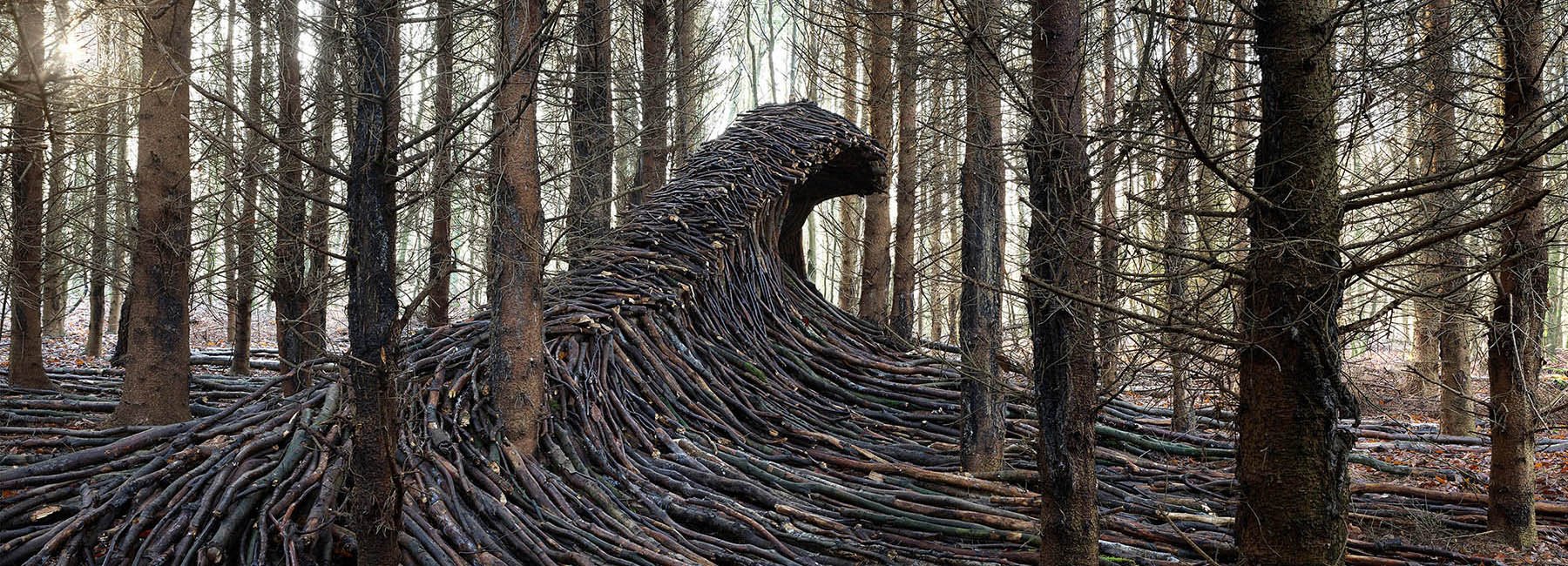
Photo: Jörg Gläscher via DesignBoom. A photographer built nine massive waves of deadwood in a forest near Hamburg, Germany.
A few years ago, I blogged about seeing Patrick Dougherty’s giant stick sculptures in Salem, Mass. He was getting a lot of attention at the time, and I studied up on him at the Smithsonian.
So I was reminded of Dougherty and the beautiful possibilities of sticks when John sent me a link to an article at This Is Colossal. The German photographer JörgGläscher, or @joerg_glaescher on Instagram, is the artist. (Colossal was tipped off to the story at This Isn’t Happiness.)
Grace Ebert reported, “As the fear of a second wave of COVID-19 swept through Germany in the fall of 2020, photographer and artist Jörg Gläscher decided to channel his own worry into a project that felt similarly vast and domineering. ‘I was working (with the idea of) the pure power of nature, the all-destroying force, which brings one of the richest countries in the world to a completely still stand,’ he tells Colossal. …
“Between November 2020 and March 2021, Gläscher spent his days in a secluded location near Hamburg, where he gathered deadwood and constructed nine massive crests — the largest of which spans four meters high and nine meters wide — that overwhelm the forest floor in undulating layers of branches and twigs. Each iteration, which he photographed and then promptly destroyed in order to reuse the materials, overwhelms the existing landscape with pools of the formerly thriving matter.
“Gläscher’s installations are part of a larger diaristic project he began at the beginning of the pandemic. Since then, he published a few magazines to present the works that range from photography to sculpture in one place. … Find more of his multi-media projects on his site and Instagram.” Great photos here.
I like thinking about an artist pursuing a project suggesting tidal waves when, like him, we were all isolating ourselves from the tidal wave of Covid. There is something intriguing about his taking the waves apart and reconstructing them in different forms. Doesn’t coronavirus do that, too?
The Covid Art Museum on Instagram was and still is an artistic response to the pandemic. And considering that the pandemic wave hasn’t yet crested worldwide, I’m sure we’ll be seeing other, Covid-inspired artworks — not to mention, more art from sticks.
As Patrick Dougherty has said, “A stick is an imaginative object. … I think we have a kind of shadow life of our hunting and gathering past, especially in our childhood play. Because a stick — a piece of wood — is an object that has an incredible amount of vibration for us.”
Photo: Otherlab via the Smithsonian. Saul Griffith’s latest venture, Otherlab, is a research company reminiscent of the “invention factory” created by Thomas Edison.
Here’s an Australian inventor who aims to stop global warming. I especially like his ideas about a substitute for lithium batteries — not just because it could save money but because lithium and other rare minerals are the new “blood diamonds.” Mining them is bad for Nature, bad for communities.
Rachel Pannett writes at the Washington Post, “During a TED talk, Australian inventor Saul Griffith wanted to show his audience how much a person’s individual choices can affect the planet.
“The person, in this case, was himself. And so, the tall engineer with tousled brown hair pulled up a chart on a big screen behind him on the stage.
“On display was an exhaustive audit of his personal energy impact, calculating the carbon footprint of every action in his life down to his underwear, toilet paper and taxes.
“The founder of a wind power company and a dedicated bicycle commuter, Griffith was ashamed to discover that he was consuming much more power than the average American. In short, a planet hypocrite, he told his audience. …
“Since that TED talk 10 years ago, Griffith’s San Francisco lab has attracted $100 million in capital from investors and spun out a dozen companies.
“The 47-year-old, who won a MacArthur ‘genius’ grant in 2007 for his prodigious inventions ‘in the global public interest,’ from novel household water-treatment systems to an educational cartoon series for kids, has spent the past decade working to solve climate change through technology. His solution: mass electrification.
“While most environmentalists have taken aim at the fossil fuel industry, Griffith wants to decarbonize each American household — replacing every gas cooktop, furnace and hot water heater with electric devices. Otherwise, he says, efforts to reach net-zero carbon emissions will fall short.
“Most of Griffith’s tinkering happens in a nearly century-old former factory in San Francisco’s Mission District. … From every available space on the ceiling and walls, Griffith’s team has hung bicycles — from cargo bikes to a four-seater electric model.
“Otherlab, which Griffith co-founded more than a decade ago, is where the Australian and two dozen other scientists are trying to find a way to stop global warming.
“One of the lab’s current projects aims to radically redesign offshore wind platforms. Another team is designing a solar-powered scooter set for launch this year. They also designed a tracker system that helps solar panels follow the sun’s path through the day.
“ ‘Things don’t stay on paper very long,’ said Joanne Huang, Otherlab’s special projects lead, who joined the company in 2019. ‘It is like a build-it-and-see kind of place. It’s very fun in that way.’ …
Griffith believes climate change is solvable, and he imagines a cleaner future that looks better than what we have now. …’There is every reason to believe the future can be awesome.’
“In the first-floor workshop, Huang and Hans von Clemm, an engineer, were recently working on modular cubes designed to stack neatly in the corner of a person’s garage to store excess energy from rooftop solar systems. The heating and storage systems are being tested in several homes in California, including Huang’s. Their hope is to store electricity from rooftop solar panels for far less than the cost of a lithium battery — making the technology accessible to more people. …
“For the task, Griffith has assembled an eclectic team. Von Clemm is a former ski instructor; Huang was a competitive snowboarder.
“Von Clemm, who joined Otherlab as an intern in 2016, remembers the day he interviewed for the job. Griffith asked to see his hands, which were calloused and covered in cuts. The week before, von Clemm had been building a knife drawer for his mom. ‘All right,’ Griffith said approvingly.
“He then handed the young engineering student a piece of paper and a pen and asked him to draw a working bicycle in 60 seconds. Von Clemm said his hands were shaking. When he finished, Griffith declared: ‘Okay, you can start tomorrow.’
“Griffith’s vision for addressing the devastating impact of climate change bucks tradition. Instead of just focusing on shutting down coal and gas-fired power plants and polluting industries and switching to renewable power generators, he wants to also focus on suburban life. … There is little use in having wind or solar power if your stovetop, furnace and water heater are powered by gas.
“Griffith acknowledges this could be a tough task — furnaces are not easy to swap out like appliances such as refrigerators: Typically, you replace them only when they are broken. …
Yu Hua in Jia Zhangke’s Swimming Out Till the Sea Turns Blue. The film documents life in rural Chinese villages over the past seven decades.
There’s a new documentary covering 70 years of life in China. In an interview at Hyperallergic, Jia Zhangke, director of Swimming Out Till the Sea Turns Blue, tells Jorden Cronk about some of the challenges of extracting personal memories from elderly people raised with a group mindset.
“Moving fluidly between fiction and documentary, the work of Chinese director Jia Zhangke assumes many forms, often within the same film. His latest, Swimming Out Till the Sea Turns Blue, is a documentary portrait of rural China, told through the lives and words of four authors — Ma Feng, Jia Pingwa, Yu Hua, and Liang Hong — whose work collectively spans from the 1949 communist revolution to the present day. Combining reflections on each era’s politics with memories of the authors’ rural upbringings, Jia charts the cultural evolution of China in intimate strokes. … Jia and I connected on Zoom to discuss hidden histories and the generation gap separating today’s Chinese youth from their rural roots.
“Hyperallergic: I’ve heard you refer to the new film as the third in your ‘Artists Trilogy.’ At what point did you begin to conceive of the film as such?
“Jia Zhangke: I shot the first two films in the trilogy back-to-back. In 2006 I made Dong, about the painter Liu Xiaodong, and in 2007 I made Useless, about the fashion designer Ma Ke. Immediately after I thought I would make the third part, about artists who are either architects or city planners. … I had found quite a few architects and city planners that would be perfect for the project, but they didn’t seem to want to share on camera the things I wanted to capture, so we postponed the project.
“It wasn’t until recently that I started to think again about the third installment. For the past few years, I’ve been going back and forth between Beijing and Jia Family Village [Note: no relation to the director], and while I was there, I noticed that they are facing many issues — and not uniquely Chinese issues, but global issues in terms of the younger generations leaving rural areas for urban settings. Nowadays in these rural areas, you tend to see mostly older people; younger people don’t stay in these areas for long. So now when these younger generations have children, they will have no connection or memories or understanding of their rural or agricultural roots. …
They’re very old. … We had to spend a lot of time during post-production finding a coherent logic and structure in what they were saying, to properly distill their memories.
“H: How did you come to the four main subjects of the film? Do they have certain characteristics or writing styles that you felt were particularly suitable to the story you were trying to tell?
“JZ: As I was thinking about who I could call on to tell these rural histories, one particular element in Jia Family Village stood out: a literary tradition with very strong connections with the first writer depicted in the film, Ma Feng. He was born and raised in Jia Family Village, and he often wrote about the region. I thought I could use writers born in similar areas who have been writing about these regions as a way to make this documentary come alive. …
“Ma Feng, he was born in the ’20s and most prolific in the ’50s and ’60s, while Jia Pingwa mostly wrote in the ’70s and ’80s, Yu Hua about the ’80s and ’90s, and Liang Hong about anything from the ’90s until now. So it made sense for me to put these authors together as a kind of relay to talk about their formative years, and even though they have some overlap, the most important eras for each of them represent specific moments in time. …
“But more interesting for me was that I could capture each author’s unique way of storytelling and their worldview through the way they talk through their memories, lives, and history, as well as how they depict their characters. … In addition to learning about the last 70 years of rural history, you’re witnessing the evolution of Chinese literature.
“H: Ma Feng is the only writer who’s no longer alive. How did you decide to have his daughter speak for him?
“JZ: For me, to put together a comprehensive understanding of these rural areas during Ma Feng’s time, it wasn’t sufficient to rely only on his daughter, because I really needed that firsthand account. That’s the reason why, in addition to the daughter, I included two village elders, both in their 90s. These elders had direct experiences and interactions with Ma Feng that I relied on to offer eyewitness testimony to what happened during this period. All three of them talk about the collectivization of society that occurred during Ma Feng’s time. When we look back and rethink the ideas from that era, we might now have different assessments, viewpoints, or understandings of these concepts, but what I want to articulate with the film is that we have to admit that this happened, no matter how we interpret what happened. Through these three people, I wanted to capture the social and historical contexts for these things.
“However, this also posed a couple of problems with regards to interviewing them. They’re very old, of course, but they also come from a society that focused on collectivism rather than individualism, which means that it is very difficult for them to talk from a first-person, or ‘I,’ perspective. It was a challenge to interview them in such a way that they would open up in front of the camera and share their private and subjective memories. And since they are old, they tend to not talk in chronological order, and instead jump around, skip ahead, and flash back in a way that isn’t always coherent. We had to spend a lot of time during post-production finding a coherent logic and structure in what they were saying, to properly distill their memories.
“H: Is this hesitancy to talk from a first-person perspective one reason you chose to shoot the interviews from multiple angles and from what seems like a quite a distance?
“JZ: For me, the compositions evolve in a natural way within the film’s structure. For the first interviews, I wanted to things to be impressionistic, so we started with images of old people eating, and through that group concept slowly but surely segue into individual memories. In other words, I wanted to locate a visual concept that would take us from the collectivist to individualist way of viewing memories.
“H: Much of the film is about the official record of Chinese history and the personal experiences of each author, and how those are quite different. In general, what is the public’s understanding of these events?
“JZ: In terms of the grand narrative, the ‘official’ version of history is pretty much the same for everyone, at least in terms of how people understand the big historical junctures. However … everything is stated in such an abstract or statistical way. That’s why I think films like this are very much needed. You can’t feel abstract or statistical histories. There’s no impact — it’s meaningless. What’s missing are visceral connections with history. Of course, there are many ways you can hide certain parts of history. But what’s more important to realize is that what’s often hidden is not necessarily what happened, but how things happened.”
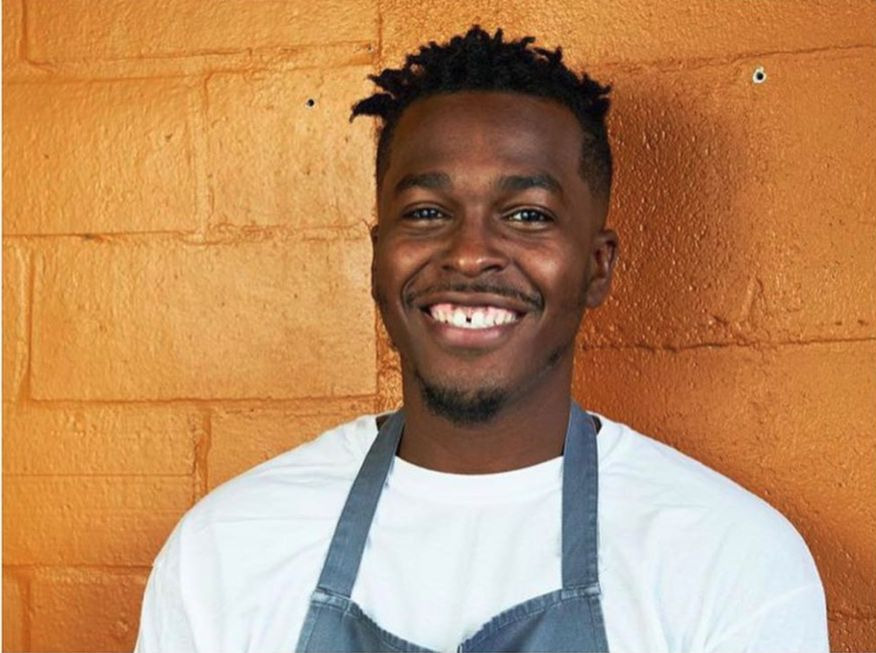
Photo: Facebook. Jonny Rhodes, owner of the acclaimed Houston restaurant Indigo, is putting his energy and reputation behind a social justice movement focused on food.
I’ve written a lot of posts about food deserts and efforts nationwide to help low-income communities get access to fresh and nourishing produce. Today’s story adds to the series, highlighting how a successful Houston restaurateur decided to make food equity his business.
Victoria Marin writes at the Washington Post, “By most accounts, Houston chef Jonathan ‘Jonny’ Rhodes has already achieved tremendous success. Just a few years removed from culinary school, he has worked in several Michelin-starred kitchens and is running his own celebrated restaurant. Nonetheless, he says, everything in his career has brought him to this moment, confronting food justice against the backdrop of what is perhaps the biggest movement against … police violence in history. …
“A restaurant, even a revered one, has never been enough for Rhodes, who says the pathway to real freedom is through the security and sustainability that comes with land ownership. He has been laying the groundwork since he opened his neo-soul food restaurant, Indigo, by building out a market of preserved and canned pantry items supplemented by produce from the modest garden next door. His intention: to eventually open a full-service grocery store and, further down the line, start a farm to supply the store
“Rhodes decided to open Indigo in Houston’s Northline neighborhood, just outside of where he grew up, in part because he wanted to prove that fine dining belonged there, even if local law enforcement — and some Yelp reviewers — may have thought otherwise. But he has long had bigger aspirations for the project he undertook two years ago: He wants [to show our] ‘people what we’re capable of. … It makes them curious. And as it makes them curious, they create, they start asking questions. And when they start asking questions, they create their own ideas, and ideas are dangerous to the establishment — so instead of telling people to stay safe, we tell them to stay dangerous.
“What constitutes ‘staying dangerous’ in Rhodes’s mind? It starts with Indigo’s unconventional, barrier-breaking premise: The five-course soul food menu is made up of dishes designed as much to convey flavor and beauty as to elicit dialogue about the food history of the African diaspora, with such names as Violence of Hunger; Hijabs, Hoodies & Afros; and Descendants of Igbo. Everything that’s cooked is prepared over a wood-fired grill because it’s historically accurate and because Rhodes and his team … couldn’t afford the $10,000 necessary to install a gas kitchen when they opened. Once or twice during the meal, Rhodes steps into the dining room, surrounded by African art, books about slave foodways and posters emblazoned with revolutionary quotes, and presents a deft treatise on the inspiration behind each dish, encouraging guests to consider the intersections between past and present. …
“The 13-seat restaurant, which offers only two seatings per night, four nights per week, has become one of the most covetedreservations going. But reviews and awards have never been Rhodes’s goal. And neither is just conversation, though conversation is a big part of the Indigo experience. … For Rhodes, who served in the Marines before starting a family, going to culinary school and then getting a degree in history, the war for natural resources has long been an apt metaphor for the black American experience. ‘African Americans have been subdued because we don’t control any natural resources,’ he says. …
“The communities Rhodes describes are commonly called ‘food deserts,’ usually densely populated neighborhoods marked by a severe lack of fresh produce coupled with an often devastating abundance of alcohol and processed food. But Rhodes and other food justice advocates around the country consider the term a misnomer. A more accurate phrase, they say, is ‘food apartheid.’ …
“According to Karen Washington, co-founder of New York City’s Rise and Root Farm, calling it apartheid allows us to ‘look at the whole food system, along with race, geography, faith and economics. You say “food apartheid,” and you get to the root cause of some of the problems around the food system. It brings in hunger and poverty.’ …
“Covid-19 has disproportionately laid siege on black Americans, something Rhodes sees as inseparable from food apartheid because of the interconnectedness between urban blight, food insecurity and health-care inaccessibility. The pandemic expedited his team’s plans. When states started shutting down in March, Indigo closed for a few weeks and then, like many other restaurants across the country, pivoted to groceries when it reopened. Unlike most other restaurants, though, Broham Fine Soul Food and Groceries isn’t a temporary endeavor. Rhodes is seizing this opportunity to do his part to dismantle food apartheid, through a sustainable, community-oriented, black-centered soul food market. …
“For Rhodes, this moment is ripe with possibility: Earlier this year, he and his team purchased six acres of land just outside the city so they can start farming on a larger scale. (Always resourceful, they’re repurposing the wood they’re clearing for cooking, building fencing and growing mushrooms.)”
More at the Post, here. Additional information at Houstonia magazine, here.
Denver is now constructing what is likely the largest sewer heat-recovery project in North America.
I have no idea what leads one to a career in sewers, but judging from this story, it can involve tackling really interesting challenges to help the environment.
As Sam Brasch reported at National Public Radio, “A secret cache of clean energy is lurking in sewers, and there are growing efforts to put it to work in the battle against climate change.
“The U.S. Department of Energy estimates Americans wash enough energy down the drain every year to power about 30 million homes. The sources are often everyday items inside homes. Think hot showers, washing machines and sinks. Evolving technology is making it easier to harness that mostly warm water.
“Denver is now constructing what is likely the largest sewer heat-recovery project in North America, according to Enwave, a Canadian energy company set to operate the system.
“Over the next few years, a $1 billion remodel will turn the 250-acre site, home to the National Western Stock Show and Rodeo, into a hub for art, education and agriculture. The revamped National Western Center will include about a million square feet of new indoor space, all of which will be heated and cooled with energy from the sewer pipes below.
“Brad Buchanan, the CEO leading the redevelopment, said the project has already changed how he thinks about the best location for real estate. Big pieces of sewer infrastructure have long repelled development. Now he imagines they might be sought out as a way to save energy costs and avoid greenhouse gas emissions.
The National Western Center estimates the project will help it annually avoid the carbon equivalent of driving an average gas-powered car around the equator 250 times. …
“The technology to harvest sewer heat isn’t complicated. At the National Western Center, construction crews have already completed a pit exposing the main sewer line. The wastewater inside stays a mild 55 to 75 degrees year-round,local officials say,no matter the weather outside. That consistent temperature can be tapped to heat and cool above-ground buildings.
“The key is a massive heat pump, which will be housed in a central plant on the campus. The device works like a reversible air conditioning unit. In the winter, it will transfer energy from the sewage into a clean-water loop connecting the buildings, adding heat to indoor spaces. The process can then be flipped to keep things cool in the summer.
“And to answer an obvious question: No, the raw effluent is never exposed to the air, so people occupying the buildings won’t get hit with waves of sewer stink. …
“If sewer energy catches on, one reason could be the potential benefits for wastewater districts. That’s because warm sewage causes its own environmental problems. In Denver, wastewater is often hotter than the South Platte River, its final destination after running through a treatment plant. This ‘thermal pollution’ can imperil native plants and wildlife. …
“The National Western Center has moved to protect its supply in the event of a kind of sewer-heat gold rush. The City and County of Denver, a partner in the project, exercised a three-year option for exclusive access to the energy inside the pipelines running through the campus. Buchanan, the project CEO, said it amounts to a new sort of environmental resource. Instead of mineral rights or water rights, his development holds sewer thermal energy rights.
” ‘We have it protected because we’re counting on that energy in perpetuity,’ he said.”
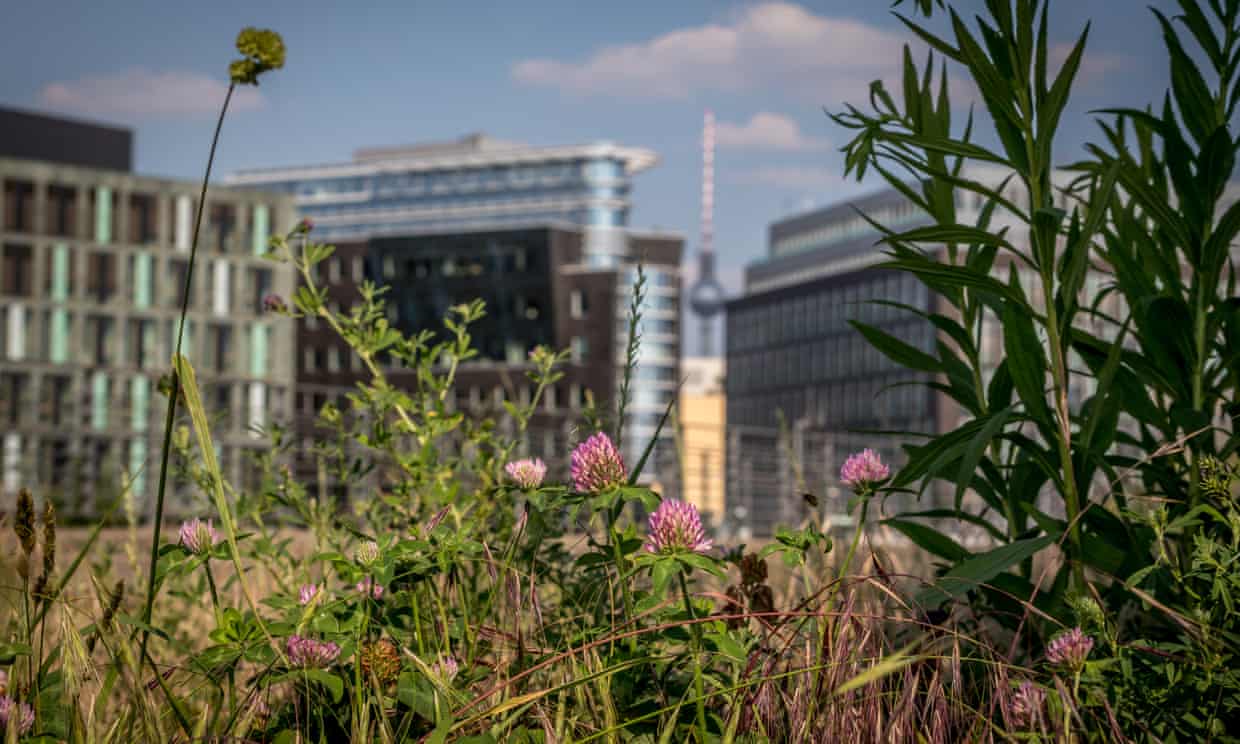
Photo: Christian Jungeblodt/The Guardian. City wildflower meadow with central Berlin’s skyline in the background. It’s all about love for pollinators.
The other day, Asakiyume pointed me to a charming thread on Twitter about volunteers in San Francisco who move bee swarms to safer places.
@Annaleen tweeted, “I have an amazing and wholesome story about a wayward swarm of bees who decided to take up residence on a lamp post in the middle of a residential neighborhood in San Francisco. … love that my city has a volunteer bee swarm emergency hotline! The dispatcher said that exterminators generally call them when they find a swarm. This city is very ‘pro life’ for bees, he told us. When I imagine a better world, this is the kind of experience I think of.”
Meanwhile, in Germany …
Philip Oltermann has this report at the Guardian. “To escape the Berlin bustle on a summer afternoon, all that Derek O’Doyle and his dog Frida have to do is lap the noisy building site outside their inner-city apartment, weave their way through the queue in front of the ice-cream van, and squeeze between two gridlocked lorries to cross over Baerwaldstrasse.
“Bordered by a one-way traffic system lies a bucolic 1,720 sq metre haven as colourful as a Monet landscape: blue cornflowers, red poppies, white cow parsley and purple field scabious dot a sea of nettles and wild grass as armies of insects buzz through the air. Two endangered carpenter bees, larger than their honey bee cousins and with pitch-black abdomens, gorge themselves on a bush of yellow gorse.
“The mini-wilderness on Baerwaldstrasse is one of more than 100 wildflower meadows that have been planted in Germany’s largest cities over the past three years and are coming into full bloom this summer to transform urban landscapes.
“Berlin has set aside [$1.79 million] to seed and nurture more than 50 wild gardens over a five-year period, while Munich has set up about 30 meadows since 2018. There are similar initiatives in Stuttgart, Leipzig and Braunschweig. Hamburg, which started the trend in 2015, this month unveiled the first of a series of bee-friendly flower beds atop bus shelters.
“Juliana Schlaberg of Germany’s Nature and Biodiversity Conservation Union (NABU) said her NGO was receiving more and more requests from city residents who either wanted to grow their own wildflower patches or pressure their council to stop cutting green spaces into manicured lawns. …
“The rain-heavy start to this year’s German summer has created a bloom so spectacular that many a doubter has been swayed. The organisers behind the scheme deliberately mixed in endangered flowers that take two years to come into their prime with populist Akzeptanzpflanzen (‘acceptance plants’) like poppies and cornflowers, which blossom after only a year. Three years on, the full floral array is on display.
” ‘I’ve changed my mind,’ said O’Doyle. ‘It’s become an incredibly attractive addition to our neighbourhood. You experience the seasons in a whole new way.’ Yet aesthetics are a mere bonus for a scheme with serious purpose: the protection of Germany’s population of wild bees.
The country is home to about 580 species of wild bee, of which an estimated 300 can be found in Berlin. More than half are endangered or on the verge of extinction.
“A 2017 study by the Entomological Society of Krefeld showed a 75% decline in total flying insect biomass in protected areas in Germany since 1989, with the use of insecticides, exposure to toxic exhaust fumes and above all a loss of diverse habitats cited as reasons for the drastic decline.
“The findings inspired a 2019 ‘save the bees’ petition in Bavaria that became the most successful in the southern state’s history, nudging politicians to pass into law its demands without putting them to a referendum first. A similar petition will be handed over to the parliament of the large state of North-Rhine Westphalia in July.
“Christian Schmid-Egger, who coordinates Berlin’s wildflower meadows on behalf of the German Wildlife Foundation, said any conservation effort would ultimate require broader changes in agricultural practices: ‘If we are going to save the bees, we won’t be doing it in cities.”’ …
“Unlike the hive-building honey bee, wild bees are solitary creatures always on the look out for new temporary accommodation. … Others have picky dietary requirements: one Berlin species of mason bee, osmia adunca, only collects pollen off viper’s bugloss, a type of plant that only grows in dry grasslands and waste spaces.” More at the Guardian, here.
Asakiyume understood that Annalee’s final statement in the Twitter thread on bee swarms is more or less my philosophy: “Sometimes, if you’re lucky, you get to glimpse a better world in the present. It’s like looking through a pinhole at something huge and distant and almost imperceptible. But you can see just enough of it that you know it’s possible, one day.”
Photo: Hill Museum & Manuscript Library. A 1600s Armenian Gospel, with a depiction of the evangelist Mark, has been digitized by Benedictine monk ColumbaStewart’s project.
I love learning about the many unusual careers and pursuits out there. In today’s story, a monk who was working on preserving old manuscripts by digitizing them, accidentally became a sleuth in dangerous regions.
Joshua Hammer writes at the Smithsonian, “When Columba Stewart, a 63-year-old Benedictine monkbased in Minnesota, arrived at the Kaiser Library, a government-affiliated archive in Kathmandu, Nepal, he stared up at the three-story building — wobbly, riven by cracks, too unsafe to use.
“It was three years after the massive Nepalese earthquake of 2015 that had killed 9,000 and laid flat much of the Kathmandu Valley. Rain leaked through holes in the roof, inundating broken masonry and congealing into gray mud on the floor. Many of the library’s manuscripts, some dating to the ninth century and written in Devanagari script (an ancient orthography system still used across the Indian subcontinent) on birch bark and palm leaves rolled up and held by clay seals, had been moved downstairs. The scrolls were stacked in bags and shoved into old glass cabinets on the ground floor. Exposed to the dust of an ongoing construction project to shore up the building’s weakened structure, as well as occasional seismic vibrations, the works were at risk of rapid disintegration.
“Stewart had flown to the Himalayas at the behest of Bidur Bhattarai, a Nepalese scholar at the Centre for the Studies of Manuscript Cultures at the University of Hamburg, who had traveled to his homeland after the quake to assess the damage. Library employees recounted their panic as books crashed to the floor and chunks of bricks and rocks came hurtling down: For months they had been forced to work outside under a tarp. …
“Stewart made three trips to Nepal in 2018 and 2019 (a spring 2020 visit was called off at the start of the Covid-19 worldwide lockdown), continuing discussions to begin digitizing the Kaiser Library’s collection, while initiating a pilot project at a nearby private institution: the Asha Archives. Its collection of 7,000 richly ornamented manuscripts on bound paper and rolled palm leaves was built up by Prem Bahadur Kansakar, and named after his father, Asha Man Singh Kansakar, a prominent early 20th-century social activist and writer from the Newari ethnic group — the historical inhabitants of the Kathmandu Valley and the dominating force in Nepali politics and culture — and donated to the public in 1987. …
“Working remotely from his stateside base, Stewart supported Bhattarai in training a team of four Nepalese staffers to begin digitizing 1,000 manuscripts newly donated to the archives. Almost all were written on traditional Nepalese paper by Newari scribes. The works treat subjects including Buddhist and Hindu philosophy, religious rituals, Ayurvedic medicine (a holistic approach based on ancient Hindu writings) and grammar, along with poetry, written in Sanskrit, Newari and Nepali and dating to the 15th through early 20th centuries. Most had been wrapped in red- or yellow-dyed cotton for centuries, and recently have been rewrapped in undyed muslin or locally produced paper for conservation. …
” ‘Everybody knows Nepal because of Tibetan Buddhist monasteries,’ Stewart says, ‘but there’s also strong Hindu presence. The manuscript tradition witnesses that mix, in a variety of languages. Nepal is a meeting place; that’s what makes it so interesting.’
“Stewart lives and works at St. John’s Abbey in Collegeville, Minnesota, where he is a professor of theology at the affiliated St. John’s University and the executive director of the Hill Museum and Manuscript Library (HMML). …
Over the past 20 years his work has taken him from the Balkans to the Himalayas, from the Sahel region of Africa to the Middle East, injecting him into the heart of conflict zones and resulting in several narrow escapes from rebel movements and religious extremists. …
“ ‘Sometimes I feel like a war correspondent. Other times I’m cast in a religious role. In northern Iraq, I’ll be in my habit at Mass with 1,500 worshipers chanting in Aramaic. Then I’ll be going around in a tank.’ …
“Stewart has built up an extensive rare-book collection for the library. On a virtual tour using his iPad, he takes me down to the basement, and removes from a shelf one of his favorite recent additions: a four-volume Old and New Testament, bound in oak, and printed in Nuremberg in 1480, twenty-five years after the Gutenberg Bible rolled off the world’s first printing press. … ‘The paper looks like it was made yesterday,’ he tells me. ‘The ink is black as can be, mixed with linseed oil to take the bite out of the type,’ he says. ‘Every piece of type was set by hand, backwards. They had to do that for every single page. That’s an extraordinary achievement in the service of knowledge.’ …
“Stewart’s work represents a high-tech evolution of the Benedictine mission. He conducted his first digitization project in 2003, in Lebanon, and went on to the rest of the Middle East and the Balkans, where Christian minorities have grown increasingly vulnerable, their cultural patrimony put at risk. Word of his deeds spread. Malian librarians who had rescued 250,000 Islamic and secular manuscripts from Al Qaeda in Timbuktu by smuggling them to Bamako enlisted his aid. Muslim communities in India, threatened by the Hindu extremist rhetoric of Prime Minister Narendra Modi, have turned to him for help digitizing their archives.”
Stewart’s life path emerged accidentally after he “joined the St. John’s faculty. He was prepared, he said, for a life of teaching and religious devotion. That bucolic vision was disrupted when the university president, aware of Stewart’s knowledge of early Christian sites in the Middle East, asked him to take on a manuscript preservation project for the Orthodox Christian church in northern Lebanon.”
At the Smithsonian, here, you can read what happened next.
Photo: Hebrew University of Jerusalem. In Israel, research with genetically modified bacteria is creating a new way to detect hidden land mines.
Giving credit where it’s due, I first learned at PRI’s The World that e coli is being used to detect forgotten land mines. You can listen to the radio broadcast here.
Then I went online and found a variety of articles on the research. This one is from the New York Times. Elizabeth Landau writes, “Land mines left over from bygone conflicts — or those still being fought — pose silent threats to millions of people around the world. With the help of bacteria that glow in their presence, these hidden hazards may one day be found and safely removed or destroyed.
“Researchers at the Hebrew University of Jerusalem have spent a decade developing living land mine sensors using E. coli bacteria. In recent studies, they describe their latest progress. By using genetic engineering, they can turn each bacterium into ‘a miniature firefly’ in the presence of a chemical associated with the explosives, said Shimshon Belkin, the Hebrew University microbiologist leading the research.
“In 2019, more than 5,500 people were killed or injured by land mines and explosive remnants of war, and 80 percent of them were civilians, according to the International Campaign to Ban Landmines. Anti-personnel land mines, which can be only a few inches across and easily concealed, are especially dangerous. Estimates vary for the worldwide count of buried land mines, but they are as high as 110 million.
“Many strategies have been tried to locate land mines, such as using metal detectors and training detection animals, including an award-winning rat that helped locate 71 land mines before it retired. Each method balances benefits with risks and costs.
“The idea of rewiring bacteria to sense land mines originated with Robert Burlage, then at Oak Ridge National Laboratory in Tennessee.
In the mid-1990s, Dr. Burlage worked on getting bacteria to light up in response to organic waste and mercury. Looking for a new application for this technique, he got the idea to try targeting land mine chemicals.
“Although Dr. Burlage conducted a few small field tests, he was unable to secure more funding and moved on. ‘My tale of woe,’ said Dr. Burlage, now a professor at Concordia University Wisconsin. …
“Bacteria are cheap and expendable and can be spread over a lot of ground. And they are relatively quick at reporting back — within hours, or up to a day, they either glow or they don’t.
“In studies published in the past year in Current Research in Biotechnology and Microbial Biotechnology, Dr. Belkin and his team describe tinkering with two key components of the E. coli genetic code: pieces of DNA called ‘promoters’ that act as on/off switches for genes, and ‘reporters’ that prompt light-emitting reactions. To produce this effect, researchers borrowed genes from marine bacteria that naturally emit light in the ocean.
“Scientists attuned the bacteria to a chemical called [DNT]. DNT vapor seeps into soil surrounding a land mine, and the bacteria can sniff it out. …
“One key challenge the group is working to overcome is safely locating the bioluminescent bacteria in a real minefield. When they detect land mines, their glow is so faint that light from the moon, stars or nearby cities could drown it out. …
“Aharon J. Agranat, a bioengineer at Hebrew University, and other researchers reported in April in the journal Biosensors and Bioelectronics that they had developed a device that shields the bacteria and detects their glow. This sensor system can then report its findings to a nearby computer, but it hasn’t been tested outside a laboratory setting. The researchers have also recently conducted field tests in Israel, collaborating with the Israeli army to ensure the safety of the experiments, as well as an Israeli defense company. The results of these tests have not been published, but Dr. Belkin called them ‘generally very successful.’ ” More here.
I know a little about the scourge of land mines from reading Laos-based mysteries by artist, educator, and activist Colin Cotterill. If you like fiction about foreign countries that not only introduces you to new geographies but also addresses the challenges to be found there, you will probably love Dr. Siri of TheCoroner’s Lunch.
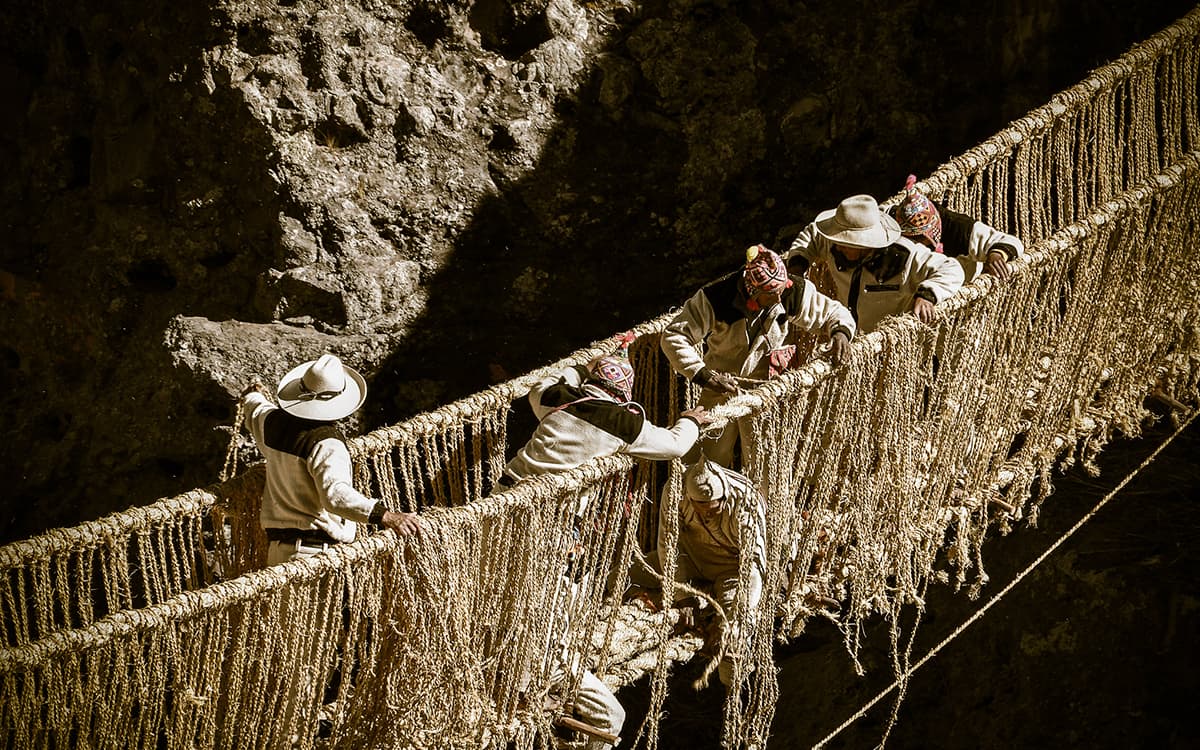
Photo: Qoriankatours. Q’eswachaka, the last Inca bridge in use and also part of the extensive road network or Qapac Ñan, has been recognized by UNESCO as a Cultural Heritage of Humanity.
On Father’s Day, John’s family tried out an aerial adventure park that included a high bridge made of ropes and slats. I told my grandson I thought his picture looked scary, but that was before I knew about the Peruvian rope bridge in today’s article. It may be a UNESCO heritage site, but it looks unbelievably scary to me.
The Guardian via Reuters-Lima explains that local artisans are constantly reweaving the bridge over the river to keep it in good repair.
“Peruvians from the Huinchiri community in Cusco region are rebuilding a 500-year-old Incan hanging bridge, made using traditional weaving techniques to string a crossing together spanning the Apurimac river far below.
The Q’eswachaka bridge has been used for over 500 years to connect communities divided by the river. But during the Covid pandemic it fell into disrepair and collapsed in March.
“Members of the affected communities, such as the Huinchiri, decided to rebuild the 30-meter (98.43 ft) long bridge in the traditional Incan style: by weaving it.
“Teams of workers, starting from both sides of the ravine and balancing on giant main ropes that had been stretched over the river, worked towards the centre, putting in place smaller ropes as barriers between the handrail ropes and the walkway’s floor.
“ ‘Last year because of the pandemic, it wasn’t strengthened … That is why at the beginning of this year the bridge fell,’ said Cusco Regional Governor Jean Paul Benavente. …
“In 2013, Unesco recognized the skills and traditions associated to the reconstruction of the Q’eswachaka bridge as Intangible Cultural Heritage of Humanity.
” ‘This is history. More than 500 years of a paradox in time. The Q’eswachaka, this Incan living bridge, is really an expression and cultural manifestation,’ added Benavente.
“ ‘This is community, in this particular case, the Huinchiri community from the Quehue district is currently working to string up this bridge that connects villages, but that also connects traditions and connects culture.’ ”
For additional scary pictures, check out the Guardian, here. If you plan to visit, Qorianka Tours here, is one option.
By the way, you can see fascinating examples of UNESCO’s Intangible Cultural Heritage of Humanity designations, here. They include such curiosities as Al Aflaj, “traditional irrigation network system in the UAE, oral traditions, knowledge and skills of construction, maintenance and equitable water distribution” in the United Arab Emirates and tree beekeeping in Poland and Belarus.
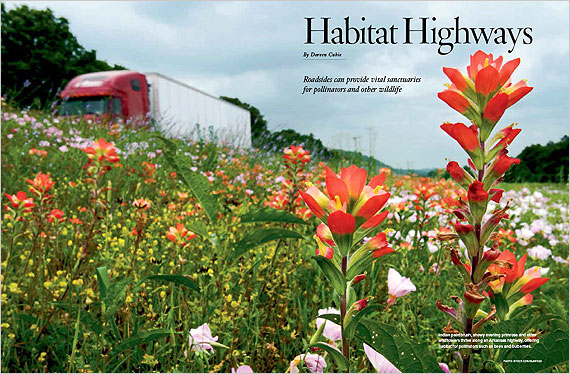
Photo: National Wildlife Federation. More people are realizing that the 17 million acres of US roadsides are vital sanctuaries for pollinators and other wildlife.
Back in the day, when my mother was active in the Rockland County Conservation Association, I learned more about preventing soil erosion using Crown vetch along the new Thruway than any normal kid should be expected to know. Today the plant is considered invasive and the vision for highway landscaping has evolved.
A recent report from the radio show Living on Earth offers the latest thinking.
“Some 17 million acres of green space line US highways and byways, and it’s vital habitat for pollinators, as well as small voles and mice and birds. Bonnie Harper-Lore, a restoration ecologist formerly with the Federal Highway Administration, tells host Steve Curwood about the value they offer to wildlife and how President Lyndon Johnson’s wife, Lady Bird, helped uplift this elongated haven for creatures and wildflowers.
“CURWOOD: Clover is a crucial source of nectar for many pollinators, especially bees. And as national pollinator week is coming up on June 21, it’s a good time to think about the many ways we can help our endangered pollinators, starting with our highways. It turns out that medians and roadsides offer miles and miles of vital habitats for many pollinators, including bees and butterflies. Bonnie Harper-Lore was a restoration ecologist for the Federal Highway Administration, and is a member of the Commission on Minnesota Resources. Welcome to Living on Earth, Bonnie. … We’re talking about those strips of vegetation along the highways. There’s often commercial or residential property right behind them. So, nationwide, just how much of this habitat is there?
“HARPER-LORE: Well, I think the listeners will be surprised to find out that the area between the pavement and the right of way fence on county, state, and interstate highways adds up to a total of 17 million acres, possibly millions of acres of conservation opportunity. … I always saw roadsides from the beginning of my career 30 years ago as an opportunity to benefit wildlife, small wildlife, small birds, small mammals, and migrating birds also use these same corridors. So if they have places to find food and cover, they are all going to do better and their populations will continue to hold where we need them to hold.
“CURWOOD: By the way, I also understand that this roadside habitat has some of the most endangered habitat in various areas – like there are parts of the original prairie that are protected alongside roads, sort of by accident. You can sometimes find real old-growth trees. I mean, how much of a treasure trove is this territory?
“HARPER-LORE: Well that’s just it: We don’t have a complete inventory of all of our roadside vegetation.
I would indeed like to see [an inventory] because I think we would be surprised at how many remnants of these old forests, old prairies, old wetlands even do exist.
“We began doing a bit of that inventory in 1993 in California – found 19 remnants within a very short time and began protecting them, managing differently, not mowing and spraying as they had in the past. So there are some of these. I mean, it’s surprising that they do exist. I know Florida has also some endangered, I believe, pitcher plants that are growing in their rights of ways and they are now watching over them differently than they have in the past. So if we know they’re there we can do differently.
“CURWOOD: So, give us the big picture as to who are the partners in these pollinator conservation efforts.
“HARPER-LORE: Well, first of all, before President Obama visited Mexico and talked to President Nieto and Prime Minister Harper from Canada and they agreed to work together to protect Monarchs – before that point, there were actually a few states that were doing pollinator-focused efforts. Wisconsin comes to mind in that the Karner Blue butterfly is an endangered species, and they actually put together, I believe, a 20-member partnership quite a few years ago to protect the Karner Blue. [That] partnership was mostly private sector, but some state and county agencies, too. … Every state Department of Transportation basically does its own thing, makes its own priorities, but now that there’s been … a reauthorization act that actually supports pollinators, all of the states will start moving in that direction, especially if they know the public is interested. So public support needs to be there.
“CURWOOD: Tell me about the multistate project known as the I-35 corridor, and what’s been done in terms of Monarch protection there? …
“HARPER-LORE: Back in 1993, a group of six states asked the Federal Highway Administration, where I worked at the time, to work together and get some funding to support their effort to actually restore prairie along the I-35 corridor and to protect any remnants that already existed there. … It runs from Minnesota through Iowa, Kansas, Missouri, Oklahoma and Texas, therefore connecting Mexico to the edge of Canada and of course that’s where the Monarchs fly.
“CURWOOD: What other wildlife uses this roadside habitat? …
“HARPER-LORE: I’ve watched hawks, all kinds of raptors, sitting on the light standards along highways and signposts just waiting for lunch to materialize down there in the vegetation on the roadside. Yes, they do well there because there are lots of mice and voles, other small things possible, plus one that actually motivated reduced mowing here in the Midwest, pheasants and other waterfowl, different kinds of ducks will nest in these rights of ways. …
“It’s because of Lady Bird Johnson that my job even existed with the Federal Highway Administration. I was working for the Minnesota Department of Transportation establishing their wildflower program back in the 1980s when I got an invitation from Mrs. Johnson to come visit with four other states who were also interested in planting wildflowers and we sat and talked with her for two days, and the thing we didn’t know she would do — because she asked us what did we need to be able to do more — within that same year, she saw to it that there was an amendment to the transportation bill that requires all states to use certain percent, not a large enough percent, but a certain percent of their budgets on native wildflowers.”
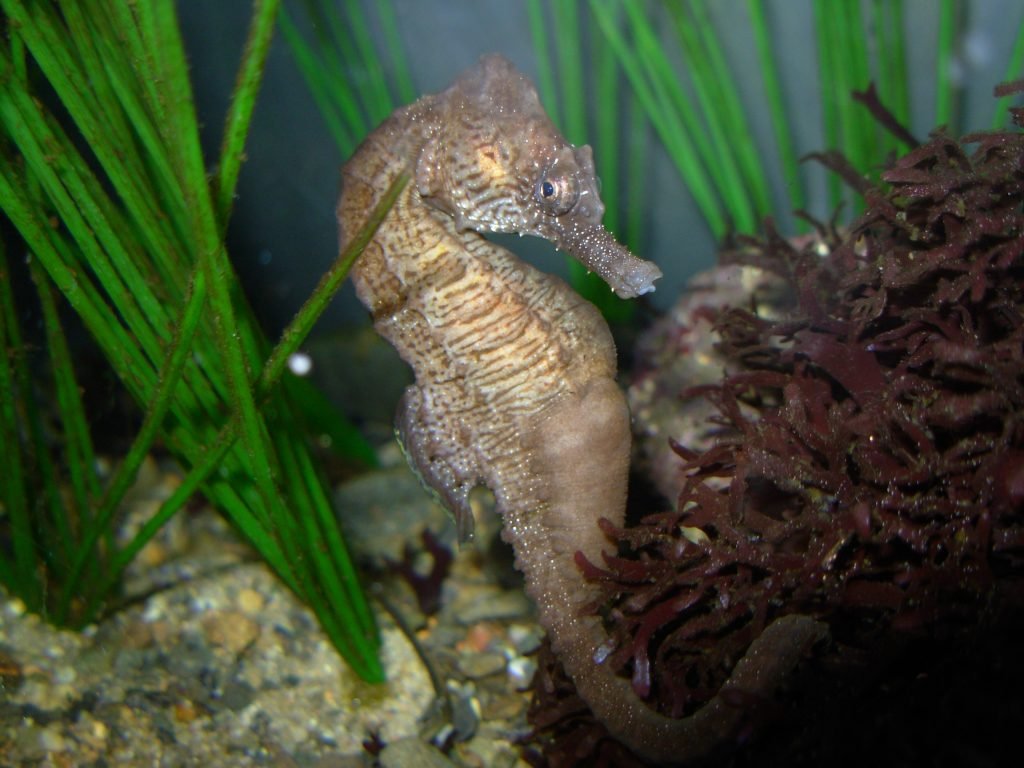
Photo: Seacoast Science Center. The male seahorse carries from 5 to 2,000 babies in his pouch, depending on the species.
More and more dads take on nurturing roles these days, a great benefit to kids — and moms, too. That got me thinking about perhaps the top nurturing dad of the animal kingdom, the seahorse. So I was pleased to find a blog post about papa seahorses at the Seacoast Science Center at Odiorne Point State Park in Rye, New Hampshire.
Intern Ashley Breault, who in 2016 was an Ocean Studies and Communications student at the University of New England, wrote, “Father’s Day is a great time to thank all the dads out there who step up their game for life’s most important job! Inarguably, the most notable dad in the animal kingdom, the seahorse has some pretty unique traits that qualify them for the #1 dad in-the-sea award!
“There are more than 50 different seahorse species … all of which do something that gives them the title of best dad: they are one of the only species in which the male carries and delivers its babies. …
“After hours of a courtship ‘dance’ that includes synchronized tail movements and twirling, a male and female seahorse will mate. The female seahorse makes the eggs, and during this mating process, transfers the unfertilized eggs to the male seahorse. The male seahorse fertilizes the eggs and is now a proud father, carrying anywhere from 5-2,000 babies in his pouch, depending on the species.
“In here, these offspring will get all the food and oxygen they need to develop. Anywhere from 14 days to 4 weeks later, all these little seahorses will be born.
“Baby seahorses are called fry and once they are born, they are completely independent. Mom and dad leave them to find food and shelter all on their own. Unfortunately, only a few of the thousands born will make it to adulthood. …
“Here at the Seacoast Science Center, you can find seahorses in our Eelgrass exhibit tank. The seahorses at the Center are called White’s seahorses, Hippocampus whitei, and are actually native to Australia, where they are a very common along the coast. These seahorses are typically very small, growing no longer than 20 cm. Our seahorses are fed mysid shrimp 4 times a day and get all the love and care they need. Because they are so small, they can only eat small amounts of food at a time, which is why they get fed so often.
“One seahorse species that you might be able to find in our local waters are Lined seahorses, Hippocampus erectus, which can live as far north as Nova Scotia and as far south as Venezuela.” More here.
You might want to check out Seacoast Science Center’s other blog entries, here, especially the post called “One Ocean,” which has a holistic take on the interconnectedness of all the oceans on planet Earth. “The idea of One World Ocean is a relatively new way of thinking about the saltwater basins we all learned about in elementary school. … Over 70% of Earth’s surface is ocean, and understanding its enormous influence on our planet and our lives on land is the first step to understanding the urgency to preserve and protect this life-giving resource.”
The Seacoast Science Center is open Wednesdays to Sundays, 10 am to 4 pm. They encourage people to buy advance tickets and, if unvaccinated and over age 3, to wear a mask.





 Suzanne's Mom's Blog