Feeds:
Posts
Comments

Archive for the ‘Uncategorized’ Category

Photo: Milwaukee Public Schools
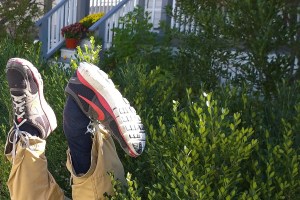
Sarah Wenzel and her class at Forest Home Elementary demonstrate a series of poses from the YogaKids cards, http://www.yogakids.com.

When I was in kindergarten, someone would come to play the piano and we children would walk in a circle pretending to be giraffes (re-e-eaching!) and elephants (swinging gently while bent over).

Just the other day, I realized that those kindergarten stretches were the same as stretches I’ve been doing for my back.

Decades ago, schools like mine were helping kids exercise for health. Now an increasing number of studies suggest that moving while in class helps children’s brains learn better, too.

Donna de la Cruz writes at the NY Times, “Sit still. It’s the mantra of every classroom. But that is changing as evidence builds that taking brief activity breaks during the day helps children learn and be more attentive in class, and a growing number of programs designed to promote movement are being adopted in schools. …

“A 2013 report from the Institute of Medicine concluded that children who are more active ‘show greater attention, have faster cognitive processing speed and perform better on standardized academic tests than children who are less active.’ And a study released in January by Lund University in Sweden shows that students, especially boys, who had daily physical education, did better in school.

“ ‘Daily physical activity is an opportunity for the average school to become a high-performing school,’ said Jesper Fritz, a doctoral student at Lund University and physician at the Skane University Hospital in Malmo, who was the study’s lead author. …

“ ‘Kids aren’t meant to sit still all day and take in information,’ said Steve Boyle, one of the co-founders of the National Association of Physical Literacy, which aims to bring movement into schools. ‘Adults aren’t wired that way either.’

“Mr. Boyle’s association has introduced a series of three- to five-minute videos called ‘BrainErgizers‘ that are being used in schools and Boys and Girls Clubs in 15 states and in Canada, Mexico, Ireland and Australia, he said. A version of the program is available to schools at no charge. …

“ ‘At the end of the week, kids have gotten an hour or more worth of movement, and it’s all done in the classroom with no special equipment,’ Mr. Boyle said. ‘We’re not looking to replace gym classes, we’re aiming to give kids more minutes of movement per week. And by introducing sports into the videos, giving kids a chance to try sports they may not have ever tried before.’ ”

To read more at the NY Times, click here.

Read Full Post »

Before I had children, I didn’t quite “get” Mister Rogers. I thought the slow, gentle way he talked was odd.

But then I saw how John at the age of three reacted to him, and the penny dropped. I hadn’t been able to figure out Mister Rogers because he wasn’t talking to me! He was talking to three-year-olds.

Mister Rogers did know how to talk to grown-ups when needed.

Recently, during the national discussion about possible funding cuts for the arts and Public Broadcasting, someone posted on Facebook a 1969 video of Mister Rogers testifying before US Senator John O. Pastore of Rhode Island. At the time, Sen. Pastore was chairman of US Senate Subcommittee on Communications.

It’s a great, great speech. It’s even recognized as such on the American Rhetoric website. The testimony won PBS $20 million in funding from the originally skeptical Sen. Pastore.

But what strikes me most strongly is that its power comes from the speaker’s clearly communicated belief in the essential goodness of his listener. It is communicated through Mister Rogers’s tone of voice and body language.

Faith in the listener is what came across to three-year-old John, too. “You are special. I like you just the way you are.”

See what you think.

Read Full Post »

Over the years, I have sometimes had reason to take reupholstery projects to a basement off Waltham’s Moody Street. Last week was the first time I noticed a curious figure that has apparently been hanging in the shop for decades. The upholsterer’s wife told me they never knew what to make of it, and she’s afraid to take it down. It’s become a kind of mascot. I’m calling it Guy Noir, and I’m open to theories.

The other pictures I’m sharing today are on more familiar topics: the biking trail in Minuteman Park, forsythia shadows on a rock, a tree weeping sap, a yard in spring, a window at Isabella Stewart Gardner’s palace, the Nesting shop’s sign and grape-hyacinth display, and a Colonial Inn flower box.

If you know what kind of tree grows those decorative yellow tassels, I’d be glad to know learn the name.

042617-Guy-Noir-at-Amelia-Upholstery

041917-MinuteMan-Park


041917-forsythia-Minute-Man-Park

042617-tree-weeps-sap


042617-tassels-on-tree

042017-Gardner-Museum


041417-Nesting-shop-sign

042717-Nesting-Shop-display


041417-Colonial-Inn-flower-boxes


Read Full Post »

042917-Eversley-show-by-Kim-Conaty-BrandeisU


I held off on posting about this Globe art review until I had seen the show myself. My husband and I went yesterday, and it was as elegant as reviewer Cate McQuaid suggests.

She wrote, “Fred Eversley, the subject of a minimalist, cosmic show at the Rose Art Museum at Brandeis University, started out in life as an aerospace engineer. His sleek sculptures, crafted and finished with precision, have the lean economy of industrial design.

“But these works don’t belong on a spacecraft — except, perhaps, to signal to an alien species the breadth of human consciousness. They are oracular. …

“In the mid 1960s, Eversley gave up his job at California’s Wyle Laboratories to become a sculptor. He was 25. By 1970, he had a solo show at New York’s Whitney Museum of American Art. …

“Eversley found his technique quickly, casting liquid polyester resin to first make gleaming, translucent blocks, cones, and arcs, then the wondrous parabolic circles he calls lenses. …

“Neighbors of his there included John McCracken and Larry Bell, artists in California’s Light and Space movement. …

“McCracken gave the young sculptor a can of black paint, and the work that sprang from that companionable gesture makes up this show. Eversley set aside the seductions of emeralds, wine reds, and honeyed yellows for a starker palette. These sculptures may be less intoxicating, but they are commanding, taking on life, death, and cosmology.

“The black pieces mirror, confront, and suck you in; black holes come to mind. White ones cradle and comfort. Gray ones are shrouds, sometimes parting to reveal whatever lies beyond.

The show’s installation, orchestrated by Rose curator Kim Conaty, is a marvel.

“Look through one work at an array of other ones (they are all untitled), and that frame shifts things: Suddenly, you’re not appraising objects in a gallery, but viewing another world, one both distant and intimate. The lenses act as gyres into the imagination.

“They stand on edge. In one suite of three, a nearly open gray circle sits between a black concave lens and a white one. The glossy inward slopes of the outer two slide us right to their centers, where the pigment clears.

“These small openings prompt the gaze of a spy through a keyhole, or a scientist through a scope. We’re discovering a world within. Peer through the black one, and the others resemble a lineup of planets. The wall sculpture beyond, a black-and-white arc, might be a falling star. The world within is galactic.”

More at the Globe, here. See Eversley bio here.

A bonus: we bumped into Kim (the curator) and her charming family, friends of Suzanne, Erik, and the kids. The little ones were about to get a treat at Dairy Joy in Weston, having just been good as gold at a concert in the museum. Kim described the concert on instagram: “#JennieCJones led @brandeisuniversity musicians in an improvisational reading of the score she developed in response to installation instructions by #LouiseNevelson from her 1967 exhibition @roseartmuseum.”


Read Full Post »

screen-shot-2017-04-28-at-153802

Photo: SWG3/Facebook
Y
ardworks takes place May 6 and 7
, 2017, in Glasgow, Scotland.

Melita knows I like artistic graffiti. In fact, we are both such fans of Lata_65 (graffiti for old folks) that we intend to try our hand at spray painting if the organization ever comes to the Boston area.

Today Melita shared a link on Facebook about graffiti in Glasgow.

Gregor Kyle wrote at GlasgowLive, “Scotland’s first dedicated graffiti festival will take street art into the heart of the community in Glasgow and open up new opportunities for young people across the city.

“Next weekend (May 6 and 7) in Finnieston, SWG3 will host over 30 of the world’s finest graffiti artists and 50 of Scotland’s street artists at the Yardworks Festival. …

“One of its main aims is to strengthen SWG3’s bond with the local community and the city of Glasgow as a whole.

“School and youth groups have been invited, with the days featuring specialist graffiti workshops and a ‘Creation Station’ for children which will allow everyone the chance to try their hand at painting. …

“ ‘It’s Scotland’s first graffiti festival and the scale of it now, the way it has grown, it’s massive now,’ explained Gaz, who is himself a graffiti artist and part of the management team at SWG3. …

“Most Glaswegians will know SWG3 as a club and concert space but by day it is a thriving hub for artists, filled with studio spaces and workshops. Slowly but steadily it has progressed over the years with the scale and ambitions of its projects growing bigger and bigger.

” ‘The yard is now basically a massive canvas for the artists,’ continued Gaz. ‘We have rendered the walls, wrapped containers in sheet metal – at no small expense – and every surface will be perfect for the artists to paint on. …

” ‘We are trying to build a sense of community in the area, which can be hard sometimes when you have a transient population with some of the students maybe only staying in the flats here for a term and then moving on.

“ ‘Finnieston has this reputation as this hipster area; what people forget is that there is this core population here and in the likes of Partick and Anderston who have lived here a long time. …

“ ‘The Commonwealth Games in Glasgow were fantastic for the city. They drew people together and, through a number of projects, connected me with a lot of other artists and graffiti writers that I didn’t know in the city.

“ ‘We will be looking to run workshops in the summer for young people and will try to play our part in improving the area and bringing the community together.’ ”

More at GlasgowLive, here.

Read Full Post »

Photo: Steven Senne/AP
New England Patriots 23-year-old rookie wide receiver Malcolm Mitchell joined a suburban women’s book club when he was at the University of Georgia.

Here’s great story that John sent me. He had been to an event at Life is good and heard a young football player talk about the sequence of events that followed his joining a women’s book club.

Emmett Knowlton wrote about the football player at Business Insider.

“New England Patriots 23-year-old rookie wide receiver Malcolm Mitchell is perhaps the biggest book lover in the NFL and, now, a published children’s-book author — all thanks to a chance encounter in a bookstore.

“In a fun story in The Boston Globe back in May, Mitchell said that when he was a junior at the University of Georgia, he decided to join a suburban, all-women’s book club after a serendipitous meeting with one of the members in the stacks of a Barnes & Noble.

” ‘I was there picking up “Me Before You,” the next book for the club,’ Silverleaf Book Club member Kathy Rackley told The Globe. ‘Malcolm walked up to me and said: “Can I ask you something? Can you recommend a book?” ‘

“Rackley had no idea that Mitchell was a star receiver on the Georgia Bulldogs, but the two got to chatting. When Rackley revealed that she was in a book club, Mitchell asked if he could join, and the two exchanged contact information. …

“Two days later, Mitchell showed up to the meeting. From The Globe

‘ “I didn’t mind [inviting him] at all,” [the hostess] recalled. “Because I didn’t think there was any way he’d show up!” But he did and [impressed] the group with his thoughts and opinions — and his own life experiences. …

“Mitchell continued to participate in the club, and he became a real book lover. According to The Globe, he was often found reading at his football locker, and when it was his turn to recommend a book he made his new friends read Marcus Luttrell’s ‘Lone Survivor.’

” ‘The book club helped me grow into a better individual, a person who learns and grows throughout life in general,’ Mitchell said.

“Mitchell’s current lifestyle has made it difficult for him to regularly attend the club. But he remains an avid reader, and he recently published a children’s book, ‘The Magician’s Hat,’ about the magical powers of reading. He started a foundation, too, called Read With Malcolm, that encourages childhood literacy.” More here.

I love the openness and enthusiasm of a guy who would ask a stranger for a book recommendation and then ask to attend the book club!

Read Full Post »

As everyone knows, there was serious unemployment when Franklin D. Roosevelt was president, so, in collaboration with Congress, he had the government hire people to create work that continues to benefit us —  roads and parks, for example, and fine art.

Unfortunately, some murals and sculptures from the 1930s and 1940s have been lost, so the search is on to reclaim it.

Matthew Blitz at Atlas Obscura has the story. “The United States government wants its art back. Special Agent Eric Radwick, who works in the Office of Investigations for the General Service Administration’s Office of the Inspector General, is working to do just that — to locate and recover government-owned long-lost artwork of the New Deal-era federal arts programs. It could be hidden in plain sight.

“It could be in grandma’s attic. It could be in the possession of art collectors. No matter if it was found in the trash or cost a few grand, the art is federal property. … Most people, upon realizing they are in possession of federal property, are cooperative. …

“On May 9th, 1933, President Franklin Delano Roosevelt received a rather curious letter from an old classmate and professional artist George Biddle. Since his March inauguration, President Roosevelt had implemented the most aggressive 100 days agenda in the country’s history in hopes of solving the Great Depression.

“While absurdly busy — he had just delivered his second Fireside Chat and was about to sign both the Farm Relief and Unemployment Relief bills — this note gave him pause. In it, Biddle wrote that he had long admired the Mexican government for paying artists ‘plumbers’ wages’ to paint murals on government buildings expressing Mexican ideals. Perhaps the President should consider something similar in the United States? …

“The letter got the President’s attention. A month later, Biddle met with members of FDR’s administration in Washington about his proposal. By the end of 1933, the first national art relief program — the Public Works of Art Project — was established.

“Over the next decade, the American art scene flourished thanks to the financial encouragement of the government. According to Smithsonian Magazine, in the first four months of 1934 alone, nearly 4,000 artists were hired to produce over 15,000 paintings, murals, sculptures and other works of art for federal buildings across the country. In 1935, the Works Progress Administration’s Federal Art Project was established, the largest of these programs both in scope and number of artists employed. …

“At a time of crisis in America, these programs not only provided an enormous collection of artwork for public consumption, but gave the creators a sense that they were needed. ‘It made them feel like they counted,’ says Virginia M. Mecklenburg, Chief Curator at the Smithsonian American Art Museum.”

Oh, my, what an enlightened federal government! Sometimes one hopes for history to repeat itself.

Read about the challenges of tracking down missing federal artwork at Atlas Obscura, here.

Once upon a time, when the federal government was concerned about unemployment, it paid people to work, artists included. That’s why many murals appeared in post offices and other government buildings in the 1930s and 1940s. This post office mural by Charles Anton Kaeselau depicts the shot heard ’round the world at Concord’s North Bridge.

042617-Kaeselau-North-Bridge-mural

042617-Kaeselau-North-Bridge-mural

Read Full Post »

Photo: Douglas Trattner
A Cleveland co-op trains refugees and others for produce-growing jobs.

I continue to find it fascinating that so many people who are making products for sale are also intent on providing job opportunities for refugees, ex-offenders, and others with challenges.

Douglas Trattner writes about one such effort at Cleveland Scene.

“It’s a brisk late-winter morning in Cleveland, but inside the greenhouses of Green City Growers it feels more like Tampa. …

“At 3.25 acres, this site is one of the largest urban greenhouses in the country, and it happens to sit in the heart of the economically depressed Central neighborhood. Inside the state-of-the-art hydroponic greenhouse, some 300,000 plants at various stages of growth float in shallow pools of nutrient-rich water. There are leafy heads of butter lettuce, colorful mixed-green blends, peppery upland cress and fragrant Italian basil.

“Opened in 2012, Green City Growers has had a promising, albeit challenging, run. Part of the ambitious Evergreen Cooperatives, which includes Evergreen Cooperative Laundry and Ohio Cooperative Solar, the greenhouse was the only one of the three employee-owned companies to not be profitable. That should change this year, says Jeremy Lisy, VP of sales. …

“As a chef and former owner of the specialty produce company KJ Greens, Lisy reached out to his former colleagues to see what types of products they were interested in. He added different lettuces and blends and beefed up sales. This year, the company is expected to hit $3 million in sales, doubling what it was just two years prior. …

“Green City Growers provides 38 people with living-wage jobs and a path to ownership. Working with programs like Refugee Response and Towards Employment, the greenhouse employs many people who might otherwise find it hard to secure gainful employment. On the current roster are people with nonviolent criminal records and immigrants from Bhutan, Guatemala and the Democratic Republic of the Congo.

“After one year of employment, workers get to join the co-op, which includes benefits like credit management and car and mortgage assistance. When the company begins to turn a profit, that money goes to the worker-owners in the form of bonuses and savings for retirement.

“Laurie ‘Spike’ Cook did [time] in the state pen but she currently is the transplant supervisor at the greenhouse and she sits on the board of the co-op. After leaving prison she searched in vain for a job for a full year until she took a class with Towards Employment. A week later she had a full-time job.

” ‘I haven’t missed a day of work in over a year,’ says Cook, who arrives an hour and half before her shift begins every day.

This place gave me a second chance. It makes me want to do better, stay better and do the right thing. Without this job I might have messed up. This job, right here, is the reason I wake up every morning. I plan on staying here until I retire.’

More here.

Photo: James Alan Edward
The nonprofit Beautiful Day trains refugees for the US job market. But if a refugee has a learning disability, the speed of doing even simple tasks may be too slow for a future employer. Let me know if you have a Providence-area job for a cheerful but challenged refugee. There’s someone I’d like to help.

033017-BeautifulDayRI-trainees-photo-by-James-Alan-Edward

Read Full Post »


Photo: Ben Gilbert/Wellcome Collection
Art and science meet at performances for farm animals in England.

Today I have another of my offbeat stories for you. It’s about performing for farm animals and checking their reactions.

Lyn Gardner writes at the Guardian, “Almost 10 years ago, David Harradine made a show in a basement for the Brighton festival. It was called An Infinite Line and featured a horse that stood entirely unconcerned throughout the performance, barely blinking at what went on around him. He was an impressively large presence, a symbolic representation of the natural world, and clearly didn’t give a fig for the theatrical avant-garde.”

Harradine was looking for more reaction from animals in March as his company, Fevered Sleep, conducted “an experiment in which human artists perform for sheep, pigs and goats at a location in Peckham. …

“The show [was] part of the Wellcome Collection’s fascinating Making Nature exhibition, which aims to explore our relationship with the natural world and how we perceive animals. ‘We are starting from the point of view that perception is knowledge,’ says its curator, Honor Beddard, ‘but when you have an encounter with an animal, how do you know that you are not projecting something on to it?’ …

“For Harradine it’s definitely ‘the most bonkers project I’ve been involved in. But it’s fascinating too. The performances are being used to start a conversation.’

“As Harradine says, we prefer not to see animals as being just like us: complex, sentient beings, with emotional responses. To that end, the animals chosen to experience Fevered Sleep’s performance are all what Harradine, himself a vegan, describes as creatures that are mostly perceived as ‘meals in waiting.’ … ‘The purpose is not to suggest that people shouldn’t eat meat but to examine our relationship with animals – and the ethical and political responsibilities of humans towards them.’ ” More here.

Sounds like such fun to be part of a “bonkers” performance. I think we could all do with a little nutty creativity in our lives.

Read Full Post »

Hi, Folks, I’m sharing a post from another blogger. An extra for today. It fits with posts I’ve had about unusual instruments.

Amelia in Hull

Hey guys!! So on Monday 17th April, me and my family went to the Humber Bridge so we could experience the ‘Height of the Reeds’ event which was on there. We put headphones on and walked 2.5k over the Humber Bridge listening to music that had been specially composed by Arve Henriksen, Jan Bang and Eivind Aarset for the event. However, on the way back you could listen to music that was made by the bridge itself!! The ‘Height of the Reeds’ music featured the amazing music of both the chorus and Orchestra of Opera North and the field recordings were taken by Jez Riley French. ‘Height of the Reeds’ is possibly one of my favourite City of Culture events so far and I’m really glad I got the opportunity to do this event. In today’s blog post, I’m going to be describing ‘Height of the Reeds’ and giving you…

View original post 312 more words

Read Full Post »

Art: Caleb Cole
“The Teacher,” exhibited at a Montserrat College of Art show, is a portrait of unnoticed dedication.

Cate McQuaid’s recent Boston Globe review of an art exhibit really spoke to me. I liked the idea of portraits that have meaning beneath the surface, and I especially liked the portrait of a teacher devoting extra time to his job. Anyway, that’s what I saw here. McQuaid saw woe.

McQuaid wrote, “With portraits, the subject tries on one face, the artist may capture another, and the viewer may see something else. Your projection, my projection. It’s all dreadfully nebulous, but if it weren’t, it would be pat and dull.

“ ‘Observance: As I See You, You See Me,’ an exhibition of photographic portraits at Montserrat College of Art’s Montserrat Gallery, examines what these shifting valences tell us about identity and societal assumptions. Many of the artists and subjects, people of color or queer, have experienced the walls strangers throw up based on appearance alone. …

“Woe is a keynote in Caleb Cole’s series ‘Other People Clothes,’ elaborately staged scenes in which the artist creates fictional personae. Cole is small and balding, with a peak of red hair, like Tintin. In ‘February Is Dental Month,’ the artist, surrounded by file folders, looks down at us from behind a large desk. We can find a story here, but the expression tells more: alienation, tenderness, perhaps disdain.” More here.

As much as I like abstract art, representational art that stirs the depths can be fascinating.

My Struggle, by Karl Ove Knausgaard, does something like that. The seemingly endless minutiae of the author’s life and thoughts flow along the surface, but something compelling emerges that is hard to describe. The writing is cinematic. The author sees everything, and observing him observe everything creates a powerful connection.

Interestingly, in the part of My Struggle that I’m reading now, Book 5, Knausgaard gets a tip from a successful novelist about having the “hinterland,” or backstory, of all your characters in mind when you write fiction. As with the Cole portrait of the teacher, the observer will sense things that are not spelled out.

Read Full Post »

The United States has the highest incarceration rate in the world. Some reasons: required minimum sentences, for-profit prisons that lobby officials to get more business, lack of programs to treat addictions. Most US prisons don’t help people who commit crimes to learn better behaviors, and it’s hard for ex-offenders to find jobs when they get out.

According to the Sentencing Project, “In the last forty years, incarceration has increased with rates upwards of 500% despite crime rates decreasing nationally.”

The good news is that here and there, local sheriffs are experimenting with techniques to reduce recidivism, as are individual states. Whether the new programs are motivated by the wish to save public money, by compassion, or for any other reason, the trend is promising.

Mikaela Porter writes at the Hartford Courant about an initiative in Connecticut.

“For years John Pittman was known as a lifer in the state prison here. But now, he’s taken on a new identity: mentor. …

” ‘My philosophy is this: no one is going to save us but us,’ Pittman said in an interview. ‘I’m older than these guys – grandfather age – and if they can learn something from me without being in my situation with a life sentence then I felt I did my job.’

“The pilot program, called T.R.U.E. (Truthfulness to oneself and others, Respect toward the community, Understanding ourselves and what brought us here, Elevating into success) was set up [early this year] for about 70 18- to 25-year-old offenders at the prison. …

“The pilot program started with a visit to Germany, when Gov. Dannel P. Malloy, Correction Commissioner Scott Semple, Vera Institute of Justice President Nicholas Turner toured prisons there.

” ‘We saw people behind bars who had keys to their own cells, cells [they] decorated themselves,’ Turner said. ‘They wore their own street clothes and they cooked their own meals and they worked in the community. People who were there left better off than they had come in.’ …

” ‘This population of 18- to 25-year-olds is responsible for 25 percent of the incidents that we respond to within our correctional institutions,’ Cheshire Warden Scott Erfe said.

“Erfe said approximately 100 correction staff over three shifts will work in the unit, and that workers have taken three weeks of training on human development and behavioral impact, motivational interviewing, mediation and conflict resolution for young offenders, trauma-informed interventions for young adult offenders and family engagement.

“The program includes work on life skills, educational assistance, team-building exercises and family assistance.

” ‘Although this unit is still in its infancy, it is clear that this has a chance to be something truly special,’ Erfe said.” More here.

I particularly like the “U” of T.R.U.E. I believe a lack of self-knowledge probably underlies most of the world’s problems, not just incarceration rates.

Photo: Lauren Schneiderman / Hartford Courant
Inmates talk to Connecticut Gov. Dannel P. Malloy about a rehabilitation program at the Cheshire Correctional Institution. Mentors work with offenders between the ages 18-25 to both make facilities safer and prevent young adults from returning to prison.

Read Full Post »

Photo: Biosphoto/Ardea/Caters News Agency
New energy generator may not be as attractive as a tree, but it’s also not as noisy as a standard wind turbine.

While you and I are just bopping along following our familiar routines, it’s reassuring to know that inventors are out there inventing.

Victoria Woollaston writes for the Daily Mail about one inventor who may help reduce global warming by making the use of wind turbines more widespread.

She says, “Monstrous, noisy conventional wind turbines may soon be a thing of the past thanks to tree-shaped wind turbines being installed in Paris. …

“French company ‘New Wind’ is installing the first at Place de la Concorde in Paris and is hoping to expand throughout the country and abroad. The 26ft (8 metre) trees are fitted with 63 aeroleaves. Each one uses tiny blades inside the ‘leaves’ and can generate electricity in wind speeds as low as 4.5mph (7km/h), and regardless of the wind’s direction. …

“The company’s founder, Jérôme Michaud-Larivière, hopes the trees can be used to exploit small air currents flowing along buildings and streets, and could eventually be installed in people’s backgardens and urban centres. …

“The trees are also silent, so sound pollution would not be an issue — a major improvement from past designs. The trees currently retail at £23,500 ($33,670).

” ‘The idea came to me in a square where I saw the leaves tremble when there was not a breath of air,’ said Jérôme Michaud-Larivière, the founder of the Parisian start-up. …

“In the future Mr Michaud-Larivière hopes to develop a ‘perfect’ tree that has leaves with natural fibres, roots that could generate geothermal energy and ‘bark’ covered with photosensitive cells.”

Readers can probably guess what I love most about this invention: “The trees can be used to exploit small air currents flowing along buildings and streets.”  That sure fits with my mantra about small things adding up: “One and one and 50 make a million.” (Line adapted from Pete Seeger’s “One Man’s Hands.”)

More at the Daily Mail, here.

Read Full Post »

Hard to believe, I know, but some things have gotten better. Take accessibility. When my father was disabled by a stroke in the 1950s, there were few supports for families. There were no ramps, no specialized bathrooms at highway rest stops, no programs to teach the afflicted new ways to be independent. People with disabilities were mostly on their own.

Today, there are interpreters for the deaf who are as dramatic and interesting as anything being interpreted, there are kneeling buses and building regulations that incorporate universal design precepts (ramps, wide doors for wheelchairs, high toilet seats, grab bars), and more.

The other day when my husband and I watched a Disney film on Netflix, we even discovered that someone with vision impairment could get all the images narrated.

And here’s another new angle: a contemporary museum is using virtual reality to enable folks in wheelchairs to see an otherwise inaccessible exhibit. Steven Overly at the Washington Post has the story.

“The magic of the ‘Infinity Mirrors’ exhibit begins as soon as the door is closed behind you. Surrounded by mirrors on all sides, visitors find themselves at the center of a seemingly endless plain filled with brightly colored lights and geometric sculptures.

“But curators at the Hirshhorn Museum and Sculpture Garden, where the exhibit is on display until May 14, faced an early challenge: how to re-create that magic for visitors in wheelchairs. …

“Drew Doucette, who oversees multimedia and technology initiatives at the Hirshhorn, thought immediately of virtual reality. …

“The Renwick Gallery, National Museum of Natural History and other Smithsonian Institution sites have created virtual experiences in the past, often with the goal of extending the exhibit to people or students who may not be able to visit in person. The ‘Infinity Mirrors’ exhibit marks the first time any have used virtual reality to make an exhibit accessible to those with disabilities, [Beth Ziebarth, director of the Smithsonian’s Accessibility Program] said.

“The wildly popular art exhibit is spread across six portable rooms, each filled with objects created by Japanese artist Yayoi Kusama. …

“But in three of the rooms, visitors must walk through 30-inch doorways and onto platforms less than four feet wide to achieve the full experience. …

“It took roughly four months to plan and design the Infinity Mirrors virtual reality experience on Unity, a program typically used to build video games, Doucette said. …

“ ‘We essentially had to take a step back from trying to recreate the rooms and get into the head of Kusama and say, “What was she trying to do? How did she end up using mirrors?” ‘ Doucette said.” Read more.

Photo: Bill O’Leary/The Washington Post
Volunteer Megan Walline experiences the installation “Infinity Mirrored Room — All the Eternal Love I Have for the Pumpkins” at the Hirshhorn in Washington, DC.

Read Full Post »

Photo: Graeme Richardson / Ice Music

And speaking of ice hotels, you might want to try an ice concert one of these days. That is, if you get yourself as far north as Swedish Lapland (also known as “the world’s best place for experiencing the Northern Lights“).

Tod Perry writes at Good that ice instruments have an ephemeral quality that is reminiscent of Buddhist mandelas.

“Tibetan Buddhists have a tradition of making elaborate artwork out of colored sand and, upon its completion, blowing it all into a river. The ritual is to show their belief in the transitory nature of life.

“On the other side of the world, a man [from Colorado who is working] in Sweden has created another form of temporary art by making music out of ice. Twenty years ago, Tim Linhart made his first ‘ICEstrument’ on a snowy mountaintop and his obsession led him to create an entire frozen orchestra and chamber hall.

“In Lulea, Sweden, [the ice sculptor] has made his own igloo concert hall where musicians perform with string and percussion instruments made of ice.

“One of the major problems with conducting an ice orchestra is that the instruments eventually fall out of tune due to body heat from the performers and audience. This has led Linhart to create a unique venting system in his ice theater that filters the body heat out of the igloo.

“Linhart’s ice instruments have a beautiful sound that play on our deep connection to water.

” ‘The ice instrument is made of frozen water, we’re made of melted water. And that physical connection opens the door for a spiritual connection,’ he says.”

Read more at Good, here.

Read Full Post »

« Newer Posts - Older Posts »