Feeds:
Posts
Comments

Archive for the ‘Uncategorized’ Category

A recent post at Asakiyume’s blog reminded me of Young at Heart, the senior-citizen chorus that inspired a movie I recommended to readers in 2011.

Asakiyume wrote, “One of the women I work with at the jail is in the choir there. I got permission to go in for the performance. The jail choir group is called the Majestics, and they’ve been mentored by a senior-citizen choir called Young at Heart, all of whom were wearing T-shirts that said ‘We put the “zen” in “senior citizen.'”

“Young at Heart performed as the opening act … Then the Majestics took the stage. There were six women, and they covered a great age range (three in their twenties, two in their thirties-forties, and one who was even older than me) and ethnically diverse (two Black, one Hispanic, three White). They sang well-known songs with lots of different flavors (hip-hop, pop, blues, soul), and all the choir members were featured at least once … The entire thing was a huge success; the audience was **so** supportive. …

“At the end the programs director called for an encore, and there hadn’t been a song laid by for that, but the Young At Heart choir sang “Forever Young” … Each time someone sang a solo, he or she linked arms with one of the members of the Majestics and brought them forward, and I could see tears in my student’s eyes and I had tears in mine, because–as the chaplain who was present pointed out–that song is a benediction, and it was so great to hear those words of blessing and hope and expectation directed at the audience in the jail:

May you grow up to be righteous
May you grow up to be true
May you always know the truth
And see the lights surrounding you
May you always be courageous
Stand upright and be strong
And may you stay
Forever young”

-@-

So lovely. Such songs take on extra meaning when sung by seniors or by people who feel hopeless.

The Young at Heart movie, which I still hope you’ll see, was also full of resonance. And it exposed me to popular music like Coldplay’s “I will try to fix you.” Whenever that song comes on the radio, I see in my mind’s eye the old guy with the oxygen tank who drew tears from his audiences. He is surely gone now, but not that memory.

That the chorus has gone beyond inspiring seniors and their families to inspiring prisoners who have little to make them feel positive or hopeful — well, it’s just too amazing.

More at Asakiyume’s blog, here.

Read Full Post »

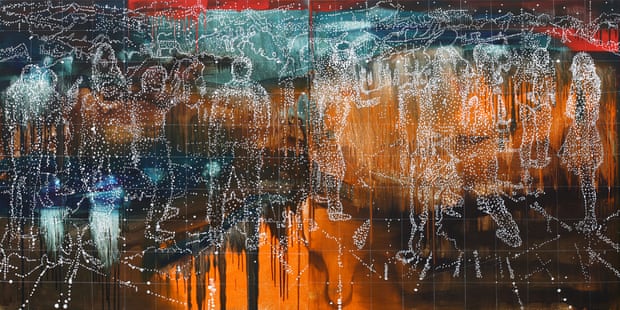
Photo: Getty
People take part in an installation entitled Sea of Hull, by artist Spencer Tunick.

The notion that the arts and related fields like graphic design can boost local economies has been an article of faith for decades, causing disappointment when it frequently fails to lift whole cities above poverty.

Nevertheless, done right and with other stars in alignment, it can be a piece of the economic puzzle in a changing world.

Here is a recent angle from Kingston upon Hull in the UK.

David Barnett reports at the Independent, “On New Year’s Day, a firework display heralded the beginning of Hull’s tenure as the Britain’s City of Culture. Multimedia stories from the city’s maritime and industrial heritage were projected on local buildings in front of a crowd of thousands.

“Over in the Hull City Museum they like a bit of culture and they know Hull’s had it for a long time; exhibits go back to the Paleolithic era. There’s also a recreation of a Roman bath house, featuring mosaics discovered in the 1940s in the Roman settlement of Petuaria, modern-day Brough in East Yorkshire.

“But never mind the Romans … what, the people of Hull might be asking, in true Monty Python’s Life of Brian style, has culture ever done for us? …

“It regularly tops the deprivation rankings for the UK’s 326 local authorities – according to the Kingston upon Hull Data Observatory’s latest figures, Hull ranks as the third most deprived local authority generally, and tops the lists of deprivation for education, skills and training. ..

“Perhaps a typical, post-industrial Northern city. Its traditional industries of whaling and sea-fishing have declined, as elsewhere; Hull still remains a large port, though, and there has been a successful drive to attract chemical and health companies to the area. …

“ ‘There might well be degrees of scepticism about what culture can mean to a place like Hull,’ says Robert Palmer, the director of the team that won and managed Glasgow’s successful bid to be named European City of Culture (as it was then known) in 1990. ‘But being designated a capital of culture can bring long-term effects in terms of the legacy it can offer.’ …

” ‘We employ a very broad definition of culture,’ says Palmer. ‘It’s not just what people might think of as “fine culture.” It’s not just opera. …’

“Which is why Hull’s City of Culture website lists events for the coming year that range from acrobatics to walking tours, by way of cabaret, jazz, literature, parkour and, yes, opera. Which is all very nice, but is it just a distraction from the problems facing Hull?

“ ‘There are tangible economic benefits,’ says Palmer. ‘We’ve seen it before in all cities that get a culture status, it’s well documented. Visitor numbers, job creation, the social impact through participation from social groups who are not normally involved in culture. The benefits are incontestable.’ ”

Lots more here.

Perhaps one year of intense focus on the arts and culture can energize enough residents to keep the momentum going. It certainly seems to have done so for Liverpool, another struggling postindustrial city that was a UK City of Culture in 2008.

One wonders if a designation as, say, a City of Math and Science might have the same kind of long-term ripples.

Read Full Post »

Photo: Jack Alterman
Linda Lear’s books include biographies of Beatrix Potter and Rachel Carson.

In 2015, I wrote here about Linda Lear’s excellent biography of Beatrix Potter, which highlights the scientific side of the beloved children’s book author /illustrator /land preservationist.

More recently, when my husband and I were watching a television special on Rachel Carson (author of The Sea Around Us and Silent Spring), I saw Lear being interviewed and realized she’d written a biography of Carson, too.

So I went to Linda Lear’s web page to learn more about her.

“Whenever my parents drove over the Allegheny River into downtown Pittsburgh from the rural community of Glenshaw where I was born,” Lear reports, “I begged my father not to go over the bridge that crossed the river above the stock yards.

“There were animal parts visible in the yard, and debris strewn along the river’s edge. The smell of dead animals mixed with the stench of sulfur from the smelting operations further down river. We talked about why the city was dirty, the river polluted, and what we could do about it. For generations my family had been involved in the natural world and from them I learned to appreciate and nurture it.

“My grandfather loved books and loved to read to me when I was little. Our favorites were fairy tales, [Grimm brothers] and [Hans Christian Anderson], Lewis Carroll, and any sort of animal fable. We loved Aesop, Br’er Rabbit, Uncle Wiggly, and of course, Peter Rabbit. He introduced me to the nonsense rhymes of Edward Lear, and to illustrators such as [Mary Jo] Beswick, Walter Crane, and Beatrix Potter.

“From my grandparents and from my mother, I absorbed the pleasures of gardening, herbaceous and perennial, learning the names of plants, and later of making a garden of my own. I always loved woodland flowers and animals. I became adept at rescuing stray kittens and baby rabbits, and finally got a healthy kitten of my own.

“I was educated at women’s schools until my graduate work at Columbia University. Before finishing my doctorate, I taught American history at independent schools, and fortunately ended up teaching at one in Washington, D.C. in the late 1960s — just in time to become an activist.

“I have had a long career in college and university teaching and have written a variety of books and articles. I began to specialize in environmental history just as the field was being defined. Fellowships at Yale’s Beinecke Rare Book Library and at the Smithsonian Institution allowed me to redefine myself as a full-time writer.”

Read her comments on her books here.

Read Full Post »

Photo: Andrew Edlin Gallery
Part-time gravedigger John Byam’s carvings of hands, as seen in a New York gallery.

Artists often have to support themselves with non-art jobs. Gone are the wealthy arts patrons of past centuries, and maybe that’s not all bad, considering the Medicis. In any case, it’s interesting to see what kinds of jobs contemporary artists hold down. You may recall this post about Brando’s gardener’s art, for example.

Now at Hypoallergic, Allison Meier describes the recent gallery showing of a self-taught artist who dug graves in his spare time.

“Dusted with sawdust, John Byam’s sculptures appear as if they’ve just been carved, the shavings attached with glue binder giving a rawness to the miniature spacecrafts, airplanes, houses, helicopters, cameras, and coffins. Andrew Edlin Gallery in Manhattan [displayed] an assembly of these pocket-sized pieces by the late Byam in Unearthed. …

“Born in 1929 in Oneonta, New York, Byam mostly lived a local life, working at his family’s trailer court, with a two-year stint in the military taking him to Japan during the Korean War.

“Later, he had odd jobs with the Delaware and Hudson Railway and as a gravedigger at the local cemetery. The wood carvings, arranged by theme at Andrew Edlin with no label text, have traces of this autobiographical narrative, with a platoon of tanks and heavy artillery, or an open coffin, colored black, on a rolling gurney.

“Yet others, like spaceships and rockets, one with ‘”Moon or Bust’ scrawled in red, herald dreams of exploration. Recognizable pop culture forms, including the U.S.S. Enterprise from Star Trek, suggest these ambitions were limited to vicarious experiences through television, magazines, and movies.

“While that gives the toy-like objects a melancholy edge, they have a lot of joy in their detailed shapes. Byam seemed to delight in making even a simple chair on such a small-scale, with annotations in pencil indicating details like ‘door front’ on a tiny house. An array of human hands chiseled into various poses, one holding a coin, another with the words ‘2 close hands’ folded in prayer, shows a similar enchantment with the shape of things. …

“Byam was a deft craftsman in the tradition of American vernacular woodcarving, and his roughly hewn art is haunted by 20th-century culture, both its wars and fantasies.”

Hyperallergic has some great pictures of Byam’s art here.

Read Full Post »

Photo: Craig T. Mathew / Mathew Imaging
Morris Robinson and Brenton Ryan in L.A. Opera’s “The Abduction From the Seraglio.”

Yesterday my husband and I were talking about Swedenborgianism. I’m not sure why. The little I know comes from an obscure 1876 Wilkie Collins novel called Two Destinies. From that I learned that followers of Swedenborg believe that nothing but trouble can result from trying to avoid your destiny.

Whether or not bad things would have happened to Morris Robinson if he kept running from his destiny, I can’t say, but as Christopher Smith writes in the Los Angeles Times, it sure took the acclaimed bass a long time to embrace it.

“Opera,” writes Smith, “is often called the most irrational art form. Seen through that lens, bass singer Morris Robinson’s unlikely career path makes wonderful sense.

“At a young age, from a family and culture that reveres singing, Robinson aspired to be a drummer instead. He ignored college music scholarships and conservatory programs for a free-ride to play football at a military college. Afterward, bypassing all thought of studying music at grad school, he worked for a Fortune 500 company in regional sales of data storage.

“At 30, in finally attempting to sing professionally, he tried out for the chorus of ‘Aida’ at the Boston Lyric Opera, the biggest company in New England. A week later, the music director handed him music for a solo role, accompanied by a plea: ‘Please don’t screw it up.’

‘A lot of the purists, they don’t believe my story,’ Robinson said. ‘They don’t believe it until they witness it themselves.’ …

“Now 47 and equipped with 18 years of major roles with A-list companies nationally and internationally, Robinson has forged a life path in opera that seems inevitable in retrospect. After all, he was ‘the rare person,’ L.A. Opera music director James Conlon said, ‘born with the great voice where strength predates technique. It’s a round, large voice.’ …

“But throughout his life he seemed to ignore, even actively ward off, singing — though it was always around him.

“Raised in a musical clan in Atlanta, Robinson had a dad, mom and three young sisters who all sang. Around 6, he participated in a church choir and then the Atlanta Boy Choir, alternately immersed in religious and secular music.

“But singing was at best a backdrop, maybe even an obstacle. …

“ ‘To me, at heart, I was a drummer. Because if you’re going to be in a church in the South, there has to be rhythm. It was always about beats, beats, beats.’

“He entered a performing arts high school. His senior year he made all-city band and all-state chorus.

“But all he really cared about? Football. Standing 6-foot-2 and weighing in the high 200s, he was aware ‘the cool guys are out there making plays on the football field while you are wearing your uniforms, marching around at halftime. … Who wants to do that?

“ ‘I had to redeem myself, my masculinity, I guess.’ ”

Read how Robinson kept resisting the inevitable and how destiny got the last say, here.

Read Full Post »

Photo: Jason Koxvold

Question: What is halfway between the book-sharing Little Free Libraries that are sweeping the country and your town library? Answer: A personal library set apart from your home in a tiny house.

The Today show interviewed an artist whose friends helped him build one, perhaps also securing themselves a place to stay as a guest.

Christina Poletto reports, “In New York’s Ulster County, at the base of the Catskills Mountains, Jason Koxvold’s woodland home has a new addition to the property that is nothing short of stunning. There, tucked among the property’s forest of oak trees, sits a tiny one-room library which holds 2,500 books.

“Koxvold, a British artist based in New York, owns the property and was inspired to carve out a space specifically for solitude and escape. ‘I work from this location and was looking to make a quiet space for writing and reflection,’ Koxvold told TODAY.

“When there’s an overflow of visiting guests, the forest library also serves as an additional bedroom. …

“Koxvold desired a simple, singular structure that he could construct on his own using red oak from the property.

“Using already-felled trees left over from the construction of the main house, cut trees were planed on site into large log sections measuring 8 x 8 feet. After air drying the 12,000 lbs of milled red oak for several seasons, they became the shelving and cubbies that make up the the library’s interior.

“Koxvold was able to complete this structure with the help of eight different friends over the course of a year.

“While the monolithic shape and black exterior is shocking against the natural forest forms, the interior, heated by a single small wood stove, is as warm as it is cozy. A lone picture window looking into the forest is a source of natural light. …

“If you’re lucky enough to be invited as a guest, you’re welcome to leave a private message in one of the books on the shelves.” More.

Nice idea about leaving notes. In Suzanne and Erik’s Harlem apartment, an entire wall was available for written messages. Guests loved it.

Read Full Post »

Illustration: Ben Kirchner
Raduan Nassar was 48 and at the height of his literary fame when, in 1984, he announced his retirement. He wanted to become a farmer.

I liked a recent article in the New Yorker about a Brazilian who left the writing life to become a farmer. Did literary perfectionism stress him out too much, or did farming just seem more real?

Alejandro Chacoff has the story.

“In 1973, the Brazilian writer Raduan Nassar quit his job. After six years as editor-in-chief at the Jornal do Bairro, an influential left-wing newspaper that opposed Brazil’s military regime, [he left] and spent a year in his São Paulo apartment, working twelve hours a day on a book, ‘crying the whole time.’ In ‘Ancient Tillage,’ the strange, short novel he wrote, a young man flees his rural home and family, only to return, chastened and a little humiliated, to the place of his childhood.

“ ‘Ancient Tillage’ was published in 1975, to immediate critical acclaim. … In 1978, a second novel appeared in print; Nassar had written the first draft of ‘A Cup of Rage’ in 1970, while living in Granja Viana, a bucolic neighborhood on the outskirts of the city. It, too, was received euphorically, winning the São Paulo Art Critics’ Association Prize (ACPA). …

Last year, Nassar’s two novels were translated into English for the first time, for the Penguin Modern Classics Series. …

“Nassar was forty-eight and at the height of his literary fame when, in 1984, he gave an interview with Folha de São Paulo, the country’s biggest daily newspaper, in which he announced his retirement. He wanted to become a farmer. … The following year, he bought a property of roughly sixteen hundred acres and began to plant soy, corn, beans, and wheat. …

“Nassar said that farming had always been his main occupation, whereas writing had ‘just been another activity.’ But his life in agriculture did not begin smoothly.

“ ‘For the first six years, we got killed; there were only losses.’ … Like his characters, he appears to have found solace in manual labor. ‘My life now is about doing, doing, doing,’ he told an interviewer, in 1996, when asked how he was faring after his literary retirement. …

“Both [Luiz Schwarcz, the editor-in-chief of Companhia das Letras, the country’s main publishing house,] and [Antonio Fernando de Franceschi, a poet and critic who became a close friend of Nassar’s,] believe that Nassar’s decision to quit came not from a waning of interest but from literary perfectionism. ‘He’s a guy who devotes himself so much to the craft that I think it’s hard for him to feel rewarded,’ Schwarcz said.” More here.

I intend to track down his books.

Read Full Post »

Photo: Evan Petty
Kids enjoying the baseball field at the Allen VR Stanley Secondary School of Math and Science for the Athletically Talented near Kampala, Uganda. 

The inimitable Karen Given at WBUR radio’s Only a Game has found another inspiring story to share with listeners. This one is about a Syracuse University grad who found his calling thanks to a youth baseball team in Uganda.

“Back in the spring of 2014, Evan Petty was a senior at Syracuse University. And he was feeling a little anxious.

” ‘Um … the pressure’s starting to kick in at that point,’ Evan says. “I didn’t really know what it is that I was really going to do. I had always really liked sports. I got a journalism degree, but I didn’t work hard enough to turn it into anything.’ …

“After graduation, Evan flew to Fairbanks to write game reports for the Goldpanners — a collegiate summer team. …

” ‘I guess it bought me time. That’s pretty much all it did,’ he says.

“Evan spent that summer thinking about baseball — he’d always loved the game. He thought he’d like to be a coach. But he didn’t have any training or experience. He figured he’d never find a paid job in this country, so he started looking elsewhere.

” ‘So I think that I looked in places like Japan, even, and places in Europe. Spain, they play some baseball. I took some Spanish in high school, maybe I could make something work with that,’ Evan says. ‘But then Uganda came up.’

“Yep. Uganda. A school was looking for an English teacher/assistant baseball coach.

“The Allen VR Stanley International School of Math and Science for the Athletically Talented was founded by an American businessman who wants to bring baseball to Uganda. Besides teaching kids math and science and English, the school had another well-publicized goal: to send a team to Williamsport.

“Evan had been watching the Little League World Series on TV since he was 13. He loves it.

“The quality of the play is so high, and everything about it is so emotional and real. It’s raw. Like, it’s so raw. It’s just the best,” he says. …

“Evan hopped on an airplane and flew to Kampala. …

“When Evan saw the baseball team he’d be coaching, he was even more excited. It’s not that the players had a lot of experience. In fact, many of them had none at all.

” ‘Put it this way: Balls were being thrown very fast, and bats were being swung very hard, and players were running very fast,’ Evan says. ‘There was a lot of raw talent everywhere.’ …

“In 2011, the team won the qualifying tournament in Poland, but the players were denied visas to come to the United States. Many of the players don’t have birth certificates. ‘Paperwork is hard in Uganda,’ Evan told me. …

” ‘We had to do a whole lot of stuff and satisfy a whole lot of people and pay a whole lot of money [in 2015 to attend the qualifying games in Poland],’ Evan says. ‘And then we had to win the games, and that was the easy part.’ …

“Uganda was headed back to Williamsport, and they had one simple goal.

” ‘Shock the world,’ Evan says.”

That is what they did. Read more.

Interestingly, the Disney flic Queen of Katwe — about a young female chess prodigy from the Katwe, Uganda, slums — also demonstrates that committed adults and international competitions offer Ugandan children one of their best hopes for rising above challenging circumstances.

Read Full Post »

Photo: City of Asylum
City of Asylum Books specializes in translation and world literature. 

With Amazon opening retail bookstores in Greater Boston and elsewhere, the independent bookstores we all love are more threatened than ever. What new models will help them survive?

The Nonprofit Quarterly discusses one idea.

Louis Altman writes, “Conventional wisdom is that the goliath Amazon, the dominant and diversified Internet retailer of everything from books to 7-string zithers has, with unbeatable pricing and almost infinite selection, crushed all brick-and-mortar booksellers in its path. …

“The truth is that independent booksellers are thriving, with 30 percent growth in the number of these stores from 2009–2016, to 2,311 as of 2016. Between 2014 and 2015, independent booksellers saw their market share actually grow from 7 percent of all book sales in 2014 to 10 percent in 2015. …

“The answer may lie with niche-filling shops like Pittsburgh’s new City of Asylum Books, part of a nascent multipurpose cultural center on the city’s North Side called Alphabet City Center. Alphabet City is a consolidated space recently acquired by City of Asylum, a nonprofit arts organization providing sanctuary and forums of expression for exiled writers of all genres from other countries, introducing many unsung voices to the Pittsburgh public through literary community events. …

“The nonprofit bookstore opened … January 14th, offering some 10,000 titles on a wide range of subjects, specializing in translated works and world literature, in 1,200 square feet of space in the Alphabet City building, which includes a bar, restaurant and a venue for readings, performances and workshops. The bookstore sells everything from cookbooks to children’s books to poetry and harbors a giving library, where patrons can take—and give—books for free. …

“Kepler’s Books of Menlo Park, California, [restructured] as a community-owned bookstore, creating a ‘hybrid model’ maintaining operation of the for-profit bookstore, connecting it with a nonprofit arm housing and sponsoring local literary events and presentations for local schools and the community.” More here.

Whether the independent bookstore will find salvation in nonprofit approaches remains to be seen, but creative thinking is sure to be a requirement for longevity. I myself think independents will need to provide services that many used bookstores, particularly nonprofit used bookstores like the Bryn Mawr Book Store in Cambridge, Mass., provide — for example, tracking down out-of-print books for a fee.

My local independent doesn’t offer many extras. It won’t order self-published books for customers, so I am forced to use Amazon if I want one. “Self-published” can include popular books published in England but not yet available in the US through normal channels. Amazon will provide. Why not independents?

There are other issues with my local independent such as shelving two of my three ordered books when they are all the same title, not offering delivery for a fee, and having a website they know is not worth using. But I want the shop to survive, so I order anything from there that it is willing to get for me.

I’d be interested in other people’s experiences and advice for independents.

Read Full Post »


Photo: Arnaud Stephenson
Perfectly timed movements create the illusion of weightlessness in performances that combine ballet and juggling.

Artists always seem to be looking for new forms of expression. The Washington Post recently reported on a production that increases the challenges of two precise kinds of movement by performing them in tandem.

Sadie Dingfelder spoke with Sean Gandini, “the creator, the director and one of the performers of ‘4×4: Ephemeral Architectures,’ a mesmerizing clockwork of human bodies and juggling objects flying through space. …

“In the months of rehearsals that took place before the piece’s London premiere in 2015, there were plenty of unintentional ballerina clubbings. …

“When the touring group arrives at a new venue, the first thing the performers do is mark the stage with 60 pieces of colored tape. That’s about twice as many marks as other performances, [and] getting the measurements exactly right is crucial. …

“ ‘I called the show “Ephemeral Architectures” because it’s what I think dancers and jugglers have in common — we are both creating traces in the air, traces that only last for an instant, and then they are gone,’ Gandini says. …

“Despite the challenges, the performers of ‘4×4′ have dropped only a few balls in hundreds of performances,’ [Emma Lister, the show’s artistic coordinator and one of the dancers] says. Additionally, all of the dancers have picked up some juggling skills, and the jugglers have gotten into ballet.

“The marriage of juggling and ballet in ‘4×4: Ephemeral Architectures’ has been so successful, it resulted in one actual marriage. Six months ago, artistic coordinator Emma Lister tied the knot with juggler Sakari Mannisto. The two are now working on a new show together that combines their art forms.

” ‘Being married to a juggler has practical advantages as well as creative ones,’ Lister says.

“ ‘If I’m on the other side of the room and I want to toss him the car keys, I can make any kind of wild throw and he’ll catch it,’ she says. ‘On a day-to-day basis, it can be quite handy.’ ” More here.

I keep thinking that, for better or worse, this period in history should be fertile for artists seeking challenges — and should elicit many forms of juggling.

Read Full Post »

Photo: Ronald van der Meijs
In January, this candle organ was on exhibit in the Netherlands. 

You may recall my January 2014 post about zebra finches playing instruments at a museum (here) and a December 2016 post on Croatia’s sea organ (here). The sea organ harnessed the tides to push water through narrow passages leading to organ pipes under marble stairs.

How many ways there are to make music! So much need for music!

Today’s post is about an artist who created a candle pipe organ. Lauren Young at Atlas Obscura explains.

“There’s a curious low industrial hum emanating from what used to be a fish market built in 1769. At De Vishal gallery in Haarlem, Netherlands, a large nine-pipe organ operated by burning candles purrs a continuous concert.

“In the video, Dutch artist Ronald van der Meijs shows his elaborate musical mechanism. Inspired by the Muller Organ housed at Grote Kerk church next to the gallery, the series of pipes looks like a massive artillery weapon connected to wooden beam air ducts. The intricate system requires careful maintenance — van der Meijs changes out the candles multiple times a day as they burn.

“For the pipe organ, ‘the candles are the musicians,’ van der Meijs explains. The candles vary in size. As the wax melts, the pitch of each pipe shifts slowly and irregularly. The shortening of the candles causes a vertical movement in each mechanism, pulling a wheel connected to a brass valve at the front end of each pipe. Opening the valves allows for different toned pitches.” More.

The mechanical kookiness makes me smile and reminds me of Rube-Goldberg-esque egg-breaking machines I have known. (See this February 2013 post.)


Read Full Post »

Photo: Judy Benson, Day Staff Writer
Kevin McBride, far right, anthropology professor at the University of Connecticut and director of research at the Mashantucket Pequot Museum, contemplates artifacts uncovered by Hurricane Sandy.

Today I’m linking to a couple articles about the work of Prof. Kevin McBride, director of research at the Mashantucket Pequot Museum in Connecticut. The first describes how he found a mutually beneficial way to work with metal detectionists so that details of finds would not be lost.

The partnership is surprising as archaeologists put a high priority on removing artifacts from their surroundings in a scientific way, and are usually at loggerheads with people using metal detectors.

The New York Times, where I read about this, has new firewalls that make it hard to share excerpts of articles like this one, alas, so I scouted out a related article by Judy Benson, a Day staff writer. In this one, Kevin McBride’s team turned up signs of Manisses activity on Block Island after Hurricane Sandy.

Judy Benson wrote, “Each no bigger than a fingernail, the two brown shards easily could have been mistaken for insignificant bits of rock, hardly a fitting reward for a day’s work. But to Kevin McBride and his dozen-member archaeology crew … at Grace’s Cove beach [that was] exactly what all the careful digging, scraping and sifting were about. … They probably are pieces of pottery left by the Manissee tribe that once inhabited the island. …

“McBride has been running archaeological digs here since 1983, but it wasn’t until 2012, when Superstorm Sandy gouged out broad sections of these dunes, that his chance to lead this project — the most comprehensive archaeological study of Block Island that’s ever been done, he said — came along. The state of Rhode Island decided to use about $500,000 of federal storm relief funds earmarked for assessments of cultural resources damaged by the storm to fund archaeological work along the state’s shoreline and the Block Island coast. …

” ‘Sandy did things to this island’s coastline that no one’s ever seen before, stripping away these dunes. The sites we’re focusing on are at risk in the next storm. The artifacts we’re finding will be lost if you don’t pick them up.’ ”

More at the Day, here.

Read Full Post »

It is not really spring yet although a weird February tried to fool us with several warm days before handing us back to single-digit temperatures.

There is a period in New England when the weather teeters back and forth between winter and spring — and inevitably brings to mind the e.e. cummings poem “[In Just-].” It’s a happy poem reminding one that as long as there are springs, there will always be excited children running outdoors to play, hollering back at someone in the house, “I don’t need a coat — it’s hot!”

Here is the poem:

in Just-
spring when the world is mud-
luscious the little
lame balloonman

whistles far and wee

and eddieandbill come
running from marbles and
piracies and it’s
spring

when the world is puddle-wonderful

the queer
old balloonman whistles
far and wee
and bettyandisbel come dancing

from hop-scotch and jump-rope and

it’s
spring
and

the

goat-footed

balloonMan whistles
far
and
wee

 2017-sunrise
021217-tree-in-snow-Providence
021817-snow-melting-at-stream
022517-fungus-rock-lichen-woods
022117-thru-the-looking-glass
030217-vinca-rises-from-decay

Read Full Post »

Photo: Floyd Davidson
Genuine “Eskimo Kiss.” Iñupiat sharing a kunik at a Nalukataq festival in Barrow, Alaska.

For Asakiyume and others interested in inventive efforts to preserve the culture of marginalized groups, this New Yorker story may be of interest.

“Iñupiat people, a tribe native to Alaska, did not have a written language for much of their history,” reports the magazine’s Culture Desk. “Instead, for thousands of years, their culture was passed down orally, often in the form of stories that parents and grandparents would tell and entrust to their children.

“In recent years, those stories, and the lessons and values and history that they contain, have become harder to preserve, as the young people of the tribe, growing up in the modern world, have drifted further and further from traditional ways.

“[A new] video, which originally appeared on ‘The New Yorker Presents‘ (Amazon Originals) and is based on a story by Simon Parkin, is about a recent experiment in transmitting Iñupiat culture through a new medium: a video game … in which an Iñupiat child travels across the wilderness to find the source of the bitter blizzards that have been hitting his village.

“Before they began building the game, E-Line developers travelled up to Barrow, in northern Alaska, in the deep, dark cold of January, to meet with tribe members and to lay the groundwork for the project. The resulting game is called Never Alone. …

“Never Alone was created through a highly collaborative process: ‘We’ve had everybody from eighty-five-year-old elders who live most of the year in remote villages to kids in Barrow High School involved in the project,’ Amy Fredeen, the C.F.O. of E-Line, told Parkin. …

“As Clare Swan, who sits on the tribal council that had to approve the project, recalls, ‘We just said, “Shoot, of course it’s difficult.” Anything that’s worth it is.’ ”

More at the New Yorker, here.

I imagine that elders and students got a thrill out of this project in different ways. I would love to know to what extent their feelings overlapped. Did the elders care more about the preservation aspects and the children about making modern media?

Read Full Post »

All Dutch electric trains are now powered by wind energy, the national railway company NS has said.

“Since 1 January, 100% of our trains are running on wind energy,” said NS spokesman, Ton Boon. …

“We in fact reached our goal a year earlier than planned,” said Boon, adding that an increase in the number of wind farms across the country and off the coast of the Netherlands had helped NS achieve its aim.

“[Dutch electricity company Eneco] and NS said on a joint website that around 600,000 passengers daily are ‘the first in the world’ to travel thanks to wind energy. NS operates about 5,500 train trips a day.

“One windmill running for an hour can power a train for 120 miles, the companies said. They hope to reduce the energy used per passenger by a further 35% by 2020 compared with 2005.” More at the Guardian, here.

Meanwhile in London, researchers are looking into solar-powered trains.

As Michael Holder said in BusinessGreen, part of the Guardian Environment Network, “Imperial College London has partnered with the climate change charity 10:10 to investigate the use of track-side solar panels to power trains. …

“The renewable traction power project will see university researchers look at connecting solar panels directly to the lines that provide power to trains, a move that would bypass the electricity grid in order to more efficiently manage power demand from trains.” More.

I wonder what sounds solar- and wind-powered trains make. Can we still say choo-choo-choo and whoo-oo-OO with our grandchildren? And who will update Thomas the Train?

Photo: Geography Photos/UIG via Getty Images
Intercity train arriving at Leiden Central railway station, Netherlands.

Read Full Post »

« Newer Posts - Older Posts »