Feeds:
Posts
Comments

Archive for the ‘Uncategorized’ Category

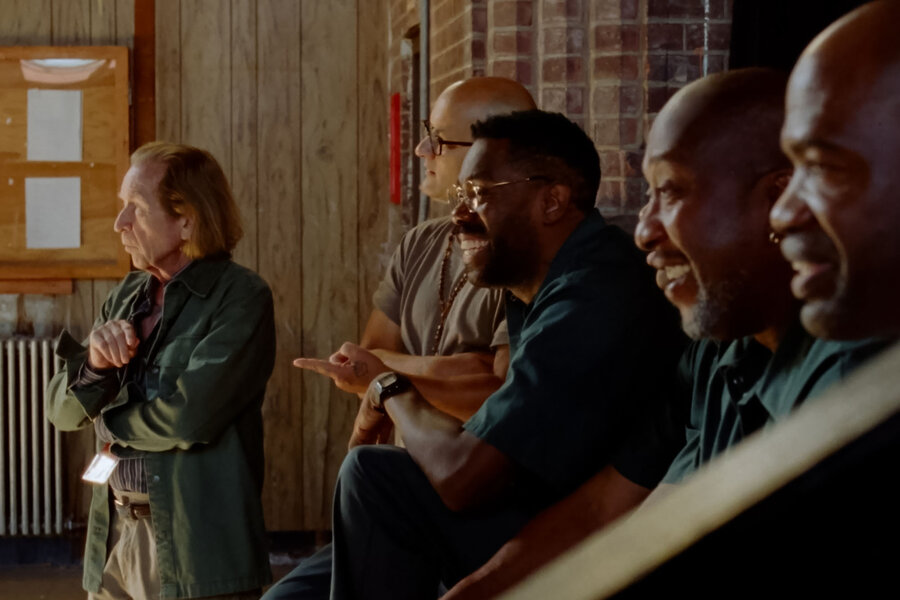
Photo: A24.
From left, Paul Raci, Sean San José, Colman Domingo, Sean “Dino” Johnson, and Mosi Eagle star in Sing Sing.

There are certain kinds of stories that always get my attention, and I’m grateful when other people find the same things interesting. Things like climate change, entrepreneurs, immigration, the kindness of strangers, housing, and life after prison. Just to name a few.

So you may be sure I liked today’s story about a theatrical production at a prison and the movie made about it.

Stephen Humphries writes at the Christian Science Monitor, “The world’s most unpredictable play only had one performance. It was staged inside a prison. The comedy, Breakin’ the Mummy’s Code, is about a man from ancient Egypt who embarks on a time travel adventure. Along the way, he encounters Robin Hood, Roman gladiators, cowboys, Hamlet, pirates, and – because why not? – Freddy Krueger from The Nightmare on Elm Street. It included a Shakespeare soliloquy – plus dance numbers. 

Breakin’ the Mummy’s Code was created by incarcerated men inside Sing Sing Correctional Facility in New York. It received a standing ovation in Cellblock B.

Now, a new movie explores the play’s legacy: the healing effect it had on its participants.

Sing Sing, directed by Greg Kwedar, reenacts the making of Breakin’ the Mummy’s Code. It even stars one of the play’s original actors. Already generating Oscar buzz, the movie … chronicles a budding friendship between two incarcerated men. Thematically, it’s about identity. The characters live in a hypermasculine environment that venerates bravado, toughness, and aggression. But the amateur actors come to discover that empathy, vulnerability, and tenderness are strengths, not weaknesses. The movie makes a case for the rehabilitative impact of arts programs inside prisons.

“ ‘I was a witness to it,’ says Mr. Kwedar, who taught an acting class in a prison with his creative partner, Clint Bentley, as part of their research. ‘I think the greatest teacher is what it’s like to step into another character and move in their shoes and step outside of yourself. That is a process of empathy’. … It gives you a prism to look at all the relationships in your life and to see perspective.’ …

“[Mr. Kwedar] spent seven years developing Sing Sing with Rehabilitation Through the Arts (RTA), the nonprofit that runs the theater program.

“There are dozens of similar theater projects across the United States. Perhaps the most well-known is Shakespeare Behind Bars. That program, which operates in three prisons in Kentucky and in one in Michigan, boasts a 6% recidivism rate for those who have participated in its productions. The Monitor was the first publication to write about that program. Then it became the subject of an award-winning 2005 documentary, Shakespeare Behind Bars

“ ‘Prisons function on shame and guilt,’ says Shakespeare Behind Bars founder Curt Tofteland, who has longtime collegial connections with the RTA. ‘But shame and guilt doesn’t change behavior. Why? Because shame and guilt doesn’t change thinking.’ …

“When change does happen, it’s a result of the actors exploring questions that the scripts raise, including ‘Who am I?’ 

“The two men at the heart of the story – John ‘Divine G’ Whitfield (played by Colman Domingo) and Clarence ‘Divine Eye’ Maclin (who portrays himself) – had to grapple with those existential questions. As the film unfolds, the audience learns that Mr. Maclin was one of the most feared men in the prison. Acting freed him to shed the gangster identity he’d clung to. The program helped him learn to express emotions. He even cried onstage. Now, he’s a natural performer on screen. …

“ ‘This is a movie about the landscape of the human face,’ says Mr. Kwedar. ‘It’s about drawing close to someone and looking them in the eyes and hearing their stories, and to know their names. And when you do that, it’s impossible to see that person as anything less than human.’

Sing Sing was filmed inside a recently decommissioned prison in New York. Its cast of established and first-time actors includes 13 RTA alumni. The production employed community-based filmmaking. For starters, it had a nonhierarchical pay structure. Everyone on set … was paid the same rate. …

“Last month, the director screened the movie inside the Sing Sing facility itself. He calls it the most profound theatrical experience of his life.”

More at the Monitor, here. No paywall. Subscriptions encouraged.
Read Full Post »

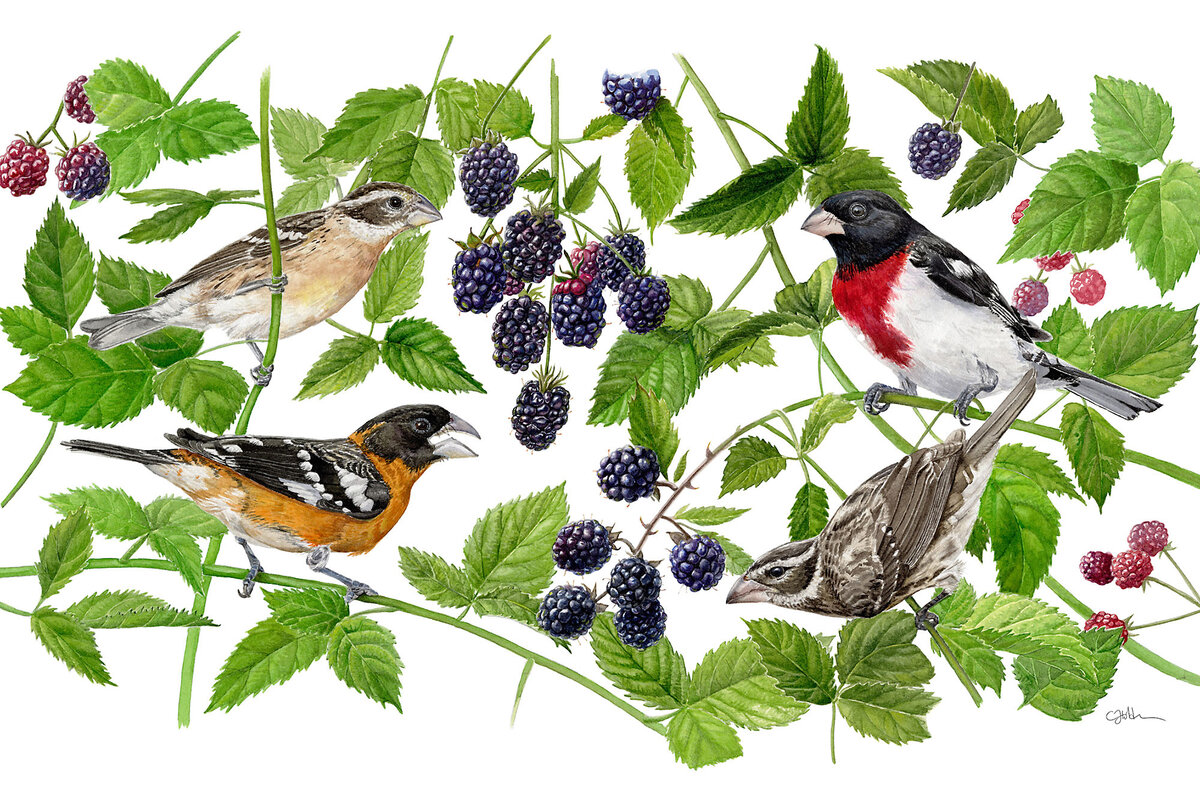
Art: Charlotte Holden.
A watercolor by Charlotte Holden, one of the artists in the Bartels Science Illustration Program at the Cornell Lab of Ornithology in Ithaca, New York, was used on the 2023 mug sent to members of the Ornithology Lab.

Our family has a lot of bird mugs. You may have some, too, especially if you have supported any environmental organization. As important as it is to protect creepy crawly insects, say, or an ugly fungus, those things don’t make great tea cups. Everyone, however, loves birds.

Today’s story is about the contemporary artists behind the bird art on your holiday cards, calendars, and coffee mugs.

Stephanie Hanes wrote at the Christian Science Monitor, “When international researchers recently discovered that a population of hummingbirds in South America was actually two distinct species – a finding made after much trekking and tracking and genome sequencing – they called on Jillian Ditner to help explain their work.

“Ms. Ditner is a bird illustrator at Cornell University’s Lab of Ornithology. And in her rendering, she could highlight the distinctions between Patagona gigas, the southern giant hummingbird, and Patagona sp. nov., the new northern giant hummingbird. …

“The birds look nearly the same. But look closely, and the plumage on the right has a bit more reddish-brown saturation. There is more distinct coloration around the northern’s neck; a beak that extends just a bit longer. 

This is one of the skills of the bird illustrator. More so than a photographer, Ms. Ditner explains, these artists can accentuate and highlight differences in species.

“They can exaggerate just a bit the ideal features that help reveal an animal’s distinct parts; play with that boundary between reality and understanding. 

“ ‘Photographs are always going to be limited,’ she says. ‘With scientific illustrations – you can take endless angles of a photograph and put them in one picture … there’s the ability to condense a lot of detail into one visual.’

“Ms. Ditner runs Cornell’s unique Bartels Science Illustration Program, a year-long fellowship for bird artists that has seen skyrocketing popularity since its founding two decades ago. (This year, Ms. Ditner received 215 applications for the solo spot; that’s up from a few dozen, she says, when she started in her position six years ago.) The Bartels program is part of Cornell’s Lab of Ornithology, which many birders in the area just call ‘the Lab.’ …

“At a time when a global library of digital images lives in one’s pocket, when attention is fought over and commoditized, there is something precious about the act of deep observation and the hand-drawn beauty that science illustration requires.  

“The bird artists at the Lab are specialists in that larger field of science illustration, a profession that includes everything from botanical sketches and renderings of the solar system to medical drawings and wildlife art. 

“Despite advances in both photography and artificial intelligence, the scientific illustration field is growing, say those who work in the field. According to The Franklin Institute, Philadelphia’s renowned natural history museum, new technology has only increased the need for science illustrators, who can help bring either nanoparticles or galaxies to a comprehensible scale; a handful of colleges have science illustration programs.

“Charlotte Holden, an artist and longtime bird lover, was one of the Bartels Illustrators in 2002. During her time in the program, Ms. Holden worked with researchers, studied bird anatomy, and honed her realism style by combining bird images with illustrations of their native flora. Like many who go through the program, her work appeared in Cornell’s Living Bird magazine, on posters, and on other materials. …

“Although Ms. Holden has been watching birds ever since she was a child outside of New York City, it was only by drawing, she says, that she began to recognize details like a bird’s different feather groups, or unique colors. 

“It’s like life, she says. It’s hard to see the details when everything is in motion. Ornithological art slows us down. It has a long history that blurs science and art and wonder; a moment to pause and appreciate the world around us. …

” ‘Art in itself is just very inspiring,’ says Maria Klos, a 2023 Bartells Illustrator who now lives in California. ‘It seems to always draw people in.’  

“One of Ms. Klos’ projects during her time in the program was to draw a pair of life-size American condor wings, which are now attached to one of the Lab’s exterior walls. Visitors can put their arms up against the image to see how their own ‘wingspans’ measure up; one more moment of art, bird, and human together.  

“Both Ms. Klos and Ms. Holden have continued their jobs as professional illustrators; both recently put on shows of their art and both say they are inspired to continue drawing nature professionally. The Bartels program has opened doors to new professional contracts, they say, but also a new way of seeing the world.

“ ‘It fosters a deeper connection to nature … when you just sit with it and observe it,’ Ms. Klos says. ‘You see things that you might have been overlooking for a long time, or might never have noticed if you didn’t sit down with it and draw it.’ ”

More at the Monitor, here. No paywall.

Read Full Post »

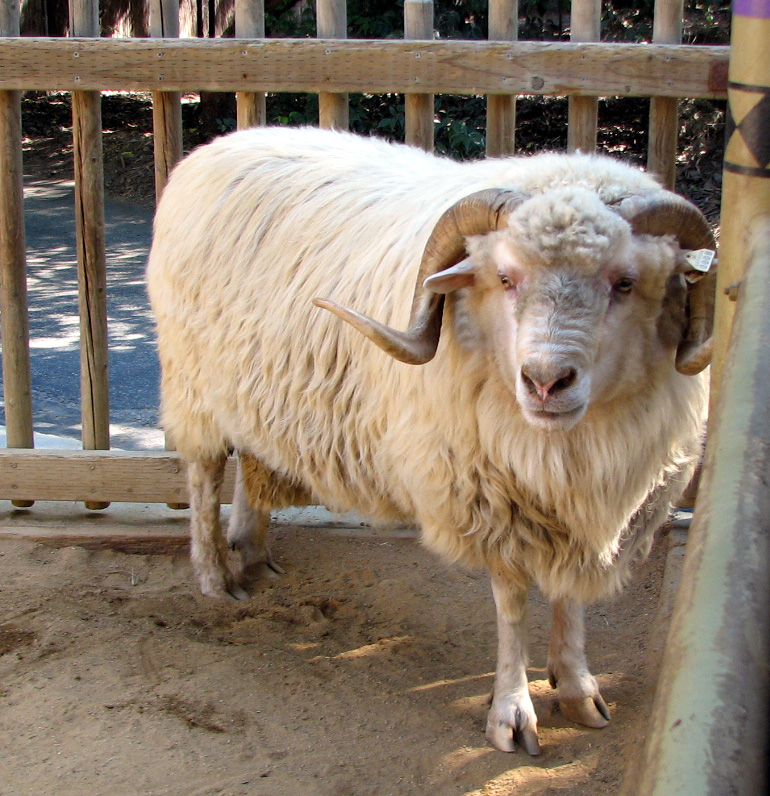
Photo: Jean Ogden via Wikimedia.
Navajo Churro sheep.

There’s a story at National Public Radio about the special relationship between a kind of sheep and the Navajo people, or Diné. Ayesha Rascoe hosts the NPR program, which you can listen here, if you prefer.

Ayesha Rascoe: For centuries, the lives of Navajo people have been intertwined with livestock — specifically, one particular breed of sheep they’ve relied on for meat and wool. The tribe is well known for weaving the wool of Churro sheep into colorful clothing and tapestries. Those weavings can fetch thousands of dollars from collectors, but they have far more than monetary value. Raising Churro sheep and weaving their wool is an important way Navajo people pass cultural knowledge from generation to generation. KSJD’s Chris Clements visited a Navajo Churro sheep celebration.

Chris Clements: Inside a crowded farmhouse on the edge of the Navajo Nation, weavers are demonstrating how to spin, dye and treat wool from Churro sheep, which they consider sacred.

Roy Kady: Hello. My name is Roy Kady. I am from Goat Springs, Ariz.

Clements: Kady, who’s in his 60s, is standing outside, wearing an ornate turquoise necklace, earrings, bracelets, and a white hat. He’s considered a master weaver, part of centuries of Navajo citizens who’ve carried on traditional beliefs that date back to the 1500s when Churro sheep arrived with early Spanish colonists.

Kady: I’m filling these big shoes that my mother wore as an agropastoralist.

Clements: Tyrrell Tapaha is Kady’s student and his grandson, who’s here at the event. …

“Tyrrell Tapaha: There’s always been weaving in my life, whether it be his work, my grandma’s work, or my great-grandma’s work. ..

“Kady: Tyrrell [says] I want to weave a human form. Do you have any ideas how I could do that? And so I just share with him. …

“Clements: Tapaha has been learning the tricks of the trade since he was very young. When he was only 8, Kady had him teach a class on the art of finger weaving at a nearby chapterhouse. … Tapaha knows that Kady’s teachings will live on with him.

“Tapaha: At least it’ll last my lifetime, you know? And I kind of hear that in how Roy talks about his contribution to the space is like him being an older person now and kind of seeing that handed off.

“Clements: After the morning’s presentations, it’s time for lunch. The weavers roast mutton, a Churro sheep they slaughtered earlier in the day. Participants of the sheep celebration gather around the grill, watching the fire hiss and sputter as the mutton cooks. It’s common for every part of the animal to be used. Nothing, not even its hooves goes to waste.

“In 1863, the U.S. military forced Navajo people to leave their ancestral homelands and relocate to an internment camp. It’s known as the Long Walk. … It almost led to the extinction of the Churro sheep.

“Navajo people were allowed to return home four years later. Some tribal members who’d managed to escape the Long Walk, kept some Churro alive. And today, thousands of Churro sheep live on or near the Navajo Nation.”

Read more about the sheep and the passing along of Diné culture at NPR, here.

Read Full Post »

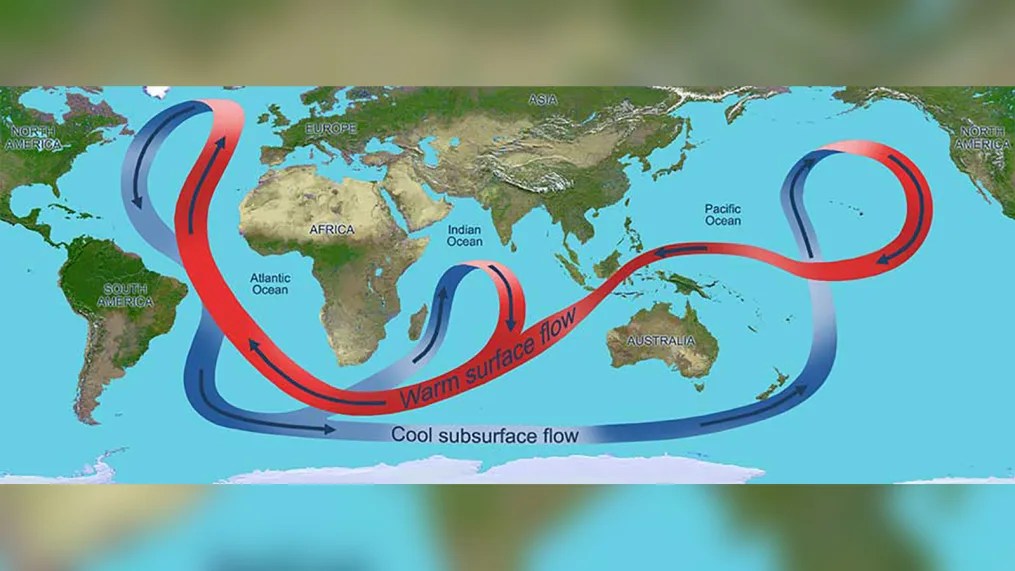
Image: CNN.
When you see phrases like “intricate interplay,” a concept I illustrate with this CNN image, suspect AI. There are lots of other common usages to be alert to.

Hello, Word People. That is, People Who Are Fascinated by Words. When you do online searches in the future, will you know what words and phrases may indicate AI behind the scenes? Kyle Orlando has some answers at Ars Technica.

“Thus far, even AI companies have had trouble coming up with tools that can reliably detect when a piece of writing was generated using a large language model [LLM]. Now, a group of researchers has established a novel method for estimating LLM usage across a large set of scientific writing by measuring which ‘excess words’ started showing up much more frequently during the LLM era (i.e., 2023 and 2024). The results ‘suggest that at least 10 percent of 2024 abstracts were processed with LLMs,’ according to the researchers.

“In a preprint paper posted earlier this month, four researchers from Germany’s University of Tübingen and Northwestern University said they were inspired by studies that measured the impact of the Covid-19 pandemic by looking at excess deaths compared to the recent past. By taking a similar look at ‘excess word usage’ after LLM writing tools became widely available in late 2022, the researchers found that ‘the appearance of LLMs led to an abrupt increase in the frequency of certain style words’ that was ‘unprecedented in both quality and quantity.’

“To measure these vocabulary changes, the researchers analyzed 14 million paper abstracts published on PubMed between 2010 and 2024, tracking the relative frequency of each word as it appeared across each year. They then compared the expected frequency of those words (based on the pre-2023 trend line) to the actual frequency of those words in abstracts from 2023 and 2024, when LLMs were in widespread use.

“The results found a number of words that were extremely uncommon in these scientific abstracts before 2023 that suddenly surged in popularity after LLMs were introduced. The word ‘delves,’ for instance, shows up in 25 times as many 2024 papers as the pre-LLM trend would expect; words like ‘showcasing’ and ‘underscores’ increased in usage by nine times as well. Other previously common words became notably more common in post-LLM abstracts: The frequency of ‘potential’ increased by 4.1 percentage points, ‘findings’ by 2.7 percentage points, and ‘crucial’ by 2.6 percentage points, for instance.

These kinds of changes in word use could happen independently of LLM usage, of course — the natural evolution of language means words sometimes go in and out of style.

“However, the researchers found that, in the pre-LLM era, such massive and sudden year-over-year increases were only seen for words related to major world health events. …

“In the post-LLM period, though, the researchers found hundreds of words with sudden, pronounced increases in scientific usage that had no common link to world events. … The words with a post-LLM frequency bump were overwhelmingly ‘style words’ like verbs, adjectives, and adverbs (a small sampling: ‘across, additionally, comprehensive, crucial, enhancing, exhibited, insights, notably, particularly, within’). …

“The pre-2023 set of abstracts acts as its own effective control group to show how vocabulary choice has changed overall in the post-LLM era.

“By highlighting hundreds of so-called ‘marker words’ that became significantly more common in the post-LLM era, the telltale signs of LLM use can sometimes be easy to pick out. Take this example abstract line called out by the researchers, with the marker words highlighted: ‘A comprehensive grasp of the intricate interplay between […] and […] is pivotal for effective therapeutic strategies.’

“After doing some statistical measures of marker word appearance across individual papers, the researchers estimate that at least 10 percent of the post-2022 papers in the PubMed corpus were written with at least some LLM assistance. The number could be even higher, the researchers say, because their set could be missing LLM-assisted abstracts that don’t include any of the marker words they identified. …

“Papers authored in countries like China, South Korea, and Taiwan showed LLM marker words 15 percent of the time, suggesting ‘LLMs might … help non-natives with editing English texts, which could justify their extensive use.’ On the other hand, the researchers offer that native English speakers ‘may [just] be better at noticing and actively removing unnatural style words from LLM outputs,’ thus hiding their LLM usage from this kind of analysis.”

More at Ars Technica via Wired, here.

Read Full Post »

Photo: Etsy.
Antique button hook for shoes.

Recently, Suzanne’s friend Jackie Delamatre has been researching and writing about unfamiliar utensils like grapefruit spoons. There sure are an array of antique gizmos for her to choose from, and lots of new ones.

Don’t you love the word “gizmo”? It was so handy when Suzanne was a toddler and was asking too many times in 10 minutes “what’s this called, what’s that called?”

Today’s story explains why and how we use words like gizmo, whatchamacallit, thingamajig …

Ursula Kania, a senior lecturer in English Language and Linguistics, at the UK’s University of Liverpool, writes at the Conversation.

Years ago, humans started speaking and we’ve not shut up since. Sometimes, though, we struggle to remember the name of an object, a place, or a person we want to talk about. The technical term for this phenomenon is ‘lethologica.’ … Drawing the occasional, temporary blank is very common. Unsurprisingly, stress doesn’t help, and it gets worse as we age.

“But what can we do if we’re coming up empty yet still want to keep the conversation going? …

“We can hesitate, using so-called fillers like ‘ehm’ and ‘uh’ to buy us some time, in the hope that the right word will make a delayed but triumphant appearance. We can describe what we mean, hoping to still get the message across. … We may even be able to recall certain formal characteristics of the word, like the first letter or sound, or how many syllables it has and generously offer these clues to the puzzled listener: ‘You know – this guy we met last week, I think his name starts with a G.’

“This is why we also call this the tip-of-the-tongue phenomenon. We’ve almost got it, and our brain is doing its best to use all stored bits of information (for example, on the word’s pronunciation and meaning) to come up with something useful to say, even if it isn’t the correct word itself.

“Sometimes, this results in us making up words on the spot (referred to within linguistics as ‘spontaneous’ or ‘ad-hoc coinages’). You may not find them in the dictionary, but they usually still make sense in context.

“Even young children already come up with them in an attempt to put into useful practice what they’ve already learned about language. …

“My favorite example in this category, though, is a Tweet about a German customer in a Welsh pub who couldn’t recall the word ‘cutlery’ and politely asked for ‘food weapons.’

“Last but certainly not least, we may use ready-made placeholders like ‘thingamajig,’ ‘whatchamacallit’ (for an object) or ‘what’s-his-name’ (for a person).

“Apparently, the struggle to find the right word is real and has been for some time, because the Oxford English Dictionary has its own category for these terms, labelled ‘thing or person whose name is forgotten or unknown.’ It includes 64 entries and some records go back as far as the early middle English period (1100–1300).

“Not all of them are still used today. The last attested use for the strangely evocative whiblin’ was in 1652, for example, and ‘jiggumbob’ is marked as obsolete.

Others, like ‘gizmo’ or ‘doodah’ are still going strong, though, and you can even buy ‘Whatchamacallits’ and ‘Whozeewhatzits’ – they are chocolate bars made by Hershey’s.

“There are threads on Reddit dedicated to collecting placeholder words in English and from around the world. They are worth exploring, with gems like ‘doomaflitchie,’ the Dutch ‘huppeldepup’ and the German ‘dingsdabumsda.’ “

If you know any others, especially whatchamallits in non-English languages, do let us know. We old folks need lots of these substitutes. More at the Conversation, here. No paywall.

Read Full Post »

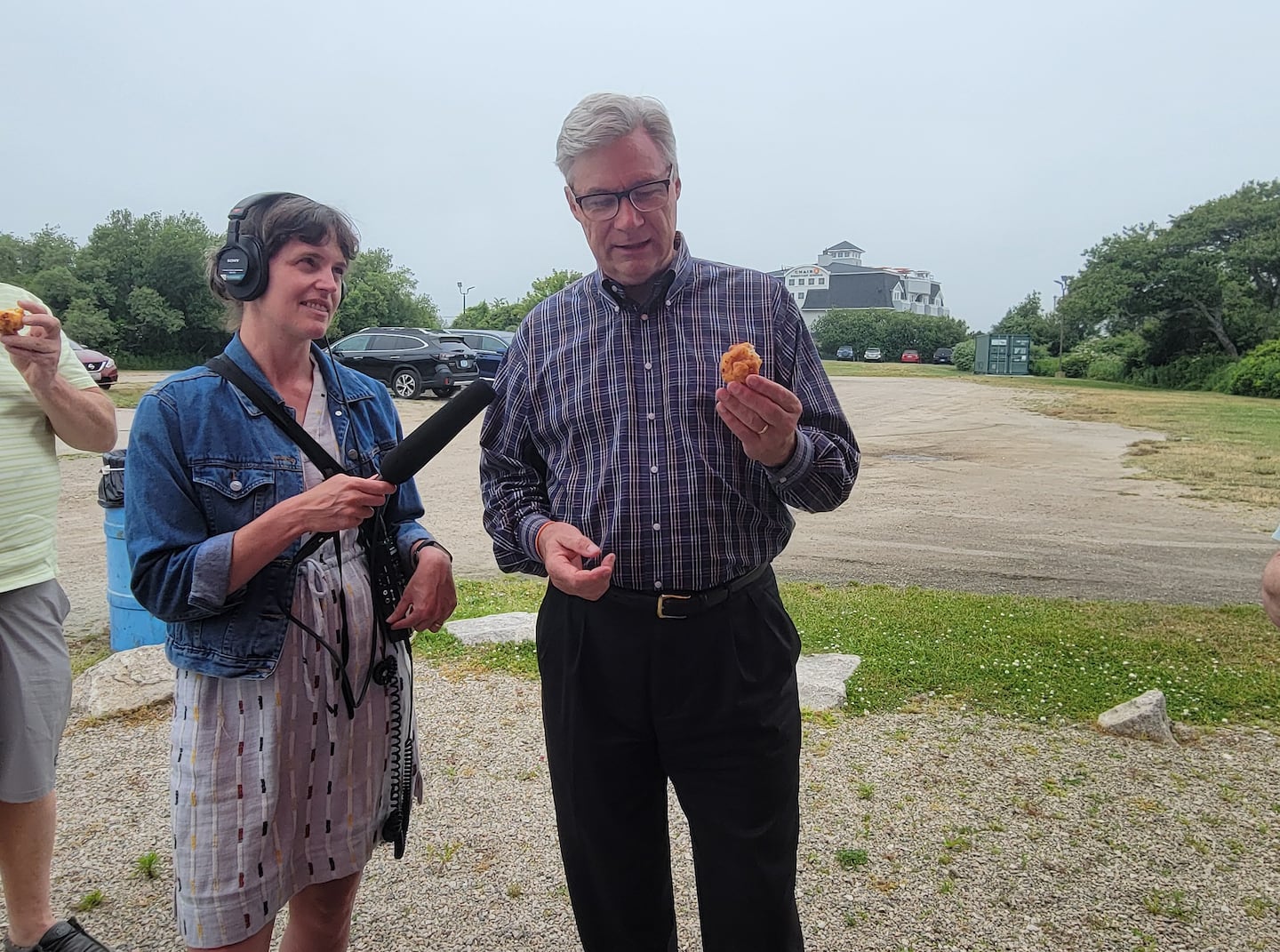
Photo: Lil Rhody Clam Cake Crawl.
Megan Hall, left, producer of the Rhode Island Report podcast, listens as US Senator Sheldon Whitehouse analyzes a clam cake as part of the 10th Lil Rhody Clam Cake Crawl.

Rhode Island is justly proud of its clam cakes, which is why local enthusiasts launched an annual hunt for the very best.

At the Boston Globe, Ed Fitzpatrick wrote about one distinguished guest who lent his opinions to fellow Rhode Island “Clamarati” during the 10th Lil Rhody Clam Cake Crawl.

“As they stood outside Aunt Carrie’s Restaurant,” Fitzpatrick wrote, “Renee Bessette asked US Senator Sheldon Whitehouse why he had agreed to join the 10th Lil Rhody Clam Clake Crawl.

“ ‘A momentary lapse in judgment,’ Whitehouse replied with a laugh.

“But the Senate Judiciary Committee member grew serious when it came time to judge Rhode Island clam cakes using a rigorous seven-point rubric that includes ‘clam-to-cake ratio’ (does it have a lot of clams?), ‘clambiance’ (as an overall experience, would you go here again?), and ‘nubbins’ (Does it have protrusions, often clams, that can also be used as a handle as you eat?).

“ ‘Less on crispy. Smaller. More on tenderosity,’ Whitehouse said as he contrasted an Iggy’s clam cake with an Aunt Carrie’s clam cake.” Read all of the Senator’s insights at the Globe, here

Blogger Hunter Gather Cook also has a Rhode Island clam cake post, which includes a recipe that recommends using freshly ground clams if at all possible.

“Think clam beignet, or donut hole,” writes Hunter Gather Cook. “Only savory. Crispy, golden brown on the outside, pillowy and light on the inside. Steam rises from the first bite. The slightest aroma of brine surrounds you. Tiny chunks of clam nestle themselves in the folds of the pillow, offering surprising bites of chewy meatiness as you down one of these little glories after another. And another.

“With the possible exception of the Pacific Northwest, no region can boast mastery of the humble clam like New England. And within New England, it is Rhode Island that does it best. I have never seen these clam cakes any other place. They are a masterpiece of street food. …

“They are to me the gateway food of Block Island, which is the place I learned to forage and the place whose natural beauty I still hold closest to my heart. My fondest wish is to die an old man in a little cottage on that island. But not just yet.

“I am 3,100 miles from Block Island right now, a long way from Galilee and Rhody clam cakes. A few days ago, as I drove home from Bodega Bay, laden with clams, I realized that this was my first real chance to make clam cakes with fresh clams I had caught since I’d moved West years ago.

“I looked at my bucket of horseneck clams, dug an hour before. While they are certainly not the glorious quahog of my youth, they would do just fine in a clam cake — after all, you grind the clams anyway. …

“My recipe has no corn. More clams than the typical fritter, cake flour instead of all-purpose, and a touch of maple syrup. Maple syrup? Trust me. You need it.

“Now normally Rhode Island clam cakes are served with Tabasco and tartar sauce. … I am more of a Tabasco man. But I could not keep thinking about how much these were like New Orleans beignets. So I decided to break from Rhode Island tradition and add a little bit of the Big Easy to this recipe: Remoulade.

“If I thought I loved clam cakes before this, I may now be a clam cake junkie. … The recipe I made was way too much for Holly and I to eat at one sitting, but I decided to make them all anyway. We gorged ourselves on clam cakes until we were about to burst. I put the leftover cakes in the fridge.

“And you know something? They fried up almost as good the next day. Popped back in the deep fryer for 2-3 minutes, they came out fine.”

Any clam cake recipe including remoulade will horrify RI clamarati, but here goes. It starts with “canola or other vegetable oil for frying, 3 beaten eggs, 1/2 cup buttermilk, 1/2 cup clam broth, 1/2 cup cold beer, 2 teaspoons maple syrup, 1 1/2 cups chopped or ground clams, 1 teaspoon salt, 2 1/2 teaspoons baking powder, and 3 1/2 cups cake flour, or all-purpose flour.”

More at Hunter Gather, here.

Read Full Post »

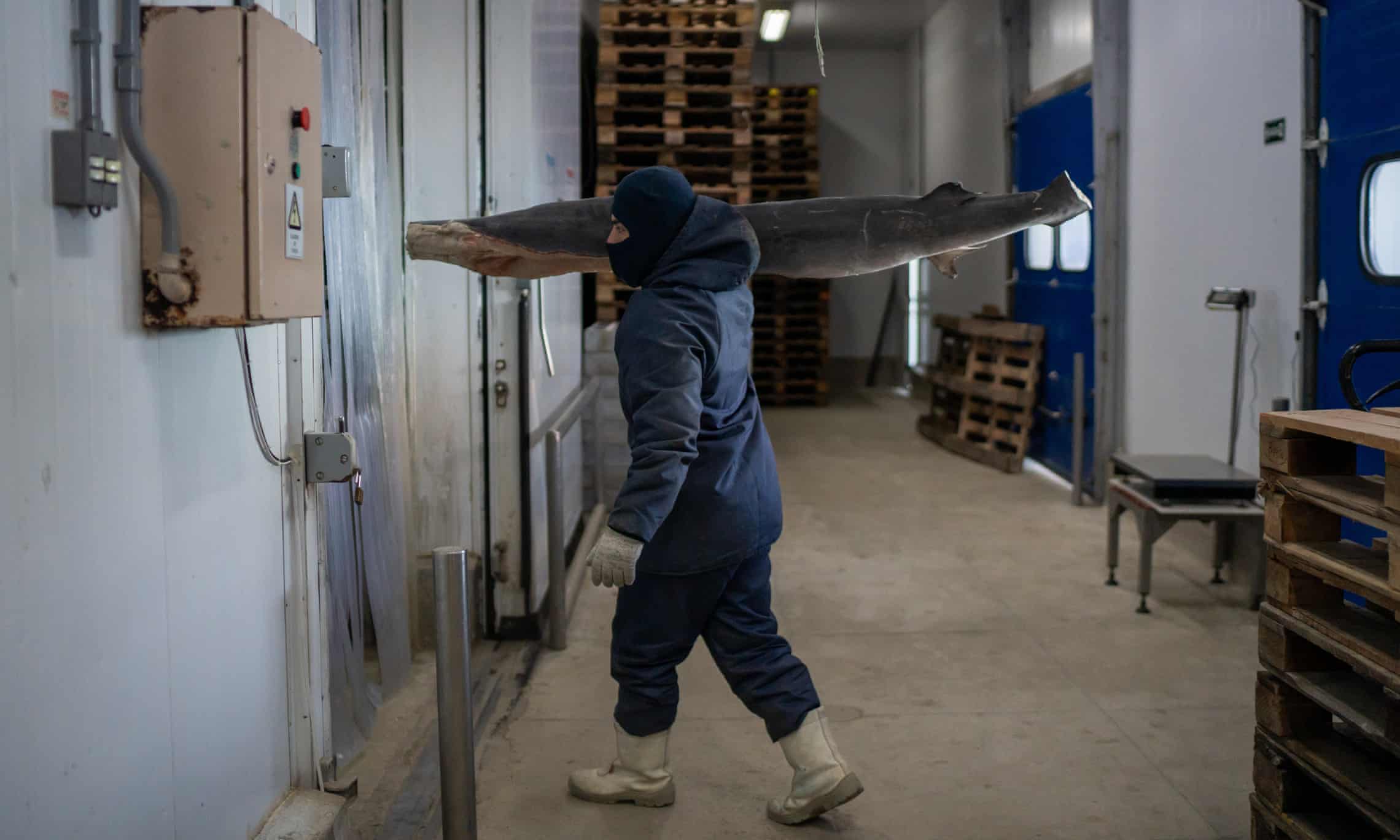
Photo: Avener Prado.
A trade that goes under the radar. Here, a blue shark is taken into cold storage in Cananéia, a fishing port in São Paulo state. Sharks reproduce slowly, but at least 80 million are killed annually
.

This is a sorry tale. Even if you don’t like the idea of swimming with sharks or keeping them as pets, I know you will be concerned that we are decimating their numbers. Today’s story explains that sometimes we are eating sharks without realizing it.

Constance Malleret reports at the Guardian that “worried conservationists say most people do not realize they are eating shark.

“The bright blue skies and calm waters of the estuary belie rough conditions at sea, and there is no sign of activity among the colourful fishing boats moored around the harbor of Cananéia, a sleepy fishing town 160 miles south of São Paulo.

“On the wharf, however, a delivery of frozen fish from Uruguay has just arrived and a few men in white gumboots are busy unloading pallets of beheaded specimens labelled Galeorhinus galeus – school shark. These thin grey fish will be kept in a cold store on shelves already stacked ceiling-high with carcasses of blue sharks, all awaiting processing and distribution to cities inland.

“ ‘Why do we work with shark?’ says Helgo Muller, 53, the company manager. ‘Because people like it; it’s good and cheap protein. It doesn’t give you crazy profits, but it’s decent enough.’

“Shark is just a small fraction of the firm’s business but they process about 10 tons a month, he says, mostly blue shark imported from countries including Costa Rica, Uruguay, China and Spain.

“Communities up and down Brazil’s 4,600-mile coastline have always eaten sharks. ‘It is part of our tradition,’ says Lucas Gabriel Jesus Silva, a 27-year-old whose grandfather moved to the area in the 1960s to fish sharks for their fins.

“However, the widespread appetite for shark meat that Muller’s company helps feed is now troubling scientists and environmentalists, who worry about unsustainable pressure on various species. …

” ‘Sharks are very vulnerable to overexploitation as they don’t reproduce as often or with as many offspring as bony fishes do,’ explains Prof Aaron MacNeil, of Canada’s Dalhousie University.

“Research published in April found that 83% of the shark and ray species sold in Brazil were threatened, according to the International Union for the Conservation of Nature (IUCN) classification.

“For years, conservation efforts focused on the fin trade with Asia and the barbaric practice of ‘finning’ – removing a shark’s fins and returning the wounded and helpless animal, often still alive, to the sea. But research from earlier this year suggests restrictions on finning have not reduced shark mortality, with at least 80 million sharks still being killed annually.

“ ‘Meat was kind of left by the wayside,’ says MacNeil, who is researching the global shark meat trade. ‘It’s only now we’re realizing how big the trade is. Its value has certainly exceeded that of fins.’ The pressure on sharks for food has risen in parallel with a decline in catches of other fish, he says.

“Traditionally, Brazilians ate shark in moqueca, a seafood stew from the states of Bahia and Espírito Santo. And many of Cananéia’s residents recall how their older relatives would use shark’s head broth and cartilage as homemade remedies. But now, sold in fillets or steaks, shark has been absorbed into Brazilians’ diet as it is cheaper than other white fish, boneless and easy to cook. It now appears in school and hospital canteens.

“The fact that few Brazilians realize they are eating shark has probably helped make it ubiquitous. While coastal people with a shark-eating tradition recognize the subtle differences in texture and flavor between shark species, to most Brazilians it is just cação – a generic term under which both shark and ray meat are sold. …

“Campaigners say the generic labelling prevents informed decisions by consumers, and this could even affect their health due to high concentrations of dangerous pollutants in these top predators. ‘If they knew, they might not eat it,’ says Ana Barbosa Martins, a researcher at Dalhousie University. …

“ ‘Fishers don’t cast their nets to catch shark specifically, but sometimes a [protected] hammerhead comes up. What can you do?’ says Lucia Rissato, who runs a fish stall in Peruíbe. … ‘We have to sell it in secret, like drugs.’ “

I guess, for vegans, getting tricked into eating shark meat is not an issue.

More at the Guardian, here. No paywall.

Read Full Post »

Photo: Minden Pictures/Alamy.
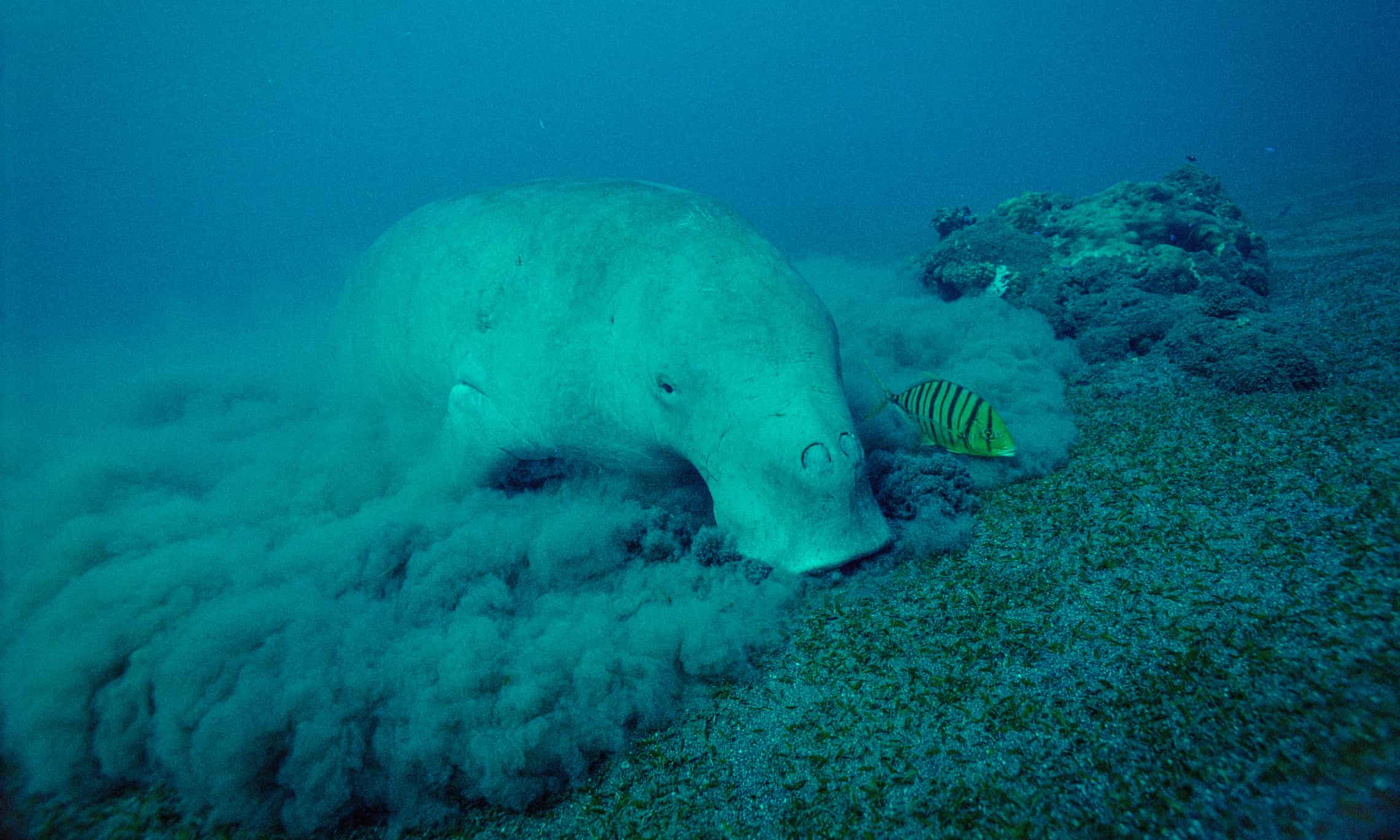
The rare sight of a dugong feeding on a seagrass meadow in Vanuatu. The gentle giants were once a common sight around the Melanesian archipelago.

Here’s an interesting story about a saltwater cousin of the shy freshwater manatee. It eats seagrass, and like most other living things in the ocean, it’s negatively affected by warming trends.

Rebecca Root writes at the Guardian, “In a bright spring day, the sun dances over the water of Havannah Bay on the island of Efate in Vanuatu. Below the surface, pockets of seagrass that can just about be seen from the shoreline, sway in the current. It’s here, if they are lucky, that onlookers may spot a dugong bobbing in the shallow water, orbiting the seagrass meadows they feed on.

“ ‘It’s wonderful seeing them swimming by and grazing off the seagrass in front of the resort,’ says Greg Pechan, the owner of a local hotel, the Havannah, which sits at the tip of the bay. Pointing out beyond the jetty that stretches into the Pacific Ocean, he says Vanuatu’s sea life is a big attraction for visitors to the Melanesian country.

“Light grey in color, dugongs, sometimes known as ‘sea cows’ and whose closest relatives are freshwater manatees, can grow up to four metres long and weigh up to 400kg (900lb). They are a ‘friendly species’ and respected by islanders, says Heidi Joy, a marine science student from Efate.

“A few years ago, it would not be unusual for Joy, who lives close to Havannah Bay, to spot a dugong in the morning and then again at sunset. That has since changed, she says. ‘We rarely see them now.’

“Dugongs are considered vulnerable to extinction by the International Union for Conservation of Nature. The exact number roaming Vanuatu’s waters is, however, unknown and this uncertainty is hindering conservation efforts, experts say.

“ ‘A lot of studies have been done where you’ve got large populations of dugongs in large seagrass meadows [such as] Australia or Abu Dhabi, but we’ve got a different dugong population. We’ve got small groups or individuals,’ says Christina Shaw, the CEO of the Vanuatu Environmental Science Society. She says that a national assessment of dugongs and seagrass in Vanuatu is urgently needed. …

“In 2023, the status of neighboring New Caledonia’s population was downgraded to ‘endangered‘ while east African dugongs have become ‘critically endangered.’ …

“In Vanuatu, however, only one aerial survey – in 1987 – has been carried out to assess the national distribution, abundance, cultural importance and threats, according to Helene Marsh, an emeritus professor in environmental science at James Cook University.

“Dugongs globally are threatened by gill-net fishing, boat traffic, coastal development and hunting. In Vanuatu, dugong meat used to be considered a source of protein, their oil used for cooking and other parts whittled into handicrafts.

“But since the 1980s, certain islands have introduced local prohibitions known as tabu, which mandates their protection. In 2010 the government also signed the Convention on Migratory Species’ dugong memorandum of understanding, committing it to protecting the sea cows and the seagrass they eat. This means hunting is now rare, says Shaw.

“Instead, another predator threatens the dugong: the climate crisis. On a spring evening in Efate, rain hammers relentlessly until nightfall, rendering the ocean a murky green. It’s downpours such as this, becoming more common, alongside storms and cyclones, that damage the seagrass so vital to the dugongs.

“Vanuatu sits in the Pacific ‘Ring of Fire,’ a tectonic belt of volcanoes and earthquakes, and a tropical cyclone region, making it prone to disasters. When these batter the bays and beaches of Vanuatu, the seagrass is swept up by the heavy winds, while the rain and debris creates sediment on the water surface, smothering the seagrass from the sunlight it needs to thrive. …

“Richard Leck, head of oceans at WWF Australia, says: ‘When that happens dugongs have no choice but to get on the move and sometimes they have to go into deeper water, expend much more effort to graze seagrass and when that happens they often get emaciated and lose condition really quickly.’ …

“As with dugongs, there is limited data on the prevalence and condition of seagrass in Vanuatu. This makes it hard, says Shaw, to advocate for investment in conservation. ‘Funders don’t like paying for studies,’ she says. ‘But how do we do [conservation] if we don’t know what’s there?’ ”

More at the Guardian, here.

Read Full Post »

Photo: Okinawa Institute of Science and Technology.
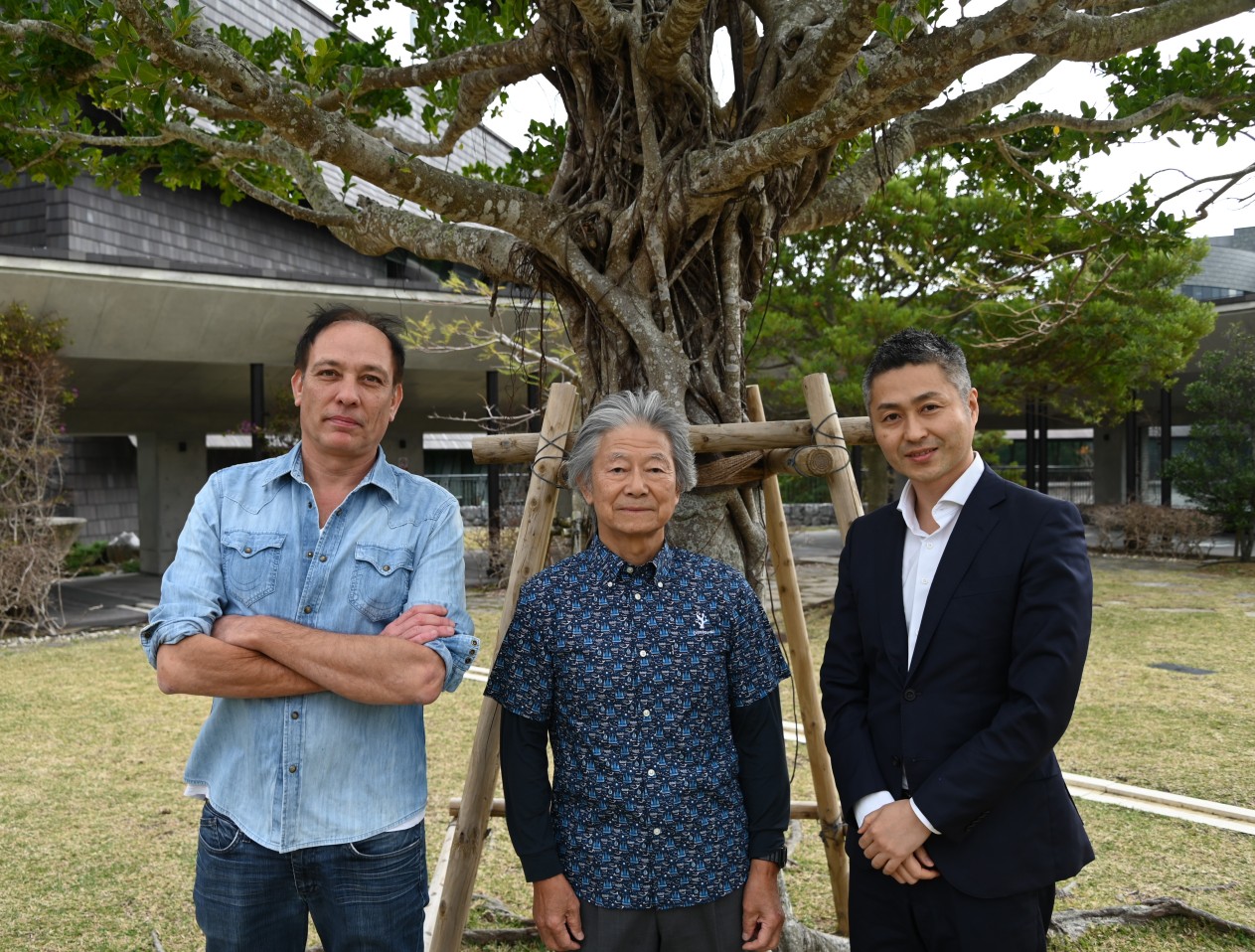
Prof. Timothy Ravasi, Prof. Noriyuki Satoh, and Shimon Sato (L-R) lead the Coral Project at OIST, a nonprofit initiative helping conserve coral biodiversity in Okinawa. 

It is now generally known that corals are important for ocean biodiversity but are in danger from climate change. If you search on “coral” at this blog, you will find a variety of stories about what people are trying to do to help.

Today we look at an organization in Japan that merges the work of local people to that of scientists.

The website of the Okinawa Institute of Science and Technology (OIST) says, “Unlike many global reef locations requiring a boat ride, Okinawa’s reefs are accessible directly from the beach — a simple walk to a nearby beach, a quick dip into the crystal-clear waters, and within moments, you are immersed in a lively ocean community. 

“Yet elders in Okinawa remember a time when coral-filled waters were more abundant, a contrast to the significant coral decline observed in recent years, especially near shorelines. Worldwide, human activities have resulted in an alarming decrease in coral populations in the last decade. Consequently, efforts to plant corals are gaining momentum. 

“The OIST Coral Project, an initiative focused on studying and preserving coral biodiversity in Okinawa, was launched in July 2023 at the Okinawa Institute of Science and Technology (OIST). To date, the project has successfully enlisted the support of 20 companies in Okinawa and mainland Japan. …

“In January 2023, Prof. Noriyuki Satoh, head of OIST’s Marine Genomics Unit, sat down with Shimon Sato, an experienced fundraiser and Advancement Officer at OIST. They came up with an ambitious idea: to use knowledge of genomics and eDNA in a new project to plant and conserve coral in Okinawa. This was the start of an innovative effort to protect local marine life by connecting with locals and companies in Okinawa and Tokyo to establish potential collaborations. 

“Prof. Satoh and his team at the Marine Genomics Unit achieved groundbreaking milestones by decoding the genomes of corals in 2011, zooxanthellae (symbiotic organisms that coexist with corals) in 2013, and the crown-of-thorns starfish (known for devouring corals) in 2017. …

“Using this knowledge, Prof. Satoh identified the best types of coral that can be planted at specific sites in Okinawa. … Permission was granted by Okinawa Prefecture and planting is done by professional vendors, following Japan’s strict coral planting regulations.

Each planting site is overseen by a different fishermen’s organization, each with its own unique team and structure.

“Before planting, Prof. Satoh engages in negotiations with the fishermen’s organizations, explaining the project’s objectives and benefits. These fishermen, who have a deep understanding and respect for the sea, are important allies. …

“Yet this project is not just about planting corals — scientists also conduct eDNA monitoring of corals and study the fish that arrive after the planting, observing which species are on the rise or decline. …

“Cause-related marketing is one of the unique aspects of this project. This is an approach where businesses associate themselves with societal issues or values by working with non-profit organizations to promote a specific cause. …

“ ‘We began with 8 companies, including Japan’s largest mobile company NTT Docomo in Tokyo and several others in Okinawa.’ … Supporting companies can use the project’s [logo]. Ryukyu Cement Co., Ltd., the largest cement company in Okinawa, displays the logo on their cement bags and donates a portion of their cement sales to the project. Another notable supporter is Majun, the leading Kariyushi wear company in Japan. Majun has created an original 100% cotton Kariyushi t-shirt embroidered with the Coral Project logo. …

“In 2018 Onna Village, where OIST is located, was declared a ‘coral village’ or ‘sango no mura’ in Japanese, and in 2019 the Government of Japan declared the village a ‘Sustainable Development Goals Future City.’ Impressively, the practice of coral planting in Onna Village began two decades ago. In 2004, a local organization, Team Churasango, was established by community members with participation from both local and mainland companies. On average, they plant 1,000 corals annually, in response to the observed decline in coral numbers. …

“The project team has recently welcomed a third person – Prof. Timothy Ravasi, leader of the Marine Climate Change Unit at OIST. Prof. Ravasi’s unit uses the latest methods in genomics to study how marine organisms adjust to warmer and more acidic oceans. …

“Shimon attributes the success of the project to two main factors. First, Prof. Satoh’s expert knowledge of corals and excellent people skills. Second, the project has secured the support of numerous stakeholders. … ‘Okinawan people value coral, and they want to return the coral reefs to their previous beautiful and healthy state. We want to support those hopes using the power of science,’ he said.”

More at the Okinawa Institute of Science and Technology, here. And you can click here to read about how OIST got the Isawa Award for this work.

Read Full Post »

Photo: Corey Favino/Elephant Family USA/Newport Restoration Foundation.
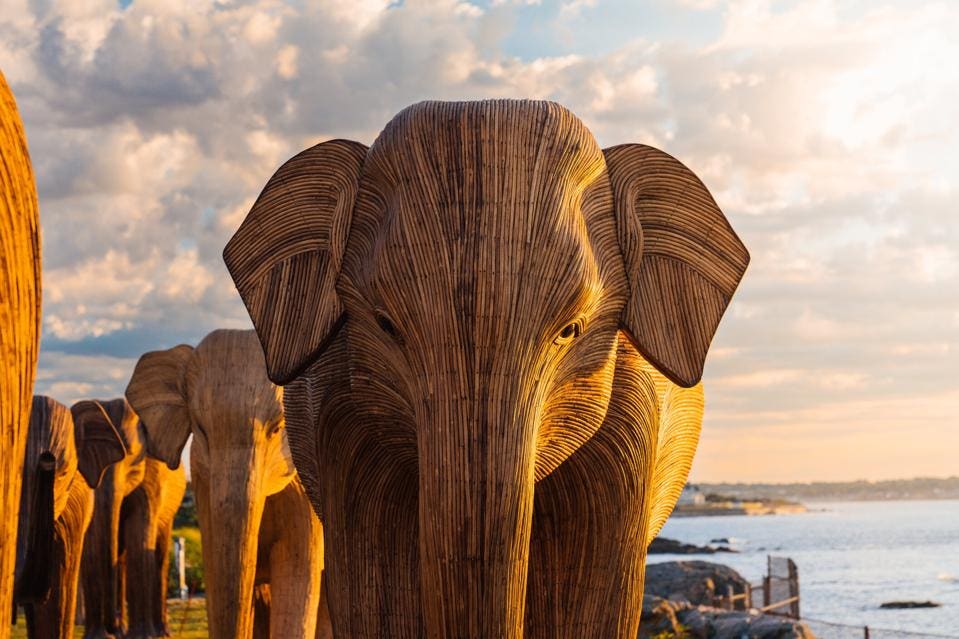
The Great Elephant Migration installation outside Rough Point mansion in Newport, Rhode Island.
The elephants are made by indigenous people from an invasive plant.

Here’s a new way to reach audiences with a message about the importance of conservation: a giant “elephant” exhibit in a beautiful seaside setting that tourists visit anyway.

At Forbes magazine, Chadd Scott begins the story by talking about India.

“India has experienced a remarkable population explosion over the past 40 years. Several actually. One is well known. India’s human population has more than doubled since 1980. … Lesser known, and even more extraordinary in light of the country’s surging human population, has been a doubling of its elephant population over that same period, from a bottom-out of around 15,000 individuals to nearly 30,000 today. Populations of Asiatic lionstigers, and the greater one-horned rhinoceros are also increasing across the country.

“India offers a remarkable example for how humans and wildlife, even the largest of wildlife, can coexist in an ever-developing world. Sharing that message with the world is the mission of the Great Elephant Migration which debuted 100 life-sized Asian elephants in Newport, RI on July 1.

“The elephants — each based on a real, wild elephant from the Nilgiri Hills known by name and personality living alongside people in their coffee and tea plantations — were made by members of the Coexistence Collective, a group of 200 Indigenous artisans from the Nilgiri Biosphere Reserve

“The herd was produced from the Lantana camara, a toxic, invasive plant overtaking the Indian forest, pushing elephants and other wildlife out and into closer proximity to humans, with greater potential for conflict. …

“ ‘It’s a conservation miracle; it’s contrary to what’s happening everywhere else in the world and it’s definitely owed to an incredibly beautiful perspective on nature and our place within nature,’ Ruth Ganesh, trustee, Elephant Family USA, co-organizer of the Newport presentation along with Art&Newport, and co-founder of the Coexistence Collective, said at The Great Elephant Migration’s opening at Rough Point. ‘That’s what we hope the herd will spread, this beautiful perspective of coexistence and seeing other species as our biological kin.’

“The elephants, and the Indians, prove conservation is as much a mindset as a management plan.

“ ‘That culture of being able to live with animals is the most important thing, more than any of the natural variables about habitat and prey, and all of that,’ Asian elephant expert and co-founder of the Real Elephant Collective in India, Tarsh Thekaekara, told Forbes.com. The Great Elephant Migration exhibition and tour is the brainchild of he and Ganesh. His research in India has focused on human-elephant coexistence. ‘Animals will survive in human dominated landscapes if people tolerate them. That is the bottom line.’ …

” ‘The people who made the elephants [practice] kind of a fusion of Hinduism and animism,’ Ganesh told Forbes.com. Animism attributes a soul and living spirit to animals, rivers, mountains, plants, and other objects often considered inanimate. ‘There’s a spiritual tapestry that underpins the answer to the question why is India succeeding in this way despite so many challenges? It’s the spirituality. It’s this perspective.’ …

“Research published this year by scientists at Colorado State University indicates that elephants have names for each other.

“Research from 2022 demonstrates the numerous ways elephants grieve their dead and participate in post-death rituals like burial, same as humans. They communicate. Feel pain. Play. Look out for each other. …

“Seeing animals as beautiful people, seeing mountains as deities and rivers as our veins, that it’s a beautiful perspective,’ Ganesh added. …

“ ‘Not just India, in lots of traditional cultures there wasn’t a decimation of wildlife. If you look at conservation in most of the First World, it happened because there was a systematic decimation of all the wildlife,’ Thekaekara explains. ‘When settlers arrived on the North American continent, they wiped out most animals. So, then you had nothing, and you had to conserve.’ …

” ‘Set aside land for nature because you assume people cannot coexist with nature — that model of conservation was inherently separationist.’ …

“Indigenous people the world over have lived more or less harmoniously with wildlife for millennia. That has not been the case with Europeans and their descendants. …

“ ‘If people stopped killing, [animals are] going to come back,’ Thekaekara said. … ‘In coffee and tea plantations, the core of the local economy isn’t upset by the elephants. They don’t eat the coffee or tea, so people’s livelihoods are not affected. It’s only a minor adjustment to your lifestyle to be able to coexist.’ ”

More at Forbes, here. No paywall for your first articles.

Read Full Post »

Photo: via Robert Turpin.
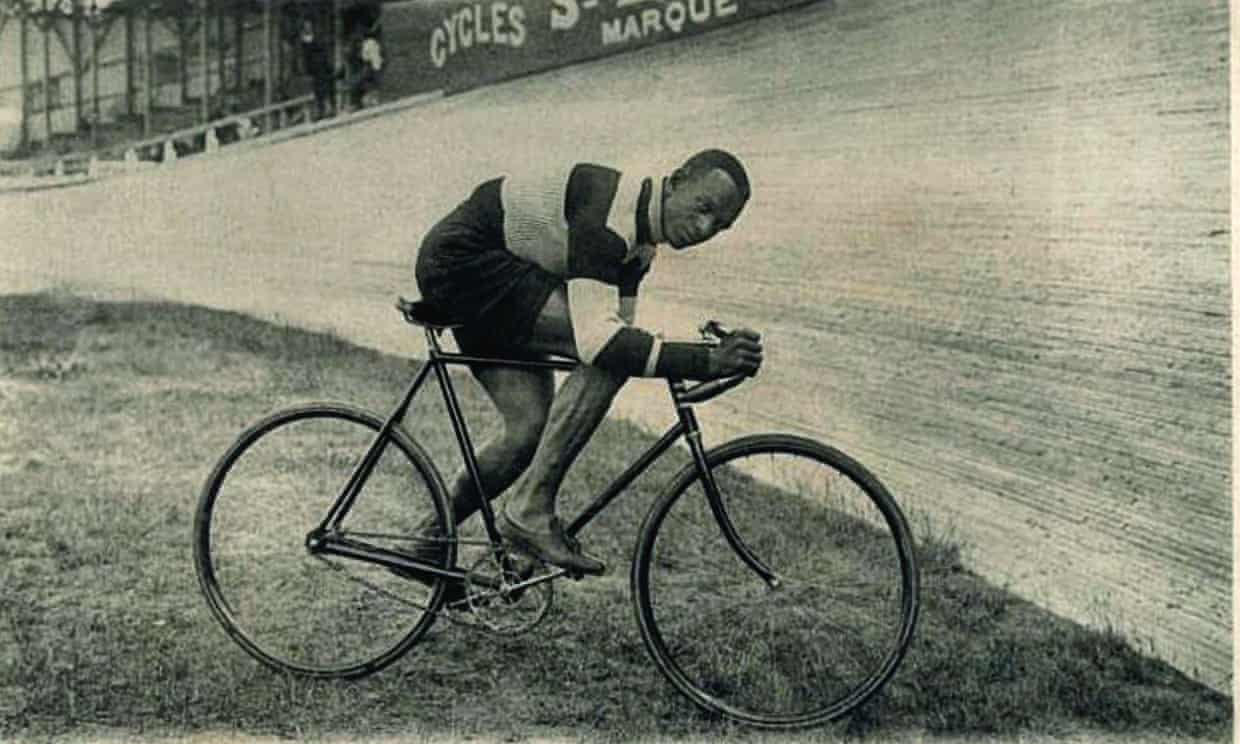
Woody Hedspeth was one of several Black American cyclists in the early 20th-century to move abroad to further his career. 

A country shoots itself in the foot when it pushes away talent. I’m thinking of asylum seekers who may have something to offer. I’m thinking of Black talent going to Europe to find a more welcoming and level playing field — writer James Baldwin, for example, singers Josephine Baker, Marian Anderson, and Paul Robeson.

Today I’m learning about Black bicycling champions turning to Europe in the early days of the competitive sport.

Rich Tenorio writes at the Guardian, “When cycling first took the US by storm in the late 19th and early 20th centuries, Black Americans joined in the new pastime. One Black cyclist, Marshall ‘Major’ Taylor, became a world champion in 1899. Yet American cycling installed a color line in professional racing. Opportunities became so limited that Black competitors had to take them wherever they could find them – including on the vaudeville stage and in Europe. Their story is documented in a new book, Black Cyclists: The Race for Inclusion, by Robert J Turpin, a professor of history at Lees-McRae College in North Carolina.

“ ‘We fall into the trap that history is linear,’ Turpin says. ‘With race relations, we think about the end of the Civil War: “Slavery ended, and things gradually got better and better for Black people.” My book shows what we already know: Things actually got worse for Black people in the US, especially from the 1880s through the 1920s … It got harder for Black cyclists to compete as professionals or even win prize money in general.’

“Turpin is a cyclist himself, and his college features a cycling studies minor, which he believes is the only such program in the US. His interest in the history of cycling extends to how it has been marketed over the decades – the subject of his previous book. …

“Turpin raises another issue: a lack of diversity in contemporary cycling. The book cites a 2020 USA Cycling survey of over 7,000 members in which just 3% reported they were Black or African American. Such underrepresentation extends to the [Olympics] and the Tour de France, where [in July] Biniam Girmay became the first Black African stage winner in the race’s 120-year history. Yet the book notes the increasing impact and influence of Black elite competitors such as 11-time national champion Justin Williams and the first Black female professional cyclist, Ayesha McGowan.

“Before attending graduate school at the University of Kentucky in 2009, Turpin learned about Taylor, whose exploits in cycling began as a teenager in Indianapolis, and crested with a world championship in the one-mile sprint in Montreal. In doing so, he became the first Black American world champion in any sport and his achievements were chronicled in an autobiography, The Fastest Bicycle Rider in the World. ‘He was an international superstar,’ Turpin says. …

“Several years later, Turpin returned to Taylor’s story. By that time, additional primary sources had been made publicly available through digitization. Turpin learned more about not only Taylor, but also his predecessors and peers. …

“Massachusetts became a venue for early Black success in cycling. David Drummond regularly won Fourth of July races in Boston. Taylor used his winnings to buy a home in Worcester – and the city’s first automobile. Katherine ‘Kittie’ Knox, a seamstress turned racing star, was famous for her self-designed outfits and her endurance. Knox illuminated challenges faced by cyclists who were both Black and female.

“ ‘If you were Black and a woman, those were two big strikes against you,’ Turpin says. …

“In 1894, a prominent nationwide cycling organization called the League of American Wheelmen, … barred all Black cyclists except Taylor from professional racing. The ban was not officially repealed until 1999 by the organization, which had been renamed the League of American Bicyclists.

“The book shows the ways in which Black cyclists responded. These included criticizing the decision in the Massachusetts state legislature and forming Black cycling leagues.

“ ‘I stress their agency,’ Turpin says. ‘I do not talk about them as victims. They were resourceful in figuring out alternative ways to still make a living and find social mobility.’ …

“Unlike Jim Crow America, international venues welcomed Black participation as professionals. Taylor left for France and Australia, and named his daughter Sydney after the city where he felt most welcome. Fellow racer Woody Hedspeth followed Taylor to France – and while Taylor returned to the US, Hedspeth remained in Paris.”

More at the Guardian, here. No firewall.

Read Full Post »

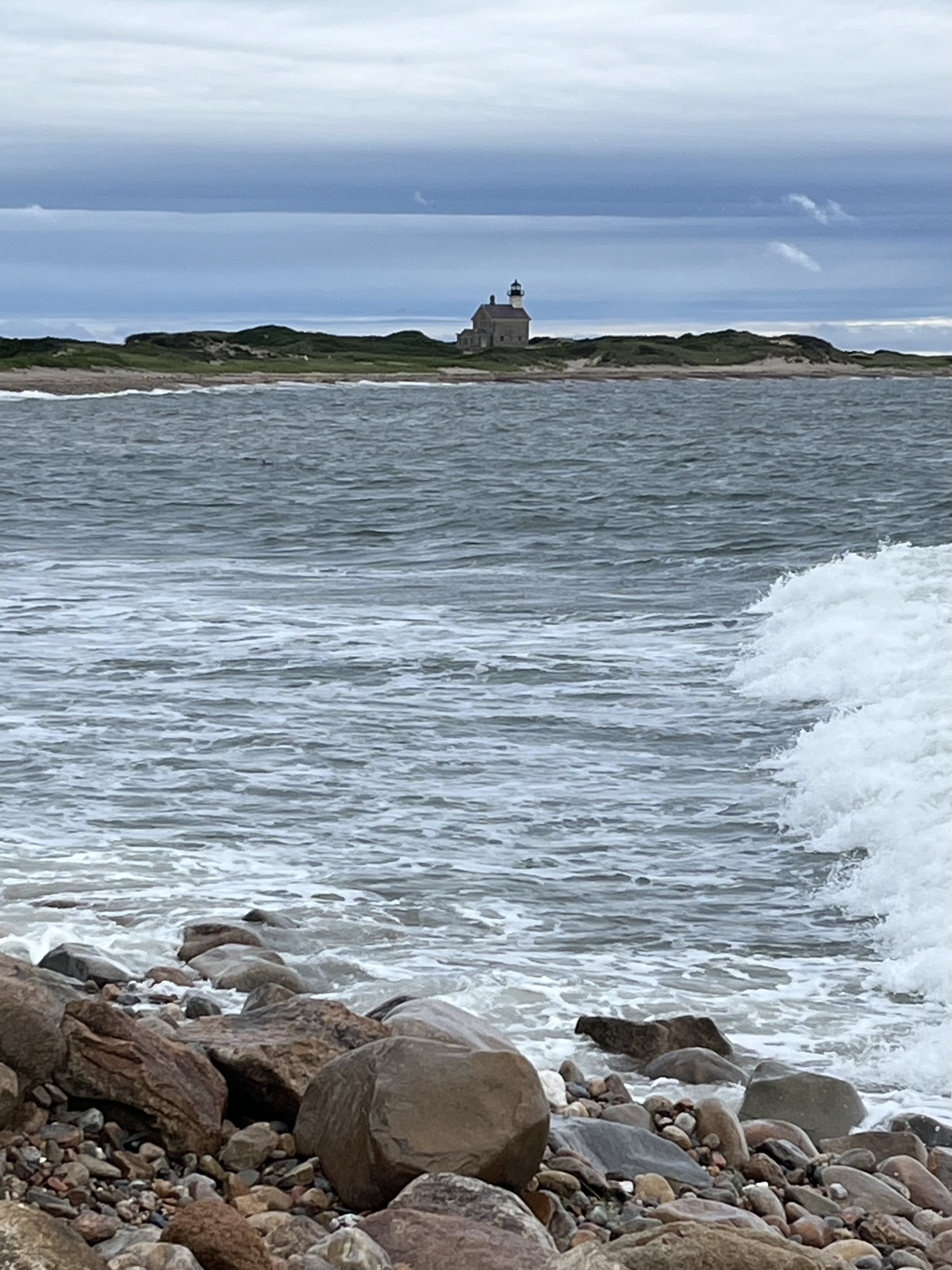
Photos: Suzanne and John’s Mom.

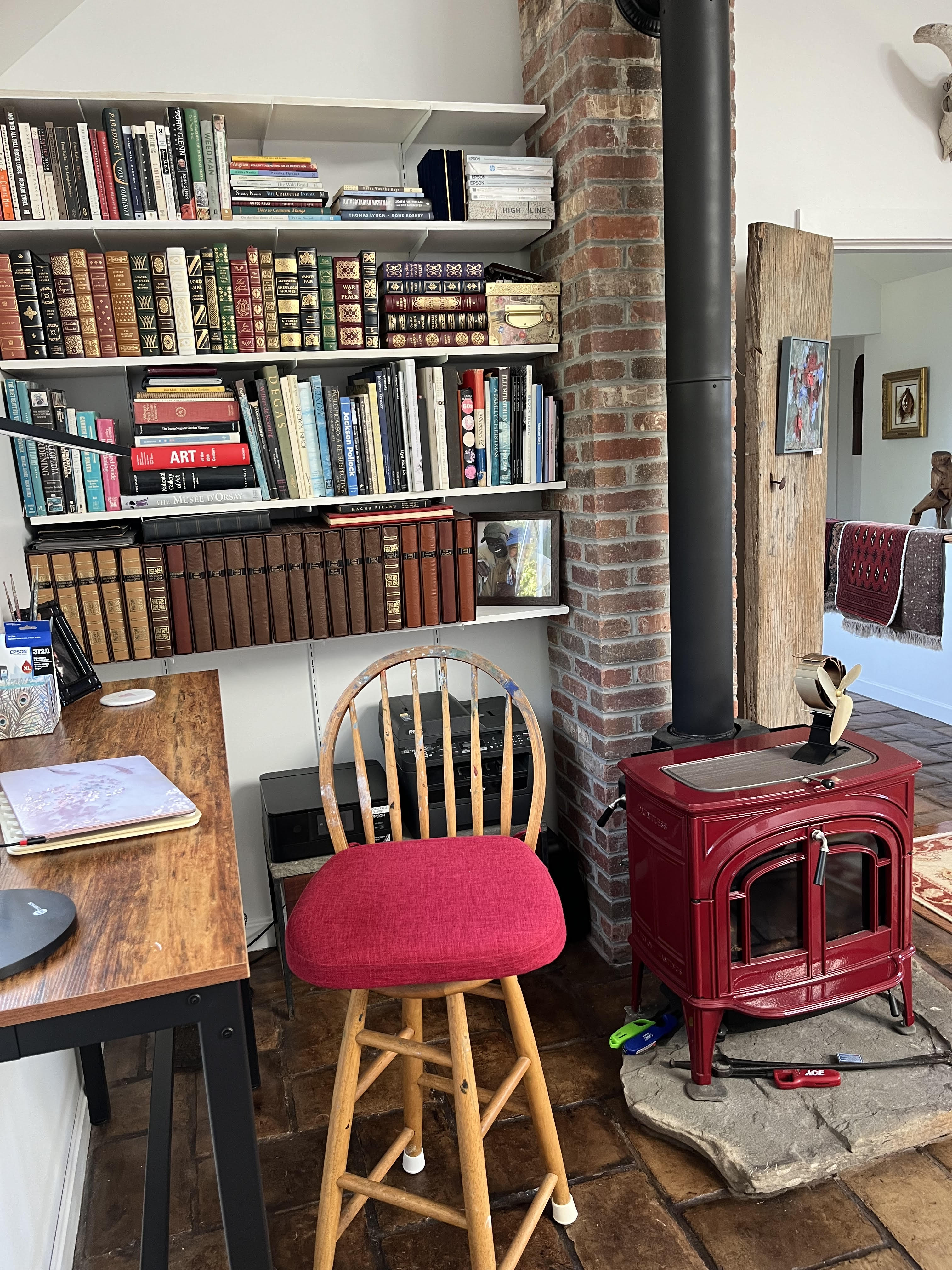
I went out to the deck early one morning and caught my breath. I knew I had to take a photo of the scene above even though all I use is a cellphone. The aperature was open a long time and my unsteady hand distorted the image a bit. My husband noticed that it created extra levels to the deck.

The next photo shows how much I admire Nature creating her own kind of art, often using shadows. Then for manmade art, I love visiting the late Ben Wohlberg‘s open houses. Part of the delight is to see his gardens and creatively decorated home.

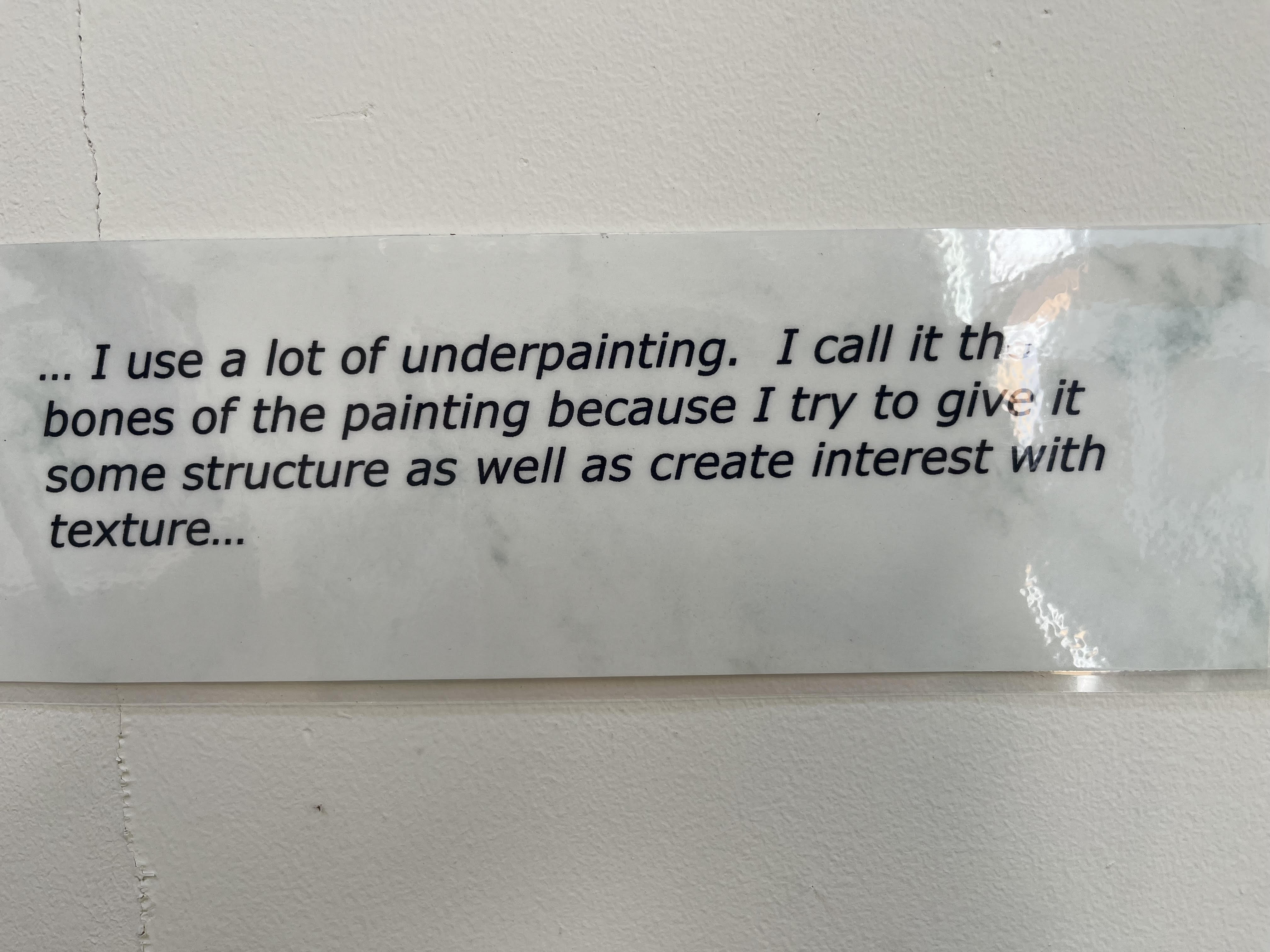
As Catherine Wohlberg told me, her husband was able to support himself with art his whole life, from magazine illustration to portraiture to abstract. He focused on abstract work in his last years, and I include one of the quotes she posted for the 2024 show. Ben’s obituary is here.

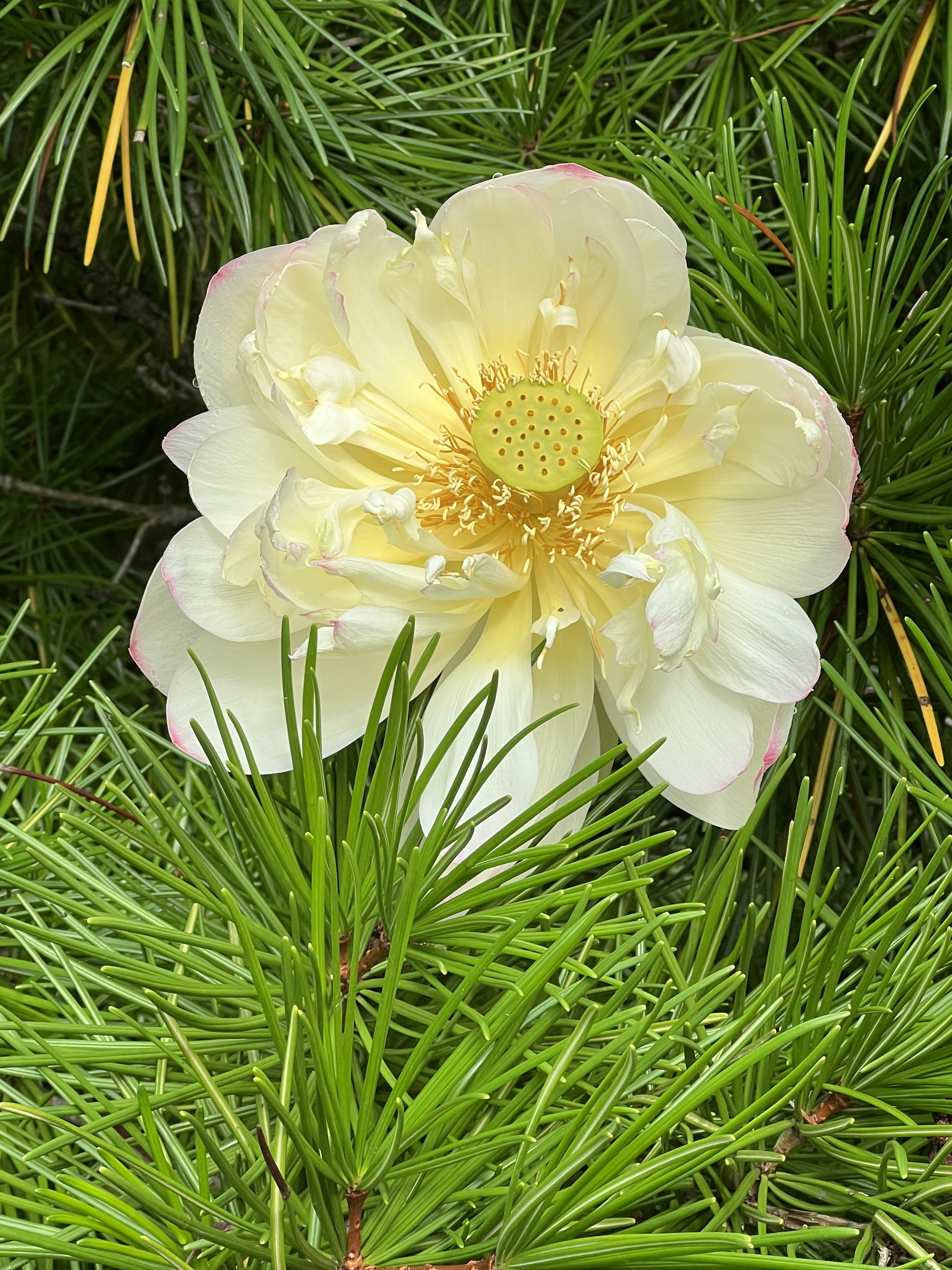
Sandra M Kelly took the next photo, the best we got from the lotus pond this year. Such an amazing flower, but one that can take over if not confined in a small space.

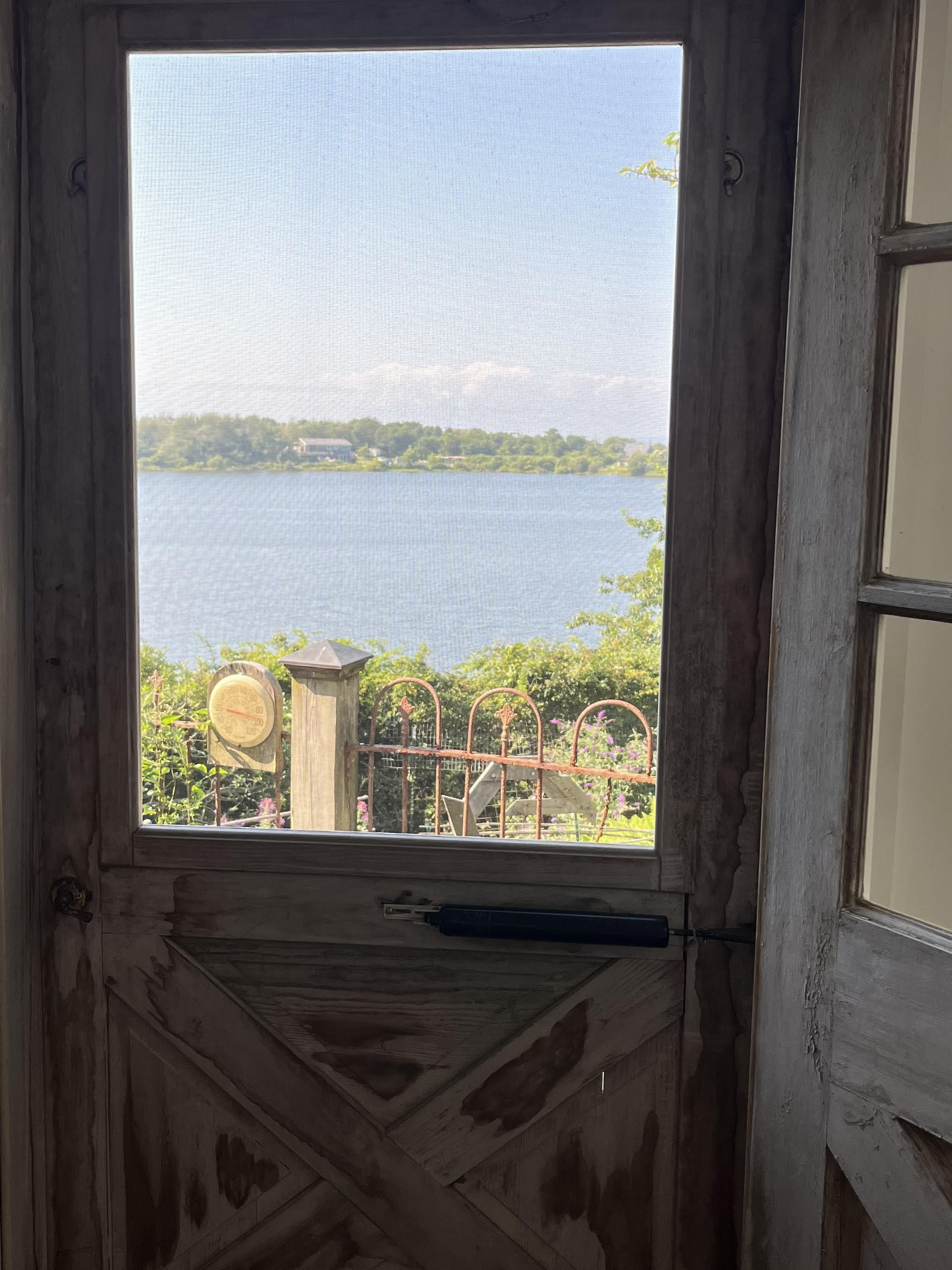
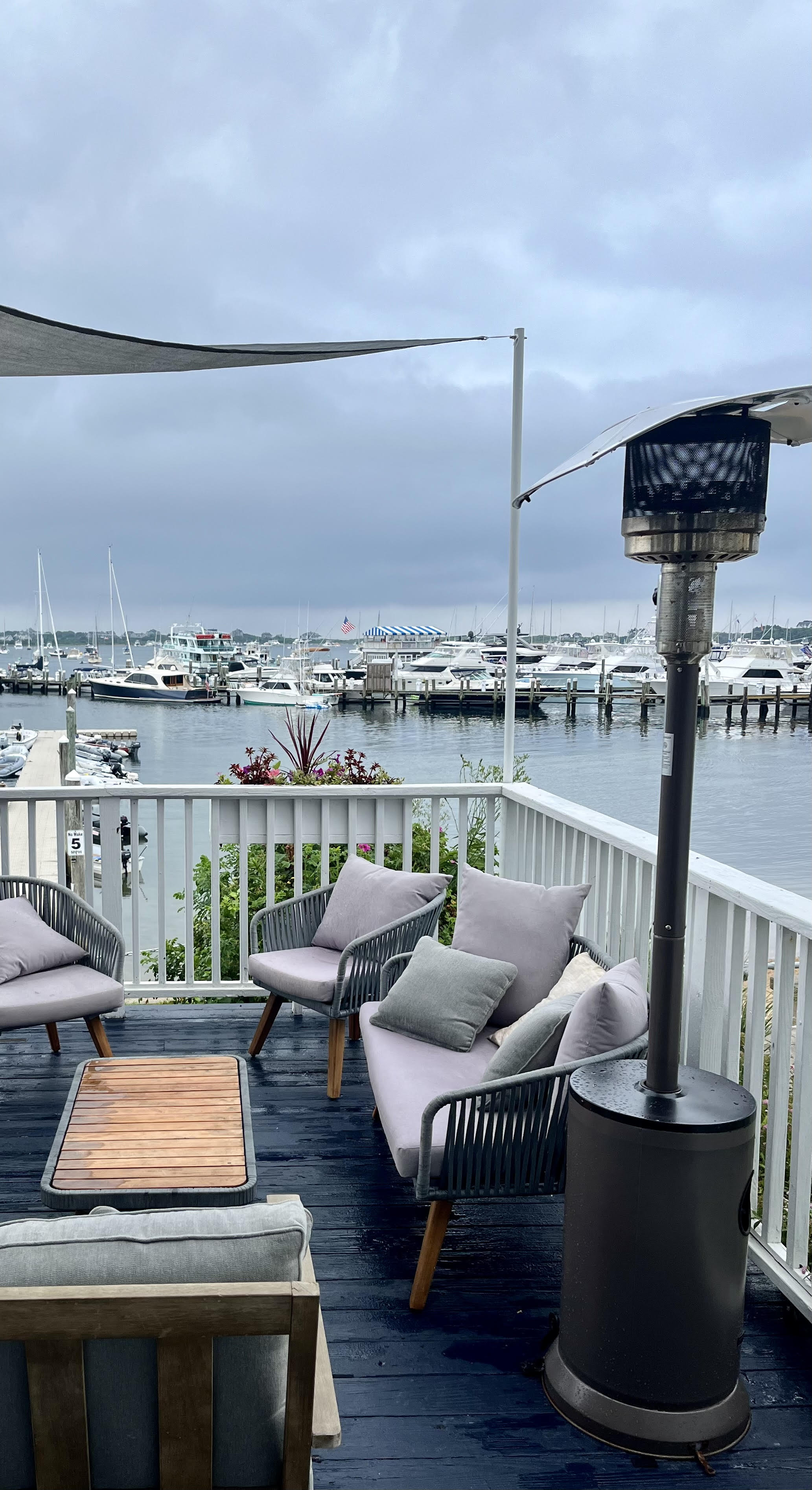
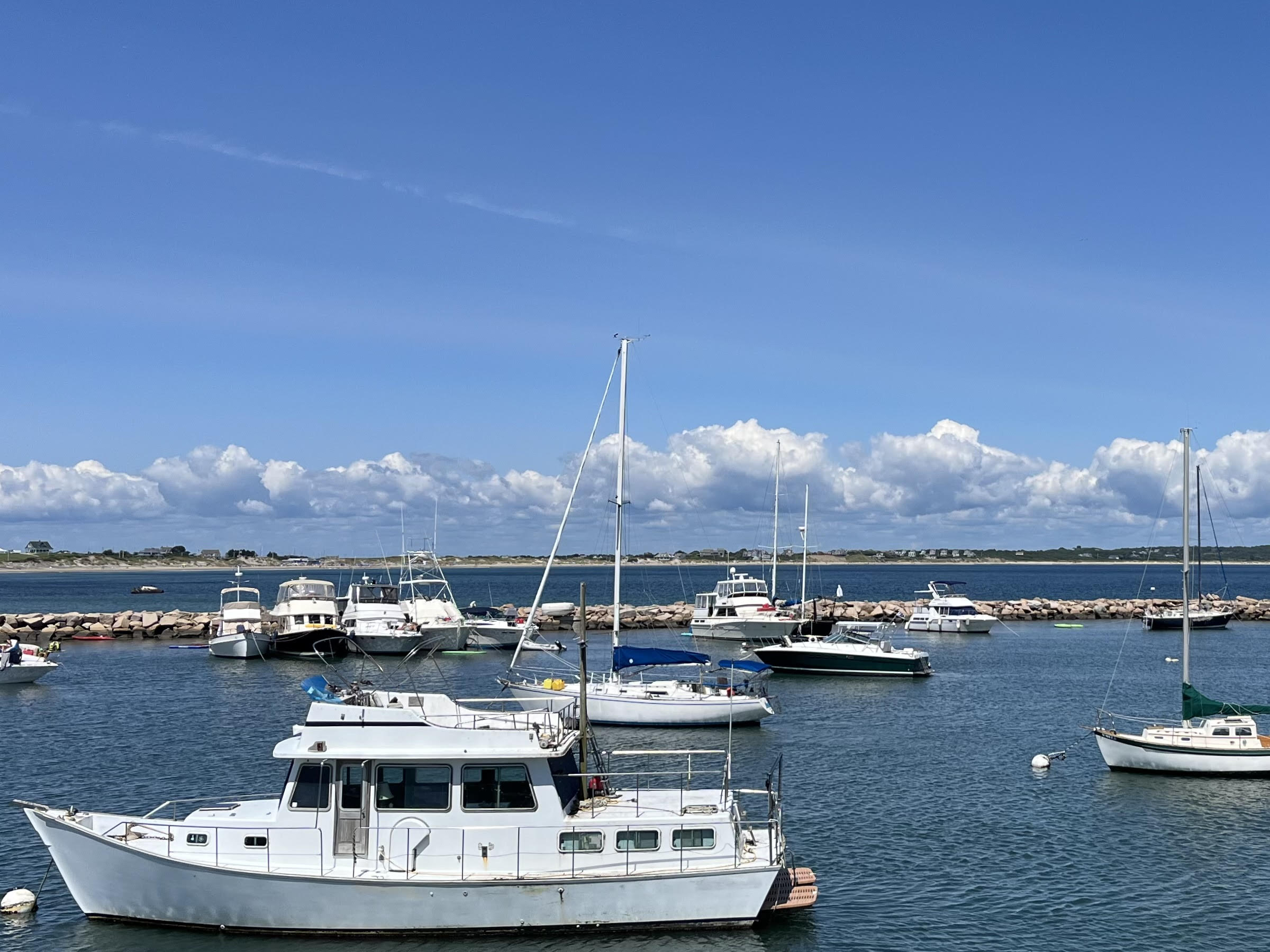
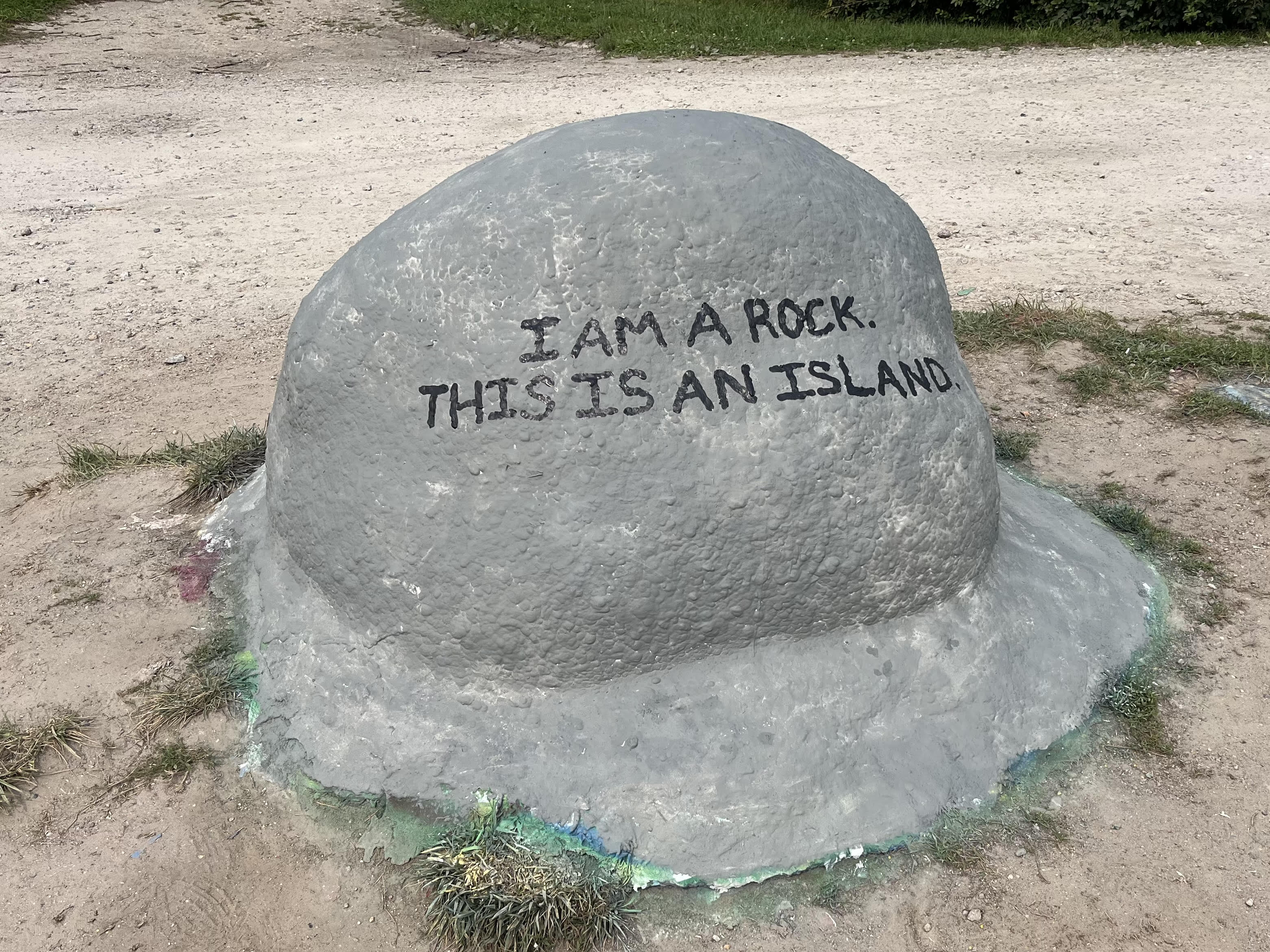
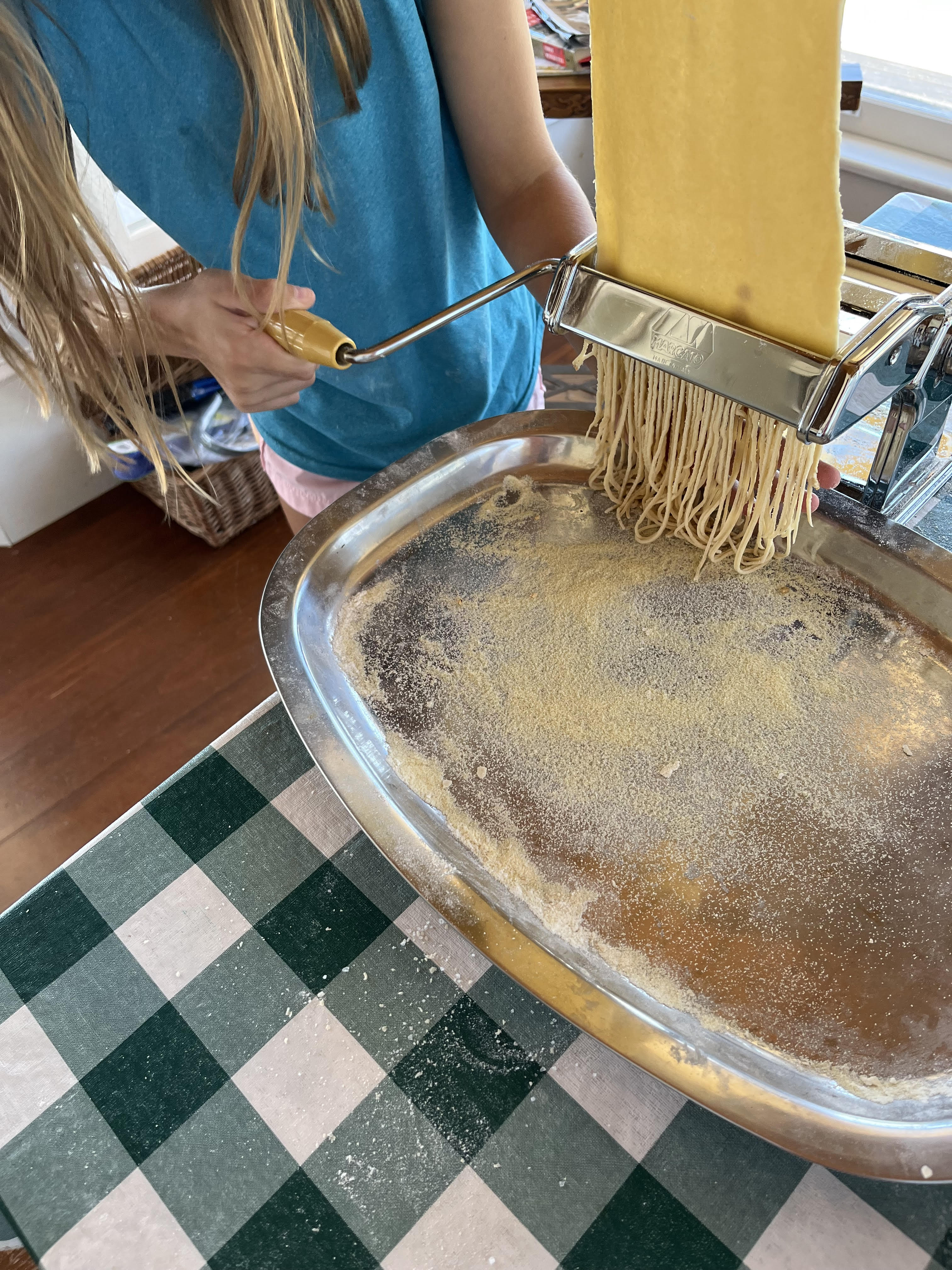
The next few photos are also from New Shoreham, including the one of my granddaughter helping her mom make fresh spaghetti. (It tasted wonderful!)

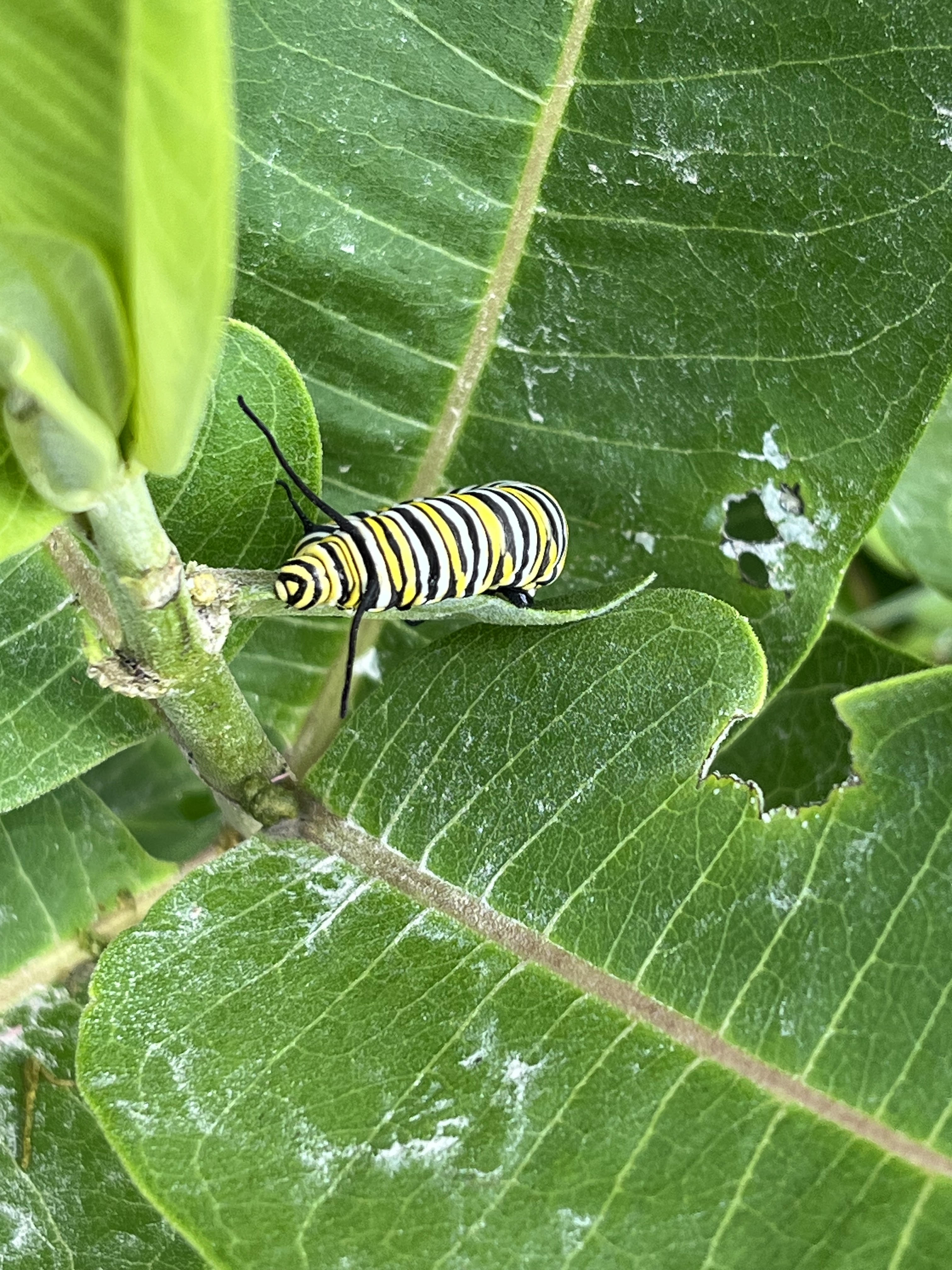
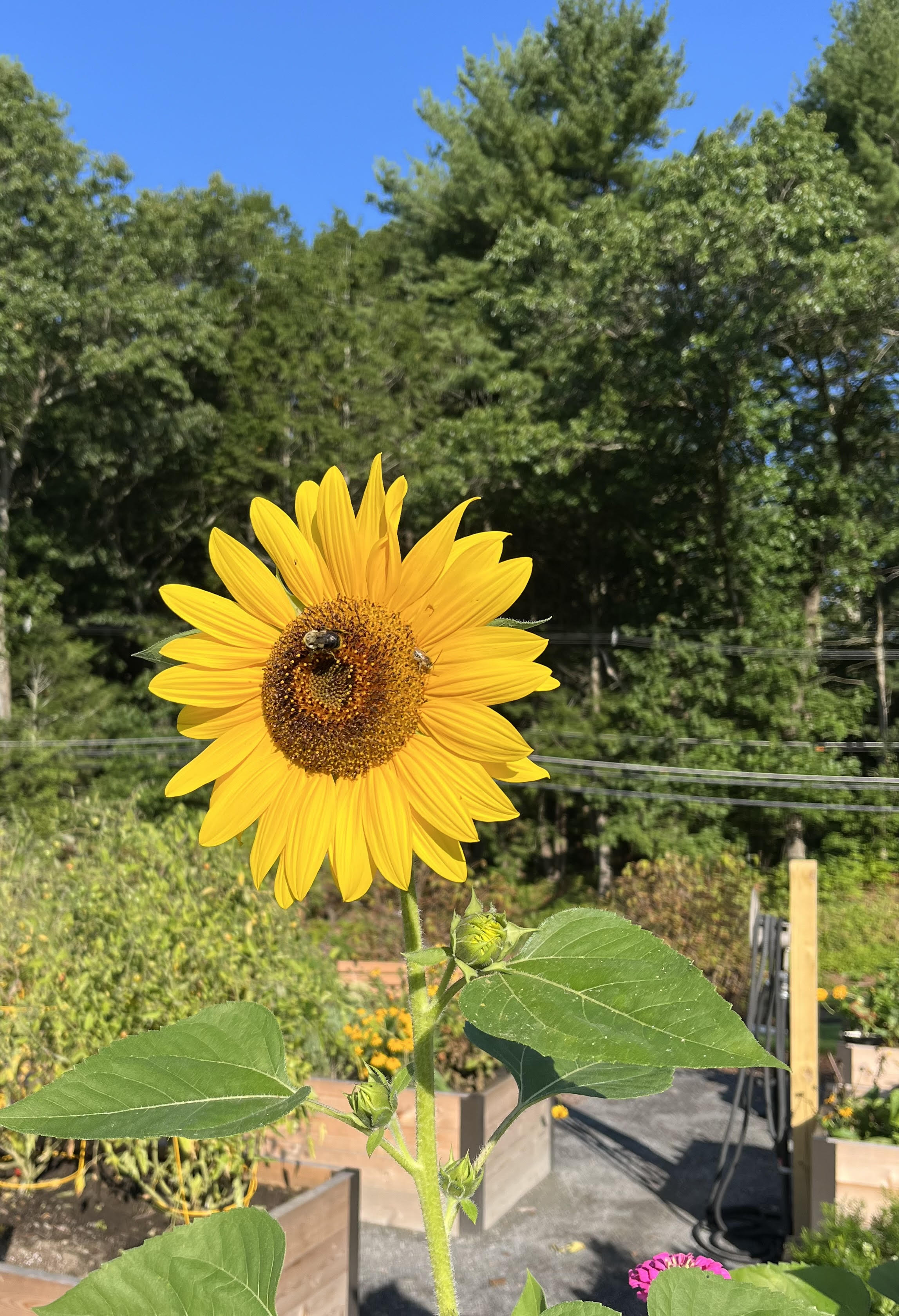
The final two pictures were taken back in Massachusetts, where we’re heading into September and harvest season.

Read Full Post »

Photo:  Patrick T. Fallon/AFP via Getty Images.
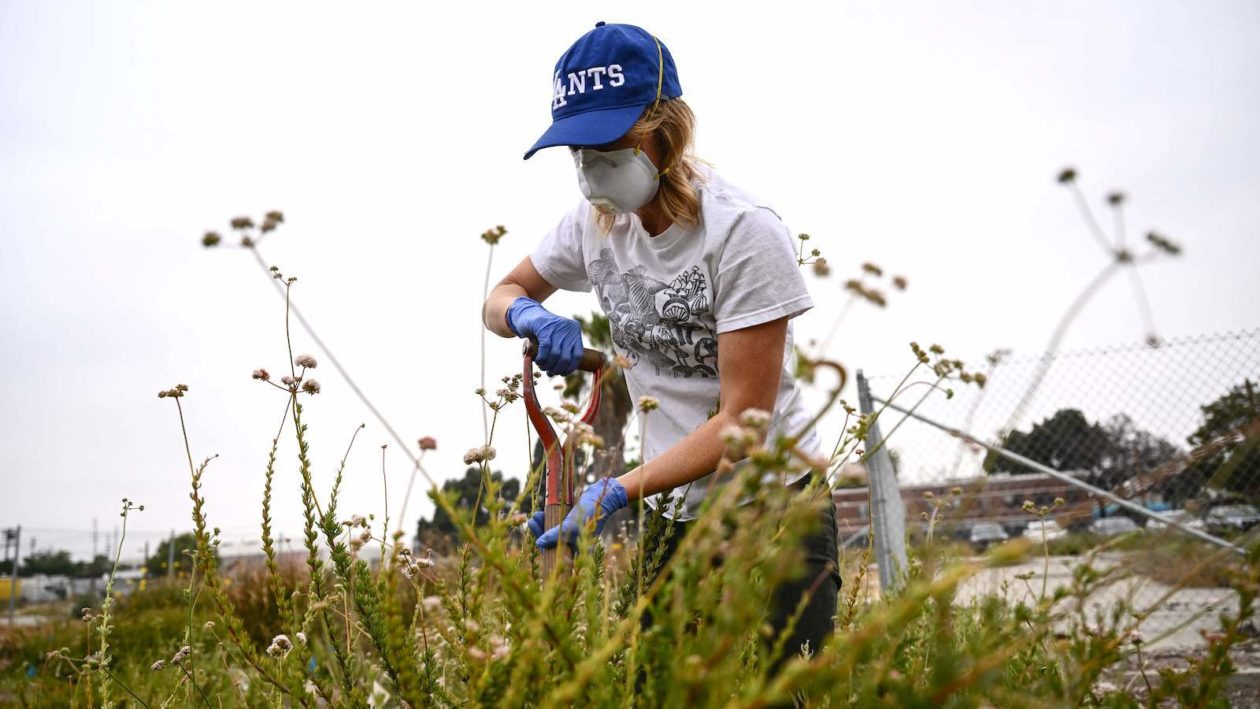
Researcher Danielle Stevenson digs up California buckwheat grown at a brownfield site in Los Angeles.

Given the mess we humans make of the environment, I have to be grateful that we can learn ways to clean things up. And to be fair, we don’t always realize we’re making a mess until it’s too late.

Richard Schiffman at Yale Environment 360, explains one new technique for cleaning things up: harnessing the power of fungus.

“The United States is dotted with up to a million brownfields — industrial and commercial properties polluted with hazardous substances. These sites are disproportionally concentrated near low-income communities and communities of color, according to the Environmental Protection Agency, and researchers predict that heavy rains and flooding due to climate change are likely to both spread and increase exposure to these contaminants.

“For more than 15 years, Danielle Stevenson, who holds a PhD in environmental toxicology from the University of California, Riverside, has been pioneering a nature-based technique for restoring contaminated land, using fungi and native plants to break down toxins like petroleum, plastics, and pesticides into less toxic chemicals.

“The usual way of dealing with tainted soil is to dig it up and cart it off to distant landfills. But that method is expensive and simply moves the problem somewhere else, Stevenson says in an interview with Yale Environment 360, ‘typically to another state with less restrictive dumping laws.’

“In a recent pilot project funded by the city of Los Angeles, Stevenson, 37, working with a team of UC Riverside students and other volunteers, significantly reduced petrochemical pollutants and heavy metals at an abandoned railyard and other industrial sites in Los Angeles. While her research is still in its early stages, Stevenson says she believes her bioremediation methods can be scaled up to clean polluted landscapes worldwide.

Yale Environment 360: I understand that you grew up on the shores of Lake Erie in a highly polluted area.

Danielle Stevenson: The Cuyahoga River, near Lake Erie, used to catch on fire from oil spills. There’s a huge amount of industrial agricultural runoff that leads to toxic algae blooms. The second-largest floating plastic island of the Great Lakes is in Lake Erie.

“But I was surprised to see abandoned oil refineries and factories with trees, plants, and mushrooms growing. I mean, they’ve found fungi growing in Chernobyl in a melted down nuclear reactor. I’ve been on sites that look so desolate and bleak, where the air smells like diesel. It looks like nothing could possibly live there. But when we sample the soil, we always find life, and we especially find fungi that are really resilient and have found a way to live in those conditions and get some sort of food from the pollution.

e360: So you became interested in fungi, eventually founding your own mycoremediation company, D.I.Y. Fungi. What are fungi?

Stevenson: They are their own kingdom of life. They are not bacteria, not a type of plant or animal. Some fungi form mushrooms [as their fruiting bodies], like the ones we like to eat. Other fungi do not form mushrooms but create these beautiful dynamic networks throughout forests and grasslands that connect to the roots of plants. Fungi are largely overlooked, but it is a really important kingdom without which we wouldn’t have soil or the carbon cycle or so many other really important functions in our ecosystems.

e360: How do fungi help restore contaminated soil?

Stevenson: Decomposer fungi can degrade petrochemicals the same way they would break down a dead tree. And in doing so, they reduce the toxicity of these petrochemicals and create soil that no longer has these contaminants or has much reduced concentrations of it. They can also eat plastic and other things made out of oil, like agrochemicals. …

e360: You worked at industrial sites in Los Angeles that were highly contaminated with heavy metals: How did the fungus help there?

Stevenson: Unfortunately, most metals don’t break down because they’re not carbon-based. In nature, it’s actually plants that pull metals out of soil. And so there are fungi, they’re called arbuscular mycorrhizal fungi, that can help plants do that better. And so on Taylor Yard [the Los Angeles railyard] and other sites, I’ve worked with a combination of decomposer fungi, arbuscular mycorrhizal fungi, and plants that we previously found to be able to pull metals like lead and arsenic out of the soil into their aboveground parts. These plants can then be removed from the site without having to remove all of that contaminated soil.

e360: How did the sites look different after the work that you did on them?

Stevenson: They became basically beautiful meadows of native plants that were flowering, and now there are bees and birds and all sorts of life coming through. We had a very high success rate. In three months we saw a more than 50 percent reduction in all [petrochemical] pollutants. And then by the 12-month period, they were pretty much not detectable.”

The rest of this article — on reusing some metals, on working with tribes — is fascinating. Read at e360, here. No paywall.

Read Full Post »

Photo: Library of Congress, LC-USZ62-51058, via Axios.
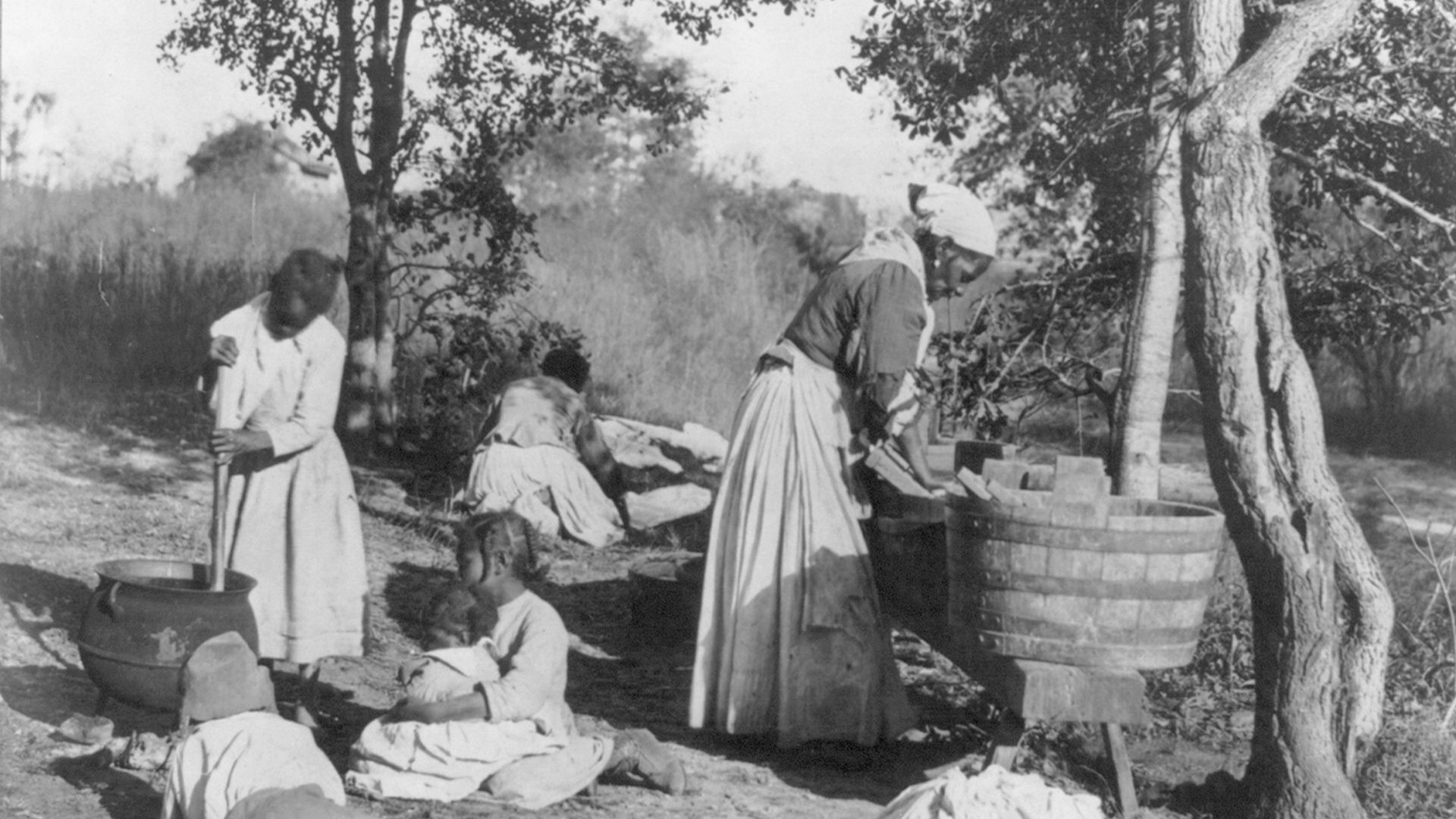
African American women and girls doing laundry with a scrub board and tub, c. 1900.

Today I’m thinking about how good things get accomplished when people submerge their differences and focus on what they have in common. And I’m remembering that even people who say they don’t like unions routinely reap the benefits of the labor movement.

One early labor milestone happened when Black washerwomen in the South had just had enough. Kim Kelly wrote up the story for the Washington Post.

“There is no one location or event that can lay a definitive claim to the founding of the American labor movement, but what is certain is the enormous debt it owes to women.

“During the Victorian era … waged labor was seen as the exclusive realm of men, and for most middle- and upper-class women, the thought of earning money for their toil was wholly foreign.

“Of course, these standards were applied specifically to native-born White women, whose status as a protected class separated their experiences from those of working-class women of color in the United States — particularly Black women, whose relationship with work in this country began with enslavement, violence and forced labor. Following Emancipation, their lives were still often defined by exploitation, abuse and wage theft. Whether held in bondage or living freely, Black women were expected to work from the moment they were old enough to hold a broom.

“These women were hardly alone. By the 1830s, the American genocide against Indigenous people had been well underway for decades, and the few Indigenous women allowed into the workforce were treated abominably. As immigration ramped up during the middle of the 19th century, female workers from other ethnic groups — including Irish immigrants fleeing a colonial famine and Russian Jews seeking to escape brutal repression — were also targeted. …

“But that restrictive social fabric quickly began to fray as the Industrial Revolution took flight. … On a balmy spring 1824 day in Pawtucket, R.I., 102 young women launched the country’s very first factory strike, and brought the city’s humming textile industry to a standstill.

“The 19th-century Northern U.S. textile industry was almost entirely White. It wasn’t until 1866, a year after Emancipation, that formerly enslaved Black female workers were able to launch a widespread work stoppage of their own — and by doing so, jump-start a wave of Black-led labor organizing that would spread through multiple industries and set the stage for decades of labor struggles to come.

On June 16, 1866, laundry workers in Jackson, Miss., called for a citywide meeting.

“The women — for they were all women, and all were Black — were tired of being paid next to nothing to spend their days hunched over steaming tubs of other (White) people’s laundry, scrubbing out stains, smoothing the wrinkles with red-hot irons, and hauling the baskets of heavy cloth through the streets. At the time, nearly all Black female workers were employed as domestics by White families, to handle the cooking, cleaning and child care, hauling water, emptying chamber pots, and performing various and sundry other tasks that the lady of the house preferred to avoid.

“Laundry, at the time a labor-intensive day-long process, topped that list in an era in which families were large, personal hygiene was negligible, and running water was scarce. The washerwomen’s wages were kept so low that even poor White families could afford to send their laundry out for Black women to clean.

“The work itself was onerous, but the relative flexibility and independence it afforded was attractive to Black female workers: They were able to work out of their own homes, which in turn allowed them to plan around their own familial and community obligations, and it was a trade that could be passed down to their own daughters. …

“In modern terms, the washerwomen were independent contractors, with lists of clients who paid a set rate for weekly service. … White employers were shocked and appalled whenever Black workers exercised their rights as free wage-earning people or dared to engage in small acts of resistance against mistreatment. One of their most powerful weapons was, simply, to quit, and go looking for more desirable clients as their former employers scrambled to hire replacements.

“This growing tension between employer and employee came to a head in 1866, when the washerwomen of Jackson presented Mayor D.N. Barrows with a petition decrying the low wages that plagued their industry and announcing their intention to ‘join in charging a uniform rate’ for their labor. As their petition read: ‘Any washerwoman who charges less will be fined by our group. We do not want to charge high prices, we just want to be able to live comfortably from our work.’ The prices they’d agreed upon were far from exorbitant: $1.50 per day for washing, $15 a month for ‘family washing,’ and $10 a month for single people. They signed their letter ‘The Washerwomen of Jackson,’ and in doing so, gave a name to Mississippi’s first trade union.

“The media response to their action was withering, dismissing the women’s intelligence and skills, predicting abject failure, and, in a move that would become common as more Black workers’ organizing efforts spread, assuming that the strike had been planned by Northern White male agitators.

“There is no record of the 1866 strike’s outcome, but the action itself had an immediate ripple effect in Jackson and farther afield. Throughout the Reconstruction era of 1865 to 1877, Black workers rose up and struck in Virginia, Tennessee, Alabama, Georgia, Louisiana, South Carolina and Washington, D.C.

“In 1869, the Colored National Labor Union was formed to represent the unique interests of Black workers who had been shut out of the larger National Labor Union. Its second president was Frederick Douglass, elected in 1872. The Great Railroad Strike of 1877, a series of often violent work stoppages in which more than 100,000 railroad workers struck over wages and dangerous working conditions, temporarily brought the railroad barons to their knees and unleashed a roving spirit of dissent that captured the imagination of workers across industries from coast to coast.

“Those winds of change arrived in Galveston, Tex., in July and August, when hundreds of workers crossed the color line and struck together several times to protest their low wages.”

For the long and interesting article at the Post, click here. A summary of the washerwomen’s strike is at the AFL-CIO site, here. No firewall for that.

Read Full Post »

Photo: Navajo-Hopi News.
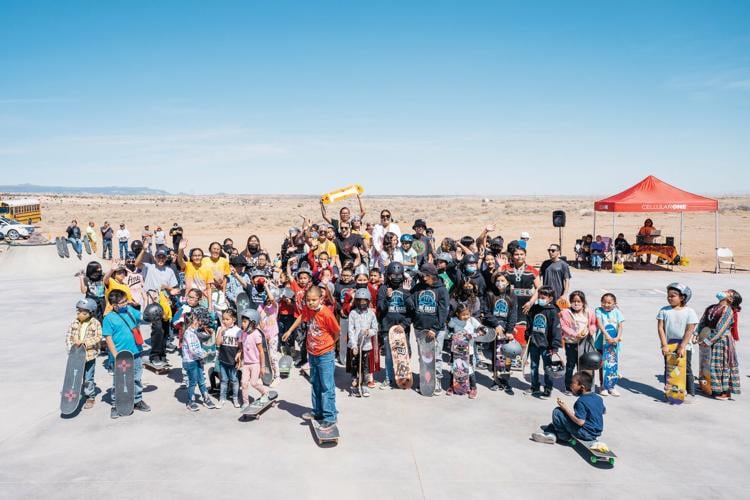
Two Gray Hills Skatepark in Newcomb, New Mexico.

The forced assimilation of indigenous children into colonist culture damaged the children, the relatives of the children, and the grown children’s descendants. In today’s story, we learn how one descendant was surprised to discover she was Navajo and looked for a way to help her long-lost community.

Roman Stubbs writes at the Washington Post, “The wind rolled off the Chuska Mountains and along the desert floor, whipping red dust and tumbleweed across the pavement of Two Grey Hills Skatepark. It was a pale Sunday morning in May, and Amy Denet Deal stood on a ledge, tying a crimson bandanna around her silver braids and smiling as she watched the children swerve down ramps in the middle of the storm.

“ ‘Amy!’ ” a young boy yelled, excited to greet the woman who helped bring the skatepark to this remote northwest corner of the Navajo Nation.

“ ‘Hi, honey. How you doing?’ she replied. ‘You’ve grown a foot since I last saw you!’

“Denet Deal, 59, considered herself younger than the boy in Diné (Navajo) years. She had reconnected with the tribe only five years earlier after a lifetime of displacement, giving up most of her belongings and a ­lofty salary as a corporate sports fashion executive in Los Angeles to move to New Mexico.

“The pandemic opened her eyes to the inequities children on the reservation face, including high rates of diabetes, mental health issues and suicide. Navajo Nation is roughly the size of West Virginia — 16 million acres stretching across Arizona, New Mexico and Utah — yet there are few opportunities for kids to play sports, with many remote areas lacking outdoor recreation and athletic facilities.

“She searched for solutions to give back and finally landed on one: Why not a skatepark?

“It took years of fundraising, with plenty of setbacks, but more than a year after it opened, she could still point to the benefits the park was bringing to her community. The kids from a nearby housing project came for free clinics held every weekend. Parents and grandparents parked their trucks near the concrete to watch, sharing food with one another in their camping chairs as the breeze stung their faces.

‘If I talk to any skateboarder, the first thing they’ll always tell me is, “Skateboarding saved my life,” ‘ Denet Deal said. …

“And so here she was again, making the four-hour drive from Sante Fe to her ancestral homeland, because visits were also helping her with the trauma of her past.

“ ‘The plus side of this is I come from displacement and a strange start in the world,’ Denet Deal said. ‘It’s really helping me heal through that work.’

“Denet Deal didn’t visit the Navajo Nation until she was in her late 30s. Her mother, Joanne, had been forced into a boarding school in Farmington, N.M., in the early 1950s. Joanne’s family had no horse or car to visit her for years. ‘She suffered all kinds of abuse and forced assimilation,’ Denet Deal said.

“Through the government’s Indian Relocation Act, Joanne left the reservation with a one-way bus ticket to Cleveland in her late teens. She got pregnant with Amy. Like thousands of other Native children in the 1960s, Amy was placed into adoption and taken in by a Catholic charity. …

“ ‘I was put up for adoption without anybody contacting my birth family, no connection to the tribe,’ Denet Deal said. ‘I grew up completely displaced from my community. I was the only Brown person in rural Indiana.’ …

“She found something to hold on to when she learned how to use a sewing machine as a child. She started making all of her own clothes and threw herself into fashion. Denet Deal developed into a rising star in the active sportswear space in the early 1990s; at 26, she was creating apparel at Reebok and by 30 she took over as design director at Puma. …

“For years, she searched for her mother. She hired a private investigator and scoured the internet. She numbed the emptiness with alcohol and work.

“In 1998, she had a breakthrough. Denet Deal convinced the Indiana Department of Health to release her record of adoption and was given Joanne’s address and phone number. She wrote Joanne a letter and received a letter back. Denet Deal visited her mother for the first time in Ohio, and together they eventually traveled to the Navajo Nation to meet other family.

“ ‘It wasn’t warm and fuzzy,’ she said. … ‘It brought back a lot of things for my mom that were hard.’ …

“Some locals rejected her because she didn’t grow up in the Navajo Nation. She was still getting to know many of her family members, and her presence could trigger reminders of a painful history for them. …

“The pandemic offered Denet Deal a chance to give back what she learned in another life. She used her past skills as a wealth generator for major corporations to help raise more than $1 million in medical supplies, food and support for a domestic violence shelter. But she wanted to do more, having seen up close the problems for children on the reservation.

“ ‘I just thought a skatepark was a really great thing to have for them.’ “

At the Post, here, you can read about the people who helped make it happen.

Read Full Post »

« Newer Posts - Older Posts »