Feeds:
Posts
Comments

Archive for the ‘Uncategorized’ Category

Photo: Rainbow Skateland.
Roller skating — often in the street — has been part of African American culture for years.
Today it’s really an art form.

The world of roller skating is a world I know nothing about. The one time I tried it at a kid birthday party, I was mostly frozen. But wait till you hear about the expertise of today’s Black roller skating world!

James Thomas reports from Atlanta for the New York Times, “To parse the different regional roller skating styles in metro Atlanta rinks, watch the traffic patterns.

“Sparkles Family Fun Center in Smyrna, Ga. on a recent Thursday night offered a case study: Locals skating in the hometown style churned the floor’s edge, punctuating their synced steps with hand claps that rose from the shoulder. Skaters in the New York-New Jersey-style bobbed steadily and pivoted in tight circles at the center of the crowded rink. A critical mass of skaters doing Chicago’s brand of fluid, James Brown-inspired footwork, or JB skating, carved a jet stream between the crowds.

“It was the warm-up party for the Jivebiscuit Skate Family Reunion, one of the longest-running national gatherings of Black roller skaters. The 17-year-old event, held in February, is one of several annual parties that have made Atlanta a skating hub, bolstered by a steady, decades-long influx of Black residents from other cities.

“ ‘It’s definitely like the Great Migration meets the skate migration,’ said Reggie Brown, 40, a JB skater and music producer who grew up in Chicago. Though he now lives in New York, Brown visits Atlanta frequently to skate. …

“That commingling has Atlanta’s stalwart skaters concerned about keeping their distinctly energetic and percussive style alive. They say Atlanta’s newer skaters, who have wide access to regional variants, increasingly practice a hybridized type of skating that’s not rooted in any one tradition.

“ ‘If you don’t understand the foundation, you have the potential to lose it altogether,’ said Vaughn Newton, the skating choreographer for the 2006 coming-of-age movie ATL. Newton, 58, is a respected bridge between the city’s younger and older skaters. …

“On any given night in Atlanta — certainly on a destination party night — a D.J.’s song choices can activate or chill the various pockets of culture swirling the floor. So when D.J. Arson played ‘Presha‘ by 2 Chainz and Lil Wayne, a standout of the trap subgenre, on the second night of Jivebiscuit at Stone Mountain Skates in Stone Mountain, Ga., the Atlanta-style skaters took their cue.

“Paul Antonio Johnson led a procession along the perimeter, his high knees evoking a drum major in a marching band. He called out routines; the skaters behind him clapped and matched cross slides to the pounding beat. The maneuver is a foundational element of the Atlanta style, where a skater crosses feet laterally in sync with the music. Though known by different names across regions, Atlanta skaters in the 1970s first termed it the crisscross. Younger generations smoothed it out, lifting their skates for a cross-body step they called the cross slide.

“ ‘If you know what you’re looking for,’ says Newton, ‘you’ll see the crisscross. And that’s what everything is built on.’

“Arson stayed in trap mode for the next half-hour before shifting smoothly out of the simmering, drum-heavy hip-hop into mid-tempo R&B with muscular grooves and few lyrics. The Atlanta skaters slowed down and cycled off the floor while the JB skaters took over, swaying and lunging, arms high. They had buoyancy and finesse.

“Atlanta style embodies ‘a lot of energy, showmanship, ugly face. It’s real hype,’ said Kenneth Anderson, known as Kojak. He and his wife, Tijuana Anderson, or Lady Tee, 61, are pillars of the Atlanta skating community. ‘It’s like riding a motorcycle on 285 and just letting your hair down,’ Kojak, 62, said. ‘It’s a real aggressive style.’ …

“When Joi Loftin moved to the area from Detroit in 1988, synth-funk and early hip-hop were prevalent. In 1995 she and other transplanted Detroit skaters, who were used to up-tempo R&B, began to pool their money each week. ‘We would rent Golden Glide rink just so we could play the music that we wanted to skate to,’ she said. ‘That session is still going on to this day.’

“Loftin soon developed relationships with other rink owners, D.J.s and skaters. She and John Perkins, a transplant from New York, started Sk8-a-Thon in 1996, one of the first recurring national parties that showcased Black roller skating styles. Their first event drew 836 skaters from around the country to the Golden Glide in Decatur, six miles east of downtown Atlanta. Over the years it grew to accommodate thousands in multiple rinks over four days, making a Labor Day trip to Atlanta a Black roller skating ritual Loftin hopes will continue now that she’s held her last Sk8-a-Thon in 2023.

“ ‘It’s a beautiful thing,’ said Terron Frank, 34, who traveled from Portsmouth, Va. for Jivebiscuit. ‘You can pretty much see every style you’d want to see in Atlanta.'”

More at the Times, here. Great photos.

Read Full Post »

Photo: Kang-Chun Cheng.
A chimpanzee swimming near the Ngamba Island sanctuary in Uganda.

Exercise instructors like to tell you how everything in your body connects to everything else. For example, moving your eyes as if trying to look behind you can help your neck turn a little farther in a neck exercise.

Interconnectedness is also true of nature. Consider Uganda, where work is being done to simultaneously protect chimpanzees, tropical forests, small-farm agriculture, and families.

Kang-Chun Cheng writes at the Christian Science Monitor, “From the shade of a banana tree, Samuel Isingoma explains why he is sacrificing his precious jackfruit to chimpanzees.

“ ‘Since I support and give fruit to the chimps, they don’t disturb anything else,’ says Mr. Isingoma, who has planted 20 jackfruit trees on his 17-acre plot in the western Ugandan village of Kasongoire. The trees’ bounty is solely for the primates. …

“Uganda is East Africa’s largest sugar cane producer and has one of the fastest-growing populations on the continent. The need to make space for homes and farms is reducing the forest cover that helps sustain chimpanzees.

“James Byamukama, an executive director at the Jane Goodall Institute, says it’s critical to have discussions within communities rather than try to impose solutions. Community monitors from the institute’s Uganda chapter have recommended that farmers plant crops that aren’t so palatable to wildlife. So about eight years ago, Mr. Isingoma started planting coffee beans, leaving behind the maize he used to cultivate.

“Now he is taking the institute’s advice one step further by giving his fruit over to hungry chimps.

“As a result, Mr. Isingoma says, ‘I feel there isn’t much of a human-wildlife conflict.’ “

The nonprofit We Stand for Wildlife expands on the connections between farming and forests.

“When over 1000 Ugandan small holder farmers adopted WCS conservation farming practices they increased crop-based income 15 fold and halted clearing on 2700 hectares [6671.845 acres] of riverside forest.

“Following the end of the civil war in 1986 refugee families began to return to their lands in the Murchison-Semliki region of Uganda that contain the last remaining natural forest in the country outside of protected areas. These riverside forests form corridors connecting the national parks and are vital habitat for chimpanzees.

“To feed their growing families farmers began to clear the forest to plant crops. Traditional agricultural practices quickly exhaust the soil and farmers are forced to deforest new areas. Between 2006 and 2010 WCS sound science showed that farmers were clearing nearly 8,000 ha of forest each year. Unless this changed the forest and its resident chimpanzee would soon disappear.

“In an attempt to avert this deforestation trend WCS joined forces with the Jane Goodall Institute and the Chimpanzee Trust. Initially we hoped that we could help farmers to capture the value of their trees by selling their stored carbon in the voluntary REDD+ market place. But the high cost of certifying the carbon for sale and the low price of forest carbon made this idea untenable.

“At WCS we adapted our plans and began offering farmers training in zero tillage farming that conserves nutrients and soil moisture, which is critical as rains become less predictable with climate change.

Farmers who adopted the less capital intensive conservation farming methods saw their maize yields increase 2-fold and their net revenue by 15-fold.

“Today over 1000 farmers are using conservation farming technique that preserve soil fertility and crop productivity dramatically reducing the need to clear more forest. Analysis of forest cover change using the Global Forest Watch interactive mapper shows that deforestation has visibly declined in areas under conservation farming. In lila was forest before the start of the REDD+ project; in green the forest still today and although it is difficult to quantify a 1 to 1 cause and effect relationship it show that deforestation was a lot less where our Private Forest Owners/conservation farmers live.”

More at the Monitor, here, at WCS, and at the Jane Goodall Institute. No firewalls.

Read Full Post »

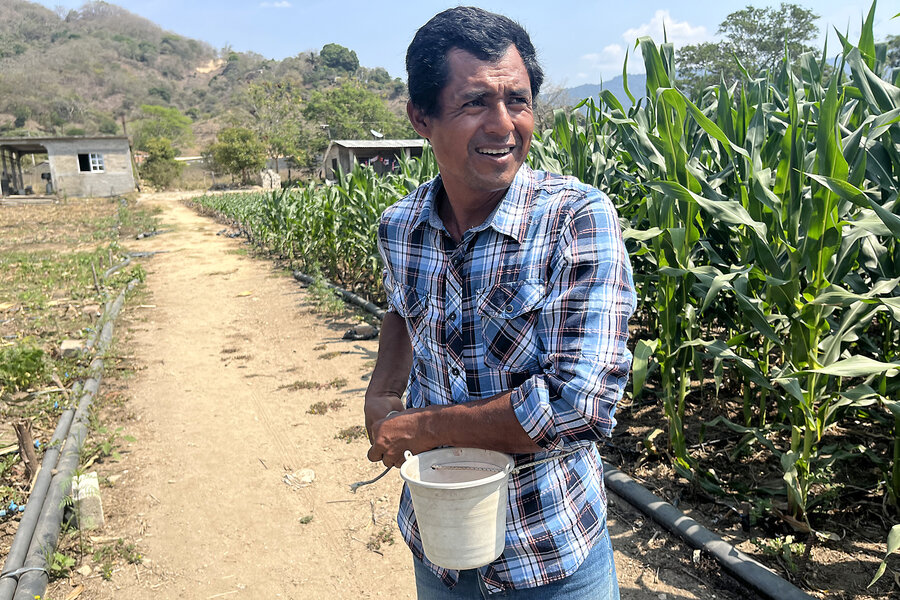
Photo: Whitney Eulich.
Fernando Matus Hernández ties a small bucket filled with heirloom corn kernels around his waist before planting them on his family’s farm in Oaxaca, Mexico.
Small farms like his are an endangered species.

Agricultural capitalism is making it hard for small farms to survive, but so are some environmental regulations, normally a public good. How can we protect both the environment and the small farms that feed us?

At the Christian Science Monitor, Erika Page, Whitney Eulich, and Srishti Jaswal have an in-depth report on the challenges facing farmers today.

“Julie De Smedt tries not to picture her future too often. When she does, she has trouble imagining herself anywhere but here, planted on this stretch of fertile land that runs from her childhood home to the River Scheldt.

“Her family’s cattle ranch is the last farm left on this sleepy Belgian country road. If she were a statistic, she would have left for the city. But at 21 years old, she’s made up her mind.

“ ‘I want to take over the farm,’ says Ms. De Smedt, who lives doors down from her grandparents and cousins on both sides. ‘I don’t want to be anywhere else.’

“But she knows how unlikely her dream is. Sometime soon, all her family farm’s land will be converted into a nature reserve. The European Union is pushing to restore ecosystems in the face of widespread environmental degradation, which contributes to climate change, so the state has expropriated their land.

“The family is not against green policies. ‘There has to be nature, and there have to be people who defend nature,’ says Wendy Vasseur, Ms. De Smedt’s mother, looking through the back door of a cow barn at the line of trees that marks the boundary of the future reserve. But nobody seems to care what will become of their family and the life they have built on this land, they say. …

“Small-farm owners around the globe, in fact, are feeling that same sense of helplessness. From Germany and Spain to India and Canada, farmers are rising up to protest not only burdensome new environmental regulations but also the impact of corporate mega-farms and cheap food imports, which have caused their costs to rise and their profits to fall dramatically. So, many around the world have driven their tractors into capital cities, sometimes spraying manure on city streets and sidewalks. They’ve blocked major freeways, set fires in urban metro stations, and demanded changes to policies that, to them, feel like death sentences. 

“ ‘What they want is a decent living,’ says Morgan Ody, general coordinator of La Via Campesina, an international small-farmers organization. ‘What they want is respect for their work.’

It would be a mistake, she says, to see the latest wave of protests as simply right-wing backlash against the green agenda.

“True, some farmers oppose green policies on political grounds, but many support them. As rural areas lose population, farmers on every continent say they are being sacrificed to meet the demands of a society that no longer values the people who feed it. …

“A cow and a pig were all Ms. De Smedt’s grandfather needed to open this farm in the 1950s. As agriculture intensified and industrialized, the farm, too, grew. Today, the wooden barns the family built itself hold 250 cattle, whose meat is sold mainly to French grocery chain Carrefour. 

“They fatten their cows on corn and beets they grow on the land destined for the nature reserve. And they will continue for as long as they can, Ms. Vasseur says. But it is a perpetual battle to keep the farm going, and Ms. Vasseur has to work a full-time job at a nearby factory to make ends meet.

“The price they can charge for their beef has not kept up with the rising costs of inputs such as fertilizer and pesticides needed to keep poisonous weeds at bay. Now, the family business has to deal with rules governing crop rotation and fallow land. …

“Their story has repeated itself around the world for decades, says Timothy Wise, a researcher and senior adviser at the Institute for Agriculture and Trade Policy, an international nonprofit that promotes sustainable food production. ‘Bigger farms get bigger, and smaller farms disappear. Rural communities just get hollowed out.’ 

“Between 2005 and 2020, the EU lost nearly 40% of its farms and over 5 million farmers, most of them smallholders. At the same time, the amount of land being farmed has stayed the same. …

“That isn’t how Lieven Nachtergale wants things to end. As coordinator of the Sigma Plan, the project responsible for Belgium’s new nature reserve, Mr. Nachtergale does not enjoy removing farmers from their land. He does, however, think it’s necessary: Natural habitats in the densely populated region of Flanders have been badly degraded, and floods pose a growing risk. In such cases, the needs of the land, if not the planet, must take precedence.

“But the real problem he sees is a model of intensified agriculture that has become so disconnected from the natural world. Fields treated with herbicides, pesticides, and heavy doses of fertilizer leave native species next to no room to thrive, he says. 

“The EU’s Nature Restoration Law requires countries to restore 30% of their natural ecosystems by 2030 and 90% by 2050. Mr. Nachtergale’s team is helping Flanders establish 36,000 hectares (almost 90,000 acres) of nature reserve, the equivalent of 5% of the land area being farmed.

“Over the years, he has grown increasingly interested in figuring out how nature and agriculture might better work together. He is working on a pilot project that would give farmers who want to produce in a ‘nature-inclusive’ way 2 hectares of land (5 acres) for every hectare of their own that they contribute. The goal is to restore ecosystems while keeping family farmers on the land. 

“ ‘We will need farmers in the future to do this kind of management,’ he says. But he recognizes the challenge of competing with bigger industrialized farms. ‘If we want to change the system and give the farmers a better future, I think we should pay more for what they are producing.’ “

More from farmers around the world at the Monitor, here. No paywall. Subscriptions welcome.

Read Full Post »

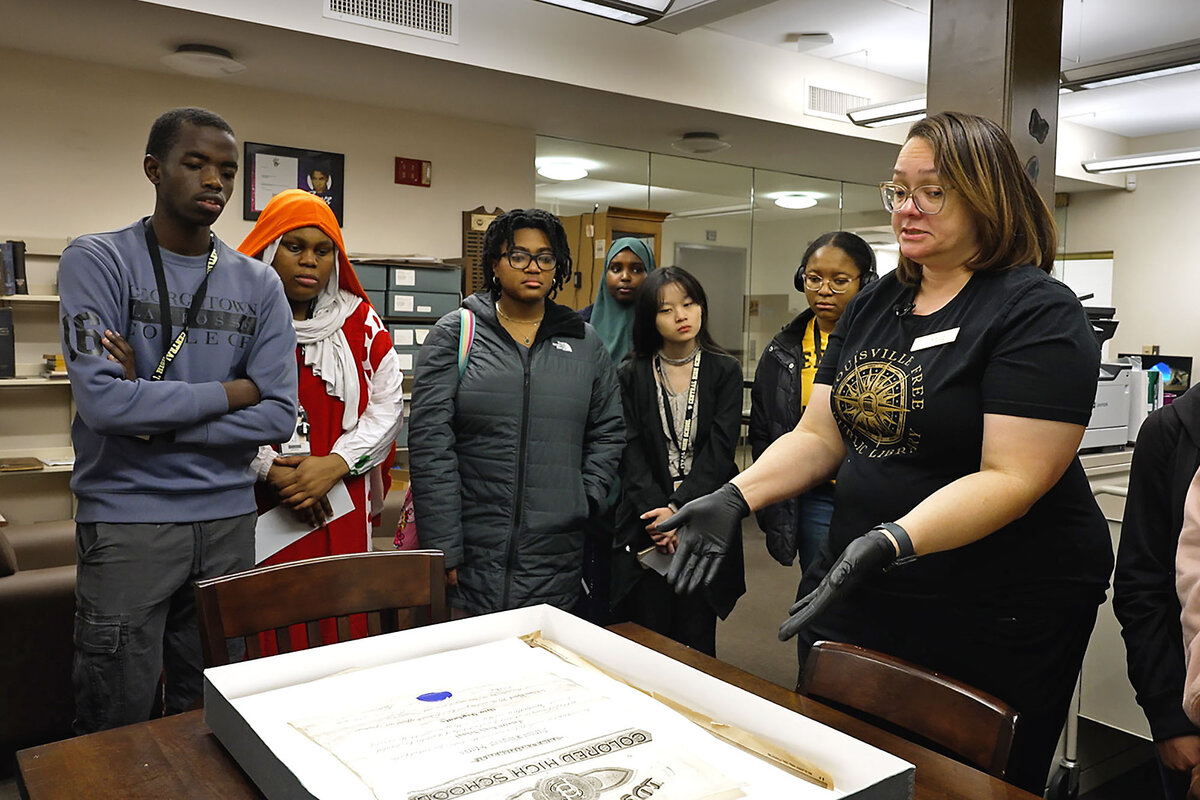
Photo: Jingnan Peng/Christian Science Monitor.
On a tour of Louisville’s Western Library, librarian Natalie Woods (right) shows a 1911 diploma of Louisville’s Central High School. Its former principal, Albert Meyzeek, helped create the oldest Black public library in the U.S. still independently run today.

It is often the case that people in a marginalized group excel in delivering badly needed services that others take for granted. Consider America’s oldest Black library and the man who started it.

Jingnan Peng writes at the Christian Science Monitor, “Thirty minutes into the library tour, Louisa Sarpee wants to work there. History is so close to her. One block away from her high school, the small library she had never set foot in laid the foundation of African American librarianship. What is more, the library was created by a former principal of her own school. Its archives even house a diploma of her school from the time the word ‘colored’ was still in the school’s name.

“ ‘Is there any way to volunteer at the library?’ the ninth grader asks Natalie Woods, the librarian giving the tour. …

“ ‘Say no more, girlfriend,’ Ms. Woods replies, beaming. ‘We’re gonna talk.’

“For Ms. Woods, the manager of Louisville’s Western Library, the gasps coming from the group of 18 students learning about its history is no surprise. She meets Louisvillians every day who know nothing about Western. The library under her care is the oldest public library in the United States independently run by and for African Americans. It was also the earliest training ground of Black librarians from around the South. It is a legacy that has changed Ms. Woods’ life, and preserving it has become her vocation. …

“The ‘Western Colored Branch’ of the Louisville Free Public Library system opened in 1905, in an era when Black communities across the South were building institutions in the wake of emancipation, says historian Tracy K’Meyer at the University of Louisville. …

“The segregated library was considered an experiment, says Ms. Woods. Its first manager, the Rev. Thomas Fountain Blue, had no formal schooling in library science – because there were no library schools open to Black people.  

“Blue not only ran a successful library … he also started the first training program for Black library workers. The course became the prototype for the first degree program in library science for African Americans, which opened in 1925 at Hampton Institute in Virginia. …

“Ms. Woods remembers Blue’s cursive handwriting. The first time she held his papers, they changed her life. She never learned about Western’s history when she grew up in Louisville. The child of a Black father and a white mother, she became a page at Louisville’s Shawnee Library. There, she would hear mentions of Western’s history.

“In 2008, while working as a library clerk and attending college at night, Ms. Woods lost the vision in her left eye due to complications from surgery. She couldn’t perceive distance properly and had to relearn basic activities, such as picking up a pencil, by repetition. It was a struggle to finish college, she says, and she gave up the idea of pursuing a master’s degree in library science.

“Then, one day, a supervisor brought Ms. Woods a folder of documents to transcribe. They were the papers of Thomas Fountain Blue. 

“On lined sheets, the cursive hand discussed circulation methods, library cards, and a library’s role in educating the public. 

“ ‘I knew of him, but I didn’t know how deep and intentional he was in everything he did,’ Ms. Woods says. ‘And it just gave me a new love and desire to go to library school.’ She obtained her library degree at Florida State University. She became Western’s manager on March 6, 2016: Blue’s 150th birthday.

“When Ms. Woods started at Western, she found that many people living near Western did not even know the library exists.

“The library’s archive, which includes Blue’s papers and a wealth of material on Black Louisville history, was disorganized. There was no indexing, and the room was not even locked down, Ms. Woods says.

“So she started giving tours of the library, which she still offers about once a week. In 2018, she obtained a $70,000 grant to index and digitize Western’s archive. 

“It is an important archive that sheds light on ‘how Black librarians, in real time, were trying to imagine what a library to serve a Black community should look like,’ says David Anderson, a professor of English at University of Louisville. …

“A child of formerly enslaved parents, Blue attended college and seminary in Virginia and ran a Louisville YMCA before starting at Western. He died in 1935, after being denied medical care for a treatable infection, says Annette Blue, his granddaughter. ‘He died from Jim Crow laws,’ she says in a Zoom interview from her home in California. …

“Ms. Woods says she does her work in honor of Blue and her parents. She tries to embody Blue’s commitment to ‘the betterment of his people.’ Her parents, who faced much opposition to their relationship as an interracial couple, taught her to ‘treat people the way you want to be treated.’ “

More at the Monitor, here. No firewall. Subscriptions are reasonable.

Read Full Post »

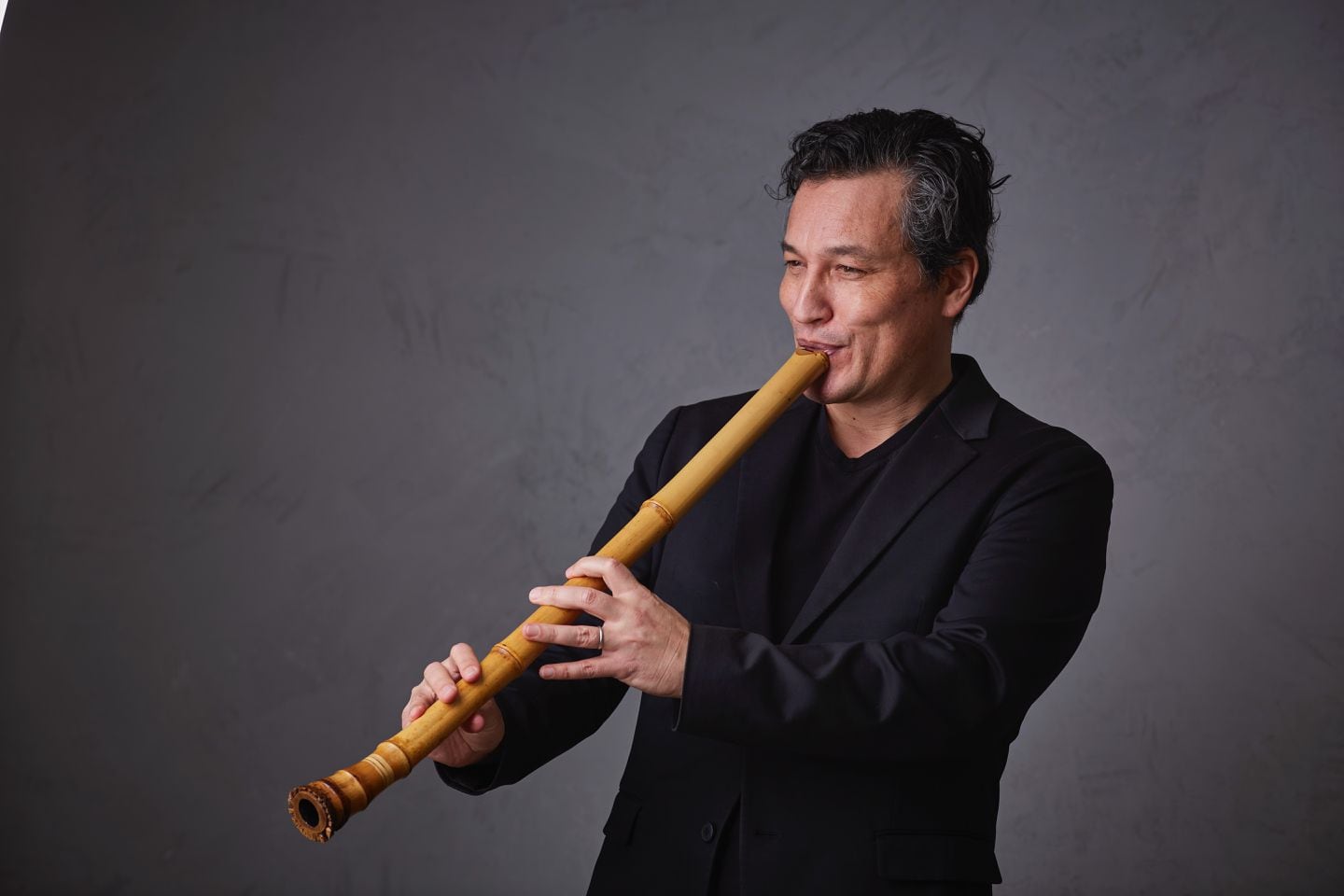
Photo: Anthony Mongiello via the Boston Globe.
Kojiro Umezaki plays the shakuhachi, a Japanese vertical bamboo flute.

In the same way different languages often express something about a culture that is not seen in other cultures, different musical instruments can do the same. A Japanese musical instrument called the shakuhachi is like that. And it can take hold of musical people in surprising ways.

A.Z. Madonna has the story at the Boston Globe. She writes, You have probably heard this sound before. This is the first thing that shakuhachi player Kojiro Umezaki tells people who aren’t familiar with his instrument.

“Maybe you’ve heard the vertical bamboo flute in movies when you see a scene of Japan, or you’ve heard one playing in the background at an Asian restaurant. Or you might have heard it in video games; if you’ve played ‘Ghost of Tsushima,’ the acclaimed action-adventure game from 2020, you didn’t just hear a shakuhachi, you heard Umezaki playing it.

“But there’s more to the instrument than its status as a symbol of Japanese music and Japan itself. …

“ ‘It is the sound of the earth,’ said shakuhachi player and maker Perry Yung in a phone interview. ‘The sound of the wind passing through a bamboo forest. It’s a sound that is constantly shifting tone colors, like light passing in the sky through clouds.’

“The shakuhachi was historically used as a solo instrument in Zen Buddhist meditation, specifically by wandering mendicant monks. It also sometimes appears in Japanese classical music, often with a koto (zither) and the three-stringed shamisen. Most modern shakuhachis have five tuning holes, with four in the front and one on the rear, and they’re tuned to the minor pentatonic scale. However, the player can partially cover holes and bend pitches to produce any pitch they want. …

“It somewhat resembles a recorder, but has no mouthpiece, so producing a sound is trickier. ‘You have to find the spot that sets up the vibration with your lips,’ said Umezaki … ‘My mother likes to tease me and say that when I first started playing it, it took me a year to make sound.’

“The child of a Japanese father and Danish mother, Umezaki grew up in Tokyo and attended an international high school. There his choir teacher was a student of famed shakuhachi player Goro Yamaguchi, and he suggested Umezaki try the instrument as well. …

‘As someone with a mixed Japanese background, you do start to wonder about the Japanese side of who you are,’ he said. For him, playing shakuhachi was ‘the simplest way to get in touch with something that is very much identified with Japanese culture.’

“The instrument found Yung in 1994, while he was acting in a play directed by Ellen Stewart at the New York experimental theater venue La MaMa. Shakuhachi player Yukio Tsuji was in the production’s band, playing the instrument in a ‘very experimental manner,’ he said. … ‘But at one point, the show was silent, and then there was the shakuhachi, and it changed my world.’ After the show, Yung rushed backstage to ask where he might get one. ‘[Tsuji] just looked at me wide-eyed, and said, “I see you’re bitten now.” ‘ …

“Yung took a DIY approach — he bought bamboo at a flower market, and copied flutes at Tsuji’s own workshop, he said. ‘I basically learned how to play and make at the same time.’

“Some time later, he studied in Japan with Kinya Sogawa, an established professional musician and craftsman. ‘He didn’t speak any English, and I didn’t speak any Japanese at the time,’ Yung said. ‘But in the traditional manner of study, you imitate the master and don’t ask questions.’ …

“Umezaki has played with Silkroad, the broad global music initiative founded by Yo-Yo Ma, for over 20 years. He considers what he’s learned there the closest thing he’s had to conservatory training. …

“Yung, whose workshop floats between New York and Rhode Island, has more recently started incorporating the instrument into activism, particularly at rallies against anti-Asian hate. ‘I start my talk with a shakuhachi offering, to others who have been affected by the violence that has been perpetrated upon the Asian-American community in recent years.’ “

More at the Globe, here.

Read Full Post »

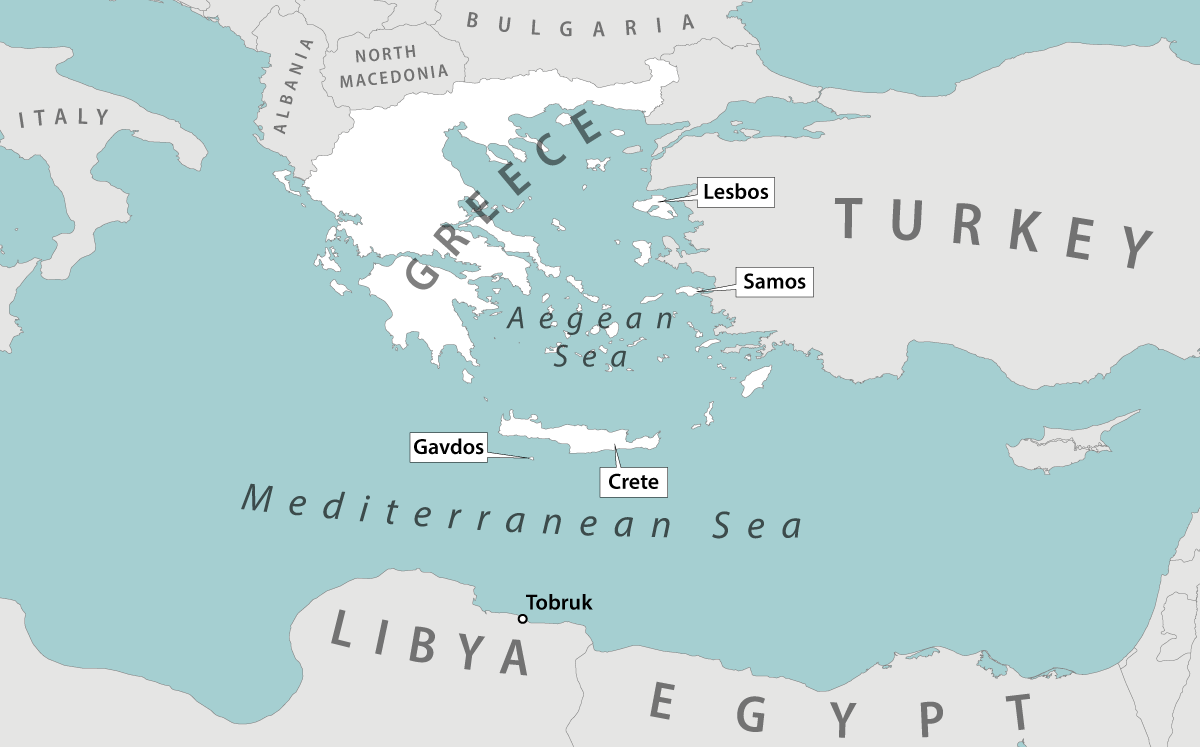
Map: Jacob Turcotte/CSM Staff.
Little islands with big responsibilities.

Because world leaders are not dealing effectively with the causes of mass migration, sometimes tiny communities and a handful of sympathetic residents are left holding the bag.

Christian Science Monitor contributor Nick Squires has a report from the little island of Gavdos in Greece.

“A tawny smudge on the blue horizon of the Mediterranean, it is the southernmost point of Europe, a sun-baked outpost of deserted beaches, gnarled juniper trees, and flocks of shaggy goats. The tiny Greek island of Gavdos, which lies to the south of Crete, [is thought to be] the place where Odysseus was shipwrecked and held captive by the nymph Calypso. …

“The island finds itself thrust to the forefront of Europe’s migration crisis, which erupted in 2015 when more than 1 million asylum-seekers reached the Continent.

Islanders may be sympathetic, but they want the migrant arrivals to stop as soon as possible, especially as the summer tourist season approaches.

“Since the beginning of the year, around 1,200 migrants have arrived on Gavdos by boat, with most of them setting out from Tobruk on the coast of Libya. In the same period last year, there were no arrivals at all. …

“The impact on such a small island is huge. The population of Gavdos is just 70 – on one occasion recently, islanders were outnumbered by the 91 migrants who arrived on a single boat from the Libyan coast.

“Most of the arrivals are economic migrants from Egypt. They are fleeing poverty and political tensions. There is a smattering of other nationalities, including Pakistanis, Bangladeshis, Syrians, and Sudanese.

“It is an influx that Gavdos is totally unprepared for. There are no facilities for the migrants – no reception center, no soup kitchen, no nongovernmental organizations. Unlike Greek islands in the Aegean such as Lesbos and Samos, which have been dealing with migrant arrivals from nearby Turkey for years, there are no personnel from charities such as the Red Cross or Doctors Without Borders.

“The task of dealing with the migrants is left to just three men – the deputy mayor, his twin brother, and the island’s sole police officer. …

“Says Lefteris Lougiakis, the deputy mayor, ‘We have the responsibility of providing them with shelter and food. During the winter, we cut wood to keep them warm. It’s a very difficult situation.’

“Islanders do what they can to care for the migrants and many feel empathy for them. ‘They travel for 20 hours in very small boats with no life jackets. It’s just by luck that we are not in their position. I feel sorry for them,’ says Stella Stefanaki, who runs a small bakery on the island. She provides sandwiches for the new arrivals, for which she is reimbursed by the council.

“Islanders may be sympathetic, but they want the migrant arrivals to stop as soon as possible, especially as the summer tourist season approaches. …

“The migrants have to cross 170 nautical miles of open sea to reach the island from North Africa. It is highly dangerous, but that has not stopped smugglers from promoting it as an effective way of getting into Europe by the back door. Each migrant pays up to $5,000 for the crossing. …

“The ‘capital’ of the island is the village of Kastri, a cluster of about a dozen houses on a ridge. The other main settlement, Sarakiniko, consists of a few cottages and tavernas hidden among sand dunes and facing a huge sweep of beach.

“There are just four children living on the island. Three of them belong to Efi Georgaka, who sells honey; keeps sheep, pigs, and goats; and, during the summer, works in the ferry ticket office in the island’s minuscule harbor.

“ ‘If things keep going like this then the island will change,’ she says, sitting on the harbor wall. ‘There will be a need for police and coast guard officers and the navy, like on other Greek islands. We don’t want [the authorities] here. We treasure the freedom and tranquillity that we have,’ says Ms. Georgaka. …

“Gavdos has emerged as a new migrant destination because of pressures elsewhere: a crackdown onmigrant boats by Greek authorities and the EU border agency Frontex in the Aegean, twinned with the hard-line policies pursued in Italy by Prime Minister Giorgia Meloni, who has staked much political capital on stopping the boats coming from North Africa.

“Earlier this month, Greece’s government promised to provide money and personnel to help Gavdos and its much larger neighbor, Crete, deal with the dramatic rise in migrant arrivals.

“ ‘Crete will not be left alone, and even more so Gavdos,’ said Dimitris Kairidis, the migration minister, after paying a visit to both islands.” More at the Monitor, here.

To me, this is a failure of leadership at a national and international level. People don’t leave home and throw themselves into danger because home is safe. It’s not fair for the little guys to have to fix what they have no power to fix.

Read Full Post »

Photo: FeelBeit.
FeelBeit is a cultural center for Israelis and Palestinians on the border of East and West Jerusalem.

Today’s story, published at Public Radio International’s The World on April 12, 2024, is one of those beauties one hopes is still true two months later. It’s about a group of Jewish and Palestinian artists who have provided a safe space for different cultures to be together in Jerusalem. It’s called FeelBeit.

Host Marco Werman reported, “For years, isolated pockets of quiet resistance in Jerusalem have tried to bring together people from both sides of the conflict, but the Oct. 7 attacks seem to have put a lot of that resistance on indefinite hold.

“But since then, one place is trying again to establish common ground between Israelis and Palestinians: FeelBeit, an event space and bar in Jerusalem.

“Located on the seam line between east and west Jerusalem, FeelBeit is an Israeli-Palestinian arts house and incubator, according to one of its managers, Karen Brunwasser. Each Wednesday night, the venue gives audiences a few hours of escape from the latest news engulfing the lives of Israelis and Palestinians.

“The venue intentionally sits on the line that divides Arab East Jerusalem and Israeli West Jerusalem. In both Arabic and Hebrew, bayt or beit means ‘home,’ so ‘FeelBeit’ literally means ‘feel at home.’ …

“ ‘This is our sort of sacred refuge,’ Brunwasser said.

“FeelBeit is an offshoot of Jerusalem Season of Culture, another organization that runs a summer festival in the city. The festival calls itself a laboratory for connection between people of different backgrounds, but it has struggled in the past against deeply entrenched opinions about the conflict.

“But Brunwasser and [Riman Barakat, a fellow manager] felt like they had a responsibility to continue hosting events amid the increased tension after Oct. 7.

“ ‘We understood how scared people are because we, ourselves, were afraid in the beginning,’ Brunwasser said. … ‘We understood that people were terrified to talk.’

That’s where they got the idea to call this evening of the arts ‘No Words,’ a stealth tool to bring people together.

“There have been eight or nine ‘No Words’ shows since the Israel-Hamas war began.

“According to Barakat, the audience every week is a mix of Israelis, Palestinians and people from other international backgrounds. And every show features Israeli and Palestinian artists alongside one another on stage. In fact, Barakat said it has actually been easier to coordinate joint performances with Israeli and Palestinian artists since the war began.

“ ‘And that’s something that has blown our mind,’ she said. …

“Zudhi Naguib is another FeelBeit member who started working on communications for the group about five years ago. He said he felt instantly at ease, partly because of the violence experienced growing up as a Palestinian in Jerusalem.

“He described the nature of this violence: ‘Eh, getting attacked by extremist Jewish Israelis, by being attacked by extremist Palestinians. Like I was attacked from both sides.’ Naguib said FeelBeit gave him a home.

“ ‘It actually shows me that Jerusalem is really much bigger than what I thought before. It shows me that there’s space for everyone. It was the trust that we succeeded to build with the people who come to FeelBeit, it really was what rescued us after the seventh of October,’ he said.

“After Oct. 7, Naguib felt too scared to leave his house. He didn’t speak to anyone for five days. It was the FeelBeit community that finally helped him. Naguib drove to the home of his boss at FeelBeit, who wanted him to join her at a kibbutz — an Israeli commune — where the parents of their mutual friend Oz had been killed in the attacks. … Naguib recounted Oz’s response to his condolences: ‘It’s not my sorry, it’s ours.’

“ ‘And he told me, “I don’t want anyone to use my mom and dad’s blood for revenge,” ‘ Naguib added.”

More at The World, here. No firewall. Donations encouraged.

Read Full Post »

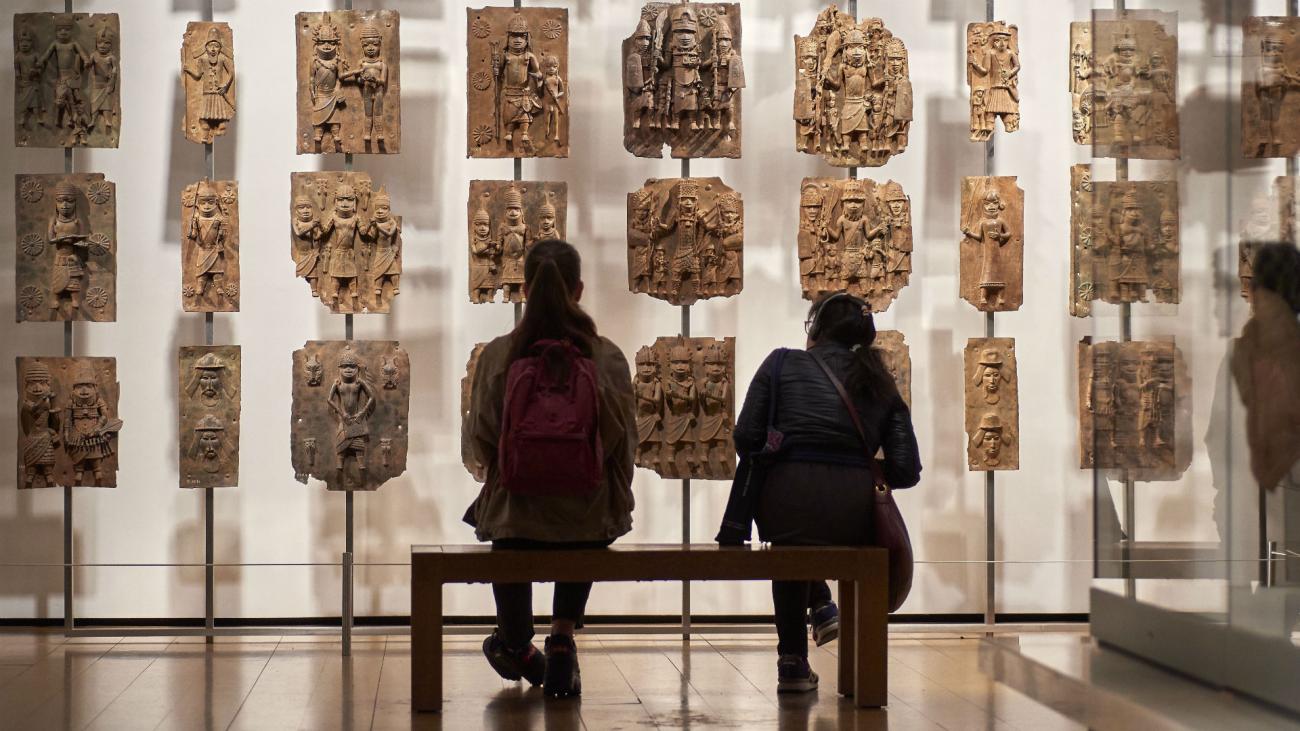
Photo: British Museum.
Benin bronzes.

Around the world, looted national treasures are beginning to return home. Among the most famous are the bronze plaques made in Benin, Africa. Now that country is building museums to protect its returning bronzes — and all its art.

Chinma Johnson-Nwosu writes at the Arts Newspaper, “The Republic of Benin, which is making its debut appearance at the Venice Biennale this year, is turning to culture as part of a strategy to spur economic growth. Its government is building four new museums in a range of locations and a cultural quarter in the largest city, Cotonou, in addition to boosting investment in arts education.

“A museum in the coastal city of Ouidah, from where the last recorded shipment of slaves to the US departed in 1860, will explore the history of slavery. It is scheduled to be completed at the end of this year, the first of the four new museums slated to open over the next five years in Benin. Maison de la Mémoire et de l’Esclavage aims to tell the history of slavery from African, American and Caribbean and European perspectives, says Alain Godonou, the director of museums for the national agency of heritage and tourism.

“Between 2016 and 2026, the Benin government plans to invest €250m [more than $5 million], with the goal of making culture the economy’s second pillar after agriculture. In addition to building museums, the government’s focus is on preserving non-material heritage, increasing cultural tourism and offering financial incentives to private investors.

“Promoting the arts goes beyond fostering a sense of national identity, says Babalola Jean-Michel Abimbola, the country’s minister of culture. ‘It’s a fight against poverty, allowing us to create jobs and build a better economy.’

“Construction began last year on a new cultural quarter in the centre of Cotonou [Le Quartier Culturel et Créatif] which is to host a contemporary art museum, a sculpture garden, a Franco-Beninese cultural institute, a concert arena, commercial galleries and a crafts village showing local crafts and heritage. …

“Further plans include the Musée des Rois et des Amazones du Danhomè in Abomey, where visitors will in future be able to explore the 300-year history of the kingdom of Dahomey. Musée International du Vodun, located in the capital, Porto-Novo, aims to rehabilitate the image of a much-maligned and globally poorly understood Indigenous religion, also known as Voodoo.

“The government hopes that the new museums will build on the success of a 2022 exhibition, where 26 recently repatriated royal artefacts went on display in the presidential office. These were shown alongside the contemporary exhibition, Art of Benin From Yesterday and Today: From Restitution to Revelation.

“The show drew more than 230,000 visitors in the three months it ran, 90% of whom were citizens of Benin, Godonou says. … While he concedes it may be too ambitious to expect to replicate the 2022 success annually, he believes a target of 100,000 would be sustainable.

“Last year, the government launched an Agency for the Development of Art and Culture. The ministries of tourism and finance are also seeking to introduce tax relief policies for the cultural industries.

“The kind of publicly funded, government-led major museum projects Benin is undertaking have little precedent in Africa. … The Benin government’s plan does, however, envisage involving the private sector. By showing entrepreneurs that people in the country are interested in art, Abimbola hopes to spark business interest. In some parts of Cotonou that is already happening. Septième Gallery, which already had a space in Paris, launched in Cotonou in 2022. …

“Investment in arts education and professional training is also increasing. Sèmè City, a government-backed development project, has revealed plans for a new Africa Design School campus located in Ouidah. The school launched in Cotonou in 2019 in partnership with L’École de Design Nantes Atlantique and has since added a masters programme and an exchange programme, in which 11 French students participated in 2023. …

“Last year, the École du Patrimoine Africain, which trains heritage professionals, celebrated its 25th anniversary. When it began, only 5% of the people working in Beninese museums were trained in heritage preservation. Now the figure is 80%.”

More at the Art Newspaper, here. Can you guess what country was the colonizer? Consider the names of the museums.

Read Full Post »

Photo: Sabine Glaubitz/dpa/picture alliance.
Notre Dame’s spire is visible once again following the partial removal of scaffolding.

After the Notre Dame cathedral in Paris burned, there were many suggestions for rebuilding it with lots of modern features, but tradition mostly won out. Ancient craft processes and materials were used whenever possible. People from all over pitched in.

Stefan Dege writes at DW, “The fire was still raging at the Notre Dame Cathedral on April 15, 2019, when French President Emmanuel Macron vowed to renovate and reconstruct the medieval monument within five years. Since then, work on the Gothic Episcopal church has been in full swing and is apparently on schedule.

” ‘We are meeting deadlines and budget,’ Philippe Jost, the head of reconstruction efforts, told a French Senate committee in late March. …

“The cathedral is officially scheduled to reopen on December 8, 2024. Though it will not be ready in time for the Summer Olympic in Paris, as was initially desired, visitors to the French capital can once again see Notre Dame’s towering spire following the recent removal of the surrounding scaffolding. The lead roof is also currently being installed. Fire-prevention features, such as a sprinkler system and compartmentalized sections, are also part of restoration efforts. …

“Exactly five years have passed since the fire, which partially destroyed the historic building. The Paris fire department fought for four hours before it was able to confine the fire to the wooden roof truss. The west facade with the main towers, the walls of the nave, the buttresses and large parts of the ceiling vault remained stable, along with the side aisles and choir ambulatories. Heat, smoke, soot and extinguishing water affected the church furnishings, but here, too, there was no major damage. …

“The extent of the destruction was not as great as initially feared. ‘Thank God not all the vaults collapsed,’ German cathedral expert Barbara Schock-Werner told DW at the time. Only three vaults fell in the end, and there was a hole in the choir. …

“French donors alone pledged €850 million ($915 million) to help restore the landmark. But money and expertise also came from Germany, with Schock-Werner taking over the coordination of German aid.

Cologne Cathedral’s construction lodge restored four stained glass windows that had been severely damaged by flames and heat. The four clerestory windows with abstract forms are the work of the French glass painter Jacques Le Chevallier (1896-1987), and were produced in the 1960s.

“In the glass workshop in Cologne, they were first freed from toxic lead dust in a decontamination chamber. The restorers then cleaned the window panes, glued cracks in the glass, soldered fractures in the lead mesh, renewed the edge lead and re-cemented the outer sides of the window panels. …

“As dramatic as the fire was, a discovery by French researchers at the fire site was just as sensational: iron clamps hold the stones of the structure together. Dating and metallurgical analyses revealed that these iron reinforcements date back to the first construction phase of the church in the 12th century. This may make Notre Dame the world’s oldest church building with such iron reinforcement.

“But more importantly, the mystery of why the nave was able to reach this height in the first place has also been solved. When construction began in 1163, Notre Dame — with its nave soaring to a height of more than 32 meters (about 105 feet) — was soon the tallest building of the time, thanks to a combination of architectural refinements. The five-nave floor plan, the cross-ribbed vaulting with thin struts and the open buttress arches on the outside of the nave, which transferred the load of the structure from the walls, made the enormous height possible. …

“In a stroke of luck, the cathedral’s showstoppers — the statues of the 12 apostles and four evangelists that architect Eugene Viollet-le-Duc grouped around the ridge turret he designed in the 19th century — survived the fire unscathed because they had been removed from the roof shortly beforehand for restoration.

“Some 2,000 oak trees were cut down for the reconstruction of the medieval roof truss. To work the trunks into beams, the craftsmen used special axes with the cathedral’s facade engraved on the blade. These can be seen in a special exhibition in the Paris Museum of Architecture. The show also details the painstaking work that was required to reinstall stones and wood in their original places to make the reconstruction as true to the original as possible.”

More at DW, here. No firewall.

Read Full Post »

Photo: Chalida EKvitthayavechnukul/AP.
Monkeys eat fruit during a monkey feast festival in Lopburi province, Thailand, Nov. 27, 2022.

Today’s story is about overly aggressive monkeys that went from being a tourist attraction to rather dangerous predators.

I don’t think I knew monkeys could be like that, but then, we don’t get many local monkey stories in the Northeast. Unless you count my story about the librarian on my street who was looking out her window as she dressed one morning and saw a little, wrinkled, old-man face staring at her.

That one turned out to be an escaped pet.

Jintamas Saksornchai at the Associated Press writes, “Thai wildlife officials laid out a plan [in April] to bring peace to a central Thai city after at least a decade of human-monkey conflict. The macaques that roam Lopburi are a symbol of local culture, and a major tourist draw. But after years of dangerous encounters with residents and visitors and several failed attempts to bring peace with population controls, local people and businesses have had enough.

“The monkeys frequently try to snatch food from humans, sometimes resulting in tussles that can leave people with scratches and other injuries. But outrage grew in March when a woman dislocated her knee after a monkey pulled her off her feet in an effort to grab food, and another man was knocked off a motorcycle by a hungry monkey.

“Authorities hope to round up some 2,500 urban monkeys and place them in massive enclosures, said Athapol Charoenshunsa, the director-general of the Department of National Parks, Wildlife and Plant Conservation. They’ll work with wildlife experts to find a way for a limited number of monkeys to stay at liberty in the city, he added. …

“An official monkey catching campaign was launched week, prioritizing more aggressive alpha males. It has caught 37 monkeys so far, most of whom have been put under the care of wildlife authorities in the neighboring province of Saraburi, while others were sent to the Lopburi zoo. Officials said they plan to capture the rest of the monkeys once the enclosures are complete, especially those in the residential areas. …

“The monkeys are a symbol of the province, about 140 kilometers (90 miles) north of Bangkok, where the ancient Three Pagodas temple celebrates an annual ‘Monkey Buffet’ festival, and they’re commonly seen throughout the city. Macaques are classified as a protected species under Thailand’s wildlife conservation law.

“Some have blamed the city’s monkey troubles on tourists and residents feeding the animals, which they say drew monkeys into the city and boosted their numbers, as well as getting them accustomed to getting food from humans.

“But an earlier effort to limit feeding may have made things worse, some residents say. Local officials began threatening fines for feeding monkeys outside a few designated areas around the main tourist attractions in recent years. But those feeding areas were dominated by a few troops of the highly territorial creatures, while rival bands grew hungry and turned to harassing humans in other areas for food even more.

“Athapol said people shouldn’t see monkeys as villains, saying that the authorities might have not been efficient enough in their work to control the simian population.

” ‘People also need to adapt to the city’s monkeys,’ said Phadej Laithong, director of the Wildlife Conservation Office, explaining that a lack of natural food sources prompts the animals to find food wherever they can, including from humans.”

More at WPRI in Providence, Rhode Island, here. There’s audio on this dilemma at The World, here.

Read Full Post »

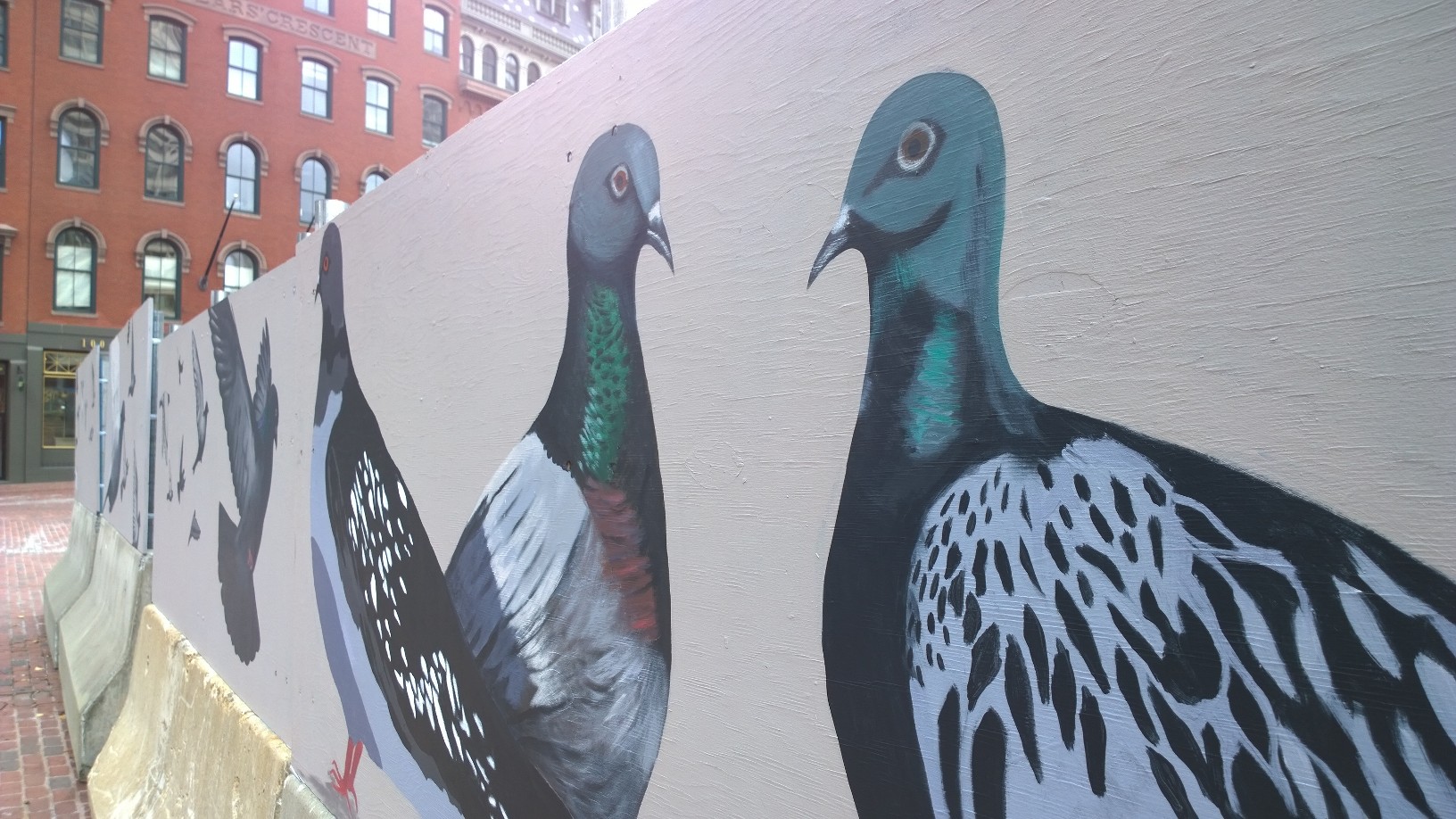
Photo: John and Suzanne’s Mom.
Pigeon art at a Boston construction site, 2014.

Pigeons get no respect. They certainly make a mess when they congregate in places where people also congregate. More often than not, human interaction is confined to efforts to get rid of pigeons, or Rock Doves, even though they are actually very pretty. Sometimes I wonder if they would be less hated if we ever saw their babies. They seem to be born fullgrown!

Cathy Free wrote recently about one pigeon at the Washington Post.

“Brooke Ciardi was in the yard of an animal shelter taking photos of dogs to help them get adopted when she suddenly felt something on her head. It was a pigeon that had swooped in and landed in her hair. Ciardi was moderately alarmed to have the bird on her head, but the pigeon seemed perfectly content.

“ ‘I was surprised because this pigeon had no fear of the dogs and no fear of people,’ said Ciardi, who works as an outreach coordinator for the Montgomery County Animal Services & Adoption Center in Derwood, Md. …

“Ciardi soon learned that the pigeon had recently become a regular at the shelter, hitching rides from the parking lot to the building on employees’ heads, shoulders or fanny packs, and refusing to hop down unless forced to. ‘She’d ridden on people to come inside the building at least five times, and they kept having to put her outside,’ Ciardi said. ‘I said, “This isn’t right — she seems to be a pet.” ‘

“Ciardi said her supervisor … decided that Valley — the name staffers chose for the rock pigeon — would make a good pet for the right person. So on April 2, about a week after the bird first landed on an employee’s shoulder, she was put up for adoption. …

“The pigeon’s friendly nature indicated that she had probably been domesticated as a fledgling, Ciardi said. ‘She’s a young pigeon, and pigeons can have a long life span of about 15 years,’ Ciardi said. …

“During World War I and World War II, carrier pigeons were used to transport secret messages from combat zones to their home coops. ‘They have such an interesting history, and they’re really smart,’ Ciardi said. ‘It used to be that they were bred and domesticated to work alongside us in the same way that dogs do. … I think it’s in their DNA to want to be among us.’

“Ciardi and her co-workers agreed it was important to find a good home for Valley. On April 2, Ciardi posted a notice on Facebook that the pigeon was up for adoption. …

“Ciardi then wrote about the bird descending on her in the rain and remaining calm when curious dogs approached.

“ ‘It was finally decided that with her love for human company and lack of survival skills, Valley would really like to be put up for adoption,’ Ciardi posted. ‘Well, she came to the right place!’

“About 850 followers liked the post, and several people mentioned that they wished they could adopt Valley. CBS affiliate WUSA9 covered the quest to find the pigeon a permanent home. …

“Two days after the Facebook post, a woman in New Jersey decided Valley would be a perfect pet for her two young boys. Keryn Rosenberger drove three hours to Montgomery County from South Amboy, N.J., to adopt Valley. …

“Rosenberger is a single mom, and she said her parents kept birds as pets when she was young. She thought Valley would be a good fit for her family. … Rosenberger said she bought some cloth pigeon diapers online for Valley, along with a harness and leash for public outings.”

More at the Post, here.

Read Full Post »

Photo: San Francisco Silent film festival.
Clara Bow in newly rediscovered The Pill Pounder, a 14-minute film. 

We had one of the first televisions (1948? 1949?) because my father was writing a story for Fortune. It was a Dumont, a big wooden box with a tiny black and white screen. There wasn’t much content available at the time, so we watched lots of silent movies. I can’t remember if I ever saw any of starlet Clara Bow’s films, but I wouldn’t be surprised. I was too young to register names of actors.

Pamela Hutchinson writes at the Guardian, “A century after she first began to turn heads, Clara Bow is ‘It’ once more. The iconic flapper of the silent film era inspired Margot Robbie’s character Nellie in Damien Chazelle’s Hollywood epic Babylon, is name checked on Taylor Swift’s forthcoming album ‘The Tortured Poets Department,’ and yesterday at the San Francisco Silent Film Festival, one of her earliest films was shown for the first time since the days of bathtub gin.

“The story of the film’s discovery has already caused excitement online. Film-maker Gary Huggins inadvertently snapped up a slice of lost silent film history at an auction in a car park in Omaha, Nebraska, that was selling old stock from a distribution company called Modern Sound Pictures. Hoping to bid on a copy of the 1926 comedy Eve’s Leaves that he had spotted on top of a pile, Huggins was informed that he could only buy the whole pallet of movies, not individual cans. The upside? The lot was his for only $20.

“Huggins soon discovered that his new pile of reels included 1923’s The Pill Pounder, a silent comedy that had been thought to be lost for decades. It is a short, two-reel film, shot on Long Island, New York. … The film stars rubber-faced vaudeville veteran Charlie Murray, the so-called ‘Irish comedian’ who was actually from Laurel, Indiana. He plays a hapless pharmacist, the ‘pill pounder’ of the title, who is trying to host a clandestine poker game in the back room of his drugstore.

“What few realized until Huggins watched the film, was that it also features 17-year-old Bow in a supporting role. She plays the girlfriend of Murray’s son, played by James Turfler, who had already appeared with Bow in her second film Down to the Sea in Ships, directed by Elmer Clifton and screened in 1922. …

“In this, one of her earliest surviving performances on film, Bow looks even younger than her years. Although she lacks the sleek Hollywood glamour she later acquired, she has the charisma to turn a thankless bit-part into something of a scene-stealer. The critics took note: based on the evidence of this film, the Exhibitors’ Trade Review described her as ‘perhaps the most promising of the younger actresses.’ …

“The film, which has been restored by the festival’s organizers and was screened with accompanying music from composer Wayne Barker, now looks remarkably good for its age. The festival’s senior film restorer, Kathy Rose O’Regan, said it was in great shape when they received it. She added: ‘We imagined it was screened maybe a few times, but there’s hardly any damage.’ …

“It is still incomplete, being in what Stenn called a ‘beta version.’ That’s because the copy Huggins found was not from the 1920s, but a 35mm print from the 1950s or 1960s of an edit of the film that was destined to become part of a 16mm compilation of old silent films with a comic voiceover poking fun at its archaic aspects. The intertitles have been removed and there are a few scenes and shots missing, too. This process is deeply unflattering to old movies, but it has been responsible for preserving versions of silent films that would otherwise have been lost. …

“ ‘For me, it is a pretty perfect 14-minutes of fun,’ says O’Regan. ‘It would be nice to know what the titles were, but you can certainly get the gist without them.’

“Stenn called the tale of the film’s discovery ‘miraculous’ and … explained that there was reason to believe that some of the discarded material was among the other cans that were sold at the Omaha auction. The hunt is on to round out The Pill Pounder, and several people have joined in the search, combing through thousands of reels.”

More at the Guardian, here. No paywall.

Read Full Post »

Photo: Tony Jolliffe/ BBC.
Newly uncovered frescoes in Pompeii depict Paris (of Troy) and his surprisingly peaceful kidnapping of Helen (of Greece) — the act that triggered the Trojan War.

Art from the ancient world can make you think twice about what you know. When you picture the Greek myth in which Paris steals the most beautiful woman in the world from her husband Menelaus, do you ever imagine her going quietly? I don’t. But judging from newly uncovered frescoes, people in Pompeii did. It puts a whole different cast on the Trojan Wars.

Jonathan Amos, Rebecca Morelle, and Alison Francis report at the BBC, “Stunning artworks have been uncovered in a new excavation at Pompeii, the ancient Roman city buried in an eruption from Mount Vesuvius in AD79.

“Archaeologists say the frescos are among the finest to be found in the ruins of the ancient site. Mythical Greek figures such as Helen of Troy are depicted on the high black walls of a large banqueting hall. …

“A third of the lost city has still to be cleared of volcanic debris. The current dig, the biggest in a generation, is underlining Pompeii’s position as the world’s premier window on the people and culture of the Roman empire. …

“It was likely the walls’ stark color was chosen to hide the smoke deposits from lamps used during entertaining after sunset. ‘In the shimmering light, the paintings would have almost come to life,’ [Park director Dr Gabriel Zuchtriegel] said.

“Two set-piece frescos dominate. In one, the god Apollo is seen trying to seduce the priestess Cassandra. Her rejection of him, according to legend, resulted in her prophecies being ignored. The tragic consequence is told in the second painting, in which Prince Paris meets the beautiful Helen – a union Cassandra knows will doom them all in the resulting Trojan War.

“The black room is the latest treasure to emerge from the excavation, which started 12 months ago – an investigation [featured] in a documentary series from the BBC and Lion TV … in April. …

“Staff are having to move quickly to protect new finds, removing what they can to a storeroom. For the frescos that must stay in position, a plaster glue is injected to their rear to prevent them coming away from the walls. Masonry is being shored up with scaffolding and temporary roofing is going over the top. …

“Excavations in the late 19th Century uncovered a laundry in one corner. The latest work has now revealed a wholesale bakery next door, as well as the grand residence with its black room. The team is confident the three areas can be connected, physically via the plumbing and by particular passageways, but also in terms of their ownership. The identity of this individual is hinted at in numerous inscriptions with the initials ‘ARV.’ The letters appear on walls and even on the bakery’s millstones.

” ‘We know who ARV is: he’s Aulus Rustius Verus,’ explained park archaeologist Dr Sophie Hay. ‘We know him from other political propaganda in Pompeii. He’s a politician. He’s super-rich. We think he may be the one who owns the posh house behind the bakery and the laundry.’

“What’s clear, however, is that all the properties were undergoing renovation at the time of the eruption. Escaping workers left roof tiles neatly stacked; their pots of lime mortar are still filled, waiting to be used; their trowels and pickaxes remain, although the wooden handles have long since rotted away.

“Dr Lia Trapani catalogues everything from the dig. She reaches for one of the thousand or more boxes of artifacts in her storeroom and pulls out a squat, turquoise cone. ‘It’s the lead weight from a plumb line.’ Just like today’s builders, the Roman workers would have used it to align vertical surfaces.

“She holds the cone between her fingers: ‘If you look closely you can see a little piece of Roman string is still attached.’

“Dr Alessandro Russo has been the other co-lead archaeologist on the dig. He wants to show us a ceiling fresco recovered from one room. Smashed during the eruption, its recovered pieces have been laid out, jigsaw-style, on a large table.

“He’s sprayed the chunks of plaster with a mist of water, which makes the detail and vivid colours jump out. You can see landscapes with Egyptian characters; foods and flowers; and some imposing theatrical masks.

” ‘This is my favorite discovery in this excavation because it is complex and rare. It is high-quality for a high-status individual,’ he explained.”

At the BBC, here, read that there’s a dark side to what they’re finding. No paywall.

Read Full Post »

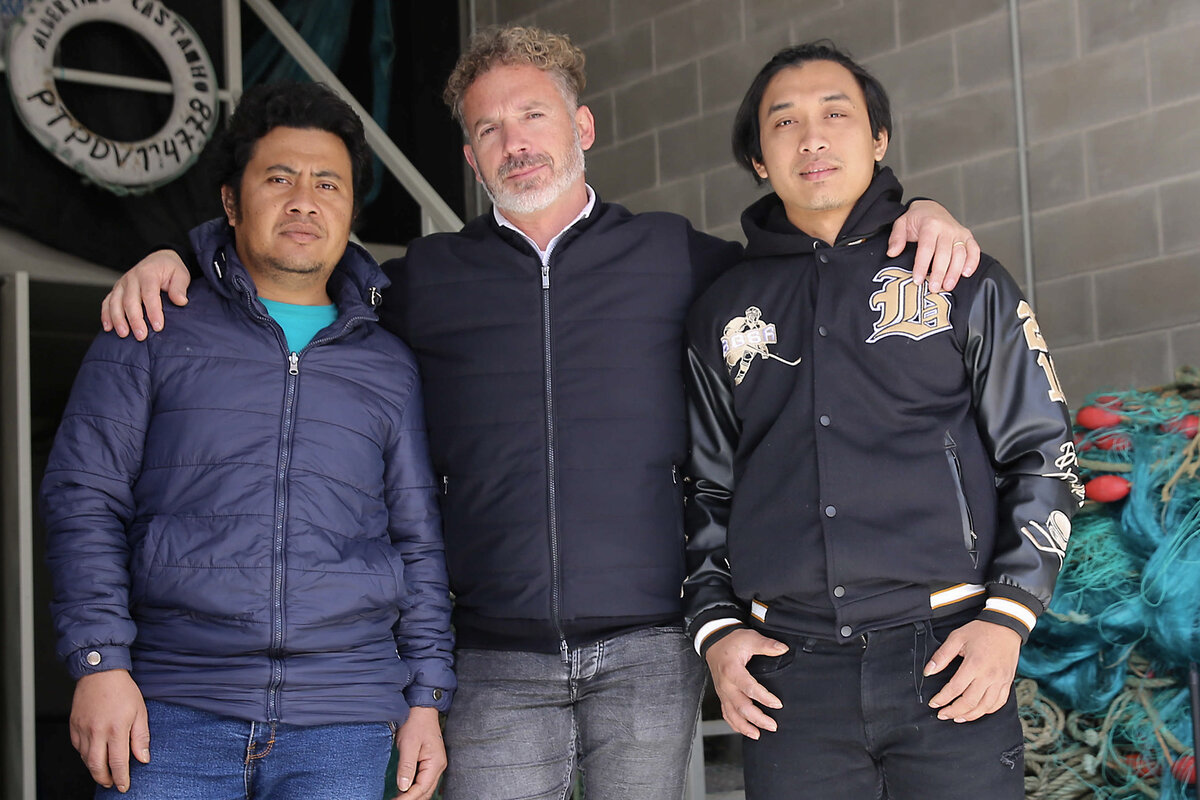
Photo: Dominique Soguel.
The
Christian Science Monitor shows a Portuguese fishing vessel captain with two of his Indonesian deckhands, March 8, 2024.

The Christian Science Monitor does a great job of finding stories about humans treating other humans with respect, even kindness. Such stories do exist. Why other media outlets don’t spend much time on them is anybody’s guess. They seem to think that anger is what people want, but why do they think that?

Dominique Soguel writes that many in Portugal are giving a welcome to migrants rejected elsewhere. They know it’s in their mutual interest. A far-right party is trying to change that, but so far harmony, says Soquel, is winning.

“Among the warehouses of one of Portugal’s oldest ports, conversations are flowing among the men sorting their fishing nets. But not without the help of Google Translate.

“The fishers at work include not just Portuguese people but also Indonesians. Thanks to a local ship captain who ventured east to solve labor shortages, Póvoa de Varzim sees a steady supply of deckhands from Indonesia, and now they account for half of all crew mates.

“And while an influx of Muslim migrants into a traditional vocation like fishing is the sort of event that would be potentially inflammatory elsewhere in Europe, in Portugal it seems to be working out without much fuss.

“ ‘The Indonesians are quite well integrated in the community,’ says another ship captain, Manuel Marques. ‘We were never against their culture. We did not ask them to change a single thing. We tried to make things as easy for them as if they were at home.

‘We do need them, and we know it. There is a mutual respect.’ …

“ ‘We also have a place to worship here, like a mosque,’ says Wahono Lucky, an Indonesian fisher. ‘I tell my boss that I don’t eat pork – I eat meat, chicken, rice, pasta, but no pork. Muslim, Christian, it’s never a problem here.’ …

“ ‘We are the only country in the European Union that allows people to come to Portugal without a job,’ notes journalist and professor Paulo Agostinho. ‘We are one of the biggest entry doors for Europe, and we are having problems with Brussels because of that. But Portugal does not have an immigration problem.’

“People from former colony Brazil make up about a third of the migrant population. Citizens of the Community of Portuguese Language Countries are also well represented, benefiting from facilitated residency procedures. In recent years, migration from India, Pakistan, Nepal, and Bangladesh has ticked up.

“Not all of Portugal’s South Asian arrivals are integrating smoothly. In the agricultural fields of Póvoa de Varzim, the sense of harmony that is palpable portside is elusive.

“Lazaro Morgado, a foreman overseeing a quartet of Indians planting seeds, clearly prefers working with a Brazilian, with whom he shares a native tongue. ‘It is complicated for the Portuguese to work with the migrants,’ says Mr. Morgado. ‘Sometimes they don’t know the procedure, and it is hard to explain. And sometimes they don’t obey the Portuguese worker even though at the end of the day, the Portuguese one is the one directly accountable to the boss.’

“Two Indian workers say they paid exorbitant sums – about €14,000 ($15,200) – to visa consultants to get here. ‘Not all Portuguese like migrants,’ notes Hardy Singh, one of the Indian workers, citing experiences of job and housing rejections on account of his ethnicity. ‘But our boss here is good.’

“Back at the port, Mr. Marques wants the Indonesian crews to stay. That’s why he – like other shipowners in the area – houses the workers in apartments scattered across the community and invites them for barbecues. The Indonesian fishers also get minimum-wage contracts and a paid-for trip home for vacation.

“ ‘Some Portuguese don’t make as much as them because they are on contract, while we only get paid if we go to sea,’ laments Tomas Postiga, an older fisher. But he grasps the importance of Indonesian workers to keep the traditional community afloat and prefers them to workers of other nationalities. Religious differences are not a problem. ‘Some are religious. Some are not. It changes nothing,’ stresses Mr. Postiga. …

“For Masrura Rashid, [Portugal’s Moorish quarter] is simply home. She arrived here six months ago, after studying engineering and wandering in the lush tea gardens of Sylhet, Bangladesh. Her father moved to Lisbon first, obtaining the right to family reunification. Now she works at her uncle’s travel agency.

“In a street rich in halal butchers and supermarkets, Ms. Rashid does not especially stand out. Donning traditional Muslim attire that fully covers her face, she is keen to learn Portuguese. ‘It’s easy here,’ she shares. ‘The weather, the environment, the people, it’s all good.’ “

More at the Monitor, here. No paywall. Subscriptions are not expensive.

Read Full Post »

 Photo: WikiPedant/ Wikimedia.
An example of “glacial rock flour” pours into Lake Louise, Alberta, Canada. 

Here’s a new-to-me theory: a discharge from our melting glaciers may be able to soak up some of the unwanted carbon in the atmosphere.

Dino Grandoni writes at the Washington Post, “Minik Rosing grew up around the fine mud flowing from Greenland’s glaciers. It wasn’t until much later, when his own daughter had grown up and was in her mid-20s, that he realized how special it is.

“During a family vacation in rural Greenland, where there was no electricity, she was fishing ice out of a milky-blue fjord for a gin and tonic when that mud gripped her feet so tightly that she had to abandon one of her boots.

“As temperatures rise, meltwater is flushing out millions of tons of this stuff: ultrafine powder ground down by the island’s melting glaciers. Geologists have a culinary-sounding name for the microscopic particles: ‘rock flour.’

“The loss of his daughter’s boot got Rosing thinking. Maybe those tiny grains of rock could be used to trap something much bigger: the carbon emissions that are altering the frozen landscape and way of life on the island.

“ ‘Greenland has been seen as the example and the horror story of climate change, and never been portrayed as a part of the solution,’ said Rosing, a geology professor at the University of Copenhagen in Denmark who was born in Greenland.

“As global emissions continue to rocket, he is part of a growing group of scientists looking for ways to suck carbon right out of the sky, an example of a sometime contentious suite of technologies called geoengineering. …

“Give it enough time and most of the carbon dioxide that humanity is pumping into the air will be taken back by the planet. CO2 dissolves in rainwater and reacts with rocks to form carbon-containing compounds that lock the gas out of the atmosphere. That naturally occurring process, called ‘chemical weathering,’ literally petrifies the air.

“The problem — at least for us humans — is that chemical weathering takes millennia to work its carbon-absorbing magic. Humanity doesn’t have that kind of time: The U.N. Intergovernmental Panel on Climate Change says society needs to drastically reduce CO2 emissions by the end of the decade. The situation has gotten so bad that the panel of scientists says we need to develop ways of pulling carbon from the air to avert catastrophe.

“So what if we could speed things up? What if, Minik Rosing and other scientists wonder, we exposed more carbon-absorbing rocks to the carbon-laden air? They call that technique ‘enhanced weathering.’

“Most enhanced-weathering proposals involve pulverizing tons of basalt or other rocks and spreading them across the land. But all that crushing would consume an enormous amount of energy that might result in more greenhouse-gas emissions. That’s where rock flour comes in.

“Glaciers flow over the bedrock like a slow-moving river. Over centuries, the tremendous weight of the ice grinds the rock underneath into a fine powder only a few ten-thousandths of a centimeter, or microns, in diameter — finer than most sand found on a beach. …

“The fineness of the grains is the flour’s advantage. It gives the substance an enormous surface area to expose to the air, making it an attractive candidate for enhanced weathering. …

“To test how well rock flour stashes carbon, Rosing and [Christiana Dietzen, a soil scientist working with Rosing] hauled about 200 tons of the stuff from Greenland for experiments.

“The material packed a one-two punch, according to a pair of papers the researchers published last year: Not only did it suck up carbon when spread over farm fields in southern Denmark, but it also enriched the soil with nutrients and increased the yield of corn and potatoes in the first year of application.

“The researchers estimate that, given enough time, spreading rock flour on all agricultural land in Denmark would suck up a quantity of carbon approximately equal to the annual emissions of that country (or of Hong Kong or Syria). Preliminary results show longer-lasting crop yields in nutrient-poor soil in Ghana.”

More at the Post, here.

Read Full Post »

« Newer Posts - Older Posts »