Feeds:
Posts
Comments

Archive for the ‘Uncategorized’ Category

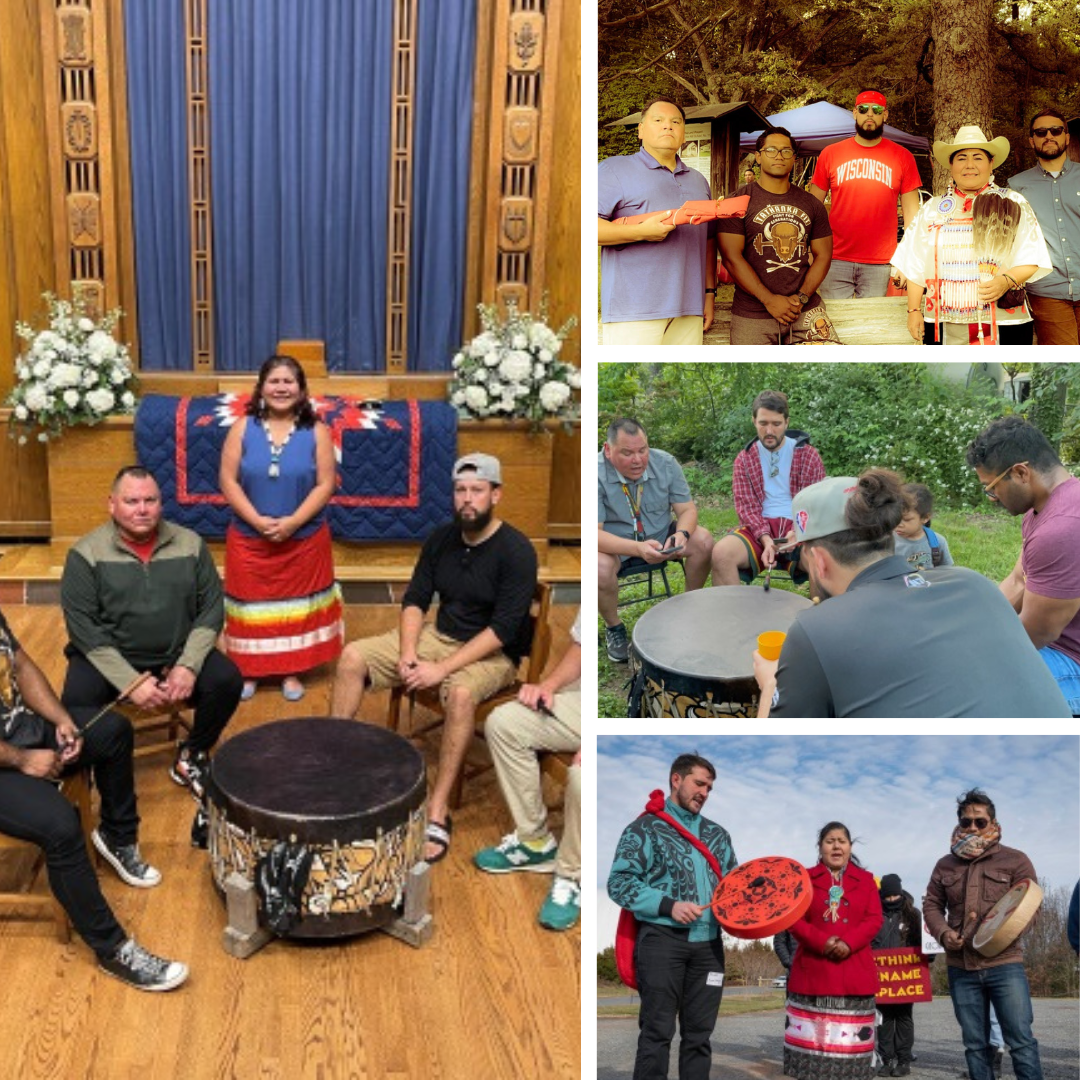
Photo: The Nicholson Project.
The Uptown Singerz are a DC-based intertribal Native American Northern powwow drum group that performs powwow, ceremonial, and in some cases political songs.

We are all enriched when previously below-the-radar groups begin to share their culture more widely. The featured article for today is from the Washington Post and highlights a cultural collaboration by members of several indigenous tribes.

Dana Hedgpeth writes, “When Nick Courtney came to D.C. seven years ago to work on education issues, he missed his Native American tribe in Washington state.

“Longing to connect with other Native Americans in the region, the 31-year-old member of the Makah Tribe helped form the Uptown Singerz, a Native American drum group that shares and celebrates their heritage.

“ ‘D.C. is a transient city because folks come and go, so that can be hard,’ said Courtney, who lives in Baltimore. ‘I still long for my own culture, but this fills my cup. It’s a bond, and I’m a part of something that’s allowed me to build a community here. It’s like a family for me.’

“In the United States, roughly 9.7 million people — or about 3 percent — of the overall population — identified themselves as being American Indian or Alaska Native in the 2020 Census. Fewer than 1 percent of people in the District, Maryland and Virginia said they are American Indian or Alaska Native.

“There are more than 500 federally recognized tribes in the country, and more than 70 percent of American Indians live away from their tribal reservations or communities.

“Being a part of Uptown Singerz gives members who are far from their tribes’ home ‘a renewed sense of community and family every time we sing, every time we drum,’ said Mary Phillips, the group’s lady backup singer (as the role is officially called by Native Americans), who is from the Omaha Tribe in Nebraska and the Laguna Pueblo Tribe in New Mexico. …

“The Uptown Singerz … practice several times a month and perform up to 20 events a year in theaters, rallies, community events and Native American gatherings and powwows in the D.C. region to showcase their talents and educate the public. They, along with the Zotigh Singers — who are from the Kiowa Tribe of Oklahoma and live in Waldorf, Md. — are one of the few American Indian drum groups in the D.C. region.

“ ‘Having the Uptown Singerz is so important because they help keep our culture alive here in D.C.,’ said Angela Gladue, 38, who is a powwow and hoop dancer. A Cree and a member of the Frog Lake First Nation in Alberta, Canada, Gladue moved to Northeast Washington six years ago and got to know other American Indians in the area, along with the drum groups. …

“The Uptown Singerz typically play around one large drum made from wood and dried animal hide. Sometimes they play smaller hand drums. Considered sacred and often used at events and some ceremonies, the drum for many American Indians represents the heartbeat of Mother Earth.

“They follow the Native American tradition of having only men sit around the drum. Women stand behind them and join in the singing because ‘women carry the sacred water of life,’ empowering them to ‘absorb or change the energy of the people around them or the energy of the drum,’ Phillips said. …

“For Gladue, hearing the drum and seeing American Indians from different tribes gather and dance was a special moment. … ‘People will ask, “Indians are still here?” To be around other Natives and not have to explain myself makes me feel good.’ “

More at the Post, here.
Read Full Post »

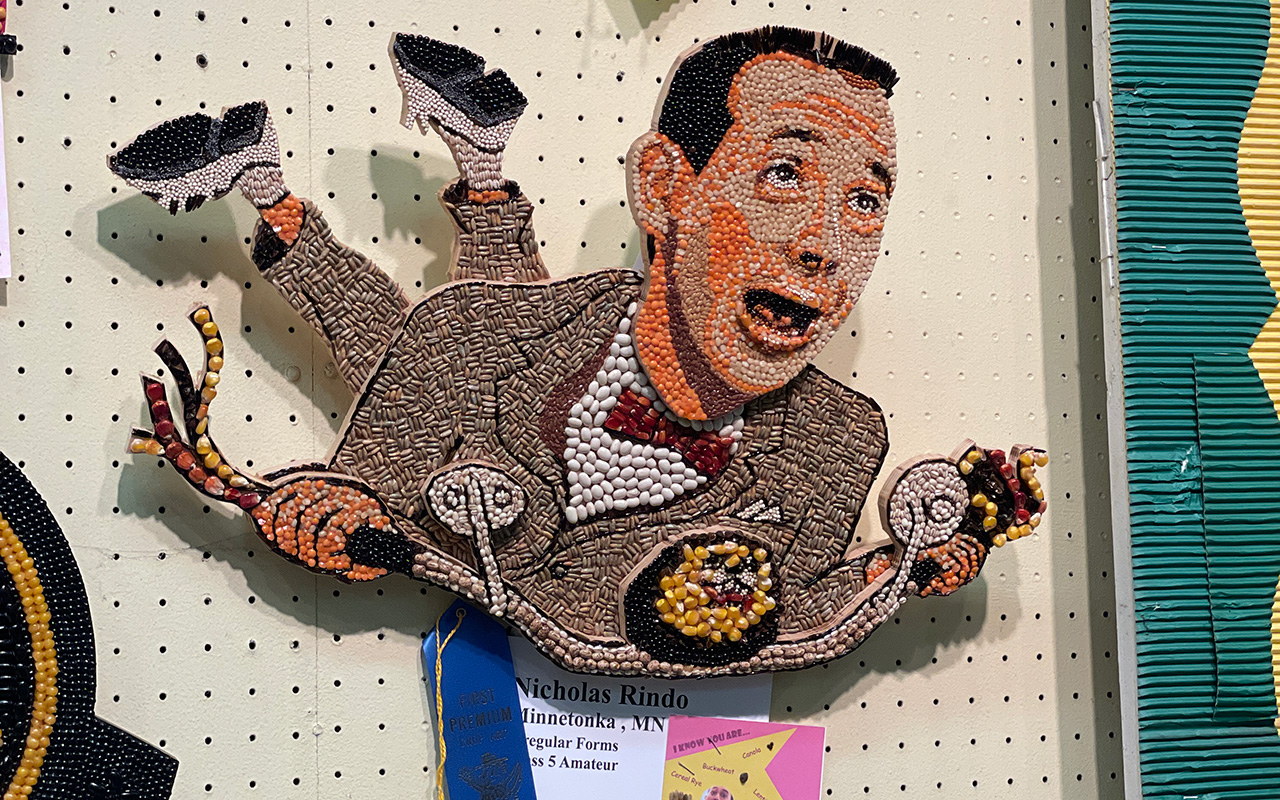
Photo: Isabella Segalovich/Hyperallergic.
Nicholas Rindo’s “I know you are…” (2023), is made from cereal rye, buckwheat, flax, pearled barley, poppy, quinoa, rainbow flint corn, sweet lupine, red millet, viking corn, wild rice, navy beans, lentils.

What is your favorite exhibit at state fairs? One of mine is seed art. It looks like it would be fun to try.

Isabella Segalovich of the art magazine Hyperallergic went to the Minnesota State Fair and has this report on the seed art of 2023.

“The longest line at the second biggest state fair in the United States wasn’t for the prize cows, roller coaster rides, or various deep-fried foods served on a stick: It was for the seed art. 

“The wait was worth it. Past scores of vintage seed sacks and neatly stacked corn cobs vying for Best of Show ribbons, visitors craned their necks to marvel at the bounty of intricate mosaics made completely out of seeds at the Minnesota State Fair, which ran from August 24 to September 4. While the vast majority of participating crop artists were Minnesotans, the country’s only state fair seed art competition has also graciously expanded its dozens of categories to include out-of-state competitors, as long as they stick to one rule:

Every seed must be grown in Minnesota. 

“I was struck not just by this craft’s painstaking nature but also by the diversity of its subject matter, which ranges from impressive portraits and still lifes to timely pop culture references and biting political commentary. This year’s show included tributes to lost luminaries (Judy Heumann, Paul Reubens aka Pee Wee Herman), hot pink Barbie memorabilia, OceanGate (‘the little sub that couldn’t’), excitement over Minnesota’s marijuana legalization, displays of support for trans youth and adults, clap backs to Ron DeSantis (‘Minnesota, where woke goes to bloom!’), and lots and lots of yacht-smashing orcas. 

“This year there were over 400 submissions of crop art, which covered both seed art and the adjacent (also delightful) scarecrow competition.

“ ‘It has grown tremendously from the very beginning,’ said Ron Kelsey, superintendent of farm crops at the fair, who was 24 when seed art first bloomed in 1965. …

“During those first years, most artists arranged seeds into natural scenes, like flowers and landscapes, until hairstylist Lillian Colton changed the game by introducing seed art portraiture. Her hyperrealistic mosaics of figures like Abraham Lincoln, Ernest Hemingway, and Barbra Streisand raised the bar for crop artists at the fair. 

“Today, artist Liz Schreiber sits where Colton once did at the demonstration table, meticulously placing tiny quinoa and flax seeds to create a bullfrog. Schreiber is the artist behind this year’s commemorative fair poster, an incredibly detailed and boldly designed amalgamation of iconography that Minnesota fairgoers hold dear. ‘It’s very meditative,’ Schreiber told MPR News. ‘It’s kind of like doing a puzzle.’ 

“ ‘A crop art picture can take dozens and, in many cases, hundreds of hours to complete,’ said Joel Alter, a former political researcher and seed art newcomer who won a second premium ribbon this year. Many find that time passes quickly, as they enjoy the thrilling and addictive process. ‘Some people get started with it and they can’t stop,’ ” said Kelsey.”

More at Hyperallergic, here. There’s no paywall but subscriptions are encouraged.

Read Full Post »

Photo: Melanie Stetson Freeman/CSM Staff.
Kyle Johnson (left) and Jonathan Hua-Phan create beats in a studio Aug. 24, 2023. Musicians can rent studio space for as little as $10 an hour – as opposed to the $100 an hour average rate in Boston.

Music belongs to everyone, but sometimes making music is expensive, especially if you need a soundproof studio with electronic bells and whistles. Fortunately, there are options.

Alessandro Clemente writes at the Christian Science Monitor, “Sanyé Mylo’s eyes twinkle with excitement. He is standing in the sound booth of The Record Co. in Boston, eager to bring his creation to life.

“ ‘This place is a musical creative sandbox,’ he says. With the press of a button, his latest rap track fills the room. As the speakers blast Mr. Mylo’s beat-pulsing rhythms, it’s hard to resist the urge to dance. ‘I didn’t know spaces like this existed,’ says Mr. Mylo, who grew up in the low-income neighborhood of Dorchester. ‘It’s the community. It’s the mission. It’s the energy. It’s more than just the environment.’

“Mr. Mylo is one of the young musicians in Boston who, thanks to The Record Co., has turned his music into a full-time occupation. The sound studio, located amid a graying backdrop of warehouses on Massachusetts Avenue, is an unexpected island of creativity and hope.

“Founded in 2010 by Matt McArthur, The Record Co. aims to give musicians more affordable access to creative workspaces and introduce the world of music to those who may have never considered their place in it.

“Mr. McArthur understands this challenge firsthand. As a music technology student at Berklee College of Music, he was frustrated by the high costs of renting time in production studios. …

“On average, a recording studio in Boston costs more than $100 per hour to rent. Mr. McArthur’s vision flipped that model on its head. He saw a recording studio not as a sanctuary for wealthy people but as a community hub available to all.

“He took out loans, collected donations, and opened a studio in a tiny basement in Cambridge, Massachusetts. Slowly but steadily, Mr. McArthur expanded it and eventually rented a new property to include rehearsal spaces and production suites.

“Today, The Record Co., with a full-time staff of more than 20 people, is a state-of-the-art, 12,000-foot facility that can be rented for as little as $10 per hour. Each month, it receives about 1,000 reservations, and around 3,500 musicians pass through its doors.

‘We don’t care if you’re good or trying to do it for a living,’ says Mr. McArthur. ‘Our philosophy is that every single person deserves to express their musical creativity.’

“At The Record Co., the ethos is clear: Music belongs to everyone, and so does the space to create it. The building has been shaped not only with an ear to acoustics but also with an eye to inclusivity, ensuring it is as welcoming to a musician in a wheelchair as to one who walks in with a guitar slung over their shoulder. …

“Beat the Odds serves low-income communities to help young people channel their energies into creative pursuits, and confront and discuss their mental health challenges. Thanks in part to the music production facility available at The Record Co., the group continues to expand its reach. It recently received a $600,000 grant from Boston Mayor Michelle Wu to finance its after-school programs. …

“Since rental fees don’t fully cover the operational costs, The Record Co. relies on donations. As a graduate of Berklee with her own memories of scraping by as a poor music student in Boston, Rachel Jordan says her investment feels personal. Now head of marketing for a tech startup in California, she says she welcomes the opportunity to help eliminate barriers to producing music, and she is committed to attracting investors to believe in the value of The Record Co.’s mission.

“ ‘There are so many quantitative ways to measure impact,’ says Ms. Jordan, ‘but sometimes the most meaningful way is through one human story at a time. We can talk about the economic impact of a thriving arts community, and that matters. But the artists themselves also tell the story of impact so well.’ …

“The Record Co.’s purpose becomes more meaningful in the context of the neighborhood surrounding it, which struggles with addiction and homelessness.

“In Boston, the stretch where Massachusetts Avenue intersects with Melnea Cass Boulevard is known as Methadone Mile, a reference to the addiction treatment centers that share the same block as the studio. Mr. McArthur, who lives in the neighborhood, acknowledges the challenges facing those with addictions, noting, ‘I’m not delusional to think that somebody is going to kick a chemical habit just because they got in the studio one day.’ Yet he holds that music offers a positive alternative to counter the pull toward destructive behaviors.

“Mr. Mylo can attest to the transformative power of music. He felt the one-size-fits-all educational system stymied his creativity. College seemed more like an insurmountable debt rather than an opportunity to learn and grow.

“A friend introduced him to Beat the Odds and The Record Co. Here he felt that his talent was not only recognized, but also nurtured.. .. Walls, built from years of distrust and self-preservation, began to crumble, recalls Mr. Mylo.  

“Now he works not only as a musician but also as a producer and mentor for new musicians who join Beat the Odds.”

More at the Monitor, here. No paywall.

Read Full Post »

Map: Jacob Turcotte/CSM Staff.
Map showing the location of the Roma school that borrows from Buddhism.

Oppressed people have many things in common even when they live on opposite sides of the world. So the wonder is that they don’t learn from each other more often, as the Roma in today’s article have learned from the “untouchables” of India.

Marc Loustau has the story at the Christian Science Monitor.

In Miskolc, Hungary, “Classes begin with a gong, not a bell, at the Dr. Ambedkar School. Each morning, 125 students in grades nine through 12, all from the local Romani community, enter the school grounds beneath a brass plaque embossed in both Hungarian and Hindi. The text marks the life of the school’s namesake, Bhimrao Ramji Ambedkar, India’s first post-independence minister for law and justice.

“The inscription finishes by invoking the school’s religious mission: ‘[Dr. Ambedkar] is a Buddhist saint,’ it reads.

“Dr. Ambedkar never set foot in Hungary, much less in the provincial northwestern city of Miskolc where the school was established in 2006. But members of Hungary’s Roma community learned about Dr. Ambedkar’s transformative work, in which he helped outlaw India’s caste system last century and improved the lives of his fellow Dalits in India. And they recognized a kindred spirit.

“The Dr. Ambedkar School is working to empower intellectual and political leaders from within Hungary’s Roma community, based on the Indian social reformer’s example. And while his neo-Buddhist worldview may seem like an odd bedfellow for Roma activism, the two are finding remarkable synchronicity among the school’s students.

“ ‘The role of the school is more than that of an educational institution, but rather a community institution that treats students with respect and dignity, providing a sense of hope and respect to Roma who are otherwise treated as outcasts by the mainstream society,’ says Jekatyerina Dunajeva, a political scientist with Central European University’s Romani Studies Program. ‘What permeates the culture of the school is a keen awareness of justice, fairness, and opposition to oppression.’

“Dr. Ambedkar was a leader in India’s independence movement in the 1930s as well as a member of the country’s oppressed Dalit group. In 1956, he founded the neo-Buddhist movement, also known as Ambedkarite Buddhism, which looked at Buddhism as a vehicle for social reform. In particular, neo-Buddhism turned into a means for Dalits – who face rampant discrimination at the bottom of Hinduism’s caste ladder – to leave the system that was oppressing them.

“Romani activist János Orsós learned about neo-Buddhism in the late 1990s by reading a biography of Dr. Ambedkar.

Then in 2005, he traveled to India, from which the Roma ethnic minority originally emigrated nearly 1,000 years ago. There he saw that both members of the Roma community and Indian Dalits struggle with problems like racism, discrimination, and segregation.

“In his memoir about finding Buddhism, Mr. Orsós noted he was most impressed by his visits to Dalit Buddhists’ schools.

“ ‘The Dalit people run these institutions themselves, not white people,’ he wrote, ‘I saw people like me take their destiny into their own hands through Buddhism and that is what I wanted to do.’

“Hungary’s educational system is highly segregated. Many Romani children attend Roma-only schools that are often underfunded and staffed by poorly trained teachers who do not understand Roma’s distinctive culture and history. Today, 60% of Romani children drop out of school, compared with 8.9% of the general population.

“Mr. Orsós believed that his Roma community could be empowered and emboldened by Ambedkarite Buddhism’s basic principles: educate, agitate, organize. So he founded the Dr. Ambedkar School in 2006.

“The school draws its 125 students from Miskolc, which has a population of around 161,000, and its surrounding villages, of which around 58,000 are Romani, according to Hungary’s 2012 census. Teachers prepare students for Hungary’s national graduation exams in areas like mathematics, literature, and history. But students also learn lessons drawn from Dr. Ambedkar’s life of activism.

“ ‘I would call myself an activist, too,’ student János Kun says. Like Dr. Ambedkar, Mr. Kun has grown up in extreme poverty and struggles against racism.

“ ‘There are eight of us in my family,’ the 20-year-old says. ‘Six of us children live in one room.’ His parents have only a sixth grade education, and he will be the first of his family to graduate from high school. He is the eldest child and helps care for his younger siblings in a house without running water.

“Romanis and the Dalits are the same, Mr. Kun says, down to their social status. ‘We are a caste,’ he declares. ‘We are at the very bottom level of society. But I’m not embarrassed to be poor.’ …

“The biggest threat to the school’s future [is the government’s] ‘work-based society’ program. Under this scheme, the government lowered the mandated school attendance age from 18 to 16, and expanded government work programs to provide employment to young people. [Prime Minister Viktor Orbán] has promoted the idea that those who aren’t succeeding in school should be diverted into the workplace where they can practice practical trades.

“But the work-based society program creates problematic incentives for Romani students, who are already struggling against discrimination in hostile school environments, to leave and seek out an easy and immediate paycheck.”

Find out why at the Monitor, here. No paywall.

Read Full Post »

Photo: Harlem Honeys and Bears.
Formed in 1979, the Harlem Honeys and Bears Swim team teaches seniors ages 64 and over, how to survive in the water, as a therapy for chronic illness, and to promote health and wellness in general.  

Reading today’s story about water ballet in Harlem, I am remembering how much I enjoyed the synchronized swimming class I took a long time ago. I still find the move called skulling useful in the water.

Laure Andrillon reports at the Washington Post about a senior group in Harlem that uses the practice for both socialization and health.

“Monica Hale recently turned 69,” writes Andrillon, “but she says she still feels like a youngster every time she dives, swims upside-down or practices the ‘barrel,’ a sophisticated move she usually attempts with a trusted synchronized swimming partner.

“Hale, who is Black, became fascinated with synchronized swimming as a child while watching the champion swimmer and movie star Esther Williams, a White woman, perform in water musicals on television. ‘She would do these fabulous turns and come up at the surface like a flower,’ Hale recalls. ‘I remember thinking, I want to do this one day. But you never saw Black people doing this. You never saw Black people very much in the water at all.’

Today, Hale is the proud captain of the Harlem Honeys and Bears, a synchronized swimming team for seniors 55 and older, whose current members are between 62 and 101 and almost exclusively Black.

“Like Williams, the Honeys and Bears create and perform what used to be called ‘water ballet’ — synchronized choreographed routines accompanied by music — in addition to competing in traditional swim races. But instead of Hollywood, Harlem is their home, and part of their mission is teaching younger Black swimmers. …

“It is a survival skill still deeply lacking in the African American community. … At their biweekly practices, Hale spends most of her time in the shallow end of the pool, teaching basic skills to recruits, some of whom don’t know how to swim when they join the team. She holds their hands while they submerge their faces in the water and cradles them while they learn to float on their backs. …

“The Honeys and Bears also hold monthly meetings to share ideas about how to spread the message that swimming can be learned by anyone, at any age. They find purpose in trying to bridge the racial gap that makes Black people of their generation less likely to swim than White seniors.

“Team members say synchronized swimming takes care of the body and the mind, and being part of a close-knit team is a way to work out and socialize at the same time. Their impressions are borne out by research, which finds that swimming offers a full-body workout that’s easy on injured or arthritic joints — a common problem for older people. It also de-stresses and burns calories, and it’s good for the heart.

“The Honeys and Bears perform at local pools, in other boroughs of New York and even out of state. Since the early 2000s, they have also traveled as a team to race individually during the state and national Senior Games, always sporting matching red sweatsuits. Some use a cane or a walker to access the pool deck, and sometimes employ a lift to slip into the water. But once they float in what they nickname their ‘fountain of youth,’ they feel more capable than when on land.

“The Honeys and Bears started gathering at the ‘bathhouse,’ an old name for what is now called the Hansborough Recreation Center, in 1979. … It was their way, they say, of reclaiming the swimming pool, a place where many team members did not feel welcome or comfortable for most of their lives.

“Some migrated to Harlem from states where interracial swimming was not allowed until the Civil Rights Act outlawed segregation in public spaces in 1964. Others grew up in New York, where pools were not officially segregated, but ‘a de facto racially segregated use was in place,’ historian Jeff Wiltse writes in Contested Waters: A Social History of Swimming Pools in America.

“ ‘When I was a little girl, my brother and I would go to the pool on colored days,’ explains Rasheedah Ali, 87, a member of the team who lived in Cincinnati before moving to Harlem in 1967. …

” ‘Of course, we need to remember our past,’ she says. ‘But we should also tell the story of whom we became — a bunch of joyful Black elders who thrive in the water.’

“Born and raised in Harlem, Gerterlyn Dozier, 89, remembers swimming in the late 1930s at what was then called Colonial Park on 146th Street, instead of the Thomas Jefferson pool on 111th Street, just a few blocks from her building. ‘If you had dark skin, it was too dangerous for you to wander’ near the closer pool, she says, because of hostile White neighbors. …

” ‘[Today] we make it a party,’ says Dozier with a burst of youthful laughter. ‘Hopefully, our kids will feel like they belong in this space and this sport. And by the time the next generation comes, the statistics will have changed.’ ”

More at the Post, here, and at Columbia Community Service, here.

Read Full Post »

A collection of fonts from Nap Time Alternative.

When I was a kid and my father was a reporter for a Rockland County paper called the Journal News, he took me once to see how type was laid for printing. The newspaper was still using metal type. The typesetter explained how he had to think “mirror image” for the words to come out right when printed. I have been interested ever since.

The days of metal type are gone except among artisans, but the topic of type is still interesting to me. Sara Friedman at Hustle has a story on some new fonts and the struggle of independent “foundries” to get visibility.

“Ten years ago, Cindy Thomason was walking down the stairs at home when she heard her phone ring.  On the other end was an executive from Warner Bros. Entertainment, calling to let her know that a font she designed would be featured in the upcoming blockbuster adaptation of the Great Gatsby.

“ ‘I had to sit down,’ Thomason says. ‘I’m just somebody who decided to design a font on a whim.’

“A nurse in suburban Virginia, Thomason began tinkering with fonts in her free time using a software package she bought for $100. She’d listed the font, which she named Grandhappy, on an online marketplace called MyFonts

“That’s where producers from Warner Bros. found it, and bought it to use as Jay Gatsby’s handwriting in the 2013 film.

It should have been a dream come true, a big break for a hobbyist font designer. But Thomason’s cut for her design’s feature-film cameo was a whopping $12 — not even enough to recoup what she paid for her design software. 

“Thomason’s story isn’t an anomaly. … With 4.5k independent artists selling on MyFonts today, many struggle to attract customers and to make a living in an oversaturated market.  

“It’s only getting harder, as designers must compete with and abide by the terms of one company that’s approaching behemoth status: Monotype. The company owns not only many of the world’s most popular fonts but also exchanges like MyFonts where font designers bring their work to market. 

“The industry is inching toward a monopoly, and it’s leaving independent designers with fewer places to go. …

“Monotype arrived at the end of the 19th century. The company was founded in Philadelphia by Tolbert Lanston, whose monotype machine invention allowed for increased speed and efficiency when producing type. Over the next few decades, Monotype, by then with branches in the US and the UK, developed popular typefaces such as Gill Sans, Perpetua, and Times New Roman. 

“In the last half of the 20th century … the mechanized process of Monotype’s signature machine faded out, replaced by phototypesetting and then digital typesetting, bringing fonts to screens. …

“Monotype [went] public with stock-ticker name TYPE in 2007. The retooled Monotype saw its annual revenues climb from $107m in 2010 to $247m in 2018 and became a powerhouse. …

“Monotype has claimed its purchases made life better for customers, who only have to navigate a licensing agreement from one company to access a bevy of fonts. But one font designer believed the acquisition of Hoefler & Co. felt like ‘a kraken eating up the industry.’

“MyFonts is known in the industry for being the gold standard for audience reach. Ellen Luff, who runs Ellen Luff Type Foundry and whose Larken font (starting at $42) is a MyFonts bestseller, told the Hustle there’s little choice but to use the site.

“ ‘When you’re independent, you’ve got your freedom, which is great. But then you have to balance being overlooked.’ …

“The power of Monotype and MyFonts isn’t the only obstacle for independents. Luff has spotted her fonts being used by corporations such as Apple and NASA, sometimes without her permission.  Luff says half of her clients come from retrospective licensing agreements made after she’s found her designs being used illegally. But going up against large companies is no easy feat for independent designers who have no legal teams to support them in negotiations.”

More at the Hustle, here. No paywall. Interesting pictures.

Read Full Post »

Photo: National Park Service.
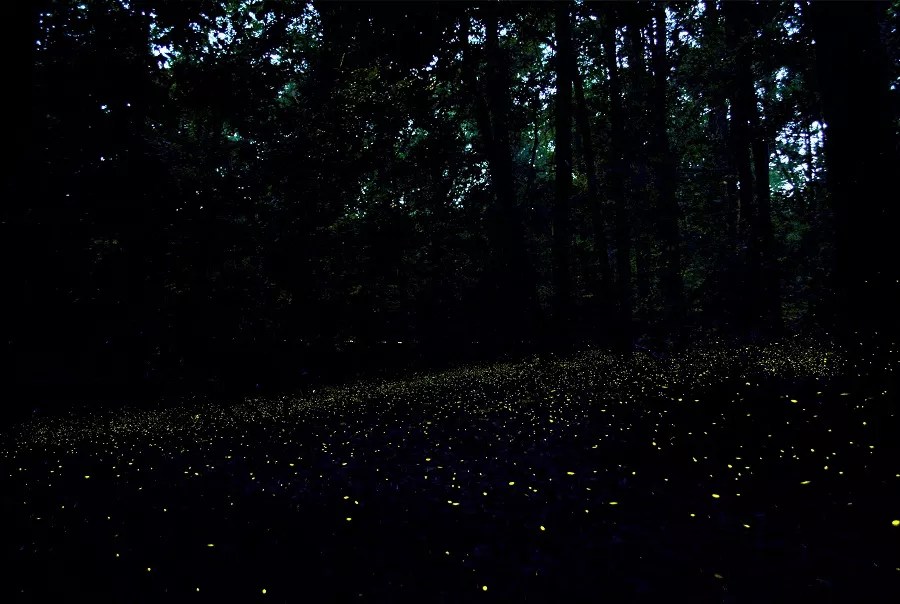
Mid-May to mid-June, synchronous fireflies light up the forest at dusk in Congaree National Park, South Carolina.

I used to love seeing fireflies as a kid, and now they are rare where I live. It makes me sad. What’s it all about? What is to be done?

Dino Grandoni at the Washington Post has this to say about the dangers to fireflies and possible ways to help bring them back.

“As a younger man, Joe Cicero saw ‘thousands and thousands of them.’ Swarms of fireflies put on a soundless fireworks show for him every summer in southern Arizona. The sight of the fireflies flashing in unison was so mysterious and mesmerizing that the entomologist made the study of the flickering insects his life’s work.

“Four decades later, Cicero, now retired, still goes back to those oak woodlands. Today, though, they’re mostly dark. The fireflies have been decimated, Cicero lamented. ‘Down to just a trivial few relative to the big population they had back then.’

“For many Americans, their otherworldly glow signals the start of summer. But across the country, many of these harbingers of summer may be blinking out of existence. What was once a series of tales from old-timers about the decline of fireflies from the days of their youth is coalescing into a disturbing scientific truth.

“Nearly 1 in 3 firefly species in the United States and Canada may be threatened with extinction, firefly experts estimate in a recent comprehensive assessment. … New research is shedding light on how these ethereal insects are struggling to thrive in the brightly lit world we have built around them.

“And the problem is bigger than a single type of bug. … In so many spots where scientists look, insects of all sorts are vanishing, … leading to fears of a potential-though-still hotly debated ‘bugpocalypse,’ which could unravel food webs for birds and other insect-eating animals and cause calamity for farmers who need pollinators to grow crops.

“ ‘I know a lot of people who hate insects. I’ve never met a single person who didn’t like fireflies,” said Sara Lewis, a Tufts University biologist and author of Silent Sparks: The Wondrous World of Fireflies.

“To understand the threats to fireflies, start underground. Fireflies in the United States spend the vast majority of their lives in their larval state, roaming the dirt to consume snails, worms and other soft-bodied grub several times their size. In contrast to their gentle summertime image, baby fireflies are vicious predators.

“But much of the swampy soil young fireflies need to thrive is increasingly being bulldozed for golf courses, suburban subdivisions and other types of development, making habitat loss a top threat. …

“ ‘These wetlands only occur right along the beach along the Mid-Atlantic,’ said Christopher Heckscher, an environmental scientist at Delaware State. … In Arizona, the Southwest synchronous firefly that Cicero studies is being trampled by different threats. Cattle and all-terrain vehicles in Coronado National Forest are stomping out its riverside habitat, he said. …

“When the time is right in the spring, juvenile fireflies seek a spot to pupate. Much like how a caterpillar transforms into a butterfly, a young firefly rearranges its body to turn into an adult. Then they take flight.

“The adults live for only a few weeks — with one thing on their minds. Fireflies flicker at each other to find their mates. …

“Males of certain species work together to woo mates by synchronizing their pulses. Other varieties are more ruthless, imitating the flashes of smaller fireflies to lure them in — and eat them. There are more than 2,000 species of fireflies globally, each doing a different dance.

“Even in the best conditions, males drifting in the air struggle to find females on the ground. ‘Mating success rate in darkness is not especially high,’ said Avalon Owens, a research fellow at Harvard. …

“Increasingly, we’re the ones making it harder. The artificial light we pour into the night is interrupting these bioluminescent courtships.

“To test the impact of light pollution, Owens set up a mating arena on her porch in her home outside Boston in 2020 during the height of the coronavirus pandemic. …

“In a study published last year, Owens and Lewis found exposing a semi-nocturnal firefly species called Photinus obscurellus to a bright light on the porch completely prevented it from mating. Out in the wild, the [researchers] found males of a related species, P. greeni, preferred LEDs meant to imitate females that were bathed in darkness.

“Brightening the night not only makes it harder for fireflies to see each other, it may also trick them into thinking it is daytime, Owens said. ‘It erases their habitat,’ she added. …

“Not every type of firefly is in peril. Some are actually thriving in our well-lit world.

“The big dipper firefly, named for the swooping arc it draws in the sky, evolved to come out at dusk and does not seem to mind modern streetlights. In their field experiments, Owens and Lewis found artificial lighting had little impact on the big dipper’s mating. Plenty can be found in well-lit corners of Central Park in New York.

“For many fireflies, there is a painful lack of data on even baseline populations. While some species remain abundant, overall, we risk the loss of firefly biodiversity. …

“While reversing climate change and other environmental threats is monumentally difficult, saving fireflies from light pollution is relatively easy. ‘You literally can just turn off the light, and the threat is gone,’ said Candace Fallon, a senior conservation biologist with the Xerces Society, a nonprofit conservation group pressing the federal government to extend endangered-species protections to fireflies. …

“For now, firefly aficionados are trying to inspire the next generation. Nearly 30,000 people flock to the Great Smoky Mountains each year to watch the park’s fireflies light up in sync. In Arizona, Cicero stages similar nightwatch parties for the few synchronous fireflies that remain there.”

More at the Post, here.

Read Full Post »

Photo: Ann Nisbet Studio designed the house above to make it dementia- and age-friendly. In the kitchen, “there are large letterbox-type slots in the drawers and cupboards to allow someone with dementia to see that there are cups, plates, cutlery and food inside,” Homes and Interiors Scotland reports.

When I was at the Fed, I attended a couple Harvard conferences on housing for the aging. I learned about something called “universal design” and thought how sensible it would be if architects would always ensure that housing features worked for people at any stage of life. Why go to the expense and disruption of putting in wider doorways, higher toilet seats, shower grab bars, ramps, and the like down the road?

In today’s article, architects considered these issues, even taking into account the possibility of someone developing dementia.

Caroline Ednie  writes at Homes and Interiors Scotland, “ ‘We lost all our belongings in the fire and were left homeless,’ recalls Kathy Li, an architect who teaches at Glasgow School of Art. ‘It was pretty traumatic. But after the initial shock wore off, we realized that what was important to us wasn’t necessarily the house itself but its location. It’s close to a beautiful reservoir where you can swim or fish, and forests that are perfect for mountain biking or road cycling.’ …

“So Kathy and her partner Richie Elliot decided to stay on the site, initially in a tiny caravan and then in a larger one-bedroom static caravan. ‘It took five years to resolve with the insurance company and we lived in the caravan the entire time,’ recalls Kathy. …

“Eventually, with the situation settled in their favor, she and Richie could begin to think about replacing their home on the site. …

“ ‘We knew we didn’t want lots of little rooms. There are fantastic views right down the valley, and we wanted to take advantage of these and of the woodland at the front. There is a southerly aspect too, which then got us thinking about a low-energy building. It was time to start again. We had this chance to create a house for life.’

“She approached architect Ann Nisbet. …The brief was essentially for an energy-efficient one-bedroom house, flexible enough to suit both living and working, to be constructed using ‘harmless’ materials.

“An unusual but crucial part of the brief was that the house should be dementia- and age-friendly. Kathy’s mother and stepfather both had dementia, and she was keen to explore and incorporate design features that would make it easier for sufferers to live in the house.

In response, Ann Nisbet attended a dementia design course at Stirling University – one of the world’s leading centers for research into the syndrome.

“ ‘We were keen to take this information, which mostly looked at care homes and hospitals, and apply it to a domestic house in a design-led, non-institutional manner,’ the architect explains.

“ ‘Research shows that you read your surroundings differently if you have dementia – for example, two materials of similar monotonal color when read together will be viewed as the same object. We used this knowledge to try to create a navigation system throughout the building, while still keeping the material palette modern and minimal.’

“As a result, the door and window frames, floors, skirtings and walls are all tonally different. As for circulation, all the key areas of the building are visible from the connection lobby, which helps you navigate the floor plan and prevents confusion.

“Thought was given to the kitchen units too: there are large letterbox-type slots in the drawers and cupboards to allow someone with dementia to see that there are cups, plates, cutlery and food inside.

“ ‘Many people have experienced a close friend or family member being diagnosed with dementia, and as we live longer, the number of sufferers is increasing,’ says Fay Goodwin, project architect at Ann Nisbet Studio.

“ ‘This house demonstrates that buildings can and should be designed to enable people with the condition to live longer in their own home and to help them overcome the day-to-day challenges they face.’ “

More at Homes and Interiors Scotland, here. Check out the close-up of the ktichen cabinets with the see-through slots. No paywall.

Read Full Post »

Photo: Bostock Brothers via the Guardian.
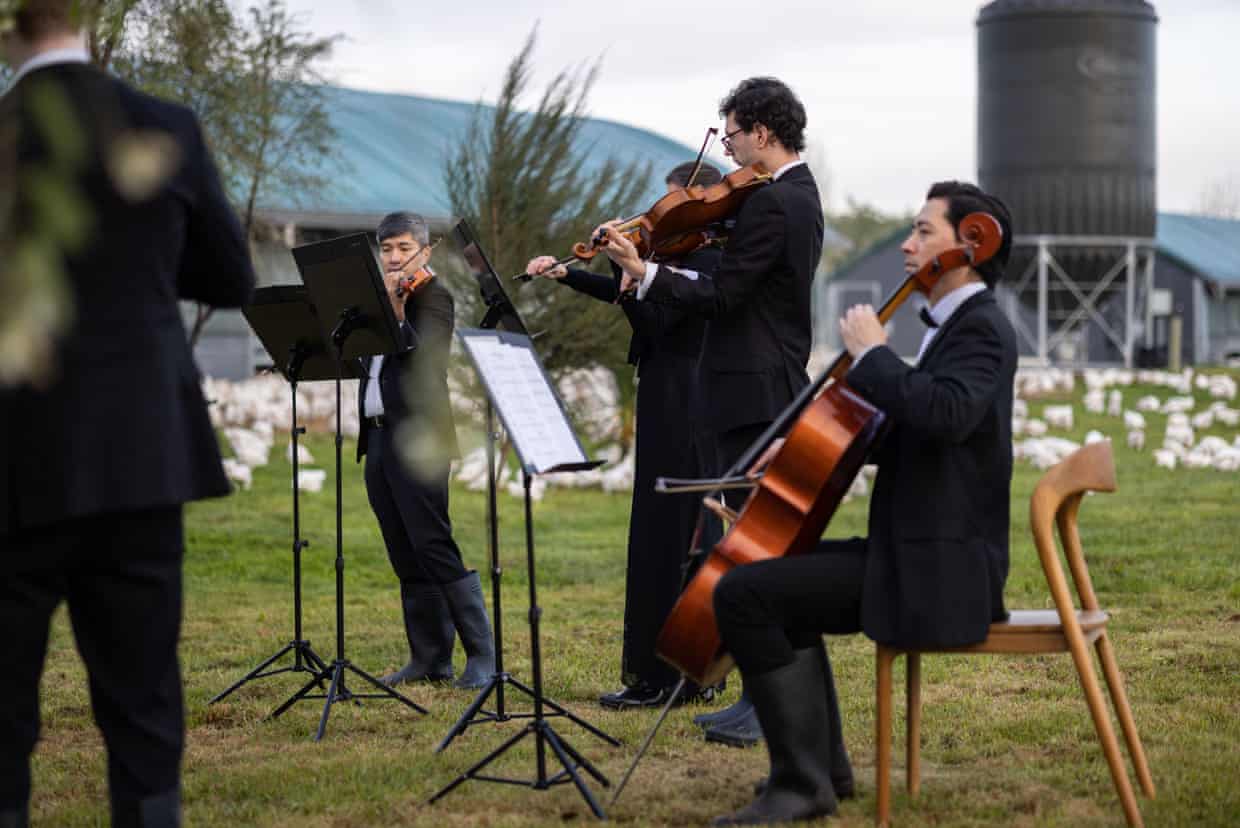
A live orchestral performance at the Bostock Brothers’ farm in Hawke’s Bay New Zealand. 

The media really knows how to have fun with a story that is susceptible to wordplay: “New Zealand Symphony Gives World Premiere for Hen-tastic Audience”; “Beethov-hen’s first symphony”; “NZ Symphony Orchestra members perform for thousands”; “im-peck-able.”

Mitchell Hageman at the New Zealand Herald wrote one of several delightful reports you can find online.

“Do chickens like classical music?” Hageman asks. “A Friday morning stunt in Hawke’s Bay proved they most certainly do.Members of the esteemed New Zealand Symphony Orchestra have performed for the likes of Dame Kiri Te Kanawa [and Sir Howard Morrison] but on Friday they faced some of their toughest critics yet: a hungry flock of thousands of Ross chickens.

“It was all part of a collaboration between Bostock Brothers Farm and the NZSO to promote ethical farming.

While slightly hesitant at first, the concert-going [chickens] eventually crowded around the clearly delighted musicians as they performed the world premiere of Chook Symphony No 1, created by composer and sound designer Hamish Oliver.

“ ‘Never could we have imagined producing a composition especially for a flock of chooks, let alone performing for them, but the opportunity was too good to pass up,’ NZSO chief executive Peter Biggs said. ‘The NZSO, like Bostock, is about being world-class and about wellbeing, so the two organizations have combined to create something very different and very new, and we hope it catches on.’

“The orchestra did some research and found instances where chickens responded particularly well to baroque music, which became the basis for the roughly two-minute symphony.

” ‘That’s strings, oboe, bassoon and harpsichord,’ Biggs said.

“After the composition was created, a sound recording was sent so it could be tested on the chickens. ‘They loved it,’ Biggs said. …

“For Bostock Brothers free-range chicken owners Ben and George Bostock, the collaboration was also a way to showcase the organic nature of chicken farming.

“ ‘Chicken farming is incredibly complex and organic farming even more so, and we’re constantly looking for ways to better our practices, ensuring our chickens are happy, healthy and organic,’ Ben Bostock said. ‘[We] know investing in a quality environment for our birds will only further yield quality results.’ …

“[George] said the response so far from the chickens had been great, and they would continue to play classical music in the sheds in future. ‘There’s lots of science that says classical music is really good for animal welfare and the response from our chickens has been really, really good.’ “

More at the Herald, here, at the Guardian, here, and at Symphony.org (the League of American Orchestras), here. No firewalls.

(And speaking of chickens, the Washington Post, here, reports that in Maine, chickens are now permitted as emotional support animals. Not that you asked.)

Read Full Post »

Photo: Christian Tunge via Henie Onstad Kunstsenter Museum in Norway.
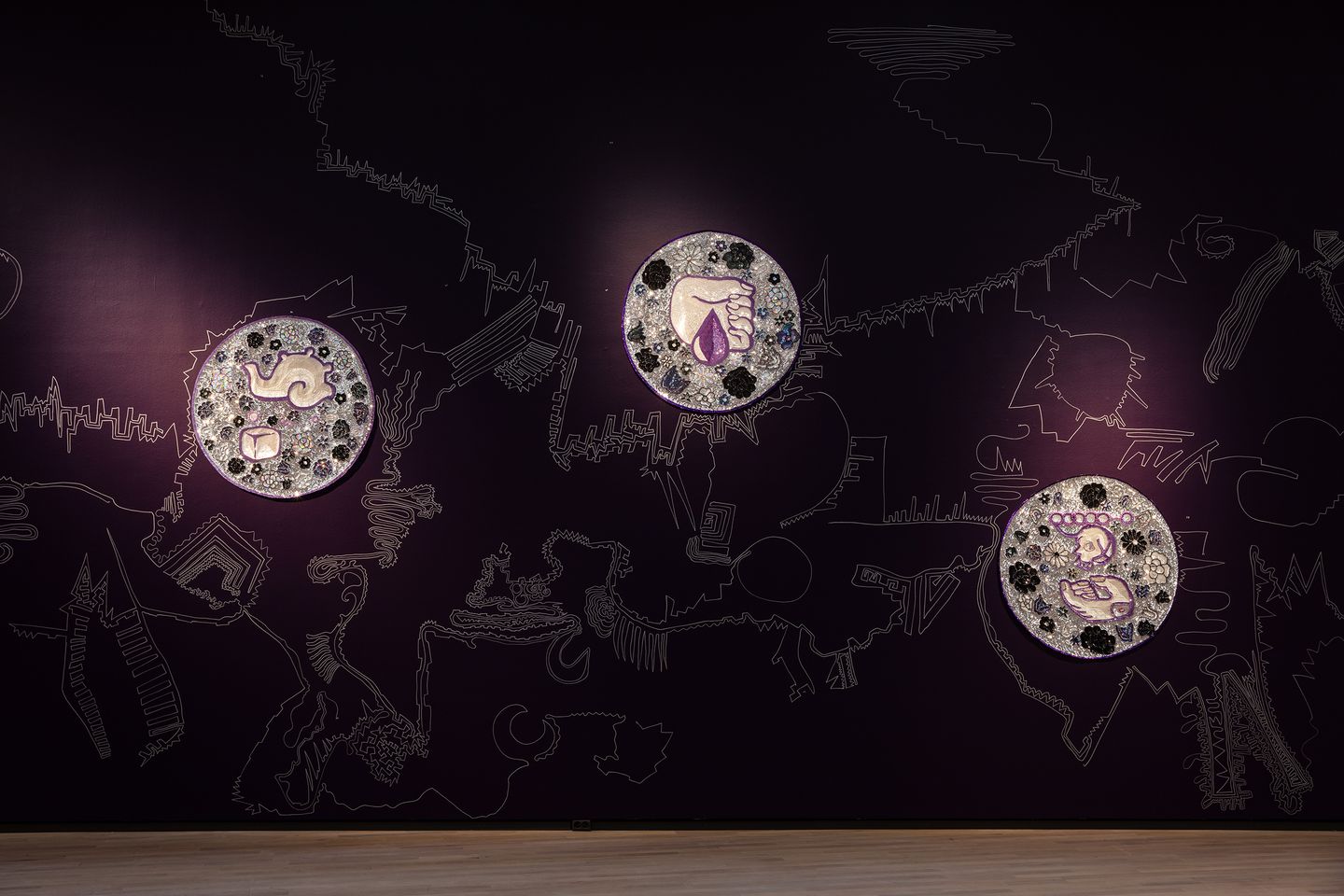
Art by Guadalupe Maravilla: “Embroideries” (2019).

Today’s post is about the artist Guadalupe Maravilla, who has found his own way of using art-making as a healing practice. He is interviewed by Jareh Das at Ocula magazine.

“At the age of eight in 1984, Maravilla fled civil war in El Salvador and arrived in the U.S. undocumented. As an adult, he overcame colon cancer, which led him to learn about global healing practices from cultures as far-reaching as Mayan and Tibetan, alongside standard medical treatments like radiation and chemotherapy.

“Accordingly, his practice brings together often separate knowledge systems, from Western Cartesianism, which sees the mind and the body as separate entities, to non-Western and non-hierarchical approaches that look to nature and natural remedies for healing and tend to view humans as part of a wider cosmological system of equal parts.

“For Maravilla’s first exhibition in Europe, and most comprehensive to date, Sound Botánica at Henie Onstad Kunstsenter (18 March–7 August 2022), over 30 works comprising monumental sculptures, drawings, a large-scale mural, and instances of activated sound baths fill the institute, including four major bodies of work: ‘Tripa Chuca’ (2016–2020), ‘Embroideries’ (2019), ‘Disease Throwers’ (2019–ongoing), and ‘Retablos’ (2021), which are devotional [votive] paintings.

“Speaking to the ethics of artistic creation, both the retablos and embroideries were made with collaborators specialized in such forms, co-authored, and fairly compensated — all of which are important to Maravilla and his wider way of working.

Sound Botánica unfolds over two main gallery spaces with the most captivating and monumental works on view being Disease Thrower #4, #6, #7, #8, #9 (all 2019)—totem-like sculptures that each incorporate a sound gong, assembled from plaster of Paris made by microwaving tissues and plastic that hold together objects collected during the artist’s travels.

“The most recent Disease Thrower #13 (2021) is an astounding work measuring over two meters high made from cast aluminum, moulding vegetation and nature into a constellation of organic forms, some related to the healing and nutrition during Maravilla’s cancer treatment, with notable vegetable forms like squash placed besides real squash at the base of the sculpture.

“In the conversation that follows, Maravilla speaks about forced migration, how trauma manifests in the body and the collective, and disrupting boundaries between art and life, with a practice led by a personal commitment to create a more equal and equitable world.

Jareh Das: Some of your artworks, such as the series of monumental sculptures ‘Disease Throwers’, are activated through performative gestures. I notice they are made of materials like luffa sponges, anatomical models, gongs, glass bottles, and the invented plaster you create by melting tissues and plastic in a microwave.

“These are hybrid, totem-like sculptures that draw from your experience as a child who migrated undocumented to the U.S. They also bridge Indigenous cultures with ritual, and speak to your cancer treatments, which have included modern medical techniques alongside healing practices.

“How did you bring together these intersecting knowledge systems and develop an art practice centered on collective healing experiences, as the exhibition Sound Botánica at Henie Onstad Kunstsenter demonstrates?

Guadalupe Maravilla: I am interested in collective healing and the intersections between the Indigenous and the medical, and dismantling systems. My daily experiences are the core of my work. People often wonder how I can be so open about having cancer, being undocumented, and being a child of war.

“I escaped the civil war in the south of El Salvador in 1984 and migrated to the United States, which separated me from my family; this is very common with migration. Somehow, I made it to the United States — I feel very blessed to be in this position, as an artist now exhibiting all over the world.

“I have a teaching position as a professor and all these great things, so I think of how lucky I am, but I also think back to the kids who did not make it, particularly those who crossed with me. On the other hand, because I’m a cancer survivor too, I can make a direct connection between the trauma of the civil war and seeing violence as a kid and the illness that came to inhabit my body.”

More at Ocula, here. No paywall. You can also listen to an interview at PRI’s the World, here.

Read Full Post »

Photo: Mark Elbroch.
Since 2018, the collaborative Olympic Cougar Project has tagged 111 individual pumas, including Charlotte, above.

How many names do you know for the animal in the picture above? I learned four from today’s article.

Stephen Humphries writes at the Christian Science Monitor, “If Kim Sager-Fradkin didn’t have to write a grant proposal, she’d be spending her afternoon on the trail of a killer. 

“The biologist leads a team that’s researching cougars in Washington’s Olympic Peninsula. (The big cat is also referred to as a puma or a mountain lion. Not to mention wild cat, or panthera.]) Today, the team is tracking a cougar named James. It suspects he recently hunted an animal in a nearby forest. 

“ ‘Visiting cougar kill sites is really fun and like being sort of a forensic scientist,’ says Ms. Sager-Fradkin … wildlife program manager for the Lower Elwha Klallam Tribe. She’s overseeing the Olympic Cougar Project in partnership with Panthera … and five other Native American tribes. They’ve pooled their talents and resources to help an apex predator that has become effectively imprisoned in the westernmost part of Washington. 

“The region’s cougars are penned inside a geographical island roughly shaped like a square. Three sides are bordered by the ocean and bays. To the south there’s the expansive Columbia River as well as Interstate 5. The barriers on all four sides collectively form a de facto fence. Unable to easily connect with other big cats in the Pacific Northwest, cougars in the Olympic Peninsula are inbreeding. The lack of genetic diversity poses health challenges for them, scientists say. By collecting data on the big cats, the Olympic Cougar Project is bolstering the case for constructing a wildlife overpass over I-5 so that the species is less confined.

“ ‘Humans love wildlife stories, and humans love wildlife movements,’ says biologist Jim Williams, author of Path of the Puma: The Remarkable Resilience of the Mountain Lion. ‘What’s really neat about this project is it’s going to create information that will be translated through story that will keep humans excited and caring about the species.’ …

“When Ms. Sager-Fradkin began working for the tribe in 2007, her primary role was to plan sustainable subsistence hunting and fishing for current and future generations. A year later, she initiated a small-scale study of cougars in the region. She called in cougar expert Mark Elbroch. In 2018, they expanded the scope and scale, incorporating the five other tribes in the region and adopting the Olympic Cougar Project name. 

“ ‘The tribes on the peninsula aren’t always working together on a lot of things,’ says Ms. Sager-Fradkin, adding that there are sometimes disagreements over issues such as hunting jurisdictions. ‘So it’s really amazing that we’ve all come together and are working on a big project like this.’  To get all the partners on board, she had to get them to see the big picture. …

“The cougars are considered an ‘umbrella species’ because so many other creatures in the ecosystem depend on them. ‘Where there are frequent kills, the grass is literally more nutrient rich,’ explains Ms. Sager-Fradkin. …

“It was this fact that helped her persuade the region’s tribes that it was in their common interest to study the feline carnivore. 

“For his part, Dr. Elbroch, director of the puma program at Panthera, adds that Ms. Sager-Fradkin used her natural skill of engaging with people. …

“Working in concert, the Skokomish, Makah, Quinault, Jamestown S’Klallam, and Lower Elwha Klallam tribes have created a grid consisting of 550 cameras. Artificial intelligence catalogs animals photographed in the peninsula – including bobcats, bears, coyotes, deer, and elk – and helps estimate their populations. Research technicians, such as Lower Elwha Klallam tribe member Vanessa Castle, analyze the patterns of 127 individual cougars. There’s also the less glamorous task of analyzing animal scat. 

“ ‘A lot of our ancestral knowledge was lost,’ says Ms. Castle, who praises how Ms. Sager-Fradkin has mentored her and other employees in the project. ‘So we’re having to relearn those things. Like how wildlife all is intertwined with each other. … I had no idea the role that mountain lions played in the system as a whole.’ …

“ ‘The first thing that is needed is to protect the habitat on either side, because you can’t spend all the money on a wildlife bridge and then end up with a Walmart parking lot right on one side,’ says Ms. Sager-Fradkin. 

“The Olympic Cougar Project is not just liberating the big cats, she adds, but also creating a sustainable ecosystem for the tribes for the next seven generations.”

More at the Monitor, here. No paywall. Subscriptions encouraged.

Read Full Post »

Photo: Robert F. Bukaty/ Associated Press.
An Atlantic puffin feeding its chick in a burrow under rocks on Eastern Egg Rock, a small island off mid-coast Maine on Aug. 5.

I learned a few years ago that that adorable seabird called the puffin might be in trouble. Because warming oceans were killing off their food, puffins were producing fewer successful offspring. This year, scientists who monitor the puffins say 2023 was the second consecutive rebound year for fledgling chicks. But it sounds like only a brief reprieve.

Patrick Whittle reports for the Associated Press (AP), “On remote islands off the Maine coast, a unique bird held its own this year in the face of climate change.

“Atlantic puffins — clownish seabirds with colorful bills and waddling gaits — had their second consecutive rebound year for fledgling chicks after suffering a catastrophic 2021, said scientists who monitor the birds. The news flies in the face of environmental trends, as scientists have said warming waters off New England jeopardize the birds because that reduces the kind of fish they need to feed their chicks.

“One fish, though — the sand lance — has remained in abundance this year, allowing puffins to thrive, said Don Lyons, director of conservation science at National Audubon Society’s Seabird Institute in Bremen, Maine. He said it’s a sign the impact of climate change on ecosystems is not always as tidy as we think.

“The encouraging news comes as the Audubon Society is celebrating its 50th anniversary of tending to Maine’s puffin colonies, which it restored from just a few dozen pairs. There are now as many as 3,000 birds, and the population is stable, Lyons said. …

“The puffins — also known as ‘clowns of the sea’ or ‘sea parrots’ — nest in burrows and feed their chicks small fish such as herring. Two years ago, the colonies suffered one of their worst years for reproduction in decades due to a lack of those fish. Only about a quarter of the birds were able to raise chicks that summer.

“Audubon and other conservation groups have tied the fish shortage to warming ocean temperatures.

The Gulf of Maine, which has puffin colonies on its islands, is warming faster than most of the world’s oceans. …

“The puffins’ ability to reproduce despite environmental changes speaks to the resiliency of seabirds, said Bill Sydeman, president and chief scientist of the Farallon Institute, a marine preservation organization based in California. However, the long-term dangers posed by climate change — such as fatal heat waves, loss of food, loss of islands to sea level rise, and inability to breed — remain existential threats. …

“ ‘The problem with climate change is these breeding failures and low breeding productivity years are now becoming chronic,’ Sydeman said. ‘There will be fewer young birds in the population that are able to recruit into the breeding population.’

“Maine’s puffins are the only breeding Atlantic puffins in the US Worldwide. The species lives in the North Atlantic from Maine and Canada to Europe. …

“The Maine puffin population once dwindled to only about 70 pairs on tiny Matinicus Rock. Hunters who pursued the birds for their meat and feathers had nearly wiped them out by the early 1900s. Stephen Kress, an Audubon ornithologist, sought to grow puffin colonies starting in the 1970s by relocating chicks from Canada to Eastern Egg Rock, another tiny island. …

“The effects of climate change on seabirds have been a focus of scientific inquiry in recent years. Interest in the subject has accelerated because of die-offs of some of the puffin’s auk family relatives, such as common murres and Cassin’s auklets off the West Coast.

“The challenges faced by seabirds make successful breeding seasons especially important, said P. Dee Boersma, a University of Washington professor of biology and director of the university’s Center for Ecosystem Sentinels.”

My husband saw puffins in Iceland. Have you ever seen them? I think I may have encountered them in a zoo, but unfortunately, that’s it.

More at the Globe, here.

Read Full Post »

Photo: Oscar Espinosa.
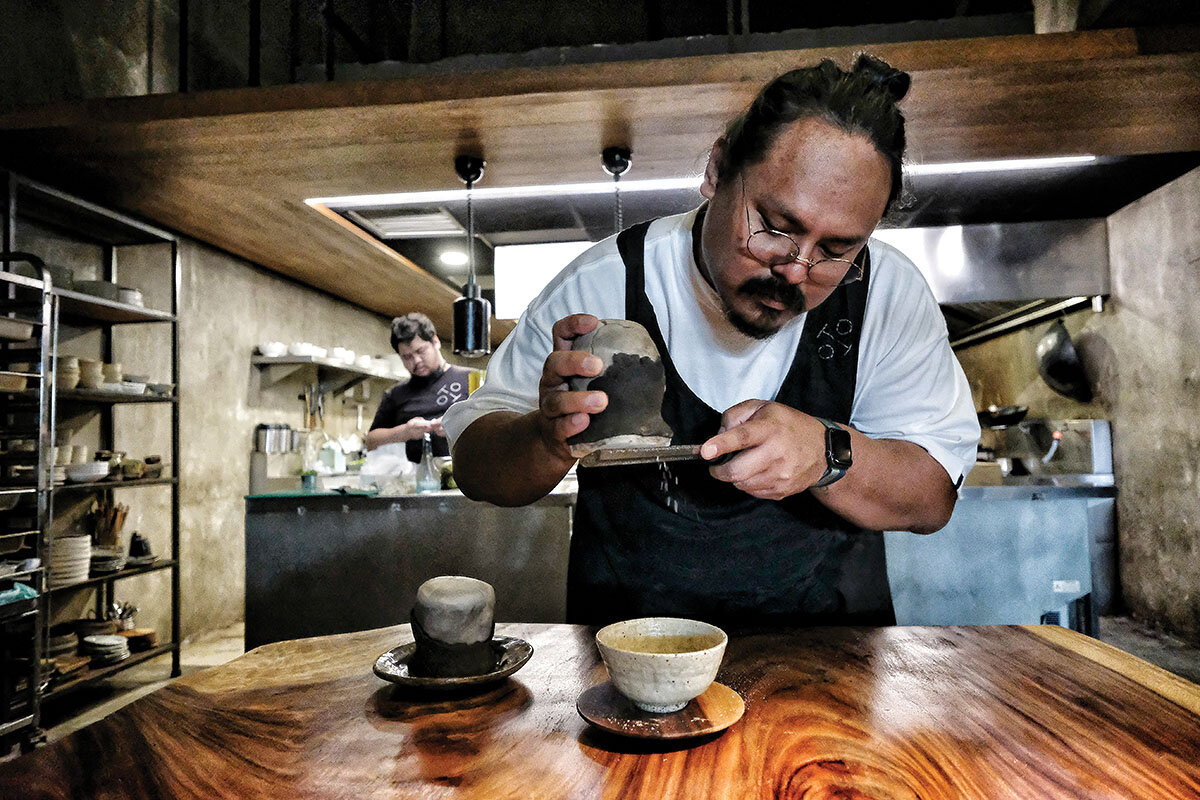
“Jordy Navarra, chef at Toyo Eatery in Manila, Philippines, delicately grates a bit of ‘asin tibuok salt on top of flan de leche ice cream, one of his restaurant’s signature desserts,” reports the Monitor.

When Fuji Xerox brought the Kinoshita family over to Rochester years ago, I spent a lot of time with Yuriko. She had lots of questions about the US but spoke great English and soon was advising other Fuji Xeros families, even making a guide book for the women.

One day Yuriko asked me why Morton Salt said “with iodine” on the label. I told her Americans didn’t get enough of that essential ingredient in their typical diets. But it got me interested in salt.

Oscar Espinosa and Laura Fornell have a report at the Christian Science Monitor on a particularly unusual salt.

“Smoke escapes from a hut in front of the mangroves of Alburquerque, on the Philippine island of Bohol. The pleasant smell of wood, coconut, and salt burning over a slow fire signals that the making of artisanal salt has begun. 

“The process, which had been passed down for generations, results in a product known as asin tibuok. It’s an oval piece of salt compacted into a clay mold that has been partially broken by the intense heat of the fire. Asin tibuok is only produced in this small coastal town of about 11,000 inhabitants. 

“ ‘For the next few days, we’ll be taking turns so that we can watch the fire 24 hours a day,’ says Nestor Manongas, who keeps his eyes on the pile of smoldering wood in the center of the hut. ‘We will have to be pouring seawater [in] to prevent the flame from igniting so that the coconut shells are slowly consumed,’ he says. ‘We can’t get distracted because the process could be ruined.’

“This controlled combustion will result in gasang, a highly salt-concentrated ash, which is then placed in a funnel-shaped tank made of bamboo, where the salt is filtered out of the ash by pouring in more seawater. The resulting brine, called tasik, will be used to cook the asin tibuok pieces.

“Mr. Manongas is one of the last remaining makers of this salt. But thanks to the determination of his family, this old trade, which had fallen into oblivion, has been revived.

“ ‘Against all odds, we kept going because we were determined to give it a new life,’ says Crisologo Manongas, Nestor’s brother. He recalls how, little by little, asin tibuok became known, with university students making it the subject of their research, chefs from Manila discovering it, documentaries being made, and in 2017 a Filipino American entrepreneur based in California deciding to import the product to the United States.” Fascinating pictures at the Monitor, here. No paywall.

For more on the production of salt, particularly the production of sea salt, I turned to Malden Salt, here. Of course, it’s self-promoting, but I think you may learn a few things, as I did. Those of you who are cooking bloggers might be especially interested.

The website says, “Salt production is one of the oldest practices dating as far back to 6,000 BC. Used for various trading and religious offerings, empires such as the ancient Romans actually used salt as a means of commerce, with Rome deriving the word ‘salary’ from salt. … Not only does it enhance flavors within dishes and allows you to season to perfection, it is an element in which the human body can’t live without – sodium. …

“Sea salt is made by seawater from the ocean entering into shallow ground or a ‘salt works’ (man-made salt water pools) where by time the sun will begin to evaporate the water, leaving behind sea salt crystals – this is called solar evaporation.

“Now this is is the easiest and preferred method for warmer climates with a low rainfall and high evaporation rate. But what about the other climates like the UK that aren’t graced with regular hot weather? This is where countries like ourselves get creative with sea salt production.

“[It’s] a naturally occurring element, containing less iodine than table salt and obtains traces of minerals/nutrients including magnesium and potassium. …

“Although it’s safe to say Maldon is sea salt’s biggest fan – there are other salts. Table salt [is] mined from natural salt deposits (older bodies of seawater which have dried long ago) the salt is then processed and manufactured into smaller crystals. Unlike sea salt, which is produced through natural methods, table salt production involves chemicals after being mined. It’s purified and striped of minerals and infused with anti-caking substances.

“Mineral salt [is] similar to table salt, but this type of salt is specifically mined from areas such as Pakistan, near the Himalayas. Did you know it’s colors are influenced from the additional minerals, such as calcium, potassium, and magnesium. You may know this as ‘Rock Salt.’ Here at Maldon we stock Tidman’s Natural Rock Salt. [Unlike] other salts, Tidman’s is also additive free. …

“Since 1882, our world-famous salt flakes have been made with the same traditional artisan methods from the coastal town of Maldon, Essex. Our salt works are run by the fourth generation Osborne family, currently in the hands of Steve Osborn, following his father’s footsteps Clive, grandfather Cyril and great grandfather James.

“Seawater from the the Blackwater Estuary in Maldon is carefully harvested on the spring tide, where there is an appreciated art to the temperature and timing, which is a family secret. Master of salt makers have been hand harvesting the naturally formed pyramid-shaped crystals that have since became Maldon’s signature.

“Maldon Salt is created through an evaporation process. Brine is evaporated in our salt pans over flames to form the unique salt crystals. [Our] salt makers use the same time-honored techniques with skilled hands poised over every batch. You can find out more where Maldon Sea Salt comes from by heading over to our YouTube channel.” Read more here.

Read Full Post »

Photo: Eldred Allen.
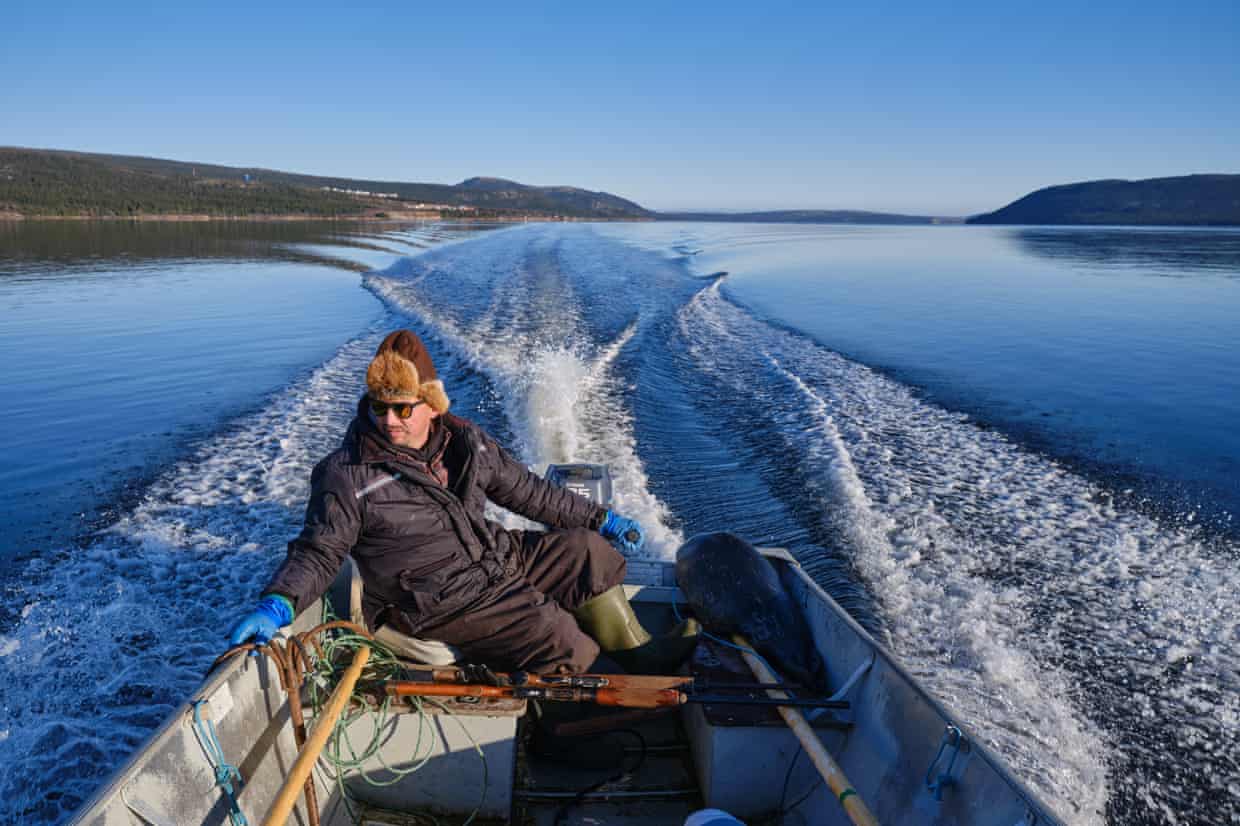
Martin Shiwak, an Inuit, with his hunting rifle in his boat, on Lake Melville, near Rigolet in Nunatsiavut, Canada.

Can you handle another story about how we are finally learning that indigenous ways are better for everyone in a changing climate? I don’t mean we all need to hunt and fish. I’m talking about protecting land and water from resource exploitation.

Ossie Michelin writes at the Guardian that “the environment Inuit have lived in for millennia is changing fast. Canada’s government once ignored Indigenous knowledge of it but now they are jointly creating the Nunatsiavut conservation area. …

“Martin Shiwak accelerates his boat to grab the seal he has shot before the animal sinks out of sight. Shiwak has hunted for years in the waters of Lake Melville, by the Inuit community of Rigolet in Nunatsiavut.

“As he hauls the ringed seal into the vessel, he says he counts himself lucky to have found one so quickly. ‘Sometimes you have to drive around here in the boat nearly all day to find a seal,’ Shiwak says. ‘Nowadays you can’t even afford to – C$60 only gets you five gallons of gas.’

“Nunatsiavut – one of four Inuit homelands in Canada – is where the subarctic becomes the Arctic. An autonomous region of Labrador-Newfoundland province, it is located at the extreme north-east corner of North America.

“Winter temperatures here can average -30C (-22F) with the windchill, as the Labrador current brings Arctic ice floes down along the coast, and a host of marine life from, plankton to polar bears. From November to June, shipping is impossible because sea ice covers the entire 9,320-mile (15,000km) coastline, so all food and supplies must be flown in. In Rigolet, a frozen 1.5kg (3.3lb) chicken will set you back C$25 (£15). Hunting is not just a tradition but a necessity. …

“As a young boy, he learned to hunt and fish with his father and grandfather, who in turn had learned these vital skills from their elders. It is also how Shiwak learned the core Inuit values of taking only what is needed, sharing, sustainability and respect for nature – values he is passing down to his own children. …

“But while traditional knowledge has allowed Inuit to survive in this harsh environment for so long, the climatic conditions they rely on are changing quickly. Since 1950, Nunatsiavut has lost 40 days of ground snow a year. Its sea ice is vanishing faster than anywhere in the Canadian Arctic. …

“There is very little local people can do about that: although the region is roughly the size of the Republic of Ireland, Nunatsiavut’s population is less than 3,000, spread among five small towns. What they can do, however, is work to protect what they have. That’s why Nunatsiavut is partnering with the Canadian government to co-develop the world’s first Inuit Protected Area of this type.

“While there are other Inuit-led marine conservation programs in Canada, this will be the first to bear the title of Inuit Protected Area. … Built on Inuit values and culture, this type of conservation area would allow Indigenous people to continue traditional practices of hunting and fishing.

“That was not always the case. Past conservation policies saw Inuit at best only consulted and at worst completely ignored. Many Inuit hunters and fishers faced fines, had their equipment confiscated and their catches from hunting and fishing taken.

“Despite being granted the power to self-govern in 2005 (after 30 years of negotiations with the Canadian government), Nunatsiavut still lacked the final say over conservation in its waters. Final decisions defaulted to federal or provincial ministers.

“Now, at last, Nunatsiavut can jointly create and co-manage the protected area, based on Inuit priorities, as an equal authority. This will allow Inuit to practice traditional hunting and fishing in the area, while protecting the waters from industry and development.

“ ‘Just because we’re small doesn’t mean we can’t do something,’ says James Goudie, deputy minister of lands and natural resources in the Nunatsiavut government. ‘We can show the world that a small region can protect a massive amount of biodiversity.’

“The Inuit Protected Area would only cover about a third of Nunatsiavut’s nearly 50,000 sq km of offshore waters, but the region is home to important populations of fish such as salmon and Arctic char, the breeding grounds for many migratory birds, and the habitat of Arctic marine mammals including polar bears, beluga whales and seals.

“Establishing a protected area is also a pre-emptive strike against resource exploitation. Significant natural gas deposits have been found offshore along the Labrador shelf, but it has remained largely unexplored because of the ice. As the climate warms, however, the region is becoming more accessible – the Inuit Protected Area would prevent such resource exploration. …

“The borders of the new area have not been finalized, with the feasibility report expected in 2024 or 2025. But [Rodd Laing, Nunatsiavut’s environment director] notes: ‘You don’t need lines on a map to recognize the great work that happened already with Inuit relative to conservation and the management of ecological resources.’

“After all, he says, for countless generations of Inuit, conservation was not an option that could be ignored: it was a way to ensure there would be enough to eat, and enough next time as well.”

More at the Guardian, here. Nice photos. No firewall.

Read Full Post »

Reading

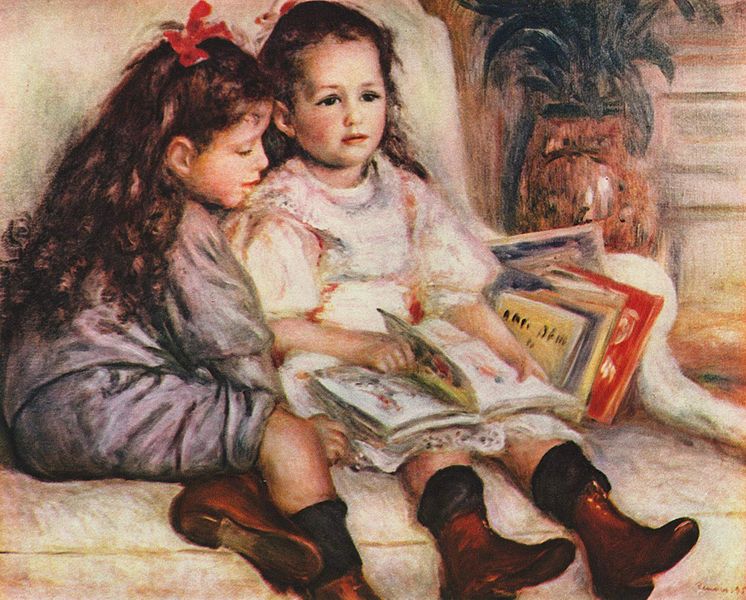
Art: Pierre-Auguste Renoir.
Portrait of Jean and Geneviève Caillebotte.

I love it when kids get into the magic of books on their own, whether through pictures (note the dreamy look on the face of Renoir’s little girl, above) or through being read to.

I have heard of people reading to a baby in the womb. We didn’t start that early, but we did start when our kids were babies, and they did the same when they grew up and had children of their own. John still reads to the family even though no one is little now: it’s just a great activity.

My father read to us kids, but his tastes leaned toward the literary. Which often meant depressing stories by Hans Christian Andersen. There was only one of those we liked. It was something about dogs, one of which had “eyes as big as saucers.” He got tired of reading that one. “Don’t you want to try a different one?” he’d ask. But we knew we didn’t like depressing. We did enjoy Kipling’s Just So Stories, which he read with a wonderful variety of dramatic voices. I have a cassette tape of him reading “The Elephant’s Child.”

Now all four grandchildren are good readers, having perhaps picked up the joy their parents and grandparents feel when reading. I don’t like hearing that the 8-year-old’s Spy School book features pills that will explode you if you’re in a situation where you might otherwise be tortured, but she got me to admit I’d probably like reading that book if I were a kid. It hooks you in fast, she reports.

Enjoy the cool work of an artist who is a serious book lover, below.

Photo: Tutt’ Art.
Jonathan Wolstenholme is an British painter and illustrator best known for art inspired by love of old books.

Read Full Post »

« Newer Posts - Older Posts »