Feeds:
Posts
Comments

Archive for the ‘Uncategorized’ Category

GPS Art

Photo: GPSArt.
A new fad: using the mapping function on your phone to create art.

At the New York Times, Claire Fahy has a report on a hobby generating the kind of puzzled glances that Pokémon enthusiasts wandering through traffic used to elicit.

“In 1665,” she begins, “Johannes Vermeer dabbed the last drop of paint onto a canvas in his Dutch studio, completing his masterpiece ‘Girl With a Pearl Earring.’

“On an April day 357 years later, Janine Strong slowed her bike to stop, paused her fitness app, and watched as the snaking line of her cycling route drew the shape of Vermeer’s masterpiece over the streets of Brooklyn.

“Ms. Strong creates what has come to be known as ‘GPS art’ — a practice that uses the Global Positioning System mapping capabilities of modern phone apps like Strava to create digital drawings using an athlete’s route across the landscape.

“Instead of biking on a straight path or in circles around a park, Ms. Strong plans her rides in the shapes of birthday cakes, stars, birds, lions — and the occasional Vermeer.

“The hobby has grown with the widespread availability of satellite tracking for use by ordinary people, in fitness apps like Nike Run Club or MapMyRide. It is particularly popular on Strava and often referred to as ‘Strava art.’

“Strava art has existed since that app’s release in 2009, but it experienced a surge in use during the pandemic. According to Michael Joseph, a senior communications manager at the company, more than three billion activities have been uploaded to Strava since the beginning of 2020.

“To complete her digital vision of ‘Girl With a Pearl Earring,’ Ms. Strong biked almost 50 miles around southern Brooklyn, carefully checking Strava to make sure each turn, circle, and straightaway was achieving the iconic earring and head covering of Vermeer’s original.

‘I always have a big smile on my face when it works out and I upload it and it’s done,’ she said. ‘It’s a very satisfying feeling.’ …

“In 2003, the New York Times Magazine ‘Year in Ideas‘ issue told of how Jeremy Wood and Hugh Pryor used Garmin GPS devices that looked like walkie-talkies to trace routes resembling butterflies and fish on walks through the English countryside.

” ‘It’s not just walking; you’ve got to be looking at this device,’ Mr. Pryor said in a recent interview. ‘People always wonder what you’re doing.’

“Mr. Wood said he got the idea for GPS art while he was using a GPS tracker on a flight and the plane flew in a holding pattern above Heathrow Airport. He was captivated by the pattern appearing on his Garmin.

“ ‘It formed this most beautiful oval shape, and it was better than I could draw by hand,’ Mr. Wood said. ‘That’s when I made a connection: You could use one’s movements to make marks in space.’

“Mr. Pryor, a classmate of Mr. Wood’s, had to develop software to get the GPS points off the Garmin and onto a computer, turning the data into drawings. In the years since, technology has advanced enough to create visual maps in real time using a phone or smart watch. …

“The practice has spread from the fields of Oxfordshire in England to the sand dunes of Rio Grande do Norte in Brazil. Gustavo Lyra has run around Rio Grande in the image of John Lennon’s face and spent almost nine hours running a route for his daughter’s fifth birthday. It was an image of Elsa from Disney’s Frozen. …

“Gene Lu, who lives in New Jersey, started creating GPS art when he became a fan of the Game of Thrones TV series in 2013. He ran the shape of the family crests from the program. …

“Lenny Maughan, who refers to himself as a ‘human Etch A Sketch,’ also started out making map art tied to pop culture. Leonard Nimoy — Mr. Spock in the original Star Trek — had just died in 2015, and Mr. Maughan decided to pay him tribute. … ‘I thought, OK, I’m going to do the Vulcan salute.’

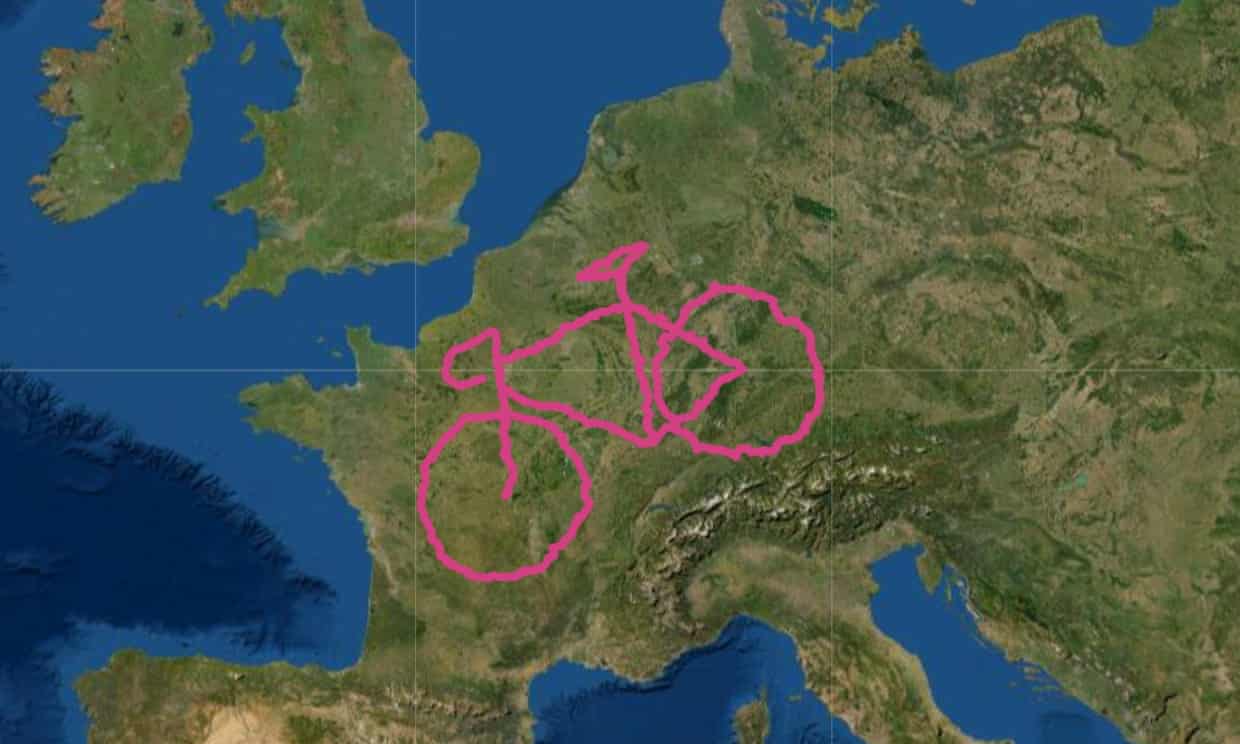
“The art form even has its own Guinness World Records categories. The Guardian profiled a couple who completed a 4,500-mile bike ride across Europe (while blogging the journey) that resulted in a 600-mile-wide GPS drawing of a bicycle — the largest such drawing on record, according to the Guardian. …

“For Mr. Lu, the unexpected is part of the beauty.

“ ‘The crazy thing is that you sort of don’t know where the map takes you; you just go with it,’ Mr. Lu said. ‘I always end up with what I’m looking for.’ “

More at the Times, here.

Photo: Daniel Rayneau-Kirkhope/Arianna Casiraghi.
The virtual bicycle drawn by Daniel Rayneau-Kirkhope and Arianna Casiraghi is 600 miles across and covers seven countries. See the article at the Guardian.
Read Full Post »

Photo: Akhila Ram.
High School student Akhila Ram won a 2022 ‘Most Innovative’ award for her invention to measure groundwater.

When I get discouraged about what we’re doing to the planet, I remind myself of all the young people coming along who like to solve problems.

Today’s post is about those who are addressing water scarcity. Akhila Ram, a high school student in Lexington, Massachusetts, won a science award for her groundwater-measuring gadget. And at the University of Illinois Chicago (UIC), there are young professors focused on reusing wastewater to save on potable water.

Collin Robisheaux writes at the Boston Globe, “Akhila Ram, a 12th-grader at Lexington High School, isn’t exactly like other high school students. In her free time she enjoys baking, painting – and inventing technologies to map out groundwater levels across the United States in order to monitor problems like water depletion.

“Ram’s invention is a computer model that uses machine learning to interpret data collected by NASA’s GRACE satellite in order to predict groundwater within a few feet of its actual level. While groundwater monitoring tools already exist, they can be expensive to install.

“Ram’s system could give farmers, well owners, and local officials a cost-effective method of monitoring groundwater. According to Ram, this model is the first to use a statistical approach on a large region to predict changes in groundwater levels. …

“The inspiration behind the invention is personal for Ram.

“ ‘My grandparents live in India, and their city faced a major drought,’ Ram said in an interview. ‘It was because of poor management. And I wanted to [do research on] solutions that could be used to properly manage water resources. … I’ve always been really passionate about climate change,’ Ram said. ‘That’s what led me here. I’ve always been trying to come up with ideas in this realm of sustainability and the environment.’ More at the Globe, here.

Meanwhile young college professors at the University of Illinois Chicago (UIC) are finding ways to make better use of wastewater.

David Staudacher reports at Rise magazine, “Water is our most precious resource, but climate change, pollution, and a growing human population has made this resource even more scarce. More than 2 billion people live in water-stressed countries. …

“To reduce this scarcity, two professors in civil, materials and environmental engineering are looking around in the world to find better ways to reclaim and reuse both fresh water and wastewater.

“To find best practices in water reuse, Associate Professor Sybil Derrible and his team have studied the work done in cities and countries around the world. In search of new water sources, many countries are turning to ocean water. …

“ ‘In places like Singapore, Hong Kong, Saudi Arabia, and Israel, there are only a few ways to get water,’ Derrible said. ‘One is from the sea through desalination, and another is by reclaiming used water. Desalination requires a lot of electricity. Recycling used water can save energy and money.’

“Derrible and his team are developing a framework to analyze water circularity — which is the practice of not wasting or losing water and recovering the resources it contains as it is reused in multiple applications — by examining how cities collect, treat, and reuse water. In Singapore, for example, municipalities collect rainwater and recycle wastewater back to industries where it doesn’t need to be treated.

“Derrible wants to create a universal framework that takes into account ideas like this and that can be used anywhere in the world, including places where fresh water is not scarce.

“ ‘Many industries require extensive volumes of water, but the water does not need to be potable. Here, used water that was minimally treated can be sufficient,’ he said. Some places in the United States are already reusing wastewater. In warm climates like Las Vegas, wastewater is used to irrigate golf courses.

“ ‘It’s a big deal because the future of many cities includes reusing water and it is becoming more and more common for many cities in the world because water is a precious resource,’ he said.

“Also, in most countries, water distribution systems consist of large, highly pressurized pipe networks that require an excessive amount of energy and that are vulnerable to large-scale contamination if something goes wrong. However, in Hanoi, Vietnam, water is distributed at low pressures, and most buildings are equipped with a basement tank, a rooftop tank, and separate water treatment processes, resulting in a system that consumes less energy and that is more resilient. …

“Even a city like Chicago — with its vast freshwater resource in Lake Michigan — can benefit from reusing water. Professor Krishna Reddy is working with the Metropolitan Water Reclamation District of Greater Chicago (MWRDGC) and several UIC professors on an interdisciplinary project investigating ways to reuse treated wastewater from MWRDGC processing plants in the region and beyond.

“The district discharges some treated water into the Chicago River, where it makes its way into the Mississippi River and ultimately into the Gulf of Mexico. But ‘from a sustainability point of view, this is not a good reuse of a resource,’ Reddy said. ‘We suggest recycling the treated water where it can be reused for beneficial purpose without any further treatment.’ The researchers are gathering data to understand how much water MWRDGC produces, uses, and discharges, and are examining the quality of the water the plants both take in and discharge. One goal is to find new uses for wastewater.

“ ‘One interesting thing is that there are a large number of industries near the water reclamation plants, and they use a lot of water,’ Reddy said. ‘Maybe some of the industries nearby could use the treated water, or it could be used for other applications like agriculture or recreational parks irrigation, toilet flushing, landscaping, and golf courses.’ “

More at the UIC College of Engineering, here.

Photo: Jim Young
Sybil Derrible and his team are developing a framework to analyze “water circularity.

Read Full Post »

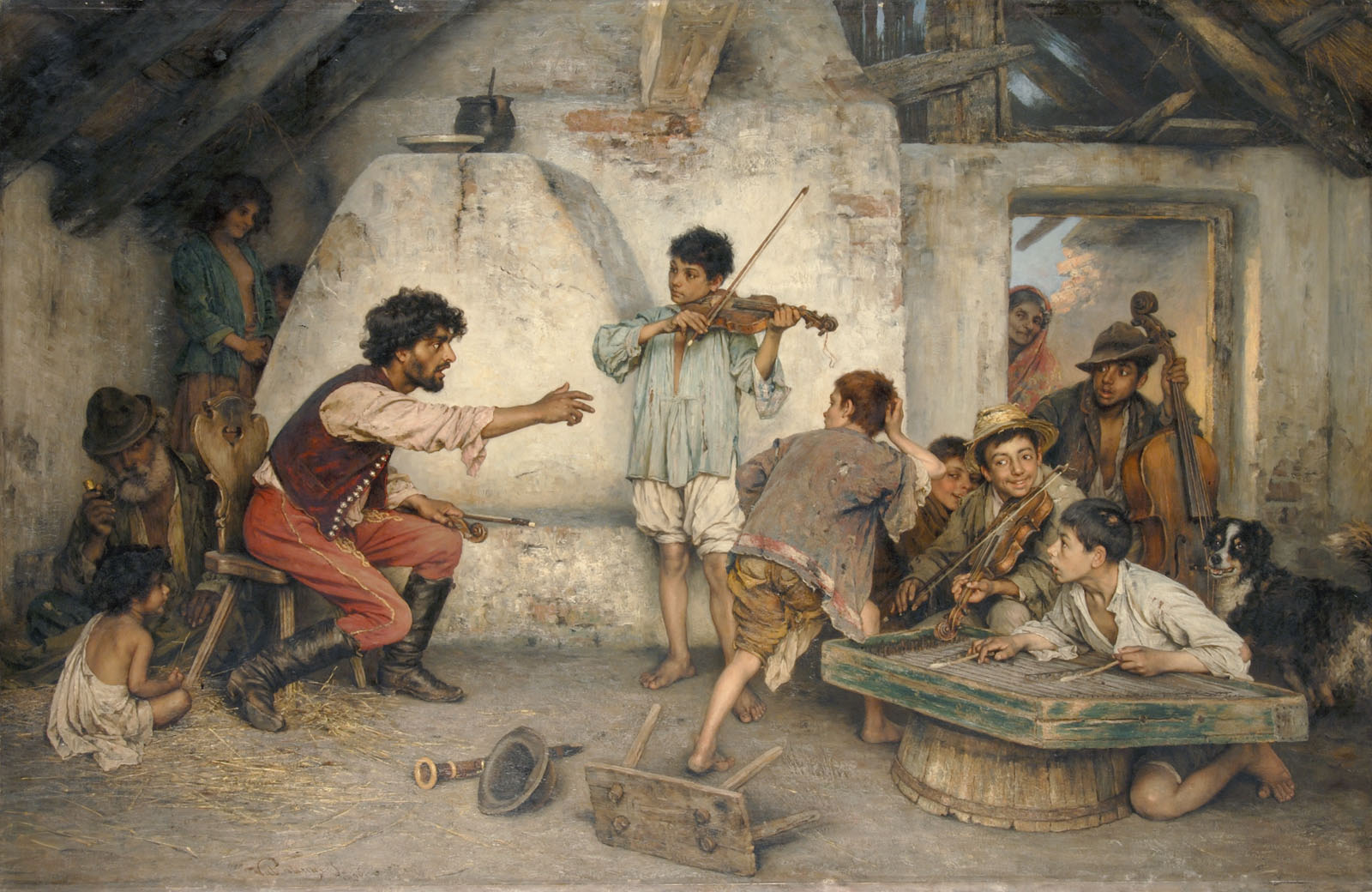
Art: Valentiny János.
János depicts Romani people in Hungary in the old days. Today a new radio show in Hungary highlights the many sides of of these people, especially Roma women.

Revisiting the notion that no group is a monolith, I take a look today at Hungarian Roma women. Persecuted throughout history in the many countries where they traveled, Roma (“travelers,” “gypsies”) have an especially tough time in Hungary, according to many observers. That’s why a new radio show featuring Roma women has been especially important for sharing Roma lives with non-Roma listeners.

Orla Barry writes about it for Public Radio International (PRI): “Szandi Minzari knows she’s different from most Roma women in Hungary. The divorced, single mother is one of the leading broadcasters on Radio Dikh, a radio station in Budapest, whose presenters are all Roma. 

“The station began broadcasting in February 2022 with the aim of raising the profile of Hungary’s large Roma community, as well as upending some of the negative stereotypes that still exist about the group.

“[In September], the European Parliament issued a statement saying that Hungary is no longer a fully functioning democracy. EU lawmakers laid out a long list of fundamental rights they believe are under threat, including the electoral system, judiciary independence and the protection of minorities. The Roma are Hungary’s largest ethnic minority.

“Minzari’s weekly radio show ‘Zsa Shej,’ which means ‘Let’s go, girls,’ in the Romani language, tries to cover subjects that are usually taboo in the Roma community, including those pertaining to relationships, menstruation and family issues. …

“Her co-host, Melanie Nagy, is also a divorcee and a single mother. Divorce is really uncommon among Roma, Minzari said, adding that many Roma women often stay in abusive relationships out of fear of poverty or shame. 

“One of Minzari’s friends, who was recently divorced, has now been ostracized by her family, she said. …

“Listeners of Radio Dikh, which is the Romani word ‘to see,’ are both Roma and non-Roma. The station’s motto is ‘about Roma, not just for Roma.’ The shows feature music and literature by Roma artists.

“Minzari’s father comes from a long line of traditional musicians, although he doesn’t play an instrument. He runs his own construction company, employing mainly Roma workers.

“Minzari describes herself as half-Roma, half-Hungarian because her mother is not Roma. When her parents first got together more than 35 years ago, there was a lot of hand wringing in her father’s family, Minzari said. …

“Minzari is proud of her Roma roots, but she still remembers being singled out in school by her teacher and labeled cigány, meaning ‘gypsy.’

“That was 23 years ago. Segregation of Roma children continues in Hungarian schools to this day. 

“In 2020, the country’s Supreme Court ordered an elementary school in Gyongyospata to pay compensation to Roma families for ‘unlawful segregation and substandard education.’ Before the ruling, Hungarian Prime Minister Viktor Orbán suggested the school should refuse to pay out any money if ordered. Instead, he suggested it was the Roma children who had created a threatening environment in the school, which led non-Roma parents to take their children to a school in a neighboring town.

“Bernard Rorke, the advocacy and research manager with the European Roma Rights Center in Budapest, has been campaigning against school segregation in Hungary since 2000. 

“Conditions for Roma have deteriorated since Viktor Orbán returned to power in 2010, Rorke said. 

“ ‘The European Commission initiated infringement proceedings against Hungary for school segregation more than five years ago and more recent EU reports have noted that segregation in Hungarian schools has actually worsened,’ he said. ‘But the Orbán government has done nothing to address it.’

“But not everyone agrees. István Forgács, who is Roma and a regular commentator on Hungarian TV, believes that segregation in schools comes down to demographics. 

“ ‘The Roma have more children than non-Roma,’ he said, ‘and the high number of Roma kids in certain schools is mostly because of this difference.’

“Forgács said he believes Orbán has been doing a good job as prime minister over the last 12 years and has ‘helped the Roma socially integrate.’

“ ‘This government has helped people to have more income, both Roma and non-Roma. It has helped Roma to have more jobs and also to get closer to the non-Roma community,’ Forgács said.

“But Rorke, with the European Roma Rights Center, said unemployment remains a big issue among Roma in Hungary, and those who have a job are often paid far less than the minimum wage. …

“During the migrant crisis in 2015, when over 1 million people fled to Europe, mainly from Syria and Afghanistan, Hungary refused most asylum requests. Hungary’s Justice Minister László Trócsányi said the country was unable to take in migrants because it already had its hands full dealing with its own Roma population. …

“Roma commentator Forgács said he wasn’t offended by the remarks and that the Orbán government just wanted to point out that it has its own challenges providing for its own people. 

“Orbán’s name is rarely heard on Radio Dikh — Minzari said she shies away from politics. In Hungary, the majority of the country’s news media is government-controlled or owned by Orbán allies. 

“Péter Erdélyi, director of the independent news outlet 444.hu in Budapest said … ‘There are lots of very difficult issues that people need to talk about in Hungarian media, but they won’t because they know that, as soon as there is even a remote whiff of criticism of government policies, there could be all sorts of problems around funding and licenses and whatnot. There’s an understanding that you are allowed to keep doing what you do, if you do not engage in politics,’ Erdélyi said.

“Minzari said the only criticism she has received about her show, so far, has come from members of the Roma community who disagree with her views. Non-Roma listeners have been hugely supportive, she said. ‘And even if people do complain, at least we’ve got them talking,’ Minzari said.”

More at the World, here. The World is on at 3 pm weekdays where I live, but you can get it anywhere and at different times. You are going to hear stories there that you are unlikely to hear anywhere else. It really does connect you with the world.

Read Full Post »

Art: Elsie Driggs, Pittsburgh, 1927, Whitney Museum of American Art, New York
“Beauty is everywhere if you know how to look for it.”

You don’t have to love pollution to love industrial monstrosities transfigured by art. In fact, the tension between what you know smokestack flames are spewing and the beauty of the fire against the blue sky is part of the appeal. Which is not to say I wouldn’t happily give it up.

Still, I was interested in this article on the general topic at the Millions. Bill Morris writes, “In the early years of the twentieth century, an eight-year-old girl named Elsie Driggs was traveling by train with her parents from Sharon, Pennsylvania, to New York. She had dozed off by the time the train reached Pittsburgh, but as the writer John Loughery would recount years later in Woman’s Art Journal, her sleep was interrupted: ‘She was awakened by her father to witness the drama of the black night-sky over Pittsburgh ablaze with soaring flames from the steel plants. It was a memorable sight.’

“So memorable that 20 years later, with her artistic career beginning to flourish, Driggs returned to Pittsburgh hoping to recapture the scene in paint. But the fiery Bessemer steel-making process had been abandoned by then, so there were no longer any flames spurting into the night sky. Worse, the local mill’s managers insisted that a steel mill was no place for a young lady—and they were suspicious that she was a union organizer or industrial spy. But Driggs did not give up. ‘Walking up Squirrel Hill to my boarding house one night, I found my view,’ she told Loughery. ‘It was such a steep hill. You looked right down on the Jones and Laughlin mills. You were right there. The forms were so close.

And I stared at it and told myself, ‘This shouldn’t be beautiful. But it is.’ And it was all I had. So I drew it.

“And then she made a painting from her sketches. And then, nearly a century later, while viewing an exhibition of the Whitney Museum’s permanent collection, my eye was drawn to a smallish black-and-white painting — just 34 by 40 inches — that from a distance appeared to be abstract. … As I got closer I realized it was a stark depiction of cylindrical industrial smokestacks bound by wires at the top left and a gush of smoke at the bottom right. The smokestacks are black and gray, the only color coming from a hint of sulfur in the pale sky. And that’s it: smokestacks, wires, smoke, sky. No flames, no human beings. How did this unremarkable image manage to be so otherworldly beautiful?

“The card on the wall told me that the picture was called ‘Pittsburgh 1927’ and it was painted by Elsie Driggs. She soon followed it with an equally stark painting of silos and ducts and smokestacks called ‘Blast Furnace,’ and then a monumental, faceted painting called ‘The Queensborough Bridge.’ These paintings gained Driggs entry into a group dubbed the Precisionists, an informal movement of mostly young artists who in the 1920s were drawn to America’s emerging industrial landscape of factories and skyscrapers and bridges, which they rendered with both a geometric precision that echoed Cubism and a sparseness that sometimes bordered on abstraction, typified by ‘Pittsburgh 1927.’

“There were other Precisionists on the walls of the Whitney the day I discovered Elsie Driggs, most notably Charles Sheeler and Charles Demuth. While Driggs was in Pittsburgh, Sheeler was in Detroit on a commission to photograph Henry Ford’s sprawling River Rouge complex, the workplace of 75,000 people, then the largest factory in the world. Sheeler’s assignment was part of the corporation’s publicity campaign for the Model A, which was about to replace Ford’s obsolete Model T. Sheeler spent six weeks roaming the complex with his camera, producing 32 prints that the company used for publicity and that are now regarded as high art. Possibly his most memorable image is ‘Criss-Crossed Conveyors, River Rouge Plant, Ford Motor Company,’ a picture of two conveyors making an X over a tangled netherworld of fences and buildings and ironwork, all of it topped by eight slender smokestacks that reach into the heavens. …

“One of Sheeler’s works from the Rouge was in the Whitney show — a painting made five years later called simply ‘River Rouge Plant,’ an oddly serene depiction of the factory’s coal processing and storage facility. The exterior walls of the buildings are creamy or tan, the foreground waters of a boat slip are glassy and calm, the sky is blue. There are no workers, no smoke or sparks or grease or slag heaps. The only hint of the repetitive, soul-crushing work that was done there is the nose of a freighter visible on the right. Part of Henry Ford’s genius was to make everything he needed to produce cars — what’s known as vertical integration, the cutting out of all middlemen — and so to make steel he had coal brought up by train from Appalachia, while his fleet of freighters brought iron ore down from Duluth, Minnesota. You would not know this by looking at Sheeler’s stately photographs or serene paintings, nor would you know that Ford was a union-busting anti-Semite who ruthlessly policed the morals of his captive work force. Sheeler was not concerned with such unpleasant facts. For him, all that mattered was that the Rouge was a visual gold mine. ‘The subject matter, he wrote to his friend Walter Arensberg, ‘is undeniably the most thrilling I have ever worked with.’ American factories, he added, were ‘our substitute for the religious experience.’

“Hanging on a wall near ‘River Rouge Plant’ was Charles Demuth’s painting ‘My Egypt’ from 1930, a depiction of a grain elevator in his hometown of Lancaster, Pennsylvania. The gray structure, topped by exhaust ducts and flanked by a smokestack, is seen from a low angle, giving it a monumental, nearly monstrous presence. Diagonal lines hint at stained glass — and at the notion, widespread at the time among Sheeler and others, that industrial structures were the cathedrals of the machine age. …

“By depicting industrial architecture and machinery but not the humans who built and operated it, the Precisionists left themselves open to the charge [of] glorifying the machine while minimizing or simply ignoring its human costs. …

“What was behind the Precisionists’ tendency to focus on machines rather than their operators, on the mechanical rather than the human? Was it a way of condemning the pulverizing power of the industrial age? Or was it a way of glorifying these monuments to human ingenuity and will? Or could it be that it was not one or the other, but a bit of both? Or neither? 

“One possible answer comes from Elsie Driggs. The year she painted ‘Pittsburgh 1927,’ Charles Lindbergh became the first person to fly solo across the Atlantic Ocean. A year later, Driggs experienced her first flight, aboard a Ford Tri-Motor that carried her from Cleveland to Detroit. It was an ethereal experience, judging by the painting she executed that year, ‘Aeroplane,’ which was included in ‘Cult of the Machine.’ It shows a curvaceous, silvery plane floating through the heavens. Black diagonal lines suggest the whirring of propellers — and identify it as the work of a Precisionist. It’s a lovely, loving homage, clearly a way of glorifying this airborne monument to human ingenuity and will.”

More at the Millions, here. Wonderful pictures. No firewall.

Read Full Post »

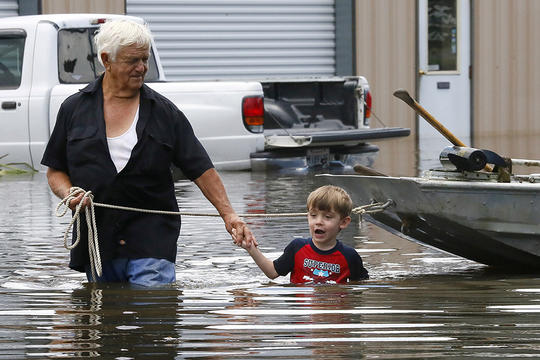
Photo: Jonathan Bachman/Reuters.
In Louisiana, climate change is erasing Isle de Jean Charles. French-speaking and indigenous residents are moving to higher ground, amid fears of losing their language and culture.

We all know someone who begins to rebuild right after a natural disaster like a wildfire or hurricane, and who are we to judge? But as extreme weather incidents become more common, some of those most affected are, with aching hearts, facing the necessity to be practical.

Patrick Cox reported at PRI’s the World, “Hurricane Ida killed dozens of Lousianans and displaced tens of thousands of others. Among the hardest hit were bilingual and French-speaking communities close to the Mississippi Delta. 

“Alces Adams lives halfway between New Orleans and the Gulf of Mexico in the small community of Cut Off in Lafourche Parish. Hurricane Ida destroyed his trailer.

“People in this part of Louisiana — bayou country — have long learned to live under adverse weather conditions. But things have gotten much worse in recent years. Rising sea levels, erosion and storm after storm have flooded entire communities. For some French speakers, Hurricane Ida was the last straw, and now many are moving away.

“A year after Ida, Adams’ trailer looks just as it did the day after the storm — twisted and torn apart with furniture spilling out, as if attacked by a pack of wild animals. Next to it is a new trailer, Adams’ temporary home provided by FEMA, the Federal Emergency Management Agency.

“Adams was born a block away in his grandparents’ house. His family’s older generation spoke only French. Adams said his grandmother learned English, but refused to speak it, except for one word: ‘Yeah.’ 

“ ‘English was forced on us about 100 years ago,’ Adams said. That’s when English was declared the only language of instruction in public schools. Adams recalled listening to his older relatives as they told him stories in French. Even then, he said, he considered the language beautiful. ‘I loved listening to that.’

“Adams’ grandmother and others told him stories of storms and floods they had survived. It helped prepare him — still a child — when Hurricane Betsy battered the region in 1965. …

“Adams doesn’t know what’s next for him. He comes from a long line of Cajuns who he said were compelled to move from one place to another, to escape poverty or discrimination, or hurricanes and flooding. 

“The French language has been a constant in all of this generational change. Adams knows that each time a French speaker moves away, it’s another micro-blow to the survival of French in southern Louisiana.

“Tulane University linguist Nathalie Dajko has been tracking the decline of French in Lafourche and neighboring Terrebonne Parishes for nearly 20 years. She was in graduate school at Tulane when Hurricane Katrina hit in 2005. It left hundreds of thousands of people homeless. Some even ended up in camps that were scattered across several southern states. Dajko visited a few of the camps as part of a gig she had with Save the Children, a nongovernmental organization.

“ ‘Every now and again, we’d come across these French speakers,’ Dajko said. ‘They would be so excited to meet somebody who spoke French, and they would talk about how they missed the French.’ …

“Louisiana French isn’t standard Parisian French. But French has had longstanding roots in the region after France claimed it in 1682. With the area drawing French speakers, the language gained a foothold. It even spread to local Indigenous tribes in the 1700s. They’d formed protective alliances with the colonial French against the British. Some of their descendants still speak French, especially those who live closer to the ocean — and the floods and storms.

“Across a causeway from one of the larger bayous in Terrebonne Parish is an island called Isle de Jean Charles. Abandoned dwellings are everywhere: collapsed walls, caved-in roofs, debris. A couple of the houses are being fixed up. But most aren’t.  Near the end of the road, a house with a sign outside says, ‘Isle de Jean Charles is not dead.’ … 

“Chris Brunet, who answered the door in a wheelchair, said he spoke French at home and English at school. Like Alces Adams, Brunet’s grandmother only spoke French; his parents were bilingual. Everyone living on the island was a member of the Biloxi-Chitimacha-Choctaw tribe. …

“ ‘Hurricane Ida is the first storm to damage the house,’ he said, pointing out his damaged roof. … Likely to be gone soon is this entire island. In the past 65 years, Isle de Jean Charles has shrunk from 22,000 acres to just 320. 

“It’s not just the storms. There are many reasons why the land is vanishing: rising sea levels, the rerouting of the Mississippi river — some of it natural, some engineered — canal construction, land erosion, some of that caused by oil and gas extraction. Then there’s the levee system, expanded after Hurricane Katrina: a life-saver for those living within it; potentially catastrophic if you’re on the outside of it.

“That’s why Brunet, and almost everyone else on the island, is leaving, with federal government assistance, to a city 35 miles inland where virtually no one speaks French.

“ ‘If I had to predict, I would suggest that people are not going to maintain French,’ linguist Nathalie Dajko said. … Still, Dajko has studied these French and bilingual communities for close to two decades, and said they’re full of surprises. 

“ ‘People have been predicting the death of Louisiana French for generations and it just won’t die,’ she said.”

More at the World, here. For a refresher on Longfellow’s fictional Evangeline, one of the French-speaking Acadians expelled from Canada to settle in Louisiana, click here.

Read Full Post »

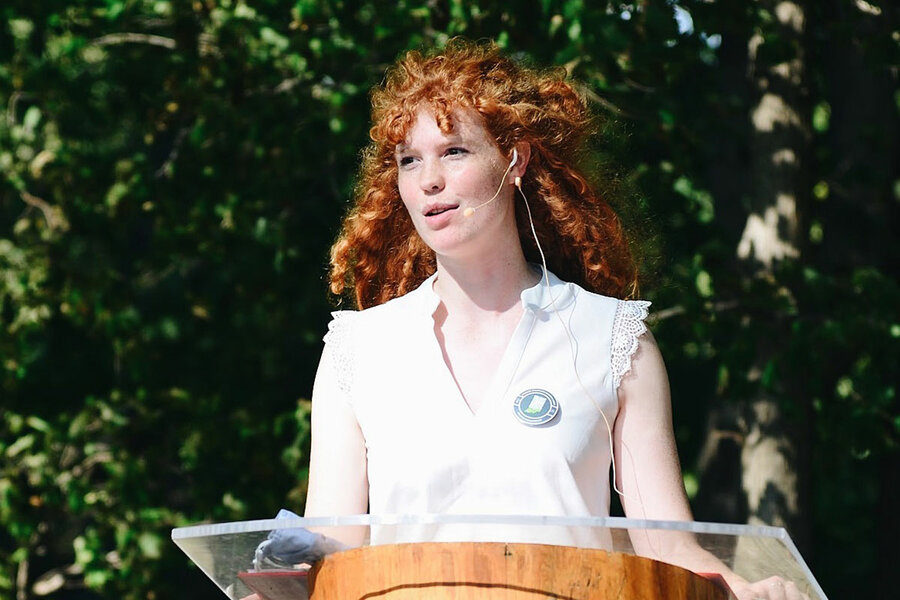
Photo: Chenyao Liu.
Elsa Barron speaks at Hoosier Interfaith Power and Light’s Faith Climate Summit, where she was moderating a panel on environmental justice, Oct. 10, 2021.

No group of people is monolithic. All individuals have their own individual views. Which is why we should never assume anything about people who identify with a particular group.

An ESL teacher I work with attends a congregation where almost everyone’s politics are X although hers are Y. She sends her daughter to their school because she loves it overall, but she teaches her daughter some differences at home.

I’m sharing an article that gets into religion just because I thought it was interesting, but if it offends anyone, I hope you know you can tell me. It’s about a small but growing group of American evangelical environmentalists.

Erika Page has the story at the Christian Science Monitor.

“Should I stay or go? It was a question Elsa Barron had wrestled with on her own for years. Now, at a public panel on faith and the climate at the COP26 summit in Glasgow, Scotland, she was on the verge of voicing it aloud to a crowd of strangers.

“The panelists, faith leaders from the All Africa Conference of Churches, hadn’t named names. But Ms. Barron had gleaned the message. One of the biggest impediments to climate action in their communities was … her home community: evangelical Americans, who hold an outsize influence in missionary ministries in Africa.

“She had bitten her tongue through the Q&A session, nervous about being vulnerable in such a high-profile crowd. But just as the moderator moved to close the event, she felt her hand shoot up.

“ ‘I grew up in that community,’ she recalls admitting to the panel, heart racing. ‘What is needed from me in this moment?’ 

“For evangelical environmentalists, the temptation to leave the church behind and take their climate concerns elsewhere is high. This is especially true among younger generations, who [are] more likely to worry about climate change than their elders. Ms. Barron, for one, stood on the brink of abandoning her faith just a couple of years ago. 

“So the response she got from those panelists at COP26 last November has stuck with her. 

“ ‘If you have the opportunity to be rooted in your community, asking questions, pushing for change, and advocating for communities that don’t have an inroad to these spaces, then that’s probably the biggest thing you can do,’ she remembers being told. 

“The choice to stay and fight has not been easy, demanding resolve, patience, and the courage to speak up, again and again. But at a time when writing off those with differing views has become commonplace, Ms. Barron has found that her empathy and love for her community [have] helped her work with, instead of against, those on the ‘other’ side of the climate divide. 

“ ‘It takes a lot of courage to not just pick one side or the other, especially in such an extremely polarized society,’ says Melanie Gish, author of God’s Wounded World: American Evangelicals and the Challenge of Environmentalism. …

“In the United States, climate awareness and urgency have grown steadily in recent years. … Even among white Evangelicals, thought has been shifting. A poll conducted by Yale and other groups in 2020 found that 44% of them attributed global warming to human activity, up from 28% when the Pew Research Center asked a similar question in 2014.

“And the National Association of Evangelicals just renewed a call to action to mitigate the environmental crisis from a ‘biblical basis,’ updating a report from 2011. Yet climate skepticism remains disproportionately high among evangelical Christians, even compared with other religious groups. Some evangelical leaders have pitted environmental movements against religion, painting the former as a politically motivated threat to a faith-driven life. Many simply don’t see church as the place to address environmental concerns. …

“[At the University of Notre Dame, Ms. Barron read] one little book that hit her ‘like a ton of bricks.’ The text was Laudato Si, the 2015 encyclical on ‘care for our common home’ written by Pope Francis. She still remembers her visceral response to her first read.

“ ‘It felt like, “Oh my goodness, how did I miss this?” ‘ she says. Until then, her religion and her love for the natural world had existed in separate spheres. Now, she began to see the environmental crisis as a deeply spiritual crisis, built on a foundation of greed, extraction, and irreverence. And with that understanding came an accompanying spiritual obligation. 

“ ‘If we don’t care about it and don’t do something about it, we’re failing to fulfill two of our callings as people of faith: to care for creation and to love our neighbors,’ she says over Zoom from her family’s home in Illinois. 

“That’s the idea behind ‘creation care,’ an environmental movement grounded in biblical direction, such as the duty to ‘tend and keep’ the Garden of Eden. … The ideas have been more readily adopted outside the U.S., especially in places on the front lines of climate change. …

“Even though creation care, also known as environmental stewardship, has become more widely accepted in the U.S., being a young evangelical environmentalist can be lonely. …

“[Ms. Barron’s] mother texted her about a group called Young Evangelicals for Climate Action. YECA was founded with the support of the Evangelical Environmental Network in 2012. In addition to the group’s advocacy, the organization trains youth fellows on writing op-eds, talking to representatives, leading projects in their own communities, and engaging effectively with church members and leadership.

“Ms. Barron says she held back none of her trepidation in her application essay to be a fellow – and was welcomed into the fold. For the first time, she met a host of evangelical environmentalists grappling with similar questions, while working to shift the culture on climate within their own churches and college campuses. …

“ ‘It starts with conversations; it starts with one-on-ones … telling your church leaders and pastors what you’re passionate about,’ says Tori Goebel, national organizer and spokesperson for YECA. ‘It’s not necessarily about facts and statistics and different scientific figures, but rather it’s just sharing stories and connecting to shared values.’ ” 

More on Evangelical environmentalists at the Monitor, here.

Read Full Post »

The musical Hamilton goes to Germany.

Claudia was first to alert me to the the New York Times story about Lin-Manuel Miranda’s musical Hamilton getting translated into German for an upcoming tour. The art of translation is really interesting to me, especially when the translator is supposed to render a play on words in a different language or convey the sense of something deeply embedded in another country’s culture.

Michael Paulson wrote from Hamburg, ” ‘Hamilton’ is a mouthful, even in English. Forty-seven songs; more than 20,000 words; fast-paced lyrics, abundant wordplay, complex rhyming patterns, plus allusions not only to hip-hop and musical theater but also to arcane aspects of early American history.

“So imagine the challenge, then, of adapting the story of America’s first treasury secretary for a German-speaking audience — preserving the rhythm, the sound, and the sensibility of the original musical while translating its dense libretto into a language characterized by multisyllabic compound nouns and sentences that often end with verbs, and all in a society that has minimal familiarity with the show’s subject matter.

“For the last four years — a timeline prolonged, like so many others, by the coronavirus pandemic — a team of translators has been working with the ‘Hamilton’ creators to develop a German version, the first production of the juggernaut musical in a language other than English. The German-speaking cast — most of them actors of color — [reflect] the show’s defining decision to retell America’s revolutionary origins with the voices of today’s diverse society. …

“Hamburg has emerged, somewhat improbably, as a commercial theater destination — the third biggest city for musical theater in the world, after New York and London — with a sizable market of German-speaking tourists. The market began with ‘Cats’ and ‘The Phantom of the Opera,’ and Disney shows are a big draw. …

“But less familiar shows have had a harder time here — “Kinky Boots” closed after a year. Sure, there are hard-core German “Hamilton” fans (some of them upset that the show is being performed in a different language from that of the cast album they love), but there are also plenty of Germans who have never even heard of Alexander Hamilton.

“ ‘It’s not like “Frozen,” which everybody knows,’ said Simone Linhof, the artistic producer of Stage Entertainment, an Amsterdam-based production company that operates four theaters in Hamburg and has the license to present ‘Hamilton’ in German. …

The German cast has already adopted its own take on the show: Whereas in New York, the musical is celebrated for its dramatization of America’s founding, almost every actor interviewed here described it as a universal human story about the rise and fall of a gifted but flawed man. …

“International productions have become an important contributor to the immense profitability of a handful of shows birthed on Broadway or in the West End, and they are often staged in the vernacular to make them more accessible. …

“For ‘Hamilton,’ Stage Entertainment executives invited translators to apply for the job by sending in sample songs, and then, not satisfied with any of the submissions, asked two of the applicants who had never met one another to collaborate. One of them, Kevin Schroeder, was a veteran musical theater translator whose proposal was clear but cautious; the other was Sera Finale, a rapper-turned-songwriter whose proposal was imaginative but imprecise.

“ ‘Kevin was like the kindergarten teacher, and I was that child who wanted to run in every direction and be punky,’ said Finale. … Both of them were wary of working together. ‘I thought, “What does he know?” ‘ Schroeder said. ‘And he thought, “I’ll show this musical theater guy.” ‘

“But they gave it a go. They wrote three songs together, and then flew to New York to pitch them to Lin-Manuel Miranda, who wrote the book, music, and lyrics for ‘Hamilton.’ Miranda can curse and coo in German (his wife is half Austrian), but that’s about it; he surprised the would-be translators by showing up for their meeting with his wife’s Austrian cousin. …

“Miranda had been on the other side once — he translated some of the lyrics of ‘West Side Story’ into Spanish for a 2009 Broadway revival — and he remembered observing how that show’s lyricist, Stephen Sondheim, listened for the sounds of the Spanish words. Miranda applied that experience to the German ‘Hamilton.’

“ ‘I’m going to feel the internal rhyme, or lack of internal rhyme, of which there is a lot in this show, and so it’s important to me whenever that can be maintained without losing comprehensibility,’ Miranda said. …

“Once Finale and Schroeder got the job, the process was painstaking, reflecting not only the complexity of the original language but also the fact that the show is almost entirely sung-through, meaning there is very little of the spoken dialogue that is generally easier to translate, because it is unconstrained by melody. They tried divvying up the songs and writing separately, but didn’t like the results, so instead they spent a half year sitting across from one another at the kitchen table in Finale’s Berlin apartment, debating ideas until both were satisfied. They would send Miranda and his team proposed German lyrics as well as a literal translation back into English, allowing Miranda to understand how their proposal differed from his original. …

“Figures of speech and wordplay rarely survive translation, but Miranda encouraged the translators to come up with their own metaphors. One example that Finale is proud of concerns Hamilton’s fixation on mortality. In English, he says ‘I imagine death so much it feels more like a memory.’ In German, he will say words meaning, ‘Every day death is writing between the lines of my diary.’ ”

More at the Times, here. At National Public Radio you can read some details without a firewall.

Read Full Post »

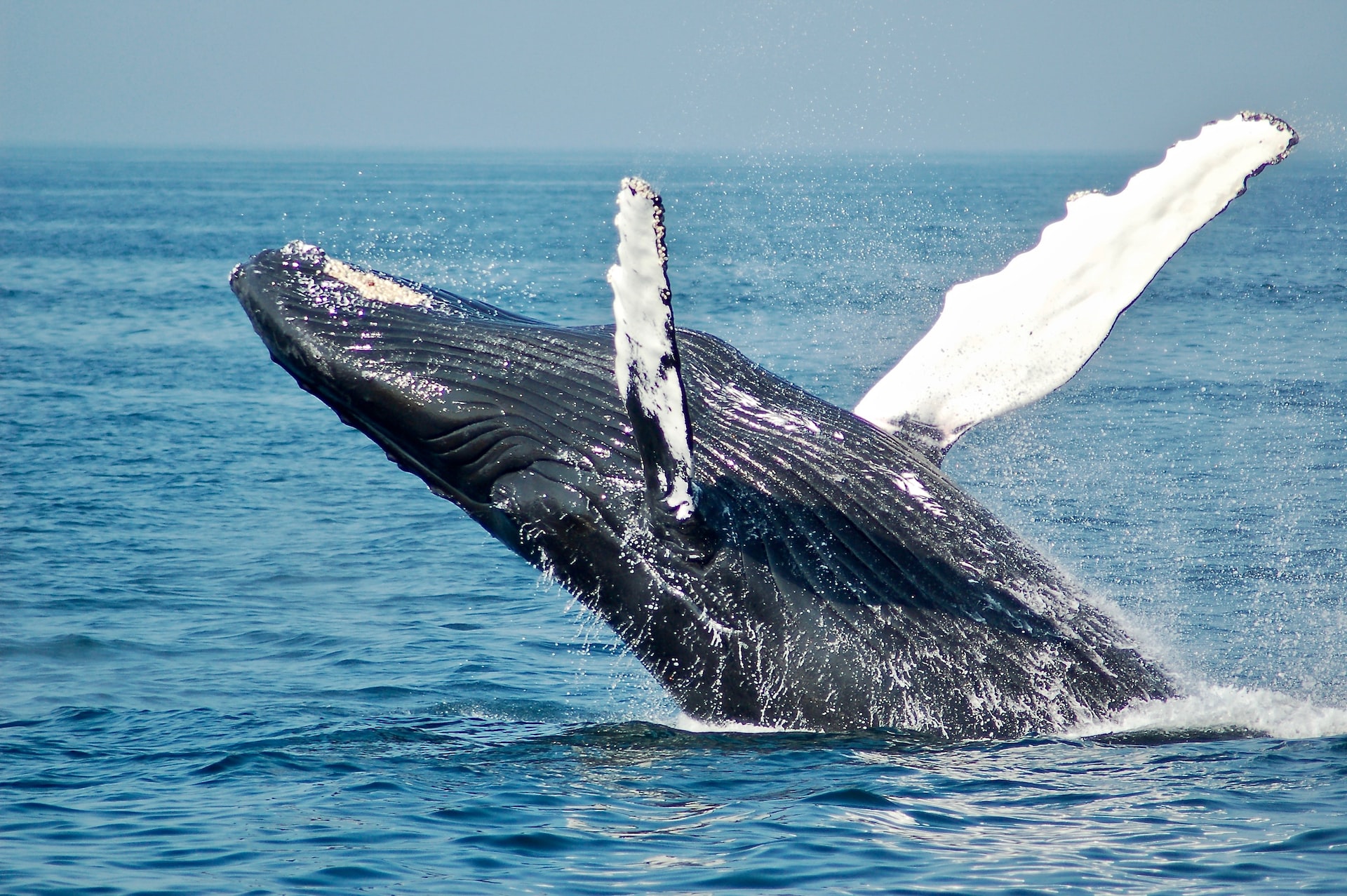
Photo: Todd Cravens via Unsplash.
Some whales “pass their songs across oceans,” says the New York Times. Humpback whales have been studied the most extensively, but other species of whales also sing complex songs.

Although we are surrounded by ocean, I fear that we rarely give much thought to how really extraordinary the ocean is and how many wonders dwell there. Today’s story is about whales that share their song lists around the world.

Carl Zimmer writes at the New York Times, “In a study published [in August], scientists found that humpback songs easily spread from one population to another across the Pacific Ocean. It can take just a couple of years for a song to move several thousand miles.

“Ellen Garland, a marine biologist at the University of St. Andrews in Scotland and an author of the study, said she was shocked to find whales in Australia passing their songs to others in French Polynesia, which in turn gave songs to whales in Ecuador.

“ ‘Half the globe is now vocally connected for whales,’ she said. ‘And that’s insane.’

“It’s even possible that the songs travel around the entire Southern Hemisphere. Preliminary studies by other scientists are revealing whales in the Atlantic Ocean picking up songs from whales in the eastern Pacific.

“Each population of humpback whales spends the winter in the same breeding grounds. The males there sing loud underwater songs that can last up to half an hour. Males in the same breeding ground sing a nearly identical tune. And from one year to the next, the population’s song gradually evolves into a new melody.

“Dr. Garland and other researchers have uncovered a complex, language-like structure in these songs.

The whales combine short sounds, which scientists call units, into phrases. They then combine the phrases into themes. And each song is made of several themes.

“Male humpbacks sometimes change a unit in their song. Sometimes they add a new phrase or chop out a theme. The other males may then copy it. These embellishments cause the population’s song to gradually evolve, resulting in drastically different melodies from one population to the next.

“Michael Noad, a marine biologist at the University of Queensland, discovered that a population’s song can sometimes make a sudden, dramatic change. In 1996, he and his colleagues noticed that a male on the east coast of Australia had given up the local song and was now singing a tune that matched one previously sung on the west coast of the country.

“Within two years, all of the males on the east coast were singing that song. Dr. Noad’s landmark study was the first to discover this kind of cultural revolution in any animal species.

“Dr. Garland … wondered if their songs were spreading farther east across the Pacific. An opportunity to find out arrived when Judith Denkinger and Javier Oña, marine biologists at the University of San Francisco de Quito in Ecuador, offered to collaborate. They study humpback whales that breed on the coast of Ecuador.

“For their new study, Ms. Denkinger and Mr. Oña recorded humpback whales from 2016 to 2018. Over the same period, Michael Poole, a marine biologist at the Marine Mammal Research Program on the French Polynesian island of Moorea, recorded whales there. …

“In 2016 and 2017, the two populations of whales had clearly distinct songs. But in 2018, a revolution happened: The whales in Ecuador were putting French Polynesian themes in their songs. The scientists reported their findings [in] the journal Royal Society Open Science.

“Elena Schall, a postdoctoral researcher at the Alfred Wegener Institute in Bremerhaven, Germany, who was not involved in the study, said that she is seeing some similar patterns in the Atlantic Ocean. Humpback whales off the coast of Brazil and South Africa are picking up themes previously recorded off the coast of Ecuador.

“It is conceivable, Dr. Schall said, that songs flow all the way around the Southern Hemisphere. ‘It’s possible, but there’s a data gap in the Indian Ocean,’ she said. ‘I think that will definitely be the next step, if we can find enough data.’ “

More at the Times, here. Amazing to think that whales in one part of the world can “cover” the songs of whales thousands of miles away.

Read Full Post »

On Twitter, I have been following @LakotaMan1, who notes on this weekend that “America wasn’t discovered — it was invaded.”

As I don’t want to take anything from Italians who are proud of the ancestry of Columbus but I need to acknowledge what indigenous people suffered from European contact, I have decided just to talk about corn. We all know that Europeans knew nothing about corn until they opened their minds to learn a thing or two from the continent’s original inhabitants.

Dina Spector wrote at Business Insider, “Glass Gem corn, a unique variety of rainbow-colored corn, became an internet sensation in 2012 when a photo of the sparkling cob was posted to Facebook.

“Shortly after, the company that sells the rare seeds, Native Seeds/SEARCH, began ramping up production to meet the high demand. The Arizona-based company still sells Glass Gem seeds on its website.

“Meanwhile, a Facebook page devoted to Glass Gem allows growers to share pictures of the vibrant corn variety. But the story behind Glass Gem is just as remarkable. It begins with one man, Carl Barnes, who set out to explore his Native American roots.

“The history was largely retold by Barnes’ protégé, Greg Schoen, in 2012, when the corn gained national attention. …

Barnes, who died in 2016, was half-Cherokee. He began growing older corn varieties in his adult years. …

“In growing these older corn varieties, Barnes was able to isolate ancestral types that had been lost to Native American tribes when they were relocated to what is now Oklahoma in the 1800s. This led to an exchange of ancient corn seed with people he had met and made friends with all over the country.

“At the same time, Barnes began selecting, saving, and replanting seeds from particularly colorful cobs. Over time, this resulted in rainbow-colored corn.

“A fellow farmer, Greg Schoen, met Barnes in 1994 at a native-plant gathering in Oklahoma. Barnes had his rainbow-colored corn on display. Schoen was blown away. That following year, Barnes gave Schoen some of the rainbow seed. Schoen planted the first seeds that summer.

“Schoen and Barnes remained close friends, and over the years, Schoen received more samples of the rainbow seed. In the beginning, Schoen only grew small amounts of the colorful corn in New Mexico, where he moved in 1999. In 2005, Schoen began growing larger plots of the rainbow corn near Sante Fe, alongside more traditional varieties.

“When the rainbow corn mixed with the traditional varieties it created new strains. Each year of successive planting, the corn displayed more vibrant colors and vivid patterns.

“According to an account from Schoen, Barnes told him that the rainbow seed originally came from a crossing of ‘Pawnee miniature popcorns with an Osage red flour corn and also another Osage corn called “Greyhorse.” ‘ …

“In 2009, Schoen passed on several varieties of the rainbow seed to Bill McDorman, who owned an Arizona seed company called Seed Trust.

“At that time, McDorman was the executive director of Native Seeds/SEARCH, a non-profit conservation organization. He brought the Glass Gem seeds with him, and they can now be purchased online.”

Saving ancient seeds is important work. To learn about the Svalbard Island Global Seed Vault in Norway, read my 2015 post, here, and my 2017 update highlighting concern that the protective permafrost is melting there.

For a bit more background on rainbow corn and some lovely photos, click at Business Insider, here. No firewall.

Read Full Post »

Photo: Stanley Forman.
A bear seen in Middleton in August represents the surprising Massachusetts black-bear comeback.

I’m sure you know it’s Fat Bear Week and time to vote on your favorite grizzly based on how successful the bear has been fattening up to hibernate.

Everybody loves bears — almost as much as dinosaurs. The advantage is that bears are still around. In fact, in today’s story we learn about a bear comeback. One caveat: it’s not safe to play with bears, anymore than with dinosaurs.

Billy Baker at the Boston Globe reports that black bears, once nearly extinct in Massachusetts, have staged their comeback without any help from wildlife officers.

“The story of the black bear that is coming to a suburb near you begins one day in the fall of 1969,” Baker reports, “when two bears showed up along a road in the northern Berkshires, in the tiny town of Florida, and appeared to be drunk.

“Back then, black bears were barely hanging on in Massachusetts, at the losing end of a 12,000-year fight with humans and [development], and the tiny population of survivors was believed to live somewhere nearby, along the border with Vermont.

“Still, these two bears were different. They hung around, happy for the crowds that came to watch them. Game wardens said the ‘tipsy bears,’ as they became known, were drunk from too many apples fermenting in their bellies.

Wardens even went so far as to briefly close the hunting season to give the bears time to ‘sober up’ before someone took a shot at them.

“Ultimately, it turned out the bears were comfortable around humans because they were semi-tame, raised by a guy in Shelburne as a roadside attraction for his gift shop on the Mohawk Trail, then released when he couldn’t afford to feed them. But all the fanfare forced the state’s wildlife experts to acknowledge that ‘we didn’t really know anything about bears in Massachusetts, other than there are some,’ according to Jim Cardoza, then a young biologist for MassWildlife.

“Thus began a five-decade effort to understand and conserve black bears in the state, a project that has succeeded beyond most people’s wildest dreams. …

“Starting in 1970, just after the ‘tipsy bears,’ the state shortened the bear hunting season to a single week, from 10 weeks since the early 1950s, and tasked Cardoza with figuring out how many bears lived in Massachusetts and the history that brought them there.

” ‘I was able to learn that at the time of Colonial settlement, bears were widespread in the state, except for very Southeastern Massachusetts and the islands,’ Cardoza said. But as settlement advanced inland to the Connecticut River Valley and the Berkshires, bears saw their forest habitat turned into farms, and their status lowered from king to pest; farmers could, and still can, legally kill any bear destroying their crops, at any time.

“They nearly disappeared in the decades between the end of the Civil War and the onset of hunting regulations in the early 20th century. By the mid-1970s, when Cardoza finished his study, he estimated there were only 80 to 100 bears in the state, all in the Berkshires. With such a small base, conservation goals were modest.

“ ‘The dream would have been to see them get established in western Franklin and Hampshire County,’ he said, but worried even that was a stretch. It wasn’t.

“By the early 90s, bears were thriving in the western part of the state, with an estimated 1,000 throughout the Berkshires and nearby hill towns. At the time, the Connecticut River was seen as a natural barrier to the east for all but the most adventurous young males. Yet over the next three decades, as the bear population in Western Massachusetts became more concentrated, females crossed the river in search of unoccupied territories, spreading throughout Central Mass., crossing endless natural and man-made barriers, including highways here, there, and everywhere.

“By 2011, the last time the state attempted a proper bear census, their numbers had grown to about 5,000. More incredible was how they were doing it, showing time and again an incredible resourcefulness, especially among breeding females, who figured out how to raise young in the woods behind a Target. …

“ ‘The expansion east is just a natural phenomenon of population expansion,’ said John Organ, a conservation scholar and former University of Massachusetts professor who recently joined the board of MassWildlife. ‘Bears are territorial, so those bears that are entering the population are looking for new unoccupied territories, and much of the state has returned to habitat where they can do quite well, even into Eastern Massachusetts.’ …

“If there’s anything biologists have learned in these five decades of studying bears, it’s that there is no overestimating their resourcefulness.

” ‘We had very little to do with [their success]. Bears are just extraordinary animals,’ said John McDonald, a professor at Westfield State University who did his doctoral research on Massachusetts black bears three decades ago. ‘What’s been satisfying is to see our predictions come true.’ …

“They’ve learned to live around people almost entirely without incident. The reverse cannot be said; with no natural predators, humans remain the chief source of bear mortality. Between 25 and 65 are killed by vehicle collisions each year, according to state environmental police records, but the actual number is likely much higher.

“Hunters now have three seasons when they can target black bear, but it remains a fringe pursuit, largely due to the extreme difficulty, after the state outlawed the use of traps, snares, bait, and dogs to hunt them. Most of the 200-250 bears harvested each year are by opportunistic hunters in tree stands waiting for deer.

“Yet as the number of bears increases, MassWildlife has stepped up efforts to get more hunters into the woods pursuing them, both to thin the population and to keep them from losing their fear of humans. …

“The best way to keep the bears at bay is exceedingly simple, specialists said: Get rid of birdfeeders and put electric fencing around chicken coops. They are the two biggest attractants to backyards and hardly anyone had either a few decades ago.”

Oh, dear! Give up my birdfeeder? I am a block from the train and my town is almost urban. Probably I will never see a bear here. If I do, good-bye birdfeeder. More at the Globe, here.

Read Full Post »

Photo: Svetozar Cenisev/ Unsplash.
When vegetation that beavers flood is dying, neighbors object to the smell. But often they like the lake that comes later.

There was a woman in my town who was up in arms about beavers flooding part of her property to build a dam. That is, she was angry until the odor of dying grasses dissipated and a beautiful lake appeared.

According to Catrin Einhorn at the New York Times, farmers out West are finding other reasons to appreciate the work of beavers.

She reports, “Horace Smith blew up a lot of beaver dams in his life. A rancher here in northeastern Nevada, he waged war against the animals, frequently with dynamite. Not from meanness or cruelty; it was a struggle over water. Mr. Smith blamed beavers for flooding some parts of his property, Cottonwood Ranch, and drying out others.

“But his son Agee, who eventually took over the ranch, is making peace. And he says welcoming beavers to work on the land is one of the best things he’s done.

“ ‘They’re very controversial still,’ said Mr. Smith, whose father died in 2014. ‘But it’s getting better. People are starting to wake up.’

“As global warming intensifies droughts, floods and wildfires, Mr. Smith has become one of a growing number of ranchers, scientists and other ‘beaver believers’ who see the creatures not only as helpers, but as furry weapons of climate resilience.

Last year, when Nevada suffered one of the worst droughts on record, beaver pools kept his cattle with enough water.

“When rains came strangely hard and fast, the vast network of dams slowed a torrent of water raging down the mountain, protecting his hay crop. And with the beavers’ help, creeks have widened into wetlands that run through the sagebrush desert, cleaning water, birthing new meadows and creating a buffer against wildfires.

“True, beavers can be complicated partners. They’re wild, swimming rodents the size of basset hounds with an obsession for building dams. When conflicts arise, and they probably will, you can’t talk it out.

“Beavers flood roads, fields, timber forests and other areas that people want dry. They fell trees without a thought as to whether humans would prefer them standing. In response to complaints, the federal government killed almost 25,000 beavers last year.

“But beavers also store lots of water for free, which is increasingly crucial in the parched West. And they don’t just help with drought. Their engineering subdues torrential floods from heavy rains or snowmelt by slowing water. It reduces erosion and recharges groundwater. And the wetlands beavers create may have the extra benefit of stashing carbon out of the atmosphere.

“In addition to all that, the rodents do environmental double duty, because they also tackle another crisis unleashed by humans: rampant biodiversity loss. Their wetlands are increasingly recognized for creating habitat for myriad species, from salmon to sage grouse.

“Beavers, you might say, are having a moment. In Colorado, Idaho, Montana, Nevada, Oregon, Utah and Wyoming, the Bureau of Land Management is working with partners to build beaver-like dams that they hope real beavers will claim and expand. In California, the new state budget designates about $1.5 million a year to restoring the animals for climate resiliency and biodiversity benefits.

“ ‘We need to get beavers back to work,’ Wade Crowfoot, California’s secretary of natural resources, said in a webinar this year. ‘Full employment for beavers.’ (Beaver believers like to note that the animals work for free.) …

“Instead of killing beavers, the federal government should be embracing them as an important component of federal climate adaptation, according to two scientists who study beavers and hydrology, Chris Jordan of National Oceanic and Atmospheric Administration Fisheries, and Emily Fairfax of California State University Channel Islands.

“ ‘It may seem trite to say that beavers are a key part of a national climate action plan, but the reality is that they are a force of 15-40 million highly skilled environmental engineers,’ Dr. Jordan and Dr. Fairfax wrote this year in a perspective article in the research journal WIREs Water. …

“When human-beaver conflicts arise, they can be addressed without killing the animals, experts say. Paint and fencing can protect trees from gnawing. Systems like the Beaver Deceiver secretly undo their handiwork with pipes that drain water from beaver settlements even when the animals keep building. Such measures are actually a more effective solution than removing the animals, according to advocates, because new beavers tend to move into empty habitat.

“If coexistence is impossible, a growing number of groups and private businesses are seeking to relocate, rather than kill, nuisance beavers.

“ ‘We put the nuisance in air quotes,’ said Molly Alves, a wildlife biologist with the Tulalip Tribes, a federally recognized tribal organization just north of Seattle that moves unwanted beavers to land managed by the United States Forest Service.

“The group’s impetus was a desire to expand the extraordinary habitat that beavers offer salmon, a culturally and economically important species. When they started in 2014, the Tulalip Tribes had to invoke their sovereign treaty rights to relocate beavers because doing so was illegal in their area under Washington State law. After a lobbying push, beaver relocation is now legal statewide and the tribes are advising state officials on a program to train others in best practices.”

More at the Times, here. Hat tip: John.

Read Full Post »

Photo: Stef King.
Members of the venerable Gidgegannup’s square dance club near Perth have begun teaching the moves to a new generation.

The topic of square dancing brings both happy memories and uncomfortable ones. The uncomfortable occasions were the result of my mother trying to manage my social life by pressing into service a philosophy professor whose many avocations included square-dance calling. That meant that I, an uncool teenager, had to invite kids I barely knew to an old-fashioned kind of party under her watchful eye.

But in and of themselves, square dances are loads of fun, and I usually got into it despite my reluctance. There’s one I remember as awkward that my little sister remembered as magical.

Today’s story is about square dancing in Australia and how the seniors who love the camaraderie and the exercise are trying to introduce the tradition to a new generation.

Emily Wind writes at the Guardian, “Less than an hour north east of Perth sits Gidgegannup, a small township known for its picturesque hiking trails and agricultural shows – plus a vibrant square dancing community that has endured through the decades.

“Despite the challenges of Covid-19 and declining membership, passionate members of the town’s square dancing club have kept the tradition well and truly alive.

“ ‘We like to see people having a go at square dancing,’ club caller Ken Pike says.

“ ‘It doesn’t matter what age, what race, color, creed or religion … you’re all the same once you’re on the square dance floor and we just want people to have fun.’

“Pike resurrected the Gidgegannup Square Dance Club in 1985 after it closed in the late 70s. He did so after members of the local Country Women’s Association branch showed a keen interest in learning. …

“A square dance involves four couples (eight dancers) dancing together in a square formation. Rather than having to remember a complete routine, dancers only need to learn specific moves that are shouted out by the ‘caller’ in different variations.

“The Gidgegannup club hosts fortnightly dances, each with a different theme. … Rosemary Corbin, the president of the club, said there were about 60 people at the western dance, with many traveling from Perth. …

“Carol and John Parsons first saw an ad for square dancing in the local paper in 1979. They went along and gave it a go with their two daughters and are still going along each fortnight. … For the couple, now both in their 80s, square dancing not only provides them with a fun social activity, but real health benefits by keeping active.

‘Our doctor is thrilled with us; she doesn’t have to worry about us because we get plenty of exercise,’ Parsons said. ‘It is very important for your mental health as well.’

“One of the appeals of square dancing is that it can be done anywhere; once you know the moves, you can attend any club in Australia – or around the world – and dance with strangers as if you’re old friends.

“While there are some dedicated dancers who have attended the Gidgegannup club for decades, numbers have declined in recent years and the group is eager to see more young people get involved so the next generation can learn the moves.”

I actually know someone in Massachusetts who joined community square dancing after her divorce and met a guy there who also thought it might be a fun way to meet people. They have been together for decades now. I don’t know if they are still square dancing.

More at the Guardian, here. No firewall.

Read Full Post »

Photo: Paul Stremple.
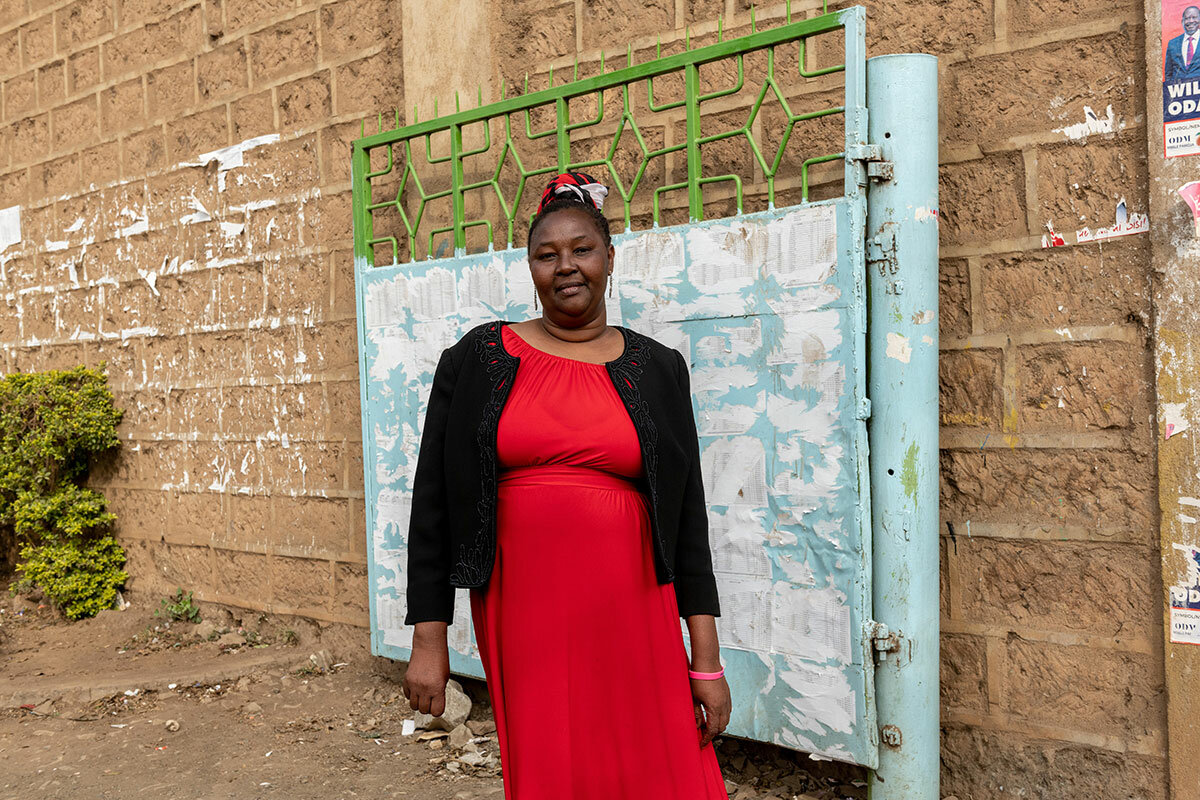
Beatrice Karore, a community leader involved in peace building during Kenya’s elections, stands outside a local vocational college in Mathare that served as a polling station.

Blessed are the peacemakers.

Often they are women. We know that not all women are peacemakers, but many are. They see where differences of opinion can get out of hand and take action.

Today’s article is about peacemakers in Kenya trying to change the pattern of violent election periods. The story was written before the country’s Supreme Court made its decision on the recount. If you can’t stand suspense, skip to the end.

Mukelwa Hlatshwayo writes at the Christian Science Monitor, “The Kenyan presidential elections are over, but peace campaigner Beatrice Karore’s work is not done.

“One recent cloudy morning in Nairobi, the founder of Wanawake Mashinani – Swahili for Grassroots Women – walks to her office in Mathare, one of the most densely populated slum areas in the Kenyan capital. 

“Sliding a heavy-duty padlock off a thick metal door, Ms. Karore and her team file into the tiny room that serves as their headquarters, and sit on blue plastic chairs. Over loud music blaring from a nearby shop, Ms. Karore begins with a prayer for a good ‘walk for the peace’ ahead.

“Ms. Karore is one of dozens of grassroots peace activists across the country who sprang into action in the months leading up to Kenya’s Aug. 9 presidential elections. Now, as the country waits for a final verdict on disputed results, that work has become increasingly important.

“The Supreme Court is due to hand down a judgment on Sept. 5, after opposition candidate Raila Odinga challenged official results that showed him losing to William Ruto by a margin of 200,000 votes. A former prime minister, Mr. Odinga has blamed five previous presidential election losses on rigging – claims that have sparked deadly riots in the past. 

“For now, an uneasy calm is holding. But some campaigners fear the Supreme Court verdict could yet unleash the violence that followed disputed polls in 2007, when more than 1,200 people were killed, and again in 2017, when more than 100 people died. 

“As her team walk out of their modest office into narrow passageways crammed with shacks, Ms. Karore says she knows the current lull is far from guaranteed. ‘We [are still] doing peace campaigns to empower the community,’ she says.

‘We realized that when there is no peace, everyone loses.’ …

“Some analysts believe that the relatively peaceful election campaign, in which the main candidates ran on social and economic issues, rather than demanding voters’ ethnic loyalty, points to a maturing democracy. 

“Widely touted reforms to the electoral process, including the effective registration of voters in the diaspora, may have given more Kenyans a sense of greater transparency. And battered by two years of COVID-19 lockdowns and rising costs of living, most Kenyans would prefer to accept the Supreme Court verdict than go to an election rerun, analysts say. …

“The manner in which Kenyans navigate the decision by the court will set a precedent for future disputes across Africa. … Even if the fragile peace holds, electoral watchers caution it will take more than one election cycle to show Kenya has left violence in the past. …

“For the past two presidential elections, Ms. Karore’s team has organized the kind of ‘holistic’ monitoring that Kenya’s human rights commission says will transform how communities like Mathare – which typically bear the brunt of any unrest – participate in the post-electoral process. Wanawake Mashinani has held several community meetings at which faith-based leaders have encouraged people to remain calm. It’s given safety tips to residents on election day. 

“And in a neighborhood that’s neglected by officials, where violence, drug abuse, and crime are prevalent, perhaps the group’s most important work is also the simplest: It checks in on residents and listens without judgment. 

“On this August morning ‘peace walk,’ Ms. Karore stops first to talk to a group of women selling hair-care products outside a corrugated iron-roof shack. Speaking in Swahili, she asks them how they are and how things have been since the elections. The discussion is light and jovial; the women laugh at a joke about a fake flour scandal doing the rounds in Mathare. 

“One vendor, a young woman called Kim, says that things have been quiet and business has been slower. She tells the group they are glad major protests didn’t break out after the results were announced, because that would have meant they would have lost everything. 

“ ‘Anything small can trigger violence on the streets,’ Ms. Karore says. ‘Many people leave their homes and go to rural areas at this time, or where people of their same tribe live.’

“Research has shown that when marginalized communities feel that their favorite candidate loses an election due to irregularities, they are more likely to resort to violence. Human rights organizations say the unrest often breaks out along ethnic and identity lines. …

“As Ms. Karore and her team walk deeper into the township, checking in on neighbors and store owners, they are greeted by passersby who recognize them from previous door-to-door visits.

“Buoyed by the work of peace campaigners across Kenya as a whole, the political atmosphere has been significantly calmer than in two previous elections. A range of activists, from artists to religious leaders, have been galvanized into action in recent months. A campaign by artists in Kibera, Kenya’s largest township, displays works that celebrate the country’s ethnic diversity. Another group of activists organized a ‘peace caravan’ across the country, carrying messages urging voters to remain calm during the heated polls.

“Still, violence and intimidation persist. … In Mathare, Reagan Victor Ondigo says he barely escaped with his life when a mob of men tried to burn down his home as he and his family slept. … He blames politicians for whipping up ethnic grievances, but he’s cautiously hopeful that those perceptions are slowly changing.

“ ‘I hope that my daughter will know that freedom is there,’ he says.”

Looks like Kenya’s Supreme Court decision was accepted by both sides. More at the Monitor, here.

Read Full Post »

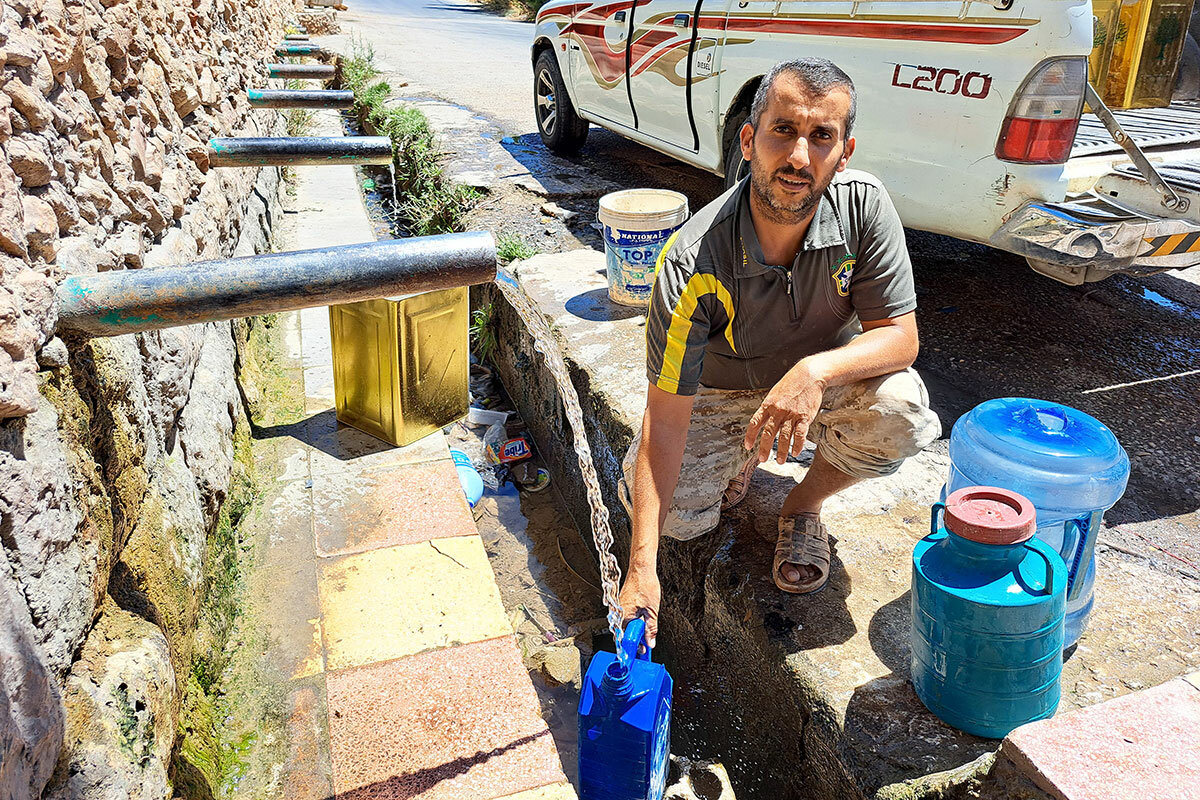
A sheep farmer in northern Jordan fills up water containers for his flock at a spring that for generations has been used to water livestock — Souf, Jordan, Aug. 24, 2022.

Either there is too much water or too little. In New England, where I live, there’s a drought, but when we get a heavy rain, the roads flood, the storm drains overflow, and instead of water going into the places where we need it, it washes into the sea.

Today’s story shares advice on water from those who have had little over the centuries and have learned to conserve.

Taylor Luck reports at the Christian Science Monitor, “In towns and cities across Jordan, ‘water day’ announces itself with a cacophony of high-pitched screeches filling the air. Motors groan and strain to pump a trickle of water from ground-level pipes up five stories to aluminum and plastic rooftop storage tanks – tanks that will hold a family’s water for an entire week or more.

“Families race to and fro across their apartments to run the pumps, do laundry, wash dishes, and water the garden before their 12-hour period is up. If they miss it, they have to wait until the next week – or perhaps weeks – for the next trickle.

‘Water day is more important than an anniversary or birthday in our household,’ says Um Uday, a working mother of five in West Amman.

“In Jordan, the second-most water-poor country in the world, people have long learned to live without the constant running water that most American families take for granted. Yet the dwindling resources due to climate change and population growth mean the most effective innovation in parched Jordan is not novel water distribution schemes, technology, or dam construction – but how people change their daily lives to get the most out of each drop. …

“In largely arid Jordan, water resources are less than 90 cubic meters (almost 24,000 gallons) per person annually, a fraction of the 500 cubic meters (about 132,000 gallons) per capita the United Nations defines as ‘absolute water scarcity.’

“Instead of supplying constantly running water, authorities release water through networks to a given village or neighborhood for one day on a weekly or twice-monthly basis as part of a rotation. The water distribution schedule is designed to distribute water equally in different parts of the country, without waste, while maximizing the rapidly diminishing reserves. …

“Suleiman, a retired air force officer who gave only his first name, stops his pickup at a roadside natural spring in the village of Souf, 35 miles north of Amman, to fill containers for his thirsty flock of sheep. As they have for generations, area residents come to this spring to stock up on water for livestock or washing; a second, purer, cold-water spring 2 miles up the hill is used for drinking water. With official water distributed to the village for a few hours once a month in the summer, these springs have become a main source. …

“Suleiman says, wiping his brow from the noon sun., ‘We have to make the most of each water source we have.’

“Yet this year has been particularly hard; Jordan’s Ministry of Water and Irrigation described 2022 as ‘the most difficult year’ yet. A shift in weather patterns means Jordan is witnessing a slight decline in rainfall. The rainfall it now receives occurs in intense, shorter time periods in concentrated areas, leaving its network of dams struggling to catch the torrential runoff.

“The dams are dry or nearing dry; green patches of earth mark where once mighty reservoirs stood. Plans to desalinate seawater at Aqaba, the nation’s only port, are two decades off at best and are costly. … With the capital getting priority for dam and aquifer water, towns and villages north and south of Amman bear the brunt of shortages – often going months without fresh supplies as summer demand spikes.  

“Um Mohamed, a widowed mother of four in Bayt Idis, a hilly, tree-dotted village in northern Jordan, heads one of thousands of households going without state-supplied water for the summer.

“On this day she purchased from a licensed private well 3 cubic meters (792.5 gallons) for $21 – enough for her family’s weekly consumption, but taking 15% of her monthly income. She will try to make it last one month. Like many, she is sticking to tried-and-true methods to stretch out each drop.

“She does the dishes in a single bucket of water placed in the sink, careful not to splash out of the bucket. Once she soaps and rinses the pots, dishes, and silverware, she pours the food-clouded water onto a few of her plants, watering in a rotation.

“Showers are timed and scheduled. Laundry is hand-washed in a large plastic basin utilizing the same water. Her backyard is dotted with jugs and buckets filled with water from her purchase; they will be used to water the plants and wash the floors over the next two weeks.

“ ‘We have entire summers where we don’t get water from authorities, so we have to rely on ourselves,’ she says. ‘If we don’t manage what we consume, then we consume ourselves.’ ”

More at the Monitor, here. No firewall. Want to read a novel about building a well in a dry land? Try Red-Haired Woman by Turkish Nobel laureate Orhan Pamuk. It’s kind of dark, though.

Read Full Post »

Photo: Oxfam.
Folktales help preserve the threatened Rohingya culture.

To understand anything about a foreign culture, you need to turn to its arts: the music, the crafts, the folktales, for example.

Stephen Snyder at PRI’s the World reports about a threatened culture holding on by a thread far from home: “Mohammed Rezuwan is on a rescue mission: The 24-year-old who lives in Cox’s Bazar — the world’s largest refugee camp — is working to save Rohingya traditional stories before a generation of storytellers dies off.

“Rohingya people have lived in the region for over a thousand years, but Myanmar’s government considers them foreigners from neighboring Bangladesh. Over the last four years, hundreds of thousands of Rohingya have been driven out of Myanmar [Burma] by government troops and local militias. Many now live in dozens of refugee camps.

“ ‘We, Rohingya people, have our own culture, tradition. We are on the brink of losing all of them, unfortunately,’ Rezuwan said in a WhatsApp voice message from Kutupalong, one of more than two dozen encampments in Cox’s Bazar, on the coast of Bangladesh.

“The crowded area accommodates families who live in tents and shelters along narrow alleyways. United Nations figures put the exile population in the camp at nearly a million — four times the number of Rohingya still living in Myanmar.

“Rezuwan lives in a bamboo shelter with his wife, his mother, a brother and a sister. The family fled their home in Maung Daw, in the Rakhine district of Myanmar, on Aug. 25, 2017, as their village was set ablaze in a campaign that has forced most Rohingya out of Rakhine.

“ ‘I remember the gunshots ringing out like thunderclaps, the bullets strafing the sky like clouds of hungry locusts,’ Rezuwan wrote in the author’s note of his book, Rohingya Folktales: Stories from Arakan, as told by Rohingya refugees. …

“In 2020, after several years at Cox’s Bazar, he took on the role of folklorist — recording stories passed along in the oral tradition by Rohingya elders. …

“Rezuwan speaks his native Rohingya and learned to speak and write Burmese in school, but his English is largely self-taught. He spent a year collecting material for his English-language book, and the online version now includes 19 stories from storytellers in several of Cox’s Bazar’s camps.

“Research was no easy task. Rezuwan doesn’t have a car or bike, so he walked, sometimes up to five miles, to meet with each storyteller and record his or her story on the phone. …

“ ‘The hardest part is finding and meeting the people from different sorts of camps,’ Rezuwan said. ‘After all, not everyone has the same talents to remember the stories — just because they are uneducated — and so, finding the right person to tell the story was finding a gem from the ocean.’

“The Rohingya language is primarily spoken, without a standardized written script. Rezuwan translated the stories by playing back his recordings and, word by word, constructing English versions of the tales. He then pasted them into WhatsApp and sent them to his editor and friend, Alex Ebsary, in Buffalo, New York, who corrected grammar and word usage. Ebsary said he intentionally edited the stories with a light touch.

“ ‘Folktales are not a universal language,’ he said in a phone interview.

‘If you read these folktales, some of them are quirky. They’re kind of not even the morals that I would think of when thinking of a folktale.’ …

“Rezuwan said his mother used to tell him the story known as ‘A Hunter and a Flock of Heron.’ The version he collected from Rashid Ahmod, a 60-year-old resident of Kutapalong, was essentially the same story he heard as a boy, he said.

“The story is about a hunter who catches a group of beautiful herons in his net. The herons all try to escape by flying around in all directions, Ebsary explained. Rezuwan said the moral of the story is that birds — and people — can’t manage to go anywhere until they cooperate.

“Rezuwan and Ebsary both singled out a story from the collection called ‘A Queen’s Dream,’ which could serve as an allegory for Rohingya as an ethnic minority.

“The story is about a powerful queen who has a vivid dream about torrential rains after a period of drought. Everyone who drinks from the rain loses their minds. So the queen sends advisers to warn everyone.

“ ‘But of course, they don’t listen and everyone drinks the rain and goes mad. And in the end, the queen decides to join them by drinking the rain herself,’ Rezuwan said.

“The moral of the story is that if a country’s majority are wrongdoers, they have the power to ‘force [the] entire country into a very bad situation,’ Rezuwan said. ‘It’s what we are facing right now.’

“Rohingya have long faced discrimination and marginalization in their home country. The United Nations has called it ‘a textbook example of ethnic cleansing.’ If life in Myanmar was untenable, Rezuwan said, ‘in [the] camps, it seems like we are facing the second genocide.’

​​”Since coming to Kutupalong, Rezuwan has organized an educational network where Rohingya children — unable to attend schools — can follow the same curriculum taught in Myanmar. …

“ ‘I wanted the international community to know about our culture, about tradition and about the existence of Rohingya people in Arakan,’ he said.

“Arakan, the name Rohingya people give to their homeland in Myanmar, no longer appears on any maps of the region.”

More at PRI’s the World, here. There is no firewall. You can also listen to the recording of the show there.

Read Full Post »

« Newer Posts - Older Posts »