Feeds:
Posts
Comments

Two Teens on Broadway

merlin_159679986_d3615b91-38f7-4db2-9e77-3294fc012e46-jumbo

Photo: Nina Westervelt for the New York Times
Thursday Williams and Rosdely Ciprian on the last day of Broadway performances for
What the Constitution Means to Me.

Imagine getting an opportunity as a teenager to be in a Broadway show — and not because you’re you’re especially good at theater! In this instance, two girls were chosen because of their experience on debate teams.

Elizabeth A. Harris writes at the New York Times, “Sitting in the balcony of the Helen Hayes Theater on Saturday evening, two teenagers munched on Welch’s Fruit Snacks and said goodbye to their Broadway show, ‘What the Constitution Means to Me.’

“Rosdely Ciprian, 14, and Thursday Williams, 18, make up half the cast of ‘Constitution,’ a play by Heidi Schreck that was extended three times Off Broadway and played five months at the Hayes, a longer and more life-changing commitment than they had ever expected.

“In the play, Ms. Schreck revisited her personal history of giving presentations about the Constitution as a high school student. Ms. Ciprian or Ms. Williams appeared toward the end of the show — they alternated performances — for a formal debate with the playwright over whether the founding document, with its history of enshrined inequities, should be abolished.

“The young women, who were cast because of their involvement in debate at their respective New York City schools, embodied the future generations who would face down the country’s unmet promises. …

“They sat down to talk about their experience, and what comes next. Ms. Ciprian will continue with the show for its 11-day run at the Kennedy Center in Washington, D.C., while Ms. Williams goes off to college. The conversation has been edited and condensed.

“HARRIS How are you feeling?

“WILLIAMS I’m sad, I’m happy. I’m sad that this is the end — you know, I’ve been on the show for one year and I have so much fun onstage. So I’m going to miss that part. But I’m happy I get to start a new chapter of my life. … I’m going to Trinity College in Hartford, Conn.

“CIPRIAN Lucky you! Going to college! I’ve always wanted to act. But this gave me more of an intense feeling of what it’s like to act. So I would love to do that, but I would also like to go into the medical field. I don’t know if I can do both. But I’ve been bit by the theater bug. All the lights! All the people watching me! I love that.

“WILLIAMS Before I started this show, I wanted to be a lawyer, and now I want to run for office. I’ve had the opportunity to meet senators and politicians. It was a real eye opener. …

“HARRIS How did you balance Broadway with being a student?

“CIPRIAN Broadway and high school — that was weird. I would have to leave at 12 o’clock for some matinees and have to email my teachers to do my work and take tests online, and submit them. …

“WILLIAMS When I got this part, kids in my school were like, ‘What do you know about Broadway?’ And I’m like, ‘Absolutely nothing — but I’m on it!’ …

“HARRIS Who has come backstage to say hello?

“CIPRIAN Sonia Sotomayor, Ruth Bader Ginsburg, Barbra Streisand.

“WILLIAMS I [had done] the Sonia and Celina Sotomayor judicial internship program. I met Sonia Sotomayor for five seconds at the elevator, and when they snatched her away from me, I said, ‘I’ll see you soon!’ not knowing when I was going to see her or how I was going to see her. But this show gave me the opportunity.

“HARRIS What happened when you saw her at the theater?

“WILLIAMS She looked me in my eyes and she goes, ‘I’m really happy that you chose college.’ … Sonia Sotomayor came from the Bronx, R.B.G. came from Brooklyn, I’m coming from Queens. Seeing these people say ‘I love you and I’m so proud of you’ really makes me think I can get to their level.

CIPRIAN We’re kind of obsessed with three things: R.B.G., unicorns and doughnuts. Those three things are our vibe.

“We have a life-size poster of R.B.G. in our green room. When she came, everybody was freaking out. And I think the audience members knew she was here, because the show brings up R.B.G. multiple times. …

“WILLIAMS She said, ‘Sonia and I have been talking about you.’ It’s so like — I just really want to go college and I want to get my 3.9 G.P.A. and I want to go to Columbia Law School and I want to be a lawyer — right now! I want to start tomorrow.”

One of my brothers took our sister and her husband to this show in August, a month before she died. I thought that was great because she had talked about it a lot, convincing me to read the interesting New Yorker review. Apparently, it was a play that really got audiences thinking about some of the things that are problematic in that much-revered document.

More at the New York Times, here.
20190824_bkp511

Photo: The Economist
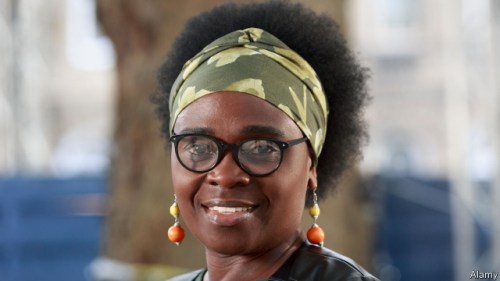
Ugandan writer Jennifer Nansubuga Makumbi is part of an African literary Renaissance.

Other than a day trip from Spain to Morocco decades ago, I have never set foot in Africa. But I have experienced it, in a way, by reading African writers such as Wole Soyinka and Chinua Acebe. Today, a new generation of young writers is offering the world fresh insight.

The Economist writes, “In 2003 Harriet Anena was a schoolgirl in northern Uganda, a region then at war. The army had ordered people into squalid, crowded camps; insurgents stalked the bush.

“ ‘We scratch our destiny / from hands of a curtailing fate,’ she scribbled, sitting beneath a mango tree. In poetry she found a way to ask questions that children, especially girls, were not supposed to ask. ‘I started writing for therapy,’ she says.

“This month Ms Anena recited those lines on the stage of the National Theatre in Kampala, melding drums, dance and poetry in an arresting evocation of love and war. Her performance was the highlight of this year’s Writivism festival, an annual celebration of creative writing, and a testament to the vitality of the country’s small but flourishing literary scene.

“Uganda was once at the fulcrum of African literature. It was at Makerere University, on a hill above Kampala, that giants such as Chinua Achebe and Ngũgĩ wa Thiong’o gathered in 1962 for the first African Writers’ Conference, a landmark event held on the eve of independence for many countries. …

“Yet in a place where history and politics weigh heavy, writers are finding fresh voice. A number of trailblazing authors have passed through FEMRITE, a non-profit founded in 1996 to publish and promote women’s writing in Uganda. Writivism, now in its seventh year, publishes an annual anthology and runs a short-story prize.

“And Ugandan literature can boast of an international superstar in Jennifer Nansubuga Makumbi (pictured), whose debut novel Kintu is a multi-generational saga that ties oral myth to a recognisable present. …

“Encountering the names of familiar places in a novel ‘just blew by mind,’ says Nyana Kakoma, who runs a small publishing house in Kampala. ‘I said wait a minute, this is me, this is my life, this is Uganda as I know it.’

“Much of this new literature is strikingly political. The Betrothal, a play by Joshua Mmali, is a retelling of a multimillion-dollar corruption scandal that he covered as a journalist for the BBC; its performances at the National Theatre in Uganda last year were greeted with whoops of recognition from audiences. Bold writers can draw on the daily chronicles of hypocrisy and clampdowns recorded by a lively press. …

“War, corruption and sexism are not easy topics, and creative expression has its limits. Uganda has an authoritarian government, presided over by an ageing and increasingly testy strongman. This month Stella Nyanzi, an activist and academic, was sentenced to 18 months in prison after posting a poem on Facebook [about] the president’s mother.

“For all that, it would be a mistake to assume that Ugandan writing is glum, pious or austere. Young writers are finding humour in struggle, and joy in the everyday. There is the promise of freedom in their work. ‘Do not miss the chance to groove, my child,’ writes Peter Kagayi, a poet, ‘at the pattering of life’s raindrops.’ ”

More here.


110619-Brainpickings-likes-kids-books

Maria Popova at Brain Pickings is a Renaissance woman. She not only reviews books on science, philosophy, and poetry at major publications, but she maintains a deeply thoughtful blog that includes the best suggestions anywhere for children’s books. I have bought many at my local indy bookstore after reading her reviews, and she has never let me — or the grandchildren — down.

Last spring I was talking to a woman who was also a Maria Popova fan and who had bought some of the Brain Pickings suggestions for her own grandchildren, but not all the same ones I had.

So I took mine out of circulation for a while to have a tidy collection in case she should drop in. I had previously learned that to keep track of these unusual books and also to share them with two families of grandchildren, it was best to bring them back and forth to my kids’ houses when I visit. I will be putting them all back in circulation soon.

Above, you can see the ones I pulled together, any of which I would love to tell you more about if you ask. (Hmm, was Take Away the A really one of hers? The more I think about it, the less I think it is her style.)

The White Cat and the Monk, a serene retelling of an ancient story, is still at Suzanne’s house. The Little Gardener and The Sound of Silence are at John’s.

In Popova’s review of The Sound of Silence, you can see why no grandparent could possibly resist this thoughtful kind of analysis. In addition, Popova apparently gets permission to show all the tantalizing illustrations.

Look at the title of this post: “The Sound of Silence: An Illustrated Serenade to the Art of Listening to Your Inner Voice Amid the Noise of Modern Life; A tender reminder that silence is not the absence of sound but the presence of an inward-listening awareness.” Already I’m hooked.

Popova begins: “ ‘There are many fine things which we cannot say if we have to shout,’ Henry David Thoreau observed in contemplating how silence ennobles speech. A year earlier, he had written in his journal: ‘I wish to hear the silence of the night, for the silence is something positive and to be heard.’

“It’s a sentiment of almost unbearable bittersweetness today, a century and a half later, as we find ourselves immersed in a culture that increasingly mistakes loudness for authority, vociferousness for voice, screaming for substance. We seem to have forgotten what Susan Sontag reminded us half a century ago — that ‘silence remains, inescapably, a form of speech,’ that it has its own aesthetic, and that learning to wield it is among the great arts of living.”

Not your typical children’s book review, am I right?

She continues, “That ennobling, endangered kind of silence is what writer Katrina Goldsaito and illustrator Julia Kuo celebrate in The Sound of Silence (public library) — the story of a little boy named Yoshio, who awakens to the elusive beauty of silence amid Tokyo’s bustle and teaches himself its secret language.

“Conceptually, the book is a trans-temporal counterpart to In Praise of Shadows — that magnificent 1933 serenade to ancient Japanese aesthetics, lamenting how excessive illumination obscures so many of life’s most beautiful dimensions, just as today’s excessive noise silences life’s subtlest and most beautiful signals.” More.

In the illustration below, the boy asks the koto player what is her favorite sound, and she puzzles him by answering, with a cryptic smile, “The sound of silence.” Check out the other illustrations here.

110519-Book-White-Cat-and-Monk

9781909263437-us

soundofsilence2

pufferfish-deadly-family-supper-526942

Photo: Getty Images
This is a puffer, a very poisonous fish, as you may know. What you may not know is that “Puffer” is the surname of some actual humans. And that’s not the only unusual name out there.

In high school, I was impressed that a poetry-leaning classmate kept lists of vibrant and suggestive words just in case she might need one for a composition.

Not long after, I started collecting interesting names I heard on the radio or saw in the newspaper. I thought they could come in handy for writing fiction or plays. I’ve lost more lists than I’ve saved, alas.

Now it’s late in the day, and I offer my most recent list to you. Perhaps you can use a couple of these, real names of real people. Of course, realness could be a problem, I suppose, since no one will believe the names are not invented like so many in Dickens.

Here goes.

Wigglesworth
Charlemagne Palestine
Welfling
Shipchandler
Tobacman
Wagg
Bogus
Puffer
Weatherwax
Issie Swickle
Cowherd
Goodgame
Shortsleeve
Capeless
Lane Partridge
Toogood
Amelia Gentleman
Dr. Doctor
Noteworthy
Getsick
Death

Let me know if you use one and what the personalty of your character is. I don’t suppose I’ll ever stop collecting these as I find people’s names just too wonderful. So get in touch with me down the road. Or send me your own finds. T.S. Eliot says that the “naming of cats is a difficult matter,” but the naming of characters shouldn’t be difficult with so many awesome names out there.

(PS. Speaking of Eliot, check out this early reading of Old Possum’s Book of Practical Cats, with Robert Donat. I’ve had the amazing recording since childhood.)

nahkofinal2

Photo: Michael Pierce
Nahko & Medicine for the People performs at the Four Corners Folk Festival in 2018. Recently, a local radio station agreed to take ownership of the festival.

There’s an Allen Ginsberg poem I love to the effect that sometimes things mysteriously appear just when they are needed. I thought of that poem when I read about a small radio station in Colorado’s Four Corners area taking on live shows it never imagined it could afford.

Braeden Waddell wrote about this at Current last summer.

“Public radio station KSUT in Ignacio, Colo., will assume ownership of two annual music festivals Sept. 30 as part of an agreement with local nonprofit organization FolkWest.

“No money will change hands as part of the arrangement. KSUT Executive Director Tami Graham said that the transfer of the Four Corners Folk Festival and the Pagosa Folk N’ Bluegrass Festival, both three-day events held in Pagosa Springs, Colo., was ‘an incredible donation’ to the station.

“The organizations had developed a relationship through a partnership of more than two decades, with KSUT sponsoring FolkWest in exchange for live studio sessions featuring artists playing for the festivals.

“ ‘My biggest goal with the acquisition of the festivals is just to maintain a really high level of production quality and a great experience for the musicians as well as the attendees,’ Graham said. …

“The decision was made after FolkWest Executive Director Crista Munro took on a new position heading the Sisters Folk Festival in Sisters, Ore. …

“ ‘It was a bittersweet moment for me, knowing that my chapter at the helm of FolkWest would be ending,’ Munro said in a post on KSUT’s website. ‘KSUT always seemed like a natural choice to take over our events. They do an amazing job with everything they produce, and Tami Graham brings a ton of live music production experience to the table.’ …

“Munro told Current that KSUT ‘believed in the vision’ she and her husband had for the festivals. ‘If it were anyone else taking this on, I would be a lot more nervous,’ she said. …

“In an interview with the Colorado Bluegrass Music Society, Munro said that the Folk N’ Bluegrass festival brings in about 2,000 attendees per day and the Four Corners Folk Festival draws nearly double that. …

“KSUT does not plan to make any ‘significant changes’ to the festivals but does aim to expand FolkWest’s Pagosa Folk N’ Bluegrass Jam Camps, which provide three days of music classes for adults and children.

“ ‘There’s a lot of grant funding available for music education … to support bringing in world-class stringed instrument musicians, for example, that want to want to teach and work with adults and youth,’ said Graham. … ‘This is just a perfect fit.’ ”

More here.

There’s a biography about self-taught artist Horace Pippin that my grandchildren and I really love. I’m posting the image from Amazon, but you don’t have to to buy it there. You could support your local independent bookstore, which is what I did.

Recently, friend and artist Meredith Fife Day posted an interesting Hyperallergic link about the Pippin exhibit at the Philadelphia Museum of Art.

John Yau wrote, “Horace Pippin (1888–1946) was born in West Chester, Pennsylvania, less than 25 years after the Civil War ended. He grew up in the village of Goshen, New York, 50 miles northwest of Manhattan, and attended segregated schools. For this reason, the seemingly neutral description of Pippin as a self-taught artist should be seen through the lens of America’s policy of segregation and government-maintained racial discrimination. The chances of Pippin attending a White-run art school were practically nonexistent during his lifetime. He was self-taught out of necessity, as the society in which he lived had shut most of its doors on him.

“Before Pippin enlisted in the segregated Black and Puerto Rican 369th Infantry Regiment, nicknamed by the Germans the ‘Harlem Hellfighters,’ he worked in a coal yard, as a hotel porter, and as a used-clothing peddler. The 369th Infantry Regiment became a distinct unit within the French army because White American army units would not fight alongside them; while in the unit, Pippin was seriously wounded in combat and received France’s Croix de Guerre. Shot in his right arm by a German sniper, he left the army and returned to West Chester, where he took up art as a therapy.

“Due to his injury, Pippin had to move his right arm with his left arm, while holding the brush in his right hand. Through this method, he learned to paint. In 1931, after working in various mediums, including pyrography, he completed his first oil painting. Between 1931 and his death in 1946, he completed around 140 paintings. Many dealt with his experience as a soldier in World War I and the racism and segregation he encountered after returning to America, which — despite the contributions of Black soldiers — did not change.

“Within a short period of time, Pippin’s oil paintings gained attention. Among his fans were the painter and illustrator N. C. Wyeth and the art critic and collector Christian Brinton. In 1939, the Robert Carlen Galleries of Philadelphia began to represent him.

“These are just some of the reasons why you should see the ongoing exhibition Horace Pippin: From War to Peace at the Philadelphia Museum of Art. …

“Pippin was a remarkably inventive artist. ‘The Ending of the War, Starting Home’ (1930-33), is a frontal view of German soldiers behind barriers and barbed wire. One soldier’s arms are raised, as if he is about to surrender. A burning biplane — technically too big in scale but right for this scene — is diving headfirst toward the ground, while a row of aerial explosions hovers just above the horizon. Pippin, who fought in brutal trench warfare, painted the scene from memory.

“What makes this painting into more than a view of war is the artist’s wide handmade frame. The frame is blistered, as if he went over it with a flame that caused the paint to crack and separate. The hand-carved objects protruding, relief-like, from it include various kinds of ordinance (shells and hand grenades, which were nicknamed ‘potato mashers’ and ‘pineapples’ because of their shapes), a tank, rifles, and helmets. There are neither heroes nor leaders in this painting, and the scene is not meant to inspire patriotism. Rather than offering a message, it tries to transport the viewer to the front lines of trench warfare.

“In ‘Mr. Prejudice’ (1943), Pippin groups 13 figures around a giant V, which dominates the upper part of the painting. … A hooded Klansmen stands behind the right side of the V, while just below him is a man in a red shirt, holding a noose. Below the V are various members of the armed figures, segregated into Black and White groups. Pippin has included himself as a soldier with the other Black soldiers, his right arm dangling at his side. …

“At no point in these two works does Pippin present himself as a victim of segregation, and yet he was affected by its strictures throughout his life, even after he gained acceptance as an artist. I thought about this when looking at ‘The Getaway’ (1939), which depicts a fox running through the snow, carrying a black-feathered fowl in its mouth. In the distance are farm buildings, sheds, and a gray, frozen stream or path.

“I kept thinking that Pippin must identify with the fox. As a successful artist, he might have felt he had gotten away with something, because he was a Black man living a White world. What he got away with was survival — being able to live and experience the joy of painting what he knew to be true.

“This is why his last completed painting, ‘The Park Bench’ (1946), is so touching. A Black man is sitting alone on a park bench in front of trees and grass. An white animal, maybe a dog or rabbit, is on the right side, on the grass between the trees. The man does not notice; he is gazing at the ground, but seemingly looking inward. Behind him is part of an empty red bench. A feeling of peace emanates from him. Pippin’s life, all he had to endure and the obstacles he overcame, makes the painting into a testimony to his perseverance and his belief in his audience and, ultimately, in art.”

More at Hyperallergic, here.

image-04-horace-pippin-the-getaway-2016-3-3-pma2016-720x486

190820102009-01-service-dogs-theater-trnd-0820-exlarge-169

Photo: CNN
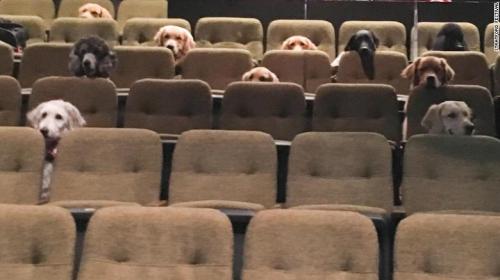
A group of service dogs attend a performance of
Billy Elliot: The Musical as part of their training.

Service dogs must learn to go everywhere with their person and be unobtrusive in settings like concert halls and theaters. That’s why trainers are getting creative about giving dogs practice. One place they get performance-attendance training is at the Stratford, Ontario, Festival, where Sandra and Pat’s great niece has been performing the last two summer to great acclaim.

Scottie Andrew explains about the dog training at CNN. “When the cast of a Canadian production of ‘Billy Elliot: The Musical’ took their final bow after a recent show, the audience didn’t make a single sound — not even a woof.

“A polite crowd of about a dozen future service dogs attended an August performance at Ontario’s Stratford Festival as part of their training. While a silent curtain call might disappoint actors, the dogs’ spellbound stillness is a great sign for their future handlers.

“The event was part of a two-year training program by K-9 Country Inn Working Service Dogs, head trainer Laura MacKenzie told CNN. The future service dogs have toured zoos, subways and crowded fairs to acclimate them to the unfamiliar lights and sounds, rapid movements and bustling crowds they might encounter with their handler, she said.

“At the theater, the dogs are expected to sit under the seat or curl up at their handlers’ feet while their humans enjoy the show, she said.

“They stayed calm and quiet throughout the performance, but a few curious pups peeked their furry heads over the seats to catch a few minutes of the show, she said.

“Ann Swerdfager of the Stratford Festival told CNN that many of the theater’s patrons bring their service dogs to performances, so the company was ‘thrilled’ to host the dogs for training. The non-profit theater company hosts ‘relaxed performances’ designed for audiences sensitive to light, sound and noise — a perfect training ground for service-dog hopefuls.” More here.

Such a well-behaved audience! Nine-yeat-old Sadie Markowitz, recognized as the new Emily Post, would approve. She’s received attention on social media lately with dictums like “never sing along.” It’s just as well that my grandchildren didn’t read that advice before they went to the Lion King in October. They would not have been able to follow it.

prairie20hannah

Photo: Melanie Stetson Freeman/ Christian Science Monitor
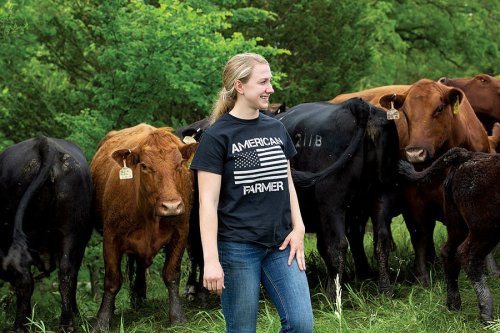
Young farmers are returning to the prairie as skilled agriculturalists and entrepreneurs —  injecting a much-needed dynamism into that world.

I can’t resist another story about young people who get interested in farming. They’re not only helping to feed us all, they’re setting an example for how people can carve new paths into an uncertain future. Do they get discouraged like the rest of us? My sense is that they don’t have time for that.

Laurent Belsie of the Christian Science Monitor talks to young farmers in Nebraska.

“Outside Unadilla, Hannah Esch walks into her cooler and pulls out packages of rib-eye, brisket, and hamburger. Over the past nine months her new company, Oak Barn Beef, sold out of meat four times and brought in $52,000 in sales. Over the next year, she expects to double those sales numbers. That will [be] when she finishes her last year of college.

“Some 150 miles northwest, the Brugger twins, Matt and Joe, show off how they’re diversifying from traditional agriculture. They directly market the beef from the cows they raise and they grow hops for local microbreweries. But the most visible sign of their commitment to the rural Plains is the two-story farmhouse they’re renovating on the family homestead. …

“It’s the place their great-grandfather bought when he moved here from Switzerland. It’s where their grandfather was born and where they played as children when the house was later rented by people who kept sheep. …

“There’s a new generation of rural entrepreneur returning to the Great Plains. … It’s not clear how big the movement is and whether it can reverse the population decline that’s gone on for a century in the rural Plains. But if energy combined with business and social media savvy can overcome demographic decline, then perhaps these youthful entrepreneurs – the first generation born after the farm crisis of the 1980s – have an opportunity to do it.

‘There is a spirit in these young people that is different than anything I’ve ever experienced,’ says Tom Field, director of the eight-year-old Engler Agribusiness Entrepreneurship Program at the University of Nebraska-Lincoln.

“Of the 120 or more of its alumni, ‘90% of them say their goal is to return – or they choose to live in – a small or rural community. These are students who have had international experiences, had internships on both coasts, but they choose to live and work and play in places where they have a deep affinity with the culture, the people, and the landscape.’ …

“When the Brugger twins first started thinking about a return to the rural Plains, their initial idea was to do something in business development. Then they met with Dr. Field of the Engler program at the University of Nebraska-Lincoln. He urged them to be role models, instead.

“ ‘He was the first one to say, … “The best thing you can do for your community is find what you love to do. Start a business around it and hire people to come back … and show other young people that you can do what you love in a rural community,” ‘ Matt recalls. …

“Now, the recent college graduates run their own company, Upstream Farms. They have 50 cows. They market the beef directly, mostly to the training table program at the University of Nebraska-Lincoln, which serves high-quality foods to student athletes. They raise hops for nearby craft breweries, and because the university takes only the best cuts of beef, the twins sell the rest of their meat as hamburger to the boutique beer firms. …

“ ‘We like to say that we’re twin brothers farming the Midwest, putting new ideas on old dirt and connecting our customers back to land.’ …

“When the twins proposed building a distillery, their parents responded, ‘That’s really risky, guys,’ Matt recalls. ‘They go, “You guys don’t know what it’s like to live in really, really hard times.” And they’re right. We’re privileged not to have [known] that. And so we do take more risks.’ …

“Stability is fragile on the prairie. Despite the good times, Gothenburg has lost more than 3% of its population since 2010, which puts it back to where it was in 1980, before the farm crisis. In rural Nebraska, however, that counts as a roaring success. …

“The decline in population not only crimps the number of people rural businesses can sell their wares to, but also reduces their labor pool. .. Between 2000 and 2010, the typical rural county in the state (one with no town of 2,500 or more) lost nearly half its population of 20- to 24-year-olds, according to the Center for Public Affairs Research at the University of Nebraska-Omaha. That is partially offset by a 16% net in-migration of 30- to 34-year-olds, presumably people who have worked elsewhere and are now wanting to return to the Great Plains.

“But it’s not enough to reverse the overall trend of Nebraskans settling in urban and suburban areas. In 2010, the two counties containing Omaha and Lincoln as well as the county between them represented just over half of Nebraska’s entire population; by 2050, they’re projected to account for two-thirds. The state’s rural counties are expected to lose population over that time….

“Even if the new generation of entrepreneurs succeeds in their attempts to work the soil, the question is whether they can really help revive the rural Midwest.

“ ‘In my area, I’m gonna guess more [people will move in], just because we are so close to Lincoln and Omaha that people can still live this lifestyle but have the great jobs,’ says Ms. Esch, bouncing along a rolling gravel road in her pickup. ‘How do you go live in the city after this?’

“But the rural parts of Nebraska and other states that aren’t close to a metropolitan area might be another matter. …

“ ‘I think the [communities] that continue to innovate and make it a great place for people to live will have more people,’ she says. ‘But the ones that don’t are going out of business.’ ”

More at the Christian Science Monitor, here.

2048

Photo: Erika Fish/QUT/AAP 
A pumice raft in the southwest Pacific in 2012. It is similar to the one now floating toward Australia. Pumice is a porous rock extruded by volcanoes. It can carry marine life, including coral, across the ocean and can help to replenish reefs.

Sometimes Nature works miracles that can leave a person breathless. So I feel a need to reach into Greek mythology for an explanation of the following.

The Great Barrier Reef suffered an 89% collapse in new coral after bleaching incidents in 2016 and 2017, according to the Guardian. But now from the sea bottom comes a repair kit. A message must have been sent through some mysterious channel to Poseidon, and he responded with roughly 37,000 acres of floating pumice carrying help.

Reports the Guardian, “A giant raft of pumice, which was spotted in the Pacific and is expected to make its way towards Australia, could help the recovery of the Great Barrier Reef from its bleaching episode by restocking millions of tiny marine organisms, including coral.

“The pumice raft, which is about 150 sq km, was produced by an underwater volcano near Tonga. It was first reported by Australian couple Michael Hoult and Larissa Brill, who were sailing a catamaran to Fiji, on 16 August.

” ‘We entered a total rock rubble slick made up of pumice stones from marble to basketball size,’ the couple said in a Facebook post. ‘The waves were knocked back to almost calm and the boat was slowed to 1 knot. The rubble slick went as far as we could see in the moonlight and with our spotlight.’ …

“Since then, the pair have been working with Queensland University of Technology geologist Scott Bryan by providing pictures and samples of the volcanic rock.

“Bryan said the raft will be the temporary home for billions of marine organisms. Marine life including barnacles, corals, crabs, snails and worms will tag along as it travels toward Australia and become a ‘potential mechanism for restocking the Great Barrier Reef. … Based on past pumice raft events we have studied over the last 20 years, it’s going to bring new healthy corals and other reef dwellers to the Great Barrier Reef.’ …

“Pumice forms when frothy molten rock cools rapidly and forms a lightweight bubble-rich rock that can float. The pumice raft comes from an unnamed but only recently discovered underwater volcano that satellite images reveal erupted about 7 August.

“[It] should begin to hit Australian shores in about seven months’ time, passing by New Caledonia, Vanuatu and reefs in the eastern Coral Sea along the way as coral begins to spawn. …

“Bryan said, ‘Each piece of pumice is a rafting vehicle. It’s a home and a vehicle for marine organisms to attach and hitch a ride across the deep ocean to get to Australia.’ ”

More here.


Happy Halloween

101319-curly-pumpkin-stem

There’s a blogger I enjoy reading although his posts are often sad. He is Bereaved Single Dad. Subtitle: “A Dad trying to cope with the loss of his partner and becoming a single parent.”

He lives in an isolated English village where his main goal is to make a happy life for his son, whom he describes as being on the autism spectrum. It’s a challenge partly because there is a lack of empathy at the local school and very few special needs services. The other issue is that Bereaved really doesn’t do anything to take care of himself, which to my way of thinking is bound to affect his son’s happiness.

But the two of them do seem to have some wonderful times together, and lately I’ve been enjoying a series of posts on their plans for a fun Halloween. Here is the post called “Halloween 3.”

“This Halloween has to make our son happy. Failure is not an option. Best way to achieve that simple goal was to let him choose what spooky activities we will fill our time with. At the start of the week he came up with his list. …

” * Halloween Costume. Dad I think we should try and go for a Freddie look. We don’t buy a costume, we see what we can rustle up. …

” * Watching as many Scooby Doo DVDs as we can find. Finish off with his three favourites. Boo Brothers, Kiss and Witches Ghost.

” *Watch a Hammer Horror movie. These are atmospheric but relatively tame these days.

” * Have a Lego building competition. This year it’s who can make the best haunted castle.

” * Make a spooky music playlist.

” * Make up a Halloween story. Dad, this year I think it’s a couple of kids stuck in a scary computer game. …

” * Any TV has to be spooky-related like Ghostbusters.

” * Monster knockout competition to decide the greatest ever horror character.

” * Apple Bobbing

” * Late night reading in the garden of Hound of the Baskervilles.

” * All dog walks have to be after dark.

” * Build a garden monster out of what we can find lying around. Then leave it for nature (or the dog) to dispose. …

” * Eat the cookie/biscuit game. Put a cookie on your forehead and then without using your hands try to somehow get the cookie into your mouth and it’s the first person to eat the cookie wins.

” * Jelly Bean roulette. We have stocked up on some new flavours. Cat food, Snail, Earthworm, Earwax, Squid.

” * Make Pumpkin Chilli Soup. Even I can manage that.”

You can read this devoted dad’s blog here.

102519-Halloween-witch


rewilding_longhorn-cattle-in-knepp-repton-park-landscape

Photo: Charlie Burrell/ Knepp Estate Castle
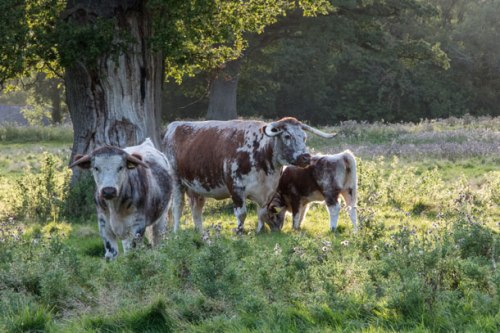
Longhorn cattle were chosen for a UK “rewilding” project as stand-ins for their extinct ancestor, the auroch.

Here’s a concept that was new to me: “rewilding” the countryside — that is, bringing the land back to an earlier and less developed state.

At the radio show Living on Earth, we learn that a UK couple was able to turn a large, unprofitable farm into a profitable one by letting the land go back to nature.

“BOBBY BASCOMB: When writer Isabella Tree and her husband, Charlie Burrell, inherited an estate in West Sussex, England, they assumed they would continue to farm as generations of family had before them. But the intensive agriculture of their predecessors grew increasingly difficult, and they decided that farming was no longer a viable option. So they began to mull over another idea: Give the land back to nature and let it take its course. Isabella Tree’s recent book is titled Wilding, and its the story of what happened to the land when they gave up farming and let nature take the reins. …

“ISABELLA TREE: We inherited this piece of land from my husband’s grandparents [in] the 1980s. And it had been intensively farmed for ever since pretty much the Second World War. [But] the farm was losing money hand over fist. [We] kept buying … bigger machines, throwing more pesticide, more fertilizer, more nitrates, built bigger dairies and changed our types of cows to more higher-milk-yielding cows. …

“We tried contract farming [and] sold all our farm equipment. It was a very, very black day. … Charlie’s ancestors have been here since the Nash castle was built two hundred and twenty or so years ago. It really isn’t for us an option to sell. [We’re] stewards of this land, and we can’t just sell up and move out. …

“BASCOMB: Well, how did you even come up with that alternative? I mean, for most farmers, I think it’s probably pretty counterintuitive to just let the land go. I mean, that’s not what you do as a farmer.

“TREE: It is a very, very difficult thing to do, you’re absolutely right. …

“BASCOMB: You talk a lot in your book about the importance of introducing herbivores. What animals did you introduce and why? …

“TREE: We had to introduce animals that we knew would be able to survive outside all year round without supplementary feeding, that would be able to fend for themselves even in a harsh or wet winter. So, we chose old breeds, we chose Old English Longhorn, wonderful cows with great white finching stripe down their backs and great big horns. And then Exmoor ponies, one of our oldest breeds of horse, they are fantastic at surviving, out in any landscape. Very, very hardy, indeed. And Tamworth pigs, another old breed that’s very closely related to Iberian swine. So, they’re the closest we felt that we could get with an English variety of pig to the wild boar. And then we had roe deer here already in low numbers. And then we introduced fallow deer and red deer. …

“BASCOMB: What does it look like? What does it smell like, even sound like, and how is that different from what you started with? …

TREE: When you walk around Knepp today is the sound of insects, for a start. On a day like this, it’s a hot, sunny day, you’ve just got the sound of crickets and grasshoppers, you’ve got bees, you’ve got hover flies, you’ve got every sort of insect out there. It’s thick with insects. If you go out there on a bicycle, you have to wear sunglasses or, you know, because you’re getting insects in your eyes. …

“This used to be the norm 50 years ago. But in the era of pesticides, we just don’t see insects anymore. So the sound of insects is astonishing. And then, of course you’ve got the bird song, surround sound bird song. Go out into the thickets, it’s sort of like the African scrub. … It’s a wonderful thing to be sitting in the middle of.

“But it’s a double edged sword because we now go on walks in other places in the UK, places where we always used to enjoy, you know, an hour or two to walk, and now we notice what isn’t there. And it’s that, it’s what Aldo Leopold called that sadness, that tragedy of having an ecological education. You know what isn’t there and what could be there, what should be there. …

“We literally haven’t introduced anything apart from the free-roaming animals. So, they’ve all found us on their own. [We] have 13 out of the 18 breeding species of bat in the UK. One of them called the Bechstein’s bat is so rare, it’s rare even in Europe. … We have Peregrine Falcons, we have them nesting in a tree. Usually you associate Peregrine falcons with cliffs and clifftops. They nest in steeples and cathedrals, but not in a tree. Nightingales are another species that is associated with woodland, but at Knepp they’re taking up territories our exploding hedgerows and our thorny scrub. And so they’re choosing a very different habitat because it’s suddenly available to them. So, it’s really changing the science books, we’ve forgotten that this is where nightingales love to be.

“And I think that’s one of the lessons from Knepp, is that we’re so used to seeing species in a very, very depleted landscape, that that’s where we think they want to be. But in fact, they’re often clinging on by their fingernails to habitat that just isn’t optimal for them. And where they’d much rather be is in the kind of habitat that we’re presenting for them at Knepp.”

More at Living on Earth, here.

day226_bill

Photo: Alight
The former American Refugee Committee, now called Alight, focuses on “doing the doable.” Alight maintains that when things seem impossible, there is always something good that can be done.

For many years, I’ve been a fan of the American Refugee Committee, now called Alight. Since the nonprofit took the new name and began to focus on “doing the doable,” I’ve enjoyed periodic news about its Changemakers.

Here is the story of a teacher who wanted to understand things firsthand. I will just point out that the term “refugee” is ordinarily applied to those who come here officially, having been screened by our State Department and accepted in advance. Now that the US is accepting so few, those of us who work with migrants are seeing more climate “refugees” and economic “refugees” — some documented, some not. This is the story of a guy who wanted to help them.

“Howdy! My name is Bill Boegeman, and I’m a high school social studies teacher in Forest Lake, Minnesota. Some of my students are from Central America – refugees now living in the U.S., many of whom made the journey to the States alone.

“Their stories are amazing – spending hours in cramped semitrailer trucks and trunks of cars, hiding from the Federales and narcotraficantes as they trekked across the Mexican desert. It’s difficult for me – and my other students – to imagine what these young people have been through, what hardships they have already endured, and the complexities they’re faced with now.

“So I wanted to go see for myself … and to try to make a difference, one day at a time.

“I traveled with Alight to the Rio Grande Valley, a vast area encompassing the southern border of Texas and parts of Mexico. In some ways, it feels a little bit like two countries living in one, cultures blended and economies interconnected. And now, Mexican-American communities are coming together with some incredible changemakers – Catholic Sisters, who Alight has recently partnered with – to serve the new waves of families who are searching for a better life.

“We began our work at La Posada Providencia, a migrant shelter just outside of San Benito, Texas. It’s a landing spot for many migrants released from detention centers with nowhere to go.

“Five years ago, Ángel was one of those migrants.

“After immigrating from Honduras and five months in detention, Ángel spent three months at La Posada where he was provided with a bed, regular meals, and mentoring services. Following a brief stint in Indianapolis, he returned to the shelter as a volunteer. Fast forward a few months and Ángel was converted into a full-fledged employee — the house cocinero — a position he still holds today.

“In addition to his cooking duties, Ángel helps to organize the shelter’s mochilas – to-go bags provided to clients who are ready to move on to their next destination. These bags include non-perishable food items, personal care products, a change of clothes, and other items that will help them along this next stage of their journey. It was here that we saw an opportunity.

“Over a lunch that Ángel prepared, La Posada’s current residents were able to provide us with ideas of items that would be useful to migrants in their mochilas as they depart the shelter for their next destinations. We landed on two primary items that we could provide: Spanish-to-English dictionaries and chapstick. While seemingly unrelated, these two things would be helpful to them in their future journeys (in the case of the chapstick, particularly those headed north). They were also absent from the supply closet on the La Posada premises.

“I asked Ángel what made La Posada Providencia such a special place. ‘It’s more than a shelter,’ he said, ‘It’s a house, a home, a family.’ ”

More at Alight, here.

102719-fall-color-combo

I’m running out of titles for posts that are basically just “more random photos.” So since a few of today’s offerings, like the one above, were taken Sunday in the rain, I thought I’d borrow my title from the old song

“Days may be cloudy or sunny
“We’re in or we’re out of the money
“But I’m with you always
“I’m with you rain or shine.”

In the rain in Minuteman National Park, I shot this gnarly old tree, which looked like it had played host to a few too many young climbers. I also photographed a Wayside Pulpit, mostly for the fall colors around it. The highly articulated leaves of a Japanese maple are my favorite thing about our backyard.

Stuga40 emailed the Swedish advice after I wrote a post on yarn bombing. As near as I can tell, it means “Give it your all.”

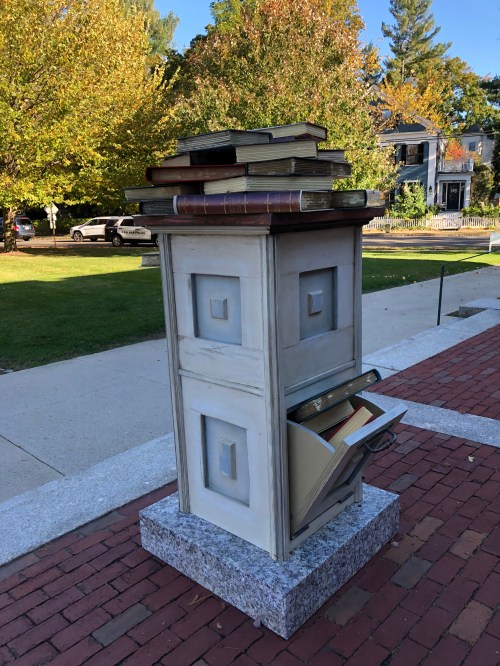
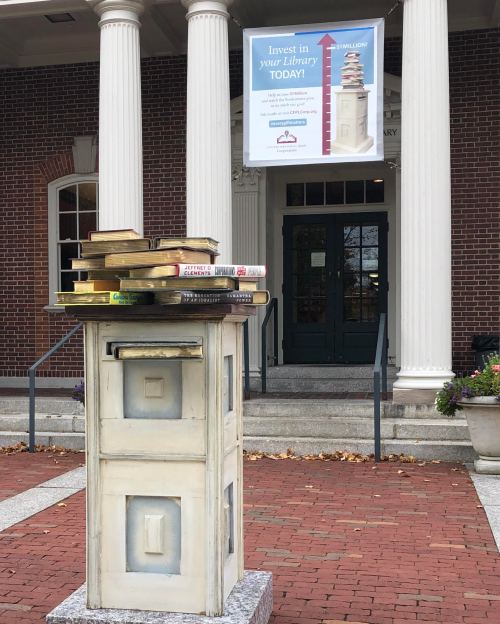
I was initially puzzled by the sculpture that appeared recently in front of the library. That is, until the sign went up about using an increasing book pile to measure donations to the fund for the new wing. The resident who did the construction included book titles by local authors.

Sandra M. Kelly shot the magnificent entries to New Shoreham’s Painted Rock archives. The two unknown artists were smart to wait until fall to paint. In fall, the rock is less likely to get slopped over with celebratory spray cans half an hour after the painstaking artwork is finished. One artist captured the Southeast Lighthouse. The other created a small figure reaching for stars and starfish.

I will wind up today with a four-year-old rock star of my acquaintance, the newest Providence mural by Shepard Fairey, and peaceful evening shadows.

102719-gnarly-tree-North-Bridge

102719-Wayside-pulpit

102519-Japanese-Maple

20191022-yarn-bomb-give-your-all

101919-book-art-at-library

102519-library-fund-raiser

101819-Painted-Rock-5


101819-Painted-Rock-2

102119-rock-star

102219-Shepard-Fairey-mural-Providence

101519-tree-shadows-Concord


cruise-auction-4

Photo: Cruise Critic
A Park West art auction in the Star Lounge on Royal Caribbean’s Navigator of the Seas.

My family went on a cruise only once (1990, New York to Bermuda), so in terms of special features, we know about Broadway-type entertainments, and that’s it. “Let’s give a warm welcome to the Royal Viking singers and dancers, Everyone!”

But cruise lines keep trying to outdo each other in offerings. One couple I know chooses their trip based on what chamber music group will be playing. And if you are into fine art or auctions, there’s a cruise for you, too.

Of course, you’re not going to pick up something valuable for cheap.

Sarah Cascone writes at Artnet, “I was lounging poolside, cocktail in hand, when I heard the announcement. The grand finale art auction was about to start.

“It was a weekend cruise from Miami to the Bahamas aboard Royal Caribbean’s recently refurbished Navigator of the Seas. … As I entered the event, hosted by cruise-ship auctioneer Park West Gallery, I bypassed the registration table, heading straight for the auction floor, where a waiter was handing out glasses of sparkling white wine.

“From the start, it was clear that this was no regular art auction. After a brief spiel encouraging folks to buy art as a legacy to leave to their children, the auctioneer, Robert Borotescu, got down to business.

‘I don’t know if you’ve seen Oprah,’ he said. ‘We have some surprises under the chairs.’

“Cue a frenzy as the few guests in the room rushed to upturn every seat cushion. There were no car keys to be found, but there were $100 certificates for discounts on winning bids.

“Borotescu, a dark-haired Romanian man in his mid-to-late 30s, endeared himself toward the crowd by offering additional raffle tickets for $100 credits throughout the auction. … With his pleasantly urbane accent, Borotescu set his audience at ease, acknowledging that they probably never had the time to visit art museums and galleries. But they were here now, and it was his job to make sure that they went home with something they absolutely loved. …

“Borotescu told us that [Park West] operates on 100 cruise ships, and claimed that the art aboard the Navigator of the Seas alone was worth $3 million. Representing some 200 artists, the company holds 1,200 auctions every month. …

“Unlike most art world organizations, Park West seems to hire employees with largely non-art backgrounds. Borotescu’s LinkedIn lists six years in fine jewelry and watch sales at Louis Vuitton Moet Hennessy before joining the company. A quick perusal of resumes of other auctioneers and art directors at the company yields unconventional experience in HVAC, used car sales, fitness instruction, and Royal Caribbean’s beverage team, to list just a few. …

“Park West specializes in what it calls ‘graphic works’: Mass-produced reproductions of original paintings, signed by the artist and released in limited editions. Some are giclée prints — a fancy term for high-quality inkjet prints. Other pieces might look like paintings, but these more expensive offerings are often merely hand-embellished, with brushstrokes layered over a printed image to give it a more ‘authentic’ feel. …

“ [The auctioneer] said: ‘If we look at the Oxford Dictionary of Art, every single artwork that can be traced back to the artist, or was created under the artist’s supervision, is considered to be an original work of art.’ …

“Most of the time, you won’t even take home the exact work you’re bidding on. Park West will ship you a functionally identical copy from its warehouse, rather than going through the trouble of turning over the on-board stock, according to Bloomberg Business. …

“The bidding kicked off with a piece by Peter Max, a well-known Pop artist who met Scaglione, Park West’s founder, back in the late 1960s, and has been represented by him ever since. …

“ ‘This is one of the gems we have on the Navigator of the Seas,’ Borotescu told the crowd, claiming that the ‘printed painting on canvas’ was valued at $23,500, but that he could start the bidding at $20,000. Less than 30 seconds later, the work was sold for $20,700.

“Max has decades of experience exhibiting at international museums. The highest auction record for a work of his is $53,125, according to the artnet Price Database. … Other artists on offer had decidedly less impressive CVs. Borotescu proudly proclaimed that Park West is the only gallery to represent David ‘Lebo’ Le Batard, noting that the artist is known for his paintings of cats and owls. …

“Every attendee was encouraged to enter a free raffle to take home a massive, unframed Thomas Kinkade [your blogger comments, ‘Ugh!’]. … One gimmick in particular stood out: A pair of works presented turned away from the audience, and sold as one lot, without any idea of what they looked like. ‘They are going to be two of the most gorgeous works of art that anyone has ever seen,’ Borotescu promised the audience. ‘Once you turn it around, if it’s something you don’t like, you don’t have to keep it.’ …

“And then there was Tweety.

“Borotescu never named the artist responsible for designing the tiny print, relying on the Looney Toons character’s name recognition … Supposedly, the artwork, which was just a couple inches high and therefore impossible to see from across the room, was valued at $549.

“ ‘Let’s have some fun,’ Borotescu suggested, asking everyone in the room to hold up their bid card. He opened the bidding at just $20. Two thirds of the crowd dropped out when he raised the price to $40, and suddenly the auctioneer slammed down the hammer, selling the cartoon bird to a handful of guests.”

More here, where you can also read about the latest confusion surrounding works by Peter Max, one of the featured artists.

I think if you didn’t take it too seriously, an onboard art auction would be fun. Gimmicks such as surprises under the chairs somehow make me think of a kid’s birthday party. The whole experience seems to play to the child worldview that is buried but available for anyone to tap in adulthood.

shane-claiborne

Photo: Christian Today
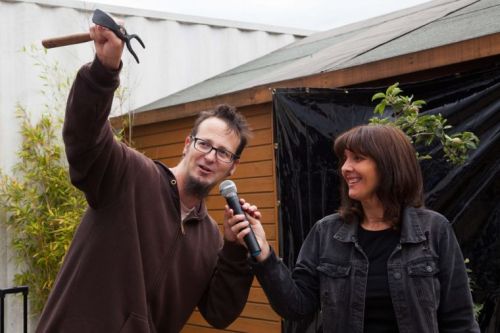
Shane Claiborne and Dr Sally Mann with one of the garden tools made from knives seized from the streets of London by police as part of a peace-focused project. In America, Claiborne beats
guns into garden tools, in a modern version of “swords into plowshares.”

I am not devout like several of my readers, but I love stories about people of any religion who try hard to practice the humane tenets of their faith.

In this story, a Christian called Shane Claiborne was a guest of the radio show On Being to explain what his faith tells him to do about the proliferation of guns used for violence in America. Host Krista Tippett brought him together with Omar Saif Ghobash, a diplomat of the United Arab Emirates and author of Letters to a Young Muslim to talk about how they would like to refocus members of their faith who seem immune to messages of love and kindness.

From the website: “Spiritual border-crossing and social creativity were themes in a conversation between Shane Claiborne and Omar Saif Ghobash, two people who have lived with some discomfort within the religious groups they continue to love. Ghobash is a diplomat of the United Arab Emirates and author of Letters to a Young Muslim. One of his responses to the politicization of Islam has been to bring a new art gallery culture to Dubai, creating spaces for thought and beauty.

“Claiborne is a singular figure in Evangelical Christianity as co-founder of The Simple Way, an intentional neighborhood-based community in North Philadelphia. One of the things he’s doing now is a restorative justice project inspired by a Bible passage — to transform guns into garden tools.” Play the episode here.

And for more on beating weapons into garden tools, there is this story by Rob James at Christian Today.

“Shane Claiborne is no shrinking violet. Prominent speaker and bestselling author Shane heads up Red Letter Christians, a movement that is committed to living ‘as if Jesus meant the things he said.’ Consequently Shane is a passionate advocate against homelessness, war, gun violence and the death penalty. As he sees it, the Gospel of grace is a call to Christian activism, something he talked about when we met at the YMCA’s recent 175th anniversary celebrations in London.

” ‘I’m here to celebrate 175 years of the YMCA because it’s not just been an organisation about words but about action. … Young people are very aware that politicians in many of countries have failed, and as we look at the world we have been handed from our parents we can see that it is very fragile.’ …

“For Shane, faith is not simply a ticket into heaven or a licence to ignore a hurting world. Faith, he believes, should give us the determination to transform the world. … It’s not about ‘going up when we die,’ he observes, but ‘about bringing God’s dream down to earth while we live. …

” ‘The health of any society is not shown by how the stock market is doing or how rich we are but how the most vulnerable are doing. And of course justice issues are all interconnected so it’s impossible to separate caring for the environment from our care for the poor. The folk who suffer the most injustices are the most vulnerable people.’ …

“And for him, the United States is a particularly challenging context at the moment.

” ‘We are living through some historic and troubling times,’ he said. “Just before I came to London I was at the border in El Paso where we have kids who are living in cages, separated from their own families, because our own administration has said they don’t know if they will ever be reunited. …

” ‘This is not about issues but about loving our neighbour, recognising that when anyone is hurting we are all hurting, and until we can all live without fear, until all of us are free, none of us are fully free.’ ”

More at Christian Today, here, and at On Being, here.