Feeds:
Posts
Comments

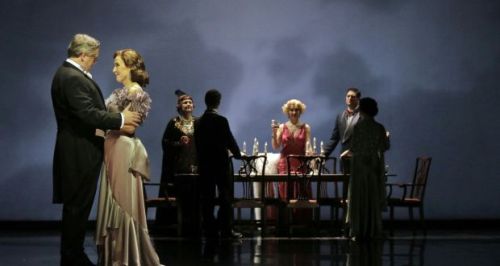
cmyk-albina-ishmasova-as-lady-macbeth

Photo: Kyrgyz Academic State Theatre
Albina Ishmasova as Lady Macbeth. As part of a unique collaboration in Kyrgyzstan, director Sarah Berger created three versions of
Macbeth using the Kyrgyz language, which she doesn’t speak.

Theatrical directors are often up for a challenge, but this challenge takes the cake: directing actors who don’t speak your language in a production of Macbeth.

That is what Sarah Berger did in Kyrgyzstan. She writes about it at The Stage.

“I recently returned from six weeks in Kyrgyzstan directing the first ever Kyrgyz translation of Macbeth, made from Russian into Kyrgyz, at the Kyrgyz Academic State Theatre in Bishkek.

“I worked with 30 Kyrgyz actors who spoke no English. I don’t speak Russian or Kyrgyz.

“To add to the mix, I took two British actors with me, Claire Cartwright and Steve Hay, who performed in English with the rest of the cast speaking Kyrgyz. They played Lady Macbeth and Macbeth respectively. There was also a fully Kyrgyz performance that was filmed and screened on state TV.

“So I had to deliver three different versions of the production in just over three weeks, as we performed four premieres with the cast variations.

“The challenge of that aside, the Kyrgyz state theatre method of working is entirely different to what we’re used to in the UK: the company comprises people who have trained there and are attached to the theatre throughout their working life, which has its advantages and disadvantages.

“The advantages are that they practise their craft every day, and are used to working as a company. They are vocally highly trained and easily fill an 800-seat theatre. They are physically grounded and able to experiment with movement and voice. For example, the Witches and Hecate invented a unique style of delivery, incorporating song and dance.

“The disadvantages are that they are not hungry for work in the same way British actors are. There’s a competitive edge missing. …

“We discovered that the challenge of acting opposite someone speaking a different language was surmountable when the intentions of the scene or particular line were clear. In fact, the particular challenge for the actors wasn’t so much the language but the differing approach to rehearsals and the text. It quickly became apparent that we adhere far more strictly to the verse, and are led by it, whereas for Kyrgyz actors that is just one element of the performance. …

The production itself worked remarkably well given its disparate elements and the lack of rehearsal time. I would recommend the experience of working in such a different arena as it informs our practice.” More.

031318-tall-bushes-bent-over-2

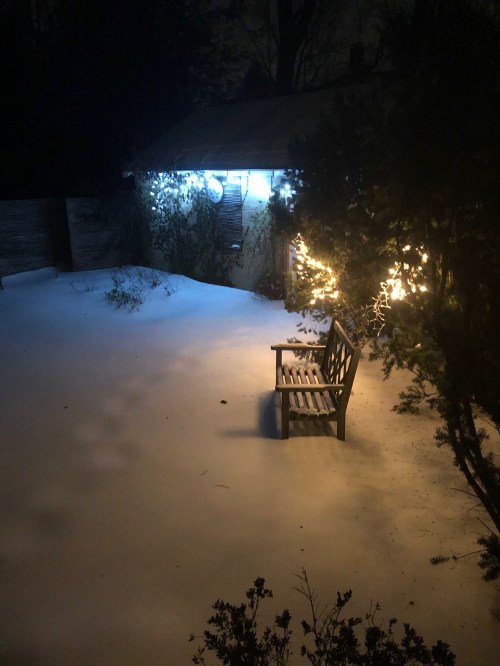
Back in March, when I was complaining about a series of heavy spring snows in New England, Deb said, “Save a picture for August, when we really need it.” I think the time has come.

Folks in the Northeast are not used to having temperatures day after day in the 90s combined with crazy-high humidity. Friends my age seem to find it totally enervating. If we can’t get to a bit of shade or find a breeze, we just sit like lumps — or move ve-ery slowly. Not all houses have air conditioning. In the past, it was seldom needed.

So it’s time to stop complaining about the heat and remember how I complained about the cold in March. Deb was right. One’s perspective changes. The picture above was taken on March 13 when I really would have preferred to see spring flowers coming up. Looks quite pleasant to me now.

I also have a few summer pictures to share. The tiny bird on what appears to be a telephone pole is actually a very large, fierce bird called an osprey. Towns along the New England coast construct special nesting platforms to keep osprey from building on telephone poles. You may see many such platforms if you take Amtrak through Connecticut. At this time of year, there may be several young ones — no longer babies — perfecting their new fishing skills.

And I include a bouquet of local wildflowers, the boats in New Shoreham’s Great Salt Pond, and four photos demonstrating how the lotus at a neighbor’s house looks as it opens. I have recorded this other years, but every year, it’s a miracle.

I can’t help noting that even the lotus seemed to take the sweltering summer rather hard. Several blossoms simply bowed over, hiding their faces somewhere among their roots in the pond. I know how they feel.

73118-osprey-Pt-Judith

080118-anniversary-wildflowers

080218-New-Harbor-boats

080118-pink-tip-of-lotus

080418-ready-to-bloom

080318-lotus-Lakeside-Dr

080418-windblown-lotus


3024

Photo: The Guardian
North America’s first pay-what-you-can grocer is located in Toronto and aims to keep overstocked but perfectly good food from going to a landfill.

I love stories about efforts to get surplus fresh food into the hands of people who might be going hungry otherwise. And keeping food out of landfills at the same time means killing two birds with one stone. But true confession: I am wasteful. I use the yummy inner parts of celery and lettuce first, and when I get around to the outer parts, they don’t look worth saving. Do I put on my thinking cap and make these leftovers into soup or something? I do not. Sometimes I compost them. I’d be interested in your ideas.

In Canada, a grocery store may have the best solution yet for food that is still good to eat but overstocked.

As Ashifa Kassam writes at the Guardian, “In a bright, airy Toronto market, the shelves are laden with everything from organic produce to pre-made meals and pet food. What shoppers won’t find, however, is price tags. In what is believed to be a North American first, everything in this grocery store is pay-what-you-can.

“The new store aims to tackle food insecurity and wastage by pitting the two issues against each other, said Jagger Gordon, the Toronto chef who launched the venture earlier this month.

“Every provision is donated by a network of partners across the region, and many of them – from blemished or misshapen produce to staples that are nearing their expiry date – would have otherwise ended up in landfills. …

“The store, which also includes a pay-what-you-can bakery and cafe, is the latest initiative to emerge from his non-profit firm, Feed It Forward. The roots of the organisation trace back to 2014, borne out of Gordon’s frustration at the C$31bn (£17.6bn) worth of food that ends up in Canadian landfills and compost sites each year while one in eight Toronto households struggles to put food on the table. …

“Prices are entirely up to the customer. ‘If you can afford to pay more, go right ahead,’ said Gordon. ‘If you can’t pay for what you have, then don’t.

“ ‘What I have noticed is people look into the baskets, try to calculate what it is and then say, “is this acceptable?” And I just say, “are you kidding me? Whatever you can give is fine, but if you are unable to make a donation, we won’t let anyone go hungry.” ‘ …

“Any profits are poured back into the store, covering costs such as rent and the transport of provisions. More than 600 volunteers help to staff the store and Gordon supplements its income with fundraising events, donations and revenue from his catering business. …

“As the store nears its closing time, Gordon surveys its largely empty shelves. ‘I’m a little disappointed that I have food left. … We’re going to the streets and hand it all out. We won’t stop until our food is gone.’ …

“Many have welcomed the initiative, but others question the sustainability of its business model. Gordon is quick to brush aside such concerns, pointing to pay-what-you-can initiatives that have been successful in Europe and noting that his soup bar managed to pay for itself.”

More at the Guardian, here.


tlumacki_blindugandanparlimentarian_metro067

Photo: John Tlumacki/Globe Staff
Margaret Baba Diri, a Ugandan legislator who lost her sight, visits the Carroll Center for the Blind in Newton to gather ideas for helping the blind in her own country.

Here is a woman from Africa who refused to let her disability keep her from helping the people of her country.

Emily Williams writes at the Boston Globe, “Margaret Baba Diri is scrolling through her iPhone, even if it doesn’t seem that way at first. The screen is dark, and she holds it at her chest, her finger swiping through the pages as an automated voice calls out the names of her apps until she lands on the one she wants.

“She is practicing ‘flicking,’ a technique she learned during an eight-week training program this spring at the Carroll Center for the Blind in Newton.

“A member of the Ugandan Parliament for more than 20 years, Baba Diri, 64, came to the center to improve her skills and move closer to her goal of opening a center for the blind and visually impaired in Uganda.

“She hopes to model many aspects of the Carroll Center’s program, she said, especially the close relationship instructors build with students. ‘We’re not here for competition,’ she said. ‘We are all growing at our own pace.’ …

“Over time, Baba Diri has developed many ways to compensate for her lack of sight and work independently. She reads braille and, with the use of a special machine, can record, edit, and print notes in braille.

“Over the past several weeks, through the center’s independent living program, Baba Diri practiced a range of everyday tasks, such as crossing streets, washing clothes, and cooking meals. …

“As she learns, she is taking careful note of how those skills are taught and envisioning how she’ll construct her own programs. …

“Baba Diri lost her sight in 1990 from glaucoma. She had been teaching biology and chemistry at a secondary school for 14 years, and when she lost her sight, she also lost her ability to teach.

“ ‘I thought it was the end of my life,’ she said.

“But a friend reminded her that the loss of her sight didn’t diminish her intellect. She could learn braille, practice mobility training, and find a new career.”

Learn more about this indomitable woman at the Globe, here.

image

Photo: Sunaina Kumar
Women of Jad tribe spinning wool in Dunda village, Uttarakhand. Their language belongs to the Tibeto-Burman group of languages and is one of 780 (possibly 850) in India.

Here is a heretical thought from someone who loves language: if practically everyone speaks a different language from everyone else, maybe we don’t need language? One must at least ponder the question of whether there is a better way to communicate with others. I’ve no idea what it could be. Even gestures have different meanings in different cultures.

There is always a need to communicate, isn’t there? It’s a puzzle. Even English, despite its frequent role as the bridge language Esperanto was meant to be, suffers from so many Orwellian uses of common words today, you can hardly trust it to convey what you mean.

These thoughts came to me because of an article by Sunaina Kumar at Atlas Obscura on the amazing array of languages in India alone.

Kumar writes, “In 1898, George A. Grierson, an Irish civil servant and philologist, undertook the first ever Linguistic Survey of India. It took Grierson 30 years to gather data on 179 languages and 544 dialects. The survey was published in 19 volumes, spanning 8,000 pages, between 1903 and 1928. …

“Ganesh Devy was frustrated by this lack of contemporary data, especially the discrepancies he saw in the existing numbers. Since the government wasn’t likely to start on a new survey in the near future, Devy, a former professor of English from the western state of Gujarat, launched the People’s Linguistic Survey of India in 2010. The name refers to the fact that it was the people of the country, and not the government, that embarked on this project.

“With single-minded ambition, he put together a team of 3,000 volunteers from all parts of the country. Since 2013, the PLSI has published 37 volumes, featuring detailed profiles of each of India’s languages. The project is expected to be completed by 2020 with 50 volumes. In the linguistic landscape of India, the work done by PLSI is not just pathbreaking, it is crucial in recording and thus preserving the languages of the country for future generations. …

“The challenge of putting a disparate team together with a minuscule budget of 8 million rupees ($1,17,000) — provided by a private trust — to map the languages spoken by 1.3 billion people was enormous.

“ ‘My team was not made of linguists, but people who could speak their own language,’ Devy says. ‘We had writers, school teachers, philosophers, social scientists, some linguists. We also had farmers, daily wagers, car drivers, people who had been in and out of jail. They had an intimacy with their language. Even if it was less scientific, it was authentic.’ These volunteers were asked to record data about the languages they spoke, including the history of the language, its grammatical features, and samples of songs and stories. It was chaotic, Devy admits, but he traveled to every corner of the country to train the team and the final product was vetted with academic rigor.

“So far, the PLSI has recorded 780 languages in India and 68 scripts. When Devy embarked on the mammoth project, even he did not expect to unearth that many. He says that the PLSI could not report on nearly 80 languages for various reasons, including accessibility of a given region due to remoteness or conflict, which brings the estimated total number of languages closer to 850.

“Based on data from the survey, Devy estimates that in the last 50 years, India has lost 220 languages, including some within the last decade. …

“ ‘India has some of the oldest surviving languages,’ says Devy. ‘A language like Tamil has been around for 2,500 years. Some of the tribal languages would be even older.

These languages have survived because they have a philosophical context to them and that philosophy is part of the lived lives of the speakers.’ …

“After mapping India’s languages, Devy, whose spirit is unflagging at 67, has turned his attention to the world at large. His next project is the Global Language Status Report. The UNESCO states that nearly half of the over 6,000 languages spoken in the world may disappear by the end of this century. The GLSR proposes to cover the languages of Africa and South America, two regions where languages are fast disappearing without any trace, and where linguistic diversity has not been mapped. …

“ ‘I have been traveling to Africa for a year now and I am not deterred by the scope of mapping 54 countries,’ Devy says. ‘The experience with PLSI was great fun, and I believe if people decide to do something, they actually can.’ ”

More here, at Atlas Obscura.

fogsculpturerenderingoverfranklinparkbostonma

Photo: Emerald Necklace Conservancy
Starting August 11, five “fog sculptures” by artist Fujiko Nakaya will grace the string of Boston parks known as the Emerald Necklace until the end of October. Nakaya uses a system of pumps, pressurized hoses, and ultrafine nozzles to create her sculptures.

You can make art from almost anything, but you need an artist’s imagination to see the possibilities. I notice that in my grandchildren, who take on creative projects that seem impossible to dull adults — like making a necklace with a heavy rock and some paper. In this story, artist Fujika Nakaya saw the possibilities of fog.

As Graham Ambrose reports at the Boston Globe, “The Emerald Necklace, Boston’s 7-mile pendant of parks built in the 19th century, will soon have a new adornment: a string of artworks made from water vapor.

“This summer, artist Fujiko Nakaya will debut ‘fog sculptures’ at five sites along the Necklace. The immersive sculptures — wafting clouds of machine-made mist — will be viewable from dawn to dusk between Aug. 11 and Oct. 31. …

“Mayor Marty Walsh of Boston hailed the project, calling the Emerald Necklace ‘a crown jewel in the City of Boston’ in a statement to the Globe. ‘Similar to the intent of the Emerald Necklace, art has a connecting power, bringing together people from all different backgrounds and all different places.’ …

“Nakaya, born in Japan in 1933, calls fog ‘the most generous of mediums.’ Since 1969 she has built more than 80 fog sculptures across four continents, transforming open spaces into dreamlike landscapes with custom-designed installations. …

Fog is living and dying. It condenses and evaporates simultaneously, with dynamism and vulnerability. It is a positive and negative,” Nakaya told the Globe. …

“To create her sculptures, which emit fog in controlled intervals, Nakaya uses a patented system of pumps, pressurized hoses, and ultrafine nozzles. Computer software receives weather data and alters fog flow to suit wind speeds, dew point, temperature, and humidity.”

Read about the dramatic origins of the sponsoring conservancy at the Boston Globe, here. The Emerald Necklace was the work of landscape visionary Frederick Law Olmsted, who also created designs for New York’s Central Park, the 1893 Chicago World’s Fair, and more.

pssikk5

Photo: Kurdistan 24
There are many strays in the Kurdistan Region, with few resources available for animal care and protection. In a refugee camp, a young man whose veterinary education was cut off by war does what he can with what he’s got.

Although it’s true that some refugees are crushed by loss and dislocation, others face up cheerfully to the way things are. A story from Kurdistan24, a television station, provides a moving example.

With contributions from Chiman Adil, Nadia Riva reports from Erbil, “A young Syrian Kurdish refugee has been appealing for other animal-lovers to help in bettering the fate of stray animals in the Kurdistan Region while running a veterinary clinic in a camp.

“Ayaz, a Syrian Kurd living in the Kawergosk camp near the Kurdistan Region’s capital of Erbil, fled the civil war which has been plaguing his country for nearly eight years.

“Before popular Syrian protests erupted across Damascus and other cities, Ayaz was a fourth-year student at the Faculty of Veterinary Medicine. The conflict, however, prevented him from completing his studies, with universities closing down and violence spreading. …

“Ayaz sought refuge in the Kurdistan Region, as hundreds of thousands of other Syrian Kurds have done, but did not let his situation affect his care of animals. … He has called for the promotion of animal rights at the camp, hoping to raise awareness and change the culture among the newer generation toward animals. … Ayaz has rescued cats, birds, turtles, and rabbits, which he keeps in his shelter at the Kawergosk camp.”

On twitter, Glenn Greenwald has been trying to raise money for this cash-strapped operation. You may remember that I wrote about Greenwald’s own animal-welfare efforts last month in a post describing how he hires homeless people to care for stray dogs.

More here.

vyc-camryn-jordan-wn-1684w

Photo: Celeste Sloman for The New York Times
Camryn Cowan and Jordan Millar, 11-year-old students in the Philharmonic’s Very Young Composers (VYC) program, received a burst of media attention after being featured along with their compositions in the New York Philharmonic Concerts in the Parks.

The young composers in this story got a boost for their musical talent thanks to a New York Philharmonic program. Just imagine what could be accomplished with similar programs in all areas of the arts — playwriting, painting, poetry, sculpture, etc.! Giving kids an opportunity to blossom benefits us all.

Joshua Barone described the experience of two gifted girls in a New York Times article: “It was the kind of debut most musicians only dream of: a world-class orchestra, tens of thousands of listeners.

“At its outdoor parks concerts [in June], the New York Philharmonic performed works by two 11-year-old girls, Camryn Cowan and Jordan Millar — newcomers to the world of composing. They won over the crowds, who gave standing ovations. Anthony Tommasini of The New York Times gave them an effusive review. …

“Where does a composer go from here? Ms. Cowan and Ms. Millar — two students from Brooklyn who are part of the Philharmonic’s Very Young Composers initiative — followed up on their victorious tour of New York City by, well, returning to class. …

“Both girls … were confident in explaining their works, originally written for a Harlem Renaissance-theme program earlier this year. Ms. Cowan, who was 10 at the time, said that her ‘Harlem Shake’ was an exercise in layering, but with saxophone improvisations that nodded to the neighborhood’s past.

“Ms. Millar’s ‘Boogie Down Uptown’ conjures stepping out of the subway onto the streets of Harlem for the first time, with musical textures inspired by the shadowy movement of Aaron Douglas paintings. (For all this seriousness, they are still children: Ms. Millar said her fascination with Douglas’s art comes from her favorite Disney movie, ‘The Princess and the Frog,’ which borrows its aesthetic from his paintings.) …

“Jon Deak — a composer, the Philharmonic’s longtime associate principal bassist, and the founder of its Very Young Composers initiative — said that … all children are creative. ‘People ask whether I’ve found the next little Mozart, and I say yes, I’ve found dozens of them,’ he said. ‘They’re all over the place. We just need to listen to them.’

“Participants in the program come from about 15 partner schools in New York. … Eventually, they graduate to writing complex scores that they workshop with one another and try out at Young People’s Concerts.

“In the process, Mr. Deak said, the students have to become leaders: ‘Look at a 10-year-old who comes up to a bassoonist’s kneecaps and says “That’s too fast” or “There’s something wrong with that note.” They have to defend their pieces, and boy, do they … do it.’ ”

More at the New York Times, here.

Young Urban Birders

kids-with-bins-15-e1417551569689-980x560

Photo: Cornell Lab of Ornithology
Increasing numbers of young people, like boys in Cornell’s BirdSleuth K-12 program, are into birding — developing their observational skills and their inherent love of nature.

One of the most hopeful things around is to see kids get interested in birds, learning to identify them and to spot unusual ones. This summer I’ve been getting a kick out of grandchildren who aim to test my ability (limited) to recognize bird calls. We have a book with buttons that you press for different calls. They press, I identify. I’m getting better.

Penelope Green reported recently at the New York Times about young urban adults who assisted with an international bird count in May.

“On Global Big Day last month, birders around the world counted all the species they could spot in 24 hours. It was a super-birding event in the bonanza that is spring migration — which runs from late April to early June, but peaks for songbirds in May — when millions of birds make their way from parts south to breed in the Northern latitudes.

“In Prospect Park, members of the Feminist Bird Club did their bit for this enormous citizen-scientist data collection effort. Led by Molly Adams, its founder, the group clocked over 80 species in under 10 hours, including one black-billed cuckoo and a cerulean warbler. These were good ‘gets’: The cerulean warbler is at risk of extinction — like so many birds, a casualty of habitat loss — so noting its whereabouts is particularly important for conservation efforts. The cuckoo is not a rare bird, it’s just hard to see and not many of them stop in New York City during their migration; that made its sighting a bit of thrill, Ms. Adams said. …

“Younger urban birders — yubbies? — like those led by Ms. Adams are the new faces in the birding world. They use social media to track their ornithological marks, with digital assists from apps like Ibird or Merlin and websites like ebird — the data collection site run by the Cornell Lab of Ornithology — which have replaced old-fashioned Sibley guides to aid in identification (though Sibley has an app, too). They are drawn in by the visual seductions of Instagram, as well as a desire for community inflected by environmentalism.  …

“Pete Lengyel, a co-founder of the Kings County Brewers Collective, a craft beer brewery and tap room in Bushwick, was hooked by [the movie} ‘Birders’ when he saw it a few years ago. Its filmmaker, Jeffrey Kimball, an urban birding convert, captured four seasons of Central Park’s birding community in an engaging portrait of its singular characters. … Mr. Lengyel, 44, sent the film to all his friends, and convened his own birding group, the Beerders, which includes two brewers, a baker, a butcher and a fashion designer — a nice cross-section of Brooklyn professions. …

“[Meanwhile, Chelsea Lawrence, a software tester for a television company] might spend half of a Saturday in Prospect Park, but if she spots a warbler at lunchtime in the planter in front of her midtown office, ‘that’s birding, too,’ she said. ‘I’m really into citizen science and data collection. It can be as competitive as you want it to be. It’s also really meditative. You have to be very present to be a good birder.’ ”

More at the New York Times, here.

nwhi-full_1

Photo: Smithsonian
A surfeit of carbon in the oceans is destroying coral reefs, home to a wide variety of marine life. But a few reefs may offer lessons for survival.

Earlier this month, I posted about an improbably successful coral reef in the busy harbor of Cartagena in South America. Scientists were thinking that if they could figure out why the reef was doing well despite inimical conditions, they might be able to save other reefs.

Now comes a story about scientists finding hopeful reefs in the Pacific Ocean and elsewhere.

Josh Gabbatiss reports at the UK’s Independent, “Sections of coral in the Pacific and the Caribbean are fighting back against the global threats that have decimated reefs worldwide. While the discovery does not allow any room for complacency in the fight to save the world’s reefs from extinction, scientists are tentatively optimistic about what they can learn from these pockets of resistance.

“Climate change, hurricanes and human activities such as intensive fishing have destroyed vast swathes of the planet’s reefs, but in a new study scientists found this destruction was not uniform. …

” ‘There are a number of reasons why one coral reef might survive while its neighbour dies,’ said Dr James Guest, a coral reef researcher at Newcastle University who led the study. ‘It could be that the location is simply better for survival – deeper water that is outside the storm tracks, for example.’

“Coral reefs might also possess certain biological characteristics that make them able to resist damage, or characteristics of their environment may allow them to rebuild themselves effectively following damage. …

“These findings were laid out in a study published in the Journal of Applied Ecology that explored dozens of these cases from tropical regions around the world. …

“The study’s lead author, Professor Peter Edmunds from California State University, Northridge, [says], ‘There are kernels of hope in places where corals are doing better, or where they are doing less badly than elsewhere and these places provide us with a focus of attention that might be used to enhance coral conservation efforts.’ …

“Scientists have voiced the need for ‘radical interventions’ such as genetic modification of corals.”

OK, I’ll let you read the rest at the Independent while I ponder the metaphors here.

Since my sister’s surgery and her diagnosis of a serious kind of cancer, I feel like I’m living in metaphor, by which I mean a couple things. For example, I can’t read about certain reefs that heal themselves because they have unique characteristics (or about scientists racing the clock to figure out how to replicate that) without thinking about how every cancer and every patient’s response to cancer is different and how researchers and physicians are trying to understand all the ways that plays out (sometimes using genetics, like the coral researchers). I also mean that literary metaphor, especially poetry, is among the few things that can help me get my head around what is going on. When you can’t understand, metaphor can be calming and provide a sense that eventually there might be answers.

More Summer Photos

071818-clouds-over-trees 2

Thinking of a line from Edna St. Vincent Millay: “O world, I cannot hold thee close enough!”

We’ve had some beautiful days lately, some wild, stormy ones, and some that were so hot and humid, I just sat around like a bump on a log. In fact, I was so hot I was ready to post one of the March snowstorm photos to cool us all off, but I’d promised Deb to pick a day in August.

I took most of the pictures myself, but I’m going to start off with two that Suzanne took in Bohuslän on Sweden’s west coast. The place looks to me like the skin of the earth, like the hide of an elephant. Note the children climbing in the giant hole left by a rock in the last Ice Age.

The bunny photo was taken in Massachusetts. He’s pretending that he doesn’t see me. Simple Pleasures is a charming little shop in Providence.

Next are three photos from the farmers market. This market has a couple wonderful farmstands and a lot of stands selling crafts or baked goods. The little boy was watching two folk musicians who perform using a washtub. They come every summer and play for tips. The boy looked to me like he wanted to be invited to join in.

The other photos are from morning walks and include lotus buds and wildflowers like Bouncing Bet and Ragged Sailor.

072418-Bohuslan-Sweden-skin-of-the-earth

072418-Bohuslan-Sweden-hole-from-ice-age

071818-bunny-in-yard

072318-Simple-Pleasures-shop

072118-farmers-market-at-American-Legion

072118-sweaters-at-outdoor-market

072118-boy-listening-to-music-at-market

072118-roads-traveled

072818-house-sign-Moonlight-Mile

072718-lotus-buds

072018-Wild-Sweet-William-or-Bouncing-Bet

072718-framing-the-wildflowers

072818-sunny-stonewall

072818-morning-on-an-island

636420432157104580-saving-brinton-still-5-mike-zahs-street

Photo: Des Moines Register
Michael Zahs, a retired history teacher, saved rare films that date to 1895 and became the subject of the 2017 documentary “Saving Brinton.” 

Did you ever read Hitty, Her First Hundred Years as a child? It’s about a doll who, through various adventures, ends up in the hands of a series of families in the course of a century. It suggests that old treasures bring joy again and again in new circumstances.

It would be lovely to find some rare, lost thing and give it new life. I know that readers like KerryCan and Deb do that all the time. In fact, Deb recently blogged about rescuing smelly old fabrics from oblivion to make a quilt. She likes to think about the former life of each piece as she works.

Suzanne, meanwhile, has been having enormous fun finding and cleaning up vintage lockets, offering resizing and placement of the customer’s family photos to give the lockets meaning for another generation.

Here’s a story about finding old silent film footage in an Iowa barn by Pamela Hutchinson at the Guardian. “Michael Zahs thinks of himself as a saver. ‘I like to save things,’ he says, ‘especially if it looks like they’re too far gone.’ This retired history teacher from Iowa, now in his 70s, has amassed quite a collection over the years: stray animals, farm implements, even a church steeple. …

“Nothing he has saved, however, has been quite as remarkable as the Brinton Collection – a mammoth set of films, lantern slides, posters and projection equipment from the first years of cinema, and even earlier. There are two exciting things about these artifacts. One is that during the more than three decades after Zahs took delivery of the collection and stored it on his property, he has been showing its treasures to local people and keeping the tradition of the travelling showman alive. The second is the discovery that the collection contains very rare material – films by the French cinema pioneer, George Méliès [remember the 2011 movie about his work, Hugo?] that were once thought to be lost.

Saving Brinton, an absorbing new documentary by Andrew Sherburne and Tommy Haines, tells the story of Zahs and the collection he saved. Between 1895 and 1909,one Frank Brinton crossed the Midwest with his wife Indiana and his travelling show, welcoming locals for a ticket price of just a few cents.

“At first he showed magic lantern slides, some of which ‘dissolved’ between two static images to create an illusion of movement. When moving pictures arrived, Brinton jumped aboard, ordering many films from distributors in France, one of the most prolific and creative producers in the early period. …

“Brinton’s programme included trick films such as those by Méliès, which used in-camera special effects to create fantastical spectacles, and many hand-coloured movies where the dye is applied directly to each frame. Projected in the dark, these vivid, bizarre images have lost none of their original impact.

“Everything the Brintons used was passed down through the family until 1981, when it arrived at Zahs’ front door. He packed all the ephemera away into what he calls his ‘Brinton room,’ while the films themselves were sent to the Library of Congress, which duplicated about two-thirds of them, quickly and simply, and sent the 16mm copies back to Zahs. The remaining third they apparently sent back to Zahs through the US mail, in a box labelled ‘explosive.’ Those original nitrate films, which are highly flammable, were stored alongside the 16mm films in a shed. It’s amazing that they survived.

“The 16mm copies were safe to project, and so Zahs did. He started the Brinton film festival in Ainsworth, Iowa (population: about 600), where he would show the slides and the films to audiences that might never otherwise have dreamed of watching a silent film projection.

“It is typical of Zahs’ commitment to not just preserving but sharing history, says Sherburne. ‘That’s how he engages people, by giving them the genuine article, putting it in their hands, or putting it in front of their eyes. It’s his way of transporting them to a different time.’ ”

Read more at the Guardian, here. And do tell me a vintage story of your own.

g1

Photo: Breeder gallery
The Breeder gallery in Athens has helped bring international attention to contemporary Greek artists. With all sorts of people thinking more creatively in the economic crisis, Greece is showing signs of revitalization.

My high school classmate Pat posted lovely vacation pictures this spring that reminded me of a long-ago tour of the wonders of ancient Greek art. Those wonders are still there to enjoy, and now, it seems, contemporary artists are adding a modern vibe that is bringing energy back to a country that was recently in danger of collapse.

Charly Wilder reports at the New York Times, “There are places we live and places we visit, and then there are the other places. Places we return to, where we put down roots, but not strong enough roots to hold us — places that change us, that we haunt and are haunted by. Nowhere embodies this for me more than Athens, a city I’ve watched shift and evolve, endure crisis and chaos and economic collapse, and yet emerge from the wreckage as one of the continent’s most vibrant and significant cultural capitals, more popular than ever as a tourist destination….

“Neighborhoods that were rundown and neglected have become seed beds for the arts, like Metaxougio, which not long ago was best known for its junk stores and Asian groceries, but now hosts the thriving multispace Bios and one of the city’s most important contemporary galleries, The Breeder, which has helped bring international attention to Greek talent like the painter Sofia Stevi and Stelios Faitakis, a street artist whose murals evoke Albrecht Dürer and Diego Rivera. …

” ‘It’s been interesting and hellish,’ said Theodosis Michos. … Back in 2006, he was a staff writer for Esquire Greece, but like almost all the Greeks I know, the crisis left Theodosis out of work. …

“‘We all got fired or we quit because we weren’t getting paid,’ he said. And yet in 2013, arguably the lowest point of the crisis, Theodosis was part of a collective that launched Popaganda, an online magazine that covers culture and city life through an Athenian lens. ‘The first thing we did to resist the crisis psychologically was to tell ourselves again and again: O.K., we are artists, we are writers, this is the best time for us, because when artists have nothing, they can do anything,’ he said, adding that this isn’t actually true. ‘We told ourselves this so many times, that we started to believe it.’ …

” ‘It’s like the whole world is coming on vacation to Greece [now],” said Fotis Vallatos, the travel editor of Blue Magazine, the in-flight publication of Greece’s largest airline, Aegean Airlines. …

“As tourism has increased, Aegean Airlines expanded from 18 mostly Greek destinations in 2001 to 145 all over the world today. Fotis is now often on the road, exploring those destinations and the many inventive restaurants and visitor attractions that have emerged in Greece since the crisis, from a wave of young chefs using Nordic, French and East Asian cooking techniques on local ingredients, to a multitude of ‘second-act producers,’ people left unemployed or underemployed who returned to the villages where they grew up and began to sell homemade, organic, artisanal Greek products — to phenomenal results.

“ ‘I think everybody became more creative after the crisis, more cooperative,’ he said.”

Read more about this renaissance at the New York Times, here.

henry-iv-tom-hanks-falstaff

Photo: Craig Schwartz
Tom Hanks as Falstaff in the recent Shakespeare Center of Los Angeles production of Henry IV — the actor’s “Los Angeles stage debut.” Hanks went off the script when a medical emergency in the audience interrupted the show.

One always wonders if an actor known for subtlety in close-ups can make the shift to the grand gesture on the big stage. It’s such a different kind of acting, and I have sometimes been disappointed (e.g. the otherwise brilliant Liv Ullmann, the amazing-on-screen Sally Hawkins). But Tom Hanks, apparently, rose to the occasion in his recent performance as Falstaff at the Shakespeare Center of Los Angeles presentation of Henry IV. He channeled Falstaff so well, in fact, he was able to ad-lib in an emergency.

As Tara Bitran  reported at Variety in June, “A few scenes into Wednesday night’s performance of Shakespeare’s ‘Henry IV’ Tom Hanks had to go off script. …

“ ‘An audience member became dehydrated and had to be taken out,’ Heath Harper, Hanks’ theatrical dialect coach, told Variety. …

“One of the crew members with medical training assisted the audience member until they regained consciousness and the paramedics arrived. The medics performed tests on the guest in the crossover under the seats. Because this is the actor crossover as well, the show could not restart.

“ ‘I’ve never seen anything like it,’ Harper said. “It credits the work we’ve done and Tom’s commitment to the character that he was able to just jump on the stage and improv as Falstaff like that. The audience absolutely ate it up.’ …

“Hanks addressed the ‘scurvy rogues who stood up from their seats’ to leave during the 20 minute pause, describing their departures as an ‘insult to all actors and to Shakespeare himself.’

“The video also shows Hanks-as-Falstaff warn: ‘Get back here or find this sword and many a dagger placed neatly in the tires of your carriage’ to laughs from the still-seated audience members.

“Hanks then returned back to center stage, inviting audience members to ‘come sit here, and I shall give thee a haircut,’ he offered. …

“Once Hanks and the production team received word that the audience member had recovered, ‘the show went on and the crowd was completely behind us to the end, giving us standing ovations all around,’ Harper said. … ‘All in all, I think it was a fantastic true-to-Shakespearean moment in LA,’ Harper said. ‘The crowd definitely got their money’s worth.’ ”

I love seeing this kind of thing happen. In fact, I still remembering seeing René Auberjonois do something similar in Alice in Wonderland when he wasn’t more than 14, presaging the brilliant career he would later have. And there’s a funny scene in Thorton Wilder’s The Skin of Our Teeth, in which the actors are supposed to pretend that someone backstage got sick and that they are all discussing it chaotically downstage. I loved the line of the actor at the Antrim Players in Suffern: “It must have been the chocolate matzohs.”

Theater can be such a good training for life: Something always goes wrong.

More at Variety, here.

06_minnie-chasing-her-sheep


Photo: Chip Thomas, MD, Indian Health Services
“My interest in documentary photography has helped sensitize me to the living conditions and quality of life of my patient population. … To the extent that they’re comfortable with me taking photos, I use these visits as an opportunity to document their lives.” More at the artist-physician’s website, here.

You probably wouldn’t want your doctor to care more about her artwork than helping patients, but a well-rounded physician is likely to bring more depth to medicine.

Jennifer Sokolowsky writes at the Seattle Times that art is becoming part of doctors’ education at Virginia Mason Medical Center in the state of Washington. The idea is to help physicians build both their observational skills and their empathy.

“One afternoon [in June],”  Sokolowsky reports, “a group of Virginia Mason doctors huddled, discussing a man who seemed to be in pain. Instead of being in a hospital, however, the doctors were at Seattle Art Museum, peering closely at the 1930s painting ‘Morning’ by Pacific Northwest artist Morris Graves.

“The painting, showing a man lying uncomfortably on a wood floor, portrayed pain in a way that was familiar to the group. …

“ ‘I thought, “Wow, this is a man I’ve seen before in our emergency room, suffering and sick,” ‘ said Dr. Laura Saganic, a Virginia Mason resident physician.

“The discussion prompted another in the group to observe that when they see their patients, they often don’t think about the patient’s circumstances before coming to the hospital. ‘Were they lying on a hardwood floor, were they in a tent?’ Saganic said.

“Building such observational skills and empathy — so critical to the physician’s art — is one of the goals of a relatively new program that exposes doctors at Virginia Mason Medical Center to arts education at Seattle Art Museum (SAM). …

“This kind of training helps address the fact that modern medical education often focuses much more on the factual side of healing, rather than balancing that knowledge with the kind of intuition and empathy the best medical practitioners can bring. …

“One artwork on the itinerary was ‘William Forbes M.D. (Professor Forbes, the Anatomist),’ a 1905 painting by Thomas Eakins. … The discussion ranged from how an understanding of human anatomy is important to both art and medicine, to the evolution of patients’ rights. …

“After last year’s pilot program, [rheumatologist Amish Dave, who spearheads the program] said, ‘We got a lot of feedback and learned that the residents wanted to spend more time thinking about emotions.”

Wow, that statement stands out to me. It gives me hope for the world to be reminded how common it is nowadays to acknowledge the importance of emotions. That is one of the “little” things we overlook amid the barrage of headlines tending to show humanity sliding backwards. More at the Seattle Times, here.

Do tell me your stories of medical providers’ outside interests, artistic or otherwise.

Photo: Chip Thomas, MD
Navajo women with a newborn goat.

02_lula-and-minnie-with-a-n