Feeds:
Posts
Comments

111118-Art-Ramble-Concord-MA

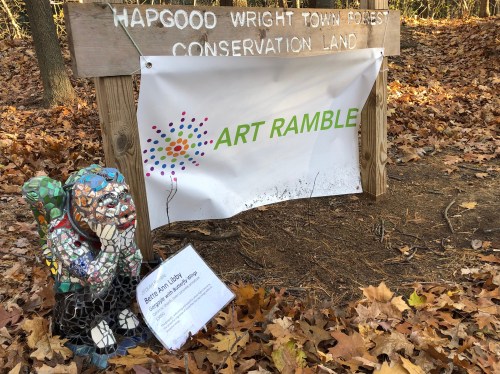
I finally got to this year’s Art Ramble in Concord’s Hapgood Wright Town Forest — site-specific creations from the Umbrella artists planted among fallen logs and leaves.

There were quite a few other visitors on the cold, sunny day. One couple shared a laugh about their madly yapping dog, who had been spooked by the recumbent figure of Thoreau in the woods. Another couple discussed with me the best way to avoid a shadow on the chicken-and-egg-sculpture. And a friendly woman who was a United Church of Christ minister and artist herself joined me for half the walk. We helped each other spot pieces that blended in so much with the surroundings that at first, when you saw a descriptive sign but no art, you would think the work had already been removed.

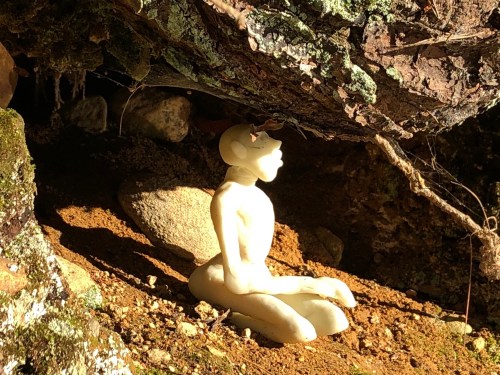
I particularly liked the tiny people — one hermit in contemplation under a root, others peeking out of the bark or cavorting on a dead log.

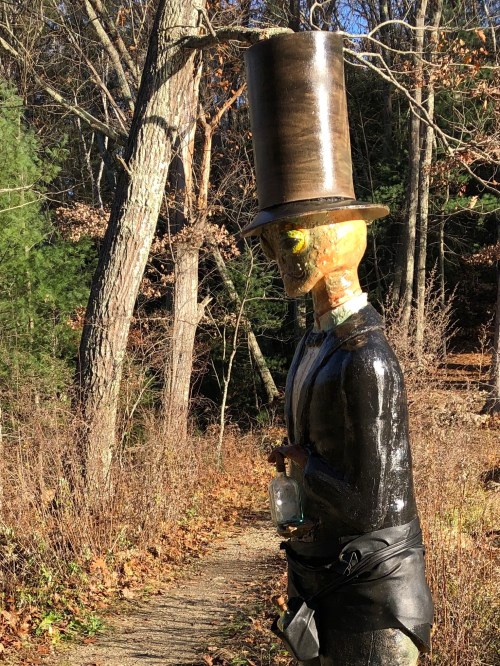
A man with a top hat and frog face was standing next to the pond — a Slavic water spirit and trickster that I am happy to know about.

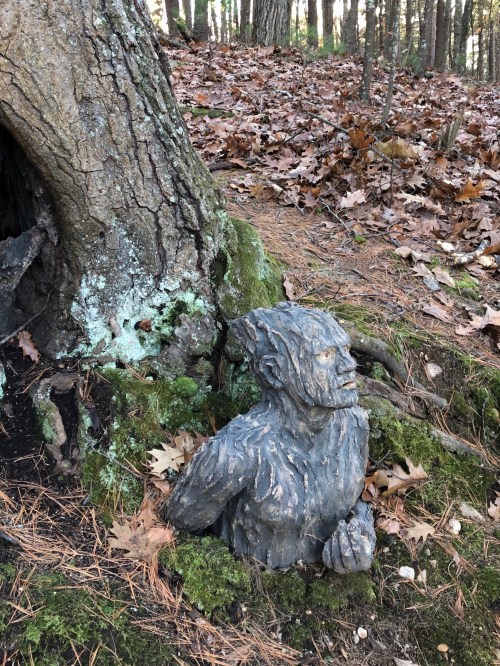
My favorite this year was the spirit emerging from the earth at the base of a tree. At first I thought, Caliban, but then looked at his gentle face.

My report on the 2016 Art Ramble is here, and the one on the 2017 Art Ramble is here.

If you live in Massachusetts or are visiting Walden Pond, which is nearby, the Art Ramble is up until Nov. 30 this year. It will make you feel like creating some art yourself — especially with leaves and sticks and mud.

111118-Thoreau-sculpture-in-woods

111118-chicken-egg-sculpture

111118-Slavic-spirit-caled-Vodnik

111118-cruel-shoes-Slavic-legend

111118-artist-plaque-town-forest

111118-contemplative-hermit-under-a-root

111118-tiny-persons-on-a-log

111118-earth-spirit-emerges


Waiting in Wartime

062518-flag-in suburbia

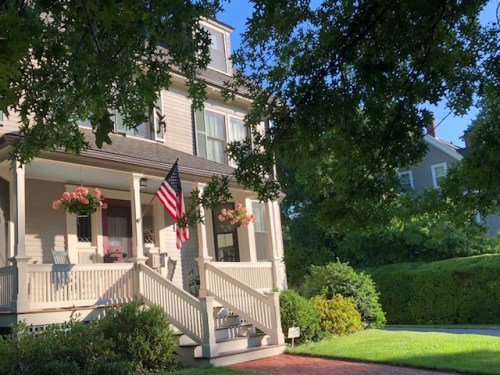
For Veterans Day, I want to give a thought to the people who wait, the families left behind, the people who love the service member and who try to stay upbeat and keep their worry from showing.

There’s a song that captures what the person left behind feels when alone and not obliged to put up a brave front. It’s called “I’ll Be Seeing You.”

Let’s start with what Wikipedia has to say about the song’s history.

” ‘I’ll Be Seeing You’ is a popular song, with music by Sammy Fain and lyrics by Irving Kahal. Published in 1938, it was inserted into the Broadway musical Right This Way, which closed after fifteen performances. …

“The musical theme has emotional power, and was much loved during World War II, when it became an anthem for those serving overseas (both British and American soldiers). The lyrics begin, in Bert Ambrose’s and Vera Lynn’s recorded versions, with a preamble:

Cathedral bells were tolling and our hearts sang on
Was it the spell of Paris or the April dawn?
Who knows if we shall meet again?
But when the morning chimes ring sweet again

I’ll be seeing you
In all the old familiar places
That this heart of mine embraces
All day through
In that small cafe
The park across the way
The children’s carousel
The chestnut trees
The wishing well
I’ll be seeing you
In every lovely summer’s day
In everything that’s light and gay
I’ll always think of you that way
I’ll find you in the morning sun
And when the night is new
I’ll be looking at the moon
But I’ll be seeing you
I’ll be seeing you


5b527e6903b4a-image

Large-scale solar “farms” are becoming the norm across the country. It’s best to put them on places that are already treeless. We need trees to absorb carbon and give us oxygen.

There’s an organization I follow on twitter, @ecorinews, that has made me more cautious about the renewable energy I advocate. I love that people are using more solar energy, but it should not be at the expense of trees, which are also important in controlling climate change. There are plenty of buildings and already empty spaces where panels could go.

Still, it’s heartening to see communities embracing sustainable energy, and I liked a story from Vermont about strange bedfellows getting the message and working together on solar — on a landfill.

Matt Hongoltz-Hetling wrote about the collaboration at the Valley News in September.

“As Vermont’s ever-shifting energy landscape continues to shake up the renewable energy sector, a community solar array coming online this month will showcase a new twist on existing financial models.

“ ‘This is a hybrid,’ said Dori Wolfe, whose company, Wolfe Energy in Strafford, has purchased two shares — at a cost of $2,784 each — of the 185-kilowatt array, which is sited beside a closed landfill site just off Route 113 in Post Mills.

“Community solar arrays — those which serve multiple customers, some of whom might not have solar-friendly homes — are nothing new in Vermont. …

“The nearly finished ‘Thetford-Strafford Community Solar’ array is designed to generate 230,000 kilowatt-hours of electricity during its first year, enough to power about 35 average Vermont homes.

“But it differs from projects in neighboring towns because it will be the first solar farm to serve a mix of customer sectors — the array is a partnership between residential customers, a commercial farm, and the town of Thetford itself. …

“Wolfe said that, among the 25 member-owner shareholders, the commercial entity — Dave Chapman’s Thetford-based Long Wind Farm — acts as the anchor, and purchased enough of the roughly 185 shares on offer to create a critical mass that allowed area residents to buy into the entity, ‘Thetford Strafford Community Solar LLC.’

“The shareholders (who live in Thetford, Strafford and Norwich) expect to recoup their investment and then some through reduced electric bills — about 85 percent of the electricity produced at the site will be sold to Green Mountain Power through the state’s net-metering program, which guarantees customers a minimum rate for feeding solar energy back into the grid.

“The remaining 15 percent of the power will be sold to the town of Thetford at 90 percent of the normal utility rate, which Wolfe said will exert downward pressure on the property tax rate. …

“Wolfe said she hopes that the Post Mills project will lead to a second phase in which more solar is installed on top of the adjacent landfill.

“Though having more solar options is expected to help more Vermonters access renewable energy, a report released earlier this summer by the Energy Action Network suggests that more regulatory action will be needed to get the state on pace for its ambitious goal of achieving 90 percent renewable energy by 2050.

“The state has made progress — in 2017, Vermont energy use was 20 percent renewable, up from 12 percent in 2010. But it is significantly off pace. … In 2017, the rate of newly added capacity was down 30 percent as compared to 2016, and new wind generation has seen an even steeper decline, according to the report.

“There are several reasons for the slowdown. … A new, 30 percent federal tariff on solar panels produced overseas [has] affected pricing, leaving solar projects looking for new ways to make the numbers work.” More.

If you are interested, click here to see what Rhode Island is doing to encourage siting of solar arrays on developed lands, like the landfill used in the Vermont story.

Does your community have a policy to spare forests from being taken down for the otherwise worthy purpose?

Photo: Tim Faulkner/ecoRI News
The Office of Administration, featuring the solar array below, is one of three Rhode Island government buildings to join the Lead by Example initiative.

img_20180424_155613

Butterflies Remember

34224912476_b47a3dd0d1_k-1200x600

Credit: Tjflex2/Flickr
Inside the pupa (or chrysalis), the caterpillar actually turns to liquid during metamorphosis. Despite such an extreme transformation, the butterfly or moth can retain learning from its caterpillar days.

Do you remember being a newborn? I don’t think our species is capable of that kind of remembering. What about other species? Recent research suggests that butterflies have a kind of muscle memory from the good old days of their caterpillar-hood.

An article from Curious Kids — a series that gets experts to answer questions that kids send in — has the scoop. Evan, age 5, asked the question.

“We have caterpillars at home. I would like to know whether they will remember being caterpillars when they are butterflies.”

“Dear Evan,

“I think it is highly unlikely that a butterfly or moth remembers being a caterpillar. However, it may well remember some experiences it learned as a caterpillar.

“That fact in itself is especially amazing because inside the pupa (or chrysalis), the caterpillar actually turns to liquid as it transforms into a butterfly or moth (the adult stage).

“The transformation from the pupa to the adult is the most dramatic change in the life cycle of a butterfly, and scientists refer to this change as metamorphosis. During metamorphosis, the body tissues of the caterpillar are completely reorganised to produce the beautiful adult butterfly that emerges from the pupa.

“Scientists have known for a long time that caterpillars can learn and remember things when they are caterpillars, and adult butterflies can do the same when they are butterflies. However, because of metamorphosis, we were not sure if an adult butterfly could remember things it learned as a caterpillar.

“This ability to remember caterpillar experiences as an adult was tested in a study by a team of scientists at Georgetown University in the US.

“The researchers trained the caterpillars to dislike the smell of ethyl acetate, a chemical often found in nail polish remover. They did this by giving the caterpillars little electric shocks every time they smelled the chemical. Soon, these caterpillars were trained to avoid that smell because it reminded them of the electric shock.

“They let the caterpillars transform into adult moths, and then tested the moths again to see if they still remembered to stay away from the ethyl acetate smell.

“And guess what? Most of them did! The scientists had shown that the memories of avoiding the bad smell experienced as a caterpillar had been carried over into the moth stage. …

“Thank you for sending in this very interesting question.

“Yours sincerely,

“A/Prof Michael F. Braby”

More at the Conversation, here.

high20five

Photo: AVID
AVID is a program that gives extra attention to students who might otherwise be marginalized. The acronym stands for Advancement Via Individual Determination.

My friends Ann and AJ had a fun time this past summer helping to chaperone their Colorado niece’s students on a trip to New York City. That’s how I learned about an enrichment program called AVID, which gives an extra boost to students who might need it and incorporates life skills with academic learning.

According to the AVID website, “75% of AVID students are from a low socioeconomic status background, and 80% are underrepresented students. Nevertheless, they outperform their peers in crucial metrics nationwide.”

Ann tells me, “It’s a curriculum that districts can purchase. Emalea has worked with these same AVID program students for four years and they are now making college plans.  Most will be first generation college students. Emalea has helped the kids with everything from social skills to completing their college applications to prepping for ACTs.” (ACTs are standardized tests similar to the SATs.)

Ann and AJ had a blast hanging out with the Colorado teens in New York and feel a lot of hope for these kids’ futures.

AVID’s approach is described on the website: “AVID students reflect and question while mastering content. … Our students work together to problem solve and to change the level of discourse in the classroom as they prepare for success. Students are taught to articulate what they don’t understand and learn how to seek out the resources they need. By teaching critical thinking, inquiry, and self-advocacy, AVID educators empower students to own their learning. …

“This student-centered approach ensures that the people doing the most talking learn the most. This engages students and creates content mastery through inquiry and collaboration. …

“All students need to learn how to learn. Note-taking, studying, and organizing assignments are all skills that must be taught and practiced to perfect, but are not explicitly taught in schools. … Educators can teach students how to master these and other academic behaviors that will help them succeed in school and life.

“Students would rather talk, move around, and ask questions than sit still and be quiet. Humans are wired to construct knowledge through action. AVID classrooms promote motion, communication, and team building through activities such as Socratic Seminars, Collaborative Study Groups, [and] peer tutoring.”

I’ve culled a few testimonials from the AVID website.

“The AVID program not only pushes students, but teachers to set these goals and do whatever it takes to achieve them.”
–Victor, High School student

“I completely changed the way I teach. It’s just amazing the difference it’s made in my teaching and students’ learning.”
–Cynthia Lee, Teacher

“AVID has really increased our graduation rates and also our success rates for students who choose to go to college.”
–Dr. Karen Fischer Gray, Superintendent

indigenous-grocery-language

Photo: CBC News
Canadian grocery stores and art galleries are starting to include indigenous languages on their labels. North West Company, which has grocery stores in more than 120 communities across northern Canada, embraced the idea after it was piloted by a 2015 school project. Snapping QR codes lets you hear word pronunciation, too.

Yesterday, for the first time, Native American women were elected to Congress: in Kansas, a Ho-Chunk, and in New Mexico, a member of the Laguna Pueblo tribe. Of course, it’s about time, but it also seems to be part of a trend bringing more visibility to indigenous people. Very belated, but good.

Canada is actually farther along in trying to address and rectify transgressions against First Nations. The following story covers one aspect of that effort.

Judith H. Dobrzynski writes at the Art Newspaper, “Canada Day, 1 July, [ushered] in a new era for the presentation of Modern and contemporary Canadian art at the Art Gallery of Ontario (AGO) in Toronto. The 13,000 sq ft J.S. McLean Centre for Indigenous and Canadian Art — which added the ‘Indigenous’ to its name last year when the museum established a Department of Canadian and Indigenous Art — [has] reimagined galleries that give primacy to First Nations and Inuit art for the first time.

“In each McLean gallery, ‘contemporary indigenous art starts the conversation with Canadian art.’ says Wanda Nanibush, who became the AGO’s first curator of indigenous art in 2016. Nanibush and Georgiana Uhlyarik, the AGO’s curator of Canadian art, have designed the centre’s display of 75 works around six themes: origins, self, land, water, transformations and ‘indigenous2indigenous.’ …

“Works by Canadian artists such as Emily Carr and Florence Carlyle are hung in dialogue with works by indigenous artists including Carl Beam and Rebecca Belmore … For instance, in the ‘self’ gallery, Belmore’s ‘Rising to the Occasion’ (1987-91), a dress that the Anishinaabe-kwe artist wore in a performance responding to a royal visit to Ontario, is paired with Joanne Tod’s painting ‘Chapeau Entaillé’ (1989) of a woman in a similar dress. … Labels in the McLean Centre are now written in indigenous languages (either the local Anishinaabemowin language or Inuktitut), as well as English and French.”

More at the Art Newspaper, here.

Art: Rebecca Belmore
Belmore’s “Rising to the Occasion” (1987-91) is a dress that the Anishinaabe-kwe artist wore in a performance responding to a royal visit to Ontario. It was recently displayed at the Art Gallery of Ontario in Toronto.

303_mu_jd_ago_01_rebecca_belmore

whales-humpback-watercolor-mom-and-baby-olga-shvartsur

Art: Olga Shvartsur/Fine Art America
Humpback whale and baby. Recently, a humpback whale appeared to intentionally protect a researcher from a tiger shark.

A scientist who studies whales underwater was astonished and more than a little frightened in September 2017 when a whale kept pushing her toward her boat. After her colleagues pulled her to safety, she saw that in the other direction a dangerous tiger shark was lurking. The researcher believes that the whale was intentionally trying to protect her. Other scientists argue that whales aren’t altruistic.

I say, Who cares? The point is the whale’s action moved the diver away from danger, and she is grateful.

Sarah Gibbens writes at the National Geographic, “For 28 years, Nan Hauser has been researching and diving with whales. The biologist is the president and director of the Center for Cetacean Research and Conservation. … During a trip to look at whales in the Cook Islands in the South Pacific last September, Hauser says she had an encounter unlike any she had experienced before.

“A humpback whale, a marine mammal capable of weighing 40 tons and growing 60 feet long, swam toward Hauser. For ten minutes, it nudged her forward with its closed mouth, tucked her under its pectoral fin, and even maneuvered her out of the water with its back. …

” ‘I was prepared to lose my life,’ she says. ‘I thought he was going to hit me and break my bones.’

“In addition to conducting research, Hauser says she was also in the Cook Islands to work on a nature film, so at the time the whale approached, both she and a fellow diver were armed with cameras. Hauser’s point-of-view footage shows just how persistently the whale nudged her. A second whale can also be seen lurking just behind the first.

“When she finally made it out of the water and up onto her boat — bruised and scratched from the barnacles on the whale — Hauser saw a third tail moving from side-to-side.

” ‘I knew that was a tiger shark,’ she says.

“Now, after viewing the footage and reflecting on the whole harrowing experience, Hauser concludes that the whale who nudged her likely exhibited an extraordinary example of altruism. …

“Hauser’s retelling isn’t the first time scientists have questioned whether humpback whales can show signs of altruism. A 2016 study in the journal Marine Mammal Science looked at 115 instances from the past 62 years in which humpbacks interfered with a pod of hunting orcas.

“Banding together, humpbacks were seen effectively protecting their calves. But there were also examples of humpbacks showing the same behavior to protect other species of whales, seals, and sea lions. …

“Martin Biuw from the Institute of Marine Research in Nowary is skeptical of Hauser’s claim that altruism is at play in the video. Hauser had speculated the whale was male, but Biuw believes it appears to be a female.

” ‘If that is the case, it is possible that she may show protective behavior towards a human (or other animal for that matter) if she has for instance recently lost her calf,’ he says.

“Biuw explained that hormonal changes could have spurred the whale to show protective behavior.” Oh, ha, ha, hormonal changes? Good grief, give me a break.

More at the National Geographic, here.

Vote!

110218-VOTE

California graphic designer @lenawolffstudio printed lots of these Vote posters, with help from a Kickstarter campaign, and sent them around the country. If you want a few for 2020, contact her or email suzannesmom@lunaandstella.com.

Why is it that some Americans don’t take advantage of the greatest right and duty of living in a democracy — the vote?

Some people say one vote doesn’t count, but that makes no sense. Millions of votes are made only from many, many one-votes. And many races are extremely close.

Others don’t see anything on the ballot — candidate or ballot question — that they care about. But just showing up is important. It increases overall turnout, which shows we care, and you can always write in a name. I’ve done that in races where only one candidate was on the ballot.

Some people fear election results will get hacked, but at least one expert, the executive director of the Center for Election Innovation & Research, says so much work has been done since 2016 that the polls are now the most secure they have ever been. Read his op-ed.

Then there is the question of getting registered (having automatic registration for those getting a driver’s license would really help) and then getting to the polls. Volunteers from your party will give anyone a ride who needs one, you know. And many states let you choose your day by having absentee voting (generally by mail) and early voting (staff waiting for you at your town hall). In addition, you could support those who are trying to make Election Day a national holiday so fewer people are tied up at work.

The biggest concern to my mind is vote suppression. There have always been groups trying to keep some people from voting. This year we are seeing restrictive laws in North Dakota preventing tribes from voting by requiring all individuals to have street addresses, which Indian reservations don’t usually have. And in Georgia, where the man in charge of voting wants everyone to vote for him to be governor, we see massive vote suppression for inconsistent punctuation and challenges to recent naturalization. These kinds of tricks are similar to those that were still keeping African Americans from voting in the South in the 1960s.

People died for your right to vote.

Since voter suppression will probably always be attempted by unscrupulous people, the best thing someone who believes in democracy can do is to keep donating to organizations that take such people to court, like the American Civil Liberties Union. There will always be people who don’t want every eligible citizen to vote — the bedrock of democracy — but you can fight back. Even small efforts count. In Kansas, for example, the Dodge City polling place was moved a great distance from where voters lived, but many ordinary folk stepped up, and now there are enough volunteers to drive everyone to the distant polling place.

One and one and 50 make a million.

New York City subway mosaic: She voted.

102318-I-voted-subway-mosaic

moore_geograph-418511-by-elliott-simpson

Photo: Elliott Simpson
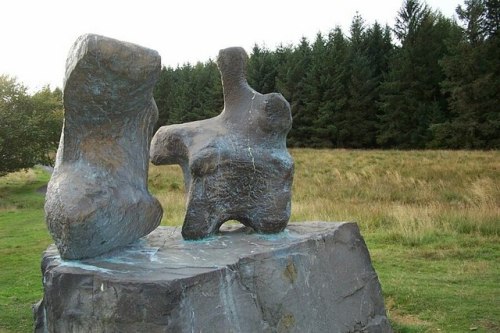
“Two Piece Reclining Figure No.1,” by Henry Moore, Glenkiln Sculpture Park in southwest Scotland. Scotland’s government has proposed a policy that, among other things, would give ordinary Scots a greater say in shaping the cultural life of their communities.

What I remember about a trip to Scotland decades ago is Loch Ness, the glowing quality of sunlight in Inverness, how Edinburgh’s castle looms over the city, sheep on the hills, sheep crossing narrow highland roads.

But there is more to Scotland, and now the government is working to give communities a greater say in how the country’s culture is presented to the world.

Christy Romer writes at Arts Professional, “Ensuring culture is fundamental to Scotland’s social and economic prosperity is a core aim of the country’s first culture strategy in over ten years. …

“The draft document outlines plans for a new Government cultural adviser and new funding models for the sector. In addition, it aims to give people a ‘greater say’ in shaping the cultural life of their communities through participatory models of decision-making and community ownership.

“ [The draft strategy says Scotland] ‘places culture as of equal importance alongside other areas such as the economy, education, environment, health and tackling inequality, and values culture for the unique perspectives it can bring.’ …

“One of the major initiatives announced is a new cultural leadership post within Scottish Government, which would be supported by strategic thinkers from the culture sector and beyond.

“This figure would be responsible for joining up thinking across Government and with major stakeholders. They would aim to respond to big societal issues and make culture central to progress in areas such as health, the economy and education.

“Other initiatives include developing a national partnership for culture, which would see the sector work with academics to develop new approaches to measuring and articulating the value of culture.

“Partnership working with businesses, schools and care homes is also seen as key to creating opportunities for more people to take part in culture. The document …  suggests using Scottish Government powers to generate a collective responsibility to support culture in the long term.’ This could involve the National Investment Bank or devolved tax and legislative powers.”

Oh, dear. Already I see trouble ahead. The intentions are good, but that wonky document suggests to me that artists were not involved in the writing and may not be helping much to carry out the policy. Hmmm. I’m wondering if government’s role in a country’s culture should be limited to funding it.

For example, consider what Claire Selvin reported in October at ArtNews about New York City: “With largest-ever allotment for department of cultural affairs, New York City Grants $43.9 million to arts programs.” That’s putting your money where your mouth is. I realize some of the funds may get lost in the bureaucracies of the various recipient arts organizations, but I think I’d rather have them working on the ultimate allocations than a government entity.

More on Scotland at Arts Professional, here.

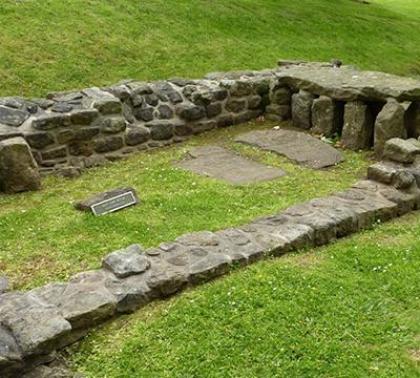
One of Scotland’s historical highlights is the Antonine Wall, built by the Romans across what is now the Central Belt of Scotland. These ruins mark the northernmost frontier barrier of the Roman Empire.

materials

untitled1-768x513

Photo: Fathul Rakhman/Mongabay-Indonesia
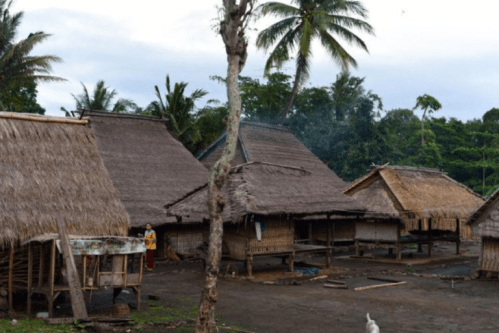
The traditional homes on the island of Lombok have survived several earthquakes over the years. Concrete homes crumble.

Often there is wisdom in the old ways. That’s what residents of an Indonesian island in the Ring of Fire learned after a series of earthquakes created havoc with modern concrete structures.

Fathul Rakhman has a report at Mongabay.

“Jumayar’s house fell early on Aug. 5, as the second of four large earthquakes in the span of three weeks ripped through the Indonesian island of Lombok, clobbering his village of Beleq in the process. …

“Although Lombok, which is next to Bali, sits squarely on the quake-prone Ring of Fire, heavy, concrete homebuilding is the norm. These rigid structures became death traps during the earthquakes. Only the handful of wooden traditional houses in Beleq, with their lightweight, flexible designs, emerged unscathed. …

“Though elements like floor height or wall width may vary in different parts of the island, all traditional Sasak homes employ the same basic design: Thatched bamboo walls enclose dirt floors, connecting them to roofs of woven reeds. … Wooden homes can sway, or ‘breathe’ when earthquakes strike, concrete houses cannot; they have no flex and topple easily.

“In North Lombok, the epicenter of the damage, 70 percent of the houses collapsed or were severely damaged. Rebuilding will require hundreds of millions of dollars, according to government estimates.

“In Beleq, families in traditional houses ran outside like everyone else, fearing for their lives. Not a single one of their traditional structures fell, even as the concrete homes around them crumbled.

‘If the government offers to rebuild here, we will reject the [construction of] concrete homes,’ said Sahirman, the Beleq village head. ‘We want to go back to our ancestral homes.’ …

“ ‘The ancestors bequeathed to us an architecture that is in harmony with nature,’ said Lalu Satriawangsa, chairperson of the provincial AMAN [the country’s largest indigenous rights nongovernmental organization] chapter. …

“The Indonesian government has typically looked upon the traditional houses as ‘slum dwellings,’ an indicator of poverty. But Lalu says the government should support the construction of traditional houses. Not only are they cheaper, but as the recent disasters proved, they are infinitely safer.

“For too long traditional homes have been seen to mark the persistence of poverty rather than the preservation of culture, ignoring their instrumental value, Lalu said.

“ ‘Now is the time for us to campaign for [the rebuilding of] homes that are more in tune with nature,’ he said. …

“As rebuilding plans take form, Sahir, the Beteq village head, believes the community should look to the past for inspiration.

“ ‘I don’t want to sleep in a concrete house ever again,’ he said.”

More at Mongabay, here.

Grand Friends Day

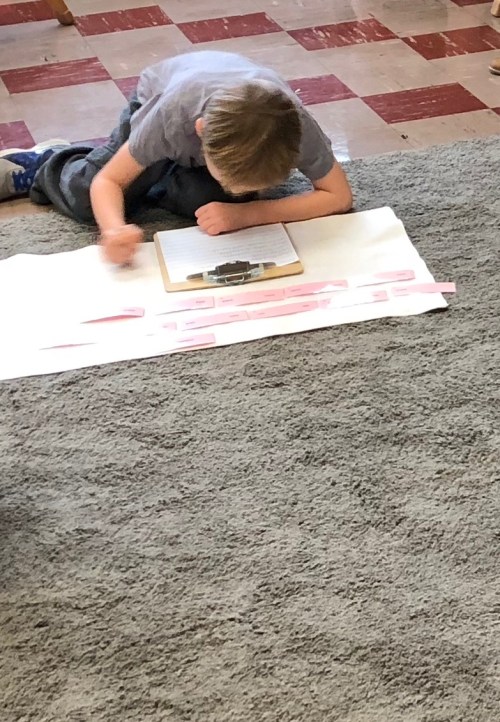
110218-recording-his-compound-words

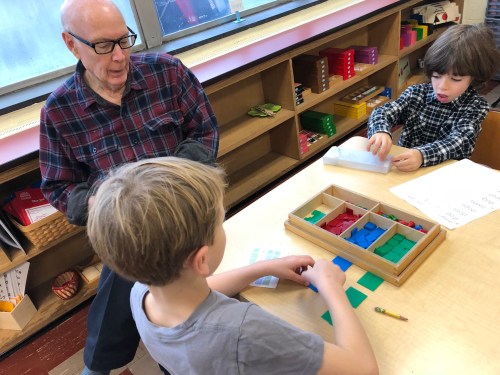
My husband and I went to one of our grandchildren’s schools this morning for a delightful event called Grand Friends Day. Suzanne‘s oldest knew the ropes and was fine with letting us look over his shoulder as he worked, but her youngest said not to come because she would be too sad when we left after the designated hour. We knew that might be true. Since pretty much anyone can be a child’s Grand Friend, our granddaughter’s teacher was happy to serve in that capacity and enjoy extra one-on-one time with her.

Before Suzanne’s family joined a Montessori school, we didn’t know a lot about this approach to education, even though one of my own grandmothers actually studied with founder Maria Montessori. Even now we have no idea how one lone teacher sets all these little spinning-top children working independently on different tasks, but each one in the multilevel class (first, second, third grade) seems to know what to do.

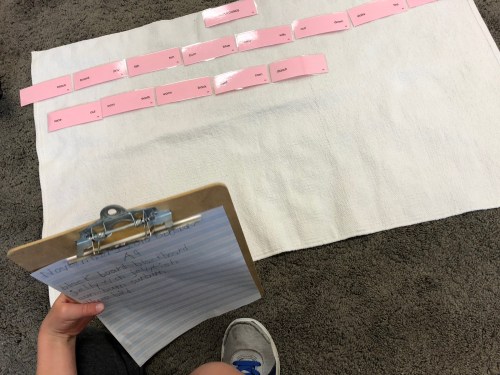
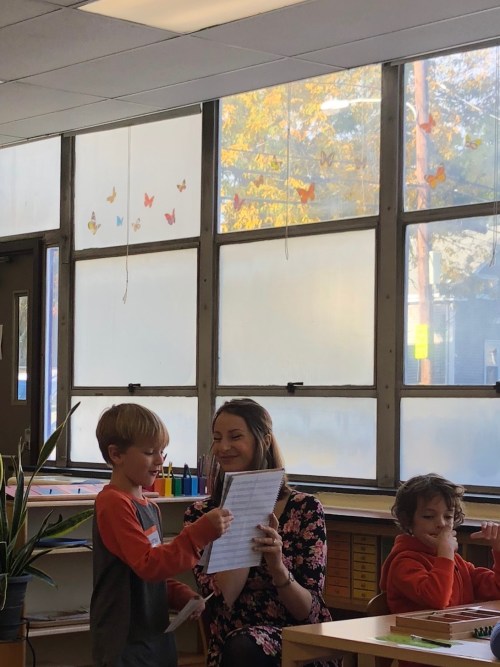
Our grandson demonstrated a whole new way of getting ready for multiplication. It took me a while to catch on as he did his work. He didn’t want to explain it. Then he headed off to other tasks, including the one above with compound words. My husband and I helped him match all the words at the left end of the pink strips with words at the right end of other pink strips. We ended up with words like “necklace,” “earthworm,” and “bluebird.” After the teacher checked the work, he began to write it all down — first as two words and then as compound words. He was still writing as we left. (The picture with the teacher was taken by Suzanne on a different day.)

It was fun to see him in operation. He definitely didn’t want much help. I offered a red pencil when his yellow one didn’t show up on a manila card he was using for consonant blends, but he said he was supposed to use yellow for those particular words, and he was right. Also, I always have a really good eraser with me, but he didn’t want it. He preferred the one that was nearly gone on his pencil. I think independence is part of the Montessori deal, but he is probably kind of independent anyway.

110218-creating-compound-words

110218-math-with Morfar

2018-teacher-checks-work

5b577d513b49fc31008b4699-1136-640

Photos: Recycled Island Foundation
This prototype for a floating park in Rotterdam is open to the public. It’s made of recycled plastic and is welcoming to many species, including homo sapiens (who is less than sapiens, it would seem, considering ongoing planet damage).

With the activities of humankind causing animal populations to decline 60 percent since 1970 and massive loss of essential insect species, I’m looking everywhere for more leadership in the environmental arena. So far, what I find are relatively small activities of isolated groups. But thank goodness for that! Small activities add up.

Jeremy Berke writes at Business Insider, “Rotterdam’s Floating Park — which is now open to visitors, though the park is just a prototype of what may become a much larger installation — is made out of plastic recycled from Rotterdam’s waterways.

“The recycled plastic is constructed into hexagonal pods, which mimic the landscape of Rotterdam’s Maas River before humans altered the landscape, according to the Recycled Island Foundation, the group behind the park.

“The pods can be used to create gardens, as habitat for wildlife, or for chilling out, and they can be molded into different seating arrangements.

5b577d863b49fc2e008b4697-1136-640

The Recycled Island Foundation says the park’s plastic hexagons were designed to provide habitat for native waterbirds, plants, fish, and even algae.

“On top of that, plastic dumped into the city’s canals is collected by ‘litter traps,’ which prevent plastic from flowing into the ocean.”

Pretty sure that dynamic and broadly effective leadership in the global-warming arena is going to come from people who are now only teenagers or even in middle school. Kids know what’s what.

More at Business Insider, here.

A litter trap in Rotterdam collects plastic waste, which can be recycled to make a floating park.

5b577c8e77bc282c008b4651-1136-640

Boo!

072318-ghostly-Sycamore-bark

Boo!

Is that a ghost emerging from the earth beneath the sidewalk or a piece of sycamore bark? Is that the Grim Reaper scratching around inside the wall of your bedroom or a squirrel? Is that a witch tapping at the kitchen window or a tree branch?

Is that an invading army at the border with tanks and surface-to-air missiles or ragtag neighbors praying for compassion?

It’s OK on Halloween to imagine dangers that don’t exist, but how about on the next day, All Saints Day, we go back to being logical.

3466

Photo: The Guardian
What it looked like when a swarm of bees attacked a New York City hotdog stand.

As you know, I think New York City is an endlessly unspooling entertainment reel. This adventure with swarming bees is a typical example. Wish I had seen it. The police officer in charge must have been surprised to discover that a bit of obscure training would actually come in handy someday.

As Adam Gabbatt reported at the Guardian, “Productivity came to a halt across New York City offices on Tuesday afternoon, as hordes of people eagerly followed the removal of 20,000 bees from a hotdog stand. …

“Thousands watched a Reuters livestream – the stand is located outside the news agency’s New York headquarters – and followed on Twitter as a police officer was called in to remove the bees. With a vacuum cleaner. …

“Officers from the New York police department stood guard, some more willingly than others, as one of their colleagues donned a beekeeper’s hat and approached the hotdog stand.

“The bees had gathered in a densely packed, roughly 15-square-foot clump, and the unidentified officer, who wore a white jacket, thick gloves and has a moustache, proceeded to vacuum up the bees. The bee cleansing took about 40 minutes, much of which was watched online.

“By around 3 pm, the officer, who told journalists he ‘has training,’ had removed the bulk of the bees, but many remained in the area, swarming around a selection of soft drinks displayed on the hotdog stall. …

“Andrew Coté, who runs the New York City beekeepers’ association, had answered a call from the NYPD and was watching as the bees were removed. Removal by vacuum cleaner – it was a specially adapted vacuum cleaner – was common, Coté said. He estimated there were 20,000 bees on the umbrella, but said: ‘You’ve got to count the legs and divide by six to be sure.’

“Coté said … this late-August swarm had likely occurred because of an ill-managed beehive. He said there were a number of hives within a block of the hotdog stand.
“By 3.15 pm police had re-opened the street, although a number of bees were still on the scene.” More here.
You definitely have to know what you’re doing with bees. I’m sure a transplanted Minnesota beekeeper I know in Berlin, Massachusetts, would have managed his hives better if he had set up in a city. Beekeeping is serious business, and you don’t want to be responsible for anyone with an allergy getting stung.
Video: Reuters

Back in Massachusetts

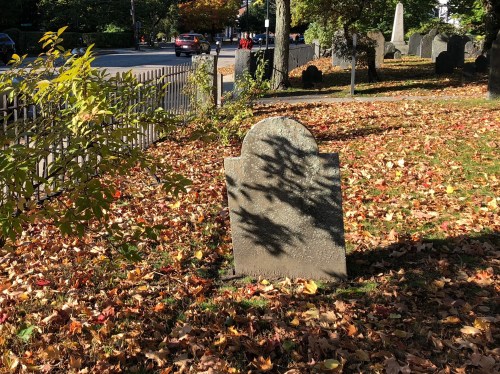
101918-gravestone-shadow

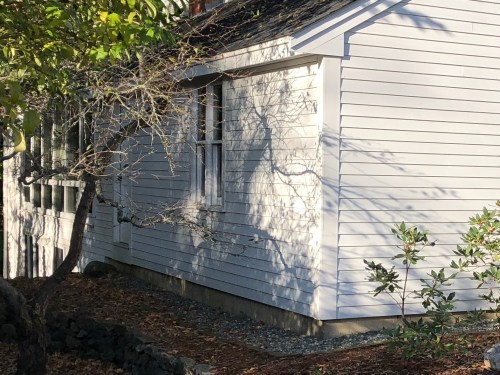
My new photography resolution, which I hope to stick to through the winter, is to capture shadows whenever the sun is out. Apart from the fact that I really like sunlight and shadow, I know I can find examples even in months when the photographic attractions of flowers and sailboats are not in evidence.

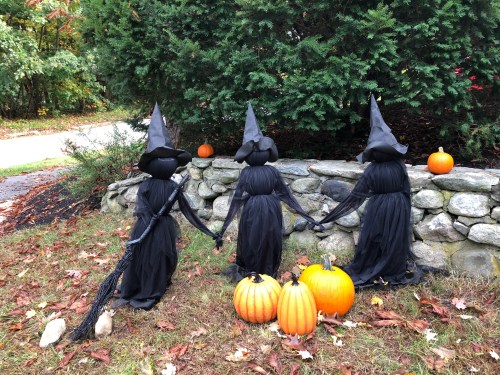
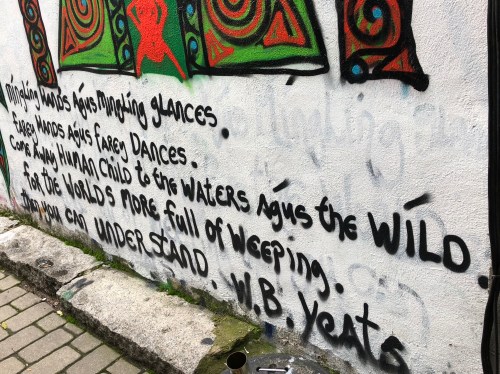
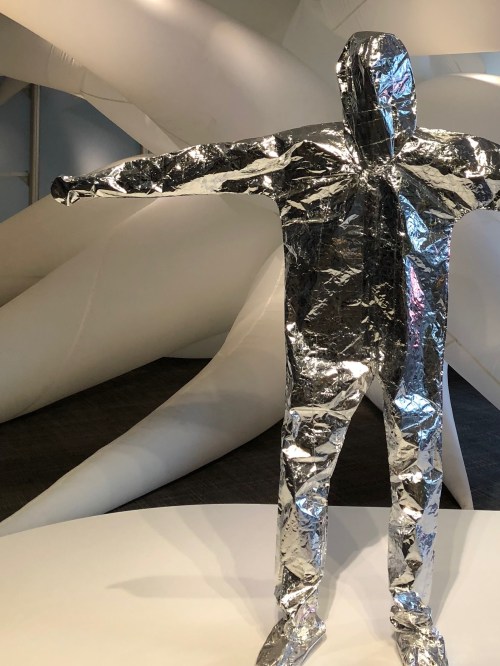
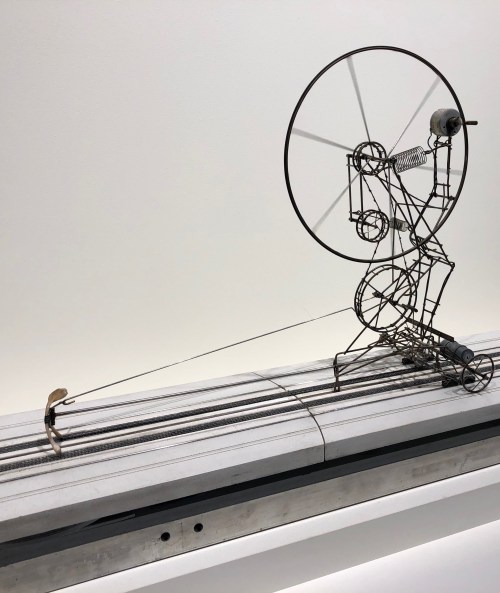
Today’s photo collection includes Massachusetts fall color, decorations for Halloween (I particularly liked that there were three witches, as in Shakespeare), curiosities from the MIT Museum (I loved Arthur Ganson‘s walking wishbone — and all his kinetic sculptures), and a graffiti warning in a Central Square alley.

“Come away, O human child!
“To the waters and the wild
“With a faery, hand in hand,
“For the world’s more full of weeping than you can understand.”

Read the rest of the W.B. Yeats poem here.

101718-porch-shadow

101918-branch-shadow

102618-fall-color-Concord-Mass

102618-autumn-leaves

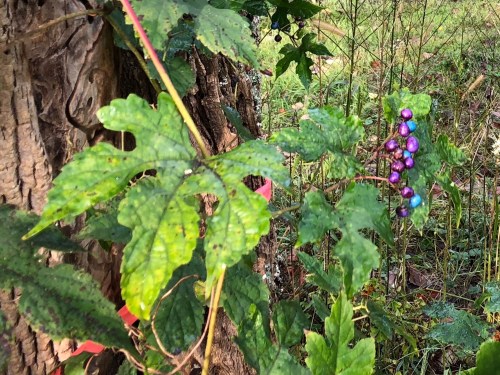
101418-purple-berries

101418-witches

101218-MIT-Museum

101218-Arthur-Ganson-walking-wishbone-machine

101218-Yeats-in-Cambridge-alley